The Scientific Thought
LCD 105 – Class 12 – Professor Nathacia
Rationalism Empiricism
• Reason as source of
knowledge
• Intellectual
• Methods of reasoning:
§ Intuition
§ Deduction
§ Induction
§ Abduction
• Experience as source of
knowledge
• Sensory
• Empirical methods:
§ Observation
§ Experimentation
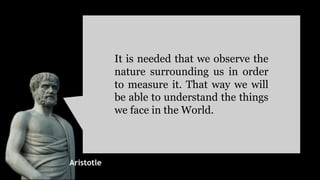
It is needed that we observe the
nature surrounding us in order
to measure it. That way we will
be able to understand the things
we face in the World.
Aristotle
• Experiments: METHOD being developed.
• Europe: Development of education (teaching broads minds, questioning being supported).
• Galileo Galilei (1564 — 1642) is the founder of Modern Science. He is the theorist of scientific
method and of autonomy of scientific research.
• Since Galileo, science doesn’t seek the essence of things, but their function.
• The Scientific Revolution established science as responsible for knowledge growth.
• Technology advance plays a core role on Science advance.
Middle Ages
The beginning of Modern Science
Aristotle
A heavier object falls in a
............ speed than a lighter
object.
Aristotle
A heavier object falls in a
FASTER speed than a
lighter object.
Aristotle
1 kg
10 kg
Galileo Galilei
A heavier object in free fall will always have
the same acceleration as a lighter object,
despite gravity force being greater in heavier
objects. If we control the shape of the
objects, they will arrive at the ground at the
same time, even if one weights 1 kilogram
and the other weights 10 kilogram.
Galileo Galilei
W=mx g
g=9,8 m/s
Same acceleration = same speed
same speed + same height = same
falling duration
Scientific method visualizing
conditions (including the non-
apparent ones) and discerning their
effects.
Galileo Galilei
Aristotle
There is spontaneous generation,
Abiogenesis, from an active
principle/agent.
Aristotle
Francesco Redi
Any type of life can only come
from another live thing.
Method with control condition.
Francesco Redi
“Do not believe in anything simply because you
have heard it. Do not believe in anything simply
because it is spoken and rumored by many. Do not
believe in anything simply because it is found
written in your religious books. Do not believe in
anything merely on the authority of your teachers
and elders. Do not believe in traditions because
they have been handed down for many
generations. But after observation and analysis,
when you find that anything agrees with reason
and is conducive to the good and benefit of one
and all, then accept it and live up to it”
- Buddha
• Scientific Method is the sistemathic attempt of turning those limitations
around.
• It is the set of procedures to help us on the task of not getting fooled by
ourselves.
• Science seeks objective measures that can be confirmed in independente
events.
• It demands evidences open to
public judgement.
• Personal testimonies are under
valued.
DEDUCTION
Deductive reasoning is when one gets to a particular
truth from a more general one. Therefore, when we
include a more specific fact into a more general one, we
are reasoning through deduction.
1) A always equals B (general fact, also known by first
premise);
2) There is an X that equals A (particular case or
second premise);
3) Therefore, this X equals B (conclusion).
Inductive reasoning is when we go the opposite way:
observing particular cases, isolated, we look for a pattern,
or a general rule that can explain and be applied to all
observed cases.
1)All observed As equal B (data observation, isolated
facts);
2)Therefore, all A equals B.
INDUCTION
Deductive reasoning: immediate inferences, syllogism or
conditional argumentation.
All animals are mortal
All men are animals
Therefore, all men are mortal
Inductive reasoning: from particular cases to general
inferences; predictions.
Copper conducts electricity.
Iron conducts electricity.
Silver conducts electricity.
Gold conducts electricity.
Copper, iron, silver and gold are metals.
Metals are electrical conductors.
DEDUCTION VS. INDUCTION
Vídeo: https://www.youtube.com/watch?v=-X8Xfl0JdTQ
POPPER:
A theory is only scientific when it is refutable by a
conceivable event.
The aim is not to prove a hypothesis right, but to prove it
wrong.
The point is the more you fail in prove your hypothesis
wrong, the more it is reliable (probability).
It is true just for that moment under that conditions.
FALSIFYABILITY
x=y: A world of equalities doesn’t leave space for
questioning;
x≠y: A world of inequalities (extreme relativism)
also doesn’t leave space for questioning, or
reasoning.
What leads us to a conditional world:
If x equals ........, then y equals ......
THE WORKING SPACE OF THE
SCIENTIFIC METHOD
SCIENTIFIC THEORY
Set of all facts and
hypothesis concerned the
object of study
Observation
Ø Systematic
Ø Controlled
Facts
Ø Verifiable
Hypothesis
Ø Testable
Ø Falsifiable
Predictions
Ø Implications
Ø (partial) conclusions
Experiments
Ø New observations
Ø Logical Analysis
New facts
Recycle
hypothesis
Do results
support the
hypothesis?
The Scientific Method
YES
NO

Class12 the scientificthought

  • 1.
    The Scientific Thought LCD105 – Class 12 – Professor Nathacia
  • 2.
    Rationalism Empiricism • Reasonas source of knowledge • Intellectual • Methods of reasoning: § Intuition § Deduction § Induction § Abduction • Experience as source of knowledge • Sensory • Empirical methods: § Observation § Experimentation
  • 3.
    It is neededthat we observe the nature surrounding us in order to measure it. That way we will be able to understand the things we face in the World. Aristotle
  • 4.
    • Experiments: METHODbeing developed. • Europe: Development of education (teaching broads minds, questioning being supported). • Galileo Galilei (1564 — 1642) is the founder of Modern Science. He is the theorist of scientific method and of autonomy of scientific research. • Since Galileo, science doesn’t seek the essence of things, but their function. • The Scientific Revolution established science as responsible for knowledge growth. • Technology advance plays a core role on Science advance. Middle Ages The beginning of Modern Science
  • 5.
  • 6.
    A heavier objectfalls in a ............ speed than a lighter object. Aristotle
  • 7.
    A heavier objectfalls in a FASTER speed than a lighter object. Aristotle
  • 8.
  • 9.
    A heavier objectin free fall will always have the same acceleration as a lighter object, despite gravity force being greater in heavier objects. If we control the shape of the objects, they will arrive at the ground at the same time, even if one weights 1 kilogram and the other weights 10 kilogram. Galileo Galilei
  • 10.
    W=mx g g=9,8 m/s Sameacceleration = same speed same speed + same height = same falling duration Scientific method visualizing conditions (including the non- apparent ones) and discerning their effects. Galileo Galilei
  • 11.
  • 12.
    There is spontaneousgeneration, Abiogenesis, from an active principle/agent. Aristotle
  • 13.
  • 14.
    Any type oflife can only come from another live thing. Method with control condition. Francesco Redi
  • 15.
    “Do not believein anything simply because you have heard it. Do not believe in anything simply because it is spoken and rumored by many. Do not believe in anything simply because it is found written in your religious books. Do not believe in anything merely on the authority of your teachers and elders. Do not believe in traditions because they have been handed down for many generations. But after observation and analysis, when you find that anything agrees with reason and is conducive to the good and benefit of one and all, then accept it and live up to it” - Buddha
  • 17.
    • Scientific Methodis the sistemathic attempt of turning those limitations around. • It is the set of procedures to help us on the task of not getting fooled by ourselves. • Science seeks objective measures that can be confirmed in independente events. • It demands evidences open to public judgement. • Personal testimonies are under valued.
  • 18.
    DEDUCTION Deductive reasoning iswhen one gets to a particular truth from a more general one. Therefore, when we include a more specific fact into a more general one, we are reasoning through deduction. 1) A always equals B (general fact, also known by first premise); 2) There is an X that equals A (particular case or second premise); 3) Therefore, this X equals B (conclusion).
  • 19.
    Inductive reasoning iswhen we go the opposite way: observing particular cases, isolated, we look for a pattern, or a general rule that can explain and be applied to all observed cases. 1)All observed As equal B (data observation, isolated facts); 2)Therefore, all A equals B. INDUCTION
  • 20.
    Deductive reasoning: immediateinferences, syllogism or conditional argumentation. All animals are mortal All men are animals Therefore, all men are mortal Inductive reasoning: from particular cases to general inferences; predictions. Copper conducts electricity. Iron conducts electricity. Silver conducts electricity. Gold conducts electricity. Copper, iron, silver and gold are metals. Metals are electrical conductors. DEDUCTION VS. INDUCTION
  • 21.
  • 22.
    POPPER: A theory isonly scientific when it is refutable by a conceivable event. The aim is not to prove a hypothesis right, but to prove it wrong. The point is the more you fail in prove your hypothesis wrong, the more it is reliable (probability). It is true just for that moment under that conditions. FALSIFYABILITY
  • 23.
    x=y: A worldof equalities doesn’t leave space for questioning; x≠y: A world of inequalities (extreme relativism) also doesn’t leave space for questioning, or reasoning. What leads us to a conditional world: If x equals ........, then y equals ...... THE WORKING SPACE OF THE SCIENTIFIC METHOD
  • 24.
    SCIENTIFIC THEORY Set ofall facts and hypothesis concerned the object of study Observation Ø Systematic Ø Controlled Facts Ø Verifiable Hypothesis Ø Testable Ø Falsifiable Predictions Ø Implications Ø (partial) conclusions Experiments Ø New observations Ø Logical Analysis New facts Recycle hypothesis Do results support the hypothesis? The Scientific Method YES NO