Natural Resources:
RENEWABLE AND NON-RENEWABLE
RESOURCES
What are Natural Resources
 A natural resource is defined as a form of energy and/or matter which is essential for
the functioning of organisms,populations and ecosystems.
 In the case of humans, a natural resource, in his words, refers to any form of energy
or matter essential for the fulfillment of physiological, socio-economic and cultural
needs, both at the individual level and that of the community. Life on our planet earth
depends upon a large number of things and services provided by the nature, which
are known as natural resources. Water, air, soil, minerals, coal, forests, crops and wild
life are all the examples of natural resources.
 According to Ramade (1984), a natural resource is defined as a form of energy and/or
matter, which is essential for the functioning of organisms, populations and
ecosystems
Classification of natural resources:
 According to Odum (1971), natural
resources can be divided into two
categories such as
renewable resources
Non renewable resources
Non-renewable resources
These are minerals that have been formed in the
lithosphere over millions of years and constitute a
closed system. These non-renewable resources, once
used, remain on earth in a different form and, unless
recycled, become waste material.
Non-renewable resources include fossil fuels such as
oil and coal, which if extracted at the present rate, will
soon be totally used up. The end products of fossil
fuels are in the form of heat and mechanical energy
and chemical compounds, which cannot be
reconstituted as a resource.
Renewable resources
Though water and biological living resources are
considered renewable. They are in fact renewable
only within certain limits. They are linked to natural
cycles such as the water cycle.
Fresh water (even after being used) is evaporated by
the sun’s energy, forms water vapour and is
reformed in clouds and falls to earth as rain.
However, water sources can be overused or wasted
to such an extent that they locally run dry. Water
sources can be so heavily polluted by sewage and
toxic substances that it becomes impossible to use
the water.
.
Forests, once destroyed take thousands of years to
regrow into fully developed natural ecosystems with
their full complement of species. Forests thus can be
said to behave like non-renewable resources if
overused.
 Fish are today being over-harvested until the catch
has become a fraction of the original resource and the
fish are incapable of breeding successfully to replenish
the population
The output of agricultural land if mismanaged drops
drastically.
When the population of a species of plant or animal is
reduced by human activities, until it cannot reproduce
fast enough to maintain a viable number, the species
becomes extinct.
Many species are probably becoming extinct without
us even knowing, and other linked species are
affected by their loss
Non-renewable resources can further be
divided into two categories
Re-cyclable
Non-Recyclable
Re-cyclable
These are non-renewable resources, which can be collected
after they are used and can be recycled. These are mainly the
non-energy mineral resources, which occur in the earth’s crust
(e.g. ores of aluminium, copper, mercury etc.) and deposits of
fertilizer nutrients (e.g. phosphate sock and potassium and
minerals used in their natural state (asbestos, clay, mica etc.)
Non-Recyclable
These are non-renewable resources, which cannot be recycled
in any way. Examples of these are fossil fuels and uranium,
which provide 90 per cent of our energy requirements
Some authors prefer to classify resources into
biotic and abiotic resources
 Biotic resources
These are living resources (e.g. forest, agriculture, fish andwild life) that are able to
reproduce or replace them and to increase
Abiotic resources
These are non-living resources (e.g. petrol, land, minerals
etc.) that are not able to replace themselves or do so at
such a slow rate that hey are not useful to consider them
in terms of the human life times
Land resources:
Landforms such as hills, valleys, plains, river basins
and wetlands include different resource generating
areas that the people living in them depend on. Many
traditional farming societies had ways of preserving
areas from which they used resources. Eg. In the
‘sacred groves’ of the Western Ghats, requests to the
spirit of the Grove for permission to cut a tree, or
extract a resource, were accompanied by simple
rituals. The outcome of a chance fall on one side or the
other of a stone balanced on a rock gave or withheld
permission. The request could not be repeated for a
specified period.
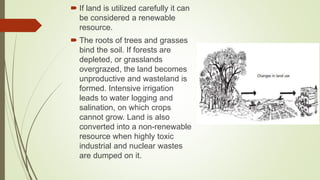
 If land is utilized carefully it can
be considered a renewable
resource.
 The roots of trees and grasses
bind the soil. If forests are
depleted, or grasslands
overgrazed, the land becomes
unproductive and wasteland is
formed. Intensive irrigation
leads to water logging and
salination, on which crops
cannot grow. Land is also
converted into a non-renewable
resource when highly toxic
industrial and nuclear wastes
are dumped on it.
Land on earth is as finite as any of our other natural
resources. While mankind has learnt to adapt his
lifestyle to various ecosystems world over, he cannot
live comfortably for instance on polar ice caps, on under
the sea, or in space in the foreseeable future.
Man needs land for building homes, cultivating food,
maintaining pastures for domestic animals, developing
industries to provide goods, and supporting the industry
by creating towns and cities. Equally importantly, man
needs to protect wilderness area in forests, grasslands,
wetlands, mountains, coasts, etc. to protect our vitally
valuable biodiversity
 Thus a rational use of land needs careful planning. One can
develop most of these different types of land uses almost
anywhere, but Protected Areas (National Park’s and Wildlife
Sanctuaries) can only be situated where some of the natural
ecosystems are still undisturbed. These Protected Areas are
important aspects of good landuse planning.
 Land Degradation: Farmland is under threat due to more and
more intense utilisation. Every year, between 5 to 7 million
hectares of land worldwide is added to the existing degraded
farmland. When soil is used more intensively by farming, it is
eroded more rapidly by wind and rain. Over irrigating farmland
leads to salinisation, as evaporation of water brings the salts to
the surface of the soil on which crops cannot grow. Over irrigation
also creates water logging of the topsoil so that crop roots are
affected and the crop deteriorates. The use of more and more
chemical fertilizers poisons the soil so that eventually the land
becomes unproductive. As urban centers grow and industrial
expansion occurs, the agricultural land and forests shrink. This is
a serious loss and has long term ill effects on human civilisation.
 Soil erosion: The characteristics of natural ecosystems such
as forests and grasslands depend on the type of soil. Soils of
various types support a wide variety of crops. The misuse of
an ecosystem leads to loss of valuable soil through erosion by
the monsoon rains and, to a smaller extent, by wind. The
roots of the trees in the forest hold the soil. Deforestation thus
leads to rapid soil erosion. Soil is washed into streams and is
transported into rivers and finally lost to the sea. The process
is more evident in areas where deforestation has led to
erosion on steep hill slopes as in the Himalayas and in the
Western Ghats. These areas are called ‘ecologically sensitive
areas’ or ESAs. To prevent the loss of millions of tons of
valuable soil every year, it is essential to preserve what
remains of our natural forest cover. It is equally important to
reforest denuded areas. The linkage between the existence of
forests and the presence of soil is greater than the forest’s
physical soil binding function alone.
 The soil is enriched by the leaflitter of the forest. This
detritus is broken down by soil micro-organisms, fungi,
worms and insects, which help to recycle nutrients in the
system. Further losses of our soil wealth will impoverish
our country and reduce its capacity to grow enough food
in future.
Deforestation
 Where civilizations have looked after forests by using forest
resources cautiously, they have prospered, where forests were
destroyed, the people were gradually impoverished. Today
logging and mining are serious causes of loss of forests in our
country and all over the world. Dams built for hydroelectric power
or irrigation have submerged forests and have displaced tribal
people whose lives are closely knit to the forest. This has
become a serious cause of concern in India. One of India’s
serious environmental problems is forest degradation due to
timber extraction and our dependence on fuelwood. A large
number of poor rural people are still highly dependent on wood to
cook their meals and heat their homes. We have not been able to
plant enough trees to support the need for timber and fuelwood.
 The National Forest Policy of 1988 now gives an added importance
to JFM. Another resolution in 1990 provided a formal structure for
community participation though the formation of Village Forest
Committees. Based on these experiences, new JFM guidelines
were issued in 2000. This stipulates that at least 25 per cent of the
income from the area must go to the community. From the initiation
of the program, until 2002, there were 63,618 JFM Committees
managing over 140,953 sq. km of forest under JFM in 27 States in
India. The States have tried a variety of approaches to JFM. The
share for village forest committeesranges from 25 per cent in Kerala
to 100 per cent in Andhra Pradesh, 50 per cent in Gujarat,
Maharashtra, Orissa and Tripura. In many States 25 per cent of the
revenue is used for village development. In many States non-timber
forest products (NTFPs) are available for people free of cost. Some
States have stopped grazing completely; some have rotational
grazing schemes which have helped in forest regeneration
 Timber extraction, mining and dams are invariably parts of
the needs of a developing country. If timber is overharvested
the ecological functions of the forest are lost. Unfortunately
forests are located in areas where there are rich mineral
resources. Forests also cover the steep embankments of river
valleys, which are ideally suited to develop hydel and irrigation
projects. Thus there is a constant conflict of interests between
the conservation interests of environmental scientists and the
Mining and Irrigation Departments. What needs to be
understood is that long-term ecological gains cannot be
sacrificed for short-term economic gains that unfortunately
lead to deforestation. These forests where development
projects are planned, can displace thousands of tribal people
who lose their homes when these plans are executed. This
leads to high levels of suffering for which there is rarely a
satisfactory answer.
Water resources
 The water cycle, through evaporation and precipitation, maintains
hydrological systems which form rivers and lakes and support in a
variety of aquatic ecosystems. Wetlands are intermediate forms
between terrestrial and aquatic ecosystems and contain species of
plants and animals that are highly moisture dependent. All aquatic
ecosystems are used by a large number of people for their daily needs
such as drinking water, washing, cooking, watering animals, and
irrigating fields. The world depends on a limited quantity of fresh
water. Water covers 70% of the earth’s surface but only 3% of this is
fresh water. Of this, 2% is in polar ice caps and only 1% is usable
water in rivers, lakes and subsoil aquifers. Only a fraction of this can
be actually used. At a global level 70% of water is used for agriculture
about 25% for industry and only 5% for domestic use. However this
varies in different countries and industrialized countries use a greater
percentage for industry. India uses 90% for agriculture, 7% for industry
and 3% for domestic use.
 One of the greatest challenges facing the world in this century is
the need to rethink the overall management of water resources.
The world population has passed the 6 billion mark. Based on the
proportion of young people in developing countries, this will
continue to increase significantly during the next few decade s.
This places enormous demands on the world’s limited freshwater
supply. The total annual freshwater withdrawals today are
estimated at 3800 cubic kilometers, twice as much as just 50 years
ago (World Commission on Dams, 2000). Studies indicate that a
person needs a minimum of 20 to 40 liters of water per day for
drinking and sanitation. More than one billion people worldwide
have no access to clean water, and to many more, supplies are
unreliable.
 Local conflicts are already spreading to states. Eg. Karnataka and
Tamil Nadu over the waters of the Krishna.
 India is expected to face critical levels of water stress by 2025. At
the global level 31 countries are already short of water and by 2025
there will be 48 countries facing serious water shortages. The UN
has estimated that by the year 2050, 4 billion people will be
seriously affected by water shortages. This will lead to multiple
conflicts between countries over the sharing of water. Around 20
major cities in India face chronic or interrupted water shortages.
There are 100 countries that share the waters of 13 large rivers and
lakes. The upstream countries could starve the downstream nations
leading to political unstable areas across the world. Examples are
Ethopia, which is upstream on the Nile and Egypt, which is
downstream and highly dependent on the Nile. International accords
that will look at a fair distribution of water in such areas will become
critical to world peace. India and Bangladesh already have a
negotiated agreement on the water use of the Ganges
ENERGY RESOURCES:
 • Energy consumption of a nation is usually considered as an index of
its development. This is because almost all the development activities
are directly or indirectly dependent upon energy.
 There are wide disparities in per capita energy use between developed
and the developing nations.
 • The very original form of energy technology probably was the fire,
which produced heat and the early man used it for cooking and heating
purposes.
 Wind and hydropower has also been used. Invention of steam
engineers replaced the burning of wood by coal and coal was further
replace by oil.
 The oil producing have started twisting arms of the developed as well
as developing countries by dictating the prices of oil and other
petroleum products.
 Energy resources are primarily divided into two categories viz. renewable and non-
renewable sources.
 Renewable energy resources must be preferred over the non-renewable
resources. This will seek to end the energy crisis which the world is facing today. It
is inevitable truth that now there is an urgent need of thinking in terms of
alternative sources of energy, which are also termed as non-conventional energy
sources which include:
– solar energy- made up equipments such has solar heat collectors, solar cells, solar
cooker, solar water heater, solar furnace, solar power plants are must.
– Windenergy
– Hydropower,Tidal energy, ocean thermal energy, geothermal energy, biomass,
biogas, biofuels etc.
 Thenonrenewable energy sources include coal, petroleum, natural gas, nuclear
energy.

Natural Resources.pptx

  • 1.
    Natural Resources: RENEWABLE ANDNON-RENEWABLE RESOURCES
  • 2.
    What are NaturalResources  A natural resource is defined as a form of energy and/or matter which is essential for the functioning of organisms,populations and ecosystems.  In the case of humans, a natural resource, in his words, refers to any form of energy or matter essential for the fulfillment of physiological, socio-economic and cultural needs, both at the individual level and that of the community. Life on our planet earth depends upon a large number of things and services provided by the nature, which are known as natural resources. Water, air, soil, minerals, coal, forests, crops and wild life are all the examples of natural resources.  According to Ramade (1984), a natural resource is defined as a form of energy and/or matter, which is essential for the functioning of organisms, populations and ecosystems
  • 3.
    Classification of naturalresources:  According to Odum (1971), natural resources can be divided into two categories such as renewable resources Non renewable resources
  • 4.
    Non-renewable resources These areminerals that have been formed in the lithosphere over millions of years and constitute a closed system. These non-renewable resources, once used, remain on earth in a different form and, unless recycled, become waste material. Non-renewable resources include fossil fuels such as oil and coal, which if extracted at the present rate, will soon be totally used up. The end products of fossil fuels are in the form of heat and mechanical energy and chemical compounds, which cannot be reconstituted as a resource.
  • 5.
    Renewable resources Though waterand biological living resources are considered renewable. They are in fact renewable only within certain limits. They are linked to natural cycles such as the water cycle. Fresh water (even after being used) is evaporated by the sun’s energy, forms water vapour and is reformed in clouds and falls to earth as rain. However, water sources can be overused or wasted to such an extent that they locally run dry. Water sources can be so heavily polluted by sewage and toxic substances that it becomes impossible to use the water.
  • 6.
    . Forests, once destroyedtake thousands of years to regrow into fully developed natural ecosystems with their full complement of species. Forests thus can be said to behave like non-renewable resources if overused.  Fish are today being over-harvested until the catch has become a fraction of the original resource and the fish are incapable of breeding successfully to replenish the population The output of agricultural land if mismanaged drops drastically. When the population of a species of plant or animal is reduced by human activities, until it cannot reproduce fast enough to maintain a viable number, the species becomes extinct.
  • 7.
    Many species areprobably becoming extinct without us even knowing, and other linked species are affected by their loss
  • 8.
    Non-renewable resources canfurther be divided into two categories Re-cyclable Non-Recyclable
  • 9.
    Re-cyclable These are non-renewableresources, which can be collected after they are used and can be recycled. These are mainly the non-energy mineral resources, which occur in the earth’s crust (e.g. ores of aluminium, copper, mercury etc.) and deposits of fertilizer nutrients (e.g. phosphate sock and potassium and minerals used in their natural state (asbestos, clay, mica etc.)
  • 10.
    Non-Recyclable These are non-renewableresources, which cannot be recycled in any way. Examples of these are fossil fuels and uranium, which provide 90 per cent of our energy requirements
  • 11.
    Some authors preferto classify resources into biotic and abiotic resources  Biotic resources These are living resources (e.g. forest, agriculture, fish andwild life) that are able to reproduce or replace them and to increase Abiotic resources These are non-living resources (e.g. petrol, land, minerals etc.) that are not able to replace themselves or do so at such a slow rate that hey are not useful to consider them in terms of the human life times
  • 12.
    Land resources: Landforms suchas hills, valleys, plains, river basins and wetlands include different resource generating areas that the people living in them depend on. Many traditional farming societies had ways of preserving areas from which they used resources. Eg. In the ‘sacred groves’ of the Western Ghats, requests to the spirit of the Grove for permission to cut a tree, or extract a resource, were accompanied by simple rituals. The outcome of a chance fall on one side or the other of a stone balanced on a rock gave or withheld permission. The request could not be repeated for a specified period.
  • 13.
     If landis utilized carefully it can be considered a renewable resource.  The roots of trees and grasses bind the soil. If forests are depleted, or grasslands overgrazed, the land becomes unproductive and wasteland is formed. Intensive irrigation leads to water logging and salination, on which crops cannot grow. Land is also converted into a non-renewable resource when highly toxic industrial and nuclear wastes are dumped on it.
  • 14.
    Land on earthis as finite as any of our other natural resources. While mankind has learnt to adapt his lifestyle to various ecosystems world over, he cannot live comfortably for instance on polar ice caps, on under the sea, or in space in the foreseeable future. Man needs land for building homes, cultivating food, maintaining pastures for domestic animals, developing industries to provide goods, and supporting the industry by creating towns and cities. Equally importantly, man needs to protect wilderness area in forests, grasslands, wetlands, mountains, coasts, etc. to protect our vitally valuable biodiversity
  • 15.
     Thus arational use of land needs careful planning. One can develop most of these different types of land uses almost anywhere, but Protected Areas (National Park’s and Wildlife Sanctuaries) can only be situated where some of the natural ecosystems are still undisturbed. These Protected Areas are important aspects of good landuse planning.  Land Degradation: Farmland is under threat due to more and more intense utilisation. Every year, between 5 to 7 million hectares of land worldwide is added to the existing degraded farmland. When soil is used more intensively by farming, it is eroded more rapidly by wind and rain. Over irrigating farmland leads to salinisation, as evaporation of water brings the salts to the surface of the soil on which crops cannot grow. Over irrigation also creates water logging of the topsoil so that crop roots are affected and the crop deteriorates. The use of more and more chemical fertilizers poisons the soil so that eventually the land becomes unproductive. As urban centers grow and industrial expansion occurs, the agricultural land and forests shrink. This is a serious loss and has long term ill effects on human civilisation.
  • 16.
     Soil erosion:The characteristics of natural ecosystems such as forests and grasslands depend on the type of soil. Soils of various types support a wide variety of crops. The misuse of an ecosystem leads to loss of valuable soil through erosion by the monsoon rains and, to a smaller extent, by wind. The roots of the trees in the forest hold the soil. Deforestation thus leads to rapid soil erosion. Soil is washed into streams and is transported into rivers and finally lost to the sea. The process is more evident in areas where deforestation has led to erosion on steep hill slopes as in the Himalayas and in the Western Ghats. These areas are called ‘ecologically sensitive areas’ or ESAs. To prevent the loss of millions of tons of valuable soil every year, it is essential to preserve what remains of our natural forest cover. It is equally important to reforest denuded areas. The linkage between the existence of forests and the presence of soil is greater than the forest’s physical soil binding function alone.
  • 17.
     The soilis enriched by the leaflitter of the forest. This detritus is broken down by soil micro-organisms, fungi, worms and insects, which help to recycle nutrients in the system. Further losses of our soil wealth will impoverish our country and reduce its capacity to grow enough food in future.
  • 18.
    Deforestation  Where civilizationshave looked after forests by using forest resources cautiously, they have prospered, where forests were destroyed, the people were gradually impoverished. Today logging and mining are serious causes of loss of forests in our country and all over the world. Dams built for hydroelectric power or irrigation have submerged forests and have displaced tribal people whose lives are closely knit to the forest. This has become a serious cause of concern in India. One of India’s serious environmental problems is forest degradation due to timber extraction and our dependence on fuelwood. A large number of poor rural people are still highly dependent on wood to cook their meals and heat their homes. We have not been able to plant enough trees to support the need for timber and fuelwood.
  • 19.
     The NationalForest Policy of 1988 now gives an added importance to JFM. Another resolution in 1990 provided a formal structure for community participation though the formation of Village Forest Committees. Based on these experiences, new JFM guidelines were issued in 2000. This stipulates that at least 25 per cent of the income from the area must go to the community. From the initiation of the program, until 2002, there were 63,618 JFM Committees managing over 140,953 sq. km of forest under JFM in 27 States in India. The States have tried a variety of approaches to JFM. The share for village forest committeesranges from 25 per cent in Kerala to 100 per cent in Andhra Pradesh, 50 per cent in Gujarat, Maharashtra, Orissa and Tripura. In many States 25 per cent of the revenue is used for village development. In many States non-timber forest products (NTFPs) are available for people free of cost. Some States have stopped grazing completely; some have rotational grazing schemes which have helped in forest regeneration
  • 20.
     Timber extraction,mining and dams are invariably parts of the needs of a developing country. If timber is overharvested the ecological functions of the forest are lost. Unfortunately forests are located in areas where there are rich mineral resources. Forests also cover the steep embankments of river valleys, which are ideally suited to develop hydel and irrigation projects. Thus there is a constant conflict of interests between the conservation interests of environmental scientists and the Mining and Irrigation Departments. What needs to be understood is that long-term ecological gains cannot be sacrificed for short-term economic gains that unfortunately lead to deforestation. These forests where development projects are planned, can displace thousands of tribal people who lose their homes when these plans are executed. This leads to high levels of suffering for which there is rarely a satisfactory answer.
  • 21.
    Water resources  Thewater cycle, through evaporation and precipitation, maintains hydrological systems which form rivers and lakes and support in a variety of aquatic ecosystems. Wetlands are intermediate forms between terrestrial and aquatic ecosystems and contain species of plants and animals that are highly moisture dependent. All aquatic ecosystems are used by a large number of people for their daily needs such as drinking water, washing, cooking, watering animals, and irrigating fields. The world depends on a limited quantity of fresh water. Water covers 70% of the earth’s surface but only 3% of this is fresh water. Of this, 2% is in polar ice caps and only 1% is usable water in rivers, lakes and subsoil aquifers. Only a fraction of this can be actually used. At a global level 70% of water is used for agriculture about 25% for industry and only 5% for domestic use. However this varies in different countries and industrialized countries use a greater percentage for industry. India uses 90% for agriculture, 7% for industry and 3% for domestic use.
  • 22.
     One ofthe greatest challenges facing the world in this century is the need to rethink the overall management of water resources. The world population has passed the 6 billion mark. Based on the proportion of young people in developing countries, this will continue to increase significantly during the next few decade s. This places enormous demands on the world’s limited freshwater supply. The total annual freshwater withdrawals today are estimated at 3800 cubic kilometers, twice as much as just 50 years ago (World Commission on Dams, 2000). Studies indicate that a person needs a minimum of 20 to 40 liters of water per day for drinking and sanitation. More than one billion people worldwide have no access to clean water, and to many more, supplies are unreliable.  Local conflicts are already spreading to states. Eg. Karnataka and Tamil Nadu over the waters of the Krishna.
  • 23.
     India isexpected to face critical levels of water stress by 2025. At the global level 31 countries are already short of water and by 2025 there will be 48 countries facing serious water shortages. The UN has estimated that by the year 2050, 4 billion people will be seriously affected by water shortages. This will lead to multiple conflicts between countries over the sharing of water. Around 20 major cities in India face chronic or interrupted water shortages. There are 100 countries that share the waters of 13 large rivers and lakes. The upstream countries could starve the downstream nations leading to political unstable areas across the world. Examples are Ethopia, which is upstream on the Nile and Egypt, which is downstream and highly dependent on the Nile. International accords that will look at a fair distribution of water in such areas will become critical to world peace. India and Bangladesh already have a negotiated agreement on the water use of the Ganges
  • 24.
    ENERGY RESOURCES:  •Energy consumption of a nation is usually considered as an index of its development. This is because almost all the development activities are directly or indirectly dependent upon energy.  There are wide disparities in per capita energy use between developed and the developing nations.  • The very original form of energy technology probably was the fire, which produced heat and the early man used it for cooking and heating purposes.  Wind and hydropower has also been used. Invention of steam engineers replaced the burning of wood by coal and coal was further replace by oil.  The oil producing have started twisting arms of the developed as well as developing countries by dictating the prices of oil and other petroleum products.
  • 25.
     Energy resourcesare primarily divided into two categories viz. renewable and non- renewable sources.  Renewable energy resources must be preferred over the non-renewable resources. This will seek to end the energy crisis which the world is facing today. It is inevitable truth that now there is an urgent need of thinking in terms of alternative sources of energy, which are also termed as non-conventional energy sources which include: – solar energy- made up equipments such has solar heat collectors, solar cells, solar cooker, solar water heater, solar furnace, solar power plants are must. – Windenergy – Hydropower,Tidal energy, ocean thermal energy, geothermal energy, biomass, biogas, biofuels etc.  Thenonrenewable energy sources include coal, petroleum, natural gas, nuclear energy.