Kathleen, April, Melanie, and Dmitri
Natural gas is made of microscopic plants and organisms that lived in the ocean millions of years ago. When the organisms died, they sank to the bottom of the ocean and were buried underneath layers of sediment.  When these organisms became buried deeper, the pressure and heat began to rise. The high pressure caused the organisms to turn into hydrocarbons such as oil and natural gas. The amount of pressure and heat determined whether the carbon molecules would become oil or natural gas. Natural gas requires more heat and pressure to form.
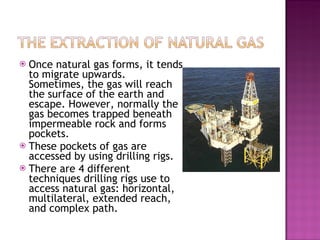
Once natural gas forms, it tends to migrate upwards. Sometimes, the gas will reach the surface of the earth and escape. However, normally the gas becomes trapped beneath impermeable rock and forms pockets. These pockets of gas are accessed by using drilling rigs.  There are 4 different techniques drilling rigs use to access natural gas: horizontal, multilateral, extended reach, and complex path.
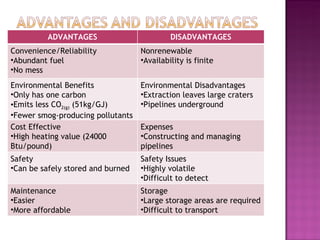
ADVANTAGES DISADVANTAGES Convenience/Reliability Abundant fuel No mess Nonrenewable Availability is finite Environmental Benefits Only has one carbon Emits less CO 2(g)  (51kg/GJ) Fewer smog-producing pollutants Environmental Disadvantages Extraction leaves large craters Pipelines underground Cost Effective High heating value (24000 Btu/pound)  Expenses Constructing and managing pipelines Safety Can be safely stored and burned Safety Issues Highly volatile Difficult to detect Maintenance Easier More affordable Storage Large storage areas are required Difficult to transport
Natural gas is a great  alternative fuel because it is  a smart choice for the economy, the environment, and you, as a  consumer, as it is convenient  and reliable.

Natural Gas

  • 1.
  • 2.
    Natural gas ismade of microscopic plants and organisms that lived in the ocean millions of years ago. When the organisms died, they sank to the bottom of the ocean and were buried underneath layers of sediment. When these organisms became buried deeper, the pressure and heat began to rise. The high pressure caused the organisms to turn into hydrocarbons such as oil and natural gas. The amount of pressure and heat determined whether the carbon molecules would become oil or natural gas. Natural gas requires more heat and pressure to form.
  • 3.
    Once natural gasforms, it tends to migrate upwards. Sometimes, the gas will reach the surface of the earth and escape. However, normally the gas becomes trapped beneath impermeable rock and forms pockets. These pockets of gas are accessed by using drilling rigs. There are 4 different techniques drilling rigs use to access natural gas: horizontal, multilateral, extended reach, and complex path.
  • 4.
    ADVANTAGES DISADVANTAGES Convenience/ReliabilityAbundant fuel No mess Nonrenewable Availability is finite Environmental Benefits Only has one carbon Emits less CO 2(g) (51kg/GJ) Fewer smog-producing pollutants Environmental Disadvantages Extraction leaves large craters Pipelines underground Cost Effective High heating value (24000 Btu/pound) Expenses Constructing and managing pipelines Safety Can be safely stored and burned Safety Issues Highly volatile Difficult to detect Maintenance Easier More affordable Storage Large storage areas are required Difficult to transport
  • 5.
    Natural gas isa great alternative fuel because it is a smart choice for the economy, the environment, and you, as a consumer, as it is convenient and reliable.