Non-Renewable Resource
Group Member
• Nur Fitri Aulia
• Rifki Fauzan
• Bella Adira Lestari
• Fairuz Nur Hasna
• Dian Nurhidayat
• Khairunnisa Solehah
Non-renewable resource (also called a finite resource) is a resource that does not renew
itself at a sufficient rate for sustainable economic extraction in meaningful human time-frames. An
example is carbon-based, organically-derived fuel. The original organic material, with the aid of
heat and pressure, becomes a fuel such as oil or gas. Fossil fuels (such as coal, petroleum, and
natural gas), and certain aquifers are all non-renewable resources.
In contrast, resources such as timber (when harvested sustainably) and wind (used to
power energy conversion systems) are considered renewable resources, largely because their
localized replenishment can occur within timeframes meaningful to humans.
Non-renewble Resource
Fossil Fuels
Fossil fuels are derived from organic matter which has been trapped between layers of sediments
within the Earth for millions of years. They are difficult to obtain as they are typically retrieved through drilling
or mining, but fossil fuels are worth the effort for the sheer amount of energy they produce.
Categories of Non-Renewable Resources
Crude Oil/Petroleum
Crude oil is a non-renewable resource that builds up in liquid form between the layers of the Earth’s
crust. Crude oil is a very versatile fuel and is used to produce things like plastics, artificial food flavorings,
heating oil, petrol, diesel, jet fuel, and propane. The top three oil-producing countries are Russia, Saudi Arabia,
and the United States.
Gas
Natural gasses gather below the Earth’s crust and, like crude oil, must be drilled for and pumped out.
These gasses are most commonly used in home heating as well as gas ovens and grills. Russia, Iran, and Qatar
are the countries with the largest recorded natural
gas reserves.
Coal
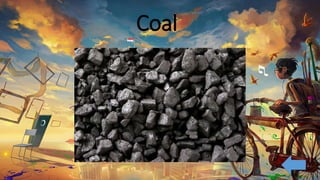
Coal is the last of the major fossil fuels. Created by compressed organic matter, it is solid like rock and is
obtained via mining. Out of all countries, China produces the most coal by far. Coal is most typically used in home
heating and the running of power plants.
Nuclear Fuels
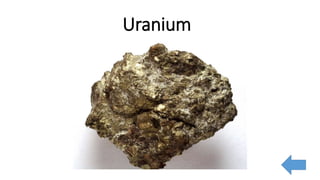
The other form of non-renewable resource used to produce energy, nuclear fuels, is primarily
obtained through the mining and refining of uranium ore. Uranium is a naturally occurring element found
within the Earth's core. Nuclear fuels are key to maintaining the Earth's environment since they are the
cleanest of all non-renewable resources.
Why we called it non renewable resource?
₡Petroleum
Because it took a quarter billion years to make it. We are going through it like
there is an unlimited supply, and this is certainly not the case. Because it cannot be
replaced
₡Fossil Fuels
Because The earth has a limited supply of oil, gas and coal at least in practical
terms. It takes millions of years for the earth to transform dead organic material into
these fossil fuels. The supply of fossil fuels we are using today come from organic
materials buried generally at least 20 million years ago, and some that were buried more
than 200 million years ago
₡ Gas
Because there is limited amounts of oil, which means liamited amounts of petroleum,
which is what gasoline is made of, thus gasoline is a nonrenewable resource. Oil is considered a
nonrenewable resource only because it takes A REALLY LONG TIME to regenerate.
₡Nuclear
Because there comes from radio active substances like uranium, plutonium etc., hence uranium
etc., will be required to produce energy. Only limited supply of uranium etc is there in earth once this is
used up nuclear energy can't be produced.
₡ Coal
Because after we dig it all up and burn it, then it's gone, finished. There is no more. It doesn't
renew itself every day.
Uranium
Coal

Non renewable resource

  • 1.
  • 2.
    Group Member • NurFitri Aulia • Rifki Fauzan • Bella Adira Lestari • Fairuz Nur Hasna • Dian Nurhidayat • Khairunnisa Solehah
  • 3.
    Non-renewable resource (alsocalled a finite resource) is a resource that does not renew itself at a sufficient rate for sustainable economic extraction in meaningful human time-frames. An example is carbon-based, organically-derived fuel. The original organic material, with the aid of heat and pressure, becomes a fuel such as oil or gas. Fossil fuels (such as coal, petroleum, and natural gas), and certain aquifers are all non-renewable resources. In contrast, resources such as timber (when harvested sustainably) and wind (used to power energy conversion systems) are considered renewable resources, largely because their localized replenishment can occur within timeframes meaningful to humans. Non-renewble Resource
  • 4.
    Fossil Fuels Fossil fuelsare derived from organic matter which has been trapped between layers of sediments within the Earth for millions of years. They are difficult to obtain as they are typically retrieved through drilling or mining, but fossil fuels are worth the effort for the sheer amount of energy they produce. Categories of Non-Renewable Resources Crude Oil/Petroleum Crude oil is a non-renewable resource that builds up in liquid form between the layers of the Earth’s crust. Crude oil is a very versatile fuel and is used to produce things like plastics, artificial food flavorings, heating oil, petrol, diesel, jet fuel, and propane. The top three oil-producing countries are Russia, Saudi Arabia, and the United States. Gas Natural gasses gather below the Earth’s crust and, like crude oil, must be drilled for and pumped out. These gasses are most commonly used in home heating as well as gas ovens and grills. Russia, Iran, and Qatar are the countries with the largest recorded natural gas reserves. Coal Coal is the last of the major fossil fuels. Created by compressed organic matter, it is solid like rock and is obtained via mining. Out of all countries, China produces the most coal by far. Coal is most typically used in home heating and the running of power plants. Nuclear Fuels The other form of non-renewable resource used to produce energy, nuclear fuels, is primarily obtained through the mining and refining of uranium ore. Uranium is a naturally occurring element found within the Earth's core. Nuclear fuels are key to maintaining the Earth's environment since they are the cleanest of all non-renewable resources.
  • 5.
    Why we calledit non renewable resource? ₡Petroleum Because it took a quarter billion years to make it. We are going through it like there is an unlimited supply, and this is certainly not the case. Because it cannot be replaced ₡Fossil Fuels Because The earth has a limited supply of oil, gas and coal at least in practical terms. It takes millions of years for the earth to transform dead organic material into these fossil fuels. The supply of fossil fuels we are using today come from organic materials buried generally at least 20 million years ago, and some that were buried more than 200 million years ago ₡ Gas Because there is limited amounts of oil, which means liamited amounts of petroleum, which is what gasoline is made of, thus gasoline is a nonrenewable resource. Oil is considered a nonrenewable resource only because it takes A REALLY LONG TIME to regenerate. ₡Nuclear Because there comes from radio active substances like uranium, plutonium etc., hence uranium etc., will be required to produce energy. Only limited supply of uranium etc is there in earth once this is used up nuclear energy can't be produced. ₡ Coal Because after we dig it all up and burn it, then it's gone, finished. There is no more. It doesn't renew itself every day.
  • 7.
  • 8.