NATURAL DRAUGHT
Shri Sa’d Vidya Mandal
Institute of technology,
Bharuch
Subject : Power plant engineering
Enrollment no : 130450119043
130450119047
130450119054
Guided by : Ass. Professor,
Mr. Mayur Makwana
SVMIT, Bharuch
Content
 Introduction to draught system
 Functions & Classification of Draughts
 Introduction to natural draught
 Estimate the height & diameter of chimney
 Condition for maximum discharge through a
chimney
 Efficiency of chimney
 Advantages and Limitations of chimney or natural
draught
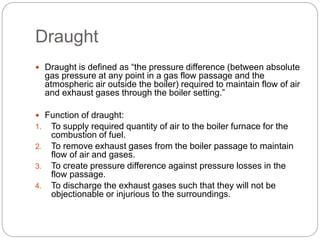
Draught
 Draught is defined as “the pressure difference (between absolute
gas pressure at any point in a gas flow passage and the
atmospheric air outside the boiler) required to maintain flow of air
and exhaust gases through the boiler setting.”
 Function of draught:
1. To supply required quantity of air to the boiler furnace for the
combustion of fuel.
2. To remove exhaust gases from the boiler passage to maintain
flow of air and gases.
3. To create pressure difference against pressure losses in the
flow passage.
4. To discharge the exhaust gases such that they will not be
objectionable or injurious to the surroundings.
Losses in the air – gas circuit of Boiler:
 Draught is nothing but pressure difference required to
accelerate the burnt gases to their final velocity and to
overcome the pressure losses in the boiler passage.
 Draught = [head required to accelerate the gases] +
[head losses in the path
of flue gases]
ℎ 𝑓 = ℎ 𝑣 + ℎ 𝑎 + ℎ 𝑔 + ℎ 𝑑
Where, ℎ 𝑓 = total draught required or total loss
ℎ 𝑣 = pressure loss due to gas exit velocity from
chimney
ℎ 𝑎 = pressure loss on air side
ℎ 𝑔 = pressure loss in gas side
ℎ 𝑑 = pressure losses in chimney and gas ducts
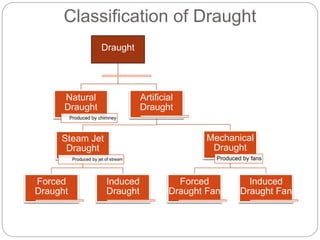
Classification of Draught
Draught
Natural
Draught
Produced by chimney
Artificial
Draught
Steam Jet
Draught
Produced by jet of stream
Forced
Draught
Induced
Draught
Mechanical
Draught
Produced by fans
Forced
Draught Fan
Induced
Draught Fan
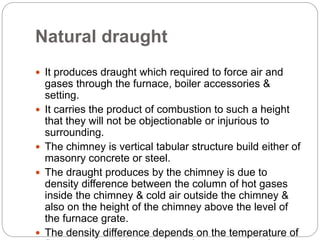
Natural draught
 It produces draught which required to force air and
gases through the furnace, boiler accessories &
setting.
 It carries the product of combustion to such a height
that they will not be objectionable or injurious to
surrounding.
 The chimney is vertical tabular structure build either of
masonry concrete or steel.
 The draught produces by the chimney is due to
density difference between the column of hot gases
inside the chimney & cold air outside the chimney &
also on the height of the chimney above the level of
the furnace grate.
 The density difference depends on the temperature of
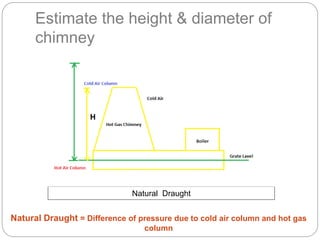
Estimate the height & diameter of
chimney
Natural Draught
Natural Draught = Difference of pressure due to cold air column and hot gas
column
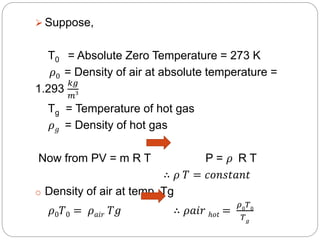
 Suppose,
T0 = Absolute Zero Temperature = 273 K
𝜌0 = Density of air at absolute temperature =
1.293
𝑘𝑔
𝑚3
Tg = Temperature of hot gas
𝜌 𝑔 = Density of hot gas
Now from PV = m R T P = 𝜌 R T
∴ 𝜌 𝑇 = 𝑐𝑜𝑛𝑠𝑡𝑎𝑛𝑡
o Density of air at temp. Tg
𝜌0 𝑇0 = 𝜌 𝑎𝑖𝑟 𝑇𝑔 ∴ 𝜌𝑎𝑖𝑟 ℎ𝑜𝑡 =
𝜌0
𝑇0
𝑇 𝑔
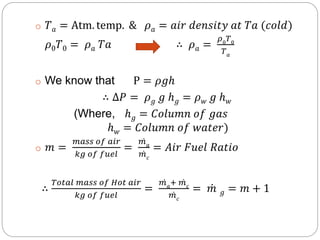
o 𝑇 𝑎 = Atm. temp. & 𝜌 𝑎 = 𝑎𝑖𝑟 𝑑𝑒𝑛𝑠𝑖𝑡𝑦 𝑎𝑡 𝑇𝑎 (𝑐𝑜𝑙𝑑)
𝜌0 𝑇0 = 𝜌 𝑎 𝑇𝑎 ∴ 𝜌 𝑎 =
𝜌0
𝑇0
𝑇 𝑎
o We know that P = 𝜌𝑔ℎ
∴ ∆𝑃 = 𝜌 𝑔 𝑔 ℎ 𝑔 = 𝜌 𝑤 𝑔 ℎ 𝑤
(Where, ℎ 𝑔 = 𝐶𝑜𝑙𝑢𝑚𝑛 𝑜𝑓 𝑔𝑎𝑠
ℎ 𝑤 = 𝐶𝑜𝑙𝑢𝑚𝑛 𝑜𝑓 𝑤𝑎𝑡𝑒𝑟)
o 𝑚 =
𝑚𝑎𝑠𝑠 𝑜𝑓 𝑎𝑖𝑟
𝑘𝑔 𝑜𝑓 𝑓𝑢𝑒𝑙
=
𝑚 𝑎
𝑚 𝑐
= 𝐴𝑖𝑟 𝐹𝑢𝑒𝑙 𝑅𝑎𝑡𝑖𝑜
∴
𝑇𝑜𝑡𝑎𝑙 𝑚𝑎𝑠𝑠 𝑜𝑓 𝐻𝑜𝑡 𝑎𝑖𝑟
𝑘𝑔 𝑜𝑓 𝑓𝑢𝑒𝑙
=
𝑚 𝑎
+ 𝑚 𝑐
𝑚 𝑐
= 𝑚 𝑔 = 𝑚 + 1
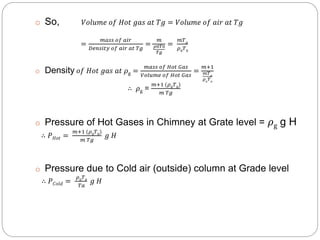
o So, 𝑉𝑜𝑙𝑢𝑚𝑒 𝑜𝑓 𝐻𝑜𝑡 𝑔𝑎𝑠 𝑎𝑡 𝑇𝑔 = 𝑉𝑜𝑙𝑢𝑚𝑒 𝑜𝑓 𝑎𝑖𝑟 𝑎𝑡 𝑇𝑔
=
𝑚𝑎𝑠𝑠 𝑜𝑓 𝑎𝑖𝑟
𝐷𝑒𝑛𝑠𝑖𝑡𝑦 𝑜𝑓 𝑎𝑖𝑟 𝑎𝑡 𝑇𝑔
=
𝑚
𝜌0𝑇0
𝑇𝑔
=
𝑚𝑇 𝑔
𝜌0 𝑇0
o Density 𝑜𝑓 𝐻𝑜𝑡 𝑔𝑎𝑠 𝑎𝑡 𝜌g =
𝑚𝑎𝑠𝑠 𝑜𝑓 𝐻𝑜𝑡 𝐺𝑎𝑠
𝑉𝑜𝑙𝑢𝑚𝑒 𝑜𝑓 𝐻𝑜𝑡 𝐺𝑎𝑠
=
𝑚+1
𝑚𝑇 𝑔
𝜌0
𝑇0
∴ 𝜌g =
𝑚+1 (𝜌0 𝑇0)
𝑚 𝑇𝑔
o Pressure of Hot Gases in Chimney at Grate level = 𝜌g g H
∴ 𝑃 𝐻𝑜𝑡 =
𝑚+1 (𝜌0 𝑇0)
𝑚 𝑇𝑔
𝑔 𝐻
o Pressure due to Cold air (outside) column at Grade level
∴ 𝑃 𝐶𝑜𝑙𝑑 =
𝜌0 𝑇0
𝑇𝑎
𝑔 𝐻
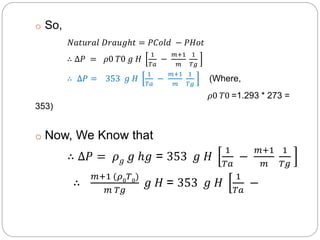
o So,
𝑁𝑎𝑡𝑢𝑟𝑎𝑙 𝐷𝑟𝑎𝑢𝑔ℎ𝑡 = 𝑃𝐶𝑜𝑙𝑑 − 𝑃𝐻𝑜𝑡
∴ ∆𝑃 = 𝜌0 𝑇0 𝑔 𝐻
1
𝑇𝑎
−
𝑚+1
𝑚
1
𝑇𝑔
∴ ∆𝑃 = 353 𝑔 𝐻
1
𝑇𝑎
−
𝑚+1
𝑚
1
𝑇𝑔
(Where,
𝜌0 𝑇0 =1.293 * 273 =
353)
o Now, We Know that
∴ ∆𝑃 = 𝜌 𝑔 𝑔 ℎ𝑔 = 353 𝑔 𝐻
1
𝑇𝑎
−
𝑚+1
𝑚
1
𝑇𝑔
∴
𝑚+1 (𝜌0
𝑇0
)
𝑚 𝑇𝑔
𝑔 𝐻 = 353 𝑔 𝐻
1
𝑇𝑎
−
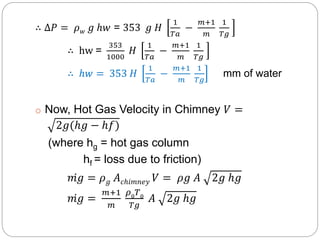
∴ ∆𝑃 = 𝜌 𝑤 𝑔 ℎ𝑤 = 353 𝑔 𝐻
1
𝑇𝑎
−
𝑚+1
𝑚
1
𝑇𝑔
∴ hw =
353
1000
𝐻
1
𝑇𝑎
−
𝑚+1
𝑚
1
𝑇𝑔
∴ ℎ𝑤 = 353 𝐻
1
𝑇𝑎
−
𝑚+1
𝑚
1
𝑇𝑔
mm of water
o Now, Hot Gas Velocity in Chimney 𝑉 =
2𝑔(ℎ𝑔 − ℎ𝑓)
(where hg = hot gas column
hf = loss due to friction)
𝑚𝑔 = 𝜌 𝑔 𝐴 𝑐ℎ𝑖𝑚𝑛𝑒𝑦 𝑉 = 𝜌𝑔 𝐴 2𝑔 ℎ𝑔
𝑚𝑔 =
𝑚+1
𝑚
𝜌0 𝑇0
𝑇𝑔
𝐴 2𝑔 ℎ𝑔
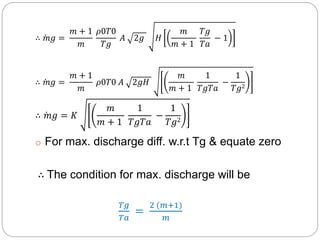
∴ 𝑚𝑔 =
𝑚 + 1
𝑚
𝜌0𝑇0
𝑇𝑔
𝐴 2𝑔 𝐻
𝑚
𝑚 + 1
𝑇𝑔
𝑇𝑎
− 1
∴ 𝑚𝑔 =
𝑚 + 1
𝑚
𝜌0𝑇0 𝐴 2𝑔𝐻
𝑚
𝑚 + 1
1
𝑇𝑔𝑇𝑎
−
1
𝑇𝑔2
∴ 𝑚𝑔 = 𝐾
𝑚
𝑚 + 1
1
𝑇𝑔𝑇𝑎
−
1
𝑇𝑔2
o For max. discharge diff. w.r.t Tg & equate zero
∴ The condition for max. discharge will be
𝑇𝑔
𝑇𝑎
=
2 (𝑚+1)
𝑚
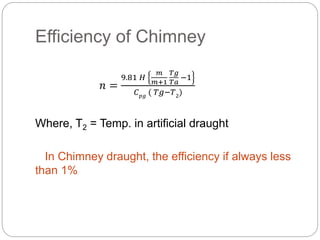
Efficiency of Chimney
𝑛 =
9.81 𝐻
𝑚
𝑚+1
𝑇𝑔
𝑇𝑎
−1
𝐶 𝑝𝑔
( 𝑇𝑔−𝑇2
)
Where, T2 = Temp. in artificial draught
In Chimney draught, the efficiency if always less
than 1%
Advantages
1. Chimney draught does not require any external
power to produce draught.
2. Simple in construction, less cost& has long life.
3. No mechanical parts & hence maintenance cost
is negligible.
4. Chimney keeps flue gases at a high place in the
atmosphere which prevents contamination of
atmosphere & maintains the cleanliness.
Limitations
1. The draught produced by chimney depends on
height of chimney, atmospheric air tem & tem of flue
gases leaving through the chimney. Hence in order
to get appropriate draught at given height off
chimney, the flue gases have to be discharged at
comparatively high temp resulting in the reduction in
overall efficiency of plant.
2. The maximum pressure available for producing
natural draught by chimney is hardly 10 to 20 mm of
water.
3. Draught created by chimney is dependent on
atmospheric air &flue gases conditions, hence there
is no flexibility to create more draught under peak
load conditions because draught available is
constant for given height of chimney.
4. Due to low velocity of air, the mixing process of air &
fuel is not proper & hence combustion is very poor.
Thank You

Natural Draught

  • 1.
    NATURAL DRAUGHT Shri Sa’dVidya Mandal Institute of technology, Bharuch Subject : Power plant engineering Enrollment no : 130450119043 130450119047 130450119054 Guided by : Ass. Professor, Mr. Mayur Makwana SVMIT, Bharuch
  • 2.
    Content  Introduction todraught system  Functions & Classification of Draughts  Introduction to natural draught  Estimate the height & diameter of chimney  Condition for maximum discharge through a chimney  Efficiency of chimney  Advantages and Limitations of chimney or natural draught
  • 3.
    Draught  Draught isdefined as “the pressure difference (between absolute gas pressure at any point in a gas flow passage and the atmospheric air outside the boiler) required to maintain flow of air and exhaust gases through the boiler setting.”  Function of draught: 1. To supply required quantity of air to the boiler furnace for the combustion of fuel. 2. To remove exhaust gases from the boiler passage to maintain flow of air and gases. 3. To create pressure difference against pressure losses in the flow passage. 4. To discharge the exhaust gases such that they will not be objectionable or injurious to the surroundings.
  • 4.
    Losses in theair – gas circuit of Boiler:  Draught is nothing but pressure difference required to accelerate the burnt gases to their final velocity and to overcome the pressure losses in the boiler passage.  Draught = [head required to accelerate the gases] + [head losses in the path of flue gases] ℎ 𝑓 = ℎ 𝑣 + ℎ 𝑎 + ℎ 𝑔 + ℎ 𝑑 Where, ℎ 𝑓 = total draught required or total loss ℎ 𝑣 = pressure loss due to gas exit velocity from chimney ℎ 𝑎 = pressure loss on air side ℎ 𝑔 = pressure loss in gas side ℎ 𝑑 = pressure losses in chimney and gas ducts
  • 5.
    Classification of Draught Draught Natural Draught Producedby chimney Artificial Draught Steam Jet Draught Produced by jet of stream Forced Draught Induced Draught Mechanical Draught Produced by fans Forced Draught Fan Induced Draught Fan
  • 6.
    Natural draught  Itproduces draught which required to force air and gases through the furnace, boiler accessories & setting.  It carries the product of combustion to such a height that they will not be objectionable or injurious to surrounding.  The chimney is vertical tabular structure build either of masonry concrete or steel.  The draught produces by the chimney is due to density difference between the column of hot gases inside the chimney & cold air outside the chimney & also on the height of the chimney above the level of the furnace grate.  The density difference depends on the temperature of
  • 7.
    Estimate the height& diameter of chimney Natural Draught Natural Draught = Difference of pressure due to cold air column and hot gas column
  • 8.
     Suppose, T0 =Absolute Zero Temperature = 273 K 𝜌0 = Density of air at absolute temperature = 1.293 𝑘𝑔 𝑚3 Tg = Temperature of hot gas 𝜌 𝑔 = Density of hot gas Now from PV = m R T P = 𝜌 R T ∴ 𝜌 𝑇 = 𝑐𝑜𝑛𝑠𝑡𝑎𝑛𝑡 o Density of air at temp. Tg 𝜌0 𝑇0 = 𝜌 𝑎𝑖𝑟 𝑇𝑔 ∴ 𝜌𝑎𝑖𝑟 ℎ𝑜𝑡 = 𝜌0 𝑇0 𝑇 𝑔
  • 9.
    o 𝑇 𝑎= Atm. temp. & 𝜌 𝑎 = 𝑎𝑖𝑟 𝑑𝑒𝑛𝑠𝑖𝑡𝑦 𝑎𝑡 𝑇𝑎 (𝑐𝑜𝑙𝑑) 𝜌0 𝑇0 = 𝜌 𝑎 𝑇𝑎 ∴ 𝜌 𝑎 = 𝜌0 𝑇0 𝑇 𝑎 o We know that P = 𝜌𝑔ℎ ∴ ∆𝑃 = 𝜌 𝑔 𝑔 ℎ 𝑔 = 𝜌 𝑤 𝑔 ℎ 𝑤 (Where, ℎ 𝑔 = 𝐶𝑜𝑙𝑢𝑚𝑛 𝑜𝑓 𝑔𝑎𝑠 ℎ 𝑤 = 𝐶𝑜𝑙𝑢𝑚𝑛 𝑜𝑓 𝑤𝑎𝑡𝑒𝑟) o 𝑚 = 𝑚𝑎𝑠𝑠 𝑜𝑓 𝑎𝑖𝑟 𝑘𝑔 𝑜𝑓 𝑓𝑢𝑒𝑙 = 𝑚 𝑎 𝑚 𝑐 = 𝐴𝑖𝑟 𝐹𝑢𝑒𝑙 𝑅𝑎𝑡𝑖𝑜 ∴ 𝑇𝑜𝑡𝑎𝑙 𝑚𝑎𝑠𝑠 𝑜𝑓 𝐻𝑜𝑡 𝑎𝑖𝑟 𝑘𝑔 𝑜𝑓 𝑓𝑢𝑒𝑙 = 𝑚 𝑎 + 𝑚 𝑐 𝑚 𝑐 = 𝑚 𝑔 = 𝑚 + 1
  • 10.
    o So, 𝑉𝑜𝑙𝑢𝑚𝑒𝑜𝑓 𝐻𝑜𝑡 𝑔𝑎𝑠 𝑎𝑡 𝑇𝑔 = 𝑉𝑜𝑙𝑢𝑚𝑒 𝑜𝑓 𝑎𝑖𝑟 𝑎𝑡 𝑇𝑔 = 𝑚𝑎𝑠𝑠 𝑜𝑓 𝑎𝑖𝑟 𝐷𝑒𝑛𝑠𝑖𝑡𝑦 𝑜𝑓 𝑎𝑖𝑟 𝑎𝑡 𝑇𝑔 = 𝑚 𝜌0𝑇0 𝑇𝑔 = 𝑚𝑇 𝑔 𝜌0 𝑇0 o Density 𝑜𝑓 𝐻𝑜𝑡 𝑔𝑎𝑠 𝑎𝑡 𝜌g = 𝑚𝑎𝑠𝑠 𝑜𝑓 𝐻𝑜𝑡 𝐺𝑎𝑠 𝑉𝑜𝑙𝑢𝑚𝑒 𝑜𝑓 𝐻𝑜𝑡 𝐺𝑎𝑠 = 𝑚+1 𝑚𝑇 𝑔 𝜌0 𝑇0 ∴ 𝜌g = 𝑚+1 (𝜌0 𝑇0) 𝑚 𝑇𝑔 o Pressure of Hot Gases in Chimney at Grate level = 𝜌g g H ∴ 𝑃 𝐻𝑜𝑡 = 𝑚+1 (𝜌0 𝑇0) 𝑚 𝑇𝑔 𝑔 𝐻 o Pressure due to Cold air (outside) column at Grade level ∴ 𝑃 𝐶𝑜𝑙𝑑 = 𝜌0 𝑇0 𝑇𝑎 𝑔 𝐻
  • 11.
    o So, 𝑁𝑎𝑡𝑢𝑟𝑎𝑙 𝐷𝑟𝑎𝑢𝑔ℎ𝑡= 𝑃𝐶𝑜𝑙𝑑 − 𝑃𝐻𝑜𝑡 ∴ ∆𝑃 = 𝜌0 𝑇0 𝑔 𝐻 1 𝑇𝑎 − 𝑚+1 𝑚 1 𝑇𝑔 ∴ ∆𝑃 = 353 𝑔 𝐻 1 𝑇𝑎 − 𝑚+1 𝑚 1 𝑇𝑔 (Where, 𝜌0 𝑇0 =1.293 * 273 = 353) o Now, We Know that ∴ ∆𝑃 = 𝜌 𝑔 𝑔 ℎ𝑔 = 353 𝑔 𝐻 1 𝑇𝑎 − 𝑚+1 𝑚 1 𝑇𝑔 ∴ 𝑚+1 (𝜌0 𝑇0 ) 𝑚 𝑇𝑔 𝑔 𝐻 = 353 𝑔 𝐻 1 𝑇𝑎 −
  • 12.
    ∴ ∆𝑃 =𝜌 𝑤 𝑔 ℎ𝑤 = 353 𝑔 𝐻 1 𝑇𝑎 − 𝑚+1 𝑚 1 𝑇𝑔 ∴ hw = 353 1000 𝐻 1 𝑇𝑎 − 𝑚+1 𝑚 1 𝑇𝑔 ∴ ℎ𝑤 = 353 𝐻 1 𝑇𝑎 − 𝑚+1 𝑚 1 𝑇𝑔 mm of water o Now, Hot Gas Velocity in Chimney 𝑉 = 2𝑔(ℎ𝑔 − ℎ𝑓) (where hg = hot gas column hf = loss due to friction) 𝑚𝑔 = 𝜌 𝑔 𝐴 𝑐ℎ𝑖𝑚𝑛𝑒𝑦 𝑉 = 𝜌𝑔 𝐴 2𝑔 ℎ𝑔 𝑚𝑔 = 𝑚+1 𝑚 𝜌0 𝑇0 𝑇𝑔 𝐴 2𝑔 ℎ𝑔
  • 13.
    ∴ 𝑚𝑔 = 𝑚+ 1 𝑚 𝜌0𝑇0 𝑇𝑔 𝐴 2𝑔 𝐻 𝑚 𝑚 + 1 𝑇𝑔 𝑇𝑎 − 1 ∴ 𝑚𝑔 = 𝑚 + 1 𝑚 𝜌0𝑇0 𝐴 2𝑔𝐻 𝑚 𝑚 + 1 1 𝑇𝑔𝑇𝑎 − 1 𝑇𝑔2 ∴ 𝑚𝑔 = 𝐾 𝑚 𝑚 + 1 1 𝑇𝑔𝑇𝑎 − 1 𝑇𝑔2 o For max. discharge diff. w.r.t Tg & equate zero ∴ The condition for max. discharge will be 𝑇𝑔 𝑇𝑎 = 2 (𝑚+1) 𝑚
  • 14.
    Efficiency of Chimney 𝑛= 9.81 𝐻 𝑚 𝑚+1 𝑇𝑔 𝑇𝑎 −1 𝐶 𝑝𝑔 ( 𝑇𝑔−𝑇2 ) Where, T2 = Temp. in artificial draught In Chimney draught, the efficiency if always less than 1%
  • 15.
    Advantages 1. Chimney draughtdoes not require any external power to produce draught. 2. Simple in construction, less cost& has long life. 3. No mechanical parts & hence maintenance cost is negligible. 4. Chimney keeps flue gases at a high place in the atmosphere which prevents contamination of atmosphere & maintains the cleanliness.
  • 16.
    Limitations 1. The draughtproduced by chimney depends on height of chimney, atmospheric air tem & tem of flue gases leaving through the chimney. Hence in order to get appropriate draught at given height off chimney, the flue gases have to be discharged at comparatively high temp resulting in the reduction in overall efficiency of plant. 2. The maximum pressure available for producing natural draught by chimney is hardly 10 to 20 mm of water. 3. Draught created by chimney is dependent on atmospheric air &flue gases conditions, hence there is no flexibility to create more draught under peak load conditions because draught available is constant for given height of chimney. 4. Due to low velocity of air, the mixing process of air & fuel is not proper & hence combustion is very poor.
  • 17.