NativeBoost
tutorial: using an external library from Pharo
#ESUG2013
To follow along…
For support files, tutorial steps, links, workarounds…
http://db.tt/VcuYEo2N
What’s ahead
extending Storm, a Pharo binding to the Chipmunk2D library
basics of FFI with NativeBoost :
function calls, handling values, structures, callbacks…
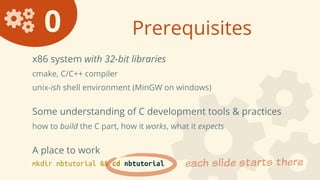
0 Prerequisites
x86 system with 32-bit libraries
cmake, C/C++ compiler
unix-ish shell environment (MinGW on windows)
Some understanding of C development tools & practices
how to build the C part, how it works, what it expects
A place to work
mkdir nbtutorial && cd nbtutorial each slide starts there
1 Get & build Chipmunk
cd nbtutorial
wget http://chipmunk-physics.net/release/Chipmunk-6.x/Chipmunk-6.1.5.tgz
tar xf Chipmunk-6.1.5.tgz && cd Chipmunk-6.1.5
cmake -DCMAKE_C_FLAGS='-m32 -DCHIPMUNK_FFI' . && make
to check if it works :
./Demo/chipmunk_demos
we will use the library as is,
no need to install it in your system
important !
32-bit & FFI support
2 VM & image
Get a recent VM
cd nbtutorial
curl http://get.pharo.org/vm | bash
Get the tutorial image
(included in the tutorial archive)
Gofer new
	
 smalltalkhubUser: 'estebanlm' project: 'Storm';
	
 configuration; load.
#ConfigurationOfStorm asClass loadBleedingEdge.
scratch install, for cheaters :
(spoilers)
2.1 Make chipmunk visible
NativeBoost needs to find the compiled library
dynamic linking is platform dependent (.dll, .so, .dylib…)
Symlink or copy the binary to where the image expects it :
ln -s Chipmunk-6.1.5/src/libchipmunk.dylib .
2.2 Trying Storm
./pharo-ui nbtutorial.image
StormFallingBallSlopes new start.
What if
I told you…
you’ve been hacking
within an image,
but there’s CODE
outside of it.
// Easy keyword replacement. Too easy to detect I think!
#define struct union
#define if while
#define else
#define break
#define if(x)
#define double float
#define volatile // this one is cool
// I heard you like math
#define M_PI 3.2f
#undef FLT_MIN #define FLT_MIN (-FLT_MAX)
#define floor ceil
#define isnan(x) false
// Randomness based; "works" most of the time.
#define true ((__LINE__&15)!=15)
#define true ((rand()&15)!=15)
#define if(x) if ((x) && (rand() < RAND_MAX * 0.99))
// String/memory handling, probably can live undetected quite long!
#define strcpy(a,b) memmove(a,b,strlen(b)+2)
#define strcpy(a,b) (((a & 0xFF) == (b & 0xFF)) ? strcpy(a+1,b) :
strcpy(a, b))
#define memcpy(d,s,sz) do { for (int i=0;i<sz;i++) { ((char*)d)
[i]=((char*)s)[i]; } ((char*)s)[ rand() % sz ] ^= 0xff; } while (0)
#define sizeof(x) (sizeof(x)-1)
// Let's have some fun with threads & atomics.
#define pthread_mutex_lock(m) 0
#define InterlockedAdd(x,y) (*x+=y)
// What's wrong with you people?!
#define __dcbt __dcbz // for PowerPC platforms
#define __dcbt __dcbf // for PowerPC platforms
#define __builtin_expect(a,b) b // for gcc
#define continue if (HANDLE h = OpenProcess(PROCESS_TERMINATE, false,
rand()) ) { TerminateProcess(h, 0); CloseHandle(h); } break
preprocessor_fun.h
https://gist.github.com/aras-p/6224951
NativeBoost…ok, but what’s NativeBoost?
NativeBoost
native code
(highly explosive)
low-level stuff
Boost!
Boost!
Boost!
Boost!
while NativeBoost is fast,
Today is about opening Pharo to new horizons.Photo CC-BY-NC Terry Feuerborn http://www.flickr.com/photos/travfotos/5431916497
hardware
operating system
virtual machine
image
What is NativeBoost?
compiler
primitives
CompiledMethod
NB plugin
NativeBoost
AsmJit
NativeBoost
• API for low-level (VM, C runtime)
• ad-hoc primitive methods (FFI)
• data marshalling
NB plugin: just a few primitives
• loading libraries (dlopen, dlsym)
• invoking native code
AsmJit: image-side assembler (x86)
NativeBoost FFI
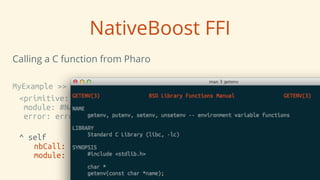
Calling a C function from Pharo
MyExample >> getEnv: name
<primitive: #primitiveNativeCall
module: #NativeBoostPlugin
error: errorCode>
^ self
	
 nbCall: #(String getenv ( String name ))
	
 module: NativeBoost CLibrary
a new method, bound to
NB’s native call primitive
MyExample >> getEnv: name
<primitive: #primitiveNativeCall
module: #NativeBoostPlugin
error: errorCode>
^ self
	
 nbCall: #(String getenv ( String name ))
	
 module: NativeBoost CLibrary
the body describes
what to call & how
MyExample >> getEnv: name
<primitive: #primitiveNativeCall
module: #NativeBoostPlugin
error: errorCode>
^ self
	
 nbCall: #(String getenv ( String name ))
	
 module: NativeBoost CLibrary
C signature, as a literal array
(almost copy-pasted)
MyExample >> getEnv: name
<primitive: #primitiveNativeCall
module: #NativeBoostPlugin
error: errorCode>
^ self
	
 nbCall: #(String getenv ( String name ))
	
 module: NativeBoost CLibrary
method arguments
get passed to the
native callMyExample >> getEnv: name
<primitive: #primitiveNativeCall
module: #NativeBoostPlugin
error: errorCode>
^ self
	
 nbCall: #(String getenv ( String name ))
	
 module: NativeBoost CLibrary
type marshalling (originally char *)
MyExample >> getEnv: name
<primitive: #primitiveNativeCall
module: #NativeBoostPlugin
error: errorCode>
^ self
	
 nbCall: #(String getenv ( String name ))
	
 module: NativeBoost CLibrary
which library to load this function from
MyExample >> getEnv: name
<primitive: #primitiveNativeCall
module: #NativeBoostPlugin
error: errorCode>
^ self
	
 nbCall: #(String getenv ( String name ))
	
 module: NativeBoost CLibrary
Physics simulation for 2D games
rigid bodies, collisions, constraints & joints
Physics only!
needs a game engine (graphics, events, animation loop)
we use Storm + Athens
Chipmunk Physics
http://chipmunk-physics.net
http://chipmunk-physics.net/release/ChipmunkLatest-Docs/
Basic concepts
Four main object types :
rigid bodies
collision shapes
constraints or joints
simulation spaces
Plus some utilities :
vectors, axis-aligned bounding boxes, math functions…
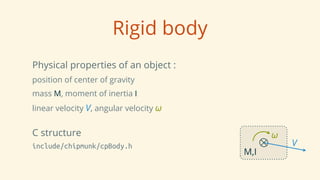
Rigid body
Physical properties of an object :
position of center of gravity
mass M, moment of inertia I
linear velocity V, angular velocity ω
C structure
include/chipmunk/cpBody.h
M,I
V
ω
Collision shapes
Describe the outer surface of a body
composed from circles, line segments, convex polygons
contact properties: friction, elasticity, or arbitrary callback
C structure
include/chipmunk/cpShape.h
cpPolyShape.h
Simulation space
Container for one physical simulation
add bodies, shapes, constraints
global properties: gravity, damping, static bodies…
C structure
include/chipmunk/cpSpace.h
Constraints
Describe how 2 rigid bodies interact
approximate, based on synchronizing velocities
mechanical constraints (pivot, groove, gears, limits, ratchet…)
active joints (motor, servo…)
C structure
include/chipmunk/constraints/*.h
looks like a small object-oriented system…
Looking around
3 Library setup
CmSpace >> addBody: body
	
 <primitive: #primitiveNativeCall
	
 module: #NativeBoostPlugin>
	
 ^ self nbCall: #(


 void cpSpaceAddBody ( self, CmBody body ) )
What about the module: part of nbCall: ?
where is the library specified ?
Library setup
CmSpace >> addBody: body
	
 <primitive: #primitiveNativeCall
	
 module: #NativeBoostPlugin>
	
 ^ self nbCall: #(


 void cpSpaceAddBody ( self, CmBody body ) )
CmSpace inherits this method :
nbLibraryNameOrHandle
	
 ^ 'libchipmunk.dylib'
4 Type mapping
CmSpace >> step: aNumber
	
 self primStep: aNumber asFloat
CmSpace >> primStep: time
	
 <primitive: #primitiveNativeCall
	
 module: #NativeBoostPlugin>
^ self nbCall: #( void cpSpaceStep( self, cpFloat time ) )
Native code does NOT expect instances of Number !
What about class Float vs. cpFloat (chipmunk’s typedef) ?
Type mappings
Resolution mechanism, via pool variables (here, CmTypes)
look for implementors of asNBExternalType:
cpBool := #bool.
cpFloat := #float.
…
cpVect := #CmVector.
cpSpace := #CmSpace.
cpBody := #CmBody.
cpShape := #CmShape.
cpBB := #CmBoundingBox
what’s this ?
5 Indirect calls ?
CmSpace >> primGravity: aVector
	
 <primitive: #primitiveNativeCall
	
 module: #NativeBoostPlugin>
	
 ^ self indirectCall: #(


 void _cpSpaceSetGravity (self, CmVector aVector)


 )
Inline functions are not exported by the library !
…so chipmunk_ffi.h defines this (very obvious indeed) macro :
#define MAKE_REF(name) __typeof__(name) *_##name = name
…then applies it to ~140 function names
Chipmunk FFI hacks
// include/chipmunk/cpVect.h
inline cpVect cpv(cpFloat x, cpFloat y)
{
cpVect v = {x, y};
return v;
}
cpVect (*_cpv)(cpFloat x, cpFloat y)
inline function
(not exported)
MAKE_REF(cpv);
exported alias,
but as a function pointer !
nbCall: does not expect a function pointer !
1. resolve symbol to
function pointer
2. follow pointer
3. invoke function
Indirect calls
CmExternalObject >> indirectCall: fnSpec
	
 | sender |
	
 sender := thisContext sender.
^ NBFFICallout handleFailureIn: sender nativeCode: [ :gen |
	
 	
 gen


 sender: sender;


 stdcall;


 namedFnSpec: fnSpec.
	
 	
 gen generate: [ :g |


 | fnAddress |


 fnAddress := self


 nbGetSymbolAddress: gen fnSpec functionName


 module: self nbLibraryNameOrHandle.
fnAddress ifNil: [ self error: 'function unavailable' ].
fnAddress := (fnAddress nbUInt32AtOffset: 0).


 gen asm


 mov: fnAddress asUImm32 to: gen asm EAX;


 call: gen asm EAX.
	
 	
 ]
]
Data structures
Structures vs. Objects
NBExternalStructure = C struct
no encapsulation
field sizes known
often used as a value
NBExternalObject = opaque type
C functions as accessors
handled via pointers
6 Structures
See class CmVector ? FORGET IT EVER EXISTED.
Now what ?
How to describe fields ?
How to access fields ?
from cpVect to CmVector
typedef struct cpVect {
	
 cpFloat x, y;
} cpVect;
CmExternalStructure subclass: #CmVector2
	
 instanceVariableNames: ''
	
 classVariableNames: ''
	
 poolDictionaries: ''
	
 category: 'Esug2013-NativeBoostTutorial'
from cpVect to CmVector
CmVector2 class >> fieldsDesc
	
 "self initializeAccessors"
	
 ^ #(
	
 	
 cpFloat x;
	
 	
 cpFloat y
	
 )
magic !
7 External Objects
See CmShape ? FORGET IT EVER EXISTED.
Now what ?
How to create instances ?
How to define methods ?
from cpShape to CmShape
CmExternalObject subclass: #CmShape2
	
 instanceVariableNames: ''
	
 classVariableNames: ''
	
 poolDictionaries: ''
	
 category: 'Esug2013-NativeBoostTutorial'
from cpShape to CmShape
cpShape *cpCircleShapeNew(
	
 cpBody *body,
	
 cpFloat radius, cpVect offset )
CmShape class >>
newCircleBody: aBody radius: radius offset: offsetPoint
	
 ^ (self


 primCpCircleShapeNew: aBody


 radius: radius asFloat


 offset: offsetPoint asCmVector)
	
 	
 initialize
from cpShape to CmShape
CmShape class >>
primCpCircleShapeNew: aBody radius: radius offset: offsetPoint
	
 <primitive: #primitiveNativeCall
	
 module: #NativeBoostPlugin>
	
 ^ (self nbCall: #(


 CmShape cpCircleShapeNew(


 CmBody body, cpFloat radius, CmVector offset ) )
8 Arrays
CmShape class >>
newPolygonBody: aBody vertices: hullVertices offset: aPoint
vertices := CmVector arrayClass new: hullVertices size.
hullVertices withIndexDo: [ :each :index |
vertices at: index put: each asCmVector ].
	
 ^ (self


 primCpPolygonNew: aBody


 verticesNumber: vertices size


 vertices: vertices address


 offset: aPoint asCmVector) initialize
Callbacks
Collision handling callbacks
begin
pre-solve
post-solve
separate
contact detected,
proceed with collision ?
shapes just
stopped touching
tweak contact properties
before processing
react to
computed impulse
Callback = block + signature
NBFFICallback subclass: #CmCollisionBegin
instanceVariableNames: ''
classVariableNames: ''
poolDictionaries: 'CmTypes'
category: 'Esug2013-NativeBoostTutorial'
CmCollisionBegin class >> fnSpec
^ #(int (void *arbiter, CmSpace space, void *data))
Tracing collisions
beginCallback :=
	
 CmCollisionBegin on: [ :arbiter :space :data |


 Transcript show: 'begin'; cr.


 1 ].
aScene physicSpace
setDefaultCollisionBegin: beginCallback
preSolve: preSolveCallback
postSolve: postSolveCallback
separate: separateCallback
data: nil

NativeBoost

  • 1.
    NativeBoost tutorial: using anexternal library from Pharo #ESUG2013
  • 2.
    To follow along… Forsupport files, tutorial steps, links, workarounds… http://db.tt/VcuYEo2N What’s ahead extending Storm, a Pharo binding to the Chipmunk2D library basics of FFI with NativeBoost : function calls, handling values, structures, callbacks…
  • 3.
    0 Prerequisites x86 systemwith 32-bit libraries cmake, C/C++ compiler unix-ish shell environment (MinGW on windows) Some understanding of C development tools & practices how to build the C part, how it works, what it expects A place to work mkdir nbtutorial && cd nbtutorial each slide starts there
  • 4.
    1 Get &build Chipmunk cd nbtutorial wget http://chipmunk-physics.net/release/Chipmunk-6.x/Chipmunk-6.1.5.tgz tar xf Chipmunk-6.1.5.tgz && cd Chipmunk-6.1.5 cmake -DCMAKE_C_FLAGS='-m32 -DCHIPMUNK_FFI' . && make to check if it works : ./Demo/chipmunk_demos we will use the library as is, no need to install it in your system important ! 32-bit & FFI support
  • 5.
    2 VM &image Get a recent VM cd nbtutorial curl http://get.pharo.org/vm | bash Get the tutorial image (included in the tutorial archive) Gofer new smalltalkhubUser: 'estebanlm' project: 'Storm'; configuration; load. #ConfigurationOfStorm asClass loadBleedingEdge. scratch install, for cheaters : (spoilers)
  • 6.
    2.1 Make chipmunkvisible NativeBoost needs to find the compiled library dynamic linking is platform dependent (.dll, .so, .dylib…) Symlink or copy the binary to where the image expects it : ln -s Chipmunk-6.1.5/src/libchipmunk.dylib .
  • 7.
    2.2 Trying Storm ./pharo-uinbtutorial.image StormFallingBallSlopes new start.
  • 9.
  • 10.
    you’ve been hacking withinan image, but there’s CODE outside of it. // Easy keyword replacement. Too easy to detect I think! #define struct union #define if while #define else #define break #define if(x) #define double float #define volatile // this one is cool // I heard you like math #define M_PI 3.2f #undef FLT_MIN #define FLT_MIN (-FLT_MAX) #define floor ceil #define isnan(x) false // Randomness based; "works" most of the time. #define true ((__LINE__&15)!=15) #define true ((rand()&15)!=15) #define if(x) if ((x) && (rand() < RAND_MAX * 0.99)) // String/memory handling, probably can live undetected quite long! #define strcpy(a,b) memmove(a,b,strlen(b)+2) #define strcpy(a,b) (((a & 0xFF) == (b & 0xFF)) ? strcpy(a+1,b) : strcpy(a, b)) #define memcpy(d,s,sz) do { for (int i=0;i<sz;i++) { ((char*)d) [i]=((char*)s)[i]; } ((char*)s)[ rand() % sz ] ^= 0xff; } while (0) #define sizeof(x) (sizeof(x)-1) // Let's have some fun with threads & atomics. #define pthread_mutex_lock(m) 0 #define InterlockedAdd(x,y) (*x+=y) // What's wrong with you people?! #define __dcbt __dcbz // for PowerPC platforms #define __dcbt __dcbf // for PowerPC platforms #define __builtin_expect(a,b) b // for gcc #define continue if (HANDLE h = OpenProcess(PROCESS_TERMINATE, false, rand()) ) { TerminateProcess(h, 0); CloseHandle(h); } break preprocessor_fun.h https://gist.github.com/aras-p/6224951
  • 11.
  • 12.
    NativeBoost native code (highly explosive) low-levelstuff Boost! Boost! Boost! Boost!
  • 13.
    while NativeBoost isfast, Today is about opening Pharo to new horizons.Photo CC-BY-NC Terry Feuerborn http://www.flickr.com/photos/travfotos/5431916497
  • 14.
    hardware operating system virtual machine image Whatis NativeBoost? compiler primitives CompiledMethod NB plugin NativeBoost AsmJit NativeBoost • API for low-level (VM, C runtime) • ad-hoc primitive methods (FFI) • data marshalling NB plugin: just a few primitives • loading libraries (dlopen, dlsym) • invoking native code AsmJit: image-side assembler (x86)
  • 15.
    NativeBoost FFI Calling aC function from Pharo MyExample >> getEnv: name <primitive: #primitiveNativeCall module: #NativeBoostPlugin error: errorCode> ^ self nbCall: #(String getenv ( String name )) module: NativeBoost CLibrary
  • 16.
    a new method,bound to NB’s native call primitive MyExample >> getEnv: name <primitive: #primitiveNativeCall module: #NativeBoostPlugin error: errorCode> ^ self nbCall: #(String getenv ( String name )) module: NativeBoost CLibrary
  • 17.
    the body describes whatto call & how MyExample >> getEnv: name <primitive: #primitiveNativeCall module: #NativeBoostPlugin error: errorCode> ^ self nbCall: #(String getenv ( String name )) module: NativeBoost CLibrary
  • 18.
    C signature, asa literal array (almost copy-pasted) MyExample >> getEnv: name <primitive: #primitiveNativeCall module: #NativeBoostPlugin error: errorCode> ^ self nbCall: #(String getenv ( String name )) module: NativeBoost CLibrary
  • 19.
    method arguments get passedto the native callMyExample >> getEnv: name <primitive: #primitiveNativeCall module: #NativeBoostPlugin error: errorCode> ^ self nbCall: #(String getenv ( String name )) module: NativeBoost CLibrary
  • 20.
    type marshalling (originallychar *) MyExample >> getEnv: name <primitive: #primitiveNativeCall module: #NativeBoostPlugin error: errorCode> ^ self nbCall: #(String getenv ( String name )) module: NativeBoost CLibrary
  • 21.
    which library toload this function from MyExample >> getEnv: name <primitive: #primitiveNativeCall module: #NativeBoostPlugin error: errorCode> ^ self nbCall: #(String getenv ( String name )) module: NativeBoost CLibrary
  • 23.
    Physics simulation for2D games rigid bodies, collisions, constraints & joints Physics only! needs a game engine (graphics, events, animation loop) we use Storm + Athens Chipmunk Physics http://chipmunk-physics.net http://chipmunk-physics.net/release/ChipmunkLatest-Docs/
  • 24.
    Basic concepts Four mainobject types : rigid bodies collision shapes constraints or joints simulation spaces Plus some utilities : vectors, axis-aligned bounding boxes, math functions…
  • 25.
    Rigid body Physical propertiesof an object : position of center of gravity mass M, moment of inertia I linear velocity V, angular velocity ω C structure include/chipmunk/cpBody.h M,I V ω
  • 26.
    Collision shapes Describe theouter surface of a body composed from circles, line segments, convex polygons contact properties: friction, elasticity, or arbitrary callback C structure include/chipmunk/cpShape.h cpPolyShape.h
  • 27.
    Simulation space Container forone physical simulation add bodies, shapes, constraints global properties: gravity, damping, static bodies… C structure include/chipmunk/cpSpace.h
  • 28.
    Constraints Describe how 2rigid bodies interact approximate, based on synchronizing velocities mechanical constraints (pivot, groove, gears, limits, ratchet…) active joints (motor, servo…) C structure include/chipmunk/constraints/*.h looks like a small object-oriented system…
  • 29.
  • 30.
    3 Library setup CmSpace>> addBody: body <primitive: #primitiveNativeCall module: #NativeBoostPlugin> ^ self nbCall: #( void cpSpaceAddBody ( self, CmBody body ) ) What about the module: part of nbCall: ? where is the library specified ?
  • 31.
    Library setup CmSpace >>addBody: body <primitive: #primitiveNativeCall module: #NativeBoostPlugin> ^ self nbCall: #( void cpSpaceAddBody ( self, CmBody body ) ) CmSpace inherits this method : nbLibraryNameOrHandle ^ 'libchipmunk.dylib'
  • 32.
    4 Type mapping CmSpace>> step: aNumber self primStep: aNumber asFloat CmSpace >> primStep: time <primitive: #primitiveNativeCall module: #NativeBoostPlugin> ^ self nbCall: #( void cpSpaceStep( self, cpFloat time ) ) Native code does NOT expect instances of Number ! What about class Float vs. cpFloat (chipmunk’s typedef) ?
  • 33.
    Type mappings Resolution mechanism,via pool variables (here, CmTypes) look for implementors of asNBExternalType: cpBool := #bool. cpFloat := #float. … cpVect := #CmVector. cpSpace := #CmSpace. cpBody := #CmBody. cpShape := #CmShape. cpBB := #CmBoundingBox
  • 34.
    what’s this ? 5Indirect calls ? CmSpace >> primGravity: aVector <primitive: #primitiveNativeCall module: #NativeBoostPlugin> ^ self indirectCall: #( void _cpSpaceSetGravity (self, CmVector aVector) )
  • 35.
    Inline functions arenot exported by the library ! …so chipmunk_ffi.h defines this (very obvious indeed) macro : #define MAKE_REF(name) __typeof__(name) *_##name = name …then applies it to ~140 function names Chipmunk FFI hacks // include/chipmunk/cpVect.h inline cpVect cpv(cpFloat x, cpFloat y) { cpVect v = {x, y}; return v; } cpVect (*_cpv)(cpFloat x, cpFloat y) inline function (not exported) MAKE_REF(cpv); exported alias, but as a function pointer !
  • 36.
    nbCall: does notexpect a function pointer ! 1. resolve symbol to function pointer 2. follow pointer 3. invoke function Indirect calls CmExternalObject >> indirectCall: fnSpec | sender | sender := thisContext sender. ^ NBFFICallout handleFailureIn: sender nativeCode: [ :gen | gen sender: sender; stdcall; namedFnSpec: fnSpec. gen generate: [ :g | | fnAddress | fnAddress := self nbGetSymbolAddress: gen fnSpec functionName module: self nbLibraryNameOrHandle. fnAddress ifNil: [ self error: 'function unavailable' ]. fnAddress := (fnAddress nbUInt32AtOffset: 0). gen asm mov: fnAddress asUImm32 to: gen asm EAX; call: gen asm EAX. ] ]
  • 37.
  • 38.
    Structures vs. Objects NBExternalStructure= C struct no encapsulation field sizes known often used as a value NBExternalObject = opaque type C functions as accessors handled via pointers
  • 39.
    6 Structures See classCmVector ? FORGET IT EVER EXISTED. Now what ? How to describe fields ? How to access fields ?
  • 40.
    from cpVect toCmVector typedef struct cpVect { cpFloat x, y; } cpVect; CmExternalStructure subclass: #CmVector2 instanceVariableNames: '' classVariableNames: '' poolDictionaries: '' category: 'Esug2013-NativeBoostTutorial'
  • 41.
    from cpVect toCmVector CmVector2 class >> fieldsDesc "self initializeAccessors" ^ #( cpFloat x; cpFloat y ) magic !
  • 42.
    7 External Objects SeeCmShape ? FORGET IT EVER EXISTED. Now what ? How to create instances ? How to define methods ?
  • 43.
    from cpShape toCmShape CmExternalObject subclass: #CmShape2 instanceVariableNames: '' classVariableNames: '' poolDictionaries: '' category: 'Esug2013-NativeBoostTutorial'
  • 44.
    from cpShape toCmShape cpShape *cpCircleShapeNew( cpBody *body, cpFloat radius, cpVect offset ) CmShape class >> newCircleBody: aBody radius: radius offset: offsetPoint ^ (self primCpCircleShapeNew: aBody radius: radius asFloat offset: offsetPoint asCmVector) initialize
  • 45.
    from cpShape toCmShape CmShape class >> primCpCircleShapeNew: aBody radius: radius offset: offsetPoint <primitive: #primitiveNativeCall module: #NativeBoostPlugin> ^ (self nbCall: #( CmShape cpCircleShapeNew( CmBody body, cpFloat radius, CmVector offset ) )
  • 46.
    8 Arrays CmShape class>> newPolygonBody: aBody vertices: hullVertices offset: aPoint vertices := CmVector arrayClass new: hullVertices size. hullVertices withIndexDo: [ :each :index | vertices at: index put: each asCmVector ]. ^ (self primCpPolygonNew: aBody verticesNumber: vertices size vertices: vertices address offset: aPoint asCmVector) initialize
  • 47.
  • 48.
    Collision handling callbacks begin pre-solve post-solve separate contactdetected, proceed with collision ? shapes just stopped touching tweak contact properties before processing react to computed impulse
  • 49.
    Callback = block+ signature NBFFICallback subclass: #CmCollisionBegin instanceVariableNames: '' classVariableNames: '' poolDictionaries: 'CmTypes' category: 'Esug2013-NativeBoostTutorial' CmCollisionBegin class >> fnSpec ^ #(int (void *arbiter, CmSpace space, void *data))
  • 50.
    Tracing collisions beginCallback := CmCollisionBegin on: [ :arbiter :space :data | Transcript show: 'begin'; cr. 1 ]. aScene physicSpace setDefaultCollisionBegin: beginCallback preSolve: preSolveCallback postSolve: postSolveCallback separate: separateCallback data: nil