




THETRENDSREPORT
February 2015
Proudly brought to you by NATIVE VML
AMONTHLY SNAPSHOT OF TRENDS INMARKETING,
STORYTELLINGANDDIGITALCULTURELOCALLYANDABROAD.
AUGMENTATION
Fan engagement of
the future.
As devices begin to perceive and process
information like humans, a new world of
possibility opens for brands to engage with
audiences. Robotic and haptic technology
now deliver tactile experiences to connect
people, and brands.
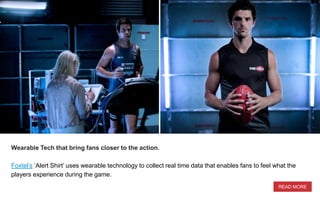
Wearable Tech that bring fans closer to the action.
Foxtel’s ‘Alert Shirt’ uses wearable technology to collect real time data that enables fans to feel what the
players experience during the game.
READ MORE
Re-imagining the
musical experience.
The power of virtual reality technology
promises to disrupt various industries. The
ability to enhance the sense of presence
makes it an exciting medium for live action
musical concerts.
Multi-sensory concerts through virtual
reality.
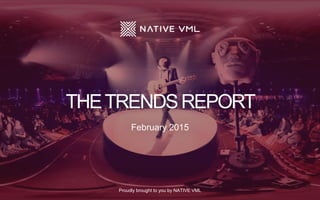
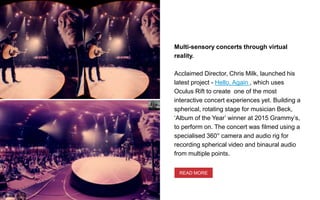
Acclaimed Director, Chris Milk, launched his
latest project - Hello, Again , which uses
Oculus Rift to create one of the most
interactive concert experiences yet. Building a
spherical, rotating stage for musician Beck,
‘Album of the Year’ winner at 2015 Grammy’s,
to perform on. The concert was filmed using a
specialised 360° camera and audio rig for
recording spherical video and binaural audio
from multiple points.
READ MORE
Virtual reality penetrating the mass market.
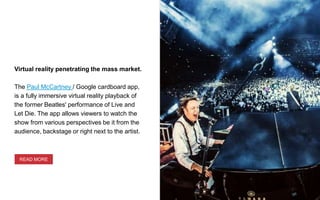
The Paul McCartney / Google cardboard app,
is a fully immersive virtual reality playback of
the former Beatles' performance of Live and
Let Die. The app allows viewers to watch the
show from various perspectives be it from the
audience, backstage or right next to the artist.
READ MORE
INNOVATION
Healthcare is increasingly moving away from
being reactive and episodic to becoming pre-
emptive and preventative, thereby
empowering consumers to manage and
monitor their own health.
Healthcare in your
hands.
Smart pen checks if you’re getting enough vitamins.
Vitastiq is a handheld device that combines data and the benefits of acupuncture, to allow
anyone to track their bodies’ vitamin and mineral levels.
READ MORE
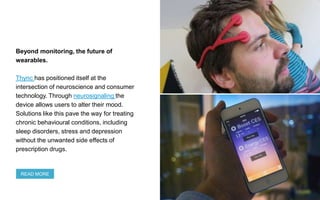
Beyond monitoring, the future of
wearables.
Thync has positioned itself at the
intersection of neuroscience and consumer
technology. Through neurosignaling the
device allows users to alter their mood.
Solutions like this pave the way for treating
chronic behavioural conditions, including
sleep disorders, stress and depression
without the unwanted side effects of
prescription drugs.
READ MORE
Until now, ecommerce has lacked instant
gratification. The challenge remains to
continually shorten the delivery process. The
future of online retail lies in utilising existing
data to determine future consumer purchases
to appropriately cater to even the most
specific of needs.
Pro-active
ecommerce
experiences.
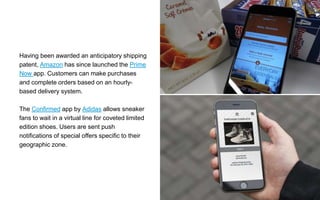
Having been awarded an anticipatory shipping
patent, Amazon has since launched the Prime
Now app. Customers can make purchases
and complete orders based on an hourly-
based delivery system.
The Confirmed app by Adidas allows sneaker
fans to wait in a virtual line for coveted limited
edition shoes. Users are sent push
notifications of special offers specific to their
geographic zone.
MOBILE, DATA AND
SOCIAL
The obsession around the need to measure
and quantify continues to grow. The
functionalities of wearables are allowing
people to tap into their most personal habits,
and potentially transform even the most basic
social interactions.
The quantification of
everything.
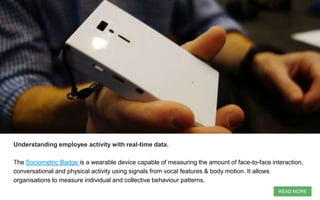
Understanding employee activity with real-time data.
The Sociometric Badge is a wearable device capable of measuring the amount of face-to-face interaction,
conversational and physical activity using signals from vocal features & body motion. It allows
organisations to measure individual and collective behaviour patterns.
READ MORE
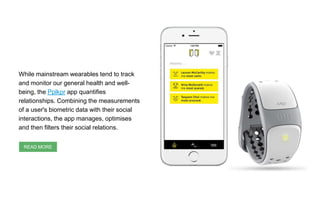
While mainstream wearables tend to track
and monitor our general health and well-
being, the Pplkpr app quantifies
relationships. Combining the measurements
of a user's biometric data with their social
interactions, the app manages, optimises
and then filters their social relations.
READ MORE
Today’s consumers transact online assuming
a high level of trust and transparency, but
major hacking incidents in 2014, have brought
data security and privacy concerns to the fore.
As consumers demand more personalised
experiences, the current systems are unable
to deliver on their expectations of privacy.
The expectations of
privacy.
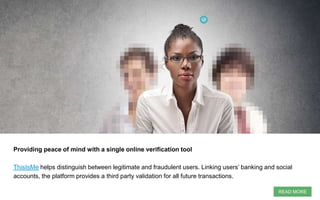
Providing peace of mind with a single online verification tool
ThisIsMe helps distinguish between legitimate and fraudulent users. Linking users’ banking and social
accounts, the platform provides a third party validation for all future transactions.
READ MORE
By 2020, the amount of digital information in
existence will have grown from 3.2 zettabytes
today to 40 zettabytes. With every like, click,
photo share, blog post and transaction,
consumers are provided compelling insights
into who they are. Yet despite the intrinsic
value of user-generated content, established
users are not receiving value for what they are
creating.
Examining social
media value.
Connecting content creators with brands.
Consumers, particularly Millennials, are
increasingly starting to think of themselves
as brands, curating their online image and
monetising it through social media and
micro-retail platforms. Tumblr announced the
Creatrs network, which connects artists to
content platforms and advertisers.
READ MORE
MARKETINGATTHE
SPEED OF
CULTURE
In our ever-changing digital culture, there is a
growing demand for brands to be braver.
Integrating low-risk, playful experimentation
and exploration into campaign strategies can
enhance the brand vision, while creating
meaningful and exciting consumer
experiences.
Playful marketing.
The Ice Bucket Challenge inspired people
to raise awareness of ALS by creating
compelling content around a fairly simple
concept; dunking yourself with a bucket of
ice water, then nominating friends and
family via social media to keep the cycle
going.
Combine the thrill of a simple challenge and
the emotional resonance of a deserving
cause and you have a campaign that will be
hard to replicate, proving just how powerful
earned media can be.
READ MORE
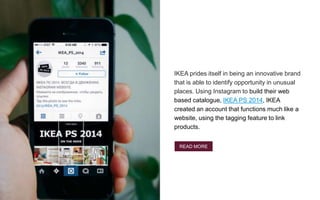
IKEA prides itself in being an innovative brand
that is able to identify opportunity in unusual
places. Using Instagram to build their web
based catalogue, IKEA PS 2014, IKEA
created an account that functions much like a
website, using the tagging feature to link
products.
Something
hacking
IKEA
READ MORE
Society is experiencing fundamental cultural
shifts due to the speed of change and
technological innovation. Consumers now
have a growing appetite for new experiences,
not new products. Winning marketing
strategies need to create carefully crafted,
personal and immersive experiences.
Experiences over
products.
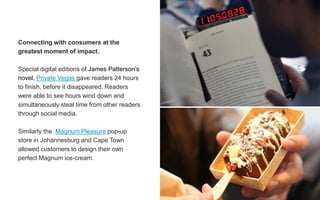
Connecting with consumers at the
greatest moment of impact.
Special digital editions of James Patterson’s
novel, Private Vegas gave readers 24 hours
to finish, before it disappeared. Readers
were able to see hours wind down and
simultaneously steal time from other readers
through social media.
Similarly the Magnum Pleasure pop-up
store in Johannesburg and Cape Town
allowed customers to design their own
perfect Magnum ice-cream.
STORYTELLING
Stories are a powerful and dynamic force,
justifying the status quo or acting as a catalyst
for change. For consumers demanding more
honesty from brands, the notion of brand
purpose is hugely important. Brands are
increasingly initiating the hard conversations
about our realities and moving towards
genuine storytelling.
Brand honesty.
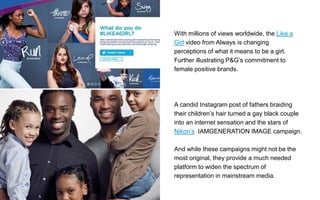
With millions of views worldwide, the Like a
Girl video from Always is changing
perceptions of what it means to be a girl.
Further illustrating P&G’s commitment to
female positive brands.
A candid Instagram post of fathers braiding
their children’s hair turned a gay black couple
into an internet sensation and the stars of
Nikon’s IAMGENERATION IMAGE campaign.
And while these campaigns might not be the
most original, they provide a much needed
platform to widen the spectrum of
representation in mainstream media.
Increasingly, all entertainment is becoming
grassroots-led and putting consumers centre
stage. The power of virtual reality allows story
makers and marketers alike, to engage
audiences through captivating, first person
interactions and narratives.
Virtual reality meets
storytelling.
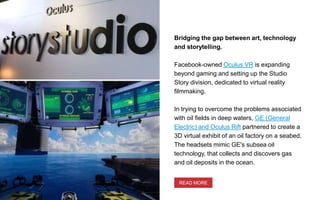
Bridging the gap between art, technology
and storytelling.
Facebook-owned Oculus VR is expanding
beyond gaming and setting up the Studio
Story division, dedicated to virtual reality
filmmaking.
In trying to overcome the problems associated
with oil fields in deep waters, GE (General
Electric) and Oculus Rift partnered to create a
3D virtual exhibit of an oil factory on a seabed.
The headsets mimic GE's subsea oil
technology, that collects and discovers gas
and oil deposits in the ocean.
READ MORE
WE ARE NATIVE VML

NATIVE VML Trends Report February 2015

  • 1.
  • 2.
    AMONTHLY SNAPSHOT OFTRENDS INMARKETING, STORYTELLINGANDDIGITALCULTURELOCALLYANDABROAD.
  • 3.
  • 4.
    Fan engagement of thefuture. As devices begin to perceive and process information like humans, a new world of possibility opens for brands to engage with audiences. Robotic and haptic technology now deliver tactile experiences to connect people, and brands.
  • 5.
    Wearable Tech thatbring fans closer to the action. Foxtel’s ‘Alert Shirt’ uses wearable technology to collect real time data that enables fans to feel what the players experience during the game. READ MORE
  • 6.
    Re-imagining the musical experience. Thepower of virtual reality technology promises to disrupt various industries. The ability to enhance the sense of presence makes it an exciting medium for live action musical concerts.
  • 7.
    Multi-sensory concerts throughvirtual reality. Acclaimed Director, Chris Milk, launched his latest project - Hello, Again , which uses Oculus Rift to create one of the most interactive concert experiences yet. Building a spherical, rotating stage for musician Beck, ‘Album of the Year’ winner at 2015 Grammy’s, to perform on. The concert was filmed using a specialised 360° camera and audio rig for recording spherical video and binaural audio from multiple points. READ MORE
  • 8.
    Virtual reality penetratingthe mass market. The Paul McCartney / Google cardboard app, is a fully immersive virtual reality playback of the former Beatles' performance of Live and Let Die. The app allows viewers to watch the show from various perspectives be it from the audience, backstage or right next to the artist. READ MORE
  • 9.
  • 10.
    Healthcare is increasinglymoving away from being reactive and episodic to becoming pre- emptive and preventative, thereby empowering consumers to manage and monitor their own health. Healthcare in your hands.
  • 11.
    Smart pen checksif you’re getting enough vitamins. Vitastiq is a handheld device that combines data and the benefits of acupuncture, to allow anyone to track their bodies’ vitamin and mineral levels. READ MORE
  • 12.
    Beyond monitoring, thefuture of wearables. Thync has positioned itself at the intersection of neuroscience and consumer technology. Through neurosignaling the device allows users to alter their mood. Solutions like this pave the way for treating chronic behavioural conditions, including sleep disorders, stress and depression without the unwanted side effects of prescription drugs. READ MORE
  • 13.
    Until now, ecommercehas lacked instant gratification. The challenge remains to continually shorten the delivery process. The future of online retail lies in utilising existing data to determine future consumer purchases to appropriately cater to even the most specific of needs. Pro-active ecommerce experiences.
  • 14.
    Having been awardedan anticipatory shipping patent, Amazon has since launched the Prime Now app. Customers can make purchases and complete orders based on an hourly- based delivery system. The Confirmed app by Adidas allows sneaker fans to wait in a virtual line for coveted limited edition shoes. Users are sent push notifications of special offers specific to their geographic zone.
  • 15.
  • 16.
    The obsession aroundthe need to measure and quantify continues to grow. The functionalities of wearables are allowing people to tap into their most personal habits, and potentially transform even the most basic social interactions. The quantification of everything.
  • 17.
    Understanding employee activitywith real-time data. The Sociometric Badge is a wearable device capable of measuring the amount of face-to-face interaction, conversational and physical activity using signals from vocal features & body motion. It allows organisations to measure individual and collective behaviour patterns. READ MORE
  • 18.
    While mainstream wearablestend to track and monitor our general health and well- being, the Pplkpr app quantifies relationships. Combining the measurements of a user's biometric data with their social interactions, the app manages, optimises and then filters their social relations. READ MORE
  • 19.
    Today’s consumers transactonline assuming a high level of trust and transparency, but major hacking incidents in 2014, have brought data security and privacy concerns to the fore. As consumers demand more personalised experiences, the current systems are unable to deliver on their expectations of privacy. The expectations of privacy.
  • 20.
    Providing peace ofmind with a single online verification tool ThisIsMe helps distinguish between legitimate and fraudulent users. Linking users’ banking and social accounts, the platform provides a third party validation for all future transactions. READ MORE
  • 21.
    By 2020, theamount of digital information in existence will have grown from 3.2 zettabytes today to 40 zettabytes. With every like, click, photo share, blog post and transaction, consumers are provided compelling insights into who they are. Yet despite the intrinsic value of user-generated content, established users are not receiving value for what they are creating. Examining social media value.
  • 22.
    Connecting content creatorswith brands. Consumers, particularly Millennials, are increasingly starting to think of themselves as brands, curating their online image and monetising it through social media and micro-retail platforms. Tumblr announced the Creatrs network, which connects artists to content platforms and advertisers. READ MORE
  • 23.
  • 24.
    In our ever-changingdigital culture, there is a growing demand for brands to be braver. Integrating low-risk, playful experimentation and exploration into campaign strategies can enhance the brand vision, while creating meaningful and exciting consumer experiences. Playful marketing.
  • 25.
    The Ice BucketChallenge inspired people to raise awareness of ALS by creating compelling content around a fairly simple concept; dunking yourself with a bucket of ice water, then nominating friends and family via social media to keep the cycle going. Combine the thrill of a simple challenge and the emotional resonance of a deserving cause and you have a campaign that will be hard to replicate, proving just how powerful earned media can be. READ MORE
  • 26.
    IKEA prides itselfin being an innovative brand that is able to identify opportunity in unusual places. Using Instagram to build their web based catalogue, IKEA PS 2014, IKEA created an account that functions much like a website, using the tagging feature to link products. Something hacking IKEA READ MORE
  • 27.
    Society is experiencingfundamental cultural shifts due to the speed of change and technological innovation. Consumers now have a growing appetite for new experiences, not new products. Winning marketing strategies need to create carefully crafted, personal and immersive experiences. Experiences over products.
  • 28.
    Connecting with consumersat the greatest moment of impact. Special digital editions of James Patterson’s novel, Private Vegas gave readers 24 hours to finish, before it disappeared. Readers were able to see hours wind down and simultaneously steal time from other readers through social media. Similarly the Magnum Pleasure pop-up store in Johannesburg and Cape Town allowed customers to design their own perfect Magnum ice-cream.
  • 29.
  • 30.
    Stories are apowerful and dynamic force, justifying the status quo or acting as a catalyst for change. For consumers demanding more honesty from brands, the notion of brand purpose is hugely important. Brands are increasingly initiating the hard conversations about our realities and moving towards genuine storytelling. Brand honesty.
  • 31.
    With millions ofviews worldwide, the Like a Girl video from Always is changing perceptions of what it means to be a girl. Further illustrating P&G’s commitment to female positive brands. A candid Instagram post of fathers braiding their children’s hair turned a gay black couple into an internet sensation and the stars of Nikon’s IAMGENERATION IMAGE campaign. And while these campaigns might not be the most original, they provide a much needed platform to widen the spectrum of representation in mainstream media.
  • 32.
    Increasingly, all entertainmentis becoming grassroots-led and putting consumers centre stage. The power of virtual reality allows story makers and marketers alike, to engage audiences through captivating, first person interactions and narratives. Virtual reality meets storytelling.
  • 33.
    Bridging the gapbetween art, technology and storytelling. Facebook-owned Oculus VR is expanding beyond gaming and setting up the Studio Story division, dedicated to virtual reality filmmaking. In trying to overcome the problems associated with oil fields in deep waters, GE (General Electric) and Oculus Rift partnered to create a 3D virtual exhibit of an oil factory on a seabed. The headsets mimic GE's subsea oil technology, that collects and discovers gas and oil deposits in the ocean. READ MORE
  • 34.