2013
Trends
2013 is going to be a

BIG
year
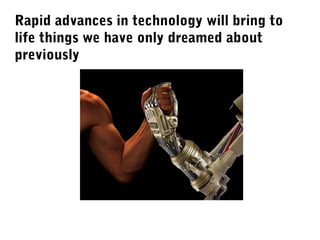
Rapid advances in technology will bring to
life things we have only dreamed about
previously
for example:
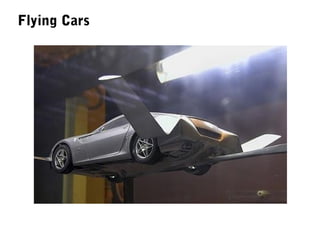
Flying Cars
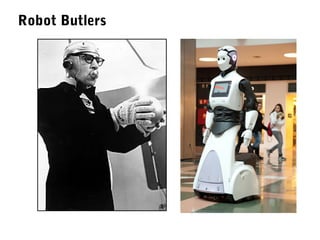
Robot Butlers
Personal Jetpacks
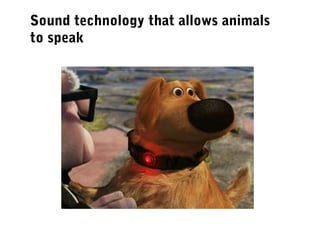
Sound technology that allows animals
to speak
the reality:
2013 will be less a

Revolution
and more an

Evolution
What does this mean??

It means an expansion of what we already
have.
It means essentially the same technology,
devices and behaviors…
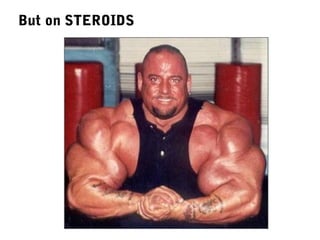
But on STEROIDS
7 Things to watch for in 2013:
1. Personalization and Customization
2. Advanced, Integrated Products
3. More Mobility Than Ever
4. Social Grows Up
5. Advertising Gets Smart
6. Intelligent Objects
7. Better Use of Data
1. Personalization and Customization
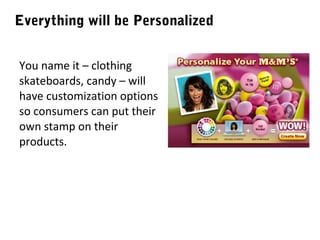
Everything will be Personalized
You name it – clothing
skateboards, candy – will
have customization options
so consumers can put their
own stamp on their
products.
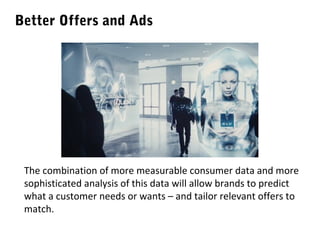
Better Offers and Ads

The combination of more measurable consumer data and more
sophisticated analysis of this data will allow brands to predict
what a customer needs or wants – and tailor relevant offers to
match.
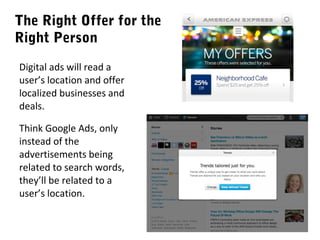
The Right Offer for the
Right Person
Digital ads will read a
user’s location and offer
localized businesses and
deals.
Think Google Ads, only
instead of the
advertisements being
related to search words,
they’ll be related to a
user’s location.
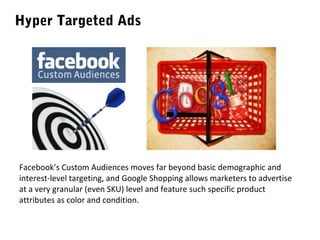
Hyper Targeted Ads

Facebook’s Custom Audiences moves far beyond basic demographic and
interest-level targeting, and Google Shopping allows marketers to advertise
at a very granular (even SKU) level and feature such specific product
attributes as color and condition.
2. Advanced, Integrated Products
Touch
Highly flexible touch sensors
are entering the smartphone
and tablet markets. They are
extending touch capabilities into
a range of new products, with
designs that are lighter, thinner
and sleeker, including excellent
optical clarity, low power
consumption and at lower cost.
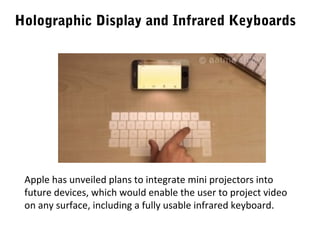
Holographic Display and Infrared Keyboards

Apple has unveiled plans to integrate mini projectors into
future devices, which would enable the user to project video
on any surface, including a fully usable infrared keyboard.
Integrated Devices: The Phablet
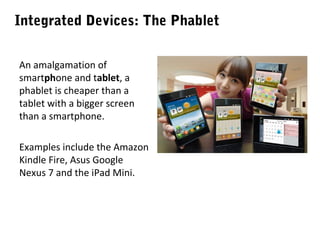
An amalgamation of
smartphone and tablet, a
phablet is cheaper than a
tablet with a bigger screen
than a smartphone.
Examples include the Amazon
Kindle Fire, Asus Google
Nexus 7 and the iPad Mini.
Integrated Experiences: Reading

Users are expecting a highly integrated experience as they move from the Web to
mobile devices and back.
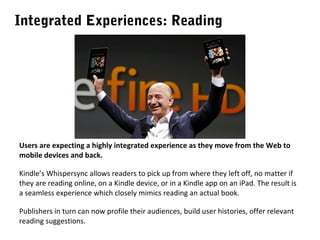
Kindle’s Whispersync allows readers to pick up from where they left off, no matter if
they are reading online, on a Kindle device, or in a Kindle app on an iPad. The result is
a seamless experience which closely mimics reading an actual book.
Publishers in turn can now profile their audiences, build user histories, offer relevant
reading suggestions.
Integrated Experiences: TV
Rather than visiting websites completely
unrelated to the programs they’re
watching, activity on the
tablet/laptop/phone and on TV is
becoming increasingly integrated.
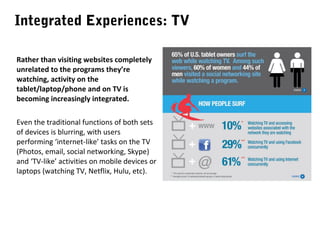
Even the traditional functions of both sets
of devices is blurring, with users
performing ‘internet-like’ tasks on the TV
(Photos, email, social networking, Skype)
and ‘TV-like’ activities on mobile devices or
laptops (watching TV, Netflix, Hulu, etc).
3. More Mobility Than Ever
Proliferation in Mobile Devices
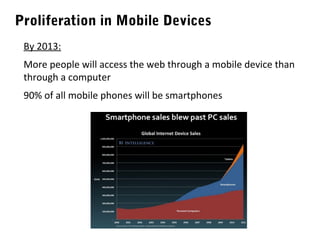
By 2013:
More people will access the web through a mobile device than
through a computer
90% of all mobile phones will be smartphones
Mobile Shopping
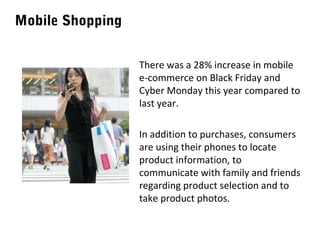
There was a 28% increase in mobile
e-commerce on Black Friday and
Cyber Monday this year compared to
last year.
In addition to purchases, consumers
are using their phones to locate
product information, to
communicate with family and friends
regarding product selection and to
take product photos.
Mobile Payments

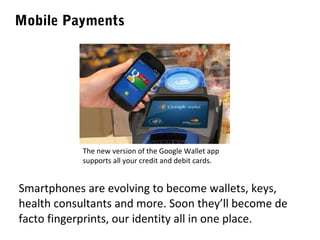
The new version of the Google Wallet app
supports all your credit and debit cards.

Smartphones are evolving to become wallets, keys,
health consultants and more. Soon they’ll become de
facto fingerprints, our identity all in one place.
Mobile-Centric Services

A number of services are emerging to batter cater to our increasingly ‘on-the-’go’ lifestyle.

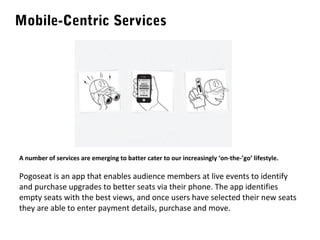
Pogoseat is an app that enables audience members at live events to identify
and purchase upgrades to better seats via their phone. The app identifies
empty seats with the best views, and once users have selected their new seats
they are able to enter payment details, purchase and move.
4. Social Grows Up
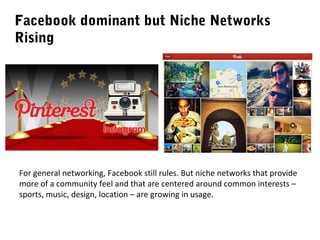
Facebook dominant but Niche Networks
Rising

For general networking, Facebook still rules. But niche networks that provide
more of a community feel and that are centered around common interests –
sports, music, design, location – are growing in usage.
Branded Communities

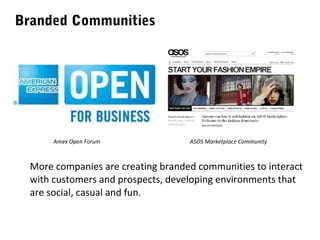
Amex Open Forum

ASOS Marketplace Community

More companies are creating branded communities to interact
with customers and prospects, developing environments that
are social, casual and fun.
Social Goes Global
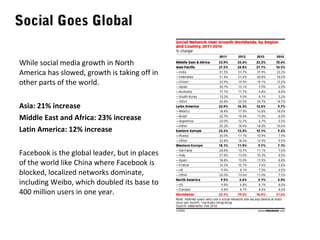
While social media growth in North
America has slowed, growth is taking off in
other parts of the world.
Asia: 21% increase
Middle East and Africa: 23% increase
Latin America: 12% increase
Facebook is the global leader, but in places
of the world like China where Facebook is
blocked, localized networks dominate,
including Weibo, which doubled its base to
400 million users in one year.
Social Data

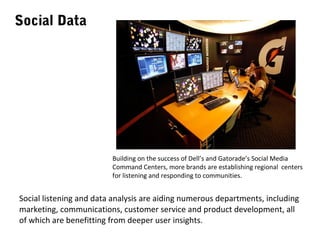
Building on the success of Dell’s and Gatorade’s Social Media
Command Centers, more brands are establishing regional centers
for listening and responding to communities.

Social listening and data analysis are aiding numerous departments, including
marketing, communications, customer service and product development, all
of which are benefitting from deeper user insights.
5. Advertising Gets Smart
New ways to reach consumers

Mobile technology is allowing
brands to turn anything – from bus
shelters to print magazines – into
retail channels.
Shopping is shifting from an activity
that takes place in physical stores or
online to a value exchange that can
play out in multiple ways.

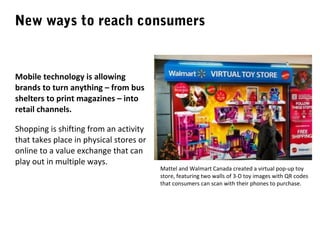
Mattel and Walmart Canada created a virtual pop-up toy
store, featuring two walls of 3-D toy images with QR codes
that consumers can scan with their phones to purchase.
Branded Entertainment

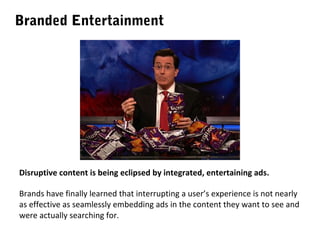
Disruptive content is being eclipsed by integrated, entertaining ads.
Brands have finally learned that interrupting a user’s experience is not nearly
as effective as seamlessly embedding ads in the content they want to see and
were actually searching for.
Native Advertising

Native advertising underpins Google search ads,
and it’s also why billions of dollars of ad revenue
have shifted to closed platforms like Facebook
(Sponsored Stories), Twitter (Promoted Tweets),
and YouTube (TrueView Promoted Videos).
Ads that are native to a site don’t live in the
corners and don’t interrupt the user; they exist
in the stream of content, and bring value to the
user in the form of brand content — promoted
videos, sponsored stories, relevant coupons,
promoted posts, etc.

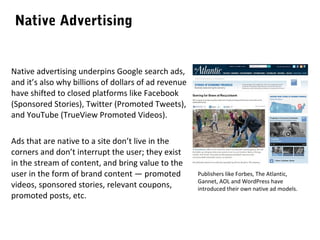
Publishers like Forbes, The Atlantic,
Gannet, AOL and WordPress have
introduced their own native ad models.
Content is King
Brands are following the
lead of Nike, Coke, Old Spice,
Apple, Adobe, and GE and
are creating quality
content to distribute
through native ad formats
on Facebook, Twitter,
WordPress and beyond.

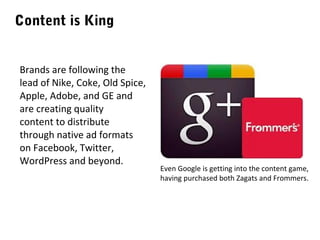
Even Google is getting into the content game,
having purchased both Zagats and Frommers.
Everyone is a Content Creator

•
•

•

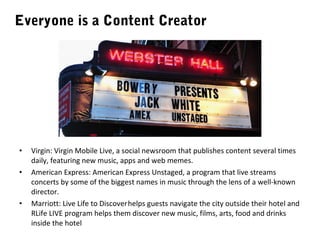
Virgin: Virgin Mobile Live, a social newsroom that publishes content several times
daily, featuring new music, apps and web memes.
American Express: American Express Unstaged, a program that live streams
concerts by some of the biggest names in music through the lens of a well-known
director.
Marriott: Live Life to Discover helps guests navigate the city outside their hotel and
RLife LIVE program helps them discover new music, films, arts, food and drinks
inside the hotel
Common “Content Factory” Elements:
• Story planning that relates to brand and sales goals
• Multimedia content including videos, images and infographics
• Using brand journalists to mine for stories within the
organization
• Utilizing a data-driven approach
• Thoughtful publishing of content to increase engagement on
social networks like Facebook and Twitter
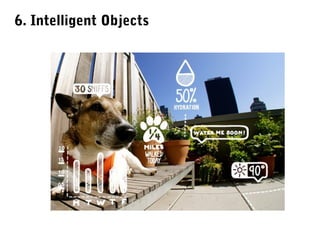
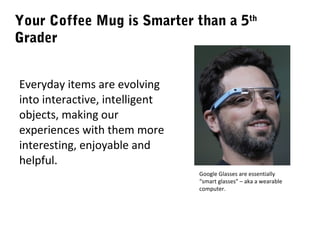
6. Intelligent Objects
Your Coffee Mug is Smarter than a 5th
Grader
Everyday items are evolving
into interactive, intelligent
objects, making our
experiences with them more
interesting, enjoyable and
helpful.
Google Glasses are essentially
“smart glasses” – aka a wearable
computer.
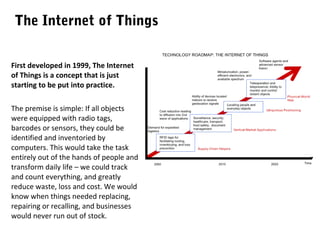
The Internet of Things
First developed in 1999, The Internet
of Things is a concept that is just
starting to be put into practice.
The premise is simple: If all objects
were equipped with radio tags,
barcodes or sensors, they could be
identified and inventoried by
computers. This would take the task
entirely out of the hands of people and
transform daily life – we could track
and count everything, and greatly
reduce waste, loss and cost. We would
know when things needed replacing,
repairing or recalling, and businesses
would never run out of stock.
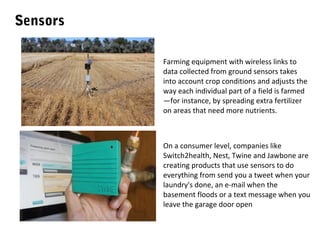
Sensors
Farming equipment with wireless links to
data collected from ground sensors takes
into account crop conditions and adjusts the
way each individual part of a field is farmed
—for instance, by spreading extra fertilizer
on areas that need more nutrients.

On a consumer level, companies like
Switch2health, Nest, Twine and Jawbone are
creating products that use sensors to do
everything from send you a tweet when your
laundry's done, an e-mail when the
basement floods or a text message when you
leave the garage door open
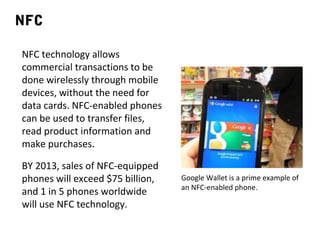
NFC
NFC technology allows
commercial transactions to be
done wirelessly through mobile
devices, without the need for
data cards. NFC-enabled phones
can be used to transfer files,
read product information and
make purchases.
BY 2013, sales of NFC-equipped
phones will exceed $75 billion,
and 1 in 5 phones worldwide
will use NFC technology.

Google Wallet is a prime example of
an NFC-enabled phone.
7. Better Use of Data
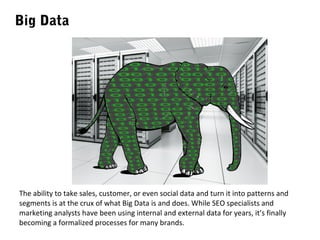
Big Data

The ability to take sales, customer, or even social data and turn it into patterns and
segments is at the crux of what Big Data is and does. While SEO specialists and
marketing analysts have been using internal and external data for years, it’s finally
becoming a formalized processes for many brands.
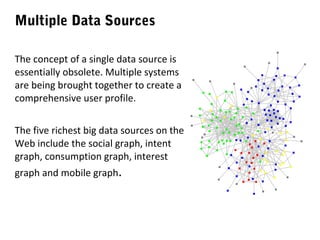
Multiple Data Sources
The concept of a single data source is
essentially obsolete. Multiple systems
are being brought together to create a
comprehensive user profile.
The five richest big data sources on the
Web include the social graph, intent
graph, consumption graph, interest
graph and mobile graph.
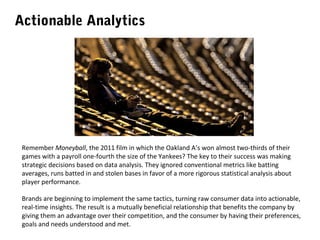
Actionable Analytics

Remember Moneyball, the 2011 film in which the Oakland A’s won almost two-thirds of their
games with a payroll one-fourth the size of the Yankees? The key to their success was making
strategic decisions based on data analysis. They ignored conventional metrics like batting
averages, runs batted in and stolen bases in favor of a more rigorous statistical analysis about
player performance.
Brands are beginning to implement the same tactics, turning raw consumer data into actionable,
real-time insights. The result is a mutually beneficial relationship that benefits the company by
giving them an advantage over their competition, and the consumer by having their preferences,
goals and needs understood and met.
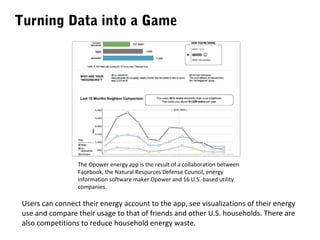
Turning Data into a Game

The Opower energy app is the result of a collaboration between
Facebook, the Natural Resources Defense Council, energy
information software maker Opower and 16 U.S.-based utility
companies.

Users can connect their energy account to the app, see visualizations of their energy
use and compare their usage to that of friends and other U.S. households. There are
also competitions to reduce household energy waste.
Final Thought
The best way to predict the future?
INVENT

IT
Thank you
Questions?
Russ Josephs
Sr. Digital Strategist
Atmosphere Proximity
1285 Avenue of the Americas
New York, NY 10019
Russ.Josephs@atmosphereproximity.com