SOCIAL STUDIES
III TERM
PLEA
Type of text: Expositive Format: Continuous
Sources:
https://www.ducksters.com/history/native_american_tribes_regions.php
https://kids.nationalgeographic.com/explore/native-americans/
Topic: The American ancient civilizations Comprehension goal: What is the cultural legacy of pre-
Columbian civilizations?
Reading level: Literal, inferential and critic
Reading strategies:
Before the reading:
1. Prior knowledge activation: What do I know about the topic?
During the reading:
1. 1.Select important information: use of macro rules, diagram.
After the reading:
1. Agreements and disagreements.
Habilidad (s) de lectura: Evidencia de Aprendizaje:
 Recover explicit information in the content
of the text.
 Selects prompt information about what, who, when, where,
why and how of the text.
 Selects relevant information about the text.
Multidisciplinary evidences.
 Identify economic, politic and cultural factors that have generated the native civilizations of North America.
BEFORE:
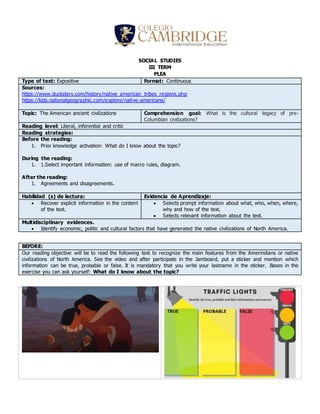
Our reading objective will be to read the following text to recognize the main features from the Amerindians or native
civilizations of North America. See the video and after participate in the Jamboard, put a sticker and mention which
information can be true, probable or false. It is mandatory that you write your lastname in the sticker. Bases in the
exercise you can ask yourself: What do I know about the topic?
DURING:
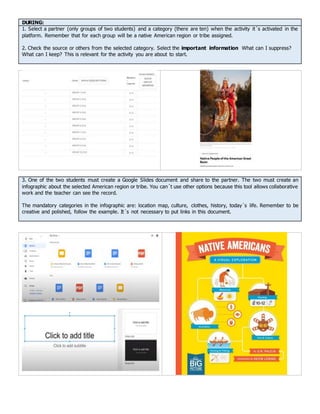
1. Select a partner (only groups of two students) and a category (there are ten) when the activity it´s activated in the
platform. Remember that for each group will be a native American region or tribe assigned.
2. Check the source or others from the selected category. Select the important information What can I suppress?
What can I keep? This is relevant for the activity you are about to start.
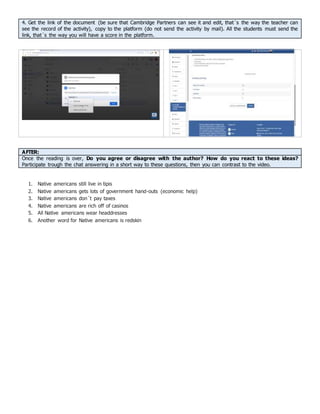
3. One of the two students must create a Google Slides document and share to the partner. The two must create an
infographic about the selected American region or tribe. You can´t use other options because this tool allows collaborative
work and the teacher can see the record.
The mandatory categories in the infographic are: location map, culture, clothes, history, today´s life. Remember to be
creative and polished, follow the example. It´s not necessary to put links in this document.
4. Get the link of the document (be sure that Cambridge Partners can see it and edit, that´s the way the teacher can
see the record of the activity), copy to the platform (do not send the activity by mail). All the students must send the
link, that´s the way you will have a score in the platform.
AFTER:
Once the reading is over, Do you agree or disagree with the author? How do you react to these ideas?
Participate trough the chat answering in a short way to these questions, then you can contrast to the video.
1. Native americans still live in tipis
2. Native americans gets lots of government hand-outs (economic help)
3. Native americans don´t pay taxes
4. Native americans are rich off of casinos
5. All Native americans wear headdresses
6. Another word for Native americans is redskin

Native americans (plea)

  • 1.
    SOCIAL STUDIES III TERM PLEA Typeof text: Expositive Format: Continuous Sources: https://www.ducksters.com/history/native_american_tribes_regions.php https://kids.nationalgeographic.com/explore/native-americans/ Topic: The American ancient civilizations Comprehension goal: What is the cultural legacy of pre- Columbian civilizations? Reading level: Literal, inferential and critic Reading strategies: Before the reading: 1. Prior knowledge activation: What do I know about the topic? During the reading: 1. 1.Select important information: use of macro rules, diagram. After the reading: 1. Agreements and disagreements. Habilidad (s) de lectura: Evidencia de Aprendizaje:  Recover explicit information in the content of the text.  Selects prompt information about what, who, when, where, why and how of the text.  Selects relevant information about the text. Multidisciplinary evidences.  Identify economic, politic and cultural factors that have generated the native civilizations of North America. BEFORE: Our reading objective will be to read the following text to recognize the main features from the Amerindians or native civilizations of North America. See the video and after participate in the Jamboard, put a sticker and mention which information can be true, probable or false. It is mandatory that you write your lastname in the sticker. Bases in the exercise you can ask yourself: What do I know about the topic?
  • 2.
    DURING: 1. Select apartner (only groups of two students) and a category (there are ten) when the activity it´s activated in the platform. Remember that for each group will be a native American region or tribe assigned. 2. Check the source or others from the selected category. Select the important information What can I suppress? What can I keep? This is relevant for the activity you are about to start. 3. One of the two students must create a Google Slides document and share to the partner. The two must create an infographic about the selected American region or tribe. You can´t use other options because this tool allows collaborative work and the teacher can see the record. The mandatory categories in the infographic are: location map, culture, clothes, history, today´s life. Remember to be creative and polished, follow the example. It´s not necessary to put links in this document.
  • 3.
    4. Get thelink of the document (be sure that Cambridge Partners can see it and edit, that´s the way the teacher can see the record of the activity), copy to the platform (do not send the activity by mail). All the students must send the link, that´s the way you will have a score in the platform. AFTER: Once the reading is over, Do you agree or disagree with the author? How do you react to these ideas? Participate trough the chat answering in a short way to these questions, then you can contrast to the video. 1. Native americans still live in tipis 2. Native americans gets lots of government hand-outs (economic help) 3. Native americans don´t pay taxes 4. Native americans are rich off of casinos 5. All Native americans wear headdresses 6. Another word for Native americans is redskin