NATIONAL POPULATION POLICY
Mrs. Namita Batra Guin
Associate Professor
Introduction
• 16% of the world’s population is Indian, occupying 2.4% of the total
globe’s land area.
• Every 6th person on the globe is an Indian, and by turn of the
century, every 5th person on the planet will become Indian.
• India adds one Australia every eight months
• By 2045, India will overtake China, if current rates persists.
• 49% of the Indian population comes from 4 states- Bihar, Rajasthan,
Madhya Pradesh and Uttar Pradesh.
• India adds about 10lakh persons to its population every fortnight.
Population Explosion
• A phenomenon of the size of a population
tending to a very large number in a finite
interval of time is called as population
explosion.
Causes of Population Explosion
• Widening gap between birth rate and death rate
• Low age at marriage
• Unfavorable religious attitude towards family planning
• Gender differences
• Socio-economic status of the family particularly status of the women in
decision making
• Importance of male child
• Lack of information
• Lack of choice of contraceptives
• Poor services of family planning
• Poverty
EFFECTS of Population Explosion
• Living standards of the population- homeless, unsafe drinking water,
illiterate, underweight, malnourished, overcrowded house etc.
• Rise in crime and violence
• Unemployment
• Poverty
• Famine- lack of cooking fuel, food.
• Lack of facilities
• Poor sanitation services
• Environmental degradation
• Deforestation
REASONS FOR FAILURE TO CONTROLPopulation
Explosion
• Lack of political commitment
• Lack of people participation
• Lack of quality health services
• Lack of education
• Lack of overall development
• Lack of appropriate technology
• Lack of transparent administration
• Lack of women empowerment
MILESTONES POPULATION POLICY 2000
• 1948- Bhore committee
• 1952- family planning program
• 1976- statement of population policy
• 1977- policy statement on family welfare program
• 1983- NHP, with a goal of NRR=1
• 1991- National development council appointed a Committee on population
• 1993- Dr. MS Swaminathan report on National population was submitted
• 1997- draft of NPP was approved by the cabinet, but could not be placed in both the
houses.
• 1999- another draft of the policy was finalised which was later approved and
launched as NPP2000.
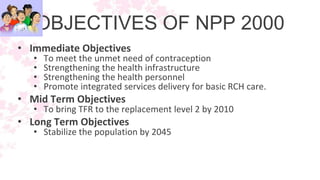
OBJECTIVES OF NPP 2000
• Immediate Objectives
• To meet the unmet need of contraception
• Strengthening the health infrastructure
• Strengthening the health personnel
• Promote integrated services delivery for basic RCH care.
• Mid Term Objectives
• To bring TFR to the replacement level 2 by 2010
• Long Term Objectives
• Stabilize the population by 2045
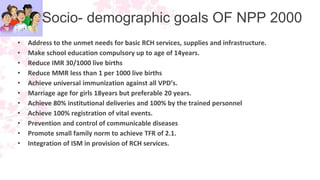
Socio- demographic goals OF NPP 2000
• Address to the unmet needs for basic RCH services, supplies and infrastructure.
• Make school education compulsory up to age of 14years.
• Reduce IMR 30/1000 live births
• Reduce MMR less than 1 per 1000 live births
• Achieve universal immunization against all VPD’s.
• Marriage age for girls 18years but preferable 20 years.
• Achieve 80% institutional deliveries and 100% by the trained personnel
• Achieve 100% registration of vital events.
• Prevention and control of communicable diseases
• Promote small family norm to achieve TFR of 2.1.
• Integration of ISM in provision of RCH services.
STRATEGIES NPP 2000
• Decentralized planning and program and
implementation
73rd and 74th amendments in the constitution
made health, family welfare and education a
responsibility of village Panchayat Raj
Institutions (PRI). 33% of the PRI seats are
reserved for women.
STRATEGIES NPP 2000
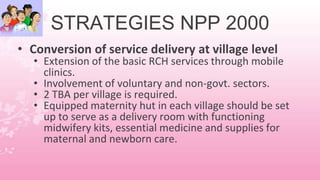
• Conversion of service delivery at village level
• Extension of the basic RCH services through mobile
clinics.
• Involvement of voluntary and non-govt. sectors.
• 2 TBA per village is required.
• Equipped maternity hut in each village should be set
up to serve as a delivery room with functioning
midwifery kits, essential medicine and supplies for
maternal and newborn care.
STRATEGIES NPP 2000
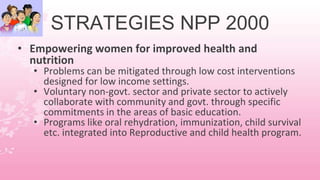
• Empowering women for improved health and
nutrition
• Problems can be mitigated through low cost interventions
designed for low income settings.
• Voluntary non-govt. sector and private sector to actively
collaborate with community and govt. through specific
commitments in the areas of basic education.
• Programs like oral rehydration, immunization, child survival
etc. integrated into Reproductive and child health program.
STRATEGIES NPP 2000
• Child survival and child health
• Priority to intensified neonatal care.
• National Technical Committee to set up, consisting of
consultants in Obstetrics, pediatrics, family health,
medical research and biostatistician.
• Improving the education for all perinatal health care
providers.
• Baby friendly hospital initiative (BFHI), to be extended
to all hospitals and clinics up to the sub centers.
STRATEGIES NPP 2000
• Meeting the unmet needs for the Family Welfare
Services
• strengthen the infrastructure at village, sub center
and primary health center
• Improve the facilities for referral transportation
• Encourage and strengthen local initiatives for
ambulance services at village and block levels
• Increase innovative social marketing schemes
STRATEGIES NPP 2000
• Greater emphasis for the underserved
population group
• Urban slums- basic and primary health care services
need to be provided.
• Coordination with municipal bodies of water,
sanitation etc.
• Campaigning regarding secondary and tertiary facilities
available
STRATEGIES NPP 2000
• Greater emphasis for the underserved
population group
• Tribal communities, hill areas and migrant
population- special attention on RCH services, basic
health.
• Provision for mobile clinics
• Information and counseling on infertility and regular
supply of standardized medication.
STRATEGIES NPP 2000
• Greater emphasis for the underserved
population group
• Adolescent- programs related to education and
delayed marriage should be encouraged.
• RCH services should be provided to adolescent girls
and boys of rural India.
• Enforcement of the Child Marriage Restraint Act, 1976.
STRATEGIES NPP 2000
• Greater emphasis for the underserved
population group
• Increased participation of men in planned
parenthood- active involvement of men for planning
families, supporting contraceptive use etc. should be
encouraged
• Re-popularization of the vasectomies- NSV, as safe and
simplest methods.
STRATEGIES NPP 2000
• Diverse health care provider
• Private practitioners need to be accredited and
assigned with defined beneficiary groups.
• Need to revive system of licensed medical
practitioners.
STRATEGIES NPP 2000
• Collaboration with and commitments from
private agencies and NGOs:
• Mobilize the private sector to serve public health
goals.
• Issues related to PPP should be addressed
carefully.
STRATEGIES NPP 2000
• Involvement of ISM in RCH services
• ISM&H should be utilized in basic RCH service delivery.
• Optimize utilization of locally based remedies and
cures and promote low cost health care.
• Guidelines to ensure standardization, efficacy and
safety of ISM&H drugs for wider entry into national
markets.
STRATEGIES NPP 2000
• Contraceptive technology and research in RCH:
• ISMH academic and research institutions to be
engaged in the social, demographic and behavioral
research.
• Population research centers need to be revitalized and
strengthened.
• Strengthening of MIS.
STRATEGIES NPP 2000
• Information, education and communication
• Massive campaigns on population related issues to
be undertaken.
• Doctors, vaidyas, hakims, nurses, local midwives,
women’s organization, youth organization and
popular stars can be utilized for the campaigns.
STRATEGIES NPP 2000
• Legislation
• 42nd Constitutional amendment allows seats of
both the houses to be frozen on the basis of 1971
census till 2026.
• It is a disincentive for poor performing states like
U.P. and M.P etc.
STRATEGIES NPP 2000
• NEW STRUCTURE
• National level: National Commission on Population,
to be chaired by PM and all chief ministers.
• State level: State level commission on population.
Coordination cell for intersectoral coordination and
technology support for designing and monitoring
projects at state level.
STRATEGIES NPP 2000
• Promotional an motivational measures for adoption of small family norm
• Panchayats and Zila parishads to be awarded for best performances
• Balika Samridhi Yojana provide cash incentive Rs.500 at birth of a girl child of
birth order 1 or 2.
• Maternity benefit scheme provide cash incentive to mothers who have their
first child after 19yrs of age.
• Couples of BPL families to be rewarded for their active involvement in family
planning.
• Village level self help groups will be set up.
• Innovated social marketing schemes will be promoted.
• Ambulance services at village level will be strengthened.
• Increased vocational training for girls
• Strict enforcement of PNDT Act, 1994.
STRATEGIES NPP 2000
• Implementation
• Empowered Action Group has been constituted under the
chairmanship of Union Minister of health and family welfare.
• National Commission of population has been constituted and many
state commission on the same lines have been established in many
states.
• State population policies have been formulated in many states.
Jansankhya Sthiratha Kosh
• National population stabilization fund was renamed and registered as
JSK in June 2003.
• Objective is the attainment of the goals of NPP 2000
• Fund supports the programs, projects, schemes, initiatives and
innovative ideas designed by Govt., NGO’s etc.
• General body of JSK is chaired by the Minister of health and family
welfare, while Governing Board is chaired by the Secretary (H&FW)

National population policy 2000 slideshare

  • 1.
    NATIONAL POPULATION POLICY Mrs.Namita Batra Guin Associate Professor
  • 2.
    Introduction • 16% ofthe world’s population is Indian, occupying 2.4% of the total globe’s land area. • Every 6th person on the globe is an Indian, and by turn of the century, every 5th person on the planet will become Indian. • India adds one Australia every eight months • By 2045, India will overtake China, if current rates persists. • 49% of the Indian population comes from 4 states- Bihar, Rajasthan, Madhya Pradesh and Uttar Pradesh. • India adds about 10lakh persons to its population every fortnight.
  • 3.
    Population Explosion • Aphenomenon of the size of a population tending to a very large number in a finite interval of time is called as population explosion.
  • 4.
    Causes of PopulationExplosion • Widening gap between birth rate and death rate • Low age at marriage • Unfavorable religious attitude towards family planning • Gender differences • Socio-economic status of the family particularly status of the women in decision making • Importance of male child • Lack of information • Lack of choice of contraceptives • Poor services of family planning • Poverty
  • 5.
    EFFECTS of PopulationExplosion • Living standards of the population- homeless, unsafe drinking water, illiterate, underweight, malnourished, overcrowded house etc. • Rise in crime and violence • Unemployment • Poverty • Famine- lack of cooking fuel, food. • Lack of facilities • Poor sanitation services • Environmental degradation • Deforestation
  • 6.
    REASONS FOR FAILURETO CONTROLPopulation Explosion • Lack of political commitment • Lack of people participation • Lack of quality health services • Lack of education • Lack of overall development • Lack of appropriate technology • Lack of transparent administration • Lack of women empowerment
  • 7.
    MILESTONES POPULATION POLICY2000 • 1948- Bhore committee • 1952- family planning program • 1976- statement of population policy • 1977- policy statement on family welfare program • 1983- NHP, with a goal of NRR=1 • 1991- National development council appointed a Committee on population • 1993- Dr. MS Swaminathan report on National population was submitted • 1997- draft of NPP was approved by the cabinet, but could not be placed in both the houses. • 1999- another draft of the policy was finalised which was later approved and launched as NPP2000.
  • 8.
    OBJECTIVES OF NPP2000 • Immediate Objectives • To meet the unmet need of contraception • Strengthening the health infrastructure • Strengthening the health personnel • Promote integrated services delivery for basic RCH care. • Mid Term Objectives • To bring TFR to the replacement level 2 by 2010 • Long Term Objectives • Stabilize the population by 2045
  • 9.
    Socio- demographic goalsOF NPP 2000 • Address to the unmet needs for basic RCH services, supplies and infrastructure. • Make school education compulsory up to age of 14years. • Reduce IMR 30/1000 live births • Reduce MMR less than 1 per 1000 live births • Achieve universal immunization against all VPD’s. • Marriage age for girls 18years but preferable 20 years. • Achieve 80% institutional deliveries and 100% by the trained personnel • Achieve 100% registration of vital events. • Prevention and control of communicable diseases • Promote small family norm to achieve TFR of 2.1. • Integration of ISM in provision of RCH services.
  • 10.
    STRATEGIES NPP 2000 •Decentralized planning and program and implementation 73rd and 74th amendments in the constitution made health, family welfare and education a responsibility of village Panchayat Raj Institutions (PRI). 33% of the PRI seats are reserved for women.
  • 11.
    STRATEGIES NPP 2000 •Conversion of service delivery at village level • Extension of the basic RCH services through mobile clinics. • Involvement of voluntary and non-govt. sectors. • 2 TBA per village is required. • Equipped maternity hut in each village should be set up to serve as a delivery room with functioning midwifery kits, essential medicine and supplies for maternal and newborn care.
  • 12.
    STRATEGIES NPP 2000 •Empowering women for improved health and nutrition • Problems can be mitigated through low cost interventions designed for low income settings. • Voluntary non-govt. sector and private sector to actively collaborate with community and govt. through specific commitments in the areas of basic education. • Programs like oral rehydration, immunization, child survival etc. integrated into Reproductive and child health program.
  • 13.
    STRATEGIES NPP 2000 •Child survival and child health • Priority to intensified neonatal care. • National Technical Committee to set up, consisting of consultants in Obstetrics, pediatrics, family health, medical research and biostatistician. • Improving the education for all perinatal health care providers. • Baby friendly hospital initiative (BFHI), to be extended to all hospitals and clinics up to the sub centers.
  • 14.
    STRATEGIES NPP 2000 •Meeting the unmet needs for the Family Welfare Services • strengthen the infrastructure at village, sub center and primary health center • Improve the facilities for referral transportation • Encourage and strengthen local initiatives for ambulance services at village and block levels • Increase innovative social marketing schemes
  • 15.
    STRATEGIES NPP 2000 •Greater emphasis for the underserved population group • Urban slums- basic and primary health care services need to be provided. • Coordination with municipal bodies of water, sanitation etc. • Campaigning regarding secondary and tertiary facilities available
  • 16.
    STRATEGIES NPP 2000 •Greater emphasis for the underserved population group • Tribal communities, hill areas and migrant population- special attention on RCH services, basic health. • Provision for mobile clinics • Information and counseling on infertility and regular supply of standardized medication.
  • 17.
    STRATEGIES NPP 2000 •Greater emphasis for the underserved population group • Adolescent- programs related to education and delayed marriage should be encouraged. • RCH services should be provided to adolescent girls and boys of rural India. • Enforcement of the Child Marriage Restraint Act, 1976.
  • 18.
    STRATEGIES NPP 2000 •Greater emphasis for the underserved population group • Increased participation of men in planned parenthood- active involvement of men for planning families, supporting contraceptive use etc. should be encouraged • Re-popularization of the vasectomies- NSV, as safe and simplest methods.
  • 19.
    STRATEGIES NPP 2000 •Diverse health care provider • Private practitioners need to be accredited and assigned with defined beneficiary groups. • Need to revive system of licensed medical practitioners.
  • 20.
    STRATEGIES NPP 2000 •Collaboration with and commitments from private agencies and NGOs: • Mobilize the private sector to serve public health goals. • Issues related to PPP should be addressed carefully.
  • 21.
    STRATEGIES NPP 2000 •Involvement of ISM in RCH services • ISM&H should be utilized in basic RCH service delivery. • Optimize utilization of locally based remedies and cures and promote low cost health care. • Guidelines to ensure standardization, efficacy and safety of ISM&H drugs for wider entry into national markets.
  • 22.
    STRATEGIES NPP 2000 •Contraceptive technology and research in RCH: • ISMH academic and research institutions to be engaged in the social, demographic and behavioral research. • Population research centers need to be revitalized and strengthened. • Strengthening of MIS.
  • 23.
    STRATEGIES NPP 2000 •Information, education and communication • Massive campaigns on population related issues to be undertaken. • Doctors, vaidyas, hakims, nurses, local midwives, women’s organization, youth organization and popular stars can be utilized for the campaigns.
  • 24.
    STRATEGIES NPP 2000 •Legislation • 42nd Constitutional amendment allows seats of both the houses to be frozen on the basis of 1971 census till 2026. • It is a disincentive for poor performing states like U.P. and M.P etc.
  • 25.
    STRATEGIES NPP 2000 •NEW STRUCTURE • National level: National Commission on Population, to be chaired by PM and all chief ministers. • State level: State level commission on population. Coordination cell for intersectoral coordination and technology support for designing and monitoring projects at state level.
  • 26.
    STRATEGIES NPP 2000 •Promotional an motivational measures for adoption of small family norm • Panchayats and Zila parishads to be awarded for best performances • Balika Samridhi Yojana provide cash incentive Rs.500 at birth of a girl child of birth order 1 or 2. • Maternity benefit scheme provide cash incentive to mothers who have their first child after 19yrs of age. • Couples of BPL families to be rewarded for their active involvement in family planning. • Village level self help groups will be set up. • Innovated social marketing schemes will be promoted. • Ambulance services at village level will be strengthened. • Increased vocational training for girls • Strict enforcement of PNDT Act, 1994.
  • 27.
    STRATEGIES NPP 2000 •Implementation • Empowered Action Group has been constituted under the chairmanship of Union Minister of health and family welfare. • National Commission of population has been constituted and many state commission on the same lines have been established in many states. • State population policies have been formulated in many states.
  • 28.
    Jansankhya Sthiratha Kosh •National population stabilization fund was renamed and registered as JSK in June 2003. • Objective is the attainment of the goals of NPP 2000 • Fund supports the programs, projects, schemes, initiatives and innovative ideas designed by Govt., NGO’s etc. • General body of JSK is chaired by the Minister of health and family welfare, while Governing Board is chaired by the Secretary (H&FW)