National 
Plan 
for Maritime 
Environmental Emergencies 
Australian Government 
Australian Maritime Safety Authority 
Australian Government 
Australian Maritime Safety
National Plan for Maritime Environmental Emergencies 
Authority 
The National Plan for Maritime Environmental Emergencies (National Plan implements Australia’s 
obligations under the United Nations Convention on the Law of the Sea, 1982; the International 
Convention on Oil Pollution Preparedness, Response and Co-operation, 1990; and the Protocol 
on Preparedness, Response and Co-operation to Pollution Incidents by Hazardous and Noxious 
Substances, 2000 with respect to the management of maritime environmental emergencies. 
The National Plan is to be maintained, amended and implemented by the National Plan Strategic 
Coordination Committee. 
Implementation 
The National Plan is hereby approved for implementation by the National Plan Strategic 
Coordination Committee. 
i
National Plan for Maritime Environmental Emergencies 
Foreword 
Australia depends almost exclusively on shipping to transport its exports and imports and in terms of 
tonnage shipped Australia is the fifth largest shipping nation in the world. Australia’s growing offshore 
petroleum industry is also critical to the country’s energy security. 
In response to the importance of these sectors to the country’s economic, environmental and social 
wellbeing, Australia is party to the United Nations Convention on the Law of the Sea, 1982 which 
establishes an obligation to protect and preserve the marine environment. The National Plan for 
Maritime Environmental Emergencies is one of the ways Australia meets its obligations. 
The National Plan parallels similar documents dealing with other aspects of maritime emergency 
response such as search and rescue, saving of life at sea, and caring for survivors brought to shore. 
In operation since 1973, the National Plan has been characterised by willing and effective 
cooperation between governments and industries, and has provided both timely and effective 
response to actual pollution incidents. 
This document recognises the need to develop and maintain a shared responsibility; and the 
commitment of all stakeholders in order to continue to provide timely and effective response, 
including making available equipment and trained personnel as and when needed, both domestically 
and internationally. 
Marine pollution plans prepared by all the Australian government jurisdictions, port corporations, 
industry and operators of offshore petroleum facilities underpin this National Plan. These plans 
provide detailed information to implement the provisions outlined in this document. 
Chair 
National Plan Strategic Coordination Committee 
ii
National Plan for Maritime Environmental Emergencies 
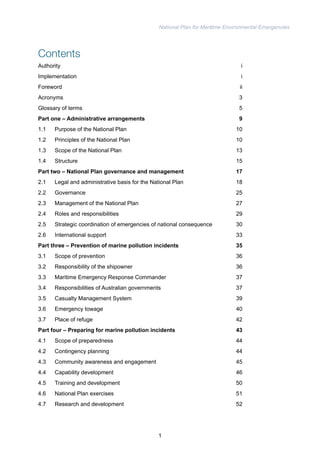
Contents 
Authority i 
Implementation i 
Foreword ii 
Acronyms 3 
Glossary of terms 5 
Part one – Administrative arrangements 9 
1.1 Purpose of the National Plan 10 
1.2 Principles of the National Plan 10 
1.3 Scope of the National Plan 13 
1.4 Structure 15 
Part two – National Plan governance and management 17 
2.1 Legal and administrative basis for the National Plan 18 
2.2 Governance 25 
2.3 Management of the National Plan 27 
2.4 Roles and responsibilities 29 
2.5 Strategic coordination of emergencies of national consequence 30 
2.6 International support 33 
Part three – Prevention of marine pollution incidents 35 
3.1 Scope of prevention 36 
3.2 Responsibility of the shipowner 36 
3.3 Maritime Emergency Response Commander 37 
3.4 Responsibilities of Australian governments 37 
3.5 Casualty Management System 39 
3.6 Emergency towage 40 
3.7 Place of refuge 42 
Part four – Preparing for marine pollution incidents 43 
4.1 Scope of preparedness 44 
4.2 Contingency planning 44 
4.3 Community awareness and engagement 45 
4.4 Capability development 46 
4.5 Training and development 50 
4.6 National Plan exercises 51 
4.7 Research and development 52 
1
National Plan for Maritime Environmental Emergencies 
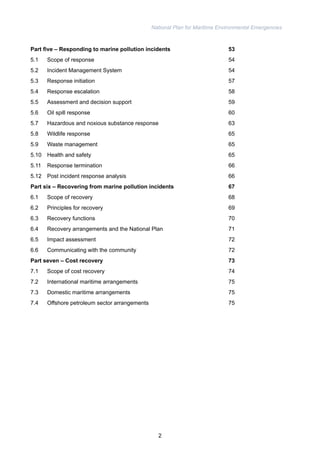
Part five – Responding to marine pollution incidents 53 
5.1 Scope of response 54 
5.2 Incident Management System 54 
5.3 Response initiation 57 
5.4 Response escalation 58 
5.5 Assessment and decision support 59 
5.6 Oil spill response 60 
5.7 Hazardous and noxious substance response 63 
5.8 Wildlife response 65 
5.9 Waste management 65 
5.10 Health and safety 65 
5.11 Response termination 66 
5.12 Post incident response analysis 66 
Part six – Recovering from marine pollution incidents 67 
6.1 Scope of recovery 68 
6.2 Principles for recovery 69 
6.3 Recovery functions 70 
6.4 Recovery arrangements and the National Plan 71 
6.5 Impact assessment 72 
6.6 Communicating with the community 72 
Part seven – Cost recovery 73 
7.1 Scope of cost recovery 74 
7.2 International maritime arrangements 75 
7.3 Domestic maritime arrangements 75 
7.4 Offshore petroleum sector arrangements 75 
2
National Plan for Maritime Environmental Emergencies 
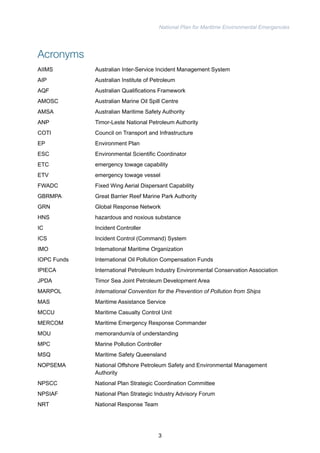
Acronyms 
AIIMS Australian Inter-Service Incident Management System 
AIP Australian Institute of Petroleum 
AQF Australian Qualifications Framework 
AMOSC Australian Marine Oil Spill Centre 
AMSA Australian Maritime Safety Authority 
ANP Timor-Leste National Petroleum Authority 
COTI Council on Transport and Infrastructure 
EP Environment Plan 
ESC Environmental Scientific Coordinator 
ETC emergency towage capability 
ETV emergency towage vessel 
FWADC Fixed Wing Aerial Dispersant Capability 
GBRMPA Great Barrier Reef Marine Park Authority 
GRN Global Response Network 
HNS hazardous and noxious substance 
IC Incident Controller 
ICS Incident Control (Command) System 
IMO International Maritime Organization 
IOPC Funds International Oil Pollution Compensation Funds 
IPIECA International Petroleum Industry Environmental Conservation Association 
JPDA Timor Sea Joint Petroleum Development Area 
MARPOL International Convention for the Prevention of Pollution from Ships 
MAS Maritime Assistance Service 
MCCU Maritime Casualty Control Unit 
MERCOM Maritime Emergency Response Commander 
MOU memorandum/a of understanding 
MPC Marine Pollution Controller 
MSQ Maritime Safety Queensland 
NOPSEMA National Offshore Petroleum Safety and Environmental Management 
Authority 
NPSCC National Plan Strategic Coordination Committee 
NPSIAF National Plan Strategic Industry Advisory Forum 
NRT National Response Team 
3
National Plan for Maritime Environmental Emergencies 
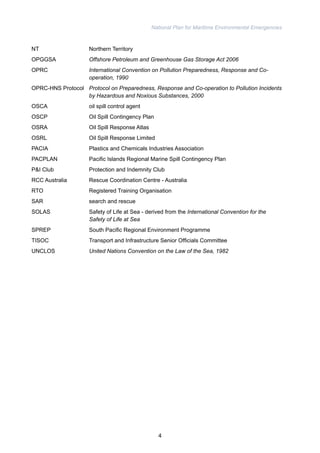
NT Northern Territory 
OPGGSA Offshore Petroleum and Greenhouse Gas Storage Act 2006 
OPRC International Convention on Pollution Preparedness, Response and Co-operation, 
1990 
OPRC-HNS Protocol Protocol on Preparedness, Response and Co-operation to Pollution Incidents 
by Hazardous and Noxious Substances, 2000 
OSCA oil spill control agent 
OSCP Oil Spill Contingency Plan 
OSRA Oil Spill Response Atlas 
OSRL Oil Spill Response Limited 
PACIA Plastics and Chemicals Industries Association 
PACPLAN Pacific Islands Regional Marine Spill Contingency Plan 
P&I Club Protection and Indemnity Club 
RCC Australia Rescue Coordination Centre - Australia 
RTO Registered Training Organisation 
SAR search and rescue 
SOLAS Safety of Life at Sea - derived from the International Convention for the 
Safety of Life at Sea 
SPREP South Pacific Regional Environment Programme 
TISOC Transport and Infrastructure Senior Officials Committee 
UNCLOS United Nations Convention on the Law of the Sea, 1982 
4
National Plan for Maritime Environmental Emergencies 
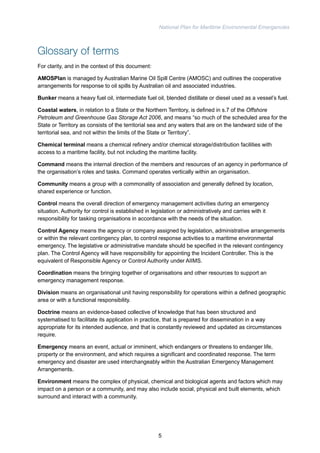
Glossary of terms 
For clarity, and in the context of this document: 
AMOSPlan is managed by Australian Marine Oil Spill Centre (AMOSC) and outlines the cooperative 
arrangements for response to oil spills by Australian oil and associated industries. 
Bunker means a heavy fuel oil, intermediate fuel oil, blended distillate or diesel used as a vessel’s fuel. 
Coastal waters, in relation to a State or the Northern Territory, is defined in s.7 of the Offshore 
Petroleum and Greenhouse Gas Storage Act 2006, and means “so much of the scheduled area for the 
State or Territory as consists of the territorial sea and any waters that are on the landward side of the 
territorial sea, and not within the limits of the State or Territory”. 
Chemical terminal means a chemical refinery and/or chemical storage/distribution facilities with 
access to a maritime facility, but not including the maritime facility. 
Command means the internal direction of the members and resources of an agency in performance of 
the organisation’s roles and tasks. Command operates vertically within an organisation. 
Community means a group with a commonality of association and generally defined by location, 
shared experience or function. 
Control means the overall direction of emergency management activities during an emergency 
situation. Authority for control is established in legislation or administratively and carries with it 
responsibility for tasking organisations in accordance with the needs of the situation. 
Control Agency means the agency or company assigned by legislation, administrative arrangements 
or within the relevant contingency plan, to control response activities to a maritime environmental 
emergency. The legislative or administrative mandate should be specified in the relevant contingency 
plan. The Control Agency will have responsibility for appointing the Incident Controller. This is the 
equivalent of Responsible Agency or Control Authority under AIIMS. 
Coordination means the bringing together of organisations and other resources to support an 
emergency management response. 
Division means an organisational unit having responsibility for operations within a defined geographic 
area or with a functional responsibility. 
Doctrine means an evidence-based collective of knowledge that has been structured and 
systematised to facilitate its application in practice, that is prepared for dissemination in a way 
appropriate for its intended audience, and that is constantly reviewed and updated as circumstances 
require. 
Emergency means an event, actual or imminent, which endangers or threatens to endanger life, 
property or the environment, and which requires a significant and coordinated response. The term 
emergency and disaster are used interchangeably within the Australian Emergency Management 
Arrangements. 
Environment means the complex of physical, chemical and biological agents and factors which may 
impact on a person or a community, and may also include social, physical and built elements, which 
surround and interact with a community. 
5
National Plan for Maritime Environmental Emergencies 
First Strike means a prompt initial response to protect the environment that is intended to limit the 
effect of an incident until such time as other resources can be deployed in support. This capability 
may vary from location to location. 
Global Response Network means the global coalition of oil spill responder organisations 
established to facilitate sharing of expertise and experience. 
Habitat means the natural home or environment of an animal, plant or other organism. 
Hazardous and noxious substance means any substance which, if introduced into the marine 
environment, is likely to create hazards to human health, to harm living resources and marine life, to 
damage amenities or to interfere with other legitimate uses of the sea. 
Incident means an event, occurrence or set of circumstances that: 
• has a definite spatial extent 
• has a definite duration 
• calls for human intervention 
• has a set of concluding conditions that can be defined 
• is or will be under the control of an Incident Controller appointed to make decisions to control 
and coordinate the approach, means and actions taken to resolve the incident. 
Incident Controller means the individual responsible for the management of all incident control 
activities across an incident. 
Incident Management Team is the group of incident management personnel comprised of the 
Incident Controller and personnel appointed by the Incident Controller to be responsible for the 
overall control of the response to an incident. 
Industry, unless already specified or defined in a particular context, means a business or 
commercial group or sector, or other socially valuable activity, such as fisheries, tourism, 
infrastructure, transport, etc. and their representative groups. 
Internal waters means those waters that fall within the constitutional boundaries of a State or 
Territory. The waters which are capable of falling within these limits are described in s.14 of the Seas 
and Submerged Lands Act 1973 as ‘bays, gulfs, estuaries, rivers, creeks, inlets, ports or harbours 
which were, on 1 January 1901, within the limits of the States and remain within the limits of the 
States’. 
Marine pollution refers to any occurrence or series of events with the same origin, including fire 
and explosion, which results or may result in discharge, release or emission of oil or a hazardous 
and noxious substance, which poses or may pose a threat to the marine environment, the coastline, 
animals or other resource, and which requires an emergency action or immediate response. Under 
the National Plan, marine pollution refers primarily to situations that may arise from shore based oil 
and chemical transfer facilities, shipping operations and/or the operation of an offshore petroleum 
facility. 
Maritime casualty means a collision of vessels, stranding or other incident of navigation, or other 
occurrence on board a vessel or external to it resulting in material damage or imminent threat of 
material damage to a vessel or cargo. 
6
National Plan for Maritime Environmental Emergencies 
Maritime facility means a wharf or mooring at which a vessel can be tied up during the process of 
loading or unloading a cargo [or passengers]. A maritime berth may be a sole user berth [such as a 
dedicated berth for an oil refinery] or may be a multi-user berth [such as a berth that handles general 
cargo, or one that handles bulk liquids such as petroleum for more than one user of the berth 
(sometimes known as a common-user berth)]. 
National Plan means the National Plan for Maritime Environmental Emergencies, and all policy, 
guidance and advisory documents produced and published in support. 
Offshore petroleum facility means a facility operating in accordance with the provisions of 
the Offshore Petroleum and Greenhouse Gas Storage Act 2006, or any relevant State/Territory 
legislation. 
Oil means hydrocarbons in any liquid form including crude oil, fuel oil, sludge, oil refuse, refined 
products and condensates. Also including dissolved or dispersed hydrocarbons, whether obtained 
from plants or animals, mineral deposits, or by synthesis. 
Oil terminal means a petroleum refinery and/or petroleum storage/distribution facilities with access 
to a maritime facility, but not including the maritime facility. 
Oil terminal operator means a company [or joint venture] that operates an oil terminal. 
Petroleum includes oil and other substances extracted in the recovery of such substances, including 
LNG and LPG. 
Place of refuge means a location, such as a port, anchorage, or other suitable place, where a 
maritime casualty can be placed in order to stabilise its condition, minimise impact on the community 
and environment, and reduce the hazards to navigation. 
Port authority, depending on jurisdiction, may refer to a state agency, a state corporation or a 
private company. 
Port waters has the same meaning as in s.12 of the Maritime Transport and Offshore Facilities 
Security Act 2003 and includes: 
a) “areas of water, between the land of the port and the open waters outside the port, intended for 
use by ships to gain access to loading, unloading or other land-based facilities; and 
b) areas of open water intended for anchoring or otherwise holding ships before they enter areas 
of water described in paragraph (a); and 
c) areas of open water between the areas of water described in paragraphs (a) and (b).” 
Protection of the Sea Levy is a statutory charge against ships, based on the ‘potential polluter 
pays’ principle, and is used to fund the National Plan for Maritime Environmental Emergencies. 
Funds are also used to meet clean-up costs which cannot be attributed to a known polluter. 
Responsible Agency – see Control Agency. 
Responsible party means the entity that has been identified as owning or having the legal 
responsibility for the vessel or facility that caused the incident. 
Section means the organisational level having responsibility for the key top level functions of 
incident management: planning, public information, logistics and operations. 
7
National Plan for Maritime Environmental Emergencies 
State means, depending on context, one or more of the states of Australia. 
Support Agency means an agency or company that provides essential services, personnel, 
material or advice in support of the Control Agency during the response to a maritime environmental 
emergency. 
Terminal (see also oil terminal and chemical terminal) 
TorresPlan is the marine oil spill contingency plan for the Torres Strait area and is a supplement to 
the Queensland Coastal Contingency Action Plan. 
Unit means a small cell of people working within one of the sections undertaking a designated set of 
activities. 
Vessel (and/or ship) has several meanings within Australian legislation and international 
conventions, but for the purpose of the National Plan means a vessel of any type whatsoever 
operating in the marine environment, and includes hydrofoil boats, air cushion vehicles, 
submersibles and floating craft of any type. Throughout this document the term vessel is preferred. 
Ship, shipowner and shipping are used where these make sense in context or arise from an official 
or formal source. 
8
National Plan for Maritime Environmental Emergencies 
Part one 
Administrative 
arrangements 
9
National Plan for Maritime Environmental Emergencies 
1.1 Purpose of the National Plan 
The National Plan for Maritime Environmental Emergencies (National Plan) sets out national 
arrangements, policies and principles for the management of maritime environmental emergencies. 
It provides for a comprehensive response to maritime environmental emergencies regardless of how 
costs might be attributed or ultimately recovered1. 
1.2 Principles of the National Plan 
The National Plan is designed to meet the following principles as described at Table 1. 
Table 1 – National Plan principles and management context 
Principle Management context 
Protect the community, 
environment and maritime 
industries 
The National Plan provides a single comprehensive and integrated 
response arrangement to minimise the impacts of marine pollution 
from vessels and oil spills from offshore petroleum facilities, as well 
as other environmental impacts arising from a maritime environmental 
emergency, upon the Australian community, environment, cultural and 
heritage resources, economy and infrastructure. 
Give effect to relevant 
international conventions 
The National Plan gives administrative effect to Australia’s emergency 
response obligations relating to the: 
• International Convention on Oil Pollution Preparedness, Response 
and Co-operation, 1990 (OPRC) 
• Protocol on Preparedness, Response and Co-operation to 
Pollution Incidents by Hazardous and Noxious Substances, 2000 
(OPRC-HNS Protocol) 
• International Convention Relating to Intervention on the High 
Seas in Cases of Oil Pollution Casualties, 1969 (Intervention 
Convention), and 
• Articles 198 and 221 of the United Nations Convention on the Law 
of the Sea, 1982 (UNCLOS). 
Integrate with the Australian 
Emergency Management 
Arrangements 
The Australian Emergency Management Arrangements describe 
how Australia addresses the risks and impacts of hazards through a 
collaborative approach between the Commonwealth, state, territory 
and local governments; business and industry; and the community. 
The National Plan forms an essential component of this integrated 
approach to disaster and emergency management by detailing 
arrangements across governments, industry and the community for 
the management of the specific threats from maritime environmental 
emergencies. 
1The Claims Management Guidelines provides information on how Commonwealth, state and Northern Territory agencies 
may be able to seek reimbursement for costs from AMSA. 
10
National Plan for Maritime Environmental Emergencies 
Principle Management context 
Provide a comprehensive 
management arrangement 
The National Plan implements a comprehensive management 
arrangement through five core components: 
• governance and policy to ensure accountability, risk assessment, 
engaging with stakeholders and providing clear strategic direction 
• prevention of marine pollution through the delivery of a system for 
the management of maritime casualties 
• preparedness for marine pollution incidents through a tiered 
approach to contingency planning, training and development of 
response personnel, and maintenance of response assets and 
services 
• response to marine pollution incidents through the 
implementation of the National Plan arrangements 
• recovery of the community and the environment from the impacts 
of marine pollution. 
A doctrinal approach to all phases is applied to the extent possible. All 
stakeholders should develop and share their evidence, knowledge and 
experience, in a documented, structured and systematised manner. 
This will facilitate practical application, and provide for review and 
revision, as circumstances require. 
Provide a single integrated 
response arrangement 
Consistent with the Council of Australian Governments National 
Disaster Resilience Statement, the National Plan recognises that the 
management of maritime environmental emergencies is the shared 
responsibility of all levels of government, industry and business, the 
non-government sector and the community. 
The National Plan achieves this through: 
• all parties fostering a cooperative relationship to ensure maritime 
environmental emergencies are managed in the interests of the 
Australian community 
• recognising the commitment of all stakeholders to collaboration 
across all levels of government, industry stakeholders and the 
community 
• emphasising the development and maintenance of cooperative 
relationships, teamwork, consultative decision making and 
shared responsibilities 
• all stakeholders committing to support the National Plan 
arrangements when an incident occurs, regardless of source or 
location. 
11
National Plan for Maritime Environmental Emergencies 
Principle Management context 
Implement a risk 
management approach 
The National Plan recognises that the starting point for reducing 
the impacts of maritime environmental emergencies lies in the 
understanding of the specific hazards and the social, environmental, 
cultural and heritage, infrastructure and economic vulnerabilities 
presented by these events. The National Plan is underpinned by 
formal risk assessment at the Commonwealth, state and Northern 
Territory (NT), regional, and local scale. 
Implement the polluter pays 
principles 
The National Plan is based on the polluter pays principle: 
• preparedness is funded on the principle that the potential 
polluters pay, and in general, for oil and HNS risks arising: 
– from shipping, a levy applies to commercial shipping visiting 
Australian ports 
– from the offshore petroleum industry, operators fund 
arrangements to meet their specific risks 
• response and recovery is funded on the basis of the polluter pays 
– for shipping, this is achieved through the implementation of 
relevant international conventions under the auspices of the 
International Maritime Organization (IMO) 
– for the offshore petroleum industry, this is achieved through 
the Offshore Petroleum and Greenhouse Gas Storage Act 
2006 (OPGGSA) 
• agencies responding to and incurring costs in relation to pollution 
incidents where the polluter is not identified, or costs are not 
recoverable, may be able to seek reimbursement of their costs 
from the Australian Maritime Safety Authority (AMSA) under the 
Protection of the Sea Levy2. 
Provide for stakeholder 
engagement 
The National Plan recognises that a broad range of stakeholders 
may be affected by a maritime environmental emergency and early 
engagement is important for preparedness, response and recovery. 
As such, the National Plan is underpinned by formal stakeholder 
engagement through the governance arrangements, community 
engagement and education programmes; and a recognition that 
contingency planning must include arrangements for the consideration 
of: 
• traditional owners’ cultural and heritage issues 
• post-European settlement heritage issues 
• the protection of habitats 
• the protection of fauna and flora 
• issuing of warnings and notices, and 
• community and industry input and feedback. 
2See footnote 1 
12
National Plan for Maritime Environmental Emergencies 
1.3 Scope of the National Plan 
Maritime environmental emergencies 
The National Plan applies to potential and actual pollution of the sea or harm to the marine 
environment by oil or hazardous and noxious substance, originating from: 
• maritime casualties requiring salvage and intervention, emergency towage and requests for a 
place of refuge 
• oil pollution or hazardous and noxious substance pollution incidents from vessels 
• oil or hazardous and noxious substance pollution incidents from oil or chemical terminals 
(addressed by state and port plans) 
• oil or hazardous and noxious substance pollution incidents from offshore petroleum activities 
• marine pollution from unknown sources 
• marine pollution from floating or sunken containers of hazardous materials 
• debris originating from a maritime casualty, or 
• physical damage caused by vessels. 
The National Plan does not contain arrangements for the management of the following hazards 
associated with shipping and offshore petroleum facilities: 
• ballast water and marine pests, or 
• marine pollutants other than oil and hazardous and noxious substances. 
The National Plan does not apply to threats to the marine environment resulting from pest species, 
climate change, marine debris and rubbish, or other natural or man-made occurrences. These are 
managed under other regimes and agreements. 
While the National Plan will respond to maritime environmental emergencies as outlined above, not 
all costs meet the criteria for reimbursement by either insurance3 or through the Protection of the 
Sea Levy. 
3Insurance in this case should be read to include all forms of insurance relating to shipping, offshore platforms, 
maritime facilities, domestic oil and chemical terminals, etc., as well as the applicable international maritime 
liability and compensation regimes. 
13
National Plan for Maritime Environmental Emergencies 
Geographic scope 
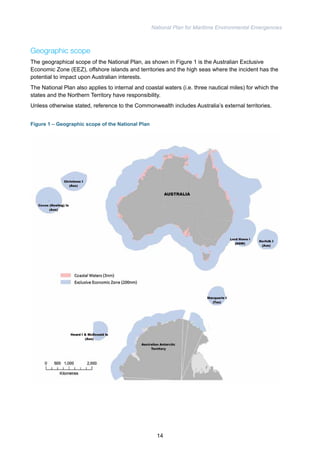
The geographical scope of the National Plan, as shown in Figure 1 is the Australian Exclusive 
Economic Zone (EEZ), offshore islands and territories and the high seas where the incident has the 
potential to impact upon Australian interests. 
The National Plan also applies to internal and coastal waters (i.e. three nautical miles) for which the 
states and the Northern Territory have responsibility. 
Unless otherwise stated, reference to the Commonwealth includes Australia’s external territories. 
Figure 1 – Geographic scope of the National Plan 
14
National Plan for Maritime Environmental Emergencies 
1.4 Structure 
Structure of this document 
This document structure reflects the comprehensive approach to emergency management: 
• Part two – Governance and management arrangements sets out the arrangements for the 
governance and strategic management of the National Plan 
• Part three – Prevention of marine pollution incidents sets out the national arrangements to 
prevent the release of marine pollution from a vessel through the implementation of a strategy 
to manage maritime casualties 
• Part four – Preparing for marine pollution incidents sets out the national arrangements that 
prepare National Plan stakeholders for marine pollution incidents 
• Part five – Responding to marine pollution incidents sets out the national arrangements for 
responding to marine pollution incidents 
• Part six – Recovering from marine pollution incidents sets out the arrangements for the 
recovery of responding agencies, the community and environment from a marine pollution 
incident, and 
• Part seven – Cost recovery sets out the cost recovery arrangements under the National Plan. 
Detail and support is provided by the National Plan policy, guidance and advisory documents 
referred to throughout the National Plan. 
15
National Plan for Maritime Environmental Emergencies 
Supporting arrangements 
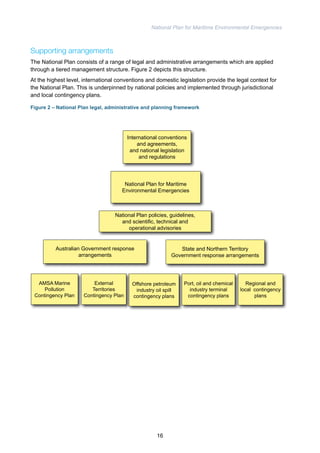
The National Plan consists of a range of legal and administrative arrangements which are applied 
through a tiered management structure. Figure 2 depicts this structure. 
At the highest level, international conventions and domestic legislation provide the legal context for 
the National Plan. This is underpinned by national policies and implemented through jurisdictional 
and local contingency plans. 
Figure 2 – National Plan legal, administrative and planning framework 
International conventions 
and agreements, 
and national legislation 
and regulations 
National Plan for Maritime 
Environmental Emergencies 
National Plan policies, guidelines, 
and scientific, technical and 
operational advisories 
Australian Government response 
arrangements 
State and Northern Territory 
Government response arrangements 
AMSA Marine 
Pollution 
Contingency Plan 
External 
Territories 
Contingency Plan 
Offshore petroleum 
industry oil spill 
contingency plans 
Port, oil and chemical 
industry terminal 
contingency plans 
Regional and 
local contingency 
plans 
16
National Plan for Maritime Environmental Emergencies 
Part TWO 
National Plan 
governance and 
management 
17
National Plan for Maritime Environmental Emergencies 
2.1 Legal and administrative basis for the 
National Plan 
The National Plan gives effect to a number of international conventions and agreements to 
which Australia is a party. The National Plan utilises a range of domestic legislation that provides 
government agencies with response powers and places preparedness and response obligations 
on various industry sectors. Recovery is a responsibility variously shared across industry, maritime 
agencies, other government entities and the affected communities. 
Australian governments 
The Commonwealth, states and Northern Territory have responsibilities for ensuring preparation 
and response to maritime environmental emergencies within their jurisdictions. The following issues 
should be addressed: 
• ensure that the jurisdiction is prepared to manage the risks associated with maritime activities 
• identify agencies or commercial operators with the responsibility to respond to maritime 
environmental emergencies, i.e. perform role the Control Agency role 
• oversee strategic or regulatory aspects of response operations, including notification of 
adjoining jurisdictions 
• coordinate relevant agencies and stakeholders 
• engage the community 
• identify an authority to declare the completion of response operations 
• coordinate cost recovery on behalf of support agencies, and 
• institute legal proceedings where appropriate. 
18
National Plan for Maritime Environmental Emergencies 
International conventions 
The National Plan implements and is supported by a number of international conventions to which 
Australia is a party. 
Table 2 – International conventions 
International convention Application to the National Plan 
International Convention on Oil 
Pollution Preparedness, Response 
and Co-operation, 1990 
Protocol on Preparedness, Response 
and Co-operation to Pollution 
Incidents by Hazardous and Noxious 
Substances, 2000 (OPRC-HNS 
Protocol) 
Provide the basis for the National Plan by setting the context for: 
• developing a national system for pollution response 
• maintaining adequate capacity and resources to address 
oil and hazardous and noxious substances (HNS) 
incidents 
• facilitating international cooperation and mutual assistance 
in preparing for and responding to major oil and HNS 
incidents, and 
• notifying without delay all States [neighbouring countries] 
whose interests are affected or likely to be affected by an 
oil or HNS pollution incident. 
International Convention for the 
Prevention of Pollution from Ships 
(MARPOL) 
Provides ships’ construction and operational requirements to 
prevent pollution from ships. Requires ships greater than 400 
gross tonnes to have pollution emergency plans. 
Provides for exemptions from discharge restrictions (and 
prosecution) where: 
• a discharge is necessary to secure the safety of a ship or 
save a life at sea, or prevent a larger spill; or 
• it is necessary during a spill response to discharge 
oil or HNS or use dispersants to minimize the overall 
damage from pollution, and is approved by the relevant 
government. 
United Nations Convention on the 
Law of the Sea, 1982 
Article 221, provides general powers for parties to take and 
enforce measures beyond the territorial sea to protect their 
coastline or related interests from pollution or threat of pollution 
following a maritime casualty or acts relating to such a casualty, 
which may reasonably be expected to result in major harmful 
consequences. 
Article 198 provides that “when a State [neighbouring country] 
becomes aware of cases in which the marine environment is 
in imminent danger of being damaged … by pollution, it shall 
immediately notify other States it deems likely to be affected by 
such damage.” 
International Convention Relating to 
Intervention on the High Sea in Cases 
of Oil Pollution Casualties, 1969 
Protocol Relating to Intervention on 
the High Seas in Cases of Pollution by 
Substances Other Than Oil, 1973 
Provides general powers for parties to take measures on the 
high seas as may be necessary to prevent, mitigate or eliminate 
grave and imminent danger to their coastline or related interests 
from the threat of pollution by oil or hazardous and noxious 
substances following a maritime casualty or acts related to such 
a casualty, which may reasonably be expected to result in major 
harmful consequences. 
19
National Plan for Maritime Environmental Emergencies 
International convention Application to the National Plan 
International Convention on Civil 
Liability for Oil Pollution Damage, 1992 
Provides for the recovery of pollution costs and payment of 
compensation from owners/operators of oil tankers. 
International Convention on the 
Establishment of an International Fund 
for Compensation for Oil Pollution 
Damage, 1992 
2003 Protocol to the International 
Convention on the Establishment of an 
International Fund for Compensation 
for Oil Pollution Damage, 1992 
Provides for additional compensation and costs where the 
tanker owners’/operators’ liability limits are exceeded, using 
funds provided by the oil industry. 
International Convention on Civil 
Liability for Bunker Oil Pollution 
Damage, 2001 
Provides for the recovery of pollution costs and payment of 
compensation from owners/operators of all vessels using oil 
as bunker fuel and references the liability arrangements in the 
Convention on Limitation of Liability for Maritime Claims, 1976 
(LLMC) and its 1996 Protocol. 
Protocol on Environmental Protection 
to the Antarctic Treaty 1991 
The objective of the Protocol is to ensure the comprehensive 
protection of the Antarctic environment and associated 
ecosystems. The Antarctic includes all the area south of 
latitude 60o south. Annex IV to the Protocol relates to marine 
pollution, specifically prohibiting the discharge of oil, noxious 
liquid substances and garbage in the Antarctic Treaty area. 
Annex VI (not yet in force) of the Protocol relates to liability for 
environmental emergencies. 
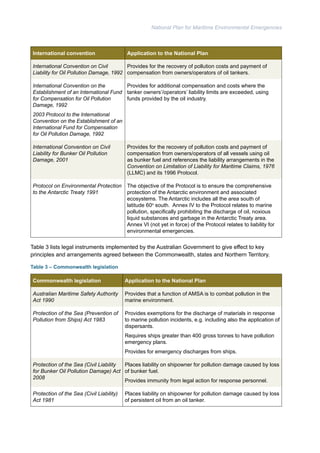
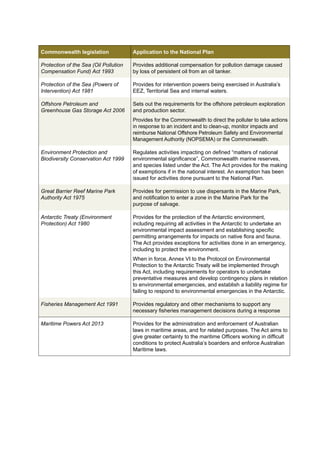
Table 3 lists legal instruments implemented by the Australian Government to give effect to key 
principles and arrangements agreed between the Commonwealth, states and Northern Territory. 
Table 3 – Commonwealth legislation 
Commonwealth legislation Application to the National Plan 
Australian Maritime Safety Authority 
Act 1990 
Provides that a function of AMSA is to combat pollution in the 
marine environment. 
Protection of the Sea (Prevention of 
Pollution from Ships) Act 1983 
Provides exemptions for the discharge of materials in response 
to marine pollution incidents, e.g. including also the application of 
dispersants. 
Requires ships greater than 400 gross tonnes to have pollution 
emergency plans. 
Provides for emergency discharges from ships. 
Protection of the Sea (Civil Liability 
for Bunker Oil Pollution Damage) Act 
2008 
Places liability on shipowner for pollution damage caused by loss 
of bunker fuel. 
Provides immunity from legal action for response personnel. 
Protection of the Sea (Civil Liability) 
Act 1981 
Places liability on shipowner for pollution damage caused by loss 
of persistent oil from an oil tanker.
Commonwealth legislation Application to the National Plan 
Protection of the Sea (Oil Pollution 
Compensation Fund) Act 1993 
Provides additional compensation for pollution damage caused 
by loss of persistent oil from an oil tanker. 
Protection of the Sea (Powers of 
Intervention) Act 1981 
Provides for intervention powers being exercised in Australia’s 
EEZ, Territorial Sea and internal waters. 
Offshore Petroleum and 
Greenhouse Gas Storage Act 2006 
Sets out the requirements for the offshore petroleum exploration 
and production sector. 
Provides for the Commonwealth to direct the polluter to take actions 
in response to an incident and to clean-up, monitor impacts and 
reimburse National Offshore Petroleum Safety and Environmental 
Management Authority (NOPSEMA) or the Commonwealth. 
Environment Protection and 
Biodiversity Conservation Act 1999 
Regulates activities impacting on defined “matters of national 
environmental significance”, Commonwealth marine reserves, 
and species listed under the Act. The Act provides for the making 
of exemptions if in the national interest. An exemption has been 
issued for activities done pursuant to the National Plan. 
Great Barrier Reef Marine Park 
Authority Act 1975 
Provides for permission to use dispersants in the Marine Park, 
and notification to enter a zone in the Marine Park for the 
purpose of salvage. 
Antarctic Treaty (Environment 
Protection) Act 1980 
Provides for the protection of the Antarctic environment, 
including requiring all activities in the Antarctic to undertake an 
environmental impact assessment and establishing specific 
permitting arrangements for impacts on native flora and fauna. 
The Act provides exceptions for activities done in an emergency, 
including to protect the environment. 
When in force, Annex VI to the Protocol on Environmental 
Protection to the Antarctic Treaty will be implemented through 
this Act, including requirements for operators to undertake 
preventative measures and develop contingency plans in relation 
to environmental emergencies, and establish a liability regime for 
failing to respond to environmental emergencies in the Antarctic. 
Fisheries Management Act 1991 Provides regulatory and other mechanisms to support any 
necessary fisheries management decisions during a response 
Maritime Powers Act 2013 Provides for the administration and enforcement of Australian 
laws in maritime areas, and for related purposes. The Act aims to 
give greater certainty to the maritime Officers working in difficult 
conditions to protect Australia’s boarders and enforce Australian 
Maritime laws.
National Plan for Maritime Environmental Emergencies 
Offshore petroleum regulation and spill response 
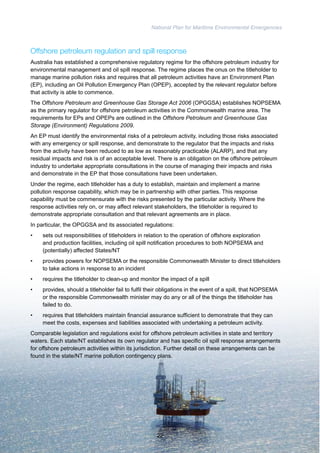
Australia has established a comprehensive regulatory regime for the offshore petroleum industry for 
environmental management and oil spill response. The regime places the onus on the titleholder to 
manage marine pollution risks and requires that all petroleum activities have an Environment Plan 
(EP), including an Oil Pollution Emergency Plan (OPEP), accepted by the relevant regulator before 
that activity is able to commence. 
The Offshore Petroleum and Greenhouse Gas Storage Act 2006 (OPGGSA) establishes NOPSEMA 
as the primary regulator for offshore petroleum activities in the Commonwealth marine area. The 
requirements for EPs and OPEPs are outlined in the Offshore Petroleum and Greenhouse Gas 
Storage (Environment) Regulations 2009. 
An EP must identify the environmental risks of a petroleum activity, including those risks associated 
with any emergency or spill response, and demonstrate to the regulator that the impacts and risks 
from the activity have been reduced to as low as reasonably practicable (ALARP), and that any 
residual impacts and risk is of an acceptable level. There is an obligation on the offshore petroleum 
industry to undertake appropriate consultations in the course of managing their impacts and risks 
and demonstrate in the EP that those consultations have been undertaken. 
Under the regime, each titleholder has a duty to establish, maintain and implement a marine 
pollution response capability, which may be in partnership with other parties. This response 
capability must be commensurate with the risks presented by the particular activity. Where the 
response activities rely on, or may affect relevant stakeholders, the titleholder is required to 
demonstrate appropriate consultation and that relevant agreements are in place. 
In particular, the OPGGSA and its associated regulations: 
• sets out responsibilities of titleholders in relation to the operation of offshore exploration 
and production facilities, including oil spill notification procedures to both NOPSEMA and 
(potentially) affected States/NT 
• provides powers for NOPSEMA or the responsible Commonwealth Minister to direct titleholders 
to take actions in response to an incident 
• requires the titleholder to clean-up and monitor the impact of a spill 
• provides, should a titleholder fail to fulfil their obligations in the event of a spill, that NOPSEMA 
or the responsible Commonwealth minister may do any or all of the things the titleholder has 
failed to do. 
• requires that titleholders maintain financial assurance sufficient to demonstrate that they can 
meet the costs, expenses and liabilities associated with undertaking a petroleum activity. 
Comparable legislation and regulations exist for offshore petroleum activities in state and territory 
waters. Each state/NT establishes its own regulator and has specific oil spill response arrangements 
for offshore petroleum activities within its jurisdiction. Further detail on these arrangements can be 
found in the state/NT marine pollution contingency plans. 
22
National Plan for Maritime Environmental Emergencies 
Other international and regional agreements 
The National Plan provides a mechanism for Australia to enter into mutual aid arrangements with 
other countries impacted by maritime environmental emergencies, giving effect to Australia’s 
obligations under OPRC and the OPRC-HNS Protocol. Australia has entered into a number of 
international cooperation agreements which are described below. 
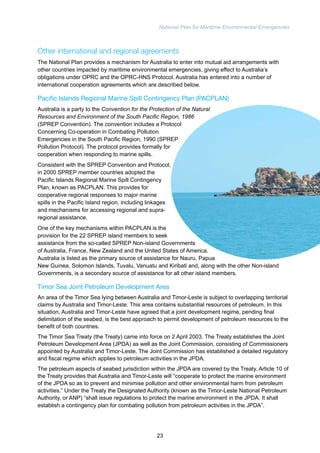
Pacific Islands Regional Marine Spill Contingency Plan (PACPLAN) 
Australia is a party to the Convention for the Protection of the Natural 
Resources and Environment of the South Pacific Region, 1986 
(SPREP Convention). The convention includes a Protocol 
Concerning Co-operation in Combating Pollution 
Emergencies in the South Pacific Region, 1990 (SPREP 
Pollution Protocol). The protocol provides formally for 
cooperation when responding to marine spills. 
Consistent with the SPREP Convention and Protocol, 
in 2000 SPREP member countries adopted the 
Pacific Islands Regional Marine Spill Contingency 
Plan, known as PACPLAN. This provides for 
cooperative regional responses to major marine 
spills in the Pacific Island region, including linkages 
and mechanisms for accessing regional and supra-regional 
assistance. 
One of the key mechanisms within PACPLAN is the 
provision for the 22 SPREP island members to seek 
assistance from the so-called SPREP Non-island Governments 
of Australia, France, New Zealand and the United States of America. 
Australia is listed as the primary source of assistance for Nauru, Papua 
New Guinea, Solomon Islands, Tuvalu, Vanuatu and Kiribati and, along with the other Non-island 
Governments, is a secondary source of assistance for all other island members. 
Timor Sea Joint Petroleum Development Area 
An area of the Timor Sea lying between Australia and Timor-Leste is subject to overlapping territorial 
claims by Australia and Timor-Leste. This area contains substantial resources of petroleum. In this 
situation, Australia and Timor-Leste have agreed that a joint development regime, pending final 
delimitation of the seabed, is the best approach to permit development of petroleum resources to the 
benefit of both countries. 
The Timor Sea Treaty (the Treaty) came into force on 2 April 2003. The Treaty establishes the Joint 
Petroleum Development Area (JPDA) as well as the Joint Commission, consisting of Commissioners 
appointed by Australia and Timor-Leste. The Joint Commission has established a detailed regulatory 
and fiscal regime which applies to petroleum activities in the JPDA. 
The petroleum aspects of seabed jurisdiction within the JPDA are covered by the Treaty. Article 10 of 
the Treaty provides that Australia and Timor-Leste will “cooperate to protect the marine environment 
of the JPDA so as to prevent and minimise pollution and other environmental harm from petroleum 
activities.” Under the Treaty the Designated Authority (known as the Timor-Leste National Petroleum 
Authority, or ANP) “shall issue regulations to protect the marine environment in the JPDA. It shall 
establish a contingency plan for combating pollution from petroleum activities in the JPDA”. 
23
National Plan for Maritime Environmental Emergencies 
The contingency plan, as agreed by the Joint Commission, states that the following applies to 
pollution incidents within the JPDA: 
• in a situation where a pollution incident could be contained by the operator, under arrangements 
approved by the ANP, the operator has responsibility for responding to the incident. The 
operator would normally inform the ANP of the incident and continuously update the ANP on 
progress 
• in situations where the pollution incident is beyond the capability of the operator, the ANP/ 
Timor-Leste Government or the operator may contact AMSA to seek assistance from Australia. 
These arrangements are consistent with Annex C paragraph (e) of the Treaty Powers and Functions 
of the Designated Authority which state that “the powers and functions of the Designated Authority 
shall include requesting assistance with pollution prevention measures, equipment and procedures 
from the appropriate Australian and Timor-Leste authorities or other bodies or persons”. 
The coordinates of the JPDA are set out in Annex A of the Timor Sea Treaty: www.austlii.edu.au/au/ 
other/dfat/treaties/2003/13.html. 
Bilateral agreements 
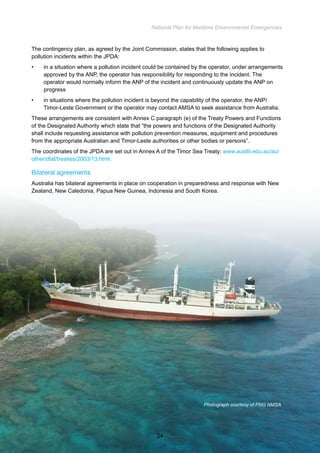
Australia has bilateral agreements in place on cooperation in preparedness and response with New 
Zealand, New Caledonia, Papua New Guinea, Indonesia and South Korea. 
Photograph courtesy of PNG NMSA 
24
National Plan for Maritime Environmental Emergencies 
2.2 Governance 
The aim of National Plan governance is to ensure a coordinated, integrated and accountable system is 
in place to manage maritime environmental emergencies. This is achieved through: 
• reporting to Australian Governments through the Council on Transport and Infrastructure (COTI), 
under the Council of Australian Governments’ arrangements 
• the establishment of the National Plan Strategic Coordination Committee (NPSCC) to set policy 
direction and oversee the implementation of the National Plan 
• stakeholder engagement, in particular with the shipping, petroleum, chemical and port industries 
• appropriate technical input to support decision making 
• links to coordinated arrangements across the Commonwealth, states and Northern Territory. 
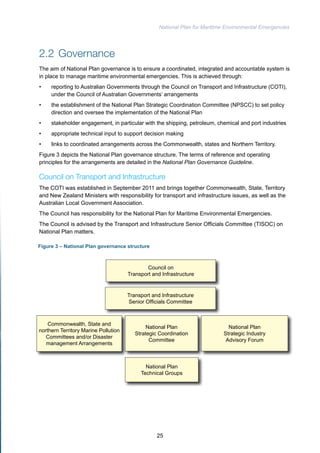
Figure 3 depicts the National Plan governance structure. The terms of reference and operating 
principles for the arrangements are detailed in the National Plan Governance Guideline. 
Council on Transport and Infrastructure 
The COTI was established in September 2011 and brings together Commonwealth, State, Territory 
and New Zealand Ministers with responsibility for transport and infrastructure issues, as well as the 
Australian Local Government Association. 
The Council has responsibility for the National Plan for Maritime Environmental Emergencies. 
The Council is advised by the Transport and Infrastructure Senior Officials Committee (TISOC) on 
National Plan matters. 
Figure 3 – National Plan governance structure 
Council on 
Transport and Infrastructure 
Senior Officials Committee 
Commonwealth, State and 
northern Territory Marine Pollution 
Committees and/or Disaster 
management Arrangements 
National Plan 
Strategic Coordination 
Committee 
National Plan 
Strategic Industry 
Advisory Forum 
National Plan 
Technical Groups 
25
National Plan for Maritime Environmental Emergencies 
National Plan Strategic Coordination Committee 
The National Plan Strategic Coordination Committee (NPSCC) is responsible for setting the broad 
policy direction of the National Plan, overseeing the implementation of the Plan and ensuring the 
effectiveness of the arrangements. 
The NPSCC is comprised of senior Commonwealth, State and Northern Territory Government 
officials and reports to TISOC on the effectiveness of the National Plan. The Committee is chaired 
by a senior official from the Australian Government. The National Plan Strategic Industry Advisory 
Forum (NPSIAF) provides an observer to the NPSCC. 
The committee can form Technical Groups to support its deliberations. The current Technical Group 
structure is described within the National Plan Governance Guideline. 
National Plan Strategic Industry Advisory Forum 
The National Plan Strategic Industry Advisory Forum (NPSIAF) is an independent industry-focused 
body established to provide input to the NPSCC on the strategic direction of the National Plan. 
The members of the NPSIAF are drawn from industry stakeholders with a direct interest in the 
operational arrangements of the National Plan, covering the commercial maritime sector, peak oil 
and chemical industry bodies, and professional bodies representing salvage and towage interests. 
The Forum can form Technical Groups to support its deliberations. 
Jurisdictional governance 
Each jurisdiction establishes and maintains a coordination group to ensure effective whole of 
government decision making within the National Plan arrangements. These groups vary between 
jurisdiction from hazard specific committees to state disaster and emergency management committees. 
Each jurisdiction produces its own contingency plans. 
26
National Plan for Maritime Environmental Emergencies 
2.3 Management of the National Plan 
The National Plan is managed by AMSA, which represents the Australian Government at the IMO in 
relation to Australia’s obligations under the OPRC Convention and the OPRC-HNS Protocol. 
The functions of AMSA in this regard include: 
• maintaining the National Plan 
• maintaining Commonwealth contingency plans 
• managing the National Response Team, including training and development 
• providing a national response equipment capability 
• coordinating the national training programme 
• maintaining uniform standards and testing protocols for oil spill dispersants and other chemical 
response agents 
• managing research and development projects undertaken in accordance with the National Plan 
Research, Development and Technology Policy 
• managing decision-making support systems such as the oil spill response atlas and trajectory 
modelling 
• managing the national emergency towage vessel and fixed-wing aerial dispersant contracts 
• providing secretariat services for National Plan committees and technical groups, and 
• undertaking international liaison as necessary. 
27
National Plan for Maritime Environmental Emergencies 
National Plan management arrangements 
The National Plan sets out the agreed policy for the implementation of management arrangements 
for maritime environmental emergencies within Australia. The National Plan is underpinned by: 
• policies – implementing documents for the strategic management of the National Plan, e.g. 
National Plan Governance Guideline 
• guidelines – documents providing guidance for the application of specific response 
arrangements detailed within the National Plan, e.g. Guideline for the Activation of the Fixed 
Wing Aerial Dispersant Capability, and 
• scientific, technical and operational advisories – advisory documents on specific technical 
issues, e.g. National Plan Response Phase Monitoring Advisory. 
Under the National Plan governance arrangements the NPSCC is responsible for the review and 
acceptance of these documents. 
Monitoring and review 
The NPSCC is responsible to ensure that the National Plan remains current and effective. The 
NPSCC may at any time decide to review the National Plan if it considers that significant change has 
occurred to the strategic context, including lessons learned from incidents and exercises. 
On behalf of the NPSCC, AMSA will conduct an annual review, no later than 31 October each year 
for NPSCC’s consideration. 
A National Plan Outlook Report will be prepared by NPSCC, by 30 June 2016. Further Outlook 
Reports are expected at five-yearly intervals. Each Outlook Report should consider: 
• the national risk profile 
• whether international obligations under the OPRC Convention and the OPRC-HNS Protocol are 
being met 
• the management effectiveness of the National Plan. 
The policy outcomes of the Outlook Report could include: 
• renewal of current National Plan arrangements 
• minor amendments to arrangements 
• a major review of arrangements. 
28
National Plan for Maritime Environmental Emergencies 
2.4 Roles and responsibilities 
Jurisdictional authorities 
Agencies that have jurisdictional or legislative responsibilities for maritime environmental 
emergencies are obligated to work closely with the Control Agency to ensure that incident response 
actions are adequate. Such arrangements should be clearly identified in contingency plans. 
Control Agency 
A Control Agency is the agency or company assigned by legislation, administrative arrangement, 
or within the relevant contingency plan, to control response activities to a maritime environmental 
emergency. The jurisdiction governments will ensure that there is an appointed Control Agency for 
each of the hazards identified within their overall emergency management arrangements. 
The Control Agency will have responsibility for appointing the Incident Controller to control the 
operational response to an incident. 
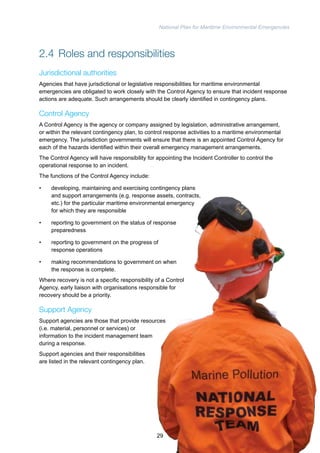
The functions of the Control Agency include: 
• developing, maintaining and exercising contingency plans 
and support arrangements (e.g. response assets, contracts, 
etc.) for the particular maritime environmental emergency 
for which they are responsible 
• reporting to government on the status of response 
preparedness 
• reporting to government on the progress of 
response operations 
• making recommendations to government on when 
the response is complete. 
Where recovery is not a specific responsibility of a Control 
Agency, early liaison with organisations responsible for 
recovery should be a priority. 
Support Agency 
Support agencies are those that provide resources 
(i.e. material, personnel or services) or 
information to the incident management team 
during a response. 
Support agencies and their responsibilities 
are listed in the relevant contingency plan. 
29
National Plan for Maritime Environmental Emergencies 
2.5 Strategic coordination of emergencies of national 
consequence 
Major or catastrophic maritime environmental emergencies have the potential to significantly impact 
on the national interests of Australia and may require extraordinary strategic coordination across 
governments and stakeholders for their effective management. Such incidents will generally be of a 
large scale and require the coordination of national and international level interests, and may include 
circumstances where: 
• there is a significant threat to the community and/or environment 
• the incident impacts upon two or more Australian jurisdictions 
• the incident impacts across an international boundary 
• the incident exceeds the capability of the nominated Control Agency 
• there is significant national and international media attention impacting across the interests of 
multiple parties, or 
• NOPSEMA or the responsible Commonwealth minister, due to the titleholders’ failure to fulfil 
their spill response obligations, is required to act. 
The National Plan provides for the coordination of stakeholders during major incidents through the 
application of four core concepts: 
• strategic leadership 
• coordination across Australian jurisdictions and sectors 
• coordination with international governments 
• processes for the orderly transfer of Control Agency responsibility. 
The Australian Emergency Management Arrangements include Model Arrangements for Leadership 
During Emergencies of National Consequence for those circumstances not fully addressed by the 
National Plan. 
30
National Plan for Maritime Environmental Emergencies 
Model Arrangements for Leadership During Emergencies of National 
Consequence 
The Council of Australian Governments endorsed the Model Arrangements for Leadership During 
Emergencies of National Consequence (Model Arrangements) on 3 July 2008. These arrangements 
represent how Australian Governments work together to coordinate major incidents. The Model 
Arrangements have specific application to incidents that require coordination of national level 
policy, strategy and public messaging or inter-jurisdictional assistance, where such assistance and 
coordination is not addressed by existing arrangements. 
It is intended that the National Plan be consistent with the Model Arrangements. Under the National 
Plan, the Model Arrangements will be applied where the coordination processes outlined within this 
section require additional support to manage coordination issues. 
Strategic leadership 
A nationally significant incident will create additional pressures on the Control Agency to manage 
the legitimate interests of the Commonwealth, state, NT, local and private sector stakeholders 
involved in the incident. Jurisdictions should appoint a senior government official to provide strategic 
leadership and coordination in support of the Control Agency. 
In the context of a nationally significant incident the role of such a senior official may include: 
• assisting the Control Agency(ies) with strategic communications, including: 
– primary spokesperson for the multi-agency response 
– primary point of contact for the briefing of government(s) 
• providing the common operating picture and situational awareness at the strategic level 
• strategic coordination, including: 
– resolution of strategic multi-jurisdictional policy and legislative issues on behalf of the 
Control Agency 
– ensuring collaboration between all parties and resolving multi-jurisdictional-agency 
conflicts 
• facilitating national and international assistance through National Plan and Australian 
Emergency Management arrangements. 
Photograph courtesy of Kelana Arshad 
31
National Plan for Maritime Environmental Emergencies 
Cross jurisdictional coordination 
Maritime environmental emergencies have the potential to impact upon the interests of two or 
more Australian jurisdictions, where both jurisdictions have legitimate administrative and regulatory 
interests in the incident. 
The National Plan addresses the complexities of such incidents through the Guideline on the 
Coordination of Multiple Jurisdiction Incidents. This procedure provides for: 
• establishment of an incident coordination process 
• determination of a ‘lead’ jurisdiction, if appropriate. 
International coordination 
The Australian Government is party to a number of international conventions and agreements that 
include obligations to report, coordinate with, and provide assistance to other countries during a 
marine pollution incident. These conventions include UNCLOS and the OPRC Convention and its 
HNS Protocol are detailed above in Table 2. 
These convention and agreement obligations rest with the Australian Government and cannot 
be delegated to another party. The National Plan includes a Guideline on the Coordination of 
International Incidents, which includes arrangements for: 
• assessment of incidents and notification arrangements 
• engagement with the Department of Foreign Affairs and Trade and relevant diplomatic posts 
• engagement with the Department of the Environment in relation to PACPLAN matters 
• coordination of response operations across trans-national boundaries 
• coordination of international assistance under PACPLAN and other MOU arrangements. 
Change of Control Agency 
The National Plan provides for the orderly escalation from local response operations to incidents 
requiring international assistance. For more detail see section 5.4. 
There may be circumstance or factors as outlined above where there is a need to change the 
Control Agency responsible for managing the response. 
The National Plan includes a Guideline on a Change of Control Agency to a third party, where such 
arrangements are not already part of disaster management or regulatory arrangements and includes 
processes for: 
• approval from the relevant jurisdiction, or relevant regulator within that jurisdiction 
• planning for the transfer of control 
• implementing a transfer arrangement. 
The procedure provides for a jurisdiction to request that AMSA or another Control Agency assume 
operational control of an incident in exceptional circumstances. 
32
National Plan for Maritime Environmental Emergencies 
2.6 International support 
Support from national governments 
The OPRC Convention and its HNS Protocol place an obligation on parties, subject to their 
capabilities and availability of relevant resources, to provide technical support and equipment for the 
purposes of responding to an incident, when the severity of such an incident so justifies, upon the 
request of any party affected or likely to be affected. AMSA has responsibility for making or receiving 
such requests in conjunction with other government agencies with an interest or responsibility. This 
will generally be undertaken through diplomatic channels and in accordance with any IMO guidance 
on international offers of assistance and any applicable bilateral or multi-lateral agreements. 
Support from the Global Response Network 
The Australian Marine Oil Spill Centre (AMOSC) based in Geelong, Victoria, on behalf of the 
Australian petroleum industry has established links with other national and international oil spill 
response organisations. AMOSC maintains a Resources and Services Alliance Agreement with Oil 
Spill Response Ltd (OSRL) which enables AMOSC and OSRL to jointly work together to support 
common members during a spill response. AMOSC and OSRL have arrangements in place to 
provide mutual assistance in the event of an extreme incident. AMOSC’s membership of the Global 
Response Network (GRN) also allows knowledge and expertise to be accessed and shared with 
Australia from overseas if/when the situation requires. 
AMOSC, through the Australian Institute of Petroleum (AIP) also has membership of the International 
Petroleum Industry Environmental Conservation Association (IPIECA) and this enables industry 
access to this global oil and gas industry association for environmental and social issues. Through 
IPIECA, industry can access the knowledge and expertise of the petroleum industry’s international 
spill response personnel. 
AMSA, through AMOSC, will coordinate activation of any of these international resources on behalf 
of the jurisdictions in the event of a maritime environmental emergency. 
AMOSC will coordinate petroleum industry access to international resources in the event of a 
petroleum industry incident in Australia. 
33
National Plan for Maritime Environmental Emergencies 
34
National Plan for Maritime Environmental Emergencies 
Part THREE 
Prevention of marine 
pollution incidents 
35
National Plan for Maritime Environmental Emergencies 
3.1 Scope of prevention 
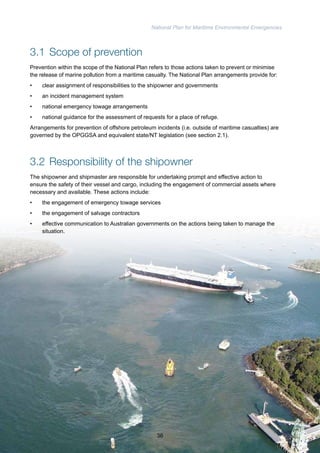
Prevention within the scope of the National Plan refers to those actions taken to prevent or minimise 
the release of marine pollution from a maritime casualty. The National Plan arrangements provide for: 
• clear assignment of responsibilities to the shipowner and governments 
• an incident management system 
• national emergency towage arrangements 
• national guidance for the assessment of requests for a place of refuge. 
Arrangements for prevention of offshore petroleum incidents (i.e. outside of maritime casualties) are 
governed by the OPGGSA and equivalent state/NT legislation (see section 2.1). 
3.2 Responsibility of the shipowner 
The shipowner and shipmaster are responsible for undertaking prompt and effective action to 
ensure the safety of their vessel and cargo, including the engagement of commercial assets where 
necessary and available. These actions include: 
• the engagement of emergency towage services 
• the engagement of salvage contractors 
• effective communication to Australian governments on the actions being taken to manage the 
situation. 
36
National Plan for Maritime Environmental Emergencies 
3.3 Maritime Emergency Response Commander 
The Maritime Emergency Response Commander (MERCOM) is responsible for the management of 
emergency intervention issues in response to maritime casualty incidents where there is an actual or 
potential risk of significant pollution. Table 4 provides more detail. 
The MERCOM is appointed by AMSA and is supported by statutory powers under the Protection of 
the Sea (Powers of Intervention) Act 1981. 
The MERCOM will consider the reasonable views and stated positions of the relevant states, 
Northern Territory and stakeholders. These entities represent community views about economic, 
environmental, community and social interests that could be impacted by the MERCOM’s decisions. 
Decisions made by the MERCOM will be expeditiously communicated to all relevant stakeholder 
groups and fully documented. 
3.4 Responsibilities of Australian governments 
Australia is obligated under International Maritime Organization Resolutions A.949(23) and A.950(23) 
to provide a maritime assistance service (MAS) for ships that may be in need of assistance. The 
circumstances of a ship’s operation that involve MAS are not those requiring rescue of persons and 
must pertain to: 
• a ship involved in an incident (e.g. loss of cargo, accidental discharge over board) that does not 
impair its seakeeping capability but requires to be reported 
• the ship, according to its master’s assessment, is in need of assistance but not in a distress 
situation that requires rescue of those involved, or 
• the ship is found to be in a distress situation but those on board have already been rescued. 
The IMO has been notified in accordance with IMO Resolution A.950(23) that the Australian Rescue 
Coordination Centre (RCC Australia), operated by AMSA , will be the contact point between ship 
masters and the Australian Government for MAS purposes. 
The Commonwealth, state and Northern Territory governments will only assume control of a 
maritime casualty incident where the shipowner and/or shipmaster are failing in their responsibility 
to manage the maritime casualty effectively, in a timely manner or in the interests of protecting the 
community and the environment. 
The jurisdiction governments have agreed the following responsibilities in relation to the response to 
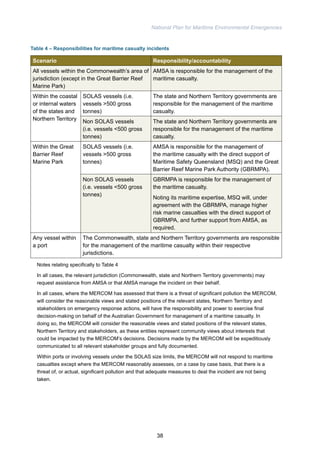
maritime casualty incidents (Table 4 refers). 
37
National Plan for Maritime Environmental Emergencies 
Table 4 – Responsibilities for maritime casualty incidents 
Scenario Responsibility/accountability 
All vessels within the Commonwealth’s area of 
jurisdiction (except in the Great Barrier Reef 
Marine Park) 
AMSA is responsible for the management of the 
maritime casualty. 
Within the coastal 
or internal waters 
of the states and 
Northern Territory 
SOLAS vessels (i.e. 
vessels >500 gross 
tonnes) 
The state and Northern Territory governments are 
responsible for the management of the maritime 
casualty. 
Non SOLAS vessels 
(i.e. vessels <500 gross 
tonnes) 
The state and Northern Territory governments are 
responsible for the management of the maritime 
casualty. 
Within the Great 
Barrier Reef 
Marine Park 
SOLAS vessels (i.e. 
vessels >500 gross 
tonnes) 
AMSA is responsible for the management of 
the maritime casualty with the direct support of 
Maritime Safety Queensland (MSQ) and the Great 
Barrier Reef Marine Park Authority (GBRMPA). 
Non SOLAS vessels 
(i.e. vessels <500 gross 
tonnes) 
GBRMPA is responsible for the management of 
the maritime casualty. 
Noting its maritime expertise, MSQ will, under 
agreement with the GBRMPA, manage higher 
risk marine casualties with the direct support of 
GBRMPA, and further support from AMSA, as 
required. 
Any vessel within 
a port 
The Commonwealth, state and Northern Territory governments are responsible 
for the management of the maritime casualty within their respective 
jurisdictions. 
Notes relating specifically to Table 4 
In all cases, the relevant jurisdiction (Commonwealth, state and Northern Territory governments) may 
request assistance from AMSA or that AMSA manage the incident on their behalf. 
In all cases, where the MERCOM has assessed that there is a threat of significant pollution the MERCOM, 
will consider the reasonable views and stated positions of the relevant states, Northern Territory and 
stakeholders on emergency response actions, will have the responsibility and power to exercise final 
decision-making on behalf of the Australian Government for management of a maritime casualty. In 
doing so, the MERCOM will consider the reasonable views and stated positions of the relevant states, 
Northern Territory and stakeholders, as these entities represent community views about interests that 
could be impacted by the MERCOM’s decisions. Decisions made by the MERCOM will be expeditiously 
communicated to all relevant stakeholder groups and fully documented. 
Within ports or involving vessels under the SOLAS size limits, the MERCOM will not respond to maritime 
casualties except where the MERCOM reasonably assesses, on a case by case basis, that there is a 
threat of, or actual, significant pollution and that adequate measures to deal the incident are not being 
taken. 
38
National Plan for Maritime Environmental Emergencies 
3.5 Casualty Management System 
Principles of maritime casualty response 
The National Plan recognises that maritime casualties have specific characteristics that can affect 
the way the incident is managed. The incident management system for maritime casualties is based 
on the following principles: 
• operational management of a maritime casualty rests with the commercial sector, i.e. towage 
and salvage contractors 
• the system must be scalable and flexible to meet the demands of the incident 
• the role of Australian governments is to oversee the actions of the shipowner/shipmaster and 
towage and salvage contractors 
• the need to facilitate communication amongst key stakeholders in relation to appropriate action 
and situational information 
• the requirement to provide for the separation of the maritime casualty and marine pollution 
response functions for significant incidents. 
Maritime Casualty Control Unit 
A Maritime Casualty Control Unit (MCCU) will be implemented for significant incidents where 
MERCOM has assumed control. This is consistent with the principles of the Australasian Inter-service 
Incident Management System (AIIMS) which provides for multiple incident management 
teams for incidents involving multiple hazards or impacts. The MCCU will: 
• oversee and monitor actions taken in response to a maritime casualty 
• review salvage and other relevant response plans 
• provide a platform for key stakeholders to discuss and maintain situational information 
• provides an avenue for informed government intervention when required. 
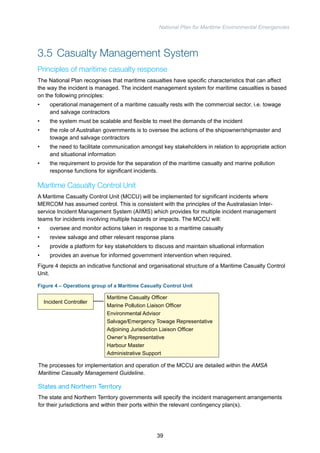
Figure 4 depicts an indicative functional and organisational structure of a Maritime Casualty Control 
Unit. 
Figure 4 – Operations group of a Maritime Casualty Control Unit 
Incident Controller 
Maritime Casualty Officer 
Marine Pollution Liaison Officer 
Environmental Advisor 
Salvage/Emergency Towage Representative 
Adjoining Jurisdiction Liaison Officer 
Owner’s Representative 
Harbour Master 
Administrative Support 
The processes for implementation and operation of the MCCU are detailed within the AMSA 
Maritime Casualty Management Guideline. 
States and Northern Territory 
The state and Northern Territory governments will specify the incident management arrangements 
for their jurisdictions and within their ports within the relevant contingency plan(s). 
39
National Plan for Maritime Environmental Emergencies 
3.6 Emergency towage 
The National Plan includes national arrangements for emergency towage capability (ETC) managed 
by AMSA, supported by jurisdiction arrangements to manage the risks within their respective 
jurisdictions. 
National emergency towage capability 
AMSA is responsible for the delivery of a national emergency towage capability within Australia’s 
eleven designated regions on the following basis (Figure 5 refers): 
• Level 1 Capability – a dedicated emergency towage vessel (ETV) operating in Far North 
Queensland ETC region 
• Level 2 Capability – contracted port towage within the other ten regions that is capable of 
undertaking open water towage operations 
• Level 3 Capability – vessels of opportunity that can be directed or contracted at the time of an 
incident to assist or supplement the Level 1 or 2 capability. 
Figure 5 – Emergency towage capability regions 
The ETC can only be activated by AMSA. Requests for activation must be made in accordance with 
the Guideline for Activation of the Emergency Towage Capability. 
40
National Plan for Maritime Environmental Emergencies 
State and Northern Territory capability 
The state and Northern Territory governments should ensure that there are adequate emergency 
towage arrangements within their jurisdiction to manage their local risks in support of the national 
capability. This capability should be detailed within their relevant contingency plans. This includes 
working with ports within their jurisdiction to: 
• ensure there are no licensing, tendering or other processes that would preclude or hinder the 
effective use of harbour towage vessels as part of the national ETC 
• include emergency towage clauses within harbour towage contracting or licensing 
arrangements 
• cooperate with the release of emergency towage vessels as required in response to a maritime 
casualty 
• include in port towage licensing or tendering arrangements appropriate provisions for 
replacement harbour towage arrangements in the event that an ETV is required to respond to a 
maritime casualty. 
41
National Plan for Maritime Environmental Emergencies 
3.7 Place of refuge 
A place of refuge is a place where a ship in need of assistance can take action to enable it to 
stabilise its condition (including the status of cargo), protect human life and the environment and 
reduce the hazards to navigation. 
The National Maritime Place of Refuge Risk Assessment Guideline is an arrangement, agreed by 
the Commonwealth, state and Northern Territory governments, for the management of requests for, 
or circumstances that require, a place of refuge. 
The guidelines state that a place of refuge should be provided by an Australian maritime agency 
when necessary and appropriate to protect: 
• the safety of the ship’s crew, passengers and salvage crew 
• the safety of human life and health within the immediate vicinity of the distressed ship 
• ecological and cultural resources, and the marine, coastal and terrestrial environments 
• economic and socio-economic infrastructure, including sensitive installations, within the coastal 
zone and ports 
• the safety of the ship and its cargo. 
The guidelines, while optional, may be implemented within the relevant jurisdiction level contingency 
plans, and jurisdictions may choose (or not) to pre-designate or identify possible places of refuge. 
42
National Plan for Maritime Environmental Emergencies 
Part FOUR 
Preparing for marine 
pollution incidents 
43
National Plan for Maritime Environmental Emergencies 
4.1 Scope of preparedness 
Preparedness within the scope of the National Plan refers to those activities undertaken to plan and 
prepare for marine pollution incidents. Key components of preparedness include: 
• contingency planning 
• community awareness and engagement 
• capability development 
• training and development 
• exercises, testing and reviews 
• research and development. 
4.2 Contingency planning 
The National Plan arrangements are underpinned by contingency planning at the national, state, 
territory, regional and local level. The Commonwealth, along with each state and the Northern 
Territory, has responsibility for establishing contingency planning requirements within their 
jurisdiction and for ensuring that those plans are current and effective. This will be consistent with 
the relevant administrative or legislative requirements for each jurisdiction. 
Together, the contingency plans provide a cascade of response measures with initial actions at the 
local level, supported and/or overseen by regional and state/Northern Territory level resources and 
management, as needed. 
Guidance on contingency planning is provided by AMSA for shipping incidents and NOPSEMA 
for offshore petroleum facilities. States emergency management arrangements can also provide 
guidance or templates. 
44
National Plan for Maritime Environmental Emergencies 
4.3 Community awareness and engagement 
Community engagement (including education) is a core component of the National Plan arrangements. 
Effective engagement is essential to engendering public confidence in the National Plan at all levels. 
Within the context of maritime environmental emergencies, community engagement has the 
following objectives: 
• educating and engaging with the community about the nature of the threat, the potential 
impacts resulting from maritime environmental emergencies and the operational constraints 
upon response actions 
• developing the community’s understanding of the National Plan arrangements at national, state/ 
Northern Territory and local levels 
• promoting the reporting of marine pollution incidents. 
The National Plan assigns the following responsibilities in relation to engagement: 
• AMSA is responsible for the development of a community education strategy in relation to the 
national maritime arrangements 
• Governments are responsible for the development of community education strategies in relation 
to their jurisdiction 
• Control Agencies should ensure that contingency plans have effective arrangements for 
community engagement during planning, response and recovery operations, including 
processes for social media monitoring, briefings and warnings. 
Volunteer management 
The National Plan recognises that, similar to other types of events, during a maritime environmental 
emergency many people from the community may spontaneously volunteer assistance and support. 
Offers are likely from both organised volunteer groups as well as individual members of the public. 
The social, community engagement and resource benefits of volunteer use within the response needs 
to be assessed against the administration, training, welfare and safety obligations of the Control Agency. 
Each jurisdiction should consider the participation of volunteers within their jurisdiction and include 
relevant directions and arrangements within their contingency plans. 
45
National Plan for Maritime Environmental Emergencies 
4.4 Capability development 
Response personnel 
National Response Team 
The National Response Team (NRT) is comprised primarily of highly qualified, trained and experienced 
state/Northern Territory and maritime industry personnel ready and able to support pollution response 
operations around the country. The NRT is managed in cooperation with all jurisdictions, which 
nominate members to meet the needs of both incident management and operations. 
The NRT is managed in accordance with the National Response Team Policy, approved by the 
National Plan Strategic Coordination Committee with activation of the NRT by AMSA. 
State and Northern Territory response teams 
The jurisdictions have response teams 
within their respective jurisdictions. 
The arrangements for these response 
teams should be outlined within the state 
and Northern Territory contingency plans. 
AMOSC Core Group 
The petroleum industry ready response 
group is called the Core Group and 
operates under the AMOSPlan to support level 2 and level 3 oil spill responses. The Core Group 
includes three levels of response expertise: Incident Controller Advisors; Spill Managers; and Field 
Operators. 
All of these are petroleum industry personnel working for AMOSC member companies. Each 
member company has a Core Group supervisor who is the primary point of contact for any Core 
Group matter. 
The Core Group and the NRT operate together during a spill response and conduct regular joint 
training and exercises. While primarily focussed on petroleum industry spill response, the Core 
Group is also available to the National Plan to support other spill responses. 
AMOSC members can activate the Core Group directly with AMOSC. All other National Plan 
stakeholders may request Core Group support through AMSA. 
Response equipment 
The National Plan applies a cascade response to the supply of response equipment, which is held 
nationally, regionally and locally. Under agreed arrangements, each jurisdiction is responsible for 
ensuring that there are sufficient stocks of equipment available to them within the cooperative 
arrangements, to address the risks within their area of responsibility. 
National Plan strategic equipment stockpiles 
AMSA maintains nine strategic equipment stockpiles of marine pollution response equipment around 
the Australian coastline. Stocks of dispersant are stored at these stockpiles as well as other key 
locations. The petroleum industry, through AMOSC, maintains stockpiles at four locations. Figure 6 
shows the location of these stockpiles. 
46
National Plan for Maritime Environmental Emergencies 
Figure 6 – Locations of national equipment stockpiles 
The location and composition of the AMSA national stockpiles is based on the following principles: 
• the purpose of the AMSA national stockpiles is to supplement the local and regional resources 
of the jurisdictions and industry 
• the establishment of an AMSA national stockpile in a given location does not reduce any 
requirement for jurisdictions and industry to maintain their own equipment stocks 
• the location of the national stockpiles is determined through the National Risk Assessment and 
logistics considerations 
• all areas identified by the National Risk Assessment as high and very high risk will be capable 
of supply by road transport from a national stockpile within a maximum of 24 hours 
• each stockpile location will be able to be supplemented by road transport from a minimum of 
one other national stockpile within a maximum of 48 hours. 
AMSA maintains an accessible database of its national equipment holdings that records current 
location and serviceability information. 
47
National Plan for Maritime Environmental Emergencies 
Petroleum industry equipment stockpiles 
The petroleum industry contributes to the National Plan via the AMOSPlan. AMOSC holds stockpiles 
of equipment and dispersant at various locations, with its largest stockpile at Geelong, Victoria. 
Small equipment holdings are held by a number of companies and these are generally available 
to other AMOSC members through the mutual aid arrangements of the AMOSPlan. AMOSC also 
contributes to the National Plan through joint funding of the aerial dispersant capability and other 
preparedness and training services. 
States and Northern Territory 
The jurisdictions maintain sufficient stocks of response equipment to manage an oil spill incident 
within their jurisdiction based on their current risk assessment and oil spill contingency plan. The 
composition and location of these stockpiles should be based on an assessment of the risk for that 
jurisdiction. 
The relevant jurisdiction contingency plans detail the arrangements for the deployment of these 
response resources. 
Local – ports, oil and chemical terminals 
The operators of ports, maritime facilities, oil and chemical terminals are normally a designated 
Control Agency and have a responsibility for maintaining appropriate equipment stocks 
commensurate with the risks posed by their operations, and access to sufficient trained personnel 
to effectively deploy that equipment. These control agencies should at a minimum maintain stocks 
of equipment or cooperative arrangements for the supply of such equipment, sufficient to maintain 
response operations until such time as other resources can be deployed in support. This is generally 
referred to as the first-strike capability and will vary from location to location. 
Each jurisdiction is responsible for determining the capability required by a local control agency. 
Offshore petroleum activities 
The offshore petroleum sector has responsibilities to clean-up oil spills from their activities. This 
requires operators to have appropriate emergency response arrangements that guarantee access to 
response capability commensurate with the risks from their activities. 
Offshore petroleum sector/AMSA memoranda of understanding 
AMSA and a number of titleholders and/or operators of offshore petroleum facilities have entered 
into Memoranda of Understanding (MOUs) setting out their respective roles and responsibilities 
when responding to a marine pollution incident. 
For marine pollution incidents from offshore petroleum facilities, requiring regional or national level 
support, AMSA will support the operator in the operator’s Control Agency role. AMSA will provide 
services and resources under its direct control, including technical and response advice, services, 
equipment, personnel and contractors. AMSA will also coordinate National Plan response equipment 
and resources, response and advisory services and personnel. 
For all other marine pollution incidents in Commonwealth waters, including those from ships and 
offshore petroleum activities that are not related to offshore petroleum facilities, AMSA has Control 
Agency responsibility, and will respond in accordance with its Marine Pollution Response Plan as 
approved by the AMSA Executive. 
48
National Plan for Maritime Environmental Emergencies 
Fixed Wing Aerial Dispersant Capability 
AMSA manages the Fixed Wing Aerial Dispersant Capability (FWADC) on behalf of National Plan 
stakeholders. The FWADC was developed in conjunction with and is jointly funded by AMOSC. 
The FWADC maintains aircraft in strategic locations around the Australian coastline and provides 
airbase management and loading support arrangements. 
The FWADC is activated by AMSA, on the request of the relevant state/NT Incident Controller or 
AMOSC, in accordance with the Guideline for the Activation of the Fixed Wing Aerial Dispersant 
Capability. Control Agencies implementing a fixed wing aerial dispersant operation should have 
regard to the Concept of Operations contained within the Guideline. 
Oil spill control agents 
Oil spill control agents (OSCAs) refer to products that are applied to floating or stranded oil to 
minimise their overall impact to the environment. Oil spill dispersants, loose sorbents and surface 
cleaners are examples of commonly used OSCAs. 
The National Plan’s approach to the usage of oil spill control agents involves four key elements: 
• acceptance for general use within Australian waters in accordance with the National Plan 
Register of Oil Spill Control Agents 
• logistics through National Plan and petroleum industry stockpiles, equipment and capability to 
use the OSCAs in a spill response 
• approval to use the OSCA in a specific response from the Incident Controller and any 
regulatory authorities. Individual contingency plans should detail the dispersant approval 
process, and 
• monitoring of the spill to determine the need to use the OSCA and of its effectiveness as part 
of response phase monitoring. 
Environmental, scientific and technical advice 
Contingency plans should include arrangements for environmental, scientific and technical advice 
within the incident management team, including ensuring that both the advice and associated 
services are integrated across planning and response. 
Preparedness requires the development and deployment of decision support tools (see section 5.5). 
49
National Plan for Maritime Environmental Emergencies 
4.5 Training and development 
The training and development of response personnel is a core component of the National Plan 
arrangements. The National Plan identifies three broad levels of training: 
• Level 1 – operator level personnel, i.e. those undertaking onsite clean-up operations. In a major 
incident this would also include supervisors appointed as site managers 
• Level 2 – middle management personnel responsible for managing the operational response, 
e.g. incident controllers, their deputies and environmental and scientific coordinators, and Fire 
Brigade (hazardous materials) specialists 
• Level 3 – senior government and industry personnel responsible for high-level decision making 
in the management of oil or HNS spill incidents. 
National training program 
AMSA is responsible for the delivery of response management training (Level 2 and 3) for National 
Plan stakeholders. AMSA delivers base level training in incident management and specialised 
training in planning, operations, logistics and incident control. All courses are delivered under the 
AMSA Registered Training Organisation in line with the requirements of the Australian Qualifications 
Framework. 
AMSA also supports the development of response personnel through the delivery of specialist 
annual workshops for Environmental and Scientific Coordinators, Incident Controllers and senior 
personnel. 
State and Northern Territory training 
The jurisdictions are responsible for their own Level 1 Training. This training may include courses on 
equipment operation and shoreline response, as well as the delivery of finance and administrative 
services. Other training programs such as oiled wildlife response, may be provided through relevant 
statutory agencies. Some States also provide higher level training. 
Petroleum industry training 
As part of the National Plan arrangements, AMOSC provides oil spill response training for the 
petroleum industry. 
AMOSC has been accredited (through the Nautical Institute) to conduct IMO OPRC training (Field 
Responder, Supervisor and On Scene Commander, and Senior Manager respectively) and delivers 
courses designed specifically for the petroleum industry. Apart from the core IMO training, AMOSC 
also facilitates specialist courses such as aerial surveillance, oiled wildlife response and company-specific 
courses. 
50
National Plan for Maritime Environmental Emergencies 
4.6 National Plan exercises 
Exercises form a core component of the arrangements for preparedness under the National Plan. 
Effectively planned and conducted exercises enable agencies to evaluate contingency plans and 
operating procedures, develop key response personnel and reinforce the stakeholder engagement 
necessary to respond during incidents. 
Each jurisdiction is responsible for ensuring that there is an effective exercise programme for their 
area of responsibility. 
Conduct of exercises 
National Plan exercises will be conducted consistent with the principles outlined in the Australian 
Emergency Management Handbook 3 – Managing Exercises prepared by the Commonwealth 
Attorney-General’s Department. 
National exercise 
The national response capability will be exercised on an annual basis, with the exercise location 
changing each time. The national exercises should include Commonwealth, state and Northern 
Territory and petroleum industry representation in the planning and conduct of the exercise. 
51
National Plan for Maritime Environmental Emergencies 
4.7 Research and development 
The objective of research and development in the context of maritime environmental emergencies 
is to identify, analyse and apply knowledge and information to enable the continuous improvement 
of the national response arrangement. Research and development should be the foundation of the 
National Plan arrangements. All National Plan jurisdictions have a responsibility to identify, support 
and resource research and development priorities. Industry is also encouraged to actively contribute 
to spill response research and development activities. 
The National Plan Research, Development and Technology Policy sets out the administrative 
arrangements by which research and development will be conducted under the National Plan 
arrangements. 
52
National Plan for Maritime Environmental Emergencies 
Part FIVE 
Responding to marine 
pollution incidents 
53
National Plan for Maritime Environmental Emergencies 
5.1 Scope of response 
Response within the scope of the National Plan refers to the management of operations directed to 
coordinate and control a marine pollution incident. The aim of response operations is to minimise 
the impacts of marine pollution from vessels, maritime facilities and oil and chemical terminals, 
and offshore petroleum facilities upon the Australian community, environment, economy and 
infrastructure. 
Arrangements for response are generally detailed within jurisdictional, regional and local contingency 
plans. The National Plan outlines those national arrangements that support these contingency plans. 
5.2 Incident Management System 
The Incident Management System implemented by the National Plan for the management of marine 
pollution incidents is consistent with the Australasian Inter-service Incident Management System 
(AIIMS). The system is designed to be adaptable to the individual circumstances of the incident or 
the particular agencies involved. 
The Incident Management System4 for pollution response is based on the five fundamental principles 
of AIIMS: 
• flexibility – the system can be applied across the full spectrum of incidents and agencies 
• functional management – the response organisation should be structured in accordance with 
the actual work to be performed during the incident or different phases of the incident 
• management by objectives – the process whereby the Incident Controller sets desired 
outcomes for the incident for the purpose of ensuring all responders understand the direction 
being taken during the response 
• unity of command – the response organisation should work to one set of common objectives 
and each individual should report to only one supervisor 
• span of control – refers to the number of individuals or functions that can be successfully 
managed by one person. 
4Although the principles of AIIMS imply a generic organisational structure, a Control Agency will need to determine an 
applicable organisational structure for each incident. Therefore, a generic organisational structure has not been included. 
54
National Plan for Maritime Environmental Emergencies 
The Guideline on the National Plan Incident Management System applies the AIIMS approach to a 
marine pollution response context. However, it is the responsibility of the Control Agency to determine 
how the system will be implemented within the relevant contingency plans. Control Agencies should 
however consider the following critical concepts when undertaking contingency planning: 
• adaptability and scalability – the size and structure of the incident management team should 
reflect the complexity of the incident and change to reflect the various stages of response and 
recovery 
• uniform terminology – the Control Agency should consider the multi-agency aspect of 
significant marine pollution incidents and endeavour to maintain consistent terminology to 
minimise communications issues 
• a defined management structure – the management structure, and respective roles and 
responsibilities of individuals, should be defined in a way that can be clearly communicated and 
applied 
• common operating picture – ensuring the management system can produce a shared and 
consistent understanding of the incident and maintain situational awareness 
• clearly defined information flows – clear definition of reporting relationships and information 
flows between individuals and sections within the response organisation. 
Incident classification 
The National Plan recognises that the majority of incidents are managed locally. However, there is 
a need to ensure that as an incident increases in size and/or complexity, the management system 
can adapt to meet these additional demands. Consistent with international practice, the National 
Plan classifies incidents so as to provide direction on the potential consequence and impact of the 
incident and to provide guidance for agency readiness levels, incident notifications, response actions 
and potential response escalation. 
The National Plan identifies three levels of incidents as follows: 
• Level 1 Incidents are generally able to be resolved through the application of local or initial 
resources only (e.g. first-strike capacity) 
• Level 2 Incidents are more complex in size, duration, resource management and risk and may 
require deployment of jurisdiction resources beyond the initial response 
• Level 3 Incidents are generally characterised by a degree of complexity that requires the 
Incident Controller to delegate all incident management functions to focus on strategic 
leadership and response coordination and may be supported by national and international 
resources. 
Consistent with AIIMS, the National Plan employs a scalable approach to incident classification, 
noting that simple thresholds pose the risk of arbitrary decisions. 
55
National Plan for Maritime Environmental Emergencies 
Table 5 provides a non-exhaustive list of the general characteristics of each of the three levels. 
These characteristics can be used to develop criteria to be considered when evaluating the need 
to escalate response arrangements. These criteria should be embedded within the relevant 
contingency plan or adapted to the specifics of an individual incident. Not all characteristics need to 
apply in all cases, or to all incidents. 
Table 5 – Guidance for incident classification 
Characteristic Level 1 Level 2 Level 3 
Management 
Jurisdiction Single jurisdiction Multiple jurisdictions Multiple jurisdictions, 
including international 
Delegation Incident Controller 
responsible for all 
functions 
Some functions delegated 
or Sections created 
All functions delegated 
and/or divisions created 
Number of agencies First-response 
agency 
Routine multi-agency 
response 
Agencies from across 
government and industry 
Incident Action Plan Simple/Outline Outline Detailed 
Resources Resourced from 
within one area 
Requires intra-state 
resources 
Requires national or 
international resources 
TYPE OF INCIDENT 
Type of response First-strike Escalated Campaign 
Duration Single shift Multiple shifts 
Days to weeks 
Extended response 
Weeks to months 
Hazards Single hazard Single hazard Multiple hazards 
RESOURCES AT RISK 
Human Potential for serious 
injuries 
Potential for loss of life Potential for multiple loss 
of life 
Environment Isolated impacts or 
with natural recovery 
expected within 
weeks 
Significant impacts and 
recovery may take months. 
Remediation required 
Significant area and 
recovery may take months. 
Remediation required 
Wildlife Individual fauna Groups of fauna or 
threatened fauna 
Large numbers of fauna 
Economy Business level 
disruption 
Business failure Disruption to a sector 
Social Reduced services Ongoing reduced services Reduced quality of life 
Infrastructure Short term failure Medium term failure Severe impairment 
Public Affairs Local and regional 
media coverage 
National media coverage International media 
coverage 
56
National Plan for Maritime Environmental Emergencies 
5.3 Response initiation 
The National Plan is a strategic standing arrangement and will be implemented in the event 
of a maritime environmental emergency. When a decision is made to respond to a maritime 
environmental emergency, response arrangements appropriate to the jurisdiction and incident type 
will be activated. 
Contingency plans should detail the procedures for initiating a response to a marine pollution 
incident, including: 
• initiation triggers 
• required actions 
• responsibilities of key agencies and personnel. 
Principles for response initiation 
Timely initiation of a response is critical to achieving an effective outcome from an operation. A 
response should be initiated where there is a need to: 
• monitor the incident, potential or actual 
• implement measures to mitigate the impacts of the incident. 
The National Plan recognises that pre-emptive or precautionary response operations may be 
necessary to ensure that the environmental or broader community interests are protected or where 
it is considered that the local resources may be insufficient to address a significant threat. The 
National Plan supports Control Agencies applying the principle of prudent over-escalation when 
considering the initial response to an incident. This principle recognises that it is more effective to 
scale down an initial response than to scale up following an under-reaction. 
Accessing the National Plan’s supporting arrangements 
The Control Agency can at any time access the National Plan’s supporting arrangements to assist 
with response operations. The resources of all National Plan and AMOSPlan stakeholders are 
available to support the Control Agency on request. 
Access to the National Plan arrangements is via a formal request from the Control Agency to AMSA, 
initially verbally through RCC Australia, and then confirmed in writing. 
AMSA will coordinate the resources of the National Plan in support of the Control Agency. 
57
National Plan for Maritime Environmental Emergencies 
5.4 Response escalation 
Incidents are dynamic and may change over time and space. During an incident there may be a 
need to enlarge the response for a range of reasons. This is referred to as escalation and may 
involve increased support to a Control Agency or a change in Control Agency. At all levels (oil and 
chemical terminals, maritime facilities, ports, state/NT, offshore platform, etc.), contingency plans, 
inter-agency and inter-jurisdictional agreements, and incident action plans should document when 
and how response escalation should occur. 
The National Plan implements a scalable approach to response management. This approach 
provides for the orderly progression from local response operations to incidents requiring 
international assistance. 
Change of Control Agency is one form of response escalation. The National Plan includes a 
Guideline on a Change of Control Agency where such arrangements are not already part of 
existing disaster and emergency management or regulatory arrangements. Section 2.5 outlines the 
circumstances for change of Control Agency during an emergency of national consequence. 
58
National Plan for Maritime Environmental Emergencies 
5.5 Assessment and decision support 
Environmental, scientific and technical advice 
Environmental, scientific and technical advice is essential to make informed and effective 
decisions regarding the establishment of response objectives and the selection of the most 
appropriate response strategies and tactics. This advice should be incorporated at all levels of 
incident management and may include: 
• direct advice to the Incident Controller 
• integration into the planning section to inform the development of the incident action plan, 
and 
• support in the field to response operations. 
AMSA on behalf of the National Plan and its stakeholders maintains numerous support tools for 
use in an incident. These tools, which are supplied by AMSA on the request of the Control Agency 
include: 
• Trajectory Modelling that identifies speed of movement, weathering and spreading 
characteristics of the pollutant under the influence of prevailing currents and weather 
conditions. The modelling capability is activated by AMSA, on the direct request of the 
relevant Incident Controller or AMOSC, in accordance with the Guideline for the Activation 
of the National Modelling Capability 
• Response Phase Monitoring assesses the effectiveness of response strategies. 
Contingency plans should include arrangements for the implementation of response phase 
monitoring at the earliest stages of the response operation. The National Plan Response 
Phase Monitoring Advisory provides advice to Control Agencies on the scope and 
implementation of monitoring activities in support of response operations 
• Geographic Information Systems are computer based mapping tools that identify 
threatened environmental and community resources, logistical information (roads, etc.) and 
any other information relevant to preparing and responding to marine pollution incidents. 
The jurisdictions are responsible for the maintenance of spatial information and manage 
access to their information. 
Memoranda of understanding and contracts exist with technical and scientific agencies to 
provide expert capability to support National Plan stakeholder needs. 
National support 
AMSA supports the implementation of the state and Northern Territory spatial information 
capability through a National Plan funding program. Funding applications are made on an annual 
basis in accordance with the Policy on the Oil Spill Response Atlas. 
59
National Plan for Maritime Environmental Emergencies 
5.6 Oil spill response 
The National Plan arrangements support the implementation of a number of response strategies, 
including (but not restricted to): 
• monitoring and assessment 
• control and recovery 
• application of oil spill control agents 
• shoreline clean-up and remediation 
• response to impacted or threatened wildlife. 
The National Plan does not give priority to a single strategy, but acknowledges that a combination of 
strategies is required to effectively manage an oil pollution incident. The relevant contingency plan 
should set out the strategies to be employed in a response operation. 
Control Agency 
The Control Agency for an oil spill response is the government agency or company assigned by 
legislation, administrative arrangement or within the relevant contingency plan to control response 
activities to an oil spill. Table 6 provides a high level summary of the Control Agencies for oil 
spill incidents. Details of these arrangements are set out in the AMSA-led Review of jurisdictional 
responsibilities for response under the OPRC and OPRC/HNS. While the Control Agency is 
responsible for control of response activities, including appointing the Incident Controller, the Control 
Agency may have arrangements in place for another government agency or company to provide oil 
spill response services during an emergency. 
60
National Plan for Maritime Environmental Emergencies 
Table 6 – Control Agencies for oil pollution incidents 
Area 
------ 
source 
Oil 
terminal 
Sole-user 
maritime 
facility for 
oil terminal 
Multi-user 
maritime 
facility 
Port 
waters 
State 
waters 
Commonwealth waters 
Shipping 
Offshore 
sourced 
petroleum 
spill 
facility 
First 
Strike / 
Level 1 
Oil terminal 
operator 
Oil terminal 
operator 
Maritime 
facility 
owner Port 
authority 
or 
state govt 
agency 
Offshore 
petroleum 
facility 
titleholder 
or 
state govt 
agency 
Levels 2 AMSA Titleholder 
and 3 
Port 
authority 
or 
state govt 
agency 
Port 
authority 
or 
state govt 
agency 
Port 
authority 
or 
state govt 
agency 
Great Barrier Reef Marine Park – for any spills the Control Agency is the Queensland Government 
Torres Strait – for any spills into the area defined within TorresPlan the Control Agency is the 
Queensland Government 
External territories: 
• for any spills into Christmas Island ports areas the Harbour Master is the Incident Controller 
• for any spills into Commonwealth waters around Christmas Island, the Incident Controller is 
appointed by AMSA. 
• for spills into Norfolk Island Waters, the Control Agency is the Norfolk Island Government. 
Notes relating to Table 6 
To avoid uncertainty, a vessel at a Maritime Facility with a line ashore is subject to the relevant Control 
Agency arrangements indicated for a Maritime Facility and not the arrangements indicated for Port Waters. 
Definitions – for Table 6 only 
First strike means a prompt initial response to protect the environment that is intended to limit the effect of 
an incident until such time as other resources can be deployed in support. This capability may vary from 
location to location. 
Oil terminal means a petroleum refinery and/or petroleum storage/distribution facilities with access to a 
maritime facility, but not including the maritime facility. 
Maritime facility means a wharf or mooring at which a vessel can be tied up during the process of loading 
or unloading a cargo [or passengers]. A maritime berth may be a sole user berth [such as a dedicated 
berth for an oil refinery] or may be a multi-user berth [such as a berth that handles general cargo, or one 
that handles bulk liquids such as petroleum for more than one user of the berth (sometimes known as a 
common-user berth)]. 
Oil terminal operator means a company [or joint venture] that operates an oil terminal. 
Port waters has the same meaning as in s.12 of the Maritime Transport and Offshore Facilities Security Act 
2003 and includes: 
a) areas of water, between the land of the port and the open waters outside the port, intended for use by 
ships to gain access to loading, unloading or other land-based facilities; and 
b) areas of open water intended for anchoring or otherwise holding ships before they enter areas of water 
described in paragraph (a); and 
c) areas of open water between the areas of water described in paragraphs (a) and (b). 
61
National Plan for Maritime Environmental Emergencies 
Coordination of the national support arrangements 
AMSA will coordinate the national arrangements in support of a Control Agency’s response 
operation. These arrangements include: 
• deployment of the National Plan Strategic Equipment Stockpiles 
• deployment of the Fixed Wing Aerial Dispersant Capability 
• deployment of AMSA and National Response Team personnel 
• providing support services including trajectory modelling, remote sensing and aerial surveillance 
• providing technical and other advice. 
The national arrangements are detailed elsewhere within the National Plan and the activation 
arrangements are contained within the relevant guideline. 
Coordination of petroleum industry arrangements 
The relevant petroleum company will coordinate all resources and contracts required to support 
their response to a marine spill from their vessel, oil terminal or offshore facility. The company will 
generally utilise their own resources in the first instance and AMOSPlan will be used to facilitate the 
provision of AMOSC resources and the provision of mutual aid from other industry members. In the 
case of an offshore petroleum facility, the company may utilise National Plan resources, if previously 
arranged with AMSA under an offshore petroleum sector/AMSA MOU (see section 4.4, above). 
62
National Plan for Maritime Environmental Emergencies 
5.7 Hazardous and noxious substance response 
As Party to the OPRC-HNS Protocol, Australia has an obligation to prepare for, and respond to, a 
pollution incident by hazardous and noxious substances (see Table 2 on Page 19). 
However, as a result of the broad range of properties, behaviours, potential for health effects, 
environmental impacts and damage to a vessel from HNS, the response to these incidents requires 
skills, knowledge, experience and equipment, which are different to oil spill response. However, 
it should be noted that some oils may present similarly to HNS and need to be responded to 
accordingly. Where appropriate, National Plan tools and support services, such as chemical 
dispersion modelling, will be available to HNS responses. 
The National Plan arrangements for HNS response is based on cooperation with the emergency 
services, in particular the hazardous materials response units within fire and rescue services 
Control Agency 
The Control Agencies for HNS incidents are listed in Table 7. 
Table 7 – Control Agencies for HNS incidents 
Chemical terminal Port Outside a port 
Commonwealth Port authority AMSA 
New South Wales Port Authority or Fire 
and Rescue NSW Port authority 
Transport for NSW, a Port 
Corporation or Roads 
and Maritime Services 
Northern Territory Fire and Rescue 
Service Port authority Department of Transport 
Queensland Chemical terminal 
operator 
Maritime Safety 
Queensland 
Maritime Safety 
Queensland 
South Australia Metropolitan Fire 
Service Port authority 
Department of 
Planning, Transport and 
Infrastructure 
Tasmania Tasmania Fire Service Tasmania Fire Service Tasmania Fire Service 
Victoria Chemical terminal 
operator / Fire agencies Fire agencies Fire Agencies 
Western Australia Department of Fire and 
Emergency Services 
Department of Fire and 
Emergency Services 
Department of Fire and 
Emergency Services 
Great Barrier Reef 
Marine Park 
Chemical terminal 
operator 
Maritime Safety 
Queensland 
Maritime Safety 
Queensland 
Indian Ocean 
Territories Harbour Master AMSA 
Norfolk Island Norfolk Island 
Government AMSA 
63
National Plan for Maritime Environmental Emergencies 
Levels of HNS response 
The National Plan is based around three distinct levels of HNS Response: 
• advisory – the focus of the advisory service is to provide an assessment of the risks to health, 
immediate response advice and an assessment of the need for additional assistance to a 
vessel’s crew. AMSA maintains arrangements with relevant hazmat agencies for the provision 
of hazardous materials advice on a 24/7 basis. This service complements State and Northern 
Territory arrangements 
• shipboard response –the objective of a shipboard response capability is to provide rapid 
intervention in order to contain an incident to a vessel and prevent damage to the vessel or loss 
of material into the environment where possible 
• major incident response – in a very small number of situations, it may be beyond the 
capability of a shipboard response and the relevant Control Agency to contain the material 
to the vessel. In these situations, which may result in the loss of material into the marine 
environment, a full response under the National Plan will be launched similar to an oil spill. 
Responsibilities 
The states and Northern Territory are responsible for establishing arrangements for HNS response 
within their jurisdiction. 
AMSA is responsible for the development and maintenance of HNS response capability within the 
Commonwealth’s jurisdiction. These arrangements are detailed within the Guideline on National 
Hazardous and Noxious Substance Response. AMSA will offer states/NT the opportunity to use 
Commonwealth arrangements on request. 
For both Commonwealth and state/NT jurisdictions, the development of HNS response capability 
should be undertaken in consultation with all relevant agencies and industry and should define 
relevant Control Agencies and address each response phase. 
64
National Plan for Maritime Environmental Emergencies 
5.8 Wildlife response 
Each jurisdiction is responsible for ensuring that 
there are effective wildlife response arrangements 
within their jurisdiction. These arrangements should 
be detailed within the relevant contingency plans, 
including the identification of the lead agency for 
these operations. In line with support for other oil spill 
response contingency systems, the National Plan also 
provides support to state and Northern Territory wildlife 
response arrangements. 
5.9 Waste management 
Oil and HNS spills in the marine environment 
can result in the production of large quantities of 
waste that require temporary storage, transport, 
management and ultimately treatment and disposal. 
Each jurisdiction has appropriate legislation detailing 
the requirements for the management and disposal 
of waste materials. Under the National Plan, wastes 
generated in a response are managed in accordance 
with that jurisdiction’s regime. 
5.10 Health and safety 
The safety of all people (responders and the 
community) in all activities is the highest priority. 
This includes training, exercising, procuring 
equipment or conducting an operational response 
activity under the National Plan. 
In order to meet this principle, safety should be 
managed in accordance with a safety management 
system detailed within the relevant contingency 
plan. The National Plan Health and Safety Guideline 
provides guidance on the implementation of a safety 
management system. 
65
National Plan for Maritime Environmental Emergencies 
5.11 Response termination 
The Control Agency is responsible for the decision to terminate response operations. This decision 
should be informed by advice from a range of stakeholders identified in relevant contingency plans, 
including the agency with jurisdictional authority. 
Contingency plans should include processes for the termination of response operations. The 
Foreshore Assessment and Response Termination Plans Advisory offers guidance to agencies and 
other stakeholders when considering response termination. 
5.12 Post incident response analysis 
Post incident analysis, incorporating a review and reporting on the operational response to a 
maritime environmental emergency assists with continuous improvement of both people and 
organisations. Key to this is engaging and sharing within and across organisations and jurisdictions. 
Under the National Plan, each jurisdiction is responsible for reviewing and reporting to other National 
Plan stakeholders on their spill responses and exercises. In practice, post incident analysis is 
conducted in accordance with the Guidelines for the Conduct of Post Incident Analysis, which is 
consistent with the Lessons Management Handbook published as part of the Australian Emergency 
Management Handbook Series. 
66
National Plan for Maritime Environmental Emergencies 
Part SIX 
Recovering from 
marine pollution 
incidents 
67
National Plan for Maritime Environmental Emergencies 
6.1 Scope of recovery 
Recovery is part of emergency management, which includes the broader components of prevention, 
preparedness and response. Recovery is the coordinated process of supporting affected 
communities in the reconstruction of their built environment and the restoration of psychological, 
social, economic, built and natural environment wellbeing. Recovery activities generally commence 
during the response phase and often continue after response activities have concluded. 
Recovery is characterised by a complex array of issues and involves a broad range of organisations 
and stakeholders. Recovery programmes and processes can have a lasting impact on the 
community and are often time consuming and costly in terms of financial and other resources. 
Under the National Plan, recovery refers to three distinct processes: 
• recovery of costs for organisations involved in response arrangements or communities that 
suffer loss resulting from pollution 
• rehabilitation of the environment 
• return of an affected socio-economic community to its pre-incident level of functioning. 
In relation to recovery of costs for organisations involved in response arrangements, further 
information is provided in part seven. 
In relation to environmental rehabilitation, recovery operations aim, as far as possible, to return 
the environment to its pre-incident condition or to a state that is considered to be an acceptable 
environmental outcome to jurisdictional authorities and key stakeholders. 
The National Plan recognises the need to return an affected socio-economic community to its 
proper level of functioning, but acknowledges that jurisdictions already have established emergency 
arrangements to achieve this. These matters are addressed in more detail below. 
68
National Plan for Maritime Environmental Emergencies 
6.2 Principles for recovery 
The National Plan is underpinned by the National Principles for Disaster Recovery which was 
endorsed by the Community and Disability Services Ministers’ Advisory Council in 2009. These 
principles are outlined in table 8. 
Table 8 – Recovery Principles 
Recovery principle Considerations 
Understanding the context • Identifying vulnerabilities (e.g. community reliant upon fishing 
income or tourism) 
• Being culturally sensitive 
• Acknowledge the capacity of the community to assist 
• Being clear on community expectations 
Recognising complexity • Recognising that information on impacts will change over time 
• There are diverse issues which need to be addressed 
• Quick action to address immediate needs may be warranted 
• There may be conflicting needs and priorities amongst 
stakeholders 
Using community led 
approaches 
• Adaptable policies and procedures to address the individual 
requirements of the incident 
• Developing partnerships with communities should be encouraged 
(e.g. local environmental groups) 
• Enabling the community to engage in their own recovery from an 
incident 
Ensuring coordination of all 
activities 
• Based on planning and information gathering 
• Clearly articulating the roles and responsibilities of stakeholders 
• Being integrated into contingency planning 
• Having clearly articulated goals and desired outcomes 
Employing effective 
communication 
• Ensuring communication is relevant, timely and credible 
• Recognising that communication with stakeholders is a two way 
process 
• Feedback should be sought and integrated into decision making 
• Ensuring information is accessible to all stakeholders 
Acknowledging and building 
capacity 
• Engaging with stakeholders as part of planning 
• Implementing recovery operations as soon as possible after the 
commencement of an incident 
• Working with stakeholders to learn from incidents to increase 
resilience into the future 
69
National Plan for Maritime Environmental Emergencies 
6.3 Recovery functions 
Typically four functions need to be addressed in the context of maritime environmental emergencies 
– environmental, economic, social and infrastructure. 
The degree to which these recovery functions need to be addressed will vary from incident to 
incident. 
Table 9 provides guidance on the types of activities required to address each of these recovery 
functions. 
Table 9 – Recovery functions 
Environmental Economic Social Infrastructure 
Assessing and 
documenting the impact 
of the incident on 
natural resources 
Assessing and 
documenting the impact 
of the incident on the 
local, regional and 
national economy 
Assessing and 
documenting the impact 
to cultural and heritage 
and other community 
resources 
Assessing and 
documenting the impact 
to infrastructure and 
services 
Rehabilitating impacted 
areas where possible 
and measuring recovery 
over time 
Support agencies 
recovering response 
costs 
Rehabilitating and 
conserving impacted 
cultural and heritage 
resources where 
possible 
Rehabilitating or 
returning to service the 
impacted infrastructure, 
e.g. damaged 
navigation aids and 
restoring production 
Communicating to the 
public the impacts of the 
incident 
Facilitating the recovery 
of losses incurred by 
business as a result of 
the incident 
Restoring community 
services as soon 
as possible, e.g. re-opening 
beaches and 
boat ramps 
Prioritising the 
rebuilding of impacted 
infrastructure 
Engaging with the 
community to assist with 
the assessment and 
rehabilitation processes 
Assisting business 
to recover from the 
intangible impacts of 
the incident, e.g. loss of 
confidence in the fishery 
or tourism sectors 
Engaging with the 
community on the 
recovery process 
Engaging with affected 
stakeholders on the 
recovery process 
70
National Plan for Maritime Environmental Emergencies 
6.4 Recovery arrangements and the National Plan 
In addition to the general recovery arrangements, described above, maritime environmental emergencies 
can encompass additional elements which should be considered when developing contingency plans 
and undertaking response operations. 
Engagement with the responsible party 
The response and recovery to maritime environmental emergencies is funded on the basis of the 
‘polluter pays’ principle (see Table 1). For recovery, this means that all stakeholders should have clear 
and early engagement with the responsible party or their representative (e.g. insurer). The responsible 
party should be represented on recovery committees to enable a shared ownership of the recovery plan 
and its implementation. 
Recovery planning 
Recovery should be included as part of the contingency planning process, building on emergency risk 
management studies and resource atlases. Plans should identify recovery management structures, 
actions, roles and responsibilities, and be consistent with relevant state, Northern Territory and 
Commonwealth level plans. Recovery plans and the results of impact assessment form the basis for 
detailed recovery action plans prepared following a maritime environmental emergency. 
Recovery committee 
The Recovery Committee is the strategic decision-making body for the recovery. It is formed when an 
impact assessment indicates that a formal recovery operation will be required. 
In most states/NT and the Commonwealth, recovery is managed in accordance with established 
emergency management arrangements. 
Recovery coordinator 
Recovery Coordinators may be appointed for a recovery operation. Recovery Coordinators are the public 
face of the recovery operation, providing leadership to the Recovery Committee and coordinating the 
recovery effort in accordance with agreed recovery plans. 
Transition from a response focus to a recovery focus 
Recovery begins at impact and recovery arrangements are established in parallel with the operational 
response. As the response activities wind down, there should be a formal transition to provide more 
focus on recovery and to achieve an effective hand-over between the two incident phases. 
A recovery action plan is developed by the Recovery Committee (where established) following a maritime 
environmental emergency. 
The Incident Controller prepares a response transition report, in consultation with the Recovery 
Coordinator, outlining: 
• the emergency action plan in place at the time of transition, emphasising actions that are incomplete 
• resources allocated to the emergency response and their exit strategies 
• an assessment of the emergency, focussing on the environment and affected community 
• an impact summary, noting specifically any areas or situations with a potential to escalate the 
emergency 
• a forecast of the expected recovery outcomes 
• proposals for activities to be continued in the recovery phase. 
The transition report should reassure the community that services are still available and must be 
supported by a coordinated public information strategy. 
71
National Plan for Maritime Environmental Emergencies 
6.5 Impact assessment 
An assessment of the extent of damage, impact on the community and environment and the 
potential need for a longer-term recovery process should take place as soon as practicable following 
the start of response operations. 
The Incident Controller is responsible for initiating the recovery impact assessment, in conjunction 
with support agencies, local government and statutory authorities. 
This should consider whether recovery can be managed locally in the short-term as part of the 
operational response, or requires more formal recovery arrangements, including the development of 
a Recovery Plan. 
The relevant contingency plan should identify the agencies responsible for the conduct of impact 
assessment during both the response and recovery phases of the incident. 
6.6 Communicating with the community 
Recovery requires a strong focus on understanding the impacts of a maritime environmental 
emergency on people: their communities, livelihoods and environment. These include health 
and psychological wellbeing, and the local economy. Effective engagement with people and their 
community needs to be underpinned by a robust communications strategy. The strategy needs to 
ensure that people understand what is going on and how to report and receive information. The 
strategy should outline actions required and the means to obtain assistance and support. Engaging 
the local communities and harnessing their capabilities can contribute greatly to enhancing recovery. 
Communication strategies need to be developed in a manner that is consistent with the 
emergency management arrangements and accepted communications protocols in the respective 
Commonwealth and states/NT jurisdictions. Community meetings and community updates are useful 
tools to maintain community support for the agencies leading and responding to both the response 
and the recovery from a maritime environmental emergency. 
72
National Plan for Maritime Environmental Emergencies 
Part SEVEN 
Cost recovery 
73
National Plan for Maritime Environmental Emergencies 
7.1 Scope of cost recovery 
Funding arrangements to support the National Plan are based on the polluter pays principles. 
Response and recovery is funded on the basis of the polluter pays. For shipping, this is achieved 
through the implementation of relevant international conventions under the auspices of the IMO. For 
the offshore petroleum industry, this is achieved through the Offshore Petroleum and Greenhouse 
Gas Storage Act 2006. All agencies responding to and incurring costs in relation to pollution 
incidents where the polluter is not identified, or costs are not recoverable, may be able to recover 
their costs from AMSA under the Protection of the Sea Levy5. 
International arrangements provide guidance as to what are considered to be reasonable costs 
associated with the response to a maritime environmental emergency. Costs and expenditure for 
the purposes of the National Plan relate to reasonable measures taken to respond to maritime 
environmental emergencies such as responding to a casualty to prevent pollution, combating actual 
pollution by oil or chemical at sea, defending sensitive resources and/or cleaning shorelines and 
coastal installations. In general, costs will be considered ‘reasonable’ if they result from actions that: 
• were undertaken on the basis of a technical appraisal of the incident 
• sought to enhance the natural processes of recovery 
• were not undertaken purely for public relations reasons. 
The Control Agency is responsible for ensuring that there are arrangements, administrative or 
legislative, in place to enable support agencies to be reimbursed for the costs incurred in responding 
to an incident. 
These costs are met by those responsible for the spill through various international and domestic 
arrangements. Generally, for Commonwealth/state/NT agencies, reimbursement is normally through 
international liability and compensation funds or shipowner’s liability insurers known as Protection & 
Indemnity Clubs (P&I Clubs). Where none of the conventions or domestic statutes provides for cost 
recovery, legal actions may need to be pursued. 
5See footnote 1 
74
National Plan for Maritime Environmental Emergencies 
7.2 International maritime arrangements 
International arrangements exist that generally ensure that the cost of combat and clean-up of spills 
originating from oil tankers and non-tankers can be recovered. These arrangements are set out in 
four international conventions to which Australia is a party: 
• For oil tankers: 
– the International Convention on Civil Liability for Oil Pollution Damage 1992 (the 1992 Civil 
Liability Convention) 
– the International Convention on the Establishment of an International Fund for 
Compensation for Oil Pollution Damage 1992 (the 1992 Fund Convention) 
– the Protocol of 2003 to the International Convention on the Establishment of an 
International Fund for Compensation for Oil Pollution Damage 1992 (the 2003 
Supplementary Fund Protocol), and 
• For non-tankers (i.e. all other vessels) 
– International Convention on Civil Liability for Bunker Oil Pollution Damage 2000 (the 
Bunkers Convention). 
The ability to utilise cost recovery arrangements relies on the ability to identify the polluter and 
to prove that they have appropriate insurance cover. The only exception is where it can be 
demonstrated that a so-called ‘mystery’ spill originated from an oil tanker. In such circumstances the 
Fund Convention mentioned above may meet clean-up costs and compensation. 
7.3 Domestic maritime arrangements 
While the international conventions mentioned above have similar applications in terms of directly 
incurred costs of pollution response, the conventions are, in general, far broader in their scope and 
application than the National Plan arrangements. Types of claims that may be accepted under the 
international conventions that are not part of the National Plan arrangements include: 
• consequential loss – loss of earnings suffered by the owners or users of property contaminated 
as a result of a spill, for example the loss of income by a fisher as a result of their nets being 
contaminated 
• pure economic loss – loss of earnings sustained by persons whose property has not been 
polluted, for example a hotelier whose premises are closed due to a contaminated public beach 
• damage to property, such as repair or cleaning of boats not involved in response activity, or cost 
of repairing roads or jetties damaged by clean-up operations. 
Where Commonwealth/state/NT agencies are unable to recover costs that have been incurred in 
responding to pollution incidents in Australia or may have difficulty in meeting financial commitments 
while waiting for reimbursements from the shipowner/P&I Club, AMSA may reimburse the 
operational or response costs. For shipping incidents, the National Plan Strategic Coordination 
Committee has agreed to apply the Claims Management Guidelines. 
7.4 Offshore petroleum sector arrangements 
For offshore petroleum facility-sourced pollution incidents, petroleum titleholders are required, under 
the Offshore Petroleum and Greenhouse Gas Storage Act 2006, to maintain adequate insurance to 
cover the costs of responding to an incident. Recent amendments to the Act clarify this requirement, 
as well as the requirement for titleholders to cover the costs of the incident response. 
75
National Plan for Maritime Environmental Emergencies 
Index 
ALARP 22 
AMOSC Core Group 46 
AMOSPlan 5, 46, 48 
Antarctic 20, 21 
Australasian Inter-service Incident Management System (AIIMS) 39, 54 
Australian Emergency Management Arrangements 10 
Australian Exclusive Economic Zone (EEZ) 15 
Australian Institute of Petroleum (AIP) 33 
Australian Local Government Association 25 
Australian Marine Oil Spill Centre (AMOSC) 5, 33, 59 
Australian Maritime Safety Authority Act 20 
Australian Qualifications Framework 50 
Ballast water 14 
Bunkers 5 
Change of Control Agency 32, 58 
Chemical terminal 5 
Christmas Island 61 
Claims Management Guideline 10 
Coastal Waters 5, 15 
Command 5 
Community 5, 10, 68 
Community engagement 45 
Contingency planning 44 
Control Agency 5, 29, 48, 54, 59, 60, 61 
Convention for the Protection of the Natural Resources and 
Environment of the South Pacific Region (see also SPREP) 23 
Convention on Limitation of Liability for Maritime Claims 20 
Coordination 5 
Cost recovery 10, 74 
Council of Australian Governments 11 
Council on Transport and Infrastructure (COTI) 25 
Doctrine 5, 11 
Emergencies of National Consequence 30 
Emergency 5 
Emergency towage 14, 27, 36, 40 
Environment Plan 22 
Environment Protection and Biodiversity Conservation Act 21 
Environmental rehabilitation 68 
Environmental, scientific and technical advice 59 
Equipment stockpiles 46, 47 
Escalation of response 58 
Exercises 51 
External territories 15, 61 
Fixed Wing Aerial Dispersant Capability (FWADC) 49 
Funding arrangements 74 
76
National Plan for Maritime Environmental Emergencies 
Geographic information systems 59 
Global Response Network (GRN) 6, 33 
Great Barrier Reef Marine Park Authority (GBRMPA) 38 
Great Barrier Reef Marine Park Authority Act 21 
Hazardous and noxious substance (HNS) 10, 13, 19, 33, 63 
HNS response 64 
Incident 6, 55 
Incident classification 56 
Incident Controller 6 
Incident Management System 54 
Incident Management Team (IMT) 6 
Infrastructure 12 
Internal waters 6 
International Convention for the Prevention of Pollution from Ships (MARPOL) 19 
International Convention on Oil Pollution Preparedness, Response and 
Co-operation (OPRC) 10,19, 23, 27, 32, 33, 63 
International Convention on the Establishment of an International Fund 
for Compensation for Oil Pollution Damage 20 
International Convention Relating to Intervention on the High Sea in Cases of 
Oil Pollution Casualties (Intervention Convention) 10, 19 
International Maritime Organization (IMO) 27, 33, 37 
International Petroleum Industry Environmental Conservation Association (IPIECA) 33 
International support 33 
Marine debris 14 
Marine pests 14 
Marine pollution 6 
Maritime Assistance Service (MAS) 37 
Maritime casualty 6, 14, 16, 19, 36, 37, 38 
Maritime Casualty Control Unit (MCCU) 39 
Maritime facility 7 
Maritime Powers Act 21 
Maritime Safety Queensland (MSQ) 38 
Maritime Transport and Offshore Facilities Security Act 7 
Model Arrangements for Leadership During Emergencies of National Consequence 30, 31 
Multiple Jurisdiction Incidents 32 
Mutual aid arrangements 23 
Mystery or unknown spill sources 14 
National Disaster Resilience Statement 11 
National Maritime Place of Refuge Risk Assessment Guideline 42 
National Offshore Petroleum Safety and Environmental Management Authority (NOPSEMA) 21, 22 
National Plan Outlook Report 28 
National Plan Research, Development and Technology Policy 27 
National Plan Strategic Coordination Committee (NPSCC) 25, 26, 28 
National Plan Strategic Industry Advisory Forum (NPSIAF) 26 
National Principles for Disaster Recovery 69 
National Response Team (NRT) 46 
Norfolk Island 61 
77
National Plan for Maritime Environmental Emergencies 
Offshore Petroleum and Greenhouse Gas Storage Act 5, 21, 22, 74 
Offshore petroleum facility 7 
Offshore petroleum sector/AMSA MOU 48 
Oil Pollution Emergency Plan (OPEP) 22 
Oil (see petroleum) 7 
Oil spill control agents (OSCAs) 49 
Oil spill response atlas (OSRA) 59 
Oil Spill Response Ltd (OSRL) 33 
Oil terminal 7 
PACPLAN (See also SPREP) 23, 32 
Petroleum 7 
Physical damage 14 
Place of refuge 7, 36, 42 
Polluter pays’ principle 71 
Port Authority 7 
Port waters 7 
Prudent over-escalation principle 57 
Protection & Indemnity Clubs (P&I Clubs) 74 
Protection of the Sea (Powers of Intervention) Act 37 
Protection of the Sea (Prevention of Pollution from Ships) Act 20 
Protection of the Sea Levy 7, 12, 14 
Rescue Coordination Centre (RCC) Australia 37 
Recovery 69, 71 
Registered Training Organisation (RTO) 50 
Research, Development and Technology 52 
Response escalation 58 
Response phase monitoring 59 
Responsible Agency 7 
Responsible Party 7 
Review of National Plan 28 
Risk Assessment 12 
Seas and Submerged Lands Act 6 
SOLAS 38 
South Pacific Regional Environment programme (SPREP) (see also PACPLAN) 23 
Stakeholders 13 
Support Agency 8, 29 
Timor Sea Joint Petroleum Development Area 23 
TorresPlan 8, 61 
Traditional owners 13 
Trajectory modelling 59 
Transport and Infrastructure Senior Officials Committee (TISOC) 25 
United Nations Convention on the Law of the Sea (UNCLOS) 32 
78
AMSA 496 (3/14)

O Plano Nacional de Marítimos

  • 1.
    National Plan forMaritime Environmental Emergencies Australian Government Australian Maritime Safety Authority Australian Government Australian Maritime Safety
  • 3.
    National Plan forMaritime Environmental Emergencies Authority The National Plan for Maritime Environmental Emergencies (National Plan implements Australia’s obligations under the United Nations Convention on the Law of the Sea, 1982; the International Convention on Oil Pollution Preparedness, Response and Co-operation, 1990; and the Protocol on Preparedness, Response and Co-operation to Pollution Incidents by Hazardous and Noxious Substances, 2000 with respect to the management of maritime environmental emergencies. The National Plan is to be maintained, amended and implemented by the National Plan Strategic Coordination Committee. Implementation The National Plan is hereby approved for implementation by the National Plan Strategic Coordination Committee. i
  • 4.
    National Plan forMaritime Environmental Emergencies Foreword Australia depends almost exclusively on shipping to transport its exports and imports and in terms of tonnage shipped Australia is the fifth largest shipping nation in the world. Australia’s growing offshore petroleum industry is also critical to the country’s energy security. In response to the importance of these sectors to the country’s economic, environmental and social wellbeing, Australia is party to the United Nations Convention on the Law of the Sea, 1982 which establishes an obligation to protect and preserve the marine environment. The National Plan for Maritime Environmental Emergencies is one of the ways Australia meets its obligations. The National Plan parallels similar documents dealing with other aspects of maritime emergency response such as search and rescue, saving of life at sea, and caring for survivors brought to shore. In operation since 1973, the National Plan has been characterised by willing and effective cooperation between governments and industries, and has provided both timely and effective response to actual pollution incidents. This document recognises the need to develop and maintain a shared responsibility; and the commitment of all stakeholders in order to continue to provide timely and effective response, including making available equipment and trained personnel as and when needed, both domestically and internationally. Marine pollution plans prepared by all the Australian government jurisdictions, port corporations, industry and operators of offshore petroleum facilities underpin this National Plan. These plans provide detailed information to implement the provisions outlined in this document. Chair National Plan Strategic Coordination Committee ii
  • 5.
    National Plan forMaritime Environmental Emergencies Contents Authority i Implementation i Foreword ii Acronyms 3 Glossary of terms 5 Part one – Administrative arrangements 9 1.1 Purpose of the National Plan 10 1.2 Principles of the National Plan 10 1.3 Scope of the National Plan 13 1.4 Structure 15 Part two – National Plan governance and management 17 2.1 Legal and administrative basis for the National Plan 18 2.2 Governance 25 2.3 Management of the National Plan 27 2.4 Roles and responsibilities 29 2.5 Strategic coordination of emergencies of national consequence 30 2.6 International support 33 Part three – Prevention of marine pollution incidents 35 3.1 Scope of prevention 36 3.2 Responsibility of the shipowner 36 3.3 Maritime Emergency Response Commander 37 3.4 Responsibilities of Australian governments 37 3.5 Casualty Management System 39 3.6 Emergency towage 40 3.7 Place of refuge 42 Part four – Preparing for marine pollution incidents 43 4.1 Scope of preparedness 44 4.2 Contingency planning 44 4.3 Community awareness and engagement 45 4.4 Capability development 46 4.5 Training and development 50 4.6 National Plan exercises 51 4.7 Research and development 52 1
  • 6.
    National Plan forMaritime Environmental Emergencies Part five – Responding to marine pollution incidents 53 5.1 Scope of response 54 5.2 Incident Management System 54 5.3 Response initiation 57 5.4 Response escalation 58 5.5 Assessment and decision support 59 5.6 Oil spill response 60 5.7 Hazardous and noxious substance response 63 5.8 Wildlife response 65 5.9 Waste management 65 5.10 Health and safety 65 5.11 Response termination 66 5.12 Post incident response analysis 66 Part six – Recovering from marine pollution incidents 67 6.1 Scope of recovery 68 6.2 Principles for recovery 69 6.3 Recovery functions 70 6.4 Recovery arrangements and the National Plan 71 6.5 Impact assessment 72 6.6 Communicating with the community 72 Part seven – Cost recovery 73 7.1 Scope of cost recovery 74 7.2 International maritime arrangements 75 7.3 Domestic maritime arrangements 75 7.4 Offshore petroleum sector arrangements 75 2
  • 7.
    National Plan forMaritime Environmental Emergencies Acronyms AIIMS Australian Inter-Service Incident Management System AIP Australian Institute of Petroleum AQF Australian Qualifications Framework AMOSC Australian Marine Oil Spill Centre AMSA Australian Maritime Safety Authority ANP Timor-Leste National Petroleum Authority COTI Council on Transport and Infrastructure EP Environment Plan ESC Environmental Scientific Coordinator ETC emergency towage capability ETV emergency towage vessel FWADC Fixed Wing Aerial Dispersant Capability GBRMPA Great Barrier Reef Marine Park Authority GRN Global Response Network HNS hazardous and noxious substance IC Incident Controller ICS Incident Control (Command) System IMO International Maritime Organization IOPC Funds International Oil Pollution Compensation Funds IPIECA International Petroleum Industry Environmental Conservation Association JPDA Timor Sea Joint Petroleum Development Area MARPOL International Convention for the Prevention of Pollution from Ships MAS Maritime Assistance Service MCCU Maritime Casualty Control Unit MERCOM Maritime Emergency Response Commander MOU memorandum/a of understanding MPC Marine Pollution Controller MSQ Maritime Safety Queensland NOPSEMA National Offshore Petroleum Safety and Environmental Management Authority NPSCC National Plan Strategic Coordination Committee NPSIAF National Plan Strategic Industry Advisory Forum NRT National Response Team 3
  • 8.
    National Plan forMaritime Environmental Emergencies NT Northern Territory OPGGSA Offshore Petroleum and Greenhouse Gas Storage Act 2006 OPRC International Convention on Pollution Preparedness, Response and Co-operation, 1990 OPRC-HNS Protocol Protocol on Preparedness, Response and Co-operation to Pollution Incidents by Hazardous and Noxious Substances, 2000 OSCA oil spill control agent OSCP Oil Spill Contingency Plan OSRA Oil Spill Response Atlas OSRL Oil Spill Response Limited PACIA Plastics and Chemicals Industries Association PACPLAN Pacific Islands Regional Marine Spill Contingency Plan P&I Club Protection and Indemnity Club RCC Australia Rescue Coordination Centre - Australia RTO Registered Training Organisation SAR search and rescue SOLAS Safety of Life at Sea - derived from the International Convention for the Safety of Life at Sea SPREP South Pacific Regional Environment Programme TISOC Transport and Infrastructure Senior Officials Committee UNCLOS United Nations Convention on the Law of the Sea, 1982 4
  • 9.
    National Plan forMaritime Environmental Emergencies Glossary of terms For clarity, and in the context of this document: AMOSPlan is managed by Australian Marine Oil Spill Centre (AMOSC) and outlines the cooperative arrangements for response to oil spills by Australian oil and associated industries. Bunker means a heavy fuel oil, intermediate fuel oil, blended distillate or diesel used as a vessel’s fuel. Coastal waters, in relation to a State or the Northern Territory, is defined in s.7 of the Offshore Petroleum and Greenhouse Gas Storage Act 2006, and means “so much of the scheduled area for the State or Territory as consists of the territorial sea and any waters that are on the landward side of the territorial sea, and not within the limits of the State or Territory”. Chemical terminal means a chemical refinery and/or chemical storage/distribution facilities with access to a maritime facility, but not including the maritime facility. Command means the internal direction of the members and resources of an agency in performance of the organisation’s roles and tasks. Command operates vertically within an organisation. Community means a group with a commonality of association and generally defined by location, shared experience or function. Control means the overall direction of emergency management activities during an emergency situation. Authority for control is established in legislation or administratively and carries with it responsibility for tasking organisations in accordance with the needs of the situation. Control Agency means the agency or company assigned by legislation, administrative arrangements or within the relevant contingency plan, to control response activities to a maritime environmental emergency. The legislative or administrative mandate should be specified in the relevant contingency plan. The Control Agency will have responsibility for appointing the Incident Controller. This is the equivalent of Responsible Agency or Control Authority under AIIMS. Coordination means the bringing together of organisations and other resources to support an emergency management response. Division means an organisational unit having responsibility for operations within a defined geographic area or with a functional responsibility. Doctrine means an evidence-based collective of knowledge that has been structured and systematised to facilitate its application in practice, that is prepared for dissemination in a way appropriate for its intended audience, and that is constantly reviewed and updated as circumstances require. Emergency means an event, actual or imminent, which endangers or threatens to endanger life, property or the environment, and which requires a significant and coordinated response. The term emergency and disaster are used interchangeably within the Australian Emergency Management Arrangements. Environment means the complex of physical, chemical and biological agents and factors which may impact on a person or a community, and may also include social, physical and built elements, which surround and interact with a community. 5
  • 10.
    National Plan forMaritime Environmental Emergencies First Strike means a prompt initial response to protect the environment that is intended to limit the effect of an incident until such time as other resources can be deployed in support. This capability may vary from location to location. Global Response Network means the global coalition of oil spill responder organisations established to facilitate sharing of expertise and experience. Habitat means the natural home or environment of an animal, plant or other organism. Hazardous and noxious substance means any substance which, if introduced into the marine environment, is likely to create hazards to human health, to harm living resources and marine life, to damage amenities or to interfere with other legitimate uses of the sea. Incident means an event, occurrence or set of circumstances that: • has a definite spatial extent • has a definite duration • calls for human intervention • has a set of concluding conditions that can be defined • is or will be under the control of an Incident Controller appointed to make decisions to control and coordinate the approach, means and actions taken to resolve the incident. Incident Controller means the individual responsible for the management of all incident control activities across an incident. Incident Management Team is the group of incident management personnel comprised of the Incident Controller and personnel appointed by the Incident Controller to be responsible for the overall control of the response to an incident. Industry, unless already specified or defined in a particular context, means a business or commercial group or sector, or other socially valuable activity, such as fisheries, tourism, infrastructure, transport, etc. and their representative groups. Internal waters means those waters that fall within the constitutional boundaries of a State or Territory. The waters which are capable of falling within these limits are described in s.14 of the Seas and Submerged Lands Act 1973 as ‘bays, gulfs, estuaries, rivers, creeks, inlets, ports or harbours which were, on 1 January 1901, within the limits of the States and remain within the limits of the States’. Marine pollution refers to any occurrence or series of events with the same origin, including fire and explosion, which results or may result in discharge, release or emission of oil or a hazardous and noxious substance, which poses or may pose a threat to the marine environment, the coastline, animals or other resource, and which requires an emergency action or immediate response. Under the National Plan, marine pollution refers primarily to situations that may arise from shore based oil and chemical transfer facilities, shipping operations and/or the operation of an offshore petroleum facility. Maritime casualty means a collision of vessels, stranding or other incident of navigation, or other occurrence on board a vessel or external to it resulting in material damage or imminent threat of material damage to a vessel or cargo. 6
  • 11.
    National Plan forMaritime Environmental Emergencies Maritime facility means a wharf or mooring at which a vessel can be tied up during the process of loading or unloading a cargo [or passengers]. A maritime berth may be a sole user berth [such as a dedicated berth for an oil refinery] or may be a multi-user berth [such as a berth that handles general cargo, or one that handles bulk liquids such as petroleum for more than one user of the berth (sometimes known as a common-user berth)]. National Plan means the National Plan for Maritime Environmental Emergencies, and all policy, guidance and advisory documents produced and published in support. Offshore petroleum facility means a facility operating in accordance with the provisions of the Offshore Petroleum and Greenhouse Gas Storage Act 2006, or any relevant State/Territory legislation. Oil means hydrocarbons in any liquid form including crude oil, fuel oil, sludge, oil refuse, refined products and condensates. Also including dissolved or dispersed hydrocarbons, whether obtained from plants or animals, mineral deposits, or by synthesis. Oil terminal means a petroleum refinery and/or petroleum storage/distribution facilities with access to a maritime facility, but not including the maritime facility. Oil terminal operator means a company [or joint venture] that operates an oil terminal. Petroleum includes oil and other substances extracted in the recovery of such substances, including LNG and LPG. Place of refuge means a location, such as a port, anchorage, or other suitable place, where a maritime casualty can be placed in order to stabilise its condition, minimise impact on the community and environment, and reduce the hazards to navigation. Port authority, depending on jurisdiction, may refer to a state agency, a state corporation or a private company. Port waters has the same meaning as in s.12 of the Maritime Transport and Offshore Facilities Security Act 2003 and includes: a) “areas of water, between the land of the port and the open waters outside the port, intended for use by ships to gain access to loading, unloading or other land-based facilities; and b) areas of open water intended for anchoring or otherwise holding ships before they enter areas of water described in paragraph (a); and c) areas of open water between the areas of water described in paragraphs (a) and (b).” Protection of the Sea Levy is a statutory charge against ships, based on the ‘potential polluter pays’ principle, and is used to fund the National Plan for Maritime Environmental Emergencies. Funds are also used to meet clean-up costs which cannot be attributed to a known polluter. Responsible Agency – see Control Agency. Responsible party means the entity that has been identified as owning or having the legal responsibility for the vessel or facility that caused the incident. Section means the organisational level having responsibility for the key top level functions of incident management: planning, public information, logistics and operations. 7
  • 12.
    National Plan forMaritime Environmental Emergencies State means, depending on context, one or more of the states of Australia. Support Agency means an agency or company that provides essential services, personnel, material or advice in support of the Control Agency during the response to a maritime environmental emergency. Terminal (see also oil terminal and chemical terminal) TorresPlan is the marine oil spill contingency plan for the Torres Strait area and is a supplement to the Queensland Coastal Contingency Action Plan. Unit means a small cell of people working within one of the sections undertaking a designated set of activities. Vessel (and/or ship) has several meanings within Australian legislation and international conventions, but for the purpose of the National Plan means a vessel of any type whatsoever operating in the marine environment, and includes hydrofoil boats, air cushion vehicles, submersibles and floating craft of any type. Throughout this document the term vessel is preferred. Ship, shipowner and shipping are used where these make sense in context or arise from an official or formal source. 8
  • 13.
    National Plan forMaritime Environmental Emergencies Part one Administrative arrangements 9
  • 14.
    National Plan forMaritime Environmental Emergencies 1.1 Purpose of the National Plan The National Plan for Maritime Environmental Emergencies (National Plan) sets out national arrangements, policies and principles for the management of maritime environmental emergencies. It provides for a comprehensive response to maritime environmental emergencies regardless of how costs might be attributed or ultimately recovered1. 1.2 Principles of the National Plan The National Plan is designed to meet the following principles as described at Table 1. Table 1 – National Plan principles and management context Principle Management context Protect the community, environment and maritime industries The National Plan provides a single comprehensive and integrated response arrangement to minimise the impacts of marine pollution from vessels and oil spills from offshore petroleum facilities, as well as other environmental impacts arising from a maritime environmental emergency, upon the Australian community, environment, cultural and heritage resources, economy and infrastructure. Give effect to relevant international conventions The National Plan gives administrative effect to Australia’s emergency response obligations relating to the: • International Convention on Oil Pollution Preparedness, Response and Co-operation, 1990 (OPRC) • Protocol on Preparedness, Response and Co-operation to Pollution Incidents by Hazardous and Noxious Substances, 2000 (OPRC-HNS Protocol) • International Convention Relating to Intervention on the High Seas in Cases of Oil Pollution Casualties, 1969 (Intervention Convention), and • Articles 198 and 221 of the United Nations Convention on the Law of the Sea, 1982 (UNCLOS). Integrate with the Australian Emergency Management Arrangements The Australian Emergency Management Arrangements describe how Australia addresses the risks and impacts of hazards through a collaborative approach between the Commonwealth, state, territory and local governments; business and industry; and the community. The National Plan forms an essential component of this integrated approach to disaster and emergency management by detailing arrangements across governments, industry and the community for the management of the specific threats from maritime environmental emergencies. 1The Claims Management Guidelines provides information on how Commonwealth, state and Northern Territory agencies may be able to seek reimbursement for costs from AMSA. 10
  • 15.
    National Plan forMaritime Environmental Emergencies Principle Management context Provide a comprehensive management arrangement The National Plan implements a comprehensive management arrangement through five core components: • governance and policy to ensure accountability, risk assessment, engaging with stakeholders and providing clear strategic direction • prevention of marine pollution through the delivery of a system for the management of maritime casualties • preparedness for marine pollution incidents through a tiered approach to contingency planning, training and development of response personnel, and maintenance of response assets and services • response to marine pollution incidents through the implementation of the National Plan arrangements • recovery of the community and the environment from the impacts of marine pollution. A doctrinal approach to all phases is applied to the extent possible. All stakeholders should develop and share their evidence, knowledge and experience, in a documented, structured and systematised manner. This will facilitate practical application, and provide for review and revision, as circumstances require. Provide a single integrated response arrangement Consistent with the Council of Australian Governments National Disaster Resilience Statement, the National Plan recognises that the management of maritime environmental emergencies is the shared responsibility of all levels of government, industry and business, the non-government sector and the community. The National Plan achieves this through: • all parties fostering a cooperative relationship to ensure maritime environmental emergencies are managed in the interests of the Australian community • recognising the commitment of all stakeholders to collaboration across all levels of government, industry stakeholders and the community • emphasising the development and maintenance of cooperative relationships, teamwork, consultative decision making and shared responsibilities • all stakeholders committing to support the National Plan arrangements when an incident occurs, regardless of source or location. 11
  • 16.
    National Plan forMaritime Environmental Emergencies Principle Management context Implement a risk management approach The National Plan recognises that the starting point for reducing the impacts of maritime environmental emergencies lies in the understanding of the specific hazards and the social, environmental, cultural and heritage, infrastructure and economic vulnerabilities presented by these events. The National Plan is underpinned by formal risk assessment at the Commonwealth, state and Northern Territory (NT), regional, and local scale. Implement the polluter pays principles The National Plan is based on the polluter pays principle: • preparedness is funded on the principle that the potential polluters pay, and in general, for oil and HNS risks arising: – from shipping, a levy applies to commercial shipping visiting Australian ports – from the offshore petroleum industry, operators fund arrangements to meet their specific risks • response and recovery is funded on the basis of the polluter pays – for shipping, this is achieved through the implementation of relevant international conventions under the auspices of the International Maritime Organization (IMO) – for the offshore petroleum industry, this is achieved through the Offshore Petroleum and Greenhouse Gas Storage Act 2006 (OPGGSA) • agencies responding to and incurring costs in relation to pollution incidents where the polluter is not identified, or costs are not recoverable, may be able to seek reimbursement of their costs from the Australian Maritime Safety Authority (AMSA) under the Protection of the Sea Levy2. Provide for stakeholder engagement The National Plan recognises that a broad range of stakeholders may be affected by a maritime environmental emergency and early engagement is important for preparedness, response and recovery. As such, the National Plan is underpinned by formal stakeholder engagement through the governance arrangements, community engagement and education programmes; and a recognition that contingency planning must include arrangements for the consideration of: • traditional owners’ cultural and heritage issues • post-European settlement heritage issues • the protection of habitats • the protection of fauna and flora • issuing of warnings and notices, and • community and industry input and feedback. 2See footnote 1 12
  • 17.
    National Plan forMaritime Environmental Emergencies 1.3 Scope of the National Plan Maritime environmental emergencies The National Plan applies to potential and actual pollution of the sea or harm to the marine environment by oil or hazardous and noxious substance, originating from: • maritime casualties requiring salvage and intervention, emergency towage and requests for a place of refuge • oil pollution or hazardous and noxious substance pollution incidents from vessels • oil or hazardous and noxious substance pollution incidents from oil or chemical terminals (addressed by state and port plans) • oil or hazardous and noxious substance pollution incidents from offshore petroleum activities • marine pollution from unknown sources • marine pollution from floating or sunken containers of hazardous materials • debris originating from a maritime casualty, or • physical damage caused by vessels. The National Plan does not contain arrangements for the management of the following hazards associated with shipping and offshore petroleum facilities: • ballast water and marine pests, or • marine pollutants other than oil and hazardous and noxious substances. The National Plan does not apply to threats to the marine environment resulting from pest species, climate change, marine debris and rubbish, or other natural or man-made occurrences. These are managed under other regimes and agreements. While the National Plan will respond to maritime environmental emergencies as outlined above, not all costs meet the criteria for reimbursement by either insurance3 or through the Protection of the Sea Levy. 3Insurance in this case should be read to include all forms of insurance relating to shipping, offshore platforms, maritime facilities, domestic oil and chemical terminals, etc., as well as the applicable international maritime liability and compensation regimes. 13
  • 18.
    National Plan forMaritime Environmental Emergencies Geographic scope The geographical scope of the National Plan, as shown in Figure 1 is the Australian Exclusive Economic Zone (EEZ), offshore islands and territories and the high seas where the incident has the potential to impact upon Australian interests. The National Plan also applies to internal and coastal waters (i.e. three nautical miles) for which the states and the Northern Territory have responsibility. Unless otherwise stated, reference to the Commonwealth includes Australia’s external territories. Figure 1 – Geographic scope of the National Plan 14
  • 19.
    National Plan forMaritime Environmental Emergencies 1.4 Structure Structure of this document This document structure reflects the comprehensive approach to emergency management: • Part two – Governance and management arrangements sets out the arrangements for the governance and strategic management of the National Plan • Part three – Prevention of marine pollution incidents sets out the national arrangements to prevent the release of marine pollution from a vessel through the implementation of a strategy to manage maritime casualties • Part four – Preparing for marine pollution incidents sets out the national arrangements that prepare National Plan stakeholders for marine pollution incidents • Part five – Responding to marine pollution incidents sets out the national arrangements for responding to marine pollution incidents • Part six – Recovering from marine pollution incidents sets out the arrangements for the recovery of responding agencies, the community and environment from a marine pollution incident, and • Part seven – Cost recovery sets out the cost recovery arrangements under the National Plan. Detail and support is provided by the National Plan policy, guidance and advisory documents referred to throughout the National Plan. 15
  • 20.
    National Plan forMaritime Environmental Emergencies Supporting arrangements The National Plan consists of a range of legal and administrative arrangements which are applied through a tiered management structure. Figure 2 depicts this structure. At the highest level, international conventions and domestic legislation provide the legal context for the National Plan. This is underpinned by national policies and implemented through jurisdictional and local contingency plans. Figure 2 – National Plan legal, administrative and planning framework International conventions and agreements, and national legislation and regulations National Plan for Maritime Environmental Emergencies National Plan policies, guidelines, and scientific, technical and operational advisories Australian Government response arrangements State and Northern Territory Government response arrangements AMSA Marine Pollution Contingency Plan External Territories Contingency Plan Offshore petroleum industry oil spill contingency plans Port, oil and chemical industry terminal contingency plans Regional and local contingency plans 16
  • 21.
    National Plan forMaritime Environmental Emergencies Part TWO National Plan governance and management 17
  • 22.
    National Plan forMaritime Environmental Emergencies 2.1 Legal and administrative basis for the National Plan The National Plan gives effect to a number of international conventions and agreements to which Australia is a party. The National Plan utilises a range of domestic legislation that provides government agencies with response powers and places preparedness and response obligations on various industry sectors. Recovery is a responsibility variously shared across industry, maritime agencies, other government entities and the affected communities. Australian governments The Commonwealth, states and Northern Territory have responsibilities for ensuring preparation and response to maritime environmental emergencies within their jurisdictions. The following issues should be addressed: • ensure that the jurisdiction is prepared to manage the risks associated with maritime activities • identify agencies or commercial operators with the responsibility to respond to maritime environmental emergencies, i.e. perform role the Control Agency role • oversee strategic or regulatory aspects of response operations, including notification of adjoining jurisdictions • coordinate relevant agencies and stakeholders • engage the community • identify an authority to declare the completion of response operations • coordinate cost recovery on behalf of support agencies, and • institute legal proceedings where appropriate. 18
  • 23.
    National Plan forMaritime Environmental Emergencies International conventions The National Plan implements and is supported by a number of international conventions to which Australia is a party. Table 2 – International conventions International convention Application to the National Plan International Convention on Oil Pollution Preparedness, Response and Co-operation, 1990 Protocol on Preparedness, Response and Co-operation to Pollution Incidents by Hazardous and Noxious Substances, 2000 (OPRC-HNS Protocol) Provide the basis for the National Plan by setting the context for: • developing a national system for pollution response • maintaining adequate capacity and resources to address oil and hazardous and noxious substances (HNS) incidents • facilitating international cooperation and mutual assistance in preparing for and responding to major oil and HNS incidents, and • notifying without delay all States [neighbouring countries] whose interests are affected or likely to be affected by an oil or HNS pollution incident. International Convention for the Prevention of Pollution from Ships (MARPOL) Provides ships’ construction and operational requirements to prevent pollution from ships. Requires ships greater than 400 gross tonnes to have pollution emergency plans. Provides for exemptions from discharge restrictions (and prosecution) where: • a discharge is necessary to secure the safety of a ship or save a life at sea, or prevent a larger spill; or • it is necessary during a spill response to discharge oil or HNS or use dispersants to minimize the overall damage from pollution, and is approved by the relevant government. United Nations Convention on the Law of the Sea, 1982 Article 221, provides general powers for parties to take and enforce measures beyond the territorial sea to protect their coastline or related interests from pollution or threat of pollution following a maritime casualty or acts relating to such a casualty, which may reasonably be expected to result in major harmful consequences. Article 198 provides that “when a State [neighbouring country] becomes aware of cases in which the marine environment is in imminent danger of being damaged … by pollution, it shall immediately notify other States it deems likely to be affected by such damage.” International Convention Relating to Intervention on the High Sea in Cases of Oil Pollution Casualties, 1969 Protocol Relating to Intervention on the High Seas in Cases of Pollution by Substances Other Than Oil, 1973 Provides general powers for parties to take measures on the high seas as may be necessary to prevent, mitigate or eliminate grave and imminent danger to their coastline or related interests from the threat of pollution by oil or hazardous and noxious substances following a maritime casualty or acts related to such a casualty, which may reasonably be expected to result in major harmful consequences. 19
  • 24.
    National Plan forMaritime Environmental Emergencies International convention Application to the National Plan International Convention on Civil Liability for Oil Pollution Damage, 1992 Provides for the recovery of pollution costs and payment of compensation from owners/operators of oil tankers. International Convention on the Establishment of an International Fund for Compensation for Oil Pollution Damage, 1992 2003 Protocol to the International Convention on the Establishment of an International Fund for Compensation for Oil Pollution Damage, 1992 Provides for additional compensation and costs where the tanker owners’/operators’ liability limits are exceeded, using funds provided by the oil industry. International Convention on Civil Liability for Bunker Oil Pollution Damage, 2001 Provides for the recovery of pollution costs and payment of compensation from owners/operators of all vessels using oil as bunker fuel and references the liability arrangements in the Convention on Limitation of Liability for Maritime Claims, 1976 (LLMC) and its 1996 Protocol. Protocol on Environmental Protection to the Antarctic Treaty 1991 The objective of the Protocol is to ensure the comprehensive protection of the Antarctic environment and associated ecosystems. The Antarctic includes all the area south of latitude 60o south. Annex IV to the Protocol relates to marine pollution, specifically prohibiting the discharge of oil, noxious liquid substances and garbage in the Antarctic Treaty area. Annex VI (not yet in force) of the Protocol relates to liability for environmental emergencies. Table 3 lists legal instruments implemented by the Australian Government to give effect to key principles and arrangements agreed between the Commonwealth, states and Northern Territory. Table 3 – Commonwealth legislation Commonwealth legislation Application to the National Plan Australian Maritime Safety Authority Act 1990 Provides that a function of AMSA is to combat pollution in the marine environment. Protection of the Sea (Prevention of Pollution from Ships) Act 1983 Provides exemptions for the discharge of materials in response to marine pollution incidents, e.g. including also the application of dispersants. Requires ships greater than 400 gross tonnes to have pollution emergency plans. Provides for emergency discharges from ships. Protection of the Sea (Civil Liability for Bunker Oil Pollution Damage) Act 2008 Places liability on shipowner for pollution damage caused by loss of bunker fuel. Provides immunity from legal action for response personnel. Protection of the Sea (Civil Liability) Act 1981 Places liability on shipowner for pollution damage caused by loss of persistent oil from an oil tanker.
  • 25.
    Commonwealth legislation Applicationto the National Plan Protection of the Sea (Oil Pollution Compensation Fund) Act 1993 Provides additional compensation for pollution damage caused by loss of persistent oil from an oil tanker. Protection of the Sea (Powers of Intervention) Act 1981 Provides for intervention powers being exercised in Australia’s EEZ, Territorial Sea and internal waters. Offshore Petroleum and Greenhouse Gas Storage Act 2006 Sets out the requirements for the offshore petroleum exploration and production sector. Provides for the Commonwealth to direct the polluter to take actions in response to an incident and to clean-up, monitor impacts and reimburse National Offshore Petroleum Safety and Environmental Management Authority (NOPSEMA) or the Commonwealth. Environment Protection and Biodiversity Conservation Act 1999 Regulates activities impacting on defined “matters of national environmental significance”, Commonwealth marine reserves, and species listed under the Act. The Act provides for the making of exemptions if in the national interest. An exemption has been issued for activities done pursuant to the National Plan. Great Barrier Reef Marine Park Authority Act 1975 Provides for permission to use dispersants in the Marine Park, and notification to enter a zone in the Marine Park for the purpose of salvage. Antarctic Treaty (Environment Protection) Act 1980 Provides for the protection of the Antarctic environment, including requiring all activities in the Antarctic to undertake an environmental impact assessment and establishing specific permitting arrangements for impacts on native flora and fauna. The Act provides exceptions for activities done in an emergency, including to protect the environment. When in force, Annex VI to the Protocol on Environmental Protection to the Antarctic Treaty will be implemented through this Act, including requirements for operators to undertake preventative measures and develop contingency plans in relation to environmental emergencies, and establish a liability regime for failing to respond to environmental emergencies in the Antarctic. Fisheries Management Act 1991 Provides regulatory and other mechanisms to support any necessary fisheries management decisions during a response Maritime Powers Act 2013 Provides for the administration and enforcement of Australian laws in maritime areas, and for related purposes. The Act aims to give greater certainty to the maritime Officers working in difficult conditions to protect Australia’s boarders and enforce Australian Maritime laws.
  • 26.
    National Plan forMaritime Environmental Emergencies Offshore petroleum regulation and spill response Australia has established a comprehensive regulatory regime for the offshore petroleum industry for environmental management and oil spill response. The regime places the onus on the titleholder to manage marine pollution risks and requires that all petroleum activities have an Environment Plan (EP), including an Oil Pollution Emergency Plan (OPEP), accepted by the relevant regulator before that activity is able to commence. The Offshore Petroleum and Greenhouse Gas Storage Act 2006 (OPGGSA) establishes NOPSEMA as the primary regulator for offshore petroleum activities in the Commonwealth marine area. The requirements for EPs and OPEPs are outlined in the Offshore Petroleum and Greenhouse Gas Storage (Environment) Regulations 2009. An EP must identify the environmental risks of a petroleum activity, including those risks associated with any emergency or spill response, and demonstrate to the regulator that the impacts and risks from the activity have been reduced to as low as reasonably practicable (ALARP), and that any residual impacts and risk is of an acceptable level. There is an obligation on the offshore petroleum industry to undertake appropriate consultations in the course of managing their impacts and risks and demonstrate in the EP that those consultations have been undertaken. Under the regime, each titleholder has a duty to establish, maintain and implement a marine pollution response capability, which may be in partnership with other parties. This response capability must be commensurate with the risks presented by the particular activity. Where the response activities rely on, or may affect relevant stakeholders, the titleholder is required to demonstrate appropriate consultation and that relevant agreements are in place. In particular, the OPGGSA and its associated regulations: • sets out responsibilities of titleholders in relation to the operation of offshore exploration and production facilities, including oil spill notification procedures to both NOPSEMA and (potentially) affected States/NT • provides powers for NOPSEMA or the responsible Commonwealth Minister to direct titleholders to take actions in response to an incident • requires the titleholder to clean-up and monitor the impact of a spill • provides, should a titleholder fail to fulfil their obligations in the event of a spill, that NOPSEMA or the responsible Commonwealth minister may do any or all of the things the titleholder has failed to do. • requires that titleholders maintain financial assurance sufficient to demonstrate that they can meet the costs, expenses and liabilities associated with undertaking a petroleum activity. Comparable legislation and regulations exist for offshore petroleum activities in state and territory waters. Each state/NT establishes its own regulator and has specific oil spill response arrangements for offshore petroleum activities within its jurisdiction. Further detail on these arrangements can be found in the state/NT marine pollution contingency plans. 22
  • 27.
    National Plan forMaritime Environmental Emergencies Other international and regional agreements The National Plan provides a mechanism for Australia to enter into mutual aid arrangements with other countries impacted by maritime environmental emergencies, giving effect to Australia’s obligations under OPRC and the OPRC-HNS Protocol. Australia has entered into a number of international cooperation agreements which are described below. Pacific Islands Regional Marine Spill Contingency Plan (PACPLAN) Australia is a party to the Convention for the Protection of the Natural Resources and Environment of the South Pacific Region, 1986 (SPREP Convention). The convention includes a Protocol Concerning Co-operation in Combating Pollution Emergencies in the South Pacific Region, 1990 (SPREP Pollution Protocol). The protocol provides formally for cooperation when responding to marine spills. Consistent with the SPREP Convention and Protocol, in 2000 SPREP member countries adopted the Pacific Islands Regional Marine Spill Contingency Plan, known as PACPLAN. This provides for cooperative regional responses to major marine spills in the Pacific Island region, including linkages and mechanisms for accessing regional and supra-regional assistance. One of the key mechanisms within PACPLAN is the provision for the 22 SPREP island members to seek assistance from the so-called SPREP Non-island Governments of Australia, France, New Zealand and the United States of America. Australia is listed as the primary source of assistance for Nauru, Papua New Guinea, Solomon Islands, Tuvalu, Vanuatu and Kiribati and, along with the other Non-island Governments, is a secondary source of assistance for all other island members. Timor Sea Joint Petroleum Development Area An area of the Timor Sea lying between Australia and Timor-Leste is subject to overlapping territorial claims by Australia and Timor-Leste. This area contains substantial resources of petroleum. In this situation, Australia and Timor-Leste have agreed that a joint development regime, pending final delimitation of the seabed, is the best approach to permit development of petroleum resources to the benefit of both countries. The Timor Sea Treaty (the Treaty) came into force on 2 April 2003. The Treaty establishes the Joint Petroleum Development Area (JPDA) as well as the Joint Commission, consisting of Commissioners appointed by Australia and Timor-Leste. The Joint Commission has established a detailed regulatory and fiscal regime which applies to petroleum activities in the JPDA. The petroleum aspects of seabed jurisdiction within the JPDA are covered by the Treaty. Article 10 of the Treaty provides that Australia and Timor-Leste will “cooperate to protect the marine environment of the JPDA so as to prevent and minimise pollution and other environmental harm from petroleum activities.” Under the Treaty the Designated Authority (known as the Timor-Leste National Petroleum Authority, or ANP) “shall issue regulations to protect the marine environment in the JPDA. It shall establish a contingency plan for combating pollution from petroleum activities in the JPDA”. 23
  • 28.
    National Plan forMaritime Environmental Emergencies The contingency plan, as agreed by the Joint Commission, states that the following applies to pollution incidents within the JPDA: • in a situation where a pollution incident could be contained by the operator, under arrangements approved by the ANP, the operator has responsibility for responding to the incident. The operator would normally inform the ANP of the incident and continuously update the ANP on progress • in situations where the pollution incident is beyond the capability of the operator, the ANP/ Timor-Leste Government or the operator may contact AMSA to seek assistance from Australia. These arrangements are consistent with Annex C paragraph (e) of the Treaty Powers and Functions of the Designated Authority which state that “the powers and functions of the Designated Authority shall include requesting assistance with pollution prevention measures, equipment and procedures from the appropriate Australian and Timor-Leste authorities or other bodies or persons”. The coordinates of the JPDA are set out in Annex A of the Timor Sea Treaty: www.austlii.edu.au/au/ other/dfat/treaties/2003/13.html. Bilateral agreements Australia has bilateral agreements in place on cooperation in preparedness and response with New Zealand, New Caledonia, Papua New Guinea, Indonesia and South Korea. Photograph courtesy of PNG NMSA 24
  • 29.
    National Plan forMaritime Environmental Emergencies 2.2 Governance The aim of National Plan governance is to ensure a coordinated, integrated and accountable system is in place to manage maritime environmental emergencies. This is achieved through: • reporting to Australian Governments through the Council on Transport and Infrastructure (COTI), under the Council of Australian Governments’ arrangements • the establishment of the National Plan Strategic Coordination Committee (NPSCC) to set policy direction and oversee the implementation of the National Plan • stakeholder engagement, in particular with the shipping, petroleum, chemical and port industries • appropriate technical input to support decision making • links to coordinated arrangements across the Commonwealth, states and Northern Territory. Figure 3 depicts the National Plan governance structure. The terms of reference and operating principles for the arrangements are detailed in the National Plan Governance Guideline. Council on Transport and Infrastructure The COTI was established in September 2011 and brings together Commonwealth, State, Territory and New Zealand Ministers with responsibility for transport and infrastructure issues, as well as the Australian Local Government Association. The Council has responsibility for the National Plan for Maritime Environmental Emergencies. The Council is advised by the Transport and Infrastructure Senior Officials Committee (TISOC) on National Plan matters. Figure 3 – National Plan governance structure Council on Transport and Infrastructure Transport and Infrastructure Senior Officials Committee Commonwealth, State and northern Territory Marine Pollution Committees and/or Disaster management Arrangements National Plan Strategic Coordination Committee National Plan Strategic Industry Advisory Forum National Plan Technical Groups 25
  • 30.
    National Plan forMaritime Environmental Emergencies National Plan Strategic Coordination Committee The National Plan Strategic Coordination Committee (NPSCC) is responsible for setting the broad policy direction of the National Plan, overseeing the implementation of the Plan and ensuring the effectiveness of the arrangements. The NPSCC is comprised of senior Commonwealth, State and Northern Territory Government officials and reports to TISOC on the effectiveness of the National Plan. The Committee is chaired by a senior official from the Australian Government. The National Plan Strategic Industry Advisory Forum (NPSIAF) provides an observer to the NPSCC. The committee can form Technical Groups to support its deliberations. The current Technical Group structure is described within the National Plan Governance Guideline. National Plan Strategic Industry Advisory Forum The National Plan Strategic Industry Advisory Forum (NPSIAF) is an independent industry-focused body established to provide input to the NPSCC on the strategic direction of the National Plan. The members of the NPSIAF are drawn from industry stakeholders with a direct interest in the operational arrangements of the National Plan, covering the commercial maritime sector, peak oil and chemical industry bodies, and professional bodies representing salvage and towage interests. The Forum can form Technical Groups to support its deliberations. Jurisdictional governance Each jurisdiction establishes and maintains a coordination group to ensure effective whole of government decision making within the National Plan arrangements. These groups vary between jurisdiction from hazard specific committees to state disaster and emergency management committees. Each jurisdiction produces its own contingency plans. 26
  • 31.
    National Plan forMaritime Environmental Emergencies 2.3 Management of the National Plan The National Plan is managed by AMSA, which represents the Australian Government at the IMO in relation to Australia’s obligations under the OPRC Convention and the OPRC-HNS Protocol. The functions of AMSA in this regard include: • maintaining the National Plan • maintaining Commonwealth contingency plans • managing the National Response Team, including training and development • providing a national response equipment capability • coordinating the national training programme • maintaining uniform standards and testing protocols for oil spill dispersants and other chemical response agents • managing research and development projects undertaken in accordance with the National Plan Research, Development and Technology Policy • managing decision-making support systems such as the oil spill response atlas and trajectory modelling • managing the national emergency towage vessel and fixed-wing aerial dispersant contracts • providing secretariat services for National Plan committees and technical groups, and • undertaking international liaison as necessary. 27
  • 32.
    National Plan forMaritime Environmental Emergencies National Plan management arrangements The National Plan sets out the agreed policy for the implementation of management arrangements for maritime environmental emergencies within Australia. The National Plan is underpinned by: • policies – implementing documents for the strategic management of the National Plan, e.g. National Plan Governance Guideline • guidelines – documents providing guidance for the application of specific response arrangements detailed within the National Plan, e.g. Guideline for the Activation of the Fixed Wing Aerial Dispersant Capability, and • scientific, technical and operational advisories – advisory documents on specific technical issues, e.g. National Plan Response Phase Monitoring Advisory. Under the National Plan governance arrangements the NPSCC is responsible for the review and acceptance of these documents. Monitoring and review The NPSCC is responsible to ensure that the National Plan remains current and effective. The NPSCC may at any time decide to review the National Plan if it considers that significant change has occurred to the strategic context, including lessons learned from incidents and exercises. On behalf of the NPSCC, AMSA will conduct an annual review, no later than 31 October each year for NPSCC’s consideration. A National Plan Outlook Report will be prepared by NPSCC, by 30 June 2016. Further Outlook Reports are expected at five-yearly intervals. Each Outlook Report should consider: • the national risk profile • whether international obligations under the OPRC Convention and the OPRC-HNS Protocol are being met • the management effectiveness of the National Plan. The policy outcomes of the Outlook Report could include: • renewal of current National Plan arrangements • minor amendments to arrangements • a major review of arrangements. 28
  • 33.
    National Plan forMaritime Environmental Emergencies 2.4 Roles and responsibilities Jurisdictional authorities Agencies that have jurisdictional or legislative responsibilities for maritime environmental emergencies are obligated to work closely with the Control Agency to ensure that incident response actions are adequate. Such arrangements should be clearly identified in contingency plans. Control Agency A Control Agency is the agency or company assigned by legislation, administrative arrangement, or within the relevant contingency plan, to control response activities to a maritime environmental emergency. The jurisdiction governments will ensure that there is an appointed Control Agency for each of the hazards identified within their overall emergency management arrangements. The Control Agency will have responsibility for appointing the Incident Controller to control the operational response to an incident. The functions of the Control Agency include: • developing, maintaining and exercising contingency plans and support arrangements (e.g. response assets, contracts, etc.) for the particular maritime environmental emergency for which they are responsible • reporting to government on the status of response preparedness • reporting to government on the progress of response operations • making recommendations to government on when the response is complete. Where recovery is not a specific responsibility of a Control Agency, early liaison with organisations responsible for recovery should be a priority. Support Agency Support agencies are those that provide resources (i.e. material, personnel or services) or information to the incident management team during a response. Support agencies and their responsibilities are listed in the relevant contingency plan. 29
  • 34.
    National Plan forMaritime Environmental Emergencies 2.5 Strategic coordination of emergencies of national consequence Major or catastrophic maritime environmental emergencies have the potential to significantly impact on the national interests of Australia and may require extraordinary strategic coordination across governments and stakeholders for their effective management. Such incidents will generally be of a large scale and require the coordination of national and international level interests, and may include circumstances where: • there is a significant threat to the community and/or environment • the incident impacts upon two or more Australian jurisdictions • the incident impacts across an international boundary • the incident exceeds the capability of the nominated Control Agency • there is significant national and international media attention impacting across the interests of multiple parties, or • NOPSEMA or the responsible Commonwealth minister, due to the titleholders’ failure to fulfil their spill response obligations, is required to act. The National Plan provides for the coordination of stakeholders during major incidents through the application of four core concepts: • strategic leadership • coordination across Australian jurisdictions and sectors • coordination with international governments • processes for the orderly transfer of Control Agency responsibility. The Australian Emergency Management Arrangements include Model Arrangements for Leadership During Emergencies of National Consequence for those circumstances not fully addressed by the National Plan. 30
  • 35.
    National Plan forMaritime Environmental Emergencies Model Arrangements for Leadership During Emergencies of National Consequence The Council of Australian Governments endorsed the Model Arrangements for Leadership During Emergencies of National Consequence (Model Arrangements) on 3 July 2008. These arrangements represent how Australian Governments work together to coordinate major incidents. The Model Arrangements have specific application to incidents that require coordination of national level policy, strategy and public messaging or inter-jurisdictional assistance, where such assistance and coordination is not addressed by existing arrangements. It is intended that the National Plan be consistent with the Model Arrangements. Under the National Plan, the Model Arrangements will be applied where the coordination processes outlined within this section require additional support to manage coordination issues. Strategic leadership A nationally significant incident will create additional pressures on the Control Agency to manage the legitimate interests of the Commonwealth, state, NT, local and private sector stakeholders involved in the incident. Jurisdictions should appoint a senior government official to provide strategic leadership and coordination in support of the Control Agency. In the context of a nationally significant incident the role of such a senior official may include: • assisting the Control Agency(ies) with strategic communications, including: – primary spokesperson for the multi-agency response – primary point of contact for the briefing of government(s) • providing the common operating picture and situational awareness at the strategic level • strategic coordination, including: – resolution of strategic multi-jurisdictional policy and legislative issues on behalf of the Control Agency – ensuring collaboration between all parties and resolving multi-jurisdictional-agency conflicts • facilitating national and international assistance through National Plan and Australian Emergency Management arrangements. Photograph courtesy of Kelana Arshad 31
  • 36.
    National Plan forMaritime Environmental Emergencies Cross jurisdictional coordination Maritime environmental emergencies have the potential to impact upon the interests of two or more Australian jurisdictions, where both jurisdictions have legitimate administrative and regulatory interests in the incident. The National Plan addresses the complexities of such incidents through the Guideline on the Coordination of Multiple Jurisdiction Incidents. This procedure provides for: • establishment of an incident coordination process • determination of a ‘lead’ jurisdiction, if appropriate. International coordination The Australian Government is party to a number of international conventions and agreements that include obligations to report, coordinate with, and provide assistance to other countries during a marine pollution incident. These conventions include UNCLOS and the OPRC Convention and its HNS Protocol are detailed above in Table 2. These convention and agreement obligations rest with the Australian Government and cannot be delegated to another party. The National Plan includes a Guideline on the Coordination of International Incidents, which includes arrangements for: • assessment of incidents and notification arrangements • engagement with the Department of Foreign Affairs and Trade and relevant diplomatic posts • engagement with the Department of the Environment in relation to PACPLAN matters • coordination of response operations across trans-national boundaries • coordination of international assistance under PACPLAN and other MOU arrangements. Change of Control Agency The National Plan provides for the orderly escalation from local response operations to incidents requiring international assistance. For more detail see section 5.4. There may be circumstance or factors as outlined above where there is a need to change the Control Agency responsible for managing the response. The National Plan includes a Guideline on a Change of Control Agency to a third party, where such arrangements are not already part of disaster management or regulatory arrangements and includes processes for: • approval from the relevant jurisdiction, or relevant regulator within that jurisdiction • planning for the transfer of control • implementing a transfer arrangement. The procedure provides for a jurisdiction to request that AMSA or another Control Agency assume operational control of an incident in exceptional circumstances. 32
  • 37.
    National Plan forMaritime Environmental Emergencies 2.6 International support Support from national governments The OPRC Convention and its HNS Protocol place an obligation on parties, subject to their capabilities and availability of relevant resources, to provide technical support and equipment for the purposes of responding to an incident, when the severity of such an incident so justifies, upon the request of any party affected or likely to be affected. AMSA has responsibility for making or receiving such requests in conjunction with other government agencies with an interest or responsibility. This will generally be undertaken through diplomatic channels and in accordance with any IMO guidance on international offers of assistance and any applicable bilateral or multi-lateral agreements. Support from the Global Response Network The Australian Marine Oil Spill Centre (AMOSC) based in Geelong, Victoria, on behalf of the Australian petroleum industry has established links with other national and international oil spill response organisations. AMOSC maintains a Resources and Services Alliance Agreement with Oil Spill Response Ltd (OSRL) which enables AMOSC and OSRL to jointly work together to support common members during a spill response. AMOSC and OSRL have arrangements in place to provide mutual assistance in the event of an extreme incident. AMOSC’s membership of the Global Response Network (GRN) also allows knowledge and expertise to be accessed and shared with Australia from overseas if/when the situation requires. AMOSC, through the Australian Institute of Petroleum (AIP) also has membership of the International Petroleum Industry Environmental Conservation Association (IPIECA) and this enables industry access to this global oil and gas industry association for environmental and social issues. Through IPIECA, industry can access the knowledge and expertise of the petroleum industry’s international spill response personnel. AMSA, through AMOSC, will coordinate activation of any of these international resources on behalf of the jurisdictions in the event of a maritime environmental emergency. AMOSC will coordinate petroleum industry access to international resources in the event of a petroleum industry incident in Australia. 33
  • 38.
    National Plan forMaritime Environmental Emergencies 34
  • 39.
    National Plan forMaritime Environmental Emergencies Part THREE Prevention of marine pollution incidents 35
  • 40.
    National Plan forMaritime Environmental Emergencies 3.1 Scope of prevention Prevention within the scope of the National Plan refers to those actions taken to prevent or minimise the release of marine pollution from a maritime casualty. The National Plan arrangements provide for: • clear assignment of responsibilities to the shipowner and governments • an incident management system • national emergency towage arrangements • national guidance for the assessment of requests for a place of refuge. Arrangements for prevention of offshore petroleum incidents (i.e. outside of maritime casualties) are governed by the OPGGSA and equivalent state/NT legislation (see section 2.1). 3.2 Responsibility of the shipowner The shipowner and shipmaster are responsible for undertaking prompt and effective action to ensure the safety of their vessel and cargo, including the engagement of commercial assets where necessary and available. These actions include: • the engagement of emergency towage services • the engagement of salvage contractors • effective communication to Australian governments on the actions being taken to manage the situation. 36
  • 41.
    National Plan forMaritime Environmental Emergencies 3.3 Maritime Emergency Response Commander The Maritime Emergency Response Commander (MERCOM) is responsible for the management of emergency intervention issues in response to maritime casualty incidents where there is an actual or potential risk of significant pollution. Table 4 provides more detail. The MERCOM is appointed by AMSA and is supported by statutory powers under the Protection of the Sea (Powers of Intervention) Act 1981. The MERCOM will consider the reasonable views and stated positions of the relevant states, Northern Territory and stakeholders. These entities represent community views about economic, environmental, community and social interests that could be impacted by the MERCOM’s decisions. Decisions made by the MERCOM will be expeditiously communicated to all relevant stakeholder groups and fully documented. 3.4 Responsibilities of Australian governments Australia is obligated under International Maritime Organization Resolutions A.949(23) and A.950(23) to provide a maritime assistance service (MAS) for ships that may be in need of assistance. The circumstances of a ship’s operation that involve MAS are not those requiring rescue of persons and must pertain to: • a ship involved in an incident (e.g. loss of cargo, accidental discharge over board) that does not impair its seakeeping capability but requires to be reported • the ship, according to its master’s assessment, is in need of assistance but not in a distress situation that requires rescue of those involved, or • the ship is found to be in a distress situation but those on board have already been rescued. The IMO has been notified in accordance with IMO Resolution A.950(23) that the Australian Rescue Coordination Centre (RCC Australia), operated by AMSA , will be the contact point between ship masters and the Australian Government for MAS purposes. The Commonwealth, state and Northern Territory governments will only assume control of a maritime casualty incident where the shipowner and/or shipmaster are failing in their responsibility to manage the maritime casualty effectively, in a timely manner or in the interests of protecting the community and the environment. The jurisdiction governments have agreed the following responsibilities in relation to the response to maritime casualty incidents (Table 4 refers). 37
  • 42.
    National Plan forMaritime Environmental Emergencies Table 4 – Responsibilities for maritime casualty incidents Scenario Responsibility/accountability All vessels within the Commonwealth’s area of jurisdiction (except in the Great Barrier Reef Marine Park) AMSA is responsible for the management of the maritime casualty. Within the coastal or internal waters of the states and Northern Territory SOLAS vessels (i.e. vessels >500 gross tonnes) The state and Northern Territory governments are responsible for the management of the maritime casualty. Non SOLAS vessels (i.e. vessels <500 gross tonnes) The state and Northern Territory governments are responsible for the management of the maritime casualty. Within the Great Barrier Reef Marine Park SOLAS vessels (i.e. vessels >500 gross tonnes) AMSA is responsible for the management of the maritime casualty with the direct support of Maritime Safety Queensland (MSQ) and the Great Barrier Reef Marine Park Authority (GBRMPA). Non SOLAS vessels (i.e. vessels <500 gross tonnes) GBRMPA is responsible for the management of the maritime casualty. Noting its maritime expertise, MSQ will, under agreement with the GBRMPA, manage higher risk marine casualties with the direct support of GBRMPA, and further support from AMSA, as required. Any vessel within a port The Commonwealth, state and Northern Territory governments are responsible for the management of the maritime casualty within their respective jurisdictions. Notes relating specifically to Table 4 In all cases, the relevant jurisdiction (Commonwealth, state and Northern Territory governments) may request assistance from AMSA or that AMSA manage the incident on their behalf. In all cases, where the MERCOM has assessed that there is a threat of significant pollution the MERCOM, will consider the reasonable views and stated positions of the relevant states, Northern Territory and stakeholders on emergency response actions, will have the responsibility and power to exercise final decision-making on behalf of the Australian Government for management of a maritime casualty. In doing so, the MERCOM will consider the reasonable views and stated positions of the relevant states, Northern Territory and stakeholders, as these entities represent community views about interests that could be impacted by the MERCOM’s decisions. Decisions made by the MERCOM will be expeditiously communicated to all relevant stakeholder groups and fully documented. Within ports or involving vessels under the SOLAS size limits, the MERCOM will not respond to maritime casualties except where the MERCOM reasonably assesses, on a case by case basis, that there is a threat of, or actual, significant pollution and that adequate measures to deal the incident are not being taken. 38
  • 43.
    National Plan forMaritime Environmental Emergencies 3.5 Casualty Management System Principles of maritime casualty response The National Plan recognises that maritime casualties have specific characteristics that can affect the way the incident is managed. The incident management system for maritime casualties is based on the following principles: • operational management of a maritime casualty rests with the commercial sector, i.e. towage and salvage contractors • the system must be scalable and flexible to meet the demands of the incident • the role of Australian governments is to oversee the actions of the shipowner/shipmaster and towage and salvage contractors • the need to facilitate communication amongst key stakeholders in relation to appropriate action and situational information • the requirement to provide for the separation of the maritime casualty and marine pollution response functions for significant incidents. Maritime Casualty Control Unit A Maritime Casualty Control Unit (MCCU) will be implemented for significant incidents where MERCOM has assumed control. This is consistent with the principles of the Australasian Inter-service Incident Management System (AIIMS) which provides for multiple incident management teams for incidents involving multiple hazards or impacts. The MCCU will: • oversee and monitor actions taken in response to a maritime casualty • review salvage and other relevant response plans • provide a platform for key stakeholders to discuss and maintain situational information • provides an avenue for informed government intervention when required. Figure 4 depicts an indicative functional and organisational structure of a Maritime Casualty Control Unit. Figure 4 – Operations group of a Maritime Casualty Control Unit Incident Controller Maritime Casualty Officer Marine Pollution Liaison Officer Environmental Advisor Salvage/Emergency Towage Representative Adjoining Jurisdiction Liaison Officer Owner’s Representative Harbour Master Administrative Support The processes for implementation and operation of the MCCU are detailed within the AMSA Maritime Casualty Management Guideline. States and Northern Territory The state and Northern Territory governments will specify the incident management arrangements for their jurisdictions and within their ports within the relevant contingency plan(s). 39
  • 44.
    National Plan forMaritime Environmental Emergencies 3.6 Emergency towage The National Plan includes national arrangements for emergency towage capability (ETC) managed by AMSA, supported by jurisdiction arrangements to manage the risks within their respective jurisdictions. National emergency towage capability AMSA is responsible for the delivery of a national emergency towage capability within Australia’s eleven designated regions on the following basis (Figure 5 refers): • Level 1 Capability – a dedicated emergency towage vessel (ETV) operating in Far North Queensland ETC region • Level 2 Capability – contracted port towage within the other ten regions that is capable of undertaking open water towage operations • Level 3 Capability – vessels of opportunity that can be directed or contracted at the time of an incident to assist or supplement the Level 1 or 2 capability. Figure 5 – Emergency towage capability regions The ETC can only be activated by AMSA. Requests for activation must be made in accordance with the Guideline for Activation of the Emergency Towage Capability. 40
  • 45.
    National Plan forMaritime Environmental Emergencies State and Northern Territory capability The state and Northern Territory governments should ensure that there are adequate emergency towage arrangements within their jurisdiction to manage their local risks in support of the national capability. This capability should be detailed within their relevant contingency plans. This includes working with ports within their jurisdiction to: • ensure there are no licensing, tendering or other processes that would preclude or hinder the effective use of harbour towage vessels as part of the national ETC • include emergency towage clauses within harbour towage contracting or licensing arrangements • cooperate with the release of emergency towage vessels as required in response to a maritime casualty • include in port towage licensing or tendering arrangements appropriate provisions for replacement harbour towage arrangements in the event that an ETV is required to respond to a maritime casualty. 41
  • 46.
    National Plan forMaritime Environmental Emergencies 3.7 Place of refuge A place of refuge is a place where a ship in need of assistance can take action to enable it to stabilise its condition (including the status of cargo), protect human life and the environment and reduce the hazards to navigation. The National Maritime Place of Refuge Risk Assessment Guideline is an arrangement, agreed by the Commonwealth, state and Northern Territory governments, for the management of requests for, or circumstances that require, a place of refuge. The guidelines state that a place of refuge should be provided by an Australian maritime agency when necessary and appropriate to protect: • the safety of the ship’s crew, passengers and salvage crew • the safety of human life and health within the immediate vicinity of the distressed ship • ecological and cultural resources, and the marine, coastal and terrestrial environments • economic and socio-economic infrastructure, including sensitive installations, within the coastal zone and ports • the safety of the ship and its cargo. The guidelines, while optional, may be implemented within the relevant jurisdiction level contingency plans, and jurisdictions may choose (or not) to pre-designate or identify possible places of refuge. 42
  • 47.
    National Plan forMaritime Environmental Emergencies Part FOUR Preparing for marine pollution incidents 43
  • 48.
    National Plan forMaritime Environmental Emergencies 4.1 Scope of preparedness Preparedness within the scope of the National Plan refers to those activities undertaken to plan and prepare for marine pollution incidents. Key components of preparedness include: • contingency planning • community awareness and engagement • capability development • training and development • exercises, testing and reviews • research and development. 4.2 Contingency planning The National Plan arrangements are underpinned by contingency planning at the national, state, territory, regional and local level. The Commonwealth, along with each state and the Northern Territory, has responsibility for establishing contingency planning requirements within their jurisdiction and for ensuring that those plans are current and effective. This will be consistent with the relevant administrative or legislative requirements for each jurisdiction. Together, the contingency plans provide a cascade of response measures with initial actions at the local level, supported and/or overseen by regional and state/Northern Territory level resources and management, as needed. Guidance on contingency planning is provided by AMSA for shipping incidents and NOPSEMA for offshore petroleum facilities. States emergency management arrangements can also provide guidance or templates. 44
  • 49.
    National Plan forMaritime Environmental Emergencies 4.3 Community awareness and engagement Community engagement (including education) is a core component of the National Plan arrangements. Effective engagement is essential to engendering public confidence in the National Plan at all levels. Within the context of maritime environmental emergencies, community engagement has the following objectives: • educating and engaging with the community about the nature of the threat, the potential impacts resulting from maritime environmental emergencies and the operational constraints upon response actions • developing the community’s understanding of the National Plan arrangements at national, state/ Northern Territory and local levels • promoting the reporting of marine pollution incidents. The National Plan assigns the following responsibilities in relation to engagement: • AMSA is responsible for the development of a community education strategy in relation to the national maritime arrangements • Governments are responsible for the development of community education strategies in relation to their jurisdiction • Control Agencies should ensure that contingency plans have effective arrangements for community engagement during planning, response and recovery operations, including processes for social media monitoring, briefings and warnings. Volunteer management The National Plan recognises that, similar to other types of events, during a maritime environmental emergency many people from the community may spontaneously volunteer assistance and support. Offers are likely from both organised volunteer groups as well as individual members of the public. The social, community engagement and resource benefits of volunteer use within the response needs to be assessed against the administration, training, welfare and safety obligations of the Control Agency. Each jurisdiction should consider the participation of volunteers within their jurisdiction and include relevant directions and arrangements within their contingency plans. 45
  • 50.
    National Plan forMaritime Environmental Emergencies 4.4 Capability development Response personnel National Response Team The National Response Team (NRT) is comprised primarily of highly qualified, trained and experienced state/Northern Territory and maritime industry personnel ready and able to support pollution response operations around the country. The NRT is managed in cooperation with all jurisdictions, which nominate members to meet the needs of both incident management and operations. The NRT is managed in accordance with the National Response Team Policy, approved by the National Plan Strategic Coordination Committee with activation of the NRT by AMSA. State and Northern Territory response teams The jurisdictions have response teams within their respective jurisdictions. The arrangements for these response teams should be outlined within the state and Northern Territory contingency plans. AMOSC Core Group The petroleum industry ready response group is called the Core Group and operates under the AMOSPlan to support level 2 and level 3 oil spill responses. The Core Group includes three levels of response expertise: Incident Controller Advisors; Spill Managers; and Field Operators. All of these are petroleum industry personnel working for AMOSC member companies. Each member company has a Core Group supervisor who is the primary point of contact for any Core Group matter. The Core Group and the NRT operate together during a spill response and conduct regular joint training and exercises. While primarily focussed on petroleum industry spill response, the Core Group is also available to the National Plan to support other spill responses. AMOSC members can activate the Core Group directly with AMOSC. All other National Plan stakeholders may request Core Group support through AMSA. Response equipment The National Plan applies a cascade response to the supply of response equipment, which is held nationally, regionally and locally. Under agreed arrangements, each jurisdiction is responsible for ensuring that there are sufficient stocks of equipment available to them within the cooperative arrangements, to address the risks within their area of responsibility. National Plan strategic equipment stockpiles AMSA maintains nine strategic equipment stockpiles of marine pollution response equipment around the Australian coastline. Stocks of dispersant are stored at these stockpiles as well as other key locations. The petroleum industry, through AMOSC, maintains stockpiles at four locations. Figure 6 shows the location of these stockpiles. 46
  • 51.
    National Plan forMaritime Environmental Emergencies Figure 6 – Locations of national equipment stockpiles The location and composition of the AMSA national stockpiles is based on the following principles: • the purpose of the AMSA national stockpiles is to supplement the local and regional resources of the jurisdictions and industry • the establishment of an AMSA national stockpile in a given location does not reduce any requirement for jurisdictions and industry to maintain their own equipment stocks • the location of the national stockpiles is determined through the National Risk Assessment and logistics considerations • all areas identified by the National Risk Assessment as high and very high risk will be capable of supply by road transport from a national stockpile within a maximum of 24 hours • each stockpile location will be able to be supplemented by road transport from a minimum of one other national stockpile within a maximum of 48 hours. AMSA maintains an accessible database of its national equipment holdings that records current location and serviceability information. 47
  • 52.
    National Plan forMaritime Environmental Emergencies Petroleum industry equipment stockpiles The petroleum industry contributes to the National Plan via the AMOSPlan. AMOSC holds stockpiles of equipment and dispersant at various locations, with its largest stockpile at Geelong, Victoria. Small equipment holdings are held by a number of companies and these are generally available to other AMOSC members through the mutual aid arrangements of the AMOSPlan. AMOSC also contributes to the National Plan through joint funding of the aerial dispersant capability and other preparedness and training services. States and Northern Territory The jurisdictions maintain sufficient stocks of response equipment to manage an oil spill incident within their jurisdiction based on their current risk assessment and oil spill contingency plan. The composition and location of these stockpiles should be based on an assessment of the risk for that jurisdiction. The relevant jurisdiction contingency plans detail the arrangements for the deployment of these response resources. Local – ports, oil and chemical terminals The operators of ports, maritime facilities, oil and chemical terminals are normally a designated Control Agency and have a responsibility for maintaining appropriate equipment stocks commensurate with the risks posed by their operations, and access to sufficient trained personnel to effectively deploy that equipment. These control agencies should at a minimum maintain stocks of equipment or cooperative arrangements for the supply of such equipment, sufficient to maintain response operations until such time as other resources can be deployed in support. This is generally referred to as the first-strike capability and will vary from location to location. Each jurisdiction is responsible for determining the capability required by a local control agency. Offshore petroleum activities The offshore petroleum sector has responsibilities to clean-up oil spills from their activities. This requires operators to have appropriate emergency response arrangements that guarantee access to response capability commensurate with the risks from their activities. Offshore petroleum sector/AMSA memoranda of understanding AMSA and a number of titleholders and/or operators of offshore petroleum facilities have entered into Memoranda of Understanding (MOUs) setting out their respective roles and responsibilities when responding to a marine pollution incident. For marine pollution incidents from offshore petroleum facilities, requiring regional or national level support, AMSA will support the operator in the operator’s Control Agency role. AMSA will provide services and resources under its direct control, including technical and response advice, services, equipment, personnel and contractors. AMSA will also coordinate National Plan response equipment and resources, response and advisory services and personnel. For all other marine pollution incidents in Commonwealth waters, including those from ships and offshore petroleum activities that are not related to offshore petroleum facilities, AMSA has Control Agency responsibility, and will respond in accordance with its Marine Pollution Response Plan as approved by the AMSA Executive. 48
  • 53.
    National Plan forMaritime Environmental Emergencies Fixed Wing Aerial Dispersant Capability AMSA manages the Fixed Wing Aerial Dispersant Capability (FWADC) on behalf of National Plan stakeholders. The FWADC was developed in conjunction with and is jointly funded by AMOSC. The FWADC maintains aircraft in strategic locations around the Australian coastline and provides airbase management and loading support arrangements. The FWADC is activated by AMSA, on the request of the relevant state/NT Incident Controller or AMOSC, in accordance with the Guideline for the Activation of the Fixed Wing Aerial Dispersant Capability. Control Agencies implementing a fixed wing aerial dispersant operation should have regard to the Concept of Operations contained within the Guideline. Oil spill control agents Oil spill control agents (OSCAs) refer to products that are applied to floating or stranded oil to minimise their overall impact to the environment. Oil spill dispersants, loose sorbents and surface cleaners are examples of commonly used OSCAs. The National Plan’s approach to the usage of oil spill control agents involves four key elements: • acceptance for general use within Australian waters in accordance with the National Plan Register of Oil Spill Control Agents • logistics through National Plan and petroleum industry stockpiles, equipment and capability to use the OSCAs in a spill response • approval to use the OSCA in a specific response from the Incident Controller and any regulatory authorities. Individual contingency plans should detail the dispersant approval process, and • monitoring of the spill to determine the need to use the OSCA and of its effectiveness as part of response phase monitoring. Environmental, scientific and technical advice Contingency plans should include arrangements for environmental, scientific and technical advice within the incident management team, including ensuring that both the advice and associated services are integrated across planning and response. Preparedness requires the development and deployment of decision support tools (see section 5.5). 49
  • 54.
    National Plan forMaritime Environmental Emergencies 4.5 Training and development The training and development of response personnel is a core component of the National Plan arrangements. The National Plan identifies three broad levels of training: • Level 1 – operator level personnel, i.e. those undertaking onsite clean-up operations. In a major incident this would also include supervisors appointed as site managers • Level 2 – middle management personnel responsible for managing the operational response, e.g. incident controllers, their deputies and environmental and scientific coordinators, and Fire Brigade (hazardous materials) specialists • Level 3 – senior government and industry personnel responsible for high-level decision making in the management of oil or HNS spill incidents. National training program AMSA is responsible for the delivery of response management training (Level 2 and 3) for National Plan stakeholders. AMSA delivers base level training in incident management and specialised training in planning, operations, logistics and incident control. All courses are delivered under the AMSA Registered Training Organisation in line with the requirements of the Australian Qualifications Framework. AMSA also supports the development of response personnel through the delivery of specialist annual workshops for Environmental and Scientific Coordinators, Incident Controllers and senior personnel. State and Northern Territory training The jurisdictions are responsible for their own Level 1 Training. This training may include courses on equipment operation and shoreline response, as well as the delivery of finance and administrative services. Other training programs such as oiled wildlife response, may be provided through relevant statutory agencies. Some States also provide higher level training. Petroleum industry training As part of the National Plan arrangements, AMOSC provides oil spill response training for the petroleum industry. AMOSC has been accredited (through the Nautical Institute) to conduct IMO OPRC training (Field Responder, Supervisor and On Scene Commander, and Senior Manager respectively) and delivers courses designed specifically for the petroleum industry. Apart from the core IMO training, AMOSC also facilitates specialist courses such as aerial surveillance, oiled wildlife response and company-specific courses. 50
  • 55.
    National Plan forMaritime Environmental Emergencies 4.6 National Plan exercises Exercises form a core component of the arrangements for preparedness under the National Plan. Effectively planned and conducted exercises enable agencies to evaluate contingency plans and operating procedures, develop key response personnel and reinforce the stakeholder engagement necessary to respond during incidents. Each jurisdiction is responsible for ensuring that there is an effective exercise programme for their area of responsibility. Conduct of exercises National Plan exercises will be conducted consistent with the principles outlined in the Australian Emergency Management Handbook 3 – Managing Exercises prepared by the Commonwealth Attorney-General’s Department. National exercise The national response capability will be exercised on an annual basis, with the exercise location changing each time. The national exercises should include Commonwealth, state and Northern Territory and petroleum industry representation in the planning and conduct of the exercise. 51
  • 56.
    National Plan forMaritime Environmental Emergencies 4.7 Research and development The objective of research and development in the context of maritime environmental emergencies is to identify, analyse and apply knowledge and information to enable the continuous improvement of the national response arrangement. Research and development should be the foundation of the National Plan arrangements. All National Plan jurisdictions have a responsibility to identify, support and resource research and development priorities. Industry is also encouraged to actively contribute to spill response research and development activities. The National Plan Research, Development and Technology Policy sets out the administrative arrangements by which research and development will be conducted under the National Plan arrangements. 52
  • 57.
    National Plan forMaritime Environmental Emergencies Part FIVE Responding to marine pollution incidents 53
  • 58.
    National Plan forMaritime Environmental Emergencies 5.1 Scope of response Response within the scope of the National Plan refers to the management of operations directed to coordinate and control a marine pollution incident. The aim of response operations is to minimise the impacts of marine pollution from vessels, maritime facilities and oil and chemical terminals, and offshore petroleum facilities upon the Australian community, environment, economy and infrastructure. Arrangements for response are generally detailed within jurisdictional, regional and local contingency plans. The National Plan outlines those national arrangements that support these contingency plans. 5.2 Incident Management System The Incident Management System implemented by the National Plan for the management of marine pollution incidents is consistent with the Australasian Inter-service Incident Management System (AIIMS). The system is designed to be adaptable to the individual circumstances of the incident or the particular agencies involved. The Incident Management System4 for pollution response is based on the five fundamental principles of AIIMS: • flexibility – the system can be applied across the full spectrum of incidents and agencies • functional management – the response organisation should be structured in accordance with the actual work to be performed during the incident or different phases of the incident • management by objectives – the process whereby the Incident Controller sets desired outcomes for the incident for the purpose of ensuring all responders understand the direction being taken during the response • unity of command – the response organisation should work to one set of common objectives and each individual should report to only one supervisor • span of control – refers to the number of individuals or functions that can be successfully managed by one person. 4Although the principles of AIIMS imply a generic organisational structure, a Control Agency will need to determine an applicable organisational structure for each incident. Therefore, a generic organisational structure has not been included. 54
  • 59.
    National Plan forMaritime Environmental Emergencies The Guideline on the National Plan Incident Management System applies the AIIMS approach to a marine pollution response context. However, it is the responsibility of the Control Agency to determine how the system will be implemented within the relevant contingency plans. Control Agencies should however consider the following critical concepts when undertaking contingency planning: • adaptability and scalability – the size and structure of the incident management team should reflect the complexity of the incident and change to reflect the various stages of response and recovery • uniform terminology – the Control Agency should consider the multi-agency aspect of significant marine pollution incidents and endeavour to maintain consistent terminology to minimise communications issues • a defined management structure – the management structure, and respective roles and responsibilities of individuals, should be defined in a way that can be clearly communicated and applied • common operating picture – ensuring the management system can produce a shared and consistent understanding of the incident and maintain situational awareness • clearly defined information flows – clear definition of reporting relationships and information flows between individuals and sections within the response organisation. Incident classification The National Plan recognises that the majority of incidents are managed locally. However, there is a need to ensure that as an incident increases in size and/or complexity, the management system can adapt to meet these additional demands. Consistent with international practice, the National Plan classifies incidents so as to provide direction on the potential consequence and impact of the incident and to provide guidance for agency readiness levels, incident notifications, response actions and potential response escalation. The National Plan identifies three levels of incidents as follows: • Level 1 Incidents are generally able to be resolved through the application of local or initial resources only (e.g. first-strike capacity) • Level 2 Incidents are more complex in size, duration, resource management and risk and may require deployment of jurisdiction resources beyond the initial response • Level 3 Incidents are generally characterised by a degree of complexity that requires the Incident Controller to delegate all incident management functions to focus on strategic leadership and response coordination and may be supported by national and international resources. Consistent with AIIMS, the National Plan employs a scalable approach to incident classification, noting that simple thresholds pose the risk of arbitrary decisions. 55
  • 60.
    National Plan forMaritime Environmental Emergencies Table 5 provides a non-exhaustive list of the general characteristics of each of the three levels. These characteristics can be used to develop criteria to be considered when evaluating the need to escalate response arrangements. These criteria should be embedded within the relevant contingency plan or adapted to the specifics of an individual incident. Not all characteristics need to apply in all cases, or to all incidents. Table 5 – Guidance for incident classification Characteristic Level 1 Level 2 Level 3 Management Jurisdiction Single jurisdiction Multiple jurisdictions Multiple jurisdictions, including international Delegation Incident Controller responsible for all functions Some functions delegated or Sections created All functions delegated and/or divisions created Number of agencies First-response agency Routine multi-agency response Agencies from across government and industry Incident Action Plan Simple/Outline Outline Detailed Resources Resourced from within one area Requires intra-state resources Requires national or international resources TYPE OF INCIDENT Type of response First-strike Escalated Campaign Duration Single shift Multiple shifts Days to weeks Extended response Weeks to months Hazards Single hazard Single hazard Multiple hazards RESOURCES AT RISK Human Potential for serious injuries Potential for loss of life Potential for multiple loss of life Environment Isolated impacts or with natural recovery expected within weeks Significant impacts and recovery may take months. Remediation required Significant area and recovery may take months. Remediation required Wildlife Individual fauna Groups of fauna or threatened fauna Large numbers of fauna Economy Business level disruption Business failure Disruption to a sector Social Reduced services Ongoing reduced services Reduced quality of life Infrastructure Short term failure Medium term failure Severe impairment Public Affairs Local and regional media coverage National media coverage International media coverage 56
  • 61.
    National Plan forMaritime Environmental Emergencies 5.3 Response initiation The National Plan is a strategic standing arrangement and will be implemented in the event of a maritime environmental emergency. When a decision is made to respond to a maritime environmental emergency, response arrangements appropriate to the jurisdiction and incident type will be activated. Contingency plans should detail the procedures for initiating a response to a marine pollution incident, including: • initiation triggers • required actions • responsibilities of key agencies and personnel. Principles for response initiation Timely initiation of a response is critical to achieving an effective outcome from an operation. A response should be initiated where there is a need to: • monitor the incident, potential or actual • implement measures to mitigate the impacts of the incident. The National Plan recognises that pre-emptive or precautionary response operations may be necessary to ensure that the environmental or broader community interests are protected or where it is considered that the local resources may be insufficient to address a significant threat. The National Plan supports Control Agencies applying the principle of prudent over-escalation when considering the initial response to an incident. This principle recognises that it is more effective to scale down an initial response than to scale up following an under-reaction. Accessing the National Plan’s supporting arrangements The Control Agency can at any time access the National Plan’s supporting arrangements to assist with response operations. The resources of all National Plan and AMOSPlan stakeholders are available to support the Control Agency on request. Access to the National Plan arrangements is via a formal request from the Control Agency to AMSA, initially verbally through RCC Australia, and then confirmed in writing. AMSA will coordinate the resources of the National Plan in support of the Control Agency. 57
  • 62.
    National Plan forMaritime Environmental Emergencies 5.4 Response escalation Incidents are dynamic and may change over time and space. During an incident there may be a need to enlarge the response for a range of reasons. This is referred to as escalation and may involve increased support to a Control Agency or a change in Control Agency. At all levels (oil and chemical terminals, maritime facilities, ports, state/NT, offshore platform, etc.), contingency plans, inter-agency and inter-jurisdictional agreements, and incident action plans should document when and how response escalation should occur. The National Plan implements a scalable approach to response management. This approach provides for the orderly progression from local response operations to incidents requiring international assistance. Change of Control Agency is one form of response escalation. The National Plan includes a Guideline on a Change of Control Agency where such arrangements are not already part of existing disaster and emergency management or regulatory arrangements. Section 2.5 outlines the circumstances for change of Control Agency during an emergency of national consequence. 58
  • 63.
    National Plan forMaritime Environmental Emergencies 5.5 Assessment and decision support Environmental, scientific and technical advice Environmental, scientific and technical advice is essential to make informed and effective decisions regarding the establishment of response objectives and the selection of the most appropriate response strategies and tactics. This advice should be incorporated at all levels of incident management and may include: • direct advice to the Incident Controller • integration into the planning section to inform the development of the incident action plan, and • support in the field to response operations. AMSA on behalf of the National Plan and its stakeholders maintains numerous support tools for use in an incident. These tools, which are supplied by AMSA on the request of the Control Agency include: • Trajectory Modelling that identifies speed of movement, weathering and spreading characteristics of the pollutant under the influence of prevailing currents and weather conditions. The modelling capability is activated by AMSA, on the direct request of the relevant Incident Controller or AMOSC, in accordance with the Guideline for the Activation of the National Modelling Capability • Response Phase Monitoring assesses the effectiveness of response strategies. Contingency plans should include arrangements for the implementation of response phase monitoring at the earliest stages of the response operation. The National Plan Response Phase Monitoring Advisory provides advice to Control Agencies on the scope and implementation of monitoring activities in support of response operations • Geographic Information Systems are computer based mapping tools that identify threatened environmental and community resources, logistical information (roads, etc.) and any other information relevant to preparing and responding to marine pollution incidents. The jurisdictions are responsible for the maintenance of spatial information and manage access to their information. Memoranda of understanding and contracts exist with technical and scientific agencies to provide expert capability to support National Plan stakeholder needs. National support AMSA supports the implementation of the state and Northern Territory spatial information capability through a National Plan funding program. Funding applications are made on an annual basis in accordance with the Policy on the Oil Spill Response Atlas. 59
  • 64.
    National Plan forMaritime Environmental Emergencies 5.6 Oil spill response The National Plan arrangements support the implementation of a number of response strategies, including (but not restricted to): • monitoring and assessment • control and recovery • application of oil spill control agents • shoreline clean-up and remediation • response to impacted or threatened wildlife. The National Plan does not give priority to a single strategy, but acknowledges that a combination of strategies is required to effectively manage an oil pollution incident. The relevant contingency plan should set out the strategies to be employed in a response operation. Control Agency The Control Agency for an oil spill response is the government agency or company assigned by legislation, administrative arrangement or within the relevant contingency plan to control response activities to an oil spill. Table 6 provides a high level summary of the Control Agencies for oil spill incidents. Details of these arrangements are set out in the AMSA-led Review of jurisdictional responsibilities for response under the OPRC and OPRC/HNS. While the Control Agency is responsible for control of response activities, including appointing the Incident Controller, the Control Agency may have arrangements in place for another government agency or company to provide oil spill response services during an emergency. 60
  • 65.
    National Plan forMaritime Environmental Emergencies Table 6 – Control Agencies for oil pollution incidents Area ------ source Oil terminal Sole-user maritime facility for oil terminal Multi-user maritime facility Port waters State waters Commonwealth waters Shipping Offshore sourced petroleum spill facility First Strike / Level 1 Oil terminal operator Oil terminal operator Maritime facility owner Port authority or state govt agency Offshore petroleum facility titleholder or state govt agency Levels 2 AMSA Titleholder and 3 Port authority or state govt agency Port authority or state govt agency Port authority or state govt agency Great Barrier Reef Marine Park – for any spills the Control Agency is the Queensland Government Torres Strait – for any spills into the area defined within TorresPlan the Control Agency is the Queensland Government External territories: • for any spills into Christmas Island ports areas the Harbour Master is the Incident Controller • for any spills into Commonwealth waters around Christmas Island, the Incident Controller is appointed by AMSA. • for spills into Norfolk Island Waters, the Control Agency is the Norfolk Island Government. Notes relating to Table 6 To avoid uncertainty, a vessel at a Maritime Facility with a line ashore is subject to the relevant Control Agency arrangements indicated for a Maritime Facility and not the arrangements indicated for Port Waters. Definitions – for Table 6 only First strike means a prompt initial response to protect the environment that is intended to limit the effect of an incident until such time as other resources can be deployed in support. This capability may vary from location to location. Oil terminal means a petroleum refinery and/or petroleum storage/distribution facilities with access to a maritime facility, but not including the maritime facility. Maritime facility means a wharf or mooring at which a vessel can be tied up during the process of loading or unloading a cargo [or passengers]. A maritime berth may be a sole user berth [such as a dedicated berth for an oil refinery] or may be a multi-user berth [such as a berth that handles general cargo, or one that handles bulk liquids such as petroleum for more than one user of the berth (sometimes known as a common-user berth)]. Oil terminal operator means a company [or joint venture] that operates an oil terminal. Port waters has the same meaning as in s.12 of the Maritime Transport and Offshore Facilities Security Act 2003 and includes: a) areas of water, between the land of the port and the open waters outside the port, intended for use by ships to gain access to loading, unloading or other land-based facilities; and b) areas of open water intended for anchoring or otherwise holding ships before they enter areas of water described in paragraph (a); and c) areas of open water between the areas of water described in paragraphs (a) and (b). 61
  • 66.
    National Plan forMaritime Environmental Emergencies Coordination of the national support arrangements AMSA will coordinate the national arrangements in support of a Control Agency’s response operation. These arrangements include: • deployment of the National Plan Strategic Equipment Stockpiles • deployment of the Fixed Wing Aerial Dispersant Capability • deployment of AMSA and National Response Team personnel • providing support services including trajectory modelling, remote sensing and aerial surveillance • providing technical and other advice. The national arrangements are detailed elsewhere within the National Plan and the activation arrangements are contained within the relevant guideline. Coordination of petroleum industry arrangements The relevant petroleum company will coordinate all resources and contracts required to support their response to a marine spill from their vessel, oil terminal or offshore facility. The company will generally utilise their own resources in the first instance and AMOSPlan will be used to facilitate the provision of AMOSC resources and the provision of mutual aid from other industry members. In the case of an offshore petroleum facility, the company may utilise National Plan resources, if previously arranged with AMSA under an offshore petroleum sector/AMSA MOU (see section 4.4, above). 62
  • 67.
    National Plan forMaritime Environmental Emergencies 5.7 Hazardous and noxious substance response As Party to the OPRC-HNS Protocol, Australia has an obligation to prepare for, and respond to, a pollution incident by hazardous and noxious substances (see Table 2 on Page 19). However, as a result of the broad range of properties, behaviours, potential for health effects, environmental impacts and damage to a vessel from HNS, the response to these incidents requires skills, knowledge, experience and equipment, which are different to oil spill response. However, it should be noted that some oils may present similarly to HNS and need to be responded to accordingly. Where appropriate, National Plan tools and support services, such as chemical dispersion modelling, will be available to HNS responses. The National Plan arrangements for HNS response is based on cooperation with the emergency services, in particular the hazardous materials response units within fire and rescue services Control Agency The Control Agencies for HNS incidents are listed in Table 7. Table 7 – Control Agencies for HNS incidents Chemical terminal Port Outside a port Commonwealth Port authority AMSA New South Wales Port Authority or Fire and Rescue NSW Port authority Transport for NSW, a Port Corporation or Roads and Maritime Services Northern Territory Fire and Rescue Service Port authority Department of Transport Queensland Chemical terminal operator Maritime Safety Queensland Maritime Safety Queensland South Australia Metropolitan Fire Service Port authority Department of Planning, Transport and Infrastructure Tasmania Tasmania Fire Service Tasmania Fire Service Tasmania Fire Service Victoria Chemical terminal operator / Fire agencies Fire agencies Fire Agencies Western Australia Department of Fire and Emergency Services Department of Fire and Emergency Services Department of Fire and Emergency Services Great Barrier Reef Marine Park Chemical terminal operator Maritime Safety Queensland Maritime Safety Queensland Indian Ocean Territories Harbour Master AMSA Norfolk Island Norfolk Island Government AMSA 63
  • 68.
    National Plan forMaritime Environmental Emergencies Levels of HNS response The National Plan is based around three distinct levels of HNS Response: • advisory – the focus of the advisory service is to provide an assessment of the risks to health, immediate response advice and an assessment of the need for additional assistance to a vessel’s crew. AMSA maintains arrangements with relevant hazmat agencies for the provision of hazardous materials advice on a 24/7 basis. This service complements State and Northern Territory arrangements • shipboard response –the objective of a shipboard response capability is to provide rapid intervention in order to contain an incident to a vessel and prevent damage to the vessel or loss of material into the environment where possible • major incident response – in a very small number of situations, it may be beyond the capability of a shipboard response and the relevant Control Agency to contain the material to the vessel. In these situations, which may result in the loss of material into the marine environment, a full response under the National Plan will be launched similar to an oil spill. Responsibilities The states and Northern Territory are responsible for establishing arrangements for HNS response within their jurisdiction. AMSA is responsible for the development and maintenance of HNS response capability within the Commonwealth’s jurisdiction. These arrangements are detailed within the Guideline on National Hazardous and Noxious Substance Response. AMSA will offer states/NT the opportunity to use Commonwealth arrangements on request. For both Commonwealth and state/NT jurisdictions, the development of HNS response capability should be undertaken in consultation with all relevant agencies and industry and should define relevant Control Agencies and address each response phase. 64
  • 69.
    National Plan forMaritime Environmental Emergencies 5.8 Wildlife response Each jurisdiction is responsible for ensuring that there are effective wildlife response arrangements within their jurisdiction. These arrangements should be detailed within the relevant contingency plans, including the identification of the lead agency for these operations. In line with support for other oil spill response contingency systems, the National Plan also provides support to state and Northern Territory wildlife response arrangements. 5.9 Waste management Oil and HNS spills in the marine environment can result in the production of large quantities of waste that require temporary storage, transport, management and ultimately treatment and disposal. Each jurisdiction has appropriate legislation detailing the requirements for the management and disposal of waste materials. Under the National Plan, wastes generated in a response are managed in accordance with that jurisdiction’s regime. 5.10 Health and safety The safety of all people (responders and the community) in all activities is the highest priority. This includes training, exercising, procuring equipment or conducting an operational response activity under the National Plan. In order to meet this principle, safety should be managed in accordance with a safety management system detailed within the relevant contingency plan. The National Plan Health and Safety Guideline provides guidance on the implementation of a safety management system. 65
  • 70.
    National Plan forMaritime Environmental Emergencies 5.11 Response termination The Control Agency is responsible for the decision to terminate response operations. This decision should be informed by advice from a range of stakeholders identified in relevant contingency plans, including the agency with jurisdictional authority. Contingency plans should include processes for the termination of response operations. The Foreshore Assessment and Response Termination Plans Advisory offers guidance to agencies and other stakeholders when considering response termination. 5.12 Post incident response analysis Post incident analysis, incorporating a review and reporting on the operational response to a maritime environmental emergency assists with continuous improvement of both people and organisations. Key to this is engaging and sharing within and across organisations and jurisdictions. Under the National Plan, each jurisdiction is responsible for reviewing and reporting to other National Plan stakeholders on their spill responses and exercises. In practice, post incident analysis is conducted in accordance with the Guidelines for the Conduct of Post Incident Analysis, which is consistent with the Lessons Management Handbook published as part of the Australian Emergency Management Handbook Series. 66
  • 71.
    National Plan forMaritime Environmental Emergencies Part SIX Recovering from marine pollution incidents 67
  • 72.
    National Plan forMaritime Environmental Emergencies 6.1 Scope of recovery Recovery is part of emergency management, which includes the broader components of prevention, preparedness and response. Recovery is the coordinated process of supporting affected communities in the reconstruction of their built environment and the restoration of psychological, social, economic, built and natural environment wellbeing. Recovery activities generally commence during the response phase and often continue after response activities have concluded. Recovery is characterised by a complex array of issues and involves a broad range of organisations and stakeholders. Recovery programmes and processes can have a lasting impact on the community and are often time consuming and costly in terms of financial and other resources. Under the National Plan, recovery refers to three distinct processes: • recovery of costs for organisations involved in response arrangements or communities that suffer loss resulting from pollution • rehabilitation of the environment • return of an affected socio-economic community to its pre-incident level of functioning. In relation to recovery of costs for organisations involved in response arrangements, further information is provided in part seven. In relation to environmental rehabilitation, recovery operations aim, as far as possible, to return the environment to its pre-incident condition or to a state that is considered to be an acceptable environmental outcome to jurisdictional authorities and key stakeholders. The National Plan recognises the need to return an affected socio-economic community to its proper level of functioning, but acknowledges that jurisdictions already have established emergency arrangements to achieve this. These matters are addressed in more detail below. 68
  • 73.
    National Plan forMaritime Environmental Emergencies 6.2 Principles for recovery The National Plan is underpinned by the National Principles for Disaster Recovery which was endorsed by the Community and Disability Services Ministers’ Advisory Council in 2009. These principles are outlined in table 8. Table 8 – Recovery Principles Recovery principle Considerations Understanding the context • Identifying vulnerabilities (e.g. community reliant upon fishing income or tourism) • Being culturally sensitive • Acknowledge the capacity of the community to assist • Being clear on community expectations Recognising complexity • Recognising that information on impacts will change over time • There are diverse issues which need to be addressed • Quick action to address immediate needs may be warranted • There may be conflicting needs and priorities amongst stakeholders Using community led approaches • Adaptable policies and procedures to address the individual requirements of the incident • Developing partnerships with communities should be encouraged (e.g. local environmental groups) • Enabling the community to engage in their own recovery from an incident Ensuring coordination of all activities • Based on planning and information gathering • Clearly articulating the roles and responsibilities of stakeholders • Being integrated into contingency planning • Having clearly articulated goals and desired outcomes Employing effective communication • Ensuring communication is relevant, timely and credible • Recognising that communication with stakeholders is a two way process • Feedback should be sought and integrated into decision making • Ensuring information is accessible to all stakeholders Acknowledging and building capacity • Engaging with stakeholders as part of planning • Implementing recovery operations as soon as possible after the commencement of an incident • Working with stakeholders to learn from incidents to increase resilience into the future 69
  • 74.
    National Plan forMaritime Environmental Emergencies 6.3 Recovery functions Typically four functions need to be addressed in the context of maritime environmental emergencies – environmental, economic, social and infrastructure. The degree to which these recovery functions need to be addressed will vary from incident to incident. Table 9 provides guidance on the types of activities required to address each of these recovery functions. Table 9 – Recovery functions Environmental Economic Social Infrastructure Assessing and documenting the impact of the incident on natural resources Assessing and documenting the impact of the incident on the local, regional and national economy Assessing and documenting the impact to cultural and heritage and other community resources Assessing and documenting the impact to infrastructure and services Rehabilitating impacted areas where possible and measuring recovery over time Support agencies recovering response costs Rehabilitating and conserving impacted cultural and heritage resources where possible Rehabilitating or returning to service the impacted infrastructure, e.g. damaged navigation aids and restoring production Communicating to the public the impacts of the incident Facilitating the recovery of losses incurred by business as a result of the incident Restoring community services as soon as possible, e.g. re-opening beaches and boat ramps Prioritising the rebuilding of impacted infrastructure Engaging with the community to assist with the assessment and rehabilitation processes Assisting business to recover from the intangible impacts of the incident, e.g. loss of confidence in the fishery or tourism sectors Engaging with the community on the recovery process Engaging with affected stakeholders on the recovery process 70
  • 75.
    National Plan forMaritime Environmental Emergencies 6.4 Recovery arrangements and the National Plan In addition to the general recovery arrangements, described above, maritime environmental emergencies can encompass additional elements which should be considered when developing contingency plans and undertaking response operations. Engagement with the responsible party The response and recovery to maritime environmental emergencies is funded on the basis of the ‘polluter pays’ principle (see Table 1). For recovery, this means that all stakeholders should have clear and early engagement with the responsible party or their representative (e.g. insurer). The responsible party should be represented on recovery committees to enable a shared ownership of the recovery plan and its implementation. Recovery planning Recovery should be included as part of the contingency planning process, building on emergency risk management studies and resource atlases. Plans should identify recovery management structures, actions, roles and responsibilities, and be consistent with relevant state, Northern Territory and Commonwealth level plans. Recovery plans and the results of impact assessment form the basis for detailed recovery action plans prepared following a maritime environmental emergency. Recovery committee The Recovery Committee is the strategic decision-making body for the recovery. It is formed when an impact assessment indicates that a formal recovery operation will be required. In most states/NT and the Commonwealth, recovery is managed in accordance with established emergency management arrangements. Recovery coordinator Recovery Coordinators may be appointed for a recovery operation. Recovery Coordinators are the public face of the recovery operation, providing leadership to the Recovery Committee and coordinating the recovery effort in accordance with agreed recovery plans. Transition from a response focus to a recovery focus Recovery begins at impact and recovery arrangements are established in parallel with the operational response. As the response activities wind down, there should be a formal transition to provide more focus on recovery and to achieve an effective hand-over between the two incident phases. A recovery action plan is developed by the Recovery Committee (where established) following a maritime environmental emergency. The Incident Controller prepares a response transition report, in consultation with the Recovery Coordinator, outlining: • the emergency action plan in place at the time of transition, emphasising actions that are incomplete • resources allocated to the emergency response and their exit strategies • an assessment of the emergency, focussing on the environment and affected community • an impact summary, noting specifically any areas or situations with a potential to escalate the emergency • a forecast of the expected recovery outcomes • proposals for activities to be continued in the recovery phase. The transition report should reassure the community that services are still available and must be supported by a coordinated public information strategy. 71
  • 76.
    National Plan forMaritime Environmental Emergencies 6.5 Impact assessment An assessment of the extent of damage, impact on the community and environment and the potential need for a longer-term recovery process should take place as soon as practicable following the start of response operations. The Incident Controller is responsible for initiating the recovery impact assessment, in conjunction with support agencies, local government and statutory authorities. This should consider whether recovery can be managed locally in the short-term as part of the operational response, or requires more formal recovery arrangements, including the development of a Recovery Plan. The relevant contingency plan should identify the agencies responsible for the conduct of impact assessment during both the response and recovery phases of the incident. 6.6 Communicating with the community Recovery requires a strong focus on understanding the impacts of a maritime environmental emergency on people: their communities, livelihoods and environment. These include health and psychological wellbeing, and the local economy. Effective engagement with people and their community needs to be underpinned by a robust communications strategy. The strategy needs to ensure that people understand what is going on and how to report and receive information. The strategy should outline actions required and the means to obtain assistance and support. Engaging the local communities and harnessing their capabilities can contribute greatly to enhancing recovery. Communication strategies need to be developed in a manner that is consistent with the emergency management arrangements and accepted communications protocols in the respective Commonwealth and states/NT jurisdictions. Community meetings and community updates are useful tools to maintain community support for the agencies leading and responding to both the response and the recovery from a maritime environmental emergency. 72
  • 77.
    National Plan forMaritime Environmental Emergencies Part SEVEN Cost recovery 73
  • 78.
    National Plan forMaritime Environmental Emergencies 7.1 Scope of cost recovery Funding arrangements to support the National Plan are based on the polluter pays principles. Response and recovery is funded on the basis of the polluter pays. For shipping, this is achieved through the implementation of relevant international conventions under the auspices of the IMO. For the offshore petroleum industry, this is achieved through the Offshore Petroleum and Greenhouse Gas Storage Act 2006. All agencies responding to and incurring costs in relation to pollution incidents where the polluter is not identified, or costs are not recoverable, may be able to recover their costs from AMSA under the Protection of the Sea Levy5. International arrangements provide guidance as to what are considered to be reasonable costs associated with the response to a maritime environmental emergency. Costs and expenditure for the purposes of the National Plan relate to reasonable measures taken to respond to maritime environmental emergencies such as responding to a casualty to prevent pollution, combating actual pollution by oil or chemical at sea, defending sensitive resources and/or cleaning shorelines and coastal installations. In general, costs will be considered ‘reasonable’ if they result from actions that: • were undertaken on the basis of a technical appraisal of the incident • sought to enhance the natural processes of recovery • were not undertaken purely for public relations reasons. The Control Agency is responsible for ensuring that there are arrangements, administrative or legislative, in place to enable support agencies to be reimbursed for the costs incurred in responding to an incident. These costs are met by those responsible for the spill through various international and domestic arrangements. Generally, for Commonwealth/state/NT agencies, reimbursement is normally through international liability and compensation funds or shipowner’s liability insurers known as Protection & Indemnity Clubs (P&I Clubs). Where none of the conventions or domestic statutes provides for cost recovery, legal actions may need to be pursued. 5See footnote 1 74
  • 79.
    National Plan forMaritime Environmental Emergencies 7.2 International maritime arrangements International arrangements exist that generally ensure that the cost of combat and clean-up of spills originating from oil tankers and non-tankers can be recovered. These arrangements are set out in four international conventions to which Australia is a party: • For oil tankers: – the International Convention on Civil Liability for Oil Pollution Damage 1992 (the 1992 Civil Liability Convention) – the International Convention on the Establishment of an International Fund for Compensation for Oil Pollution Damage 1992 (the 1992 Fund Convention) – the Protocol of 2003 to the International Convention on the Establishment of an International Fund for Compensation for Oil Pollution Damage 1992 (the 2003 Supplementary Fund Protocol), and • For non-tankers (i.e. all other vessels) – International Convention on Civil Liability for Bunker Oil Pollution Damage 2000 (the Bunkers Convention). The ability to utilise cost recovery arrangements relies on the ability to identify the polluter and to prove that they have appropriate insurance cover. The only exception is where it can be demonstrated that a so-called ‘mystery’ spill originated from an oil tanker. In such circumstances the Fund Convention mentioned above may meet clean-up costs and compensation. 7.3 Domestic maritime arrangements While the international conventions mentioned above have similar applications in terms of directly incurred costs of pollution response, the conventions are, in general, far broader in their scope and application than the National Plan arrangements. Types of claims that may be accepted under the international conventions that are not part of the National Plan arrangements include: • consequential loss – loss of earnings suffered by the owners or users of property contaminated as a result of a spill, for example the loss of income by a fisher as a result of their nets being contaminated • pure economic loss – loss of earnings sustained by persons whose property has not been polluted, for example a hotelier whose premises are closed due to a contaminated public beach • damage to property, such as repair or cleaning of boats not involved in response activity, or cost of repairing roads or jetties damaged by clean-up operations. Where Commonwealth/state/NT agencies are unable to recover costs that have been incurred in responding to pollution incidents in Australia or may have difficulty in meeting financial commitments while waiting for reimbursements from the shipowner/P&I Club, AMSA may reimburse the operational or response costs. For shipping incidents, the National Plan Strategic Coordination Committee has agreed to apply the Claims Management Guidelines. 7.4 Offshore petroleum sector arrangements For offshore petroleum facility-sourced pollution incidents, petroleum titleholders are required, under the Offshore Petroleum and Greenhouse Gas Storage Act 2006, to maintain adequate insurance to cover the costs of responding to an incident. Recent amendments to the Act clarify this requirement, as well as the requirement for titleholders to cover the costs of the incident response. 75
  • 80.
    National Plan forMaritime Environmental Emergencies Index ALARP 22 AMOSC Core Group 46 AMOSPlan 5, 46, 48 Antarctic 20, 21 Australasian Inter-service Incident Management System (AIIMS) 39, 54 Australian Emergency Management Arrangements 10 Australian Exclusive Economic Zone (EEZ) 15 Australian Institute of Petroleum (AIP) 33 Australian Local Government Association 25 Australian Marine Oil Spill Centre (AMOSC) 5, 33, 59 Australian Maritime Safety Authority Act 20 Australian Qualifications Framework 50 Ballast water 14 Bunkers 5 Change of Control Agency 32, 58 Chemical terminal 5 Christmas Island 61 Claims Management Guideline 10 Coastal Waters 5, 15 Command 5 Community 5, 10, 68 Community engagement 45 Contingency planning 44 Control Agency 5, 29, 48, 54, 59, 60, 61 Convention for the Protection of the Natural Resources and Environment of the South Pacific Region (see also SPREP) 23 Convention on Limitation of Liability for Maritime Claims 20 Coordination 5 Cost recovery 10, 74 Council of Australian Governments 11 Council on Transport and Infrastructure (COTI) 25 Doctrine 5, 11 Emergencies of National Consequence 30 Emergency 5 Emergency towage 14, 27, 36, 40 Environment Plan 22 Environment Protection and Biodiversity Conservation Act 21 Environmental rehabilitation 68 Environmental, scientific and technical advice 59 Equipment stockpiles 46, 47 Escalation of response 58 Exercises 51 External territories 15, 61 Fixed Wing Aerial Dispersant Capability (FWADC) 49 Funding arrangements 74 76
  • 81.
    National Plan forMaritime Environmental Emergencies Geographic information systems 59 Global Response Network (GRN) 6, 33 Great Barrier Reef Marine Park Authority (GBRMPA) 38 Great Barrier Reef Marine Park Authority Act 21 Hazardous and noxious substance (HNS) 10, 13, 19, 33, 63 HNS response 64 Incident 6, 55 Incident classification 56 Incident Controller 6 Incident Management System 54 Incident Management Team (IMT) 6 Infrastructure 12 Internal waters 6 International Convention for the Prevention of Pollution from Ships (MARPOL) 19 International Convention on Oil Pollution Preparedness, Response and Co-operation (OPRC) 10,19, 23, 27, 32, 33, 63 International Convention on the Establishment of an International Fund for Compensation for Oil Pollution Damage 20 International Convention Relating to Intervention on the High Sea in Cases of Oil Pollution Casualties (Intervention Convention) 10, 19 International Maritime Organization (IMO) 27, 33, 37 International Petroleum Industry Environmental Conservation Association (IPIECA) 33 International support 33 Marine debris 14 Marine pests 14 Marine pollution 6 Maritime Assistance Service (MAS) 37 Maritime casualty 6, 14, 16, 19, 36, 37, 38 Maritime Casualty Control Unit (MCCU) 39 Maritime facility 7 Maritime Powers Act 21 Maritime Safety Queensland (MSQ) 38 Maritime Transport and Offshore Facilities Security Act 7 Model Arrangements for Leadership During Emergencies of National Consequence 30, 31 Multiple Jurisdiction Incidents 32 Mutual aid arrangements 23 Mystery or unknown spill sources 14 National Disaster Resilience Statement 11 National Maritime Place of Refuge Risk Assessment Guideline 42 National Offshore Petroleum Safety and Environmental Management Authority (NOPSEMA) 21, 22 National Plan Outlook Report 28 National Plan Research, Development and Technology Policy 27 National Plan Strategic Coordination Committee (NPSCC) 25, 26, 28 National Plan Strategic Industry Advisory Forum (NPSIAF) 26 National Principles for Disaster Recovery 69 National Response Team (NRT) 46 Norfolk Island 61 77
  • 82.
    National Plan forMaritime Environmental Emergencies Offshore Petroleum and Greenhouse Gas Storage Act 5, 21, 22, 74 Offshore petroleum facility 7 Offshore petroleum sector/AMSA MOU 48 Oil Pollution Emergency Plan (OPEP) 22 Oil (see petroleum) 7 Oil spill control agents (OSCAs) 49 Oil spill response atlas (OSRA) 59 Oil Spill Response Ltd (OSRL) 33 Oil terminal 7 PACPLAN (See also SPREP) 23, 32 Petroleum 7 Physical damage 14 Place of refuge 7, 36, 42 Polluter pays’ principle 71 Port Authority 7 Port waters 7 Prudent over-escalation principle 57 Protection & Indemnity Clubs (P&I Clubs) 74 Protection of the Sea (Powers of Intervention) Act 37 Protection of the Sea (Prevention of Pollution from Ships) Act 20 Protection of the Sea Levy 7, 12, 14 Rescue Coordination Centre (RCC) Australia 37 Recovery 69, 71 Registered Training Organisation (RTO) 50 Research, Development and Technology 52 Response escalation 58 Response phase monitoring 59 Responsible Agency 7 Responsible Party 7 Review of National Plan 28 Risk Assessment 12 Seas and Submerged Lands Act 6 SOLAS 38 South Pacific Regional Environment programme (SPREP) (see also PACPLAN) 23 Stakeholders 13 Support Agency 8, 29 Timor Sea Joint Petroleum Development Area 23 TorresPlan 8, 61 Traditional owners 13 Trajectory modelling 59 Transport and Infrastructure Senior Officials Committee (TISOC) 25 United Nations Convention on the Law of the Sea (UNCLOS) 32 78
  • 84.