Topic:Lymphatic
Filariasis
Topic:Lymphatic
Filariasis
PRESENTED TO :
DR. POOJA MONGIA
(ASSOCIATE PROF.,DIPSAR)
PRESENTED BY :
YASH
20/BPH/DIPSAR/2020
(8TH SEM)
Agenda
Introduction
1.
Filarial vector
2.
Transmission& life
cycle
3.
Sign and symptoms
4.
Prevention
5.
National programme&
Data
6.
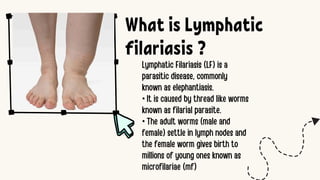
Lymphatic Filariasis (LF) is a
parasitic disease, commonly
known as elephantiasis.
• It is caused by thread like worms
known as filarial parasite.
• The adult worms (male and
female) settle in lymph nodes and
the female worm gives birth to
millions of young ones known as
microfilariae (mf)
What is Lymphatic
filariasis ?
The persons infected with the parasite
may experience frequent acute
attacks of adenolymphangitis when
they may have symptoms of fever,
pain and redness in the affected body
parts.
• After 6 to 8 years of infection, clinical
symptoms such as swollen legs or
enlarged lymph nodes/lymph vessels
or hydrocele may appear
• These chronic manifestations become
irreversible as the lymphatic system
has already been damaged.
Due to damaged lymphatic system,
patients with lymphoedema have frequent
attacks of infection causing high fever
and severe pain.
Patients may be bed-ridden for several
days and normal routine activities become
difficult. Such attacks not only cause
acute physical suffering but also directly
impede the earning capacity of the
individual.
Lymphatic filariasis is estimated to be one
of the leading causes of disability
worldwide. Elimination of the disease is an
important tool for poverty alleviation and
economic development
Filarial Vector
C.quinquefasciatus is the vector of W.bancrofti in the mainland. C.quinquefasciatus breeds
association with human habitations and is the domestic pest mosquitoes, preferring pollut
waters, such as sewage and sullage water collections including cess pools, cess pits, drains a
septic tanks. In the absence of such type of water collections, they can breed in comparative
clean water collections also.
Elephantiasis occurs in the presence of microscopic worm such as Wuchereria bancrofti the mo
common), Brugia malayi, and Brugia timori (also known as B. timori), all of which are transmitt
by bites from infected mosquitoes. It is a type of helminth infection.
Mosquitos are Vectors and spread the Infection A mosquito is the intermediate host and carrie
The most common vectors/carriers are: Anopheles species in Africa, Culex quinquefasciatus in t
Americas, Mansonia and Aedes species in the Pacific and in Aisa.
Transmission of Lymphatic filariasis
The adult produces millions of very small immature larvae known as
microfilariae, which circulate in the peripheral blood with marked
nocturnal periodicity. The worms usually live and produce microfilariae
for 5-8 years.
Lymphatic filariasis is transmitted through mosquito bites.
" In India, 99.4% of the cases are caused by the species - Wuchereria bancrofti whereas Brugia
malayi is responsible for 0.6% of the problem."
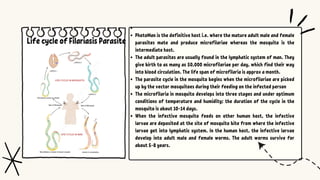
Life cycle of Filariasis Parasite
PhotoMan is the definitive host i.e. where the mature adult male and female
parasites mate and produce microfilariae whereas the mosquito is the
intermediate host.
The adult parasites are usually found in the lymphatic system of man. They
give birth to as many as 50,000 microfilariae per day, which find their way
into blood circulation. The life span of microfilaria is approx a month.
The parasite cycle in the mosquito begins when the microfilariae are picked
up by the vector mosquitoes during their feeding on the infected person
The microfilaria in mosquito develops into three stages and under optimum
conditions of temperature and humidity; the duration of the cycle in the
mosquito is about 10-14 days.
When the infective mosquito feeds on other human host, the infective
larvae are deposited at the site of mosquito bite from where the infective
larvae get into lymphatic system. In the human host, the infective larvae
develop into adult male and female worms. The adult worms survive for
about 5-8 years.
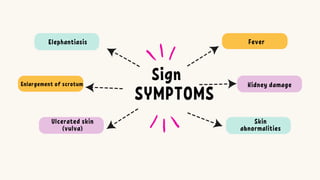
Sign
SYMPTOMS
Enlargement of scrotum
Elephantiasis
Ulcerated skin
(vulva)
Kidney damage
Fever
Skin
abnormalities
PREVENTION
The World Health Organization recommends mass deworming treating entire groups of people who are at risk with a single
annual dose of two medicines, namely albendazole in combination with either ivermectin or diethylcarbamazine citrate. With
consistent treatment, since the disease needs a human host, the reduction of microfilariae means the disease will not be
transmitted, the adult worms will die out, and the cycle will be broken. Transmission of the infection can be broken when a
single dose of these combined oral medicines is consistently maintained annually for duration of four to six years. Using a
combination of treatments better reduces the number of microfilariae in blood
Carefully wash and dry the swollen area with soap and water every day.
Elevate the swollen arm or leg during the day and at night to move the fluid.
Perform exercises to move the fluid and improve lymph flow.
Disinfect any wound.
ANTI ADULT MEASURE
Anti-Adult Measures: Pyrethram as
space spray is used. It is useful as a
temporary means of personal
protection but has no practical value
in present day vector control
programmes.
CHEMICAL CONTROL
ORGANOPHOSPHOROUS
LARVICIDES:
PERSONAL PROPHYLAXIS
Chemical Control: Mosquito Larvicidal Oil
like pyrethram oil, temephos and
fenthion, Pyrosene Oil-E are used.
Larvicidal operations are complemented by
minor engineering operations such as filling
up of ditches and cesspools, drainage of
stagnant water, adequate maintenance of
septic tanks and soakage pits, etc.
Management of the environment is the most
effective approach to the problem of
controlling mosquito breeding.
Personal Prophylaxis: Though mosquito
control is a complex procedure, it is
wiser to take preventive measure to
avoid mosquito bites by using
mosquito nets.
To break the chain of transmission several
vector control measures are there which can
be applicable techniques for controlling
mosquitoes. As Lymphatic Fiharisis is a culex
mosquito vector borne infectious disease, it
is always wiser to take steps to check the
mosquito breeding.
Antilarval Measures: Adequate
sanitation and underground
wastewater disposal systern are the
ideal method to destroy the mosquito-
breeding place. The anti-larval
activities comprise of the above
mentioned.
VECTOR CONTROL
ANTI LARVAL MEASURES
NATIONAL
FILARIA
CONTROL
PROGRAMME
AFTER PILOT PROJECT IN ORISSA FROM 1949 TO 1954, THE NATIONAL
FILARIA CONTROL PROGRAMME (NFCP) WAS LAUNCHED IN THE COUNTRY IN
1955 WITH THE OBJECTIVE OF DELIMITING THE PROBLEM, TO UNDERTAKE
CONTROL MEASURES IN ENDEMIC AREAS AND TO TRAIN PERSONNEL TO
MAN THE PROGRAMME. THE MAIN CONTROL MEASURES WERE MASS DEC
ADMINISTRATION, ANTILARVAL MEASURES IN URBAN AREAS AND INDOOR
RESIDUAL SPRAY IN RURAL AREAS.
NFCP STRATEGY
RECURRENT ANTI-LARVAL MEASURES AT WEEKLY INTERVALS.
ENVIRONMENTAL METHODS INCLUDING SOURCE REDUCTION BY FILLING DITCHES, PITS, LOW LYING
AREAS, DEWEEDING, DESILTING, ETC.
BIOLOGICAL CONTROL OF MOSQUITO BREEDING THROUGH LARVIVOROUS FISH.
ANTI-PARASITIC MEASURES THROUGH 'DETECTION' AND 'TREATMENT' OF MICROFILARIA CARRIERS
AND DISEASE PERSON WITH DEC BY FILARIA CLINICS IN TOWNS COVERED UNDER THE PROGRAMME.
1
2
Elimination of
Lymphatic Filariasis
in India
In 1997, WHO and its Member States made a commitment to eliminate Lymphatic Filariasis (LF) as public
health problem by 2020 through World Health Assembly Resolution WHA 50.29. The National Health Policy
(2002) has set the goal of Elimination of Lymphatic Filariasis in India by 2015. Later extended to 2021.
Subsequent to that Global Alliance to Eliminate Lymphatic Filariasis (GAELF) has been formed in 2000.
Twin pillar strategies of Mass Drug Administration (MDA) for interruption of transmission i.e. no new
case and Morbidity Management and Disability Prevention (MMDP) for catering the disease afflicted
patients were adopted for elimination.
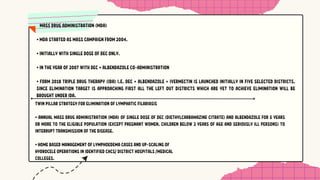
MASS DRUG ADMINISTRATION (MDA)
• MDA STARTED AS MASS CAMPAIGN FROM 2004.
• INITIALLY WITH SINGLE DOSE OF DEC ONLY.
• IN THE YEAR OF 2007 WITH DEC + ALBENDAZOLE CO-ADMINISTRATION
• FORM 2018 TRIPLE DRUG THERAPY (IDA) I.E. DEC + ALBENDAZOLE + IVERMECTIN IS LAUNCHED INITIALLY IN FIVE SELECTED DISTRICTS.
SINCE ELIMINATION TARGET IS APPROACHING FIRST ALL THE LEFT OUT DISTRICTS WHICH ARE YET TO ACHIEVE ELIMINATION WILL BE
BROUGHT UNDER IDA.
TWIN PILLAR STRATEGY FOR ELIMINATION OF LYMPHATIC FILARIASIS
• ANNUAL MASS DRUG ADMINISTRATION (MDA) OF SINGLE DOSE OF DEC (DIETHYLCARBAMAZINE CITRATE) AND ALBENDAZOLE FOR 5 YEARS
OR MORE TO THE ELIGIBLE POPULATION (EXCEPT PREGNANT WOMEN, CHILDREN BELOW 2 YEARS OF AGE AND SERIOUSLY ILL PERSONS) TO
INTERRUPT TRANSMISSION OF THE DISEASE.
• HOME BASED MANAGEMENT OF LYMPHOEDEMA CASES AND UP-SCALING OF
HYDROCELE OPERATIONS IN IDENTIFIED CHCS/ DISTRICT HOSPITALS /MEDICAL
COLLEGES.
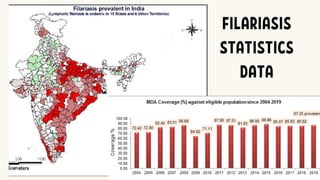
FILARIASIS
STATISTICS
DATA
THANK
YOU!
THANK
YOU!

Lymphatic Filariasis .ppt

  • 1.
    Topic:Lymphatic Filariasis Topic:Lymphatic Filariasis PRESENTED TO : DR.POOJA MONGIA (ASSOCIATE PROF.,DIPSAR) PRESENTED BY : YASH 20/BPH/DIPSAR/2020 (8TH SEM)
  • 2.
    Agenda Introduction 1. Filarial vector 2. Transmission& life cycle 3. Signand symptoms 4. Prevention 5. National programme& Data 6.
  • 3.
    Lymphatic Filariasis (LF)is a parasitic disease, commonly known as elephantiasis. • It is caused by thread like worms known as filarial parasite. • The adult worms (male and female) settle in lymph nodes and the female worm gives birth to millions of young ones known as microfilariae (mf) What is Lymphatic filariasis ?
  • 4.
    The persons infectedwith the parasite may experience frequent acute attacks of adenolymphangitis when they may have symptoms of fever, pain and redness in the affected body parts. • After 6 to 8 years of infection, clinical symptoms such as swollen legs or enlarged lymph nodes/lymph vessels or hydrocele may appear • These chronic manifestations become irreversible as the lymphatic system has already been damaged. Due to damaged lymphatic system, patients with lymphoedema have frequent attacks of infection causing high fever and severe pain. Patients may be bed-ridden for several days and normal routine activities become difficult. Such attacks not only cause acute physical suffering but also directly impede the earning capacity of the individual. Lymphatic filariasis is estimated to be one of the leading causes of disability worldwide. Elimination of the disease is an important tool for poverty alleviation and economic development
  • 5.
    Filarial Vector C.quinquefasciatus isthe vector of W.bancrofti in the mainland. C.quinquefasciatus breeds association with human habitations and is the domestic pest mosquitoes, preferring pollut waters, such as sewage and sullage water collections including cess pools, cess pits, drains a septic tanks. In the absence of such type of water collections, they can breed in comparative clean water collections also. Elephantiasis occurs in the presence of microscopic worm such as Wuchereria bancrofti the mo common), Brugia malayi, and Brugia timori (also known as B. timori), all of which are transmitt by bites from infected mosquitoes. It is a type of helminth infection. Mosquitos are Vectors and spread the Infection A mosquito is the intermediate host and carrie The most common vectors/carriers are: Anopheles species in Africa, Culex quinquefasciatus in t Americas, Mansonia and Aedes species in the Pacific and in Aisa.
  • 6.
    Transmission of Lymphaticfilariasis The adult produces millions of very small immature larvae known as microfilariae, which circulate in the peripheral blood with marked nocturnal periodicity. The worms usually live and produce microfilariae for 5-8 years. Lymphatic filariasis is transmitted through mosquito bites. " In India, 99.4% of the cases are caused by the species - Wuchereria bancrofti whereas Brugia malayi is responsible for 0.6% of the problem."
  • 7.
    Life cycle ofFilariasis Parasite PhotoMan is the definitive host i.e. where the mature adult male and female parasites mate and produce microfilariae whereas the mosquito is the intermediate host. The adult parasites are usually found in the lymphatic system of man. They give birth to as many as 50,000 microfilariae per day, which find their way into blood circulation. The life span of microfilaria is approx a month. The parasite cycle in the mosquito begins when the microfilariae are picked up by the vector mosquitoes during their feeding on the infected person The microfilaria in mosquito develops into three stages and under optimum conditions of temperature and humidity; the duration of the cycle in the mosquito is about 10-14 days. When the infective mosquito feeds on other human host, the infective larvae are deposited at the site of mosquito bite from where the infective larvae get into lymphatic system. In the human host, the infective larvae develop into adult male and female worms. The adult worms survive for about 5-8 years.
  • 8.
    Sign SYMPTOMS Enlargement of scrotum Elephantiasis Ulceratedskin (vulva) Kidney damage Fever Skin abnormalities
  • 9.
    PREVENTION The World HealthOrganization recommends mass deworming treating entire groups of people who are at risk with a single annual dose of two medicines, namely albendazole in combination with either ivermectin or diethylcarbamazine citrate. With consistent treatment, since the disease needs a human host, the reduction of microfilariae means the disease will not be transmitted, the adult worms will die out, and the cycle will be broken. Transmission of the infection can be broken when a single dose of these combined oral medicines is consistently maintained annually for duration of four to six years. Using a combination of treatments better reduces the number of microfilariae in blood Carefully wash and dry the swollen area with soap and water every day. Elevate the swollen arm or leg during the day and at night to move the fluid. Perform exercises to move the fluid and improve lymph flow. Disinfect any wound.
  • 10.
    ANTI ADULT MEASURE Anti-AdultMeasures: Pyrethram as space spray is used. It is useful as a temporary means of personal protection but has no practical value in present day vector control programmes. CHEMICAL CONTROL ORGANOPHOSPHOROUS LARVICIDES: PERSONAL PROPHYLAXIS Chemical Control: Mosquito Larvicidal Oil like pyrethram oil, temephos and fenthion, Pyrosene Oil-E are used. Larvicidal operations are complemented by minor engineering operations such as filling up of ditches and cesspools, drainage of stagnant water, adequate maintenance of septic tanks and soakage pits, etc. Management of the environment is the most effective approach to the problem of controlling mosquito breeding. Personal Prophylaxis: Though mosquito control is a complex procedure, it is wiser to take preventive measure to avoid mosquito bites by using mosquito nets. To break the chain of transmission several vector control measures are there which can be applicable techniques for controlling mosquitoes. As Lymphatic Fiharisis is a culex mosquito vector borne infectious disease, it is always wiser to take steps to check the mosquito breeding. Antilarval Measures: Adequate sanitation and underground wastewater disposal systern are the ideal method to destroy the mosquito- breeding place. The anti-larval activities comprise of the above mentioned. VECTOR CONTROL ANTI LARVAL MEASURES
  • 11.
    NATIONAL FILARIA CONTROL PROGRAMME AFTER PILOT PROJECTIN ORISSA FROM 1949 TO 1954, THE NATIONAL FILARIA CONTROL PROGRAMME (NFCP) WAS LAUNCHED IN THE COUNTRY IN 1955 WITH THE OBJECTIVE OF DELIMITING THE PROBLEM, TO UNDERTAKE CONTROL MEASURES IN ENDEMIC AREAS AND TO TRAIN PERSONNEL TO MAN THE PROGRAMME. THE MAIN CONTROL MEASURES WERE MASS DEC ADMINISTRATION, ANTILARVAL MEASURES IN URBAN AREAS AND INDOOR RESIDUAL SPRAY IN RURAL AREAS. NFCP STRATEGY RECURRENT ANTI-LARVAL MEASURES AT WEEKLY INTERVALS. ENVIRONMENTAL METHODS INCLUDING SOURCE REDUCTION BY FILLING DITCHES, PITS, LOW LYING AREAS, DEWEEDING, DESILTING, ETC. BIOLOGICAL CONTROL OF MOSQUITO BREEDING THROUGH LARVIVOROUS FISH. ANTI-PARASITIC MEASURES THROUGH 'DETECTION' AND 'TREATMENT' OF MICROFILARIA CARRIERS AND DISEASE PERSON WITH DEC BY FILARIA CLINICS IN TOWNS COVERED UNDER THE PROGRAMME.
  • 12.
    1 2 Elimination of Lymphatic Filariasis inIndia In 1997, WHO and its Member States made a commitment to eliminate Lymphatic Filariasis (LF) as public health problem by 2020 through World Health Assembly Resolution WHA 50.29. The National Health Policy (2002) has set the goal of Elimination of Lymphatic Filariasis in India by 2015. Later extended to 2021. Subsequent to that Global Alliance to Eliminate Lymphatic Filariasis (GAELF) has been formed in 2000. Twin pillar strategies of Mass Drug Administration (MDA) for interruption of transmission i.e. no new case and Morbidity Management and Disability Prevention (MMDP) for catering the disease afflicted patients were adopted for elimination.
  • 13.
    MASS DRUG ADMINISTRATION(MDA) • MDA STARTED AS MASS CAMPAIGN FROM 2004. • INITIALLY WITH SINGLE DOSE OF DEC ONLY. • IN THE YEAR OF 2007 WITH DEC + ALBENDAZOLE CO-ADMINISTRATION • FORM 2018 TRIPLE DRUG THERAPY (IDA) I.E. DEC + ALBENDAZOLE + IVERMECTIN IS LAUNCHED INITIALLY IN FIVE SELECTED DISTRICTS. SINCE ELIMINATION TARGET IS APPROACHING FIRST ALL THE LEFT OUT DISTRICTS WHICH ARE YET TO ACHIEVE ELIMINATION WILL BE BROUGHT UNDER IDA. TWIN PILLAR STRATEGY FOR ELIMINATION OF LYMPHATIC FILARIASIS • ANNUAL MASS DRUG ADMINISTRATION (MDA) OF SINGLE DOSE OF DEC (DIETHYLCARBAMAZINE CITRATE) AND ALBENDAZOLE FOR 5 YEARS OR MORE TO THE ELIGIBLE POPULATION (EXCEPT PREGNANT WOMEN, CHILDREN BELOW 2 YEARS OF AGE AND SERIOUSLY ILL PERSONS) TO INTERRUPT TRANSMISSION OF THE DISEASE. • HOME BASED MANAGEMENT OF LYMPHOEDEMA CASES AND UP-SCALING OF HYDROCELE OPERATIONS IN IDENTIFIED CHCS/ DISTRICT HOSPITALS /MEDICAL COLLEGES.
  • 14.
  • 15.