1
Dr. Kabita Chatterjee
Blood Bank
• # 2700
Blood Collection
• 5.59 million
Total Population
• 1.1 billion
Voluntary
Donation
= 3.08
million
(55.1%)
Replacement
Donation =
2.51 million
(44.9%)
Out of
5.59
million
Blood
collection:2
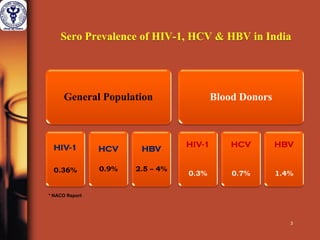
General Population
HIV-1
0.36%
HCV
0.9%
HBV
2.5 – 4%
Blood Donors
HIV-1
0.3%
HCV
0.7%
HBV
1.4%
* NACO Report
3
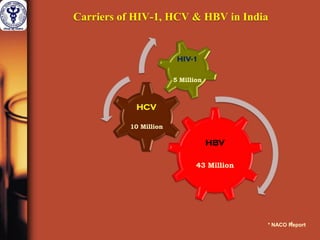
HBV
43 Million
HCV
10 Million
HIV-1
5 Million
* NACO Report
Carriers of HIV-1, HCV & HBV in India
4
Nucleic Acid Testing
 Nucleic Acid testing (NAT) for HIV, HCV and HBV became
available in the latter 1990’s and is now routinely used in
many countries
 Technological advance in blood screening that enables further
reduction of window period for HIV, HBV and HCV
 Detects very low levels of viral RNA or DNA that may be
present in donated blood
 Highly sensitive & specific — targets specific viral nucleic acid
sequences
 Reduces window period through direct detection of viral nucleic
acid sequences
 Prevents transfusion of infected blood components and
therefore exposure to life-threatening transfusion-transmitted
disease
 Provides additional layer of safety to the world’s blood supply
Detection of Infectivity in blood
T = 0
high medium low
ID NAT detection limit
antibody
virus
relative
concentration
infectivity
neutralized
infectivity threshold
loweclipse
NAT
serology
antigen antibody
antigen detection limit
MP NAT detection limit
eclipse
Why Nucleic Acid Testing? Reduction of Window Period
7
Busch MP et al. Transfusion 2005;45:254-264,Assal A et al. Transfusion 2009;49:289-300,
Weusten J et al, Transfusion 2011;51:203-15
•Higher sensitivity
•Pooled testing requires deconvolution to identify
the single positive unit
•This process requires an additional step of
handling, additional time for testing and hence delay
in release of units
•In High prevalence situation high number of pools
will be positive resulting in deconvolution of several
pools
•In high prevalence situation additional
manipulations can increase the chances
Benefits of Individual Donor Testing (IDT)
8
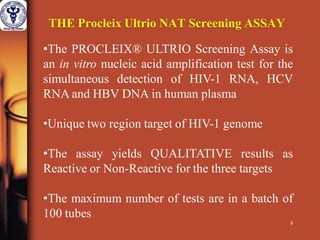
•The PROCLEIX® ULTRIO Screening Assay is
an in vitro nucleic acid amplification test for the
simultaneous detection of HIV-1 RNA, HCV
RNA and HBV DNA in human plasma
•Unique two region target of HIV-1 genome
•The assay yields QUALITATIVE results as
Reactive or Non-Reactive for the three targets
•The maximum number of tests are in a batch of
100 tubes
THE Procleix Ultrio NAT Screening ASSAY
9
Sample Collection
10
11
Sample
Pipetting
Target
Capture
Amplification Detection Results
ASSAY PROCEDURE- OVERVIEW
12
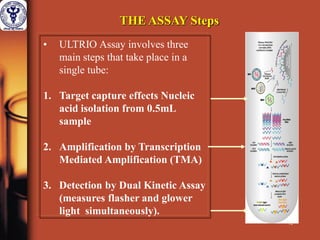
• ULTRIO Assay involves three
main steps that take place in a
single tube:
1. Target capture effects Nucleic
acid isolation from 0.5mL
sample
2. Amplification by Transcription
Mediated Amplification (TMA)
3. Detection by Dual Kinetic Assay
(measures flasher and glower
light simultaneously).
THE ASSAY Steps
13
o When a NAT lab is being set up or a new assay is being
brought on-board three consecutive runs should have less
than 3% invalid results.
o Valid run - is a run were internal parameters perform
according to specification there by assuring validity of the
result. Percentage invalid should be below10%.
o If the invalid results exceed 10%, the protocol requires a
repeat Run, and the final decision rests on HOD or on an
authorised person.
Validation of NAT Test
14
•Internal control:
An internal control RNA added to the sample assures
fool proof system check for the entire procedure.
•Dual Kinetic Assay monitoring (DKA):
Flasher light emission by the internal control
authenticates the operator’s performance and
the Glower light emission by the viral amplicons
indicates the presence of viruses in the specimen.
Quality Control for the ASSAY & SYSTEM
15
•Calibrators:
Each run of 100 maximum tests includes several tests
dedicated to Positive and Negative Calibrators. The
positive calibrators are for each of the three targets.
The result for the calibrators has to meet the expected
criterion for the test results to be valid.
Quality Control for the Run & SYSTEM
16
Specimens found to be reactive in the ULTRIO Screening
Assay are tested by PROCLEIX® Discriminatory Assays
(dHIV-1, dHCV, and dHBV) to determine if they are
reactive for HIV-1, HCV, HBV or any combination of
these three.
The PROCLEIX® HIV-1, HCV, and HBV Discriminatory
Assays utilize the same Assay reagents with one
difference: HIV-1-specific, HCV-specific, or HBV-
specific probe reagents are used in place of the ULTRIO
Assay Probe Reagent.
THE Discriminatory ASSAY &
SYSTEM
17
Ultrio
Non-Reactive
Testing
complete
Ultrio Reactive
Repeat Ultrio
Discriminatory
If NR If R
Testing Testing
Repeat Complete
Store the plasma for ALT
NAT
Ultrio Invalid
Repeat Ultrio
If Non-Reactive
Testing Complete
If Reactive Repeat
Ultrio
Testing Algorithm for PROCLEIX Ultrio
18
Conducted ID-NAT Evaluation in 2009 by
Procleix Ultrio Assay
Routine ID NAT for HIV-1, HCV and HBV
started from July 2010 by Procleix Ultrio Assay
Current annual donation – approx 40,000
19
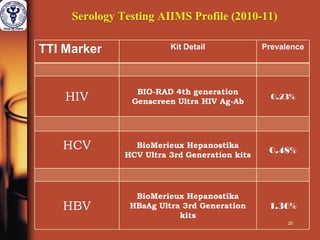
TTI Marker Kit Detail Prevalence
HIV BIO-RAD 4th generation
Genscreen Ultra HIV Ag-Ab
0.23%
HCV BioMerieux Hepanostika
HCV Ultra 3rd Generation kits
0.48%
HBV
BioMerieux Hepanostika
HBsAg Ultra 3rd Generation
kits
1.36%
20
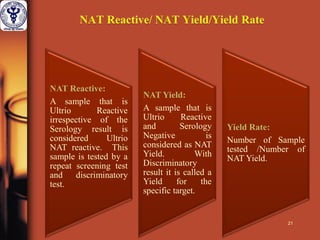
NAT Reactive:
A sample that is
Ultrio Reactive
irrespective of the
Serology result is
considered Ultrio
NAT reactive. This
sample is tested by a
repeat screening test
and discriminatory
test.
NAT Yield:
A sample that is
Ultrio Reactive
and Serology
Negative is
considered as NAT
Yield. With
Discriminatory
result it is called a
Yield for the
specific target.
Yield Rate:
Number of Sample
tested /Number of
NAT Yield.
21
40672
samples
tested HIV-1 HCV HBV
Co
Infection
Combined
Total
NAT
Reactive
44
(0.11%)
96
(0.24%)
412
(1.01%)
37*
(0.09%)
589
(1.45%)
NAT Yield# 00 26 39 3** 68
Yield Rate 00 1/ 1564 1/ 1043 1/13557 1/598
* Co Infection: HIV-1-HBV: 6, HBV-HCV: 28, HIV-1-HCV:1, HIV-1-HCV-HBV:2.
** Co Infection Yield: 3 HBV-HCV 22
AIIMS NAT Experience
• More than Forty Thousand samples
tested with routine Nat screening
• 68 samples were reactive for NAT
but Non reactive with Serology
• NAT yield rate is 1 in 598 for all the
three viruses
AIIMS ULTRIO PLUS*
STUDY
• 2nd Generation NAT assay for HIV-1,HCV
and HBV
• Brings down the HBV window period to
only 15 days
• New Target Enhancer reagent provides
optimal virus disruption, amplification and
detection of HBV DNA
• Excellent Sensitivity for HIV-1 and HCV
• Unique 2 region target for HIV-1 genome
* Product not Registered in India and not available for commercial use
AIIMS Ultrio Plus Experience
Samples tested:
2532
HIV-1 HCV HBV Combined Total
Ultrio Plus
Reactive /
Discriminated
0
(0%)
3
(0.12%)
30
(1.18%)
33
(1.30%)
Ultrio Plus
Yield
0
(0%)
1
(0.04%)
7
(0.28%)
8
(0.32%)
Ultrio Plus
Yield Rate
0 1 in 2532 1 in 362 1 in 317
Ultrio Plus Yield: Samples Reactive for Ultrio Plus but Non Reactive for Ultrio &
Serology
• Among 2532 samples tested Ultrio Plus
yield rate is 1 in 317
• Compared to our Routine NAT with Ultrio
Yield rate is 1 in 598.
• 8 samples (1 HCV and 7 HBV) were
detected by Ultrio Plus which are non
reactive by Ultrio and Serology
• Proves the better sensitivity and window
period reduction of the assay.
AIIMS Ultrio Plus Experience
1. Reddy R, Vermeulen M. “ Sensitivity of NAT Options: The SANBS Experience,” Novartis Symposium ISBT Lisbon, Portugal, June 2011.
 Sensitivity
shown when
testing 23 HIV-1
low viral load,
IDT window
period yield
samples.
 Greater clinical
sensitivity in IDT
than MP6.
 Both Ultrio and
Ultrio Plus in
MP8 were
comparable to
MPX in MP6 for
HIV-1.
94%
76%
61%
42%
94%
76%
66%
52%
91%
62%
0%
10%
20%
30%
40%
50%
60%
70%
80%
90%
100%
IDT MP4 MP6 MP8 MP16
Ultrio
Ultrio Plus
MPX
%Reactive
The South African Experience with NAT
Ultrio and Ultrio Plus in IDT Detected More HIV-1 Positive Samples
than did MPX in MP61
%Reactive
62%
77%
39%
53%
47%
31%
41%
0%
10%
20%
30%
40%
50%
60%
70%
80%
90%
Ultrio UltrioPlus MPX
IDT
MP4
MP6
MP8
1. Reddy R, Vermeulen M. “ Sensitivity of NAT Options: The SANBS Experience,” Novartis Symposium ISBT Lisbon, Portugal, June 2011.
The South African Experience with NAT
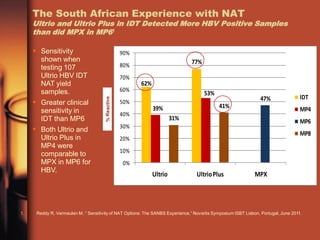
Ultrio and Ultrio Plus in IDT Detected More HBV Positive Samples
than did MPX in MP61
 Sensitivity
shown when
testing 107
Ultrio HBV IDT
NAT yield
samples.
 Greater clinical
sensitivity in
IDT than MP6
 Both Ultrio and
Ultrio Plus in
MP4 were
comparable to
MPX in MP6 for
HBV.
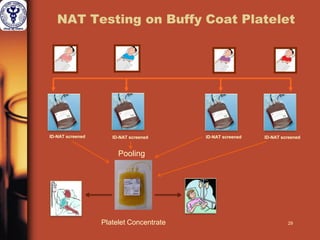
NAT Testing on Buffy Coat Platelet
ID-NAT screened
Pooling
Platelet Concentrate
ID-NAT screened ID-NAT screened ID-NAT screened
29
Cost dynamics of ID NAT
o For a high volume blood bank doing 100% component
preparations Procleix assay is very cost effective as the
charging is cost per reportable result, which gets divided
across the components issued.
o Cost effective in the long run by preventing window
period infection thus eliminating the treatment cost and
burden on Health care and relief from infection to an
individual, the family and the society.
30
.
.
.
.
After implementing ID-NAT, Anti-HBc screening was
discontinued, thus reducing our discard rate from 16-20%
to 2-4%.
It helped in improving our inventory status for Blood
and Blood products.
Reduced discard rate meant Less requirement to
targeting higher number of donation.
Saving manpower and cost (which was earlier used for
Anti-HBc testing).
31
For a blood bank which is making 100% component from
a single unit of blood for e.g.
(a) Packed RBC (b) Platelet concentrate (c) FFP
For AIIMS Main Blood Bank, NAT yield rate is 1 in 598
donations (all three viruses)
3 lives are saved by testing one unit whole blood.
32
Serology tests will fail to detect Window Period
cases, use of NAT is an additional layer of safety to
the supply of blood and blood products.
Blood safety is a greater challenge in India because
of the high Sero-prevalence of HIV (0.3%), HCV
(0.7%), and HBV (1.4%) in blood donor population
and relatively low percentage (55.1%) of voluntary
donors.
In continuing the efforts to make the blood Supply
safer AIIMS main Blood Bank is evaluating an
upgraded version of the Ultrio Assay (Ultrio Plus),
in hopes of implementing this when the benefits are
realized. 33
34

Nat Testing

  • 1.
  • 2.
    Blood Bank • #2700 Blood Collection • 5.59 million Total Population • 1.1 billion Voluntary Donation = 3.08 million (55.1%) Replacement Donation = 2.51 million (44.9%) Out of 5.59 million Blood collection:2
  • 3.
    General Population HIV-1 0.36% HCV 0.9% HBV 2.5 –4% Blood Donors HIV-1 0.3% HCV 0.7% HBV 1.4% * NACO Report 3
  • 4.
    HBV 43 Million HCV 10 Million HIV-1 5Million * NACO Report Carriers of HIV-1, HCV & HBV in India 4
  • 5.
    Nucleic Acid Testing Nucleic Acid testing (NAT) for HIV, HCV and HBV became available in the latter 1990’s and is now routinely used in many countries  Technological advance in blood screening that enables further reduction of window period for HIV, HBV and HCV  Detects very low levels of viral RNA or DNA that may be present in donated blood  Highly sensitive & specific — targets specific viral nucleic acid sequences  Reduces window period through direct detection of viral nucleic acid sequences  Prevents transfusion of infected blood components and therefore exposure to life-threatening transfusion-transmitted disease  Provides additional layer of safety to the world’s blood supply
  • 6.
    Detection of Infectivityin blood T = 0 high medium low ID NAT detection limit antibody virus relative concentration infectivity neutralized infectivity threshold infectivity threshold loweclipse NAT serology antigen antibody antigen detection limit MP NAT detection limit eclipse
  • 7.
    Why Nucleic AcidTesting? Reduction of Window Period 7 Busch MP et al. Transfusion 2005;45:254-264,Assal A et al. Transfusion 2009;49:289-300, Weusten J et al, Transfusion 2011;51:203-15
  • 8.
    •Higher sensitivity •Pooled testingrequires deconvolution to identify the single positive unit •This process requires an additional step of handling, additional time for testing and hence delay in release of units •In High prevalence situation high number of pools will be positive resulting in deconvolution of several pools •In high prevalence situation additional manipulations can increase the chances Benefits of Individual Donor Testing (IDT) 8
  • 9.
    •The PROCLEIX® ULTRIOScreening Assay is an in vitro nucleic acid amplification test for the simultaneous detection of HIV-1 RNA, HCV RNA and HBV DNA in human plasma •Unique two region target of HIV-1 genome •The assay yields QUALITATIVE results as Reactive or Non-Reactive for the three targets •The maximum number of tests are in a batch of 100 tubes THE Procleix Ultrio NAT Screening ASSAY 9
  • 10.
  • 11.
  • 12.
  • 13.
    • ULTRIO Assayinvolves three main steps that take place in a single tube: 1. Target capture effects Nucleic acid isolation from 0.5mL sample 2. Amplification by Transcription Mediated Amplification (TMA) 3. Detection by Dual Kinetic Assay (measures flasher and glower light simultaneously). THE ASSAY Steps 13
  • 14.
    o When aNAT lab is being set up or a new assay is being brought on-board three consecutive runs should have less than 3% invalid results. o Valid run - is a run were internal parameters perform according to specification there by assuring validity of the result. Percentage invalid should be below10%. o If the invalid results exceed 10%, the protocol requires a repeat Run, and the final decision rests on HOD or on an authorised person. Validation of NAT Test 14
  • 15.
    •Internal control: An internalcontrol RNA added to the sample assures fool proof system check for the entire procedure. •Dual Kinetic Assay monitoring (DKA): Flasher light emission by the internal control authenticates the operator’s performance and the Glower light emission by the viral amplicons indicates the presence of viruses in the specimen. Quality Control for the ASSAY & SYSTEM 15
  • 16.
    •Calibrators: Each run of100 maximum tests includes several tests dedicated to Positive and Negative Calibrators. The positive calibrators are for each of the three targets. The result for the calibrators has to meet the expected criterion for the test results to be valid. Quality Control for the Run & SYSTEM 16
  • 17.
    Specimens found tobe reactive in the ULTRIO Screening Assay are tested by PROCLEIX® Discriminatory Assays (dHIV-1, dHCV, and dHBV) to determine if they are reactive for HIV-1, HCV, HBV or any combination of these three. The PROCLEIX® HIV-1, HCV, and HBV Discriminatory Assays utilize the same Assay reagents with one difference: HIV-1-specific, HCV-specific, or HBV- specific probe reagents are used in place of the ULTRIO Assay Probe Reagent. THE Discriminatory ASSAY & SYSTEM 17
  • 18.
    Ultrio Non-Reactive Testing complete Ultrio Reactive Repeat Ultrio Discriminatory IfNR If R Testing Testing Repeat Complete Store the plasma for ALT NAT Ultrio Invalid Repeat Ultrio If Non-Reactive Testing Complete If Reactive Repeat Ultrio Testing Algorithm for PROCLEIX Ultrio 18
  • 19.
    Conducted ID-NAT Evaluationin 2009 by Procleix Ultrio Assay Routine ID NAT for HIV-1, HCV and HBV started from July 2010 by Procleix Ultrio Assay Current annual donation – approx 40,000 19
  • 20.
    TTI Marker KitDetail Prevalence HIV BIO-RAD 4th generation Genscreen Ultra HIV Ag-Ab 0.23% HCV BioMerieux Hepanostika HCV Ultra 3rd Generation kits 0.48% HBV BioMerieux Hepanostika HBsAg Ultra 3rd Generation kits 1.36% 20
  • 21.
    NAT Reactive: A samplethat is Ultrio Reactive irrespective of the Serology result is considered Ultrio NAT reactive. This sample is tested by a repeat screening test and discriminatory test. NAT Yield: A sample that is Ultrio Reactive and Serology Negative is considered as NAT Yield. With Discriminatory result it is called a Yield for the specific target. Yield Rate: Number of Sample tested /Number of NAT Yield. 21
  • 22.
    40672 samples tested HIV-1 HCVHBV Co Infection Combined Total NAT Reactive 44 (0.11%) 96 (0.24%) 412 (1.01%) 37* (0.09%) 589 (1.45%) NAT Yield# 00 26 39 3** 68 Yield Rate 00 1/ 1564 1/ 1043 1/13557 1/598 * Co Infection: HIV-1-HBV: 6, HBV-HCV: 28, HIV-1-HCV:1, HIV-1-HCV-HBV:2. ** Co Infection Yield: 3 HBV-HCV 22 AIIMS NAT Experience
  • 23.
    AIIMS NAT Experience •More than Forty Thousand samples tested with routine Nat screening • 68 samples were reactive for NAT but Non reactive with Serology • NAT yield rate is 1 in 598 for all the three viruses
  • 24.
    AIIMS ULTRIO PLUS* STUDY •2nd Generation NAT assay for HIV-1,HCV and HBV • Brings down the HBV window period to only 15 days • New Target Enhancer reagent provides optimal virus disruption, amplification and detection of HBV DNA • Excellent Sensitivity for HIV-1 and HCV • Unique 2 region target for HIV-1 genome * Product not Registered in India and not available for commercial use
  • 25.
    AIIMS Ultrio PlusExperience Samples tested: 2532 HIV-1 HCV HBV Combined Total Ultrio Plus Reactive / Discriminated 0 (0%) 3 (0.12%) 30 (1.18%) 33 (1.30%) Ultrio Plus Yield 0 (0%) 1 (0.04%) 7 (0.28%) 8 (0.32%) Ultrio Plus Yield Rate 0 1 in 2532 1 in 362 1 in 317 Ultrio Plus Yield: Samples Reactive for Ultrio Plus but Non Reactive for Ultrio & Serology
  • 26.
    • Among 2532samples tested Ultrio Plus yield rate is 1 in 317 • Compared to our Routine NAT with Ultrio Yield rate is 1 in 598. • 8 samples (1 HCV and 7 HBV) were detected by Ultrio Plus which are non reactive by Ultrio and Serology • Proves the better sensitivity and window period reduction of the assay. AIIMS Ultrio Plus Experience
  • 27.
    1. Reddy R,Vermeulen M. “ Sensitivity of NAT Options: The SANBS Experience,” Novartis Symposium ISBT Lisbon, Portugal, June 2011.  Sensitivity shown when testing 23 HIV-1 low viral load, IDT window period yield samples.  Greater clinical sensitivity in IDT than MP6.  Both Ultrio and Ultrio Plus in MP8 were comparable to MPX in MP6 for HIV-1. 94% 76% 61% 42% 94% 76% 66% 52% 91% 62% 0% 10% 20% 30% 40% 50% 60% 70% 80% 90% 100% IDT MP4 MP6 MP8 MP16 Ultrio Ultrio Plus MPX %Reactive The South African Experience with NAT Ultrio and Ultrio Plus in IDT Detected More HIV-1 Positive Samples than did MPX in MP61
  • 28.
    %Reactive 62% 77% 39% 53% 47% 31% 41% 0% 10% 20% 30% 40% 50% 60% 70% 80% 90% Ultrio UltrioPlus MPX IDT MP4 MP6 MP8 1.Reddy R, Vermeulen M. “ Sensitivity of NAT Options: The SANBS Experience,” Novartis Symposium ISBT Lisbon, Portugal, June 2011. The South African Experience with NAT Ultrio and Ultrio Plus in IDT Detected More HBV Positive Samples than did MPX in MP61  Sensitivity shown when testing 107 Ultrio HBV IDT NAT yield samples.  Greater clinical sensitivity in IDT than MP6  Both Ultrio and Ultrio Plus in MP4 were comparable to MPX in MP6 for HBV.
  • 29.
    NAT Testing onBuffy Coat Platelet ID-NAT screened Pooling Platelet Concentrate ID-NAT screened ID-NAT screened ID-NAT screened 29
  • 30.
    Cost dynamics ofID NAT o For a high volume blood bank doing 100% component preparations Procleix assay is very cost effective as the charging is cost per reportable result, which gets divided across the components issued. o Cost effective in the long run by preventing window period infection thus eliminating the treatment cost and burden on Health care and relief from infection to an individual, the family and the society. 30
  • 31.
    . . . . After implementing ID-NAT,Anti-HBc screening was discontinued, thus reducing our discard rate from 16-20% to 2-4%. It helped in improving our inventory status for Blood and Blood products. Reduced discard rate meant Less requirement to targeting higher number of donation. Saving manpower and cost (which was earlier used for Anti-HBc testing). 31
  • 32.
    For a bloodbank which is making 100% component from a single unit of blood for e.g. (a) Packed RBC (b) Platelet concentrate (c) FFP For AIIMS Main Blood Bank, NAT yield rate is 1 in 598 donations (all three viruses) 3 lives are saved by testing one unit whole blood. 32
  • 33.
    Serology tests willfail to detect Window Period cases, use of NAT is an additional layer of safety to the supply of blood and blood products. Blood safety is a greater challenge in India because of the high Sero-prevalence of HIV (0.3%), HCV (0.7%), and HBV (1.4%) in blood donor population and relatively low percentage (55.1%) of voluntary donors. In continuing the efforts to make the blood Supply safer AIIMS main Blood Bank is evaluating an upgraded version of the Ultrio Assay (Ultrio Plus), in hopes of implementing this when the benefits are realized. 33
  • 34.