
R Chandrashekhar
President, NASSCOM
Consumer-Centricity
Digital as a Differentiator
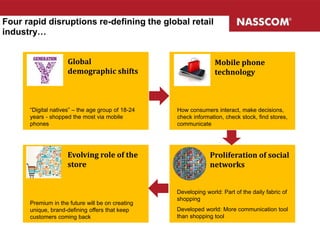
Four rapid disruptions re-defining the global retail
industry…
“Digital natives” – the age group of 18-24
years - shopped the most via mobile
phones
Global
demographic shifts
Mobile phone
technology
How consumers interact, make decisions,
check information, check stock, find stores,
communicate
Proliferation of social
networks
Developing world: Part of the daily fabric of
shopping
Developed world: More communication tool
than shopping tool
Evolving role of the
store
Premium in the future will be on creating
unique, brand-defining offers that keep
customers coming back
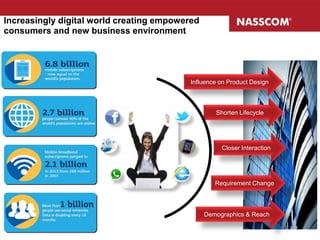
Increasingly digital world creating empowered
consumers and new business environment
Influence on Product Design
Requirement Change
Shorten Lifecycle
Closer Interaction
Demographics & Reach
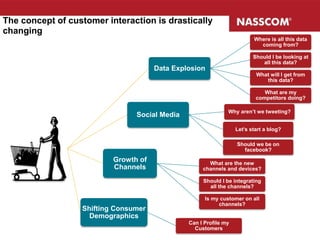
The concept of customer interaction is drastically
changing
Data Explosion
Where is all this data
coming from?
Should I be looking at
all this data?
What will I get from
this data?
What are my
competitors doing?
Social Media
Why aren’t we tweeting?
Let’s start a blog?
Should we be on
facebook?
Growth of
Channels
What are the new
channels and devices?
Should I be integrating
all the channels?
Is my customer on all
channels?
Shifting Consumer
Demographics
Can I Profile my
Customers
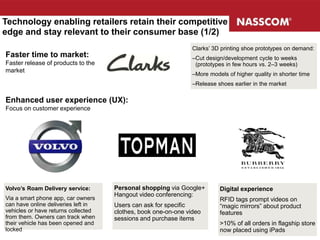
Faster time to market:
Faster release of products to the
market
Clarks’ 3D printing shoe prototypes on demand:
–Cut design/development cycle to weeks
(prototypes in few hours vs. 2–3 weeks)
–More models of higher quality in shorter time
–Release shoes earlier in the market
Enhanced user experience (UX):
Focus on customer experience
Volvo’s Roam Delivery service:
Via a smart phone app, car owners
can have online deliveries left in
vehicles or have returns collected
from them. Owners can track when
their vehicle has been opened and
locked
Personal shopping via Google+
Hangout video conferencing:
Users can ask for specific
clothes, book one-on-one video
sessions and purchase items
Technology enabling retailers retain their competitive
edge and stay relevant to their consumer base (1/2)
Digital experience
RFID tags prompt videos on
“magic mirrors” about product
features
>10% of all orders in flagship store
now placed using iPads
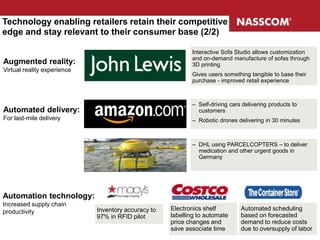
Augmented reality:
Virtual reality experience
Interactive Sofa Studio allows customization
and on-demand manufacture of sofas through
3D printing
Gives users something tangible to base their
purchase - improved retail experience
Automated delivery:
For last-mile delivery
Technology enabling retailers retain their competitive
edge and stay relevant to their consumer base (2/2)
Inventory accuracy to
97% in RFID pilot
– Self-driving cars delivering products to
customers
– Robotic drones delivering in 30 minutes
– DHL using PARCELCOPTERS – to deliver
medication and other urgent goods in
Germany
Automation technology:
Increased supply chain
productivity
Electronics shelf
labelling to automate
price changes and
save associate time
Automated scheduling
based on forecasted
demand to reduce costs
due to oversupply of labor
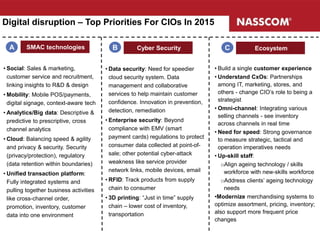
Digital disruption – Top Priorities For CIOs In 2015
A
• Social: Sales & marketing,
customer service and recruitment,
linking insights to R&D & design
• Mobility: Mobile POS/payments,
digital signage, context-aware tech
• Analytics/Big data: Descriptive &
predictive to prescriptive, cross
channel analytics
• Cloud: Balancing speed & agility
and privacy & security. Security
(privacy/protection), regulatory
(data retention within boundaries)
• Unified transaction platform:
Fully integrated systems and
pulling together business activities
like cross-channel order,
promotion, inventory, customer
data into one environment
• Data security: Need for speedier
cloud security system. Data
management and collaborative
services to help maintain customer
confidence. Innovation in prevention,
detection, remediation
• Enterprise security: Beyond
compliance with EMV (smart
payment cards) regulations to protect
consumer data collected at point-of-
sale; other potential cyber-attack
weakness like service provider
network links, mobile devices, email
• RFID: Track products from supply
chain to consumer
• 3D printing: “Just in time” supply
chain – lower cost of inventory,
transportation
• Build a single customer experience
• Understand CxOs: Partnerships
among IT, marketing, stores, and
others - change CIO’s role to being a
strategist
• Omni-channel: Integrating various
selling channels - see inventory
across channels in real time
• Need for speed: Strong governance
to measure strategic, tactical and
operation imperatives needs
• Up-skill staff:
oAlign ageing technology / skills
workforce with new-skills workforce
oAddress clients’ ageing technology
needs
•Modernize merchandising systems to
optimize assortment, pricing, inventory;
also support more frequent price
changes
SMAC technologies B Cyber Security C Ecosystem
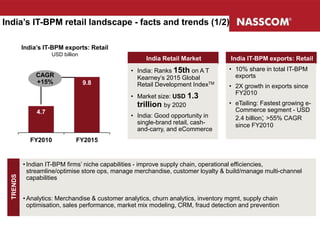
India’s IT-BPM retail landscape - facts and trends (1/2)
India’s IT-BPM exports: Retail
USD billion
4.7
9.8
FY2010 FY2015
India Retail Market
• India: Ranks 15th on A T
Kearney’s 2015 Global
Retail Development IndexTM
• Market size: USD 1.3
trillion by 2020
• India: Good opportunity in
single-brand retail, cash-
and-carry, and eCommerce
CAGR
+15%
India IT-BPM exports: Retail
• 10% share in total IT-BPM
exports
• 2X growth in exports since
FY2010
• eTailing: Fastest growing e-
Commerce segment - USD
2.4 billion; >55% CAGR
since FY2010
TRENDS
• Indian IT-BPM firms’ niche capabilities - improve supply chain, operational efficiencies,
streamline/optimise store ops, manage merchandise, customer loyalty & build/manage multi-channel
capabilities
• Analytics: Merchandise & customer analytics, churn analytics, inventory mgmt, supply chain
optimisation, sales performance, market mix modeling, CRM, fraud detection and prevention
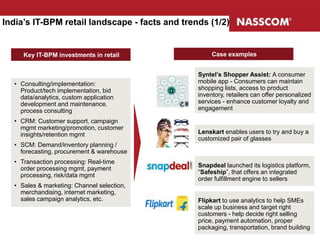
India’s IT-BPM retail landscape - facts and trends (1/2)
Key IT-BPM investments in retail
• Consulting/implementation:
Product/tech implementation, bid
data/analytics, custom application
development and maintenance,
process consulting
• CRM: Customer support, campaign
mgmt marketing/promotion, customer
insights/retention mgmt
• SCM: Demand/inventory planning /
forecasting, procurement & warehouse
• Transaction processing: Real-time
order processing mgmt, payment
processing, risk/data mgmt
• Sales & marketing: Channel selection,
merchandising, internet marketing,
sales campaign analytics, etc.
Case examples
Syntel’s Shopper Assist: A consumer
mobile app - Consumers can maintain
shopping lists, access to product
inventory, retailers can offer personalized
services - enhance customer loyalty and
engagement
Lenskart enables users to try and buy a
customized pair of glasses
Snapdeal launched its logistics platform,
“Safeship”, that offers an integrated
order fulfillment engine to sellers
Flipkart to use analytics to help SMEs
scale up business and target right
customers - help decide right selling
price, payment automation, proper
packaging, transportation, brand building
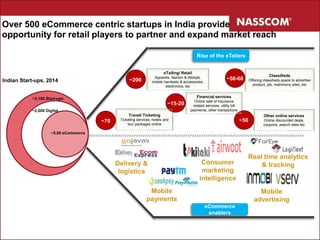
Over 500 eCommerce centric startups in India provide
opportunity for retail players to partner and expand market reach
~3,100 Start-ups
~2,000 Digital
~5,00 eCommerce
Indian Start-ups, 2014
eTailing/ Retail
Apparels, fashion & lifestyle,
mobile handsets & accessories,
electronics, etc
~200
eCommerce
enablers
~70
~50-60
~15-20
~50
Travel/ Ticketing
Ticketing services, hotels and
tour packages online
Classifieds
Offering classifieds space to advertise
product, job, matrimony sites, etc
Financial services
Online sale of insurance
related services, utility bill
payments, other transactions
Other online services
Online discounted deals,
coupons, search sites etc
Real time analytics
& trackingDelivery &
logistics
Mobile
payments
Mobile
advertising
Consumer
marketing
intelligence
Rise of the eTailers
THANK YOU
rc@nasscom.in

NASSCOM Address

  • 1.
  • 2.
    Four rapid disruptionsre-defining the global retail industry… “Digital natives” – the age group of 18-24 years - shopped the most via mobile phones Global demographic shifts Mobile phone technology How consumers interact, make decisions, check information, check stock, find stores, communicate Proliferation of social networks Developing world: Part of the daily fabric of shopping Developed world: More communication tool than shopping tool Evolving role of the store Premium in the future will be on creating unique, brand-defining offers that keep customers coming back
  • 3.
    Increasingly digital worldcreating empowered consumers and new business environment Influence on Product Design Requirement Change Shorten Lifecycle Closer Interaction Demographics & Reach
  • 4.
    The concept ofcustomer interaction is drastically changing Data Explosion Where is all this data coming from? Should I be looking at all this data? What will I get from this data? What are my competitors doing? Social Media Why aren’t we tweeting? Let’s start a blog? Should we be on facebook? Growth of Channels What are the new channels and devices? Should I be integrating all the channels? Is my customer on all channels? Shifting Consumer Demographics Can I Profile my Customers
  • 5.
    Faster time tomarket: Faster release of products to the market Clarks’ 3D printing shoe prototypes on demand: –Cut design/development cycle to weeks (prototypes in few hours vs. 2–3 weeks) –More models of higher quality in shorter time –Release shoes earlier in the market Enhanced user experience (UX): Focus on customer experience Volvo’s Roam Delivery service: Via a smart phone app, car owners can have online deliveries left in vehicles or have returns collected from them. Owners can track when their vehicle has been opened and locked Personal shopping via Google+ Hangout video conferencing: Users can ask for specific clothes, book one-on-one video sessions and purchase items Technology enabling retailers retain their competitive edge and stay relevant to their consumer base (1/2) Digital experience RFID tags prompt videos on “magic mirrors” about product features >10% of all orders in flagship store now placed using iPads
  • 6.
    Augmented reality: Virtual realityexperience Interactive Sofa Studio allows customization and on-demand manufacture of sofas through 3D printing Gives users something tangible to base their purchase - improved retail experience Automated delivery: For last-mile delivery Technology enabling retailers retain their competitive edge and stay relevant to their consumer base (2/2) Inventory accuracy to 97% in RFID pilot – Self-driving cars delivering products to customers – Robotic drones delivering in 30 minutes – DHL using PARCELCOPTERS – to deliver medication and other urgent goods in Germany Automation technology: Increased supply chain productivity Electronics shelf labelling to automate price changes and save associate time Automated scheduling based on forecasted demand to reduce costs due to oversupply of labor
  • 7.
    Digital disruption –Top Priorities For CIOs In 2015 A • Social: Sales & marketing, customer service and recruitment, linking insights to R&D & design • Mobility: Mobile POS/payments, digital signage, context-aware tech • Analytics/Big data: Descriptive & predictive to prescriptive, cross channel analytics • Cloud: Balancing speed & agility and privacy & security. Security (privacy/protection), regulatory (data retention within boundaries) • Unified transaction platform: Fully integrated systems and pulling together business activities like cross-channel order, promotion, inventory, customer data into one environment • Data security: Need for speedier cloud security system. Data management and collaborative services to help maintain customer confidence. Innovation in prevention, detection, remediation • Enterprise security: Beyond compliance with EMV (smart payment cards) regulations to protect consumer data collected at point-of- sale; other potential cyber-attack weakness like service provider network links, mobile devices, email • RFID: Track products from supply chain to consumer • 3D printing: “Just in time” supply chain – lower cost of inventory, transportation • Build a single customer experience • Understand CxOs: Partnerships among IT, marketing, stores, and others - change CIO’s role to being a strategist • Omni-channel: Integrating various selling channels - see inventory across channels in real time • Need for speed: Strong governance to measure strategic, tactical and operation imperatives needs • Up-skill staff: oAlign ageing technology / skills workforce with new-skills workforce oAddress clients’ ageing technology needs •Modernize merchandising systems to optimize assortment, pricing, inventory; also support more frequent price changes SMAC technologies B Cyber Security C Ecosystem
  • 8.
    India’s IT-BPM retaillandscape - facts and trends (1/2) India’s IT-BPM exports: Retail USD billion 4.7 9.8 FY2010 FY2015 India Retail Market • India: Ranks 15th on A T Kearney’s 2015 Global Retail Development IndexTM • Market size: USD 1.3 trillion by 2020 • India: Good opportunity in single-brand retail, cash- and-carry, and eCommerce CAGR +15% India IT-BPM exports: Retail • 10% share in total IT-BPM exports • 2X growth in exports since FY2010 • eTailing: Fastest growing e- Commerce segment - USD 2.4 billion; >55% CAGR since FY2010 TRENDS • Indian IT-BPM firms’ niche capabilities - improve supply chain, operational efficiencies, streamline/optimise store ops, manage merchandise, customer loyalty & build/manage multi-channel capabilities • Analytics: Merchandise & customer analytics, churn analytics, inventory mgmt, supply chain optimisation, sales performance, market mix modeling, CRM, fraud detection and prevention
  • 9.
    India’s IT-BPM retaillandscape - facts and trends (1/2) Key IT-BPM investments in retail • Consulting/implementation: Product/tech implementation, bid data/analytics, custom application development and maintenance, process consulting • CRM: Customer support, campaign mgmt marketing/promotion, customer insights/retention mgmt • SCM: Demand/inventory planning / forecasting, procurement & warehouse • Transaction processing: Real-time order processing mgmt, payment processing, risk/data mgmt • Sales & marketing: Channel selection, merchandising, internet marketing, sales campaign analytics, etc. Case examples Syntel’s Shopper Assist: A consumer mobile app - Consumers can maintain shopping lists, access to product inventory, retailers can offer personalized services - enhance customer loyalty and engagement Lenskart enables users to try and buy a customized pair of glasses Snapdeal launched its logistics platform, “Safeship”, that offers an integrated order fulfillment engine to sellers Flipkart to use analytics to help SMEs scale up business and target right customers - help decide right selling price, payment automation, proper packaging, transportation, brand building
  • 10.
    Over 500 eCommercecentric startups in India provide opportunity for retail players to partner and expand market reach ~3,100 Start-ups ~2,000 Digital ~5,00 eCommerce Indian Start-ups, 2014 eTailing/ Retail Apparels, fashion & lifestyle, mobile handsets & accessories, electronics, etc ~200 eCommerce enablers ~70 ~50-60 ~15-20 ~50 Travel/ Ticketing Ticketing services, hotels and tour packages online Classifieds Offering classifieds space to advertise product, job, matrimony sites, etc Financial services Online sale of insurance related services, utility bill payments, other transactions Other online services Online discounted deals, coupons, search sites etc Real time analytics & trackingDelivery & logistics Mobile payments Mobile advertising Consumer marketing intelligence Rise of the eTailers
  • 11.