Literary Devices of Fiction
 Setting
 Plot
 Character
 Conflict
 Point of View
 Theme
 Mood
 Dialogue
 Rhetorical Devices
 Flashback
 Foreshadowing
 Figurative Language
 Sensory Details
 Allusion
Setting (element)
 The setting of a story is
the time and place in
which it occurs.
 Elements of setting may
include the physical,
psychological, cultural, or
historical background
against which the story
takes place.
Mood (element)
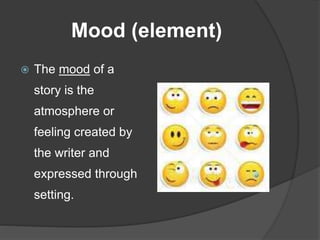
 The mood of a
story is the
atmosphere or
feeling created by
the writer and
expressed through
setting.
Plot (element)
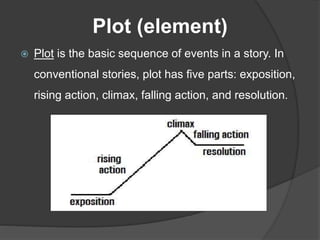
 Plot is the basic sequence of events in a story. In
conventional stories, plot has five parts: exposition,
rising action, climax, falling action, and resolution.
Flashback (technique)
 A flashback is a literary device by which
a work presents material that occurred
prior to the opening scene.
 Various methods may be used such as
recollections of characters, narration by
the characters, dream sequences, and
reveries.
Foreshadowing (technique)
 Foreshadowing is the presentation of material in
a work in such a way that later events are
prepared for. The purpose of foreshadowing is to
prepare the reader or viewer for action to come.
 Foreshadowing can result from
 the establishment of a mood or atmosphere,
 an event that adumbrates the later action,
 the appearance of physical objects or facts, or
 the revelation of a fundamental and decisive character
trait.
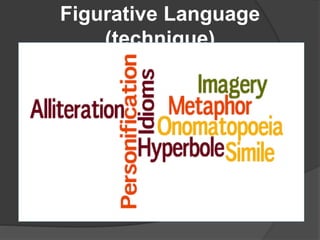
Figurative Language
(technique)
Figurative Language
Simile Metaphor
 A comparison of two
things that are
essentially different,
usually using the words
like or as.
 Example: “Oh my
love is like a red, red
rose.” (from “A Red, Red
Rose” by Robert Burns)
 A subtle comparison
in which the author
describes a person or
thing using words
that are not meant to
be taken literally.
 Example: “Time is a
dressmaker specializing
in alterations.” (Faith
Baldwin)
Figurative Language
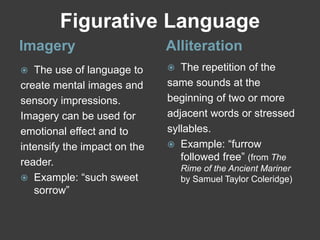
Imagery Alliteration
 The use of language to
create mental images and
sensory impressions.
Imagery can be used for
emotional effect and to
intensify the impact on the
reader.
 Example: “such sweet
sorrow”
 The repetition of the
same sounds at the
beginning of two or more
adjacent words or stressed
syllables.
 Example: “furrow
followed free” (from The
Rime of the Ancient Mariner
by Samuel Taylor Coleridge)
Figurative Language
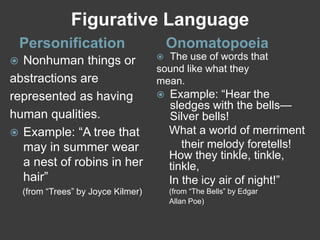
Personification Onomatopoeia
 Nonhuman things or
abstractions are
represented as having
human qualities.
 Example: “A tree that
may in summer wear
a nest of robins in her
hair”
(from “Trees” by Joyce Kilmer)
 The use of words that
sound like what they
mean.
 Example: “Hear the
sledges with the bells—
Silver bells!
What a world of merriment
their melody foretells!
How they tinkle, tinkle,
tinkle,
In the icy air of night!”
(from “The Bells” by Edgar
Allan Poe)
Figurative Language
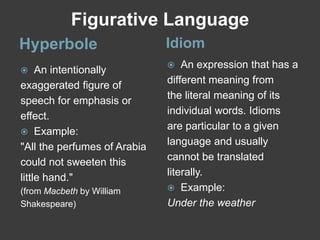
Hyperbole Idiom
 An intentionally
exaggerated figure of
speech for emphasis or
effect.
 Example:
"All the perfumes of Arabia
could not sweeten this
little hand."
(from Macbeth by William
Shakespeare)
 An expression that has a
different meaning from
the literal meaning of its
individual words. Idioms
are particular to a given
language and usually
cannot be translated
literally.
 Example:
Under the weather
Rhetorical Device
(technique)
 A technique that an author or speaker
uses to evoke an emotional response
(e.g., analogy, simile, metaphor) in order
to influence or persuade his audience.
Review: Literary Devices of
Fiction
 Setting
 Mood
 Plot
 Flashback
 Foreshadowing
 Figurative Language
 Simile
 Metaphor
 Imagery
 Alliteration
 Personification
 Onomatopoeia
 Hyperbole
 Idiom
 Rhetorical Devices
Types of Characters
(element)
 Dynamic character—a character which
changes during the course of a story or
novel
 Static character—a character who
remains primarily the same during the
course of a story or novel
Types of Characters
 Round character—a well developed
character who demonstrates varied and
sometimes contradictory traits
 Flat character—a two-dimensional and
relatively uncomplicated character who
does not change throughout a story or
novel
 Stock Character—a special kind of flat
character who is instantly recognizable
(stereotypical)
Types of Characters
 Protagonist—the story’s main character
 Antagonist—a character in opposition of
the protagonist
 Character Foil—a secondary character
who contrasts with the protagonist in
order to highlight aspects of the main
character’s personality
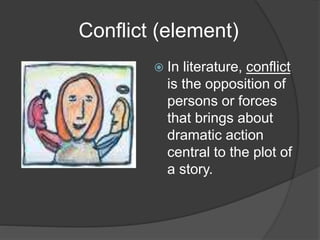
Conflict (element)
 In literature, conflict
is the opposition of
persons or forces
that brings about
dramatic action
central to the plot of
a story.
Types of Conflict
 Character versus Character—a conflict
between one character and another
 Character versus Nature—a conflict
between a character and a force of nature
 Character versus Society—a conflict
between a character and the values,
beliefs, and/or customs of a larger group
 Character versus Self—an internal
psychological conflict within a character
Characterization
 Characterization is the creation of
imaginary persons so that they seem
lifelike. There are three fundamental
methods of characterization.
Characterization
 The explicit presentation by the author
of the character through direct
description, either in an introductory
block or more often piecemeal
throughout the work, illustrated by
action (external characterization).
Characterization
 The presentation of a character in
action, with little or no explicit comment
by the author, in the expectation that
the reader can deduce the attributes of
the character from his/her actions
(external characterization).
Characterization
 The representation from within a
character, without comment by the
author, of the impact of actions and
emotions on the character’s inner self
(internal characterization).
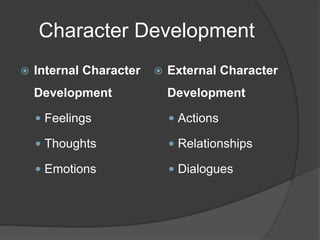
Character Development
 Internal Character
Development
 Feelings
 Thoughts
 Emotions
 External Character
Development
 Actions
 Relationships
 Dialogues
Character Motivation
 Character Motivation—the reasons,
justifications, and explanations for the action
of a character
 Motivation results from a combination of the
character’s moral nature with the
circumstances in which the character is
placed.
 Motivation helps to determine what the
character does, says, and feels or fails to feel.
Irony (technique)
 Irony– the use of words to express
something other than, and especially the
opposite of, the literal meaning
 Situational irony—a literary technique
for implying, through plot or character,
that the actual situation is quite
different from that presented
Irony (technique)
 Irony– the use of words to express
something other than, and especially the
opposite of, the literal meaning
 Situational irony—a literary technique
for implying, through plot or character,
that the actual situation is quite
different from that presented
Foreshadowing (technique)
 Foreshadowing is the presentation of material
in a word in such a way that later events are
prepared for.
 Foreshadowing can result from the
establishment of a mood or atmosphere. It can
result from an event that adumbrates the later
action. It can result from the appearance of
physical objects or facts, or from the revelation
of a fundamental and decisive character trait.
In all cases, the purpose of foreshadowing is
to prepare the reader or viewer for action to
come.
Imagery and Dialogue
Imagery Dialogue
 The use of language to
create mental images and
sensory impressions.
Imagery can be used for
emotional effect and to
intensify the impact on the
reader.
 The lines spoken
between character in fiction
or a play.
Point of View-Narrator
(element)
 The narrator is the teller of a story.
 Reliable narrator—the reader accepts the
statements of fact and judgment without
serious question
 Unreliable narrator—the reader questions or
seeks to qualify the statements of fact and
judgment.
Point of View
 The point of view is the perspective from
which the events in the story are told.
The author may choose to use any of
the following:
 Omniscient/third-person omniscient
 Omniscient/third-person limited
 Objective
 First person/subjective
 Limited
Point of View
 Omniscient/third-person omniscient—
The narrator tells the story in third
person from an all-knowing perspective.
The knowledge is not limited by any one
character’s view or behavior, as the
narrator knows everything about all
characters.
 Signal pronouns—he, she, they
Point of View
 Omniscient/third-person limited—The
narrator restricts his knowledge to one
character’s view or behavior.
 Signal pronouns—he, she, they
 Objective—The narrator reveals only the
actions and words without the benefit of
the inner thoughts and feelings.
 Signal pronouns—he, she, they
Point of View
 First person/subjective—The narrator
restricts the perspective to that of only
one character to tell the story.
 Signal pronouns—I, we, us
 Limited—A narrative mode in which the
story is told through the point of view of
a single character and is limited to what
he or she sees, hears, feels, or is told.
 Signal pronouns—I, we, us
Sensory Details
(techniques)
 Sensory details are details in writing that
describe what is seen, heard, smelled,
tasted, or touched.
 Writers often use sensory details to enhance
the mood and theme in writing.
Allusion (techniques)
 An allusion is a reference within a literary work to
another work of literature, art, or real event. The
reference is often brief and implied.
 Mythological allusion—a direct or indirect reference to a
character or event in mythology
 Biblical allusion—a reference to a character or event from
the Bible
 Historical allusion—a reference to a person or event in
history
Theme (element)
 The theme is the central or universal idea
of a piece of fiction; it is a perception about
life and the human condition.
 An implicit theme refers to the author’s ability to
construct a piece in such a way that through
inference the reader understands the theme.
Theme
 The theme is also the main idea of a
nonfiction essay.
 An explicit theme refers to when the author
overtly states the theme somewhere in the
work.
Theme
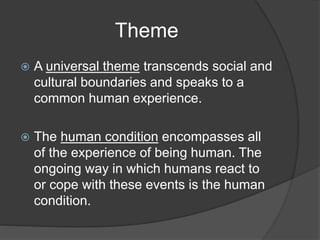
 A universal theme transcends social and
cultural boundaries and speaks to a
common human experience.
 The human condition encompasses all
of the experience of being human. The
ongoing way in which humans react to
or cope with these events is the human
condition.
Literary_devices_of_fiction.pptx

Literary_devices_of_fiction.pptx

  • 2.
    Literary Devices ofFiction  Setting  Plot  Character  Conflict  Point of View  Theme  Mood  Dialogue  Rhetorical Devices  Flashback  Foreshadowing  Figurative Language  Sensory Details  Allusion
  • 3.
    Setting (element)  Thesetting of a story is the time and place in which it occurs.  Elements of setting may include the physical, psychological, cultural, or historical background against which the story takes place.
  • 4.
    Mood (element)  Themood of a story is the atmosphere or feeling created by the writer and expressed through setting.
  • 5.
    Plot (element)  Plotis the basic sequence of events in a story. In conventional stories, plot has five parts: exposition, rising action, climax, falling action, and resolution.
  • 6.
    Flashback (technique)  Aflashback is a literary device by which a work presents material that occurred prior to the opening scene.  Various methods may be used such as recollections of characters, narration by the characters, dream sequences, and reveries.
  • 7.
    Foreshadowing (technique)  Foreshadowingis the presentation of material in a work in such a way that later events are prepared for. The purpose of foreshadowing is to prepare the reader or viewer for action to come.  Foreshadowing can result from  the establishment of a mood or atmosphere,  an event that adumbrates the later action,  the appearance of physical objects or facts, or  the revelation of a fundamental and decisive character trait.
  • 8.
  • 9.
    Figurative Language Simile Metaphor A comparison of two things that are essentially different, usually using the words like or as.  Example: “Oh my love is like a red, red rose.” (from “A Red, Red Rose” by Robert Burns)  A subtle comparison in which the author describes a person or thing using words that are not meant to be taken literally.  Example: “Time is a dressmaker specializing in alterations.” (Faith Baldwin)
  • 10.
    Figurative Language Imagery Alliteration The use of language to create mental images and sensory impressions. Imagery can be used for emotional effect and to intensify the impact on the reader.  Example: “such sweet sorrow”  The repetition of the same sounds at the beginning of two or more adjacent words or stressed syllables.  Example: “furrow followed free” (from The Rime of the Ancient Mariner by Samuel Taylor Coleridge)
  • 11.
    Figurative Language Personification Onomatopoeia Nonhuman things or abstractions are represented as having human qualities.  Example: “A tree that may in summer wear a nest of robins in her hair” (from “Trees” by Joyce Kilmer)  The use of words that sound like what they mean.  Example: “Hear the sledges with the bells— Silver bells! What a world of merriment their melody foretells! How they tinkle, tinkle, tinkle, In the icy air of night!” (from “The Bells” by Edgar Allan Poe)
  • 12.
    Figurative Language Hyperbole Idiom An intentionally exaggerated figure of speech for emphasis or effect.  Example: "All the perfumes of Arabia could not sweeten this little hand." (from Macbeth by William Shakespeare)  An expression that has a different meaning from the literal meaning of its individual words. Idioms are particular to a given language and usually cannot be translated literally.  Example: Under the weather
  • 13.
    Rhetorical Device (technique)  Atechnique that an author or speaker uses to evoke an emotional response (e.g., analogy, simile, metaphor) in order to influence or persuade his audience.
  • 14.
    Review: Literary Devicesof Fiction  Setting  Mood  Plot  Flashback  Foreshadowing  Figurative Language  Simile  Metaphor  Imagery  Alliteration  Personification  Onomatopoeia  Hyperbole  Idiom  Rhetorical Devices
  • 15.
    Types of Characters (element) Dynamic character—a character which changes during the course of a story or novel  Static character—a character who remains primarily the same during the course of a story or novel
  • 16.
    Types of Characters Round character—a well developed character who demonstrates varied and sometimes contradictory traits  Flat character—a two-dimensional and relatively uncomplicated character who does not change throughout a story or novel  Stock Character—a special kind of flat character who is instantly recognizable (stereotypical)
  • 17.
    Types of Characters Protagonist—the story’s main character  Antagonist—a character in opposition of the protagonist  Character Foil—a secondary character who contrasts with the protagonist in order to highlight aspects of the main character’s personality
  • 18.
    Conflict (element)  Inliterature, conflict is the opposition of persons or forces that brings about dramatic action central to the plot of a story.
  • 19.
    Types of Conflict Character versus Character—a conflict between one character and another  Character versus Nature—a conflict between a character and a force of nature  Character versus Society—a conflict between a character and the values, beliefs, and/or customs of a larger group  Character versus Self—an internal psychological conflict within a character
  • 20.
    Characterization  Characterization isthe creation of imaginary persons so that they seem lifelike. There are three fundamental methods of characterization.
  • 21.
    Characterization  The explicitpresentation by the author of the character through direct description, either in an introductory block or more often piecemeal throughout the work, illustrated by action (external characterization).
  • 22.
    Characterization  The presentationof a character in action, with little or no explicit comment by the author, in the expectation that the reader can deduce the attributes of the character from his/her actions (external characterization).
  • 23.
    Characterization  The representationfrom within a character, without comment by the author, of the impact of actions and emotions on the character’s inner self (internal characterization).
  • 24.
    Character Development  InternalCharacter Development  Feelings  Thoughts  Emotions  External Character Development  Actions  Relationships  Dialogues
  • 25.
    Character Motivation  CharacterMotivation—the reasons, justifications, and explanations for the action of a character  Motivation results from a combination of the character’s moral nature with the circumstances in which the character is placed.  Motivation helps to determine what the character does, says, and feels or fails to feel.
  • 26.
    Irony (technique)  Irony–the use of words to express something other than, and especially the opposite of, the literal meaning  Situational irony—a literary technique for implying, through plot or character, that the actual situation is quite different from that presented
  • 27.
    Irony (technique)  Irony–the use of words to express something other than, and especially the opposite of, the literal meaning  Situational irony—a literary technique for implying, through plot or character, that the actual situation is quite different from that presented
  • 28.
    Foreshadowing (technique)  Foreshadowingis the presentation of material in a word in such a way that later events are prepared for.  Foreshadowing can result from the establishment of a mood or atmosphere. It can result from an event that adumbrates the later action. It can result from the appearance of physical objects or facts, or from the revelation of a fundamental and decisive character trait. In all cases, the purpose of foreshadowing is to prepare the reader or viewer for action to come.
  • 29.
    Imagery and Dialogue ImageryDialogue  The use of language to create mental images and sensory impressions. Imagery can be used for emotional effect and to intensify the impact on the reader.  The lines spoken between character in fiction or a play.
  • 30.
    Point of View-Narrator (element) The narrator is the teller of a story.  Reliable narrator—the reader accepts the statements of fact and judgment without serious question  Unreliable narrator—the reader questions or seeks to qualify the statements of fact and judgment.
  • 31.
    Point of View The point of view is the perspective from which the events in the story are told. The author may choose to use any of the following:  Omniscient/third-person omniscient  Omniscient/third-person limited  Objective  First person/subjective  Limited
  • 32.
    Point of View Omniscient/third-person omniscient— The narrator tells the story in third person from an all-knowing perspective. The knowledge is not limited by any one character’s view or behavior, as the narrator knows everything about all characters.  Signal pronouns—he, she, they
  • 33.
    Point of View Omniscient/third-person limited—The narrator restricts his knowledge to one character’s view or behavior.  Signal pronouns—he, she, they  Objective—The narrator reveals only the actions and words without the benefit of the inner thoughts and feelings.  Signal pronouns—he, she, they
  • 34.
    Point of View First person/subjective—The narrator restricts the perspective to that of only one character to tell the story.  Signal pronouns—I, we, us  Limited—A narrative mode in which the story is told through the point of view of a single character and is limited to what he or she sees, hears, feels, or is told.  Signal pronouns—I, we, us
  • 35.
    Sensory Details (techniques)  Sensorydetails are details in writing that describe what is seen, heard, smelled, tasted, or touched.  Writers often use sensory details to enhance the mood and theme in writing.
  • 36.
    Allusion (techniques)  Anallusion is a reference within a literary work to another work of literature, art, or real event. The reference is often brief and implied.  Mythological allusion—a direct or indirect reference to a character or event in mythology  Biblical allusion—a reference to a character or event from the Bible  Historical allusion—a reference to a person or event in history
  • 37.
    Theme (element)  Thetheme is the central or universal idea of a piece of fiction; it is a perception about life and the human condition.  An implicit theme refers to the author’s ability to construct a piece in such a way that through inference the reader understands the theme.
  • 38.
    Theme  The themeis also the main idea of a nonfiction essay.  An explicit theme refers to when the author overtly states the theme somewhere in the work.
  • 39.
    Theme  A universaltheme transcends social and cultural boundaries and speaks to a common human experience.  The human condition encompasses all of the experience of being human. The ongoing way in which humans react to or cope with these events is the human condition.

Editor's Notes

  • #6 Find relevant examples to provide to students in explaining these definitions: (elaborate on definitions as you see appropriate) Exposition—used at the beginning of a work to explain to the reader the background information needed to understand the characters and their circumstances. Rising action—a series of conflicts and crisis that lead to the climax Climax—the turning point of action in a piece of fiction, the greatest moment of tension Falling action—events following the climax of a piece of fiction that eventually lead to the conclusion or denouement Denouement—the resolution of the plot in a piece of fiction In media res—stories beginning in the middle of action
  • #7 Harmon, W. H. (1996). A handbook to literature (7th Edition ed.). Upper Saddle River: Prentice-Hall, Inc.
  • #8 Harmon, W. H. (1996). A handbook to literature (7th Edition ed.). Upper Saddle River: Prentice-Hall, Inc.
  • #9 Figurative Language—Language layered with meaning by word images and figures of speech as opposed to literal language. Image created on http://www.wordle.net
  • #16 Review the types of characters with students.
  • #17 Review the types of characters with students.
  • #18 Review the types of characters with students.
  • #21 Harmon, W. H. (1996). A handbook to literature (7th Edition ed.). Upper Saddle River: Prentice-Hall, Inc.
  • #22 Harmon, W. H. (1996). A handbook to literature (7th Edition ed.). Upper Saddle River: Prentice-Hall, Inc.
  • #23 Harmon, W. H. (1996). A handbook to literature (7th Edition ed.). Upper Saddle River: Prentice-Hall, Inc.
  • #24 Harmon, W. H. (1996). A handbook to literature (7th Edition ed.). Upper Saddle River: Prentice-Hall, Inc.
  • #26 Harmon, W. H. (1996). A handbook to literature (7th Edition ed.). Upper Saddle River: Prentice-Hall, Inc.
  • #29 Harmon, W. H. (1996). A handbook to literature (7th Edition ed.). Upper Saddle River: Prentice-Hall, Inc.
  • #31 Harmon, W. H. (1996). A handbook to literature (7th Edition ed.). Upper Saddle River: Prentice-Hall, Inc.
  • #40 http://www.reference.com/browse/human+condition