Created by: Mrs. Nettleton
Revising: editing the content of
your piece to make your ideas
clearer
 Day 1: Explode the Moment: “Show, Don’t Tell”
 Day 2: Adding figurative language
 Day 3: Sentence fluency
 Day 4: Transition Words

 Day 5: Adding dialogue
What does it mean to“Explode the
Moment?
 Take us through the important sections of your memory in slow

motion.
 Show your audience what is happening, don’t just tell them.

 Add in more description.
 Use dialogue to slow down this short section of time.
 Make use of a flashback.
 Share your present thoughts.
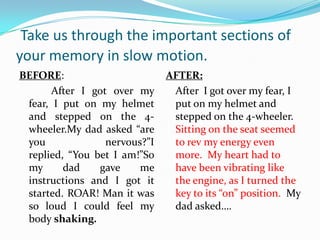
Take us through the important sections of
your memory in slow motion.
BEFORE:
After I got over my
fear, I put on my helmet
and stepped on the 4wheeler.My dad asked “are
you
nervous?”I
replied, “You bet I am!”So
my
dad
gave
me
instructions and I got it
started. ROAR! Man it was
so loud I could feel my
body shaking.

AFTER:
After I got over my fear, I
put on my helmet and
stepped on the 4-wheeler.
Sitting on the seat seemed
to rev my energy even
more. My heart had to
have been vibrating like
the engine, as I turned the
key to its “on” position. My
dad asked….
Add in more description.
 BEFORE: I ran through the

smoke filled kitchen into the
hallway. I went into the
closest room and grabbed the
closest cover I could find, and
ran down the hall with the
cover. I turned off the stove
and put the cover over the
pan and the fire stopped. I
felt like a hero.

 AFTER: As I tried to make it

the short distance from the
kitchen into the closet room,
the hallway seemed to grow
longer, seeming like a neverending maze that was
keeping me from reaching my
destination. I went into the
closet room and my eyes
scanned the room’s contents:
a dull gray blanket in the
corner seemed to be
screaming to me, “I will
help….” I grabbed the closest
cover and….
Use dialogue to slow down this
short section of time.
 BEFORE: The weather was sunny
and bright. The team I played for
was the Bulls and we were a good
team. While I was there my team
was warming up by some pitching

and some were warming up by
passing the ball to each other. After
warming up we went in front of the
dugout and had a discussion and
prayed.

 AFTER: The weather was sunny and
bright. The team I played for was
the Bulls and we were a good team.
While I was there my team was
warming up by some pitching and

some were warming up by passing
the ball to each other. Listening to
the conversation, everyone was
filling calm and anticipating the
upcoming game. “Rickie, are you
ready to score a run today?” Other
players were asking happy, easy
going questions, and it was nice to
experience the relaxed mood. After
warming up we went in front of the
dugout and had a discussion and
prayed.
Make use of a flashback.
 BEFORE: I thought about all

the happy memories, and
couldn’t stop seeing her smile in
my mind. I could still hear her
talking, and laughing, and
everything else.

 AFTER: . I could still hear her

talking, and laughing, and
everything else. One particular
memory that came to mind was
enjoying Easter at her house. I
had ran into her house in my
Easter best to be greeted by her
familiar hug and soft voice.
“Come here and let me see you,”
she quietly stated. She slipped
me one of her extra special sugar
cookies and said, “Don’t tell your
mom that I gave that to you
before your dinner.” Moments
like this seem so near and it
makes her lying here in this
casket seem so unreal.
Share your present thoughts.
 BEFORE: Then it started

going up the hill very slow.
When it started going
higher and higher I wanted
to get off but it was too
late. Then I thought to late
to turn back now.

 AFTER: Then it started

going up the hill very slow.
As our position reached
higher and higher, my
thoughts pleaded: ‘Can I
get off ?’ The slow, gentle
movements of our
climbing higher stopped
and I was staring at the
gigantic hill before me. I
closed my eyes, screamed
loudly, andnow thought:
‘It is too late to turn back
now.’
Student Instructions:
 Look at your rough draft.
 At least one section to “explode the moment” has been

identified for you.
 Write out this small section of your memory using one

or more of the “explode the moment” techniques we
have discussed today.
What is dialogue?
 Dialogue is when we quote someone’s exact words.


“Hey, that is a cool shirt!”

 When you are narrating a memory, think about the

way people spoke.
 Sometimes people do not speak in complete sentences.


“What?”
Punctuating dialogue
 Use quotation marks to surround spoken words.
 Put all punctuation marks inside the quotation marks.

 Indent each time someone new is speaking.
Tagged dialogue
 An author will write he said, she said, he asked, etc.. To

let the reader know who is talking.

 “Whoa! Look at that cool bike,” Marla exclaimed.
 Tammy said, “My dad falls asleep in front of the TV

every night.”
 After that, my grandma took me to see my great aunt

in the casket. She looked so peaceful and beautiful as

S

my grandma said, “ he told me she didn’t sleep in her
dress clothes, and she wasn’t going to be buried in her
dress clothes so, she picked sleep clothes to be buried
in.” She was dressed in a pink robe with a velvet, soft
pink nightgown under. She had pearls over her rist,
too. I thought about all the happy memories, and
couldn’t stop seeing her smile in my mind. I could still
hear her talking, and laughing, and everything else.
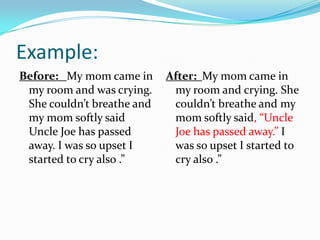
Example:
Before: My mom came in
my room and was crying.
She couldn’t breathe and
my mom softly said
Uncle Joe has passed
away. I was so upset I
started to cry also .”

After: My mom came in
my room and crying. She
couldn’t breathe and my
mom softly said, “Uncle
Joe has passed away.” I
was so upset I started to
cry also .”
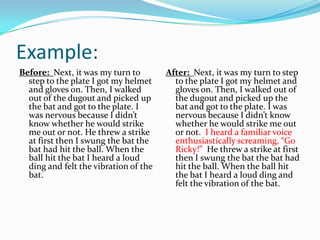
Example:
Before: Next, it was my turn to
step to the plate I got my helmet
and gloves on. Then, I walked
out of the dugout and picked up
the bat and got to the plate. I
was nervous because I didn’t
know whether he would strike
me out or not. He threw a strike
at first then I swung the bat the
bat had hit the ball. When the
ball hit the bat I heard a loud
ding and felt the vibration of the
bat.

After: Next, it was my turn to step
to the plate I got my helmet and
gloves on. Then, I walked out of
the dugout and picked up the
bat and got to the plate. I was
nervous because I didn’t know
whether he would strike me out
or not. I heard a familiar voice
enthusiastically screaming, “Go
Ricky!” He threw a strike at first
then I swung the bat the bat had
hit the ball. When the ball hit
the bat I heard a loud ding and
felt the vibration of the bat.
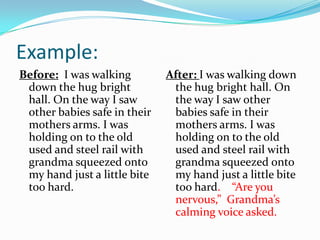
Example:
Before: I was walking
down the hug bright
hall. On the way I saw
other babies safe in their
mothers arms. I was
holding on to the old
used and steel rail with
grandma squeezed onto
my hand just a little bite
too hard.

After: I was walking down
the hug bright hall. On
the way I saw other
babies safe in their
mothers arms. I was
holding on to the old
used and steel rail with
grandma squeezed onto
my hand just a little bite
too hard. “Are you
nervous,” Grandma’s
calming voice asked.
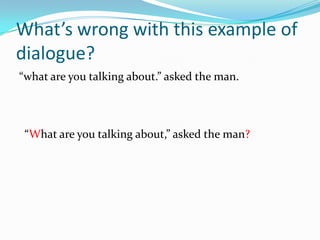
What’s wrong with this example of
dialogue?
 I don’t want to go, “exclaimed the tired, little boy.”

 “I don’t want to go,” exclaimed the tired, little boy.
What’s wrong with this example of
dialogue?
“what are you talking about.” asked the man.

“What are you talking about,” asked the man?
Your task:
 Read through your personal narrative, and look for

places to add in dialogue.
 You should add in 2 examples of dialogue into your

rough draft.

Revising our personal narratives

  • 1.
  • 2.
    Revising: editing thecontent of your piece to make your ideas clearer  Day 1: Explode the Moment: “Show, Don’t Tell”  Day 2: Adding figurative language  Day 3: Sentence fluency  Day 4: Transition Words  Day 5: Adding dialogue
  • 3.
    What does itmean to“Explode the Moment?  Take us through the important sections of your memory in slow motion.  Show your audience what is happening, don’t just tell them.  Add in more description.  Use dialogue to slow down this short section of time.  Make use of a flashback.  Share your present thoughts.
  • 4.
    Take us throughthe important sections of your memory in slow motion. BEFORE: After I got over my fear, I put on my helmet and stepped on the 4wheeler.My dad asked “are you nervous?”I replied, “You bet I am!”So my dad gave me instructions and I got it started. ROAR! Man it was so loud I could feel my body shaking. AFTER: After I got over my fear, I put on my helmet and stepped on the 4-wheeler. Sitting on the seat seemed to rev my energy even more. My heart had to have been vibrating like the engine, as I turned the key to its “on” position. My dad asked….
  • 5.
    Add in moredescription.  BEFORE: I ran through the smoke filled kitchen into the hallway. I went into the closest room and grabbed the closest cover I could find, and ran down the hall with the cover. I turned off the stove and put the cover over the pan and the fire stopped. I felt like a hero.  AFTER: As I tried to make it the short distance from the kitchen into the closet room, the hallway seemed to grow longer, seeming like a neverending maze that was keeping me from reaching my destination. I went into the closet room and my eyes scanned the room’s contents: a dull gray blanket in the corner seemed to be screaming to me, “I will help….” I grabbed the closest cover and….
  • 6.
    Use dialogue toslow down this short section of time.  BEFORE: The weather was sunny and bright. The team I played for was the Bulls and we were a good team. While I was there my team was warming up by some pitching and some were warming up by passing the ball to each other. After warming up we went in front of the dugout and had a discussion and prayed.  AFTER: The weather was sunny and bright. The team I played for was the Bulls and we were a good team. While I was there my team was warming up by some pitching and some were warming up by passing the ball to each other. Listening to the conversation, everyone was filling calm and anticipating the upcoming game. “Rickie, are you ready to score a run today?” Other players were asking happy, easy going questions, and it was nice to experience the relaxed mood. After warming up we went in front of the dugout and had a discussion and prayed.
  • 7.
    Make use ofa flashback.  BEFORE: I thought about all the happy memories, and couldn’t stop seeing her smile in my mind. I could still hear her talking, and laughing, and everything else.  AFTER: . I could still hear her talking, and laughing, and everything else. One particular memory that came to mind was enjoying Easter at her house. I had ran into her house in my Easter best to be greeted by her familiar hug and soft voice. “Come here and let me see you,” she quietly stated. She slipped me one of her extra special sugar cookies and said, “Don’t tell your mom that I gave that to you before your dinner.” Moments like this seem so near and it makes her lying here in this casket seem so unreal.
  • 8.
    Share your presentthoughts.  BEFORE: Then it started going up the hill very slow. When it started going higher and higher I wanted to get off but it was too late. Then I thought to late to turn back now.  AFTER: Then it started going up the hill very slow. As our position reached higher and higher, my thoughts pleaded: ‘Can I get off ?’ The slow, gentle movements of our climbing higher stopped and I was staring at the gigantic hill before me. I closed my eyes, screamed loudly, andnow thought: ‘It is too late to turn back now.’
  • 9.
    Student Instructions:  Lookat your rough draft.  At least one section to “explode the moment” has been identified for you.  Write out this small section of your memory using one or more of the “explode the moment” techniques we have discussed today.
  • 10.
    What is dialogue? Dialogue is when we quote someone’s exact words.  “Hey, that is a cool shirt!”  When you are narrating a memory, think about the way people spoke.  Sometimes people do not speak in complete sentences.  “What?”
  • 11.
    Punctuating dialogue  Usequotation marks to surround spoken words.  Put all punctuation marks inside the quotation marks.  Indent each time someone new is speaking.
  • 12.
    Tagged dialogue  Anauthor will write he said, she said, he asked, etc.. To let the reader know who is talking.  “Whoa! Look at that cool bike,” Marla exclaimed.  Tammy said, “My dad falls asleep in front of the TV every night.”
  • 13.
     After that,my grandma took me to see my great aunt in the casket. She looked so peaceful and beautiful as S my grandma said, “ he told me she didn’t sleep in her dress clothes, and she wasn’t going to be buried in her dress clothes so, she picked sleep clothes to be buried in.” She was dressed in a pink robe with a velvet, soft pink nightgown under. She had pearls over her rist, too. I thought about all the happy memories, and couldn’t stop seeing her smile in my mind. I could still hear her talking, and laughing, and everything else.
  • 14.
    Example: Before: My momcame in my room and was crying. She couldn’t breathe and my mom softly said Uncle Joe has passed away. I was so upset I started to cry also .” After: My mom came in my room and crying. She couldn’t breathe and my mom softly said, “Uncle Joe has passed away.” I was so upset I started to cry also .”
  • 15.
    Example: Before: Next, itwas my turn to step to the plate I got my helmet and gloves on. Then, I walked out of the dugout and picked up the bat and got to the plate. I was nervous because I didn’t know whether he would strike me out or not. He threw a strike at first then I swung the bat the bat had hit the ball. When the ball hit the bat I heard a loud ding and felt the vibration of the bat. After: Next, it was my turn to step to the plate I got my helmet and gloves on. Then, I walked out of the dugout and picked up the bat and got to the plate. I was nervous because I didn’t know whether he would strike me out or not. I heard a familiar voice enthusiastically screaming, “Go Ricky!” He threw a strike at first then I swung the bat the bat had hit the ball. When the ball hit the bat I heard a loud ding and felt the vibration of the bat.
  • 16.
    Example: Before: I waswalking down the hug bright hall. On the way I saw other babies safe in their mothers arms. I was holding on to the old used and steel rail with grandma squeezed onto my hand just a little bite too hard. After: I was walking down the hug bright hall. On the way I saw other babies safe in their mothers arms. I was holding on to the old used and steel rail with grandma squeezed onto my hand just a little bite too hard. “Are you nervous,” Grandma’s calming voice asked.
  • 17.
    What’s wrong withthis example of dialogue?  I don’t want to go, “exclaimed the tired, little boy.”  “I don’t want to go,” exclaimed the tired, little boy.
  • 18.
    What’s wrong withthis example of dialogue? “what are you talking about.” asked the man. “What are you talking about,” asked the man?
  • 19.
    Your task:  Readthrough your personal narrative, and look for places to add in dialogue.  You should add in 2 examples of dialogue into your rough draft.