NARRATIVE 
INVESTIGATION
Narrative is the way a story is told in both fictional and non-fictional media texts. As well 
as referring to the different types of story structures narrative also reflects a certain 
genre. 
There are different structures of narrative such as linear and circular narrative. Linear 
narrative is were there is a clear beginning, middle and end. Aristole identified that the 
basic linear line structure and observed that the middle section may involve some sort 
of crisis being resolved at the end of the story. 
Circular narrative is a structure that is the narrative going round in a circle and the film 
ends were it begins. Examples of films with a circular structure are (500) Days of 
Summer and The Hangover.
Vladimir Propp 
Propp is a Russian critic and literary theorist. After analysing over 100 Russian fairy tales he 
proposed that it was possible to classify the characters and their actions into clearly defined 
roles and functions. 
This model is useful, however as it highlights the similarites between seemingly quite different 
stories. 
Propp’s Character Roles 
- The hero (seeks something) 
- The villain (opposes the hero) 
- The donor (helps the hero by providing a magic object) 
- The dispatcher (sends the hero on his way) 
- The false hero (falsely assuming the role of the hero) 
- The helper (gives support to the hero) 
- The princess (the reward for the hero, but also needs protection from the villain) 
- Her father
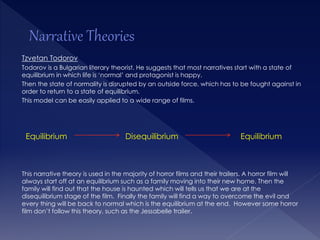
Tzvetan Todorov 
Todorov is a Bulgarian literary theorist. He suggests that most narratives start with a state of 
equilibrium in which life is ‘normal’ and protagonist is happy. 
Then the state of normality is disrupted by an outside force, which has to be fought against in 
order to return to a state of equilibrium. 
This model can be easily applied to a wide range of films. 
Equilibrium Disequilibrium Equilibrium 
This narrative theory is used in the majority of horror films and their trailers. A horror film will 
always start off at an equilibrium such as a family moving into their new home. Then the 
family will find out that the house is haunted which will tells us that we are at the 
disequilibrium stage of the film. Finally the family will find a way to overcome the evil and 
every thing will be back to normal which is the equilibrium at the end. However some horror 
film don’t follow this theory, such as the Jessabelle trailer.
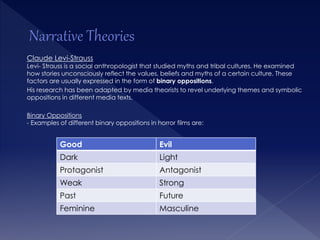
Claude Levi-Strauss 
Levi- Strauss is a social anthropologist that studied myths and tribal cultures. He examined 
how stories unconsciously reflect the values, beliefs and myths of a certain culture. These 
factors are usually expressed in the form of binary oppositions. 
His research has been adapted by media theorists to revel underlying themes and symbolic 
oppositions in different media texts. 
Binary Oppositions 
- Examples of different binary oppositions in horror films are: 
Good Evil 
Dark Light 
Protagonist Antagonist 
Weak Strong 
Past Future 
Feminine Masculine

Narrative investigation

  • 1.
  • 2.
    Narrative is theway a story is told in both fictional and non-fictional media texts. As well as referring to the different types of story structures narrative also reflects a certain genre. There are different structures of narrative such as linear and circular narrative. Linear narrative is were there is a clear beginning, middle and end. Aristole identified that the basic linear line structure and observed that the middle section may involve some sort of crisis being resolved at the end of the story. Circular narrative is a structure that is the narrative going round in a circle and the film ends were it begins. Examples of films with a circular structure are (500) Days of Summer and The Hangover.
  • 3.
    Vladimir Propp Proppis a Russian critic and literary theorist. After analysing over 100 Russian fairy tales he proposed that it was possible to classify the characters and their actions into clearly defined roles and functions. This model is useful, however as it highlights the similarites between seemingly quite different stories. Propp’s Character Roles - The hero (seeks something) - The villain (opposes the hero) - The donor (helps the hero by providing a magic object) - The dispatcher (sends the hero on his way) - The false hero (falsely assuming the role of the hero) - The helper (gives support to the hero) - The princess (the reward for the hero, but also needs protection from the villain) - Her father
  • 4.
    Tzvetan Todorov Todorovis a Bulgarian literary theorist. He suggests that most narratives start with a state of equilibrium in which life is ‘normal’ and protagonist is happy. Then the state of normality is disrupted by an outside force, which has to be fought against in order to return to a state of equilibrium. This model can be easily applied to a wide range of films. Equilibrium Disequilibrium Equilibrium This narrative theory is used in the majority of horror films and their trailers. A horror film will always start off at an equilibrium such as a family moving into their new home. Then the family will find out that the house is haunted which will tells us that we are at the disequilibrium stage of the film. Finally the family will find a way to overcome the evil and every thing will be back to normal which is the equilibrium at the end. However some horror film don’t follow this theory, such as the Jessabelle trailer.
  • 5.
    Claude Levi-Strauss Levi-Strauss is a social anthropologist that studied myths and tribal cultures. He examined how stories unconsciously reflect the values, beliefs and myths of a certain culture. These factors are usually expressed in the form of binary oppositions. His research has been adapted by media theorists to revel underlying themes and symbolic oppositions in different media texts. Binary Oppositions - Examples of different binary oppositions in horror films are: Good Evil Dark Light Protagonist Antagonist Weak Strong Past Future Feminine Masculine