Narrative Theory
Todorov
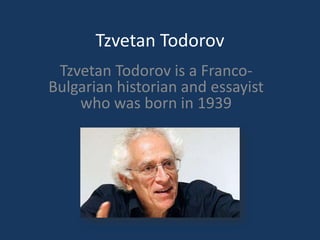
Tzvetan Todorov
Tzvetan Todorov is a Franco-
Bulgarian historian and essayist
who was born in 1939
Todorov’s Narrative Theory
Todorov simplified the idea of
narrative theory while also
allowing a more complex
interpretation of film texts with
his theory of Equilibrium and
Disequilibrium.
The fictional environment begins
with a state of equilibrium
(everything is as it should be in a state of
equal balance between powers of any
kind, where equality of importance or
effect exists among the various parts of
any complex unity).
Todorov’s Narrative Theory
The fictional environment then
suffers some disruption or
disequilibrium.
Todorov’s Narrative Theory
The narrative then ends with a
state of new equilibrium.
Todorov’s Narrative Theory
There are five stages the narrative can progress
through:
• A state of equilibrium - all is as it should be.
Todorov’s Narrative Theory
There are five stages the narrative can progress
through:
• A state of equilibrium - all is as it should be.
• Something happens to disrupt that order.
Todorov’s Narrative Theory
There are five stages the narrative can progress
through:
• A state of equilibrium - all is as it should be.
• Something happens to disrupt that order
• Recognition that the disorder has occurred.
Todorov’s Narrative Theory
There are five stages the narrative can progress
through:
• A state of equilibrium - all is as it should be.
• Something happens to disrupt that order
• Recognition that the disorder has occurred.
• There is an attempt to repair the damage of
the disruption.
Todorov’s Narrative Theory
There are five stages the narrative can progress
through:
• A state of equilibrium - all is as it should be.
• Something happens to disrupt that order
• Recognition that the disorder has occurred.
• There is an attempt to repair the damage of
the disruption.
• There is a restoration of a new equilibrium.
Todorov’s Narrative Theory
The five stages the narrative can progress
through:
• A state of equilibrium - all is as it should be.
• Something happens to disrupt that order
• Recognition that the disorder has occurred.
• There is an attempt to repair the damage of
the disruption.
• There is a restoration of a new equilibrium.
Todorov’s Narrative Theory
In these stages, the narrative is not seen as a
linear structure but a circular one.
Todorov’s Narrative Theory
In these stages, narrative is not seen as a linear
structure but a circular one.
The narrative is driven by attempts to restore
the equilibrium.
Todorov’s Narrative Theory
In these stages, narrative is not seen as a linear
structure but a circular one.
The narrative is driven by attempts to restore
the equilibrium.
However, the equilibrium at the end of the
story is not identical to the initial equilibrium.
Todorov’s Narrative Theory
Todorov argues that narrative
involves a transformation
Todorov’s Narrative Theory
The characters or the situations
are transformed through the
progress of the disruption.
Todorov’s Narrative Theory
The disruption itself usually takes
place outside the normal social
framework, outside ‘normal’ social
events
Todorov’s Narrative Theory
In summary:
• Narratives don’t need to be linear.
Todorov’s Narrative Theory
In summary:
• Narratives don’t need to be linear.
• The progression from initial equilibrium to
restoration always involves a transformation.
Todorov’s Narrative Theory
In summary:
• Narratives don’t need to be linear.
• The progression from initial equilibrium to
restoration always involves a transformation.
• The middle period of a narrative can depict
actions that transgress everyday habits and
routines.
Todorov’s Narrative Theory
In summary:
• Narratives don’t need to be linear.
• The progression from initial equilibrium to
restoration always involves a transformation.
• The middle period of a narrative can depict
actions that transgress everyday habits and
routines.
• There can be many disruptions whilst seeking a
new equilibrium (horror relies on this
technique).
Todorov’s Narrative Theory
In summary:
• Narratives don’t need to be linear.
• The progression from initial equilibrium to
restoration always involves a transformation.
• The middle period of a narrative can depict
actions that transgress everyday habits and
routines.
• There can be many disruptions whilst seeking a
new equilibrium (horror relies on this
technique).
Todorov’s Narrative Theory
The End
Todorov’s Narrative Theory

Todorovs narrative theory

  • 1.
  • 2.
    Tzvetan Todorov Tzvetan Todorovis a Franco- Bulgarian historian and essayist who was born in 1939
  • 3.
    Todorov’s Narrative Theory Todorovsimplified the idea of narrative theory while also allowing a more complex interpretation of film texts with his theory of Equilibrium and Disequilibrium.
  • 4.
    The fictional environmentbegins with a state of equilibrium (everything is as it should be in a state of equal balance between powers of any kind, where equality of importance or effect exists among the various parts of any complex unity). Todorov’s Narrative Theory
  • 5.
    The fictional environmentthen suffers some disruption or disequilibrium. Todorov’s Narrative Theory
  • 6.
    The narrative thenends with a state of new equilibrium. Todorov’s Narrative Theory
  • 7.
    There are fivestages the narrative can progress through: • A state of equilibrium - all is as it should be. Todorov’s Narrative Theory
  • 8.
    There are fivestages the narrative can progress through: • A state of equilibrium - all is as it should be. • Something happens to disrupt that order. Todorov’s Narrative Theory
  • 9.
    There are fivestages the narrative can progress through: • A state of equilibrium - all is as it should be. • Something happens to disrupt that order • Recognition that the disorder has occurred. Todorov’s Narrative Theory
  • 10.
    There are fivestages the narrative can progress through: • A state of equilibrium - all is as it should be. • Something happens to disrupt that order • Recognition that the disorder has occurred. • There is an attempt to repair the damage of the disruption. Todorov’s Narrative Theory
  • 11.
    There are fivestages the narrative can progress through: • A state of equilibrium - all is as it should be. • Something happens to disrupt that order • Recognition that the disorder has occurred. • There is an attempt to repair the damage of the disruption. • There is a restoration of a new equilibrium. Todorov’s Narrative Theory
  • 12.
    The five stagesthe narrative can progress through: • A state of equilibrium - all is as it should be. • Something happens to disrupt that order • Recognition that the disorder has occurred. • There is an attempt to repair the damage of the disruption. • There is a restoration of a new equilibrium. Todorov’s Narrative Theory
  • 13.
    In these stages,the narrative is not seen as a linear structure but a circular one. Todorov’s Narrative Theory
  • 14.
    In these stages,narrative is not seen as a linear structure but a circular one. The narrative is driven by attempts to restore the equilibrium. Todorov’s Narrative Theory
  • 15.
    In these stages,narrative is not seen as a linear structure but a circular one. The narrative is driven by attempts to restore the equilibrium. However, the equilibrium at the end of the story is not identical to the initial equilibrium. Todorov’s Narrative Theory
  • 16.
    Todorov argues thatnarrative involves a transformation Todorov’s Narrative Theory
  • 17.
    The characters orthe situations are transformed through the progress of the disruption. Todorov’s Narrative Theory
  • 18.
    The disruption itselfusually takes place outside the normal social framework, outside ‘normal’ social events Todorov’s Narrative Theory
  • 19.
    In summary: • Narrativesdon’t need to be linear. Todorov’s Narrative Theory
  • 20.
    In summary: • Narrativesdon’t need to be linear. • The progression from initial equilibrium to restoration always involves a transformation. Todorov’s Narrative Theory
  • 21.
    In summary: • Narrativesdon’t need to be linear. • The progression from initial equilibrium to restoration always involves a transformation. • The middle period of a narrative can depict actions that transgress everyday habits and routines. Todorov’s Narrative Theory
  • 22.
    In summary: • Narrativesdon’t need to be linear. • The progression from initial equilibrium to restoration always involves a transformation. • The middle period of a narrative can depict actions that transgress everyday habits and routines. • There can be many disruptions whilst seeking a new equilibrium (horror relies on this technique). Todorov’s Narrative Theory
  • 23.
    In summary: • Narrativesdon’t need to be linear. • The progression from initial equilibrium to restoration always involves a transformation. • The middle period of a narrative can depict actions that transgress everyday habits and routines. • There can be many disruptions whilst seeking a new equilibrium (horror relies on this technique). Todorov’s Narrative Theory
  • 24.