NARRATIVE
THEORY
When discussing Narrative, what is
meant of the storyline to a piece of
Media.
Examples of Narrative within Media is as
follows:
• TV Programs
• Novels
• Films
• Advertisements
• News
• Internet (Snapchat)
• Gossip
NarrativeTheory is important to study in Media
because narrative conveys the meaning of the piece
to the audience.
Narrative theory analyses the way in which media
texts communicate meaning about events; can be
applied to films, tv, photos and magazines
Narrative analysis of internet based media is more
problematic, though may still be relevant.
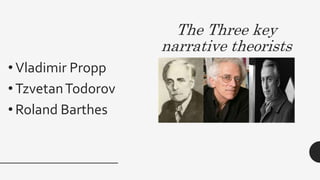
The Three key
narrative theorists
• Vladimir Propp
• TzvetanTodorov
• Roland Barthes
Vladimir Propp
• Russian theorist who suggests that
there are a limited number of
character types that share a function
within all types of narrative.
• When an audience reads a film, this
knowledge of character types are
used.
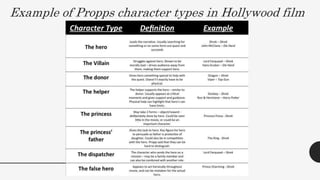
• He studied folk tales and proposed that it is
possible to identify 8 character roles in all
media with narrative:
• Villain
• Hero
• Donor
• Helper
• Princess
• Father
• Dispatcher
• False hero
Example of Propps character types in Hollywood film
Tzvetan
Todorov
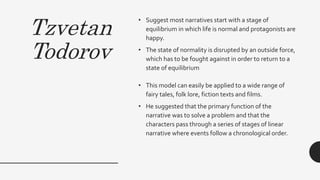
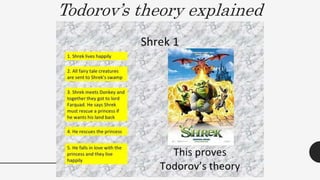
• Suggest most narratives start with a stage of
equilibrium in which life is normal and protagonists are
happy.
• The state of normality is disrupted by an outside force,
which has to be fought against in order to return to a
state of equilibrium
• This model can easily be applied to a wide range of
fairy tales, folk lore, fiction texts and films.
• He suggested that the primary function of the
narrative was to solve a problem and that the
characters pass through a series of stages of linear
narrative where events follow a chronological order.
Todorov’s theory explained
Roland
Barthes
theory
explained
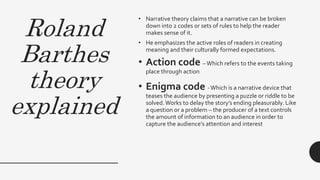
• Narrative theory claims that a narrative can be broken
down into 2 codes or sets of rules to help the reader
makes sense of it.
• He emphasizes the active roles of readers in creating
meaning and their culturally formed expectations.
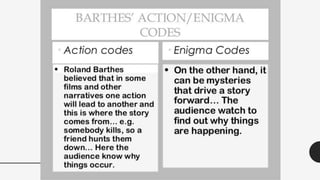
• Action code –Which refers to the events taking
place through action
• Enigma code -Which is a narrative device that
teases the audience by presenting a puzzle or riddle to be
solved.Works to delay the story’s ending pleasurably. Like
a question or a problem – the producer of a text controls
the amount of information to an audience in order to
capture the audience’s attention and interest
Narrative Film Theory

Narrative Film Theory

  • 1.
    NARRATIVE THEORY When discussing Narrative,what is meant of the storyline to a piece of Media. Examples of Narrative within Media is as follows: • TV Programs • Novels • Films • Advertisements • News • Internet (Snapchat) • Gossip NarrativeTheory is important to study in Media because narrative conveys the meaning of the piece to the audience. Narrative theory analyses the way in which media texts communicate meaning about events; can be applied to films, tv, photos and magazines Narrative analysis of internet based media is more problematic, though may still be relevant.
  • 2.
    The Three key narrativetheorists • Vladimir Propp • TzvetanTodorov • Roland Barthes
  • 3.
    Vladimir Propp • Russiantheorist who suggests that there are a limited number of character types that share a function within all types of narrative. • When an audience reads a film, this knowledge of character types are used. • He studied folk tales and proposed that it is possible to identify 8 character roles in all media with narrative: • Villain • Hero • Donor • Helper • Princess • Father • Dispatcher • False hero
  • 4.
    Example of Proppscharacter types in Hollywood film
  • 5.
    Tzvetan Todorov • Suggest mostnarratives start with a stage of equilibrium in which life is normal and protagonists are happy. • The state of normality is disrupted by an outside force, which has to be fought against in order to return to a state of equilibrium • This model can easily be applied to a wide range of fairy tales, folk lore, fiction texts and films. • He suggested that the primary function of the narrative was to solve a problem and that the characters pass through a series of stages of linear narrative where events follow a chronological order.
  • 6.
  • 7.
    Roland Barthes theory explained • Narrative theoryclaims that a narrative can be broken down into 2 codes or sets of rules to help the reader makes sense of it. • He emphasizes the active roles of readers in creating meaning and their culturally formed expectations. • Action code –Which refers to the events taking place through action • Enigma code -Which is a narrative device that teases the audience by presenting a puzzle or riddle to be solved.Works to delay the story’s ending pleasurably. Like a question or a problem – the producer of a text controls the amount of information to an audience in order to capture the audience’s attention and interest