Supply Management: The Missing
Voice in the Integrated Business Plan
How Cost Management, Negotiation and Contract Management
Inform the Process and are Essential to Its Execution


               Arnold Mark Wells, CPIM
               25 August 2011
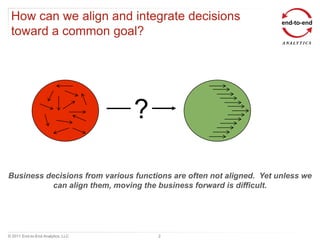
How can we align and integrate decisions
 toward a common goal?


                                   ?

Business decisions from various functions are often not aligned. Yet unless we
           can align them, moving the business forward is difficult.


ยฉ 2011 End-to-End Analytics, LLC       2
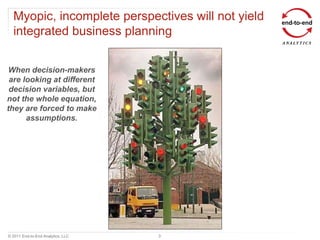
Myopic, incomplete perspectives will not yield
  integrated business planning


 When decision-makers
 are looking at different
 decision variables, but
not the whole equation,
they are forced to make
      assumptions.


ยฉ 2011 End-to-End Analytics, LLC   3
The Dangers of Dis-integrated Decisions


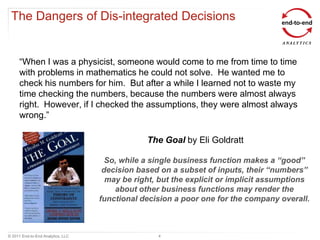
     โ€œWhen I was a physicist, someone would come to me from time to time
     with problems in mathematics he could not solve. He wanted me to
     check his numbers for him. But after a while I learned not to waste my
     time checking the numbers, because the numbers were almost always
     right. However, if I checked the assumptions, they were almost always
     wrong.โ€

                                               The Goal by Eli Goldratt

                                     So, while a single business function makes a โ€œgoodโ€
                                    decision based on a subset of inputs, their โ€œnumbersโ€
                                     may be right, but the explicit or implicit assumptions
                                       about other business functions may render the
                                   functional decision a poor one for the company overall.


ยฉ 2011 End-to-End Analytics, LLC                  4
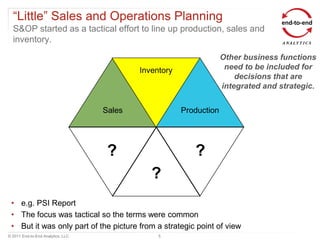
โ€œLittleโ€ Sales and Operations Planning
  S&OP started as a tactical effort to line up production, sales and
  inventory.
                                                                    Other business functions
                                           Inventory                 need to be included for
                                                                        decisions that are
                                                                    integrated and strategic.


                                   Sales               Production


                                    ?                     ?
                                              ?
 โ€ข e.g. PSI Report
 โ€ข The focus was tactical so the terms were common
 โ€ข But it was only part of the picture from a strategic point of view
ยฉ 2011 End-to-End Analytics, LLC                5
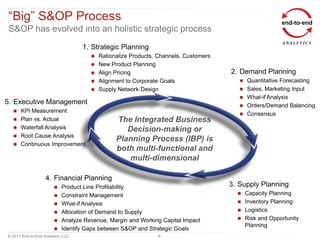
โ€œBigโ€ S&OP Process
 S&OP has evolved into an holistic strategic process
                                   1. Strategic Planning
                                      ๏ฎ   Rationalize Products, Channels, Customers
                                      ๏ฎ   New Product Planning
                                      ๏ฎ   Align Pricing                               2. Demand Planning
                                      ๏ฎ   Alignment to Corporate Goals                   ๏ฎ   Quantitative Forecasting
                                      ๏ฎ   Supply Network Design                          ๏ฎ   Sales, Marketing Input
                                                                                         ๏ฎ   What-if Analysis
5. Executive Management                                                                  ๏ฎ   Orders/Demand Balancing
  ๏ฎ   KPI Measurement
                                                                                         ๏ฎ   Consensus
  ๏ฎ   Plan vs. Actual                           The Integrated Business
  ๏ฎ   Waterfall Analysis                           Decision-making or
  ๏ฎ   Root Cause Analysis
                                                Planning Process (IBP) is
  ๏ฎ   Continuous Improvement
                                                both multi-functional and
                                                   multi-dimensional

                   4. Financial Planning
                        ๏ฎ   Product Line Profitability                                3. Supply Planning
                        ๏ฎ   Constraint Management                                       ๏ฎ Capacity Planning
                        ๏ฎ   What-if Analysis                                            ๏ฎ Inventory Planning

                        ๏ฎ   Allocation of Demand to Supply                              ๏ฎ Logistics

                        ๏ฎ   Analyze Revenue, Margin and Working Capital Impact          ๏ฎ Risk and Opportunity
                                                                                          Planning
                        ๏ฎ   Identify Gaps between S&OP and Strategic Goals
ยฉ 2011 End-to-End Analytics, LLC                               6
Including Supply Management in the Process
 Participation and Preparation


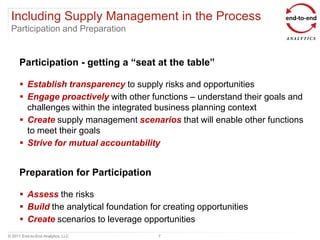
      Participation - getting a โ€œseat at the tableโ€

      ๏‚ง Establish transparency to supply risks and opportunities
      ๏‚ง Engage proactively with other functions โ€“ understand their goals and
        challenges within the integrated business planning context
      ๏‚ง Create supply management scenarios that will enable other functions
        to meet their goals
      ๏‚ง Strive for mutual accountability


      Preparation for Participation

      ๏‚ง Assess the risks
      ๏‚ง Build the analytical foundation for creating opportunities
      ๏‚ง Create scenarios to leverage opportunities
ยฉ 2011 End-to-End Analytics, LLC          7
Preparation for Participation
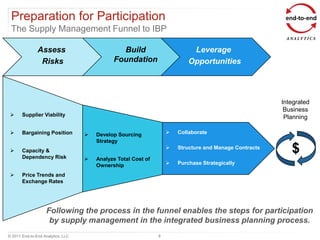
 The Supply Management Funnel to IBP

               Assess                          Build                        Leverage
                Risks                        Foundation                    Opportunities


                                                                                                        Integrated
                                                                                                         Business
 ๏ƒ˜     Supplier Viability                                                                                Planning

 ๏ƒ˜     Bargaining Position         ๏ƒ˜   Develop Sourcing            ๏ƒ˜   Collaborate
                                       Strategy
 ๏ƒ˜     Capacity &
       Dependency Risk
                                                                   ๏ƒ˜   Structure and Manage Contracts
                                                                                                           $
                                   ๏ƒ˜   Analyze Total Cost of
                                       Ownership                   ๏ƒ˜   Purchase Strategically

 ๏ƒ˜     Price Trends and
       Exchange Rates


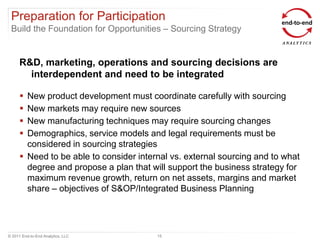
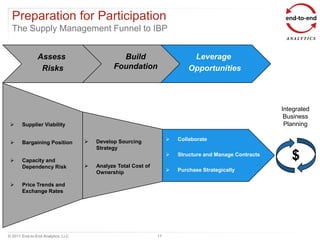
                    Following the process in the funnel enables the steps for participation
                     by supply management in the integrated business planning process.
ยฉ 2011 End-to-End Analytics, LLC                               8
Preparation for Participation
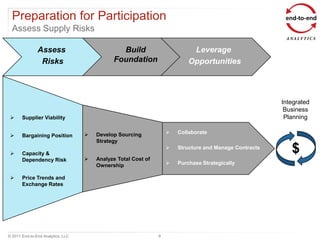
  Assess Supply Risks

               Assess                          Build                        Leverage
                Risks                        Foundation                    Opportunities


                                                                                                        Integrated
                                                                                                         Business
 ๏ƒ˜     Supplier Viability                                                                                Planning

                                   ๏ƒ˜                               ๏ƒ˜   Collaborate
 ๏ƒ˜     Bargaining Position             Develop Sourcing
                                       Strategy

 ๏ƒ˜     Capacity &
                                                                   ๏ƒ˜   Structure and Manage Contracts
                                                                                                           $
       Dependency Risk             ๏ƒ˜   Analyze Total Cost of
                                       Ownership                   ๏ƒ˜   Purchase Strategically

 ๏ƒ˜     Price Trends and
       Exchange Rates


ยฉ 2011 End-to-End Analytics, LLC                               9
Preparation for Participation
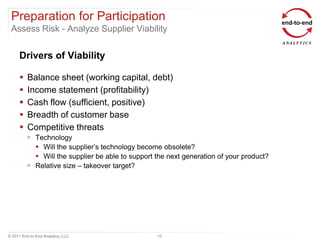
 Assess Risk - Analyze Supplier Viability


      Drivers of Viability

      ๏‚ง   Balance sheet (working capital, debt)
      ๏‚ง   Income statement (profitability)
      ๏‚ง   Cash flow (sufficient, positive)
      ๏‚ง   Breadth of customer base
      ๏‚ง   Competitive threats
          ๏ƒบ Technology
            ๏‚ง Will the supplierโ€Ÿs technology become obsolete?
            ๏‚ง Will the supplier be able to support the next generation of your product?
          ๏ƒบ Relative size โ€“ takeover target?


ยฉ 2011 End-to-End Analytics, LLC                   10
Preparation for Participation
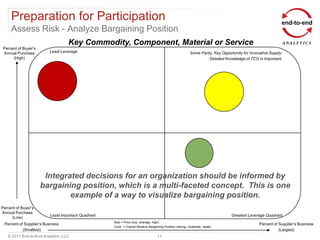
     Assess Risk - Analyze Bargaining Position
                                   Key Commodity, Component, Material or Service
 Percent of Buyerโ€Ÿs
 Annual Purchase         Least Leverage                                                                    Some Parity; Key Opportunity for Innovative Supply;
      (High)                                                                                                         Detailed Knowledge of TCO is Important;


                       Integrated decisions for an organization should be informed by
                      bargaining position, which is a multi-faceted concept. This is one
                              example of a way to visualize bargaining position.
Percent of Buyerโ€Ÿs
Annual Purchase
                          Least Important Quadrant                                                                               Greatest Leverage Quadrant
     (Low)
                                                     Size = Price (low, average, high)
 Percent of Supplierโ€Ÿs Business                                                                                                                  Percent of Supplierโ€žs Business
                                                     Color = Overall Relative Bargaining Position (strong, moderate, weak)
           (Smallest)                                                                                                                                       (Largest)
   ยฉ 2011 End-to-End Analytics, LLC                                                11
Preparation for Participation
 Assess Risk โ€“ Supplier Capacity and Dependency

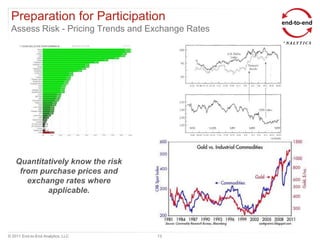
           Commodity A                          Commodity B

                                                  Commodity A
                                                   10%                        Committed from Current, Approved
                                                                  20%
                                                                              Suppliers
                                    35%

         50%                                                                  Additional Potential Commitment from
                                                                        20%   Current Suppiers
                                                50%
                               10%                                            Opportunity for Other Supply
                         5%                           35%


                              50%                                             Potential Risk to Supply
           Commodity C                          Commodity D
                                                            0%

                20%                                                           Systematically identify and
                                                10%                           graphically depict where the
                                           5%
                                                                               capacity of your suppliers
          20%                        60%                                       and broader capacity puts
                                                        100%                         supply at risk.


ยฉ 2011 End-to-End Analytics, LLC                             12
Preparation for Participation
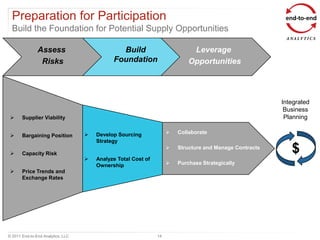
 Assess Risk - Pricing Trends and Exchange Rates


    Quantitatively know the risk
     from purchase prices and
       exchange rates where
            applicable.


ยฉ 2011 End-to-End Analytics, LLC   13
Preparation for Participation
  Build the Foundation for Potential Supply Opportunities

               Assess                          Build                         Leverage
                Risks                        Foundation                     Opportunities


                                                                                                         Integrated
                                                                                                          Business
 ๏ƒ˜     Supplier Viability                                                                                 Planning

                                   ๏ƒ˜                                ๏ƒ˜   Collaborate
 ๏ƒ˜     Bargaining Position             Develop Sourcing
                                       Strategy

 ๏ƒ˜     Capacity Risk
                                                                    ๏ƒ˜   Structure and Manage Contracts
                                                                                                            $
                                   ๏ƒ˜   Analyze Total Cost of
                                       Ownership                    ๏ƒ˜   Purchase Strategically
 ๏ƒ˜     Price Trends and
       Exchange Rates


ยฉ 2011 End-to-End Analytics, LLC                               14
Preparation for Participation
 Build the Foundation for Opportunities โ€“ Sourcing Strategy


      R&D, marketing, operations and sourcing decisions are
        interdependent and need to be integrated

      ๏‚ง New product development must coordinate carefully with sourcing
      ๏‚ง New markets may require new sources
      ๏‚ง New manufacturing techniques may require sourcing changes
      ๏‚ง Demographics, service models and legal requirements must be
        considered in sourcing strategies
      ๏‚ง Need to be able to consider internal vs. external sourcing and to what
        degree and propose a plan that will support the business strategy for
        maximum revenue growth, return on net assets, margins and market
        share โ€“ objectives of S&OP/Integrated Business Planning


ยฉ 2011 End-to-End Analytics, LLC         15
Preparation for Participation
 Build the Foundation for Opportunities โ€“ Analyze TCO

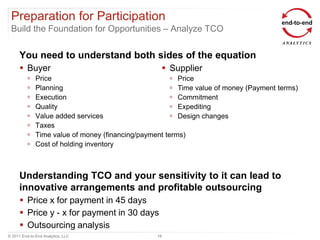
      You need to understand both sides of the equation
      ๏‚ง Buyer                                      ๏‚ง Supplier
          ๏ƒบ   Price                                     ๏ƒบ   Price
          ๏ƒบ   Planning                                  ๏ƒบ   Time value of money (Payment terms)
          ๏ƒบ   Execution                                 ๏ƒบ   Commitment
          ๏ƒบ   Quality                                   ๏ƒบ   Expediting
          ๏ƒบ   Value added services                      ๏ƒบ   Design changes
          ๏ƒบ   Taxes
          ๏ƒบ   Time value of money (financing/payment   terms)
          ๏ƒบ   Cost of holding inventory


      Understanding TCO and your sensitivity to it can lead to
      innovative arrangements and profitable outsourcing
      ๏‚ง Price x for payment in 45 days
      ๏‚ง Price y - x for payment in 30 days
      ๏‚ง Outsourcing analysis
ยฉ 2011 End-to-End Analytics, LLC                  16
Preparation for Participation
  The Supply Management Funnel to IBP


               Assess                          Build                         Leverage
                Risks                        Foundation                     Opportunities


                                                                                                         Integrated
                                                                                                          Business
 ๏ƒ˜     Supplier Viability                                                                                 Planning

                                   ๏ƒ˜                                ๏ƒ˜   Collaborate
 ๏ƒ˜     Bargaining Position             Develop Sourcing
                                       Strategy

 ๏ƒ˜     Capacity and
                                                                    ๏ƒ˜   Structure and Manage Contracts
                                                                                                            $
       Dependency Risk             ๏ƒ˜   Analyze Total Cost of
                                       Ownership                    ๏ƒ˜   Purchase Strategically

 ๏ƒ˜     Price Trends and
       Exchange Rates


ยฉ 2011 End-to-End Analytics, LLC                               17
Preparation for Participation
 Leverage Opportunities โ€“ Collaboration Scenarios

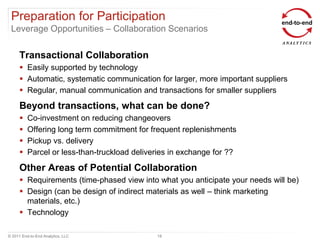
      Transactional Collaboration
      ๏‚ง Easily supported by technology
      ๏‚ง Automatic, systematic communication for larger, more important suppliers
      ๏‚ง Regular, manual communication and transactions for smaller suppliers

      Beyond transactions, what can be done?
      ๏‚ง   Co-investment on reducing changeovers
      ๏‚ง   Offering long term commitment for frequent replenishments
      ๏‚ง   Pickup vs. delivery
      ๏‚ง   Parcel or less-than-truckload deliveries in exchange for ??

      Other Areas of Potential Collaboration
      ๏‚ง Requirements (time-phased view into what you anticipate your needs will be)
      ๏‚ง Design (can be design of indirect materials as well โ€“ think marketing
        materials, etc.)
      ๏‚ง Technology

ยฉ 2011 End-to-End Analytics, LLC              18
Preparation for Participation
 Leverage Opportunities - Contract Structure & Management
 Scenarios

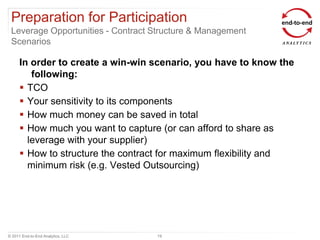
      In order to create a win-win scenario, you have to know the
         following:
      ๏‚ง TCO
      ๏‚ง Your sensitivity to its components
      ๏‚ง How much money can be saved in total
      ๏‚ง How much you want to capture (or can afford to share as
        leverage with your supplier)
      ๏‚ง How to structure the contract for maximum flexibility and
        minimum risk (e.g. Vested Outsourcing)


ยฉ 2011 End-to-End Analytics, LLC   19
Supply Management Contributions โ€“ Opp.
 Leverage Opportunities โ€“ Contract Structure & Management
 Scenarios

      Considerations for Flexibility and Risk
      ๏‚ง Potential range of future requirements by period
      ๏‚ง Minimum and maximum quantity in units for each period
      ๏‚ง Unit price by period, fixed or market dependent
      ๏‚ง Lead time commitment
      ๏‚ง Understanding regarding cancellation or changes to orders
      ๏‚ง Minimum and maximum quantities over a range of periods
      ๏‚ง Minimum order quantities
      ๏‚ง Sequential capacity expansion options, each of which might
        have its own lead time and associated payment for expansion
        cost
      ๏‚ง Other

ยฉ 2011 End-to-End Analytics, LLC    20
Preparation for Participation
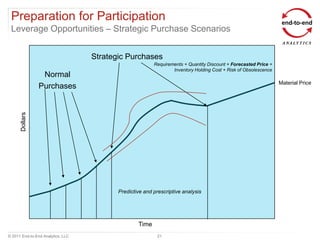
 Leverage Opportunities โ€“ Strategic Purchase Scenarios


                                   Strategic Purchases
                                                         Requirements + Quantity Discount + Forecasted Price +
                                                                 Inventory Holding Cost + Risk of Obsolescence
                 Normal
                                                                                                                 Material Price
                Purchases
      Dollars


                                          Predictive and prescriptive analysis


                                                  Time
ยฉ 2011 End-to-End Analytics, LLC                          21
Summary
 Getting Started


      Participation - getting a โ€œseat at the tableโ€

      ๏‚ง Establish transparency to supply risks and opportunities
      ๏‚ง Engage proactively with other functions โ€“ understand their goals and
        challenges within the integrated business planning context
      ๏‚ง Create supply management scenarios that will enable other functions
        to meet their goals
      ๏‚ง Strive for mutual accountability


      Preparation for Participation

      ๏‚ง Assess the risks
      ๏‚ง Build the analytical foundation for creating opportunities
      ๏‚ง Create scenarios to leverage opportunities
ยฉ 2011 End-to-End Analytics, LLC          22
Supply Chain and Pricing Expertise                                  Analytical Know-how


                                                                      Arnold Mark Wells, CPIM
                                                                      Principal

                                                                      End-to-End Analytics, LLC
                                                                      955 Alma St., Suite B
                                                                      Palo Alto, CA 94310

                                                                      330 546 2404
                                                                      mark@e2eanalytics.com


                                     Superior Supply Chain Performance Through Data-Driven Analysis


                                   Powerful, Visual, Interactive Excel-based Tools


                                                                               Also:
                                                                               โ€ข mark@arnoldmarkwells.com
                                                                               โ€ข http://arnoldmarkwells.wordpress.com

ยฉ 2011 End-to-End Analytics, LLC                                 23

NAPM AZ Presentation 25 Aug 2011

  • 1.
    Supply Management: TheMissing Voice in the Integrated Business Plan How Cost Management, Negotiation and Contract Management Inform the Process and are Essential to Its Execution Arnold Mark Wells, CPIM 25 August 2011
  • 2.
    How can wealign and integrate decisions toward a common goal? ? Business decisions from various functions are often not aligned. Yet unless we can align them, moving the business forward is difficult. ยฉ 2011 End-to-End Analytics, LLC 2
  • 3.
    Myopic, incomplete perspectiveswill not yield integrated business planning When decision-makers are looking at different decision variables, but not the whole equation, they are forced to make assumptions. ยฉ 2011 End-to-End Analytics, LLC 3
  • 4.
    The Dangers ofDis-integrated Decisions โ€œWhen I was a physicist, someone would come to me from time to time with problems in mathematics he could not solve. He wanted me to check his numbers for him. But after a while I learned not to waste my time checking the numbers, because the numbers were almost always right. However, if I checked the assumptions, they were almost always wrong.โ€ The Goal by Eli Goldratt So, while a single business function makes a โ€œgoodโ€ decision based on a subset of inputs, their โ€œnumbersโ€ may be right, but the explicit or implicit assumptions about other business functions may render the functional decision a poor one for the company overall. ยฉ 2011 End-to-End Analytics, LLC 4
  • 5.
    โ€œLittleโ€ Sales andOperations Planning S&OP started as a tactical effort to line up production, sales and inventory. Other business functions Inventory need to be included for decisions that are integrated and strategic. Sales Production ? ? ? โ€ข e.g. PSI Report โ€ข The focus was tactical so the terms were common โ€ข But it was only part of the picture from a strategic point of view ยฉ 2011 End-to-End Analytics, LLC 5
  • 6.
    โ€œBigโ€ S&OP Process S&OP has evolved into an holistic strategic process 1. Strategic Planning ๏ฎ Rationalize Products, Channels, Customers ๏ฎ New Product Planning ๏ฎ Align Pricing 2. Demand Planning ๏ฎ Alignment to Corporate Goals ๏ฎ Quantitative Forecasting ๏ฎ Supply Network Design ๏ฎ Sales, Marketing Input ๏ฎ What-if Analysis 5. Executive Management ๏ฎ Orders/Demand Balancing ๏ฎ KPI Measurement ๏ฎ Consensus ๏ฎ Plan vs. Actual The Integrated Business ๏ฎ Waterfall Analysis Decision-making or ๏ฎ Root Cause Analysis Planning Process (IBP) is ๏ฎ Continuous Improvement both multi-functional and multi-dimensional 4. Financial Planning ๏ฎ Product Line Profitability 3. Supply Planning ๏ฎ Constraint Management ๏ฎ Capacity Planning ๏ฎ What-if Analysis ๏ฎ Inventory Planning ๏ฎ Allocation of Demand to Supply ๏ฎ Logistics ๏ฎ Analyze Revenue, Margin and Working Capital Impact ๏ฎ Risk and Opportunity Planning ๏ฎ Identify Gaps between S&OP and Strategic Goals ยฉ 2011 End-to-End Analytics, LLC 6
  • 7.
    Including Supply Managementin the Process Participation and Preparation Participation - getting a โ€œseat at the tableโ€ ๏‚ง Establish transparency to supply risks and opportunities ๏‚ง Engage proactively with other functions โ€“ understand their goals and challenges within the integrated business planning context ๏‚ง Create supply management scenarios that will enable other functions to meet their goals ๏‚ง Strive for mutual accountability Preparation for Participation ๏‚ง Assess the risks ๏‚ง Build the analytical foundation for creating opportunities ๏‚ง Create scenarios to leverage opportunities ยฉ 2011 End-to-End Analytics, LLC 7
  • 8.
    Preparation for Participation The Supply Management Funnel to IBP Assess Build Leverage Risks Foundation Opportunities Integrated Business ๏ƒ˜ Supplier Viability Planning ๏ƒ˜ Bargaining Position ๏ƒ˜ Develop Sourcing ๏ƒ˜ Collaborate Strategy ๏ƒ˜ Capacity & Dependency Risk ๏ƒ˜ Structure and Manage Contracts $ ๏ƒ˜ Analyze Total Cost of Ownership ๏ƒ˜ Purchase Strategically ๏ƒ˜ Price Trends and Exchange Rates Following the process in the funnel enables the steps for participation by supply management in the integrated business planning process. ยฉ 2011 End-to-End Analytics, LLC 8
  • 9.
    Preparation for Participation Assess Supply Risks Assess Build Leverage Risks Foundation Opportunities Integrated Business ๏ƒ˜ Supplier Viability Planning ๏ƒ˜ ๏ƒ˜ Collaborate ๏ƒ˜ Bargaining Position Develop Sourcing Strategy ๏ƒ˜ Capacity & ๏ƒ˜ Structure and Manage Contracts $ Dependency Risk ๏ƒ˜ Analyze Total Cost of Ownership ๏ƒ˜ Purchase Strategically ๏ƒ˜ Price Trends and Exchange Rates ยฉ 2011 End-to-End Analytics, LLC 9
  • 10.
    Preparation for Participation Assess Risk - Analyze Supplier Viability Drivers of Viability ๏‚ง Balance sheet (working capital, debt) ๏‚ง Income statement (profitability) ๏‚ง Cash flow (sufficient, positive) ๏‚ง Breadth of customer base ๏‚ง Competitive threats ๏ƒบ Technology ๏‚ง Will the supplierโ€Ÿs technology become obsolete? ๏‚ง Will the supplier be able to support the next generation of your product? ๏ƒบ Relative size โ€“ takeover target? ยฉ 2011 End-to-End Analytics, LLC 10
  • 11.
    Preparation for Participation Assess Risk - Analyze Bargaining Position Key Commodity, Component, Material or Service Percent of Buyerโ€Ÿs Annual Purchase Least Leverage Some Parity; Key Opportunity for Innovative Supply; (High) Detailed Knowledge of TCO is Important; Integrated decisions for an organization should be informed by bargaining position, which is a multi-faceted concept. This is one example of a way to visualize bargaining position. Percent of Buyerโ€Ÿs Annual Purchase Least Important Quadrant Greatest Leverage Quadrant (Low) Size = Price (low, average, high) Percent of Supplierโ€Ÿs Business Percent of Supplierโ€žs Business Color = Overall Relative Bargaining Position (strong, moderate, weak) (Smallest) (Largest) ยฉ 2011 End-to-End Analytics, LLC 11
  • 12.
    Preparation for Participation Assess Risk โ€“ Supplier Capacity and Dependency Commodity A Commodity B Commodity A 10% Committed from Current, Approved 20% Suppliers 35% 50% Additional Potential Commitment from 20% Current Suppiers 50% 10% Opportunity for Other Supply 5% 35% 50% Potential Risk to Supply Commodity C Commodity D 0% 20% Systematically identify and 10% graphically depict where the 5% capacity of your suppliers 20% 60% and broader capacity puts 100% supply at risk. ยฉ 2011 End-to-End Analytics, LLC 12
  • 13.
    Preparation for Participation Assess Risk - Pricing Trends and Exchange Rates Quantitatively know the risk from purchase prices and exchange rates where applicable. ยฉ 2011 End-to-End Analytics, LLC 13
  • 14.
    Preparation for Participation Build the Foundation for Potential Supply Opportunities Assess Build Leverage Risks Foundation Opportunities Integrated Business ๏ƒ˜ Supplier Viability Planning ๏ƒ˜ ๏ƒ˜ Collaborate ๏ƒ˜ Bargaining Position Develop Sourcing Strategy ๏ƒ˜ Capacity Risk ๏ƒ˜ Structure and Manage Contracts $ ๏ƒ˜ Analyze Total Cost of Ownership ๏ƒ˜ Purchase Strategically ๏ƒ˜ Price Trends and Exchange Rates ยฉ 2011 End-to-End Analytics, LLC 14
  • 15.
    Preparation for Participation Build the Foundation for Opportunities โ€“ Sourcing Strategy R&D, marketing, operations and sourcing decisions are interdependent and need to be integrated ๏‚ง New product development must coordinate carefully with sourcing ๏‚ง New markets may require new sources ๏‚ง New manufacturing techniques may require sourcing changes ๏‚ง Demographics, service models and legal requirements must be considered in sourcing strategies ๏‚ง Need to be able to consider internal vs. external sourcing and to what degree and propose a plan that will support the business strategy for maximum revenue growth, return on net assets, margins and market share โ€“ objectives of S&OP/Integrated Business Planning ยฉ 2011 End-to-End Analytics, LLC 15
  • 16.
    Preparation for Participation Build the Foundation for Opportunities โ€“ Analyze TCO You need to understand both sides of the equation ๏‚ง Buyer ๏‚ง Supplier ๏ƒบ Price ๏ƒบ Price ๏ƒบ Planning ๏ƒบ Time value of money (Payment terms) ๏ƒบ Execution ๏ƒบ Commitment ๏ƒบ Quality ๏ƒบ Expediting ๏ƒบ Value added services ๏ƒบ Design changes ๏ƒบ Taxes ๏ƒบ Time value of money (financing/payment terms) ๏ƒบ Cost of holding inventory Understanding TCO and your sensitivity to it can lead to innovative arrangements and profitable outsourcing ๏‚ง Price x for payment in 45 days ๏‚ง Price y - x for payment in 30 days ๏‚ง Outsourcing analysis ยฉ 2011 End-to-End Analytics, LLC 16
  • 17.
    Preparation for Participation The Supply Management Funnel to IBP Assess Build Leverage Risks Foundation Opportunities Integrated Business ๏ƒ˜ Supplier Viability Planning ๏ƒ˜ ๏ƒ˜ Collaborate ๏ƒ˜ Bargaining Position Develop Sourcing Strategy ๏ƒ˜ Capacity and ๏ƒ˜ Structure and Manage Contracts $ Dependency Risk ๏ƒ˜ Analyze Total Cost of Ownership ๏ƒ˜ Purchase Strategically ๏ƒ˜ Price Trends and Exchange Rates ยฉ 2011 End-to-End Analytics, LLC 17
  • 18.
    Preparation for Participation Leverage Opportunities โ€“ Collaboration Scenarios Transactional Collaboration ๏‚ง Easily supported by technology ๏‚ง Automatic, systematic communication for larger, more important suppliers ๏‚ง Regular, manual communication and transactions for smaller suppliers Beyond transactions, what can be done? ๏‚ง Co-investment on reducing changeovers ๏‚ง Offering long term commitment for frequent replenishments ๏‚ง Pickup vs. delivery ๏‚ง Parcel or less-than-truckload deliveries in exchange for ?? Other Areas of Potential Collaboration ๏‚ง Requirements (time-phased view into what you anticipate your needs will be) ๏‚ง Design (can be design of indirect materials as well โ€“ think marketing materials, etc.) ๏‚ง Technology ยฉ 2011 End-to-End Analytics, LLC 18
  • 19.
    Preparation for Participation Leverage Opportunities - Contract Structure & Management Scenarios In order to create a win-win scenario, you have to know the following: ๏‚ง TCO ๏‚ง Your sensitivity to its components ๏‚ง How much money can be saved in total ๏‚ง How much you want to capture (or can afford to share as leverage with your supplier) ๏‚ง How to structure the contract for maximum flexibility and minimum risk (e.g. Vested Outsourcing) ยฉ 2011 End-to-End Analytics, LLC 19
  • 20.
    Supply Management Contributionsโ€“ Opp. Leverage Opportunities โ€“ Contract Structure & Management Scenarios Considerations for Flexibility and Risk ๏‚ง Potential range of future requirements by period ๏‚ง Minimum and maximum quantity in units for each period ๏‚ง Unit price by period, fixed or market dependent ๏‚ง Lead time commitment ๏‚ง Understanding regarding cancellation or changes to orders ๏‚ง Minimum and maximum quantities over a range of periods ๏‚ง Minimum order quantities ๏‚ง Sequential capacity expansion options, each of which might have its own lead time and associated payment for expansion cost ๏‚ง Other ยฉ 2011 End-to-End Analytics, LLC 20
  • 21.
    Preparation for Participation Leverage Opportunities โ€“ Strategic Purchase Scenarios Strategic Purchases Requirements + Quantity Discount + Forecasted Price + Inventory Holding Cost + Risk of Obsolescence Normal Material Price Purchases Dollars Predictive and prescriptive analysis Time ยฉ 2011 End-to-End Analytics, LLC 21
  • 22.
    Summary Getting Started Participation - getting a โ€œseat at the tableโ€ ๏‚ง Establish transparency to supply risks and opportunities ๏‚ง Engage proactively with other functions โ€“ understand their goals and challenges within the integrated business planning context ๏‚ง Create supply management scenarios that will enable other functions to meet their goals ๏‚ง Strive for mutual accountability Preparation for Participation ๏‚ง Assess the risks ๏‚ง Build the analytical foundation for creating opportunities ๏‚ง Create scenarios to leverage opportunities ยฉ 2011 End-to-End Analytics, LLC 22
  • 23.
    Supply Chain andPricing Expertise Analytical Know-how Arnold Mark Wells, CPIM Principal End-to-End Analytics, LLC 955 Alma St., Suite B Palo Alto, CA 94310 330 546 2404 mark@e2eanalytics.com Superior Supply Chain Performance Through Data-Driven Analysis Powerful, Visual, Interactive Excel-based Tools Also: โ€ข mark@arnoldmarkwells.com โ€ข http://arnoldmarkwells.wordpress.com ยฉ 2011 End-to-End Analytics, LLC 23

Editor's Notes

  • #3ย Each function has its own goals and targets to hit. Many times, these are not aligned to deliver an overall greater value to shareholders. This may be a bit more obvious in the direct procurement space, but it is also true in indirect procurement for critical supplies. How can these many interdependent decisions within separate business functions be aligned?
  • #9ย Certainly a risk can present an opportunity and an opportunity implies a risk (at least the risk of an opportunity cost).
  • #11ย Other possible factors:Relative QualitySwitching Cost
  • #12ย This is one visual way to present a potential area of risk for the business plan.Other possible factors:Contribution to innovationRelative QualityCollaboration and Automation
  • #13ย Again, these could be indirect commodities, materials or services as well as direct. This can apply to both manufacturing and to service environments. In the indirect and non-manufacturing spaces, physical space and media space, paper, money (in banking for ATMโ€™s), critical spare parts for manufacturing equipment and other similar purchased goods and services come to mind. Hopefully, you can quickly think of the relevant critical purchased goods or services in your industry and in your company.
  • #14ย In recent months commodity prices have risen and fluctuated. This creates a risk to the costs for both direct and indirect procurement.
  • #19ย Companies like SAP, Oracle and Ariba have created businesses or lines of business that are focused on facilitating transactional collaboration and execution, driving down procurement costs. If this is not in place for your largest and most critical suppliers, is there a good reason? Has the total cost of the opportunity been analyzed and is that part of the integrated decision dialog? Can the collaboration be extended to planning in a way that inventory and lead times can be reduced?