Nanoshell
P.Samuel, Ph.D
Assistant Professor of Biotechnology,
ANJA College, Sivakasi
What is a Nanoshell?
• A Nanoshell, is a type of spherical nanoparticle
consisting of a dielectric core which is covered
by a thin metallic shell (usually gold).
• These Nanoshell involve a quasiparticle called
a Plasmon which is a collective excitation or
quantum plasma oscillation where the
electrons simultaneously oscillate with respect
to all the ions.
Discovery of Nanoshell
• The discovery of the nanoshell was made by
Professor Naomi J. Halas and her team at Rice
University in 2003.
• After many suggestions, cancer therapy came
out of ongoing collaborations with bioengineers
looking for different types of biomedical
applications.
• "One of our visions", Halas stated, "no less than
single visit diagnosis and treatment of cancer".
Production of Nanoshell
• Method: Microfluidic Composite Foams, further
this method replace standard lithographic
method.
• The method was explained by Suhanya
Duraiswamy and Saif A. Khan of the Department
of Chemical and Biomolecular Engineering in
Singapore.
Materials required for Nanoshell
synthesis
• Tetraethyl orthosilicate
• Ammonium hydroxide
• Hydroxylamine hydrochloride
• 3-aminopropyl tris
• Hydrogentetrachloroaurate (III) trihydrate
• Tetrakis (hydroxymethyl) phosphonium chloride
• Sodium hydroxide
• Potassium carbonate
• Ethanol
• Ultrapure water and glassware washed in aqua
regia and rinsed thoroughly in water.
Steps in production of Nanoshell
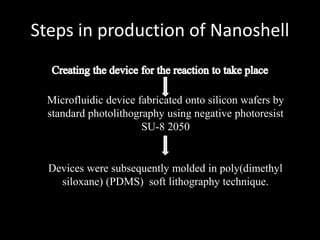
Microfluidic device fabricated onto silicon wafers by
standard photolithography using negative photoresist
SU-8 2050
Devices were subsequently molded in poly(dimethyl
siloxane) (PDMS) soft lithography technique.
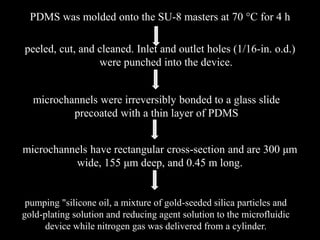
PDMS was molded onto the SU-8 masters at 70 °C for 4 h
peeled, cut, and cleaned. Inlet and outlet holes (1/16-in. o.d.)
were punched into the device.
microchannels were irreversibly bonded to a glass slide
precoated with a thin layer of PDMS
microchannels have rectangular cross-section and are 300 μm
wide, 155 μm deep, and 0.45 m long.
pumping "silicone oil, a mixture of gold-seeded silica particles and
gold-plating solution and reducing agent solution to the microfluidic
device while nitrogen gas was delivered from a cylinder.
• The plating solution was then left to age, in a controlled
environment, for longer than 24 hours.
• After the aging process, the fluid is collected from the Microfluidic
Device and placed in a centrifuge.
• The resulting liquid has a layer of oil on the surface with a solution
below that contains the nanoshells.

Nanoshell

  • 1.
    Nanoshell P.Samuel, Ph.D Assistant Professorof Biotechnology, ANJA College, Sivakasi
  • 2.
    What is aNanoshell? • A Nanoshell, is a type of spherical nanoparticle consisting of a dielectric core which is covered by a thin metallic shell (usually gold). • These Nanoshell involve a quasiparticle called a Plasmon which is a collective excitation or quantum plasma oscillation where the electrons simultaneously oscillate with respect to all the ions.
  • 3.
    Discovery of Nanoshell •The discovery of the nanoshell was made by Professor Naomi J. Halas and her team at Rice University in 2003. • After many suggestions, cancer therapy came out of ongoing collaborations with bioengineers looking for different types of biomedical applications. • "One of our visions", Halas stated, "no less than single visit diagnosis and treatment of cancer".
  • 4.
    Production of Nanoshell •Method: Microfluidic Composite Foams, further this method replace standard lithographic method. • The method was explained by Suhanya Duraiswamy and Saif A. Khan of the Department of Chemical and Biomolecular Engineering in Singapore.
  • 5.
    Materials required forNanoshell synthesis • Tetraethyl orthosilicate • Ammonium hydroxide • Hydroxylamine hydrochloride • 3-aminopropyl tris • Hydrogentetrachloroaurate (III) trihydrate • Tetrakis (hydroxymethyl) phosphonium chloride • Sodium hydroxide • Potassium carbonate • Ethanol • Ultrapure water and glassware washed in aqua regia and rinsed thoroughly in water.
  • 6.
    Steps in productionof Nanoshell Microfluidic device fabricated onto silicon wafers by standard photolithography using negative photoresist SU-8 2050 Devices were subsequently molded in poly(dimethyl siloxane) (PDMS) soft lithography technique.
  • 7.
    PDMS was moldedonto the SU-8 masters at 70 °C for 4 h peeled, cut, and cleaned. Inlet and outlet holes (1/16-in. o.d.) were punched into the device. microchannels were irreversibly bonded to a glass slide precoated with a thin layer of PDMS microchannels have rectangular cross-section and are 300 μm wide, 155 μm deep, and 0.45 m long. pumping "silicone oil, a mixture of gold-seeded silica particles and gold-plating solution and reducing agent solution to the microfluidic device while nitrogen gas was delivered from a cylinder.
  • 8.
    • The platingsolution was then left to age, in a controlled environment, for longer than 24 hours. • After the aging process, the fluid is collected from the Microfluidic Device and placed in a centrifuge. • The resulting liquid has a layer of oil on the surface with a solution below that contains the nanoshells.