z
Nanotechnology
ā€œHello to the Futureā€
z
Sir
Ahmed saleem
Saqib shahzad
Submitted to:
Submitted by:
z
Content:
ļ‚§ History.
ļ‚§ Definition.
ļ‚§ Techniques of nanotechnology.
ļ‚§ Application in nanotechnology.(Nanomedicine,)
ļ‚§ (Nanoelectronics,Nanoagriculture,Nanospace and many
others)
ļ‚§ Advantages of nanotechnology.
ļ‚§ Disadvantages of nanotechnology.
ļ‚§ Conclusion.
z
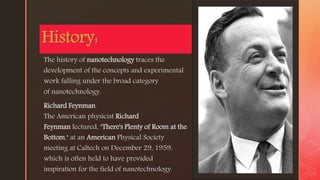
The history of nanotechnology traces the
development of the concepts and experimental
work falling under the broad category
of nanotechnology.
Richard Feynman.
The American physicist Richard
Feynman lectured, "There's Plenty of Room at the
Bottom," at an American Physical Society
meeting at Caltech on December 29, 1959,
which is often held to have provided
inspiration for the field of nanotechnology.
History:
z
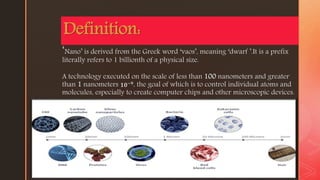
ā€˜Nano’ is derived from the Greek word ā€˜vaos’, meaning ā€˜dwarf ’.It is a prefix
literally refers to 1 billionth of a physical size.
A technology executed on the scale of less than 100 nanometers and greater
than 1 nanometers šŸšŸŽāˆ’šŸ—
, the goal of which is to control individual atoms and
molecules, especially to create computer chips and other microscopic devices.
Definition:
z
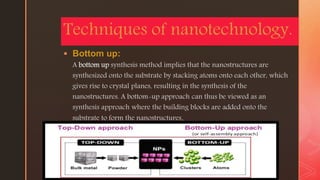
ļ‚§ Bottom up:
A bottom up synthesis method implies that the nanostructures are
synthesized onto the substrate by stacking atoms onto each other, which
gives rise to crystal planes, resulting in the synthesis of the
nanostructures. A bottom-up approach can thus be viewed as an
synthesis approach where the building blocks are added onto the
substrate to form the nanostructures.
Techniques of nanotechnology.
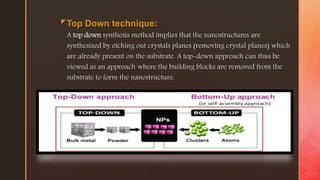
zTop Down technique:
A top down synthesis method implies that the nanostructures are
synthesized by etching out crystals planes (removing crystal planes) which
are already present on the substrate. A top-down approach can thus be
viewed as an approach where the building blocks are removed from the
substrate to form the nanostructure.
z
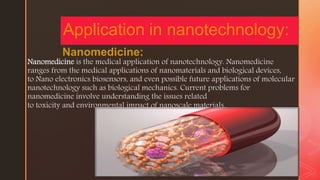
Nanomedicine:
Nanomedicine is the medical application of nanotechnology. Nanomedicine
ranges from the medical applications of nanomaterials and biological devices,
to Nano electronics biosensors, and even possible future applications of molecular
nanotechnology such as biological mechanics. Current problems for
nanomedicine involve understanding the issues related
to toxicity and environmental impact of nanoscale materials.
Application in nanotechnology:
z
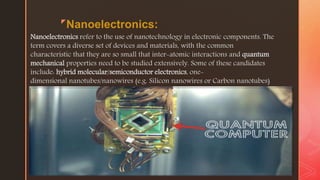
Nanoelectronics:
Nanoelectronics refer to the use of nanotechnology in electronic components. The
term covers a diverse set of devices and materials, with the common
characteristic that they are so small that inter-atomic interactions and quantum
mechanical properties need to be studied extensively. Some of these candidates
include: hybrid molecular/semiconductor electronics, one-
dimensional nanotubes/nanowires (e.g. Silicon nanowires or Carbon nanotubes)
or advanced molecular electronics. Recent silicon CMOS technology generations,
z
Nanoagriculture:
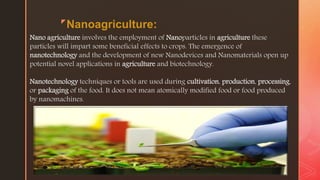
Nano agriculture involves the employment of Nanoparticles in agriculture these
particles will impart some beneficial effects to crops. The emergence of
nanotechnology and the development of new Nanodevices and Nanomaterials open up
potential novel applications in agriculture and biotechnology.
Nanotechnology techniques or tools are used during cultivation, production, processing,
or packaging of the food. It does not mean atomically modified food or food produced
by nanomachines.
z
Nanotechnology in Space:
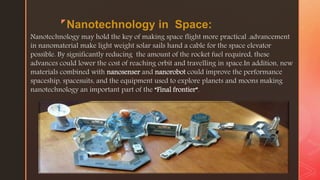
Nanotechnology may hold the key of making space flight more practical .advancement
in nanomaterial make light weight solar sails hand a cable for the space elevator
possible. By significantly reducing the amount of the rocket fuel required, these
advances could lower the cost of reaching orbit and travelling in space.In addition, new
materials combined with nanosenser and nanorobot could improve the performance
spaceship, spacesuits, and the equipment used to explore planets and moons making
nanotechnology an important part of the ā€œFinal frontierā€.
z
Advantages of Nanotechnology
Nanotechnology can actually revolutionize a lot of electronic products,procedures, and
applications. The areas that benefit from the continued development of nanotechnology
when it comes to electronic products include nano transistors, nano diodes, OLED, plasma
displays, quantum computers, and many more.
Nanotechnology can also benefit the energy sector. The development of more effective
energy-producing, energy-absorbing, and energy storage products in smaller and more
efficient devices is possible with this technology. Such items like batteries, fuel cells, and
solar cells can be built smaller but can be made to be more effective with this technology.
Nanotechnology make like nanotubes, aerogels, nano particles, and other similar items to
produce their products with. These materials are often stronger, more durable, and
lighter than those that are not produced with the help of nanotechnology
z
Disadvantages of nanotechnology
Disadvantages of this Nanotechnology and its development is the possible loss of jobs in
the traditional farming and manufacturing industry.
Due to the possibility of developing alternative sources of energy that are more efficient
and long lasting won’t require the use of fossil fuels. That may lowering of the value of
oil and diamonds will also lose its value since it can now be mass produced.
Atomic weapons can now be more accessible and made to be more powerful and more
destructive. These can also become more accessible with nanotechnology.
Presently, nanotechnology is very expensive and developing it can cost you a lot of
money. It is also pretty difficult to manufacture, which is probably why products made
with nanotechnology are more expensive
z
As a conclusion to this topic I would like to say that Nanotechnology is a
brand new technology that has just began, it is a revolutionary science that
will change all what we knew before. The future that we were watching just
in science fiction movies will in the near future be real. This new
technology keep us healthy because of nanorobots that will repair every
damage that we have in our body.It will give scientists the ability
to manipulate the combination of atoms in an object and just by using carbon
nanotubes that are known to be a hundred times stronger than steel and in
addition to that they are very flexible. That will lead to the creation of objects
that can change their forms and have multiple purposes.
Conclusion:
z

Nanotechnology.

  • 1.
  • 2.
  • 3.
    z Content: ļ‚§ History. ļ‚§ Definition. ļ‚§Techniques of nanotechnology. ļ‚§ Application in nanotechnology.(Nanomedicine,) ļ‚§ (Nanoelectronics,Nanoagriculture,Nanospace and many others) ļ‚§ Advantages of nanotechnology. ļ‚§ Disadvantages of nanotechnology. ļ‚§ Conclusion.
  • 4.
    z The history ofnanotechnology traces the development of the concepts and experimental work falling under the broad category of nanotechnology. Richard Feynman. The American physicist Richard Feynman lectured, "There's Plenty of Room at the Bottom," at an American Physical Society meeting at Caltech on December 29, 1959, which is often held to have provided inspiration for the field of nanotechnology. History:
  • 5.
    z ā€˜Nano’ is derivedfrom the Greek word ā€˜vaos’, meaning ā€˜dwarf ’.It is a prefix literally refers to 1 billionth of a physical size. A technology executed on the scale of less than 100 nanometers and greater than 1 nanometers šŸšŸŽāˆ’šŸ— , the goal of which is to control individual atoms and molecules, especially to create computer chips and other microscopic devices. Definition:
  • 6.
    z ļ‚§ Bottom up: Abottom up synthesis method implies that the nanostructures are synthesized onto the substrate by stacking atoms onto each other, which gives rise to crystal planes, resulting in the synthesis of the nanostructures. A bottom-up approach can thus be viewed as an synthesis approach where the building blocks are added onto the substrate to form the nanostructures. Techniques of nanotechnology.
  • 7.
    zTop Down technique: Atop down synthesis method implies that the nanostructures are synthesized by etching out crystals planes (removing crystal planes) which are already present on the substrate. A top-down approach can thus be viewed as an approach where the building blocks are removed from the substrate to form the nanostructure.
  • 8.
    z Nanomedicine: Nanomedicine is themedical application of nanotechnology. Nanomedicine ranges from the medical applications of nanomaterials and biological devices, to Nano electronics biosensors, and even possible future applications of molecular nanotechnology such as biological mechanics. Current problems for nanomedicine involve understanding the issues related to toxicity and environmental impact of nanoscale materials. Application in nanotechnology:
  • 9.
    z Nanoelectronics: Nanoelectronics refer tothe use of nanotechnology in electronic components. The term covers a diverse set of devices and materials, with the common characteristic that they are so small that inter-atomic interactions and quantum mechanical properties need to be studied extensively. Some of these candidates include: hybrid molecular/semiconductor electronics, one- dimensional nanotubes/nanowires (e.g. Silicon nanowires or Carbon nanotubes) or advanced molecular electronics. Recent silicon CMOS technology generations,
  • 10.
    z Nanoagriculture: Nano agriculture involvesthe employment of Nanoparticles in agriculture these particles will impart some beneficial effects to crops. The emergence of nanotechnology and the development of new Nanodevices and Nanomaterials open up potential novel applications in agriculture and biotechnology. Nanotechnology techniques or tools are used during cultivation, production, processing, or packaging of the food. It does not mean atomically modified food or food produced by nanomachines.
  • 11.
    z Nanotechnology in Space: Nanotechnologymay hold the key of making space flight more practical .advancement in nanomaterial make light weight solar sails hand a cable for the space elevator possible. By significantly reducing the amount of the rocket fuel required, these advances could lower the cost of reaching orbit and travelling in space.In addition, new materials combined with nanosenser and nanorobot could improve the performance spaceship, spacesuits, and the equipment used to explore planets and moons making nanotechnology an important part of the ā€œFinal frontierā€.
  • 12.
    z Advantages of Nanotechnology Nanotechnologycan actually revolutionize a lot of electronic products,procedures, and applications. The areas that benefit from the continued development of nanotechnology when it comes to electronic products include nano transistors, nano diodes, OLED, plasma displays, quantum computers, and many more. Nanotechnology can also benefit the energy sector. The development of more effective energy-producing, energy-absorbing, and energy storage products in smaller and more efficient devices is possible with this technology. Such items like batteries, fuel cells, and solar cells can be built smaller but can be made to be more effective with this technology. Nanotechnology make like nanotubes, aerogels, nano particles, and other similar items to produce their products with. These materials are often stronger, more durable, and lighter than those that are not produced with the help of nanotechnology
  • 13.
    z Disadvantages of nanotechnology Disadvantagesof this Nanotechnology and its development is the possible loss of jobs in the traditional farming and manufacturing industry. Due to the possibility of developing alternative sources of energy that are more efficient and long lasting won’t require the use of fossil fuels. That may lowering of the value of oil and diamonds will also lose its value since it can now be mass produced. Atomic weapons can now be more accessible and made to be more powerful and more destructive. These can also become more accessible with nanotechnology. Presently, nanotechnology is very expensive and developing it can cost you a lot of money. It is also pretty difficult to manufacture, which is probably why products made with nanotechnology are more expensive
  • 14.
    z As a conclusionto this topic I would like to say that Nanotechnology is a brand new technology that has just began, it is a revolutionary science that will change all what we knew before. The future that we were watching just in science fiction movies will in the near future be real. This new technology keep us healthy because of nanorobots that will repair every damage that we have in our body.It will give scientists the ability to manipulate the combination of atoms in an object and just by using carbon nanotubes that are known to be a hundred times stronger than steel and in addition to that they are very flexible. That will lead to the creation of objects that can change their forms and have multiple purposes. Conclusion:
  • 15.