Nanotechnology is defined as: the application of scientific knowledge
to manipulate and control matter at the Nano scale level to make use of
size and structure dependent properties and phenomena distinct from
those associated with individual atoms or molecules or with bulk
materials.
   The Nano scale is the size range from approximately 1nm to 100nm.
   Nanotechnology exhibits a strong degree of convergence with many
other disciplines, such as the information and communications
technologies (ICT) industry.
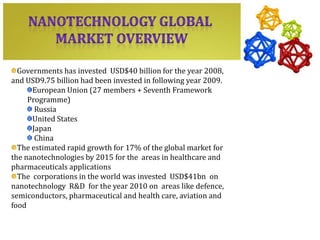
Governments has invested USD$40 billion for the year 2008,
and USD9.75 billion had been invested in following year 2009.
      European Union (27 members + Seventh Framework
     Programme)
       Russia
      United States
      Japan
       China
  The estimated rapid growth for 17% of the global market for
the nanotechnologies by 2015 for the areas in healthcare and
pharmaceuticals applications
  The corporations in the world was invested USD$41bn on
nanotechnology R&D for the year 2010 on areas like defence,
semiconductors, pharmaceutical and health care, aviation and
food
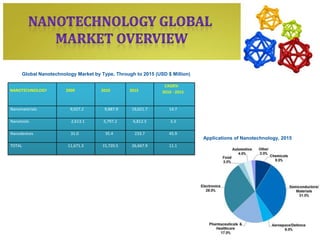
Global Nanotechnology Market by Type, Through to 2015 (USD $ Million)

                                                               CAGR%
NANOTECHNOLOGY         2009          2010        2015         2010 - 2015


Nanomaterials           9,027.2        9,887.9    19,621.7       14.7

Nanotools                2,613.1      5,797.2     6,812.5         3.3

Nanodevices              31.0          35.4        233.7         45.9
                                                                             Applications of Nanotechnology, 2015
TOTAL                  11,671.3       15,720.5    26,667.9       11.1
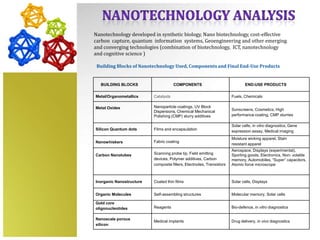
Nanotechnology developed in synthetic biology, Nano biotechnology, cost-effective
carbon capture, quantum information systems, Geoengineering and other emerging
and converging technologies (combination of biotechnology, ICT, nanotechnology
and cognitive science )

 Building Blocks of Nanotechnology Used, Components and Final End-Use Products


  BUILDING BLOCKS                     COMPONENTS                               END-USE PRODUCTS

Metal/Organometallics     Catalysts                                    Fuels, Chemicals

Metal Oxides              Nanoparticle coatings, UV Block
                          Dispersions, Chemical Mechanical             Sunscreens, Cosmetics, High
                          Polishing (CMP) slurry additives             performance coating, CMP slurries

                                                                       Solar cells, in vitro diagnostics, Gene
Silicon Quantum dots      Films and encapsulation                      expression assay, Medical imaging
                                                                       Moisture wicking apparel, Stain
Nanowhiskers              Fabric coating
                                                                       resistant apparel
                                                                       Aerospace, Displays (experimental),
Carbon Nanotubes          Scanning probe tip, Field emitting           Sporting goods, Electronics, Non- volatile
                          devices, Polymer additives, Carbon           memory, Automobiles, “Super” capacitors,
                          composite fillers, Electrodes, Transistors   Atomic force microscope


Inorganic Nanostructure   Coated thin films                            Solar cells, Displays


Organic Molecules         Self-assembling structures                   Molecular memory, Solar cells

Gold core
oligonucleotides          Reagents                                     Bio-defence, in vitro diagnostics

Nanoscale porous
                          Medical implants                             Drug delivery, in vivo diagnostics
silicon
Nanomaterials having a impact on sectors such as a Health,IT,Energy fields.

   The major drivers for the nanotechnologies in energy sector for the need of security and

sustainability of energy supply, and growing consumer and government awareness of the implications

of climate change.

   Nanomaterials will also contribute to the development of new drugs, therapies, and cures for

currently chronic and fatal illnesses

   The application of nanotechnologies has the widespread of vast capability and assurance for

advanced diagnostics, improved public health and new therapeutic treatments.
Nanotechnology has potentially opportunities in the
health, energy, and the environmental remediation
markets such as,
      Environment
      Water
      Agriculture
      Clean Technology
      Healthcare and Pharmaceuticals
Development of useful applications for Nano scale phenomena;
   Regulatory, legal, political and ethical issues;
   Competition with established micro scale technologies;
   License of proof-of-concept Nano tools, delivery systems and products;
   Intellectual property protection, and skilling of patent and technology transfer offices;
   Potential internal reluctance to embrace nanotechnologies and Nano tools within businesses;
   Undertaking nanotechnology R&D in a way that pro-actively and meaningfully engages with society;
   Large-scale production cost challenges;
   Cost premium over existing products;
   Need for multidisciplinary infrastructure and researchers;
   Safety and toxicity and the effective management of the potential risks of manufactured Nano
materials;
   Public and consumer concern about safety and resulting consumer activism that might inhibit
commercial investment in nanotechnology-based products.;
Risks include health and safety risks, ecological, business, political, social, ethical, and security risks
 The major risks for the Nanotechnologies in potential toxicity, health and safety effects, and invasive nature
of some manufactured Nano materials.
 The adequate management and control of risks in engineered Nano materials and products
incorporating Nano materials worldwide.
 Nanotechnology Work Health and Safety Program, is focusing on
       Ensure nanotechnology is covered appropriately within the Work Health and Safety;
       Regulatory Framework;
       Improve understanding of the hazardous properties of engineered Nano materials;
       Assess the effectiveness of workplace controls in preventing exposure to engineered Nano materials;
       Develop procedures for detecting and measuring emissions exposure in workplaces;
       Provide information and guidance for Australian nanotechnology organizations;
       Ensure consistency with international approaches & contributing to international work;
Growth and demand for clean technology and alternative energy products are likely to be

stimulated by the introduction of nanotechnologies in the near future, enhancing efficacies of

technologies embraced by the industry, and displacing older technologies and business

enterprises relying on them.

   Nanotechnologies are expected to have a large impact on the health care industry

   The applications of Convergence of Nano Technologies and products in the filed of medicine,

dentistry and diagnostics.
Nano tools refers the technologies of enabled services of
Engineering, envision of scientists, and influence of atoms.
   The Nano scale is the most powerful and efficient tools of
Nanotechnology.
    Commerical Nano tools
        Nano manipulators
        Near-field optical microscopes;
        Nano machining tools ;
        Advanced optical lithography tools.
Manufactured Nano materials -
   Aluminum Oxide
   Cerium Oxide
   Iron Nano particles
   Silver Nano particles
   Titanium dioxide
   Zinc Oxide
   Silicon dioxide
   Polystyrene
   Dendrimers
   Nan clays
   Carbon black
   Fullerenes(C60)
   Single-walled carbon Nano tubes(SWCNTs)
   Multi-walled carbon Nano tubes(MWCNTs)
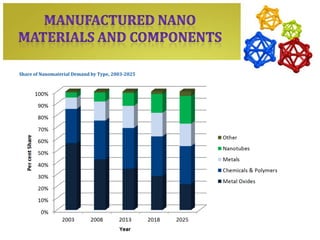
Share of Nanomaterial Demand by Type, 2003-2025
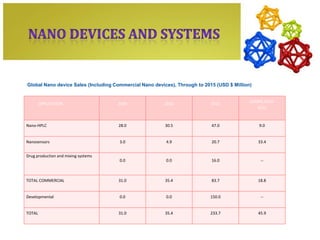
Global Nano device Sales (Including Commercial Nano devices), Through to 2015 (USD $ Million)


                                                                                            CAGR% 2010-
        APPLICATION                  2009               2010                2015
                                                                                               2015


Nano-HPLC                            28.0                30.5               47.0                9.0


Nanosensors                           3.0                4.9                20.7                33.4


Drug production and mixing systems
                                      0.0                0.0                16.0                 --


TOTAL COMMERCIAL                     31.0                35.4               83.7                18.8


Developmental                         0.0                0.0               150.0                 --


TOTAL                                31.0                35.4              233.7                45.9
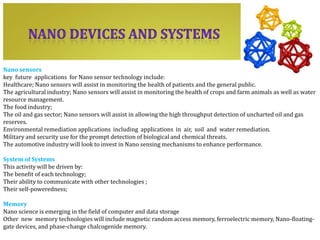
Nano sensors
key future applications for Nano sensor technology include:
Healthcare; Nano sensors will assist in monitoring the health of patients and the general public.
The agricultural industry; Nano sensors will assist in monitoring the health of crops and farm animals as well as water
resource management.
The food industry;
The oil and gas sector; Nano sensors will assist in allowing the high throughput detection of uncharted oil and gas
reserves.
Environmental remediation applications including applications in air, soil and water remediation.
Military and security use for the prompt detection of biological and chemical threats.
The automotive industry will look to invest in Nano sensing mechanisms to enhance performance.

System of Systems
This activity will be driven by:
The benefit of each technology;
Their ability to communicate with other technologies ;
Their self-poweredness;

Memory
Nano science is emerging in the field of computer and data storage
Other new memory technologies will include magnetic random access memory, ferroelectric memory, Nano-floating-
gate devices, and phase-change chalcogenide memory.
Thanking for downloading


 For more information visit us

www.worldresearchreport.com

         Or Email us

worldresearchreport@gmail.com

Nanotechnology

  • 2.
    Nanotechnology is definedas: the application of scientific knowledge to manipulate and control matter at the Nano scale level to make use of size and structure dependent properties and phenomena distinct from those associated with individual atoms or molecules or with bulk materials. The Nano scale is the size range from approximately 1nm to 100nm. Nanotechnology exhibits a strong degree of convergence with many other disciplines, such as the information and communications technologies (ICT) industry.
  • 3.
    Governments has investedUSD$40 billion for the year 2008, and USD9.75 billion had been invested in following year 2009. European Union (27 members + Seventh Framework Programme) Russia United States Japan China The estimated rapid growth for 17% of the global market for the nanotechnologies by 2015 for the areas in healthcare and pharmaceuticals applications The corporations in the world was invested USD$41bn on nanotechnology R&D for the year 2010 on areas like defence, semiconductors, pharmaceutical and health care, aviation and food
  • 4.
    Global Nanotechnology Marketby Type, Through to 2015 (USD $ Million) CAGR% NANOTECHNOLOGY 2009 2010 2015 2010 - 2015 Nanomaterials 9,027.2 9,887.9 19,621.7 14.7 Nanotools 2,613.1 5,797.2 6,812.5 3.3 Nanodevices 31.0 35.4 233.7 45.9 Applications of Nanotechnology, 2015 TOTAL 11,671.3 15,720.5 26,667.9 11.1
  • 5.
    Nanotechnology developed insynthetic biology, Nano biotechnology, cost-effective carbon capture, quantum information systems, Geoengineering and other emerging and converging technologies (combination of biotechnology, ICT, nanotechnology and cognitive science ) Building Blocks of Nanotechnology Used, Components and Final End-Use Products BUILDING BLOCKS COMPONENTS END-USE PRODUCTS Metal/Organometallics Catalysts Fuels, Chemicals Metal Oxides Nanoparticle coatings, UV Block Dispersions, Chemical Mechanical Sunscreens, Cosmetics, High Polishing (CMP) slurry additives performance coating, CMP slurries Solar cells, in vitro diagnostics, Gene Silicon Quantum dots Films and encapsulation expression assay, Medical imaging Moisture wicking apparel, Stain Nanowhiskers Fabric coating resistant apparel Aerospace, Displays (experimental), Carbon Nanotubes Scanning probe tip, Field emitting Sporting goods, Electronics, Non- volatile devices, Polymer additives, Carbon memory, Automobiles, “Super” capacitors, composite fillers, Electrodes, Transistors Atomic force microscope Inorganic Nanostructure Coated thin films Solar cells, Displays Organic Molecules Self-assembling structures Molecular memory, Solar cells Gold core oligonucleotides Reagents Bio-defence, in vitro diagnostics Nanoscale porous Medical implants Drug delivery, in vivo diagnostics silicon
  • 6.
    Nanomaterials having aimpact on sectors such as a Health,IT,Energy fields. The major drivers for the nanotechnologies in energy sector for the need of security and sustainability of energy supply, and growing consumer and government awareness of the implications of climate change. Nanomaterials will also contribute to the development of new drugs, therapies, and cures for currently chronic and fatal illnesses The application of nanotechnologies has the widespread of vast capability and assurance for advanced diagnostics, improved public health and new therapeutic treatments.
  • 7.
    Nanotechnology has potentiallyopportunities in the health, energy, and the environmental remediation markets such as, Environment Water Agriculture Clean Technology Healthcare and Pharmaceuticals
  • 8.
    Development of usefulapplications for Nano scale phenomena; Regulatory, legal, political and ethical issues; Competition with established micro scale technologies; License of proof-of-concept Nano tools, delivery systems and products; Intellectual property protection, and skilling of patent and technology transfer offices; Potential internal reluctance to embrace nanotechnologies and Nano tools within businesses; Undertaking nanotechnology R&D in a way that pro-actively and meaningfully engages with society; Large-scale production cost challenges; Cost premium over existing products; Need for multidisciplinary infrastructure and researchers; Safety and toxicity and the effective management of the potential risks of manufactured Nano materials; Public and consumer concern about safety and resulting consumer activism that might inhibit commercial investment in nanotechnology-based products.;
  • 9.
    Risks include healthand safety risks, ecological, business, political, social, ethical, and security risks The major risks for the Nanotechnologies in potential toxicity, health and safety effects, and invasive nature of some manufactured Nano materials. The adequate management and control of risks in engineered Nano materials and products incorporating Nano materials worldwide. Nanotechnology Work Health and Safety Program, is focusing on Ensure nanotechnology is covered appropriately within the Work Health and Safety; Regulatory Framework; Improve understanding of the hazardous properties of engineered Nano materials; Assess the effectiveness of workplace controls in preventing exposure to engineered Nano materials; Develop procedures for detecting and measuring emissions exposure in workplaces; Provide information and guidance for Australian nanotechnology organizations; Ensure consistency with international approaches & contributing to international work;
  • 10.
    Growth and demandfor clean technology and alternative energy products are likely to be stimulated by the introduction of nanotechnologies in the near future, enhancing efficacies of technologies embraced by the industry, and displacing older technologies and business enterprises relying on them. Nanotechnologies are expected to have a large impact on the health care industry The applications of Convergence of Nano Technologies and products in the filed of medicine, dentistry and diagnostics.
  • 11.
    Nano tools refersthe technologies of enabled services of Engineering, envision of scientists, and influence of atoms. The Nano scale is the most powerful and efficient tools of Nanotechnology. Commerical Nano tools Nano manipulators Near-field optical microscopes; Nano machining tools ; Advanced optical lithography tools.
  • 12.
    Manufactured Nano materials- Aluminum Oxide Cerium Oxide Iron Nano particles Silver Nano particles Titanium dioxide Zinc Oxide Silicon dioxide Polystyrene Dendrimers Nan clays Carbon black Fullerenes(C60) Single-walled carbon Nano tubes(SWCNTs) Multi-walled carbon Nano tubes(MWCNTs)
  • 13.
    Share of NanomaterialDemand by Type, 2003-2025
  • 14.
    Global Nano deviceSales (Including Commercial Nano devices), Through to 2015 (USD $ Million) CAGR% 2010- APPLICATION 2009 2010 2015 2015 Nano-HPLC 28.0 30.5 47.0 9.0 Nanosensors 3.0 4.9 20.7 33.4 Drug production and mixing systems 0.0 0.0 16.0 -- TOTAL COMMERCIAL 31.0 35.4 83.7 18.8 Developmental 0.0 0.0 150.0 -- TOTAL 31.0 35.4 233.7 45.9
  • 15.
    Nano sensors key futureapplications for Nano sensor technology include: Healthcare; Nano sensors will assist in monitoring the health of patients and the general public. The agricultural industry; Nano sensors will assist in monitoring the health of crops and farm animals as well as water resource management. The food industry; The oil and gas sector; Nano sensors will assist in allowing the high throughput detection of uncharted oil and gas reserves. Environmental remediation applications including applications in air, soil and water remediation. Military and security use for the prompt detection of biological and chemical threats. The automotive industry will look to invest in Nano sensing mechanisms to enhance performance. System of Systems This activity will be driven by: The benefit of each technology; Their ability to communicate with other technologies ; Their self-poweredness; Memory Nano science is emerging in the field of computer and data storage Other new memory technologies will include magnetic random access memory, ferroelectric memory, Nano-floating- gate devices, and phase-change chalcogenide memory.
  • 16.
    Thanking for downloading For more information visit us www.worldresearchreport.com Or Email us worldresearchreport@gmail.com