Nanotechnology And MaterialsTechnology Nedo
download
https://ebookbell.com/product/nanotechnology-and-materials-
technology-nedo-1879128
Explore and download more ebooks at ebookbell.com
2.
Here are somerecommended products that we believe you will be
interested in. You can click the link to download.
Nanotechnology For Electronic Materials And Devices Nanostructure
Science And Technology 1st Edition Anatoli Korkin
https://ebookbell.com/product/nanotechnology-for-electronic-materials-
and-devices-nanostructure-science-and-technology-1st-edition-anatoli-
korkin-2021228
Advances In Materials Manufacturing Science And Technology 13 Volume 2
Modern Design Theory And Methodology Mems And Nanotechnology Material
Science And Technology In Manufacturing Dongming Guo
https://ebookbell.com/product/advances-in-materials-manufacturing-
science-and-technology-13-volume-2-modern-design-theory-and-
methodology-mems-and-nanotechnology-material-science-and-technology-
in-manufacturing-dongming-guo-4648380
Nanotechnology And Functional Materials For Engineers A Volume In
Micro And Nano Technologies 1st Edition Yaser Dahman Auth
https://ebookbell.com/product/nanotechnology-and-functional-materials-
for-engineers-a-volume-in-micro-and-nano-technologies-1st-edition-
yaser-dahman-auth-6614796
Proceedings Of The 4th International Symposium On Materials And
Sustainable Development Volume 1 Nano Technology And Advanced
Materials 1st Ed Abdelbaki Benmounah
https://ebookbell.com/product/proceedings-of-the-4th-international-
symposium-on-materials-and-sustainable-development-volume-1-nano-
technology-and-advanced-materials-1st-ed-abdelbaki-benmounah-22425656
3.
Recent Trends InNanotechnology And Materials Science Selected Review
Papers From The 2013 International Conference On Manufacturing
Optimization Industrial And Material Engineering Moime 2013 1st
Edition Ford Lumban Gaol Editor
https://ebookbell.com/product/recent-trends-in-nanotechnology-and-
materials-science-selected-review-papers-from-the-2013-international-
conference-on-manufacturing-optimization-industrial-and-material-
engineering-moime-2013-1st-edition-ford-lumban-gaol-editor-4696738
Nanotechnology And Nanoelectronics Materials Devices Measurement
Techniques 1st Edition W R Fahrner Auth
https://ebookbell.com/product/nanotechnology-and-nanoelectronics-
materials-devices-measurement-techniques-1st-edition-w-r-fahrner-
auth-4190642
Applied Nanotechnology Materials And Applications Haghi A K Kodolov
https://ebookbell.com/product/applied-nanotechnology-materials-and-
applications-haghi-a-k-kodolov-5742826
Carbon Materials And Nanotechnology Krueger A
https://ebookbell.com/product/carbon-materials-and-nanotechnology-
krueger-a-2582198
Nanostructured Materials And Nanotechnology Iii Sanjay Mathur
https://ebookbell.com/product/nanostructured-materials-and-
nanotechnology-iii-sanjay-mathur-4308788
6.
Contents
Int roduction ·······································································································i
Organization of This Brochure ··············································································· ii
• Nanotechnology Program
Nanotechnology Glass Project ················································································· 1
Nanotechnology Metal Project ··············································································· 3
Adva nced Nanocarbon Appl ication Project ······························································· 5
Nanotechnology Particle Project ············································································· 7
Nanostruct ure Coa ting Project ·············································································· 9
Synthetic Nanofunct ion Materials Project ······························································· 11
Nanotechnology Material Metrology Project ····························································· 13
Project on Na nostruct ured P olymeric Materials ························································ 15
Adv anced Nanofabrication Process Technology Using Quantum Beams ······················· 17
Full color Rewr itable Paper U sing Functional Capsules Project ·································· 19
Nanostructure Forming for Cer amics Integration Project ··········································· 21
R&D of 3D NanoScale Certified Reference Materials Project ······································ 23
Adv anced Diamond Dev ice Project ··········································································· 25
Carbon Nanotube FED Project ··············································································· 27
Highly Funct ional Nanotechnology Glass Project for Photonic Devices ························· 29
High-St rength Nanotechnology Glass Project for Displays ········································· 31
• Innova tive Materials Devel opment Program
Adva nced Evaluation Methods Research Project for Na noscale Semiconductors
······················································································································· 33
•
Development of Phonic Network Technology ···························································· 35
Development of Highly-C apacity Optical Storage Technology ······································ 37
MEMS Project ····································································································· 39
Program for F unda mental Technologies of Adva nced Infor mation a nd
Telecommunicat ions Equi pment and Devices
7.
•Basic Technology ResearchPromotion
Research on High-Resolution and High-Speed
Composition Analysis of Nanometer-Thick Films ······················································ 41
Rugate Filters ····································································································· 43
Development of Nanoparticle and Nano-Thin-Film Phosphors for FED ························ 45
Study of GaN on Si Power Devices ········································································· 47
Development of a Drug Delivery System Making Use of Biodegradable Nanocomposite
Polymer Particles ································································································ 49
Development of Basic Technology for High Density Surface Mount
Next-Generation Semiconductor Devices ································································· 51
Advanced UV-B and C Optical Semiconductor Devices ··············································· 53
Development of Ultra-high-speed InP Epitaxial Crystal Manufacturing Technologies ······ 55
Functional Nanoprobes for Bioproperty Mapping ······················································ 57
Development of the World First Cathodluminescence and Raman Spectroscopic
Systems Using a Near-field Spectroscopic Technique ················································· 59
Index of Key Words ······························································································ iv
8.
Introduction
Nanotechnology is anadvanced technology that has received a lot of attention for its
ability to make use of the unique properties of nanosized materials. Nanotechnology is
capable of manipulating and controlling material structures at the nano level (a
nanometer is equal to one millionth of a millimeter) and offering unprecedented
functions and excellent material properties. Nanotechnology consists of the “top-down
approach” and the “bottom-up approach.” In the former approach, the sophistication of
fine processing technologies, such as semiconductor manufacturing, can lead to the
processing of nanosized fine structures. In the bottom-up approach, self-organization
properties inherent in materials can be utilized to assemble nanosized fine structures
from the atomic or moleculer levels. Nanotechnology, including nanostructured material
metrology to accurately determine physical properties at the nanolevel, is considered a
strategic technological area that goes beyond conventional technologies, potentially
leading to a paradigm shift in new industrial technologies.
The basic concept of nanotechnology first emerged half a century ago. Actual
observation and manipulation of nanosized atoms became possible when scanning
tunneling microscopes came into practical use in the first half of the 1980s. Since the
United States launched its National Nanotechnology Initiative (NNI) in 2000 as a
strategic governmental research program, global nanotechnology research and
development investment has been on the rise.
As stated in the “Science and Technology Basic Plan” (March 2001) and “Promotion
Strategy of Prioritized Areas” (September 2001) of the Cabinet Office’s Council for
Science and Technology Policy, Japan considers nanotechnology and nanomaterials to
be key areas for the 21st century that will support a wide range of scientific and
technological breakthroughs. Moreover, they are priority technologies essential to the
sustainable development of economic society and enhancement of industrial
competitiveness. Given their importance, the Japanese government has designated
nanotechnology and materials as one of four priority areas for enhanced research and
development over the next five years. NEDO, Japan's largest public R&D
management organization for promoting advanced industrial technology development,
has been carrying out various activities related to nanotechnology in recent years.
Nanotechnology is indeed a key technology for innovative development in various
industrial technologies, and it is expected to contribute to significant energy
conservation and environmental burden reduction in the future. Because of this, NEDO
allocated 16.3 billion yen to activities concerning nanotechnology and materials in its
FY2005 R&D budget of 148.1 billion yen.
This brochure describes NEDO’s research and development projects that involve the
collaborative efforts of government, industry and academia in the area of
nanotechnology as well as research and development support provided to private sector
enterprises.
i
9.
Organization of ThisBrochure
This brochure describes NEDO's projects in the area of research and development on
nanotechnology. The projects are grouped into the four research and technology
programs outlined below.
Nanotechnology Program
Controlling materials at the nano level can enhance material functions and
characteristics, leading to considerable energy savings and environmental load
reduction. Nanotechnology is a major advance capable of bringing extraordinary change
to various industrial technologies, and thus the establishment of nanotechnology is vital.
Knowledge gained from nanotechnology should be systematized to establish a
technological base that can contribute to sustainable development of Japan's economy
as a basic resource of industrial competitiveness.
Innovative Materials Development Program
The materials area is one of the strong points of Japanese industry. In this area,
timely provision of solutions (commercialization of parts and products) can be achieved
by manufacturing system technologies that shorten the lead time for production, and by
technologies combining material development and fabrication technologies, making full
use of material functions and properties. In this way, the program aims to establish
high-value added material industries (a materials industry and a components industry)
for creating new markets and jobs and to enhance the international competitiveness of
Japanese industry.
Program for Fundamental Technologies of Advanced Information and
Telecommunications Equipment and Devices
Research and development on information and telecommunication technologies will be
conducted to develop information and telecommunications equipment and devices for
constructing advanced communication networks. The program aims to create a more
prosperous society while also considering environmental load reduction and
standardization of technologies for promoting practical application and market
dissemination.
Research and development program: A policy package of research and development
projects that the Ministry of Economy, Trade and Industry considers essential to achieve
strategic policy goals related to industrial technologies that are established by analyzing
social needs, market trends and technology trends both in Japan and abroad.
ii
10.
Research Phases Describedin This Brochure
*About “Focus 21”
Some of the projects described in this brochure are “Focus 21” projects that emphasize
development for practical application in order to stimulate the economy. Focus 21
projects must meet the following four conditions:
1. Technical innovation leading to enhanced competitiveness
2. Prospect of findings from research and development that will result in new products
and/or services
3. Possibility of creating new markets in a relatively short period of time that will
result in significant growth and economic ripple effects
4. Willingness and specific efforts by industry to provide funding for realizing
commercial market introduction.
Basic Technology Research Promotion (Private Sector Basic Technology Research
Promotion Activities)
Unlike its research and development programs, NEDO’s basic technology research
promotion activities involve the solicitation of proposals for research themes related to
mining and manufacturing basic technology, and entrustment of actual research work
to private sector enterprises that propose high risk but promising research themes. In
Japan, private sector enterprises undertake most of the research and development
activities. This brochure describes research themes related to nanotechnology that are
representative of NEDO's basic technology research promotion.
Research and Development Projects
Focus 21 projects*
Development for
Practical Application
Applied Research
Basic Research
Basic Technology Research Promotion Activities
(Solicitation of proposals for research themes)
Commercialization
iii
11.
Nanotechnology Glass Project
Background
Keywords:Glass, Sub-wavelength structure, Telecommunications
R&D Term: FY2001᳸FY2005ų Budget of FY2005:
ųThe Nanotechnology Glass Project is intended
for the development of fundamental
technologies for glasses with completely new
functions by controlling structure on a
nanometer scale. It is primarily known that
glass is transparent, hard and stable thermally
and chemically.
This project aims to further increase the levels
of these advantages. Japanese industry will䇭
extensively utilize the outcome obtained from
this project and will cultivate new leading
markets in the fields of optical communication,
energy and environment. It will also contribute
to international society.
Organization
Contents
[Ძ] Telecommunications
Ყ Storage Ყųųųųųųųųųųųų
Precise fabrication technology for wavelength-
level periodic structures on a glass surface is
being developed using semiconductor
microfabrication technology, including
lithography and dry etching. For example, the
etching rate of the glass could be vertically
controlled by doping several additives, realizing
fabrication of a rectangular periodic structure
with a 200-nm grove width and an aspect ratio of
6. Furthermore, resistance against mechanical
shock was remarkably improved by overcladding
on the periodic structure. It was demonstrated
small demultiplexer on a glass plate of 6 x 9 mm.
This project aims
technology to fabricate optical memory heads,
which will provide high angular dispersion for a
so-called “super prism”.
Ყ CommunicationsᲧų ųųųųųųų
Optical fiber networks have begun to spread
instead of metal networks due to increased
Internet traffic. There is a strong requirement of
small and low-cost optical devices, which can be
used even in a harsh environment. This project is
developing new glasses for low-loss optical
waveguides, athermal optics and micro-lens
arrays. Also,
Diffraction efficiencies and cross sectional SEM
views of diffraction gratings before (left) and
after (right) overcladding
Ultra-small 4-channel
demultiplexer
designed to operate at
around 1550-nm
wavelength
Project Leader䇭
Participating Organizations
New Glass Forum
Also, a high recording density DVD that can
record high definition TV images for 24 hours
has been developed in this project. This
research was transferred to the Focus 21
Project in order to accelerate R&D for practical
application.
2mm
Concave
mirror
Arrayed
waveguide
output
Arrayed waveguide
input
Buried
grating
Wavelength (μm) Wavelength (μm)
0.5
0.6
0.7
0.8
0.9
1.0
Diffraction
efficiency
(-)
TM
TE TM
TE
1.48 1.52 1.56 1.60
1.48 1.52 1.56 1.60
5μm
30o
calculated
by RCWA
Nanotechnology Program
410 million yen
to construct the basic
that this technology was applicable to an ultra-
.K. HIRAO
䇭Professor䇭K䋮HIRAO䇭Kyoto university
Prof
National Institute of Advanced Industrial Science and Technology
1
last letter remainedunanswered, and she was too proud to write
again. No doubt, she told herself, his thoughts were occupied by
some new attraction. With a sudden flash of intuition, she realized
that for Paul there would always be an attraction of some kind, and
generally a new one.
This unpleasant perception had one good result, at least; it lightened
her sense of remorse towards Amanda. She had long ago got over
the ordeal of seeing her cousin again, and the strange scene
between them had been relegated to a curious phase of unreality,
covered up and almost obliterated, as such scenes not infrequently
are among relations and intimate friends, by the thousand
commonplace incidents of every-day life. And yet some sort of
apology had been proffered by Amanda, as she sat up in her white
wrapper, very pale and hollow-eyed, with her red hair cut short, and
just beginning to come in in soft waves like Elizabeth's—a thing she
had always desired.
"You know," she said, in her weak voice "I was real sick that last
time you saw me. I was just coming down with the fever."
"I know you were," Elizabeth said gently, conquering the thrill of
anger which swept over her at the recollection.
"I guess I said some queer things," Amanda ventured next, and
gave an odd, furtive look from her light eyes.
"You certainly did," said Elizabeth, coldly. Not all the pity she felt for
Amanda's weakness could avail to make her speak in any other way.
"Well, I guess," Amanda said, after a moment and closing her eyes
as if wearied out, "people aren't accountable for what they say when
they're sick."
"No," said Elizabeth, "I suppose not." And with this tacit apology and
its acceptance, this episode between the cousins might be
considered closed. Certainly, on Elizabeth's side, it was not only
closed, but forgotten, in the pressure of far more serious troubles.
14.
As she kneltthat afternoon looking into the fire, a vision of her
future life—colorless, empty, without joy or love—seemed to stare
back at her from its glowing depths. The years stretched out before
her, a dreary waste—without Paul. She was sure that he would never
come back; the bond between them seemed the merest shadow. He
had forgotten her in three short months, while she was more in love
than ever, since she had never fully realized, at the time, the void
that he would leave behind him. For a short time her life had
bloomed like the summer; and now nothing was left to her but the
fast-approaching gray monotony of the November days, and the
bleak cold of the winter.
Upon these cheerful reflections entered Mrs. Bobby Van Antwerp, in
a short skirt somewhat the worse for wear, with dark eyes that
shone brilliantly beneath her battered hat, and her small piquante
face glowing with health and exercise.
"Don't get up," she said. "What a beautiful blaze!" She sat down to it
at once and held out her small, gloveless hands to its pleasant
warmth. "I walked all the way," she announced, triumphantly, "and I
thought I would just drop in, and perhaps you'd give me a cup of
tea."
One must have lived in the Neighborhood to appreciate the
informality of all this. People paid calls in their carriages, with their
card-cases and their best Sunday gowns—it was not good form to
come on foot, even had the distances permitted. But the young
woman always spoken of as "Mrs. Bobby" though her claims to a
more formal designation had long since been established, was a law
unto herself and cared little what the Neighborhood's laws might be.
Elizabeth had already noticed that this great lady, the greatest lady
in the Neighborhood, treated her with more friendliness than other
people of less assured position with whom she was, theoretically, on
more intimate terms. This curious fact, and the cause of it, occupied
her thoughts while she rang the bell and ordered tea, a little
flustered inwardly, but outwardly calm, and comfortably conscious of
the becoming neatness of her serge skirt and velveteen blouse.
15.
Whatever her troublesmight be, she had not yet reached so great a
pitch of desperation as to neglect her appearance.
"Aren't these autumn days beautiful!" said Mrs. Bobby, making
herself at home by unfastening her coat and tossing aside her hat,
whereby she disclosed to view a somewhat tousled halo of curly
dark hair. "I tell Bobby that just these few days in the autumn make
up to us for the bother of keeping the place, though in summer it is
fearfully hot, and unspeakably dull all the year round. It must be
very dull for you," said Mrs. Bobby, coming to a sudden pause.
"Oh, yes, it's dull," Elizabeth admitted, with a little sigh.
Mrs. Bobby laughed.
"Why don't you say 'oh, but I am so fond of the place,' or 'but I'm
not at all dependent on society,' as the other girls in the
Neighborhood do?"
"I don't know," said Elizabeth, reflectively. "I don't think, for one
thing, that I am so awfully fond of the place; and as for society—I
have never had any, so naturally I get on without it."
"But you would enjoy it, if you had it?"
A curious brightness shone for an instant in Elizabeth's eyes. "Ah,
yes, I should enjoy it," she said, quickly. "I'm sure I should."
"I'm sure you would, too," said Mrs. Bobby. She seemed to reflect a
moment. "Don't you go away in August?" she asked at last.
"Yes, this year we did," said Elizabeth. "We went to Borehaven. It—it
wasn't very amusing." She stopped short blushing as if the last
words had been wrung from her unawares; but Mrs. Bobby's smile
seemed to invite confidence.
"Tell me all about it," she said. "Was it very terrible?"
"Yes, very," said Elizabeth, frankly. "There were a good many girls
who used to promenade up and down, and a number of old ladies
16.
who sat inrows on the piazza and criticized the people and
grumbled about the table; and they one and all treated us as if we
had committed some crime. We were quite distressed till we found
out that it was nothing personal—only the way they always treat
new arrivals."
"Ah, I know the type of place," said Mrs. Bobby "and the people.
Were there any men?"
"A few who were called men—about sixteen, I should think—most of
them—but they didn't interest me particularly." And Elizabeth
blushed, as she remembered the reason which had made her
indifferent, at least to such men as Borehaven could boast of. Mrs.
Bobby noticed the blush.
"What!" she said to herself "another attraction in this wilderness?
Not that stupid Frank Courtenay—I hope not. Yet there isn't and
never has been another man in the place that I ever heard of." While
she pondered this problem the tea-things were brought in, and
Elizabeth seated herself at the small table, behind the old silver urn,
in the full glow of the firelight, which played on her hair and brought
out the warm creamy tones of her skin. Mrs. Bobby watched her
silently with her bright dark eyes, her small, pointed chin supported
on her hand.
"You ought to go to town for the winter," she announced at last
abruptly. This seemed to be the upshot of her reflections. Elizabeth
looked up with a little start, and a momentary brightening of the
eyes, which faded, however, instantly.
"Oh, my aunts could never bear to leave here," she said. "They have
so taken root in this place. Besides," she went on, constrained to
greater frankness by the consciousness of that quality in Mrs. Bobby
herself "what would be the use if we did go? We know so few
people. It would be horrid to be in New York and not know any one
or go anywhere."
17.
"Yes, that wouldn'tbe pleasant," admitted Mrs. Bobby, to whom
indeed such a state of things was inconceivable. "But you would
know people," she went on, after a moment "every one does
somehow. There are your cousins, the Schuyler Van Vorsts, for
instance."
"Who would probably never notice us," said Elizabeth "or if they did,
would ask us to a family dinner."
"Well, that certainly would be worse than nothing," Mrs. Bobby
admitted. "But—how about your old school friends? You must have
known some nice girls at Madame Veuillet's. You would see, no
doubt, a great deal of them."
Elizabeth shook her head. "I doubt it," she said. "They spoke—some
of them—of asking me to stop with them, but they have none of
them done so. They don't even write to me any more. It doesn't
take long for people to forget one, Mrs. Van Antwerp," said poor
Elizabeth, putting into words the melancholy philosophy which
experience had lately taught her.
"My dear child," cried Mrs. Van Antwerp, "you're too young to realize
that—yet." She put out her hand in her warm, impulsive way, and
touched Elizabeth's. "I can promise you one thing," she said. "If you
come to New York, I'll do what I can to make it pleasant for you."
Elizabeth looked up with glistening eyes. "You're—you're awfully
kind," she began, stammering. In another moment she would have
burst into tears, and perhaps, in the sudden expansion, confided
everything to this new friend—in which case her life's history would
have been different. But just then she heard the sound of wheels,
and immediately she stiffened and the habit of reserve, which had
been growing upon her during the last three months, reasserted
itself. When her aunts entered, in a little glow of excitement after
their day at Cranston, Elizabeth was sitting quite cool and placid
behind the tea-things, absorbed in the problems of milk and sugar.
18.
The rest ofMrs. Bobby's visit seemed to her rather dull. They sat
around the fire, and Mrs. Bobby drank her tea and ate a great many
of the little round cakes which accompanied it, and which she
praised warmly, to the gratification of Miss Joanna, who had made
them. She told them all about her domestic affairs, and Bobby's
affairs, and the family affairs generally, and was altogether very
charming and as the Misses Van Vorst expressed it, "neighborly;" but
still she said not a word further of their going to town, or of that
pleasant if rather vague promise she had made in a moment of
impulse, which perhaps she already regretted. It was not till she
held Elizabeth's hand at parting that she invited her, as if by a
sudden thought, to dinner on the following Friday.
"It will be dull, I'm afraid," she said. "Only the Rector and his wife,
and the Hartingtons, and Julian Gerard, who is coming up over
Sunday. You will be the only young girl, and I want you to amuse
Julian. We dine at eight. Do come early, so we can have a talk
beforehand."
Elizabeth, entirely taken by surprise, had only time to murmur an
acceptance, when Mrs. Bobby hurried off, being hastened by the
arrival of her husband, who had called for her and was waiting
outside in the dog-cart. "Friday, remember," she called out from the
yawning darkness beyond the door, "and come early." Then Bobby
Van Antwerp's restless horse bore her off.
The Misses Van Vorst returned to the drawing-room, in a state of
considerable excitement.
"Think of my dining at the Van Antwerps!" Elizabeth exclaimed, still
rosy from the unexpected honor. "I was so taken aback that I could
hardly answer properly. But how on earth am I to amuse Julian—
whoever he may be, and what have I got to wear?"
"It's a—a very nice attention," said Miss Cornelia, complacently.
"She's never asked the Courtenay girls, I know, from what their
mother told me. She said they thought it a pity she was so
19.
unsociable. I think,sister, when we see them we might mention that
we don't find her unsociable—just casually, you know. As for what
you can wear, my dear—either your white crepe or white organdie is
quite pretty enough, and much nicer than anything the Courtenay
girls would have."
"To think of dinner at eight o'clock!" said Miss Joanna, who was only
just recovering her powers of speech. "So very fashionable! I wish,
dear, if you can, you would notice what they have. Mrs. Bobby says
her cook is very good at croquettes. I wish you could tell me, dear, if
they are better than ours."
"I'm afraid I shan't be able to think of croquettes," said Elizabeth,
"what with the burden of being on my best behavior and
entertaining Mr. Gerard. I think by the way, that he must be that
dark man I have seen sometimes in their pew on Sundays. Which
would he like me best in, do you suppose—the white crepe or the
organdie? I must get them both out, and decide which to wear."
Elizabeth's spirits were as easily exhilarated as they were depressed.
She ran up-stairs, humming a gay little tune which had not come
into her head for many a day. This dinner at the Van Antwerps', with
the prospect of meeting a few of her neighbors and apparently, one
unmarried man, might have seemed to many people a commonplace
affair enough; but to Elizabeth it was a great occasion, and for the
rest of the evening, bright visions of future pleasure danced before
her eyes. That night, for the first time in many weeks, she did not
cry herself to sleep, thinking of Paul.
20.
"A
Chapter XIII
nd youreally think I look nicely?" Elizabeth asked this question
in tremulous excitement, as she stood before the long pier-glass
in her room on the night of her first dinner-party. The maid was on
her knees behind her arranging the folds of her train, Miss Joanna
stood ready with her cloak, and Miss Cornelia hovered a little way
off, admiring the scene. Elizabeth held her head high, there was a
brilliant color in her cheeks, her eyes shone like stars. You would
hardly have known her for the same girl who had struggled with sad
thoughts and disappointed hopes in the twilight only a few days
before. This seemed some young princess, to whom the good things
of life came naturally, unsought, by the royal prerogative of beauty.
"You—you look lovely," faltered Miss Cornelia, forgetting her
principles in the excitement of the occasion "and your dress is
sweet."
"It is fortunate I had it cut low, isn't it," said Elizabeth, as she
clasped a string of pearls, which had once belonged to her
grandmother, about her round white throat. "There, do I look all
right? You're sure my skirt hangs well? I wanted a white rose, but
we have no pretty ones left." A slight cloud of discontent crossed her
face, but vanished instantly; since really, as she said to herself, she
looked very nice even without flowers.
"Don't be late," entreated Miss Joanna. "Just think if the dinner
should be spoiled!"
"Yes, it would be very bad manners," added Miss Cornelia "not to be
punctual."
21.
"I don't know,"said Elizabeth, doubtfully. "It's rather countrified to
be too early." But still she drew on her gloves and put on her cloak,
and started a good half-hour before the appointed time, in deference
to Miss Joanna's fears for the dinner and Miss Cornelia's sense of the
value of punctuality.
The clock was striking eight as she entered the wide hall of the Van
Antwerps's house, and read, or fancied that she did, in the solemn
butler's immobile countenance, an assurance that she was
unfashionably prompt. The demure little maid who followed him and
took Elizabeth's cloak, regretted to inform her that Mrs. Van Antwerp
was not quite ready, but would be down directly, and hoped that
Miss Van Vorst would excuse her unpunctuality. Elizabeth's heart
sank, but the maid was ushering her into the drawing-room, and
there was no retreat. Yet she shrank back involuntarily, as the long
room yawned before her, empty, except for one person whom she
did not know; and thus she stood for a moment hesitating, her
warm Titian coloring framed against the dark plush of the portiere,
and her white gown falling about her in graceful folds, of a
statuesque simplicity almost severe, but from which her youth and
rounded curves emerged all the more triumphant. Her heart beat
fast and there was a deep burning color in her cheeks, but she held
herself erect, with the proud little turn of the head that seemed to
come to her by nature.
The tall dark man who was turning over the leaves of a magazine at
the end of the room, looked up as she entered and gazed at her for
a moment in silence. Their eyes met; for an instant he seemed to
hesitate. Then he rose and walked slowly towards her.
"You must let me introduce myself, Miss Van Vorst," he said, and his
voice was like his movements, very deliberate, yet it was clear-cut
and pleasant in tone. "My name is Gerard. Mrs. Van Antwerp told me
I should have the pleasure of taking you in to dinner."
He spoke so quietly and naturally, and seemed to accept the
situation with such absolute indifference, that whatever
22.
awkwardness it mighthave contained for a young girl nervous over
her first dinner, was instantly removed. Elizabeth felt grateful, and
yet perversely a little piqued that this grave, dark man should place
her at a disadvantage, that he should be perfectly at home and
know exactly what to do, when she was nervous and flustered. But
that kind Providence which had endowed Elizabeth with so many
good gifts had given her among others a power to cover inward
perturbation with a brave show of self-possession.
"I'm terribly early," she was able to say now, quite lightly and easily,
though still with that uncomfortable beating of the heart. "My aunts
are very old-fashioned, and insist on punctuality as one of the
cardinal virtues."
"In which they are quite right, I think," said Mr. Gerard, smiling. "But
when you know Mrs. Van Antwerp well, you will have learned that it
is the one virtue in which she is utterly lacking."
"I—I don't know her very well," Elizabeth admitted, regretting
somewhat that she could not assert the contrary. "I have never even
been here before," she added, glancing about the room, whose
stateliness was a little overpowering.
"Really! Then wouldn't you—a—like to come into the conservatory
and look at the flowers?" suggested Mr. Gerard, who seemed to have
charged himself with the duties of host. "Oh, you needn't wait for
Mrs. Van Antwerp," he added, smiling, as Elizabeth hesitated. "I
know the time when she went to dress, and can assert with
confidence that she won't be down for another half-hour."
So Elizabeth found herself led, somewhat against her will, into the
famous conservatory, of whose beauties she had often heard; but
with which, it must be confessed, she was less occupied than with
the man by her side, at whom she cast furtive glances from beneath
her long lashes. He was tall—decidedly taller than herself, though
she was a tall woman, and rather broadly built than otherwise. His
dark, smooth-shaven face, which had lighted up pleasantly when he
23.
smiled, was inrepose rather heavy and impassive, with an ugly,
square chin, that seemed to indicate an indomitable will, of a kind to
pursue tenaciously whatever he might desire. In contradiction to
this, his eyes, except when a passing gleam of interest or
amusement brightened their sombre depths, had a weary indifferent
look, as if there were nothing in the world, on the whole, worth
desiring.
"And this is the man," thought Elizabeth, "whom I am expected to
amuse. He doesn't look as if it would be an easy task. But no doubt
Mrs. Bobby has given him the same charge about me, and he is
trying, conscientiously, to obey. That's why he's taken me in here to
show me the sights, the way they do to the country visitors." Her
heart leaped rebelliously at the thought, even while she was saying
aloud mechanically: "'What a fine azalea!' I wonder if I look like a
countrified production. My gown isn't, at least; but then—he
wouldn't appreciate that fact. It probably would be the same to him,
if it came out of the Ark; he isn't the sort of man to notice, one way
or the other. I don't believe he cares for women—no, nor they for
him. He's not at all good-looking, and he must be—thirty-five"—she
ventured another glance. "Oh, that, at least. His hair is quite gray on
the temples. 'Yes, those orchids are beautiful. I never saw anything
like them.' I must do my duty and admire properly; he thinks me
very unsophisticated, no doubt. I don't think I like him. Did Mrs.
Bobby think it would amuse me to—amuse him? But perhaps he is
thinking the same thing about me." And she stole another glance at
his face, but could not read, in his half-closed eyes and unmoved
expression, any indication of his real feelings.
They had made the round of the conservatory, when suddenly he
stopped. "Don't you—want a flower for your gown," he asked. He
looked about him reflectively. "Let me see," he said. "You would like
it to be white." Elizabeth wondered how he knew that. After a
moment's hesitation, he chose a white rose and gave it to her. She
fastened it carefully in her gown, where its green leaves formed the
only touch of color.
24.
"How does itlook?" she asked innocently, and raised her eyes to his,
where unexpectedly they encountered an odd gleam, of something
that seemed neither wholly interest nor yet amusement, and that
made her look down again quickly, while the warm color mantled in
her cheeks. It was a moment before he answered her.
"It looks well," he said then, quietly, "and suits your gown." And
they sauntered back slowly to the drawing-room.
Mrs. Bobby came hurrying in by the opposite door, fastening as she
went the diamond star in her black lace.
"My dear child," she said, kissing Elizabeth, "what must you think of
me! It is all Bobby's fault for taking us such a long drive, and I see
he is not down yet either, the wretch! But Julian has been
entertaining you, so it is all right. I'm afraid though that he has been
taking away my character unmercifully, telling you that I am always
late, and other pleasing things of the kind."
Gerard's smile again softened his face. "Do me justice, Eleanor," he
said. "You know I don't say worse things of my friends behind their
backs than I do to their faces."
She laughed. "I should be sorry for them if you did," she returned.
"But here," she went on, as voices were heard in the hall, "here, in
good time, are the Rector and his wife. What a blessing they didn't
arrive sooner!"
The words had hardly left her lips before the Rector and his wife
were ushered in, the latter uttering voluble apologies for being late,
and laying all the blame on the erratic behavior of the village
hackman, who feeling an utter contempt for people who did not
keep their own carriages, reserved the privilege of calling for them
at what hour he pleased. The theme of his unpunctuality was so
engrossing that the Rector's wife would have enlarged on it for some
time, had she not caught sight of Elizabeth, and in her surprise
subsided into a chair and momentary silence. And then strolled in
Bobby Van Antwerp, fair, well-groomed, amiable, and mildly bored at
25.
the prospect ofentertaining his neighbors; and immediately
afterwards followed the Hartingtons, still more bored at the prospect
of being entertained; after which they all went in to dinner, and
Elizabeth found herself seated between the Rector and Gerard.
"You live here all the year round, don't you?" the latter said to her,
somewhere about the third course, when he had given utterance to
several other conventional remarks, and she had grown accustomed
to the multiplicity of forks at her plate, and had decided that the
light of wax candles, beaming softly under rose-colored shades, was
eminently becoming to every one. She looked at him now with an
odd little challenge in her eyes, called forth, in spite of herself, by
the wearied civility of his conversational efforts.
"Yes, I live here all the year round," she said, in her clear, flute-like
voice. "I—I'm a country girl, you see."
He smiled. "You are to be congratulated, I think."
"Do you think so?" asked Elizabeth, in genuine surprise.
"Why, yes, I love the country; don't you," he said tranquilly.
She was silent for a moment, her eyes resting absently on the
graceful erection of ferns in the centre of the table, which rose, like
a fairy island, from a lake of glass. "It's not a conventional thing to
say," she answered at last, slowly "but if you want the truth"—
"I always want the truth," said Gerard.
"Well, then, I don't think I do care for the country," she said. "I've
had too much of it. I—there are times when I detest it." She spoke
with sudden vehemence, and she met his wondering gaze with eyes
that were curiously hard.
Gerard's face clouded. "You don't care for the country," he said,
slowly, "and yet you live here all the year round?"
26.
"Ah, that's thevery reason," she said, lightly. "People always tell you
that you don't appreciate your blessings; but how can you
reasonably be expected to, when you don't have any voice in
choosing them?"
"If you did, you probably wouldn't like them any better," he retorted.
"And it would be more annoying to think that you had had a voice in
the matter and had chosen wrong."
"Perhaps," said Elizabeth, "but I should like to make the
experiment." And she stared again thoughtfully at the feathery forms
of the ferns.
"Well, if you had your choice," said Gerard, lazily, "what would you
choose as an improvement on the present state of things?"
She turned towards him with a slight start. "What should I choose,"
she said, slowly "as an improvement on my life just now?"
"Yes, if you had a fairy Godmother," suggested Gerard.
"With unlimited power?" questioned Elizabeth.
He laughed. "Well, not quite that, perhaps," he said, "but—a fairy
Godmother who could give you a good deal. A very charming one,
too," he added, in a low voice.
Elizabeth knit her brows and pouted out her full lips, in apparently
deep reflection. "If I had a fairy Godmother," she said, musingly,
"and she were to give me three wishes—three, you know, is the
magic number in the fairy tales—why, I should choose first of all, I
think, a season in town"—
"Which you might tire of in a month," suggested Gerard.
"Not at all," said Elizabeth, decidedly, "because my second wish
would be for the capacity to be always amused."
"And do you really think," said Gerard, "that you would like that—to
go through life as if it were a sort of opera bouffe?"
27.
"Why not?" saidElizabeth. "I'm a frivolous person. I confess I like
opera bouffe."
"For an evening, perhaps," said Gerard, "but after a time you'd get
tired of it—oh, yes, I'm sure you would—and you'd begin to think"—
"Ah, no, I shouldn't," she interrupted him, eagerly "for that's what
my third wish should be. I should ask for the power never to think.
Thought—thought is horrible." She spoke the last words very low,
more to herself than him, and broke off suddenly, as an odd,
frightened look crept into her eyes. Gerard watched her in some
perplexity.
"This girl," he said to himself "who must be, I suppose, somewhere
about twenty, and has seen, according to Eleanor, nothing of the
world, talks sometimes like a thoughtless child, and sometimes like a
woman of thirty, and an unhappy one at that. I can't quite make her
out." Aloud he said, in an odd, dry voice that he had not hitherto
used towards her, "Now that you have pretty well in theory at least,
reduced yourself to the level of a brainless doll, why not ask, now
that you are about it, for the power not to feel? Then you would
really be a complete automaton, and nothing on earth could have
power to hurt you."
Elizabeth had grown very pale, and her hands were tightly locked
together under the table. "Ah," she said, wearily "I've exhausted my
three wishes. And, besides, it's too much to ask. No fairy Godmother,
I'm afraid, could give one the power not to feel."
"Be thankful for that," he said, quickly. "A woman who has no
capacity for suffering is—is—would be unspeakably repellant."
"Would she?" said Elizabeth, dreamily. "I should think, for my part,
that she would be rather enviable." She sat staring absently before
her, and Gerard did not try to break the silence. In a moment Mrs.
Hartington on his other side claimed his attention, and Elizabeth was
not sorry. She felt vaguely resentful towards him for having made
her think of unpleasant things, which she had resolved not to do
28.
that evening. Thedinner went on, and she helped herself
mechanically to dish after dish which was pressed upon her. The
Rector turned to her and made a few labored remarks, adapted as
he thought to her youthful intelligence, and she answered them
absently. Bobby Van Antwerp told, in a languid way, a funny story for
the benefit of the table, and the conversation grew general for
awhile. Dinner was nearly over when Gerard said, turning to her with
a pleasant smile:
"I'm not a prophet, and yet I am going to venture on a prediction. In
a little while, I think, you'll find your fairy Godmother, and have your
season in town, though I don't know if the other things will be
thrown in; and then some time in the course of it, I'll ask you if you
are satisfied, and you'll tell me perhaps, that you are sick of it all,
and are pining for the country, the green fields, and—a—the view of
the river"—
He stopped as Elizabeth interrupted him flippantly. "Oh, no, never,"
she cried. "I'd prefer city streets to green fields any day, and as for
the river—I've looked at it all my life, and I'm afraid I've exhausted
its possibilities." She was quite herself again, her cheeks were pink;
she looked up at him with laughing eyes. "Confess that you think me
terribly frivolous," she said; "confess that you disapprove of me
entirely."
"On the contrary," said Gerard, with rather a cold smile "I think there
is a good deal to be said for your point of view—and as for
disapproval, that's a priggish sensation that I hope I don't allow
myself to feel towards any one. Wait till I see you in town," he went
on, more genially "and then perhaps we'll agree better."
"Ah, but you never will see me in town," she said, sadly.
"Never?" he returned, slightly raising his eye-brows. "That's rather a
rash prediction. I think I may have the pleasure of meeting you
there before very long. You see I believe in fairy Godmothers," he
29.
added, lightly, asMrs. Bobby gave the signal, and, rising, he pushed
back Elizabeth's chair.
She paused for a moment, as she gathered up in one hand the soft
white folds of her gown. "I wish your faith could perform miracles,"
she said. And then she followed dreamily in the wake of the well-
worn black satin gown, which had been seen, on many another
festive occasion, on the broad back of the Rector's wife.
"He does disapprove of me," the girl thought to herself. "He would
have liked me better if I were a little bread-and-butter miss, in white
muslin and blue ribbons, who babbled of green fields and taught a
class in Sunday school. That's the kind of woman he admires. He
thinks me hard and flippant, but—I don't care. At least he dropped
that weary, society manner. It is something to have inspired him with
an emotion of some sort, even if it happens to be disapproval."
30.
T
Chapter XIV
he Rector'swife, after the first surprise, was very glad to see
Elizabeth. It made her feel more at home, and she drew her
down now eagerly, beside her on the sofa by the fire, whose warmth
on that autumn evening modified the somewhat chill atmosphere of
the state drawing-room.
"My dear Elizabeth, I never expected to see you here." Increased
respect mingled with the surprise in her tone. Elizabeth had certainly
gone up several degrees in her estimation. "It's quite an honor to be
asked—the Courtenays never are, I know, though don't repeat that I
said so. Of course we are asked every year, as is only due, you
know, to the Rector's position, my dear; but almost always the
children are ill, or something goes wrong, and it's three years now
since we've been able to come. It was unfortunate our being late
this time. Do you think Mrs. Bobby was much annoyed?" The
Rector's wife lowered her voice anxiously, as she for the first time
waited for a response.
"Oh, no," Elizabeth was able truthfully to assure her. "I'm sure she
wasn't annoyed."
"Well, to be sure, the Hartingtons were later"—in a tone of relief
—"but these great swells can do as they please. You look very nice,
Elizabeth, very nice indeed. I never saw that dress before. It must
be pleasant to have something new occasionally"—and the Rector's
wife gave a gentle sigh. "You see I have had the color changed on
this dress—red, I think, makes it look quite different, and it is warm
and pretty for the autumn. Don't repeat this, Elizabeth, but I wore
the same dress here the last time I came to dinner four years ago—
31.
only then itwas trimmed with pale blue. It was summer, you see, so
it looked cool. Do you suppose Mrs. Bobby would remember?"
"Oh, I don't suppose Mrs. Bobby cares"—Elizabeth began absently
"much about dress," she added, hastily. She was looking vaguely
about her, wondering as the familiar voice meandered on, if she
were really at dinner at the Van Antwerps', or prosaically seated as
she had so often been before, in the Rectory parlor.
Mrs. Hartington, a large fair woman, very splendidly dressed, had
seized upon Mrs. Bobby and was talking to her on a sofa at the
other end of the room.
"So you have taken up the Van Vorst girl," she was saying, as she
surveyed Elizabeth through her lorgnette. "She is really quite pretty,
and—a—not bad form. That gown of hers is effective—it's so simple.
I wonder how she learned to dress herself, here in the country."
"Oh, she's learned more than that, Sybil, I imagine," said Mrs.
Bobby, in level tones. "I think her very good form, and extremely
pretty. Her coloring is very picturesque, and quite natural." This very
innocently, without a glance at the conspicuously blonde hair which
her friends said had not been bestowed on Sybil Hartington by
nature.
"She inherits it from her mother, I suppose—a red-haired bar-maid,
wasn't she?" said Mrs. Hartington, again subjecting Elizabeth to a
prolonged scrutiny. "After all, she lacks distinction," she announced,
dropping her lorgnette and turning to more important subjects.
Mrs. Bobby did not enjoy that half-hour after dinner; neither,
perhaps, did Elizabeth, who had heard several times already the
account of the attack of measles from which the Rectory children
had lately recovered, and was glad when the men appeared in the
midst of it. But if she had expected Mr. Gerard to come up to her to
resume their conversation, as perhaps she had, in spite of her
consciousness of his disapproval, she was destined to be
disappointed. Gerard did give her one long look, as she sat in the full
32.
glow of thefirelight; but he turned almost immediately and spoke to
Mrs. Hartington, who had, indeed, the air of confidently expecting
him to do so. It was Bobby Van Antwerp who sauntered up to
Elizabeth, hospitably intent on making her feel at home.
"It was awfully good of you to come to-night, Miss Van Vorst. These
dinner-parties in the country are stupid things, but, after all, it's a
way of seeing something of one's neighbors. I think you're too
unsociable here, as a rule. It's a bore of course to take one's horses
out at night, but if one always thought of that, one would never go
anywhere."
"I'm sure," Elizabeth said sincerely, "I was very glad to come. A
dinner-party is a great event to me."
"Ah, well, it is dull here for a young girl," said Bobby, kindly. "My wife
finds it very dull; but she knows I'm fond of the old place, and she
comes to please me. You and she must try to amuse each other. You
know, between ourselves"—lowering his voice—"Eleanor doesn't
always take to people; it has made some of our neighbors around
here feel rather sore—I'm afraid. But she does take to you, and so I
hope we shall see a great deal of you."
Elizabeth smiled and murmured her thanks, wondering greatly to
find herself thus singled out from the rest of the Neighborhood; and
just then Mrs. Bobby came up and took her hand.
"Come," she said, "I want you to play for me. I'm so fond of music,
and I've heard that you play beautifully."
"Ah, but I don't," Elizabeth protested; but still she allowed herself to
be led to the piano, without undue reluctance. And then that grand
piano, with the name of the maker had been tempting her to try it
ever since dinner-time.
After all, it is doubtful if Mrs. Bobby cared so very much for music;
but it is possible she knew of some one else who did. Elizabeth had
a gift which had come to her, Heaven knows how!—a gift in which
33.
far greater pianistsare sometimes lacking—the power to throw
herself into what she played and to infuse into it something of her
own personality. Her playing seemed no mere, mechanical repetition
of what she had been taught, but the unstudied, spontaneous
expression of her own thoughts and feelings. As she passed at Mrs.
Bobby's request from one thing to another, mingling more set
compositions with fragments from operas and songs of the day, the
conversation between Mrs. Hartington and Gerard slackened, and he
glanced more and more frequently towards the piano.
"Music is rather a bore—isn't it—after dinner this way," drawled Mrs.
Hartington, noticing this fact.
"I don't think I agree with you. I'm fond of music," said Gerard, and
after awhile he found an opportunity to saunter over to the piano,
where Elizabeth sat playing, a little absently now, bits from Wagner.
She started and looked up, blushing slightly, as Gerard asked her if
she could play the Fire-music.
"I—it is a long time since I have tried it," she began, impelled by
some vague instinct to refuse, and then she stopped, and almost
unconsciously her fingers touched the keys, as she caught a look
that seemed to compel obedience. He smiled.
"Please play it," he said, and though the tone was caressing, there
lurked in it a half perceptible note of command. She felt it, as she
began to play, and he stood listening, his grave eyes fixed upon her
face. "A severe judge," she thought to herself with a proud little thrill
of rebellion. And then, as she played on, she forgot this thought,
and the fear of his criticism; forgot the strange room, and the
strange people, and the fact that she was dining at the Van
Antwerps'; forgot everything but the eyes fixed upon her, and played
as she had never played before.
Elizabeth had always put the best of herself into her music, her
finest qualities of brain and soul. But now she put into it something
of which she before was hardly conscious, a force and depth and
34.
fire, which stirredinarticulately within her, and found expression in
the throbbing Wagnerian chords. All the magic of the fairy spell
thrilled beneath her touch, as it rose and fell and wove itself in and
out amidst the clash of conflicting motives, while Brünnhilde sank
ever deeper into slumber, and the flames leaped and danced and
played about her sleeping form, and there lurked no premonition in
her maiden dreams of that fatal, all-engrossing love, which was yet
to awaken her from the serenity of oblivion. Then, as the rippling
cadence died away, Elizabeth hesitated for a moment, striking furtive
harmonies, till she passed at length into the poignant sweetness, the
passionate self-surrender of the second act of Tristan, and so on to
the Liebestod, with its swan-song of triumphant anguish, of love
supreme even in death. With the last sobbing chord, Elizabeth's
hands fell from the keys, and she sat staring straight before her, with
eyes that were unusually large and dark.
"Upon my word she can play," said Bobby Van Antwerp, and looked,
for him, slightly stirred. "She has temperament," Mrs. Hartington
coldly responded and again honored Elizabeth with a prolonged
stare. "My dear child," exclaimed Elizabeth's hostess, "I had no idea
you could play like that." The only person who said nothing was the
man for whom she had played. He stood motionless by the piano,
and his face was white and set. When the applause of the others
had ceased, and Elizabeth, blushing now and smiling, looked up at
him in involuntary surprise at his silence as if from a dream, he
started and then, recovering himself, he spoke mechanically a few
conventional words of thanks, and without comment on her
performance, turned abruptly away.
Elizabeth still sat, a trifle dazed, at the piano, her hands tightly
clasped in her lap. Her cheeks were burning painfully and she bit her
lip to keep back the tears that sprang unbidden to her eyes. She
seemed to have fallen suddenly from the clouds back to earth. After
a moment she rose and went over to her hostess to say farewell.
"Don't go," Mrs. Bobby entreated, holding her hand, "I really haven't
seen anything of you."
35.
"I must go,thank you," Elizabeth said, quietly. "William,"—this was
the gardener, who on state occasions officiated as coachman—"will
be furious if he is kept waiting."
She felt a sudden eagerness to be gone, and Mrs. Bobby admitted
the force of her excuse and parted with her reluctantly. Both Bobby
and Gerard escorted her into the hall, but it was Gerard who placed
her in the carriage, and yet, as he did so, said not a word further of
seeing her again.
"He probably doesn't wish to," thought Elizabeth, "now that he has
done his duty to the last." The reflection was the only unpleasant
one that she brought away from an otherwise successful evening.
Gerard sauntered back into the drawing-room, and stood leaning
against the mantel-piece, gazing with thoughtful eyes into the fire,
while, as it leaped and flickered, and sent out glowing tongues of
flame, a woman's face looked up at him framed in her shimmering
hair, and the magic of the fire-music still rang in his ear, mingled
with the more passionate strains of Tristan, the deeper tragedy of
Liebestod.
He had been standing thus a long time when Mrs. Bobby came and
stood beside him. The other guests had left and Bobby had gone off
to his den.
"Well," she said tentatively, glancing up smiling into his face, "well,
Julian, what did you think of her?"
He started and looked at her blankly for a moment. "Think of—
whom, Eleanor?" he asked.
"You know whom I mean—Elizabeth Van Vorst."
Gerard's eyes wandered back to the fire, where they rested for a
moment absently. "I think," he said at last slowly, and as if weighing
his words with more than his wonted deliberation, "I think there's
too much red in her hair."
36.
"Too much redin her hair," Mrs. Bobby repeated blankly; then
recovering herself: "But there isn't any, Julian, or very little. I call her
hair golden, not red."
"Look at it in the fire-light," Gerard insisted imperturbably, "and you
will see that it's a deep red."
"Well, and if it is," said Mrs. Bobby—"not that I admit for a moment
that you are right—but if it is, red hair is all the fashion nowadays."
"No doubt," said Gerard. "It's a matter of taste. But for myself I
never see a red-haired woman"—He stopped, but went on presently
with an effort. "I never see a red-haired woman, that I don't
instinctively avoid her. Yes, it's a—a superstition, if you will. I feel
that she will be dangerous, somehow or another, perhaps to herself,
and certainly to others." A note of unwonted feeling thrilled his
voice. He broke off suddenly and stared again into the fire.
Mrs. Bobby sat and watched him in silence. "And so," she said to
herself, "that woman's hair was red."
"You see," said Gerard, presently, looking at her with a smile, "I've
shown the confidence I repose in you by confessing my pet
superstition. Miss Van Vorst's hair is not very red, I admit, except in
some lights, but still it's—it's red enough to be dangerous; and that
fact, and certain other little things I've noticed about her, incline me
to—to avoid her. She puzzles me; I can't quite make her out. Still,
she is certainly a girl whom a great many men would—would
admire. I'm no criterion, I believe."
"I hope not, I'm sure," said Mrs. Bobby, ruefully "for the sake of
most of the women I know. My dear Julian, I despair of ever getting
you married."
"My dear Eleanor, if you would only stop trying. Your efforts are, if
you will excuse my saying so, a little too transparent. Do you
suppose that I imagined this evening that your unpunctuality was
entirely accidental?"
37.
"Imagine what youwill, you marvel of astuteness," said Eleanor,
composedly. "I certainly did not intend to hurry down while I knew
Elizabeth to be in such good hands, as I admit yours to be, in spite
of certain faults which I hope marriage will improve. And that's why
I don't relax my efforts, as you call them, while there is such a
superfluity of nice girls in the world, and such an insufficiency of nice
men to deserve them. But I'm disappointed about—about Elizabeth
Van Vorst," she went on, musingly. "I thought—I don't know why,
Julian—but I thought that you would like her."
Gerard started. "I never said that I—didn't like her," he observed.
"No, but your remarks seemed to point in that direction. Now I like
her very much. Indeed, to return your confidence with another,
Julian"—she looked up with a smile—"I was thinking, if Bobby
approves, of asking her to spend the winter with me.
"I knew that," he returned, calmly, "and I approve of the plan highly.
It will be a pleasant change for her, as she doesn't seem exactly
satisfied with her surroundings; and for you it will be a—a"—he
paused, apparently in search of an appropriate word—"an interesting
study," he concluded.
She looked up in surprise. "A—a study," she repeated.
"Yes, a study—to see what a girl like that, with the somewhat odd
antecedents that you told me about once, and some contradictory
characteristics that I think she has—to see how she develops in the
storm and stress of a New York season. I—I think you will find it
quite interesting, Eleanor."
"I'm glad you think so," she returned, softly. "But—how about
yourself, Julian? Couldn't you—just on general psychological
principles—condescend to take an interest in it, too?"
A shadow fell on Gerard's face. "Oh, for myself," he said, carelessly,
"I'm not easily interested in things nowadays, and above all not—
thank Heaven! not in women." He paused. "All the same," he added,
38.
"you have thebest wishes—for the success of your protégée." And
with this he bade her good-night, and left her.
She sat for a long time without moving, and watched the fire flicker
and die away.
"On the whole, I'm rather glad her hair is red—in certain lights at
least," she observed at last, apparently to the smouldering embers.
"It—it makes the study still more interesting."
39.
W
Chapter XV
hen EleanorVan Antwerp had uttered the words "If Bobby
approves," she had given voice to a purely conventional
formula; for when, in the eight years of their married life, had Bobby
not approved of anything that she might chance to desire? She did
not suppose for a moment that he would object to her asking
Elizabeth Van Vorst, or any one under the sun, to spend the winter,
and when, the next morning, she paid him a visit in his den, where
he was supposed to be transacting important business, and proved
to be enjoying a novel and a cigar, she was still, as she asked his
permission to carry out her new plan, merely paying a graceful
concession to the perfunctory and outworn theory of his supremacy.
Bobby listened placidly, puffing at his cigar, his clear-cut, clean-
shaven profile, outlined against the window-pane seeming absolutely
impassive in the gray light of the autumn day. But when she
concluded, and was waiting, all aglow with her own enthusiasm, for
his answer, he turned his blue eyes towards her with an unusually
thoughtful look.
"Well," she said, impatiently, as he still declined to commit himself,
"what do you think?"
"What do I think," he repeated, slowly, "of your asking Elizabeth Van
Vorst to spend the winter?"
"Why, yes, I don't want to do it, dear, of course, unless you
approve."
"Well, then," said Bobby, calmly, "if you ask my candid opinion, I
think it would be a mistake. I—I'd rather you didn't Eleanor, really I
would."
40.
"Bobby," Eleanor VanAntwerp stared at her husband in incredulous
amazement. "Bobby, you don't mean to say that you don't want me
to ask her?"
"That's about it." Bobby paused and reflectively knocked the ashes
from his cigar. "You see," he went on, argumentatively "this is the
way I look at it. The girl is good-looking, and all that, and it's very
nice for you to see something of her up here, and I'm only too glad,
for it's awfully sweet of you, darling, to come here on my account,
and I've always been sorry that there wasn't some woman whom
you could be friends with. But to ask a girl to spend the winter, and
introduce her to people, is—is a responsibility; and if you want to
ask any one—why, I'd rather it were some girl whom I know all
about—that's all."
It was not often that Bobby made such a long speech. His wife could
hardly hear him to the end of it. "But, my dear Bobby" she
exclaimed, breaking in upon his last words, "you know all about
Elizabeth Van Vorst!"
"Do I," said Bobby, quietly. "I know that her father was a fool, and
that her mother was—worse. Perhaps it would be better if I didn't
know quite so much, Eleanor."
"For Heaven's sake, don't harp on what happened centuries ago,"
cried Mrs. Bobby, who had not been born in the neighborhood. "I've
always thought it a shame the way people here snub that poor girl.
People can't help what their fathers and mothers were like. If mine
were fairly respectable, I'm sure it's no credit to me."
"None at all," Bobby assented, "but still you'd feel rather badly if
they were not. It's a natural feeling, Eleanor. I'm not a crank about
family, but on general principles, I think a girl whose mother was a
lady is more apt to behave herself than one whose mother was—
well, quite the reverse."
"And on general principles," said Eleanor, quickly "I agree with you,
but I think Elizabeth Van Vorst the exception that proves the rule."
41.
"Then I wouldrather," said Bobby, tranquilly, "that it were proved
under some one else's auspices than yours."
"But that doesn't seem likely, under the circumstances," exclaimed
his wife, impatiently. "Really, Bobby, you disappoint me. I never
supposed you had such narrow-minded ideas. The girl has been very
well brought up by those dear old aunts, and she is perfectly well-
bred. And I'm sure there is plenty of good blood in the family as well
as bad. The Schuyler Van Vorsts are their cousins, and lots of old
Dutch families. I dare say, if we went far enough back, we'd find
ourselves related to them, too."
"I dare say," said Bobby, resignedly, "if we went far enough back,
we'd find ourselves related to a lot of queer people. But we don't,
thank Heaven! have to ask them to visit us."
"Ah, well, I see you are hopelessly opposed to my plan," said Mrs.
Bobby, changing her tactics, "and of course, dear, as I told you
before, I wouldn't think of asking any one unless you approve."
"Oh, I don't really care," said Bobby, somewhat taken aback by this
sudden surrender. "Ask any one you please. You know I never
interfere with your plans. Only don't blame me if they turn out badly
—that's all."
"Ah, but they never do," cried Mrs. Bobby, "at least this one won't,
I'm sure. I really have set my heart on it, Bobby," she went on,
pleadingly. "The truth is, though I don't often speak of it, going out
has been a weariness, and that big house in town seems horribly
empty since—since the baby died." Her lip trembled and she paused
for a moment, while Bobby turned and stared fixedly out of the
window at the brilliantly-tinted leaves that a chill east wind was
whirling inexorably to the ground. "I thought," she went on
presently, in a voice that was not quite steady, "that if I had some
one with me to make the house seem a little brighter—some young
girl whom I could take with me on the same old round that I'm so
sick of—why, I could look at life through her eyes, and it would seem
42.
more worth while.But of course Bobby," she concluded, earnestly, "I
wouldn't for the world do anything to which you really object."
"My dear Eleanor," said Bobby, turning round at this and speaking for
him quite solemnly. "You know I don't object to anything in the
world that could make you happy."
And so Mrs. Bobby had her own way.
It was on Saturday that this conversation took place; and on Sunday
afternoon they all walked over to the Homestead—Mrs. Bobby, her
husband and Gerard. Elizabeth had been prepared for their coming,
by a whisper from Mrs. Bobby after church; and tea was all ready for
them with Miss Joanna's cakes, and a fire that was welcome after
the cold out-doors, where the bleak east wind was still robbing the
trees of their glory and ushering in prematurely the dull grayness of
November. Mrs. Bobby was not satisfied till she could draw Elizabeth
to a distant sofa, and deliver the invitation which she felt, in her
impetuous fashion, she could not withhold for another day.
But though the first of Elizabeth's wishes was thus fulfilled with a
promptness most unusual outside of fairy tales, she did not accept
with the enthusiasm that might have been expected. For a moment,
indeed, her eyes sparkled, her cheeks glowed with delight. And then
of a sudden the color faded, her eyes fell, she shrank back as if
frightened at the idea.
"I—I—it's awfully sweet of you, Mrs. Van Antwerp," she said, low
and hurriedly, "but I—I can't go—I wish I could, but I can't. Don't—
don't ask me." It was almost as if she had said, "Don't tempt me."
Poor Mrs. Bobby, whose intentions were so good, was exceedingly
puzzled and not a little piqued.
"Oh, well, if you don't care to come," she said, coldly, in the great-
lady manner which she seldom assumed, "of course I shall not urge
you. I shouldn't have mentioned the subject, if I had not thought
from what you said the other day, that you were really anxious to
come to town."
43.
"So I was,so I am—for some reasons; but for others—Dear Mrs. Van
Antwerp," the girl pleaded, "don't think me ungrateful. I should love
to come beyond anything, but—but I can't. It doesn't seem right,"
she added, more firmly.
"Doesn't seem right," repeated Mrs. Bobby, wondering, "You mean
on your aunts' account. You think it wouldn't be right to leave
them?"
"Yes," Elizabeth assented, as if relieved at being furnished with an
excuse of some sort, however feeble, "I don't think it would be right
to leave them."
"But that is nonsense," cried Mrs. Bobby. "They will miss you terribly,
of course, but it will be no worse than when you were at school, and
they would be the first to wish you to go, I'm sure."
Elizabeth was quite sure of it, too. Mrs. Bobby, reading this
conviction in her eyes, and all the more anxious for the success of
her plan, now that it met with so many unexpected obstacles, went
on to expatiate on the delights of a season in town, and all the
possibilities that life can offer, to one who has youth, talent and
beauty. Elizabeth listened eagerly with dilating eyes, which she only
once withdrew from Mrs. Bobby's face, to glance across to the other
end of the room, where Mr. Gerard was leaning forward in an
attitude of respectful interest, as he talked to Miss Cornelia. For a
moment Elizabeth's eyes rested, half absently perhaps, on the
strong lines of his face, while the irrelevant thought passed through
her mind: "I wonder what he would think." Then, quick as lightning,
the answer followed. "I don't care," she said, under her breath, and
drew herself up with a little flash of defiance.
She turned towards Mrs. Bobby. "Do you really want me?" she
asked, caressingly.
"Should I have asked you, if I didn't," laughed Mrs. Bobby,
triumphant, as she saw that victory was hers.
44.
Elizabeth told thenews to her aunts as soon as the visitors had left.
Their delight was what she had expected. They were eager in
approving her decision, and in assuring her that she should have all
the pretty gowns that the occasion required, sustained by the
conviction, which occurred simultaneously to the minds of both, that
their old black silks, which they had foolishly thought of as shabby,
would do admirably another winter. It would be the height of
extravagance, as Miss Cornelia afterwards observed to replace them.
"It's just what we have always wished for you," she cried, her little
curls all a'flutter with joyful excitement, "and so unexpected—quite
like a fairy-tale."
"Yes," Elizabeth assented, "quite like a fairy-tale. There's only one
difference," she added to herself, as she left the room, "from every
well-regulated fairy-tale that I ever heard of. The fairy Godmother,
coach and four, are just a little—too late."
45.
"M
Chapter XVI
y dearElizabeth," said Mrs. Bobby, "I regret to say it, but you
really are growing terribly spoiled."
The winter was far advanced when Mrs. Bobby made this remark.
With Lent growing every day nearer, the whirl of gaiety grew ever
faster and more furious. It was not often that Mrs. Bobby and her
guest had an opportunity for private conversation. But to-night, as it
happened, they had merely been out to dinner, and having returned
at an unusually early hour, Elizabeth came into Mrs. Bobby's boudoir
in her long white dressing-gown, and sat brushing out her masses of
wavy hair, while she and her hostess discussed the evening's
entertainment, and other recent events of interest.
Mrs. Bobby's eyes rested upon Elizabeth with all the satisfaction with
which a connoisseur regards some beautiful object of which he has
been the discoverer. Elizabeth's beauty, Elizabeth's conquests,
formed to Mrs. Bobby just then a theme of which she never tired.
Nor did she fail to make them the text for various sermons that she
delivered to Bobby about this time, on the subject of her own
wisdom, and his utter failure as a prophet.
"Confess, Bobby, that my plans turn out well," she would say, "and
that I'm not such a fool as you thought me."
"Why, I never," Bobby would protest, "thought you anything of the
kind." But she would go on unheeding:
"It would have been a shame for that girl to be buried in the
country, and I do take some credit to myself for having rescued her
from such a fate. But after that, all the credit is due to Elizabeth. I
did what I could, of course, to launch her successfully, but when all
46.
Welcome to ourwebsite – the perfect destination for book lovers and
knowledge seekers. We believe that every book holds a new world,
offering opportunities for learning, discovery, and personal growth.
That’s why we are dedicated to bringing you a diverse collection of
books, ranging from classic literature and specialized publications to
self-development guides and children's books.
More than just a book-buying platform, we strive to be a bridge
connecting you with timeless cultural and intellectual values. With an
elegant, user-friendly interface and a smart search system, you can
quickly find the books that best suit your interests. Additionally,
our special promotions and home delivery services help you save time
and fully enjoy the joy of reading.
Join us on a journey of knowledge exploration, passion nurturing, and
personal growth every day!
ebookbell.com





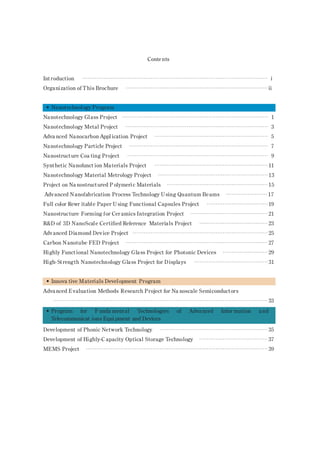
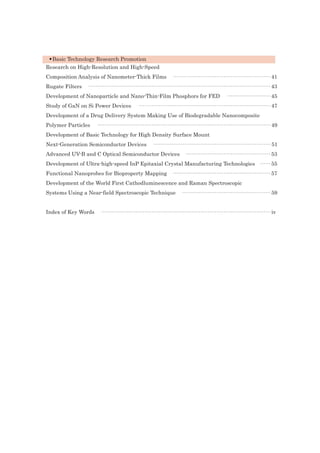
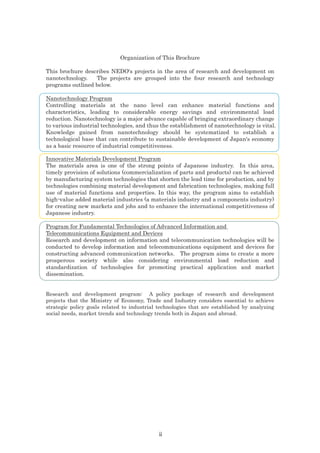
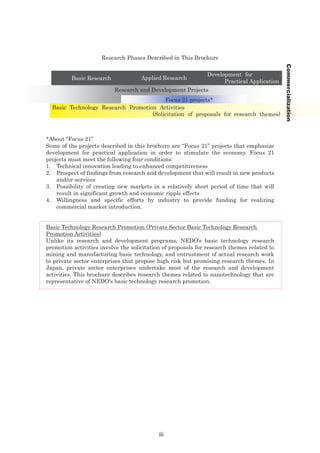
![Nanotechnology Glass Project
Background
Keywords: Glass, Sub-wavelength structure, Telecommunications
R&D Term: FY2001᳸FY2005ų Budget of FY2005:
ųThe Nanotechnology Glass Project is intended
for the development of fundamental
technologies for glasses with completely new
functions by controlling structure on a
nanometer scale. It is primarily known that
glass is transparent, hard and stable thermally
and chemically.
This project aims to further increase the levels
of these advantages. Japanese industry will䇭
extensively utilize the outcome obtained from
this project and will cultivate new leading
markets in the fields of optical communication,
energy and environment. It will also contribute
to international society.
Organization
Contents
[Ძ] Telecommunications
Ყ Storage Ყųųųųųųųųųųųų
Precise fabrication technology for wavelength-
level periodic structures on a glass surface is
being developed using semiconductor
microfabrication technology, including
lithography and dry etching. For example, the
etching rate of the glass could be vertically
controlled by doping several additives, realizing
fabrication of a rectangular periodic structure
with a 200-nm grove width and an aspect ratio of
6. Furthermore, resistance against mechanical
shock was remarkably improved by overcladding
on the periodic structure. It was demonstrated
small demultiplexer on a glass plate of 6 x 9 mm.
This project aims
technology to fabricate optical memory heads,
which will provide high angular dispersion for a
so-called “super prism”.
Ყ CommunicationsᲧų ųųųųųųų
Optical fiber networks have begun to spread
instead of metal networks due to increased
Internet traffic. There is a strong requirement of
small and low-cost optical devices, which can be
used even in a harsh environment. This project is
developing new glasses for low-loss optical
waveguides, athermal optics and micro-lens
arrays. Also,
Diffraction efficiencies and cross sectional SEM
views of diffraction gratings before (left) and
after (right) overcladding
Ultra-small 4-channel
demultiplexer
designed to operate at
around 1550-nm
wavelength
Project Leader䇭
Participating Organizations
New Glass Forum
Also, a high recording density DVD that can
record high definition TV images for 24 hours
has been developed in this project. This
research was transferred to the Focus 21
Project in order to accelerate R&D for practical
application.
2mm
Concave
mirror
Arrayed
waveguide
output
Arrayed waveguide
input
Buried
grating
Wavelength (μm) Wavelength (μm)
0.5
0.6
0.7
0.8
0.9
1.0
Diffraction
efficiency
(-)
TM
TE TM
TE
1.48 1.52 1.56 1.60
1.48 1.52 1.56 1.60
5μm
30o
calculated
by RCWA
Nanotechnology Program
410 million yen
to construct the basic
that this technology was applicable to an ultra-
.K. HIRAO
䇭Professor䇭K䋮HIRAO䇭Kyoto university
Prof
National Institute of Advanced Industrial Science and Technology
1](https://image.slidesharecdn.com/939564-250621113416-0925addd/85/Nanotechnology-And-Materials-Technology-Nedo-11-320.jpg)