Presented by:
Abhaya Raj Sharma (B25)
Radhika Rani Kashyap (B26)
Aashima Chauhan (B27)
Prateek Tyagi (B28)
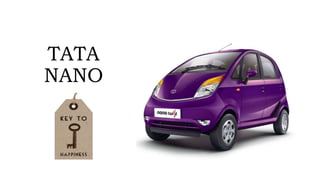
TATA
NANO
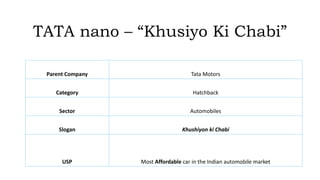
TATA nano – “Khusiyo Ki Chabi”
Parent Company Tata Motors
Category Hatchback
Sector Automobiles
Slogan Khushiyon ki Chabi
USP Most Affordable car in the Indian automobile market
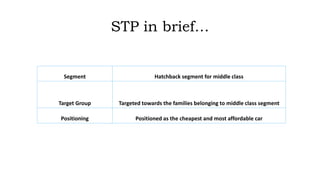
STP in brief…
Segment Hatchback segment for middle class
Target Group Targeted towards the families belonging to middle class segment
Positioning Positioned as the cheapest and most affordable car
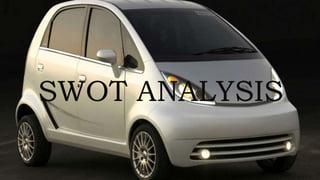
SWOT ANALYSIS
Strengths:
1. Very Affordable price
2. Traffic friendly (easy to drive even in heavy traffic)
3. Innovative engineering providing better facilities than the same segment cars
4. Low maintenance and handling cost
5. Good fuel efficiency
6. A “common mans” car
Weaknesses:
1. Perceived as a cheap product
2. Safety issues
3. Smaller fuel tank and Limited power engine
4. No International presence
5. Not suitable for hilly regions
Opportunities:
1. Capitalization of the main fact
2. Increase international market presence especially Europe
3. Attracting Maruti customers (as production of Maruti 800 is stopped)
4. Providing appealing options at affordable price range
5. Correcting possible weakness points
Threats:
1. Increasing fuel costs
2. Competition from big automobile giants
3. Competitive products offering same features at a lesser price
4. Product innovations and economic engineering by competitors
5. Customer perception of a cheap car
6. Extremely Dynamic Consumer Behavior
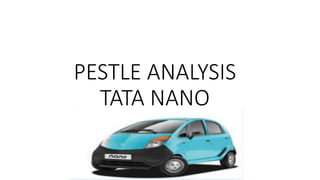
PESTLE ANALYSIS
TATA NANO
PESTLE
P ( POLITICAL)
E (ECONOMICAL)
S (SOCIAL)
T (TECHNOLOGICAL)
L (LEGAL)
E (ECOLOGICAL)
POLITICAL
a) Tax reduction is applied to specific vehicle segment
a) Utility vehicles
b) Multi purpose vehicles
b) Growth of export in the industry is strong in Asia and Africa
c) FDI rules have been open to allow the business to prosper the country
d) Labour regulation should be closely monitored specifically if doing business
with other countries (i.e. any acquisitions and joint venture)
e) Different part or religion India offers incentives such as Taxes and Excise
Duty benefits
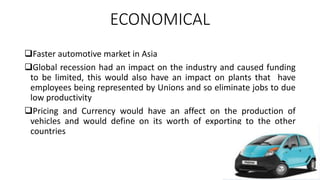
ECONOMICAL
Faster automotive market in Asia
Global recession had an impact on the industry and caused funding
to be limited, this would also have an impact on plants that have
employees being represented by Unions and so eliminate jobs to due
low productivity
Pricing and Currency would have an affect on the production of
vehicles and would define on its worth of exporting to the other
countries
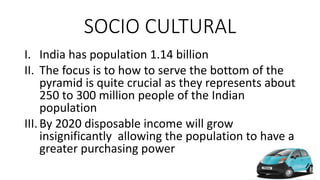
SOCIO CULTURAL
I. India has population 1.14 billion
II. The focus is to how to serve the bottom of the
pyramid is quite crucial as they represents about
250 to 300 million people of the Indian
population
III.By 2020 disposable income will grow
insignificantly allowing the population to have a
greater purchasing power
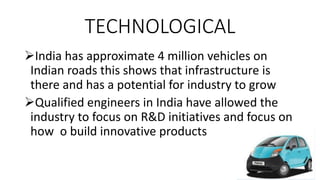
TECHNOLOGICAL
India has approximate 4 million vehicles on
Indian roads this shows that infrastructure is
there and has a potential for industry to grow
Qualified engineers in India have allowed the
industry to focus on R&D initiatives and focus on
how o build innovative products
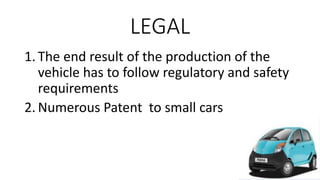
LEGAL
1. The end result of the production of the
vehicle has to follow regulatory and safety
requirements
2. Numerous Patent to small cars
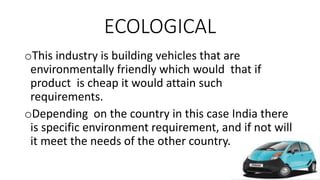
ECOLOGICAL
oThis industry is building vehicles that are
environmentally friendly which would that if
product is cheap it would attain such
requirements.
oDepending on the country in this case India there
is specific environment requirement, and if not will
it meet the needs of the other country.

Nano presentation

  • 1.
    Presented by: Abhaya RajSharma (B25) Radhika Rani Kashyap (B26) Aashima Chauhan (B27) Prateek Tyagi (B28)
  • 2.
  • 3.
    TATA nano –“Khusiyo Ki Chabi” Parent Company Tata Motors Category Hatchback Sector Automobiles Slogan Khushiyon ki Chabi USP Most Affordable car in the Indian automobile market
  • 4.
    STP in brief… SegmentHatchback segment for middle class Target Group Targeted towards the families belonging to middle class segment Positioning Positioned as the cheapest and most affordable car
  • 5.
  • 6.
    Strengths: 1. Very Affordableprice 2. Traffic friendly (easy to drive even in heavy traffic) 3. Innovative engineering providing better facilities than the same segment cars 4. Low maintenance and handling cost 5. Good fuel efficiency 6. A “common mans” car
  • 7.
    Weaknesses: 1. Perceived asa cheap product 2. Safety issues 3. Smaller fuel tank and Limited power engine 4. No International presence 5. Not suitable for hilly regions
  • 8.
    Opportunities: 1. Capitalization ofthe main fact 2. Increase international market presence especially Europe 3. Attracting Maruti customers (as production of Maruti 800 is stopped) 4. Providing appealing options at affordable price range 5. Correcting possible weakness points
  • 9.
    Threats: 1. Increasing fuelcosts 2. Competition from big automobile giants 3. Competitive products offering same features at a lesser price 4. Product innovations and economic engineering by competitors 5. Customer perception of a cheap car 6. Extremely Dynamic Consumer Behavior
  • 10.
  • 11.
    PESTLE P ( POLITICAL) E(ECONOMICAL) S (SOCIAL) T (TECHNOLOGICAL) L (LEGAL) E (ECOLOGICAL)
  • 12.
    POLITICAL a) Tax reductionis applied to specific vehicle segment a) Utility vehicles b) Multi purpose vehicles b) Growth of export in the industry is strong in Asia and Africa c) FDI rules have been open to allow the business to prosper the country d) Labour regulation should be closely monitored specifically if doing business with other countries (i.e. any acquisitions and joint venture) e) Different part or religion India offers incentives such as Taxes and Excise Duty benefits
  • 13.
    ECONOMICAL Faster automotive marketin Asia Global recession had an impact on the industry and caused funding to be limited, this would also have an impact on plants that have employees being represented by Unions and so eliminate jobs to due low productivity Pricing and Currency would have an affect on the production of vehicles and would define on its worth of exporting to the other countries
  • 14.
    SOCIO CULTURAL I. Indiahas population 1.14 billion II. The focus is to how to serve the bottom of the pyramid is quite crucial as they represents about 250 to 300 million people of the Indian population III.By 2020 disposable income will grow insignificantly allowing the population to have a greater purchasing power
  • 15.
    TECHNOLOGICAL India has approximate4 million vehicles on Indian roads this shows that infrastructure is there and has a potential for industry to grow Qualified engineers in India have allowed the industry to focus on R&D initiatives and focus on how o build innovative products
  • 16.
    LEGAL 1. The endresult of the production of the vehicle has to follow regulatory and safety requirements 2. Numerous Patent to small cars
  • 17.
    ECOLOGICAL oThis industry isbuilding vehicles that are environmentally friendly which would that if product is cheap it would attain such requirements. oDepending on the country in this case India there is specific environment requirement, and if not will it meet the needs of the other country.