CASE STUDY ON 
“TATA-NANO-VATION”
About TATA 
motors 
Established in 1945, the company is top 1 automobile 
manufacturer in India, world’s 4th largest truck 
manufacturers and world’s third largest bus manufacturer. 
Tata motors has produced & sold more than 4 million cars in 
India so far. 
It has more than 25000 employees, 4500 engineers and 
scientists and with R&D. 
Tata launched “TATA INDICA” India’s largest selling car, 
which is India’s first fully indigenous car. 
In 2005, they created a new segment mini trucks with the 
launch of “TATA ACE”. 
In Jan 2008, TATA unveiled its “People car” , TATA NANO the 
cheapest car.
Business 
Models for 
TATA NANO 
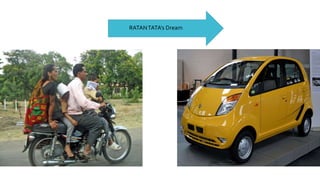
Dream of Sri RATAN TATA, a car cheap enough for motor 
cycle buyers. 
For this project, TATA adopted “COLLABARATIVE 
APPROACH”, which usually believes in vertically integrated 
approach and company believes it could do everything 
better than others 
BUSINESS PROCESS OUTSOURCING 
Outsourcing was into New product development, SCM, 
Design and styling of its products also. 
Refined the manufacturing process by breaking down every 
component of the car into its smallest pieces. 
eliminating everything that was unnecessary.
Business 
Models for 
TATA NANO 
Continued….. 
outsourcing its manufacturing to a limited number of 
suppliers. 
NANO was more eco-friendly and affordable with a millage 
of 23 KM/ltr. 
It even attracted rich individuals. 
“A Promise is a Promise” said Ratan TATA, on launch of TATA 
NANO. 
The NANO project didn’t grab the attention of only Indians 
but whole word.
CHA 
RATAN TATA’s Dream
NEW PRODUCT 
DEVELOPMENT
IDEA 
SCREENING 
Three major requirement of TATA Motor’s engineers is 
 Low cost (₹ 1,00,000) 
 Emission Norms 
 Acceptable performance standards( 4 wheeler)
Company 
generated 
several ideas, 
such as…. 
A scooter with two more back wheels for better stability. 
An auto rickshaw with four wheels? 
A four wheeled rural car? 
A four wheeled open car with safety side bar? 
Made with openings like auto rikshaw? 
And so on… 
But market wanted a CAR and not something people would say 
“That’s just a scooter with four wheels or auto-rickshaw with four 
wheels”
RESEARCH & 
DEVELOPMENT 
Named the project X3 consisting of 5 major team members from 
different disciplines. 
 Girish Wagh one of the 5 members, did something no one at tata 
thought of, 
“He interacted with customers” 
He approached with a question, why? Why do you want a four 
wheeler? 
Interestingly, customers said, 
“If I had a four wheeler, I would have better marriage prospects in 
my village” 
 Drivers of 3 wheelers are looked down upon in India. 
Then he understood that four wheels had an emotional, not just 
practical.
BUT 
what type of 
product????? 
 The car has to be built on a different platform as compared to the 
conventional one. 
 It must meet all the safety and regulatory requirements. 
 The car has to be designed so that it can be exported. 
 The car must be a beacon for the Indian automobile Industry and 
prove the world India is capable enough.
Continued… 
The design team initially came up with a vehicle which had bars, 
which wasmore of a quadricycle than a car, so a failure. 
Wagh used to spend an hour or two on the floor in order to take 
suggestions from designers, manufacturing team. 
Then team grew into 500 members, on a daily basis 5 core 
members gathered to discuss about development and 
suggestions. 
Ratan Tata insisted to change the design, he wanted it to be easy 
for tall people to get in and out and the height was increased by 
100millimeters. 
The initial two cylinder engine was 580cc, later the capacity raised 
to 624cc to have optimumengine performance.
COST 
CUTTING 
FEATURES 
 The trunk is only accessible from inside the car as the rear hatch 
doesn’t open 
One wide wiper instead of usual pair. 
No power steering, radio or music can be fitted as accessories. 
No air bags In any model 
624cc two engine cylinder. 
No air conditioning. 
To ease the assembly, body panels are glued instead of welded.
Collaboration 
as a source of 
innovation…. 
TATA MOTORS considered COLLABORATION as the source of 
innovation from different company’s idea to reduce cost. 
TATA divided the components into two types – proprietary design 
andTatamotors design. 
 For proprietary design components Tata went with established 
suppliers such as BOSCHGROUP. 
BOSCH GROUP, which supplies the engine management systems.
BOSCH GROUP 
 Bosch group decided to take the challenge to be a part in cheapest 
car though they (Bosch) developed systems only for high end 
vehicles. 
 Bosch again split the development between its design centers 
Bangalore and Germany 
Using local design capabilities was a crucial decision and 
employment took place at higher wage levels. 
 Bosch developed a software consists of electronic control unit, 
fuel injectors, sensors, ignition oil, tank vent level and throttle 
body assembly. 
 Cost effective “drum brakes” were used.
SUPPLIERS 
 There were more than 100 suppliers. 
 The brief to suppliers was: 
“Make things smaller and lighter, do away with superficial parts, and 
change the material wherever possible” 
A few did their own way and few developed with the tata motors. 
 Arvind Kapur, CEO of Rico, supplier of blocks to the engine, 
decided to use aluminum for engine instead of traditional cast iron 
as it was smaller, lighter and cost was less. 
 Rico also found a way not to connect the engine with the rear 
wheels 
 Price negotiations from Tata motors side apparently started from 
50%of what suppliers offered.
Distribution 
Manufacturing 
EOS was very crucial factor to reach low cost of the product. 
Tata wanted to build one million Nano’s per year. 
NANO is constructed of components that can be built and shipped 
separately to be assembled in a variety of location. 
 So. Tata nano is being sold in KITS. 
 Any local entrepreneur can establish assembly unit and can sell in 
pre-defined locations.
TATA NANO-A 
GLOBAL 
CAR? 
Though It succeeded in creating huge market hype before the 
launch, it took whole 2 years to sell its 1,00,000th car. 
 Couldn’t meet the annual sales expectations of 2,50,000 cars. 
 First reason is the forced movement of production plant from west 
Bengal to sanand, Gujarat because of strike. 
“Hence company was unable to deliver cars to first buyer’s in time” 
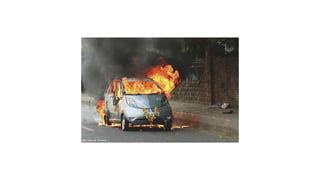
Few fire incidents and resulted media sensitivity. 
 Negative word of mouth from non targeted customers who 
bought the car. 
 Positioning as “worlds cheapest car” was actually a disaster in 
global market.
CASE QUESTIONS
How do you view Tata Nano as an innovation ? 
A differentiated product or a low cost product
Differentiated 
+ 
Low cost 
product 
Tata Nano is a both a differentiated product with the lowest 
possible price. 
Tata Nano is a low cost car by the positioning itself as the “Worlds 
cheapest Car” with a price tag of ₹ 1,00,000. 
 Started with the theme “A car for everyone” 
Targeted to 2 wheeler motor cycle buyer who cant afford 4 
wheelers 
Low cost product with complete entry level features. 
Tata Nano is differentiated in a very different manner, 
 Stating itself as worlds cheapest affordable car 
Nano born with the emotional touch and that created a huge 
market hype. 
 Collaborative approach with more than 100 suppliers for this 
project is truly uniqueness 
 Also targeting is differential factor.
Tata Nano could not have seen the light of the day had it not 
embarked upon a policy of collaborations and alliances. 
Do you agree? Justify?
Without 
collaborations 
and alliances, 
NANO wouldn’t 
have reached 
customer. 
Bosch being a major player in supplier took a challenge and 
succeeded in providing with the least cost technology. 
 Giving free decision making to the suppliers made them innovators. 
Without the suppliers the Nano would have been costlier in several 
factors. 
The innovation was faster as each supplier produced simultaneously. 
 Innovation from different suppliers. 
The plants and employment might have increased the price of end 
product. 
 Breaking down of components and outsourcing them gave an option 
to concentrate more on that particular product. 
Tata Motors bargained up to 50%with the suppliers.
Despite the huge market hype and the first mover advantage, 
it appears that company has not able to cash upon in? do you 
agree with this? What are the reasons for this?
Yes, TATA 
MOTORS was 
unable to cash 
upon it. 
Because, 
The annual sales expectations of 1 lakh per year was not reached. 
 It took 2 long years to reach its 1,00,000th car. 
 Strikes in west Bengal resulted in movement of production plant 
to sananda, Gujarat which not only resulted in 18 months delay to 
first buyer and also huge cost. 
 It also resulted in heavy inventory costs. 
 Few fire cases made customers to back out on the verge of 
buying, safety does matter. 
 The sound of 2 cylinder engine was a major negative factor which 
made it sound like a auto. 
 Negative word of mouth by non targeted customer group.
Continued.. 
 Lack of basic features made it just plane product but not a 
complete car. 
 The price gap between Nano and Suzuki alto was only around 
50,000 after equipping Nano with necessary accessories. 
 The positioning was a unable to attract customers as they still 
looked car as a status of symbol. 
No one wants to own a car, that showcases as cheapest car. 
 Style 
 Craze over 2 wheelers and convenience of travelling in rural areas 
with two wheeler in lands. 
Well, the launch of 2012 model, is a success.
What is the role of leadership and strategy execution in 
bringing out such zero- base products? Justify your answer.
Team work 
Suggestions 
from everyone 
freedom to 
suppliers in R&D 
 A team of 500 members lead by 5 core members made Nano into 
reality. 
Mr. wagh used to take suggestions from every person in the plant 
to make it better and better with least cost. 
 The suppliers are allowed to research for their particular part so 
that they can come up with innovative ideas.
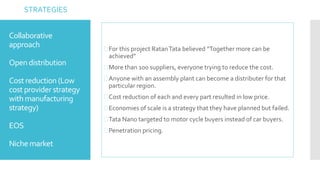
Collaborative 
approach 
Open distribution 
Cost reduction (Low 
cost provider strategy 
with manufacturing 
strategy) 
EOS 
Niche market 
 For this project RatanTata believed “Together more can be 
achieved” 
More than 100 suppliers, everyone trying to reduce the cost. 
Anyone with an assembly plant can become a distributer for that 
particular region. 
 Cost reduction of each and every part resulted in low price. 
Economies of scale is a strategy that they have planned but failed. 
Tata Nano targeted to motor cycle buyers instead of car buyers. 
Penetration pricing. 
STRATEGIES
QUESTIONS? 
Thank YOu

Case study on TATO NANO-VATION

  • 1.
    CASE STUDY ON “TATA-NANO-VATION”
  • 2.
    About TATA motors Established in 1945, the company is top 1 automobile manufacturer in India, world’s 4th largest truck manufacturers and world’s third largest bus manufacturer. Tata motors has produced & sold more than 4 million cars in India so far. It has more than 25000 employees, 4500 engineers and scientists and with R&D. Tata launched “TATA INDICA” India’s largest selling car, which is India’s first fully indigenous car. In 2005, they created a new segment mini trucks with the launch of “TATA ACE”. In Jan 2008, TATA unveiled its “People car” , TATA NANO the cheapest car.
  • 3.
    Business Models for TATA NANO Dream of Sri RATAN TATA, a car cheap enough for motor cycle buyers. For this project, TATA adopted “COLLABARATIVE APPROACH”, which usually believes in vertically integrated approach and company believes it could do everything better than others BUSINESS PROCESS OUTSOURCING Outsourcing was into New product development, SCM, Design and styling of its products also. Refined the manufacturing process by breaking down every component of the car into its smallest pieces. eliminating everything that was unnecessary.
  • 4.
    Business Models for TATA NANO Continued….. outsourcing its manufacturing to a limited number of suppliers. NANO was more eco-friendly and affordable with a millage of 23 KM/ltr. It even attracted rich individuals. “A Promise is a Promise” said Ratan TATA, on launch of TATA NANO. The NANO project didn’t grab the attention of only Indians but whole word.
  • 5.
  • 6.
  • 7.
    IDEA SCREENING Threemajor requirement of TATA Motor’s engineers is  Low cost (₹ 1,00,000)  Emission Norms  Acceptable performance standards( 4 wheeler)
  • 8.
    Company generated severalideas, such as…. A scooter with two more back wheels for better stability. An auto rickshaw with four wheels? A four wheeled rural car? A four wheeled open car with safety side bar? Made with openings like auto rikshaw? And so on… But market wanted a CAR and not something people would say “That’s just a scooter with four wheels or auto-rickshaw with four wheels”
  • 9.
    RESEARCH & DEVELOPMENT Named the project X3 consisting of 5 major team members from different disciplines.  Girish Wagh one of the 5 members, did something no one at tata thought of, “He interacted with customers” He approached with a question, why? Why do you want a four wheeler? Interestingly, customers said, “If I had a four wheeler, I would have better marriage prospects in my village”  Drivers of 3 wheelers are looked down upon in India. Then he understood that four wheels had an emotional, not just practical.
  • 10.
    BUT what typeof product?????  The car has to be built on a different platform as compared to the conventional one.  It must meet all the safety and regulatory requirements.  The car has to be designed so that it can be exported.  The car must be a beacon for the Indian automobile Industry and prove the world India is capable enough.
  • 11.
    Continued… The designteam initially came up with a vehicle which had bars, which wasmore of a quadricycle than a car, so a failure. Wagh used to spend an hour or two on the floor in order to take suggestions from designers, manufacturing team. Then team grew into 500 members, on a daily basis 5 core members gathered to discuss about development and suggestions. Ratan Tata insisted to change the design, he wanted it to be easy for tall people to get in and out and the height was increased by 100millimeters. The initial two cylinder engine was 580cc, later the capacity raised to 624cc to have optimumengine performance.
  • 12.
    COST CUTTING FEATURES  The trunk is only accessible from inside the car as the rear hatch doesn’t open One wide wiper instead of usual pair. No power steering, radio or music can be fitted as accessories. No air bags In any model 624cc two engine cylinder. No air conditioning. To ease the assembly, body panels are glued instead of welded.
  • 13.
    Collaboration as asource of innovation…. TATA MOTORS considered COLLABORATION as the source of innovation from different company’s idea to reduce cost. TATA divided the components into two types – proprietary design andTatamotors design.  For proprietary design components Tata went with established suppliers such as BOSCHGROUP. BOSCH GROUP, which supplies the engine management systems.
  • 14.
    BOSCH GROUP Bosch group decided to take the challenge to be a part in cheapest car though they (Bosch) developed systems only for high end vehicles.  Bosch again split the development between its design centers Bangalore and Germany Using local design capabilities was a crucial decision and employment took place at higher wage levels.  Bosch developed a software consists of electronic control unit, fuel injectors, sensors, ignition oil, tank vent level and throttle body assembly.  Cost effective “drum brakes” were used.
  • 15.
    SUPPLIERS  Therewere more than 100 suppliers.  The brief to suppliers was: “Make things smaller and lighter, do away with superficial parts, and change the material wherever possible” A few did their own way and few developed with the tata motors.  Arvind Kapur, CEO of Rico, supplier of blocks to the engine, decided to use aluminum for engine instead of traditional cast iron as it was smaller, lighter and cost was less.  Rico also found a way not to connect the engine with the rear wheels  Price negotiations from Tata motors side apparently started from 50%of what suppliers offered.
  • 16.
    Distribution Manufacturing EOSwas very crucial factor to reach low cost of the product. Tata wanted to build one million Nano’s per year. NANO is constructed of components that can be built and shipped separately to be assembled in a variety of location.  So. Tata nano is being sold in KITS.  Any local entrepreneur can establish assembly unit and can sell in pre-defined locations.
  • 17.
    TATA NANO-A GLOBAL CAR? Though It succeeded in creating huge market hype before the launch, it took whole 2 years to sell its 1,00,000th car.  Couldn’t meet the annual sales expectations of 2,50,000 cars.  First reason is the forced movement of production plant from west Bengal to sanand, Gujarat because of strike. “Hence company was unable to deliver cars to first buyer’s in time” Few fire incidents and resulted media sensitivity.  Negative word of mouth from non targeted customers who bought the car.  Positioning as “worlds cheapest car” was actually a disaster in global market.
  • 18.
  • 19.
    How do youview Tata Nano as an innovation ? A differentiated product or a low cost product
  • 20.
    Differentiated + Lowcost product Tata Nano is a both a differentiated product with the lowest possible price. Tata Nano is a low cost car by the positioning itself as the “Worlds cheapest Car” with a price tag of ₹ 1,00,000.  Started with the theme “A car for everyone” Targeted to 2 wheeler motor cycle buyer who cant afford 4 wheelers Low cost product with complete entry level features. Tata Nano is differentiated in a very different manner,  Stating itself as worlds cheapest affordable car Nano born with the emotional touch and that created a huge market hype.  Collaborative approach with more than 100 suppliers for this project is truly uniqueness  Also targeting is differential factor.
  • 21.
    Tata Nano couldnot have seen the light of the day had it not embarked upon a policy of collaborations and alliances. Do you agree? Justify?
  • 22.
    Without collaborations andalliances, NANO wouldn’t have reached customer. Bosch being a major player in supplier took a challenge and succeeded in providing with the least cost technology.  Giving free decision making to the suppliers made them innovators. Without the suppliers the Nano would have been costlier in several factors. The innovation was faster as each supplier produced simultaneously.  Innovation from different suppliers. The plants and employment might have increased the price of end product.  Breaking down of components and outsourcing them gave an option to concentrate more on that particular product. Tata Motors bargained up to 50%with the suppliers.
  • 23.
    Despite the hugemarket hype and the first mover advantage, it appears that company has not able to cash upon in? do you agree with this? What are the reasons for this?
  • 24.
    Yes, TATA MOTORSwas unable to cash upon it. Because, The annual sales expectations of 1 lakh per year was not reached.  It took 2 long years to reach its 1,00,000th car.  Strikes in west Bengal resulted in movement of production plant to sananda, Gujarat which not only resulted in 18 months delay to first buyer and also huge cost.  It also resulted in heavy inventory costs.  Few fire cases made customers to back out on the verge of buying, safety does matter.  The sound of 2 cylinder engine was a major negative factor which made it sound like a auto.  Negative word of mouth by non targeted customer group.
  • 25.
    Continued..  Lackof basic features made it just plane product but not a complete car.  The price gap between Nano and Suzuki alto was only around 50,000 after equipping Nano with necessary accessories.  The positioning was a unable to attract customers as they still looked car as a status of symbol. No one wants to own a car, that showcases as cheapest car.  Style  Craze over 2 wheelers and convenience of travelling in rural areas with two wheeler in lands. Well, the launch of 2012 model, is a success.
  • 27.
    What is therole of leadership and strategy execution in bringing out such zero- base products? Justify your answer.
  • 28.
    Team work Suggestions from everyone freedom to suppliers in R&D  A team of 500 members lead by 5 core members made Nano into reality. Mr. wagh used to take suggestions from every person in the plant to make it better and better with least cost.  The suppliers are allowed to research for their particular part so that they can come up with innovative ideas.
  • 29.
    Collaborative approach Opendistribution Cost reduction (Low cost provider strategy with manufacturing strategy) EOS Niche market  For this project RatanTata believed “Together more can be achieved” More than 100 suppliers, everyone trying to reduce the cost. Anyone with an assembly plant can become a distributer for that particular region.  Cost reduction of each and every part resulted in low price. Economies of scale is a strategy that they have planned but failed. Tata Nano targeted to motor cycle buyers instead of car buyers. Penetration pricing. STRATEGIES
  • 30.

Editor's Notes

  • #3 R&D= Research and development
  • #4 COLLABARATIVE APPROACH= few companies coming together for a common cause. Vertically integrated approach= major things are done in company without any other co help.
  • #5 KM/LTR= kilo meter per litre
  • #17 EOS= Economies of scale
  • #25 Strike for 1000 acre land
  • #26 Accessories such as music, Ac Nobody wants to show they have the worlds cheapest car, a middle class family