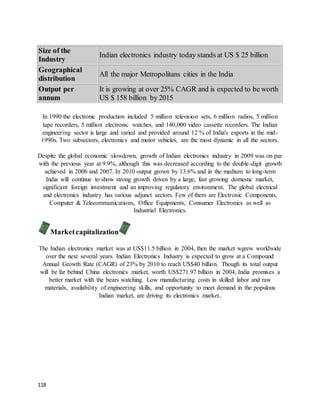
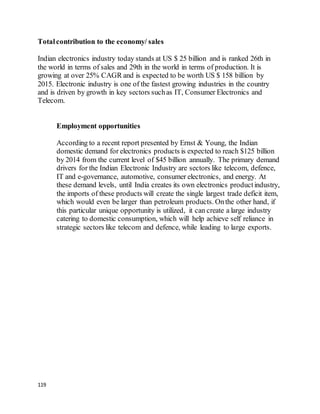
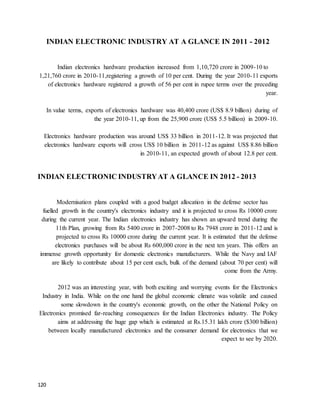
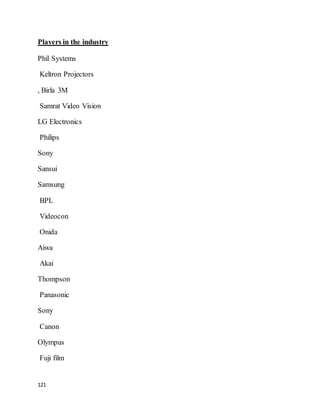
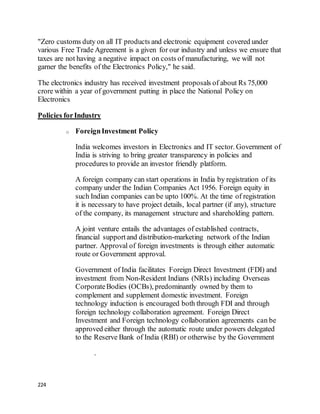
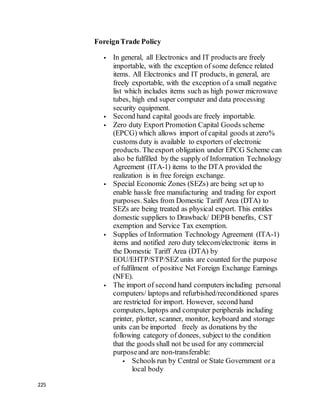
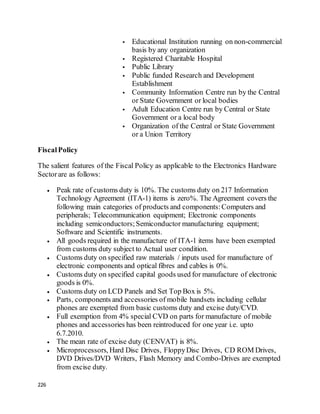
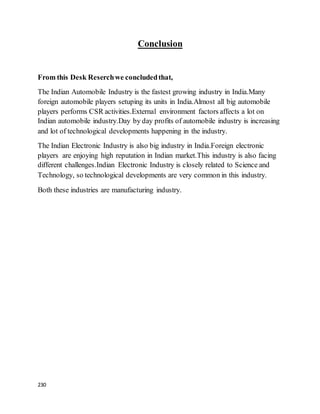
1
A
Project Report
On
Indian Automobile Industry
And
Indian Electronic Industry
Submitted By
Name Roll No.
Miss Meraj Bagwan 02
Miss Supriya Keskar 27
Miss Trupti Khomane 28
Miss Jyoti Shinde 44
Class : MBA I, VIIT, Baramati
Under The Guidance Of
Dr. Rupendra Gaikwad
Subject : Industrial Analysis – Desk Research (215)
2
Indian Automobile Industry
Chapter 1 : Industry Analysis – the Basics
Indian Automobile Industry
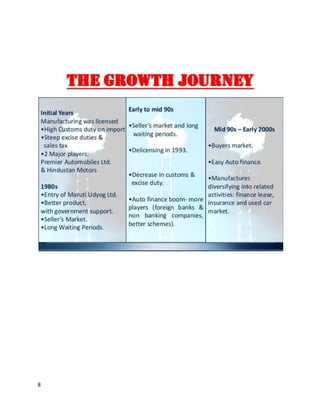
History of the Industry
The first car ran on India's roads in 1897. Until the 1930s, cars were imported
directly, but in very small numbers.
An embryonic automotive industry emerged in India in the 1940s. Hindustan was
launched in 1942, longtime competitor Premier in 1944. They built GM and Fiat
products respectively Mahindra & Mahindra was established by two brothers in
1945, and began assembly of Jeep CJ-3A utility vehicles. Following the
independence, in 1947, the Government of India and the private sector launched
efforts to create an automotive componentmanufacturing industry to supply to the
automobile industry. In 1953 an import substitution programme was launched, and
the import of fully built-up cars began to be impeded.
The Hindustan Ambassador dominated India's automotive market from the 1960s
until the mid-80s.
However, the growth was relatively slow in the 1950s and 1960s due to
nationalisation and the license raj which hampered the Indian private sector. Total
restrictions for import of vehicles were set and after 1970 the automotive industry
started to grow, but the growth was mainly driven by tractors, commercial vehicles
and scooters. Cars were still a major luxury item. In the 1970s price controls were
finally lifted, inserting a competitive element into the automobile market.By the
1980s, the automobile market was still dominated by Hindustan and Premier, who
sold superannuated products in fairly limited numbers.During the eighties, a few
competitors began to arrive on the scene.
3
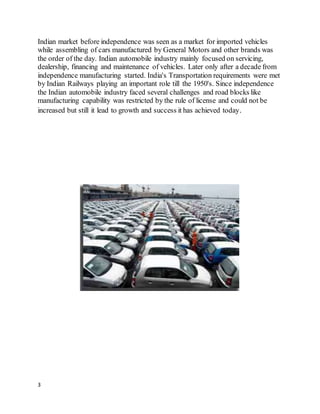
Indian market before independence was seen as a market for imported vehicles
while assembling of cars manufactured by General Motors and other brands was
the order of the day. Indian automobile industry mainly focused on servicing,
dealership, financing and maintenance of vehicles. Later only after a decade from
independence manufacturing started. India's Transportation requirements were met
by Indian Railways playing an important role till the 1950's. Since independence
the Indian automobile industry faced several challenges and road blocks like
manufacturing capability was restricted by the rule of license and could not be
increased but still it lead to growth and success it has achieved today.
4
Nature Of theIndustry
The automotive industry in India is one of the larger markets in the world. It had
previously been one of the fastest growing globally, but is currently experiencing
flat or negative growth rates. India's passenger car and commercial vehicle
manufacturing industry is the sixth largest in the world, with an annual production
of more than 3.9 million units in 2011. According to recent reports, India overtook
Brazil and became the sixth largest passenger vehicle producerin the world
(beating such old and new auto makers as Belgium, United Kingdom, Italy,
Canada, Mexico, Russia, Spain, France, Brazil), grew 16 to 18 percent to sell
around three million units in the courseof 2011 and 2012.In 2009, India emerged
as Asia's fourth largest exporter of passenger cars, behind Japan, South Korea, and
Thailand. In 2010, India beat Thailand to becomeAsia's third largest exporter of
passenger cars.
As of 2010, India is home to 40 million passenger vehicles. More than 3.7 million
automotive vehicles were produced in India in 2010 (an increase of 33.9%),
making the country the second (after China) fastest growing automobile market in
the world in that year.According to the Society of Indian Automobile
Manufacturers, annual vehicle sales are projected to increase to 4 million by 2015,
no longer 5 million as previously projected.
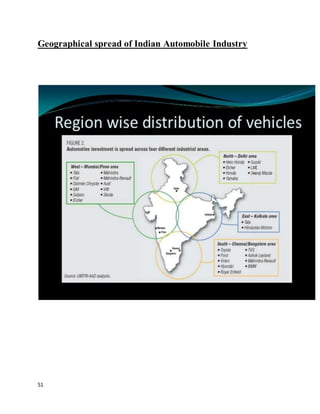
The majority of India's car manufacturing industry is based around three clusters in
the south, west and north. The southern cluster consisting of Chennai is the biggest
with 35% of the revenue share. The western hub near Mumbai and Pune
contributes to 33% of the market and the northern cluster around the National
Capital Region contributes 32%.Chennai, with the India operations of Ford,
Hyundai, Renault, Mitsubishi, Nissan, BMW, Hindustan Motors, Daimler, Caparo,
and PSA Peugeot Citroën is about to begin their operations by 2014. Chennai
accounts for 60% of the country's automotive exports. Gurgaon and Manesar in
Haryana form the northern cluster where the country's largest car manufacturer,
Maruti Suzuki, is based. The Chakan corridor near Pune, Maharashtra is the
western cluster with companies like General Motors, Volkswagen, Skoda,
Mahindra and Mahindra, Tata Motors, Mercedes Benz, Land Rover, Jaguar Cars,
Fiat and Force Motors having assembly plants in the area. Nashik has a major base
of Mahindra and Mahindra with a SUV assembly unit and an Engine assembly
5
unit. Aurangabad with Audi, Skodaand Volkswagen also forms part of the western
cluster. Another emerging cluster is in the state of Gujarat with manufacturing
facility of General Motors in Halol and further planned for Tata Nano at their plant
in Sanand. Ford, Maruti Suzuki and Peugeot-Citroen plants are also set to come up
in Gujarat.[13] Kolkata with Hindustan Motors, Noida with Honda and Bangalore
with Toyotaare some of the other automotive manufacturing regions around the
country.
In 2011, there were 3,695 factories producing automotive parts in all of India.The
average firm made US$6 million in annual revenue with profits close to US$400
thousand.
Size of the Industry 2.6 Million Units
Geographical
distribution
Jamshedpur, Pune, Lucknow, Gurgoan,
Delhi, Mumbai, Bangalore, etc
Output per annum Rs 2,000 crore per annum
Percentage in world
market
6-8%
Market
Capitalization
5% of the share
6
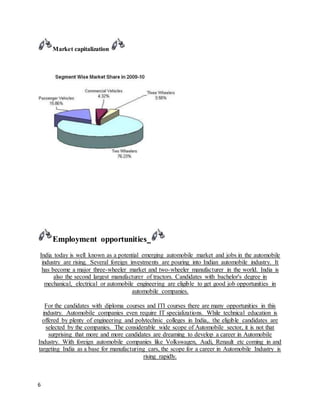
Market capitalization
Employment opportunities
India today is well known as a potential emerging automobile market and jobs in the automobile
industry are rising. Several foreign investments are pouring into Indian automobile industry. It
has become a major three-wheeler market and two-wheeler manufacturer in the world. India is
also the second largest manufacturer of tractors. Candidates with bachelor's degree in
mechanical, electrical or automobile engineering are eligible to get good job opportunities in
automobile companies.
For the candidates with diploma courses and ITI courses there are many opportunities in this
industry. Automobile companies even require IT specializations. While technical education is
offered by plenty of engineering and polytechnic colleges in India,. the eligible candidates are
selected by the companies. The considerable wide scope of Automobile sector, it is not that
surprising that more and more candidates are dreaming to develop a career in Automobile
Industry. With foreign automobile companies like Volkswagen, Audi, Renault etc coming in and
targeting India as a base for manufacturing cars, the scope for a career in Automobile Industry is
rising rapidly.
7
Indian Automobile Industry a glance in 2011 - 2012
 In March 2012 as compared to March 2011, production grew at a single digit
rate of 6.83%.
 In 2011-12, the industry produced 20,366,432 vehicles of which share of
two wheelers, passenger vehicles, three wheelers and commercial vehicles
were 76%, 15%, 4% and 4% respectively.
 The growth rate for overall domestic sales for 2011-12 was 12.24 percent
amounting to 17,376,624 vehicles. Passenger Cars grew by 2.19%, Utility
Vehicles grew by 16.47% and Vans by 10.01% during this period.
 Forthe first time in history car sales crossed two million in a financial year.
If we compare sales figures of March 2012 to March 2011, the growth for
two wheelers was 8.27%.
 During April to March 2012, the industry exported 2,910,055 automobiles
registering a growth of 25.44%.
 In March 2012 compared to March 2011, overall automobile exports
registered a growth of 17.81%
8
9
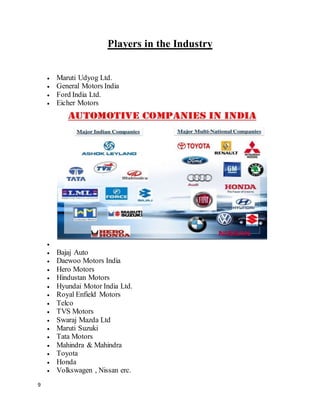
Players in the Industry
 Maruti Udyog Ltd.
 General Motors India
 Ford India Ltd.
 Eicher Motors

 Bajaj Auto
 Daewoo Motors India
 Hero Motors
 Hindustan Motors
 Hyundai Motor India Ltd.
 Royal Enfield Motors
 Telco
 TVS Motors
 Swaraj Mazda Ltd
 Maruti Suzuki
 Tata Motors
 Mahindra & Mahindra
 Toyota
 Honda
 Volkswagen , Nissan erc.
10
Nature of Competition From an economist’s perspective in the
industry
Following types of competition ins exists in Indian Automobile Industry :
Perfect Competition
Monopolistic Competition
Oligopoly
Monopolistic Competition :
Current Trends in the current Monopolistic Automobile Market :
Considering huge market potential, production of passenger cars is projected to
grow at CAGR of 11% between 2010-11 and 2013-2014.
Oligopoly Competition :
Transformation from Oligopoly to Monopolistic Market :
Causes Of Transformation :
Sanjay Gandhiowned Maruti Technical Services Limited , which was liquidatd .
After his death , Indira Gandhi Government collaborated with Suzuki Motors , a
Japanese firm , for collaboration- formation of Maruti Udyog Limited and renamed
after later Maruti Suzuki in 2007.
New Industrial Policy in july 1991 by Congress Government led by Mr. Narsinha
Rao. It unshackled Indian industrial economy from unnecessary bureaucratic
model. It introduced liberalization poliies – Abolishment of License Raj.
April 1993 – Government removed motor cars from list of industries reserved for
compulsory licensing.
Effects Of Transformation:
11
New firm including foreign players entered with modern engineering , efficient
processes and modern shop-floorlayouts.
Indian automobile industry grew at 19.31% per annum in post1991 era compared
to 8.56% during 1985-91
Delicencing of sectorattracted many major Global OEMs (G.M., Ford, Honda,
Hyundai etc.) to start assembly in India.
Impact of Oligopolystructure :
Impact on Automobile Industry –
a) Growth very slow becauseof low demand and low economic status of the
country
b) Government restrictions provided no motivation or incentive foe firms to
technological upgradation.
c) Supply was low and there weren’t many competitors.
Impact on Cosumers –
Cosumers did not have many choices;the demand was fairly low as cars were
still a luxury and availability of same models.
12
Top 3 Players in the industry with marketshare :
 Maruti Suzuki India Limited ( 37% Market Share)
 Hyundai Motors India Limited (14.4% Market Share)
 Tata Motors(13.1% Market Share)
Bottom 3 players in the industry with market share :
 Honda (2.9% Market Share)
 Volkswagen (2.4% Market Share)
 Nissan ( 1.5% Market Share)
ClassificationofPlayers :
Leaders :
 Maruti Suzuki
 Hyundai Motors India Limited
 Tata Motors
Followers :
 Mahindra and Mahindra
 General Motors India Private Limited
 Ford India
Challengers :
 Honda
 Volkswagen
 Nissan
Nichers :
Maruti Suzuki India Limited
13
Profile of Top 3 Companies
Maruti Suzuki India Limited
Type Public
Traded as
BSE: 532500
NSE: MARUTI
BSE SENSEX Constituent
Industry Automotive
Predecessor(s) Maruti Udyog Limited
Founded 1981
Headquarters New Delhi, India[1]
Key people
RC Bhargava[2] (Chairman)
Kenichi Ayukawa[3] (CEO &
MD)
Products Automobiles
Revenue
369.34 billion
(US$5.9 billion) (2012)[4]
Net income
16.81 billion
(US$270 million) (2012)[4]
Employees 6,903 (2011)[5]
Parent Suzuki[6]
Website www.marutisuzuki.com
Maruti Suzuki India Limited (/marut̪i suzuki/), commonly referred to as Maruti
and formerly known as Maruti Udyog Limited, is an automobile manufacturer in
India.[7] It is a subsidiary of Japanese automobile and motorcycle manufacturer
Suzuki.[6] As of November 2012, it had a market share of 37% of the Indian
passenger car market.[8] Maruti Suzuki manufactures and sells a complete range of
cars from the entry level Alto, to the hatchback Ritz, A-Star, Swift, Wagon R, Zen
14
and sedans DZire, Kizashi and SX4, in the 'C' segment Eeco, Omni, Multi Purpose
vehicle Suzuki Ertiga and Sports Utility vehicle Grand Vitara.[9]
The company's headquarters are on Nelson Mandela Road, New Delhi.[1] In
February 2012, the company sold its ten millionth vehicle in India.[10]
History
Originally, 18.28% of the company was owned by the Indian government, and
54.2% by Suzuki of Japan. The BJP-led government held an initial public offering
of 25% of the company in June 2003. As of May 2007, the government of India
sold its complete share to Indian financial institutions and no longer has any stake
in Maruti Udyog.[11]
Maruti Udyog Limited (MUL) was established in February 1981, though the
actual production commenced in 1983 with the Maruti 800, based on the Suzuki
Alto kei car which at the time was the only modern car available in India, its only
competitors - the Hindustan Ambassador and Premier Padmini - were both around
25 years out of date at that point. Through 2004, Maruti Suzuki has produced over
5 Million vehicles. Maruti Suzukis are sold in India and various several other
countries, depending upon export orders. Models similar to those made by Maruti
in India, albeit not assembled or fully manufactured in India or Japan are sold by
Pak Suzuki Motors in Pakistan.
The company exports more than 50,000 cars annually and has domestic sales of
730,000 cars annually.[citation needed] Its manufacturing facilities are located at two
facilities Gurgaon and Manesar in Haryana, south of Delhi. Maruti Suzuki’s
Gurgaon facility has an installed capacity of 900,000 units per annum. The
Manesar facilities, launched in February 2007 comprise a vehicle assembly plant
with a capacity of 550,000 units per year and a Diesel Engine plant with an annual
capacity of 100,000 engines and transmissions. Manesar and Gurgaon facilities
have a combined capability to produceover 14,50,000 units annually.
About 35% of [8] all cars sold in India are made by Maruti. The company is 54.2%
owned by the Japanese multinational Suzuki Motor Corporation per cent of Maruti
Suzuki. The rest is owned by public and financial institutions. It is listed on the
Bombay StockExchange and National StockExchange of India.[citation needed]
15
During 2007 and 2008, Maruti Suzuki sold 764,842 cars, of which 53,024 were
exported. In all, over six million Maruti Suzuki cars are on Indian roads since the
first car was rolled out on 14 December 1983.
The Suzuki Motor Corporation, Maruti's main stakeholder, has been a global leader
in mini and compactcars for three decades. Suzuki’s strategy is to utilise light-
weight, compactengines with stronger power, fuel-efficiency and performance
capabilities. Nearly 75,000 people are employed directly by Maruti Suzuki and its
partners. It has been rated first in customer satisfaction among all car makers in
India from 1999 to 2009 by J D Power Asia Pacific.[12] Maruti Suzuki will be
introducing new 800 cc model by Diwali in 2012.The model is supposed to be fuel
efficient, and therefore more expensive.[13] With increasing market competition in
the small car segment, a new model along with the upcoming WagonR Stingray
will be the key fresh products for Maruti Suzuki India (MSI) to defend its market
share amid the ever increasing competition[14]
Products and services :
1. 800 (1983) (still distributed to some cities like Guwahati) Competes with
Tata Nano, Maruti Alto and Maruti Omni
2. Omni (launched 1984) Competes with Tata Nano, Tata Venture, Maruti 800
and Maruti Eeco
3. Gypsy King (launched 1985) India's first indegenious vehicle and first
compactSAV, competes with Mahindra Thar CRDe, Tata Sumo 4x4 and
ForceGurkha
4. WagonR (launched 1999) Competes with Nissan Micra Active, Maruti A-
star and Hyundai i10
5. Swift (launched 2005) Created a Maruti 800 rivalling benchmark, competes
with Tata Vista, Hyundai i20, SkodaFabia, Volkswagen Polo and Toyota
Etios Liva
6. SX4 (launched 2007) Soonto be replaced by the upcoming sedan
codenamed YL1, competes with Ford Fiesta, Hyundai Verna, Honda City,
SkodaRapid, Volkswagen Vento, Renault Scala and Nissan Sunny
7. Swift DZire (launched 2008) Competes with Mahindra Verito, Toyota
Etios, Ford Classic, Mahindra Verito Vibe, Honda Amaze, Chevrolet Sail,
SkodaFabia and Tata Manza
8. A-star (launched 2008) Competes with Chevrolet Beat, Nissan Micra
Active, Ford Figo and Maruti Wagon-R Stingray
16
9. Ritz (launched 2009) Competes with Maruti Swift, Tata Vista, Hyundai
Grand i10, Honda Brio, Nissan Micra, Renault Pulse and ToyotaEtios Liva
10.Eeco (launched 2010) Stripped down Versa with a lowered roof, in
competition with Tata Venture, Tata Winger Platinum, and in-house Omni
11.Alto K10 (launched 2010), competes in the economy class with the Tata
Indica, Hindustan Motors Ambassadorand Chevrolet Spark
12.Maruti Ertiga (launched 2012), seven seater MPV R3 designed and
developed in India, in competition with Toyota Innova, Mahindra Xylo,
Nissan Evalia, Ashok Leyland Stile and Tata Sumo Grande.[50] In early
2012, Suzuki Ertiga will be exported first to Indonesia in Completely Knock
Down car.[51]
13.Maruti XA Alpha based compactSUV to compete with the Ford EcoSport,
Mahindra Xylo Quanto, Nissan Terrano & Renault Duster will be launched
in the year 2014
14.Maruti Alto 800, launched in 2012, Competes with Tata Nano
15.Maruti Stingray, launched in 2013, Competes with Maruti A-star,
Chevrolet Beat and Chevrolet Sail
17
DifferenciationStrategies ofMaruti Suzuki :
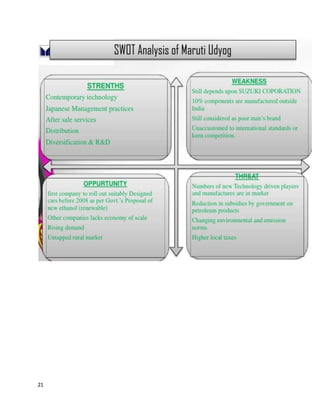
Maruti-Suzuki use differentiated marketing to attract all segments. Others, such as
Hyundai, and Microsoft appeal to two or more segments, but not all segments.
Differenciation strategies of Maruti Suzuki takes different forms :
Brand Name : Maruti Suzuki
Technology : The highly fuel efficient, technologically advanced K series engines
have been very well appreciated by our customers for their performance.
Service : best service and highest number of service centers.
Dealers network : Highest
Quality : value for money
Performance, mileage best match with Indian road conditions, less maintenance
cost, resale price.
18
Marketing Mix of Maruti Suzuki :
Product :
There are number of products ofMaruti in the market. Some of the models are
given below :
Maruti-800, Zen, Esteem, Omni, Alto, Gypsy,Wagnor, Grand vitara , Ertiga etc.
These products are divided on the basis of product, quality, variety, design,
features etc.
Price :
The price of maruti car is between Rs.187000 to Rs.1500000.Maruti 800 is the
lowest price car of this company. Alto, Wagnar, Omni are also the low price car of
the company.Zen, Esteem are the mid price car of the company.But Grand Vitara
is the high price model of the company.Theprice of the car are decided according
to its productvariety, quality, design etc. Their pricing strategy is to provide an
option to every customer looking for upgradation in his car.
Place :
Maruti Suzuki has their dealers in different regions of the country like ; Pune,
Mumbai, Delhi etc.
2628 number of workshops that provide customers with maintenance supportin
1220 cities.
Maruti had built a strong network of 600 outlets spread over 393 towns and cities.
Vendors of Maruti Suzuki :
Maruti Suzuki has 200 vendors.
1) Bimetal Bearings Ltd. , Coimbatore –
They manufactures engine bearings, bushes and thrust washers.
2) Amalgamation Valeo Clutch Ltd. , Mumbai –
Leading manufacturer of cluch assemblies in India for new generation
vehicles.
3) I.P.Repco Ltd. , Chennai –
19
Member of Amalgamations group , manufacturing Fiywheel Ring Gears for
engine range of vehicles.
4) Lumax Industries Ltd. –
Biggest manufacturers of Automotive Lights in India.
5) Pricol Ltd., Coimbatore –
Automotive instruments and speed meter cables in India.
6) Fennar India Ltd., Chennai –
Largest manufacturer of Belts and oil seals in India.
Geographical spread Of plants of Maruti Suzuki :
Gurgaon , Manesar, New Delhi, Gujarat etc.
Promotion :
Maruti Suzuki uses following promotional tools:
Advertising –
Television Ads
Print Ads
Radio Ads
Slogan : “Ghar Aa Gaya Hindustan”
Information advertising, alternative advertising options.
BTL- Sponsorships
TV shows-India’s GotTallent
Place advertising- Bill Boards
Sales Promotion-
Productwarranties
Premiums (gifts)
20
Trade shows etc.
Maruti and Customer Relationship Management :
Maruti has created a landmark in CRM by launching a website for the customers in
the year 1998.
Maruti is investing a lot of money and efforts in building customer loyalty
programmes.
21
22
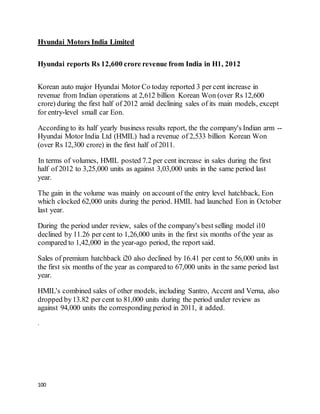
Hyundai Motors India Limited
Drive your way
Type Subsidiary
Industry Automotive
Founded 6 May 1996
Headquarters
Sriperumbudur, Kanchipuram
district, Tamil Nadu, India
Key people Mr. Bo Shin Seo (MD)
Products Automobiles
Parent Hyundai Motor Company
Website www.hyundai.co.in
Hyundai Motor India Limited is a wholly owned subsidiary of the Hyundai
Motor Company in India. It is the 2Hyundai Motor India Limited is currently the
second largest auto exporter from India.[69] It is making India the global
manufacturing basefor small cars.
Hyundai sells several models in India, the most popular being the Santro Xing, i10,
Hyundai EON and the i20. On 3 September 2013, Hyundai launched its much-
awaited car, Grand i10 in petrol and diesel variants. Other models include the Getz,
Accent, Elantra, second generation Verna, Santa Fe and the Sonata Transform.
Hyundai has two manufacturing plants in India located at Sriperumbudur in the
Indian state of Tamil Nadu. Both plants have a combined annual capacity of
600,000 units. In the year 2007, Hyundai opened its R&D facility in Hyderabad,
employing now nearly 450 engineers from different parts of the country. Hyundai
Motor India Engineering (HMIE) gives technical & engineering supportin vehicle
development and CAD & CAE supportto Hyundai's main R&D centre in
Namyang, Korea.
In 2010, Hyundai started its design activities at Hyderabad R&D Centre with
Styling, Digital Design & Skin CAD Teams.
23
Hyundai Motor India Limited was formed in 6 May 1996 by the Hyundai Motor
Company of South Korea. When Hyundai Motor Company entered the Indian
Automobile Market in 1996 the Hyundai brand was almost unknown throughout
India. During the entry of Hyundai in 1996, there were only five major automobile
manufacturers in India, i.e. Maruti, Hindustan, Premier, Tata and Mahindra.
Daewoo had entered the Indian automobile market with Cielo just three years back
while Ford, Opel and Honda had entered less than a year back.
For more than a decade till Hyundai arrived, Maruti Suzuki had a near monopoly
over the passenger cars segment because TELCO and M&M were solely utility
and commercial vehicle manufacturers, while Hindustan and Premier both built
outdated and uncompetitive products.
History
HMIL's first car, the Hyundai Santro was launched in 23 September 1998 and was
a runaway success. Within a few months of its inception HMIL became the second
largest automobile manufacturer and the largest automobile exporter in India.
Hyundai Motor India Limited (HMIL) is a wholly owned subsidiary of Hyundai
Motor Company (HMC), South Korea and is the largest passenger car exporter and
the second largest car manufacturer in India. HMIL presently markets 6 models of
passenger cars across segments. The A2 segment includes the Santro, i10,eon and
the i20, the A3 segment includes the Accent and the fluidic Verna and the fluidic
elantra, the A5 segment includes the Sonata Transform and the SUV segment
includes the Santa Fe.
HMIL’s manufacturing plant near Chennai claims to have the most advanced
production, quality and testing capabilities in the country.[citation needed] To cater to
rising demand, HMIL commissioned its second plant in February 2008, which
produces an additional 300,000 units per annum, raising HMIL’s total production
capacity to 600,000 units per annum.
HMC has set up a research and development facility(Hyundai Motor India
Engineering - HMIE) in the cyber city of Hyderabad.
As HMC’s global export hub for compactcars, HMIL is the first automotive
company in India to achieve the export of 10 lakh cars in just over a decade. HMIL
currently exports cars to more than 120 countries across EU, Africa, Middle East,
Latin America, Asia and Australia. It has been the number one exporter of
passenger cars of the country for the sixth year in a row.[citation needed]
24
To supportits growth and expansion plans, HMIL currently has a 307 strong dealer
network and 627 strong service points across India, which will see further
expansion in 2010.[citation needed] In July 2012, Arvind Saxena, the Director of
Marketing and Sales stepped down from the position after serving the company for
7 long years.[1]
Products :
1. Hyundai Accent Executive (Launched 2011)
2. Hyundai Santro Xing (Launched 2003)
3. Hyundai Uber Cooli20 (Launched 2008)
4. Hyundai Next Gen i10 (Launched 2010)
5. Hyundai Grand i10 (Launched 2013)
6. Hyundai Fluidic Verna (Launched 2011)
7. Hyundai EON (Launched 2011)
8. Hyundai Neo Fluidic Elantra (Launched 2012)
Imported
1. Hyundai Terracan (2003–2007)
2. Hyundai Elantra (2004–2010)
3. Hyundai Tucson(2005–2010)
4. Hyundai Sonata Transform (2010–2011)
5. Hyundai Santa Fe (Launched 2010)
6. Hyundai Sonata (Launched 2010)
25
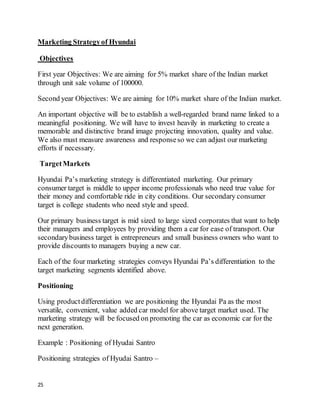
Marketing Strategyof Hyundai
Objectives
First year Objectives: We are aiming for 5% market share of the Indian market
through unit sale volume of 100000.
Second year Objectives: We are aiming for 10% market share of the Indian market.
An important objective will be to establish a well-regarded brand name linked to a
meaningful positioning. We will have to invest heavily in marketing to create a
memorable and distinctive brand image projecting innovation, quality and value.
We also must measure awareness and responseso we can adjust our marketing
efforts if necessary.
TargetMarkets
Hyundai Pa’s marketing strategy is differentiated marketing. Our primary
consumer target is middle to upper income professionals who need true value for
their money and comfortable ride in city conditions. Our secondary consumer
target is college students who need style and speed.
Our primary business target is mid sized to large sized corporates that want to help
their managers and employees by providing them a car for ease of transport. Our
secondarybusiness target is entrepreneurs and small business owners who want to
provide discounts to managers buying a new car.
Each of the four marketing strategies conveys Hyundai Pa’s differentiation to the
target marketing segments identified above.
Positioning
Using productdifferentiation we are positioning the Hyundai Pa as the most
versatile, convenient, value added car model for above target market used. The
marketing strategy will be focused on promoting the car as economic car for the
next generation.
Example : Positioning of Hyudai Santro
Positioning strategies of Hyudai Santro –
26
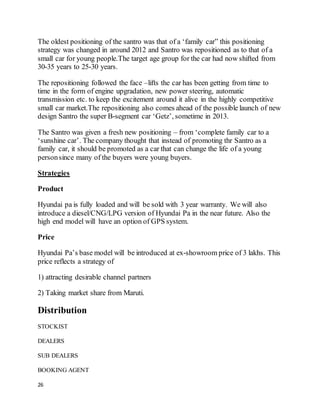
The oldest positioning of the santro was that of a ‘family car” this positioning
strategy was changed in around 2012 and Santro was repositioned as to that of a
small car for young people.The target age group for the car had now shifted from
30-35 years to 25-30 years.
The repositioning followed the face –lifts the car has been getting from time to
time in the form of engine upgradation, new power steering, automatic
transmission etc. to keep the excitement around it alive in the highly competitive
small car market.The repositioning also comes ahead of the possible launch of new
design Santro the super B-segment car ‘Getz’, sometime in 2013.
The Santro was given a fresh new positioning – from ‘complete family car to a
‘sunshine car’. The company thought that instead of promoting thr Santro as a
family car, it should be promoted as a car that can change the life of a young
personsince many of the buyers were young buyers.
Strategies
Product
Hyundai pa is fully loaded and will be sold with 3 year warranty. We will also
introduce a diesel/CNG/LPG version of Hyundai Pa in the near future. Also the
high end model will have an option of GPS system.
Price
Hyundai Pa’s base model will be introduced at ex-showroom price of 3 lakhs. This
price reflects a strategy of
1) attracting desirable channel partners
2) Taking market share from Maruti.
Distribution
STOCKIST
DEALERS
SUB DEALERS
BOOKING AGENT
27
Marketing Mix
Product
The all-new “Hyundai Pa” is fully loaded with a range of exciting new features. It's
a perfect complement to your evolved tastes and lifestyle. And the best way to take
your driving pleasure to a brand-new high. European Styling. Japanese
Engineering. Dream-Like Handling.
The new Hyundai Pa is a generation different from Getz and Santro design. Styled
with a clear sense of muscularity, its one-and-a-half box, aggressive form makes
for a look of stability, a sense that it is packed with energy and ready to deliver a
dynamic drive.
Price
Hyundai is expected to take Maruti heads on with the pricing of their upcoming
Hyundai Pa car. After launching cars for the masses since so many years, India’s
second largest automobile manufacturer is now targeting the premium segment
with their latest model from the Hyundai’s stable. The analysts predict the pricing
of this premium hunchback to start from Rs. 3 lakh.
This price range would practically rip apart Maruti’s offering in Zen Estilo, which
is priced at a higher tag of Rs. 3.5 lakh. Both the companies are known for their
value based offerings and Hyundai with their extensive service network and brand
reputation for making reliable cars should get the customer’s nod over their
competition.
The official pricing however is still not out. However, the company is said to be
studying the prospects oflaunching the base model at the 3 - lakh price tag.
Place
Sales and service network
As of March 2011, HMIL has 451 dealerships and more than 647 Hyundai
Authorised Service Centers in 340 cities across India. HMIL also operates its own
dealerships known as HyundaiMotor Plazas in large metros across India. HMIL
has the second largest sales and service network in India after Maruti Suzuki.[citation
needed]
28
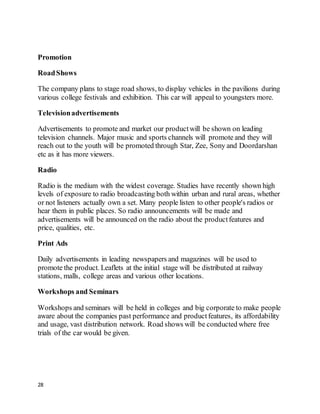
Promotion
RoadShows
The company plans to stage road shows, to display vehicles in the pavilions during
various college festivals and exhibition. This car will appeal to youngsters more.
Televisionadvertisements
Advertisements to promote and market our productwill be shown on leading
television channels. Major music and sports channels will promote and they will
reach out to the youth will be promoted through Star, Zee, Sony and Doordarshan
etc as it has more viewers.
Radio
Radio is the medium with the widest coverage. Studies have recently shown high
levels of exposure to radio broadcasting both within urban and rural areas, whether
or not listeners actually own a set. Many people listen to other people's radios or
hear them in public places. So radio announcements will be made and
advertisements will be announced on the radio about the productfeatures and
price, qualities, etc.
Print Ads
Daily advertisements in leading newspapers and magazines will be used to
promote the product. Leaflets at the initial stage will be distributed at railway
stations, malls, college areas and various other locations.
Workshops and Seminars
Workshops and seminars will be held in colleges and big corporate to make people
aware about the companies past performance and productfeatures, its affordability
and usage, vast distribution network. Road shows will be conducted where free
trials of the car would be given.
29
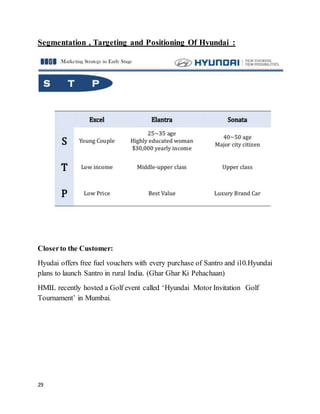
Segmentation , Targeting and Positioning Of Hyundai :
Closerto the Customer:
Hyudai offers free fuel vouchers with every purchase of Santro and i10.Hyundai
plans to launch Santro in rural India. (Ghar Ghar Ki Pehachaan)
HMIL recently hosted a Golf event called ‘Hyundai Motor Invitation Golf
Tournament’ in Mumbai.
30
Hyundai Motor India Limited – SWOT Analysis
Strengths:
• HMIL has managed to gain customers loyalty and trust by serving them with
superior technology.
• The Korean car manufacturer has almost become like an Indian brand due to its
long time presence in the Indian market
• HMIL has the second largest market share in overall passenger car segment next
to Maruti Suzuki
• Hyundai Motor India limited is the largest car exporter from Asian Market which
showed a 10% growth compared to last FY
• The domestic sales has witnessed an average growth rate of 19.1%
• HMIL has proved itself by manufacturing cars which suits Indian road conditions
and it has superior quality compared to its competitor MUL in its respective
segments.
• HMIL involves itself in lot of CSR activities by donating funds and vehicles to
the government
Weaknesses
• HMIL is not the first mover in the Indian market, hence it is difficult to capture
the rural market
• Maruti is more reputed and trusted brand in Indian automobile industry among
customers
• Hyundai has lesser network of service stations on highways
• In SUV segment both Tucson and its next model Santa Fe dint make a major
impact
• Since HMIL concentrates on both domestic and International sales there are
higher risks of exchange rate fluctuations
• Hyundai products are not cost effective as it doesn’t compromise its quality
31
Opportunities
• Hyundai may act as threat to Maruti Alto’s market territory
• The labour issues in Maruti Suzuki has affected production and inturn the overall
sales and brand name has been affected. Hyundai can use this opportunity to boost
up sales and expand the market
• SIAM – Society of Indian automobile Manufacturers, have indicated there is
potential market in abroad for the cars exported by HMIL
• There is more scope of HMIL to enter into small car segment as its has dedicated
R&D plant in Hyderabad, India. Hyundai is one of the very few companies that has
widest R&D network across the world located in Korea, Europe, India, US, Japan
• Hyundai has very good opportunity in entering into commercial vehicles and
Recreational vehicles as they are already doing well outside India. Currently HMIL
has its focus only on Passenger car segment
Threats
• Though MSIL seems to be a direct competitor for Hyundai, there are other major
players like Tata, Mahindra imposing a strong threat for Hyundai Motors India to
expand its product category
• Foreign Direct Investments flowing in Indian automobile space are not good
signs for already existing Giants like MUL and Hyundai.
• The increase in petrol prices have paralysed the sales of overall petrol vehicles
• People doesn’t prefer to make new investments as there are more job cuts due to
global economic crisis
• Almost all major automobile players have started invading India to open up their
market and their manufacturing plant in India.”Chennai” is referred to as the
Detroit of Asia!
• Hyundai faced a slight decline in market share due to tough competition from
Ford’s Figo and Volkswagen- Polo
• Many manufacturers have started to concentrate on small car segment as an
alternative to Nano. These will slowdown the expected sales of Eon.
• Maruti new 800 diesel may increase the threats to HMIL
32
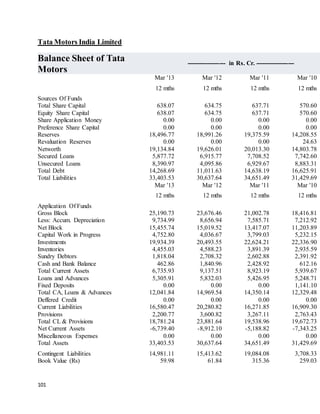
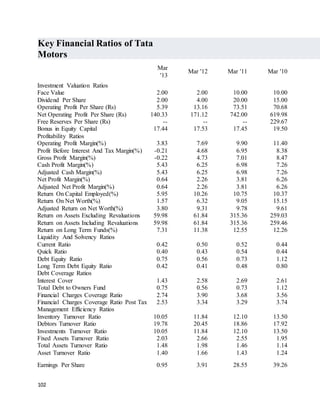
Tata Motors
Type Public
Traded as
BSE: 500570 (BSE SENSEX
Constituent)
NSE: TATAMOTORS
NYSE: TTM
Industry Automotive
Founded 1945
Founder(s) J. R. D. Tata
Headquarters Mumbai, Maharashtra, India
Area served Worldwide
Key people
Ratan Tata (Chairman
Emeritus)
Cyrus Pallonji Mistry
(Chairman)
Karl Slym (died 26 January
2014, Managing Director)
Ravi Kant (Vice Chairman)
Products
Automobiles
Commercial vehicles
Coaches
Buses
Construction equipment
Military vehicles
Automotive parts
Services
Automotive design,
engineering and outsourcing
services
Vehicle leasing
Vehicle service
Revenue
US$ 34.7 billion (FY 2012-
13)[4]
Operating US$ 3.06 billion (2012)[4]
33
income
Profit US$ 2.28 billion (2012)
Totalassets US$ 28.05 billion (2012)
Totalequity US$ 6.44 billion (2012)
Employees 59,759 (2012)[4]
Parent Tata Group
Divisions Tata Motors Cars
Subsidiaries
Jaguar Land Rover
Tata Daewoo
Tata Hispano
Website www.tatamotors.com
Tata Motors Limited (formerly TELCO, short for Tata Engineering and
Locomotive Company) is an Indian multinational automotive manufacturing
company headquartered in Mumbai, Maharashtra, India and a subsidiary of the
Tata Group. Its products include passenger cars, trucks, vans, coaches, buses,
construction equipment and military vehicles. It is the world's sixteenth-largest
motor vehicle manufacturing company, fourth-largest truck manufacturer and
second-largest bus manufacturer by volume.[5]
Tata Motors has auto manufacturing and assembly plants in Jamshedpur,
Pantnagar, Lucknow, Sanand, Dharwad and Pune in India, as well as in Argentina,
South Africa, Thailand and the United Kingdom. It has research and development
centres in Pune, Jamshedpur, Lucknow and Dharwad, India, and in South Korea,
Spain, and the United Kingdom. Tata Motors' principal subsidiaries include the
British premium car maker Jaguar Land Rover (the maker of Jaguar, Land Rover
and Range Rover cars) and the South Korean commercial vehicle manufactuer
Tata Daewoo. Tata Motors has a bus manufacturing joint venture with Marcopolo
S.A. (Tata Marcopolo), a construction equipment manufacturing joint venture with
Hitachi (Tata Hitachi Construction Machinery) and a joint venture with Fiat which
manufactures automotive components and Fiat and Tata branded vehicles.
Founded in 1945 as a manufacturer of locomotives, the company manufactured its
first commercial vehicle in 1954 in a collaboration with Daimler-Benz AG, which
ended in 1969. Tata Motors entered the passenger vehicle market in 1991 with the
launch of the Tata Sierra, becoming the first Indian manufacturer to achieve the
capability of developing a competitive indigenous automobile.[6] In 1998 Tata
launched the first fully indigenous Indian passenger car, the Indica, and in 2008
34
launched the Tata Nano, the world's cheapest car. Tata Motors acquired the South
Korean truck manufacturer Daewoo Commercial Vehicles Company in 2004 and
purchased Jaguar Land Rover from Ford in 2008.
Tata entered the commercial vehicle sector in 1954 after forming a joint venture
with Daimler-Benz of Germany. After years of dominating the commercial vehicle
market in India, Tata Motors entered the passenger vehicle market in 1991 by
launching the Tata Sierra, a multi utility vehicle. Tata subsequently launched the
Tata Estate (1992; a station wagon design based on the earlier 'TataMobile' (1989),
a light commercial vehicle), the Tata Sumo (1994; LCV) and the Tata Safari
(1998; India's first sports utility vehicle).
Tata launched the Indica in 1998, the first fully indigenous Indian passenger car.
Although initially criticised by auto-analysts, its excellent fuel economy, powerful
engine and an aggressive marketing strategy made it one of the bestselling cars in
the history of the Indian automobile industry. A newer version of the car, named
Indica V2, was a major improvement over the previous version and quickly
became a mass-favourite. Tata Motors also successfully exported large quantities
of the car to South Africa. The success ofIndica played a key role in the growth of
Tata Motors.[7]
In 2004 Tata Motors acquired Daewoo's South Korea-based truck manufacturing
unit, Daewoo Commercial Vehicles Company, later renamed Tata Daewoo.[8]
On 27 September 2004, Tata Motors rang the opening bell at the New York Stock
Exchange (NYSE) to mark the listing of Tata Motors.[9]
In 2005, Tata Motors acquired a 21% controlling stake in the Spanish bus and
coachmanufacturer Hispano Carrocera.[10] Tata Motors continued its market area
expansion through the introduction of new products suchas buses (Starbus &
Globus, jointly developed with subsidiary Hispano Carrocera) and trucks (Novus,
jointly developed with subsidiary Tata Daewoo).
In 2006, Tata formed a joint venture with the Brazil-based Marcopolo, Tata
Marcopolo Bus, to manufacture fully built buses and coaches.[11]
In 2008, Tata Motors acquired the British car maker Jaguar Land Rover,
manufacturer of the Jaguar, Land Rover and Daimler luxury car brands, from Ford
Motor Company.[12][13][14][15]
35
In May 2009 Tata unveiled the Tata World Truck range jointly developed with
Tata Daewoo;[16] the range went in sale in South Korea, South Africa, the SAARC
countries and the Middle-East at the end of 2009.[16]
Tata acquired full ownership of Hispano Carrocera in 2009.[17]
In 2010, Tata Motors acquired an 80% stake in the Italian design and engineering
company Trilix for €1.85 million. The acquisition formed part of the company's
plan to enhance its styling and design capabilities.[18]
In 2012, Tata Motors announced it would invest around 6 billion in the
development of Futuristic Infantry Combat Vehicles in collaboration with
DRDO.[19]
In 2013, Tata Motors announced it will sell in India, the first vehicle in the world
to run on compressed air (engines designed by the French company MDI) and
dubbed "Mini CAT".
Tata Technologies
Tata Technologies Limited (TTL) is an 86.91% owned subsidiary of Tata Motors
which provides design, engineering and business process outsourcing services to
the automotive industry. It is headquartered in Pune (Hinjewadi) and also has
operations in Detroit, London and Thailand. TTL's clients include Ford, General
Motors, Honda and Toyota.
The British engineering and design services company Incat International, which
specialises in engineering and design services and productlifecycle management in
the automotive, aerospaceand engineering sectors, is a wholly owned subsidiary of
TTL. It was acquired by TTL in August 2005 for 4 billion.
European TechnicalCentre
The Tata Motors European Technical Centre (TMETC) is an automotive design,
engineering and research company based at the campus of the University of
Warwick in the United Kingdom. It was established in 2005 and is a wholly owned
subsidiary of Tata Motors. It was the joint developer of the World Truck.[34]
36
Marketing Mix of TATA MOTORS
Tata motors is a leading automobile brand. It is most widely known for its
commercial vehicles such as buses and trucks. However, TATA motors has also
started an excellent expansion in passenger cars and it is rapidly gaining market
share. The Marketing mix of Tata Motors talks about the 4P of the brand which has
helped the brand rise in the automobile empire.
1. Product: Tata has a very wide range of products it has passenger cars, utility
vehicles, Trucks, Commercial passenger Carriers And Defence Vehicles
Passenger
cars
UtilityVehiclesTrucks Commercial
PassengerCarriers
Indica vista Safari Dicor Tata
Novas
Buses
Indigo XL Sumo Grande TL 4×4 Winger
Nano Sumo Magic
Fiat cars Xenon XT
2. Price: The prices of Tata motors are generally affordable acceptable by the
general public at large. Tata always have something for the lower class people with
Nano being their trump card. Giving discount every month and special promotion
for certain type of vehicle also one of the strong strategy use by Tata Motors.
Discount can be made from Company’s profit or from dealer’s profit at certain
range.
3. Place: Tata Motors has an extensive dealer network covering Indian and
International markets. Wherever you are, there is a Tata Motors Sales and Service
dealership close to you. The channel of distribution, physical location, and
dealership method of distribution and sales is generally adopted. The distribution
of vehicle must be in a very systematic way, from the plant to dealership and to
end user. This is not only in India itself but also to the world-wide dealership.
4. Promotion: Tata motors promote their products via Advetising and after sales
services
5. People: Tata Motors owe our success to the highly motivated and talented staff.
Our recruitment division picks the crème-de-la-crème from premier universities,
management and engineering institutes in India. they put them through rigorous
37
training programmes to hone their entrepreneurial skills and impart comprehensive
product knowledge.
6. Processes: Tata motors follow Balanced Scorecard Collaborative, Inc for
achieving excellence in overall Company performance.
7. Physical Evidence: The management of the company has managed to keep their
hopes alive even in this recession and hopes that the worse is behind Tata Motors
recently launched the most awaited car of the year, Tata Nano and the company
has already received 203,000 booking that are fully paid and 70 percent of the
applicants are ready to wait till the end of 2010 for the car to be manufactured.
Positioning Strategies OfTata Motors :
Example : Tata Indica
It has positioned Indica as ‘more car per car’. The new car offers more space, more
style,more power and more options. Emphasizing the delivery of world class
quality. They have tried to redefine the small car market as It has been understood
in India.
38
Bottom 3 Companies
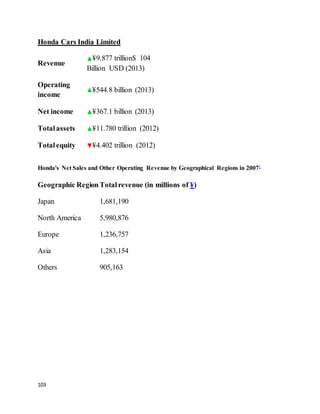
Honda Cars India Limited
Type Subsidiary
Industry Automotive
Founded December 1995
Headquarters
Greater Noida, Uttar
Pradesh
Number of
locations
Greater Noida, Uttar
Pradesh
Bhiwadi, Rajasthan
Key people
Mr. Hironori Kanayama,
President and CEO
Products Automobiles
Parent Honda
Website hondacarindia.com
Honda Cars India Ltd. (HCIL) is a subsidiary of the Honda of Japan for the
production, marketing and export of passenger cars in India. Formerly known as
Honda Siel Cars India Ltd, it began operations in December 1995 as a joint venture
between Honda Motor Company and Usha International of Siddharth Shriram
Group. In August, 2012, Honda bought out Usha International's entire 3.16 percent
stake for 1.8 billion in the joint venture. The company officially changed its name
to Honda Cars India Ltd. (HCIL) and became a 100% subsidiary of Honda.
It operates production facilities at Greater Noida in Uttar Pradesh and at Bhiwadi
in Rajasthan. The company's total investment in its productionfacilities in India as
of 2010 was over 16.2 billion.
39
Facilities
HCIL's first manufacturing unit at Greater Noida commenced operations in 1997.
Setup at an initial investment of over 4.5 billion, the plant is spread over 150
acres (0.61 km2). The initial capacity of the plant was 30,000 cars per annum,
which was thereafter increased to 50,000 cars on a two-shift basis. The capacity
has further been enhanced to 100,000 units annually as of 2008. This expansion led
to an increase in the covered area in the plant from 107,000 m² to over 130,000 m².
The company invested 7.8 billion in Bhiwadi for its second productionplant with
an annual productioncapacity of 50,000 units.[2] It operates under the ISO 9001
standard for quality management and ISO 14001 for environment management.
Honda setup its Third plant in India at Tapukara in Alwar District of Rajasthan,
spread over 450 acres with an investment of ₹3526 crores.[3]
HCIL produces the following vehicles in India for local and export markets:
 Honda City (Launched 1998)
 Honda Accord (Launched 2001, Production discontinued in 2013)
 Honda Civic (Launched 2006, Production discontinued in 2012)
 Honda Jazz (Launched 2009, Production temporarily discontinued in early 2013 in
anticipation of all-new model)
 Honda Brio (Launched 2011)
 Honda CR-V (Imported since 2003; 2013 model locally assembled)
 Honda Amaze (launched April 2013)
Sales
HCIL has 152 dealerships across 98 cities in 20 states and 3 Union Territories of
India.[4]
It sold 55,884 units during the period April '09 - February '10 as against 45,052
units during the same period a year ago, recording an increase of over 24%. Honda
jazz is known as Honda fit in other countries.
40
Marketing Mix Honda Motors
Honda motors has a strong marketing mix because of its dynamic use of the
productmarketing mix concept. Below we discuss the marketing mix of Honda
motors.
PRODUCT :
Available Car Models
Honda Jazz Honda City 2008 Honda Civic
Honda Accord2008 Honda Civic Hybrid Honda CR-V
Features:
Looks and Design:
The looks of the Honda cars is stunning or in other words we can say that it is an
outstanding design among its competitors.
Interiors:
Interiors are brilliantly designed, Multidimensional dash, Steering wheel with
audio controls, I pod connective music system, comfortable Seat, safety features
like Airbags etc
Engine, Gearbox and Performance:
I-VTEC engine, Smoothest engine widely spaced gear ratios, Paddle shift, Ride
and Handling, Independent suspension on the front, Wheel base ,ABS, Dual air
bags and EBD are standard feature of this car.
PRICE :
41
Ex ShowroomMumbai
Honda Jazz Jazzbasic
Rs. 743000Jazz
ModeRs. 773786
Jazz Active
Rs. 778871
Honda City 2008 Honda
City 1.5
EMTRs. 825100Honda
City 1.5 SMTRs. 879000
Honda City 1.5 SAT
Rs. 954900
Honda Civic Honda Civic
1.8 E MTRs. 1102300Honda
Civic 1.8 S MTRs. 1274300
Honda Civic 1.8 V MT
Rs. 1307900
Honda Civic 1.8 V AT
Rs. 1389400
Honda Accord2008
Honda AccordElegance
ATRs. 1833700Honda
Accord 2.4 (Base
Model)Rs. 1833700
Honda AccordInspire
MT
Rs. 1833700
Honda AccordElegance
MT
Rs. 1912400
Honda AccordInspire
AT
Rs. 1912400
Honda AccordV 6 3.5
Rs. 2532300
Honda AccordV 6 3.5
Inspire
Rs. 2532300
Honda Civic Hybrid Rs.
22,23,401
Honda CR-V Honda CR-V
2.0
2WD(MT)Rs.2203000Honda
CR-V 2.4 CR-
V(M/T)Rs. 2357200
Honda CR-V 2.4 CR-V(A/T)
Rs. 2430600
42
PLACE :
The Honda City, its first offering introduced in 1997, revolutionized the Indian
passenger car market and has ever since been recognized as an engineering marvel
in the Indian automobile industry. The company has a capacity of manufacturing
100,000 cars.
Sales and Distribution Network:
Strong sales and distribution network : 94 facilities and in 57 cities and 51
Exclusive Dealership. HSCI dealerships are based on the “3S Facility” (Sales,
Service, Spares) format, offering complete range of services to its customers.
Having established itself as a leading brand in the metros, the company is now
focusing on increasing its presence in tier-II towns and cities and plans to increase
its dealership network to more than 100 by the end of 2008-09 fiscal year.
The company is targeting 100 dealer outlets across India by 2009, as per their
expansion strategy which is based on the ’1 dealer per 1000 cars’ formula
PROMOTION :
Honda is a brand known for its quality and innovation. Honda was never into an
aggressive promotional activities but the company always tried to maintain the
quality and created a brand image by providing better customer service. Honda car
like Honda city is the largest seller in the segment and ranked fourth position in
passenger car segment.
Considering the advertisement, Honda has been very careful and precise in their
advertisements. Honda always projected their image as most reliable brand,
advanced technology, eco friendly cars. Even considering the television
commercials, Honda promoted their hybrid car that runs without gasoline and
emits water as the bye product rather than advertising the specific brands existing
in the market. The ad was more concentrated to the company’s technological
advancements and eco friendly image which differentiated Honda from the
competitors
43
Volkswagen India
Type Subsidiary
Industry Automotive
Founded 2007
Key
people
Mr. Mahesh Kodumudi, President
and Managing Director
Products Automobiles
Parent Volkswagen Group Sales India
Website www.volkswagen.co.in
VolkswagenIndia Private Limited is a subsidiary of Volkswagen Group Sales
India Private Limited that assembles, manufactures and distributes Volkswagen
vehicles in India. It was established in 2007.
Manufacturing facilities
Volkswagen India Private Limited operates a manufacturing plant in Chakan,
Maharashtra which is capable of producing 110,000 vehicles per annum. The plant
is also shared by ŠkodaAuto India Private Limited for assembling the ŠkodaFabia
& Rapid.
Manufactured locally
 Volkswagen Passat (2007–present)
44
 Volkswagen Jetta (2008–present)
 Volkswagen Polo (2010–2013)
 Volkswagen Vento (2010–present)
Sales performance
In the year 2010, VIPL recorded sales of 32,627 vehicles against 3,039 vehicles
sold during the year 2009 and registered a sales growth of over 1,000%.[2]
Fan club
A group of Volkswagen car enthusiasts started a fan club for Volkswagen vehicle
owners and fans and created Volkswagen Fans Club Community Website on 24th
March, 2012. Registered members discuss about their Volkswagen vehicles and
share their knowledge. They help each other in solving issues and guide those
people who are seeking to purchase new Volkswagen vehicle.
45
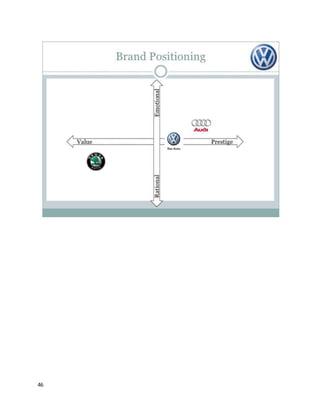
Marketing Mix of Volkswagen
Product :
15 different models under 3 brands.
Plant at Chakan, near Pune.
More assembly plans in India – competitive advantage.
Awards last year.
Price :
Targeted mainly for the luxury segment in the Indian market.
Plan to capture bigger market through the VW Polo.
Place :
Significant presence – number of dealerships and outlets across major cities.
Promotion:
Launched Integrated Marketing campaign in November, 2009.
Collaboration with DDB Mudra.
Evoke consumer awareness of VW as a brand.
Innovative promotional campaigns – OOH, print ads,TVCs.
Print media – Communicating benefits.
Television Commercials – Brand building.
AD CAMPAIGNS
Highlights the technical qualities it ensures.
“… tested by our engineers. So you don’t need to.”
Highlights Volkswagen as a composite brand.
Cars for different stages of life and career.
46
47
Nissan Motors India Private Limited
Type Subsidiary
Industry Automotive
Founded 2005
Headquarters Chennai, Tamil Nadu[1][2]
Area served India
Key people
Mr. Kenichiro YOMURA ,
CEO and MD
Products Automobiles
Parent
Renault Nissan Automotive
India Private Limited
Website www.nissan.in
NissanMotorIndia Private Limited is the Indian subsidiary of NissanMotor
Company of Japan.[3]
History
Nissan Motor India Private Limited (NMIPL) started its operations in India in
2005, with the launch of the Nissan X-Trail (T30), which was imported as a
CBU.[3]
Manufacturing facilities
NMIPL's manufacturing plant in Chennai can manufacture 200,000 vehicles per
annum. The Chennai Plant has an additional 200,000 vehicles per annum capacity
exclusively for French car maker Renault's Indian arm Renault India Private
Limited. The plant's combined capacity is 400,000 vehicles per annum.
48
The plant in Oragadam with an investment of 45 billion (US$720 million) covers
an area of 650 acres (2.6 km2).[4] It will manufacture the Nissan Micra for the
Indian and European market, besides various other models for the Indian market.[5]
Manufactured locally
1. Nissan Micra (launched 2010)
2. Nissan Sunny (launched 2011)
3. Nissan Evalia (launched 2012)
4. Nissan Terrano(launched 10/09/2013)
Imported
1. Nissan X-Trail (Launched 2005)
2. Nissan Teana (Launched 2007)
3. Nissan 370Z (Launched 2010)
Sales and service network
NMIPL has appointed Hover Automotive India for the Sales, Service, Parts,
Marketing & Dealer Development functions for Nissan vehicles in India. Nissan
currently has 40 dealerships across 39 cities in 17 states and 1 Union Territory of
India.[6]
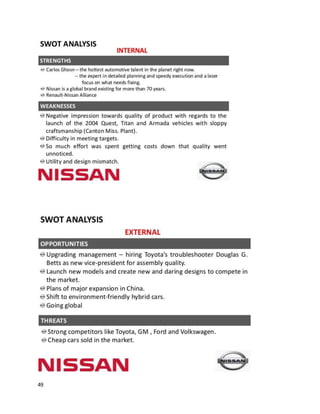
49
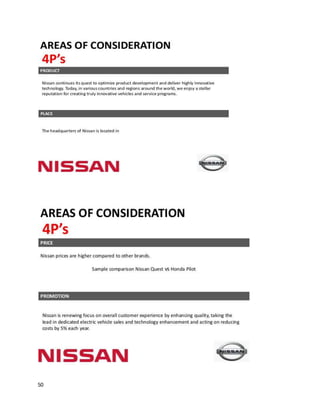
50
51
Geographical spread of Indian Automobile Industry
52
Demand and Supply balance in the Industry
The automobile industry crisis of 2008–2010 makes us wonder what are the
factorswhich lead to such a crisis. Let us discuss in detail the various demand and
supplyfactors which affect the automobile sector.
Demand Factors
1 . F i n a n c i n g O p t i o n s
Auto industry observers cite car loans as the biggest driving factor for the
expansionof the Compact Car segment. At present, almost 85 per cent of all new
car sales are backed by auto finance, compared to 65 per cent five years
ago.Interest rates on car loans have come down drastically in the past four or five
years,which helps prospective buyers take the plunge. The growth of the CC-
segment in the pastfew years can be mainly credited to factors such as rise in
income levels leadingto increased affordability and simultaneous reduction in
interest rates leading to lower EMIs. The drop in interest rates usually helps very
few people to probably shift fromthe base model to a deluxe model. A larger shift
happens if people are willing to takelong-term loans, like five years instead of the
earlier three-year loans.2.
Advertising And Marketing
Due to the advertising techniques adopted by all the manufacturers in the CC-
Segment the sales have risen drastically. It is all due to because the companies now
adays are using even aggressive selling techniques for which they are even coping
withthe Film celebrities and Cricket stars, like Maruti has contracted Irfan Pathan
as the brand ambassadorof Zen and for Santro Hyundai has contracted for Shah
Rukh Khan.And the companies are even trying to approachto the customer as to
there demand for a vehicle at special interest loans, etc. They are using data
according to the customersreturn and earning capacity for attracting the customers
for there vehicles.
3 . P r i c e O f T h e C a r
One of the major factors that affect the demand of any commodity in the market is
the price of the commodity. As the law of demand also states that with an increase
in price the demand of the commodity decreases and vice versa.Since, in the
compactcar segment market even there are very less competitors there isstiff price
competition. Like the price of Zen in 2001 was Rs. 3.93 lacs whichincreased to Rs.
4.01 lacs in 2005, but still the sale of the Maruti brand keeps onincreasing it was
due to the company’s reputation with the customers.
4. Inc o me O f C o ns umer / Buyer
The income of the consumer or buyer of the car is a very important factor of
demand.In recent time we have seen that due to increase in the Income of the
53
general public,there has been a shift from the Lower CC-segment cars to the Upper
CC-segmentcars
Due to the recent increase in the number of multinationals in India, the income
levelof the employees have risen drastically and has made CC-segment cars an
entry levelcar for a lot of people. The average age of a CC-segment car owner has
also droppedfrom35 years to 31 years in India.
5.Increase In Affordability
The demand for passenger cars is driven mainly by greater affordability, which in
turnincreases the aspiration level of the customers. Todaywith high amount of
disposableincome in the hand of Indian youth, who forms major portion of the
population, PVmarket has larger addressable market.
6 . D e mo g ra phic D rive rs
Cars being aspirational products, purchasedecisions are influenced by the
overalleconomic environment. Increase in per capita income increases the
consumptiontendency of the customer. Growth in per capita income and rising
aspirations andchanging lifestyle is leading to increased preference for carsover
two-wheelers, which is also having a positive rub off on car demand.
7.Availability Of Easy Financing Options
A majority of PV purchases are financed through financial institutions. Over the
past4-5 years car industry has been benefited through significant increase in
affordabilitydue to the decrease in EMIs. Car finance rates dropped from 17% in
2000-01 to 11%in 2005-06. However it has increased and averaged at 13.75% in
2006-07. The currenthardening of interest rates is expected to affect demand
byreducing affordability.8.
New Offerings
Car sales increase when a new model hits the market. Due to escalation
incompetition in Indian car market, frequency of new model launches has
increased. Inthe past one year only the Indian car market has seen many launches
namely SX4,Swift Diesel, Zen Estilo, Spark, Logan, etc.
9 . E x p o r t s
The share of exports from domestic productionis currently at 12-13%, which is
muchlower than current export hubs. Currently, India’s share of global passenger
carsexportvolume stands at less than 1%. But India is fast emerging as a
manufacturinghub for leading global car makers, and several manufacturers have
already firmed up plans for setting up manufacturing bases in India, which will
also be used for exports.3
Supply Factors
1.Presence Across Segments
54
Manufacturers with presence across various productsegments can ensure
higher volume and better capacity utilization by using the common manufacturing
capacity.Typically a customer upgrades from one segment to higher segment and
the presenceacross various segments ensures that the company retains its existing
customers.
2 . E ffic ie nt O pe ra tio ns
Competition in PV segment is very intense and this requires the existing players
toinitiate steps to reduce their costof production. Effective and successful
operationmethods like platform commonality, reduction in vendor base and
workforcerationalization can help a company immensely.
3.Wide Dealer Network And Availability Of Finance
A wide dealer network helps the company serve customers over wide
geographicalarea. Fore.g. Maruti has used its available wide service network as
point of differenceover competitors. The companies are tying up with the financial
institutions havingrural presence to provide additional financing options to
customers in suchareas.
4.Access To Latest Technologies
Indian PV segment is highly competitive with as many a 14 players operating in it
andmore than 80 models on the offering. But still any new model launch meets
withincrease in sales volume for the company. Moreover in a time when a
substantial portion of Indian customer is looking to upgrade in higher segment,
companies withlatest technologies and latest models will catch more attentions
5 . P r i c e O f T h e C a r
Price of the car is one of the major factors that affect the supply as well as the
demandof a car. If the price of the car is high in the market, the manufacturer or the
supplier will want to supply more units in the market so he can earn more profits.In
the automotive industry where the market type is oligopoly, if one company
dropsits price for the car, there is a huge impact on the sales of the other cars as
well as thesame car. In the market the price of one car is inter-related to the price
of the other cars in the same segment.
6 . F a c to rs O f P ro duc tio n
There are some factors of production which influence the supply of a car likeCost
of Raw MaterialLabour CostMachineryInput CostThesefactors influence the
supply of a car largely. If the costof the raw material(Steel, Spare Parts, Rubber)
7.GovernmentPolicies And Taxes
If there is a change in the government policies regarding the increase in the road
taxcharged or the tax which is to be paid per unit sold, the supply of a car will
fluctuatewith the nature of the change.
55
Professional Trade Bodies of The Automobile Industry
SOCIETY OF INDIAN AUTOMOBILE MANUFACTURERS
Society of Indian Automobile Manufacturers (SIAM) is the apex Industry
bodyrepresenting 38 leading vehicle and vehicular engine manufacturers in
India. SIAM is an important channel for the communication for the
Automobile Industry with the Government, National and International
organizations. The Society works very much closely with all the concerned stake
holders and actively participates in formulation of rules, regulations and policies
related to the Automobile Industry. SIAM provides a window for the Indian
Automobile industry and aims to enhance exchanges and communication, expand
economics, trade and technical cooperation between the Automotive Industry and
its international counterparts. With its regular and continuous interaction with the
international bodies and organizations it aims to facilitate upgradation of
technical capabilities of the Indian Industry to match the best practiceworldwide.
SIAM also interacts with worldwide experts to assess the global trends and
developments shaping the Automotive Industry. It has been actively pursuing
the issues like Frontier Technologies viz. Telematics: Promotion of Alternative
Fuels which includes Hydrogen Energy for automotive use through cell
vehicles and Harmonisation of Safety and Emission Standards, etc.
Dissemination of information is the integral part of SIAM'S activities, which it
does through various publications, reports, seminars and conferences. SIAM
organizes the biennial Auto Expo series of trade fairs in co-operation with
Confederation of Indian Industry (CII) and Automotive Component
Manufacturers Association of India (ACMA). SIAM has been striving to keep
pace with the socio-economic and technological changes shaping the Automobile
Industry and endeavour to be a catalyst in the development of a stronger
Automobile Industry in India.
Activities of SIAM
Inspection of vehicles:
56
SAFE,the Society for Automotive Fitness and Environment an initiative of SIAM
focusses oncreating awareness among vehicles users about their responsibility
for cleaner air and safer roads, by proper maintenance of vehicles. SIAM &
SAFE organise campaigns and emission clinics to check vehicles for pollution
and issue of pollution under control certificate for compliant vehicles.
EmissionTesting:
In pursuance of its commitment to reducing pollution SIAM-SAFE have
developed a Computerised PUC System. The first Computerised PUC Centre for
Petrol vehicles was launched in Kolkata.The Computerised PUC Centers are
modeled on international systems.This system minimizes human intervention and
deficiencies prevalent in the current system in the process ofrecording and
issuing PUC certificates, thereby establishing credibility and acceptance to the
certificate issues. SAIM-SAFE have set up computerised emission check centres
in cities across the country.
Traning for Drivers:
The number of accidents in the country is caused due to high stress and low self
esteem among the drivers in particular. Hence there is a need to touch on the
psychological aspects which will enable all drivers to view themselves with
greater pride and involvement in their personal and professional life.SIAM
introduced a new training conceptfor development of softskill of drivers of
commercial vehicles. This training focuses on psychological aspects of the
drivers in order to improve their performance and handle stress arising due to
long working hours. Training is also provided on vehicle maintenance and traffic
regulations by partnering vehicle manufacturers and traffic police. SAFE, along
with several partners organises workshops on soft skill development for
commercial vehicle drivers in various cities across the country.
EducationalProgrammes:
SIAM has undertaken several initiatives for Road Safety education of students,
drivers and the public at large.
57
Online Presence of Players in the Automobile Industry
Maruti Suzuki names Digitas as its digital agency
Ignitee Digital was handling the digital duties of the brand since 2011.
Auto major Maruti Suzuki India has awarded its digital duties to Digitas India.
afaqs! has learnt this from multiple sources. The brand will be handled by the
agency's Delhi office.
Ignitee Digital, which was handling the digital duties of the brand since 2011,
stands to be the agency which has lost the account. Ignitee's duties for Maruti
included building the website, organising campaigns, ORM (online reputation
management) and search optimisation, among others.
Most of the duties to be handled by Digitas will be on the media planning and
buying side, along with SEM (search engine marketing) and SEO (search engine
optimisation). afaqs! also learns that the agency will be responsible to grow the
brand on the social media platforms.
On the digital front, Maruti Suzuki has worked with several agencies in the past,
including Interface Business Solutions (social media marketing for Ritz, Swift
Dzire and SX4), social media agency Media Redefined (Alto K10) and integrated
marketing communication agency Markigence Communications (A-star and
Estilo).
Ongoing List of SocialMedia Examples in the Auto and Car Industry
Chevy Tahoe “Createyou ad” – 2006
Perhaps one of the earliest examples (and boldest) was the advertisement where
anyone could create their own Chevy ads. Many anti-SUV/Auto ads appeared, and
some suggest it was a failed campaign. I believe it was a success forthe very
reasons it was criticized, at least GM took a bold move to embrace what everyone
was talking about, aside from the residual buzz from the campaign itself.
Honda/Acura
Has launched several campaigns such as this ‘create your own profile‘ for your
social network, featuring Honda Pilot. Other examples inlcude Acura TSX
Facebookpage, and a Honda YouTube channel that features a variety of
innovation lead videos.
58
GM launches a Community program -2008
From Neville and Shel of the For Immediate Release program (podcast)“GMnext
is more or less a year-long online initiative around the 100th anniversary of the
company. Here’s a bit of an overview in the event it’s close to what you’re looking
for. Shel did a few podcastswhen they launched.” Aside from this community
initiative, GM continues to push the envelope and has created a ‘social media
newsroom‘.
Chrysler Listens with Insight Community -08
Forming an online community is one thing, but using it to listen to customers, then
making changes is another. Chrysler has launched a Customer Advisory Board that
allows customers to be involved in a two way dialog to make suggestions. This one
was powered by Passenger, see list of other insight vendors.
GM’s many blogs
This Chrysler auto focused blog is rich with media, appears to be frequently
updated, by void of many comments. Of coursemany of you know the GM Fast
Lane blog, which has been around since 2005, authored by employees such as Bob
Lutz, and the GMNext blogs.
Ford’s SocialMedia Press Release
I’ve never really understood the value of the social media press release, as I’d
rather see corporations/employees joining the conversation, as the level of trust
will be higher. In any case, Ford has developed a social media press release for it’s
cars, the layout and visualization of the cars looks fantastic.
Toyota:Masterof Africa -2008
I applaud this community site that talks about 4X4 best practices and sharing, as it
discusses not only the sponsored brands’discussionof their products, butother
companies. Great way to really join the authentic conversations that the market
will already have, and attempt to build trust.
BMW 1 Series Graffiti Facebookcampaign -2008
This is perhaps one of the best case studies of brands getting social media right,
like the Dell Regeneration campaign (both by Federated Media) BMW reaches to
existing Grafiti users to draw what they think the BMW 1 means to them “What
drives you?”. The result is astounding, thousands of beautiful pieces of art created,
and spread across Facebook.NissanFinland launches SocialMap Mashup
This interactive map let’s members upload their destinations and images and let’s
them share with others.
59
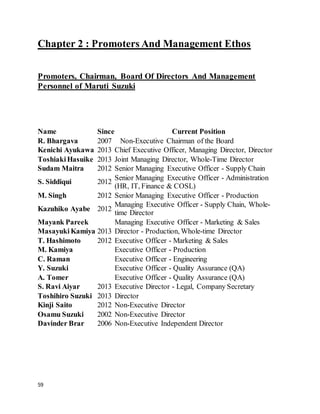
Chapter 2 : Promoters And Management Ethos
Promoters, Chairman, Board Of Directors And Management
Personnel of Maruti Suzuki
Name Since Current Position
R. Bhargava 2007 Non-Executive Chairman of the Board
Kenichi Ayukawa 2013 Chief Executive Officer, Managing Director, Director
ToshiakiHasuike 2013 Joint Managing Director, Whole-Time Director
Sudam Maitra 2012 Senior Managing Executive Officer - Supply Chain
S. Siddiqui 2012
Senior Managing Executive Officer - Administration
(HR, IT, Finance & COSL)
M. Singh 2012 Senior Managing Executive Officer - Production
Kazuhiko Ayabe 2012
Managing Executive Officer - Supply Chain, Whole-
time Director
Mayank Pareek Managing Executive Officer - Marketing & Sales
Masayuki Kamiya 2013 Director - Production, Whole-time Director
T. Hashimoto 2012 Executive Officer - Marketing & Sales
M. Kamiya Executive Officer - Production
C. Raman Executive Officer - Engineering
Y. Suzuki Executive Officer - Quality Assurance (QA)
A. Tomer Executive Officer - Quality Assurance (QA)
S. Ravi Aiyar 2013 Executive Director - Legal, Company Secretary
Toshihiro Suzuki 2013 Director
Kinji Saito 2012 Non-Executive Director
Osamu Suzuki 2002 Non-Executive Director
Davinder Brar 2006 Non-Executive Independent Director
60
Biography :
Mr. Ravindra Chandra Bhargava, M.Sc. (Maths), M.A. (Dev. Economics)
serves as the President and Chief Executive Officer at RCB Consulting Private Ltd.
Mr. Bhargava served as the Managing Director of Maruti Suzuki India Ltd. since
1985 and the Chairman and Managing Director since 1990. He joined the Indian
Administrative Service (I.A.S.) in 1956 and stood 1st in the batch and was allotted
to the U.P. cadre. From 1981 to 1997, he served with Maruti Suzuki India Ltd.
initially on deputation from the I.A.S. as Director of Marketing. He served as an
Agricultural Production Commissioner and Secretary to the Government of the
State of Jammu and Kashmir for the Departments of Agriculture, Horticulture,
Animal Husbandry, Forests, Co-operationfrom 1968 to 1973. He served as a
Special Assistant to the Union Minister of Energy, Government of India from 1973
to 1974. From 1974 to 1978, he served as the Joint Secretary to the Government of
India, Ministry of Energy and the Cabinet Secretariat. He served Bharat Heavy
Electricals Limited as the Director of Commercial. He has been the Chairman of
the Board of Maruti Suzuki India Ltd. since December 19, 2007 and Fem Care
Pharma Ltd. since June 25, 2009. He serves as Chairman of the Board of Directors
at Roulunds Codan (India) Ltd. and Roulunds Braking (India) Limited. He served
as the Chairman and a Director of Omax Autos Ltd. until January 2008. Mr.
Bhargava serves as a Member of Advisory Board of Aditya Birla Private Equity
Fund. He has been an Independent Director at UltraTech Cement Limited since
July 6, 2004. He has been a Non-executive Independent Director at Dabur India
Ltd., since January 27, 2005 and Polaris Financial Technology Limited since
March 1999. He has been Independent Director of UltraTech Cement Ltd. since
July 6, 2004. He has been a Director of Polaris since March, 1999. He has been a
Non-Executive Director of Polaris Software Lab Ltd. since March 1999. He has
been an Independent Director of Idea Cellular Ltd, since October20, 2008. He
serves as a Non Executive Director of Maruti Suzuki India Ltd. He has been an
Independent Director of Infrastructure Leasing & Financial Services Limited since
August 1990. He serves as a Director in Optimus Outsourcing Company Limited, a
subsidiary of Polaris Software Lab Ltd. Mr. Bhargava serves as a Director of
Optimus Global Services Limited, IL&FS Limited, Grasim Industries Ltd.,
Machino Bassel (India) Limited, IL&FS Securities Services Ltd. and Thomson
Press (India) Limited. He has been a Director of Samruddhi Cement Ltd. since
61
May 18, 2010. Mr. Bhargava serves as a Member of Board of Governors of Indian
Institute of Management Calcutta. He served as a Director of Lord Krishna Bank,
Ltd. He served as a Director of Shree Digvijay Cement Company Ltd. from
September 12, 2006 to March 25, 2008. Mr. Bhargava has a Master of Sciences
degree in Mathematics from Allahabad University, India and a Master of Arts in
Developmental Economics from Williams College, Williams town, MA, USA.
Mr. Kenichi Ayukawa has been Managing Director and Chief Executive Officer
at Maruti Suzuki India Limited since April 1, 2013. Mr. Ayukawa serves as a
Senior Managing Officer of Suzuki Motor Corp. and served as its a Managing
Officer. He has been a Director of Maruti Suzuki India Limited since July 21, 2008
and has been an Additional Director at Asahi India Glass Ltd. since May 21, 2013.
Mr. Ayukawa has been a Director of Subros since July 29, 2013. He served as a
Non-Executive Director at Pak Suzuki Motor Co. Ltd. He is a graduate from Osaka
University.
62
Corporate Social Responsibility of Maruti Suzuki :
 Maruti Suzuki was the first company to promote safe driving and training in
the country.
 Maruti Suzuki envisions road safety in its flagship Corporate Social
Responsibility arena.
 The company collaborated with the Delhi government in 2000 to set up the
Institute of Driving and Traffic Research (IDTR) at Loni in North East
Delhi.
 In the technical education/skill development area, MSIL has adopted 10
state-run ITIs (one each at Kerala, Tamil Nadu, Maharashtra, two at Goa,
and four at Haryana.) with intent to transform them into the Centers of
Excellence. The company plans to increase the total number of ITIs to 50 by
2015.
63
Promoters, Chairman, BoardOf Directors And ManagementPersonnelof
Hyundai Motors India Limited
Key Executives for Hyundai Motor India Limited
Name Title
Bo Shin Seo
Chief Executive Officer and
Managing Director
R. Sethuraman
Senior Vice President of Finance &
CorporateAffairs and Director
Anish Agarwal Head of Lucknow Zone
Nalin Kapoor
Group Head of Marketing and Senior
General Manager
Head of West Zone
T.
Sarangarajan
No
Relationships
Head of
Production
Division
and Vice
President
Anurag
Singh
No
Relationships
Head of
North Zone
Pankaj
Tiwari
No
Relationships
Head of
Central
Zone
M. Whoo
No
Relationships
Head of
R&d and
Engineering
Operations
-
64
Mr. R. Sethuraman promoted as Director
Mr. RakeshSrivastava promotedas Sr. Vice President
Mr. R Sethuraman as Director Finance and Member of Board and Mr. Rakesh
Srivastava as Sr. Vice President, Sales and Marketing. Prior to this elevation,
Mr. R. Sethuraman was Senior Vice President, Finance and Member of the
Board of Directors of HMIL, while Mr. Rakesh Srivastava was Vice President,
National Sales and Marketing.
.
Mr Bo Shin Seo took over as the company's Managing Director, from Mr H.
W. Park, who is returning to Korea as the Chief Financial Officer of Kia
Motors. Mr Park goes back to his home country after a stint in India.
Prior to his elevation as Managing Director, Mr Seo was Executive Director –
Production, a position he held for two years.
“Mr Seo is an engineer by training, in his distinguished career he has been
Hyundai's ProductionHead at its Alabama plant in the US,” says a press release
from Hyundai India.
Chung Ju-yung a South Korean entrepreneur, businessman and the founder of
all Hyundai Groups of South Korea.
Born
Chung Ju-yung
November 25, 1915
Tongchon, Kangwŏn, [Korea]
(now Tongchon, North Korea)
Died
March 21, 2001 (aged 85)
Songpa District, Seoul, South
Korea
Nationality South Korean
Occupation Businessman
Known for
Founder and honorary chairman
of Hyundai.
65
Corporate Social Responsibility Of Hyundai Motors India Limited :
Hyundai Motor India Foundation ( HMIF) , the Corporate Social Responsibility
arm of Hyundai Motor India Limited, further reiterated its’ commitment to Tamil
Nadu by launching fresh initiatives. HMIF launched two new programs” Project
Go Green” and “Adoptionof Model Villages”. These two programs are the latest
addition to other ongoing projects such as community development, road safety,
education and healthcare.
On the occasion, HMIF also welcomed the 7th batch of 120 Korean Happy Move
volunteers, who will be working on upgrading living and sanitation conditions of
villages and schools in the various districts of Tamil Nadu.
As a part of HMIF’s ongoing support to educationprojects, the Foundation
undertook the following activities.
 Donation of 450 sets of benches to government schools across the state
 Donation of 200 tables and chairs to teachers of 50 schools
 Undertaking responsibility of sinking of Ten (10) bore wells at middle
schools
 Handing out of certificates to the first graduating batch of 50 nursing
students who benefitted from the vocation training scheme of the company
Hyundai Motor Indian Foundation has invested over Rupees Twenty Crore in
various CSR projects since its inception in April 2006.
About the Projects:
Project“Go Green”
Project “Go Green” is an income generating tree planting project with a difference.
Undertaken along with TIST, the project envisages distributing one lakh saplings
to farmers in a phased manner. The farmer will plant the sapling on his land
holdings and be paid by HMIF for its upkeep and maintenance. The proceeds from
sale of the producewill add to his income. Saplings like , teak, jackfruit, mango etc
will be given out. HMIL along with TIST will regularly monitor the progress.
Adoption of ModelVillage
This scheme focuses on sanitation and income generation. Five needy villages and
three of their hamlets in the Kancheepuram district have been identified under this
66
scheme. The villagers will be provided with individual toilets and given lessons in
hygiene. Schools will be provided with safe drinking water. Women’s self help
groups will be provided supportand guidance to make their projects commercially
viable and ensure income for the members.
Happy Move
The happy move volunteers comprise of a contingent of 120 students and 20
doctors all sponsored byHyundai Motor Corporation, Korea. So far 54 villages
and 62 schools have benefited through this initiative under their health, sanitation
and nutrition program. These students have tiled floors of the schools, built new
toilets , increased the level of hygiene standards in the schoolcommunity kitchens,
renovated and repaired the schools where required.
They have also conducted medical camps for adults and educated the villagers
about hygiene issues.
About Hyundai MotorIndia Foundation
Hyundai Motor India Foundation was formed on April 10, 2006. Born out of the
need to provide structured supportto community development, HMIF aims to
uplift the larger section of the society through a Five Point program Viz:
 Education
 Road safety
 Community Development
 Healthcare
 Arts and Culture
All projects of HMIF are extremely popular with the public and well appreciated
by the government. HMIF if funded directly through Hyundai Motor India Limited
(HMIL) through a contribution of Rs 100 for every car sold. For further
information,
67
Promoters, Chairman, Board Of Directors And
Management Personnel of Tata Motors :
JehangirRatanji Dadabhoy Tata (29 July 1904 – 29 November 1993) was a
French-born Indian aviator and business tycoon. He was the former Chairman of
Tata Sons. He became India's first licensed pilot in 1929. In 1983, he was awarded
the French Legion of Honour and, in 1992, India's highest civilian award, the
Bharat Ratna.[1]
Born
29 July 1904
Paris, France
Died
29 November 1993 (aged 89)
Geneva, Switzerland
Nationality Indian
Ethnicity Parsi
Occupation Former Chairman of Tata Group
Known for
Founder of TCS
Founder of Tata Motors
Founder of Titan Industries
Founder of Tata Tea
Founder of Voltas
Founder of Air India
Religion Zoroastrianism
Spouse(s) Thelma Vicaji Tata
Children None
Parents
R.D. and Suzanne Tata nee
Brière
Mr. Karl Slym served as the Managing Director at Tata Motors Limited from
September 13, 2012 to January 26, 2014. Mr. Slym joined Tata Motors in
68
September 2012. Mr. Slym served as the Managing Director and President of
General Motors India Pvt. Ltd. (known as GM India) at General Motors Company
from October1, 2007 to January 1, 2012. He served as an Executive Vice
President of SAIC GM Wuling Automobile Co., Ltd. since January 1, 2012. He
served as President of Cami Automotive Inc. since September 2002. He served as
President and Managing Director for Indian Subsidiary of Motors Liquidation
Company (formerly General Motors Corporation) from October1, 2007 to July
2009. Mr. Slym served as Vice President of Quality at General Motors, Asia
Pacific and GM Daewoo since January 1, 2006. He joined General Motors in 1995
and served as an Assistant Plant Manager at the Oshawa car assembly plant in
1999. He served as plant manager of GM of Canada's Oshawa car plants 1 and 2 in
Ontario, Canada. He served as a Director of General Motors India Pvt. Ltd. until
January 1, 2012. He served as Director of CAMI Automotive, General Motors'
Canadian joint venture with Suzuki Motor Manufacturing Corporation, since
September 2002. He then moved on to general assembly manager at the same
facility before becoming director of manufacturing for the new Opel Polska plant
development in Gliwice, Poland, in 1997. He worked for Toyota U.K. in
Derbyshire, rising to General Assembly Manager, before joining GM. Mr. Slym
served as a Director of Tata Motors Limited until January 26, 2014. He was
awarded a Sloan Fellowship from GM and in 2002 earned a master of science
degree in business administration from Stanford University. He graduated in 1984
from his post-secondaryeducation in productionengineering at England's Derby
University. Mr. Slym passed away on January 26, 2014.
Ratan
Tata 28 December 1937 (age 76)
Surat, India
69
Born
Residence Colaba, Mumbai, India[1]
Nationality Indian
Ethnicity Parsi
Alma mater Cornell University
Occupation
Former Chairman of Tata
Group
Religion Zoroastrianism
Awards
Padma Vibhushan (2008)
KBE (2009)
Signature
RatanTata, KBE (Born Ratan NavalTata on 28 December 1937) is an Indian
businessman of the Tata Group, a Mumbai-based conglomerate. He was the
chairman of the group from 1991-2012. He stepped down as the chairman on 28
December 2012 and now holds the position of Chairman Emeritus of the group
which is an honorary and advisory position. He will continue as the chairman of
the groups charitable trusts.[2]
Early life
Ratan Tata is the adoptive great-grandson of Tata group founder Jamsetji
Nusserwanji Tata.
Tata began his schooling in Mumbai at the Campion Schooland the Bishop Cotton
Schoolin Shimla, and finished his secondaryeducation at the Cathedral and John
Connon School.[4] He completed his B.S. in architecture with structural
engineering from Cornell University in 1962, and the Advanced Management
70
Program from Harvard Business Schoolin 1975.[5] Tata is a member of the Alpha
Sigma Phi fraternity.
Career
Tata began his career in the Tata group in 1962; he initially worked on the shop
floor of Tata Steel, shovelling limestone and handling the blast furnace.[6]
In 1991, J. R. D. Tata stepped down as Tata Industries chairman, naming Ratan as
his successor.
In 1991, Tata was appointed as the chairman of the Tata group. Under his
stewardship, Tata Tea acquired Tetley, Tata motors acquired Jaguar Land Rover
and Tata Steel acquired Corus, which have turned Tata from a largely India-centric
company into a global business, with 65% revenues coming from abroad. He also
pushed the development of the Tata Indica and the Tata Nano Ratan Tata retired
from all executive responsibility in the Tata group on December 28, 2012 which is
also his 75th birthday and he is succeeded by Cyrus Mistry, the 44-year-old son of
Pallonji Mistry and managing director of Shapoorji Pallonji Group.[7][8]
He is chairman emeritus of Tata Sons, Tata Motors, Tata Steel and a few other
group companies. He is also the chairman of the main two Tata trusts Sir Dorabji
Tata and Allied Trusts and Sir Ratan Tata Trust which together hold 66% of shares
in the group holding company Tata Sons.
Ratan Tata has served in various capacities in organisations in India and abroad.
He is a member of the Prime Minister's Council on Trade and Industry. Tata is on
the board of governors of the East-West Center, the advisory board of R&D's
Center for Asia Pacific Policy, the jury panel of Pritzker Architecture Prize -
considered to be one of the world's premier architecture prizes[9] and serves on the
program board of the Bill & Melinda Gates Foundation's India AIDS initiative.[10]
71
Cyrus Pallonji Mistry (born 4 July 1968) is an Irish businessman who became
chairman of Tata Group, an Indian business conglomerate, on 28 December
2012.[2][3] He is the sixth chairman of the group and the second not to be named
Tata, after Nowroji Saklatwala.[4] TheEconomist has described him as "the most
important industrialist" in both India and Britain.[5]
He is the youngest son of Indian construction magnate Pallonji Mistry.[6]
Cyrus Mistry
Born 4 July 1968 (age 45)
Nationality Irish[1]
Alma mater
Imperial College London
London Business School
Occupation Chairman of Tata Group
Spouse(s) Rohiqa Mistry
Children 2
Parents
Pallonji Mistry
Patsy Perin Dubash
Early life and education
Mistry studied at the Cathedral & John Connon Schoolin Mumbai.[7] He graduated
from the Imperial College, London with a BEng in civil engineering and holds a
Master of Science in management from the London Business School. He is a
fellow of the Institution of Civil Engineers.[8][9]
Career
Mistry has been managing director of Shapoorji Pallonji & Company, which is part
of the Shapoorji Pallonji Group. He joined the board of Tata Sons on 1 September
2006, a year after his father retired from it.[1] He served as a Director of Tata Elxsi
72
Limited, from 24 September 1990 to 26 October2009 and was a Director of Tata
Power Co. Ltd until 18 September 2006.[citation needed]
In 2012, Mistry was appointed as the chairman of Tata Sons. In addition, he is also
chairman of all major Tata companies including Tata Industries, Tata Steel, Tata
Motors, Tata Consultancy Services, Tata Power, Tata Teleservices, Indian Hotels,
Tata Global Beverages and Tata Chemicals.[citation needed
73
Corporate Social Responsibility Of Tata Motors :
Education
Education initiatives implemented include scholarships, infrastructure and
facility improvement to allow greater access to quality education, implementing
extra-curricular activities for overall development of students and teacher training
programs.
A joint team of journalists and employees of Tata Motors Thailand donated items
such as sun-filter shades to help block sunshine on the schoolplaygrounds, life-
vests for children in the Baan Phukhem school, Amphur Kaengkrachan and
Phetchburi. Since most of them travel to schoolvia boat, towels, blankets, rice,
slippers and various other essentials in addition to a financial donation for the
construction of the sun-filter shades.
Monetary donations of KRW 35 million were made by Tata Daewoo for delivery
of coal briquette, scholarships for school-going children in South Korea. Training
program for teachers in Jeonbuk, South Korea, and an alliance with Gunsan
Yongkwang Girls' Middle Schoolwas formed under the 'Company SchoolAlliance
Program.'
Employability and Skill Advancement
To promote skill-based employment for youth Tata Motors collaborates with 112
Industrial Training Institutes (ITI) across 19 states under the Institute Management
Committee (IMC) Model. At the plant level, training is provided to women
through Self Help Groups to empower them. The empowerment paves the way for
economic self-reliance. Tata Motors Grihini SocialWelfare Society, which
employs more than 1000 women, achieveda significantmilestone by crossing
a turnover of 13 crores. To align community initiatives with core business
processes,we initiated a 'Driver Training Programme' with a target of training 3.4
million youth over a period of ten years.
JaguarLand Roverwith Birmingham MetropolitanCollege forgeda
partnership to deliver Interactive Learning Programmes for schools and
collegesat the Jaguar Land Rover Education Business Partnership Centres in
Solihull and Castle Bromwich, Birmingham. The Centres will be the hubs for
showcasing engineering careers to pupils from across the region so they consider
engineering when they start to think about their career options. Further, a
partnership with the Institution of Mechanical Engineers (IMechE) builds on a long
74
standing relationship with IMechE and reflects the need for the UK to maintain its
engineering pedigree.
Pursuing the objectives of fostering close relations with the local community and
of providing relevant industrial experience to the engineering students, Tata
Motors South Africa forged an alliance with the Engineering Faculty at the
University of Pretoria. The Company has provided on-the-job industrial training on
various functions like production, quality, purchase, logistics etc., to students from
the University of Pretoria.
Environmental conservation
Tata Motors' focus on environmental management helps preserve the long-term
health of people and ecosystems and build strong relationships with local
communities. Various initiatives have been undertaken within the broad frame of
Environment and Climate Change to address the conservation of natural resources
and energy, minimize waste generation, enhance recovery and recycling of
material and develop eco-friendly process and systems. We have been
continuously working towards reducing our various environmental footprints,
which is evidenced by our decrease in specific consumption levels. We recycle
close to 69% of woodpackaging,eliminating the use of fresh wood. A 200 litre
engine oil barrel can now be used to test 170 engines instead of 85 engines.
At Jamshedpur and Lucknow, the wet garbage from our canteens is converted to
usable organic manure to sustain greenery in the plants. We achieved annualized
energy savings of 230,959 GJ through conservation initiatives across our
operations. Similarly, in last three years, we have reduced Green House Gas
emissions by 22,581.62 tonnes ofCO2 while total energy consumed per vehicle
produced has also decreased.
Healthcare
Tata Motors actively promotes healthcare both at the national and plant levels. A
partnership with Smile Train empowers surgeons to provide free corrective surgery
for children with cleft lip and palette deformities. Further, AIDS awareness
campaigns were conducted for truck drivers. Preventive and curative healthcare
facilities are provided through small Mobile Health Clinics, awareness camps,
hospitals and clinics. Besides, rural health workers are trained to act as foot doctors
to cure minor ailments in their allocated areas.
Tata Motors Thailand also extended vehicular support to raise funds for
helping the Tsunami and Earthquake victims of Japan.
75
Reducing Pollution
Tata Motors has been at the forefront of the Indian automobile industry's anti-
pollution efforts by introducing cleaner engines. It is the first Indian Company to
introduce vehicles with Euro norms well ahead of the mandated dates. Tata Motors'
joint venture with Cummins Engine Company, USA, in 1992, was a pioneering
effort to introduce emission controltechnology for India. Over the years, Tata
Motors has also made investments in setting up of an advanced emission-testing
laboratory.
Restoring EcologicalBalance
Tata Motors has set up effluent treatment facilities in its plants, to avoid release of
polluted water into the ecosystem. In Pune, the treated water is conserved in lakes
attracting various species of birds from around the world thus turning the space
into a green belt.
Tree plantation programmes involving villagers and Tata Motors employees, have
turned acres of barren village green. Tata Motors has planted as many as 80,000
trees in the works and the township and more than 2.4 million trees have been
planted in Jamshedpur region. Over half a million trees have been planted in the
Pune region. Tata Motors has directed all its suppliers to package their products in
alternate material instead of wood.
76
Promoters, Chairman, Board Of Directors And Management
Personnel of Honda Cars India Limited
Honda : Name AgeSince Current Position
Fumihiko Ike 61 2013 Chairman of the Board, Representative Director
TakanobuIto 59 2013
President, Executive President, Representative
Director
Tetsuo Iwamura 62 2013
Executive Vice President, Chief Director of
North America Region, Chief Director of Four-
wheeled Business, Risk Management Officer,
President of Subsidiaries, Representative
Director
Sho Minekawa 58 2013
Senior Managing Executive Officer, Chief
Director of Japan Sales, Chief Director of Safety
Drive Popularization
Takashi Yamamoto 60 2013
Senior Managing Executive Officer, Senior
Director of Four-wheeled Productionin Main
Four-wheeled Business Unit, Director
Yoshiharu Yamamoto60 2013
Senior Managing Executive Officer, Chief
Director of IT, President of Subsidiary, Director
Hidenobu Iwata 2012
Senior Managing Executive Officer, President of
Subsidiary
Masahiro Yoshida 56 2013
Managing Executive Officer, Chief Director of
Administration, Compliance Officer, Director
Koichi Fukuo 2010 Managing Executive Officer
Ko Katayama
Managing Executive Officer, Senior Director of
SCM of Automobiles ProductionSupervision
Unit and Main Automobiles Business Unit
Hiroshi Kobayashi 58
Managing Executive Officer, Chief Director of
Asia and Oceania, President of Subsidiaries
Yoshiyuki Matsumoto
Managing Executive Officer, President of
Subsidiary
Manabu Nishimae
Managing Executive Officer, Chief Director of
Europe & CIS & Middle Eastern and Africa,
President of Subsidiary
77
Corporate Social Responsibility Of Honda Cars India
Limited :
Honda Foundation announces Young Engineers and Scientists Award for the
4th Consecutive Year
The YES awards were instituted in 2008 to encourageand support young
Indian engineers and scientists
Honda Motor India Pvt. Limited (HMI) on Feb 26, 2012 announced the winners of
fourth Young Engineers and Scientists’ (YES) awards in India and presented
awards to fourteen students from India’s premier institutes for science &
technology – Indian Institute of Technology.
The YES Award initiative of Honda Foundation has been facilitated by Honda
Motor India Pvt. Ltd., to foster young students who have excelled in the area of
science and technology and continue to aspire for higher academic achievement in
the area of Eco-Technology. Through this initiative, Honda Foundation will grant
financial aid to the winning students and also give them an opportunity to pursue
trainings or higher professional education, in Japan.
A cash scholarship of US $3000, was presented to fourteen students selected from
seven IITs – Delhi, Bombay, Roorkee, Madras, Kharagpur, Kanpur & Guwahati on
the basis of their Cumulative Grade Point Average (CGPA), technical papers,
essays and finally their performance in the one-on-one interviews. All the YES
Award recipients may claim $ 7,000/- for 2 months Summer Training in Japan or
‘Yes Award Plus’ scholarship of US$10,000 if they are admitted to, and join
postgraduate (master or doctoral) study in the designated Japanese universities,
within three years of having received the YES Award.
Hello Woods Symposium
We have held a variety of programs with the theme of "Healthy Forests and
Healthy Kids" at Hello Woods,which includes a restored satoyama village forest
on an expansive, 42-hectare site. The Hello Woods Symposium was launched in
2010 to commemorate the 10th anniversary of the founding of Hello Woods.
Guests representing a variety of perspectives, including officials from government
agencies and local governments as well as researchers and representatives of
NPOs, are invited to exchange views on forests, children, and related topics.
78
Promoters, Chairman, Board Of Directors And
Management Personnel of Volkswagan India
Key Executives for VolkswagenIndia Pvt Ltd.
Name Title
Mahesh Kodumudi
Managing Director, President, Head of
Production – Pune & Maharashtra Plants
and Chief Representative
Hans-Jaochim Rothenpieler
Managing Director for Engineering - VW
Saschen
Wolf-Stefan Specht
Head of Volkswagen Passenger Cars Sales
of India
Maria Stenstrom
Managing Director of Operations of
Volkswagen Group Canada and Brand
Director of Volkswagen Canada
Maik Stephan
Managing Director of Volkswagen Group
Sales
K. K. Swamy Managing Director and Vice President
Frank Tuch
Head of Group Quality Assurance -VW
Group
79
Corporate Social Responsibility Of VolkswaganIndia :
VolkswagenIndia initiates CSR in drought declaredGulani village at Khed in
Pune
Volkswagen India Private Limited has undertaken the initiative of recharging the
water resource at Gulani village in Khed taluka.
The water channel in the village will be deepened and widened so as to increase
the water capacity by over 13 times and it will be used for domestic and agriculture
purposes. Government of Maharashtra has declared 18 villages in Khed taluka as
draught affected and has approached industries and corporates to come ahead and
join hands in strengthening the water resources in these villages. Volkswagen
India, has taken up this project at Gulani village situated approximately 30
kilometers from Volkswagen Pune Plant in Chakan.
Volkswagen India, prior to this initiative, has undertaken several other social
responsibilities in the past such as building an additional block at Zilla Parishad
school in Nighoje, H1N1 (Swine Flu) vaccination to over 1,500 school children in
the neighbouring villages of Nighoje, Mhalunge and Kharabwadi, and also is
supporting Inter-Mission Industrial Development Community College for a period
of three years. This institute educates the underprivileged youth and women in
Chakan. Earlier, Volkswagen India had donated an ambulance to Red Cross in
Nighoje and a bus to the Inter Mission Care and Rehabilitation Society in Paud.
With its headquarters in Pune, Maharashtra, the Volkswagen Group is represented
by five brands in India: Audi, Lamborghini, Porsche, ŠKODA, and Volkswagen.
The Volkswagen Group has been present in India for the last 12 years and began
its India journey with the entry of the ŠKODA brand in 2001, Audi brand and
Volkswagen brand in 2007, Porsche brand and Lamborghini brand in 2012. Each
brand has its own character and operates as an independent entity in the market.
2) Community education pimpri chinchwad by Volkswagen.
80
Promoters, Chairman, Board Of Directors And
Management Personnel of Nissan Motors India Private
Limited :
Mr Kenichiro Yomura , president of Nissan's India operations.
Insiders at nissan motor co ltd (7201)
Name (Connections) Title
Carlos Ghosn
Chairman, Chief Executive
Officer, President,
Chairman of Renault, Chief
Executive Officer of
Renault and President of
Renault
--
Toshiyuki Shiga
Vice Chairman, Chief
Operating Officer and
Chairman of Global
Environment Management
Committee
--
Hidetoshi Imazu
Executive Vice President
of Manufacturing & Scm
and Director
Mitsuhiko Yamashita
Executive Vice President
of Research and
Development and Director
Hiroto Saikawa
Chief Competitive Officer,
Executive Vice President
and Representative
Director
Greg Kelly
Senior Vice President and
Representative Director
Jose Munoz Executive Vice-President
81
Name (Connections) Title
and Chairman of The North
America Business
Jose Valls
Senior Vice-President and
Chairman of The Latin
America Unit
ScottBecker
Vice Chairman of North
America Operations and
Vice President of Legal
Affairs -North America
Other Board Members on Board
Name (Connections) Primary Company
William Krueger Jatco Ltd.
Katsumi Nakamura Nissan Motor Co. Ltd.
Toshiyuki Nakamura Nissan Motor Co. Ltd.
Masahiko Aoki Nissan Motor Co. Ltd.
Jean-Baptiste Duzan AB Volvo
Mikio Nakura Nissan Motor Co. Ltd.
Shigetoshi Ando Nissan Motor Co. Ltd.
Tony Laydon Nissan Motor Co. Ltd.
82
Corporate Social Responsibility Of Nissan Motors India
Private Limited :
Nissanto become the world’s No1 sellerof zero-emissionvehicles by 2016
CEO Carlos Ghosnspeaks with the Global Media Centeron
announcement of the NissanGreenProgram2016.
Nissan Motor Comapny announced our new six-year environmental action plan,
Nissan Green Program (NGP2016) on Oct. 24, 2011, Yokohama in Japan, where
company has headquartered. Rising population and developing economies mainly
in emerging markets arouse concerns about energy, resource supply, price hike,
and environmental impact rise.
NGP2016 focuses on reducing environmental impact of corporateactivities and
pursuing harmony between resource consumption and ecology by promoting and
widening the application of green technologies that were developed in NGP2010,
previous environmental action plan, and contributing to recycling-based society.
Nissan CEO Carlos Ghosnspeaks with the Global Media Center about the
company’s new mid-term environmental plan, promoting zero-emission vehicles
and corporatesocial responsibility (CSR).
.
83
Chapter 3 : External Environment
PESTL Analysis of Automobile Sector
• Political
• In 2002, the Indian government formulated an auto policy that aimed
at promoting integrated, phased, enduring and self-sustained growth of
theIndian automotive industry
• Allows automatic approval for foreign equity investment up to 100% in the
automotive sector and does not lay down any minimum investment
criteria.
• Formulation of an appropriate auto fuel policy to ensure availability
of adequate amount of appropriate fuel to meet emission norms
• Establish an international hub for manufacturing small, affordable
passenger cars as well as tractor and two wheeler.
• Lying emphasis on R&D activities carried out by companies in India.
• Promoting multi-model transportation and the implementation of mass
rapid transport system.
• Economic
• Economic pressures on the industry are causing automobile companies to
reorganize the traditional sales process.
• Govt. has granted concessions, such as reduced interest rates for export
financing.
• The Indian economy has grown at 8.5% per annum.
• The manufacturing sector has grown at 8-10 % per annum in the last few
years.
• More than 90% of the CV purchase is on credit.
• Finance availability to CV buyers has grown in scope during the last few
years.
• Several Indian firms have partnered with global players.
• While some have formed joint ventures with equity participation, other
also has entered intot echnology tie-ups.
• Establishmentof India as a manufacturing hub, for mini, compact cars and
for auto components.
84
• Social
• Since changed lifestyle of people, leads to increased purchase
of automobiles, so automobile sector have a large customer base to serve.
• The average family size is 4, which makes it favorable to buy a
four wheeler.
• Upward migration of household income levels.
• 85% of cars are financed in India.
• Car priced below USD 12000 accounts for nearly 80% of the market.
• Vehicles priced between USD 7000-12000 form the largest segment in
the passenger car market.
• Indian customers are educated and well informed.They are price sensitive
and put a lot of emphasis on value for money.
• Preferencefor small and compact cars. They are socially acceptable
evenamongstthe well off.
• Prefrence for fuel efficientcars with low running costs.
• Technological
• More and more emphasis is being laid on R & D activities
carried out bycompanies in India.
• tax deduction of up to 150% for in-house research and R & D
activities.
• The Government of India is promoting National Automotive
Testing andR&D Infrastructure
• Technological solutions helps in integrating the supply chain,
hence reduce losses and increase profitability.
• Advanced technologies, both in product and production
process have developed.
• With the development or evolution of alternate fuels, hybrid
cars have made entry into the market.
• few global companies have setup R &D centers in India.
85
Environmental Issues
 Physical infrastructure such as roads and bridges affect the use of automobiles. If there is good
availability of roads or the roads are smooth then it will affect the use of automobiles.
 Physical conditions like environmental situation affect the use of automobiles. If the environment
is pleasant then it will lead to more use of vehicles.
 The category for Indian Automobile Industry is "Red" which represents the highly polluting
industries SeveralAutomobile exhaust pollutants are as follows:
 Hydrocarbon
 Nitrogen Oxides
 Carbon Monoxide
 Carbon Dioxide
• Legal
• Legal provision relatingto environmentalpopulation by automobiles.
• Legal provisions relating to safety measures.
• Indian governmentauto policy aimed at promoting an integrated,phased and
conductivegrowth of the Indian automobileindustry.
• Establishan internationalhub for manufacturing small, affordable passenger cars
as well as tractor and two wheelers.
86
Automobile Industry Regulations in India
The automotive regulations in India are governed by the Ministry of Road
Transportand Highways (MoRT&H) which is the nodal ministry for regulation of
the automotive sectorin India.[1][2]
In India the Rules and Regulations related to driving license, registration of motor
vehicles, controlof traffic, construction & maintenance of motor vehicles etc are
governed by the Motor Vehicles Act, 1988 (MVA) and the Central Motor Vehicles
rules 1989 (CMVR).
The CMVR - Technical Standing Committee (CMVR-TSC) advises MoRT&Hon
various technical aspects related to CMVR. This Committee has representatives
from various organisations namely; Ministry of Heavy Industries & Public
Enterprises (MoHI&PE), MoRT&H, Bureau of Indian Standards (BIS), Testing
Agencies such as Automotive Research Association of India (ARAI), Vehicle
Research and Development Establishment (VRDE), Central Institute of Road
Transport(CIRT), industry representatives from Society of Indian Automobile
Manufacturers (SIAM), Automotive Component Manufacturers Association
(ACMA) and TractorManufacturers Association (TMA) and representatives from
State TransportDepartments.
CMVR-TSC is assisted by another Committee called the Automobile Industry
Standards Committee (AISC) having members from various stakeholders in
drafting the technical standards related to Safety. The major functions of the
committee are as follows:
 Preparation of new standards for automotive items related to safety.
 To review and recommend amendments to the existing standards
 Recommend adoption of such standards to CMVR Technical Standing
Committee
 Recommend commissioning of testing facilities at appropriate stages
 Recommend the necessary funding of such facilities to the CMVR Technical
Standing Committee
 Advise CMVR Technical Standing Committee on any other issues referred
to it
AISC submits the draft safety standards in the form of recommendations to
CMVR-TSC for final approval. The CMVR – TSC looks into the
87
recommendations of AISC and either approves or sends the recommendations to
AISC for amendments. After approval CMVR-TSC submits its final proposalto
MoRT&H. MoRT&H then takes the final decision for incorporation of the
recommendations in CMVR.
The Automotive Industry Standards are published by the Automotive Research
Association of India on behalf of the Automotive Industry Standards Committee.
Under Rule 126 of the CMVR, various test agencies are established to test and
certify the vehicles based on the safety standards and emission norms prescribed
by the Ministry. Every manufacturer of motor vehicle has to submit a prototype of
the vehicle to be manufactured to any of the test agencies mentioned hereafter.
After testing the vehicle for compliance of all standards and norms, the test agency
shall grant a certificate to the manufacturer. The test agencies are – Automotive
Research Association of India, Pune (ARAI), Vehicle Research & Development
Establishment, Ahmednagar, Central Farm Machinery Testing and Training
Institute, Budhni, Indian Institute of Petroleum, Dehradun, Central Institute of
Road Transport, Pune and International Centre for Automotive Technology,
Manesar.
Facing the challenges of new age
The Indian automotive industry has been facing new challenges due to the rapid
changes taking place during the last decade..
To realise the growth predictions, it is important to overcome various challenges
the industry is facing currently. Two of the foremost challenges are the spiralling
costof fuel and the paucity of highly skilled manpower.
Rising oil price
International price of crude oil has crossed US$ 120 per barrel and is rising at an
alarming rate. The forecast of market experts that the crude oil price will plateau
around US$ 100 per barrel has been proved wrong. The skyrocketting crude oil
price rise will affect the economic growth of most of the nations of the world
including India. The prospectsofIndia and China of becoming economic
superpower will be seriously affected. Also, the rise in oil prices will impact the
growth of global automotive industry. Unless the use of alternative fuels increases,
it is very unlikely that the situation will change for the better. This necessarily
means that more and more investments should be directed towards R&D,
88
establishing mechanisms to translate R&D results into products and their efficient
manufacturing. This will also require radical redesigning of engines.
Human resources
The second major challenge is the creation of highly skilled human resource
required for the auto industry. Auto industry, like many other industries is facing
severe shortage of skilled technical as well as managerial manpower. This
challenge becomes all the more daunting because faults lie at a more fundamental
level of training infrastructure and the social perception.
In India, engineering colleges and technology institutions impart engineering
education. Many of these institutions used to provide training in automotive
engineering through well-established Internal Combustion Engineering (ICE) and
Mechanical Engineering departments. However, the new wave of IT, electronics
and communication technology has forced these institutions to close down ICE
departments and also reduce the umber of Mechanical Engineering departments.
The well-known ICE department of the Indian Institute of Science that produced
high quality research and trained manpower is a sad example of these
developments. It is true that more than 50 per cent of the total components of the
current automobiles are electronic and that the importance of communication
technology is also increasing. However, the advances and training in these areas
cannot be at the costof the fundamental aspects of auto engineering including
thermodynamics. Therefore, we need to redesign our automotive engineering
courses and brand them properly to attract good students. This will help in not only
increasing the number of auto engineers, which is crucial to the growth of the auto
industry, but also getting the human resources to carry out research in the auto
sectorand achieve breakthroughs necessary for designing the next-generation
vehicles.
There is also an urgent need to improve the quality of skilled and semi skilled
manpower working in the auto industry. To do this the existing vocational
educational institutions have to be upgraded and more number of such institutes
should be started. Today, most of our vocational educational institutes have poorly
trained, unmotivated and uninspiring teaching faculty, and outdated equipment,
machines, syllabus and governance system. National Knowledge Commission, in
its recent report has given several recommendations to improve vocational training
in this country. The Central Government has accepted all the recommendations.
89
Two major recommendations are rebranding the vocational education by updating
the syllabus and public-private partnership (PPP)in the establishment and
governance of vocational educational institutes. Accordingly, the finance minister
has allotted an initial amount of Rs. 1,000 crores in this year's budget to establish a
corporation of Rs. 15,000 crore outlay through PPP model. It is hoped that this
corporation will help immensely in revolutionising and making the vocational
education more relevant to the contemporary needs.
The third area that needs to be addressed immediately is the shortage of human
resources in auto design. The government as well as the professionals have realised
that creative people in India need to be given training by which they can come into
the mainstream and design contemporary products in general and autos in
particular. National Institute of Design at Ahmedabad is playing a seminal role in
producing good designers. However, the output of the institute is very small.
Therefore, in the first of its kind National Policy of Design, the Government has
suggested to establish four such institutes, immediately.
RegulatoryBodies ofthe industry :
 The automotive regulations in India are governed by the Ministry of
Shipping, Road Transport& Highways (MoSRT&H).
 The principal instrument governing the automotive sectorin India is the
Motor Vehicles Act, 1988 (MVA) along with the Central Motor Vehicles
Rules 1989 (CMVR).
 Automotive Research Association of India (ARAI)
 Vehicle Research & Development Establishment, Ahmednagar
 Central Farm Machinery Testing and Training Institute, Budni.
 Indian Institute of Petroleum, Dehradun
 Central Institute of Road Transport, Pune.
 International centre for Automotive Technology, Manesar.
 Ministry of Heavy Industries & Public Enterprises (MoHI&PE)
90
 Vehicle Research and Development Establishment (VRDE)
 Central Institute of Road Transport(CIRT)
 Society of Indian Automobile Manufacturers (SIAM)
 Automotive ComponentManufacturers Association (ACMA)
 Tractor Manufacturers Association (TMA)
 Central Motor Vehicles Rules-Technical Standing Committee (CMVR-TSC)
Auto Policy In India :
1. POLICY OBJECTIVES
This policy aims to promote integrated, phased, enduring and self-sustained growth
of the Indian automotive industry. The objectives are to:-
(i) Exalt the sector as a lever of industrial growth and employment and to achieve a
high degree of value addition in the country;
(ii) Promote a globally competitive automotive industry and emerge as a global
source for auto components;
(iii) Establish an international hub for manufacturing small, affordable passenger
cars and a key center for manufacturing Tractors and Two-wheelers in the world;
(iv) Ensure a balanced transition to open trade at a minimal risk to the Indian
economy and local industry;
(v) Conduce incessant modernization of the industry and facilitate indigenous
design, research and development;
(vi) Steer India's software industry into automotive technology;
(vii) Assist development of vehicles propelled by alternate energy sources;
(viii) Development of domestic safety and environmental standards at par with
international standards.
Policies :
FOREIGN DIRECT INVESTMENT
7Automatic approval for foreign equity investment upto 100% of manufacture of
automobiles and component is permitted.
91
IMPORT TARIFF
The Government will review the automotive tariff structure periodically to
encourage demand, promote the growth of the industry and prevent India from
becoming a dumping ground for international rejects. In respect of items with
bound rates viz. Buses, Trucks, Tractors, CBUs and Auto components,
Government will give adequate accommodation to indigenous industry to attain
global standards. In consonance with Auto Policy objectives, in respectof unbound
items i.e., Motor Cars, MUVs, Motorcycles, Mopeds, Scooters and Auto
Rickshaws, the import tariff shall be so designed as to give maximum fillip to
manufacturing in the country without extending undue protection to domestic
industry.. Used vehicles imported into the country would have to meet CMVR,
environmental requirements as per Public Notice issued by DGFT laying down
specific standards and other criteria for such imports.
EXCISE DUTY
India can build export capability and become an Asian hub for export of small cars.
The growth of this segment needs to be spurred. Multi Utility Vehicles are an
important mode of economical mass transport in rural India due to poor road
infrastructure and lack of good State transport system. They are the first vehicle
purchased by a number of farmers, traders, small businessmen in rural and semi-
urban markets. The Government will endeavour to provide fiscal incentives to this
sector. Commercial Vehicles Presently excise duty on commercial vehicles sold by
a manufacturer whether as a chassis or with a complete body is 16%. However, no
duty is levied on the body that is built by an independent body builder on chassis
bought from a manufacturer. This dispensation inveigles production of the
complete trucks and buses by the chassis manufacturer and is detrimental to safety
standards. The duty imposed on the construction of bodies by an independent body
builder, small or organised sector, shall be equal to that of bodies built by a chassis
manufacturer. The Government will encourage fabrication of bus body on bus
chassis designed for better passenger comfort instead of truck chassis as is the
current practice. The Government will promote the use of multi-axle vehicles for
carriage of goods as they cause reduced environmental pollution and lesser wear
and tear on road surface in comparison to the existing 2-axle trucks.
In the Interiem Budget 2014 of India, Exise duty for automobile sector will reduce
from 12% to 8%.So that prices of automobiles will reduced.
92
IMPROVING ROAD INFRASTRUCTURE
Traffic on roads is growing at a rate of 7 to 10% per annum while the vehicle
population growth for the past few years is of the order of 12% per annum. Poor
road infrastructure and traffic congestion can be a bottleneck in the growth of
vehicle industry. A balanced and coordinated approach will be undertaken for
proper maintenance, upgradation and development of roads by encouraging private
sector participation besides public investment and incorporating latest technologies
and management practices to take care of increase in vehicular traffic. For the
convenience of traveling public the Government shall also promote multi-modal
transportation and the implementation of mass rapid transport systems.
INCENTIVE FOR RESEARCH AND DEVELOPMENT
The Government shall promote Research & Development in automotive industry
by strengthening the efforts of industry in this direction by providing suitable fiscal
and financial incentives. The current policy allows Weighted Tax Deduction under
I.T. Act, 1961 for sponsored research and in-house R&D expenditure. This will be
improved further for research and development activities of vehicle and component
manufacturers from the current level of 125%. 11.3 In addition, Vehicle
manufacturers will also be considered for a rebate on the applicable excise duty for
every 1% of the gross turnover of the company expended during the year on
Research and Development carried either in-house under a distinct dedicated
entity, faculty or division within the company assessed as competent and qualified
for the purpose or in any other R&D institution in the country. Allocations to
automotive cess fund created for R&D of automotive industry shall be increased
and the scope of activities covered under it enlarged.
BUILDING BYE LAWS FOR RESIDENTIAL, COMMERCIAL AND
OTHER USES
With the growth of vehicles, smooth traffic movement has come under severe
strain. The problem has been aggravated because of inadequate provision of
parking facilities generally. Starting with metropolitan and important towns, the
Government will pursue with State Governments and Local bodies amendments to
bye laws for upward revision of the parking norms for new residential buildings,
construction of common parking for existing residential areas besides parking
upgradation in all commercial areas. Multi-storied parking shall also be
encouraged.
ENVIRONMENTAL ASPECTS
93
The automotive and oil industry have to heave together to constantly fulfill
environment imperatives. The Government will continue to promote the use of low
emission fuel auto technology. The Government after considering the
recommendations of the Expert Committee on Auto Fuel Policy headed by Dr.
R.A. Mashelkar, have approved a road map for implementation for the auto fuel
quality consistent with the required levels of vehicular emissions norms and
environmental quality. The Government will formulate a comprehensive auto fuel
policy covering the other related aspects and ensure availability of appropriate auto
fuel/fuel mixes at minimum social costs across the country. Suitable institutional
mechanism will be put in place for certification, monitoring and enforcement of
different technologies/fuel mixes . In the short run, the Government will encourage
the use of short chain hydrocarbons along with other auto fuels of the quality
necessary to meet the vehicular emissions norms. There is prime need to support
the development and introduction of vehicles propelled by energy sources other
than hydrocarbons by promoting appropriate automotive technology. Hybrid
vehicles and vehicles operating with batteries and fuel cells are alternatives to the
conventional automobile, which in their early beginnings, lie intreasured.. In order
to facilitate faster upgradation of environmental quality, the Govt. will consider
having a terminal life policy for commercial vehicles alongwith incentives for
replacement for such vehicles.
SAFETY
14.1 Government will duly amend the Central Motor Vehicles Rules, Bureau of
Indian Standards (BIS) and other relevant provisions and introduce safety
regulations that conform to global standards. 14.2 Testing and certification
facilities need to be revised and strengthened in accordance with safety standards
of global order. Government, in partnership with industry, will tend to this
requirement.
94
Pollution handling and environmental issues facedby the industry.
If it is believed that smoking is harmful then there is a need to take a break from
the personal automobile as the favorite set of wheels could be harming the
environment and even the health more. As rest of the world is catching up with the
concept of personal cars in the country, where days back having a car for the entire
family will soon become a thing of the past as each bread winner of the family
wants his or her personal set of wheels. Hence it is would not be surprising that the
pollution levels in several metros of the country like Delhi, Mumbai, Kolkata and
Bangalore are on the increase. In the cars the pollution comes from the process of
the evaporation of the fuel and from the by-products of the combustion process.
Cars use Petrol and Diesel which are a mixture of Hydrocarbons and compounds
usually contain Hydrogen and carbon items. In simple terms the Oxygen in the air
converts all the Hydrogen in the fuel to water and Carbon in the fuel would be
converted to Carbon Dioxide. Nitrogen is supposed to remain unaffected in this
whole process. However things are not that good as they look and engines are not
that perfect either. Several types of harmful gases are emitted in the whole process
of combustion which leaves the air polluted.
The government is taking and has taken steps to introduce catalytic converters in
the country a few years back to reduce air pollution. In addition to this petrol with
lead has been phased out from several parts of the country to cut down on lead
particles in the exhaust.
In addition to this several cars and two wheeler companies are striving hard
themselves to provide pollution free environment. Companies like Tata Motors and
Mahindra are fine tuning their Diesel engines for optimum performance and
reduced emission. In the two-wheelers category the companies like Hero Honda is
providing pollution free vehicles.
95
Liberalisation
Eventually multinational automakers, such as, though not limited to, Suzuki and
Toyota of Japan and Hyundai of South Korea, were allowed to invest in the Indian
market ultimately leading to the establishment of an automotive industry in India.
Maruti Suzuki was the first, and the most successfulof these new entries, and in
part the result of government policies to promote the automotive industry
beginning in the 1980s. As India began to liberalise their automobile market in
1991, a number of foreign firms also initiated joint ventures with existing Indian
companies. The variety of options available to the consumer began to multiply in
the nineties, whereas before there had usually only been one option in each price
class. By 2000, there were 12 large automotive companies in the Indian market,
most of them offshoots of global companies.
The Premier Padmini was the Ambassador's only true competitor.
Exports were slow to grow. Sales of small numbers of vehicles to tertiary markets
and neighbouring countries began early, and in 1987 Maruti Suzuki shipped 480
cars to Europe (Hungary). After some growth in the mid-nineties, exports once
again began to drop as the outmoded platforms handed down to Indian
manufacturers by multinationals were not competitive. This was not to last, and
today India manufactures low-priced cars for markets across the globe. As of 18
March 2013 global brands such as Proton Holdings, PSA Group, Kia, Mazda,
Chrysler, Dodge and Geely Holding Group are shelving plans for India due to the
global economic crisis.
96
Chapter 4: Financials
Maruti Suzuki India Limited
97
Key FinancialRatios of Maruti
Suzuki India
Mar '13 Mar '12 Mar '11 Mar '10 '
Investment Valuation Ratios
Face Value 5.00 5.00 5.00 5.00
Dividend Per Share 8.00 7.50 7.50 6.00
Operating Profit Per Share (Rs) 140.02 86.98 125.94 129.38
Net Operating Profit Per Share (Rs) 1,442.93 1,231.77 1,267.47 1,014.77
Free Reserves Per Share (Rs) -- -- -- 403.82
Bonus in Equity Capital -- -- -- --
Profitability Ratios
Operating Profit Margin(%) 9.70 7.06 9.93 12.74
Profit Before Interest And Tax Margin(%) 5.33 3.77 7.07 9.73
Gross Profit Margin(%) 5.43 3.86 7.16 9.93
Cash Profit Margin(%) 9.57 7.61 8.89 10.78
Adjusted Cash Margin(%) 9.57 7.61 8.89 10.78
Net Profit Margin(%) 5.38 4.49 6.16 8.34
Adjusted Net Profit Margin(%) 5.38 4.49 6.16 8.34
Return On Capital Employed(%) 15.92 13.53 22.32 27.89
Return On Net Worth(%) 12.87 10.76 16.50 21.10
Adjusted Return on Net Worth(%) 12.87 10.76 16.50 20.29
Return on Assets Excluding Revaluations 615.03 525.68 479.99 409.65
Return on Assets Including Revaluations 615.03 525.68 479.99 409.65
Return on Long Term Funds(%) 16.63 14.49 22.37 28.80
Liquidity And Solvency Ratios
Current Ratio 1.04 1.13 1.57 0.91
Quick Ratio 0.90 1.03 1.26 0.68
Debt Equity Ratio 0.07 0.07 0.01 0.07
Long Term Debt Equity Ratio 0.03 -- 0.01 0.04
Debt Coverage Ratios
Interest Cover 16.76 39.88 125.35 105.39
Total Debt to Owners Fund 0.07 0.07 0.01 0.07
Financial Charges Coverage Ratio 26.56 60.50 165.89 130.02
Financial Charges Coverage Ratio Post Tax 23.41 51.25 133.08 100.18
Management Efficiency Ratios
Inventory Turnover Ratio 23.68 19.81 25.88 30.47
Debtors Turnover Ratio 36.92 40.39 44.81 33.92
Investments Turnover Ratio 23.68 19.81 25.88 30.47
Fixed Assets Turnover Ratio 2.25 2.46 3.14 2.82
Total Assets Turnover Ratio 2.21 2.22 2.62 2.32
Asset Turnover Ratio 2.41 2.35 2.74 2.58
Average Raw Material Holding -- -- -- 10.66
Average Finished Goods Held -- -- -- 5.35
Number of Days In Working Capital 1.02 19.31 24.53 0.83
98
FinancialStatements for maruti suzuki india ltd (MSIL)
Year over year, Maruti Suzuki India Limited has been able to grow revenues from 352.0B INR to 432.2B
INR. Most impressively, the company has been able to reduce the percentage of sales devoted to cost of
goods sold, SGA expenses and income tax expenses. All of these improvements led to a bottom line
growth from 16.8B INR to 24.7B INR.
Currency in
Millions of Indian Rupees
Mar 31
2010
Restated
INR
Mar 31
2011
Restated
INR
Mar 31
2012
Restated
INR
Mar 31
2013
INR
Revenues 295,915.0 363,330.0 351,972.0 432,159.0
Other Revenues -- 3,559.0 3,959.0 5,477.0
TOTAL REVENUES 295,915.0 366,889.0 355,931.0 437,636.0
Cost of Goods Sold 241,123.0 311,231.0 308,382.0 365,491.0
GROSS PROFIT 54,792.0 55,658.0 47,549.0 72,145.0
Selling General & Admin Expenses, Total 15,820.0 17,170.0 19,006.0 23,326.0
Depreciation & Amortization, Total 8,414.0 10,313.0 11,625.0 18,897.0
Other Operating Expenses -1,001.0 1,408.0 233.0 3,158.0
OTHER OPERATINGEXPENSES,TOTAL 23,233.0 28,891.0 30,864.0 45,381.0
OPERATINGINCOME 31,559.0 26,767.0 16,685.0 26,764.0
Interest Expense -374.0 -288.0 -611.0 -1,967.0
Interest and Investment Income 3,756.0 3,856.0 3,598.0 2,652.0
NET INTEREST EXPENSE 3,382.0 3,568.0 2,987.0 685.0
Income (Loss) on Equity Investments 797.0 753.0 474.0 219.0
Currency Exchange Gains (Loss) -135.0 135.0 -1,810.0 -1,519.0
Other Non-Operating Income (Expenses) 696.0 362.0 1,173.0 869.0
EBT, EXCLUDINGUNUSUAL ITEMS 36,299.0 31,585.0 19,509.0 27,018.0
Gain (Loss) on Sale of Investments 1,264.0 597.0 2,575.0 4,234.0
Gain (Loss) on Sale of Assets -97.0 -79.0 -157.0 -332.0
99
EBT, INCLUDINGUNUSUAL ITEMS 37,466.0 32,103.0 21,927.0 30,920.0
Income Tax Expense 11,219.0 8,279.0 5,115.0 6,215.0
Minority Interest in Earnings -- -- -- -13.0
Earnings from Continuing Operations 26,247.0 23,824.0 16,812.0 24,705.0
NET INCOME 26,247.0 23,824.0 16,812.0 24,692.0
NET INCOME TO COMMON INCLUDING
EXTRA ITEMS
26,247.0 23,824.0 16,812.0 24,692.0
NET INCOME TO COMMON EXCLUDING
EXTRA ITEMS
26,247.0 23,824.0 16,812.0 24,692.0
100
Hyundai Motors India Limited
Hyundai reports Rs 12,600 crore revenue from India in H1, 2012
Korean auto major Hyundai Motor Co today reported 3 per cent increase in
revenue from Indian operations at 2,612 billion Korean Won (over Rs 12,600
crore) during the first half of 2012 amid declining sales of its main models, except
for entry-level small car Eon.
According to its half yearly business results report, the the company's Indian arm --
Hyundai Motor India Ltd (HMIL) had a revenue of 2,533 billion Korean Won
(over Rs 12,300 crore) in the first half of 2011.
In terms of volumes, HMIL posted 7.2 per cent increase in sales during the first
half of 2012 to 3,25,000 units as against 3,03,000 units in the same period last
year.
The gain in the volume was mainly on account of the entry level hatchback, Eon
which clocked 62,000 units during the period. HMIL had launched Eon in October
last year.
During the period under review, sales of the company's best selling model i10
declined by 11.26 per cent to 1,26,000 units in the first six months of the year as
compared to 1,42,000 in the year-ago period, the report said.
Sales of premium hatchback i20 also declined by 16.41 per cent to 56,000 units in
the first six months of the year as compared to 67,000 units in the same period last
year.
HMIL's combined sales of other models, including Santro, Accent and Verna, also
dropped by13.82 per cent to 81,000 units during the period under review as
against 94,000 units the corresponding period in 2011, it added.
.
101
Tata Motors India Limited
Balance Sheet of Tata
Motors
------------------- in Rs. Cr. -------------------
Mar '13 Mar '12 Mar '11 Mar '10 '
12 mths 12 mths 12 mths 12 mths
Sources Of Funds
Total Share Capital 638.07 634.75 637.71 570.60
Equity Share Capital 638.07 634.75 637.71 570.60
Share Application Money 0.00 0.00 0.00 0.00
Preference Share Capital 0.00 0.00 0.00 0.00
Reserves 18,496.77 18,991.26 19,375.59 14,208.55
Revaluation Reserves 0.00 0.00 0.00 24.63
Networth 19,134.84 19,626.01 20,013.30 14,803.78
Secured Loans 5,877.72 6,915.77 7,708.52 7,742.60
Unsecured Loans 8,390.97 4,095.86 6,929.67 8,883.31
Total Debt 14,268.69 11,011.63 14,638.19 16,625.91
Total Liabilities 33,403.53 30,637.64 34,651.49 31,429.69
Mar '13 Mar '12 Mar '11 Mar '10
12 mths 12 mths 12 mths 12 mths
Application Of Funds
Gross Block 25,190.73 23,676.46 21,002.78 18,416.81
Less: Accum. Depreciation 9,734.99 8,656.94 7,585.71 7,212.92
Net Block 15,455.74 15,019.52 13,417.07 11,203.89
Capital Work in Progress 4,752.80 4,036.67 3,799.03 5,232.15
Investments 19,934.39 20,493.55 22,624.21 22,336.90
Inventories 4,455.03 4,588.23 3,891.39 2,935.59
Sundry Debtors 1,818.04 2,708.32 2,602.88 2,391.92
Cash and Bank Balance 462.86 1,840.96 2,428.92 612.16
Total Current Assets 6,735.93 9,137.51 8,923.19 5,939.67
Loans and Advances 5,305.91 5,832.03 5,426.95 5,248.71
Fixed Deposits 0.00 0.00 0.00 1,141.10
Total CA, Loans & Advances 12,041.84 14,969.54 14,350.14 12,329.48
Deffered Credit 0.00 0.00 0.00 0.00
Current Liabilities 16,580.47 20,280.82 16,271.85 16,909.30
Provisions 2,200.77 3,600.82 3,267.11 2,763.43
Total CL & Provisions 18,781.24 23,881.64 19,538.96 19,672.73
Net Current Assets -6,739.40 -8,912.10 -5,188.82 -7,343.25
Miscellaneous Expenses 0.00 0.00 0.00 0.00
Total Assets 33,403.53 30,637.64 34,651.49 31,429.69
Contingent Liabilities 14,981.11 15,413.62 19,084.08 3,708.33
Book Value (Rs) 59.98 61.84 315.36 259.03
102
Key Financial Ratios of Tata
Motors
Mar
'13
Mar '12 Mar '11 Mar '10 '
Investment Valuation Ratios
Face Value 2.00 2.00 10.00 10.00
Dividend Per Share 2.00 4.00 20.00 15.00
Operating Profit Per Share (Rs) 5.39 13.16 73.51 70.68
Net Operating Profit Per Share (Rs) 140.33 171.12 742.00 619.98
Free Reserves Per Share (Rs) -- -- -- 229.67
Bonus in Equity Capital 17.44 17.53 17.45 19.50
Profitability Ratios
Operating Profit Margin(%) 3.83 7.69 9.90 11.40
Profit Before Interest And Tax Margin(%) -0.21 4.68 6.95 8.38
Gross Profit Margin(%) -0.22 4.73 7.01 8.47
Cash Profit Margin(%) 5.43 6.25 6.98 7.26
Adjusted Cash Margin(%) 5.43 6.25 6.98 7.26
Net Profit Margin(%) 0.64 2.26 3.81 6.26
Adjusted Net Profit Margin(%) 0.64 2.26 3.81 6.26
Return On Capital Employed(%) 5.95 10.26 10.75 10.37
Return On Net Worth(%) 1.57 6.32 9.05 15.15
Adjusted Return on Net Worth(%) 3.80 9.31 9.78 9.61
Return on Assets Excluding Revaluations 59.98 61.84 315.36 259.03
Return on Assets Including Revaluations 59.98 61.84 315.36 259.46
Return on Long Term Funds(%) 7.31 11.38 12.55 12.26
Liquidity And Solvency Ratios
Current Ratio 0.42 0.50 0.52 0.44
Quick Ratio 0.40 0.43 0.54 0.44
Debt Equity Ratio 0.75 0.56 0.73 1.12
Long Term Debt Equity Ratio 0.42 0.41 0.48 0.80
Debt Coverage Ratios
Interest Cover 1.43 2.58 2.69 2.61
Total Debt to Owners Fund 0.75 0.56 0.73 1.12
Financial Charges Coverage Ratio 2.74 3.90 3.68 3.56
Financial Charges Coverage Ratio Post Tax 2.53 3.34 3.29 3.74
Management Efficiency Ratios
Inventory Turnover Ratio 10.05 11.84 12.10 13.50
Debtors Turnover Ratio 19.78 20.45 18.86 17.92
Investments Turnover Ratio 10.05 11.84 12.10 13.50
Fixed Assets Turnover Ratio 2.03 2.66 2.55 1.95
Total Assets Turnover Ratio 1.48 1.98 1.46 1.14
Asset Turnover Ratio 1.40 1.66 1.43 1.24
Earnings Per Share 0.95 3.91 28.55 39.26
103
Honda Cars India Limited
Revenue
¥9.877 trillion$ 104
Billion USD (2013)
Operating
income
¥544.8 billion (2013)
Net income ¥367.1 billion (2013)
Totalassets ¥11.780 trillion (2012)
Totalequity ¥4.402 trillion (2012)
Honda's Net Sales and Other Operating Revenue by Geographical Regions in 2007[
Geographic RegionTotalrevenue (in millions of ¥)
Japan 1,681,190
North America 5,980,876
Europe 1,236,757
Asia 1,283,154
Others 905,163
104
VolkswaganIndia
Production output 5,771,789 units (2012)
Revenue €103.942 billion (2012)
Profit €21.7 billion (2012)
Sales performance
In the year 2010, VIPL recorded sales of 32,627 vehicles against 3,039 vehicles
sold during the year 2009 and registered a sales growth of over 1,000%.
NissanMotors India Limited
Sales performance
In the year 2007, NMIPL recorded sales of 533 vehicles. Nissan Motor India has
sold more than 13,000 units of its flagship model Micra since sales began in July
2010.
Production
output
4,889,379 units
(2012)[4]
Revenue ¥9.63 trillion (2012)[5]
Operating income ¥523.5 billion (2012)[5]
Profit ¥342.4 billion (2012)[5]
Total assets ¥12.8 trillion (2012)[5]
Total equity ¥4.51 trillion (2012)[6]
105
CHAPTER 5: Recent Developments
Indian auto industry, is currently growing at the pace of around 18 % per annum, has become a
hot destination for global auto manufacturers like Volvo, General Motors and Ford. The Indian
Automobile industry has adopted global standards which are manifested in the increasing exports
of this sector. After a temporary decline in the years 1998- 99 and 1999-00, exports increased
with robust growth rates of well over 50 per cent in 2002-03 and 2003-04 each to exceed two
and- a-half times the export figure for 2001-02.
The Annual growth of the industry was 16.0 per cent in April-December, 2004; the growth rate
in 2003-04 was 15.1 per cent. The compound annual growth rate (CAGR) of Indian Automobile
Industry is of 22 per cent between 1992 and 1997. While the investments exceeding to Rs.
50,000 crore, the turnover of the industry was Rs. 59,518 crore in 2002-03. It even estimated to
have exceeded Rs.1, 00,000 crore (USD
The development story of the Indian automobile industry cannot be complete without mentioning
the Pioneer Mr. J.R.D Tata's role in setting up the Tata group with high standard Engineering
Research Centre (ERC) in 1965 to facilitate technological advancement.. 60% of the Indian
commercial vehicle market is dominated by Tata Motors.
 Today India is being recognized as a potential emerging auto market.
 The industry adds up foreign players to their investments.
 80% of the segment size is contributed by two-wheelers & motorcycles.
 Indian passenger vehicle market is dominated by cars (79%) unlike the USA.
 India is the largest three-wheeler & two-wheeler market in the world. It is second largest
tractor manufacturer in the world, fifth largest commercial vehicle manufacturer in the
world.
 India crossed the 1 million mark as the fourth largest car market in Asia recently.
 The industry is expected to grow to US$ 40 billion by 2015 from the current level of US$
7 billion in 2008. By the year 2016 the industry is expected to contribute 10% of the
nation's GDP.
 Very recently history has been created in the world of Automobile Industry by Ratan
Tata, Chairman (Tata Motors) by launching the world's cheapest car NANO. The price of
the car was around one lakh which gained instant recognition in the automobile industry
across the globe. It heralded the coming to age of the Indian Automobile Industry.
India is the second Largest Producer of Motorcycles in the world (5.2 Mln) after China .
106
Exports in the industry
India's automobile exports have grown consistently and reached $4.5 billion in
2009, with United Kingdom being India's largest export market followed by Italy,
Germany, Netherlands and South Africa. India's automobile exports are expected
to cross $12 billion by 2014.
In 2008, South Korean multinational Hyundai Motors alone exported 240,000 cars
made in India. Nissan Motors plans to export 250,000 vehicles manufactured in its
India plant by 2011.[83] Similarly, US automobile company, General Motors
announced its plans to export about 50,000 cars manufactured in India by 2011.
In September 2009, Ford Motors announced its plans to set up a plant in India with
an annual capacity of 250,000 cars for US$500 million. The cars will be
manufactured both for the Indian market and for export.
In 2009 India (0.23m) surpassed China (0.16m) as Asia's fourth largest exporter of
cars after Japan (1.77m), Korea (1.12m) and Thailand (0.26m) by allowing foreign
carmakers 100% ownership of factories in India, which China does not allow.
Hyundai, the biggest exporter from the country, now ships more than 250,000 cars
annually from India. Apart from Maruti Exports' shipments to Suzuki's other
markets, Maruti Suzuki also manufactures small cars for Nissan, which sells them
in Europe. Nissan will also export small cars from its new Indian assembly line.
Tata Motors exports its passenger vehicles to Asian and African markets, and is in
preparation to launch electric vehicles in Europe in 2010. The firm is also planning
to launch an electric version of its low-cost car the Tata Nano in Europe and in the
U.S. Mahindra & Mahindra is preparing to introduce its pickup trucks and small
SUV models in the U.S. market. Bajaj Auto is designing a low-cost car for Renault
Nissan Automotive India, which will market the productworldwide. Renault
Nissan may also join domestic commercial vehicle manufacturer Ashok Leyland in
another small car project.
Following are the top 20 export countries of Indian Automobiule Industry :
107
Rank
Country
2007-2008(in USD
Millions)
2008-2009(in USD
Millions)
Percentage
Growth
1
United States of
America
593.64 525.24 -11.52
2 Italy 332.35 359.68 8.22
3 Sri Lanka 249.14 216.11 -13.26
4 South Africa 224.93 188.57 -15.79
5 United Kingdom 165.57 246.32 48.77
6
United Arab
Emirates
164.44 192.74 17.21
7 Algeria 147.34 265.63 80.28
8 Bangladesh 137.26 164.86 20.11
9 Egypt 134.43 143.54 5.99
10 Germany 133.52 409.63 206.8
11 Colombia 118.88 120.71 1.54
12 Nepal 111.33 98.13 -11.86
13 Mexico 93.80 94.10 0.32
14 Turkey 83.53 73.82 -11.63
15 Spain 81.01 56.96 -29.69
16 France 76.77 134.21 74.83
17 Nigeria 66.01 148.74 125.03
18 Greece 65.75 127.63 94.1
19 Netherland 65.19 163.66 151.05
20 Ghana 59.91 38.30 -36.07
108
Mergers And Acquisitions in the Automobile Industry
Mergers and acquisitions has been regular phenomenon in an automobile industry and is
considered as one of most important business strategies in today's corporate world and play a
vital role across all business sectors in general and automotive sector in particular. While
mergers lead to amalgamation of two or more enterprises which in turn leads to formation a big
single entity, acquisitions refers to takeover or buyout of one company by another.
In 2008 Indian Auto maker Tata Motors acquired two iconic British car brands from its US based
owner Ford Motor Company. JLR was managed and owned by American auto giant Ford Motor
Company. Ford acquired Jaguar in 1989 and Land rover in 2002. Both brands were kept as part
of Ford Motor's luxury car segment called Premier Automotive Group. Since acquiring Jaguar,
Ford has invested huge sums in terms of technology and other resources in order to consolidate
its position in European and American market but this venture has never been profitable. Also
Land rover which ford acquired from BMW in 2002 failed to generate appreciable profits. Ford
decided to sell both brands together due to their close association. There were various bidders up
for this deal which included rival Indian vehicle maker Mahindra Group and private finance
group One Equity but deal was finalised with Tata Motors for US $ 2.3 billion on a cash free
debt free basis and was much hyped across the media.
Mergers and Acquisitions in the industry :
 Ford acquired Jaguar in 1989 and Land rover in 2002.
 In 2008 Indian Auto maker Tata Motors acquired two iconic British car brands from its
US based owner Ford Motor Company i.e. Jagur and Landrover.
 The board of Maruti Suzuki, India's largest carmaker, has proposed to merge Suzuki
Powertrain India Ltd (SPIL).
 Maruti Suzuki was a joint venture between the Indian government, and Suzuki of Japan.
As of May 10 2007, Govt. of India sold its complete share to Indian financial institutions.
With this, Govt. of India no longer has stake in Maruti Udyog.
 Renault and Nissan Company
 Hero and Honda
 Toyota and Kirloskar Motor
 Tata Motors and Daewoo Commercial Vehicle Company
109
TechnologicalDevelopmentin the industry :
Indian automotive industry urgently needs technologies to producefuel efficient,
environmental friendly, lighter, safer, and costcompetitive engines and vehicles.
Therefore, some of the areas where there is a need for nationally focused efforts in
technology development are: advanced materials, advanced manufacturing
techniques, newer and innovative technologies for utilization of alternative fuels,
emission abatement, fuel economy improvement, safety enhancement, engine
management systems, embedded vehicle controlsystem.
In this phase of TDM, there are 33 projects ( 2 from IITD, 2 from IITM, 11from
IITKG, 4 from IISc ,8 from IITR,6 from IITK ) in automotive technology areas
that aim at providing technological solutions in a wide spectrum of subjects
ranging from development of advanced materials, hydrogen fueled bus, fuel
efficient two wheeler engine, electric vehicle to intelligent vehicles.
Leading Automotive OEMs and Component industries like Ashok Leyland, Tata
Auto Components Ltd., Harita Industries, TVS Motors, Motorola, Tata Steel, Tata
Motors have committed participation in these projects.
NationalNeeds
Indian automotive industry contributes significantly to the overall GDP of the
nation and also provides significant business and employment opportunities. It is
an engine of growth for the Indian economy. It is one of the key industries whose
well being is very important in our vision of improving the living standard of our
population.
With the liberalization of economy, the decades old monopolistic environment of
the Indian automotive industry where only a handful of vehicle models were
available with a long waiting list, gradually gave way to a highly competitive,
complex and rapidly changing market which was not limited to domestic market
alone. Todaythe number of vehicle models available are more than hundred and
not a month goes without offerings of newer and more advanced model. Todaythe
market is customer driven with performance, cost, fuel economy and reliability
being the key drivers.
. The market has slowly becomea technology driven market where MNCs are
using "technology forcing" as a route to keep their market share. Thus the need for
Indian automotive industry to develop/ acquire a range of new technologies in a
very short time has never been so acute .
110
Ironically for the Indian automotive industry, the costof technology development
has increased manifold and increasing productcosthas put a squeeze on profit
margins affecting their ability to outsource expensive technologies.
Some of the issues we face are unique to India (such that 70% of our vehicle
population consists of two wheelers and 7 out of the 10 dirtiest cities are in India)
and innovative technologies relevant to its need are needed. Three wheelers are
unique to our market and no technologies are available from advanced countries to
optimize such veh. Indian automotive industry urgently needs technologies to
producefuel efficient, environmental friendly, lighter, safer and costcompetitive
engines, and vehicles.
111
Labour Unrest in Indian Automobile Industry
< Latent Importance ofEmpl.. Women Safety in Indi.. >
Automobile Industry
“Honda Motorcycles staff, police clash, over 100 hurt”
Economic Times 26th July 2005
“Sacked workers beat CEO to death in Noida; 50 Hurt, 10 Execs in ICU As 200-
Strong Mob RunsRiot”
Economic Times, 23rd September 2008
“Labourunrestslams brakes on auto hub”
Economic Times, 21st October, 2009
“Workers kill VP of Coimbatorefirm”
Economic Times, 23rd September, 2009
“India’sstrike, riots become fatal for auto parts outsourcing”
Economic Times, 16th November 2009
“Strikes cost over 500 crore in 2011”
Times of India, 22nd May, 2012
“1 killed in labourstrife at Maruti plant;90 Injured As Workers Attack Executives,
Set Fire To CompanyOffice At Manesar”
Times of India 19th July, 2012
“Strike at Hyundaienters sixth day”
Economic Times, 5th November, 2012
The above exhibits give a general idea about the alarming situation that prevails in
Indian automobile industry with respectto labor disputes.. It was in 2005 that the
112
agitating workers of Honda Motorcycle and ScooterIndia were brutally attacked
by police. This labor unrest was followed by labor unrest at several other
manufacturing plants, including Sunbeam, Micro-Tech, Rico Daruhera, Rico Auto,
FCC Rico, Hema Engineering, HMSI, Hi Lux, AG Industries, Hero Honda, Sona
Steering, Bajaj and Denso Haryana
As is evident from the newspaper exhibits, deaths have occurred even before on
account of labor disputes, but it did not catch media attention as much as the recent
case of Mr.Awanish Kumar a General Manager of the Maruti plant in Manesar.
Why Disputes?
The major cause of unrest or protesthas risen from the fact that the companies
does not allow the formation of labor unions. As can be seen in the caseof Rico
Auto incident which happened in October2009, it all started when the company
expelled 17 people on grounds of discipline, who are believed to be victimized for
helping form trade unions in the company. The labor strike lead to violent protests
and confrontations between employees and finally ended up in the death of an
employee. Even the Maruti Gurgaon plant issue also had similar problems of trade
unions where company was against formation of trade unions.
Another major cause is the low wage issue. India has one of the most rigid laws for
employment. But it is not still strong enough to meet the requirements of the
present day economy. there are strict regulations regarding the wages, rights and
other facilities which are applicable to permanent employees. To avoid giving
them, companies prefer to employ more contract laborers. Wage inequality has
been the major cause of labor unrest in Maruti plant in Manesar. The contract
laborers who were almost 40% of the total labor force were given almost half of
the salary of the permanent workers when the work performed by them were
similar to the permanent workers. Contract Labor Act 1970 prohibits employment
of contract labor in any work similar to that of permanent employees. But the
workers were not able to raise the issue becauseof the absence of a strong union
for contract laborers.
Another cause of many industrial disputes is the unfair and ill treatment of workers
by the employees. It happens not only in caseof wages, but also in the nature of
work and facilities provided. In Manesar plant, the work was so hectic that they
hardly got time to go to toilet In between. They were given too short breaks. The
pressure on them was so high. They were penalized heavily for late comings and
absenteeism. The facilities provided to the workers was also inadequate as per the
113
laws. They worked harder every day to increase the productivity of the plant, but
they were not paid as per the work.
The other cause is the changing economic environment. This problem aggravates
especially when the company makes huge profit and the workers feel the same
does not penetrate till the lower level. They feel that they work hard (made to do
double the work) to gain such profits, but they does not benefit from the profit they
earned for the company.
Another cause can be the mismanagement and failure to understand the culture of
the location by the top level management. Maruti puts forward the example again.
The Manesar plant issue proves that the entire machinery was a failure to anticipate
such an unrest. The new MD who was a Japanese was no way able to establish a
rapport with the Indian machinery. The middle level management also failed to
communicate between the high level management and the laborers. So the entire
machinery was in dire straits within the company. Strikes had been so frequent
within the company, still they were not able to anticipate such an extreme incident.
The incident also made clear the absence of a strong Industrial Relations team in
the organization..
Impact
The highest impact of any labor issue falls first on the affected company. The
prdocution gets affected and the sales come down which in turn affects profits.
Manesar plant issue became severe to such an extent that the company had to think
of locking out the plant. The incident also hit the componentmanufacturers who
depended solely on Maruti. The local economy of the region also gets adversely
affected due to such incident.
Another major impact is on the investment climate and economy of the country.
Such incidents when increasingly reported sullies the image of the country. These
incidents would be seen as alarming signs by many potential investors who
consider India as a place for investment. These incidents would affect the
investments at a time when India is becoming a manufacturing base for many of
the foreign automobile manufacturers.
While it was the suppliers who bear the impact in case of Maruti incident, it was
the manufacturer who got the impact in case of Rico Auto strike. A strike at a
factory in India affected the global value chain and it impacts India in the long
term perspective. The Rico strike that extended 45 days led to closure of factories
of Ford and GM abroad since the supply to these factories was affected. Such
114
incidents raise questions about the credibility of India as a location for industries
and many companies would look for alternate locations like China and Thailand.
The Manesar plant incident has led to serious thoughts not only in the
manufacturing industry, but also in the academic field. Industrial Relations has
gained popularity after the incident. It has long been a neglected field. The top B-
schools are revamping their curriculum to give emphasis to this subject which was
forgotten for a long time especially after the economic reforms of 1991.
Companies also pushed the management institutions to include industrial relations
and rebalance the human resource courses so that those skills are not neglected.
How to tackle ?
The major concern still stays with employment of contractlabor. Maruti after the
Manesar incident told that it will revisit its contractlabor policy. Employment of
Contract labor should be minimized. At present, the contract laborers face lot of
discrimination and they are still unorganized. They do not have unions to represent
them. There is a lack of security and social welfare for them. They do not enjoy
rights or facilities at par with permanent employees though they do the same kind
of job. Such discrimination should be stopped. Itis this discrimination, exploitation
and deprivation that leads to labor unrest and riots.
The laws and legal framework regarding the contractlabor should be clear and
straight forward. They should feel empowered. The laborers should be educated
and made aware of the industrial scenario of the country and how important their
contribution is to the progress of the industry and nation. The increasing
aspirations of the present working class should be understood by the management.
The HR department should be more proactive in dealing with the laborers.
Promotion of trust between the manager and the managed is necessary. More
discretionary power should be given to employees. The management should have
dialogues with the workers.. The industrial set up should be improved in such a
way with the inclusion of employees such that they get incentives for increased
productivity. Capacity development should be given importance not only in the
high level and middle level management, but also in the shop floor level. Such
actions would surely make the employees more empowered and self-valued.
The role of labor unions in the industrial scenario of our country cannot be
negated. It is the approachtowards the trade unions that determines how well they
are managed. Companies which always restrict and controlthe formation of trade
unions have always suffered at their hands. Companies should allow formation of
115
trade unions on democratic grounds. Toyota is an excellent example for their
approachto employees. They are considered as a company which do not build only
cars, but people too. If the company pursues properemployee engagement,
employee development and transparent conversations with the employees, they
would not seek the help of an external agency for help like a labor union. So it is
required that every company has a 360o feedback system so that even the lightest
issue is addressed before it gets serious.
It is not only the companies which should revisit their approachto trade unions.
Trade unions should have a second thought on why and what they exist for. They
should safeguard the interest of the workers, but at the same time, they have the
responsibility to promotethe growth of the industry and the country. They should
understand the changed industrial scenario. Trade unions should not become
franchisees of politicians.
Another area where thrust has to be given is the handling of the labor issues.
Whatever industries do, disputes will continue to occur. But the success depends
on how smoothly the company handles it. Thebility to listen and negotiate with
patience should be there in every management. The way a dispute is handled
creates an image of the company in the minds of the workers. It is very important
to create a good image becausethe image persists even after the conflict is over
and the worker returns to work. It is far more important to create an inclusive work
atmosphere for workers returning after strikes.
The last few years have indeed seen a rise in labour unrest, particularly in the auto
and auto parts sector. Among the prominent instances are: Mahindra (Nashik),
May 2009 and March 2011; Sunbeam Auto (Gurgaon), May 2009; BoschChassis
(Pune), July 2009; Honda Motorcycle (Manesar), August 2009; Rico Auto
(Gurgaon), August 2009, including a one-day strike of the entire auto industry in
Gurgaon; Pricol (Coimbatore), September 2009; Volvo (Hoskote, Karnataka),
August 2010; MRF Tyres (Chennai), October2010 and June 2011; General Motors
(Halol, Gujarat), March 2011; Maruti Suzuki (Manesar), June-October 2011;
Bosch(Bangalore), September 2011; Dunlop (Hooghly), October2011; Caparo
(Sriperumbudur, Tamil Nadu), December 2011; Dunlop (Ambattur, Tamil Nadu),
February 2012; Hyundai (Chennai) April and December 2011-January 2012; and
so on.
This is the desk researchonIndian Automobile Industry.
116
Indian Electronic Industry
Chapter 1 : Industry Analysis : the Basics
History
Indian Electronics industry dates back to the early
1960's. Electronics was one industry initially
restricted to the development and maintenance of
fundamental communication systems including
radio-broadcasting, telephonic and telegraphic
communication, and augmentation of defense
capabilities. Until 1984, the electronics Industry was
primarily government owned and then in 1980s
witnessed a rapid growth of the electronics industry
due to sweeping economic changes, resulting in the
liberalization and globalization of the economy.
The economic transformation all over the world was motivated by two compelling factors - the
determination to boost economic growth, and to accelerate the development of export-oriented industries,
like the electronics industry. By 1991 in the country private investments - both foreign and domestic were
encouraged. The easing of foreign investment norms, allowance of 100% foreign equity, reduction in
custom tariffs, and relicensing of several consumer electronic products had attracted remarkable amount
of foreign collaboration and investment.
The domestic Electronic industry also responded favorably to the policies of the government. The
initiatives of the electronics field to private sector enabled entrepreneurs to establish the industries to meet
demand in the market. Improvements in the Indian Electronics industry have not been limited to a
particular segment, but encompass all its sectors. This pace made in the areas of commercial software,
telecommunications, electronics, instrumentation, positioning and networking systems, and defense. The
result therefore has been a significant trade growth that began in the late 1990's. The Indian Electronics
Industry is a text for investors who consider India as a potential investment opportunity.
117
Nature of the Electronic Industry
India is the fifth largest economy in the world and has the second largest GDP
among emerging economies. Owing to its large population, the potential
consumer demand is almost unlimited and consequently under appropriate
conditions, strong growth performance can be expected. In fact, the
liberalization of the economy in 1991 has led to rapid growth. The electronics
industry, in particular, is emerging as one of the most important industry in the
Indian market.
The electronics industry in India dates back to the early 1960s. Electronics was
initially restricted to the development and maintenance of fundamental
communication systems including radio-broadcasting, telephonic and
telegraphic communication, and augmentation of defense capabilities. Until
1984, the electronics sector was primarily government owned. The late 1980s
witnessed a rapid growth of the electronics industry due to sweeping economic
changes, resulting in the liberalization and globalization of the economy. The
economic transformation was motivated by two compelling factors - the
determination to boost economic growth, and to accelerate the development of
export-oriented industries, like the electronics industry.
The electronics industry has recorded very high growth in subsequent years. By
1991, private investments - both foreign and domestic - were encouraged. The
easing of foreign investment norms, allowance of 100 percent foreign equity,
reduction in custom tariffs, and delicensing of several consumer electronic
products attracted remarkable amount of foreign collaboration and investment.
The domestic industry also responded favorably to the politic policies of the
government. The opening of the electronics field to private sector enabled
entrepreneurs to establish industries to meet hitherto suppressed demand.
Improvements in the electronics industry have not been limited to a particular
segment, but encompass all its sectors. Strides have been made in the areas of
commercial electronics, software, telecommunications, instrumentation,
positioning and networking systems, and defense. The result has been a
significant trade growth that began in the late 1990s.
Despite commendable achievements in the sphere of electronics, considerable
infrastructural improvements remain a priority. Water, power,
telecommunications, and transportation sectors must still be augmented so that
high economic growth can be sustained.
The authors have examined the roles of government, major companies in
electronics including the multinationals, research organizations, and
educational institutions in establishing the infrastructure.
118
Size of the
Industry
Indian electronics industry today stands at US $ 25 billion
Geographical
distribution
All the major Metropolitans cities in the India
Output per
annum
It is growing at over 25% CAGR and is expected to be worth
US $ 158 billion by 2015
In 1990 the electronic production included 5 million television sets, 6 million radios, 5 million
tape recorders, 5 million electronic watches, and 140,000 video cassette recorders. The Indian
engineering sector is large and varied and provided around 12 % of India's exports in the mid-
1990s. Two subsectors, electronics and motor vehicles, are the most dynamic in all the sectors.
Despite the global economic slowdown, growth of Indian electronics industry in 2009 was on par
with the previous year at 9.9%, although this was decreased according to the double-digit growth
achieved in 2006 and 2007. In 2010 output grown by 13.6% and in the medium to long-term
India will continue to show strong growth driven by a large, fast growing domestic market,
significant foreign investment and an improving regulatory environment. The global electrical
and electronics industry has various adjunct sectors. Few of them are Electronic Components,
Computer & Telecommunications, Office Equipments, Consumer Electronics as well as
Industrial Electronics.
Marketcapitalization
The Indian electronics market was at US$11.5 billion in 2004, then the market wgrew worldwide
over the next several years. Indian Electronics Industry is expected to grow at a Compound
Annual Growth Rate (CAGR) of 23% by 2010 to reach US$40 billion. Though its total output
will be far behind China electronics market, worth US$271.97 billion in 2004, India promises a
better market with the bears watching. Low manufacturing costs in skilled labor and raw
materials, availability of engineering skills, and opportunity to meet demand in the populous
Indian market, are driving its electronics market.
119
Totalcontribution to the economy/ sales
Indian electronics industry today stands at US $ 25 billion and is ranked 26th in
the world in terms of sales and 29th in the world in terms of production. It is
growing at over 25% CAGR and is expected to be worth US $ 158 billion by
2015. Electronic industry is one of the fastest growing industries in the country
and is driven by growth in key sectors suchas IT, Consumer Electronics and
Telecom.
Employment opportunities
According to a recent report presented by Ernst & Young, the Indian
domestic demand for electronics products is expected to reach $125 billion
by 2014 from the current level of $45 billion annually. The primary demand
drivers for the Indian Electronic Industry are sectors like telecom, defence,
IT and e-governance, automotive, consumer electronics, and energy. At
these demand levels, until India creates its own electronics productindustry,
the imports of these products will create the single largest trade deficit item,
which would even be larger than petroleum products. Onthe other hand, if
this particular unique opportunity is utilized, it can create a large industry
catering to domestic consumption, which will help achieve self reliance in
strategic sectors like telecom and defence, while leading to large exports.
120
INDIAN ELECTRONIC INDUSTRY AT A GLANCE IN 2011 - 2012
Indian electronics hardware production increased from 1,10,720 crore in 2009-10 to
1,21,760 crore in 2010-11,registering a growth of 10 per cent. During the year 2010-11 exports
of electronics hardware registered a growth of 56 per cent in rupee terms over the preceding
year.
In value terms, exports of electronics hardware was 40,400 crore (US$ 8.9 billion) during of
the year 2010-11, up from the 25,900 crore (US$ 5.5 billion) in 2009-10.
Electronics hardware production was around US$ 33 billion in 2011-12. It was projected that
electronics hardware exports will cross US$ 10 billion in 2011-12 as against US$ 8.86 billion
in 2010-11, an expected growth of about 12.8 per cent.
INDIAN ELECTRONIC INDUSTRYAT A GLANCE IN 2012 - 2013
Modernisation plans coupled with a good budget allocation in the defense sector has
fuelled growth in the country's electronics industry and it is projected to cross Rs 10000 crore
during the current year. The Indian electronics industry has shown an upward trend during the
11th Plan, growing from Rs 5400 crore in 2007-2008 to Rs 7948 crore in 2011-12 and is
projected to cross Rs 10000 crore during the current year. It is estimated that the defense
electronics purchases will be about Rs 600,000 crore in the next ten years. This offers an
immense growth opportunity for domestic electronics manufacturers. While the Navy and IAF
are likely to contribute about 15 per cent each, bulk of the demand (about 70 per cent) will
come from the Army.
2012 was an interesting year, with both exciting and worrying events for the Electronics
Industry in India. While on the one hand the global economic climate was volatile and caused
some slowdown in the country's economic growth, on the other the National Policy on
Electronics promised far-reaching consequences for the Indian Electronics industry. The Policy
aims at addressing the huge gap which is estimated at Rs.15.31 lakh crore ($300 billion)
between locally manufactured electronics and the consumer demand for electronics that we
expect to see by 2020.
121
Players in the industry
Phil Systems
Keltron Projectors
, Birla 3M
Samrat Video Vision
LG Electronics
Philips
Sony
Sansui
Samsung
BPL
Videocon
Onida
Aiwa
Akai
Thompson
Panasonic
Sony
Canon
Olympus
Fuji film
122
Top 3 Players in the industry :
L.G. Electronics India PrivateLimited ( MarketShare: 22.7%)
Samsung India Electronics Private Limited (MarketShare : 21.0%)
VideoconIndustries Limited (MarketShare: 13.6%)
Bottom 3 Players in the industry :
Onida Electronics (MarketShare:4.5%)
British PhysicalLaboratories Group (MarketShare:3.5%)
Akai Consumer Electronics India Limited (MarketShare:3%)
(Market share is of the year 2012)
123
Possible ClassificationofPlayers into Leaders, Challengers, Followers and
Nichers :
Leaders :
L.G. Electronics India Private Limited
Samsung India Electronics Private Limited
Videocon Industries Limited
Challengers :
Onida Electronics
British Physical Laboratories Group(BPL)
Akai Consumer Electronics India Limited
Followers :
Samsung India Electronics Private Limited
Videocon Industries Limited
Nichers :
L.G. Electronics India Private Limited
124
Top 3 Companies
L.G. Electronics India Private Limited
LG Electronics India Pvt. Ltd. manufactures and sells consumer electronics, home
appliances, computer products, and mobile phones in India. The company's
consumer electronics include LCD TVs, plasma displays, display panels, color
televisions, home theatre systems, music systems, DVD recorders/players, and
MP3 and MP4 players; and home appliances comprise room air conditioners,
commercial air conditioners, refrigerators, refrigerator compressors,washing
machines, dishwashers, microwaves, and vacuum cleaners. The company also
offers computer products, suchas laptops, notebook and desktop personal
computers, LCD monitors, CRT monitors, optical storage devices, and projectors;
and mobile phones, including camera phones, music phones, and color screen
GSM handsets. It sells its products through dealers. The company was incorporated
in 1997 and is based in Greater Noida, India. LG Electronics India Pvt. Ltd.
operates as a subsidiary of LG Electronics Inc.
125
126
127
LG Electronics
Parent Company LG Group
Category Consumer Electronics
Sector IT and Technology
Tagline/ Slogan Life’s Good
USP
Innovative Technologies and Cutting edge Designs; Health (in
Indian Consumer Durables Market)
STP
Segment
Mobile Communications, Home Entertainment, Home Appliances,
Air Conditioning, and Energy Solutions
Target Group
Consumer Durables: Currently mass market, efforts are on to shift
to a more premium segment
Mobile Phones: Youth/Generation
Positioning Technology that offers you more and sets you free
SWOT Analysis
Strength
1. Wide range of products to serve all categories and a strong focus
on technology and quality
2. Effective localization of product offerings for growth markets
like India, Brazil, China
3. Brand offers sound rational appeal – good product features and
good value for money
4. Good after sales service and wide distribution network
5. Subsidiaries enjoy independence in decision making and hence
have flexibility in adapting to the local market
6. Sponsorship of sports and entertainment events enhances
visibility
7. It has nearly 100,000 employees and is one of the top mobile
128
manufacturers
Weakness
1. Brand lacks influence in the opinionated segment of early
adopters especially in the social media environment
2. Brand has limited market share compared to market leaders
Opportunity
1. Fast growth of home appliances, electronics goods market in
emerging economies
2. Convert improved brand image and awareness in to market
share
3. Increase the already Wide product portfolio
Threats
1. Price war with close Korean competitors like Samsung can
disrupt growth in price sensitive markets
2. Highly competitive industry dynamics
3. Stagnant urban demand
4. Instances of false green claims can erode brand value and
consumer trust
Competition
Competitors
1. Samsung
2. Sony
3. Panasonic
4. Toshiba
5. Whirlpool
129
130
131
Samsung India Electronics Private Limited
As a unit of behemoth Samsung Electronics, Samsung India Electronics works to
keep its customers connected through its growing products portfolio. It develops
and manufactures a wide variety of consumer electronics devices, including DVD
players, plasma televisions, digital cameras, personal computers, color monitors,
LCD panels, printers, and computer peripherals. The New Delhi-based company
also makes and markets semiconductors, suchas DRAMs, SRAMs, and flash
memory products. Ranging from wireless phones to networking switches, Samsung
India produces communications devices, as well.
samsung Electronics commenced its operations in India in December 1995 and is
today a leading provider of Consumer Electronics , IT and Telecom products in the
Indian market. Samsung India is the Regional Headquarters for Samsung’s South
West Asia operations, which provides employment to over 8,000 employees with
around 6,000 employees being involved in R&D. In 2010, Samsung India achieved
a sales turnover of US$3.5 billion.
Samsung began operations in India through its manufacturing complex located at
Noida (UP), which today houses facilities for Colour Televisions (including 3D,
LED and LCD Televisions), Mobile Phones, Refrigerators, Washing Machines and
Split Air Conditioners categories. Samsung commenced operations of its second
state–of-the-art manufacturing complex at Sriperumbudur, Tamil Nadu in
November 2007. Today, the Sriperumbudur facility manufactures Colour
televisions, Fully Automatic Front Loading Washing Machines, Refrigerators and
Split Air Conditioners. Samsung India has two R&D Centres in India – at Delhi
and Bangalore .While the Delhi R&D Centre develops software solutions for hi-
end televisions such as Plasma TVs, LCD TVs and Digital Media Products, the
Bangalore R&D Centre works on major projects for Samsung Electronics in the
area of telecom, wireless terminals and infrastructure, Networking, SoC (System
on Chip) Digital Printing and other multimedia/digital media as well as application
software.
Samsung India is a market leader in productcategories like LED TVs, LCD TVs,
Slim TVs and Side by Side Refrigerators. While it is the second largest mobile
handset brand in India, it leads in the smart phone segment in India.
Samsung India has won several awards and recognitions for both its corporate
initiatives as well as its productinnovations in audio visual, home appliance, IT
and telecom productcategories.
132
133
134
135
136
137
138
139
Videocon Industries Limited
Videocon Industries Limited is a large diversified Indian company headquartered
in Gurgaon, Haryana. The group has 17 manufacturing sites in India and plants in
Mainland China, Poland, Italy and Mexico. It claims to be the third largest picture
tube manufacturer in the world. The group is a US$5 billion glob The Videocon
Group emerges as a $2.5 billion global conglomeratecontinuing to set trends in
every sphere of its activities from aconference room sized assembly line in 1979 to
having state-of-the-art manufacturing facilities in 17 different locations all over the
globe.Todaytheword‘VIDEOCON’is synonymouswith millions ofIndiansall over the
globe. Through its consumer electronics and homeappliances products it has
enriched the lives of millions of Indians.And since being the only true Indian brand
amongst the largeplethora of Korean and German brands Videocon has managed
tocarve its own niche in the market be the market leader.
"The Indian Multinational"
Type Public Company
Traded as
BSE: 532129
NSE: VIDEOIND
Industry Conglomerate
Founded 1979
Founder(s) Venugopal Dhoot[1]
Headquarters Gurgaon, India
Key people
Venugopal Dhoot
(Chairman & managing
director)[1]
Products
Consumer Electronics
Home Appliances
Components
Office Automation
Mobile phones
140
Wireless
Internet
Petroleum
Satellite television
Power
Revenue
181572.7 million
(US$3.0 billion)(2012–13)[2]
Net income
-716.3 million
(US$−12 million)(2012–13)[2]
Employees 9,000 (2012)
Subsidiaries
Videocon Telecom
Videocon d2h
Videocon Consumer
Electronics & Home
Appliances
Website
www.videocon.com
videoconworld.com
Corporate profile
The Videocon group's core areas of business are consumer electronics and home
appliances. They have recently diversified into areas such as DTH, power, oil
exploration and telecommunication.
Consumer electronics
In India, the group sells consumer products like colour televisions, washing
machines, air conditioners, refrigerators, microwave ovens and many other home
appliances, through a multi-brand strategy with the largest sales and service
network in India.[5]
Since the entry of Korean Chaebols and their rising popularity in the Indian
market, Videocon from a stand-point of market leader has seen a slow decline to
become a no 3 player in India. The company continues to do well in the washing
machine and refrigerator segment but has significantly lost ground in the consumer
electronics space[6]
141
Mobile phones
In November 2009, Videocon launched its new line of mobile phones.[7] Videocon
has, since launched a number of handsets ranging from basic colour FM phones to
high-end Android devices. In February 2011, Videocon Mobile Phones launched
the hitherto unknown conceptof 'Zero' paise (1 paise is the 100th unit of 1INR) per
second with bundled SIM cards of Videocon mobile services for 7 of its handset
models.
In June 2013, Videocon Mobiles launched its own flagship smartphone Videocon
A55HD in India for Rs. 13,499.[8]
Oil and gas
An important asset for the group is its Ravva oil field with one of the lowest
operating costs in the world producing 50,0000 barrels of oil per day.[9]
DTH
In 2009, Videocon launched its DTH product, called 'd2h'. As a pioneering offer in
the Indian DTH market, Videocon offered LCD & TVs with built-in DTH satellite
receiver with sizes 19" to 42".
Telecommunication
Videocon Telecommunications Limited has a licence for mobile service operations
across India. It launched its services on 7 April 2010 in Mumbai.
MajorAchievements of Videocon Industries Ltd:
One of the world's largest and most respected CRT glassmanufacturers
Firing the largest furnace of its kind in the world with a tank sizeof 3300 sq ft
One of the few companies in the world to convert sand to TV
One of the largest and most acknowledged CPT manufacturer in the world
Manufactured India's first rust-free Washing Machine
142
143
144
145
Bottom Companies
Onida Electronics
Mirc Electronics Pvt. Ltd.
Type Public BSE: 500279
Industry Consumer electronics
Founded 1981
Headquarters Mumbai, Maharashtra , India
Revenue
15284.6 million
(US$250 million)
Employees 1500
Website www.onida.com
Onida is an electronics brand of Mirc Electronics, based in India. Onida is well
known in India for its colour CRT televisions.
History
Onida was started by G.L. Mirchandani and Vijay Mansukhani in 1981 in Mumbai.
In 1982, Onida started assembling television sets at their factory in Andheri,
Mumbai. It was established as "Mirc Electronics" in 1981.[4] Since then, Onida has
evolved into a multi-product company in the consumer durables and appliances
sector. Onida achieved a 100% growth in ACs and microwave ovens and a 40%
growth in washing machines last year.
Onida came out with the famous caption 'Neighbour's Envy, Owner's Pride'.
Another popular theme of the ads was a devil complete with horns and tail in the
1980s. The devil was replaced by a married couple later.[5] Onida has a network of
33 branch offices, 208 Customer Relation Centers and 41 depots spread across
India.[6] As on 31 March 2005, Onida had a market capitalization of
3014.6 million.
146
Mirc Electronics won an “Award for Excellence in Electronics” in 1999, from the
Ministry of Information Technology, Government of India.[7] Onida with its Sales
& Marketing office in Dubai reported a 215 per cent export growth in two years,
setting the base for an increased robustinternational presence.
Products
Onida brand has following range of products.
1. LCD TVs
2. Plasma TVs
3. Televisions
4. DVD and Home Theater Systems
5. Air Conditioners
6. Washing machines
7. Microwave Ovens
8. Presentation Products
9. Inverters
10.Mobile phones
11.LED TV
12.LCD monitor
13.LCD TV
147
148
149
British Physical Laboratories Group (BPL)
British PhysicalLaboratories Group (BPL) is an Indian electronics company [1]
that deals with consumer appliances (such as refrigerators and washing machines),
home entertainment products and health care devices.
Type Public (BSE: 500074)
Industry Electronics
Founded 1963
Headquarters Bengaluru, India
Products
Medical equipment,
televisions, refrigerators,
washing machines,
microwaves & audio
equipment
Revenue
118.50 crore
(US$19 million)
Operating
income
Rs 90 Crores
Net income
Rs 77 Crores (Extraordinary
income inclusive)
Employees around 250
Website www.bpl.in
150
History
In 1963, BPL founder and Group Chairman TPG Nambiar began manufacturing
hermetically sealed precision panel meters in Palakkad, Kerala, under the name of
British PhysicalLaboratories. Having worked in the United Kingdom and United
States, when he came back to India with a vision of pioneering the manufacture of
superior quality electronic products, he dreamed of making BPL a household
name.
Over the years, BPL's growth has been subject to constant challenges. The
company was started during the Licence Raj, a time when the government had
reserved many areas of business for the public sector. It had also virtually barred
most entrepreneurs from entering other fields through reservations on licensing.
1980s
From 1980 onwards, when the industrial licensing was relaxed, BPL began
manufacturing televisions and telecommunications equipment, demonstrating its
potential and future business area. In the early 1990s, after globalisation and
liberalization of the Indian economy, competition entered the market. BPL retained
its strong presence and growth rate.
BPL concentrated on importing technology, improving productquality,
innovations and manufacturing of electronic products. Inlate 1980s, BPL had
metamorphosed from an entrepreneurial venture, into India's biggest consumer
electronics & telecommunication company; the slide from the top was equally
quick after liberalisation.
Performance
BPL Ltd has reported a net loss of 34.76 crore (equivalent to 732 crore or
US$12 million in 2014) in the second quarter of fiscal 2005-06, on gross sales of
34.71 crore (equivalent to 731 crore or US$12 million in 2014). Operating losses
were at 13.91 crore (equivalent to 293 crore or US$4.8 million in 2014).
Gross sales were 64.45 crore (equivalent to 1,357 crore or US$22 million in
2014) in the correspondingperiod during 2004-05 while net loss was at 41.59
crore (equivalent to 875 crore or US$14 million in 2014).
According to the company, the promoters have brought in 50.08 crore (equivalent
to 1,054 crore or US$17 million in 2014) as contemplated in the corporate debt
151
restructuring scheme. The amount was to pay statutory liabilities, unsecured,
pressing creditors, dealers, credit balances, employee dues and working capital
requirements, in part.
In respect to the auditors' qualification of the company's accounts for the period
ended March 31, 2005, about undisputed amounts payable in respect of income-tax
( 4.44 crore (equivalent to 9.3 crore or US$1.5 million in 2014)), dividend tax (
2.51 crore (equivalent to 5.3 crore or US$860,000 in 2014)), wealth tax ( 0.11
crore (equivalent to 2.3 million or US$38,000 in 2014)), TDS ( 6.77 crore
(equivalent to 142 crore or US$2.3 million in 2014)) and customs duty ( 1.68
crore (equivalent to 3.5 crore or US$580,000 in 2014)), the Chairman and
Managing director, Mr Ajit G. Nambiar said the company had earlier not been able
to remit the dues becauseof cash flow constraint but in July 2005, remitted the
entire dues except 1.26 crore (equivalent to 2.7 crore or US$430,000 in 2014) in
customs duty.
Company Profile
BPL was incorporated in 1963 and promoted by T P G Nambiar of the BPL
group. Its subsidiaries are BPL Display Devices, BPL SoftEnergy Systems and
Bharat Energy Ventures. Other group companies include Electronic Research,
BPL Systems and Projects, BPL Sanyo, Dynamic Electronics, etc. It is having
manufacturing facilities in Palakad, Bangalore, Noida and Doddaballapur. The
company came out with a public issue in Mar.'94.Products manufactured by BPL
include televisions, test and measuring equipments, medical electronic
equipments and office automation products. The technical tie-up with Sanyo,
Japan, has helped the company widen its productrange making it a formidable
player in the Indian electronic industry. BPL is the only company to be awarded
with the BZT reputation for export to Germany. BPL was granted recognition as
an export house in 1993. It had won the Elcina award (1991-92) for export of
electronic equipment like color TVs, oscilloscopes, copiers, PCBs, etc to
competitive markets of GCA countries. Nokia Phones has appointed BPL as its
local distributor in India. It was awarded the Certificate of Merit for outstanding
export performance in consumer electronics from the Export Promotion Council
in 1995-96. In 1996-97, the company sucessfully completed an export-oriented
project for the manufacture of alkaline batteries at a costof Rs 120 cr at
152
Dobaspet, Tumkur district, Karnataka, with technical collaboration from Sanyo,
Japan. In 1998-99, BPL Automation, one of the subsidiary of the company was
amalgamated with the company. The amalgamation benefit the company in terms
of better control over the affairs of plastic moulding and tool room division. BPL
is India's first television company to cross the one million mark (sales in volume).
It continues to retain its No 1 position in the colour television market across all
segments with a compositeretail marketshare of 19%. BPL acquired 2 crore
equity shares of BPL PTI Limited which was engaged in the manufacture and
marketing of dry cell batteries. This company is now a subsidiary of BPL with
effect from Aug.'00. During the 4th qtr of 2001-02 the company introduced the
first integrated Home Theatre Solution with 4000 MW PMPO output. The
Company got ISO 14000 EMS (Energy Management Systems) Certification for
conserving energy
153
BPL
Parent Company BPL(originally British Physical Laboratories) Group
Category Consumer Electronics
Sector IT & Technology
Tagline/ Slogan Believe in the Best; Happier Living Everyday
USP Renowned Indian electronics brand with high emphasis on quality
STP
Segment
Consumer appliances, home entertainment, health equipment
(under “SureCare” brand)
Target Group Middle class segment and health care providers
Positioning A complete day-to-day solution (for consumer electronics);
SWOT Analysis
Strength
1. Ranked among the top 100 most trusted brands in India
2. Tie up with Sanyo for technology transfer to manufacture CTVs
3. Strong brand with a legacy of making smart and popular TVs
4. Brand had strong advertising through TVCs and print media
5. Entire portfolio includes Medical equipment, televisions,
refrigerators, washing machines, microwaves & audio equipment
Weakness
1.Expansion into several unrelated sectors led to the downfall
2.Lack of economies of scale compared to the Korean giants
3.Being an Indian brand leads to lower brand perception compared
to the global brands
Opportunity
1.Medical devices market market is likely to grow annually in the
coming years
2. Growing consumer appliances market in tier -2,3 cities
Threats
1.Overseas competitors winning over BPL’s customer segment
2. Rapidly changing technology and new features being added by
foreign players
Competition
Competitors
1.Samsung
2.LG electronics
3. Videocon
154
155
Akai Consumer Electronics India Ltd
Akai Electric Company Ltd established in July 15th 1929. There was a time when
Akai was known as"Akai, the tape deck manufacturing company". This is a story,
which cannot be left out whenever mentioning Akai, a company that was founded
upon audio recoding and reproduction technology. Sound technology has changed
with time, from open reel tapes to cassettes, from CDs to MDs, from VTRs to
DVDs. But within the history of productdevelopment, it is the shift from analog to
digital technology that has had the greatest impact. Akai has developed business in
foreign markets far and wide especially in Europe, the middle and near east, Asia,
and Oceania. Akai’s development base is located in Japan and our productionand
marketing base in Hong Kong.
Akai’s goal is to becomea company that people love and know well. Akai
continues to carry out global activities through our subsidiaries and distributors in
different countries. And while Akai is establishing its brand image, Akai is making
an effort to enrich its productline at the same time. One example of this is the
professional editing equipment for broadcasting stations and movie studios in
which Akai is now active.
In 1999 Akai Electric Co Ltd. and Videocon Ltd. came up with a joint venture
company, Akai India Ltd.Having used Baron's aggressive pricing tactics to make a
splash, Akai will use Videocon's distribution and marketing strengths to
consolidate itself in India. Akai's market share, according to ORG figures, rose to
16 per cent in 1998-99. Akai India plans to make and sell 3.5 lakh color TV sets in
the first year of operations, and 5 lakh by 2001. While the design and micro
components would be imported, all other parts, including picture tubes and other
critical components, will be sourced in India. The company intends to introduce
seven colour TV models, a flat screen TV model called Plasma, audio products in
the 270-4,000-watt range, digital video discs, dolby prologic home theatre systems
and a combi-system inclusive of a television and a video-compact disc player.
Akai was launched in India in 1995 and there after the CTV market was never the
same. Before Akai, the CTV was a luxury affordable only to the middle class and
above. The starting price of CTV at that time was Rs 15000 and above. It was a big
task for a middle-income family to afford one at that time.
156
Players like Videocon, BPL, Philips and Onida dominated CTV market at that
time. Akai had to break the stronghold of these players and how they did it is one
of the greatest marketing success stories ever.
From 0 to14% market share within 18 months. That was the outcome. Akai did this
by going by the advice of Don Corleone “ Make an offer that no one can refuse”.
“ Rs.9999 for a 21 inch color television” screamed full-page ads in newspapers. It
was for the first time that a consumer durable marketer took full pages that too
frequently. Along with the price, Akai invented the conceptof exchange schemes
into the Indian market and customers loved it. Nobodycould believe the offer and
the price. I don’tthink anyone now also knew how it worked out.You go to the
dealer with an old TV and you could get a discount of Rs 5000 on the new one.
WOW…
Akai positioned itself as a price warrior and the heritage factor of being a Japanese
company boosted the brand image of the company. The tag “Made in Japan”
always impresses Indian consumers and it helped Akai to scale up in the market
with in a short span of time.
Baron also took an unconventional distribution strategy by advertising heavily
before the producthit the market. This created rush in the market and distributors
paid upfront to get the orders and the company had the money before selling its
product. The additional margins also satisfied the dealers.
The price and the hype affected the market share of the leaders in CTV market .All
the players cut their prices as high as 40% so as to survive. This prompted
customers to believe that they were being forced to pay a higher price before Akai
came into the market. The price offers expanded the Indian CTV market like a
rocket propeller
Akai ran into rough weathers shortly after 1998. Akai globally was owned by
Ontario based Semi Tech corporation. Baron ‘s relationship with Semi Tech
became rough. Baron, to tide over the probability of severing ties with Akai,
forged a deal with Aiwa of Japan for marketing Hi Fi music systems.
Kabir Mulchandani did the same with Aiwa selling the brand at a price unheard of
and making the productcategory reachable to middle class. But Aiwa as an upscale
157
brand ( 51% of the co is owned by Sony) was not happy by this positioning
,however an the brand was looking for an upstart in the Indian market and Kabir’s
strategy helped Aiwa to create a brand awareness and expand the market.
Akai thus severed its association with Baron and forged a marketing relationship
with Videocon. Videocon was marketing the brands of Semitech like Sansui.
Akai struggled to shrug of the image of a low price brand which was strongly
embedded in the mind of the Indian consumer. As Mr Abrahan Koshy of IIMA
says ‘ Discounted brands are promotion dependant” so to survive Akai had to
spend heavily on Advertisements and it was a difficult proposition.
Baron later tried its luck with another Chinese brand TCL but could not succeed.
Once a posterboy in the media and once acclaimed as a marketing whiz kid, Kabir
Mulchandani has faded in to history as a one productwonder. He is battling lot of
legal issues and nobodytalks about him now. But marketing history remembers
him as a Disruptive Marketer who made two luxury productcategories CTV and
Hi-FI systems affordable to the Indian consumer.
Akai expanded the Indian CTV market which is now estimated to be 80 lakhs units
per year. The Korean majors currently dominate the market. Since the launch of
Akai in 1995, the entry-level models are ranging sub 10000, which was
unthinkable in the 90’s. Now all the major players including SONY have a CTV
model below Rs 10000. Even Flat TV starts in this range. All these, thanks to
AKAI. But the brand has now becomea marginal player in the Indian market.
Videocon is finding it difficult to fit this brand into its already crowded product
portfolio. Aiwa is fighting it out at the affordable TV and Music system category
with the backing of SONY.
158
159
Demand Factorin the Industry
160
Professional Trade Bodies Of Indian Electronic industry :
ELCINA ELECTRONIC INDUSTRIES ASSOCIATION
OF INDIA
ELCINA was established in 1967 while India's Electronics industry was still
in its infancy. Since then the organization is well known as an interactive forum
for electronics and IT manufacturers. Including the basic objective of promoting
hardware manufacturing through active representation and advice to the
Government, it has been also networking with national and international
technical institutions and business promotion bodies to further the interests of its
members. Today, in this increasingly liberalised environment, there is greater and
more focus on professionaland value-added services rendered by the Association
to the Electronics and IT Community.
As India’s oldest and largest electronics association, Elcina has always remained
committed to the promotion of the electronics manufacturing culture in the
country, which is mostly focusing on components - the building blocks of
electronics industry. Elcina, now has been renamed as Elcina electronic
industries association of India, and even widened its horizons and broadened its
activities to include the development of the entire electronics and its hardware,
including components and assemblies, consumer electronics, telecoms, IT,
industrial/professional, defense/strategic electronics and other emerging areas
like medical and automobile electronics, embedded systems and hardware design.
Elcina has been continuing to work towards correlating the common interest of
electronic hardware manufacturers with that of manufacturers of electronic
materials, machinery and service providers, for accelerating growth. Elcina has
taken much initiative to create awareness on issues impacting hardware
manufacturing, such as policy and environmental developments, drawing up a
well-defined agenda for both the government as well as the industry.
.
Services
ELCINA, as an ISO 9001:2008 Association (certified by UL), constantly
161
endeavours to upgrade services which include, among others, active industry-
government interface and networking with key decision making bodies with
quick and effective representation to government and continuous follow up on
policy. Swift dissemination of the most relevant information/data, circulars and
notifications using electronic media and providing value added information and
updates as well as promoting business with the supportof ELCINA's dynamic
website.
Publications, Reports and Surveys to capture the latest in the industry. Training
Programmes, conferences, workshops on emerging business practices and
quality, Self Empowerment Programmes (SEPs such as Six Sigma Black Belt,
TQM, TPM, Environment Management, Scheduling, Customer Satisfaction,
Benchmarking, etc.Advisory and Consultancy services, infrastructure supportfor
business meets, conferences and promotional activities at ELCINA's Conference
and Committee Room,Annual Awards for Excellence, and permanent Product
Display Facility at ELCINA House, including virtual display in the ELCINA
website are some of its other services.
The interests of members are best served by catering to the larger interest of the
country. Also keeping in mind the sweeping pace of liberalisation and the
integration with the global economy, ELCINA services are constantly evaluated
and upgraded to suit the best interest of its members and the global electronics
community.
In its endeavor is to catalyse the flow of investment funds and rapid growth of the
Indian Electronics industry, ELCINA had launched its consultancy services.
Apart from in-house database and expertise, which is ELCINA’s consultancy
division, it has tie-ups with three professional organisations with sound track
record records and expertise in the electronic industry.
These tie-ups help to tailor the client’s projects to their specific requirement and
allocate optimum skilled manpower and time for each project. The tie-ups also
enable to take up diverse projects from different clients simultaneously and also
adhere to tight deadlines.
162
INDIAN ELECTRICAL AND ELECTRONICS
MANUFACTURERS ASSOCIATION
IEEMA was instituted in 1948 by most of the pioneers of the electrical and
electronic industry to provide guidance and leadership mostly to the fledgling
Indian electrical Industry which was aligning itself to the national goal of self
sustenance and import substitution. The Foundation was laid in 1948. IEEMA
represents the entre Indian electrical and industrial electronics industry in today's
rapidly changing business environment. IEEMA promotes and protects the
interests of the Indian company’s active in the area of electrical and presents the
sectoron many councils and committees constituted by the Government. In
January 1998, IEEMA became the first industry association in India to obtain
ISO certification.
The visionaries who founded IEEMA were: Mr. N.K Gurjar, Kirloskar Electric
Co., Mr. B.K. Rohatgi, Indian Electrical Works Ltd, Mr. C.M. Shaw, General
Electric Co. Ltd, Mr. Kishenchand, Kaycee Industries Ltd, and Mr. C.G.
Gorton, National Insulated Cable Co. of India Ltd. Indian Electrical and
Electronics Manufacturers’ Association (IEEMA) is the apex association of
manufacturers of electrical, industrial electronics and allied equipment in India.
IEEMA has a pan India presence with its headquarters in Mumbai and regional
offices in New Delhi, Kolkata and Bengaluru.
IEEMA, the first ISO certified industry association in India, has over 750
member organisations encompassing the complete value chain in power
generation, transmission and distribution. Its membership base, rangingfrom
public sector enterprises, multinational companies to small and medium
companies, gives IEEMA a truly national representative character. IEEMA
members represent a combined annual turnover in excess of Rs. 1, 10,000 crores
(approximately US$ 22 billion) and have contributed to more than 95% of the
power equipment installed in India. India’s exports of electrical equipment are
around Rs. 18,000 crores (approximately US$ 4 billion) and the industry provides
direct employment to over 5 lakh persons and indirectly to over 10 lakhs.
Vision and Mission
Electricity for all, and Global Excellence, which leads to Human Enrichment
would cater to the needs of the industry in the changed economic environment.
IEEMA has taken the bold step to restructure itself and has drawn an ambitious
163
medium term programme. As a first step while restructuring itself to serve its
stakeholders better, IEEMA evolved a Vision, ‘Electricity for All and Global
Excellence leading to Human Enrichment’ based on the five building blocks viz;
‘Credibility with Stakeholders, Excellence, Global Presence, Environment and
Enabling Power to All’.
Services
With expertise resident in its productdivisions and cells, IEEMA is the natural
voice of the Indian electrical industry and plays a crucial policy advocacyrole
with the government and its agencies. IEEMA facilitates a robusttwo-way flow
of customized and value added information between the government and the
industry. It sensitizes all stakeholders on the future requirements for development
of the power sectorin the country. IEEMA also engages proactively in
government-industry consultative mechanism through its representation on
councils and committees constituted by the government and its agencies in
policy, strategy and other matters.
IEEMA provides a vibrant platform for knowledge sharing, adoption of best
practices and networking opportunities for manufacturers, utilities, professionals,
international experts and organizations. It organizes technical product-specific
international seminars, national conferences and workshops, as also numerous
training programmes for capacity building of technical personnel in the country
and abroad. IEEMA works closely with government agencies, utilities,
standardization bodies, research and development organizations and testing
institutes for formulating Indian standards for electro-technical industry and
developing energy efficient products.
WINDING WIRES MANUFACTURERS’
ASSOCIATION (WWMAI)
Winding Wires Manufacturers’ Association (WWMAI) was incorporated in
November 1973, and is the Representative Association of Indian Copper
Winding Wires Manufacturers. The Members of the Association are generally
164
engaged in the productionof : Enamelled Copper/Aluminium winding wires,
Paper covered or Fibre Glass / Nomex covered conductors and Continuously
Transposed Conductors (CTC)
Objectives
Some of the main objects for which the Associationis establishedare:
To promote and protecttrade, commerce, manufacture and sale of Winding
Wires and Insulated Strips.
To make representations to guide the Government Departments and officials in
matters of common interest to the Industry.
To enable a feeling of evenness, fraternity and co-operation amongst its Members
and others in the Industry.
To develop co-operation amongst all the Members, to promote healthy
competition, to safeguard and protectthe interest of the Domestic Winding Wire
Industry in all possible ways.
To get affiliated with all the other Associations with a view to promote measures
for the protection of the interests of the Winding Wire Industry.
165
Online presence of electronic industry
Canon, LG, Samsung Among Cos Creating Online Communities To Connect
With Consumers
BUOYED by their successfulTweets and YouTube promos, brands such as
Canon, LG, Samsung and Adidas are now busy creating online consumer
communities. Marketers feel that besides increasing brand salience, online
communities can emerge as a platform for cross-selling products, thanks to the
ever-increasing relevance of the internet as a medium to reach out to consumers.
.
LG will sooncome up with an online community that will be used “to receive
consumer feedback and directly talk to them and thereby increase consumer
bonding with the LG brand”. Others such as Sony PlayStation, Tata Teleservices,
Philips, Samsung Mobile, Canon and Adidas too believe that the internet lends
itself as a big medium for brands to connectfaster with consumers than traditional
media. Tata Teleservices is using online communities to track consumer behaviour
for its three brands — Tata Indicom, Photon and Tata Docomo. “In a category like
telecom, where tariffs are changing everyday, it helps us to hear the inherent voice
of consumers,” says Lloyd Mathias, the telco’s CMO.
Canon and Samsung Mobile, which were among the earliest to roll out online
consumer communities in India, claim huge dividends. Canon has logged in 80,000
members in its Canon Edge community. “Since a lot of consumers participating in
our community are interested in serious photography, this translated into nearly
100% growth in the digital SLR camera business,” says Alok Bharadwaj, senior
VP at Canon India. “Next month, we will launch an online photo gallery that will
provide further thrust.”
While money spent on online promotion is still less than 5% of the overall
marketing budget for most brands in India, brands like LG and Canon are
increasing their online investments 50-100% every year. This is because the return
on marketing investment on the internet is high as its costis minimal and the reach
measurable. But the companies are not betting big on online sales. Canon manages
to sell some ten cameras every month online, but average monthly revenue of Rs 1
lakh is nothing great.
However, in digital categories such as gaming and software, companies are
looking at online sales. Sony Computer Entertainment, for example, plans to
166
replicate its hugely successfulonline store in India along with online community,
according to its country manager in India Atindriya Bose.
Similarly, Samsung Mobile, which has more than three million users in India in
its online community Samsung Fun Club, plans to use it as a platform to distribute
and sell mobile phone applications. “We have just launched applications for
Samsung phones through the Fun Club, which will be expanded into areas like
maps, instant messaging, sports and news,” says Ranjit Yadav, director (mobile &
IT) at Samsung India. European electronics firm Philips is planning to start online
communities for its B2B business in healthcare and lighting. “We are already
running a couple of pilots targeting doctors,radiologist and architects,” says Vivek
Sharma, CMO of Philips India.
Marketers say the internet is a great enabler for building brands in the tech space
and for products that target the youth.
CONNECTING PEOPLE
LG
Online Presence:Interactive website, online sales, plans to roll out online
consumer community social networking 0.5 million users per month in India
Canon
Online Presence:Online consumer community, online sales 80,000 users in India
Samsung Mobile
Online Presence:Online consumer community 3 million users in India Adidas
Online Presence:Social networking, specific online groups focusing on key areas
such as football and running
75,000peoplejoined the Adidas India community during a recent promotion on
Facebook
167
Chapter 2 : Promoters and management ethos
L.G. Electronics India Private Limited
Bon-JoonKoo
Vice Chairman, LG Electronics
Bon-joonKoo assumed the role of Vice Chairman of LG Electronics on October
1, 2010.
Born in 1951, Mr. Koo is the grandson of In-hwoi Koo, the founder of the LG
Group. Mr. Koo has nearly a quarter of a century of experience working for
various LG companies.
Prior to his appointment to Vice Chairman of LG Electronics, Mr. Koo served as
the Vice Chairman and CEO of LG International.
From 1999 to 2006, Mr. Koo created and led the joint venture LG.Philips LCD,
which became LG Display in 2008. He set the stage for LG Display to becomethe
leading global LCD manufacturer that it is today.
Earlier in his career, Mr. Koo held various executive roles overseeing
semiconductors, PCs, IT and chemicals. He returned to LG Electronics where he
worked from 1986 to 1995 across a range of business areas.
Mr. Koo graduated from Seoul National University in 1978 with a degree in
computational statistics and received his MBA from the University of Chicago
Booth Schoolof Business.
Mr. Bon-Joon Koo has been the Chief Executive Officer of LG Electronics Inc.
since October1, 2010 and has been Head of Business Innovation Office since
November 2010. Mr. Koo served as the Chief Executive Officer of LG
International Corp. Mr. Koo served as Chief Executive Officer of LG Display Co.
Ltd. (formerly LG.phillips Lcd Co., Ltd.) since July 1999. Mr. Koo served as
President and Chief Executive Officer of LG Semicon, Executive Vice President of
LG Chemical and also as Vice President of LG Electronics. He served as Vice
Chairman of LG International Corp. Mr. Koo serves as Vice Chairman of LG
Electronics Inc and serves as its Director. He served as Vice Chairman and Joint
Representative Director of LG Display Co., Ltd. (Also Known as LG Philips LCD
168
Co. Ltd) since July 1999. He served as Joint Representative Director of
Koninklijke Philips Electronics NV until February 16, 2007. Mr. Koo holds a
Bachelor of Science degree in Computer Science and Statistics from Seoul
National University in Korea and an M.B.A. degree from the University of
Chicago in the USA.
Mr. SoonH. Kwon serves as an Executive Officer of LG Electronics U.S.A., Inc.
Mr. Kwon has been the Managing Director at LG Electronics India Pvt. Ltd. since
January 1, 2011. Mr. Kwon serves as Senior Vice President of India Operations at
LG Electronics Inc. and served as its Chief Executive Officer of South West Asia
and Senior Vice President. Mr. Kwon is responsible for LG's growing revenue and
building LG Business Solutions Company as a leading B2B supplier. He serves as
an Executive Officer of LG Electronics U.S.A., Inc. and is responsible for digital
appliance sales and marketing in the Americas, Asia, the Middle East and Africa.
He served as the Global Head of Business Solutions at LG Electronics and also
served as the Managing Director at LGE Australia since 2009. His earlier stints
within LG Electronics includes the CorporateMarketing Vice-President in Korea
and senior positions in the US and Canada markets. Mr. Kwon served as President,
Digital Appliance Division of LG Electronics USA until January 2007. He has
spent 22 years at LG, and served as President of LG Electronics-Canada. He served
a variety of senior positions, with an emphasis on brand management and LG's
OEM appliance business operations. Since 2002, he served as President of LG
Electronics-Canada, based in Mississauga, Ontario. He has been a Director at LG
Electronics India Pvt. Ltd. since January 1, 2011. Mr. Kwon has Bachelor of Arts
degree in Economical Statistics from Sung Kyun Kwon University, in Seoul,
Korea
169
Samsung Electronics India Limited
B. D. Park No
Relationships
Managing Director, Chief Executive
Officer of Samsung South-West Asia
Operations and President of Samsung
South-West Asia Operations
--
H. B. Lee No
Relationships
Chief Executive Officer of South West
Asia Regional Quarters and President
of South West Asia Regional Quarters
--
SameerGarde No
Relationships
Head of Enterprise Business --
MaheshKrishnan No
Relationships
Business Head of Home Appliances
and Vice President
46
Raj Kumar Rishi No
Relationships
Business Head of Audio Visual (AV)
Business and Vice President of Audio
Visual (AV) Business
--
Vineet Taneja
B.Tech., PGDM
No
Relationships
Head of Mobile and Digital Imaging
Business
49
Ravinder Zutshi No
Relationships
Deputy Managing Director
Lee Kun-hee
(born January 9, 1942) is a South Korean business magnate and the Chairman of
Samsung Electronics. He had resigned in April 2008, owing to Samsung slush
funds scandal, but returned on March 24, 2010. In 1996, Lee became a member of
the International Olympic Committee. With an estimated net worth of
$12.6 billion, he and his family rank among the Forbes richest people in the world.
He is the third son of Samsung founder Lee Byung-chull.[3]
Early life
170
Lee has a degree in economics from Waseda University and an MBA from George
Washington University.
Samsung
Lee Kun-hee joined the Samsung Group in 1968 and took over the chairmanship
on December 1, 1987, just two weeks after the death of his father and Samsung's
founder Lee Byung-chull.[4] In the early 1990s, believing that Samsung Group was
overly focused on producing massive quantities of low-quality goods and that it
was not prepared to compete in quality, Lee famously said in 1993 "Change
everything except your wife and kids" and true to his word attempted to reform the
profoundly Korean culture that had pervaded Samsung until this point. Foreign
employees were brought in and local employees were shipped out as Lee tried to
foster a more international attitude to doing business.
Under Lee's guidance, the company has been transformed from a Korean budget
name into a major international force and arguably the most prominent Asian
brand worldwide. One of the group's subsidiaries, Samsung Electronics, is now one
of the world's leading developers and producers of semiconductors, and was listed
in Fortune magazine's list of the 100 largest corporations in the world in 2007.
TodaySamsung's revenues are now 39 times what they were in 1987, it generates
around 20 percent of South Korea's GDP, and Lee is the country's richest man.[5]
On April 21, 2008, he officially resigned, and stated: "We, including myself, have
caused troubles to the nation with the special probe; I deeply apologize for that,
and I'll take full responsibility for everything, both legally and morally."[6] On
December 29, 2009, the South Korean government moved to pardon Lee Kun-hee.
On March 24, 2010, he announced his return to Samsung Electronics as its
chairman.
Awards
 In 2004, Lee received the Legion of Honour from French government at
Paris.
 In September 2006, Lee received the James A. Van Fleet Award from the
Korea Society.
171
Mr. Oh-Hyun Kwon has been the Chief Executive Officer of Samsung
Electronics Co. Ltd. since March 14, 2013. Mr. Kwon served as Chief Executive
Officer of Samsung Display Co., Ltd. He served as the Chief Executive Officer at
Samsung Electronics Co. Ltd. since June 2012. Mr. Kwon served as the President
of Device Solutions and Head of LCD Business at Samsung Electronics Co. Ltd.
from July 2011 to December 2011. Mr. Kwon also served as President of
Semiconductor Business and Display Operations at Samsung Electronics Co. Ltd.
from May 2008 to December 2011. Mr. Kwon headed the Non-memory Chip
Division of Samsung Electronics Co. He serves as the Chairman of the Board at
Samsung Electronics Co. Ltd. Mr. Kwon served as Vice Chairman of Samsung
Electronics Co. Ltd. since December 2011 and serves as its Director. He has a BS
in Electrical Engineering from Seoul National University
Mr. B. D. Park has been the Managing Director of Samsung India Electronics
Private Ltd., since January 10, 2012. Mr. Park has been Chief Executive Officer of
Samsung South-West Asia Operations and President of Samsung South-West Asia
Operations at Samsung Electronics Co. Ltd., since January 10, 2012. He oversees
the operations of Samsung India Electronics, Samsung India Software Operations
(SISO) and Samsung's R&D centre at Bangalore. Mr. Park has over 28 years of
work experience at Samsung, having started his career with Samsung Electro
Mechanics Co in 1983. He joined Samsung Electronics Co. Ltd. in 1991 and has
worked in the Overseas Marketing Planning Group in Korea; Samsung Latin
America RHQ and was the Head of the Samsung’s subsidiary at Chile. He became
the Director of the Mobile Export team in 2001 and the Head of South East
Asia/South West Asia/Middle East Marketing Group in Global Mobile Business in
2004. He served as Head of the Mobile and IT division at Samsung since 2008
172
Videocon Industries
Venugopal Dhoot
Venugopal Dhoot (born 30 September 1951 in Bombay, India (now Mumbai)) is
an Indian businessman. According to Forbes Magazine, his wealth in 2013 is $1.25
billion. He is said to be the thirty eighth richest man in India.
He is an alumnus of the College of Engineering, Pune, India. He is married to
Rama Dhoot and has two children, Anirudh and Surbhi.
Career
His father, the late Nandlal Madhavlal Dhoot, was an Indian industrialist who
made his earlier fortune in the sugarcane and cotton industry. Nandlal Dhoot was
the founder of Videocon Corporation and other businesses ventures such as
Videocon Electronics. The company's major breakthrough came when it received
one of India's first licenses to manufacture color televisions.
Mr. Venugopal Nandlal Dhoot serves as the Chairman of the Board of Videocon
Industries Ltd. and has been its Managing Director since September 1, 2005. Mr.
Dhoot serves as the President of Indo Japanese Association. He is one of the
promoters of the Videocon group of companies and has been instrumental in
growth and promotion of the Videocon group. He is an Advisor to the Government
of Orissa on issues of industrial development in Orissa. He has been associated in
the consumer electronics and home appliances business for over 30 years. He
served as the Chief Executive Officer of Videocon Industries Ltd. since September
1, 2005. Mr. Dhoot has been a Director of Videocon Industries Ltd. since June 1,
2005. He served as a Non-Executive Director of Trend Electronics Ltd. since
December 29, 1998. He served as an Independent Director of Rural Electrification
Corporation Limited from December 20, 2007 to December 19, 2011. Mr. Dhoot
served as a Director of Value Industries Ltd (Alternate Name: Videocon
Appliances Ltd) from March 8, 1988 to February 1, 2012. He serves as the
President of the Electronic Industries Association of Marathwada. He was the
President of the Associated Chambers of Commerce and Industry in India. He
holds a BE in Electricals Engineering from the Pune University. He studied at
Pune Engineering College, Pune.
173
 Founding Father
Shri Nandlal Madhavlal Dhoot, the founder of the Videocon Group,
completed his education from Ahmednagar and Pune. After a successfulstint
with sugarcane and cottoncultivation, he boldly ventured into importing
machinery from Europe to set up the Gangapur Sakhar Karkhana (Sugar Mill)
in 1955. Thosewere the times when the villages did not even have electricity.
Thus, was unleashed an Industrial Revolution. The die was cast. Over the years,
Nandlalji's path-breaking attitude found expression in a myraid ways, earning
him the well-deserved reputation of The Pioneer of industrial activity in
Marathwada, Maharashtra, India. In early 80's, Nandlalji introduced his three
sons - Venugopal, Rajkumar and Pradipkumar into business
 Board of Directors
Mr. Venugopal N. Dhoot
Mr. S. Padmanabhan
Maj. Gen. S. C. N. Jatar
Mr. A. G. Joshi
Mr. Radhey Shyam Agarwal
Mr. B. Ravindranath – Nominee IDBI Limited
 Promoters
Mr. Venugopal N. Dhoot
Mr. Rajkumar N. Dhoot
Mr. Rajkumar N. Dhoot, Member of Parliament (Rajya Sabha) and Immediate
Past-President of the Apex Indian Chamber of Commerce & Industry,
ASSOCHAM (The Associated Chambers of Commerce and Industry of India)
is also the Promoter & Owner of the diversified Videocon Group of Companies.
He is a well known Industrialist and was born on 11th September, 1955 at
Ahmednagar in Maharashtra, India.
174
Mr. Dhoot did his Graduation with Honors in Commerce from S.B. College,
Aurangabad, Maharashtra. Apart from Trade and Politics, he is vigorously
involved in social work which includes promoting education especially among
girls by running a Girls High Schoolat Gangapur for 1100 girls of First to
Tenth Standard. He runs a leading multi-Super Specialty Charitable Hospital -
‘Nandlal Dhoot Charitable Hospital’ at Aurangabad with an investment of -
Rs.100 crores, providing only second Cobalt-60 facilities for Cancer treatment,
a fully developed Cardiac Center and allied treatment. He has also undertaken
construction of roads in Gangapur, Aurangabad and adjoining areas.
Mr. Dhoot was first elected to Rajya Sabha in April 2002 and served the
Parliamentary Standing Committee on Finance, Consultative Committees for
the Ministry of Commerce and Industry as also the Ministry of Urban
Development and Poverty Alleviation.
Mr. Dhoot has been a Consultative Committee member for the Ministry of
Finance and permanent Special Invitee at the Consultative Committee for the
Ministry of Communications and IT and for the Ministry of Petroleum and
Natural Gas. He was a special invitee to the Consultative Committee for the
Ministry of Information and Broadcasting. In May 2008, Mr. Dhoot was re-
elected to Rajya Sabha and had been a Member of the Standing Committee on
Information Technology apart from being a Member of the Rajbhasha Samiti of
the Ministry of Textiles. At present he is a Member of the Standing Committee
on Health and Family Welfare. Apart from keenly raising the issues of
Maharashtra through Parliamentary Questions, No-Day-Yet Named Motions,
amendments on the Motion of Thanks on Presidents’ Address etc, he has
introduced key Private Members Bills in the Rajya Sabha.
Mr. Dhoot is the Former President of Marathwada Industries Association
(MIA), now Chamber of Marathwada Industries and Agriculture (CMIA) which
actively promotes industries in Marathwada region and is a Member of India-
France Parliamentary Friendship Group.
Mr. Pradipkumar Nandlal Dhoot
Mr. Pradipkumar N. Dhoot has been involved with the Videocon Group since
its inception. He was a Director of Videocon Industries Ltd from 16th February
1991 to 14th August 2012. At various stages he held a number of directorships
with companies involved in manufacturing and trading of consumer electronic
goods and home appliances, real estate and infrastructure development,
175
telecom, industrial finance and oil and gas companies. Presently he heads the
International Oil & Gas business of Videocon Group from its business head
office in Dubai. He holds a bachelor of commerce degree. In past he was a full
time director of VIL and was responsible for managing the overseas operations
of the group which are spread over three continents. He received the Man of
Electronics award in 2005 from the Consumer Electronics and TV
Manufacturers Association.
176
ONida Electronics
Mr Gulu Mirchandani CHAIRMAN & MANAGING DIRECTOR
Mr. Gulu L. Mirchandani, the Chairman & Managing Director of Mirc Electronics
Limited is an alumnus of BITS Pilani and holds a degree in BE (Mechanical). Mr
Mirchandani is closely involved in the development of corporatestrategy and
formulating, incubating and delivering emerging technologies and services in the
area of televisions and other products ofthe company. Mirc won the award of
excellence in Electronics under his able leadership in 1999 from the Ministry of
Information Technology, the Government of India.
Mr Mirchandani has held several key positions in the industry. He was appointed
as the president of Consumer Electronics & TV Manufacturer Association (
CETMA) for two consecutive years in 1992 & 1994. He was appointed as the
Chairman of the Bombay chapter of the World Presidents' Organisation (WPO), an
International Organisation of more than 3000 CEO's with operation in more than
60 countries and presently he is the Chairman of the South Asia Region. Mr
Mirchandani is also on the Board of many companies, including Shoppers Stop
Limited, VIP Industries Limited and KEC International Limited Etc
Mr. Vijay J. Mansukhani MANAGING DIRECTOR
Mr. Vijay J. Mansukhani is a co-promoterof Mirc Electronics Limited and is also
its Managing Director. He has been associated with Mirc since its inception
in1981. A graduate from the College of Marine Engineering, Mumbai. Mr.
Mansukhani has over 30 years of experience and proven expertise in driving the
organisational growth through the enhancement of existing growth areas and
developing potential opportunities. As the key member in devising and
implementing corporate growth strategy for Mirc, he is also involved in the
telecom sector. He is the Managing Director of Adino Telecom Limited, a joint
Venture with Enkay Telecommunications (India) Limited. Mr. Mansukhani is also
on the Board of several companies, including Akasaka Electronics Limited etc.
177
Mr. Gulu Mirchandani CHAIRMAN & MANAGING DIRECTOR
Mr. Gulu L. Mirchandani, the Chairman & Managing Director of Mirc Electronics
Limited is an alumnus of BITS Pilani and holds a degree in BE ( Mechanical). Mr
Mirchandani is closely involved in the development of corporate strategy and
formulating, incubating and delivering emerging technologies and services in the
area of television and other products of the company. Mirc Electronics won the
award of excellence in Electronics under his able leadership in 1999 from the
Ministry of Information Technology, the Government of India.
Mr Mirchandani has held several key positions in the industry. He was appointed
as the president of Consumer Electronics & TV Manufacturer Association
(CETMA) for two consecutive years in 1992 & 1994. He was also appointed as the
Chairman of the Bombay chapter of the World Presidents' Organization (WPO), an
International Organization of more than 3000 CEO's with operation in more than
60 countries and presently he is the Chariman of the South Asia Region. Mr
Mirchandani is also on the Board of many companies, including Shoppers Stop
Limited, VIP Industries Limited and KEC International Limited Etc.
Mr Vijay Mansukhani MANAGING DIRECTOR
Mr Vijay J Mansukhani is a co-promoter of Mirc Electronics Limited which he
founded in 1981. Currently he is the Managing Director of the company. A
graduate from the college of Marine Engineering, Mumbai, Mr Mansukhani has
over 30 years of experience and proven expertise in driving organizational growth
through the enhancement of existing growth areas and development of potential
opportunities.
He is a key member in devising and implementing corporate growth strategy for
Mirc Electronics.
178
BPL
Mr.Ajit Nambiar is instrumental in setting up of the following manufacturing
facilities: Colour Television Manufacturing Facility at Old Madras Road,
Bangalore. Alkaline Battery Manufacturing Facility in Dobaspet, near Bangalore.
He has been an Executive Chairman of Bpl Ltd. since April 1, 2008 and served as
its Chairman since 1999. He serves as Vice Chairman of BPL Display Devices
Limited. Mr. Nambiar serves as an Executive Director of BPL Ltd. He serves as a
Director of BPL Soft Energy Systems Limited, Anan Properties & Finance
Company Limited, BPL Telecom Private Limited, Electro Investment Private
Limited, Nambiar International Investments Private Limited, Aquabionics Holding
Corporation Pvt Ltd., Phoenix Holdings Pvt Ltd., Stallion Computers Pvt Ltd., E R
Computers Pvt Ltd., Electronic Research Pvt Ltd., Bharat EPDC Energy Private
Limited, BPL Power Projects (AP) Private Limited, BPL Power Projects (Kerala)
Pvt Ltd., NI Micro Technologies Private Limited, SANYO BPL Private Limited,
Dynamic Electronic Private Limited, Zyfax systems (Bangalore) Pvt Ltd., Bartons
Sons & Company Pvt Ltd., Merino Finance Private Limited, and BPL Techno
Vision Private Limited. Mr. Nambiar holds Degree in Electrical Engineering from
Boston University, USA.
Name Designation
Ajit G Nambiar Chairman & Managing Director
K S Prasad Director
K Jayabharath Reddy Director
Subhash Bathe Director
Name Designation
Anju Chandrasekhar Director
S Prabhala Director
Suraj L Mehta Directo
179
Akai Cosumer Electronics India Limited
Akai Electric Company Ltd. was founded by MasukichiAkai in Tokyo Japan
in July of 1929 as a manufacturer of radio components, sockets and other electrical
parts.
Masukichi's business expanded rapidly through the 20's and 30's. Masukichi's
eldest son, Saburo, grew up in the factory and later enrolled himself in night school
at the Tokyo Institute of Technology to study electrical machinery.
180
Corporate Social Responsibility
L.G Electronics India Private Limited
Environment
LG Electronics constantly researches and introduces a full range of innovative,
greener products and services, and continue to be a leader in developing green
innovations. We are always looking for innovative ideas and technologies which
will supportour efforts as, a leading company in practicing environmental
management.
Every dream a company has for its future is founded upon the health and
prosperity of the community it serves. As a biomedical enterprise, LG Life Science
is even more keenly aware of this fact. We strive to protectand nurture people's
health, the environment and our local communities not as separate activities, but as
an integral part of our normal daily work.
LGLS willingly donates stocks of free medications to help disaster victims,
working through the Korean Red Cross, Korean Medical Association and other
organizations to assist people affected by flood, earthquake and other large-scale
emergencies. We also provide direct funding to Korea's Childhood Leukemia
Foundation, Kidney Patients Association, and Organ Donation Campaign, and
donate antibiotics and vaccines to North Korea. In cooperation with the LG
Welfare Foundation, LG Life Sciences supplies our growth hormone product,
Eutropin, to treat growth-impaired children. The Foundation has helped treat over
three hundred children with short stature since 1995.
"One company, One mountain, One river" is the name for our long-running
campaign of regular environmental clean-up activities. LGLS has operated waste-
reduction programs at its worksites since 1999 to reduce the company's landfill,
water and energy usage, targeting an ultimate goal of 'zero pollution.' When a
marine accident caused over 10 thousand tons of oil to spill into the waters of
Korea's Taean peninsula in 2007, we mobilized 100 employee volunteers to
participate in the clean-up.
181
Through such diverse activities, LG Life Sciences is fulfilling its corporatesocial
responsibility.
Helping out in our local communities is an important element of earning society's
trust for our company. Each of our workplaces is active in local volunteer work.
LGLS supports blood drives and operates a 'science teacher-for-a-day' program
that dispatches LGLS's staff to local schools. We donate osteoarthritis drugs to
help low-income seniors and target our employee volunteer corps to assist elderly
households, teenage heads of households and disabled persons. LGLS tries to
foster a 'participatory CSR' culture among its workers, encouraging everyone to
give some of their time for the benefit of society. Examples include the 'Health &
Youth Fund', to which employees donate a portion of their monthly salaries, and
'Heath & Youth Volunteers' group, which our employees created themselves to
provide assistance to elderly persons living alone.
LG Runs CorporateSocial Responsibility Campaign On FacebookJuly 29, 2011 at
5:44 pm by Agung Dwi Cahyadi Share 0 1 1 0 0 LG-loves-indonesiaThe large
number of Facebookusers in Indonesia has prompted LG to run its corporatesocial
responsibility (CSR) campaign on the popular platform. The company has
developed the LG Click and Donate program to raise funds from each ‘like’ on the
LG Loves Indonesia Facebookpage. The program turns each ‘like’ into a brick
that will be used to build a library for homeless children. Just a few days after it
was launched on May 15, 10,000 Facebookusers got in on the action by clicking
the button. In order to get even more support, LG adjusted the program slightly by
turning each click into a Rp1,000 donation ($US0.10). By the end of the campaign
just a few days ago, Rp34,172,000 ($US4028 ) and 10,000 bricks had been
collected. Touched by participants’ enthusiasm, the company increased the
donation to Rp200,000,000 ($US23,577) and gave it to the Kick Andy Foundation,
a partner of the program. “Hopefully, we can build a proper library with an
adequate bookcollection,” said the CEO of LG Electronics Indonesia, Kim Weon
Dae. In the wake of this program’s success, LG has launched a similar one for
Ramadan called the Cup of Faith. It will turn every ‘like’ on the LG Loves
Indonesia Facebookpage and every tweet using #SharetheJoy on Twitter into a
cup of rice (approximately 250 grams) for the less-fortunate. The program is
certainly a good example of how a corporation can employ Facebookin a manner
that is socially responsible. We have written in the pastabout the frequent misuse
of Facebookin Indonesia, so this story is somewhat refreshing, as it shows that the
platform can indeed be used to do some good.
182
LG Electronics’Environmental Vision
LG Electronics will realize Global Top Company in the EESH area through
corporatelevel EESH management system operation, energy efficiency
optimization, eco-friendly process & productdevelopment, business site safety &
health, and employee health improvement activities. Also, by providing
differentiated customer value, LG Electronics will pursue earth environment
preservation, sustainable social advancement, and improve the quality of life for
stakeholders.
LG Electronics constantly researches and introduces a full range of innovative,
greener products and services, and continue to be a leader in developing green
innovations. We are always looking for innovative ideas and technologies which
will supportour efforts as, a leading company in practicing environmental
management. Since it first announced its environmental vision in 1994, LG
Electronics has been practicing environmental management throughout the life-
cycle from development and purchasing through production and use to disposal,
and reducing the environmental impacts that occurduring business activities.
Furthermore, LG Electronics make every effort to provide better quality to
consumers and to contribute to more sustainable communities.
LG Electronics’Environmental Product Policy
LG Electronics is committed to providing a better experience for its customers, by
contributing to environmental protection efforts, and offering green values.
1) Comply with international conventions, standards, and local laws associated
with the environment and engage in voluntary activities to improve the
environment.
2) Develop and implement a system to reduce greenhouse gas emissions, measure
and improve the performance of this system, and always make the results available
to the public.
3) Identify and meet the needs of green consumers, by promoting the sustainability
of our products and stimulating the consumption of greener products.
183
4) Make all manufacturing processes, throughout the productlife cycle, comply
with environmental protection initiatives.
5) Recognize eco-friendliness as a vital part of productdevelopment and
manufacturing, and take preventive measures to minimize the environmental
impact throughout a product’s life cycle, including raw materials, production, use,
and disposal.
6) Take the lead in establishing a sustainable society by developing new
environmental and energy businesses.
7) Educate our employees on green issues and environmental initiatives while
teaching them to develop greener products and reduce greenhouse gases.
8) Expand cooperation with our stakeholders to protect the environment.
.
Eco-Design - LG's Eco-Design strategy works to reduce the environmental impact
of a product's development, production, and circulation while improving efficiency
of resources, recycling, and reducing hazardous materials.
Eco-Products -LG's Eco-Products from HDTVs to clothes washers to mobile
phones use the Eco-Design. Such Eco-Products are resource- and energy-efficient,
generating less waste.
Hazardous Materials - LG adheres to strict requirements regarding the
management of hazardous materials in its production processes.
Take-Back & Recycling - LG Electronics has established several take-back
programs and recycling facilities, allowing consumers to return end-of-life
products. Productsare recycled in a responsible manner.
Climate Change - LG will announce a set of global green policies called "Life's
Green 2020" at CES. To address global climate change, LG is pledging to work to
reduce greenhouse gases emitted both in the production process and over the
lifetime of its products.
. In products, LG intends to reduce greenhouse gasses emitted over the lifetime of
its products by 30 megatons by 2020.
184
Samsung Electronics India Private Limited
Samsung India wins the prestigious Golden PeacockAwardfor its CSR
initiatives
Samsung Electronics Co. Ltd, a global leader in technology has been awarded the
prestigious 'Golden Peacock Award for Corporate Social Responsibility 2013’for
its Samsung Smart Schoolinitiative. The Award recognises Samsung’s work to
improve the quality of education provided to underprivileged children in the
country through its CSR initiatives.
The Samsung Smart School initiative seeks to address the digital divide in the
country by providing students an interactive learning environment in the
classroom, facilitated by Samsung products like the Smartboard, laptops and
tablets. Several Smart Classes have been set up in Navodaya Vidyalaya schools
across the country in the Year 2013. Most recently the Company has set up a
Samsung Smart Class in Sriperumbudur in Tamil Nadu. Samsung is also
partnering with Industrial Training Institutes (ITIs) in the country to enrich the
quality of coursecontent relevant to its business.
Noida, Uttar Pradesh, India
Samsung today announced the launch of its ‘Nanum Village' project in India, with
the adoption of Baidpura village near its Noida manufacturing facility. One of the
first of its kind CSR initiatives by Samsung in India, the Nanum Village project
will see Samsung bringing in several improvements in the infrastructure, health
and education facilities in the village.
As part of its Nanum Village initiative, the Company will constructa community
centre for Baidpura residents at the Sri Sant Vinobha Bhave Inter College, which
will house recreation facilities, a library as well as computers for the benefit of the
community. With education as a strong focus for its CorporateSocial
Responsibility initiatives, the Company plans to set up a Smart Class in the school.
By providing computers, tablets and Smart board in the Samsung Smart class, the
Company plans to enrich the quality of education being provided to the students
and open up a whole new world of possibilities for them. The Company will also
carry out other health and community development initiatives at Baidpura going
forward.
185
The Nanum Village project in Noida is the latest addition to several CSR projects
undertaken by Samsung in India. A group of volunteers from Samsung Electronics'
headquarters in Korea have been working in Sriperumbudur, Tamil Nadu and now
in Delhi, for the past three weeks, as part of the Company's global employee
volunteer program. The volunteers set up a Samsung Smart Class in the
Keeranallur Government High School, carried out repair works in the school,
taught students basic hygiene and involved them in various physical education
activities. Some volunteers also supported health check-up camps organised by
Samsung India in around 10 villages in Sriperumbudur. Samsung volunteers are
currently working in the Sarvodaya Secondary School, Sawada carrying out
educational activities.
About Samsung's CSR Initiatives in India: Samsung's CSR program in India
places substantial focus on providing quality education to underprivileged children
in the country. The company is in the process ofsetting up Samsung Smart Classes
at Navodaya Vidyalayas in different parts of the country. This initiative is helping
bridge the digital divide in the country while at the same time improving the
quality of education being provided in these schools.
Samsung Hope Projectto Provide Quality Education to Underprivileged
Children in Tamil Nadu
Samsung Electronics Co Ltd has announced the launch of “Samsung Hope
Project”, which aims to make a difference in the lives of underprivileged children
by providing them quality education.
“Samsung aims to reach out to children across 100 villages in Tamil Nadu through
Aid India, its selected partner and in Delhi and Uttar Pradesh through Smile
Foundation. Consumers too will get an opportunity to participate in this
educational initiative and supportthis movement. For every Galaxy Note sold in
the period between February and June 2012, Samsung will contribute Rs 100
towards supporting the selected projects.”Company sourced said.
Samsung had constituted a high profile jury to evaluate and select partners for this
programme. The jury was headed by Dr Raghunath A Mashelkar, former Director
General of Council of Scientific and Industrial Research (CSIR), and currently the
President of Indian National Science Academy (INSA).
186
AID India – Samsung SuperKidz Program
AID India was founded in July 1997 and has been working in Tamil Nadu for the
last 14 years in the field of education. Founded by IIT and BITS alumni, it works
closely with the Government and UNICEF to develop curriculum and
methodologies to improve education quality in schools. Under the ‘Samsung
SuperKidz Program’ children from 100 villages in Tamil Nadu will benefit from
AID India’s vast experience and will learn Tamil, English, Math and Science
through innovative teaching techniques. Comprehensive skill assessment and
monitoring, individual attention, special focus for weaker students and regular
interaction with parents, will ensure that the development of each child is taken
care of. Through the program, children will be enabled to improve their grades and
those that are drop outs are encouraged to re-join the formal schoolsystem.
Smile Foundation MissionEducation Program
Mission Education, established in the year 2003, is the flag ship programme of
Smile Foundation. The programme reaches out to more than 12000 children across
19 states in India. The program ensures education of under privileged children
from backward rural/ urban locations. It aims at imparting education to bring
changes not only in the amount of knowledge gained but also in the abilities to
think and acquire habits, skills and attitude which characterize an individual who is
socially accepted and adjusted. Through Samsung’s support, Smile Foundation will
reach out to children at two centres in New Delhi and Noida. The program will
enrol children in the age group of 6-16 years in bridge courses and enable them to
get mainstreamed in formal schools. Children will learn subjects including Maths,
Science, English and EVS. To ensure their overall development, regular events,
extra-curricular activities and medical aid will also be provided.
187
Videocon Industries
As a reciprocity to society, Videocon Group is committed to fulfilling its
obligations of social responsibility, as well as genuine community initiatives.
These include, among others, a first-rate academic haven for the high-school
education of underprivileged children and a world-classcardio vascular treatment,
charitable hospital at Aurangabad, Maharashtra in India, specializing in cancer and
heart surgery for the benefit of society's marginalized sections. Videocon organizes
regularly Blood Donation Camps at the above charitable hospital. Videocon's deep-
rooted commitment to environment conservation translates into process
improvements that help recycle CRT glass, curb carbon emissions and other
pollutants. Among others, the Group's India glass plant has supported a large-scale
initiative like the plantation of over 200,000 teak trees.
The group's sponsorship of cricketing events across the globe underlies its
commitment and passionfor sports as well as its goal to uplift the spirits of a
global audience. Videocon has not forgotten the grassroots either; the Videocon
Schoolof Cricket launched in Kolkata under the guidance of former India captain,
SauravGanguly, aims to inspire and train budding cricketers in the age group of 10
to 17 years to greater heights.
CSR activities:
Hospital
In the memory of our founder Videocon runs a world class hospital with the latest
equipments, MRI, CT scanmachines run by dedicated doctors specializing in
Cancer and heart surgery. The hospital is 100% charitable and caters to the people
in Indian villages which cannot even supporttheir families let alone afford
medicines.
Schools
The group runs a world class schooldreamt by our LATE founder in the village of
Gangapur, dedicated to giving high quality high schooleducation to
underprivileged girls inspiring them to aim higher and work for the development of
the country.
Creative quality circle team won manufacturing trophy for excellence case study
in 3rd convention held at Jawaharlal Nehru Engineering College Aurangabad and
distinguished award in 17th National Convention at Madurai between 04/12/2003
to 07/12/2003.
188
BHARARI Team won distinguished award in 3rd convention of at Jawaharlal
Nehru Engineering College Aurangabad and also won excellence award in 17th
national convention at Madurai between 04/12/2003 to 07/12/2003.
Charities
To pay homage to our beloved chairman late SHRI NANDALALJI DHOOT /
(KAKASAHEB) we have arrange Bhajan program & blood donation on date 26th
April every year. Most of our employees participate in blood donation camp. In
year 2004 & 2005 90 to 110 employees have donated blood. The blood donation
camp is arranged at our Dhoot Hospital Blood Bank.
Sports
Cricket
The Videocon Schoolof cricket was launched in Kolkata to train budding talent in
the age group of 10 to 17. The academy has been undertaken in cooperation with
the captain of the Indian cricket team, Saurav Ganguly, who has been designated
Chief Coach. It aims to put about 700 students through the paces every year.
Sponsorship of cricketing events across the globe underlies Videocon's
commitment and passionfor sports as well as its goal to connectwith a global
audience.
Sponsorship
Videocon is inspired heavily by the uplifting values perpetuated by sports. Its
ability to draw people together irrespective of differences in race, gender, religion
and country. Unity of spirit and purposeis ultimately what builds bridges between
diverse cultures. This is the corebelief of a group that today has operations spread
over a cross-cultural milieu worldwide. Also, at the heart of sports is fair play, a
virtue which enjoys exalted status among values cherished by Videocon.
The group has been deeply involved in supporting sports. Its sponsorship of
cricketing events across the globe underlies its commitment and passion for sports
as well as its goal to connectwith a global audience.
It is a matter of pride that Videocon's Audio Visual products entertain enthusiasts
and fans passionate about watching sports worldwide.
189
Energy Conservation
The Company consistently pursues reduction in energy consumption in its
manufacturing process onan ongoing basis.
An overall awareness has been created among the employees/workers to avoid
wastage of water and power by shutting the power off when not in use. A
parameter has been developed in office atmosphere to shut power off for some part
of day so as to take up manual work and complete the manual activity during that
part of the day. The lighting fixture in the administrative areas has been optimized.
A Quality team has been appointed to closely monitor the consumption of fuel and
lying emphasis on non-conventional energy sources.
The group takes environment conservation seriously. It is working to equip its
facilities with methods that help recycle CRT glass, curb carbon emissions and
other pollutants. Videocon's India glass plant has supported plantation of over
2,00,000 teak trees
Garbage Free India (GFI)
With the help and supportfrom IIFA, Wizcraft & Bollywood, Videocon partnered
with Garbage Free India (GFI) program, 2013. The motive of this social cause was
to spread awareness about the huge garbage problem in India and what citizens can
do about it. The program was focused towards changing the public behaviour and
attitude, spreading awareness and helping the municipal corporations to be more
successfulin keeping the cities of India clean. The Videocon sponsored,citizen
driven movement was also recognized by superstar Shah Rukh Khan on the
prestigious stage of IIFA 2013. Other Bollywood stars like Ayushmann Khurrana,
Shahid Kapoor, Parineeti Chopra, Boman Irani and Shabana Azmi extended their
whole hearted supportto the initiative.
190
Onida Electronics
In Pursuit of Excellence
Whether you're a veteran professional or a recent graduate, you'll find an
environment that allows you to explore and map out a dynamic career path tailored
to your personal goals, and a supportive community of colleagues working
together toward real opportunities to positively impact our company, our
customers, and their own careers.
Our responsibility towards new employees doesn'tstop at salaries and
compensation alone. To enrich the skills of employees, we organize training at
regular basis on latest technologies and new product.
We strongly believe that health is wealth; a healthy bodyreflects a healthy mind.
At MIRC we occasionally organize health camps and we have dedicated in - house
health care centre at our WADA Plant.
In this fast pacelife at MEL we also ensure fun at work via festival celebration,
entertainment activities by maintaining high appetite for work. While enjoying our
life we do ensure that each one at MEL individually contributes back to the society
in which ever possible away. Some of our CSR activities which we religious
ensure are blood donation camps, development of rural areas, providing education
aid for poorchildren.
Our commitment to our work will reflect in our attitude at work, our discipline and
decorum while at work
191
BPL
 BPL participates regularly in preventive healthcare camps in Tamil Nadu.
 BPL and Health Management & Research Institute (HMRI) jointly work on
telemedicine projects in Andhra Pradesh.
 BPL supports frontline clinic in rural Palakkad, Kerala.
 BPL is spearheading promoting the revival of the family physician and
enhancing primary healthcare in the country.
 BPL is actively participating in FICCI’s Skill Development Taskforce for
Healthcare.
 BPL has set up a mentoring program for start-ups in the field medical device
innovation
 Our level of commitment to education is evident in the major sponsorships
BPL gives to colleges and elementary schools.
 BPL also sponsorsbasic electronic courses to high schoolstudents in
cooperation with St. Josephs College, Bangalore.
 In addition, BPL provides music learning experiences and supportfor
TAAQADEMY, a music schoolin Bangalore where one gets an on-the-road
experience, expert schooling, and customised classes, courses and
workshops for beginners to advanced players.
Corporate SocialResponsibility
Every productor service we provide is always weighed in against meeting unmet
needs in an affordable way. Our constant endeavour is therefore to use technology
to find innovative solutions that will transform lives for the better at every level of
society, and provide a cleaner, healthier, secure and enjoyable world to live in. At
BPL being socially responsible has become a way of life
192
Chapter 3 : External Evvironment
PEST Analysis of Indian Electronic Industry
193
Department of Electronics and Information Technology
Government
agencyexecutive
J. Satyanarayana, Secretary
Parent
department
Ministry of Communications
and Information Technology
Child
Government
agency
see below
Website deity.gov.in
The Department of Electronics and Information Technology (DeitY) comes
under The Indian Ministry of Communications and Information Technology. It was
earlier called The Department of Information Technology, but in 2012 it was
renamed to The Department of Electronics and Information Technology.
This is a list of organizations that come under The Department of Electronics and
Information Technology.
 Controller of Certifying Authorities (CCA)
 Cyber Appellate Tribunal (CAT)
 SemiconductorIntegrated Circuits Layout-DesignRegistry
 Indian Computer EmergencyResponse Team (ICERT)
 .in Registry
194
Ministry of Communications and Information Technology(India)
Emblem of India
Jurisdiction Government of India
Headquarters
Sanchar Bhawan
New Delhi
22°37′20″N 77°12′50″E
Minister
responsible
Kapil Sibal
Agency
executive
, Minister of Communications and
Information Technology (India)
Child agencies
Department of
Telecommunications
Department of Electronics and
Information Technology
Department of Posts
Website www.mit.gov.in
The Ministry of Communication and Information Technology is an Indian
government ministry. It contains three departments:
 Department of Telecommunications
 Department of Electronics and Information Technology
 Department of Posts
The following cadre controlling authority of the Civil Services (including Indian
Telecommunication Service, Indian PostalService, Telegraph Traffic Service and
195
Indian Posts and Telegraphs Accounts and Finance Service) are under the
administration and supervision of the Ministry of Communications and
Information Technology.
The Government of India, Ministry of Communications & Information
Technology, Department of Electronics and Information Technology (formerly
the "Department of Information Technology") has a mission to promote the e-
Development of India through a multi-pronged strategy of e-Infrastructure creation
to facilitate and promote e-governance, promotion of the Electronics &
Information Technology-Information Technology Enabled Services (IT-ITeS)
Industry, providing support for the creation of Innovation/Research &
Development (R&D), building a knowledge network and securing India's
cyberspace
NationalPolicy on Electronics
NationalPolicy on Electronics is formulated by the Government of India to boost
India's Electronics Systems and Design Manufacturing industry and improve its
share in global market. The policy was drafted in 2011 by the Department of
Information Technology of the Ministry of Communication and Information
Technology.[1][2] It is the first of the three policies for IT, Telecom and Electronics
released by the government.
Salient features
The strategies included in the policy are listed below.
1. Provide incentives through Modified Special Incentive Package Scheme (M-
SIPS)
2. Setting up of Semiconductor Wafer Fabrication facilities
3. Preferential market access to domestically manufactured electronic products
4. Provide incentives for setting up of 200 Electronic Manufacturing Clusters
(EMCs) - setting up of greenfield EMCs and upgradation of brownfield
EMCs
5. Establish a stable tax regime and market India as a destination to attract
investments
6. Create a completely secure cyber ecosystemin the country
196
7. Implementation of e-waste (Management and Handling) Rules, 2011
8. To set up National Electronic Mission
Electronic SystemDesign& Manufacturing
Over the last couple of decades India has been the epicenter of consumer demand
fuelled by a phenomenal GDP growth. While demand increased across all sectors,
demand for high technology products, specifically electronic products has
registered significant growth and going by current estimates, the demand for
electronics hardware in the country is projected to increase from USD 45 billion in
2009 to USD400 billion by 2020 (Source: Task ForceReport).
The estimated production will reach USD 104 billion by the year 2020, creating a
gap of USD 296 billion in demand and production. This creates a unique
opportunity for companies in the ESDM (Electronic System Design &
Manufacturing) sectorto look at India as their next destination to cater to the
domestic Indian demand as well as act as an exports hub.
Accordingly, the Government has initiated several initiatives for the development
of electronics sectorin the country. The Government has recently approved
National Policy on Electronics (NPE). One of the important objectives of the NPE
is to achieve a turnover of about USD 400 Billion by 2020 involving investment of
about USD 100 Billion and employment to around 28 million by 2020. This
interalia, includes achieving a turnover of USD 55 Billion of chip design and
embedded software industry, USD 80 Billion of exports in the sector. Moreover,
the policy also proposes setting up of over 200 Electronic Manufacturing Clusters.
Another important objective of the policy is to significantly upscale high-end
human resource creation to 2500 PhDs annually by 2020 in the sector.
197
Industry Welcomes New Electronics Policy
.
The key objectives of the Policy are:
(i) To create an eco-system for a globally competitive Electronic System Design
and Manufacturing (ESDM) sector in the country to achieve a turnover of about
USD 400 billion by 2020 involving investment of about USD 100 billion and
employment to around 28 million people at various levels.
(ii) To build on the emerging chip design and embedded software industry to
achieve global leadership in Very Large Scale Integration (VLSI), chip design
and other frontier technical areas and to achieve a turnover of USD 55 billion by
2020.
(iii) To build a strong supply chain of raw materials, parts and electronic
components to raise the indigenous availability of these inputs from the present
20-25 per cent to over 60 per cent by 2020.
(iv) To increase the export in ESDM sector from USD 5.5 billion to USD 80
billion by 2020.
(v) To significantly enhance availability of skilled manpower in the ESDM sector.
Special focus for augmenting postgraduate education and to produce about 2500
PhDs annually by 2020.
(vi) To create an institutional mechanism for developing and mandating standards
and certification for electronic products and services to strengthen quality
assessment infrastructure nationwide.
(vii) To develop an appropriate security ecosystem in ESDM.
(viii) To create long-term partnerships between ESDM and strategic and core
infrastructure sectors - Defence, Atomic Energy, Space, Railways, Power,
Telecommunications, etc.
(ix) To become a global leader in creating Intellectual Property (IP) in the ESDM
sector by increasing fund flow for R&D, seed capital and venture capital for start-
198
ups in the ESDM and nanoelectronics sectors.
(x) To develop core competencies in strategic and core infrastructure sectors like
telecommunications, automotive, avionics, industrial, medical, solar, Information
and Broadcasting, Railways, etc through use of ESDM in these sectors.
(xi) To use technology to develop electronic products catering to domestic needs,
including rural needs and conditions, as well as international needs at affordable
price points.
(xii) To become a global leader in the Electronic Manufacturing Services (EMS)
segment by promoting progressive higher value addition in manufacturing and
product development.
(xiii) To expedite adoption of best practices in e-waste management.
(xiv) To source, stockpile and promote indigenous exploration and mining of rare
earth metals required for manufacture of electronic components.
To achieve these objectives, the policy proposes the following strategies:
(i) Creating eco-system for globally competitive ESDM sector: The strategies
include provision of fiscal incentives for investment, setting up of electronic
manufacturing clusters, preferential market access to domestically manufactured
electronic products, setting up of semiconductor wafer fabrication facilities,
industry friendly and stable tax regime. Based on Cabinet approval, a high level
Empowered committee has been constituted to identify and shortlist technology
and investors for setting up two semiconductor wafer manufacturing fabrication
facilities. Based on another Cabinet approval a policy for providing preference to
domestically manufactured electronic goods has been announced. Separate
proposals have also been considered by the Cabinet for approval of Modified
Special Incentive Package for the ESDM Sector and for setting up of Electronics
Manufacturing Clusters (EMCs).
(ii) Promotion of Exports: The strategies include aggressive marketing of India as
an investment destination and providing incentives for export,
(iii) Human Resource Development: The strategies include involvement of
private sector, universities and institutions of learning for scaling up of requisite
199
capacities at all levels for the projected manpower demand. A specialized Institute
for semiconductor chip design is also proposed.
(iv) Developing and mandating standards to curb inflow of sub-standard and
unsafe electronic products by mandating technical and safety standards which
conform to international standards.
(v) Cyber security: To create a complete secure cyber eco-system in the country,
through suitable design and development of indigenous appropriate products
through frontier technology/product oriented research, testing and validation of
security of products.
(vi) Strategic electronics: The strategies include creating long-term partnerships
between domestic ESDM industry and strategic sectors for sourcing products
domestically and providing Defense Offset obligations for electronic
procurements through ESDM products.
(vii) Creating ecosystem for vibrant innovation and R&D in the ESDM sector
including nanoelectronics. The strategy includes creation of an Electronic
Development Fund.
(viii) Electronics in other sectors: The strategy includes supporting and :
developing expertise in the electronics in the following sectors of economy:
automotive, avionics, Light Emitting Diodes (LEDs), Industrial, medical, solar
photovoltaics, Information and Broadcasting, Telecommunications, Railways,
Intelligent Transport Systems, and Games and Toys.
(ix) Handling e-waste: The strategy includes various initiatives to facilitate
environment friendly e-waste handling policies.
200
Challenges Facing Indian Electronics Industry
Realchallenges
There are some integral challenges that the Indian electronics industry is facing
today. If not controlled in time, it can posesome serious challenges. PVG Menon,
president, India Semiconductor Association (ISA) says: "A significant challenge
is the costof finance, especially working capital. Capital is scarceto come by in
India, and the costof borrowing is very high, as compared to some other countries
where electronics is flourishing. Another challenge is hard infrastructure, such as
power, water, roads, etc. India will need to make significant and fast investments
into infrastructure if domestic manufacturing has to get an impetus, and grow to
global scale."
The serious obstacles observed in the path of growth are the lack of friendly
ecosystemfor growth, inconsistent government initiatives, unstable exchange
rate, poorinfrastructure, and so on. It gets even harder to for India to catch up
with the major global electronics manufacturing centers as the gap widens.
Dhar elaborates: "Looking at the rate at which electronics import is projected to
grow, electronics hardware has potential to surpass oil import bill. Herein lies the
challenge and also an opportunity for the industry. The demand for electronics is
growing significantly, but so is the competition from globally competitive
manufacturing centres. Industry and government must jointly put their act
together, turn a new leaf, and invigorate this lacklustre sector of our economy."
Breaking down the challenges, the severe price pressure on India-made products
and the inverted duty structure play spoilt sporttoo. Menon adds:"There is severe
price pressure on India-made products from imported products, someof which
seem to be suspiciously low priced with respect to BOM-to-manufacturing cost
ratios. Moreover, the inverted duty structure on some of the components actually
makes it cheaper to import them, than to design and make them indigenously in
India."
The existent supply-chain issues are also prevalent but it is expected to ease out
with the policy for development of clusters, which will hopefully lead to gradual
201
reduction of these bottlenecks.
Learning from global market
First and foremost, we need to be able to somehow attract the large Indian
diaspora, most of whom are highly qualified and experienced - to come and set up
companies in India.
Countries like China, Taiwan and Korea have been hugely successfulwith this
approach. "The NRI community constitute a very rich source of ideas, talent,
cutting-edge technological capability and of course investment potential. As a
nation we should make it very easy and attractive for them to come in and set up
companies here to develop 'Made in India for the world' products. Second, capital
must be available at a significantly lower rate than what it is presently. Multiple
routes are available for this, and all of them should be explored. Third, domestic
manufacturing should be encouraged and incentivised, as only scale can bring
about efficiency and economy in the supply chain. Many countries have adopted
different policies to stimulate domestic manufacturing, and India too should learn
and emulate this," Menon elaborates.
The key learning is that opportunity does not knock the doorstep twice. India
needs to learn to catch the wave and ride it! We missed the wave a few times in
past, from semiconductor fabs to mobile phones. It is time to grab the next wave
in time!
Industry Promotion Activities
Department of Electronics and Information Technology (DEIT) through numerous
industry promotion programs continues to give a fillip to the IT and Electronics
Hardware sector. A few broad initiatives are discussed here.
Infrastructure Support
Inadequate infrastructure has been identified as one of the constraining factors
202
being faced by the Electronics Hardware manufacturing sector. In order to address
the same, the Department has notified the Policy Resolution for setting up of
Information Technology Investment Regions (ITIRs)* in the Gazette of India dated
28.5.2008. These regions would be endowed with excellent infrastructure and
would reap the benefits of co-siting, networking and greater efficiency through use
of common infrastructure and supportservices.
R&D Promotion
Major highlights include promoting Startups focussed ontechnology and
innovation, a weighted deduction of 150% of expenditure incurred on in-house
R&D is also available under the Income Tax Ac. In addition to the existing scheme
for funding R&D projects, the department has put in place the 2 key schemes.
SupportInternational Patent Protection in Electronics & IT (SIP-EIT),
Multiplier Grants Scheme (MGS),
Tax Incentives
Over the years, the Government has been taking steps to bring down the total
taxation level on electronics Hardware. The general rate of excise duty (CENVAT)
has been reduced to 8% and Central Sales Tax (CST)has been reduced from 3% to
2%. VAT on IT products is @4%.
Task Force to Stimulate Growth
A Task Forcewas set up by the Department of Electronics and Information
Technology vide Office Order dated 11th August, 2009 to make recommendations
on the following issues:
 Strategies to augment the growth of the IT software and IT enabled services
sectorin the context of global developments.
 Steps needed to accelerate domestic demand for (i) Electronics Hardware
products and (ii) IT & IT enabled services.
REGULATORY ENVIRONMENT
Implementation of ITA-I under WTO
India has been successfully promoting reforms in all the constituents of the
Internet,
Communication and Entertainment sector. Being a signatory to the Information
Technology
203
Agreement (ITA-I) of the World Trade Organization and with effect from March 1,
2005
the customs duty on all the specified 217 items has been eliminated.
Electronics and Information Technology industry can be set up anywhere in the
country,
subject to clearance from the authorities responsible for control of environmental
pollution
and local zoning and land use regulations.
ForeignInvestment Policy
A foreign company can start operations in India by registration of its company
under the
Indian Companies Act 1956. Foreign equity in such Indian companies can be up to
100 per
cent. At the time of registration it is necessary to have project details, local partner
(if any),
structure of the company, its management structure and shareholding pattern.
Registration is
a kind of formality and it takes about two weeks. It can forge strategic tie up with
an Indian
partner.
ForeignTrade Policy
In general, all Electronics and IT products are freely importable, with the exception
of some
defence related items. All Electronics and IT products, in general, are freely
exportable, with
the exception of a small negative list which includes items such as high power
microwave
tubes, high end super computer and data processing security equipment.
Export Promotion Capital Goodsscheme (EPCG) allows import of capital goods
on
payment of 5 per cent customs duty. The export obligation under EPCG Scheme
can also be
CorporateCatalyst India A report on Indian Electronics Industry
fulfilled by the supply of Information Technology Agreement (ITA-1) items to the
DTA
provided the realization is in free foreign exchange.
SEZ Scheme
Special Economic Zone (SEZ) is a specifically delineated duty free enclave and
shall be
204
deemed to be foreign territory for the purposes oftrade operations and duties and
tariffs.
SEZ unit may import/procure from the DTA without payment of duty all types of
goods
and services, including capital goods, whether new or second hand, required by it
for its
activities or in connection therewith, provided they are not prohibited items of
imports.
The units shall also be permitted to import goods required for the approved
activity,
including capital goods, free of costor on loan from clients. SEZ unit may, on the
basis of a
firm contract between the parties, source the capital goods from a domestic/foreign
leasing
company. SEZ unit shall be a positive Net Foreign Exchange earner. Net Foreign
Exchange
Earning (NFE) shall be calculated cumulatively for a period of five years from the
commencement of production.
Export Oriented Units
Special schemes are available for setting up Export Oriented Units for the
Electronics/IT
Sector. Various incentives and concessions are available under these schemes. The
schemes
are:
• Export Oriented Unit (EOU) Scheme
• Electronics Hardware Technology Park (EHTP) Scheme
• Software Technology Park (STP)Scheme
• EOU/EHTP/STP Schemes
Units undertaking to export their entire productionof goods and services, except
permissible sales in the Domestic Tariff Area (DTA), may be set up under the
EOU, EHTP
or STP Scheme for manufacture of goods, including repair, re-making, re-
conditioning, reengineering
and rendering of services. Trading units, however, are not covered under these
schemes.
Economic Zones (SEZ) policy – and further relaxing the minimum area
requirements (to
qualify for an SEZ status), for the IT-BPO sector..
205
Chapter 4 : Financials
L.G. Electronics India Limited
Revenue
US$ 29.387 billion (2013)
US$ 11.635 billion (2013)
Financial Highlights
Parent Consolidated
2011 2012 2013 2011 2012 2013
KRW bn KRW bn KRW bn KRW bn KRW bn KRW bn
Sales 28,097 25,427 28,079 57,740 55,123 58,140
Operating Profit (Loss) -264 46 -214 332 1,217 1,285
Net Profit (Loss) -278 -352 -189 -479 103 223
TotalAssets 24,199 23,832 24,971 35,519 34,766 35,528
TotalLiabilities 13,704 13,809 15,138 22,363 22,060 22,839
TotalShareholder's Equity 10,495 10,023 9,833 13,156 12,706 12,689
Income Statement
Income Statement
Parent Consolidated
2011 2012 2013 2011 2012 2013
KRW bn KRW bn KRW bn KRW bn KRW bn KRW bn
Sales 28,097 25,427 28,079 57,740 55,123 58,140
Cost of goods sold 23,053 19,986 22,650 45,151 42,252 44,721
Gross profit 5,044 5,411 5,429 12,589 12,870 13,420
SG&A 5,308 5,395 5,643 12,258 11,654 12,135
Operating income (Loss) -264 46 -214 332 1,217 1,285
Non operationg income (Loss) -138 -286 -33 -803 -668 -708
Net profit (Loss) before tax -402 -240 -247 -472 549 577
Tax -124 113 -58 7 446 354
Net profit (Loss) -278 -352 -189 -479 103 223
Balance Sheet
Balance Sheet
Parent Consolidated
2011 2012 2013 2011 2012 2013
KRW bn KRW bn KRW bn KRW bn KRW bn KRW bn
Assets
Current Assets
24,199
8,150
23,832
7,548
24,971
7,853
35,519
17,280
34,766
16,308
35,528
16,325
206
Cash and cash equivalents
Accounts receivable
Inventory
Other
1,364
5,077
886
823
1,114
4,693
922
819
1,298
4,697
917
941
2,781
7,339
5,322
1,838
2,185
7,333
5,075
1,716
2,645
7,117
4,839
1,724
Non-current Assets 16,046 16,282 16,282 18,240 18,458 19,203
Investment
PP&E
Intangible assets
Other
7,965
5,191
916
1,974
7,950
5,437
962
1,933
8,006
6,045
1,086
1,145
4,252
9,593
1,168
3,226
4,183
9,889
1,222
3,163
4,330
10,342
1,364
3,168
Liabilities 13,704 13,809 15,138 22,363 22,060 22,839
Accounts payable
Debt
Other
3,854
5,826
4,025
3,996
5,264
4,549
4,327
5,942
4,869
5,751
9,680
6,932
5,627
8,638
7,795
5,691
9,211
7,937
Equity 10,495 10,023 9,833 13,156 12,706 12,689
Financial Ratios
Financial Ratios
Parent Consolidated
2011 2012 2013 2011 2012 2013
Operating Profit Margin
Net Profit Margin
ROA
ROE
-0.9%
-1.0%
-1.2%
-2.7%
0.2%
-1.4%
-1.5%
-3.4%
-0.8%
-0.7%
-0.8%
-1.9%
0.6%
-0.8%
na
na
2.2%
0.2%
0.3%
0.8%
2.2%
0.4%
0.6%
1.8%
Liabilities -to- Equity Ratio
Debt -to- Equity Ratio
Net Debt- to- Equity Ratio
130.6%
55.5%
42.5%
137.8%
52.5%
41.4%
154.0%
60.4%
47.2%
170.0%
73.6%
52.4%
173.6%
68.0%
50.8%
180.0
%
72.6%
51.7%
Sales Growth
Operating Profit Growth
Net Proft Growth
TotalAssets Turnover
-3.9%
nm
nm
1.2
-9.5%
nm
nm
1.1
10.4%
nm
nm
1.2
na
na
nm
na
-4.5%
266.9%
nm
1.6
5.5%
5.6%
nm
1
LG India unit sees revenue doubling by 2015
The Indian unit of South Korea’s LG Electronics expects to double its revenue to
$9 billion by 2015, a top executive said, as rising incomes and growing urban
households expand the consumer durables market in Asia’s third largest economy.
LG Electronics India Pvt Ltd, which sells consumer appliances, IT hardware and
mobile devices, also plans to grow its revenue by 25% in 2011 and 2012 each,
chief operating officer Yasho V. Verma told Reuters in an interview, surpassing
industry-wide growth estimates.
207
In addition to the manufacturing plant at Greater Noida, LG operates a second
plant in western India, manufacturing GSM phones, colour televisions, air
conditioners, washing machines, refrigerators and optical disc drives.
The company set up its wholly-owned Indian unit in 1997, and has grown to be
among the leading brands in the country’s fast growing consumer durables market,
estimated to have annual sales of Rs65,000 crore ($14.7 billion).
The firm currently exports to countries in the Middle East, Africa, southeast Asia
and Europe from India.
208
Samsung Electronics India Private Limited
Revenue ₩201.103 trillion (2012)
Operating income US$18.8634614 billion (2012)
Profit ₩23.845 trillion (2012)
Total assets ₩181.071 trillion (2012)
Total equity ₩121.480 trillion (2012)
Employees 326,000 (2014)
209
Videocon Industries
Key Ratios
Years Jun-13 Dec-11 Dec-10 Sep-09 Sep-08
Debt-Equity Ratio 2.1 1.6 1.3 1.2 1.1
Long Term Debt-Equity Ratio 1.1 0.9 1.2 1.2 1.0
Current Ratio 1.3 1.6 5.4 4.7 3.6
Fixed Assets 1.2 1.3 1.2 1.0 1.2
Inventory 5.9 6.3 6.2 5.6 6.8
Debtors 4.5 4.8 5.4 5.7 7.0
Interest Cover Ratio 0.9 1.7 2.1 1.9 4.0
PBIDTM (%) 18.1 18.8 18.5 19.4 23.6
PBITM (%) 13.7 14.1 13.6 13.3 17.0
PBDTM (%) 3.4 10.7 12.0 12.3 19.3
CPM (%) 3.7 8.9 9.9 10.4 15.9
APATM (%) -0.7 4.2 5.1 4.3 9.3
ROCE (%) 5.5 7.3 8.5 8.0 13.4
RONW (%) -0.9 5.6 7.1 5.7 15.2
PE 0.0 9.9 11.2 14.9 5.3
EBIDTA 3,463.0 2,426.1 2,713.9 1,821.1 2,259.0
DivYield 0.3 0.3 0.5 0.8 0.5
PBV 0.6 0.5 0.7 0.8 0.7
EPS 0.0 17.6 19.5 16.9 36.9
Balance Sheet of Videocon
Industries
------------------- in Rs. Cr. -------------------
Jun '13 Dec '11 Dec '10 Sep '09 '
18 mths 12 mths 15 mths 12 mths
Sources Of Funds
Total Share Capital 334.09 333.94 347.96 275.42
Equity Share Capital 318.76 303.01 301.95 229.41
Share Application Money 0.00 0.00 0.00 95.00
Preference Share Capital 15.33 30.93 46.01 46.01
Reserves 9,783.90 9,619.04 9,085.92 6,929.63
Revaluation Reserves 0.00 0.00 0.00 0.00
210
Networth 10,117.99 9,952.98 9,433.88 7,300.05
Secured Loans 18,575.73 9,835.64 5,937.61 6,735.04
Unsecured Loans 3,321.99 8,820.38 5,836.16 2,349.51
Total Debt 21,897.72 18,656.02 11,773.77 9,084.55
Total Liabilities 32,015.71 28,609.00 21,207.65 16,384.60
Jun '13 Dec '11 Dec '10 Sep '09
18 mths 12 mths 15 mths 12 mths
Application Of Funds
Gross Block 11,317.42 10,246.63 9,536.60 9,004.95
Less: Accum. Depreciation 5,389.10 5,142.52 4,804.07 4,298.83
Net Block 5,928.32 5,104.11 4,732.53 4,706.12
Capital Work in Progress 667.46 1,244.09 1,270.58 1,314.15
Investments 4,936.94 4,743.71 4,267.96 3,064.90
Inventories 2,157.90 2,080.71 2,040.14 1,763.49
Sundry Debtors 2,832.70 2,750.44 2,647.33 1,708.11
Cash and Bank Balance 485.83 117.94 401.24 318.80
Total Current Assets 5,476.43 4,949.09 5,088.71 3,790.40
Loans and Advances 19,920.03 15,580.58 6,639.36 4,850.78
Fixed Deposits 0.00 386.61 915.20 179.71
Total CA, Loans & Advances 25,396.46 20,916.28 12,643.27 8,820.89
Deffered Credit 0.00 0.00 0.00 0.00
Current Liabilities 4,671.37 3,298.72 1,588.71 1,391.29
Provisions 242.07 100.47 117.98 130.19
Total CL & Provisions 4,913.44 3,399.19 1,706.69 1,521.48
Net Current Assets 20,483.02 17,517.09 10,936.58 7,299.41
Miscellaneous Expenses 0.00 0.00 0.00 0.00
Total Assets 32,015.74 28,609.00 21,207.65 16,384.58
Contingent Liabilities 10,899.36 433.02 191.47 122.93
Book Value (Rs) 316.92 327.44 310.89 312.07
Profit & Loss account of
Videocon Industries
------------------- in Rs. Cr. -------------------
Jun '13 Dec '11 Dec '10 Sep '09
18 mths 12 mths 15 mths 12 mths
Income
Sales Turnover 18,157.28 12,919.47 14,675.93 9,381.27
Excise Duty 0.00 269.25 266.24 218.23
Net Sales 18,157.28 12,650.22 14,409.69 9,163.04
Other Income 418.27 -57.83 -138.26 -52.73
Stock Adjustments 57.73 14.04 15.34 12.45
Total Income 18,633.28 12,606.43 14,286.77 9,122.76
Expenditure
Raw Materials 11,577.75 7,906.48 9,127.65 5,626.84
Power & Fuel Cost 142.11 84.51 91.32 80.84
Employee Cost 397.99 225.35 228.01 126.42
Other Manufacturing Expenses 1,266.83 891.59 796.17 692.90
211
Selling and Admin Expenses 0.00 984.06 1,216.60 692.21
Miscellaneous Expenses 1,823.93 88.37 113.08 82.30
Preoperative Exp Capitalised 0.00 0.00 0.00 0.00
Total Expenses 15,208.61 10,180.36 11,572.83 7,301.51
Jun '13 Dec '11 Dec '10 Sep '09
18 mths 12 mths 15 mths 12 mths
Operating Profit 3,006.40 2,483.90 2,852.20 1,873.98
PBDIT 3,424.67 2,426.07 2,713.94 1,821.25
Interest 2,714.82 1,045.14 950.54 665.75
PBDT 709.85 1,380.93 1,763.40 1,155.50
Depreciation 824.35 607.56 712.96 577.15
Other Written Off 0.00 0.00 0.00 0.00
Profit Before Tax -114.50 773.37 1,050.44 578.35
Extra-ordinary items 0.00 -5.65 -5.78 73.68
PBT (Post Extra-ord Items) -114.50 767.72 1,044.66 652.03
Tax -42.88 227.81 305.75 177.68
Reported Net Profit -71.63 545.56 744.69 400.66
Total Value Addition 3,630.87 2,273.88 2,445.17 1,674.67
Preference Dividend 2.77 3.38 4.61 3.68
Equity Dividend 19.88 15.94 30.20 46.25
Corporate Dividend Tax 3.85 3.13 5.78 8.49
Per share data (annualised)
Shares in issue (lakhs) 3,187.72 3,030.22 3,019.64 2,294.07
Earning Per Share (Rs) -2.33 17.89 24.51 17.30
Equity Dividend (%) 20.00 5.00 10.00 20.00
Book Value (Rs) 316.92 327.44 310.89 312.07
Directors Report
212
Onida Electronics
Mar
'13
Mar '12 Mar '11 Mar '
Investment Valuation Ratios
Face Value 10.00 10.00 10.00 10.
Dividend Per Share -- -- --
Operating Profit Per Share (Rs) -0.02 -0.03 -0.03 -0.
Net Operating Profit Per Share (Rs) -- -- --
Free Reserves Per Share (Rs) -- -- -12.00 -11.
Bonus in Equity Capital -- -- --
Profitability Ratios
Operating Profit Margin(%) -- -- --
Profit Before Interest And Tax Margin(%) -- -- --
Gross Profit Margin(%) -- -- --
Cash Profit Margin(%) -- -- --
Adjusted Cash Margin(%) -- -1,260.36 -38,403.75 -2,474.
Net Profit Margin(%) -- -1,260.36 -38,403.75 -2,474.
Adjusted Net Profit Margin(%) -- -- --
Return On Capital Employed(%) -- -- --
Return On Net Worth(%) -- -- --
Adjusted Return on Net Worth(%) -- -- --
Return on Assets Excluding Revaluations -2.05 -2.03 -2.00 -1.
Return on Assets Including Revaluations -2.05 -2.03 -2.00 -1.
Return on Long Term Funds(%) -- -- --
Liquidity And Solvency Ratios
Current Ratio 0.39 0.40 0.40 0.
Quick Ratio 0.39 0.40 0.40 0.
Debt Equity Ratio -- -- --
Long Term Debt Equity Ratio -- -- --
Debt Coverage Ratios
Interest Cover -- -- -2,764.07
Total Debt to Owners Fund -- -- --
Financial Charges Coverage Ratio -- -- -2,764.07 -707.
Financial Charges Coverage Ratio Post Tax -- -- -2,764.07 -707.
213
Key Financial Ratios of Mirc
Electronics
Mar
'12
Mar '11 Mar '10 Mar '0
Investment Valuation Ratios
Face Value 1.00 1.00 1.00 1.0
Dividend Per Share -- 1.00 0.95 0.9
Operating Profit Per Share (Rs) 1.28 5.09 4.00 7.9
Net Operating Profit Per Share (Rs) 116.45 134.92 105.96 213.1
Free Reserves Per Share (Rs) 13.71 16.46 15.70 35.6
Bonus in Equity Capital 66.01 66.01 66.01 66.0
Profitability Ratios
Operating Profit Margin(%) 1.10 3.77 3.77 3.7
Profit Before Interest And Tax Margin(%) -0.20 2.63 2.45 2.4
Gross Profit Margin(%) -0.20 2.64 2.46 2.4
Cash Profit Margin(%) -0.53 2.57 2.51 1.9
Adjusted Cash Margin(%) -0.53 2.57 2.51 1.9
Net Profit Margin(%) -2.35 1.42 1.22 0.6
Adjusted Net Profit Margin(%) -2.35 1.42 1.22 0.6
Return On Capital Employed(%) -0.53 12.62 10.18 8.1
Return On Net Worth(%) -17.11 10.24 6.98 3.6
Adjusted Return on Net Worth(%) -13.35 10.36 6.84 3.7
Return on Assets Excluding Revaluations 16.05 18.80 18.04 36.6
Return on Assets Including Revaluations 16.05 18.80 18.04 36.6
Return on Long Term Funds(%) -0.68 14.73 10.96 9.6
Liquidity And Solvency Ratios
Current Ratio 1.02 1.11 1.19 1.4
Quick Ratio 0.68 0.66 0.65 1.1
Debt Equity Ratio 0.60 0.58 0.52 0.8
Long Term Debt Equity Ratio 0.25 0.36 0.41 0.6
Debt Coverage Ratios
Interest Cover -0.06 4.33 2.67
Total Debt to Owners Fund 0.60 0.58 0.52
Financial Charges Coverage Ratio 0.63 4.22 3.42
Financial Charges Coverage Ratio Post Tax 0.44 3.76 3.20
Management Efficiency Ratios
Inventory Turnover Ratio 5.77 5.82 6.36
Debtors Turnover Ratio 11.34 15.22 15.44
Investments Turnover Ratio 5.77 5.82 6.36
Fixed Assets Turnover Ratio 4.30 4.60 3.71
Total Assets Turnover Ratio 4.53 4.54 3.86
Asset Turnover Ratio 4.20 4.71 3.46
Average Raw Material Holding 45.99 70.26 86.32
214
Average Finished Goods Held 45.52 40.27 24.95
Number of Days In Working Capital 37.67 35.40 32.15
Profit & Loss Account Ratios
Material Cost Composition 78.27 82.62 75.61
Imported Composition of Raw Materials
Consumed
68.81 70.19 67.17
Selling Distribution Cost Composition 7.19 8.12 8.48
Expenses as Composition of Total Sales 0.73 1.35 0.39
Cash Flow Indicator Ratios
Dividend Payout Ratio Net Profit -- 60.36 88.63
Dividend Payout Ratio Cash Profit -- 33.69 42.06
Earning Retention Ratio -- 40.38 9.59
Cash Earning Retention Ratio -- 66.54 57.54
AdjustedCash Flow Times -- 3.16 3.54
Mar
'12
Mar '11 Mar '10
Earnings Per Share -2.75 1.93 1.26
Book Value 16.05 18.80 18.04
2004-
03
2005-
03
2006-
03
2007-
03
2008-
03
2009-
03
2010-
03
2011-
03
2012-
03
2013-
03
TTM
Revenue INR Mil — — — 15,302 15,420 14,492 15,267 19,397 16,752 12,904 12,904
Gross Margin % — — — 24.4 24.3 22.4 23.4 23.0 20.4 21.6 21.6
Operating
Income INR Mil
— — — 729 653 380 423 554 -8 -469 -469
Operating Margin % — — — 4.8 4.2 2.6 2.8 2.9 — -3.6 -3.6
Net Income INR Mil — — — 361 355 80 200 290 -387 -286 -286
Earnings Per
Share INR
— — — 2.54 2.50 0.56 1.37 2.05 -2.73 -2.02 -2.02
Dividends INR — — — — — 1.00 0.40 0.95 1.00 — —
Payout Ratio % — — — — — 84.2 28.4 46.4 — — —
Shares Mil — — — 142 142 67 142 142 142 142 142
Book Value Per
Share INR
— — — 15.91 17.24 39.24 17.50 — 16.05 14.01 14.01
Operating Cash — — — 454 50 489 1,787 315 307 781 781
215
Margins % ofSales
2004-
03
2005-
03
2006-
03
2007-
03
2008-
03
2009-
03
2010-
03
2011-
03
2012-
03
2013-
03
TTM
Revenue — — — 100.00 100.00 100.00 100.00 100.00 100.00 100.00100.00
COGS — — — 75.57 75.74 77.56 76.58 77.03 79.58 78.38 78.38
Gross Margin — — — 24.43 24.26 22.44 23.42 22.97 20.42 21.62 21.62
SG&A — — — — — — — — — — —
R&D — — — — — — — — — — —
Other — — — 20.06 20.41 20.18 20.93 20.38 20.64 25.55 25.55
Operating Margin — — — 4.76 4.23 2.62 2.77 2.86 -0.05 -3.63 -3.63
Net Int Inc & Other — — — -1.35 -1.52 -1.99 -1.16 -0.93 -2.42 — —
EBT Margin — — — 3.41 2.71 0.63 1.61 1.93 -2.47 -3.63 -3.63
Profitability
2004-
03
2005-
03
2006-
03
2007-
03
2008-
03
2009-
03
2010-
03
2011-
03
2012-
03
2013-
03
TTM
Tax Rate % — — — 30.38 14.68 13.38 18.87 22.37 — — —
Net Margin % — — — 2.36 2.30 0.55 1.31 1.50 -2.31 -2.22 -2.22
Asset Turnover
(Average)
— — — 2.33 2.21 2.08 2.21 2.39 2.01 1.72 1.72
Return on Assets % — — — 5.49 5.09 1.14 2.89 3.57 -4.64 -3.81 -3.81
Financial Leverage
(Average)
— — — 2.91 3.02 2.48 2.94 3.43 3.50 3.65 3.98
Return on Equity % — — — 15.96 15.09 3.14 7.82 11.41 -16.05 -13.61
-
13.61
Return on Invested
Capital %
— — — 5.56 3.71 -3.71 1.33 3.76 -22.02 -13.61
-
13.61
Interest Coverage — — — 3.52 2.78 1.32 2.40 3.07 -0.16 — —
216
BPL
Balance Sheet of BPL ------------------- in Rs. Cr. -------------------
Mar
'13
Mar '12 Mar '11 Mar '10
12
mths
12 mths 12 mths 12 mths
Sources Of Funds
Total Share Capital 218.47 218.26 218.10 218.10
Equity Share Capital 48.89 48.67 48.51 48.51
Share Application Money 0.00 0.00 0.00 0.00
Preference Share Capital 169.59 169.59 169.59 169.59
Reserves 148.69 159.39 97.80 19.50
Revaluation Reserves 0.00 0.00 0.00 0.00
Networth 367.16 377.65 315.90 237.60
Secured Loans 0.00 0.00 118.47 275.09
Unsecured Loans 0.00 25.00 0.00 0.00
Total Debt 0.00 25.00 118.47 275.09
Total Liabilities 367.16 402.65 434.37 512.69
Mar
'13
Mar '12 Mar '11 Mar '10
12
mths
12 mths 12 mths 12 mths
Application Of Funds
Gross Block 78.76 86.53 223.61 277.66
Less: Accum. Depreciation 58.39 60.15 151.85 164.37
Net Block 20.37 26.38 71.76 113.29
Capital Work in Progress 0.00 0.00 0.00 0.00
Investments 115.40 115.40 137.00 318.52
Inventories 8.07 9.43 8.43 9.82
Sundry Debtors 18.39 12.95 17.75 15.80
Cash and Bank Balance 7.07 5.67 0.45 2.42
Total Current Assets 33.53 28.05 26.63 28.04
Loans and Advances 234.95 277.81 257.84 317.67
Fixed Deposits 0.00 0.00 3.41 5.13
Total CA, Loans & Advances 268.48 305.86 287.88 350.84
Deffered Credit 0.00 0.00 0.00 0.00
Current Liabilities 32.13 40.30 62.26 88.43
Provisions 4.96 4.69 0.00 181.52
Total CL & Provisions 37.09 44.99 62.26 269.95
Net Current Assets 231.39 260.87 225.62 80.89
Miscellaneous Expenses 0.00 0.00 0.00 0.00
Total Assets 367.16 402.65 434.38 512.70
Contingent Liabilities 62.72 49.66 28.82 31.47
Book Value (Rs) 40.42 42.75 30.16 14.02 9
217
BPL's Financial Summary
Parameter MAR'13 MAR'12
Operational & Financial Ratios:
Earnings Per Share (Rs) -2.11 12.47
DPS(Rs) 0.00 0.00
Book NAV/Share(Rs) 40.42 42.54
Margin Ratios:
Yield on Advances 0.00 0.00
Yield on Investments 0.00 0.00
Cost of Liabilities 0.00 0.00
NIM 0.00 0.00
Interest Spread 0.00 0.00
Performance Ratios:
ROA(%) -5.01 25.41
ROE(%) -5.09 34.41
ROCE(%) 8.53 13.04
Efficiency Ratios:
Cost Income Ratio 0.00 0.00
Core Cost Income Ratio 0.00 0.00
Operating Costs to Assets 0.00 0.00
Capitalisation Ratios:
Tier 1 ratio 0.00 0.00
Tier 2 ratio 0.00 0.00
CAR 0.00 0.00
Valuation Parameters:
PER(x) 0.00 1.41
218
PCE(x) -7.94 1.25
Price / Book(x) 0.35 0.41
Yield(%) 0.00 0.00
EV / Net Sales(x) 2.41 3.56
EV / Core EBITDA(x) 6.77 4.19
EV / EBIT(x) 7.04 4.95
EV / CE(x) 1.13 1.32
M Cap / Sales 0.71 1.11
Growth Ratio:
Core Operating Income Growth -12.88 -65.00
Operating Profit Growth -47.95 -50.84
Net Profit Growth -116.95 -21.92
BVPS Growth -4.99 41.60
Advances Growth 0.00 0.00
EPS Growth(%) -116.88 -22.17
Liquidity Ratios:
Loans / Deposits(x) 0.00 0.00
Total Debt / Equity(x) 0.00 0.00
Current Ratio(x) 0.00 0.00
Quick Ratio(x) 0.00 0.00
Total Debt / Mcap(x) 0.00 0.00
Net NPA in Rs. Million 0.00 0.00
219
Particular
201103 201003200903200803200703
Liquidity Ratios
Debt/Equity Ratio 1.84 4.24 3.96 2.99 3.13
Current Ratio 1.16 1.23 1.28 1.29 0.96
Turnover Ratios
Inventory Turnover Ratio 10.18 8.20 6.92 7.79 5.78
Fixed Assets Turnover Ratio 0.37 0.28 0.25 0.38 0.41
Debtors Turnover Ratio 5.54 5.99 5.17 6.59 7.20
Interest Coverage Ratios 8.51 0.95 -5.70 -10.33 -1.55
Profitability Ratios
Operating Profit Margin 104.34 28.33 -71.33 -95.15 2.45
PAT/Total Income 33.63 0.28 -16.98 -38.49 -24.12
NPM (Net Profit Margin) 83.68 0.40 -17.13 -39.03 -23.78
Return on Capital Employed 18.78 2.42 -12.52 -22.65 -3.40
Return on Networth 72.53 0.49 -18.10 -48.75 -34.65
220
Akai Cosumer Electronics India Limited
'Akai India' - 5 News Result(s)
 Akai launches Android-based Smart Box for Rs. 6,590
Press Trust of India | Thursday October4, 2012
Akai launched a 'Smart Box', which allows users to surf Internet on their
television sets, at a price of Rs. 6,590 in the country.
 AKAI gears up for festive seasonwith new TV launches
Surbhi Chawla | Thursday August 30, 2012
Gearing up for the upcoming festive season, AKAI has launched three new
TVs in the Indian market.
 Akai launches smallestLED TV in India priced at Rs 11,000
Japanese electronics maker Akai today announced the launch of the smallest
LED TV in the Indian market priced at Rs 11,000.
 Akai enters mobile market with 10 new models
Akai India on Tuesday forayed into the Indian mobile market with the
launch of ten new handsets with a price tag between Rs 1,800 and Rs 8,000.
The range will appeal to consumers across all segments, with a special focus
on the youth, and are currently available across 8,000 retail outlets i...
 Akai launches smallestLED TV in India priced at Rs 11,000
Japanese electronics maker Akai today announced the launch of the smallest
LED TV in the Indian market priced at Rs 11,000.
221
Chapter 5: Recent Developments
 The Indian Electronic industry constitutes less than 1% of the global market.
However, demand for these products are growing rapidly and investments
are flowing in to augment manufacturing capacity.
 TodayIndia remains a major importer of electronic materials, components
and finished equipment amounting worth of $20 billion (Rs84, 000 crore ) in
2007. The country imports electronic goods mainly from China
 In past four years, productionof computers has grown at a compounded
annual growth rate (CAGR) of 31%, which is highest among the various
electronic products in India. And then the production is followed by
communication and broadcastequipment (25%), strategic electronics (20%)
and industrial electronics (17%).
 The consumer electronics segment has grown at a CAGR of 10% in the last
five years includes a wide range of products suchas DVD, VCD/MP3
players, television sets and microwave ovens.
 The growth in demand for telecom products has been high, with India
adding two million mobile phone users every month, which serves as one of
the main reasons for the growth in productionof electronic goods. This
growth is expected to continue over the next decade, too.
 To attract foreign investment the government has adopted Chinese style
Special Economic Zones with the aim to provide islands of excellence where
the infrastructure is world standard. Fifteen-year tax breaks given to foreign
investors and SEZs are treated as foreign territories for the purpose of trade
operations, duties and tariffs.
 India has been a great success storyin the IT services industry and the next
great opportunity is to create our own electronics productindustry, which
will help to move up the value chain and create global technology brands.
Todaythe market is at the threshold of a decisive phase in our growth where,
if the government and entrepreneurs take concrete steps it can create a $100
billion electronics productindustry from India in the next 10 years.
 Multi national corporations provide growing electronics market to India at
lower costs by manufacturing semiconductors in India. India has the
potential to come up as the next electronics and hardware destination in the
world. The chip design and other complex components electronic device can
be acquired from the Indian companies at low cost.
 India is growing up to be one of the biggest markets for electronic
222
instrumentations. The consumption value of electronic equipment in India in
2005 is estimated as US$ 28.2 billion. The main factor pertaining to the
success ofthe Indian Electronics and Hardware Industry is the growth in the
market demand. The growth in the manufacturing of semiconductorserves
as the key driver in the emergence of India as one of the leaders. The
advantages pertaining to the taxes and duties, the access to technical and
engineering expertise, propermanufacturing facilities, lucrative investment
offers, etc.
R & D in Electronics
The Electronics sector is a key player in the economy and one of the most
globalised industries in the world. It is a strategic enabler and a driving force for all
the services, be it Internet, telecom, precision engineering industries, aviation,
energy, banking imagine any service, nothing works without Electronics. The
rapidly growing Indian electronics industry can be broadly categorised into six
segments. They are consumer Electronics (the largest chunk of the market),
industrial Electronics, strategic Electronics, Computers, Communication and
Broadcasting equipment and Electronic components.
A key focus in the Electronics sector is R&D leading to innovative products.
Department of Information Technology has long acknowledged R&D as an
integral part of Electronics ecosystem and is supporting the entire value chain of
R&D activities in the country ranging from the basic components to sophisticated
productdevelopment.
As a roadmap for developing, strengthening and enhancing the competitiveness of
the Indian Electronics sectorDIT has constituted a group-R&D in Electronics
Group to conductsponsored R&Dactivities across India at various academic
institutions of higher learning and R&D laboratories, in the areas assigned to it
through a variety of plan programmes. The sophisticated projects assigned to the
groups cover a wide spectrum of key technological areas. These include
developments in Nanotechnology, Medical Electronics, Microelectronics,
Industrial Electronics et al.
The major R&D initiatives of the Group has been in the development of Linac
tubes, Automation and Intelligent Transportation Systems (ITS) technology,
setting up of Nanoelectronics centers and generic Nanometrology facilities. Major
divisions of the group include the following.
223
 Electronics Systems Development & Application Division
 Electronic Materials & Components Development Division
 Microelectronics Development Division
Semiconductor ICs Layout Design Registry
Electronics industry demands for GST from next fiscal
Stating that present tax system is hindering its progress, the electronics
manufacturing industry has demanded implementation of GST in the next financial
year.
Another industry bodyConsumer Electronics and Appliances Manufacturers
Association (CEAMA) also said GST should be introduced without any delay.
The GST, which aims at replacing most of indirect taxes, is stalled for want of
political census.
CEAMA has also asked the Finance Ministry to remove customduty on colour
picture tube and LCD/LED panel below 19-inch.
Khanna said all manufacturers in the country have closed down their production
lines thereby rendering 15,000 people directly and several thousand indirectly
unemployed and have put about Rs 40,000 crores of banks at stake.
"This (removing duty) will help about 15 small and medium companies to start
manufacturing flat panel TV (FPT)in the country and create employment
opportunity for additional 10,000 people. With this, we hope about 9 million FPT
will be made in 2014," Khanna said.
At present, there is 10 per cent tax on import of LED and LCD panel below 19-
inch size.
Goel said central sales tax is the worst enemy of high value added manufacturing
in the country. So are special additional duty and high value added tax (VAT) on
raw materials,components and basic inputs, he said.
224
"Zero customs duty on all IT products and electronic equipment covered under
various Free Trade Agreement is a given for our industry and unless we ensure that
taxes are not having a negative impact on costs of manufacturing, we will not
garner the benefits of the Electronics Policy," he said.
The electronics industry has received investment proposals of about Rs 75,000
crore within a year of government putting in place the National Policy on
Electronics
Policies forIndustry
o ForeignInvestment Policy
India welcomes investors in Electronics and IT sector. Government of
India is striving to bring greater transparency in policies and
procedures to provide an investor friendly platform.
A foreign company can start operations in India by registration of its
company under the Indian Companies Act 1956. Foreign equity in
such Indian companies can be upto 100%. At the time of registration
it is necessary to have project details, local partner (if any), structure
of the company, its management structure and shareholding pattern.
A joint venture entails the advantages of established contracts,
financial supportand distribution-marketing network of the Indian
partner. Approval of foreign investments is through either automatic
route or Government approval.
Government of India facilitates Foreign Direct Investment (FDI) and
investment from Non-Resident Indians (NRIs) including Overseas
CorporateBodies (OCBs), predominantly owned by them to
complement and supplement domestic investment. Foreign
technology induction is encouraged both through FDI and through
foreign technology collaboration agreement. Foreign Direct
Investment and Foreign technology collaboration agreements can be
approved either through the automatic route under powers delegated
to the Reserve Bank of India (RBI) or otherwise by the Government
.
225
ForeignTrade Policy
 In general, all Electronics and IT products are freely
importable, with the exception of some defence related
items. All Electronics and IT products, in general, are
freely exportable, with the exception of a small negative
list which includes items such as high power microwave
tubes, high end super computer and data processing
security equipment.
 Second hand capital goods are freely importable.
 Zero duty Export Promotion Capital Goods scheme
(EPCG) which allows import of capital goods at zero%
customs duty is available to exporters of electronic
products. Theexport obligation under EPCG Scheme can
also be fulfilled by the supply of Information Technology
Agreement (ITA-1) items to the DTA provided the
realization is in free foreign exchange.
 Special Economic Zones (SEZs) are being set up to
enable hassle free manufacturing and trading for export
purposes. Sales from Domestic Tariff Area (DTA) to
SEZs are being treated as physical export. This entitles
domestic suppliers to Drawback/ DEPB benefits, CST
exemption and Service Tax exemption.
 Supplies of Information Technology Agreement (ITA-1)
items and notified zero duty telecom/electronic items in
the Domestic Tariff Area (DTA) by
EOU/EHTP/STP/SEZ units are counted for the purpose
of fulfilment of positive Net Foreign Exchange Earnings
(NFE).
 The import of second hand computers including personal
computers/ laptops and refurbished/reconditioned spares
are restricted for import. However, second hand
computers, laptops and computer peripherals including
printer, plotter, scanner, monitor, keyboard and storage
units can be imported freely as donations by the
following category of donees, subject to the condition
that the goods shall not be used for any commercial
purposeand are non-transferable:
 Schools run by Central or State Government or a
local body
226
 Educational Institution running on non-commercial
basis by any organization
 Registered Charitable Hospital
 Public Library
 Public funded Research and Development
Establishment
 Community Information Centre run by the Central
or State Government or local bodies
 Adult Education Centre run by Central or State
Government or a local body
 Organization of the Central or State Government
or a Union Territory
FiscalPolicy
The salient features of the Fiscal Policy as applicable to the Electronics Hardware
Sectorare as follows:
 Peak rate of customs duty is 10%. The customs duty on 217 Information
Technology Agreement (ITA-1) items is zero%. The Agreement covers the
following main categories of products and components:Computers and
peripherals; Telecommunication equipment; Electronic components
including semiconductors;Semiconductor manufacturing equipment;
Software and Scientific instruments.
 All goods required in the manufacture of ITA-1 items have been exempted
from customs duty subject to Actual user condition.
 Customs duty on specified raw materials / inputs used for manufacture of
electronic components and optical fibres and cables is 0%.
 Customs duty on specified capital goods used for manufacture of electronic
goods is 0%.
 Customs duty on LCD Panels and Set Top Box is 5%.
 Parts, components and accessories of mobile handsets including cellular
phones are exempted from basic customs duty and excise duty/CVD.
 Full exemption from 4% special CVD on parts for manufacture of mobile
phones and accessories has been reintroduced for one year i.e. upto
6.7.2010.
 The mean rate of excise duty (CENVAT) is 8%.
 Microprocessors, Hard Disc Drives, FloppyDisc Drives, CD ROM Drives,
DVD Drives/DVD Writers, Flash Memory and Combo-Drives are exempted
from excise duty.
227
 VAT on IT items is @4% and non-IT electronic items is @12.5%. CST is
2%.
About Electronics and Computer Software Export PromotionCouncil
Electronics and Computer Software Export Promotion Council (ESC), sponsored
by the Government of India is India’s largest Electronics and IT trade facilitation
organization. Starting in 1989, with an export performance of US$ 200 million,
ESC has successfully steered India’s Electronics and Software Exports to US$ 65
billion during 2010-11 with membership of over 2200 exporters today. ESC
facilitates global interests of foreign companies interested in establishing business
linkages in India. ESC’s excellent match – making services help interested ICT
companies to locate a reliable partner in India for their business requirements.
In an Industry where the degree of technological obsolescenceis very high, ESC is
striving hard to elevate India’s position in the international trading arena of the
Electronic and Computer Software.
Some Mergers and Acquisitions in the electronic industry
Acquisition of Thomson SA by Videocon
Videocon through a Wholly Owned Offshore Subsidiary acquired the Colour
Picture Tube (CPT)businesses from Thomson S.A having manufacturing facilities
in Poland, Italy, Mexico and China along with supportresearch and development
facilities.
Acquisition rationale
The acquisition came at a time when Thomson was facing a fall in demand in
developed markets for television with CPTs and was moving more towards Flat-
screen and Plasma Television. However, Videocon saw an opportunity in the
emerging countries for CPTs and hence pursued with the acquisition. Besides, the
acquisition gave Videocon, the access to advanced technology giving the company
control over an R&D facility in Agnani, Italy. The major reasons behind this
acquisition were:[10]
Costcutting – Videocon was better positioned to shift the activities to low-cost
locations and also it could integrate the operations with the glass panel facility in
228
India with the CPT manufacturing facilities acquired from ThomsonS.A.
Videocon wanted to leverage its position in the existing parts of the business and
this acquisition would give it a strong negotiation position and could reduce impact
of glass pricing volatility. Videocon could also reduce the costs byupgrading and
improving the existing productionlines.
Vertical Integration – The acquisition helped Videocon in vertically integrating
its existing glass-shell business where it had been enjoying substantially high
margins.[11] Videocon’s glass division had the largest glass shell plant in a single
location. This gave the company an unrivaled advantage in terms of economies of
scale and a leadership position in the glass shell industry. The acquisition also gave
Videocon a ready-market for its glass business and it was part of Videocon’s long-
term strategy to have a global vertically-integrated manufacturing facility.
RationalisationofProduct Profile – Videocon modified its productprofile to
cater to the changing market needs like moving away from very large size picture
tubes to smaller ones.[12] Apart from the overall strategy Videocon also had a plan
on the technological front. It wanted to improve the setup for the production line
and line speed post-merger. Its focus was to increase sales while reducing the costs
and thereby improving the productivity of the existing line. The company also
wanted to foray in a big way into LCD panels back-end assembly . On the sales
front the company wanted to leverage on the existing clients of Thomsonand build
relation as a preferred supplier to maximise sales. Also, Videocon could benefit
from OEM CTV business with the help of Videocon’s CTVdivision, invest for
new models and introduction of new technologies.[13]
Thomson’s perspective
In 2005 Thomsonplanned entry into the high-growth digital media and technology
business. Also, Thomsonwanted to exit consumer and electronics businesses as
they were incurring significant losses. After sale of its TV business to Chinese
group TCL, and Tubes to Videocon, Thomsondivested from the audio/video
accessories business which was the last unit of its consumer electronics business.
The need to divest are quite evident from the losses that it incurred in these
businesses particularly that the unit that it sold off to Videocon, the Optical
Modules activity, and the Audio/Video & Accessories businesses which totalled
around €749 million for 2005. Moreover Thomsonhad done some acquisitions that
were in line with boosting their revenues in the following years. [14]
Other competitors for the acquisition
229
When Videocon entered the race for the colour picture tubes manufacturing
capacity of ThomsonSA in November 2004, there were 16 other bidders.
Videocon stood slim chances given the fact that it had to battle it out with players
like LG, Philips, Samsung and Matsushita, Daewoo and several Chinese
manufacturers but finally managed to close the deal. The deal catapulted Videocon
into the No. 3 slot in the global pecking order for CPTs. An official of Videocon
said on the deal "The word is out in the world that India and Indian companies are
not just a good bet by themselves, but also a hedge against China.“[15]
Thomson’s exit from Videocon
Thomsonis looking to sell out its share in Videocon (a 10 percent share via GDRs)
and in most likelihood it would be bought by Videocon itself. Thomsonwould be
exiting at a loss as it had acquired the stake at around 400 (US$6.50) per
share.The deal is expected to happen at current market prices. Videocon’s GDR is
currently traded at around $5.06 on the Luxembourg StockExchange. On the
Bombay stockexchange its trading around 150 against the 52-week high of 868
in Jan 2008.
230
Conclusion
From this Desk Reserchwe concludedthat,
The Indian Automobile Industry is the fastest growing industry in India.Many
foreign automobile players setuping its units in India.Almost all big automobile
players performs CSR activities.External environment factors affects a lot on
Indian automobile industry.Day by day profits of automobile industry is increasing
and lot of technological developments happening in the industry.
The Indian Electronic Industry is also big industry in India.Foreign electronic
players are enjoying high reputation in Indian market.This industry is also facing
different challenges.Indian Electronic Industry is closely related to Science and
Technology, so technological developments are very common in this industry.
Both these industries are manufacturing industry.

Project report industry analysis

  • 1.
    1 A Project Report On Indian AutomobileIndustry And Indian Electronic Industry Submitted By Name Roll No. Miss Meraj Bagwan 02 Miss Supriya Keskar 27 Miss Trupti Khomane 28 Miss Jyoti Shinde 44 Class : MBA I, VIIT, Baramati Under The Guidance Of Dr. Rupendra Gaikwad Subject : Industrial Analysis – Desk Research (215)
  • 2.
    2 Indian Automobile Industry Chapter1 : Industry Analysis – the Basics Indian Automobile Industry History of the Industry The first car ran on India's roads in 1897. Until the 1930s, cars were imported directly, but in very small numbers. An embryonic automotive industry emerged in India in the 1940s. Hindustan was launched in 1942, longtime competitor Premier in 1944. They built GM and Fiat products respectively Mahindra & Mahindra was established by two brothers in 1945, and began assembly of Jeep CJ-3A utility vehicles. Following the independence, in 1947, the Government of India and the private sector launched efforts to create an automotive componentmanufacturing industry to supply to the automobile industry. In 1953 an import substitution programme was launched, and the import of fully built-up cars began to be impeded. The Hindustan Ambassador dominated India's automotive market from the 1960s until the mid-80s. However, the growth was relatively slow in the 1950s and 1960s due to nationalisation and the license raj which hampered the Indian private sector. Total restrictions for import of vehicles were set and after 1970 the automotive industry started to grow, but the growth was mainly driven by tractors, commercial vehicles and scooters. Cars were still a major luxury item. In the 1970s price controls were finally lifted, inserting a competitive element into the automobile market.By the 1980s, the automobile market was still dominated by Hindustan and Premier, who sold superannuated products in fairly limited numbers.During the eighties, a few competitors began to arrive on the scene.
  • 3.
    3 Indian market beforeindependence was seen as a market for imported vehicles while assembling of cars manufactured by General Motors and other brands was the order of the day. Indian automobile industry mainly focused on servicing, dealership, financing and maintenance of vehicles. Later only after a decade from independence manufacturing started. India's Transportation requirements were met by Indian Railways playing an important role till the 1950's. Since independence the Indian automobile industry faced several challenges and road blocks like manufacturing capability was restricted by the rule of license and could not be increased but still it lead to growth and success it has achieved today.
  • 4.
    4 Nature Of theIndustry Theautomotive industry in India is one of the larger markets in the world. It had previously been one of the fastest growing globally, but is currently experiencing flat or negative growth rates. India's passenger car and commercial vehicle manufacturing industry is the sixth largest in the world, with an annual production of more than 3.9 million units in 2011. According to recent reports, India overtook Brazil and became the sixth largest passenger vehicle producerin the world (beating such old and new auto makers as Belgium, United Kingdom, Italy, Canada, Mexico, Russia, Spain, France, Brazil), grew 16 to 18 percent to sell around three million units in the courseof 2011 and 2012.In 2009, India emerged as Asia's fourth largest exporter of passenger cars, behind Japan, South Korea, and Thailand. In 2010, India beat Thailand to becomeAsia's third largest exporter of passenger cars. As of 2010, India is home to 40 million passenger vehicles. More than 3.7 million automotive vehicles were produced in India in 2010 (an increase of 33.9%), making the country the second (after China) fastest growing automobile market in the world in that year.According to the Society of Indian Automobile Manufacturers, annual vehicle sales are projected to increase to 4 million by 2015, no longer 5 million as previously projected. The majority of India's car manufacturing industry is based around three clusters in the south, west and north. The southern cluster consisting of Chennai is the biggest with 35% of the revenue share. The western hub near Mumbai and Pune contributes to 33% of the market and the northern cluster around the National Capital Region contributes 32%.Chennai, with the India operations of Ford, Hyundai, Renault, Mitsubishi, Nissan, BMW, Hindustan Motors, Daimler, Caparo, and PSA Peugeot Citroën is about to begin their operations by 2014. Chennai accounts for 60% of the country's automotive exports. Gurgaon and Manesar in Haryana form the northern cluster where the country's largest car manufacturer, Maruti Suzuki, is based. The Chakan corridor near Pune, Maharashtra is the western cluster with companies like General Motors, Volkswagen, Skoda, Mahindra and Mahindra, Tata Motors, Mercedes Benz, Land Rover, Jaguar Cars, Fiat and Force Motors having assembly plants in the area. Nashik has a major base of Mahindra and Mahindra with a SUV assembly unit and an Engine assembly
  • 5.
    5 unit. Aurangabad withAudi, Skodaand Volkswagen also forms part of the western cluster. Another emerging cluster is in the state of Gujarat with manufacturing facility of General Motors in Halol and further planned for Tata Nano at their plant in Sanand. Ford, Maruti Suzuki and Peugeot-Citroen plants are also set to come up in Gujarat.[13] Kolkata with Hindustan Motors, Noida with Honda and Bangalore with Toyotaare some of the other automotive manufacturing regions around the country. In 2011, there were 3,695 factories producing automotive parts in all of India.The average firm made US$6 million in annual revenue with profits close to US$400 thousand. Size of the Industry 2.6 Million Units Geographical distribution Jamshedpur, Pune, Lucknow, Gurgoan, Delhi, Mumbai, Bangalore, etc Output per annum Rs 2,000 crore per annum Percentage in world market 6-8% Market Capitalization 5% of the share
  • 6.
    6 Market capitalization Employment opportunities Indiatoday is well known as a potential emerging automobile market and jobs in the automobile industry are rising. Several foreign investments are pouring into Indian automobile industry. It has become a major three-wheeler market and two-wheeler manufacturer in the world. India is also the second largest manufacturer of tractors. Candidates with bachelor's degree in mechanical, electrical or automobile engineering are eligible to get good job opportunities in automobile companies. For the candidates with diploma courses and ITI courses there are many opportunities in this industry. Automobile companies even require IT specializations. While technical education is offered by plenty of engineering and polytechnic colleges in India,. the eligible candidates are selected by the companies. The considerable wide scope of Automobile sector, it is not that surprising that more and more candidates are dreaming to develop a career in Automobile Industry. With foreign automobile companies like Volkswagen, Audi, Renault etc coming in and targeting India as a base for manufacturing cars, the scope for a career in Automobile Industry is rising rapidly.
  • 7.
    7 Indian Automobile Industrya glance in 2011 - 2012  In March 2012 as compared to March 2011, production grew at a single digit rate of 6.83%.  In 2011-12, the industry produced 20,366,432 vehicles of which share of two wheelers, passenger vehicles, three wheelers and commercial vehicles were 76%, 15%, 4% and 4% respectively.  The growth rate for overall domestic sales for 2011-12 was 12.24 percent amounting to 17,376,624 vehicles. Passenger Cars grew by 2.19%, Utility Vehicles grew by 16.47% and Vans by 10.01% during this period.  Forthe first time in history car sales crossed two million in a financial year. If we compare sales figures of March 2012 to March 2011, the growth for two wheelers was 8.27%.  During April to March 2012, the industry exported 2,910,055 automobiles registering a growth of 25.44%.  In March 2012 compared to March 2011, overall automobile exports registered a growth of 17.81%
  • 8.
  • 9.
    9 Players in theIndustry  Maruti Udyog Ltd.  General Motors India  Ford India Ltd.  Eicher Motors   Bajaj Auto  Daewoo Motors India  Hero Motors  Hindustan Motors  Hyundai Motor India Ltd.  Royal Enfield Motors  Telco  TVS Motors  Swaraj Mazda Ltd  Maruti Suzuki  Tata Motors  Mahindra & Mahindra  Toyota  Honda  Volkswagen , Nissan erc.
  • 10.
    10 Nature of CompetitionFrom an economist’s perspective in the industry Following types of competition ins exists in Indian Automobile Industry : Perfect Competition Monopolistic Competition Oligopoly Monopolistic Competition : Current Trends in the current Monopolistic Automobile Market : Considering huge market potential, production of passenger cars is projected to grow at CAGR of 11% between 2010-11 and 2013-2014. Oligopoly Competition : Transformation from Oligopoly to Monopolistic Market : Causes Of Transformation : Sanjay Gandhiowned Maruti Technical Services Limited , which was liquidatd . After his death , Indira Gandhi Government collaborated with Suzuki Motors , a Japanese firm , for collaboration- formation of Maruti Udyog Limited and renamed after later Maruti Suzuki in 2007. New Industrial Policy in july 1991 by Congress Government led by Mr. Narsinha Rao. It unshackled Indian industrial economy from unnecessary bureaucratic model. It introduced liberalization poliies – Abolishment of License Raj. April 1993 – Government removed motor cars from list of industries reserved for compulsory licensing. Effects Of Transformation:
  • 11.
    11 New firm includingforeign players entered with modern engineering , efficient processes and modern shop-floorlayouts. Indian automobile industry grew at 19.31% per annum in post1991 era compared to 8.56% during 1985-91 Delicencing of sectorattracted many major Global OEMs (G.M., Ford, Honda, Hyundai etc.) to start assembly in India. Impact of Oligopolystructure : Impact on Automobile Industry – a) Growth very slow becauseof low demand and low economic status of the country b) Government restrictions provided no motivation or incentive foe firms to technological upgradation. c) Supply was low and there weren’t many competitors. Impact on Cosumers – Cosumers did not have many choices;the demand was fairly low as cars were still a luxury and availability of same models.
  • 12.
    12 Top 3 Playersin the industry with marketshare :  Maruti Suzuki India Limited ( 37% Market Share)  Hyundai Motors India Limited (14.4% Market Share)  Tata Motors(13.1% Market Share) Bottom 3 players in the industry with market share :  Honda (2.9% Market Share)  Volkswagen (2.4% Market Share)  Nissan ( 1.5% Market Share) ClassificationofPlayers : Leaders :  Maruti Suzuki  Hyundai Motors India Limited  Tata Motors Followers :  Mahindra and Mahindra  General Motors India Private Limited  Ford India Challengers :  Honda  Volkswagen  Nissan Nichers : Maruti Suzuki India Limited
  • 13.
    13 Profile of Top3 Companies Maruti Suzuki India Limited Type Public Traded as BSE: 532500 NSE: MARUTI BSE SENSEX Constituent Industry Automotive Predecessor(s) Maruti Udyog Limited Founded 1981 Headquarters New Delhi, India[1] Key people RC Bhargava[2] (Chairman) Kenichi Ayukawa[3] (CEO & MD) Products Automobiles Revenue 369.34 billion (US$5.9 billion) (2012)[4] Net income 16.81 billion (US$270 million) (2012)[4] Employees 6,903 (2011)[5] Parent Suzuki[6] Website www.marutisuzuki.com Maruti Suzuki India Limited (/marut̪i suzuki/), commonly referred to as Maruti and formerly known as Maruti Udyog Limited, is an automobile manufacturer in India.[7] It is a subsidiary of Japanese automobile and motorcycle manufacturer Suzuki.[6] As of November 2012, it had a market share of 37% of the Indian passenger car market.[8] Maruti Suzuki manufactures and sells a complete range of cars from the entry level Alto, to the hatchback Ritz, A-Star, Swift, Wagon R, Zen
  • 14.
    14 and sedans DZire,Kizashi and SX4, in the 'C' segment Eeco, Omni, Multi Purpose vehicle Suzuki Ertiga and Sports Utility vehicle Grand Vitara.[9] The company's headquarters are on Nelson Mandela Road, New Delhi.[1] In February 2012, the company sold its ten millionth vehicle in India.[10] History Originally, 18.28% of the company was owned by the Indian government, and 54.2% by Suzuki of Japan. The BJP-led government held an initial public offering of 25% of the company in June 2003. As of May 2007, the government of India sold its complete share to Indian financial institutions and no longer has any stake in Maruti Udyog.[11] Maruti Udyog Limited (MUL) was established in February 1981, though the actual production commenced in 1983 with the Maruti 800, based on the Suzuki Alto kei car which at the time was the only modern car available in India, its only competitors - the Hindustan Ambassador and Premier Padmini - were both around 25 years out of date at that point. Through 2004, Maruti Suzuki has produced over 5 Million vehicles. Maruti Suzukis are sold in India and various several other countries, depending upon export orders. Models similar to those made by Maruti in India, albeit not assembled or fully manufactured in India or Japan are sold by Pak Suzuki Motors in Pakistan. The company exports more than 50,000 cars annually and has domestic sales of 730,000 cars annually.[citation needed] Its manufacturing facilities are located at two facilities Gurgaon and Manesar in Haryana, south of Delhi. Maruti Suzuki’s Gurgaon facility has an installed capacity of 900,000 units per annum. The Manesar facilities, launched in February 2007 comprise a vehicle assembly plant with a capacity of 550,000 units per year and a Diesel Engine plant with an annual capacity of 100,000 engines and transmissions. Manesar and Gurgaon facilities have a combined capability to produceover 14,50,000 units annually. About 35% of [8] all cars sold in India are made by Maruti. The company is 54.2% owned by the Japanese multinational Suzuki Motor Corporation per cent of Maruti Suzuki. The rest is owned by public and financial institutions. It is listed on the Bombay StockExchange and National StockExchange of India.[citation needed]
  • 15.
    15 During 2007 and2008, Maruti Suzuki sold 764,842 cars, of which 53,024 were exported. In all, over six million Maruti Suzuki cars are on Indian roads since the first car was rolled out on 14 December 1983. The Suzuki Motor Corporation, Maruti's main stakeholder, has been a global leader in mini and compactcars for three decades. Suzuki’s strategy is to utilise light- weight, compactengines with stronger power, fuel-efficiency and performance capabilities. Nearly 75,000 people are employed directly by Maruti Suzuki and its partners. It has been rated first in customer satisfaction among all car makers in India from 1999 to 2009 by J D Power Asia Pacific.[12] Maruti Suzuki will be introducing new 800 cc model by Diwali in 2012.The model is supposed to be fuel efficient, and therefore more expensive.[13] With increasing market competition in the small car segment, a new model along with the upcoming WagonR Stingray will be the key fresh products for Maruti Suzuki India (MSI) to defend its market share amid the ever increasing competition[14] Products and services : 1. 800 (1983) (still distributed to some cities like Guwahati) Competes with Tata Nano, Maruti Alto and Maruti Omni 2. Omni (launched 1984) Competes with Tata Nano, Tata Venture, Maruti 800 and Maruti Eeco 3. Gypsy King (launched 1985) India's first indegenious vehicle and first compactSAV, competes with Mahindra Thar CRDe, Tata Sumo 4x4 and ForceGurkha 4. WagonR (launched 1999) Competes with Nissan Micra Active, Maruti A- star and Hyundai i10 5. Swift (launched 2005) Created a Maruti 800 rivalling benchmark, competes with Tata Vista, Hyundai i20, SkodaFabia, Volkswagen Polo and Toyota Etios Liva 6. SX4 (launched 2007) Soonto be replaced by the upcoming sedan codenamed YL1, competes with Ford Fiesta, Hyundai Verna, Honda City, SkodaRapid, Volkswagen Vento, Renault Scala and Nissan Sunny 7. Swift DZire (launched 2008) Competes with Mahindra Verito, Toyota Etios, Ford Classic, Mahindra Verito Vibe, Honda Amaze, Chevrolet Sail, SkodaFabia and Tata Manza 8. A-star (launched 2008) Competes with Chevrolet Beat, Nissan Micra Active, Ford Figo and Maruti Wagon-R Stingray
  • 16.
    16 9. Ritz (launched2009) Competes with Maruti Swift, Tata Vista, Hyundai Grand i10, Honda Brio, Nissan Micra, Renault Pulse and ToyotaEtios Liva 10.Eeco (launched 2010) Stripped down Versa with a lowered roof, in competition with Tata Venture, Tata Winger Platinum, and in-house Omni 11.Alto K10 (launched 2010), competes in the economy class with the Tata Indica, Hindustan Motors Ambassadorand Chevrolet Spark 12.Maruti Ertiga (launched 2012), seven seater MPV R3 designed and developed in India, in competition with Toyota Innova, Mahindra Xylo, Nissan Evalia, Ashok Leyland Stile and Tata Sumo Grande.[50] In early 2012, Suzuki Ertiga will be exported first to Indonesia in Completely Knock Down car.[51] 13.Maruti XA Alpha based compactSUV to compete with the Ford EcoSport, Mahindra Xylo Quanto, Nissan Terrano & Renault Duster will be launched in the year 2014 14.Maruti Alto 800, launched in 2012, Competes with Tata Nano 15.Maruti Stingray, launched in 2013, Competes with Maruti A-star, Chevrolet Beat and Chevrolet Sail
  • 17.
    17 DifferenciationStrategies ofMaruti Suzuki: Maruti-Suzuki use differentiated marketing to attract all segments. Others, such as Hyundai, and Microsoft appeal to two or more segments, but not all segments. Differenciation strategies of Maruti Suzuki takes different forms : Brand Name : Maruti Suzuki Technology : The highly fuel efficient, technologically advanced K series engines have been very well appreciated by our customers for their performance. Service : best service and highest number of service centers. Dealers network : Highest Quality : value for money Performance, mileage best match with Indian road conditions, less maintenance cost, resale price.
  • 18.
    18 Marketing Mix ofMaruti Suzuki : Product : There are number of products ofMaruti in the market. Some of the models are given below : Maruti-800, Zen, Esteem, Omni, Alto, Gypsy,Wagnor, Grand vitara , Ertiga etc. These products are divided on the basis of product, quality, variety, design, features etc. Price : The price of maruti car is between Rs.187000 to Rs.1500000.Maruti 800 is the lowest price car of this company. Alto, Wagnar, Omni are also the low price car of the company.Zen, Esteem are the mid price car of the company.But Grand Vitara is the high price model of the company.Theprice of the car are decided according to its productvariety, quality, design etc. Their pricing strategy is to provide an option to every customer looking for upgradation in his car. Place : Maruti Suzuki has their dealers in different regions of the country like ; Pune, Mumbai, Delhi etc. 2628 number of workshops that provide customers with maintenance supportin 1220 cities. Maruti had built a strong network of 600 outlets spread over 393 towns and cities. Vendors of Maruti Suzuki : Maruti Suzuki has 200 vendors. 1) Bimetal Bearings Ltd. , Coimbatore – They manufactures engine bearings, bushes and thrust washers. 2) Amalgamation Valeo Clutch Ltd. , Mumbai – Leading manufacturer of cluch assemblies in India for new generation vehicles. 3) I.P.Repco Ltd. , Chennai –
  • 19.
    19 Member of Amalgamationsgroup , manufacturing Fiywheel Ring Gears for engine range of vehicles. 4) Lumax Industries Ltd. – Biggest manufacturers of Automotive Lights in India. 5) Pricol Ltd., Coimbatore – Automotive instruments and speed meter cables in India. 6) Fennar India Ltd., Chennai – Largest manufacturer of Belts and oil seals in India. Geographical spread Of plants of Maruti Suzuki : Gurgaon , Manesar, New Delhi, Gujarat etc. Promotion : Maruti Suzuki uses following promotional tools: Advertising – Television Ads Print Ads Radio Ads Slogan : “Ghar Aa Gaya Hindustan” Information advertising, alternative advertising options. BTL- Sponsorships TV shows-India’s GotTallent Place advertising- Bill Boards Sales Promotion- Productwarranties Premiums (gifts)
  • 20.
    20 Trade shows etc. Marutiand Customer Relationship Management : Maruti has created a landmark in CRM by launching a website for the customers in the year 1998. Maruti is investing a lot of money and efforts in building customer loyalty programmes.
  • 21.
  • 22.
    22 Hyundai Motors IndiaLimited Drive your way Type Subsidiary Industry Automotive Founded 6 May 1996 Headquarters Sriperumbudur, Kanchipuram district, Tamil Nadu, India Key people Mr. Bo Shin Seo (MD) Products Automobiles Parent Hyundai Motor Company Website www.hyundai.co.in Hyundai Motor India Limited is a wholly owned subsidiary of the Hyundai Motor Company in India. It is the 2Hyundai Motor India Limited is currently the second largest auto exporter from India.[69] It is making India the global manufacturing basefor small cars. Hyundai sells several models in India, the most popular being the Santro Xing, i10, Hyundai EON and the i20. On 3 September 2013, Hyundai launched its much- awaited car, Grand i10 in petrol and diesel variants. Other models include the Getz, Accent, Elantra, second generation Verna, Santa Fe and the Sonata Transform. Hyundai has two manufacturing plants in India located at Sriperumbudur in the Indian state of Tamil Nadu. Both plants have a combined annual capacity of 600,000 units. In the year 2007, Hyundai opened its R&D facility in Hyderabad, employing now nearly 450 engineers from different parts of the country. Hyundai Motor India Engineering (HMIE) gives technical & engineering supportin vehicle development and CAD & CAE supportto Hyundai's main R&D centre in Namyang, Korea. In 2010, Hyundai started its design activities at Hyderabad R&D Centre with Styling, Digital Design & Skin CAD Teams.
  • 23.
    23 Hyundai Motor IndiaLimited was formed in 6 May 1996 by the Hyundai Motor Company of South Korea. When Hyundai Motor Company entered the Indian Automobile Market in 1996 the Hyundai brand was almost unknown throughout India. During the entry of Hyundai in 1996, there were only five major automobile manufacturers in India, i.e. Maruti, Hindustan, Premier, Tata and Mahindra. Daewoo had entered the Indian automobile market with Cielo just three years back while Ford, Opel and Honda had entered less than a year back. For more than a decade till Hyundai arrived, Maruti Suzuki had a near monopoly over the passenger cars segment because TELCO and M&M were solely utility and commercial vehicle manufacturers, while Hindustan and Premier both built outdated and uncompetitive products. History HMIL's first car, the Hyundai Santro was launched in 23 September 1998 and was a runaway success. Within a few months of its inception HMIL became the second largest automobile manufacturer and the largest automobile exporter in India. Hyundai Motor India Limited (HMIL) is a wholly owned subsidiary of Hyundai Motor Company (HMC), South Korea and is the largest passenger car exporter and the second largest car manufacturer in India. HMIL presently markets 6 models of passenger cars across segments. The A2 segment includes the Santro, i10,eon and the i20, the A3 segment includes the Accent and the fluidic Verna and the fluidic elantra, the A5 segment includes the Sonata Transform and the SUV segment includes the Santa Fe. HMIL’s manufacturing plant near Chennai claims to have the most advanced production, quality and testing capabilities in the country.[citation needed] To cater to rising demand, HMIL commissioned its second plant in February 2008, which produces an additional 300,000 units per annum, raising HMIL’s total production capacity to 600,000 units per annum. HMC has set up a research and development facility(Hyundai Motor India Engineering - HMIE) in the cyber city of Hyderabad. As HMC’s global export hub for compactcars, HMIL is the first automotive company in India to achieve the export of 10 lakh cars in just over a decade. HMIL currently exports cars to more than 120 countries across EU, Africa, Middle East, Latin America, Asia and Australia. It has been the number one exporter of passenger cars of the country for the sixth year in a row.[citation needed]
  • 24.
    24 To supportits growthand expansion plans, HMIL currently has a 307 strong dealer network and 627 strong service points across India, which will see further expansion in 2010.[citation needed] In July 2012, Arvind Saxena, the Director of Marketing and Sales stepped down from the position after serving the company for 7 long years.[1] Products : 1. Hyundai Accent Executive (Launched 2011) 2. Hyundai Santro Xing (Launched 2003) 3. Hyundai Uber Cooli20 (Launched 2008) 4. Hyundai Next Gen i10 (Launched 2010) 5. Hyundai Grand i10 (Launched 2013) 6. Hyundai Fluidic Verna (Launched 2011) 7. Hyundai EON (Launched 2011) 8. Hyundai Neo Fluidic Elantra (Launched 2012) Imported 1. Hyundai Terracan (2003–2007) 2. Hyundai Elantra (2004–2010) 3. Hyundai Tucson(2005–2010) 4. Hyundai Sonata Transform (2010–2011) 5. Hyundai Santa Fe (Launched 2010) 6. Hyundai Sonata (Launched 2010)
  • 25.
    25 Marketing Strategyof Hyundai Objectives Firstyear Objectives: We are aiming for 5% market share of the Indian market through unit sale volume of 100000. Second year Objectives: We are aiming for 10% market share of the Indian market. An important objective will be to establish a well-regarded brand name linked to a meaningful positioning. We will have to invest heavily in marketing to create a memorable and distinctive brand image projecting innovation, quality and value. We also must measure awareness and responseso we can adjust our marketing efforts if necessary. TargetMarkets Hyundai Pa’s marketing strategy is differentiated marketing. Our primary consumer target is middle to upper income professionals who need true value for their money and comfortable ride in city conditions. Our secondary consumer target is college students who need style and speed. Our primary business target is mid sized to large sized corporates that want to help their managers and employees by providing them a car for ease of transport. Our secondarybusiness target is entrepreneurs and small business owners who want to provide discounts to managers buying a new car. Each of the four marketing strategies conveys Hyundai Pa’s differentiation to the target marketing segments identified above. Positioning Using productdifferentiation we are positioning the Hyundai Pa as the most versatile, convenient, value added car model for above target market used. The marketing strategy will be focused on promoting the car as economic car for the next generation. Example : Positioning of Hyudai Santro Positioning strategies of Hyudai Santro –
  • 26.
    26 The oldest positioningof the santro was that of a ‘family car” this positioning strategy was changed in around 2012 and Santro was repositioned as to that of a small car for young people.The target age group for the car had now shifted from 30-35 years to 25-30 years. The repositioning followed the face –lifts the car has been getting from time to time in the form of engine upgradation, new power steering, automatic transmission etc. to keep the excitement around it alive in the highly competitive small car market.The repositioning also comes ahead of the possible launch of new design Santro the super B-segment car ‘Getz’, sometime in 2013. The Santro was given a fresh new positioning – from ‘complete family car to a ‘sunshine car’. The company thought that instead of promoting thr Santro as a family car, it should be promoted as a car that can change the life of a young personsince many of the buyers were young buyers. Strategies Product Hyundai pa is fully loaded and will be sold with 3 year warranty. We will also introduce a diesel/CNG/LPG version of Hyundai Pa in the near future. Also the high end model will have an option of GPS system. Price Hyundai Pa’s base model will be introduced at ex-showroom price of 3 lakhs. This price reflects a strategy of 1) attracting desirable channel partners 2) Taking market share from Maruti. Distribution STOCKIST DEALERS SUB DEALERS BOOKING AGENT
  • 27.
    27 Marketing Mix Product The all-new“Hyundai Pa” is fully loaded with a range of exciting new features. It's a perfect complement to your evolved tastes and lifestyle. And the best way to take your driving pleasure to a brand-new high. European Styling. Japanese Engineering. Dream-Like Handling. The new Hyundai Pa is a generation different from Getz and Santro design. Styled with a clear sense of muscularity, its one-and-a-half box, aggressive form makes for a look of stability, a sense that it is packed with energy and ready to deliver a dynamic drive. Price Hyundai is expected to take Maruti heads on with the pricing of their upcoming Hyundai Pa car. After launching cars for the masses since so many years, India’s second largest automobile manufacturer is now targeting the premium segment with their latest model from the Hyundai’s stable. The analysts predict the pricing of this premium hunchback to start from Rs. 3 lakh. This price range would practically rip apart Maruti’s offering in Zen Estilo, which is priced at a higher tag of Rs. 3.5 lakh. Both the companies are known for their value based offerings and Hyundai with their extensive service network and brand reputation for making reliable cars should get the customer’s nod over their competition. The official pricing however is still not out. However, the company is said to be studying the prospects oflaunching the base model at the 3 - lakh price tag. Place Sales and service network As of March 2011, HMIL has 451 dealerships and more than 647 Hyundai Authorised Service Centers in 340 cities across India. HMIL also operates its own dealerships known as HyundaiMotor Plazas in large metros across India. HMIL has the second largest sales and service network in India after Maruti Suzuki.[citation needed]
  • 28.
    28 Promotion RoadShows The company plansto stage road shows, to display vehicles in the pavilions during various college festivals and exhibition. This car will appeal to youngsters more. Televisionadvertisements Advertisements to promote and market our productwill be shown on leading television channels. Major music and sports channels will promote and they will reach out to the youth will be promoted through Star, Zee, Sony and Doordarshan etc as it has more viewers. Radio Radio is the medium with the widest coverage. Studies have recently shown high levels of exposure to radio broadcasting both within urban and rural areas, whether or not listeners actually own a set. Many people listen to other people's radios or hear them in public places. So radio announcements will be made and advertisements will be announced on the radio about the productfeatures and price, qualities, etc. Print Ads Daily advertisements in leading newspapers and magazines will be used to promote the product. Leaflets at the initial stage will be distributed at railway stations, malls, college areas and various other locations. Workshops and Seminars Workshops and seminars will be held in colleges and big corporate to make people aware about the companies past performance and productfeatures, its affordability and usage, vast distribution network. Road shows will be conducted where free trials of the car would be given.
  • 29.
    29 Segmentation , Targetingand Positioning Of Hyundai : Closerto the Customer: Hyudai offers free fuel vouchers with every purchase of Santro and i10.Hyundai plans to launch Santro in rural India. (Ghar Ghar Ki Pehachaan) HMIL recently hosted a Golf event called ‘Hyundai Motor Invitation Golf Tournament’ in Mumbai.
  • 30.
    30 Hyundai Motor IndiaLimited – SWOT Analysis Strengths: • HMIL has managed to gain customers loyalty and trust by serving them with superior technology. • The Korean car manufacturer has almost become like an Indian brand due to its long time presence in the Indian market • HMIL has the second largest market share in overall passenger car segment next to Maruti Suzuki • Hyundai Motor India limited is the largest car exporter from Asian Market which showed a 10% growth compared to last FY • The domestic sales has witnessed an average growth rate of 19.1% • HMIL has proved itself by manufacturing cars which suits Indian road conditions and it has superior quality compared to its competitor MUL in its respective segments. • HMIL involves itself in lot of CSR activities by donating funds and vehicles to the government Weaknesses • HMIL is not the first mover in the Indian market, hence it is difficult to capture the rural market • Maruti is more reputed and trusted brand in Indian automobile industry among customers • Hyundai has lesser network of service stations on highways • In SUV segment both Tucson and its next model Santa Fe dint make a major impact • Since HMIL concentrates on both domestic and International sales there are higher risks of exchange rate fluctuations • Hyundai products are not cost effective as it doesn’t compromise its quality
  • 31.
    31 Opportunities • Hyundai mayact as threat to Maruti Alto’s market territory • The labour issues in Maruti Suzuki has affected production and inturn the overall sales and brand name has been affected. Hyundai can use this opportunity to boost up sales and expand the market • SIAM – Society of Indian automobile Manufacturers, have indicated there is potential market in abroad for the cars exported by HMIL • There is more scope of HMIL to enter into small car segment as its has dedicated R&D plant in Hyderabad, India. Hyundai is one of the very few companies that has widest R&D network across the world located in Korea, Europe, India, US, Japan • Hyundai has very good opportunity in entering into commercial vehicles and Recreational vehicles as they are already doing well outside India. Currently HMIL has its focus only on Passenger car segment Threats • Though MSIL seems to be a direct competitor for Hyundai, there are other major players like Tata, Mahindra imposing a strong threat for Hyundai Motors India to expand its product category • Foreign Direct Investments flowing in Indian automobile space are not good signs for already existing Giants like MUL and Hyundai. • The increase in petrol prices have paralysed the sales of overall petrol vehicles • People doesn’t prefer to make new investments as there are more job cuts due to global economic crisis • Almost all major automobile players have started invading India to open up their market and their manufacturing plant in India.”Chennai” is referred to as the Detroit of Asia! • Hyundai faced a slight decline in market share due to tough competition from Ford’s Figo and Volkswagen- Polo • Many manufacturers have started to concentrate on small car segment as an alternative to Nano. These will slowdown the expected sales of Eon. • Maruti new 800 diesel may increase the threats to HMIL
  • 32.
    32 Tata Motors Type Public Tradedas BSE: 500570 (BSE SENSEX Constituent) NSE: TATAMOTORS NYSE: TTM Industry Automotive Founded 1945 Founder(s) J. R. D. Tata Headquarters Mumbai, Maharashtra, India Area served Worldwide Key people Ratan Tata (Chairman Emeritus) Cyrus Pallonji Mistry (Chairman) Karl Slym (died 26 January 2014, Managing Director) Ravi Kant (Vice Chairman) Products Automobiles Commercial vehicles Coaches Buses Construction equipment Military vehicles Automotive parts Services Automotive design, engineering and outsourcing services Vehicle leasing Vehicle service Revenue US$ 34.7 billion (FY 2012- 13)[4] Operating US$ 3.06 billion (2012)[4]
  • 33.
    33 income Profit US$ 2.28billion (2012) Totalassets US$ 28.05 billion (2012) Totalequity US$ 6.44 billion (2012) Employees 59,759 (2012)[4] Parent Tata Group Divisions Tata Motors Cars Subsidiaries Jaguar Land Rover Tata Daewoo Tata Hispano Website www.tatamotors.com Tata Motors Limited (formerly TELCO, short for Tata Engineering and Locomotive Company) is an Indian multinational automotive manufacturing company headquartered in Mumbai, Maharashtra, India and a subsidiary of the Tata Group. Its products include passenger cars, trucks, vans, coaches, buses, construction equipment and military vehicles. It is the world's sixteenth-largest motor vehicle manufacturing company, fourth-largest truck manufacturer and second-largest bus manufacturer by volume.[5] Tata Motors has auto manufacturing and assembly plants in Jamshedpur, Pantnagar, Lucknow, Sanand, Dharwad and Pune in India, as well as in Argentina, South Africa, Thailand and the United Kingdom. It has research and development centres in Pune, Jamshedpur, Lucknow and Dharwad, India, and in South Korea, Spain, and the United Kingdom. Tata Motors' principal subsidiaries include the British premium car maker Jaguar Land Rover (the maker of Jaguar, Land Rover and Range Rover cars) and the South Korean commercial vehicle manufactuer Tata Daewoo. Tata Motors has a bus manufacturing joint venture with Marcopolo S.A. (Tata Marcopolo), a construction equipment manufacturing joint venture with Hitachi (Tata Hitachi Construction Machinery) and a joint venture with Fiat which manufactures automotive components and Fiat and Tata branded vehicles. Founded in 1945 as a manufacturer of locomotives, the company manufactured its first commercial vehicle in 1954 in a collaboration with Daimler-Benz AG, which ended in 1969. Tata Motors entered the passenger vehicle market in 1991 with the launch of the Tata Sierra, becoming the first Indian manufacturer to achieve the capability of developing a competitive indigenous automobile.[6] In 1998 Tata launched the first fully indigenous Indian passenger car, the Indica, and in 2008
  • 34.
    34 launched the TataNano, the world's cheapest car. Tata Motors acquired the South Korean truck manufacturer Daewoo Commercial Vehicles Company in 2004 and purchased Jaguar Land Rover from Ford in 2008. Tata entered the commercial vehicle sector in 1954 after forming a joint venture with Daimler-Benz of Germany. After years of dominating the commercial vehicle market in India, Tata Motors entered the passenger vehicle market in 1991 by launching the Tata Sierra, a multi utility vehicle. Tata subsequently launched the Tata Estate (1992; a station wagon design based on the earlier 'TataMobile' (1989), a light commercial vehicle), the Tata Sumo (1994; LCV) and the Tata Safari (1998; India's first sports utility vehicle). Tata launched the Indica in 1998, the first fully indigenous Indian passenger car. Although initially criticised by auto-analysts, its excellent fuel economy, powerful engine and an aggressive marketing strategy made it one of the bestselling cars in the history of the Indian automobile industry. A newer version of the car, named Indica V2, was a major improvement over the previous version and quickly became a mass-favourite. Tata Motors also successfully exported large quantities of the car to South Africa. The success ofIndica played a key role in the growth of Tata Motors.[7] In 2004 Tata Motors acquired Daewoo's South Korea-based truck manufacturing unit, Daewoo Commercial Vehicles Company, later renamed Tata Daewoo.[8] On 27 September 2004, Tata Motors rang the opening bell at the New York Stock Exchange (NYSE) to mark the listing of Tata Motors.[9] In 2005, Tata Motors acquired a 21% controlling stake in the Spanish bus and coachmanufacturer Hispano Carrocera.[10] Tata Motors continued its market area expansion through the introduction of new products suchas buses (Starbus & Globus, jointly developed with subsidiary Hispano Carrocera) and trucks (Novus, jointly developed with subsidiary Tata Daewoo). In 2006, Tata formed a joint venture with the Brazil-based Marcopolo, Tata Marcopolo Bus, to manufacture fully built buses and coaches.[11] In 2008, Tata Motors acquired the British car maker Jaguar Land Rover, manufacturer of the Jaguar, Land Rover and Daimler luxury car brands, from Ford Motor Company.[12][13][14][15]
  • 35.
    35 In May 2009Tata unveiled the Tata World Truck range jointly developed with Tata Daewoo;[16] the range went in sale in South Korea, South Africa, the SAARC countries and the Middle-East at the end of 2009.[16] Tata acquired full ownership of Hispano Carrocera in 2009.[17] In 2010, Tata Motors acquired an 80% stake in the Italian design and engineering company Trilix for €1.85 million. The acquisition formed part of the company's plan to enhance its styling and design capabilities.[18] In 2012, Tata Motors announced it would invest around 6 billion in the development of Futuristic Infantry Combat Vehicles in collaboration with DRDO.[19] In 2013, Tata Motors announced it will sell in India, the first vehicle in the world to run on compressed air (engines designed by the French company MDI) and dubbed "Mini CAT". Tata Technologies Tata Technologies Limited (TTL) is an 86.91% owned subsidiary of Tata Motors which provides design, engineering and business process outsourcing services to the automotive industry. It is headquartered in Pune (Hinjewadi) and also has operations in Detroit, London and Thailand. TTL's clients include Ford, General Motors, Honda and Toyota. The British engineering and design services company Incat International, which specialises in engineering and design services and productlifecycle management in the automotive, aerospaceand engineering sectors, is a wholly owned subsidiary of TTL. It was acquired by TTL in August 2005 for 4 billion. European TechnicalCentre The Tata Motors European Technical Centre (TMETC) is an automotive design, engineering and research company based at the campus of the University of Warwick in the United Kingdom. It was established in 2005 and is a wholly owned subsidiary of Tata Motors. It was the joint developer of the World Truck.[34]
  • 36.
    36 Marketing Mix ofTATA MOTORS Tata motors is a leading automobile brand. It is most widely known for its commercial vehicles such as buses and trucks. However, TATA motors has also started an excellent expansion in passenger cars and it is rapidly gaining market share. The Marketing mix of Tata Motors talks about the 4P of the brand which has helped the brand rise in the automobile empire. 1. Product: Tata has a very wide range of products it has passenger cars, utility vehicles, Trucks, Commercial passenger Carriers And Defence Vehicles Passenger cars UtilityVehiclesTrucks Commercial PassengerCarriers Indica vista Safari Dicor Tata Novas Buses Indigo XL Sumo Grande TL 4×4 Winger Nano Sumo Magic Fiat cars Xenon XT 2. Price: The prices of Tata motors are generally affordable acceptable by the general public at large. Tata always have something for the lower class people with Nano being their trump card. Giving discount every month and special promotion for certain type of vehicle also one of the strong strategy use by Tata Motors. Discount can be made from Company’s profit or from dealer’s profit at certain range. 3. Place: Tata Motors has an extensive dealer network covering Indian and International markets. Wherever you are, there is a Tata Motors Sales and Service dealership close to you. The channel of distribution, physical location, and dealership method of distribution and sales is generally adopted. The distribution of vehicle must be in a very systematic way, from the plant to dealership and to end user. This is not only in India itself but also to the world-wide dealership. 4. Promotion: Tata motors promote their products via Advetising and after sales services 5. People: Tata Motors owe our success to the highly motivated and talented staff. Our recruitment division picks the crème-de-la-crème from premier universities, management and engineering institutes in India. they put them through rigorous
  • 37.
    37 training programmes tohone their entrepreneurial skills and impart comprehensive product knowledge. 6. Processes: Tata motors follow Balanced Scorecard Collaborative, Inc for achieving excellence in overall Company performance. 7. Physical Evidence: The management of the company has managed to keep their hopes alive even in this recession and hopes that the worse is behind Tata Motors recently launched the most awaited car of the year, Tata Nano and the company has already received 203,000 booking that are fully paid and 70 percent of the applicants are ready to wait till the end of 2010 for the car to be manufactured. Positioning Strategies OfTata Motors : Example : Tata Indica It has positioned Indica as ‘more car per car’. The new car offers more space, more style,more power and more options. Emphasizing the delivery of world class quality. They have tried to redefine the small car market as It has been understood in India.
  • 38.
    38 Bottom 3 Companies HondaCars India Limited Type Subsidiary Industry Automotive Founded December 1995 Headquarters Greater Noida, Uttar Pradesh Number of locations Greater Noida, Uttar Pradesh Bhiwadi, Rajasthan Key people Mr. Hironori Kanayama, President and CEO Products Automobiles Parent Honda Website hondacarindia.com Honda Cars India Ltd. (HCIL) is a subsidiary of the Honda of Japan for the production, marketing and export of passenger cars in India. Formerly known as Honda Siel Cars India Ltd, it began operations in December 1995 as a joint venture between Honda Motor Company and Usha International of Siddharth Shriram Group. In August, 2012, Honda bought out Usha International's entire 3.16 percent stake for 1.8 billion in the joint venture. The company officially changed its name to Honda Cars India Ltd. (HCIL) and became a 100% subsidiary of Honda. It operates production facilities at Greater Noida in Uttar Pradesh and at Bhiwadi in Rajasthan. The company's total investment in its productionfacilities in India as of 2010 was over 16.2 billion.
  • 39.
    39 Facilities HCIL's first manufacturingunit at Greater Noida commenced operations in 1997. Setup at an initial investment of over 4.5 billion, the plant is spread over 150 acres (0.61 km2). The initial capacity of the plant was 30,000 cars per annum, which was thereafter increased to 50,000 cars on a two-shift basis. The capacity has further been enhanced to 100,000 units annually as of 2008. This expansion led to an increase in the covered area in the plant from 107,000 m² to over 130,000 m². The company invested 7.8 billion in Bhiwadi for its second productionplant with an annual productioncapacity of 50,000 units.[2] It operates under the ISO 9001 standard for quality management and ISO 14001 for environment management. Honda setup its Third plant in India at Tapukara in Alwar District of Rajasthan, spread over 450 acres with an investment of ₹3526 crores.[3] HCIL produces the following vehicles in India for local and export markets:  Honda City (Launched 1998)  Honda Accord (Launched 2001, Production discontinued in 2013)  Honda Civic (Launched 2006, Production discontinued in 2012)  Honda Jazz (Launched 2009, Production temporarily discontinued in early 2013 in anticipation of all-new model)  Honda Brio (Launched 2011)  Honda CR-V (Imported since 2003; 2013 model locally assembled)  Honda Amaze (launched April 2013) Sales HCIL has 152 dealerships across 98 cities in 20 states and 3 Union Territories of India.[4] It sold 55,884 units during the period April '09 - February '10 as against 45,052 units during the same period a year ago, recording an increase of over 24%. Honda jazz is known as Honda fit in other countries.
  • 40.
    40 Marketing Mix HondaMotors Honda motors has a strong marketing mix because of its dynamic use of the productmarketing mix concept. Below we discuss the marketing mix of Honda motors. PRODUCT : Available Car Models Honda Jazz Honda City 2008 Honda Civic Honda Accord2008 Honda Civic Hybrid Honda CR-V Features: Looks and Design: The looks of the Honda cars is stunning or in other words we can say that it is an outstanding design among its competitors. Interiors: Interiors are brilliantly designed, Multidimensional dash, Steering wheel with audio controls, I pod connective music system, comfortable Seat, safety features like Airbags etc Engine, Gearbox and Performance: I-VTEC engine, Smoothest engine widely spaced gear ratios, Paddle shift, Ride and Handling, Independent suspension on the front, Wheel base ,ABS, Dual air bags and EBD are standard feature of this car. PRICE :
  • 41.
    41 Ex ShowroomMumbai Honda JazzJazzbasic Rs. 743000Jazz ModeRs. 773786 Jazz Active Rs. 778871 Honda City 2008 Honda City 1.5 EMTRs. 825100Honda City 1.5 SMTRs. 879000 Honda City 1.5 SAT Rs. 954900 Honda Civic Honda Civic 1.8 E MTRs. 1102300Honda Civic 1.8 S MTRs. 1274300 Honda Civic 1.8 V MT Rs. 1307900 Honda Civic 1.8 V AT Rs. 1389400 Honda Accord2008 Honda AccordElegance ATRs. 1833700Honda Accord 2.4 (Base Model)Rs. 1833700 Honda AccordInspire MT Rs. 1833700 Honda AccordElegance MT Rs. 1912400 Honda AccordInspire AT Rs. 1912400 Honda AccordV 6 3.5 Rs. 2532300 Honda AccordV 6 3.5 Inspire Rs. 2532300 Honda Civic Hybrid Rs. 22,23,401 Honda CR-V Honda CR-V 2.0 2WD(MT)Rs.2203000Honda CR-V 2.4 CR- V(M/T)Rs. 2357200 Honda CR-V 2.4 CR-V(A/T) Rs. 2430600
  • 42.
    42 PLACE : The HondaCity, its first offering introduced in 1997, revolutionized the Indian passenger car market and has ever since been recognized as an engineering marvel in the Indian automobile industry. The company has a capacity of manufacturing 100,000 cars. Sales and Distribution Network: Strong sales and distribution network : 94 facilities and in 57 cities and 51 Exclusive Dealership. HSCI dealerships are based on the “3S Facility” (Sales, Service, Spares) format, offering complete range of services to its customers. Having established itself as a leading brand in the metros, the company is now focusing on increasing its presence in tier-II towns and cities and plans to increase its dealership network to more than 100 by the end of 2008-09 fiscal year. The company is targeting 100 dealer outlets across India by 2009, as per their expansion strategy which is based on the ’1 dealer per 1000 cars’ formula PROMOTION : Honda is a brand known for its quality and innovation. Honda was never into an aggressive promotional activities but the company always tried to maintain the quality and created a brand image by providing better customer service. Honda car like Honda city is the largest seller in the segment and ranked fourth position in passenger car segment. Considering the advertisement, Honda has been very careful and precise in their advertisements. Honda always projected their image as most reliable brand, advanced technology, eco friendly cars. Even considering the television commercials, Honda promoted their hybrid car that runs without gasoline and emits water as the bye product rather than advertising the specific brands existing in the market. The ad was more concentrated to the company’s technological advancements and eco friendly image which differentiated Honda from the competitors
  • 43.
    43 Volkswagen India Type Subsidiary IndustryAutomotive Founded 2007 Key people Mr. Mahesh Kodumudi, President and Managing Director Products Automobiles Parent Volkswagen Group Sales India Website www.volkswagen.co.in VolkswagenIndia Private Limited is a subsidiary of Volkswagen Group Sales India Private Limited that assembles, manufactures and distributes Volkswagen vehicles in India. It was established in 2007. Manufacturing facilities Volkswagen India Private Limited operates a manufacturing plant in Chakan, Maharashtra which is capable of producing 110,000 vehicles per annum. The plant is also shared by ŠkodaAuto India Private Limited for assembling the ŠkodaFabia & Rapid. Manufactured locally  Volkswagen Passat (2007–present)
  • 44.
    44  Volkswagen Jetta(2008–present)  Volkswagen Polo (2010–2013)  Volkswagen Vento (2010–present) Sales performance In the year 2010, VIPL recorded sales of 32,627 vehicles against 3,039 vehicles sold during the year 2009 and registered a sales growth of over 1,000%.[2] Fan club A group of Volkswagen car enthusiasts started a fan club for Volkswagen vehicle owners and fans and created Volkswagen Fans Club Community Website on 24th March, 2012. Registered members discuss about their Volkswagen vehicles and share their knowledge. They help each other in solving issues and guide those people who are seeking to purchase new Volkswagen vehicle.
  • 45.
    45 Marketing Mix ofVolkswagen Product : 15 different models under 3 brands. Plant at Chakan, near Pune. More assembly plans in India – competitive advantage. Awards last year. Price : Targeted mainly for the luxury segment in the Indian market. Plan to capture bigger market through the VW Polo. Place : Significant presence – number of dealerships and outlets across major cities. Promotion: Launched Integrated Marketing campaign in November, 2009. Collaboration with DDB Mudra. Evoke consumer awareness of VW as a brand. Innovative promotional campaigns – OOH, print ads,TVCs. Print media – Communicating benefits. Television Commercials – Brand building. AD CAMPAIGNS Highlights the technical qualities it ensures. “… tested by our engineers. So you don’t need to.” Highlights Volkswagen as a composite brand. Cars for different stages of life and career.
  • 46.
  • 47.
    47 Nissan Motors IndiaPrivate Limited Type Subsidiary Industry Automotive Founded 2005 Headquarters Chennai, Tamil Nadu[1][2] Area served India Key people Mr. Kenichiro YOMURA , CEO and MD Products Automobiles Parent Renault Nissan Automotive India Private Limited Website www.nissan.in NissanMotorIndia Private Limited is the Indian subsidiary of NissanMotor Company of Japan.[3] History Nissan Motor India Private Limited (NMIPL) started its operations in India in 2005, with the launch of the Nissan X-Trail (T30), which was imported as a CBU.[3] Manufacturing facilities NMIPL's manufacturing plant in Chennai can manufacture 200,000 vehicles per annum. The Chennai Plant has an additional 200,000 vehicles per annum capacity exclusively for French car maker Renault's Indian arm Renault India Private Limited. The plant's combined capacity is 400,000 vehicles per annum.
  • 48.
    48 The plant inOragadam with an investment of 45 billion (US$720 million) covers an area of 650 acres (2.6 km2).[4] It will manufacture the Nissan Micra for the Indian and European market, besides various other models for the Indian market.[5] Manufactured locally 1. Nissan Micra (launched 2010) 2. Nissan Sunny (launched 2011) 3. Nissan Evalia (launched 2012) 4. Nissan Terrano(launched 10/09/2013) Imported 1. Nissan X-Trail (Launched 2005) 2. Nissan Teana (Launched 2007) 3. Nissan 370Z (Launched 2010) Sales and service network NMIPL has appointed Hover Automotive India for the Sales, Service, Parts, Marketing & Dealer Development functions for Nissan vehicles in India. Nissan currently has 40 dealerships across 39 cities in 17 states and 1 Union Territory of India.[6]
  • 49.
  • 50.
  • 51.
    51 Geographical spread ofIndian Automobile Industry
  • 52.
    52 Demand and Supplybalance in the Industry The automobile industry crisis of 2008–2010 makes us wonder what are the factorswhich lead to such a crisis. Let us discuss in detail the various demand and supplyfactors which affect the automobile sector. Demand Factors 1 . F i n a n c i n g O p t i o n s Auto industry observers cite car loans as the biggest driving factor for the expansionof the Compact Car segment. At present, almost 85 per cent of all new car sales are backed by auto finance, compared to 65 per cent five years ago.Interest rates on car loans have come down drastically in the past four or five years,which helps prospective buyers take the plunge. The growth of the CC- segment in the pastfew years can be mainly credited to factors such as rise in income levels leadingto increased affordability and simultaneous reduction in interest rates leading to lower EMIs. The drop in interest rates usually helps very few people to probably shift fromthe base model to a deluxe model. A larger shift happens if people are willing to takelong-term loans, like five years instead of the earlier three-year loans.2. Advertising And Marketing Due to the advertising techniques adopted by all the manufacturers in the CC- Segment the sales have risen drastically. It is all due to because the companies now adays are using even aggressive selling techniques for which they are even coping withthe Film celebrities and Cricket stars, like Maruti has contracted Irfan Pathan as the brand ambassadorof Zen and for Santro Hyundai has contracted for Shah Rukh Khan.And the companies are even trying to approachto the customer as to there demand for a vehicle at special interest loans, etc. They are using data according to the customersreturn and earning capacity for attracting the customers for there vehicles. 3 . P r i c e O f T h e C a r One of the major factors that affect the demand of any commodity in the market is the price of the commodity. As the law of demand also states that with an increase in price the demand of the commodity decreases and vice versa.Since, in the compactcar segment market even there are very less competitors there isstiff price competition. Like the price of Zen in 2001 was Rs. 3.93 lacs whichincreased to Rs. 4.01 lacs in 2005, but still the sale of the Maruti brand keeps onincreasing it was due to the company’s reputation with the customers. 4. Inc o me O f C o ns umer / Buyer The income of the consumer or buyer of the car is a very important factor of demand.In recent time we have seen that due to increase in the Income of the
  • 53.
    53 general public,there hasbeen a shift from the Lower CC-segment cars to the Upper CC-segmentcars Due to the recent increase in the number of multinationals in India, the income levelof the employees have risen drastically and has made CC-segment cars an entry levelcar for a lot of people. The average age of a CC-segment car owner has also droppedfrom35 years to 31 years in India. 5.Increase In Affordability The demand for passenger cars is driven mainly by greater affordability, which in turnincreases the aspiration level of the customers. Todaywith high amount of disposableincome in the hand of Indian youth, who forms major portion of the population, PVmarket has larger addressable market. 6 . D e mo g ra phic D rive rs Cars being aspirational products, purchasedecisions are influenced by the overalleconomic environment. Increase in per capita income increases the consumptiontendency of the customer. Growth in per capita income and rising aspirations andchanging lifestyle is leading to increased preference for carsover two-wheelers, which is also having a positive rub off on car demand. 7.Availability Of Easy Financing Options A majority of PV purchases are financed through financial institutions. Over the past4-5 years car industry has been benefited through significant increase in affordabilitydue to the decrease in EMIs. Car finance rates dropped from 17% in 2000-01 to 11%in 2005-06. However it has increased and averaged at 13.75% in 2006-07. The currenthardening of interest rates is expected to affect demand byreducing affordability.8. New Offerings Car sales increase when a new model hits the market. Due to escalation incompetition in Indian car market, frequency of new model launches has increased. Inthe past one year only the Indian car market has seen many launches namely SX4,Swift Diesel, Zen Estilo, Spark, Logan, etc. 9 . E x p o r t s The share of exports from domestic productionis currently at 12-13%, which is muchlower than current export hubs. Currently, India’s share of global passenger carsexportvolume stands at less than 1%. But India is fast emerging as a manufacturinghub for leading global car makers, and several manufacturers have already firmed up plans for setting up manufacturing bases in India, which will also be used for exports.3 Supply Factors 1.Presence Across Segments
  • 54.
    54 Manufacturers with presenceacross various productsegments can ensure higher volume and better capacity utilization by using the common manufacturing capacity.Typically a customer upgrades from one segment to higher segment and the presenceacross various segments ensures that the company retains its existing customers. 2 . E ffic ie nt O pe ra tio ns Competition in PV segment is very intense and this requires the existing players toinitiate steps to reduce their costof production. Effective and successful operationmethods like platform commonality, reduction in vendor base and workforcerationalization can help a company immensely. 3.Wide Dealer Network And Availability Of Finance A wide dealer network helps the company serve customers over wide geographicalarea. Fore.g. Maruti has used its available wide service network as point of differenceover competitors. The companies are tying up with the financial institutions havingrural presence to provide additional financing options to customers in suchareas. 4.Access To Latest Technologies Indian PV segment is highly competitive with as many a 14 players operating in it andmore than 80 models on the offering. But still any new model launch meets withincrease in sales volume for the company. Moreover in a time when a substantial portion of Indian customer is looking to upgrade in higher segment, companies withlatest technologies and latest models will catch more attentions 5 . P r i c e O f T h e C a r Price of the car is one of the major factors that affect the supply as well as the demandof a car. If the price of the car is high in the market, the manufacturer or the supplier will want to supply more units in the market so he can earn more profits.In the automotive industry where the market type is oligopoly, if one company dropsits price for the car, there is a huge impact on the sales of the other cars as well as thesame car. In the market the price of one car is inter-related to the price of the other cars in the same segment. 6 . F a c to rs O f P ro duc tio n There are some factors of production which influence the supply of a car likeCost of Raw MaterialLabour CostMachineryInput CostThesefactors influence the supply of a car largely. If the costof the raw material(Steel, Spare Parts, Rubber) 7.GovernmentPolicies And Taxes If there is a change in the government policies regarding the increase in the road taxcharged or the tax which is to be paid per unit sold, the supply of a car will fluctuatewith the nature of the change.
  • 55.
    55 Professional Trade Bodiesof The Automobile Industry SOCIETY OF INDIAN AUTOMOBILE MANUFACTURERS Society of Indian Automobile Manufacturers (SIAM) is the apex Industry bodyrepresenting 38 leading vehicle and vehicular engine manufacturers in India. SIAM is an important channel for the communication for the Automobile Industry with the Government, National and International organizations. The Society works very much closely with all the concerned stake holders and actively participates in formulation of rules, regulations and policies related to the Automobile Industry. SIAM provides a window for the Indian Automobile industry and aims to enhance exchanges and communication, expand economics, trade and technical cooperation between the Automotive Industry and its international counterparts. With its regular and continuous interaction with the international bodies and organizations it aims to facilitate upgradation of technical capabilities of the Indian Industry to match the best practiceworldwide. SIAM also interacts with worldwide experts to assess the global trends and developments shaping the Automotive Industry. It has been actively pursuing the issues like Frontier Technologies viz. Telematics: Promotion of Alternative Fuels which includes Hydrogen Energy for automotive use through cell vehicles and Harmonisation of Safety and Emission Standards, etc. Dissemination of information is the integral part of SIAM'S activities, which it does through various publications, reports, seminars and conferences. SIAM organizes the biennial Auto Expo series of trade fairs in co-operation with Confederation of Indian Industry (CII) and Automotive Component Manufacturers Association of India (ACMA). SIAM has been striving to keep pace with the socio-economic and technological changes shaping the Automobile Industry and endeavour to be a catalyst in the development of a stronger Automobile Industry in India. Activities of SIAM Inspection of vehicles:
  • 56.
    56 SAFE,the Society forAutomotive Fitness and Environment an initiative of SIAM focusses oncreating awareness among vehicles users about their responsibility for cleaner air and safer roads, by proper maintenance of vehicles. SIAM & SAFE organise campaigns and emission clinics to check vehicles for pollution and issue of pollution under control certificate for compliant vehicles. EmissionTesting: In pursuance of its commitment to reducing pollution SIAM-SAFE have developed a Computerised PUC System. The first Computerised PUC Centre for Petrol vehicles was launched in Kolkata.The Computerised PUC Centers are modeled on international systems.This system minimizes human intervention and deficiencies prevalent in the current system in the process ofrecording and issuing PUC certificates, thereby establishing credibility and acceptance to the certificate issues. SAIM-SAFE have set up computerised emission check centres in cities across the country. Traning for Drivers: The number of accidents in the country is caused due to high stress and low self esteem among the drivers in particular. Hence there is a need to touch on the psychological aspects which will enable all drivers to view themselves with greater pride and involvement in their personal and professional life.SIAM introduced a new training conceptfor development of softskill of drivers of commercial vehicles. This training focuses on psychological aspects of the drivers in order to improve their performance and handle stress arising due to long working hours. Training is also provided on vehicle maintenance and traffic regulations by partnering vehicle manufacturers and traffic police. SAFE, along with several partners organises workshops on soft skill development for commercial vehicle drivers in various cities across the country. EducationalProgrammes: SIAM has undertaken several initiatives for Road Safety education of students, drivers and the public at large.
  • 57.
    57 Online Presence ofPlayers in the Automobile Industry Maruti Suzuki names Digitas as its digital agency Ignitee Digital was handling the digital duties of the brand since 2011. Auto major Maruti Suzuki India has awarded its digital duties to Digitas India. afaqs! has learnt this from multiple sources. The brand will be handled by the agency's Delhi office. Ignitee Digital, which was handling the digital duties of the brand since 2011, stands to be the agency which has lost the account. Ignitee's duties for Maruti included building the website, organising campaigns, ORM (online reputation management) and search optimisation, among others. Most of the duties to be handled by Digitas will be on the media planning and buying side, along with SEM (search engine marketing) and SEO (search engine optimisation). afaqs! also learns that the agency will be responsible to grow the brand on the social media platforms. On the digital front, Maruti Suzuki has worked with several agencies in the past, including Interface Business Solutions (social media marketing for Ritz, Swift Dzire and SX4), social media agency Media Redefined (Alto K10) and integrated marketing communication agency Markigence Communications (A-star and Estilo). Ongoing List of SocialMedia Examples in the Auto and Car Industry Chevy Tahoe “Createyou ad” – 2006 Perhaps one of the earliest examples (and boldest) was the advertisement where anyone could create their own Chevy ads. Many anti-SUV/Auto ads appeared, and some suggest it was a failed campaign. I believe it was a success forthe very reasons it was criticized, at least GM took a bold move to embrace what everyone was talking about, aside from the residual buzz from the campaign itself. Honda/Acura Has launched several campaigns such as this ‘create your own profile‘ for your social network, featuring Honda Pilot. Other examples inlcude Acura TSX Facebookpage, and a Honda YouTube channel that features a variety of innovation lead videos.
  • 58.
    58 GM launches aCommunity program -2008 From Neville and Shel of the For Immediate Release program (podcast)“GMnext is more or less a year-long online initiative around the 100th anniversary of the company. Here’s a bit of an overview in the event it’s close to what you’re looking for. Shel did a few podcastswhen they launched.” Aside from this community initiative, GM continues to push the envelope and has created a ‘social media newsroom‘. Chrysler Listens with Insight Community -08 Forming an online community is one thing, but using it to listen to customers, then making changes is another. Chrysler has launched a Customer Advisory Board that allows customers to be involved in a two way dialog to make suggestions. This one was powered by Passenger, see list of other insight vendors. GM’s many blogs This Chrysler auto focused blog is rich with media, appears to be frequently updated, by void of many comments. Of coursemany of you know the GM Fast Lane blog, which has been around since 2005, authored by employees such as Bob Lutz, and the GMNext blogs. Ford’s SocialMedia Press Release I’ve never really understood the value of the social media press release, as I’d rather see corporations/employees joining the conversation, as the level of trust will be higher. In any case, Ford has developed a social media press release for it’s cars, the layout and visualization of the cars looks fantastic. Toyota:Masterof Africa -2008 I applaud this community site that talks about 4X4 best practices and sharing, as it discusses not only the sponsored brands’discussionof their products, butother companies. Great way to really join the authentic conversations that the market will already have, and attempt to build trust. BMW 1 Series Graffiti Facebookcampaign -2008 This is perhaps one of the best case studies of brands getting social media right, like the Dell Regeneration campaign (both by Federated Media) BMW reaches to existing Grafiti users to draw what they think the BMW 1 means to them “What drives you?”. The result is astounding, thousands of beautiful pieces of art created, and spread across Facebook.NissanFinland launches SocialMap Mashup This interactive map let’s members upload their destinations and images and let’s them share with others.
  • 59.
    59 Chapter 2 :Promoters And Management Ethos Promoters, Chairman, Board Of Directors And Management Personnel of Maruti Suzuki Name Since Current Position R. Bhargava 2007 Non-Executive Chairman of the Board Kenichi Ayukawa 2013 Chief Executive Officer, Managing Director, Director ToshiakiHasuike 2013 Joint Managing Director, Whole-Time Director Sudam Maitra 2012 Senior Managing Executive Officer - Supply Chain S. Siddiqui 2012 Senior Managing Executive Officer - Administration (HR, IT, Finance & COSL) M. Singh 2012 Senior Managing Executive Officer - Production Kazuhiko Ayabe 2012 Managing Executive Officer - Supply Chain, Whole- time Director Mayank Pareek Managing Executive Officer - Marketing & Sales Masayuki Kamiya 2013 Director - Production, Whole-time Director T. Hashimoto 2012 Executive Officer - Marketing & Sales M. Kamiya Executive Officer - Production C. Raman Executive Officer - Engineering Y. Suzuki Executive Officer - Quality Assurance (QA) A. Tomer Executive Officer - Quality Assurance (QA) S. Ravi Aiyar 2013 Executive Director - Legal, Company Secretary Toshihiro Suzuki 2013 Director Kinji Saito 2012 Non-Executive Director Osamu Suzuki 2002 Non-Executive Director Davinder Brar 2006 Non-Executive Independent Director
  • 60.
    60 Biography : Mr. RavindraChandra Bhargava, M.Sc. (Maths), M.A. (Dev. Economics) serves as the President and Chief Executive Officer at RCB Consulting Private Ltd. Mr. Bhargava served as the Managing Director of Maruti Suzuki India Ltd. since 1985 and the Chairman and Managing Director since 1990. He joined the Indian Administrative Service (I.A.S.) in 1956 and stood 1st in the batch and was allotted to the U.P. cadre. From 1981 to 1997, he served with Maruti Suzuki India Ltd. initially on deputation from the I.A.S. as Director of Marketing. He served as an Agricultural Production Commissioner and Secretary to the Government of the State of Jammu and Kashmir for the Departments of Agriculture, Horticulture, Animal Husbandry, Forests, Co-operationfrom 1968 to 1973. He served as a Special Assistant to the Union Minister of Energy, Government of India from 1973 to 1974. From 1974 to 1978, he served as the Joint Secretary to the Government of India, Ministry of Energy and the Cabinet Secretariat. He served Bharat Heavy Electricals Limited as the Director of Commercial. He has been the Chairman of the Board of Maruti Suzuki India Ltd. since December 19, 2007 and Fem Care Pharma Ltd. since June 25, 2009. He serves as Chairman of the Board of Directors at Roulunds Codan (India) Ltd. and Roulunds Braking (India) Limited. He served as the Chairman and a Director of Omax Autos Ltd. until January 2008. Mr. Bhargava serves as a Member of Advisory Board of Aditya Birla Private Equity Fund. He has been an Independent Director at UltraTech Cement Limited since July 6, 2004. He has been a Non-executive Independent Director at Dabur India Ltd., since January 27, 2005 and Polaris Financial Technology Limited since March 1999. He has been Independent Director of UltraTech Cement Ltd. since July 6, 2004. He has been a Director of Polaris since March, 1999. He has been a Non-Executive Director of Polaris Software Lab Ltd. since March 1999. He has been an Independent Director of Idea Cellular Ltd, since October20, 2008. He serves as a Non Executive Director of Maruti Suzuki India Ltd. He has been an Independent Director of Infrastructure Leasing & Financial Services Limited since August 1990. He serves as a Director in Optimus Outsourcing Company Limited, a subsidiary of Polaris Software Lab Ltd. Mr. Bhargava serves as a Director of Optimus Global Services Limited, IL&FS Limited, Grasim Industries Ltd., Machino Bassel (India) Limited, IL&FS Securities Services Ltd. and Thomson Press (India) Limited. He has been a Director of Samruddhi Cement Ltd. since
  • 61.
    61 May 18, 2010.Mr. Bhargava serves as a Member of Board of Governors of Indian Institute of Management Calcutta. He served as a Director of Lord Krishna Bank, Ltd. He served as a Director of Shree Digvijay Cement Company Ltd. from September 12, 2006 to March 25, 2008. Mr. Bhargava has a Master of Sciences degree in Mathematics from Allahabad University, India and a Master of Arts in Developmental Economics from Williams College, Williams town, MA, USA. Mr. Kenichi Ayukawa has been Managing Director and Chief Executive Officer at Maruti Suzuki India Limited since April 1, 2013. Mr. Ayukawa serves as a Senior Managing Officer of Suzuki Motor Corp. and served as its a Managing Officer. He has been a Director of Maruti Suzuki India Limited since July 21, 2008 and has been an Additional Director at Asahi India Glass Ltd. since May 21, 2013. Mr. Ayukawa has been a Director of Subros since July 29, 2013. He served as a Non-Executive Director at Pak Suzuki Motor Co. Ltd. He is a graduate from Osaka University.
  • 62.
    62 Corporate Social Responsibilityof Maruti Suzuki :  Maruti Suzuki was the first company to promote safe driving and training in the country.  Maruti Suzuki envisions road safety in its flagship Corporate Social Responsibility arena.  The company collaborated with the Delhi government in 2000 to set up the Institute of Driving and Traffic Research (IDTR) at Loni in North East Delhi.  In the technical education/skill development area, MSIL has adopted 10 state-run ITIs (one each at Kerala, Tamil Nadu, Maharashtra, two at Goa, and four at Haryana.) with intent to transform them into the Centers of Excellence. The company plans to increase the total number of ITIs to 50 by 2015.
  • 63.
    63 Promoters, Chairman, BoardOfDirectors And ManagementPersonnelof Hyundai Motors India Limited Key Executives for Hyundai Motor India Limited Name Title Bo Shin Seo Chief Executive Officer and Managing Director R. Sethuraman Senior Vice President of Finance & CorporateAffairs and Director Anish Agarwal Head of Lucknow Zone Nalin Kapoor Group Head of Marketing and Senior General Manager Head of West Zone T. Sarangarajan No Relationships Head of Production Division and Vice President Anurag Singh No Relationships Head of North Zone Pankaj Tiwari No Relationships Head of Central Zone M. Whoo No Relationships Head of R&d and Engineering Operations -
  • 64.
    64 Mr. R. Sethuramanpromoted as Director Mr. RakeshSrivastava promotedas Sr. Vice President Mr. R Sethuraman as Director Finance and Member of Board and Mr. Rakesh Srivastava as Sr. Vice President, Sales and Marketing. Prior to this elevation, Mr. R. Sethuraman was Senior Vice President, Finance and Member of the Board of Directors of HMIL, while Mr. Rakesh Srivastava was Vice President, National Sales and Marketing. . Mr Bo Shin Seo took over as the company's Managing Director, from Mr H. W. Park, who is returning to Korea as the Chief Financial Officer of Kia Motors. Mr Park goes back to his home country after a stint in India. Prior to his elevation as Managing Director, Mr Seo was Executive Director – Production, a position he held for two years. “Mr Seo is an engineer by training, in his distinguished career he has been Hyundai's ProductionHead at its Alabama plant in the US,” says a press release from Hyundai India. Chung Ju-yung a South Korean entrepreneur, businessman and the founder of all Hyundai Groups of South Korea. Born Chung Ju-yung November 25, 1915 Tongchon, Kangwŏn, [Korea] (now Tongchon, North Korea) Died March 21, 2001 (aged 85) Songpa District, Seoul, South Korea Nationality South Korean Occupation Businessman Known for Founder and honorary chairman of Hyundai.
  • 65.
    65 Corporate Social ResponsibilityOf Hyundai Motors India Limited : Hyundai Motor India Foundation ( HMIF) , the Corporate Social Responsibility arm of Hyundai Motor India Limited, further reiterated its’ commitment to Tamil Nadu by launching fresh initiatives. HMIF launched two new programs” Project Go Green” and “Adoptionof Model Villages”. These two programs are the latest addition to other ongoing projects such as community development, road safety, education and healthcare. On the occasion, HMIF also welcomed the 7th batch of 120 Korean Happy Move volunteers, who will be working on upgrading living and sanitation conditions of villages and schools in the various districts of Tamil Nadu. As a part of HMIF’s ongoing support to educationprojects, the Foundation undertook the following activities.  Donation of 450 sets of benches to government schools across the state  Donation of 200 tables and chairs to teachers of 50 schools  Undertaking responsibility of sinking of Ten (10) bore wells at middle schools  Handing out of certificates to the first graduating batch of 50 nursing students who benefitted from the vocation training scheme of the company Hyundai Motor Indian Foundation has invested over Rupees Twenty Crore in various CSR projects since its inception in April 2006. About the Projects: Project“Go Green” Project “Go Green” is an income generating tree planting project with a difference. Undertaken along with TIST, the project envisages distributing one lakh saplings to farmers in a phased manner. The farmer will plant the sapling on his land holdings and be paid by HMIF for its upkeep and maintenance. The proceeds from sale of the producewill add to his income. Saplings like , teak, jackfruit, mango etc will be given out. HMIL along with TIST will regularly monitor the progress. Adoption of ModelVillage This scheme focuses on sanitation and income generation. Five needy villages and three of their hamlets in the Kancheepuram district have been identified under this
  • 66.
    66 scheme. The villagerswill be provided with individual toilets and given lessons in hygiene. Schools will be provided with safe drinking water. Women’s self help groups will be provided supportand guidance to make their projects commercially viable and ensure income for the members. Happy Move The happy move volunteers comprise of a contingent of 120 students and 20 doctors all sponsored byHyundai Motor Corporation, Korea. So far 54 villages and 62 schools have benefited through this initiative under their health, sanitation and nutrition program. These students have tiled floors of the schools, built new toilets , increased the level of hygiene standards in the schoolcommunity kitchens, renovated and repaired the schools where required. They have also conducted medical camps for adults and educated the villagers about hygiene issues. About Hyundai MotorIndia Foundation Hyundai Motor India Foundation was formed on April 10, 2006. Born out of the need to provide structured supportto community development, HMIF aims to uplift the larger section of the society through a Five Point program Viz:  Education  Road safety  Community Development  Healthcare  Arts and Culture All projects of HMIF are extremely popular with the public and well appreciated by the government. HMIF if funded directly through Hyundai Motor India Limited (HMIL) through a contribution of Rs 100 for every car sold. For further information,
  • 67.
    67 Promoters, Chairman, BoardOf Directors And Management Personnel of Tata Motors : JehangirRatanji Dadabhoy Tata (29 July 1904 – 29 November 1993) was a French-born Indian aviator and business tycoon. He was the former Chairman of Tata Sons. He became India's first licensed pilot in 1929. In 1983, he was awarded the French Legion of Honour and, in 1992, India's highest civilian award, the Bharat Ratna.[1] Born 29 July 1904 Paris, France Died 29 November 1993 (aged 89) Geneva, Switzerland Nationality Indian Ethnicity Parsi Occupation Former Chairman of Tata Group Known for Founder of TCS Founder of Tata Motors Founder of Titan Industries Founder of Tata Tea Founder of Voltas Founder of Air India Religion Zoroastrianism Spouse(s) Thelma Vicaji Tata Children None Parents R.D. and Suzanne Tata nee Brière Mr. Karl Slym served as the Managing Director at Tata Motors Limited from September 13, 2012 to January 26, 2014. Mr. Slym joined Tata Motors in
  • 68.
    68 September 2012. Mr.Slym served as the Managing Director and President of General Motors India Pvt. Ltd. (known as GM India) at General Motors Company from October1, 2007 to January 1, 2012. He served as an Executive Vice President of SAIC GM Wuling Automobile Co., Ltd. since January 1, 2012. He served as President of Cami Automotive Inc. since September 2002. He served as President and Managing Director for Indian Subsidiary of Motors Liquidation Company (formerly General Motors Corporation) from October1, 2007 to July 2009. Mr. Slym served as Vice President of Quality at General Motors, Asia Pacific and GM Daewoo since January 1, 2006. He joined General Motors in 1995 and served as an Assistant Plant Manager at the Oshawa car assembly plant in 1999. He served as plant manager of GM of Canada's Oshawa car plants 1 and 2 in Ontario, Canada. He served as a Director of General Motors India Pvt. Ltd. until January 1, 2012. He served as Director of CAMI Automotive, General Motors' Canadian joint venture with Suzuki Motor Manufacturing Corporation, since September 2002. He then moved on to general assembly manager at the same facility before becoming director of manufacturing for the new Opel Polska plant development in Gliwice, Poland, in 1997. He worked for Toyota U.K. in Derbyshire, rising to General Assembly Manager, before joining GM. Mr. Slym served as a Director of Tata Motors Limited until January 26, 2014. He was awarded a Sloan Fellowship from GM and in 2002 earned a master of science degree in business administration from Stanford University. He graduated in 1984 from his post-secondaryeducation in productionengineering at England's Derby University. Mr. Slym passed away on January 26, 2014. Ratan Tata 28 December 1937 (age 76) Surat, India
  • 69.
    69 Born Residence Colaba, Mumbai,India[1] Nationality Indian Ethnicity Parsi Alma mater Cornell University Occupation Former Chairman of Tata Group Religion Zoroastrianism Awards Padma Vibhushan (2008) KBE (2009) Signature RatanTata, KBE (Born Ratan NavalTata on 28 December 1937) is an Indian businessman of the Tata Group, a Mumbai-based conglomerate. He was the chairman of the group from 1991-2012. He stepped down as the chairman on 28 December 2012 and now holds the position of Chairman Emeritus of the group which is an honorary and advisory position. He will continue as the chairman of the groups charitable trusts.[2] Early life Ratan Tata is the adoptive great-grandson of Tata group founder Jamsetji Nusserwanji Tata. Tata began his schooling in Mumbai at the Campion Schooland the Bishop Cotton Schoolin Shimla, and finished his secondaryeducation at the Cathedral and John Connon School.[4] He completed his B.S. in architecture with structural engineering from Cornell University in 1962, and the Advanced Management
  • 70.
    70 Program from HarvardBusiness Schoolin 1975.[5] Tata is a member of the Alpha Sigma Phi fraternity. Career Tata began his career in the Tata group in 1962; he initially worked on the shop floor of Tata Steel, shovelling limestone and handling the blast furnace.[6] In 1991, J. R. D. Tata stepped down as Tata Industries chairman, naming Ratan as his successor. In 1991, Tata was appointed as the chairman of the Tata group. Under his stewardship, Tata Tea acquired Tetley, Tata motors acquired Jaguar Land Rover and Tata Steel acquired Corus, which have turned Tata from a largely India-centric company into a global business, with 65% revenues coming from abroad. He also pushed the development of the Tata Indica and the Tata Nano Ratan Tata retired from all executive responsibility in the Tata group on December 28, 2012 which is also his 75th birthday and he is succeeded by Cyrus Mistry, the 44-year-old son of Pallonji Mistry and managing director of Shapoorji Pallonji Group.[7][8] He is chairman emeritus of Tata Sons, Tata Motors, Tata Steel and a few other group companies. He is also the chairman of the main two Tata trusts Sir Dorabji Tata and Allied Trusts and Sir Ratan Tata Trust which together hold 66% of shares in the group holding company Tata Sons. Ratan Tata has served in various capacities in organisations in India and abroad. He is a member of the Prime Minister's Council on Trade and Industry. Tata is on the board of governors of the East-West Center, the advisory board of R&D's Center for Asia Pacific Policy, the jury panel of Pritzker Architecture Prize - considered to be one of the world's premier architecture prizes[9] and serves on the program board of the Bill & Melinda Gates Foundation's India AIDS initiative.[10]
  • 71.
    71 Cyrus Pallonji Mistry(born 4 July 1968) is an Irish businessman who became chairman of Tata Group, an Indian business conglomerate, on 28 December 2012.[2][3] He is the sixth chairman of the group and the second not to be named Tata, after Nowroji Saklatwala.[4] TheEconomist has described him as "the most important industrialist" in both India and Britain.[5] He is the youngest son of Indian construction magnate Pallonji Mistry.[6] Cyrus Mistry Born 4 July 1968 (age 45) Nationality Irish[1] Alma mater Imperial College London London Business School Occupation Chairman of Tata Group Spouse(s) Rohiqa Mistry Children 2 Parents Pallonji Mistry Patsy Perin Dubash Early life and education Mistry studied at the Cathedral & John Connon Schoolin Mumbai.[7] He graduated from the Imperial College, London with a BEng in civil engineering and holds a Master of Science in management from the London Business School. He is a fellow of the Institution of Civil Engineers.[8][9] Career Mistry has been managing director of Shapoorji Pallonji & Company, which is part of the Shapoorji Pallonji Group. He joined the board of Tata Sons on 1 September 2006, a year after his father retired from it.[1] He served as a Director of Tata Elxsi
  • 72.
    72 Limited, from 24September 1990 to 26 October2009 and was a Director of Tata Power Co. Ltd until 18 September 2006.[citation needed] In 2012, Mistry was appointed as the chairman of Tata Sons. In addition, he is also chairman of all major Tata companies including Tata Industries, Tata Steel, Tata Motors, Tata Consultancy Services, Tata Power, Tata Teleservices, Indian Hotels, Tata Global Beverages and Tata Chemicals.[citation needed
  • 73.
    73 Corporate Social ResponsibilityOf Tata Motors : Education Education initiatives implemented include scholarships, infrastructure and facility improvement to allow greater access to quality education, implementing extra-curricular activities for overall development of students and teacher training programs. A joint team of journalists and employees of Tata Motors Thailand donated items such as sun-filter shades to help block sunshine on the schoolplaygrounds, life- vests for children in the Baan Phukhem school, Amphur Kaengkrachan and Phetchburi. Since most of them travel to schoolvia boat, towels, blankets, rice, slippers and various other essentials in addition to a financial donation for the construction of the sun-filter shades. Monetary donations of KRW 35 million were made by Tata Daewoo for delivery of coal briquette, scholarships for school-going children in South Korea. Training program for teachers in Jeonbuk, South Korea, and an alliance with Gunsan Yongkwang Girls' Middle Schoolwas formed under the 'Company SchoolAlliance Program.' Employability and Skill Advancement To promote skill-based employment for youth Tata Motors collaborates with 112 Industrial Training Institutes (ITI) across 19 states under the Institute Management Committee (IMC) Model. At the plant level, training is provided to women through Self Help Groups to empower them. The empowerment paves the way for economic self-reliance. Tata Motors Grihini SocialWelfare Society, which employs more than 1000 women, achieveda significantmilestone by crossing a turnover of 13 crores. To align community initiatives with core business processes,we initiated a 'Driver Training Programme' with a target of training 3.4 million youth over a period of ten years. JaguarLand Roverwith Birmingham MetropolitanCollege forgeda partnership to deliver Interactive Learning Programmes for schools and collegesat the Jaguar Land Rover Education Business Partnership Centres in Solihull and Castle Bromwich, Birmingham. The Centres will be the hubs for showcasing engineering careers to pupils from across the region so they consider engineering when they start to think about their career options. Further, a partnership with the Institution of Mechanical Engineers (IMechE) builds on a long
  • 74.
    74 standing relationship withIMechE and reflects the need for the UK to maintain its engineering pedigree. Pursuing the objectives of fostering close relations with the local community and of providing relevant industrial experience to the engineering students, Tata Motors South Africa forged an alliance with the Engineering Faculty at the University of Pretoria. The Company has provided on-the-job industrial training on various functions like production, quality, purchase, logistics etc., to students from the University of Pretoria. Environmental conservation Tata Motors' focus on environmental management helps preserve the long-term health of people and ecosystems and build strong relationships with local communities. Various initiatives have been undertaken within the broad frame of Environment and Climate Change to address the conservation of natural resources and energy, minimize waste generation, enhance recovery and recycling of material and develop eco-friendly process and systems. We have been continuously working towards reducing our various environmental footprints, which is evidenced by our decrease in specific consumption levels. We recycle close to 69% of woodpackaging,eliminating the use of fresh wood. A 200 litre engine oil barrel can now be used to test 170 engines instead of 85 engines. At Jamshedpur and Lucknow, the wet garbage from our canteens is converted to usable organic manure to sustain greenery in the plants. We achieved annualized energy savings of 230,959 GJ through conservation initiatives across our operations. Similarly, in last three years, we have reduced Green House Gas emissions by 22,581.62 tonnes ofCO2 while total energy consumed per vehicle produced has also decreased. Healthcare Tata Motors actively promotes healthcare both at the national and plant levels. A partnership with Smile Train empowers surgeons to provide free corrective surgery for children with cleft lip and palette deformities. Further, AIDS awareness campaigns were conducted for truck drivers. Preventive and curative healthcare facilities are provided through small Mobile Health Clinics, awareness camps, hospitals and clinics. Besides, rural health workers are trained to act as foot doctors to cure minor ailments in their allocated areas. Tata Motors Thailand also extended vehicular support to raise funds for helping the Tsunami and Earthquake victims of Japan.
  • 75.
    75 Reducing Pollution Tata Motorshas been at the forefront of the Indian automobile industry's anti- pollution efforts by introducing cleaner engines. It is the first Indian Company to introduce vehicles with Euro norms well ahead of the mandated dates. Tata Motors' joint venture with Cummins Engine Company, USA, in 1992, was a pioneering effort to introduce emission controltechnology for India. Over the years, Tata Motors has also made investments in setting up of an advanced emission-testing laboratory. Restoring EcologicalBalance Tata Motors has set up effluent treatment facilities in its plants, to avoid release of polluted water into the ecosystem. In Pune, the treated water is conserved in lakes attracting various species of birds from around the world thus turning the space into a green belt. Tree plantation programmes involving villagers and Tata Motors employees, have turned acres of barren village green. Tata Motors has planted as many as 80,000 trees in the works and the township and more than 2.4 million trees have been planted in Jamshedpur region. Over half a million trees have been planted in the Pune region. Tata Motors has directed all its suppliers to package their products in alternate material instead of wood.
  • 76.
    76 Promoters, Chairman, BoardOf Directors And Management Personnel of Honda Cars India Limited Honda : Name AgeSince Current Position Fumihiko Ike 61 2013 Chairman of the Board, Representative Director TakanobuIto 59 2013 President, Executive President, Representative Director Tetsuo Iwamura 62 2013 Executive Vice President, Chief Director of North America Region, Chief Director of Four- wheeled Business, Risk Management Officer, President of Subsidiaries, Representative Director Sho Minekawa 58 2013 Senior Managing Executive Officer, Chief Director of Japan Sales, Chief Director of Safety Drive Popularization Takashi Yamamoto 60 2013 Senior Managing Executive Officer, Senior Director of Four-wheeled Productionin Main Four-wheeled Business Unit, Director Yoshiharu Yamamoto60 2013 Senior Managing Executive Officer, Chief Director of IT, President of Subsidiary, Director Hidenobu Iwata 2012 Senior Managing Executive Officer, President of Subsidiary Masahiro Yoshida 56 2013 Managing Executive Officer, Chief Director of Administration, Compliance Officer, Director Koichi Fukuo 2010 Managing Executive Officer Ko Katayama Managing Executive Officer, Senior Director of SCM of Automobiles ProductionSupervision Unit and Main Automobiles Business Unit Hiroshi Kobayashi 58 Managing Executive Officer, Chief Director of Asia and Oceania, President of Subsidiaries Yoshiyuki Matsumoto Managing Executive Officer, President of Subsidiary Manabu Nishimae Managing Executive Officer, Chief Director of Europe & CIS & Middle Eastern and Africa, President of Subsidiary
  • 77.
    77 Corporate Social ResponsibilityOf Honda Cars India Limited : Honda Foundation announces Young Engineers and Scientists Award for the 4th Consecutive Year The YES awards were instituted in 2008 to encourageand support young Indian engineers and scientists Honda Motor India Pvt. Limited (HMI) on Feb 26, 2012 announced the winners of fourth Young Engineers and Scientists’ (YES) awards in India and presented awards to fourteen students from India’s premier institutes for science & technology – Indian Institute of Technology. The YES Award initiative of Honda Foundation has been facilitated by Honda Motor India Pvt. Ltd., to foster young students who have excelled in the area of science and technology and continue to aspire for higher academic achievement in the area of Eco-Technology. Through this initiative, Honda Foundation will grant financial aid to the winning students and also give them an opportunity to pursue trainings or higher professional education, in Japan. A cash scholarship of US $3000, was presented to fourteen students selected from seven IITs – Delhi, Bombay, Roorkee, Madras, Kharagpur, Kanpur & Guwahati on the basis of their Cumulative Grade Point Average (CGPA), technical papers, essays and finally their performance in the one-on-one interviews. All the YES Award recipients may claim $ 7,000/- for 2 months Summer Training in Japan or ‘Yes Award Plus’ scholarship of US$10,000 if they are admitted to, and join postgraduate (master or doctoral) study in the designated Japanese universities, within three years of having received the YES Award. Hello Woods Symposium We have held a variety of programs with the theme of "Healthy Forests and Healthy Kids" at Hello Woods,which includes a restored satoyama village forest on an expansive, 42-hectare site. The Hello Woods Symposium was launched in 2010 to commemorate the 10th anniversary of the founding of Hello Woods. Guests representing a variety of perspectives, including officials from government agencies and local governments as well as researchers and representatives of NPOs, are invited to exchange views on forests, children, and related topics.
  • 78.
    78 Promoters, Chairman, BoardOf Directors And Management Personnel of Volkswagan India Key Executives for VolkswagenIndia Pvt Ltd. Name Title Mahesh Kodumudi Managing Director, President, Head of Production – Pune & Maharashtra Plants and Chief Representative Hans-Jaochim Rothenpieler Managing Director for Engineering - VW Saschen Wolf-Stefan Specht Head of Volkswagen Passenger Cars Sales of India Maria Stenstrom Managing Director of Operations of Volkswagen Group Canada and Brand Director of Volkswagen Canada Maik Stephan Managing Director of Volkswagen Group Sales K. K. Swamy Managing Director and Vice President Frank Tuch Head of Group Quality Assurance -VW Group
  • 79.
    79 Corporate Social ResponsibilityOf VolkswaganIndia : VolkswagenIndia initiates CSR in drought declaredGulani village at Khed in Pune Volkswagen India Private Limited has undertaken the initiative of recharging the water resource at Gulani village in Khed taluka. The water channel in the village will be deepened and widened so as to increase the water capacity by over 13 times and it will be used for domestic and agriculture purposes. Government of Maharashtra has declared 18 villages in Khed taluka as draught affected and has approached industries and corporates to come ahead and join hands in strengthening the water resources in these villages. Volkswagen India, has taken up this project at Gulani village situated approximately 30 kilometers from Volkswagen Pune Plant in Chakan. Volkswagen India, prior to this initiative, has undertaken several other social responsibilities in the past such as building an additional block at Zilla Parishad school in Nighoje, H1N1 (Swine Flu) vaccination to over 1,500 school children in the neighbouring villages of Nighoje, Mhalunge and Kharabwadi, and also is supporting Inter-Mission Industrial Development Community College for a period of three years. This institute educates the underprivileged youth and women in Chakan. Earlier, Volkswagen India had donated an ambulance to Red Cross in Nighoje and a bus to the Inter Mission Care and Rehabilitation Society in Paud. With its headquarters in Pune, Maharashtra, the Volkswagen Group is represented by five brands in India: Audi, Lamborghini, Porsche, ŠKODA, and Volkswagen. The Volkswagen Group has been present in India for the last 12 years and began its India journey with the entry of the ŠKODA brand in 2001, Audi brand and Volkswagen brand in 2007, Porsche brand and Lamborghini brand in 2012. Each brand has its own character and operates as an independent entity in the market. 2) Community education pimpri chinchwad by Volkswagen.
  • 80.
    80 Promoters, Chairman, BoardOf Directors And Management Personnel of Nissan Motors India Private Limited : Mr Kenichiro Yomura , president of Nissan's India operations. Insiders at nissan motor co ltd (7201) Name (Connections) Title Carlos Ghosn Chairman, Chief Executive Officer, President, Chairman of Renault, Chief Executive Officer of Renault and President of Renault -- Toshiyuki Shiga Vice Chairman, Chief Operating Officer and Chairman of Global Environment Management Committee -- Hidetoshi Imazu Executive Vice President of Manufacturing & Scm and Director Mitsuhiko Yamashita Executive Vice President of Research and Development and Director Hiroto Saikawa Chief Competitive Officer, Executive Vice President and Representative Director Greg Kelly Senior Vice President and Representative Director Jose Munoz Executive Vice-President
  • 81.
    81 Name (Connections) Title andChairman of The North America Business Jose Valls Senior Vice-President and Chairman of The Latin America Unit ScottBecker Vice Chairman of North America Operations and Vice President of Legal Affairs -North America Other Board Members on Board Name (Connections) Primary Company William Krueger Jatco Ltd. Katsumi Nakamura Nissan Motor Co. Ltd. Toshiyuki Nakamura Nissan Motor Co. Ltd. Masahiko Aoki Nissan Motor Co. Ltd. Jean-Baptiste Duzan AB Volvo Mikio Nakura Nissan Motor Co. Ltd. Shigetoshi Ando Nissan Motor Co. Ltd. Tony Laydon Nissan Motor Co. Ltd.
  • 82.
    82 Corporate Social ResponsibilityOf Nissan Motors India Private Limited : Nissanto become the world’s No1 sellerof zero-emissionvehicles by 2016 CEO Carlos Ghosnspeaks with the Global Media Centeron announcement of the NissanGreenProgram2016. Nissan Motor Comapny announced our new six-year environmental action plan, Nissan Green Program (NGP2016) on Oct. 24, 2011, Yokohama in Japan, where company has headquartered. Rising population and developing economies mainly in emerging markets arouse concerns about energy, resource supply, price hike, and environmental impact rise. NGP2016 focuses on reducing environmental impact of corporateactivities and pursuing harmony between resource consumption and ecology by promoting and widening the application of green technologies that were developed in NGP2010, previous environmental action plan, and contributing to recycling-based society. Nissan CEO Carlos Ghosnspeaks with the Global Media Center about the company’s new mid-term environmental plan, promoting zero-emission vehicles and corporatesocial responsibility (CSR). .
  • 83.
    83 Chapter 3 :External Environment PESTL Analysis of Automobile Sector • Political • In 2002, the Indian government formulated an auto policy that aimed at promoting integrated, phased, enduring and self-sustained growth of theIndian automotive industry • Allows automatic approval for foreign equity investment up to 100% in the automotive sector and does not lay down any minimum investment criteria. • Formulation of an appropriate auto fuel policy to ensure availability of adequate amount of appropriate fuel to meet emission norms • Establish an international hub for manufacturing small, affordable passenger cars as well as tractor and two wheeler. • Lying emphasis on R&D activities carried out by companies in India. • Promoting multi-model transportation and the implementation of mass rapid transport system. • Economic • Economic pressures on the industry are causing automobile companies to reorganize the traditional sales process. • Govt. has granted concessions, such as reduced interest rates for export financing. • The Indian economy has grown at 8.5% per annum. • The manufacturing sector has grown at 8-10 % per annum in the last few years. • More than 90% of the CV purchase is on credit. • Finance availability to CV buyers has grown in scope during the last few years. • Several Indian firms have partnered with global players. • While some have formed joint ventures with equity participation, other also has entered intot echnology tie-ups. • Establishmentof India as a manufacturing hub, for mini, compact cars and for auto components.
  • 84.
    84 • Social • Sincechanged lifestyle of people, leads to increased purchase of automobiles, so automobile sector have a large customer base to serve. • The average family size is 4, which makes it favorable to buy a four wheeler. • Upward migration of household income levels. • 85% of cars are financed in India. • Car priced below USD 12000 accounts for nearly 80% of the market. • Vehicles priced between USD 7000-12000 form the largest segment in the passenger car market. • Indian customers are educated and well informed.They are price sensitive and put a lot of emphasis on value for money. • Preferencefor small and compact cars. They are socially acceptable evenamongstthe well off. • Prefrence for fuel efficientcars with low running costs. • Technological • More and more emphasis is being laid on R & D activities carried out bycompanies in India. • tax deduction of up to 150% for in-house research and R & D activities. • The Government of India is promoting National Automotive Testing andR&D Infrastructure • Technological solutions helps in integrating the supply chain, hence reduce losses and increase profitability. • Advanced technologies, both in product and production process have developed. • With the development or evolution of alternate fuels, hybrid cars have made entry into the market. • few global companies have setup R &D centers in India.
  • 85.
    85 Environmental Issues  Physicalinfrastructure such as roads and bridges affect the use of automobiles. If there is good availability of roads or the roads are smooth then it will affect the use of automobiles.  Physical conditions like environmental situation affect the use of automobiles. If the environment is pleasant then it will lead to more use of vehicles.  The category for Indian Automobile Industry is "Red" which represents the highly polluting industries SeveralAutomobile exhaust pollutants are as follows:  Hydrocarbon  Nitrogen Oxides  Carbon Monoxide  Carbon Dioxide • Legal • Legal provision relatingto environmentalpopulation by automobiles. • Legal provisions relating to safety measures. • Indian governmentauto policy aimed at promoting an integrated,phased and conductivegrowth of the Indian automobileindustry. • Establishan internationalhub for manufacturing small, affordable passenger cars as well as tractor and two wheelers.
  • 86.
    86 Automobile Industry Regulationsin India The automotive regulations in India are governed by the Ministry of Road Transportand Highways (MoRT&H) which is the nodal ministry for regulation of the automotive sectorin India.[1][2] In India the Rules and Regulations related to driving license, registration of motor vehicles, controlof traffic, construction & maintenance of motor vehicles etc are governed by the Motor Vehicles Act, 1988 (MVA) and the Central Motor Vehicles rules 1989 (CMVR). The CMVR - Technical Standing Committee (CMVR-TSC) advises MoRT&Hon various technical aspects related to CMVR. This Committee has representatives from various organisations namely; Ministry of Heavy Industries & Public Enterprises (MoHI&PE), MoRT&H, Bureau of Indian Standards (BIS), Testing Agencies such as Automotive Research Association of India (ARAI), Vehicle Research and Development Establishment (VRDE), Central Institute of Road Transport(CIRT), industry representatives from Society of Indian Automobile Manufacturers (SIAM), Automotive Component Manufacturers Association (ACMA) and TractorManufacturers Association (TMA) and representatives from State TransportDepartments. CMVR-TSC is assisted by another Committee called the Automobile Industry Standards Committee (AISC) having members from various stakeholders in drafting the technical standards related to Safety. The major functions of the committee are as follows:  Preparation of new standards for automotive items related to safety.  To review and recommend amendments to the existing standards  Recommend adoption of such standards to CMVR Technical Standing Committee  Recommend commissioning of testing facilities at appropriate stages  Recommend the necessary funding of such facilities to the CMVR Technical Standing Committee  Advise CMVR Technical Standing Committee on any other issues referred to it AISC submits the draft safety standards in the form of recommendations to CMVR-TSC for final approval. The CMVR – TSC looks into the
  • 87.
    87 recommendations of AISCand either approves or sends the recommendations to AISC for amendments. After approval CMVR-TSC submits its final proposalto MoRT&H. MoRT&H then takes the final decision for incorporation of the recommendations in CMVR. The Automotive Industry Standards are published by the Automotive Research Association of India on behalf of the Automotive Industry Standards Committee. Under Rule 126 of the CMVR, various test agencies are established to test and certify the vehicles based on the safety standards and emission norms prescribed by the Ministry. Every manufacturer of motor vehicle has to submit a prototype of the vehicle to be manufactured to any of the test agencies mentioned hereafter. After testing the vehicle for compliance of all standards and norms, the test agency shall grant a certificate to the manufacturer. The test agencies are – Automotive Research Association of India, Pune (ARAI), Vehicle Research & Development Establishment, Ahmednagar, Central Farm Machinery Testing and Training Institute, Budhni, Indian Institute of Petroleum, Dehradun, Central Institute of Road Transport, Pune and International Centre for Automotive Technology, Manesar. Facing the challenges of new age The Indian automotive industry has been facing new challenges due to the rapid changes taking place during the last decade.. To realise the growth predictions, it is important to overcome various challenges the industry is facing currently. Two of the foremost challenges are the spiralling costof fuel and the paucity of highly skilled manpower. Rising oil price International price of crude oil has crossed US$ 120 per barrel and is rising at an alarming rate. The forecast of market experts that the crude oil price will plateau around US$ 100 per barrel has been proved wrong. The skyrocketting crude oil price rise will affect the economic growth of most of the nations of the world including India. The prospectsofIndia and China of becoming economic superpower will be seriously affected. Also, the rise in oil prices will impact the growth of global automotive industry. Unless the use of alternative fuels increases, it is very unlikely that the situation will change for the better. This necessarily means that more and more investments should be directed towards R&D,
  • 88.
    88 establishing mechanisms totranslate R&D results into products and their efficient manufacturing. This will also require radical redesigning of engines. Human resources The second major challenge is the creation of highly skilled human resource required for the auto industry. Auto industry, like many other industries is facing severe shortage of skilled technical as well as managerial manpower. This challenge becomes all the more daunting because faults lie at a more fundamental level of training infrastructure and the social perception. In India, engineering colleges and technology institutions impart engineering education. Many of these institutions used to provide training in automotive engineering through well-established Internal Combustion Engineering (ICE) and Mechanical Engineering departments. However, the new wave of IT, electronics and communication technology has forced these institutions to close down ICE departments and also reduce the umber of Mechanical Engineering departments. The well-known ICE department of the Indian Institute of Science that produced high quality research and trained manpower is a sad example of these developments. It is true that more than 50 per cent of the total components of the current automobiles are electronic and that the importance of communication technology is also increasing. However, the advances and training in these areas cannot be at the costof the fundamental aspects of auto engineering including thermodynamics. Therefore, we need to redesign our automotive engineering courses and brand them properly to attract good students. This will help in not only increasing the number of auto engineers, which is crucial to the growth of the auto industry, but also getting the human resources to carry out research in the auto sectorand achieve breakthroughs necessary for designing the next-generation vehicles. There is also an urgent need to improve the quality of skilled and semi skilled manpower working in the auto industry. To do this the existing vocational educational institutions have to be upgraded and more number of such institutes should be started. Today, most of our vocational educational institutes have poorly trained, unmotivated and uninspiring teaching faculty, and outdated equipment, machines, syllabus and governance system. National Knowledge Commission, in its recent report has given several recommendations to improve vocational training in this country. The Central Government has accepted all the recommendations.
  • 89.
    89 Two major recommendationsare rebranding the vocational education by updating the syllabus and public-private partnership (PPP)in the establishment and governance of vocational educational institutes. Accordingly, the finance minister has allotted an initial amount of Rs. 1,000 crores in this year's budget to establish a corporation of Rs. 15,000 crore outlay through PPP model. It is hoped that this corporation will help immensely in revolutionising and making the vocational education more relevant to the contemporary needs. The third area that needs to be addressed immediately is the shortage of human resources in auto design. The government as well as the professionals have realised that creative people in India need to be given training by which they can come into the mainstream and design contemporary products in general and autos in particular. National Institute of Design at Ahmedabad is playing a seminal role in producing good designers. However, the output of the institute is very small. Therefore, in the first of its kind National Policy of Design, the Government has suggested to establish four such institutes, immediately. RegulatoryBodies ofthe industry :  The automotive regulations in India are governed by the Ministry of Shipping, Road Transport& Highways (MoSRT&H).  The principal instrument governing the automotive sectorin India is the Motor Vehicles Act, 1988 (MVA) along with the Central Motor Vehicles Rules 1989 (CMVR).  Automotive Research Association of India (ARAI)  Vehicle Research & Development Establishment, Ahmednagar  Central Farm Machinery Testing and Training Institute, Budni.  Indian Institute of Petroleum, Dehradun  Central Institute of Road Transport, Pune.  International centre for Automotive Technology, Manesar.  Ministry of Heavy Industries & Public Enterprises (MoHI&PE)
  • 90.
    90  Vehicle Researchand Development Establishment (VRDE)  Central Institute of Road Transport(CIRT)  Society of Indian Automobile Manufacturers (SIAM)  Automotive ComponentManufacturers Association (ACMA)  Tractor Manufacturers Association (TMA)  Central Motor Vehicles Rules-Technical Standing Committee (CMVR-TSC) Auto Policy In India : 1. POLICY OBJECTIVES This policy aims to promote integrated, phased, enduring and self-sustained growth of the Indian automotive industry. The objectives are to:- (i) Exalt the sector as a lever of industrial growth and employment and to achieve a high degree of value addition in the country; (ii) Promote a globally competitive automotive industry and emerge as a global source for auto components; (iii) Establish an international hub for manufacturing small, affordable passenger cars and a key center for manufacturing Tractors and Two-wheelers in the world; (iv) Ensure a balanced transition to open trade at a minimal risk to the Indian economy and local industry; (v) Conduce incessant modernization of the industry and facilitate indigenous design, research and development; (vi) Steer India's software industry into automotive technology; (vii) Assist development of vehicles propelled by alternate energy sources; (viii) Development of domestic safety and environmental standards at par with international standards. Policies : FOREIGN DIRECT INVESTMENT 7Automatic approval for foreign equity investment upto 100% of manufacture of automobiles and component is permitted.
  • 91.
    91 IMPORT TARIFF The Governmentwill review the automotive tariff structure periodically to encourage demand, promote the growth of the industry and prevent India from becoming a dumping ground for international rejects. In respect of items with bound rates viz. Buses, Trucks, Tractors, CBUs and Auto components, Government will give adequate accommodation to indigenous industry to attain global standards. In consonance with Auto Policy objectives, in respectof unbound items i.e., Motor Cars, MUVs, Motorcycles, Mopeds, Scooters and Auto Rickshaws, the import tariff shall be so designed as to give maximum fillip to manufacturing in the country without extending undue protection to domestic industry.. Used vehicles imported into the country would have to meet CMVR, environmental requirements as per Public Notice issued by DGFT laying down specific standards and other criteria for such imports. EXCISE DUTY India can build export capability and become an Asian hub for export of small cars. The growth of this segment needs to be spurred. Multi Utility Vehicles are an important mode of economical mass transport in rural India due to poor road infrastructure and lack of good State transport system. They are the first vehicle purchased by a number of farmers, traders, small businessmen in rural and semi- urban markets. The Government will endeavour to provide fiscal incentives to this sector. Commercial Vehicles Presently excise duty on commercial vehicles sold by a manufacturer whether as a chassis or with a complete body is 16%. However, no duty is levied on the body that is built by an independent body builder on chassis bought from a manufacturer. This dispensation inveigles production of the complete trucks and buses by the chassis manufacturer and is detrimental to safety standards. The duty imposed on the construction of bodies by an independent body builder, small or organised sector, shall be equal to that of bodies built by a chassis manufacturer. The Government will encourage fabrication of bus body on bus chassis designed for better passenger comfort instead of truck chassis as is the current practice. The Government will promote the use of multi-axle vehicles for carriage of goods as they cause reduced environmental pollution and lesser wear and tear on road surface in comparison to the existing 2-axle trucks. In the Interiem Budget 2014 of India, Exise duty for automobile sector will reduce from 12% to 8%.So that prices of automobiles will reduced.
  • 92.
    92 IMPROVING ROAD INFRASTRUCTURE Trafficon roads is growing at a rate of 7 to 10% per annum while the vehicle population growth for the past few years is of the order of 12% per annum. Poor road infrastructure and traffic congestion can be a bottleneck in the growth of vehicle industry. A balanced and coordinated approach will be undertaken for proper maintenance, upgradation and development of roads by encouraging private sector participation besides public investment and incorporating latest technologies and management practices to take care of increase in vehicular traffic. For the convenience of traveling public the Government shall also promote multi-modal transportation and the implementation of mass rapid transport systems. INCENTIVE FOR RESEARCH AND DEVELOPMENT The Government shall promote Research & Development in automotive industry by strengthening the efforts of industry in this direction by providing suitable fiscal and financial incentives. The current policy allows Weighted Tax Deduction under I.T. Act, 1961 for sponsored research and in-house R&D expenditure. This will be improved further for research and development activities of vehicle and component manufacturers from the current level of 125%. 11.3 In addition, Vehicle manufacturers will also be considered for a rebate on the applicable excise duty for every 1% of the gross turnover of the company expended during the year on Research and Development carried either in-house under a distinct dedicated entity, faculty or division within the company assessed as competent and qualified for the purpose or in any other R&D institution in the country. Allocations to automotive cess fund created for R&D of automotive industry shall be increased and the scope of activities covered under it enlarged. BUILDING BYE LAWS FOR RESIDENTIAL, COMMERCIAL AND OTHER USES With the growth of vehicles, smooth traffic movement has come under severe strain. The problem has been aggravated because of inadequate provision of parking facilities generally. Starting with metropolitan and important towns, the Government will pursue with State Governments and Local bodies amendments to bye laws for upward revision of the parking norms for new residential buildings, construction of common parking for existing residential areas besides parking upgradation in all commercial areas. Multi-storied parking shall also be encouraged. ENVIRONMENTAL ASPECTS
  • 93.
    93 The automotive andoil industry have to heave together to constantly fulfill environment imperatives. The Government will continue to promote the use of low emission fuel auto technology. The Government after considering the recommendations of the Expert Committee on Auto Fuel Policy headed by Dr. R.A. Mashelkar, have approved a road map for implementation for the auto fuel quality consistent with the required levels of vehicular emissions norms and environmental quality. The Government will formulate a comprehensive auto fuel policy covering the other related aspects and ensure availability of appropriate auto fuel/fuel mixes at minimum social costs across the country. Suitable institutional mechanism will be put in place for certification, monitoring and enforcement of different technologies/fuel mixes . In the short run, the Government will encourage the use of short chain hydrocarbons along with other auto fuels of the quality necessary to meet the vehicular emissions norms. There is prime need to support the development and introduction of vehicles propelled by energy sources other than hydrocarbons by promoting appropriate automotive technology. Hybrid vehicles and vehicles operating with batteries and fuel cells are alternatives to the conventional automobile, which in their early beginnings, lie intreasured.. In order to facilitate faster upgradation of environmental quality, the Govt. will consider having a terminal life policy for commercial vehicles alongwith incentives for replacement for such vehicles. SAFETY 14.1 Government will duly amend the Central Motor Vehicles Rules, Bureau of Indian Standards (BIS) and other relevant provisions and introduce safety regulations that conform to global standards. 14.2 Testing and certification facilities need to be revised and strengthened in accordance with safety standards of global order. Government, in partnership with industry, will tend to this requirement.
  • 94.
    94 Pollution handling andenvironmental issues facedby the industry. If it is believed that smoking is harmful then there is a need to take a break from the personal automobile as the favorite set of wheels could be harming the environment and even the health more. As rest of the world is catching up with the concept of personal cars in the country, where days back having a car for the entire family will soon become a thing of the past as each bread winner of the family wants his or her personal set of wheels. Hence it is would not be surprising that the pollution levels in several metros of the country like Delhi, Mumbai, Kolkata and Bangalore are on the increase. In the cars the pollution comes from the process of the evaporation of the fuel and from the by-products of the combustion process. Cars use Petrol and Diesel which are a mixture of Hydrocarbons and compounds usually contain Hydrogen and carbon items. In simple terms the Oxygen in the air converts all the Hydrogen in the fuel to water and Carbon in the fuel would be converted to Carbon Dioxide. Nitrogen is supposed to remain unaffected in this whole process. However things are not that good as they look and engines are not that perfect either. Several types of harmful gases are emitted in the whole process of combustion which leaves the air polluted. The government is taking and has taken steps to introduce catalytic converters in the country a few years back to reduce air pollution. In addition to this petrol with lead has been phased out from several parts of the country to cut down on lead particles in the exhaust. In addition to this several cars and two wheeler companies are striving hard themselves to provide pollution free environment. Companies like Tata Motors and Mahindra are fine tuning their Diesel engines for optimum performance and reduced emission. In the two-wheelers category the companies like Hero Honda is providing pollution free vehicles.
  • 95.
    95 Liberalisation Eventually multinational automakers,such as, though not limited to, Suzuki and Toyota of Japan and Hyundai of South Korea, were allowed to invest in the Indian market ultimately leading to the establishment of an automotive industry in India. Maruti Suzuki was the first, and the most successfulof these new entries, and in part the result of government policies to promote the automotive industry beginning in the 1980s. As India began to liberalise their automobile market in 1991, a number of foreign firms also initiated joint ventures with existing Indian companies. The variety of options available to the consumer began to multiply in the nineties, whereas before there had usually only been one option in each price class. By 2000, there were 12 large automotive companies in the Indian market, most of them offshoots of global companies. The Premier Padmini was the Ambassador's only true competitor. Exports were slow to grow. Sales of small numbers of vehicles to tertiary markets and neighbouring countries began early, and in 1987 Maruti Suzuki shipped 480 cars to Europe (Hungary). After some growth in the mid-nineties, exports once again began to drop as the outmoded platforms handed down to Indian manufacturers by multinationals were not competitive. This was not to last, and today India manufactures low-priced cars for markets across the globe. As of 18 March 2013 global brands such as Proton Holdings, PSA Group, Kia, Mazda, Chrysler, Dodge and Geely Holding Group are shelving plans for India due to the global economic crisis.
  • 96.
    96 Chapter 4: Financials MarutiSuzuki India Limited
  • 97.
    97 Key FinancialRatios ofMaruti Suzuki India Mar '13 Mar '12 Mar '11 Mar '10 ' Investment Valuation Ratios Face Value 5.00 5.00 5.00 5.00 Dividend Per Share 8.00 7.50 7.50 6.00 Operating Profit Per Share (Rs) 140.02 86.98 125.94 129.38 Net Operating Profit Per Share (Rs) 1,442.93 1,231.77 1,267.47 1,014.77 Free Reserves Per Share (Rs) -- -- -- 403.82 Bonus in Equity Capital -- -- -- -- Profitability Ratios Operating Profit Margin(%) 9.70 7.06 9.93 12.74 Profit Before Interest And Tax Margin(%) 5.33 3.77 7.07 9.73 Gross Profit Margin(%) 5.43 3.86 7.16 9.93 Cash Profit Margin(%) 9.57 7.61 8.89 10.78 Adjusted Cash Margin(%) 9.57 7.61 8.89 10.78 Net Profit Margin(%) 5.38 4.49 6.16 8.34 Adjusted Net Profit Margin(%) 5.38 4.49 6.16 8.34 Return On Capital Employed(%) 15.92 13.53 22.32 27.89 Return On Net Worth(%) 12.87 10.76 16.50 21.10 Adjusted Return on Net Worth(%) 12.87 10.76 16.50 20.29 Return on Assets Excluding Revaluations 615.03 525.68 479.99 409.65 Return on Assets Including Revaluations 615.03 525.68 479.99 409.65 Return on Long Term Funds(%) 16.63 14.49 22.37 28.80 Liquidity And Solvency Ratios Current Ratio 1.04 1.13 1.57 0.91 Quick Ratio 0.90 1.03 1.26 0.68 Debt Equity Ratio 0.07 0.07 0.01 0.07 Long Term Debt Equity Ratio 0.03 -- 0.01 0.04 Debt Coverage Ratios Interest Cover 16.76 39.88 125.35 105.39 Total Debt to Owners Fund 0.07 0.07 0.01 0.07 Financial Charges Coverage Ratio 26.56 60.50 165.89 130.02 Financial Charges Coverage Ratio Post Tax 23.41 51.25 133.08 100.18 Management Efficiency Ratios Inventory Turnover Ratio 23.68 19.81 25.88 30.47 Debtors Turnover Ratio 36.92 40.39 44.81 33.92 Investments Turnover Ratio 23.68 19.81 25.88 30.47 Fixed Assets Turnover Ratio 2.25 2.46 3.14 2.82 Total Assets Turnover Ratio 2.21 2.22 2.62 2.32 Asset Turnover Ratio 2.41 2.35 2.74 2.58 Average Raw Material Holding -- -- -- 10.66 Average Finished Goods Held -- -- -- 5.35 Number of Days In Working Capital 1.02 19.31 24.53 0.83
  • 98.
    98 FinancialStatements for marutisuzuki india ltd (MSIL) Year over year, Maruti Suzuki India Limited has been able to grow revenues from 352.0B INR to 432.2B INR. Most impressively, the company has been able to reduce the percentage of sales devoted to cost of goods sold, SGA expenses and income tax expenses. All of these improvements led to a bottom line growth from 16.8B INR to 24.7B INR. Currency in Millions of Indian Rupees Mar 31 2010 Restated INR Mar 31 2011 Restated INR Mar 31 2012 Restated INR Mar 31 2013 INR Revenues 295,915.0 363,330.0 351,972.0 432,159.0 Other Revenues -- 3,559.0 3,959.0 5,477.0 TOTAL REVENUES 295,915.0 366,889.0 355,931.0 437,636.0 Cost of Goods Sold 241,123.0 311,231.0 308,382.0 365,491.0 GROSS PROFIT 54,792.0 55,658.0 47,549.0 72,145.0 Selling General & Admin Expenses, Total 15,820.0 17,170.0 19,006.0 23,326.0 Depreciation & Amortization, Total 8,414.0 10,313.0 11,625.0 18,897.0 Other Operating Expenses -1,001.0 1,408.0 233.0 3,158.0 OTHER OPERATINGEXPENSES,TOTAL 23,233.0 28,891.0 30,864.0 45,381.0 OPERATINGINCOME 31,559.0 26,767.0 16,685.0 26,764.0 Interest Expense -374.0 -288.0 -611.0 -1,967.0 Interest and Investment Income 3,756.0 3,856.0 3,598.0 2,652.0 NET INTEREST EXPENSE 3,382.0 3,568.0 2,987.0 685.0 Income (Loss) on Equity Investments 797.0 753.0 474.0 219.0 Currency Exchange Gains (Loss) -135.0 135.0 -1,810.0 -1,519.0 Other Non-Operating Income (Expenses) 696.0 362.0 1,173.0 869.0 EBT, EXCLUDINGUNUSUAL ITEMS 36,299.0 31,585.0 19,509.0 27,018.0 Gain (Loss) on Sale of Investments 1,264.0 597.0 2,575.0 4,234.0 Gain (Loss) on Sale of Assets -97.0 -79.0 -157.0 -332.0
  • 99.
    99 EBT, INCLUDINGUNUSUAL ITEMS37,466.0 32,103.0 21,927.0 30,920.0 Income Tax Expense 11,219.0 8,279.0 5,115.0 6,215.0 Minority Interest in Earnings -- -- -- -13.0 Earnings from Continuing Operations 26,247.0 23,824.0 16,812.0 24,705.0 NET INCOME 26,247.0 23,824.0 16,812.0 24,692.0 NET INCOME TO COMMON INCLUDING EXTRA ITEMS 26,247.0 23,824.0 16,812.0 24,692.0 NET INCOME TO COMMON EXCLUDING EXTRA ITEMS 26,247.0 23,824.0 16,812.0 24,692.0
  • 100.
    100 Hyundai Motors IndiaLimited Hyundai reports Rs 12,600 crore revenue from India in H1, 2012 Korean auto major Hyundai Motor Co today reported 3 per cent increase in revenue from Indian operations at 2,612 billion Korean Won (over Rs 12,600 crore) during the first half of 2012 amid declining sales of its main models, except for entry-level small car Eon. According to its half yearly business results report, the the company's Indian arm -- Hyundai Motor India Ltd (HMIL) had a revenue of 2,533 billion Korean Won (over Rs 12,300 crore) in the first half of 2011. In terms of volumes, HMIL posted 7.2 per cent increase in sales during the first half of 2012 to 3,25,000 units as against 3,03,000 units in the same period last year. The gain in the volume was mainly on account of the entry level hatchback, Eon which clocked 62,000 units during the period. HMIL had launched Eon in October last year. During the period under review, sales of the company's best selling model i10 declined by 11.26 per cent to 1,26,000 units in the first six months of the year as compared to 1,42,000 in the year-ago period, the report said. Sales of premium hatchback i20 also declined by 16.41 per cent to 56,000 units in the first six months of the year as compared to 67,000 units in the same period last year. HMIL's combined sales of other models, including Santro, Accent and Verna, also dropped by13.82 per cent to 81,000 units during the period under review as against 94,000 units the corresponding period in 2011, it added. .
  • 101.
    101 Tata Motors IndiaLimited Balance Sheet of Tata Motors ------------------- in Rs. Cr. ------------------- Mar '13 Mar '12 Mar '11 Mar '10 ' 12 mths 12 mths 12 mths 12 mths Sources Of Funds Total Share Capital 638.07 634.75 637.71 570.60 Equity Share Capital 638.07 634.75 637.71 570.60 Share Application Money 0.00 0.00 0.00 0.00 Preference Share Capital 0.00 0.00 0.00 0.00 Reserves 18,496.77 18,991.26 19,375.59 14,208.55 Revaluation Reserves 0.00 0.00 0.00 24.63 Networth 19,134.84 19,626.01 20,013.30 14,803.78 Secured Loans 5,877.72 6,915.77 7,708.52 7,742.60 Unsecured Loans 8,390.97 4,095.86 6,929.67 8,883.31 Total Debt 14,268.69 11,011.63 14,638.19 16,625.91 Total Liabilities 33,403.53 30,637.64 34,651.49 31,429.69 Mar '13 Mar '12 Mar '11 Mar '10 12 mths 12 mths 12 mths 12 mths Application Of Funds Gross Block 25,190.73 23,676.46 21,002.78 18,416.81 Less: Accum. Depreciation 9,734.99 8,656.94 7,585.71 7,212.92 Net Block 15,455.74 15,019.52 13,417.07 11,203.89 Capital Work in Progress 4,752.80 4,036.67 3,799.03 5,232.15 Investments 19,934.39 20,493.55 22,624.21 22,336.90 Inventories 4,455.03 4,588.23 3,891.39 2,935.59 Sundry Debtors 1,818.04 2,708.32 2,602.88 2,391.92 Cash and Bank Balance 462.86 1,840.96 2,428.92 612.16 Total Current Assets 6,735.93 9,137.51 8,923.19 5,939.67 Loans and Advances 5,305.91 5,832.03 5,426.95 5,248.71 Fixed Deposits 0.00 0.00 0.00 1,141.10 Total CA, Loans & Advances 12,041.84 14,969.54 14,350.14 12,329.48 Deffered Credit 0.00 0.00 0.00 0.00 Current Liabilities 16,580.47 20,280.82 16,271.85 16,909.30 Provisions 2,200.77 3,600.82 3,267.11 2,763.43 Total CL & Provisions 18,781.24 23,881.64 19,538.96 19,672.73 Net Current Assets -6,739.40 -8,912.10 -5,188.82 -7,343.25 Miscellaneous Expenses 0.00 0.00 0.00 0.00 Total Assets 33,403.53 30,637.64 34,651.49 31,429.69 Contingent Liabilities 14,981.11 15,413.62 19,084.08 3,708.33 Book Value (Rs) 59.98 61.84 315.36 259.03
  • 102.
    102 Key Financial Ratiosof Tata Motors Mar '13 Mar '12 Mar '11 Mar '10 ' Investment Valuation Ratios Face Value 2.00 2.00 10.00 10.00 Dividend Per Share 2.00 4.00 20.00 15.00 Operating Profit Per Share (Rs) 5.39 13.16 73.51 70.68 Net Operating Profit Per Share (Rs) 140.33 171.12 742.00 619.98 Free Reserves Per Share (Rs) -- -- -- 229.67 Bonus in Equity Capital 17.44 17.53 17.45 19.50 Profitability Ratios Operating Profit Margin(%) 3.83 7.69 9.90 11.40 Profit Before Interest And Tax Margin(%) -0.21 4.68 6.95 8.38 Gross Profit Margin(%) -0.22 4.73 7.01 8.47 Cash Profit Margin(%) 5.43 6.25 6.98 7.26 Adjusted Cash Margin(%) 5.43 6.25 6.98 7.26 Net Profit Margin(%) 0.64 2.26 3.81 6.26 Adjusted Net Profit Margin(%) 0.64 2.26 3.81 6.26 Return On Capital Employed(%) 5.95 10.26 10.75 10.37 Return On Net Worth(%) 1.57 6.32 9.05 15.15 Adjusted Return on Net Worth(%) 3.80 9.31 9.78 9.61 Return on Assets Excluding Revaluations 59.98 61.84 315.36 259.03 Return on Assets Including Revaluations 59.98 61.84 315.36 259.46 Return on Long Term Funds(%) 7.31 11.38 12.55 12.26 Liquidity And Solvency Ratios Current Ratio 0.42 0.50 0.52 0.44 Quick Ratio 0.40 0.43 0.54 0.44 Debt Equity Ratio 0.75 0.56 0.73 1.12 Long Term Debt Equity Ratio 0.42 0.41 0.48 0.80 Debt Coverage Ratios Interest Cover 1.43 2.58 2.69 2.61 Total Debt to Owners Fund 0.75 0.56 0.73 1.12 Financial Charges Coverage Ratio 2.74 3.90 3.68 3.56 Financial Charges Coverage Ratio Post Tax 2.53 3.34 3.29 3.74 Management Efficiency Ratios Inventory Turnover Ratio 10.05 11.84 12.10 13.50 Debtors Turnover Ratio 19.78 20.45 18.86 17.92 Investments Turnover Ratio 10.05 11.84 12.10 13.50 Fixed Assets Turnover Ratio 2.03 2.66 2.55 1.95 Total Assets Turnover Ratio 1.48 1.98 1.46 1.14 Asset Turnover Ratio 1.40 1.66 1.43 1.24 Earnings Per Share 0.95 3.91 28.55 39.26
  • 103.
    103 Honda Cars IndiaLimited Revenue ¥9.877 trillion$ 104 Billion USD (2013) Operating income ¥544.8 billion (2013) Net income ¥367.1 billion (2013) Totalassets ¥11.780 trillion (2012) Totalequity ¥4.402 trillion (2012) Honda's Net Sales and Other Operating Revenue by Geographical Regions in 2007[ Geographic RegionTotalrevenue (in millions of ¥) Japan 1,681,190 North America 5,980,876 Europe 1,236,757 Asia 1,283,154 Others 905,163
  • 104.
    104 VolkswaganIndia Production output 5,771,789units (2012) Revenue €103.942 billion (2012) Profit €21.7 billion (2012) Sales performance In the year 2010, VIPL recorded sales of 32,627 vehicles against 3,039 vehicles sold during the year 2009 and registered a sales growth of over 1,000%. NissanMotors India Limited Sales performance In the year 2007, NMIPL recorded sales of 533 vehicles. Nissan Motor India has sold more than 13,000 units of its flagship model Micra since sales began in July 2010. Production output 4,889,379 units (2012)[4] Revenue ¥9.63 trillion (2012)[5] Operating income ¥523.5 billion (2012)[5] Profit ¥342.4 billion (2012)[5] Total assets ¥12.8 trillion (2012)[5] Total equity ¥4.51 trillion (2012)[6]
  • 105.
    105 CHAPTER 5: RecentDevelopments Indian auto industry, is currently growing at the pace of around 18 % per annum, has become a hot destination for global auto manufacturers like Volvo, General Motors and Ford. The Indian Automobile industry has adopted global standards which are manifested in the increasing exports of this sector. After a temporary decline in the years 1998- 99 and 1999-00, exports increased with robust growth rates of well over 50 per cent in 2002-03 and 2003-04 each to exceed two and- a-half times the export figure for 2001-02. The Annual growth of the industry was 16.0 per cent in April-December, 2004; the growth rate in 2003-04 was 15.1 per cent. The compound annual growth rate (CAGR) of Indian Automobile Industry is of 22 per cent between 1992 and 1997. While the investments exceeding to Rs. 50,000 crore, the turnover of the industry was Rs. 59,518 crore in 2002-03. It even estimated to have exceeded Rs.1, 00,000 crore (USD The development story of the Indian automobile industry cannot be complete without mentioning the Pioneer Mr. J.R.D Tata's role in setting up the Tata group with high standard Engineering Research Centre (ERC) in 1965 to facilitate technological advancement.. 60% of the Indian commercial vehicle market is dominated by Tata Motors.  Today India is being recognized as a potential emerging auto market.  The industry adds up foreign players to their investments.  80% of the segment size is contributed by two-wheelers & motorcycles.  Indian passenger vehicle market is dominated by cars (79%) unlike the USA.  India is the largest three-wheeler & two-wheeler market in the world. It is second largest tractor manufacturer in the world, fifth largest commercial vehicle manufacturer in the world.  India crossed the 1 million mark as the fourth largest car market in Asia recently.  The industry is expected to grow to US$ 40 billion by 2015 from the current level of US$ 7 billion in 2008. By the year 2016 the industry is expected to contribute 10% of the nation's GDP.  Very recently history has been created in the world of Automobile Industry by Ratan Tata, Chairman (Tata Motors) by launching the world's cheapest car NANO. The price of the car was around one lakh which gained instant recognition in the automobile industry across the globe. It heralded the coming to age of the Indian Automobile Industry. India is the second Largest Producer of Motorcycles in the world (5.2 Mln) after China .
  • 106.
    106 Exports in theindustry India's automobile exports have grown consistently and reached $4.5 billion in 2009, with United Kingdom being India's largest export market followed by Italy, Germany, Netherlands and South Africa. India's automobile exports are expected to cross $12 billion by 2014. In 2008, South Korean multinational Hyundai Motors alone exported 240,000 cars made in India. Nissan Motors plans to export 250,000 vehicles manufactured in its India plant by 2011.[83] Similarly, US automobile company, General Motors announced its plans to export about 50,000 cars manufactured in India by 2011. In September 2009, Ford Motors announced its plans to set up a plant in India with an annual capacity of 250,000 cars for US$500 million. The cars will be manufactured both for the Indian market and for export. In 2009 India (0.23m) surpassed China (0.16m) as Asia's fourth largest exporter of cars after Japan (1.77m), Korea (1.12m) and Thailand (0.26m) by allowing foreign carmakers 100% ownership of factories in India, which China does not allow. Hyundai, the biggest exporter from the country, now ships more than 250,000 cars annually from India. Apart from Maruti Exports' shipments to Suzuki's other markets, Maruti Suzuki also manufactures small cars for Nissan, which sells them in Europe. Nissan will also export small cars from its new Indian assembly line. Tata Motors exports its passenger vehicles to Asian and African markets, and is in preparation to launch electric vehicles in Europe in 2010. The firm is also planning to launch an electric version of its low-cost car the Tata Nano in Europe and in the U.S. Mahindra & Mahindra is preparing to introduce its pickup trucks and small SUV models in the U.S. market. Bajaj Auto is designing a low-cost car for Renault Nissan Automotive India, which will market the productworldwide. Renault Nissan may also join domestic commercial vehicle manufacturer Ashok Leyland in another small car project. Following are the top 20 export countries of Indian Automobiule Industry :
  • 107.
    107 Rank Country 2007-2008(in USD Millions) 2008-2009(in USD Millions) Percentage Growth 1 UnitedStates of America 593.64 525.24 -11.52 2 Italy 332.35 359.68 8.22 3 Sri Lanka 249.14 216.11 -13.26 4 South Africa 224.93 188.57 -15.79 5 United Kingdom 165.57 246.32 48.77 6 United Arab Emirates 164.44 192.74 17.21 7 Algeria 147.34 265.63 80.28 8 Bangladesh 137.26 164.86 20.11 9 Egypt 134.43 143.54 5.99 10 Germany 133.52 409.63 206.8 11 Colombia 118.88 120.71 1.54 12 Nepal 111.33 98.13 -11.86 13 Mexico 93.80 94.10 0.32 14 Turkey 83.53 73.82 -11.63 15 Spain 81.01 56.96 -29.69 16 France 76.77 134.21 74.83 17 Nigeria 66.01 148.74 125.03 18 Greece 65.75 127.63 94.1 19 Netherland 65.19 163.66 151.05 20 Ghana 59.91 38.30 -36.07
  • 108.
    108 Mergers And Acquisitionsin the Automobile Industry Mergers and acquisitions has been regular phenomenon in an automobile industry and is considered as one of most important business strategies in today's corporate world and play a vital role across all business sectors in general and automotive sector in particular. While mergers lead to amalgamation of two or more enterprises which in turn leads to formation a big single entity, acquisitions refers to takeover or buyout of one company by another. In 2008 Indian Auto maker Tata Motors acquired two iconic British car brands from its US based owner Ford Motor Company. JLR was managed and owned by American auto giant Ford Motor Company. Ford acquired Jaguar in 1989 and Land rover in 2002. Both brands were kept as part of Ford Motor's luxury car segment called Premier Automotive Group. Since acquiring Jaguar, Ford has invested huge sums in terms of technology and other resources in order to consolidate its position in European and American market but this venture has never been profitable. Also Land rover which ford acquired from BMW in 2002 failed to generate appreciable profits. Ford decided to sell both brands together due to their close association. There were various bidders up for this deal which included rival Indian vehicle maker Mahindra Group and private finance group One Equity but deal was finalised with Tata Motors for US $ 2.3 billion on a cash free debt free basis and was much hyped across the media. Mergers and Acquisitions in the industry :  Ford acquired Jaguar in 1989 and Land rover in 2002.  In 2008 Indian Auto maker Tata Motors acquired two iconic British car brands from its US based owner Ford Motor Company i.e. Jagur and Landrover.  The board of Maruti Suzuki, India's largest carmaker, has proposed to merge Suzuki Powertrain India Ltd (SPIL).  Maruti Suzuki was a joint venture between the Indian government, and Suzuki of Japan. As of May 10 2007, Govt. of India sold its complete share to Indian financial institutions. With this, Govt. of India no longer has stake in Maruti Udyog.  Renault and Nissan Company  Hero and Honda  Toyota and Kirloskar Motor  Tata Motors and Daewoo Commercial Vehicle Company
  • 109.
    109 TechnologicalDevelopmentin the industry: Indian automotive industry urgently needs technologies to producefuel efficient, environmental friendly, lighter, safer, and costcompetitive engines and vehicles. Therefore, some of the areas where there is a need for nationally focused efforts in technology development are: advanced materials, advanced manufacturing techniques, newer and innovative technologies for utilization of alternative fuels, emission abatement, fuel economy improvement, safety enhancement, engine management systems, embedded vehicle controlsystem. In this phase of TDM, there are 33 projects ( 2 from IITD, 2 from IITM, 11from IITKG, 4 from IISc ,8 from IITR,6 from IITK ) in automotive technology areas that aim at providing technological solutions in a wide spectrum of subjects ranging from development of advanced materials, hydrogen fueled bus, fuel efficient two wheeler engine, electric vehicle to intelligent vehicles. Leading Automotive OEMs and Component industries like Ashok Leyland, Tata Auto Components Ltd., Harita Industries, TVS Motors, Motorola, Tata Steel, Tata Motors have committed participation in these projects. NationalNeeds Indian automotive industry contributes significantly to the overall GDP of the nation and also provides significant business and employment opportunities. It is an engine of growth for the Indian economy. It is one of the key industries whose well being is very important in our vision of improving the living standard of our population. With the liberalization of economy, the decades old monopolistic environment of the Indian automotive industry where only a handful of vehicle models were available with a long waiting list, gradually gave way to a highly competitive, complex and rapidly changing market which was not limited to domestic market alone. Todaythe number of vehicle models available are more than hundred and not a month goes without offerings of newer and more advanced model. Todaythe market is customer driven with performance, cost, fuel economy and reliability being the key drivers. . The market has slowly becomea technology driven market where MNCs are using "technology forcing" as a route to keep their market share. Thus the need for Indian automotive industry to develop/ acquire a range of new technologies in a very short time has never been so acute .
  • 110.
    110 Ironically for theIndian automotive industry, the costof technology development has increased manifold and increasing productcosthas put a squeeze on profit margins affecting their ability to outsource expensive technologies. Some of the issues we face are unique to India (such that 70% of our vehicle population consists of two wheelers and 7 out of the 10 dirtiest cities are in India) and innovative technologies relevant to its need are needed. Three wheelers are unique to our market and no technologies are available from advanced countries to optimize such veh. Indian automotive industry urgently needs technologies to producefuel efficient, environmental friendly, lighter, safer and costcompetitive engines, and vehicles.
  • 111.
    111 Labour Unrest inIndian Automobile Industry < Latent Importance ofEmpl.. Women Safety in Indi.. > Automobile Industry “Honda Motorcycles staff, police clash, over 100 hurt” Economic Times 26th July 2005 “Sacked workers beat CEO to death in Noida; 50 Hurt, 10 Execs in ICU As 200- Strong Mob RunsRiot” Economic Times, 23rd September 2008 “Labourunrestslams brakes on auto hub” Economic Times, 21st October, 2009 “Workers kill VP of Coimbatorefirm” Economic Times, 23rd September, 2009 “India’sstrike, riots become fatal for auto parts outsourcing” Economic Times, 16th November 2009 “Strikes cost over 500 crore in 2011” Times of India, 22nd May, 2012 “1 killed in labourstrife at Maruti plant;90 Injured As Workers Attack Executives, Set Fire To CompanyOffice At Manesar” Times of India 19th July, 2012 “Strike at Hyundaienters sixth day” Economic Times, 5th November, 2012 The above exhibits give a general idea about the alarming situation that prevails in Indian automobile industry with respectto labor disputes.. It was in 2005 that the
  • 112.
    112 agitating workers ofHonda Motorcycle and ScooterIndia were brutally attacked by police. This labor unrest was followed by labor unrest at several other manufacturing plants, including Sunbeam, Micro-Tech, Rico Daruhera, Rico Auto, FCC Rico, Hema Engineering, HMSI, Hi Lux, AG Industries, Hero Honda, Sona Steering, Bajaj and Denso Haryana As is evident from the newspaper exhibits, deaths have occurred even before on account of labor disputes, but it did not catch media attention as much as the recent case of Mr.Awanish Kumar a General Manager of the Maruti plant in Manesar. Why Disputes? The major cause of unrest or protesthas risen from the fact that the companies does not allow the formation of labor unions. As can be seen in the caseof Rico Auto incident which happened in October2009, it all started when the company expelled 17 people on grounds of discipline, who are believed to be victimized for helping form trade unions in the company. The labor strike lead to violent protests and confrontations between employees and finally ended up in the death of an employee. Even the Maruti Gurgaon plant issue also had similar problems of trade unions where company was against formation of trade unions. Another major cause is the low wage issue. India has one of the most rigid laws for employment. But it is not still strong enough to meet the requirements of the present day economy. there are strict regulations regarding the wages, rights and other facilities which are applicable to permanent employees. To avoid giving them, companies prefer to employ more contract laborers. Wage inequality has been the major cause of labor unrest in Maruti plant in Manesar. The contract laborers who were almost 40% of the total labor force were given almost half of the salary of the permanent workers when the work performed by them were similar to the permanent workers. Contract Labor Act 1970 prohibits employment of contract labor in any work similar to that of permanent employees. But the workers were not able to raise the issue becauseof the absence of a strong union for contract laborers. Another cause of many industrial disputes is the unfair and ill treatment of workers by the employees. It happens not only in caseof wages, but also in the nature of work and facilities provided. In Manesar plant, the work was so hectic that they hardly got time to go to toilet In between. They were given too short breaks. The pressure on them was so high. They were penalized heavily for late comings and absenteeism. The facilities provided to the workers was also inadequate as per the
  • 113.
    113 laws. They workedharder every day to increase the productivity of the plant, but they were not paid as per the work. The other cause is the changing economic environment. This problem aggravates especially when the company makes huge profit and the workers feel the same does not penetrate till the lower level. They feel that they work hard (made to do double the work) to gain such profits, but they does not benefit from the profit they earned for the company. Another cause can be the mismanagement and failure to understand the culture of the location by the top level management. Maruti puts forward the example again. The Manesar plant issue proves that the entire machinery was a failure to anticipate such an unrest. The new MD who was a Japanese was no way able to establish a rapport with the Indian machinery. The middle level management also failed to communicate between the high level management and the laborers. So the entire machinery was in dire straits within the company. Strikes had been so frequent within the company, still they were not able to anticipate such an extreme incident. The incident also made clear the absence of a strong Industrial Relations team in the organization.. Impact The highest impact of any labor issue falls first on the affected company. The prdocution gets affected and the sales come down which in turn affects profits. Manesar plant issue became severe to such an extent that the company had to think of locking out the plant. The incident also hit the componentmanufacturers who depended solely on Maruti. The local economy of the region also gets adversely affected due to such incident. Another major impact is on the investment climate and economy of the country. Such incidents when increasingly reported sullies the image of the country. These incidents would be seen as alarming signs by many potential investors who consider India as a place for investment. These incidents would affect the investments at a time when India is becoming a manufacturing base for many of the foreign automobile manufacturers. While it was the suppliers who bear the impact in case of Maruti incident, it was the manufacturer who got the impact in case of Rico Auto strike. A strike at a factory in India affected the global value chain and it impacts India in the long term perspective. The Rico strike that extended 45 days led to closure of factories of Ford and GM abroad since the supply to these factories was affected. Such
  • 114.
    114 incidents raise questionsabout the credibility of India as a location for industries and many companies would look for alternate locations like China and Thailand. The Manesar plant incident has led to serious thoughts not only in the manufacturing industry, but also in the academic field. Industrial Relations has gained popularity after the incident. It has long been a neglected field. The top B- schools are revamping their curriculum to give emphasis to this subject which was forgotten for a long time especially after the economic reforms of 1991. Companies also pushed the management institutions to include industrial relations and rebalance the human resource courses so that those skills are not neglected. How to tackle ? The major concern still stays with employment of contractlabor. Maruti after the Manesar incident told that it will revisit its contractlabor policy. Employment of Contract labor should be minimized. At present, the contract laborers face lot of discrimination and they are still unorganized. They do not have unions to represent them. There is a lack of security and social welfare for them. They do not enjoy rights or facilities at par with permanent employees though they do the same kind of job. Such discrimination should be stopped. Itis this discrimination, exploitation and deprivation that leads to labor unrest and riots. The laws and legal framework regarding the contractlabor should be clear and straight forward. They should feel empowered. The laborers should be educated and made aware of the industrial scenario of the country and how important their contribution is to the progress of the industry and nation. The increasing aspirations of the present working class should be understood by the management. The HR department should be more proactive in dealing with the laborers. Promotion of trust between the manager and the managed is necessary. More discretionary power should be given to employees. The management should have dialogues with the workers.. The industrial set up should be improved in such a way with the inclusion of employees such that they get incentives for increased productivity. Capacity development should be given importance not only in the high level and middle level management, but also in the shop floor level. Such actions would surely make the employees more empowered and self-valued. The role of labor unions in the industrial scenario of our country cannot be negated. It is the approachtowards the trade unions that determines how well they are managed. Companies which always restrict and controlthe formation of trade unions have always suffered at their hands. Companies should allow formation of
  • 115.
    115 trade unions ondemocratic grounds. Toyota is an excellent example for their approachto employees. They are considered as a company which do not build only cars, but people too. If the company pursues properemployee engagement, employee development and transparent conversations with the employees, they would not seek the help of an external agency for help like a labor union. So it is required that every company has a 360o feedback system so that even the lightest issue is addressed before it gets serious. It is not only the companies which should revisit their approachto trade unions. Trade unions should have a second thought on why and what they exist for. They should safeguard the interest of the workers, but at the same time, they have the responsibility to promotethe growth of the industry and the country. They should understand the changed industrial scenario. Trade unions should not become franchisees of politicians. Another area where thrust has to be given is the handling of the labor issues. Whatever industries do, disputes will continue to occur. But the success depends on how smoothly the company handles it. Thebility to listen and negotiate with patience should be there in every management. The way a dispute is handled creates an image of the company in the minds of the workers. It is very important to create a good image becausethe image persists even after the conflict is over and the worker returns to work. It is far more important to create an inclusive work atmosphere for workers returning after strikes. The last few years have indeed seen a rise in labour unrest, particularly in the auto and auto parts sector. Among the prominent instances are: Mahindra (Nashik), May 2009 and March 2011; Sunbeam Auto (Gurgaon), May 2009; BoschChassis (Pune), July 2009; Honda Motorcycle (Manesar), August 2009; Rico Auto (Gurgaon), August 2009, including a one-day strike of the entire auto industry in Gurgaon; Pricol (Coimbatore), September 2009; Volvo (Hoskote, Karnataka), August 2010; MRF Tyres (Chennai), October2010 and June 2011; General Motors (Halol, Gujarat), March 2011; Maruti Suzuki (Manesar), June-October 2011; Bosch(Bangalore), September 2011; Dunlop (Hooghly), October2011; Caparo (Sriperumbudur, Tamil Nadu), December 2011; Dunlop (Ambattur, Tamil Nadu), February 2012; Hyundai (Chennai) April and December 2011-January 2012; and so on. This is the desk researchonIndian Automobile Industry.
  • 116.
    116 Indian Electronic Industry Chapter1 : Industry Analysis : the Basics History Indian Electronics industry dates back to the early 1960's. Electronics was one industry initially restricted to the development and maintenance of fundamental communication systems including radio-broadcasting, telephonic and telegraphic communication, and augmentation of defense capabilities. Until 1984, the electronics Industry was primarily government owned and then in 1980s witnessed a rapid growth of the electronics industry due to sweeping economic changes, resulting in the liberalization and globalization of the economy. The economic transformation all over the world was motivated by two compelling factors - the determination to boost economic growth, and to accelerate the development of export-oriented industries, like the electronics industry. By 1991 in the country private investments - both foreign and domestic were encouraged. The easing of foreign investment norms, allowance of 100% foreign equity, reduction in custom tariffs, and relicensing of several consumer electronic products had attracted remarkable amount of foreign collaboration and investment. The domestic Electronic industry also responded favorably to the policies of the government. The initiatives of the electronics field to private sector enabled entrepreneurs to establish the industries to meet demand in the market. Improvements in the Indian Electronics industry have not been limited to a particular segment, but encompass all its sectors. This pace made in the areas of commercial software, telecommunications, electronics, instrumentation, positioning and networking systems, and defense. The result therefore has been a significant trade growth that began in the late 1990's. The Indian Electronics Industry is a text for investors who consider India as a potential investment opportunity.
  • 117.
    117 Nature of theElectronic Industry India is the fifth largest economy in the world and has the second largest GDP among emerging economies. Owing to its large population, the potential consumer demand is almost unlimited and consequently under appropriate conditions, strong growth performance can be expected. In fact, the liberalization of the economy in 1991 has led to rapid growth. The electronics industry, in particular, is emerging as one of the most important industry in the Indian market. The electronics industry in India dates back to the early 1960s. Electronics was initially restricted to the development and maintenance of fundamental communication systems including radio-broadcasting, telephonic and telegraphic communication, and augmentation of defense capabilities. Until 1984, the electronics sector was primarily government owned. The late 1980s witnessed a rapid growth of the electronics industry due to sweeping economic changes, resulting in the liberalization and globalization of the economy. The economic transformation was motivated by two compelling factors - the determination to boost economic growth, and to accelerate the development of export-oriented industries, like the electronics industry. The electronics industry has recorded very high growth in subsequent years. By 1991, private investments - both foreign and domestic - were encouraged. The easing of foreign investment norms, allowance of 100 percent foreign equity, reduction in custom tariffs, and delicensing of several consumer electronic products attracted remarkable amount of foreign collaboration and investment. The domestic industry also responded favorably to the politic policies of the government. The opening of the electronics field to private sector enabled entrepreneurs to establish industries to meet hitherto suppressed demand. Improvements in the electronics industry have not been limited to a particular segment, but encompass all its sectors. Strides have been made in the areas of commercial electronics, software, telecommunications, instrumentation, positioning and networking systems, and defense. The result has been a significant trade growth that began in the late 1990s. Despite commendable achievements in the sphere of electronics, considerable infrastructural improvements remain a priority. Water, power, telecommunications, and transportation sectors must still be augmented so that high economic growth can be sustained. The authors have examined the roles of government, major companies in electronics including the multinationals, research organizations, and educational institutions in establishing the infrastructure.
  • 118.
    118 Size of the Industry Indianelectronics industry today stands at US $ 25 billion Geographical distribution All the major Metropolitans cities in the India Output per annum It is growing at over 25% CAGR and is expected to be worth US $ 158 billion by 2015 In 1990 the electronic production included 5 million television sets, 6 million radios, 5 million tape recorders, 5 million electronic watches, and 140,000 video cassette recorders. The Indian engineering sector is large and varied and provided around 12 % of India's exports in the mid- 1990s. Two subsectors, electronics and motor vehicles, are the most dynamic in all the sectors. Despite the global economic slowdown, growth of Indian electronics industry in 2009 was on par with the previous year at 9.9%, although this was decreased according to the double-digit growth achieved in 2006 and 2007. In 2010 output grown by 13.6% and in the medium to long-term India will continue to show strong growth driven by a large, fast growing domestic market, significant foreign investment and an improving regulatory environment. The global electrical and electronics industry has various adjunct sectors. Few of them are Electronic Components, Computer & Telecommunications, Office Equipments, Consumer Electronics as well as Industrial Electronics. Marketcapitalization The Indian electronics market was at US$11.5 billion in 2004, then the market wgrew worldwide over the next several years. Indian Electronics Industry is expected to grow at a Compound Annual Growth Rate (CAGR) of 23% by 2010 to reach US$40 billion. Though its total output will be far behind China electronics market, worth US$271.97 billion in 2004, India promises a better market with the bears watching. Low manufacturing costs in skilled labor and raw materials, availability of engineering skills, and opportunity to meet demand in the populous Indian market, are driving its electronics market.
  • 119.
    119 Totalcontribution to theeconomy/ sales Indian electronics industry today stands at US $ 25 billion and is ranked 26th in the world in terms of sales and 29th in the world in terms of production. It is growing at over 25% CAGR and is expected to be worth US $ 158 billion by 2015. Electronic industry is one of the fastest growing industries in the country and is driven by growth in key sectors suchas IT, Consumer Electronics and Telecom. Employment opportunities According to a recent report presented by Ernst & Young, the Indian domestic demand for electronics products is expected to reach $125 billion by 2014 from the current level of $45 billion annually. The primary demand drivers for the Indian Electronic Industry are sectors like telecom, defence, IT and e-governance, automotive, consumer electronics, and energy. At these demand levels, until India creates its own electronics productindustry, the imports of these products will create the single largest trade deficit item, which would even be larger than petroleum products. Onthe other hand, if this particular unique opportunity is utilized, it can create a large industry catering to domestic consumption, which will help achieve self reliance in strategic sectors like telecom and defence, while leading to large exports.
  • 120.
    120 INDIAN ELECTRONIC INDUSTRYAT A GLANCE IN 2011 - 2012 Indian electronics hardware production increased from 1,10,720 crore in 2009-10 to 1,21,760 crore in 2010-11,registering a growth of 10 per cent. During the year 2010-11 exports of electronics hardware registered a growth of 56 per cent in rupee terms over the preceding year. In value terms, exports of electronics hardware was 40,400 crore (US$ 8.9 billion) during of the year 2010-11, up from the 25,900 crore (US$ 5.5 billion) in 2009-10. Electronics hardware production was around US$ 33 billion in 2011-12. It was projected that electronics hardware exports will cross US$ 10 billion in 2011-12 as against US$ 8.86 billion in 2010-11, an expected growth of about 12.8 per cent. INDIAN ELECTRONIC INDUSTRYAT A GLANCE IN 2012 - 2013 Modernisation plans coupled with a good budget allocation in the defense sector has fuelled growth in the country's electronics industry and it is projected to cross Rs 10000 crore during the current year. The Indian electronics industry has shown an upward trend during the 11th Plan, growing from Rs 5400 crore in 2007-2008 to Rs 7948 crore in 2011-12 and is projected to cross Rs 10000 crore during the current year. It is estimated that the defense electronics purchases will be about Rs 600,000 crore in the next ten years. This offers an immense growth opportunity for domestic electronics manufacturers. While the Navy and IAF are likely to contribute about 15 per cent each, bulk of the demand (about 70 per cent) will come from the Army. 2012 was an interesting year, with both exciting and worrying events for the Electronics Industry in India. While on the one hand the global economic climate was volatile and caused some slowdown in the country's economic growth, on the other the National Policy on Electronics promised far-reaching consequences for the Indian Electronics industry. The Policy aims at addressing the huge gap which is estimated at Rs.15.31 lakh crore ($300 billion) between locally manufactured electronics and the consumer demand for electronics that we expect to see by 2020.
  • 121.
    121 Players in theindustry Phil Systems Keltron Projectors , Birla 3M Samrat Video Vision LG Electronics Philips Sony Sansui Samsung BPL Videocon Onida Aiwa Akai Thompson Panasonic Sony Canon Olympus Fuji film
  • 122.
    122 Top 3 Playersin the industry : L.G. Electronics India PrivateLimited ( MarketShare: 22.7%) Samsung India Electronics Private Limited (MarketShare : 21.0%) VideoconIndustries Limited (MarketShare: 13.6%) Bottom 3 Players in the industry : Onida Electronics (MarketShare:4.5%) British PhysicalLaboratories Group (MarketShare:3.5%) Akai Consumer Electronics India Limited (MarketShare:3%) (Market share is of the year 2012)
  • 123.
    123 Possible ClassificationofPlayers intoLeaders, Challengers, Followers and Nichers : Leaders : L.G. Electronics India Private Limited Samsung India Electronics Private Limited Videocon Industries Limited Challengers : Onida Electronics British Physical Laboratories Group(BPL) Akai Consumer Electronics India Limited Followers : Samsung India Electronics Private Limited Videocon Industries Limited Nichers : L.G. Electronics India Private Limited
  • 124.
    124 Top 3 Companies L.G.Electronics India Private Limited LG Electronics India Pvt. Ltd. manufactures and sells consumer electronics, home appliances, computer products, and mobile phones in India. The company's consumer electronics include LCD TVs, plasma displays, display panels, color televisions, home theatre systems, music systems, DVD recorders/players, and MP3 and MP4 players; and home appliances comprise room air conditioners, commercial air conditioners, refrigerators, refrigerator compressors,washing machines, dishwashers, microwaves, and vacuum cleaners. The company also offers computer products, suchas laptops, notebook and desktop personal computers, LCD monitors, CRT monitors, optical storage devices, and projectors; and mobile phones, including camera phones, music phones, and color screen GSM handsets. It sells its products through dealers. The company was incorporated in 1997 and is based in Greater Noida, India. LG Electronics India Pvt. Ltd. operates as a subsidiary of LG Electronics Inc.
  • 125.
  • 126.
  • 127.
    127 LG Electronics Parent CompanyLG Group Category Consumer Electronics Sector IT and Technology Tagline/ Slogan Life’s Good USP Innovative Technologies and Cutting edge Designs; Health (in Indian Consumer Durables Market) STP Segment Mobile Communications, Home Entertainment, Home Appliances, Air Conditioning, and Energy Solutions Target Group Consumer Durables: Currently mass market, efforts are on to shift to a more premium segment Mobile Phones: Youth/Generation Positioning Technology that offers you more and sets you free SWOT Analysis Strength 1. Wide range of products to serve all categories and a strong focus on technology and quality 2. Effective localization of product offerings for growth markets like India, Brazil, China 3. Brand offers sound rational appeal – good product features and good value for money 4. Good after sales service and wide distribution network 5. Subsidiaries enjoy independence in decision making and hence have flexibility in adapting to the local market 6. Sponsorship of sports and entertainment events enhances visibility 7. It has nearly 100,000 employees and is one of the top mobile
  • 128.
    128 manufacturers Weakness 1. Brand lacksinfluence in the opinionated segment of early adopters especially in the social media environment 2. Brand has limited market share compared to market leaders Opportunity 1. Fast growth of home appliances, electronics goods market in emerging economies 2. Convert improved brand image and awareness in to market share 3. Increase the already Wide product portfolio Threats 1. Price war with close Korean competitors like Samsung can disrupt growth in price sensitive markets 2. Highly competitive industry dynamics 3. Stagnant urban demand 4. Instances of false green claims can erode brand value and consumer trust Competition Competitors 1. Samsung 2. Sony 3. Panasonic 4. Toshiba 5. Whirlpool
  • 129.
  • 130.
  • 131.
    131 Samsung India ElectronicsPrivate Limited As a unit of behemoth Samsung Electronics, Samsung India Electronics works to keep its customers connected through its growing products portfolio. It develops and manufactures a wide variety of consumer electronics devices, including DVD players, plasma televisions, digital cameras, personal computers, color monitors, LCD panels, printers, and computer peripherals. The New Delhi-based company also makes and markets semiconductors, suchas DRAMs, SRAMs, and flash memory products. Ranging from wireless phones to networking switches, Samsung India produces communications devices, as well. samsung Electronics commenced its operations in India in December 1995 and is today a leading provider of Consumer Electronics , IT and Telecom products in the Indian market. Samsung India is the Regional Headquarters for Samsung’s South West Asia operations, which provides employment to over 8,000 employees with around 6,000 employees being involved in R&D. In 2010, Samsung India achieved a sales turnover of US$3.5 billion. Samsung began operations in India through its manufacturing complex located at Noida (UP), which today houses facilities for Colour Televisions (including 3D, LED and LCD Televisions), Mobile Phones, Refrigerators, Washing Machines and Split Air Conditioners categories. Samsung commenced operations of its second state–of-the-art manufacturing complex at Sriperumbudur, Tamil Nadu in November 2007. Today, the Sriperumbudur facility manufactures Colour televisions, Fully Automatic Front Loading Washing Machines, Refrigerators and Split Air Conditioners. Samsung India has two R&D Centres in India – at Delhi and Bangalore .While the Delhi R&D Centre develops software solutions for hi- end televisions such as Plasma TVs, LCD TVs and Digital Media Products, the Bangalore R&D Centre works on major projects for Samsung Electronics in the area of telecom, wireless terminals and infrastructure, Networking, SoC (System on Chip) Digital Printing and other multimedia/digital media as well as application software. Samsung India is a market leader in productcategories like LED TVs, LCD TVs, Slim TVs and Side by Side Refrigerators. While it is the second largest mobile handset brand in India, it leads in the smart phone segment in India. Samsung India has won several awards and recognitions for both its corporate initiatives as well as its productinnovations in audio visual, home appliance, IT and telecom productcategories.
  • 132.
  • 133.
  • 134.
  • 135.
  • 136.
  • 137.
  • 138.
  • 139.
    139 Videocon Industries Limited VideoconIndustries Limited is a large diversified Indian company headquartered in Gurgaon, Haryana. The group has 17 manufacturing sites in India and plants in Mainland China, Poland, Italy and Mexico. It claims to be the third largest picture tube manufacturer in the world. The group is a US$5 billion glob The Videocon Group emerges as a $2.5 billion global conglomeratecontinuing to set trends in every sphere of its activities from aconference room sized assembly line in 1979 to having state-of-the-art manufacturing facilities in 17 different locations all over the globe.Todaytheword‘VIDEOCON’is synonymouswith millions ofIndiansall over the globe. Through its consumer electronics and homeappliances products it has enriched the lives of millions of Indians.And since being the only true Indian brand amongst the largeplethora of Korean and German brands Videocon has managed tocarve its own niche in the market be the market leader. "The Indian Multinational" Type Public Company Traded as BSE: 532129 NSE: VIDEOIND Industry Conglomerate Founded 1979 Founder(s) Venugopal Dhoot[1] Headquarters Gurgaon, India Key people Venugopal Dhoot (Chairman & managing director)[1] Products Consumer Electronics Home Appliances Components Office Automation Mobile phones
  • 140.
    140 Wireless Internet Petroleum Satellite television Power Revenue 181572.7 million (US$3.0billion)(2012–13)[2] Net income -716.3 million (US$−12 million)(2012–13)[2] Employees 9,000 (2012) Subsidiaries Videocon Telecom Videocon d2h Videocon Consumer Electronics & Home Appliances Website www.videocon.com videoconworld.com Corporate profile The Videocon group's core areas of business are consumer electronics and home appliances. They have recently diversified into areas such as DTH, power, oil exploration and telecommunication. Consumer electronics In India, the group sells consumer products like colour televisions, washing machines, air conditioners, refrigerators, microwave ovens and many other home appliances, through a multi-brand strategy with the largest sales and service network in India.[5] Since the entry of Korean Chaebols and their rising popularity in the Indian market, Videocon from a stand-point of market leader has seen a slow decline to become a no 3 player in India. The company continues to do well in the washing machine and refrigerator segment but has significantly lost ground in the consumer electronics space[6]
  • 141.
    141 Mobile phones In November2009, Videocon launched its new line of mobile phones.[7] Videocon has, since launched a number of handsets ranging from basic colour FM phones to high-end Android devices. In February 2011, Videocon Mobile Phones launched the hitherto unknown conceptof 'Zero' paise (1 paise is the 100th unit of 1INR) per second with bundled SIM cards of Videocon mobile services for 7 of its handset models. In June 2013, Videocon Mobiles launched its own flagship smartphone Videocon A55HD in India for Rs. 13,499.[8] Oil and gas An important asset for the group is its Ravva oil field with one of the lowest operating costs in the world producing 50,0000 barrels of oil per day.[9] DTH In 2009, Videocon launched its DTH product, called 'd2h'. As a pioneering offer in the Indian DTH market, Videocon offered LCD & TVs with built-in DTH satellite receiver with sizes 19" to 42". Telecommunication Videocon Telecommunications Limited has a licence for mobile service operations across India. It launched its services on 7 April 2010 in Mumbai. MajorAchievements of Videocon Industries Ltd: One of the world's largest and most respected CRT glassmanufacturers Firing the largest furnace of its kind in the world with a tank sizeof 3300 sq ft One of the few companies in the world to convert sand to TV One of the largest and most acknowledged CPT manufacturer in the world Manufactured India's first rust-free Washing Machine
  • 142.
  • 143.
  • 144.
  • 145.
    145 Bottom Companies Onida Electronics MircElectronics Pvt. Ltd. Type Public BSE: 500279 Industry Consumer electronics Founded 1981 Headquarters Mumbai, Maharashtra , India Revenue 15284.6 million (US$250 million) Employees 1500 Website www.onida.com Onida is an electronics brand of Mirc Electronics, based in India. Onida is well known in India for its colour CRT televisions. History Onida was started by G.L. Mirchandani and Vijay Mansukhani in 1981 in Mumbai. In 1982, Onida started assembling television sets at their factory in Andheri, Mumbai. It was established as "Mirc Electronics" in 1981.[4] Since then, Onida has evolved into a multi-product company in the consumer durables and appliances sector. Onida achieved a 100% growth in ACs and microwave ovens and a 40% growth in washing machines last year. Onida came out with the famous caption 'Neighbour's Envy, Owner's Pride'. Another popular theme of the ads was a devil complete with horns and tail in the 1980s. The devil was replaced by a married couple later.[5] Onida has a network of 33 branch offices, 208 Customer Relation Centers and 41 depots spread across India.[6] As on 31 March 2005, Onida had a market capitalization of 3014.6 million.
  • 146.
    146 Mirc Electronics wonan “Award for Excellence in Electronics” in 1999, from the Ministry of Information Technology, Government of India.[7] Onida with its Sales & Marketing office in Dubai reported a 215 per cent export growth in two years, setting the base for an increased robustinternational presence. Products Onida brand has following range of products. 1. LCD TVs 2. Plasma TVs 3. Televisions 4. DVD and Home Theater Systems 5. Air Conditioners 6. Washing machines 7. Microwave Ovens 8. Presentation Products 9. Inverters 10.Mobile phones 11.LED TV 12.LCD monitor 13.LCD TV
  • 147.
  • 148.
  • 149.
    149 British Physical LaboratoriesGroup (BPL) British PhysicalLaboratories Group (BPL) is an Indian electronics company [1] that deals with consumer appliances (such as refrigerators and washing machines), home entertainment products and health care devices. Type Public (BSE: 500074) Industry Electronics Founded 1963 Headquarters Bengaluru, India Products Medical equipment, televisions, refrigerators, washing machines, microwaves & audio equipment Revenue 118.50 crore (US$19 million) Operating income Rs 90 Crores Net income Rs 77 Crores (Extraordinary income inclusive) Employees around 250 Website www.bpl.in
  • 150.
    150 History In 1963, BPLfounder and Group Chairman TPG Nambiar began manufacturing hermetically sealed precision panel meters in Palakkad, Kerala, under the name of British PhysicalLaboratories. Having worked in the United Kingdom and United States, when he came back to India with a vision of pioneering the manufacture of superior quality electronic products, he dreamed of making BPL a household name. Over the years, BPL's growth has been subject to constant challenges. The company was started during the Licence Raj, a time when the government had reserved many areas of business for the public sector. It had also virtually barred most entrepreneurs from entering other fields through reservations on licensing. 1980s From 1980 onwards, when the industrial licensing was relaxed, BPL began manufacturing televisions and telecommunications equipment, demonstrating its potential and future business area. In the early 1990s, after globalisation and liberalization of the Indian economy, competition entered the market. BPL retained its strong presence and growth rate. BPL concentrated on importing technology, improving productquality, innovations and manufacturing of electronic products. Inlate 1980s, BPL had metamorphosed from an entrepreneurial venture, into India's biggest consumer electronics & telecommunication company; the slide from the top was equally quick after liberalisation. Performance BPL Ltd has reported a net loss of 34.76 crore (equivalent to 732 crore or US$12 million in 2014) in the second quarter of fiscal 2005-06, on gross sales of 34.71 crore (equivalent to 731 crore or US$12 million in 2014). Operating losses were at 13.91 crore (equivalent to 293 crore or US$4.8 million in 2014). Gross sales were 64.45 crore (equivalent to 1,357 crore or US$22 million in 2014) in the correspondingperiod during 2004-05 while net loss was at 41.59 crore (equivalent to 875 crore or US$14 million in 2014). According to the company, the promoters have brought in 50.08 crore (equivalent to 1,054 crore or US$17 million in 2014) as contemplated in the corporate debt
  • 151.
    151 restructuring scheme. Theamount was to pay statutory liabilities, unsecured, pressing creditors, dealers, credit balances, employee dues and working capital requirements, in part. In respect to the auditors' qualification of the company's accounts for the period ended March 31, 2005, about undisputed amounts payable in respect of income-tax ( 4.44 crore (equivalent to 9.3 crore or US$1.5 million in 2014)), dividend tax ( 2.51 crore (equivalent to 5.3 crore or US$860,000 in 2014)), wealth tax ( 0.11 crore (equivalent to 2.3 million or US$38,000 in 2014)), TDS ( 6.77 crore (equivalent to 142 crore or US$2.3 million in 2014)) and customs duty ( 1.68 crore (equivalent to 3.5 crore or US$580,000 in 2014)), the Chairman and Managing director, Mr Ajit G. Nambiar said the company had earlier not been able to remit the dues becauseof cash flow constraint but in July 2005, remitted the entire dues except 1.26 crore (equivalent to 2.7 crore or US$430,000 in 2014) in customs duty. Company Profile BPL was incorporated in 1963 and promoted by T P G Nambiar of the BPL group. Its subsidiaries are BPL Display Devices, BPL SoftEnergy Systems and Bharat Energy Ventures. Other group companies include Electronic Research, BPL Systems and Projects, BPL Sanyo, Dynamic Electronics, etc. It is having manufacturing facilities in Palakad, Bangalore, Noida and Doddaballapur. The company came out with a public issue in Mar.'94.Products manufactured by BPL include televisions, test and measuring equipments, medical electronic equipments and office automation products. The technical tie-up with Sanyo, Japan, has helped the company widen its productrange making it a formidable player in the Indian electronic industry. BPL is the only company to be awarded with the BZT reputation for export to Germany. BPL was granted recognition as an export house in 1993. It had won the Elcina award (1991-92) for export of electronic equipment like color TVs, oscilloscopes, copiers, PCBs, etc to competitive markets of GCA countries. Nokia Phones has appointed BPL as its local distributor in India. It was awarded the Certificate of Merit for outstanding export performance in consumer electronics from the Export Promotion Council in 1995-96. In 1996-97, the company sucessfully completed an export-oriented project for the manufacture of alkaline batteries at a costof Rs 120 cr at
  • 152.
    152 Dobaspet, Tumkur district,Karnataka, with technical collaboration from Sanyo, Japan. In 1998-99, BPL Automation, one of the subsidiary of the company was amalgamated with the company. The amalgamation benefit the company in terms of better control over the affairs of plastic moulding and tool room division. BPL is India's first television company to cross the one million mark (sales in volume). It continues to retain its No 1 position in the colour television market across all segments with a compositeretail marketshare of 19%. BPL acquired 2 crore equity shares of BPL PTI Limited which was engaged in the manufacture and marketing of dry cell batteries. This company is now a subsidiary of BPL with effect from Aug.'00. During the 4th qtr of 2001-02 the company introduced the first integrated Home Theatre Solution with 4000 MW PMPO output. The Company got ISO 14000 EMS (Energy Management Systems) Certification for conserving energy
  • 153.
    153 BPL Parent Company BPL(originallyBritish Physical Laboratories) Group Category Consumer Electronics Sector IT & Technology Tagline/ Slogan Believe in the Best; Happier Living Everyday USP Renowned Indian electronics brand with high emphasis on quality STP Segment Consumer appliances, home entertainment, health equipment (under “SureCare” brand) Target Group Middle class segment and health care providers Positioning A complete day-to-day solution (for consumer electronics); SWOT Analysis Strength 1. Ranked among the top 100 most trusted brands in India 2. Tie up with Sanyo for technology transfer to manufacture CTVs 3. Strong brand with a legacy of making smart and popular TVs 4. Brand had strong advertising through TVCs and print media 5. Entire portfolio includes Medical equipment, televisions, refrigerators, washing machines, microwaves & audio equipment Weakness 1.Expansion into several unrelated sectors led to the downfall 2.Lack of economies of scale compared to the Korean giants 3.Being an Indian brand leads to lower brand perception compared to the global brands Opportunity 1.Medical devices market market is likely to grow annually in the coming years 2. Growing consumer appliances market in tier -2,3 cities Threats 1.Overseas competitors winning over BPL’s customer segment 2. Rapidly changing technology and new features being added by foreign players Competition Competitors 1.Samsung 2.LG electronics 3. Videocon
  • 154.
  • 155.
    155 Akai Consumer ElectronicsIndia Ltd Akai Electric Company Ltd established in July 15th 1929. There was a time when Akai was known as"Akai, the tape deck manufacturing company". This is a story, which cannot be left out whenever mentioning Akai, a company that was founded upon audio recoding and reproduction technology. Sound technology has changed with time, from open reel tapes to cassettes, from CDs to MDs, from VTRs to DVDs. But within the history of productdevelopment, it is the shift from analog to digital technology that has had the greatest impact. Akai has developed business in foreign markets far and wide especially in Europe, the middle and near east, Asia, and Oceania. Akai’s development base is located in Japan and our productionand marketing base in Hong Kong. Akai’s goal is to becomea company that people love and know well. Akai continues to carry out global activities through our subsidiaries and distributors in different countries. And while Akai is establishing its brand image, Akai is making an effort to enrich its productline at the same time. One example of this is the professional editing equipment for broadcasting stations and movie studios in which Akai is now active. In 1999 Akai Electric Co Ltd. and Videocon Ltd. came up with a joint venture company, Akai India Ltd.Having used Baron's aggressive pricing tactics to make a splash, Akai will use Videocon's distribution and marketing strengths to consolidate itself in India. Akai's market share, according to ORG figures, rose to 16 per cent in 1998-99. Akai India plans to make and sell 3.5 lakh color TV sets in the first year of operations, and 5 lakh by 2001. While the design and micro components would be imported, all other parts, including picture tubes and other critical components, will be sourced in India. The company intends to introduce seven colour TV models, a flat screen TV model called Plasma, audio products in the 270-4,000-watt range, digital video discs, dolby prologic home theatre systems and a combi-system inclusive of a television and a video-compact disc player. Akai was launched in India in 1995 and there after the CTV market was never the same. Before Akai, the CTV was a luxury affordable only to the middle class and above. The starting price of CTV at that time was Rs 15000 and above. It was a big task for a middle-income family to afford one at that time.
  • 156.
    156 Players like Videocon,BPL, Philips and Onida dominated CTV market at that time. Akai had to break the stronghold of these players and how they did it is one of the greatest marketing success stories ever. From 0 to14% market share within 18 months. That was the outcome. Akai did this by going by the advice of Don Corleone “ Make an offer that no one can refuse”. “ Rs.9999 for a 21 inch color television” screamed full-page ads in newspapers. It was for the first time that a consumer durable marketer took full pages that too frequently. Along with the price, Akai invented the conceptof exchange schemes into the Indian market and customers loved it. Nobodycould believe the offer and the price. I don’tthink anyone now also knew how it worked out.You go to the dealer with an old TV and you could get a discount of Rs 5000 on the new one. WOW… Akai positioned itself as a price warrior and the heritage factor of being a Japanese company boosted the brand image of the company. The tag “Made in Japan” always impresses Indian consumers and it helped Akai to scale up in the market with in a short span of time. Baron also took an unconventional distribution strategy by advertising heavily before the producthit the market. This created rush in the market and distributors paid upfront to get the orders and the company had the money before selling its product. The additional margins also satisfied the dealers. The price and the hype affected the market share of the leaders in CTV market .All the players cut their prices as high as 40% so as to survive. This prompted customers to believe that they were being forced to pay a higher price before Akai came into the market. The price offers expanded the Indian CTV market like a rocket propeller Akai ran into rough weathers shortly after 1998. Akai globally was owned by Ontario based Semi Tech corporation. Baron ‘s relationship with Semi Tech became rough. Baron, to tide over the probability of severing ties with Akai, forged a deal with Aiwa of Japan for marketing Hi Fi music systems. Kabir Mulchandani did the same with Aiwa selling the brand at a price unheard of and making the productcategory reachable to middle class. But Aiwa as an upscale
  • 157.
    157 brand ( 51%of the co is owned by Sony) was not happy by this positioning ,however an the brand was looking for an upstart in the Indian market and Kabir’s strategy helped Aiwa to create a brand awareness and expand the market. Akai thus severed its association with Baron and forged a marketing relationship with Videocon. Videocon was marketing the brands of Semitech like Sansui. Akai struggled to shrug of the image of a low price brand which was strongly embedded in the mind of the Indian consumer. As Mr Abrahan Koshy of IIMA says ‘ Discounted brands are promotion dependant” so to survive Akai had to spend heavily on Advertisements and it was a difficult proposition. Baron later tried its luck with another Chinese brand TCL but could not succeed. Once a posterboy in the media and once acclaimed as a marketing whiz kid, Kabir Mulchandani has faded in to history as a one productwonder. He is battling lot of legal issues and nobodytalks about him now. But marketing history remembers him as a Disruptive Marketer who made two luxury productcategories CTV and Hi-FI systems affordable to the Indian consumer. Akai expanded the Indian CTV market which is now estimated to be 80 lakhs units per year. The Korean majors currently dominate the market. Since the launch of Akai in 1995, the entry-level models are ranging sub 10000, which was unthinkable in the 90’s. Now all the major players including SONY have a CTV model below Rs 10000. Even Flat TV starts in this range. All these, thanks to AKAI. But the brand has now becomea marginal player in the Indian market. Videocon is finding it difficult to fit this brand into its already crowded product portfolio. Aiwa is fighting it out at the affordable TV and Music system category with the backing of SONY.
  • 158.
  • 159.
  • 160.
    160 Professional Trade BodiesOf Indian Electronic industry : ELCINA ELECTRONIC INDUSTRIES ASSOCIATION OF INDIA ELCINA was established in 1967 while India's Electronics industry was still in its infancy. Since then the organization is well known as an interactive forum for electronics and IT manufacturers. Including the basic objective of promoting hardware manufacturing through active representation and advice to the Government, it has been also networking with national and international technical institutions and business promotion bodies to further the interests of its members. Today, in this increasingly liberalised environment, there is greater and more focus on professionaland value-added services rendered by the Association to the Electronics and IT Community. As India’s oldest and largest electronics association, Elcina has always remained committed to the promotion of the electronics manufacturing culture in the country, which is mostly focusing on components - the building blocks of electronics industry. Elcina, now has been renamed as Elcina electronic industries association of India, and even widened its horizons and broadened its activities to include the development of the entire electronics and its hardware, including components and assemblies, consumer electronics, telecoms, IT, industrial/professional, defense/strategic electronics and other emerging areas like medical and automobile electronics, embedded systems and hardware design. Elcina has been continuing to work towards correlating the common interest of electronic hardware manufacturers with that of manufacturers of electronic materials, machinery and service providers, for accelerating growth. Elcina has taken much initiative to create awareness on issues impacting hardware manufacturing, such as policy and environmental developments, drawing up a well-defined agenda for both the government as well as the industry. . Services ELCINA, as an ISO 9001:2008 Association (certified by UL), constantly
  • 161.
    161 endeavours to upgradeservices which include, among others, active industry- government interface and networking with key decision making bodies with quick and effective representation to government and continuous follow up on policy. Swift dissemination of the most relevant information/data, circulars and notifications using electronic media and providing value added information and updates as well as promoting business with the supportof ELCINA's dynamic website. Publications, Reports and Surveys to capture the latest in the industry. Training Programmes, conferences, workshops on emerging business practices and quality, Self Empowerment Programmes (SEPs such as Six Sigma Black Belt, TQM, TPM, Environment Management, Scheduling, Customer Satisfaction, Benchmarking, etc.Advisory and Consultancy services, infrastructure supportfor business meets, conferences and promotional activities at ELCINA's Conference and Committee Room,Annual Awards for Excellence, and permanent Product Display Facility at ELCINA House, including virtual display in the ELCINA website are some of its other services. The interests of members are best served by catering to the larger interest of the country. Also keeping in mind the sweeping pace of liberalisation and the integration with the global economy, ELCINA services are constantly evaluated and upgraded to suit the best interest of its members and the global electronics community. In its endeavor is to catalyse the flow of investment funds and rapid growth of the Indian Electronics industry, ELCINA had launched its consultancy services. Apart from in-house database and expertise, which is ELCINA’s consultancy division, it has tie-ups with three professional organisations with sound track record records and expertise in the electronic industry. These tie-ups help to tailor the client’s projects to their specific requirement and allocate optimum skilled manpower and time for each project. The tie-ups also enable to take up diverse projects from different clients simultaneously and also adhere to tight deadlines.
  • 162.
    162 INDIAN ELECTRICAL ANDELECTRONICS MANUFACTURERS ASSOCIATION IEEMA was instituted in 1948 by most of the pioneers of the electrical and electronic industry to provide guidance and leadership mostly to the fledgling Indian electrical Industry which was aligning itself to the national goal of self sustenance and import substitution. The Foundation was laid in 1948. IEEMA represents the entre Indian electrical and industrial electronics industry in today's rapidly changing business environment. IEEMA promotes and protects the interests of the Indian company’s active in the area of electrical and presents the sectoron many councils and committees constituted by the Government. In January 1998, IEEMA became the first industry association in India to obtain ISO certification. The visionaries who founded IEEMA were: Mr. N.K Gurjar, Kirloskar Electric Co., Mr. B.K. Rohatgi, Indian Electrical Works Ltd, Mr. C.M. Shaw, General Electric Co. Ltd, Mr. Kishenchand, Kaycee Industries Ltd, and Mr. C.G. Gorton, National Insulated Cable Co. of India Ltd. Indian Electrical and Electronics Manufacturers’ Association (IEEMA) is the apex association of manufacturers of electrical, industrial electronics and allied equipment in India. IEEMA has a pan India presence with its headquarters in Mumbai and regional offices in New Delhi, Kolkata and Bengaluru. IEEMA, the first ISO certified industry association in India, has over 750 member organisations encompassing the complete value chain in power generation, transmission and distribution. Its membership base, rangingfrom public sector enterprises, multinational companies to small and medium companies, gives IEEMA a truly national representative character. IEEMA members represent a combined annual turnover in excess of Rs. 1, 10,000 crores (approximately US$ 22 billion) and have contributed to more than 95% of the power equipment installed in India. India’s exports of electrical equipment are around Rs. 18,000 crores (approximately US$ 4 billion) and the industry provides direct employment to over 5 lakh persons and indirectly to over 10 lakhs. Vision and Mission Electricity for all, and Global Excellence, which leads to Human Enrichment would cater to the needs of the industry in the changed economic environment. IEEMA has taken the bold step to restructure itself and has drawn an ambitious
  • 163.
    163 medium term programme.As a first step while restructuring itself to serve its stakeholders better, IEEMA evolved a Vision, ‘Electricity for All and Global Excellence leading to Human Enrichment’ based on the five building blocks viz; ‘Credibility with Stakeholders, Excellence, Global Presence, Environment and Enabling Power to All’. Services With expertise resident in its productdivisions and cells, IEEMA is the natural voice of the Indian electrical industry and plays a crucial policy advocacyrole with the government and its agencies. IEEMA facilitates a robusttwo-way flow of customized and value added information between the government and the industry. It sensitizes all stakeholders on the future requirements for development of the power sectorin the country. IEEMA also engages proactively in government-industry consultative mechanism through its representation on councils and committees constituted by the government and its agencies in policy, strategy and other matters. IEEMA provides a vibrant platform for knowledge sharing, adoption of best practices and networking opportunities for manufacturers, utilities, professionals, international experts and organizations. It organizes technical product-specific international seminars, national conferences and workshops, as also numerous training programmes for capacity building of technical personnel in the country and abroad. IEEMA works closely with government agencies, utilities, standardization bodies, research and development organizations and testing institutes for formulating Indian standards for electro-technical industry and developing energy efficient products. WINDING WIRES MANUFACTURERS’ ASSOCIATION (WWMAI) Winding Wires Manufacturers’ Association (WWMAI) was incorporated in November 1973, and is the Representative Association of Indian Copper Winding Wires Manufacturers. The Members of the Association are generally
  • 164.
    164 engaged in theproductionof : Enamelled Copper/Aluminium winding wires, Paper covered or Fibre Glass / Nomex covered conductors and Continuously Transposed Conductors (CTC) Objectives Some of the main objects for which the Associationis establishedare: To promote and protecttrade, commerce, manufacture and sale of Winding Wires and Insulated Strips. To make representations to guide the Government Departments and officials in matters of common interest to the Industry. To enable a feeling of evenness, fraternity and co-operation amongst its Members and others in the Industry. To develop co-operation amongst all the Members, to promote healthy competition, to safeguard and protectthe interest of the Domestic Winding Wire Industry in all possible ways. To get affiliated with all the other Associations with a view to promote measures for the protection of the interests of the Winding Wire Industry.
  • 165.
    165 Online presence ofelectronic industry Canon, LG, Samsung Among Cos Creating Online Communities To Connect With Consumers BUOYED by their successfulTweets and YouTube promos, brands such as Canon, LG, Samsung and Adidas are now busy creating online consumer communities. Marketers feel that besides increasing brand salience, online communities can emerge as a platform for cross-selling products, thanks to the ever-increasing relevance of the internet as a medium to reach out to consumers. . LG will sooncome up with an online community that will be used “to receive consumer feedback and directly talk to them and thereby increase consumer bonding with the LG brand”. Others such as Sony PlayStation, Tata Teleservices, Philips, Samsung Mobile, Canon and Adidas too believe that the internet lends itself as a big medium for brands to connectfaster with consumers than traditional media. Tata Teleservices is using online communities to track consumer behaviour for its three brands — Tata Indicom, Photon and Tata Docomo. “In a category like telecom, where tariffs are changing everyday, it helps us to hear the inherent voice of consumers,” says Lloyd Mathias, the telco’s CMO. Canon and Samsung Mobile, which were among the earliest to roll out online consumer communities in India, claim huge dividends. Canon has logged in 80,000 members in its Canon Edge community. “Since a lot of consumers participating in our community are interested in serious photography, this translated into nearly 100% growth in the digital SLR camera business,” says Alok Bharadwaj, senior VP at Canon India. “Next month, we will launch an online photo gallery that will provide further thrust.” While money spent on online promotion is still less than 5% of the overall marketing budget for most brands in India, brands like LG and Canon are increasing their online investments 50-100% every year. This is because the return on marketing investment on the internet is high as its costis minimal and the reach measurable. But the companies are not betting big on online sales. Canon manages to sell some ten cameras every month online, but average monthly revenue of Rs 1 lakh is nothing great. However, in digital categories such as gaming and software, companies are looking at online sales. Sony Computer Entertainment, for example, plans to
  • 166.
    166 replicate its hugelysuccessfulonline store in India along with online community, according to its country manager in India Atindriya Bose. Similarly, Samsung Mobile, which has more than three million users in India in its online community Samsung Fun Club, plans to use it as a platform to distribute and sell mobile phone applications. “We have just launched applications for Samsung phones through the Fun Club, which will be expanded into areas like maps, instant messaging, sports and news,” says Ranjit Yadav, director (mobile & IT) at Samsung India. European electronics firm Philips is planning to start online communities for its B2B business in healthcare and lighting. “We are already running a couple of pilots targeting doctors,radiologist and architects,” says Vivek Sharma, CMO of Philips India. Marketers say the internet is a great enabler for building brands in the tech space and for products that target the youth. CONNECTING PEOPLE LG Online Presence:Interactive website, online sales, plans to roll out online consumer community social networking 0.5 million users per month in India Canon Online Presence:Online consumer community, online sales 80,000 users in India Samsung Mobile Online Presence:Online consumer community 3 million users in India Adidas Online Presence:Social networking, specific online groups focusing on key areas such as football and running 75,000peoplejoined the Adidas India community during a recent promotion on Facebook
  • 167.
    167 Chapter 2 :Promoters and management ethos L.G. Electronics India Private Limited Bon-JoonKoo Vice Chairman, LG Electronics Bon-joonKoo assumed the role of Vice Chairman of LG Electronics on October 1, 2010. Born in 1951, Mr. Koo is the grandson of In-hwoi Koo, the founder of the LG Group. Mr. Koo has nearly a quarter of a century of experience working for various LG companies. Prior to his appointment to Vice Chairman of LG Electronics, Mr. Koo served as the Vice Chairman and CEO of LG International. From 1999 to 2006, Mr. Koo created and led the joint venture LG.Philips LCD, which became LG Display in 2008. He set the stage for LG Display to becomethe leading global LCD manufacturer that it is today. Earlier in his career, Mr. Koo held various executive roles overseeing semiconductors, PCs, IT and chemicals. He returned to LG Electronics where he worked from 1986 to 1995 across a range of business areas. Mr. Koo graduated from Seoul National University in 1978 with a degree in computational statistics and received his MBA from the University of Chicago Booth Schoolof Business. Mr. Bon-Joon Koo has been the Chief Executive Officer of LG Electronics Inc. since October1, 2010 and has been Head of Business Innovation Office since November 2010. Mr. Koo served as the Chief Executive Officer of LG International Corp. Mr. Koo served as Chief Executive Officer of LG Display Co. Ltd. (formerly LG.phillips Lcd Co., Ltd.) since July 1999. Mr. Koo served as President and Chief Executive Officer of LG Semicon, Executive Vice President of LG Chemical and also as Vice President of LG Electronics. He served as Vice Chairman of LG International Corp. Mr. Koo serves as Vice Chairman of LG Electronics Inc and serves as its Director. He served as Vice Chairman and Joint Representative Director of LG Display Co., Ltd. (Also Known as LG Philips LCD
  • 168.
    168 Co. Ltd) sinceJuly 1999. He served as Joint Representative Director of Koninklijke Philips Electronics NV until February 16, 2007. Mr. Koo holds a Bachelor of Science degree in Computer Science and Statistics from Seoul National University in Korea and an M.B.A. degree from the University of Chicago in the USA. Mr. SoonH. Kwon serves as an Executive Officer of LG Electronics U.S.A., Inc. Mr. Kwon has been the Managing Director at LG Electronics India Pvt. Ltd. since January 1, 2011. Mr. Kwon serves as Senior Vice President of India Operations at LG Electronics Inc. and served as its Chief Executive Officer of South West Asia and Senior Vice President. Mr. Kwon is responsible for LG's growing revenue and building LG Business Solutions Company as a leading B2B supplier. He serves as an Executive Officer of LG Electronics U.S.A., Inc. and is responsible for digital appliance sales and marketing in the Americas, Asia, the Middle East and Africa. He served as the Global Head of Business Solutions at LG Electronics and also served as the Managing Director at LGE Australia since 2009. His earlier stints within LG Electronics includes the CorporateMarketing Vice-President in Korea and senior positions in the US and Canada markets. Mr. Kwon served as President, Digital Appliance Division of LG Electronics USA until January 2007. He has spent 22 years at LG, and served as President of LG Electronics-Canada. He served a variety of senior positions, with an emphasis on brand management and LG's OEM appliance business operations. Since 2002, he served as President of LG Electronics-Canada, based in Mississauga, Ontario. He has been a Director at LG Electronics India Pvt. Ltd. since January 1, 2011. Mr. Kwon has Bachelor of Arts degree in Economical Statistics from Sung Kyun Kwon University, in Seoul, Korea
  • 169.
    169 Samsung Electronics IndiaLimited B. D. Park No Relationships Managing Director, Chief Executive Officer of Samsung South-West Asia Operations and President of Samsung South-West Asia Operations -- H. B. Lee No Relationships Chief Executive Officer of South West Asia Regional Quarters and President of South West Asia Regional Quarters -- SameerGarde No Relationships Head of Enterprise Business -- MaheshKrishnan No Relationships Business Head of Home Appliances and Vice President 46 Raj Kumar Rishi No Relationships Business Head of Audio Visual (AV) Business and Vice President of Audio Visual (AV) Business -- Vineet Taneja B.Tech., PGDM No Relationships Head of Mobile and Digital Imaging Business 49 Ravinder Zutshi No Relationships Deputy Managing Director Lee Kun-hee (born January 9, 1942) is a South Korean business magnate and the Chairman of Samsung Electronics. He had resigned in April 2008, owing to Samsung slush funds scandal, but returned on March 24, 2010. In 1996, Lee became a member of the International Olympic Committee. With an estimated net worth of $12.6 billion, he and his family rank among the Forbes richest people in the world. He is the third son of Samsung founder Lee Byung-chull.[3] Early life
  • 170.
    170 Lee has adegree in economics from Waseda University and an MBA from George Washington University. Samsung Lee Kun-hee joined the Samsung Group in 1968 and took over the chairmanship on December 1, 1987, just two weeks after the death of his father and Samsung's founder Lee Byung-chull.[4] In the early 1990s, believing that Samsung Group was overly focused on producing massive quantities of low-quality goods and that it was not prepared to compete in quality, Lee famously said in 1993 "Change everything except your wife and kids" and true to his word attempted to reform the profoundly Korean culture that had pervaded Samsung until this point. Foreign employees were brought in and local employees were shipped out as Lee tried to foster a more international attitude to doing business. Under Lee's guidance, the company has been transformed from a Korean budget name into a major international force and arguably the most prominent Asian brand worldwide. One of the group's subsidiaries, Samsung Electronics, is now one of the world's leading developers and producers of semiconductors, and was listed in Fortune magazine's list of the 100 largest corporations in the world in 2007. TodaySamsung's revenues are now 39 times what they were in 1987, it generates around 20 percent of South Korea's GDP, and Lee is the country's richest man.[5] On April 21, 2008, he officially resigned, and stated: "We, including myself, have caused troubles to the nation with the special probe; I deeply apologize for that, and I'll take full responsibility for everything, both legally and morally."[6] On December 29, 2009, the South Korean government moved to pardon Lee Kun-hee. On March 24, 2010, he announced his return to Samsung Electronics as its chairman. Awards  In 2004, Lee received the Legion of Honour from French government at Paris.  In September 2006, Lee received the James A. Van Fleet Award from the Korea Society.
  • 171.
    171 Mr. Oh-Hyun Kwonhas been the Chief Executive Officer of Samsung Electronics Co. Ltd. since March 14, 2013. Mr. Kwon served as Chief Executive Officer of Samsung Display Co., Ltd. He served as the Chief Executive Officer at Samsung Electronics Co. Ltd. since June 2012. Mr. Kwon served as the President of Device Solutions and Head of LCD Business at Samsung Electronics Co. Ltd. from July 2011 to December 2011. Mr. Kwon also served as President of Semiconductor Business and Display Operations at Samsung Electronics Co. Ltd. from May 2008 to December 2011. Mr. Kwon headed the Non-memory Chip Division of Samsung Electronics Co. He serves as the Chairman of the Board at Samsung Electronics Co. Ltd. Mr. Kwon served as Vice Chairman of Samsung Electronics Co. Ltd. since December 2011 and serves as its Director. He has a BS in Electrical Engineering from Seoul National University Mr. B. D. Park has been the Managing Director of Samsung India Electronics Private Ltd., since January 10, 2012. Mr. Park has been Chief Executive Officer of Samsung South-West Asia Operations and President of Samsung South-West Asia Operations at Samsung Electronics Co. Ltd., since January 10, 2012. He oversees the operations of Samsung India Electronics, Samsung India Software Operations (SISO) and Samsung's R&D centre at Bangalore. Mr. Park has over 28 years of work experience at Samsung, having started his career with Samsung Electro Mechanics Co in 1983. He joined Samsung Electronics Co. Ltd. in 1991 and has worked in the Overseas Marketing Planning Group in Korea; Samsung Latin America RHQ and was the Head of the Samsung’s subsidiary at Chile. He became the Director of the Mobile Export team in 2001 and the Head of South East Asia/South West Asia/Middle East Marketing Group in Global Mobile Business in 2004. He served as Head of the Mobile and IT division at Samsung since 2008
  • 172.
    172 Videocon Industries Venugopal Dhoot VenugopalDhoot (born 30 September 1951 in Bombay, India (now Mumbai)) is an Indian businessman. According to Forbes Magazine, his wealth in 2013 is $1.25 billion. He is said to be the thirty eighth richest man in India. He is an alumnus of the College of Engineering, Pune, India. He is married to Rama Dhoot and has two children, Anirudh and Surbhi. Career His father, the late Nandlal Madhavlal Dhoot, was an Indian industrialist who made his earlier fortune in the sugarcane and cotton industry. Nandlal Dhoot was the founder of Videocon Corporation and other businesses ventures such as Videocon Electronics. The company's major breakthrough came when it received one of India's first licenses to manufacture color televisions. Mr. Venugopal Nandlal Dhoot serves as the Chairman of the Board of Videocon Industries Ltd. and has been its Managing Director since September 1, 2005. Mr. Dhoot serves as the President of Indo Japanese Association. He is one of the promoters of the Videocon group of companies and has been instrumental in growth and promotion of the Videocon group. He is an Advisor to the Government of Orissa on issues of industrial development in Orissa. He has been associated in the consumer electronics and home appliances business for over 30 years. He served as the Chief Executive Officer of Videocon Industries Ltd. since September 1, 2005. Mr. Dhoot has been a Director of Videocon Industries Ltd. since June 1, 2005. He served as a Non-Executive Director of Trend Electronics Ltd. since December 29, 1998. He served as an Independent Director of Rural Electrification Corporation Limited from December 20, 2007 to December 19, 2011. Mr. Dhoot served as a Director of Value Industries Ltd (Alternate Name: Videocon Appliances Ltd) from March 8, 1988 to February 1, 2012. He serves as the President of the Electronic Industries Association of Marathwada. He was the President of the Associated Chambers of Commerce and Industry in India. He holds a BE in Electricals Engineering from the Pune University. He studied at Pune Engineering College, Pune.
  • 173.
    173  Founding Father ShriNandlal Madhavlal Dhoot, the founder of the Videocon Group, completed his education from Ahmednagar and Pune. After a successfulstint with sugarcane and cottoncultivation, he boldly ventured into importing machinery from Europe to set up the Gangapur Sakhar Karkhana (Sugar Mill) in 1955. Thosewere the times when the villages did not even have electricity. Thus, was unleashed an Industrial Revolution. The die was cast. Over the years, Nandlalji's path-breaking attitude found expression in a myraid ways, earning him the well-deserved reputation of The Pioneer of industrial activity in Marathwada, Maharashtra, India. In early 80's, Nandlalji introduced his three sons - Venugopal, Rajkumar and Pradipkumar into business  Board of Directors Mr. Venugopal N. Dhoot Mr. S. Padmanabhan Maj. Gen. S. C. N. Jatar Mr. A. G. Joshi Mr. Radhey Shyam Agarwal Mr. B. Ravindranath – Nominee IDBI Limited  Promoters Mr. Venugopal N. Dhoot Mr. Rajkumar N. Dhoot Mr. Rajkumar N. Dhoot, Member of Parliament (Rajya Sabha) and Immediate Past-President of the Apex Indian Chamber of Commerce & Industry, ASSOCHAM (The Associated Chambers of Commerce and Industry of India) is also the Promoter & Owner of the diversified Videocon Group of Companies. He is a well known Industrialist and was born on 11th September, 1955 at Ahmednagar in Maharashtra, India.
  • 174.
    174 Mr. Dhoot didhis Graduation with Honors in Commerce from S.B. College, Aurangabad, Maharashtra. Apart from Trade and Politics, he is vigorously involved in social work which includes promoting education especially among girls by running a Girls High Schoolat Gangapur for 1100 girls of First to Tenth Standard. He runs a leading multi-Super Specialty Charitable Hospital - ‘Nandlal Dhoot Charitable Hospital’ at Aurangabad with an investment of - Rs.100 crores, providing only second Cobalt-60 facilities for Cancer treatment, a fully developed Cardiac Center and allied treatment. He has also undertaken construction of roads in Gangapur, Aurangabad and adjoining areas. Mr. Dhoot was first elected to Rajya Sabha in April 2002 and served the Parliamentary Standing Committee on Finance, Consultative Committees for the Ministry of Commerce and Industry as also the Ministry of Urban Development and Poverty Alleviation. Mr. Dhoot has been a Consultative Committee member for the Ministry of Finance and permanent Special Invitee at the Consultative Committee for the Ministry of Communications and IT and for the Ministry of Petroleum and Natural Gas. He was a special invitee to the Consultative Committee for the Ministry of Information and Broadcasting. In May 2008, Mr. Dhoot was re- elected to Rajya Sabha and had been a Member of the Standing Committee on Information Technology apart from being a Member of the Rajbhasha Samiti of the Ministry of Textiles. At present he is a Member of the Standing Committee on Health and Family Welfare. Apart from keenly raising the issues of Maharashtra through Parliamentary Questions, No-Day-Yet Named Motions, amendments on the Motion of Thanks on Presidents’ Address etc, he has introduced key Private Members Bills in the Rajya Sabha. Mr. Dhoot is the Former President of Marathwada Industries Association (MIA), now Chamber of Marathwada Industries and Agriculture (CMIA) which actively promotes industries in Marathwada region and is a Member of India- France Parliamentary Friendship Group. Mr. Pradipkumar Nandlal Dhoot Mr. Pradipkumar N. Dhoot has been involved with the Videocon Group since its inception. He was a Director of Videocon Industries Ltd from 16th February 1991 to 14th August 2012. At various stages he held a number of directorships with companies involved in manufacturing and trading of consumer electronic goods and home appliances, real estate and infrastructure development,
  • 175.
    175 telecom, industrial financeand oil and gas companies. Presently he heads the International Oil & Gas business of Videocon Group from its business head office in Dubai. He holds a bachelor of commerce degree. In past he was a full time director of VIL and was responsible for managing the overseas operations of the group which are spread over three continents. He received the Man of Electronics award in 2005 from the Consumer Electronics and TV Manufacturers Association.
  • 176.
    176 ONida Electronics Mr GuluMirchandani CHAIRMAN & MANAGING DIRECTOR Mr. Gulu L. Mirchandani, the Chairman & Managing Director of Mirc Electronics Limited is an alumnus of BITS Pilani and holds a degree in BE (Mechanical). Mr Mirchandani is closely involved in the development of corporatestrategy and formulating, incubating and delivering emerging technologies and services in the area of televisions and other products ofthe company. Mirc won the award of excellence in Electronics under his able leadership in 1999 from the Ministry of Information Technology, the Government of India. Mr Mirchandani has held several key positions in the industry. He was appointed as the president of Consumer Electronics & TV Manufacturer Association ( CETMA) for two consecutive years in 1992 & 1994. He was appointed as the Chairman of the Bombay chapter of the World Presidents' Organisation (WPO), an International Organisation of more than 3000 CEO's with operation in more than 60 countries and presently he is the Chairman of the South Asia Region. Mr Mirchandani is also on the Board of many companies, including Shoppers Stop Limited, VIP Industries Limited and KEC International Limited Etc Mr. Vijay J. Mansukhani MANAGING DIRECTOR Mr. Vijay J. Mansukhani is a co-promoterof Mirc Electronics Limited and is also its Managing Director. He has been associated with Mirc since its inception in1981. A graduate from the College of Marine Engineering, Mumbai. Mr. Mansukhani has over 30 years of experience and proven expertise in driving the organisational growth through the enhancement of existing growth areas and developing potential opportunities. As the key member in devising and implementing corporate growth strategy for Mirc, he is also involved in the telecom sector. He is the Managing Director of Adino Telecom Limited, a joint Venture with Enkay Telecommunications (India) Limited. Mr. Mansukhani is also on the Board of several companies, including Akasaka Electronics Limited etc.
  • 177.
    177 Mr. Gulu MirchandaniCHAIRMAN & MANAGING DIRECTOR Mr. Gulu L. Mirchandani, the Chairman & Managing Director of Mirc Electronics Limited is an alumnus of BITS Pilani and holds a degree in BE ( Mechanical). Mr Mirchandani is closely involved in the development of corporate strategy and formulating, incubating and delivering emerging technologies and services in the area of television and other products of the company. Mirc Electronics won the award of excellence in Electronics under his able leadership in 1999 from the Ministry of Information Technology, the Government of India. Mr Mirchandani has held several key positions in the industry. He was appointed as the president of Consumer Electronics & TV Manufacturer Association (CETMA) for two consecutive years in 1992 & 1994. He was also appointed as the Chairman of the Bombay chapter of the World Presidents' Organization (WPO), an International Organization of more than 3000 CEO's with operation in more than 60 countries and presently he is the Chariman of the South Asia Region. Mr Mirchandani is also on the Board of many companies, including Shoppers Stop Limited, VIP Industries Limited and KEC International Limited Etc. Mr Vijay Mansukhani MANAGING DIRECTOR Mr Vijay J Mansukhani is a co-promoter of Mirc Electronics Limited which he founded in 1981. Currently he is the Managing Director of the company. A graduate from the college of Marine Engineering, Mumbai, Mr Mansukhani has over 30 years of experience and proven expertise in driving organizational growth through the enhancement of existing growth areas and development of potential opportunities. He is a key member in devising and implementing corporate growth strategy for Mirc Electronics.
  • 178.
    178 BPL Mr.Ajit Nambiar isinstrumental in setting up of the following manufacturing facilities: Colour Television Manufacturing Facility at Old Madras Road, Bangalore. Alkaline Battery Manufacturing Facility in Dobaspet, near Bangalore. He has been an Executive Chairman of Bpl Ltd. since April 1, 2008 and served as its Chairman since 1999. He serves as Vice Chairman of BPL Display Devices Limited. Mr. Nambiar serves as an Executive Director of BPL Ltd. He serves as a Director of BPL Soft Energy Systems Limited, Anan Properties & Finance Company Limited, BPL Telecom Private Limited, Electro Investment Private Limited, Nambiar International Investments Private Limited, Aquabionics Holding Corporation Pvt Ltd., Phoenix Holdings Pvt Ltd., Stallion Computers Pvt Ltd., E R Computers Pvt Ltd., Electronic Research Pvt Ltd., Bharat EPDC Energy Private Limited, BPL Power Projects (AP) Private Limited, BPL Power Projects (Kerala) Pvt Ltd., NI Micro Technologies Private Limited, SANYO BPL Private Limited, Dynamic Electronic Private Limited, Zyfax systems (Bangalore) Pvt Ltd., Bartons Sons & Company Pvt Ltd., Merino Finance Private Limited, and BPL Techno Vision Private Limited. Mr. Nambiar holds Degree in Electrical Engineering from Boston University, USA. Name Designation Ajit G Nambiar Chairman & Managing Director K S Prasad Director K Jayabharath Reddy Director Subhash Bathe Director Name Designation Anju Chandrasekhar Director S Prabhala Director Suraj L Mehta Directo
  • 179.
    179 Akai Cosumer ElectronicsIndia Limited Akai Electric Company Ltd. was founded by MasukichiAkai in Tokyo Japan in July of 1929 as a manufacturer of radio components, sockets and other electrical parts. Masukichi's business expanded rapidly through the 20's and 30's. Masukichi's eldest son, Saburo, grew up in the factory and later enrolled himself in night school at the Tokyo Institute of Technology to study electrical machinery.
  • 180.
    180 Corporate Social Responsibility L.GElectronics India Private Limited Environment LG Electronics constantly researches and introduces a full range of innovative, greener products and services, and continue to be a leader in developing green innovations. We are always looking for innovative ideas and technologies which will supportour efforts as, a leading company in practicing environmental management. Every dream a company has for its future is founded upon the health and prosperity of the community it serves. As a biomedical enterprise, LG Life Science is even more keenly aware of this fact. We strive to protectand nurture people's health, the environment and our local communities not as separate activities, but as an integral part of our normal daily work. LGLS willingly donates stocks of free medications to help disaster victims, working through the Korean Red Cross, Korean Medical Association and other organizations to assist people affected by flood, earthquake and other large-scale emergencies. We also provide direct funding to Korea's Childhood Leukemia Foundation, Kidney Patients Association, and Organ Donation Campaign, and donate antibiotics and vaccines to North Korea. In cooperation with the LG Welfare Foundation, LG Life Sciences supplies our growth hormone product, Eutropin, to treat growth-impaired children. The Foundation has helped treat over three hundred children with short stature since 1995. "One company, One mountain, One river" is the name for our long-running campaign of regular environmental clean-up activities. LGLS has operated waste- reduction programs at its worksites since 1999 to reduce the company's landfill, water and energy usage, targeting an ultimate goal of 'zero pollution.' When a marine accident caused over 10 thousand tons of oil to spill into the waters of Korea's Taean peninsula in 2007, we mobilized 100 employee volunteers to participate in the clean-up.
  • 181.
    181 Through such diverseactivities, LG Life Sciences is fulfilling its corporatesocial responsibility. Helping out in our local communities is an important element of earning society's trust for our company. Each of our workplaces is active in local volunteer work. LGLS supports blood drives and operates a 'science teacher-for-a-day' program that dispatches LGLS's staff to local schools. We donate osteoarthritis drugs to help low-income seniors and target our employee volunteer corps to assist elderly households, teenage heads of households and disabled persons. LGLS tries to foster a 'participatory CSR' culture among its workers, encouraging everyone to give some of their time for the benefit of society. Examples include the 'Health & Youth Fund', to which employees donate a portion of their monthly salaries, and 'Heath & Youth Volunteers' group, which our employees created themselves to provide assistance to elderly persons living alone. LG Runs CorporateSocial Responsibility Campaign On FacebookJuly 29, 2011 at 5:44 pm by Agung Dwi Cahyadi Share 0 1 1 0 0 LG-loves-indonesiaThe large number of Facebookusers in Indonesia has prompted LG to run its corporatesocial responsibility (CSR) campaign on the popular platform. The company has developed the LG Click and Donate program to raise funds from each ‘like’ on the LG Loves Indonesia Facebookpage. The program turns each ‘like’ into a brick that will be used to build a library for homeless children. Just a few days after it was launched on May 15, 10,000 Facebookusers got in on the action by clicking the button. In order to get even more support, LG adjusted the program slightly by turning each click into a Rp1,000 donation ($US0.10). By the end of the campaign just a few days ago, Rp34,172,000 ($US4028 ) and 10,000 bricks had been collected. Touched by participants’ enthusiasm, the company increased the donation to Rp200,000,000 ($US23,577) and gave it to the Kick Andy Foundation, a partner of the program. “Hopefully, we can build a proper library with an adequate bookcollection,” said the CEO of LG Electronics Indonesia, Kim Weon Dae. In the wake of this program’s success, LG has launched a similar one for Ramadan called the Cup of Faith. It will turn every ‘like’ on the LG Loves Indonesia Facebookpage and every tweet using #SharetheJoy on Twitter into a cup of rice (approximately 250 grams) for the less-fortunate. The program is certainly a good example of how a corporation can employ Facebookin a manner that is socially responsible. We have written in the pastabout the frequent misuse of Facebookin Indonesia, so this story is somewhat refreshing, as it shows that the platform can indeed be used to do some good.
  • 182.
    182 LG Electronics’Environmental Vision LGElectronics will realize Global Top Company in the EESH area through corporatelevel EESH management system operation, energy efficiency optimization, eco-friendly process & productdevelopment, business site safety & health, and employee health improvement activities. Also, by providing differentiated customer value, LG Electronics will pursue earth environment preservation, sustainable social advancement, and improve the quality of life for stakeholders. LG Electronics constantly researches and introduces a full range of innovative, greener products and services, and continue to be a leader in developing green innovations. We are always looking for innovative ideas and technologies which will supportour efforts as, a leading company in practicing environmental management. Since it first announced its environmental vision in 1994, LG Electronics has been practicing environmental management throughout the life- cycle from development and purchasing through production and use to disposal, and reducing the environmental impacts that occurduring business activities. Furthermore, LG Electronics make every effort to provide better quality to consumers and to contribute to more sustainable communities. LG Electronics’Environmental Product Policy LG Electronics is committed to providing a better experience for its customers, by contributing to environmental protection efforts, and offering green values. 1) Comply with international conventions, standards, and local laws associated with the environment and engage in voluntary activities to improve the environment. 2) Develop and implement a system to reduce greenhouse gas emissions, measure and improve the performance of this system, and always make the results available to the public. 3) Identify and meet the needs of green consumers, by promoting the sustainability of our products and stimulating the consumption of greener products.
  • 183.
    183 4) Make allmanufacturing processes, throughout the productlife cycle, comply with environmental protection initiatives. 5) Recognize eco-friendliness as a vital part of productdevelopment and manufacturing, and take preventive measures to minimize the environmental impact throughout a product’s life cycle, including raw materials, production, use, and disposal. 6) Take the lead in establishing a sustainable society by developing new environmental and energy businesses. 7) Educate our employees on green issues and environmental initiatives while teaching them to develop greener products and reduce greenhouse gases. 8) Expand cooperation with our stakeholders to protect the environment. . Eco-Design - LG's Eco-Design strategy works to reduce the environmental impact of a product's development, production, and circulation while improving efficiency of resources, recycling, and reducing hazardous materials. Eco-Products -LG's Eco-Products from HDTVs to clothes washers to mobile phones use the Eco-Design. Such Eco-Products are resource- and energy-efficient, generating less waste. Hazardous Materials - LG adheres to strict requirements regarding the management of hazardous materials in its production processes. Take-Back & Recycling - LG Electronics has established several take-back programs and recycling facilities, allowing consumers to return end-of-life products. Productsare recycled in a responsible manner. Climate Change - LG will announce a set of global green policies called "Life's Green 2020" at CES. To address global climate change, LG is pledging to work to reduce greenhouse gases emitted both in the production process and over the lifetime of its products. . In products, LG intends to reduce greenhouse gasses emitted over the lifetime of its products by 30 megatons by 2020.
  • 184.
    184 Samsung Electronics IndiaPrivate Limited Samsung India wins the prestigious Golden PeacockAwardfor its CSR initiatives Samsung Electronics Co. Ltd, a global leader in technology has been awarded the prestigious 'Golden Peacock Award for Corporate Social Responsibility 2013’for its Samsung Smart Schoolinitiative. The Award recognises Samsung’s work to improve the quality of education provided to underprivileged children in the country through its CSR initiatives. The Samsung Smart School initiative seeks to address the digital divide in the country by providing students an interactive learning environment in the classroom, facilitated by Samsung products like the Smartboard, laptops and tablets. Several Smart Classes have been set up in Navodaya Vidyalaya schools across the country in the Year 2013. Most recently the Company has set up a Samsung Smart Class in Sriperumbudur in Tamil Nadu. Samsung is also partnering with Industrial Training Institutes (ITIs) in the country to enrich the quality of coursecontent relevant to its business. Noida, Uttar Pradesh, India Samsung today announced the launch of its ‘Nanum Village' project in India, with the adoption of Baidpura village near its Noida manufacturing facility. One of the first of its kind CSR initiatives by Samsung in India, the Nanum Village project will see Samsung bringing in several improvements in the infrastructure, health and education facilities in the village. As part of its Nanum Village initiative, the Company will constructa community centre for Baidpura residents at the Sri Sant Vinobha Bhave Inter College, which will house recreation facilities, a library as well as computers for the benefit of the community. With education as a strong focus for its CorporateSocial Responsibility initiatives, the Company plans to set up a Smart Class in the school. By providing computers, tablets and Smart board in the Samsung Smart class, the Company plans to enrich the quality of education being provided to the students and open up a whole new world of possibilities for them. The Company will also carry out other health and community development initiatives at Baidpura going forward.
  • 185.
    185 The Nanum Villageproject in Noida is the latest addition to several CSR projects undertaken by Samsung in India. A group of volunteers from Samsung Electronics' headquarters in Korea have been working in Sriperumbudur, Tamil Nadu and now in Delhi, for the past three weeks, as part of the Company's global employee volunteer program. The volunteers set up a Samsung Smart Class in the Keeranallur Government High School, carried out repair works in the school, taught students basic hygiene and involved them in various physical education activities. Some volunteers also supported health check-up camps organised by Samsung India in around 10 villages in Sriperumbudur. Samsung volunteers are currently working in the Sarvodaya Secondary School, Sawada carrying out educational activities. About Samsung's CSR Initiatives in India: Samsung's CSR program in India places substantial focus on providing quality education to underprivileged children in the country. The company is in the process ofsetting up Samsung Smart Classes at Navodaya Vidyalayas in different parts of the country. This initiative is helping bridge the digital divide in the country while at the same time improving the quality of education being provided in these schools. Samsung Hope Projectto Provide Quality Education to Underprivileged Children in Tamil Nadu Samsung Electronics Co Ltd has announced the launch of “Samsung Hope Project”, which aims to make a difference in the lives of underprivileged children by providing them quality education. “Samsung aims to reach out to children across 100 villages in Tamil Nadu through Aid India, its selected partner and in Delhi and Uttar Pradesh through Smile Foundation. Consumers too will get an opportunity to participate in this educational initiative and supportthis movement. For every Galaxy Note sold in the period between February and June 2012, Samsung will contribute Rs 100 towards supporting the selected projects.”Company sourced said. Samsung had constituted a high profile jury to evaluate and select partners for this programme. The jury was headed by Dr Raghunath A Mashelkar, former Director General of Council of Scientific and Industrial Research (CSIR), and currently the President of Indian National Science Academy (INSA).
  • 186.
    186 AID India –Samsung SuperKidz Program AID India was founded in July 1997 and has been working in Tamil Nadu for the last 14 years in the field of education. Founded by IIT and BITS alumni, it works closely with the Government and UNICEF to develop curriculum and methodologies to improve education quality in schools. Under the ‘Samsung SuperKidz Program’ children from 100 villages in Tamil Nadu will benefit from AID India’s vast experience and will learn Tamil, English, Math and Science through innovative teaching techniques. Comprehensive skill assessment and monitoring, individual attention, special focus for weaker students and regular interaction with parents, will ensure that the development of each child is taken care of. Through the program, children will be enabled to improve their grades and those that are drop outs are encouraged to re-join the formal schoolsystem. Smile Foundation MissionEducation Program Mission Education, established in the year 2003, is the flag ship programme of Smile Foundation. The programme reaches out to more than 12000 children across 19 states in India. The program ensures education of under privileged children from backward rural/ urban locations. It aims at imparting education to bring changes not only in the amount of knowledge gained but also in the abilities to think and acquire habits, skills and attitude which characterize an individual who is socially accepted and adjusted. Through Samsung’s support, Smile Foundation will reach out to children at two centres in New Delhi and Noida. The program will enrol children in the age group of 6-16 years in bridge courses and enable them to get mainstreamed in formal schools. Children will learn subjects including Maths, Science, English and EVS. To ensure their overall development, regular events, extra-curricular activities and medical aid will also be provided.
  • 187.
    187 Videocon Industries As areciprocity to society, Videocon Group is committed to fulfilling its obligations of social responsibility, as well as genuine community initiatives. These include, among others, a first-rate academic haven for the high-school education of underprivileged children and a world-classcardio vascular treatment, charitable hospital at Aurangabad, Maharashtra in India, specializing in cancer and heart surgery for the benefit of society's marginalized sections. Videocon organizes regularly Blood Donation Camps at the above charitable hospital. Videocon's deep- rooted commitment to environment conservation translates into process improvements that help recycle CRT glass, curb carbon emissions and other pollutants. Among others, the Group's India glass plant has supported a large-scale initiative like the plantation of over 200,000 teak trees. The group's sponsorship of cricketing events across the globe underlies its commitment and passionfor sports as well as its goal to uplift the spirits of a global audience. Videocon has not forgotten the grassroots either; the Videocon Schoolof Cricket launched in Kolkata under the guidance of former India captain, SauravGanguly, aims to inspire and train budding cricketers in the age group of 10 to 17 years to greater heights. CSR activities: Hospital In the memory of our founder Videocon runs a world class hospital with the latest equipments, MRI, CT scanmachines run by dedicated doctors specializing in Cancer and heart surgery. The hospital is 100% charitable and caters to the people in Indian villages which cannot even supporttheir families let alone afford medicines. Schools The group runs a world class schooldreamt by our LATE founder in the village of Gangapur, dedicated to giving high quality high schooleducation to underprivileged girls inspiring them to aim higher and work for the development of the country. Creative quality circle team won manufacturing trophy for excellence case study in 3rd convention held at Jawaharlal Nehru Engineering College Aurangabad and distinguished award in 17th National Convention at Madurai between 04/12/2003 to 07/12/2003.
  • 188.
    188 BHARARI Team wondistinguished award in 3rd convention of at Jawaharlal Nehru Engineering College Aurangabad and also won excellence award in 17th national convention at Madurai between 04/12/2003 to 07/12/2003. Charities To pay homage to our beloved chairman late SHRI NANDALALJI DHOOT / (KAKASAHEB) we have arrange Bhajan program & blood donation on date 26th April every year. Most of our employees participate in blood donation camp. In year 2004 & 2005 90 to 110 employees have donated blood. The blood donation camp is arranged at our Dhoot Hospital Blood Bank. Sports Cricket The Videocon Schoolof cricket was launched in Kolkata to train budding talent in the age group of 10 to 17. The academy has been undertaken in cooperation with the captain of the Indian cricket team, Saurav Ganguly, who has been designated Chief Coach. It aims to put about 700 students through the paces every year. Sponsorship of cricketing events across the globe underlies Videocon's commitment and passionfor sports as well as its goal to connectwith a global audience. Sponsorship Videocon is inspired heavily by the uplifting values perpetuated by sports. Its ability to draw people together irrespective of differences in race, gender, religion and country. Unity of spirit and purposeis ultimately what builds bridges between diverse cultures. This is the corebelief of a group that today has operations spread over a cross-cultural milieu worldwide. Also, at the heart of sports is fair play, a virtue which enjoys exalted status among values cherished by Videocon. The group has been deeply involved in supporting sports. Its sponsorship of cricketing events across the globe underlies its commitment and passion for sports as well as its goal to connectwith a global audience. It is a matter of pride that Videocon's Audio Visual products entertain enthusiasts and fans passionate about watching sports worldwide.
  • 189.
    189 Energy Conservation The Companyconsistently pursues reduction in energy consumption in its manufacturing process onan ongoing basis. An overall awareness has been created among the employees/workers to avoid wastage of water and power by shutting the power off when not in use. A parameter has been developed in office atmosphere to shut power off for some part of day so as to take up manual work and complete the manual activity during that part of the day. The lighting fixture in the administrative areas has been optimized. A Quality team has been appointed to closely monitor the consumption of fuel and lying emphasis on non-conventional energy sources. The group takes environment conservation seriously. It is working to equip its facilities with methods that help recycle CRT glass, curb carbon emissions and other pollutants. Videocon's India glass plant has supported plantation of over 2,00,000 teak trees Garbage Free India (GFI) With the help and supportfrom IIFA, Wizcraft & Bollywood, Videocon partnered with Garbage Free India (GFI) program, 2013. The motive of this social cause was to spread awareness about the huge garbage problem in India and what citizens can do about it. The program was focused towards changing the public behaviour and attitude, spreading awareness and helping the municipal corporations to be more successfulin keeping the cities of India clean. The Videocon sponsored,citizen driven movement was also recognized by superstar Shah Rukh Khan on the prestigious stage of IIFA 2013. Other Bollywood stars like Ayushmann Khurrana, Shahid Kapoor, Parineeti Chopra, Boman Irani and Shabana Azmi extended their whole hearted supportto the initiative.
  • 190.
    190 Onida Electronics In Pursuitof Excellence Whether you're a veteran professional or a recent graduate, you'll find an environment that allows you to explore and map out a dynamic career path tailored to your personal goals, and a supportive community of colleagues working together toward real opportunities to positively impact our company, our customers, and their own careers. Our responsibility towards new employees doesn'tstop at salaries and compensation alone. To enrich the skills of employees, we organize training at regular basis on latest technologies and new product. We strongly believe that health is wealth; a healthy bodyreflects a healthy mind. At MIRC we occasionally organize health camps and we have dedicated in - house health care centre at our WADA Plant. In this fast pacelife at MEL we also ensure fun at work via festival celebration, entertainment activities by maintaining high appetite for work. While enjoying our life we do ensure that each one at MEL individually contributes back to the society in which ever possible away. Some of our CSR activities which we religious ensure are blood donation camps, development of rural areas, providing education aid for poorchildren. Our commitment to our work will reflect in our attitude at work, our discipline and decorum while at work
  • 191.
    191 BPL  BPL participatesregularly in preventive healthcare camps in Tamil Nadu.  BPL and Health Management & Research Institute (HMRI) jointly work on telemedicine projects in Andhra Pradesh.  BPL supports frontline clinic in rural Palakkad, Kerala.  BPL is spearheading promoting the revival of the family physician and enhancing primary healthcare in the country.  BPL is actively participating in FICCI’s Skill Development Taskforce for Healthcare.  BPL has set up a mentoring program for start-ups in the field medical device innovation  Our level of commitment to education is evident in the major sponsorships BPL gives to colleges and elementary schools.  BPL also sponsorsbasic electronic courses to high schoolstudents in cooperation with St. Josephs College, Bangalore.  In addition, BPL provides music learning experiences and supportfor TAAQADEMY, a music schoolin Bangalore where one gets an on-the-road experience, expert schooling, and customised classes, courses and workshops for beginners to advanced players. Corporate SocialResponsibility Every productor service we provide is always weighed in against meeting unmet needs in an affordable way. Our constant endeavour is therefore to use technology to find innovative solutions that will transform lives for the better at every level of society, and provide a cleaner, healthier, secure and enjoyable world to live in. At BPL being socially responsible has become a way of life
  • 192.
    192 Chapter 3 :External Evvironment PEST Analysis of Indian Electronic Industry
  • 193.
    193 Department of Electronicsand Information Technology Government agencyexecutive J. Satyanarayana, Secretary Parent department Ministry of Communications and Information Technology Child Government agency see below Website deity.gov.in The Department of Electronics and Information Technology (DeitY) comes under The Indian Ministry of Communications and Information Technology. It was earlier called The Department of Information Technology, but in 2012 it was renamed to The Department of Electronics and Information Technology. This is a list of organizations that come under The Department of Electronics and Information Technology.  Controller of Certifying Authorities (CCA)  Cyber Appellate Tribunal (CAT)  SemiconductorIntegrated Circuits Layout-DesignRegistry  Indian Computer EmergencyResponse Team (ICERT)  .in Registry
  • 194.
    194 Ministry of Communicationsand Information Technology(India) Emblem of India Jurisdiction Government of India Headquarters Sanchar Bhawan New Delhi 22°37′20″N 77°12′50″E Minister responsible Kapil Sibal Agency executive , Minister of Communications and Information Technology (India) Child agencies Department of Telecommunications Department of Electronics and Information Technology Department of Posts Website www.mit.gov.in The Ministry of Communication and Information Technology is an Indian government ministry. It contains three departments:  Department of Telecommunications  Department of Electronics and Information Technology  Department of Posts The following cadre controlling authority of the Civil Services (including Indian Telecommunication Service, Indian PostalService, Telegraph Traffic Service and
  • 195.
    195 Indian Posts andTelegraphs Accounts and Finance Service) are under the administration and supervision of the Ministry of Communications and Information Technology. The Government of India, Ministry of Communications & Information Technology, Department of Electronics and Information Technology (formerly the "Department of Information Technology") has a mission to promote the e- Development of India through a multi-pronged strategy of e-Infrastructure creation to facilitate and promote e-governance, promotion of the Electronics & Information Technology-Information Technology Enabled Services (IT-ITeS) Industry, providing support for the creation of Innovation/Research & Development (R&D), building a knowledge network and securing India's cyberspace NationalPolicy on Electronics NationalPolicy on Electronics is formulated by the Government of India to boost India's Electronics Systems and Design Manufacturing industry and improve its share in global market. The policy was drafted in 2011 by the Department of Information Technology of the Ministry of Communication and Information Technology.[1][2] It is the first of the three policies for IT, Telecom and Electronics released by the government. Salient features The strategies included in the policy are listed below. 1. Provide incentives through Modified Special Incentive Package Scheme (M- SIPS) 2. Setting up of Semiconductor Wafer Fabrication facilities 3. Preferential market access to domestically manufactured electronic products 4. Provide incentives for setting up of 200 Electronic Manufacturing Clusters (EMCs) - setting up of greenfield EMCs and upgradation of brownfield EMCs 5. Establish a stable tax regime and market India as a destination to attract investments 6. Create a completely secure cyber ecosystemin the country
  • 196.
    196 7. Implementation ofe-waste (Management and Handling) Rules, 2011 8. To set up National Electronic Mission Electronic SystemDesign& Manufacturing Over the last couple of decades India has been the epicenter of consumer demand fuelled by a phenomenal GDP growth. While demand increased across all sectors, demand for high technology products, specifically electronic products has registered significant growth and going by current estimates, the demand for electronics hardware in the country is projected to increase from USD 45 billion in 2009 to USD400 billion by 2020 (Source: Task ForceReport). The estimated production will reach USD 104 billion by the year 2020, creating a gap of USD 296 billion in demand and production. This creates a unique opportunity for companies in the ESDM (Electronic System Design & Manufacturing) sectorto look at India as their next destination to cater to the domestic Indian demand as well as act as an exports hub. Accordingly, the Government has initiated several initiatives for the development of electronics sectorin the country. The Government has recently approved National Policy on Electronics (NPE). One of the important objectives of the NPE is to achieve a turnover of about USD 400 Billion by 2020 involving investment of about USD 100 Billion and employment to around 28 million by 2020. This interalia, includes achieving a turnover of USD 55 Billion of chip design and embedded software industry, USD 80 Billion of exports in the sector. Moreover, the policy also proposes setting up of over 200 Electronic Manufacturing Clusters. Another important objective of the policy is to significantly upscale high-end human resource creation to 2500 PhDs annually by 2020 in the sector.
  • 197.
    197 Industry Welcomes NewElectronics Policy . The key objectives of the Policy are: (i) To create an eco-system for a globally competitive Electronic System Design and Manufacturing (ESDM) sector in the country to achieve a turnover of about USD 400 billion by 2020 involving investment of about USD 100 billion and employment to around 28 million people at various levels. (ii) To build on the emerging chip design and embedded software industry to achieve global leadership in Very Large Scale Integration (VLSI), chip design and other frontier technical areas and to achieve a turnover of USD 55 billion by 2020. (iii) To build a strong supply chain of raw materials, parts and electronic components to raise the indigenous availability of these inputs from the present 20-25 per cent to over 60 per cent by 2020. (iv) To increase the export in ESDM sector from USD 5.5 billion to USD 80 billion by 2020. (v) To significantly enhance availability of skilled manpower in the ESDM sector. Special focus for augmenting postgraduate education and to produce about 2500 PhDs annually by 2020. (vi) To create an institutional mechanism for developing and mandating standards and certification for electronic products and services to strengthen quality assessment infrastructure nationwide. (vii) To develop an appropriate security ecosystem in ESDM. (viii) To create long-term partnerships between ESDM and strategic and core infrastructure sectors - Defence, Atomic Energy, Space, Railways, Power, Telecommunications, etc. (ix) To become a global leader in creating Intellectual Property (IP) in the ESDM sector by increasing fund flow for R&D, seed capital and venture capital for start-
  • 198.
    198 ups in theESDM and nanoelectronics sectors. (x) To develop core competencies in strategic and core infrastructure sectors like telecommunications, automotive, avionics, industrial, medical, solar, Information and Broadcasting, Railways, etc through use of ESDM in these sectors. (xi) To use technology to develop electronic products catering to domestic needs, including rural needs and conditions, as well as international needs at affordable price points. (xii) To become a global leader in the Electronic Manufacturing Services (EMS) segment by promoting progressive higher value addition in manufacturing and product development. (xiii) To expedite adoption of best practices in e-waste management. (xiv) To source, stockpile and promote indigenous exploration and mining of rare earth metals required for manufacture of electronic components. To achieve these objectives, the policy proposes the following strategies: (i) Creating eco-system for globally competitive ESDM sector: The strategies include provision of fiscal incentives for investment, setting up of electronic manufacturing clusters, preferential market access to domestically manufactured electronic products, setting up of semiconductor wafer fabrication facilities, industry friendly and stable tax regime. Based on Cabinet approval, a high level Empowered committee has been constituted to identify and shortlist technology and investors for setting up two semiconductor wafer manufacturing fabrication facilities. Based on another Cabinet approval a policy for providing preference to domestically manufactured electronic goods has been announced. Separate proposals have also been considered by the Cabinet for approval of Modified Special Incentive Package for the ESDM Sector and for setting up of Electronics Manufacturing Clusters (EMCs). (ii) Promotion of Exports: The strategies include aggressive marketing of India as an investment destination and providing incentives for export, (iii) Human Resource Development: The strategies include involvement of private sector, universities and institutions of learning for scaling up of requisite
  • 199.
    199 capacities at alllevels for the projected manpower demand. A specialized Institute for semiconductor chip design is also proposed. (iv) Developing and mandating standards to curb inflow of sub-standard and unsafe electronic products by mandating technical and safety standards which conform to international standards. (v) Cyber security: To create a complete secure cyber eco-system in the country, through suitable design and development of indigenous appropriate products through frontier technology/product oriented research, testing and validation of security of products. (vi) Strategic electronics: The strategies include creating long-term partnerships between domestic ESDM industry and strategic sectors for sourcing products domestically and providing Defense Offset obligations for electronic procurements through ESDM products. (vii) Creating ecosystem for vibrant innovation and R&D in the ESDM sector including nanoelectronics. The strategy includes creation of an Electronic Development Fund. (viii) Electronics in other sectors: The strategy includes supporting and : developing expertise in the electronics in the following sectors of economy: automotive, avionics, Light Emitting Diodes (LEDs), Industrial, medical, solar photovoltaics, Information and Broadcasting, Telecommunications, Railways, Intelligent Transport Systems, and Games and Toys. (ix) Handling e-waste: The strategy includes various initiatives to facilitate environment friendly e-waste handling policies.
  • 200.
    200 Challenges Facing IndianElectronics Industry Realchallenges There are some integral challenges that the Indian electronics industry is facing today. If not controlled in time, it can posesome serious challenges. PVG Menon, president, India Semiconductor Association (ISA) says: "A significant challenge is the costof finance, especially working capital. Capital is scarceto come by in India, and the costof borrowing is very high, as compared to some other countries where electronics is flourishing. Another challenge is hard infrastructure, such as power, water, roads, etc. India will need to make significant and fast investments into infrastructure if domestic manufacturing has to get an impetus, and grow to global scale." The serious obstacles observed in the path of growth are the lack of friendly ecosystemfor growth, inconsistent government initiatives, unstable exchange rate, poorinfrastructure, and so on. It gets even harder to for India to catch up with the major global electronics manufacturing centers as the gap widens. Dhar elaborates: "Looking at the rate at which electronics import is projected to grow, electronics hardware has potential to surpass oil import bill. Herein lies the challenge and also an opportunity for the industry. The demand for electronics is growing significantly, but so is the competition from globally competitive manufacturing centres. Industry and government must jointly put their act together, turn a new leaf, and invigorate this lacklustre sector of our economy." Breaking down the challenges, the severe price pressure on India-made products and the inverted duty structure play spoilt sporttoo. Menon adds:"There is severe price pressure on India-made products from imported products, someof which seem to be suspiciously low priced with respect to BOM-to-manufacturing cost ratios. Moreover, the inverted duty structure on some of the components actually makes it cheaper to import them, than to design and make them indigenously in India." The existent supply-chain issues are also prevalent but it is expected to ease out with the policy for development of clusters, which will hopefully lead to gradual
  • 201.
    201 reduction of thesebottlenecks. Learning from global market First and foremost, we need to be able to somehow attract the large Indian diaspora, most of whom are highly qualified and experienced - to come and set up companies in India. Countries like China, Taiwan and Korea have been hugely successfulwith this approach. "The NRI community constitute a very rich source of ideas, talent, cutting-edge technological capability and of course investment potential. As a nation we should make it very easy and attractive for them to come in and set up companies here to develop 'Made in India for the world' products. Second, capital must be available at a significantly lower rate than what it is presently. Multiple routes are available for this, and all of them should be explored. Third, domestic manufacturing should be encouraged and incentivised, as only scale can bring about efficiency and economy in the supply chain. Many countries have adopted different policies to stimulate domestic manufacturing, and India too should learn and emulate this," Menon elaborates. The key learning is that opportunity does not knock the doorstep twice. India needs to learn to catch the wave and ride it! We missed the wave a few times in past, from semiconductor fabs to mobile phones. It is time to grab the next wave in time! Industry Promotion Activities Department of Electronics and Information Technology (DEIT) through numerous industry promotion programs continues to give a fillip to the IT and Electronics Hardware sector. A few broad initiatives are discussed here. Infrastructure Support Inadequate infrastructure has been identified as one of the constraining factors
  • 202.
    202 being faced bythe Electronics Hardware manufacturing sector. In order to address the same, the Department has notified the Policy Resolution for setting up of Information Technology Investment Regions (ITIRs)* in the Gazette of India dated 28.5.2008. These regions would be endowed with excellent infrastructure and would reap the benefits of co-siting, networking and greater efficiency through use of common infrastructure and supportservices. R&D Promotion Major highlights include promoting Startups focussed ontechnology and innovation, a weighted deduction of 150% of expenditure incurred on in-house R&D is also available under the Income Tax Ac. In addition to the existing scheme for funding R&D projects, the department has put in place the 2 key schemes. SupportInternational Patent Protection in Electronics & IT (SIP-EIT), Multiplier Grants Scheme (MGS), Tax Incentives Over the years, the Government has been taking steps to bring down the total taxation level on electronics Hardware. The general rate of excise duty (CENVAT) has been reduced to 8% and Central Sales Tax (CST)has been reduced from 3% to 2%. VAT on IT products is @4%. Task Force to Stimulate Growth A Task Forcewas set up by the Department of Electronics and Information Technology vide Office Order dated 11th August, 2009 to make recommendations on the following issues:  Strategies to augment the growth of the IT software and IT enabled services sectorin the context of global developments.  Steps needed to accelerate domestic demand for (i) Electronics Hardware products and (ii) IT & IT enabled services. REGULATORY ENVIRONMENT Implementation of ITA-I under WTO India has been successfully promoting reforms in all the constituents of the Internet, Communication and Entertainment sector. Being a signatory to the Information Technology
  • 203.
    203 Agreement (ITA-I) ofthe World Trade Organization and with effect from March 1, 2005 the customs duty on all the specified 217 items has been eliminated. Electronics and Information Technology industry can be set up anywhere in the country, subject to clearance from the authorities responsible for control of environmental pollution and local zoning and land use regulations. ForeignInvestment Policy A foreign company can start operations in India by registration of its company under the Indian Companies Act 1956. Foreign equity in such Indian companies can be up to 100 per cent. At the time of registration it is necessary to have project details, local partner (if any), structure of the company, its management structure and shareholding pattern. Registration is a kind of formality and it takes about two weeks. It can forge strategic tie up with an Indian partner. ForeignTrade Policy In general, all Electronics and IT products are freely importable, with the exception of some defence related items. All Electronics and IT products, in general, are freely exportable, with the exception of a small negative list which includes items such as high power microwave tubes, high end super computer and data processing security equipment. Export Promotion Capital Goodsscheme (EPCG) allows import of capital goods on payment of 5 per cent customs duty. The export obligation under EPCG Scheme can also be CorporateCatalyst India A report on Indian Electronics Industry fulfilled by the supply of Information Technology Agreement (ITA-1) items to the DTA provided the realization is in free foreign exchange. SEZ Scheme Special Economic Zone (SEZ) is a specifically delineated duty free enclave and shall be
  • 204.
    204 deemed to beforeign territory for the purposes oftrade operations and duties and tariffs. SEZ unit may import/procure from the DTA without payment of duty all types of goods and services, including capital goods, whether new or second hand, required by it for its activities or in connection therewith, provided they are not prohibited items of imports. The units shall also be permitted to import goods required for the approved activity, including capital goods, free of costor on loan from clients. SEZ unit may, on the basis of a firm contract between the parties, source the capital goods from a domestic/foreign leasing company. SEZ unit shall be a positive Net Foreign Exchange earner. Net Foreign Exchange Earning (NFE) shall be calculated cumulatively for a period of five years from the commencement of production. Export Oriented Units Special schemes are available for setting up Export Oriented Units for the Electronics/IT Sector. Various incentives and concessions are available under these schemes. The schemes are: • Export Oriented Unit (EOU) Scheme • Electronics Hardware Technology Park (EHTP) Scheme • Software Technology Park (STP)Scheme • EOU/EHTP/STP Schemes Units undertaking to export their entire productionof goods and services, except permissible sales in the Domestic Tariff Area (DTA), may be set up under the EOU, EHTP or STP Scheme for manufacture of goods, including repair, re-making, re- conditioning, reengineering and rendering of services. Trading units, however, are not covered under these schemes. Economic Zones (SEZ) policy – and further relaxing the minimum area requirements (to qualify for an SEZ status), for the IT-BPO sector..
  • 205.
    205 Chapter 4 :Financials L.G. Electronics India Limited Revenue US$ 29.387 billion (2013) US$ 11.635 billion (2013) Financial Highlights Parent Consolidated 2011 2012 2013 2011 2012 2013 KRW bn KRW bn KRW bn KRW bn KRW bn KRW bn Sales 28,097 25,427 28,079 57,740 55,123 58,140 Operating Profit (Loss) -264 46 -214 332 1,217 1,285 Net Profit (Loss) -278 -352 -189 -479 103 223 TotalAssets 24,199 23,832 24,971 35,519 34,766 35,528 TotalLiabilities 13,704 13,809 15,138 22,363 22,060 22,839 TotalShareholder's Equity 10,495 10,023 9,833 13,156 12,706 12,689 Income Statement Income Statement Parent Consolidated 2011 2012 2013 2011 2012 2013 KRW bn KRW bn KRW bn KRW bn KRW bn KRW bn Sales 28,097 25,427 28,079 57,740 55,123 58,140 Cost of goods sold 23,053 19,986 22,650 45,151 42,252 44,721 Gross profit 5,044 5,411 5,429 12,589 12,870 13,420 SG&A 5,308 5,395 5,643 12,258 11,654 12,135 Operating income (Loss) -264 46 -214 332 1,217 1,285 Non operationg income (Loss) -138 -286 -33 -803 -668 -708 Net profit (Loss) before tax -402 -240 -247 -472 549 577 Tax -124 113 -58 7 446 354 Net profit (Loss) -278 -352 -189 -479 103 223 Balance Sheet Balance Sheet Parent Consolidated 2011 2012 2013 2011 2012 2013 KRW bn KRW bn KRW bn KRW bn KRW bn KRW bn Assets Current Assets 24,199 8,150 23,832 7,548 24,971 7,853 35,519 17,280 34,766 16,308 35,528 16,325
  • 206.
    206 Cash and cashequivalents Accounts receivable Inventory Other 1,364 5,077 886 823 1,114 4,693 922 819 1,298 4,697 917 941 2,781 7,339 5,322 1,838 2,185 7,333 5,075 1,716 2,645 7,117 4,839 1,724 Non-current Assets 16,046 16,282 16,282 18,240 18,458 19,203 Investment PP&E Intangible assets Other 7,965 5,191 916 1,974 7,950 5,437 962 1,933 8,006 6,045 1,086 1,145 4,252 9,593 1,168 3,226 4,183 9,889 1,222 3,163 4,330 10,342 1,364 3,168 Liabilities 13,704 13,809 15,138 22,363 22,060 22,839 Accounts payable Debt Other 3,854 5,826 4,025 3,996 5,264 4,549 4,327 5,942 4,869 5,751 9,680 6,932 5,627 8,638 7,795 5,691 9,211 7,937 Equity 10,495 10,023 9,833 13,156 12,706 12,689 Financial Ratios Financial Ratios Parent Consolidated 2011 2012 2013 2011 2012 2013 Operating Profit Margin Net Profit Margin ROA ROE -0.9% -1.0% -1.2% -2.7% 0.2% -1.4% -1.5% -3.4% -0.8% -0.7% -0.8% -1.9% 0.6% -0.8% na na 2.2% 0.2% 0.3% 0.8% 2.2% 0.4% 0.6% 1.8% Liabilities -to- Equity Ratio Debt -to- Equity Ratio Net Debt- to- Equity Ratio 130.6% 55.5% 42.5% 137.8% 52.5% 41.4% 154.0% 60.4% 47.2% 170.0% 73.6% 52.4% 173.6% 68.0% 50.8% 180.0 % 72.6% 51.7% Sales Growth Operating Profit Growth Net Proft Growth TotalAssets Turnover -3.9% nm nm 1.2 -9.5% nm nm 1.1 10.4% nm nm 1.2 na na nm na -4.5% 266.9% nm 1.6 5.5% 5.6% nm 1 LG India unit sees revenue doubling by 2015 The Indian unit of South Korea’s LG Electronics expects to double its revenue to $9 billion by 2015, a top executive said, as rising incomes and growing urban households expand the consumer durables market in Asia’s third largest economy. LG Electronics India Pvt Ltd, which sells consumer appliances, IT hardware and mobile devices, also plans to grow its revenue by 25% in 2011 and 2012 each, chief operating officer Yasho V. Verma told Reuters in an interview, surpassing industry-wide growth estimates.
  • 207.
    207 In addition tothe manufacturing plant at Greater Noida, LG operates a second plant in western India, manufacturing GSM phones, colour televisions, air conditioners, washing machines, refrigerators and optical disc drives. The company set up its wholly-owned Indian unit in 1997, and has grown to be among the leading brands in the country’s fast growing consumer durables market, estimated to have annual sales of Rs65,000 crore ($14.7 billion). The firm currently exports to countries in the Middle East, Africa, southeast Asia and Europe from India.
  • 208.
    208 Samsung Electronics IndiaPrivate Limited Revenue ₩201.103 trillion (2012) Operating income US$18.8634614 billion (2012) Profit ₩23.845 trillion (2012) Total assets ₩181.071 trillion (2012) Total equity ₩121.480 trillion (2012) Employees 326,000 (2014)
  • 209.
    209 Videocon Industries Key Ratios YearsJun-13 Dec-11 Dec-10 Sep-09 Sep-08 Debt-Equity Ratio 2.1 1.6 1.3 1.2 1.1 Long Term Debt-Equity Ratio 1.1 0.9 1.2 1.2 1.0 Current Ratio 1.3 1.6 5.4 4.7 3.6 Fixed Assets 1.2 1.3 1.2 1.0 1.2 Inventory 5.9 6.3 6.2 5.6 6.8 Debtors 4.5 4.8 5.4 5.7 7.0 Interest Cover Ratio 0.9 1.7 2.1 1.9 4.0 PBIDTM (%) 18.1 18.8 18.5 19.4 23.6 PBITM (%) 13.7 14.1 13.6 13.3 17.0 PBDTM (%) 3.4 10.7 12.0 12.3 19.3 CPM (%) 3.7 8.9 9.9 10.4 15.9 APATM (%) -0.7 4.2 5.1 4.3 9.3 ROCE (%) 5.5 7.3 8.5 8.0 13.4 RONW (%) -0.9 5.6 7.1 5.7 15.2 PE 0.0 9.9 11.2 14.9 5.3 EBIDTA 3,463.0 2,426.1 2,713.9 1,821.1 2,259.0 DivYield 0.3 0.3 0.5 0.8 0.5 PBV 0.6 0.5 0.7 0.8 0.7 EPS 0.0 17.6 19.5 16.9 36.9 Balance Sheet of Videocon Industries ------------------- in Rs. Cr. ------------------- Jun '13 Dec '11 Dec '10 Sep '09 ' 18 mths 12 mths 15 mths 12 mths Sources Of Funds Total Share Capital 334.09 333.94 347.96 275.42 Equity Share Capital 318.76 303.01 301.95 229.41 Share Application Money 0.00 0.00 0.00 95.00 Preference Share Capital 15.33 30.93 46.01 46.01 Reserves 9,783.90 9,619.04 9,085.92 6,929.63 Revaluation Reserves 0.00 0.00 0.00 0.00
  • 210.
    210 Networth 10,117.99 9,952.989,433.88 7,300.05 Secured Loans 18,575.73 9,835.64 5,937.61 6,735.04 Unsecured Loans 3,321.99 8,820.38 5,836.16 2,349.51 Total Debt 21,897.72 18,656.02 11,773.77 9,084.55 Total Liabilities 32,015.71 28,609.00 21,207.65 16,384.60 Jun '13 Dec '11 Dec '10 Sep '09 18 mths 12 mths 15 mths 12 mths Application Of Funds Gross Block 11,317.42 10,246.63 9,536.60 9,004.95 Less: Accum. Depreciation 5,389.10 5,142.52 4,804.07 4,298.83 Net Block 5,928.32 5,104.11 4,732.53 4,706.12 Capital Work in Progress 667.46 1,244.09 1,270.58 1,314.15 Investments 4,936.94 4,743.71 4,267.96 3,064.90 Inventories 2,157.90 2,080.71 2,040.14 1,763.49 Sundry Debtors 2,832.70 2,750.44 2,647.33 1,708.11 Cash and Bank Balance 485.83 117.94 401.24 318.80 Total Current Assets 5,476.43 4,949.09 5,088.71 3,790.40 Loans and Advances 19,920.03 15,580.58 6,639.36 4,850.78 Fixed Deposits 0.00 386.61 915.20 179.71 Total CA, Loans & Advances 25,396.46 20,916.28 12,643.27 8,820.89 Deffered Credit 0.00 0.00 0.00 0.00 Current Liabilities 4,671.37 3,298.72 1,588.71 1,391.29 Provisions 242.07 100.47 117.98 130.19 Total CL & Provisions 4,913.44 3,399.19 1,706.69 1,521.48 Net Current Assets 20,483.02 17,517.09 10,936.58 7,299.41 Miscellaneous Expenses 0.00 0.00 0.00 0.00 Total Assets 32,015.74 28,609.00 21,207.65 16,384.58 Contingent Liabilities 10,899.36 433.02 191.47 122.93 Book Value (Rs) 316.92 327.44 310.89 312.07 Profit & Loss account of Videocon Industries ------------------- in Rs. Cr. ------------------- Jun '13 Dec '11 Dec '10 Sep '09 18 mths 12 mths 15 mths 12 mths Income Sales Turnover 18,157.28 12,919.47 14,675.93 9,381.27 Excise Duty 0.00 269.25 266.24 218.23 Net Sales 18,157.28 12,650.22 14,409.69 9,163.04 Other Income 418.27 -57.83 -138.26 -52.73 Stock Adjustments 57.73 14.04 15.34 12.45 Total Income 18,633.28 12,606.43 14,286.77 9,122.76 Expenditure Raw Materials 11,577.75 7,906.48 9,127.65 5,626.84 Power & Fuel Cost 142.11 84.51 91.32 80.84 Employee Cost 397.99 225.35 228.01 126.42 Other Manufacturing Expenses 1,266.83 891.59 796.17 692.90
  • 211.
    211 Selling and AdminExpenses 0.00 984.06 1,216.60 692.21 Miscellaneous Expenses 1,823.93 88.37 113.08 82.30 Preoperative Exp Capitalised 0.00 0.00 0.00 0.00 Total Expenses 15,208.61 10,180.36 11,572.83 7,301.51 Jun '13 Dec '11 Dec '10 Sep '09 18 mths 12 mths 15 mths 12 mths Operating Profit 3,006.40 2,483.90 2,852.20 1,873.98 PBDIT 3,424.67 2,426.07 2,713.94 1,821.25 Interest 2,714.82 1,045.14 950.54 665.75 PBDT 709.85 1,380.93 1,763.40 1,155.50 Depreciation 824.35 607.56 712.96 577.15 Other Written Off 0.00 0.00 0.00 0.00 Profit Before Tax -114.50 773.37 1,050.44 578.35 Extra-ordinary items 0.00 -5.65 -5.78 73.68 PBT (Post Extra-ord Items) -114.50 767.72 1,044.66 652.03 Tax -42.88 227.81 305.75 177.68 Reported Net Profit -71.63 545.56 744.69 400.66 Total Value Addition 3,630.87 2,273.88 2,445.17 1,674.67 Preference Dividend 2.77 3.38 4.61 3.68 Equity Dividend 19.88 15.94 30.20 46.25 Corporate Dividend Tax 3.85 3.13 5.78 8.49 Per share data (annualised) Shares in issue (lakhs) 3,187.72 3,030.22 3,019.64 2,294.07 Earning Per Share (Rs) -2.33 17.89 24.51 17.30 Equity Dividend (%) 20.00 5.00 10.00 20.00 Book Value (Rs) 316.92 327.44 310.89 312.07 Directors Report
  • 212.
    212 Onida Electronics Mar '13 Mar '12Mar '11 Mar ' Investment Valuation Ratios Face Value 10.00 10.00 10.00 10. Dividend Per Share -- -- -- Operating Profit Per Share (Rs) -0.02 -0.03 -0.03 -0. Net Operating Profit Per Share (Rs) -- -- -- Free Reserves Per Share (Rs) -- -- -12.00 -11. Bonus in Equity Capital -- -- -- Profitability Ratios Operating Profit Margin(%) -- -- -- Profit Before Interest And Tax Margin(%) -- -- -- Gross Profit Margin(%) -- -- -- Cash Profit Margin(%) -- -- -- Adjusted Cash Margin(%) -- -1,260.36 -38,403.75 -2,474. Net Profit Margin(%) -- -1,260.36 -38,403.75 -2,474. Adjusted Net Profit Margin(%) -- -- -- Return On Capital Employed(%) -- -- -- Return On Net Worth(%) -- -- -- Adjusted Return on Net Worth(%) -- -- -- Return on Assets Excluding Revaluations -2.05 -2.03 -2.00 -1. Return on Assets Including Revaluations -2.05 -2.03 -2.00 -1. Return on Long Term Funds(%) -- -- -- Liquidity And Solvency Ratios Current Ratio 0.39 0.40 0.40 0. Quick Ratio 0.39 0.40 0.40 0. Debt Equity Ratio -- -- -- Long Term Debt Equity Ratio -- -- -- Debt Coverage Ratios Interest Cover -- -- -2,764.07 Total Debt to Owners Fund -- -- -- Financial Charges Coverage Ratio -- -- -2,764.07 -707. Financial Charges Coverage Ratio Post Tax -- -- -2,764.07 -707.
  • 213.
    213 Key Financial Ratiosof Mirc Electronics Mar '12 Mar '11 Mar '10 Mar '0 Investment Valuation Ratios Face Value 1.00 1.00 1.00 1.0 Dividend Per Share -- 1.00 0.95 0.9 Operating Profit Per Share (Rs) 1.28 5.09 4.00 7.9 Net Operating Profit Per Share (Rs) 116.45 134.92 105.96 213.1 Free Reserves Per Share (Rs) 13.71 16.46 15.70 35.6 Bonus in Equity Capital 66.01 66.01 66.01 66.0 Profitability Ratios Operating Profit Margin(%) 1.10 3.77 3.77 3.7 Profit Before Interest And Tax Margin(%) -0.20 2.63 2.45 2.4 Gross Profit Margin(%) -0.20 2.64 2.46 2.4 Cash Profit Margin(%) -0.53 2.57 2.51 1.9 Adjusted Cash Margin(%) -0.53 2.57 2.51 1.9 Net Profit Margin(%) -2.35 1.42 1.22 0.6 Adjusted Net Profit Margin(%) -2.35 1.42 1.22 0.6 Return On Capital Employed(%) -0.53 12.62 10.18 8.1 Return On Net Worth(%) -17.11 10.24 6.98 3.6 Adjusted Return on Net Worth(%) -13.35 10.36 6.84 3.7 Return on Assets Excluding Revaluations 16.05 18.80 18.04 36.6 Return on Assets Including Revaluations 16.05 18.80 18.04 36.6 Return on Long Term Funds(%) -0.68 14.73 10.96 9.6 Liquidity And Solvency Ratios Current Ratio 1.02 1.11 1.19 1.4 Quick Ratio 0.68 0.66 0.65 1.1 Debt Equity Ratio 0.60 0.58 0.52 0.8 Long Term Debt Equity Ratio 0.25 0.36 0.41 0.6 Debt Coverage Ratios Interest Cover -0.06 4.33 2.67 Total Debt to Owners Fund 0.60 0.58 0.52 Financial Charges Coverage Ratio 0.63 4.22 3.42 Financial Charges Coverage Ratio Post Tax 0.44 3.76 3.20 Management Efficiency Ratios Inventory Turnover Ratio 5.77 5.82 6.36 Debtors Turnover Ratio 11.34 15.22 15.44 Investments Turnover Ratio 5.77 5.82 6.36 Fixed Assets Turnover Ratio 4.30 4.60 3.71 Total Assets Turnover Ratio 4.53 4.54 3.86 Asset Turnover Ratio 4.20 4.71 3.46 Average Raw Material Holding 45.99 70.26 86.32
  • 214.
    214 Average Finished GoodsHeld 45.52 40.27 24.95 Number of Days In Working Capital 37.67 35.40 32.15 Profit & Loss Account Ratios Material Cost Composition 78.27 82.62 75.61 Imported Composition of Raw Materials Consumed 68.81 70.19 67.17 Selling Distribution Cost Composition 7.19 8.12 8.48 Expenses as Composition of Total Sales 0.73 1.35 0.39 Cash Flow Indicator Ratios Dividend Payout Ratio Net Profit -- 60.36 88.63 Dividend Payout Ratio Cash Profit -- 33.69 42.06 Earning Retention Ratio -- 40.38 9.59 Cash Earning Retention Ratio -- 66.54 57.54 AdjustedCash Flow Times -- 3.16 3.54 Mar '12 Mar '11 Mar '10 Earnings Per Share -2.75 1.93 1.26 Book Value 16.05 18.80 18.04 2004- 03 2005- 03 2006- 03 2007- 03 2008- 03 2009- 03 2010- 03 2011- 03 2012- 03 2013- 03 TTM Revenue INR Mil — — — 15,302 15,420 14,492 15,267 19,397 16,752 12,904 12,904 Gross Margin % — — — 24.4 24.3 22.4 23.4 23.0 20.4 21.6 21.6 Operating Income INR Mil — — — 729 653 380 423 554 -8 -469 -469 Operating Margin % — — — 4.8 4.2 2.6 2.8 2.9 — -3.6 -3.6 Net Income INR Mil — — — 361 355 80 200 290 -387 -286 -286 Earnings Per Share INR — — — 2.54 2.50 0.56 1.37 2.05 -2.73 -2.02 -2.02 Dividends INR — — — — — 1.00 0.40 0.95 1.00 — — Payout Ratio % — — — — — 84.2 28.4 46.4 — — — Shares Mil — — — 142 142 67 142 142 142 142 142 Book Value Per Share INR — — — 15.91 17.24 39.24 17.50 — 16.05 14.01 14.01 Operating Cash — — — 454 50 489 1,787 315 307 781 781
  • 215.
    215 Margins % ofSales 2004- 03 2005- 03 2006- 03 2007- 03 2008- 03 2009- 03 2010- 03 2011- 03 2012- 03 2013- 03 TTM Revenue— — — 100.00 100.00 100.00 100.00 100.00 100.00 100.00100.00 COGS — — — 75.57 75.74 77.56 76.58 77.03 79.58 78.38 78.38 Gross Margin — — — 24.43 24.26 22.44 23.42 22.97 20.42 21.62 21.62 SG&A — — — — — — — — — — — R&D — — — — — — — — — — — Other — — — 20.06 20.41 20.18 20.93 20.38 20.64 25.55 25.55 Operating Margin — — — 4.76 4.23 2.62 2.77 2.86 -0.05 -3.63 -3.63 Net Int Inc & Other — — — -1.35 -1.52 -1.99 -1.16 -0.93 -2.42 — — EBT Margin — — — 3.41 2.71 0.63 1.61 1.93 -2.47 -3.63 -3.63 Profitability 2004- 03 2005- 03 2006- 03 2007- 03 2008- 03 2009- 03 2010- 03 2011- 03 2012- 03 2013- 03 TTM Tax Rate % — — — 30.38 14.68 13.38 18.87 22.37 — — — Net Margin % — — — 2.36 2.30 0.55 1.31 1.50 -2.31 -2.22 -2.22 Asset Turnover (Average) — — — 2.33 2.21 2.08 2.21 2.39 2.01 1.72 1.72 Return on Assets % — — — 5.49 5.09 1.14 2.89 3.57 -4.64 -3.81 -3.81 Financial Leverage (Average) — — — 2.91 3.02 2.48 2.94 3.43 3.50 3.65 3.98 Return on Equity % — — — 15.96 15.09 3.14 7.82 11.41 -16.05 -13.61 - 13.61 Return on Invested Capital % — — — 5.56 3.71 -3.71 1.33 3.76 -22.02 -13.61 - 13.61 Interest Coverage — — — 3.52 2.78 1.32 2.40 3.07 -0.16 — —
  • 216.
    216 BPL Balance Sheet ofBPL ------------------- in Rs. Cr. ------------------- Mar '13 Mar '12 Mar '11 Mar '10 12 mths 12 mths 12 mths 12 mths Sources Of Funds Total Share Capital 218.47 218.26 218.10 218.10 Equity Share Capital 48.89 48.67 48.51 48.51 Share Application Money 0.00 0.00 0.00 0.00 Preference Share Capital 169.59 169.59 169.59 169.59 Reserves 148.69 159.39 97.80 19.50 Revaluation Reserves 0.00 0.00 0.00 0.00 Networth 367.16 377.65 315.90 237.60 Secured Loans 0.00 0.00 118.47 275.09 Unsecured Loans 0.00 25.00 0.00 0.00 Total Debt 0.00 25.00 118.47 275.09 Total Liabilities 367.16 402.65 434.37 512.69 Mar '13 Mar '12 Mar '11 Mar '10 12 mths 12 mths 12 mths 12 mths Application Of Funds Gross Block 78.76 86.53 223.61 277.66 Less: Accum. Depreciation 58.39 60.15 151.85 164.37 Net Block 20.37 26.38 71.76 113.29 Capital Work in Progress 0.00 0.00 0.00 0.00 Investments 115.40 115.40 137.00 318.52 Inventories 8.07 9.43 8.43 9.82 Sundry Debtors 18.39 12.95 17.75 15.80 Cash and Bank Balance 7.07 5.67 0.45 2.42 Total Current Assets 33.53 28.05 26.63 28.04 Loans and Advances 234.95 277.81 257.84 317.67 Fixed Deposits 0.00 0.00 3.41 5.13 Total CA, Loans & Advances 268.48 305.86 287.88 350.84 Deffered Credit 0.00 0.00 0.00 0.00 Current Liabilities 32.13 40.30 62.26 88.43 Provisions 4.96 4.69 0.00 181.52 Total CL & Provisions 37.09 44.99 62.26 269.95 Net Current Assets 231.39 260.87 225.62 80.89 Miscellaneous Expenses 0.00 0.00 0.00 0.00 Total Assets 367.16 402.65 434.38 512.70 Contingent Liabilities 62.72 49.66 28.82 31.47 Book Value (Rs) 40.42 42.75 30.16 14.02 9
  • 217.
    217 BPL's Financial Summary ParameterMAR'13 MAR'12 Operational & Financial Ratios: Earnings Per Share (Rs) -2.11 12.47 DPS(Rs) 0.00 0.00 Book NAV/Share(Rs) 40.42 42.54 Margin Ratios: Yield on Advances 0.00 0.00 Yield on Investments 0.00 0.00 Cost of Liabilities 0.00 0.00 NIM 0.00 0.00 Interest Spread 0.00 0.00 Performance Ratios: ROA(%) -5.01 25.41 ROE(%) -5.09 34.41 ROCE(%) 8.53 13.04 Efficiency Ratios: Cost Income Ratio 0.00 0.00 Core Cost Income Ratio 0.00 0.00 Operating Costs to Assets 0.00 0.00 Capitalisation Ratios: Tier 1 ratio 0.00 0.00 Tier 2 ratio 0.00 0.00 CAR 0.00 0.00 Valuation Parameters: PER(x) 0.00 1.41
  • 218.
    218 PCE(x) -7.94 1.25 Price/ Book(x) 0.35 0.41 Yield(%) 0.00 0.00 EV / Net Sales(x) 2.41 3.56 EV / Core EBITDA(x) 6.77 4.19 EV / EBIT(x) 7.04 4.95 EV / CE(x) 1.13 1.32 M Cap / Sales 0.71 1.11 Growth Ratio: Core Operating Income Growth -12.88 -65.00 Operating Profit Growth -47.95 -50.84 Net Profit Growth -116.95 -21.92 BVPS Growth -4.99 41.60 Advances Growth 0.00 0.00 EPS Growth(%) -116.88 -22.17 Liquidity Ratios: Loans / Deposits(x) 0.00 0.00 Total Debt / Equity(x) 0.00 0.00 Current Ratio(x) 0.00 0.00 Quick Ratio(x) 0.00 0.00 Total Debt / Mcap(x) 0.00 0.00 Net NPA in Rs. Million 0.00 0.00
  • 219.
    219 Particular 201103 201003200903200803200703 Liquidity Ratios Debt/EquityRatio 1.84 4.24 3.96 2.99 3.13 Current Ratio 1.16 1.23 1.28 1.29 0.96 Turnover Ratios Inventory Turnover Ratio 10.18 8.20 6.92 7.79 5.78 Fixed Assets Turnover Ratio 0.37 0.28 0.25 0.38 0.41 Debtors Turnover Ratio 5.54 5.99 5.17 6.59 7.20 Interest Coverage Ratios 8.51 0.95 -5.70 -10.33 -1.55 Profitability Ratios Operating Profit Margin 104.34 28.33 -71.33 -95.15 2.45 PAT/Total Income 33.63 0.28 -16.98 -38.49 -24.12 NPM (Net Profit Margin) 83.68 0.40 -17.13 -39.03 -23.78 Return on Capital Employed 18.78 2.42 -12.52 -22.65 -3.40 Return on Networth 72.53 0.49 -18.10 -48.75 -34.65
  • 220.
    220 Akai Cosumer ElectronicsIndia Limited 'Akai India' - 5 News Result(s)  Akai launches Android-based Smart Box for Rs. 6,590 Press Trust of India | Thursday October4, 2012 Akai launched a 'Smart Box', which allows users to surf Internet on their television sets, at a price of Rs. 6,590 in the country.  AKAI gears up for festive seasonwith new TV launches Surbhi Chawla | Thursday August 30, 2012 Gearing up for the upcoming festive season, AKAI has launched three new TVs in the Indian market.  Akai launches smallestLED TV in India priced at Rs 11,000 Japanese electronics maker Akai today announced the launch of the smallest LED TV in the Indian market priced at Rs 11,000.  Akai enters mobile market with 10 new models Akai India on Tuesday forayed into the Indian mobile market with the launch of ten new handsets with a price tag between Rs 1,800 and Rs 8,000. The range will appeal to consumers across all segments, with a special focus on the youth, and are currently available across 8,000 retail outlets i...  Akai launches smallestLED TV in India priced at Rs 11,000 Japanese electronics maker Akai today announced the launch of the smallest LED TV in the Indian market priced at Rs 11,000.
  • 221.
    221 Chapter 5: RecentDevelopments  The Indian Electronic industry constitutes less than 1% of the global market. However, demand for these products are growing rapidly and investments are flowing in to augment manufacturing capacity.  TodayIndia remains a major importer of electronic materials, components and finished equipment amounting worth of $20 billion (Rs84, 000 crore ) in 2007. The country imports electronic goods mainly from China  In past four years, productionof computers has grown at a compounded annual growth rate (CAGR) of 31%, which is highest among the various electronic products in India. And then the production is followed by communication and broadcastequipment (25%), strategic electronics (20%) and industrial electronics (17%).  The consumer electronics segment has grown at a CAGR of 10% in the last five years includes a wide range of products suchas DVD, VCD/MP3 players, television sets and microwave ovens.  The growth in demand for telecom products has been high, with India adding two million mobile phone users every month, which serves as one of the main reasons for the growth in productionof electronic goods. This growth is expected to continue over the next decade, too.  To attract foreign investment the government has adopted Chinese style Special Economic Zones with the aim to provide islands of excellence where the infrastructure is world standard. Fifteen-year tax breaks given to foreign investors and SEZs are treated as foreign territories for the purpose of trade operations, duties and tariffs.  India has been a great success storyin the IT services industry and the next great opportunity is to create our own electronics productindustry, which will help to move up the value chain and create global technology brands. Todaythe market is at the threshold of a decisive phase in our growth where, if the government and entrepreneurs take concrete steps it can create a $100 billion electronics productindustry from India in the next 10 years.  Multi national corporations provide growing electronics market to India at lower costs by manufacturing semiconductors in India. India has the potential to come up as the next electronics and hardware destination in the world. The chip design and other complex components electronic device can be acquired from the Indian companies at low cost.  India is growing up to be one of the biggest markets for electronic
  • 222.
    222 instrumentations. The consumptionvalue of electronic equipment in India in 2005 is estimated as US$ 28.2 billion. The main factor pertaining to the success ofthe Indian Electronics and Hardware Industry is the growth in the market demand. The growth in the manufacturing of semiconductorserves as the key driver in the emergence of India as one of the leaders. The advantages pertaining to the taxes and duties, the access to technical and engineering expertise, propermanufacturing facilities, lucrative investment offers, etc. R & D in Electronics The Electronics sector is a key player in the economy and one of the most globalised industries in the world. It is a strategic enabler and a driving force for all the services, be it Internet, telecom, precision engineering industries, aviation, energy, banking imagine any service, nothing works without Electronics. The rapidly growing Indian electronics industry can be broadly categorised into six segments. They are consumer Electronics (the largest chunk of the market), industrial Electronics, strategic Electronics, Computers, Communication and Broadcasting equipment and Electronic components. A key focus in the Electronics sector is R&D leading to innovative products. Department of Information Technology has long acknowledged R&D as an integral part of Electronics ecosystem and is supporting the entire value chain of R&D activities in the country ranging from the basic components to sophisticated productdevelopment. As a roadmap for developing, strengthening and enhancing the competitiveness of the Indian Electronics sectorDIT has constituted a group-R&D in Electronics Group to conductsponsored R&Dactivities across India at various academic institutions of higher learning and R&D laboratories, in the areas assigned to it through a variety of plan programmes. The sophisticated projects assigned to the groups cover a wide spectrum of key technological areas. These include developments in Nanotechnology, Medical Electronics, Microelectronics, Industrial Electronics et al. The major R&D initiatives of the Group has been in the development of Linac tubes, Automation and Intelligent Transportation Systems (ITS) technology, setting up of Nanoelectronics centers and generic Nanometrology facilities. Major divisions of the group include the following.
  • 223.
    223  Electronics SystemsDevelopment & Application Division  Electronic Materials & Components Development Division  Microelectronics Development Division Semiconductor ICs Layout Design Registry Electronics industry demands for GST from next fiscal Stating that present tax system is hindering its progress, the electronics manufacturing industry has demanded implementation of GST in the next financial year. Another industry bodyConsumer Electronics and Appliances Manufacturers Association (CEAMA) also said GST should be introduced without any delay. The GST, which aims at replacing most of indirect taxes, is stalled for want of political census. CEAMA has also asked the Finance Ministry to remove customduty on colour picture tube and LCD/LED panel below 19-inch. Khanna said all manufacturers in the country have closed down their production lines thereby rendering 15,000 people directly and several thousand indirectly unemployed and have put about Rs 40,000 crores of banks at stake. "This (removing duty) will help about 15 small and medium companies to start manufacturing flat panel TV (FPT)in the country and create employment opportunity for additional 10,000 people. With this, we hope about 9 million FPT will be made in 2014," Khanna said. At present, there is 10 per cent tax on import of LED and LCD panel below 19- inch size. Goel said central sales tax is the worst enemy of high value added manufacturing in the country. So are special additional duty and high value added tax (VAT) on raw materials,components and basic inputs, he said.
  • 224.
    224 "Zero customs dutyon all IT products and electronic equipment covered under various Free Trade Agreement is a given for our industry and unless we ensure that taxes are not having a negative impact on costs of manufacturing, we will not garner the benefits of the Electronics Policy," he said. The electronics industry has received investment proposals of about Rs 75,000 crore within a year of government putting in place the National Policy on Electronics Policies forIndustry o ForeignInvestment Policy India welcomes investors in Electronics and IT sector. Government of India is striving to bring greater transparency in policies and procedures to provide an investor friendly platform. A foreign company can start operations in India by registration of its company under the Indian Companies Act 1956. Foreign equity in such Indian companies can be upto 100%. At the time of registration it is necessary to have project details, local partner (if any), structure of the company, its management structure and shareholding pattern. A joint venture entails the advantages of established contracts, financial supportand distribution-marketing network of the Indian partner. Approval of foreign investments is through either automatic route or Government approval. Government of India facilitates Foreign Direct Investment (FDI) and investment from Non-Resident Indians (NRIs) including Overseas CorporateBodies (OCBs), predominantly owned by them to complement and supplement domestic investment. Foreign technology induction is encouraged both through FDI and through foreign technology collaboration agreement. Foreign Direct Investment and Foreign technology collaboration agreements can be approved either through the automatic route under powers delegated to the Reserve Bank of India (RBI) or otherwise by the Government .
  • 225.
    225 ForeignTrade Policy  Ingeneral, all Electronics and IT products are freely importable, with the exception of some defence related items. All Electronics and IT products, in general, are freely exportable, with the exception of a small negative list which includes items such as high power microwave tubes, high end super computer and data processing security equipment.  Second hand capital goods are freely importable.  Zero duty Export Promotion Capital Goods scheme (EPCG) which allows import of capital goods at zero% customs duty is available to exporters of electronic products. Theexport obligation under EPCG Scheme can also be fulfilled by the supply of Information Technology Agreement (ITA-1) items to the DTA provided the realization is in free foreign exchange.  Special Economic Zones (SEZs) are being set up to enable hassle free manufacturing and trading for export purposes. Sales from Domestic Tariff Area (DTA) to SEZs are being treated as physical export. This entitles domestic suppliers to Drawback/ DEPB benefits, CST exemption and Service Tax exemption.  Supplies of Information Technology Agreement (ITA-1) items and notified zero duty telecom/electronic items in the Domestic Tariff Area (DTA) by EOU/EHTP/STP/SEZ units are counted for the purpose of fulfilment of positive Net Foreign Exchange Earnings (NFE).  The import of second hand computers including personal computers/ laptops and refurbished/reconditioned spares are restricted for import. However, second hand computers, laptops and computer peripherals including printer, plotter, scanner, monitor, keyboard and storage units can be imported freely as donations by the following category of donees, subject to the condition that the goods shall not be used for any commercial purposeand are non-transferable:  Schools run by Central or State Government or a local body
  • 226.
    226  Educational Institutionrunning on non-commercial basis by any organization  Registered Charitable Hospital  Public Library  Public funded Research and Development Establishment  Community Information Centre run by the Central or State Government or local bodies  Adult Education Centre run by Central or State Government or a local body  Organization of the Central or State Government or a Union Territory FiscalPolicy The salient features of the Fiscal Policy as applicable to the Electronics Hardware Sectorare as follows:  Peak rate of customs duty is 10%. The customs duty on 217 Information Technology Agreement (ITA-1) items is zero%. The Agreement covers the following main categories of products and components:Computers and peripherals; Telecommunication equipment; Electronic components including semiconductors;Semiconductor manufacturing equipment; Software and Scientific instruments.  All goods required in the manufacture of ITA-1 items have been exempted from customs duty subject to Actual user condition.  Customs duty on specified raw materials / inputs used for manufacture of electronic components and optical fibres and cables is 0%.  Customs duty on specified capital goods used for manufacture of electronic goods is 0%.  Customs duty on LCD Panels and Set Top Box is 5%.  Parts, components and accessories of mobile handsets including cellular phones are exempted from basic customs duty and excise duty/CVD.  Full exemption from 4% special CVD on parts for manufacture of mobile phones and accessories has been reintroduced for one year i.e. upto 6.7.2010.  The mean rate of excise duty (CENVAT) is 8%.  Microprocessors, Hard Disc Drives, FloppyDisc Drives, CD ROM Drives, DVD Drives/DVD Writers, Flash Memory and Combo-Drives are exempted from excise duty.
  • 227.
    227  VAT onIT items is @4% and non-IT electronic items is @12.5%. CST is 2%. About Electronics and Computer Software Export PromotionCouncil Electronics and Computer Software Export Promotion Council (ESC), sponsored by the Government of India is India’s largest Electronics and IT trade facilitation organization. Starting in 1989, with an export performance of US$ 200 million, ESC has successfully steered India’s Electronics and Software Exports to US$ 65 billion during 2010-11 with membership of over 2200 exporters today. ESC facilitates global interests of foreign companies interested in establishing business linkages in India. ESC’s excellent match – making services help interested ICT companies to locate a reliable partner in India for their business requirements. In an Industry where the degree of technological obsolescenceis very high, ESC is striving hard to elevate India’s position in the international trading arena of the Electronic and Computer Software. Some Mergers and Acquisitions in the electronic industry Acquisition of Thomson SA by Videocon Videocon through a Wholly Owned Offshore Subsidiary acquired the Colour Picture Tube (CPT)businesses from Thomson S.A having manufacturing facilities in Poland, Italy, Mexico and China along with supportresearch and development facilities. Acquisition rationale The acquisition came at a time when Thomson was facing a fall in demand in developed markets for television with CPTs and was moving more towards Flat- screen and Plasma Television. However, Videocon saw an opportunity in the emerging countries for CPTs and hence pursued with the acquisition. Besides, the acquisition gave Videocon, the access to advanced technology giving the company control over an R&D facility in Agnani, Italy. The major reasons behind this acquisition were:[10] Costcutting – Videocon was better positioned to shift the activities to low-cost locations and also it could integrate the operations with the glass panel facility in
  • 228.
    228 India with theCPT manufacturing facilities acquired from ThomsonS.A. Videocon wanted to leverage its position in the existing parts of the business and this acquisition would give it a strong negotiation position and could reduce impact of glass pricing volatility. Videocon could also reduce the costs byupgrading and improving the existing productionlines. Vertical Integration – The acquisition helped Videocon in vertically integrating its existing glass-shell business where it had been enjoying substantially high margins.[11] Videocon’s glass division had the largest glass shell plant in a single location. This gave the company an unrivaled advantage in terms of economies of scale and a leadership position in the glass shell industry. The acquisition also gave Videocon a ready-market for its glass business and it was part of Videocon’s long- term strategy to have a global vertically-integrated manufacturing facility. RationalisationofProduct Profile – Videocon modified its productprofile to cater to the changing market needs like moving away from very large size picture tubes to smaller ones.[12] Apart from the overall strategy Videocon also had a plan on the technological front. It wanted to improve the setup for the production line and line speed post-merger. Its focus was to increase sales while reducing the costs and thereby improving the productivity of the existing line. The company also wanted to foray in a big way into LCD panels back-end assembly . On the sales front the company wanted to leverage on the existing clients of Thomsonand build relation as a preferred supplier to maximise sales. Also, Videocon could benefit from OEM CTV business with the help of Videocon’s CTVdivision, invest for new models and introduction of new technologies.[13] Thomson’s perspective In 2005 Thomsonplanned entry into the high-growth digital media and technology business. Also, Thomsonwanted to exit consumer and electronics businesses as they were incurring significant losses. After sale of its TV business to Chinese group TCL, and Tubes to Videocon, Thomsondivested from the audio/video accessories business which was the last unit of its consumer electronics business. The need to divest are quite evident from the losses that it incurred in these businesses particularly that the unit that it sold off to Videocon, the Optical Modules activity, and the Audio/Video & Accessories businesses which totalled around €749 million for 2005. Moreover Thomsonhad done some acquisitions that were in line with boosting their revenues in the following years. [14] Other competitors for the acquisition
  • 229.
    229 When Videocon enteredthe race for the colour picture tubes manufacturing capacity of ThomsonSA in November 2004, there were 16 other bidders. Videocon stood slim chances given the fact that it had to battle it out with players like LG, Philips, Samsung and Matsushita, Daewoo and several Chinese manufacturers but finally managed to close the deal. The deal catapulted Videocon into the No. 3 slot in the global pecking order for CPTs. An official of Videocon said on the deal "The word is out in the world that India and Indian companies are not just a good bet by themselves, but also a hedge against China.“[15] Thomson’s exit from Videocon Thomsonis looking to sell out its share in Videocon (a 10 percent share via GDRs) and in most likelihood it would be bought by Videocon itself. Thomsonwould be exiting at a loss as it had acquired the stake at around 400 (US$6.50) per share.The deal is expected to happen at current market prices. Videocon’s GDR is currently traded at around $5.06 on the Luxembourg StockExchange. On the Bombay stockexchange its trading around 150 against the 52-week high of 868 in Jan 2008.
  • 230.
    230 Conclusion From this DeskReserchwe concludedthat, The Indian Automobile Industry is the fastest growing industry in India.Many foreign automobile players setuping its units in India.Almost all big automobile players performs CSR activities.External environment factors affects a lot on Indian automobile industry.Day by day profits of automobile industry is increasing and lot of technological developments happening in the industry. The Indian Electronic Industry is also big industry in India.Foreign electronic players are enjoying high reputation in Indian market.This industry is also facing different challenges.Indian Electronic Industry is closely related to Science and Technology, so technological developments are very common in this industry. Both these industries are manufacturing industry.