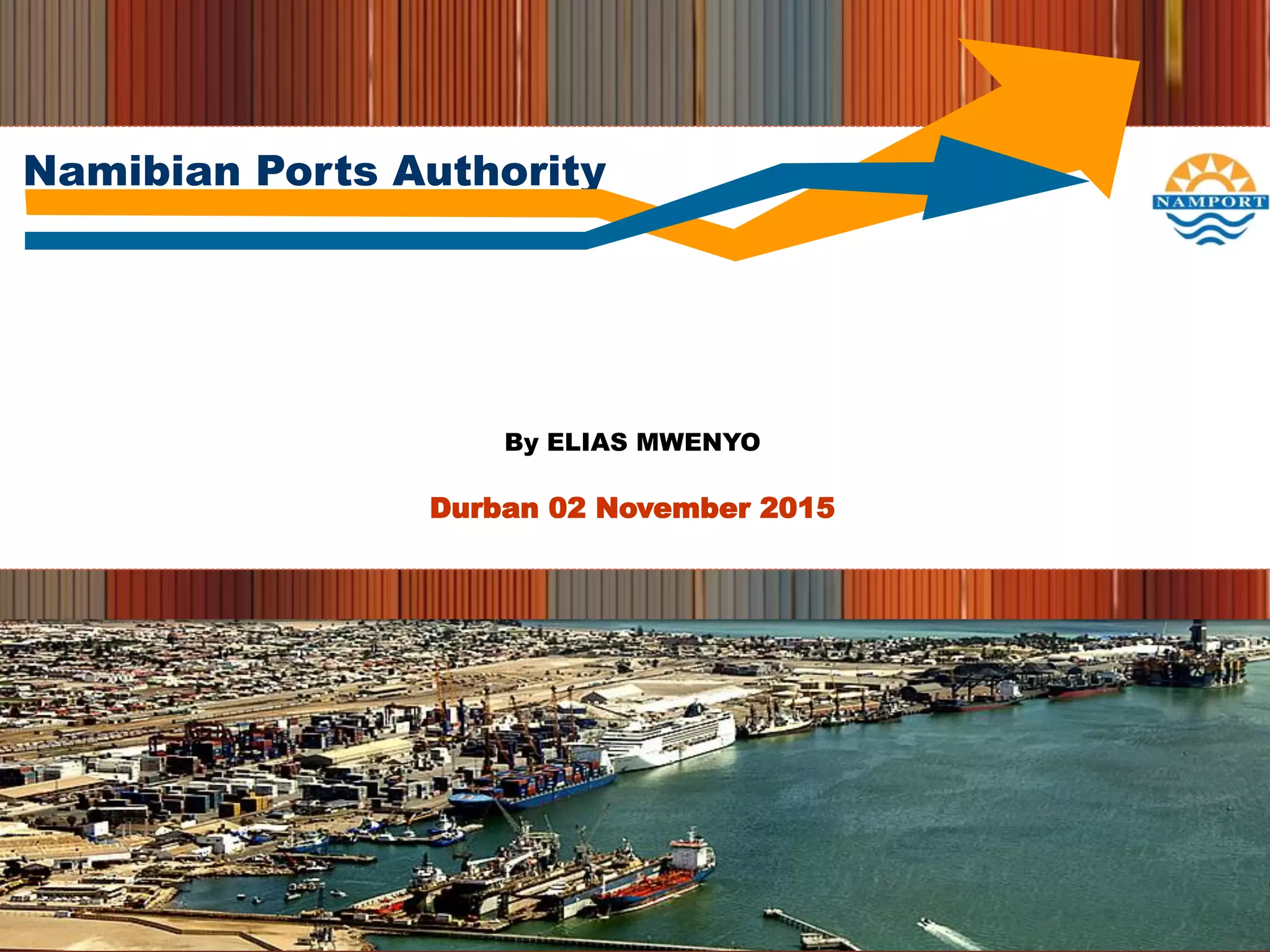
Namibian Ports Authority
By ELIAS MWENYO
Durban 02 November 2015
CONTENTS
1. Namport at a glance
2. The Market Environment
3. Link to National Strategy
4. Growth
5. Ports and Hinterland Links
6. Successes
7. Major Projects & Investment Opportunities
Namport at a Glance
 State owned entity that Manages and the ports of
Walvis Bay and Luderitz
 Established in 1994 by an Act of Parliament
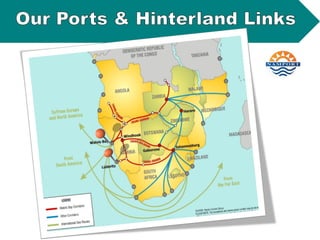
 Linked to the SADC Region via various transport
corridors
 ISO 9001, 14001 and OSHSAS 18001 certification
 Ports ISPS compliant
The Market
Environment
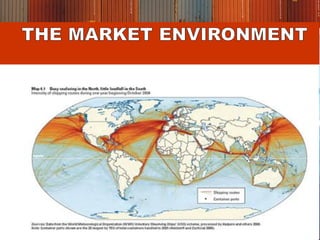
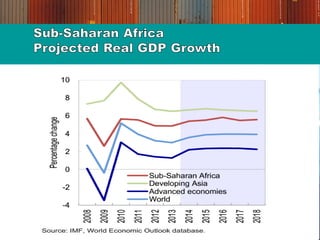
• Economic changes. Seaborne trade has increased substantially,
in part because of the massive redistribution of manufacturing to
low cost locations (China).
• Technical changes. The growth in ship size to better achieve
economies of scale has been a prevalent technical change.
• Organizational changes. The maritime and port industry are
increasingly controlled by large shipping companies and terminal
operators that have engaged in strategic alliances as well as
mergers and acquisitions.
DO 5.1 (Public Infrastructure) : By 2017, Namibia shall have a well-functioning, high
quality transport infrastructure connected to major local and regional markets as well as
linked to the Port of Walvis Bay: 70% of railway network to comply with SADC axle load
recommendation of 18.5 tonnes
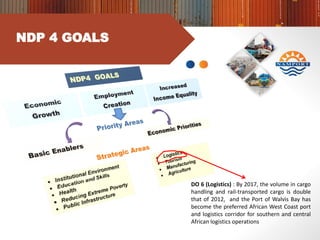
DO 6 (Logistics) : By 2017, the volume in cargo handling and rail-transported cargo is
double that of 2012, and the Port of Walvis Bay has become the preferred African West
Coast port and logistics corridor for southern and central African logistics operations
NDP 4 GOALS
DO 6 (Logistics) : By 2017, the volume in cargo
handling and rail-transported cargo is double
that of 2012, and the Port of Walvis Bay has
become the preferred African West Coast port
and logistics corridor for southern and central
African logistics operations
DO 5.1 (Public Infrastructure) : By 2017, Namibia shall have a well-functioning, high
quality transport infrastructure connected to major local and regional markets as well as
linked to the Port of Walvis Bay: 70% of railway network to comply with SADC axle load
recommendation of 18.5 tonnes
DO 6 (Logistics) : By 2017, the volume in cargo handling and rail-transported cargo is
double that of 2012, and the Port of Walvis Bay has become the preferred African West
Coast port and logistics corridor for southern and central African logistics operations
NAMPORT STRATEGY TO
ACHIEVE NDP4 DESIRED
OUTCOMES
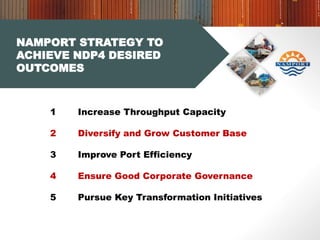
1 Increase Throughput Capacity
2 Diversify and Grow Customer Base
3 Improve Port Efficiency
4 Ensure Good Corporate Governance
5 Pursue Key Transformation Initiatives
DO 5.1 (Public Infrastructure) : By 2017, Namibia shall have a well-functioning, high
quality transport infrastructure connected to major local and regional markets as well as
linked to the Port of Walvis Bay: 70% of railway network to comply with SADC axle load
recommendation of 18.5 tonnes
DO 6 (Logistics) : By 2017, the volume in cargo handling and rail-transported cargo is
double that of 2012, and the Port of Walvis Bay has become the preferred African West
Coast port and logistics corridor for southern and central African logistics operations
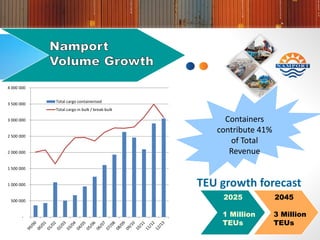
-
500 000
1 000 000
1 500 000
2 000 000
2 500 000
3 000 000
3 500 000
4 000 000
Total cargo containerised
Total cargo in bulk / break-bulk
TEU growth forecast
2025
1 Million
TEUs
2045
3 Million
TEUs
Containers
contribute 41%
of Total
Revenue
• Maximised existing capacity at Walvis Bay Port
• Increased TEU capacity from 250,000 to 355,000 TEUs
• Increased draft at Berths 1 to 3 from -12.8 m to -14 m
• Enabled Berths 1 to 3 to handle 4500 TEU container vessels – berth 2 x
250 m vessels at same time
• Relocated a shed on the quay to provide additional stacking pace
• Increasing future container handling capacity at Walvis Bay
• Commenced building a New Container Terminal with capacity of
750,000 TEUs p.a. with 16m draft and 600 m quay length
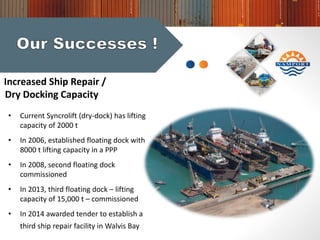
Increased Ship Repair /
Dry Docking Capacity
• Current Syncrolift (dry-dock) has lifting
capacity of 2000 t
• In 2006, established floating dock with
8000 t lifting capacity in a PPP
• In 2008, second floating dock
commissioned
• In 2013, third floating dock – lifting
capacity of 15,000 t – commissioned
• In 2014 awarded tender to establish a
third ship repair facility in Walvis Bay
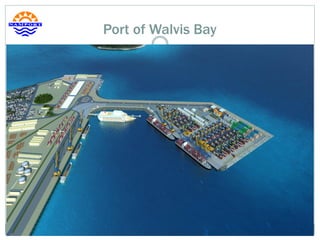
Port of Walvis Bay
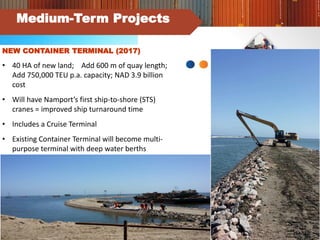
Medium-Term Projects
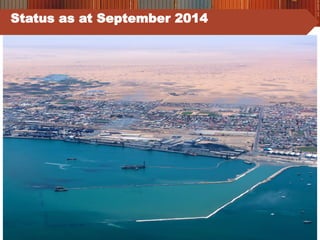
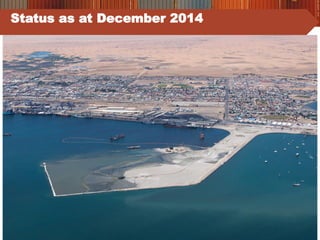
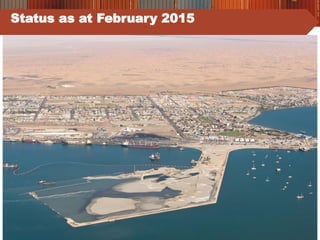
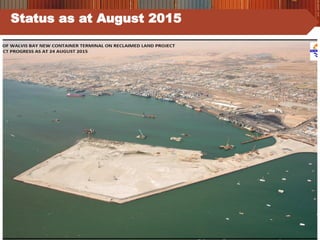
NEW CONTAINER TERMINAL (2017)
• 40 HA of new land; Add 600 m of quay length;
Add 750,000 TEU p.a. capacity; NAD 3.9 billion
cost
• Will have Namport’s first ship-to-shore (STS)
cranes = improved ship turnaround time
• Includes a Cruise Terminal
• Existing Container Terminal will become multi-
purpose terminal with deep water berths
Status as at September 2014
Status as at December 2014
Status as at February 2015
Status as at August 2015
Overall Project
progress to date
38%
On Schedule to commission end of 2017
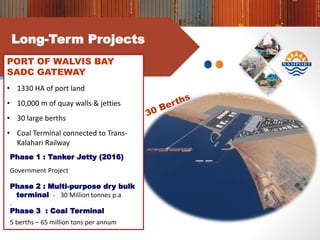
Long-Term Projects
PORT OF WALVIS BAY
SADC GATEWAY
• 1330 HA of port land
• 10,000 m of quay walls & jetties
• 30 large berths
• Coal Terminal connected to Trans-
Kalahari Railway
Phase 1 : Tanker Jetty (2016)
Government Project
Phase 2 : Multi-purpose dry bulk
terminal - 30 Million tonnes p.a
.
Phase 3 : Coal Terminal
5 berths – 65 million tons per annum
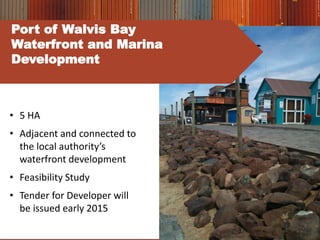
• 5 HA
• Adjacent and connected to
the local authority’s
waterfront development
• Feasibility Study
• Tender for Developer will
be issued early 2015
Port of Walvis Bay
Waterfront and Marina
Development
Namport overview

Namport overview

  • 1.
    Namibian Ports Authority ByELIAS MWENYO Durban 02 November 2015
  • 2.
    CONTENTS 1. Namport ata glance 2. The Market Environment 3. Link to National Strategy 4. Growth 5. Ports and Hinterland Links 6. Successes 7. Major Projects & Investment Opportunities
  • 3.
    Namport at aGlance  State owned entity that Manages and the ports of Walvis Bay and Luderitz  Established in 1994 by an Act of Parliament  Linked to the SADC Region via various transport corridors  ISO 9001, 14001 and OSHSAS 18001 certification  Ports ISPS compliant
  • 5.
    The Market Environment • Economicchanges. Seaborne trade has increased substantially, in part because of the massive redistribution of manufacturing to low cost locations (China). • Technical changes. The growth in ship size to better achieve economies of scale has been a prevalent technical change. • Organizational changes. The maritime and port industry are increasingly controlled by large shipping companies and terminal operators that have engaged in strategic alliances as well as mergers and acquisitions.
  • 6.
    DO 5.1 (PublicInfrastructure) : By 2017, Namibia shall have a well-functioning, high quality transport infrastructure connected to major local and regional markets as well as linked to the Port of Walvis Bay: 70% of railway network to comply with SADC axle load recommendation of 18.5 tonnes DO 6 (Logistics) : By 2017, the volume in cargo handling and rail-transported cargo is double that of 2012, and the Port of Walvis Bay has become the preferred African West Coast port and logistics corridor for southern and central African logistics operations NDP 4 GOALS DO 6 (Logistics) : By 2017, the volume in cargo handling and rail-transported cargo is double that of 2012, and the Port of Walvis Bay has become the preferred African West Coast port and logistics corridor for southern and central African logistics operations
  • 7.
    DO 5.1 (PublicInfrastructure) : By 2017, Namibia shall have a well-functioning, high quality transport infrastructure connected to major local and regional markets as well as linked to the Port of Walvis Bay: 70% of railway network to comply with SADC axle load recommendation of 18.5 tonnes DO 6 (Logistics) : By 2017, the volume in cargo handling and rail-transported cargo is double that of 2012, and the Port of Walvis Bay has become the preferred African West Coast port and logistics corridor for southern and central African logistics operations NAMPORT STRATEGY TO ACHIEVE NDP4 DESIRED OUTCOMES 1 Increase Throughput Capacity 2 Diversify and Grow Customer Base 3 Improve Port Efficiency 4 Ensure Good Corporate Governance 5 Pursue Key Transformation Initiatives
  • 8.
    DO 5.1 (PublicInfrastructure) : By 2017, Namibia shall have a well-functioning, high quality transport infrastructure connected to major local and regional markets as well as linked to the Port of Walvis Bay: 70% of railway network to comply with SADC axle load recommendation of 18.5 tonnes DO 6 (Logistics) : By 2017, the volume in cargo handling and rail-transported cargo is double that of 2012, and the Port of Walvis Bay has become the preferred African West Coast port and logistics corridor for southern and central African logistics operations
  • 9.
    - 500 000 1 000000 1 500 000 2 000 000 2 500 000 3 000 000 3 500 000 4 000 000 Total cargo containerised Total cargo in bulk / break-bulk TEU growth forecast 2025 1 Million TEUs 2045 3 Million TEUs Containers contribute 41% of Total Revenue
  • 11.
    • Maximised existingcapacity at Walvis Bay Port • Increased TEU capacity from 250,000 to 355,000 TEUs • Increased draft at Berths 1 to 3 from -12.8 m to -14 m • Enabled Berths 1 to 3 to handle 4500 TEU container vessels – berth 2 x 250 m vessels at same time • Relocated a shed on the quay to provide additional stacking pace • Increasing future container handling capacity at Walvis Bay • Commenced building a New Container Terminal with capacity of 750,000 TEUs p.a. with 16m draft and 600 m quay length
  • 12.
    Increased Ship Repair/ Dry Docking Capacity • Current Syncrolift (dry-dock) has lifting capacity of 2000 t • In 2006, established floating dock with 8000 t lifting capacity in a PPP • In 2008, second floating dock commissioned • In 2013, third floating dock – lifting capacity of 15,000 t – commissioned • In 2014 awarded tender to establish a third ship repair facility in Walvis Bay
  • 14.
  • 15.
    Medium-Term Projects NEW CONTAINERTERMINAL (2017) • 40 HA of new land; Add 600 m of quay length; Add 750,000 TEU p.a. capacity; NAD 3.9 billion cost • Will have Namport’s first ship-to-shore (STS) cranes = improved ship turnaround time • Includes a Cruise Terminal • Existing Container Terminal will become multi- purpose terminal with deep water berths
  • 16.
    Status as atSeptember 2014
  • 17.
    Status as atDecember 2014
  • 18.
    Status as atFebruary 2015
  • 19.
    Status as atAugust 2015
  • 20.
    Overall Project progress todate 38% On Schedule to commission end of 2017
  • 21.
    Long-Term Projects PORT OFWALVIS BAY SADC GATEWAY • 1330 HA of port land • 10,000 m of quay walls & jetties • 30 large berths • Coal Terminal connected to Trans- Kalahari Railway Phase 1 : Tanker Jetty (2016) Government Project Phase 2 : Multi-purpose dry bulk terminal - 30 Million tonnes p.a . Phase 3 : Coal Terminal 5 berths – 65 million tons per annum
  • 22.
    • 5 HA •Adjacent and connected to the local authority’s waterfront development • Feasibility Study • Tender for Developer will be issued early 2015 Port of Walvis Bay Waterfront and Marina Development