
International Ocean Transportation
• Huseyin Tekler
• Flag
• Liability Conventions
• Non-Vessel Operating Common Carriers
• Security Requirements
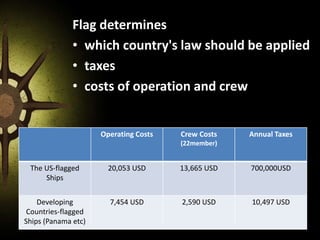
Flag determines
• which country's law should be applied
• taxes
• costs of operation and crew
Operating Costs Crew Costs
(22member)
Annual Taxes
The US-flagged
Ships
20,053 USD 13,665 USD 700,000USD
Developing
Countries-flagged
Ships (Panama etc)
7,454 USD 2,590 USD 10,497 USD
• Flag of Convenience (FOC)
The term “flag of convenience” refers to registering a ship in a
sovereign state different from that of the ship's owners.
• Open registry
This is a system whereby a country may allow ships to be registered
there and fly the country's flag without the real owner having any
definite connection with the country.
• Cabotage
Transport of goods or passengers between two places in the same
country by a transport operator from another country.
Liability Conventions
• Hague Rules
A 1924 international liability convention for ocean cargo that restricts the liability of the
carrier to US$ 500 per package or per customary freight unit.
• Hague-Visby Rules
A 1968 international liability convention for ocean cargo that restricts the liability of the
carrier to SDR 666,67 per package or per customary freight unit.
• Hamburg Rules
A 1978 international liability convention for ocean cargo that restricts the liability of the
carrier to US$ 833 per package or per customary freight unit.
• Rotterdam Rules
A 2008 international liability convention for intermodal cargo that restricts the liability
of the carrier to US$ 875 per package or per customary freight unit.
Non-Vessel-Operating Common Carriers
Non-Vessel-Operating Common Carriers (NVOCCs) make up another
type shipping company, but with the caveat that they do not own and
operate ships.
NVOCCS regulated by federal Maritime Commission (FMC).
NVOCCs provide a variety of services for their customers, the underlying
shippers
Negotiate service contracts with Vessel-operating carriers (VOCCs) for the
aggregated volume of their underlying shippers' cargoes.
NVOCCs, can obtain discounts
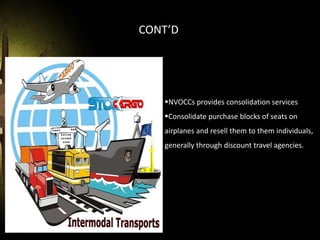
Many NVOCCs provide intermodal combinations of Ocean and inland
transportation.
Provide consolidation services to the customers with the same destination.
CONT’D
NVOCCs provides consolidation services
Consolidate purchase blocks of seats on
airplanes and resell them to them individuals,
generally through discount travel agencies.
Freight Charges
Shipping lines will charge for container shipping either by following published
tariff rates or by negotiating contract rates with large volume shippers. All tariff
rates can be determined, and shipping lines will negotiate rates for as 12 containers
shipped at once.
Types of Freight Charges
1. Arbitrage Charge (ARB)
2. Bunk adjustment and factor (BAF)
3. Currency adjustment factor (CAF)
4.Container yard to container yard movement of
cargo (CY/CY)
5.Container freight stations to container yard
movement of cargo (CFS/CY)
6. Chassis charge.
7. Terminal handling charge (THC)
1. Arbitrary charge; this charge is for added expenses, such as transshipment in an
intermediary port, ice-breaking, cleaning of returned containers that are not ready for next
cargo.
2. Bunker adjustment; this is an extra charge applied by shipping to reflect fluctuations in the
cost of bunker fuel.
3. Currency adjustment factor; is the charge applied to freight rates by shipping lines,. Ensure
that the revenue of the shipping lines is not affected by movements in the currencies.
4. CY/CY; this is a charge added to the freight rate to reflect the cost of moment from one yard
in the port to another.
5. CFS/CY; this is a charge added to the rate to reflect the cost of moving cargo from out side
the port to a yard the port
6. Chassis charge; this is a charge imposed by container shipping line for providing customers
with truck chassis at the harbor terminals.
7. THC; this is a charge payable to a shipping line either for receiving a full container load,
delivering, storing at container terminal or for receiving it from the ship at the discharge port,
storing it and delivering to the consignee.
CONT’D
SECURITY REQUIREMENTS
After the terrorist attacks took place in the beginning of the twenty-first
century, a number of measures were taken worldwide to limit the
probability of terrorist attacks carried out by sea.
The United States’ Approach:
In September 11, 2001, U.S. customs began developing antiterrorism to
help secure the United States. Within months of these attacks, U.S.
customs service had created the container security initiative (CSI).
Border Security’s top priority is to keep terrorists and their weapons
from entering the U.S.
The European Union’s Programs
The European Union has Approached security in a significantly different
way; it recognizes that there are new security issues with the increase in
terrorism and the availability of weapons.
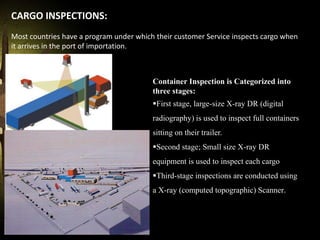
CARGO INSPECTIONS:
Most countries have a program under which their customer Service inspects cargo when
it arrives in the port of importation.
Container Inspection is Categorized into
three stages:
First stage, large-size X-ray DR (digital
radiography) is used to inspect full containers
sitting on their trailer.
Second stage; Small size X-ray DR
equipment is used to inspect each cargo
Third-stage inspections are conducted using
a X-ray (computed topographic) Scanner.
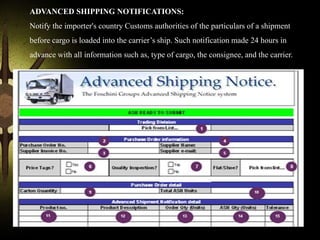
ADVANCED SHIPPING NOTIFICATIONS:
Notify the importer's country Customs authorities of the particulars of a shipment
before cargo is loaded into the carrier’s ship. Such notification made 24 hours in
advance with all information such as, type of cargo, the consignee, and the carrier.
Thank You!
谢谢!

Presentation of ocean transportation

  • 1.
    International Ocean Transportation •Huseyin Tekler • Flag • Liability Conventions • Non-Vessel Operating Common Carriers • Security Requirements
  • 2.
    Flag determines • whichcountry's law should be applied • taxes • costs of operation and crew Operating Costs Crew Costs (22member) Annual Taxes The US-flagged Ships 20,053 USD 13,665 USD 700,000USD Developing Countries-flagged Ships (Panama etc) 7,454 USD 2,590 USD 10,497 USD
  • 3.
    • Flag ofConvenience (FOC) The term “flag of convenience” refers to registering a ship in a sovereign state different from that of the ship's owners. • Open registry This is a system whereby a country may allow ships to be registered there and fly the country's flag without the real owner having any definite connection with the country. • Cabotage Transport of goods or passengers between two places in the same country by a transport operator from another country.
  • 4.
    Liability Conventions • HagueRules A 1924 international liability convention for ocean cargo that restricts the liability of the carrier to US$ 500 per package or per customary freight unit. • Hague-Visby Rules A 1968 international liability convention for ocean cargo that restricts the liability of the carrier to SDR 666,67 per package or per customary freight unit. • Hamburg Rules A 1978 international liability convention for ocean cargo that restricts the liability of the carrier to US$ 833 per package or per customary freight unit. • Rotterdam Rules A 2008 international liability convention for intermodal cargo that restricts the liability of the carrier to US$ 875 per package or per customary freight unit.
  • 5.
    Non-Vessel-Operating Common Carriers Non-Vessel-OperatingCommon Carriers (NVOCCs) make up another type shipping company, but with the caveat that they do not own and operate ships. NVOCCS regulated by federal Maritime Commission (FMC). NVOCCs provide a variety of services for their customers, the underlying shippers Negotiate service contracts with Vessel-operating carriers (VOCCs) for the aggregated volume of their underlying shippers' cargoes. NVOCCs, can obtain discounts Many NVOCCs provide intermodal combinations of Ocean and inland transportation. Provide consolidation services to the customers with the same destination.
  • 6.
    CONT’D NVOCCs provides consolidationservices Consolidate purchase blocks of seats on airplanes and resell them to them individuals, generally through discount travel agencies.
  • 7.
    Freight Charges Shipping lineswill charge for container shipping either by following published tariff rates or by negotiating contract rates with large volume shippers. All tariff rates can be determined, and shipping lines will negotiate rates for as 12 containers shipped at once. Types of Freight Charges 1. Arbitrage Charge (ARB) 2. Bunk adjustment and factor (BAF) 3. Currency adjustment factor (CAF) 4.Container yard to container yard movement of cargo (CY/CY) 5.Container freight stations to container yard movement of cargo (CFS/CY) 6. Chassis charge. 7. Terminal handling charge (THC)
  • 8.
    1. Arbitrary charge;this charge is for added expenses, such as transshipment in an intermediary port, ice-breaking, cleaning of returned containers that are not ready for next cargo. 2. Bunker adjustment; this is an extra charge applied by shipping to reflect fluctuations in the cost of bunker fuel. 3. Currency adjustment factor; is the charge applied to freight rates by shipping lines,. Ensure that the revenue of the shipping lines is not affected by movements in the currencies. 4. CY/CY; this is a charge added to the freight rate to reflect the cost of moment from one yard in the port to another. 5. CFS/CY; this is a charge added to the rate to reflect the cost of moving cargo from out side the port to a yard the port 6. Chassis charge; this is a charge imposed by container shipping line for providing customers with truck chassis at the harbor terminals. 7. THC; this is a charge payable to a shipping line either for receiving a full container load, delivering, storing at container terminal or for receiving it from the ship at the discharge port, storing it and delivering to the consignee. CONT’D
  • 9.
    SECURITY REQUIREMENTS After theterrorist attacks took place in the beginning of the twenty-first century, a number of measures were taken worldwide to limit the probability of terrorist attacks carried out by sea. The United States’ Approach: In September 11, 2001, U.S. customs began developing antiterrorism to help secure the United States. Within months of these attacks, U.S. customs service had created the container security initiative (CSI). Border Security’s top priority is to keep terrorists and their weapons from entering the U.S. The European Union’s Programs The European Union has Approached security in a significantly different way; it recognizes that there are new security issues with the increase in terrorism and the availability of weapons.
  • 10.
    CARGO INSPECTIONS: Most countrieshave a program under which their customer Service inspects cargo when it arrives in the port of importation. Container Inspection is Categorized into three stages: First stage, large-size X-ray DR (digital radiography) is used to inspect full containers sitting on their trailer. Second stage; Small size X-ray DR equipment is used to inspect each cargo Third-stage inspections are conducted using a X-ray (computed topographic) Scanner.
  • 11.
    ADVANCED SHIPPING NOTIFICATIONS: Notifythe importer's country Customs authorities of the particulars of a shipment before cargo is loaded into the carrier’s ship. Such notification made 24 hours in advance with all information such as, type of cargo, the consignee, and the carrier.
  • 12.