Brand Extension:
Growing the
McDonald’s Brand
AKSHIT JAIN 15BSP0140
Akansha Bhambri
Agenda
 Evolution & About McD
 Timeline
 Product Mix
 E-Presence
 Challenges
 McD’s Way
 Conclusion
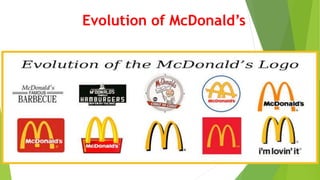
Evolution of McDonald’s
About McDonald’s
 McDonald's was started as a drive-in restaurant by two brothers,
Richard and Maurice McDonald in California, US in 1937.
 The business, which was generating $200,000 per annum in the 1940s ,
got a further boost with the emergence of a revolutionary concept
called 'self-service.
 Speed, service and cleanliness became the critical success factors of
the business.
 By mid- 1950s, the restaurant's revenues had reached $350,000.
 Today it is the world's largest chain of fast food restaurants
 Today it serves around 68 million customers daily in 119 countries
across 36,538 outlets
Timeline
 1937 – Drive-thur restaurant – The Airdome on route 66, California
 1940 – Renamed as McDonald’s
 1943 – Ronald McDonald character was created
 1961 – Rights sold to Ray Kroc for $2.7 million
 1962 – First McD’s with seating opened in Denver
 1963 – 1 billion burgers sold with 500 total restaurants
 1971 – McDonald’s expand globally
 1979 – Happy meal was introduced
 1997 – McFlurry was invented
 2003 – The iconic I’m Lovin’ it campaign
 2015 – Steve Easterbrook become CEO; announced widespread reform plan
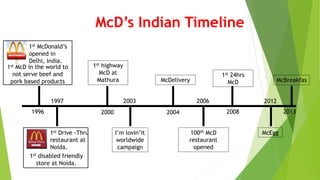
McD’s Indian Timeline
1996
1st McDonald’s
opened in
Delhi, India.
1st McD in the world to
not serve beef and
pork based products
1997
1st Drive -Thru
restaurant at
Noida.
1st disabled friendly
store at Noida.
2000
1st highway
McD at
Mathura
2004
20062003
I’m lovin’it
worldwide
campaign
2008
1st 24hrs
McD
2012
McEgg
2013
McBreakfas
t
McDelivery
100th McD
restaurant
opened
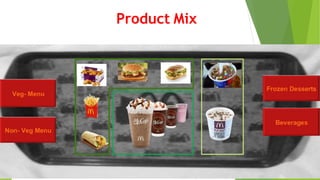
Product Mix
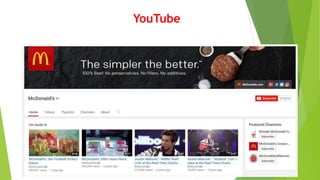
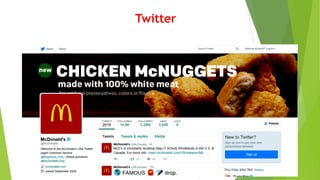
SOCIAL MEDIA GIVES TREMENDOUS
RESPONSES & HELPS IN BRAND
BUILDING & EXTENSION
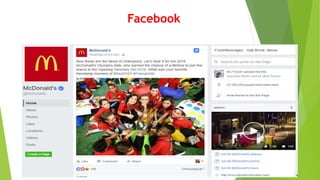
Facebook
YouTube
Twitter
Challenges
Challenging environment
Global health concern
Market saturation, and a slumping economy
Culture differences
McDonald's Way
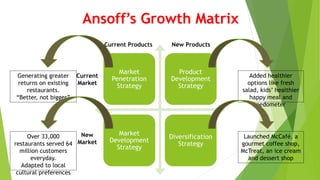
To overcome these, the company has employed a
number of different growth strategies that can be
classified using the Ansoff’s growth share matrix
Company extended its offering by leveraging its
brand
Introduced new products based on local culture
Brand Extensions – Advantages
 Facilitate New Product
acceptance
 Improve brand image
 Reduce risk perceived by
the customers
 Increase efficiency of
promotional expenditures
 Avoid cost of developing a
new brand
 Permit consumer variety-
seeking
Feedback benefits to the parent
brand and company
Clarify brand meaning
Enhance the parent brand
image
Bring new customers into
the brand franchise and
increase market coverage
Revitalize the brand
Permit subsequent
extensions
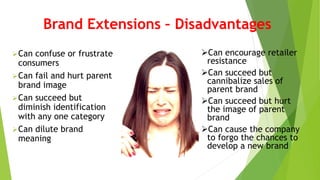
Brand Extensions – Disadvantages
Can confuse or frustrate
consumers
Can fail and hurt parent
brand image
Can succeed but
diminish identification
with any one category
Can dilute brand
meaning
Can encourage retailer
resistance
Can succeed but
cannibalize sales of
parent brand
Can succeed but hurt
the image of parent
brand
Can cause the company
to forgo the chances to
develop a new brand
Market
Penetration
Strategy
Product
Development
Strategy
Market
Development
Strategy
Diversification
Strategy
Ansoff’s Growth Matrix
Current Products New Products
Current
Market
New
Market
Generating greater
returns on existing
restaurants.
“Better, not bigger”
Over 33,000
restaurants served 64
million customers
everyday.
Adapted to local
cultural preferences
Launched McCafé, a
gourmet coffee shop,
McTreat, an ice cream
and dessert shop
Added healthier
options like fresh
salad, kids’ healthier
happy meal and
pedometer
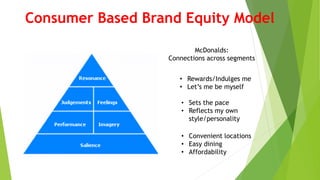
Consumer Based Brand Equity Model
‱ Rewards/Indulges me
‱ Let’s me be myself
McDonalds:
Connections across segments
‱ Sets the pace
‱ Reflects my own
style/personality
‱ Convenient locations
‱ Easy dining
‱ Affordability
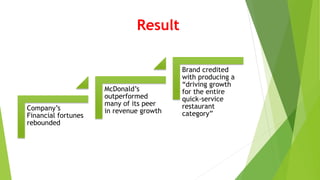
Result
Company’s
Financial fortunes
rebounded
McDonald’s
outperformed
many of its peer
in revenue growth
Brand credited
with producing a
“driving growth
for the entire
quick-service
restaurant
category”
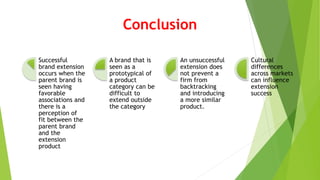
Conclusion
Successful
brand extension
occurs when the
parent brand is
seen having
favorable
associations and
there is a
perception of
fit between the
parent brand
and the
extension
product
A brand that is
seen as a
prototypical of
a product
category can be
difficult to
extend outside
the category
An unsuccessful
extension does
not prevent a
firm from
backtracking
and introducing
a more similar
product.
Cultural
differences
across markets
can influence
extension
success
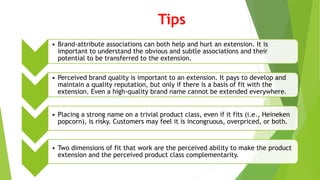
Tips
‱ Brand-attribute associations can both help and hurt an extension. It is
important to understand the obvious and subtle associations and their
potential to be transferred to the extension.
‱ Perceived brand quality is important to an extension. It pays to develop and
maintain a quality reputation, but only if there is a basis of fit with the
extension. Even a high-quality brand name cannot be extended everywhere.
‱ Placing a strong name on a trivial product class, even if it fits (i.e., Heineken
popcorn), is risky. Customers may feel it is incongruous, overpriced, or both.
‱ Two dimensions of fit that work are the perceived ability to make the product
extension and the perceived product class complementarity.
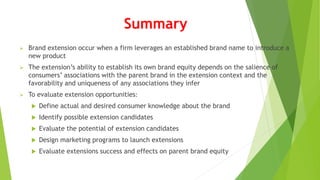
Summary
 Brand extension occur when a firm leverages an established brand name to introduce a
new product
 The extension’s ability to establish its own brand equity depends on the salience of
consumers’ associations with the parent brand in the extension context and the
favorability and uniqueness of any associations they infer
 To evaluate extension opportunities:
 Define actual and desired consumer knowledge about the brand
 Identify possible extension candidates
 Evaluate the potential of extension candidates
 Design marketing programs to launch extensions
 Evaluate extensions success and effects on parent brand equity