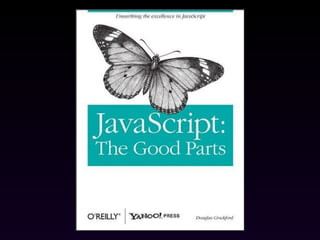
JavaScript:   The Good Parts Douglas Crockford Yahoo! Inc. http://www.crockford.com/codecamp/
The World's Most Misunderstood Programming Language
A language of many contrasts.
The broadest range of programmer skills of any programming language. From computer scientists  to cut-n-pasters  and everyone in between.
Complaints "JavaScript is not a language I know." "The browser programming experience is awful." "It's not fast enough." "The language is just a pile of mistakes."
Hidden under a huge steaming pile of good intentions and blunders is an elegant, expressive programming language. JavaScript has good parts.
JavaScript is succeeding very well in an environment where Java was a total failure.
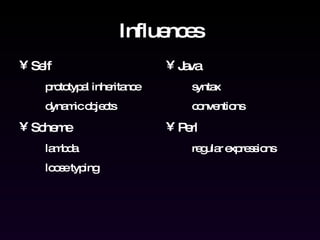
Influences Self prototypal inheritance dynamic objects Scheme lambda loose typing Java syntax conventions Perl regular expressions
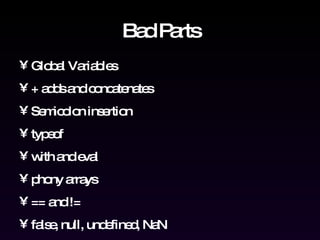
Bad Parts Global Variables + adds and concatenates Semicolon insertion typeof with and eval phony arrays == and != false, null, undefined, NaN
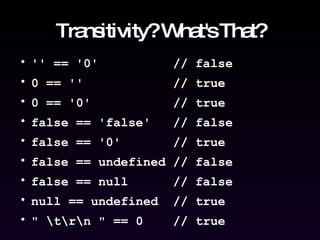
Transitivity? What's That? '' == '0'  // false 0 == ''  // true 0 == '0'  // true false == 'false'  // false false == '0'  // true false == undefined // false false == null  // false null == undefined  // true " \t\r\n " == 0  // true
value = myObject[name]; if (value  == null ) { alert(name + ' not found.'); } Two errors that cancel each other out.
value = myObject[name]; if (value  === undefined ) { alert(name + ' not found.'); }
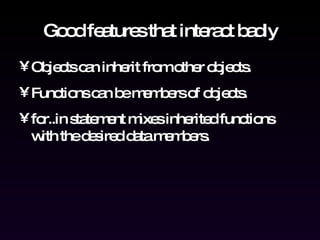
Good features that interact badly Objects can inherit from other objects. Functions can be members of objects. for..in statement mixes inherited functions with the desired data members.
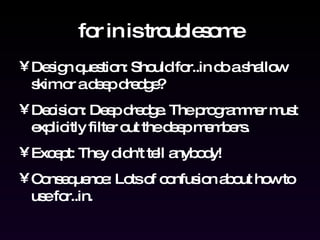
for in is troublesome Design question: Should for..in do a shallow skim or a deep dredge? Decision: Deep dredge. The programmer must explicitly filter out the deep members. Except: They didn't tell anybody! Consequence: Lots of confusion about how to use for..in.
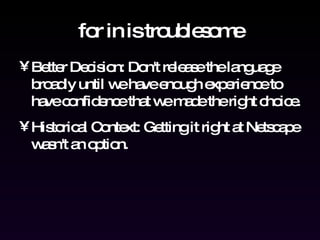
for in is troublesome Better Decision: Don't release the language broadly until we have enough experience to have confidence that we made the right choice. Historical Context: Getting it right at Netscape wasn't an option.
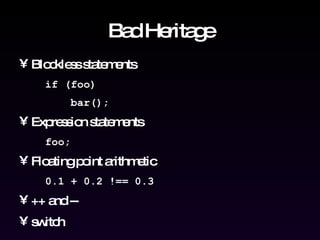
Bad Heritage Blockless statements if (foo) bar(); Expression statements foo; Floating point arithmetic 0.1 + 0.2 !== 0.3 ++ and -- switch
Good Parts Lambda Dynamic Objects Loose Typing Object Literals
Inheritance Inheritance is object-oriented code reuse. Two Schools: Classical Prototypal
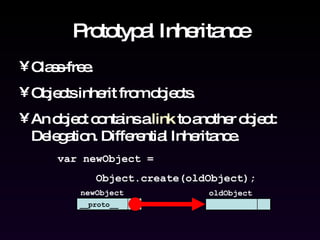
Prototypal Inheritance Class-free. Objects inherit from objects. An object contains a  link  to another object: Delegation. Differential Inheritance. var newObject =  Object.create(oldObject); newObject oldObject __proto__
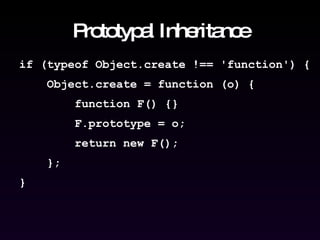
Prototypal Inheritance if (typeof Object.create !== 'function') { Object.create = function (o) { function F() {} F.prototype = o; return new F(); }; }
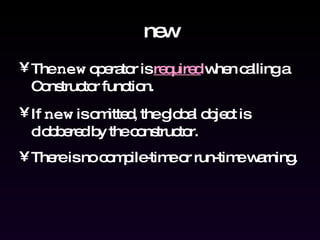
new The  new  operator is  required  when calling a Constructor function. If  new  is omitted, the global object is clobbered by the constructor. There is no compile-time or run-time warning.
Global var  names  = ['zero', 'one', 'two',  'three', 'four', 'five', 'six',  'seven', 'eight', 'nine']; var  digit_name  =  function (n) { return  names [n]; }; alert( digit_name (3));  // 'three'
Slow var  digit_name  =  function (n) {   var  names  = ['zero', 'one', 'two',  'three', 'four', 'five', 'six',  'seven', 'eight', 'nine']; return  names [n]; }; alert( digit_name (3));  // 'three'
Closure var  digit_name  = (function () { var  names  = ['zero', 'one', 'two',  'three', 'four', 'five', 'six',  'seven', 'eight', 'nine']; return  function (n) { return  names [n]; }; } ()) ; alert( digit_name (3));  // 'three'
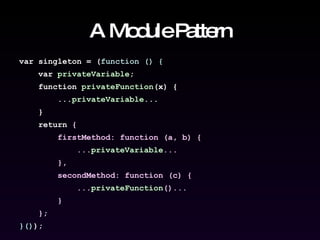
A Module Pattern var singleton = ( function () { var  privateVariable ; function  privateFunction (x) { ... privateVariable ... } return  { firstMethod: function (a, b) { ... privateVariable ... }, secondMethod: function (c) { ... privateFunction ()... } } ; }() );
Module pattern is easily transformed into a powerful constructor pattern.
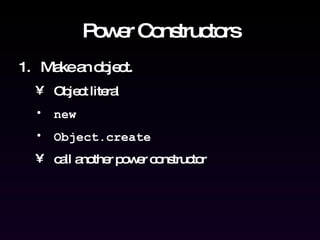
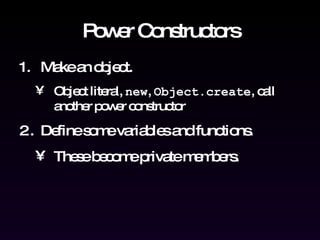
Power Constructors Make an object. Object literal new Object.create call another power constructor
Power Constructors Make an object. Object literal,  new ,  Object.create , call another power constructor Define some variables and functions.  These become private members.
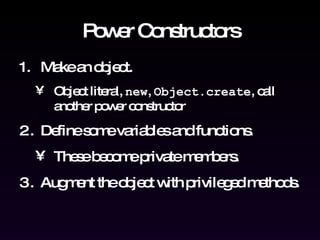
Power Constructors Make an object. Object literal,  new ,  Object.create , call another power constructor Define some variables and functions.  These become private members. Augment the object with privileged methods.
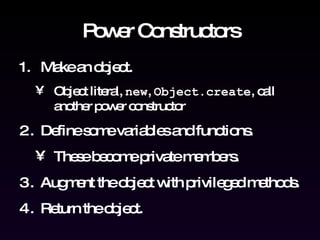
Power Constructors Make an object. Object literal,  new ,  Object.create , call another power constructor Define some variables and functions.  These become private members. Augment the object with privileged methods. Return the object.
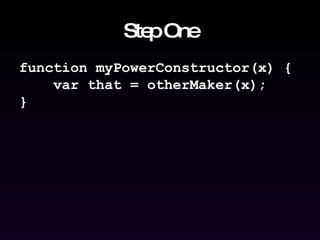
Step One function myPowerConstructor(x) { var that = otherMaker(x); }
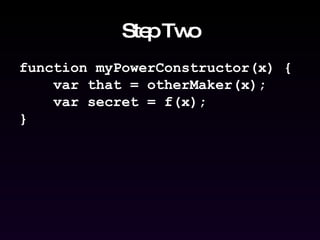
Step Two function myPowerConstructor(x) { var that = otherMaker(x); var secret = f(x); }
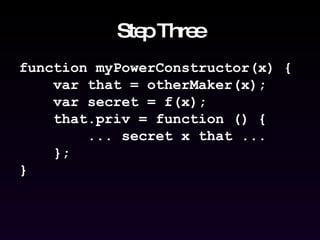
Step Three function myPowerConstructor(x) { var that = otherMaker(x); var secret = f(x); that.priv = function () { ... secret x that ... }; }
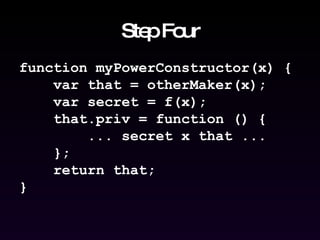
Step Four function myPowerConstructor(x) { var that = otherMaker(x); var secret = f(x); that.priv = function () { ... secret x that ... }; return that; }
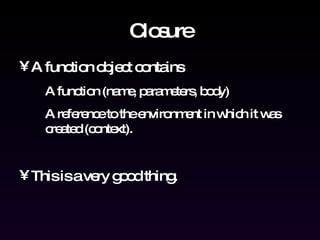
Closure A function object contains A function (name, parameters, body) A reference to the environment in which it was created (context). This is a very good thing.
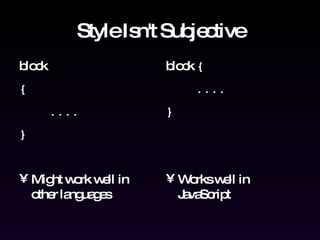
Style Isn't Subjective block { .... } Might work well in other languages block  { .... } Works well in JavaScript
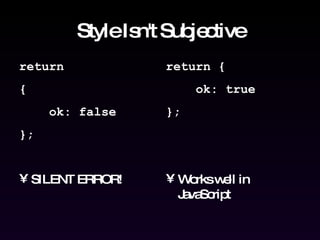
Style Isn't Subjective return { ok: false }; SILENT ERROR! return { ok: true }; Works well in JavaScript
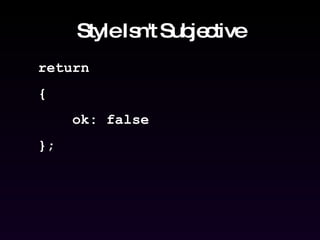
Style Isn't Subjective return { ok: false };
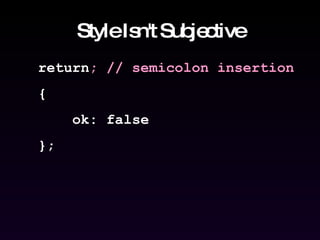
Style Isn't Subjective return ; // semicolon insertion { ok: false };
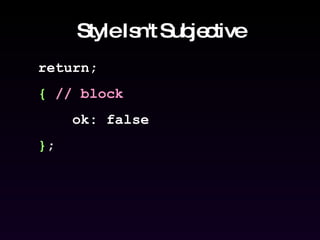
Style Isn't Subjective return; {   // block ok: false } ;
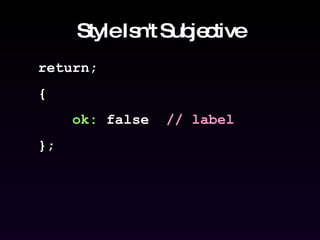
Style Isn't Subjective return; {  ok:  false  // label };
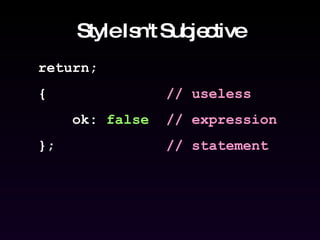
Style Isn't Subjective return; {  // useless ok:  false   // expression };  // statement
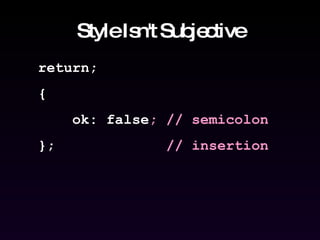
Style Isn't Subjective return; {  ok: false ; // semicolon };  // insertion
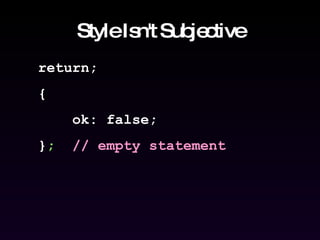
Style Isn't Subjective return; {  ok: false; } ;   // empty statement
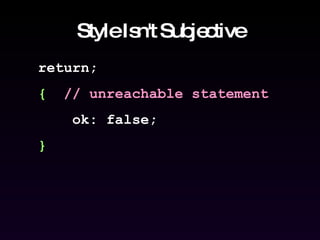
Style Isn't Subjective return; {   // unreachable statement ok: false; }
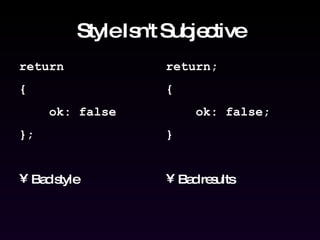
Style Isn't Subjective return { ok: false }; Bad style return; { ok: false; } Bad results
Working with the Grain
A Personal Journey Beautiful Code
JSLint JSLint defines a professional subset of JavaScript. It imposes a programming discipline that makes me much more confident in a dynamic, loosely-typed environment. http://www.JSLint.com/
WARNING! JSLint will hurt your feelings.
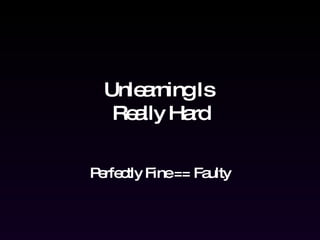
Unlearning Is  Really Hard Perfectly Fine == Faulty
It's not ignorance does so much damage; it's knowin' so derned much that ain't so.  Josh Billings
The Very Best Part: Stability No new design errors  since 1999!
Coming Soon [ES3.1] ECMAScript Fifth Edition Corrections Reality Support for object hardening Strict mode for reliability "use strict"; Waiting on implementations
Not Coming Soon [ES4] This project has been cancelled. Instead, [ES-Harmony]. So far, this project has no defined goals or rules.
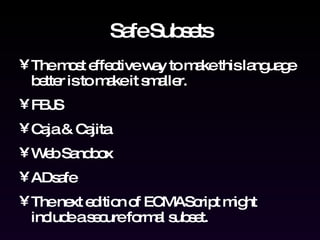
Safe Subsets The most effective way to make this language better is to make it smaller. FBJS Caja & Cajita Web Sandbox ADsafe The next edition of ECMAScript might include a secure formal subset.
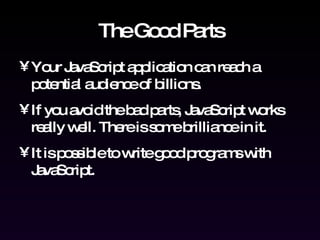
The Good Parts Your JavaScript application can reach a potential audience of billions. If you avoid the bad parts, JavaScript works really well. There is some brilliance in it. It is possible to write good programs with JavaScript.
 

Douglas Crockford Presentation Goodparts

  • 1.
    JavaScript: The Good Parts Douglas Crockford Yahoo! Inc. http://www.crockford.com/codecamp/
  • 2.
    The World's MostMisunderstood Programming Language
  • 3.
    A language ofmany contrasts.
  • 4.
    The broadest rangeof programmer skills of any programming language. From computer scientists to cut-n-pasters and everyone in between.
  • 5.
    Complaints "JavaScript isnot a language I know." "The browser programming experience is awful." "It's not fast enough." "The language is just a pile of mistakes."
  • 6.
    Hidden under ahuge steaming pile of good intentions and blunders is an elegant, expressive programming language. JavaScript has good parts.
  • 7.
    JavaScript is succeedingvery well in an environment where Java was a total failure.
  • 8.
    Influences Self prototypalinheritance dynamic objects Scheme lambda loose typing Java syntax conventions Perl regular expressions
  • 9.
    Bad Parts GlobalVariables + adds and concatenates Semicolon insertion typeof with and eval phony arrays == and != false, null, undefined, NaN
  • 10.
    Transitivity? What's That?'' == '0' // false 0 == '' // true 0 == '0' // true false == 'false' // false false == '0' // true false == undefined // false false == null // false null == undefined // true " \t\r\n " == 0 // true
  • 11.
    value = myObject[name];if (value == null ) { alert(name + ' not found.'); } Two errors that cancel each other out.
  • 12.
    value = myObject[name];if (value === undefined ) { alert(name + ' not found.'); }
  • 13.
    Good features thatinteract badly Objects can inherit from other objects. Functions can be members of objects. for..in statement mixes inherited functions with the desired data members.
  • 14.
    for in istroublesome Design question: Should for..in do a shallow skim or a deep dredge? Decision: Deep dredge. The programmer must explicitly filter out the deep members. Except: They didn't tell anybody! Consequence: Lots of confusion about how to use for..in.
  • 15.
    for in istroublesome Better Decision: Don't release the language broadly until we have enough experience to have confidence that we made the right choice. Historical Context: Getting it right at Netscape wasn't an option.
  • 16.
    Bad Heritage Blocklessstatements if (foo) bar(); Expression statements foo; Floating point arithmetic 0.1 + 0.2 !== 0.3 ++ and -- switch
  • 17.
    Good Parts LambdaDynamic Objects Loose Typing Object Literals
  • 18.
    Inheritance Inheritance isobject-oriented code reuse. Two Schools: Classical Prototypal
  • 19.
    Prototypal Inheritance Class-free.Objects inherit from objects. An object contains a link to another object: Delegation. Differential Inheritance. var newObject = Object.create(oldObject); newObject oldObject __proto__
  • 20.
    Prototypal Inheritance if(typeof Object.create !== 'function') { Object.create = function (o) { function F() {} F.prototype = o; return new F(); }; }
  • 21.
    new The new operator is required when calling a Constructor function. If new is omitted, the global object is clobbered by the constructor. There is no compile-time or run-time warning.
  • 22.
    Global var names = ['zero', 'one', 'two', 'three', 'four', 'five', 'six', 'seven', 'eight', 'nine']; var digit_name = function (n) { return names [n]; }; alert( digit_name (3)); // 'three'
  • 23.
    Slow var digit_name = function (n) { var names = ['zero', 'one', 'two', 'three', 'four', 'five', 'six', 'seven', 'eight', 'nine']; return names [n]; }; alert( digit_name (3)); // 'three'
  • 24.
    Closure var digit_name = (function () { var names = ['zero', 'one', 'two', 'three', 'four', 'five', 'six', 'seven', 'eight', 'nine']; return function (n) { return names [n]; }; } ()) ; alert( digit_name (3)); // 'three'
  • 25.
    A Module Patternvar singleton = ( function () { var privateVariable ; function privateFunction (x) { ... privateVariable ... } return { firstMethod: function (a, b) { ... privateVariable ... }, secondMethod: function (c) { ... privateFunction ()... } } ; }() );
  • 26.
    Module pattern iseasily transformed into a powerful constructor pattern.
  • 27.
    Power Constructors Makean object. Object literal new Object.create call another power constructor
  • 28.
    Power Constructors Makean object. Object literal, new , Object.create , call another power constructor Define some variables and functions. These become private members.
  • 29.
    Power Constructors Makean object. Object literal, new , Object.create , call another power constructor Define some variables and functions. These become private members. Augment the object with privileged methods.
  • 30.
    Power Constructors Makean object. Object literal, new , Object.create , call another power constructor Define some variables and functions. These become private members. Augment the object with privileged methods. Return the object.
  • 31.
    Step One functionmyPowerConstructor(x) { var that = otherMaker(x); }
  • 32.
    Step Two functionmyPowerConstructor(x) { var that = otherMaker(x); var secret = f(x); }
  • 33.
    Step Three functionmyPowerConstructor(x) { var that = otherMaker(x); var secret = f(x); that.priv = function () { ... secret x that ... }; }
  • 34.
    Step Four functionmyPowerConstructor(x) { var that = otherMaker(x); var secret = f(x); that.priv = function () { ... secret x that ... }; return that; }
  • 35.
    Closure A functionobject contains A function (name, parameters, body) A reference to the environment in which it was created (context). This is a very good thing.
  • 36.
    Style Isn't Subjectiveblock { .... } Might work well in other languages block { .... } Works well in JavaScript
  • 37.
    Style Isn't Subjectivereturn { ok: false }; SILENT ERROR! return { ok: true }; Works well in JavaScript
  • 38.
    Style Isn't Subjectivereturn { ok: false };
  • 39.
    Style Isn't Subjectivereturn ; // semicolon insertion { ok: false };
  • 40.
    Style Isn't Subjectivereturn; { // block ok: false } ;
  • 41.
    Style Isn't Subjectivereturn; { ok: false // label };
  • 42.
    Style Isn't Subjectivereturn; { // useless ok: false // expression }; // statement
  • 43.
    Style Isn't Subjectivereturn; { ok: false ; // semicolon }; // insertion
  • 44.
    Style Isn't Subjectivereturn; { ok: false; } ; // empty statement
  • 45.
    Style Isn't Subjectivereturn; { // unreachable statement ok: false; }
  • 46.
    Style Isn't Subjectivereturn { ok: false }; Bad style return; { ok: false; } Bad results
  • 47.
  • 48.
    A Personal JourneyBeautiful Code
  • 49.
    JSLint JSLint definesa professional subset of JavaScript. It imposes a programming discipline that makes me much more confident in a dynamic, loosely-typed environment. http://www.JSLint.com/
  • 50.
    WARNING! JSLint willhurt your feelings.
  • 51.
    Unlearning Is Really Hard Perfectly Fine == Faulty
  • 52.
    It's not ignorancedoes so much damage; it's knowin' so derned much that ain't so. Josh Billings
  • 53.
    The Very BestPart: Stability No new design errors since 1999!
  • 54.
    Coming Soon [ES3.1]ECMAScript Fifth Edition Corrections Reality Support for object hardening Strict mode for reliability "use strict"; Waiting on implementations
  • 55.
    Not Coming Soon[ES4] This project has been cancelled. Instead, [ES-Harmony]. So far, this project has no defined goals or rules.
  • 56.
    Safe Subsets Themost effective way to make this language better is to make it smaller. FBJS Caja & Cajita Web Sandbox ADsafe The next edition of ECMAScript might include a secure formal subset.
  • 57.
    The Good PartsYour JavaScript application can reach a potential audience of billions. If you avoid the bad parts, JavaScript works really well. There is some brilliance in it. It is possible to write good programs with JavaScript.
  • 58.