SMME Support Structure
Improving Productivity,
Profitability and
Competitiveness
NAFCOC RE-LAUNCH
CONFERENCE: BOJANALA
DISTRICT
Rustenburg Civic Centre
By: Conrad Sebego-Principal
Consultant
PRESENTATION OUTLINE
NPI Mandate
Overview of NPI Strategic Thrusts
Local Case Study: Turn Around Strategies
Local Case Study: Continuous Improvement
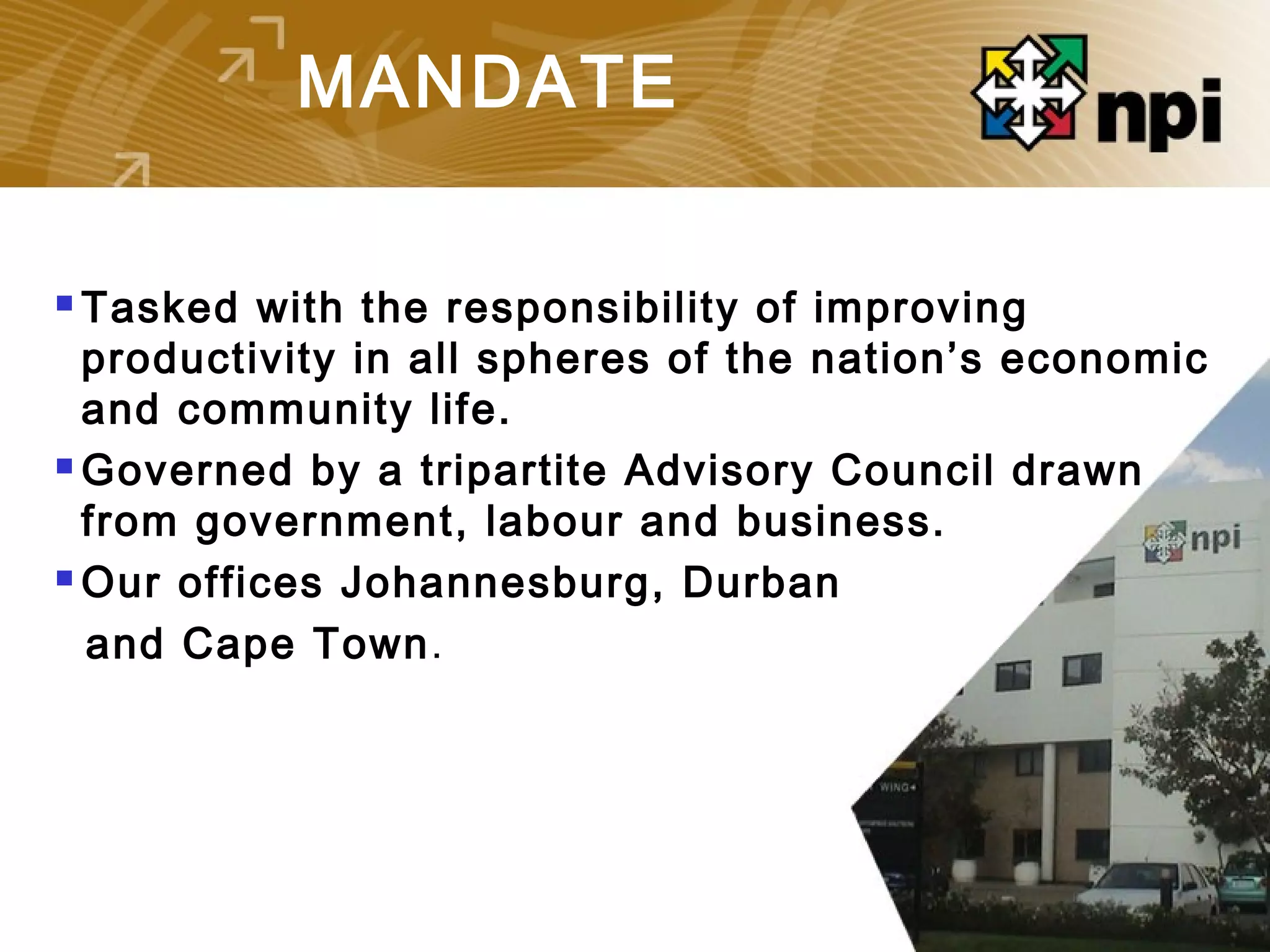
MANDATE
 Tasked with the responsibility of improving
productivity in all spheres of the nation’s economic
and community life.
 Governed by a tripartite Advisory Council drawn
from government, labour and business.
 Our offices Johannesburg, Durban
and Cape Town.
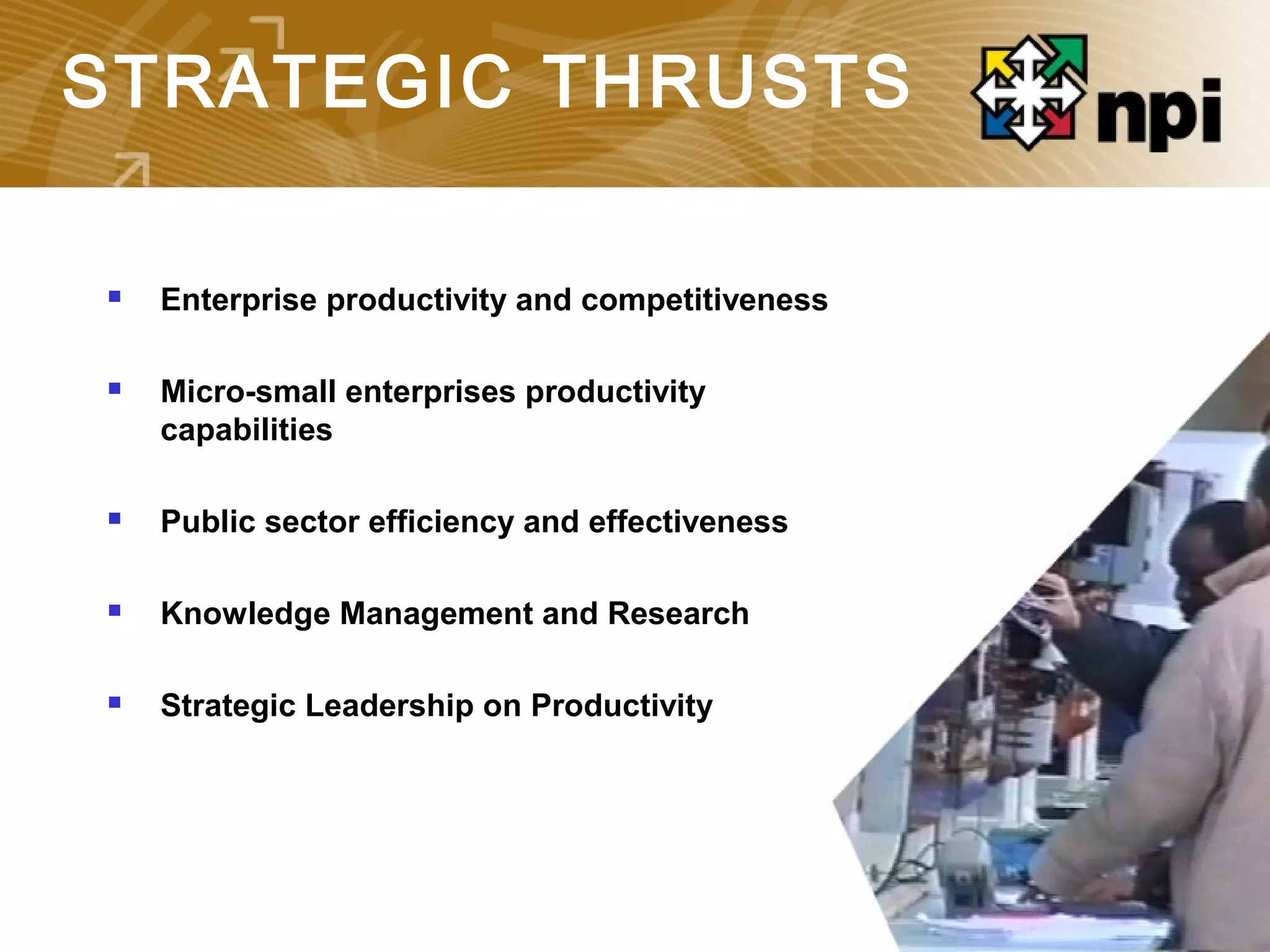
STRATEGIC THRUSTS
 Enterprise productivity and competitiveness
 Micro-small enterprises productivity
capabilities
 Public sector efficiency and effectiveness
 Knowledge Management and Research
 Strategic Leadership on Productivity
SOCIAL PLAN PROGRAMME
The programme is an initiative of the Jobs
Summit, aimed at reducing retrenchments
and creating new jobs:
 it applies when large scale retrenchments look
likely (50 people or 10% of the organisation’s
labour force) because retrenchment on this
scale can affect the sector, regional or national
interests
SOCIAL PLAN PROGRAMME (cont
 it aims to prevent job losses and a decline in
employment by promoting negotiations on
security of employment
 It aims to lessen the social and economic
impact on individuals, regions and the national
economy
A social plan approach is vital when there is
a reasonable possibility of developing
alternatives that could save jobs
WHAT DOES IT COST?
This support initiative is partially funded
by the state, which pays 65% of the
consulting costs. The company pays the
balance. Companies that cannot afford
to contribute 35% should submit a
special application for a 100% funded
intervention.
PHASE 1 – PREVENTING JOB LOSSES
Through the National Productivity Institute’s social
plan technical support facility, we can:
 Establish Future Forums to identify problems, working
collaboratively with labour and management on the
future of the company
 Save the jobs of workers facing retrenchment by
providing technical assistance and support

Develop strategies to turn the company around

Improve the company’s performance through better marketing,
operations and financial strategies
 Assist companies to assess their performance and
detect early signs of decline
PHASE 2 – MANAGING RETRENCHMENT
Following notification by the company, the
Department of Labour will:
 Provide counselling of affected workers
 Present life skills techniques in compiling a resume,
interview behaviour, etc.
 Provide information on accessing opportunities for
employment, small, medium and micro enterprises and
provincial projects
 Provide contact details for organisations of learning or
financing small business
 Assist with skills development
PHASE 3 – JOB CREATION
The Department of Provincial and Local
Government will help by:
 Developing regional and local economies
 Regenerating local economies affected by
large scale retrenchment
PROCESS OVERVIEW
SERCO INDUSTRIES
Serco Industries started up 20 years ago. The
business grew steadily and by the late 1990's was
the leading supplier of insulated trucks in the
country.
New competitors emerged using lower prices and
faster turnaround from their under-utilised facilities,
and were able to capture a significant share of
Serco's traditional market. Serco was in distress and
facing the real provide assistance in turning the
company around.
THE PROBLEM
After an indepth analysis, the NPI
determined the following problems:
 Late delivery
 Low productivity
 Clients complained of poor quality
 Lack of reporting systems and ineffective
planning
 Accepted inferior products from suppliers
 Ineffective customer relations
NPI’s SOLUTION
Implementation of quality management and
production methods
Management were coached
Supply chain development saw lead times and
quality improve.
Accurate specifications were developed and used
to ensure products were delivered "right first time".
Researching the market and identifying customer
issues affecting relationships and sales
THE IMPACT
As Serco's performance improved, clients expressed approval of the
positive developments and started to place more orders with the
company.
Turnover increased from R30.5 million in 2002/3 to R 45.0 million in
2004/5.
Innovative thinking resulted in the development of new, technologically
advanced trailers.
Production increased from 12 units per months to 17 units per month
A target of 80% "right first time" on completed products has been
achieved.
Improved workforce morale and greater motivation at management
levels
HIGHLIGHTS
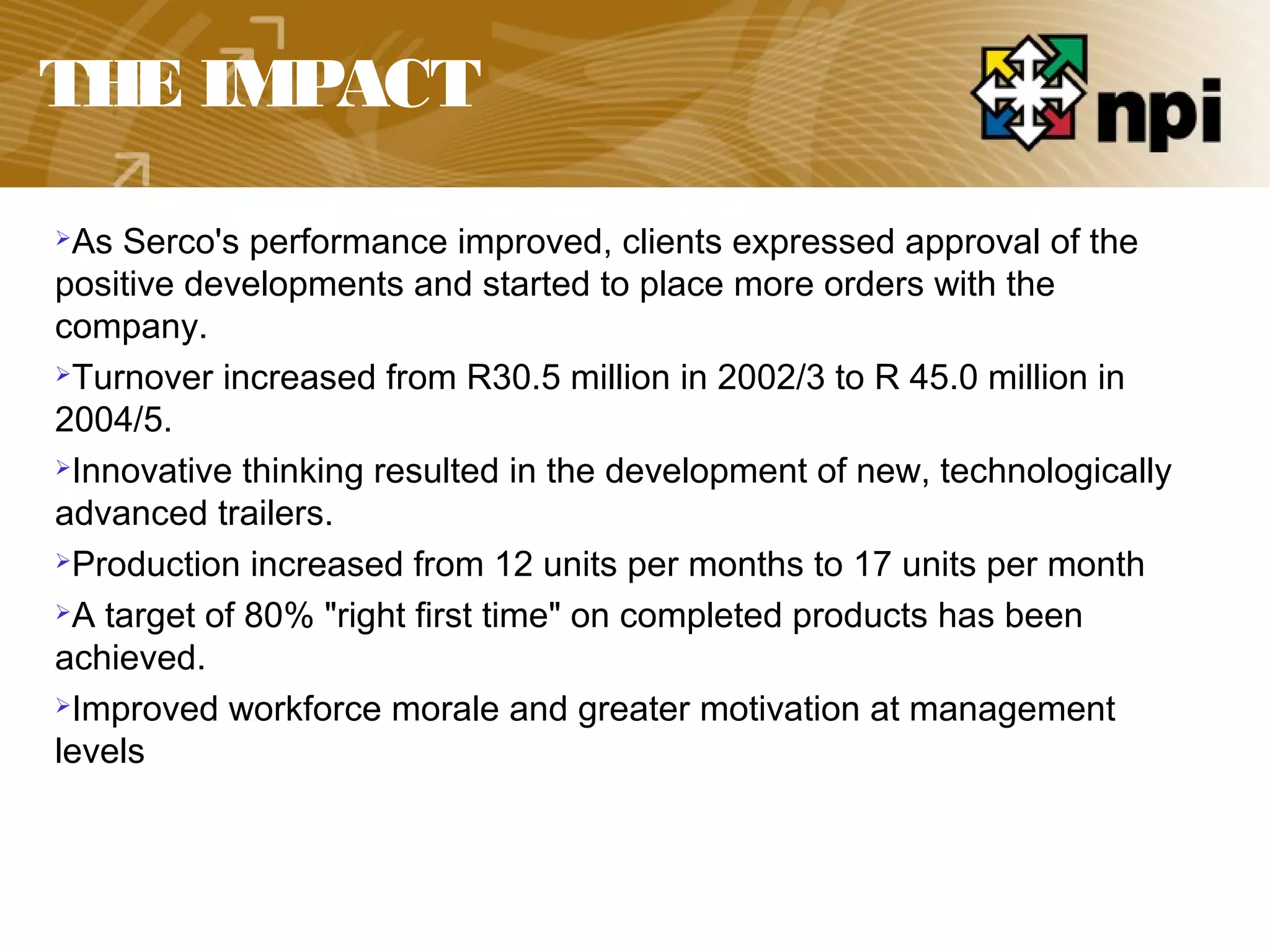
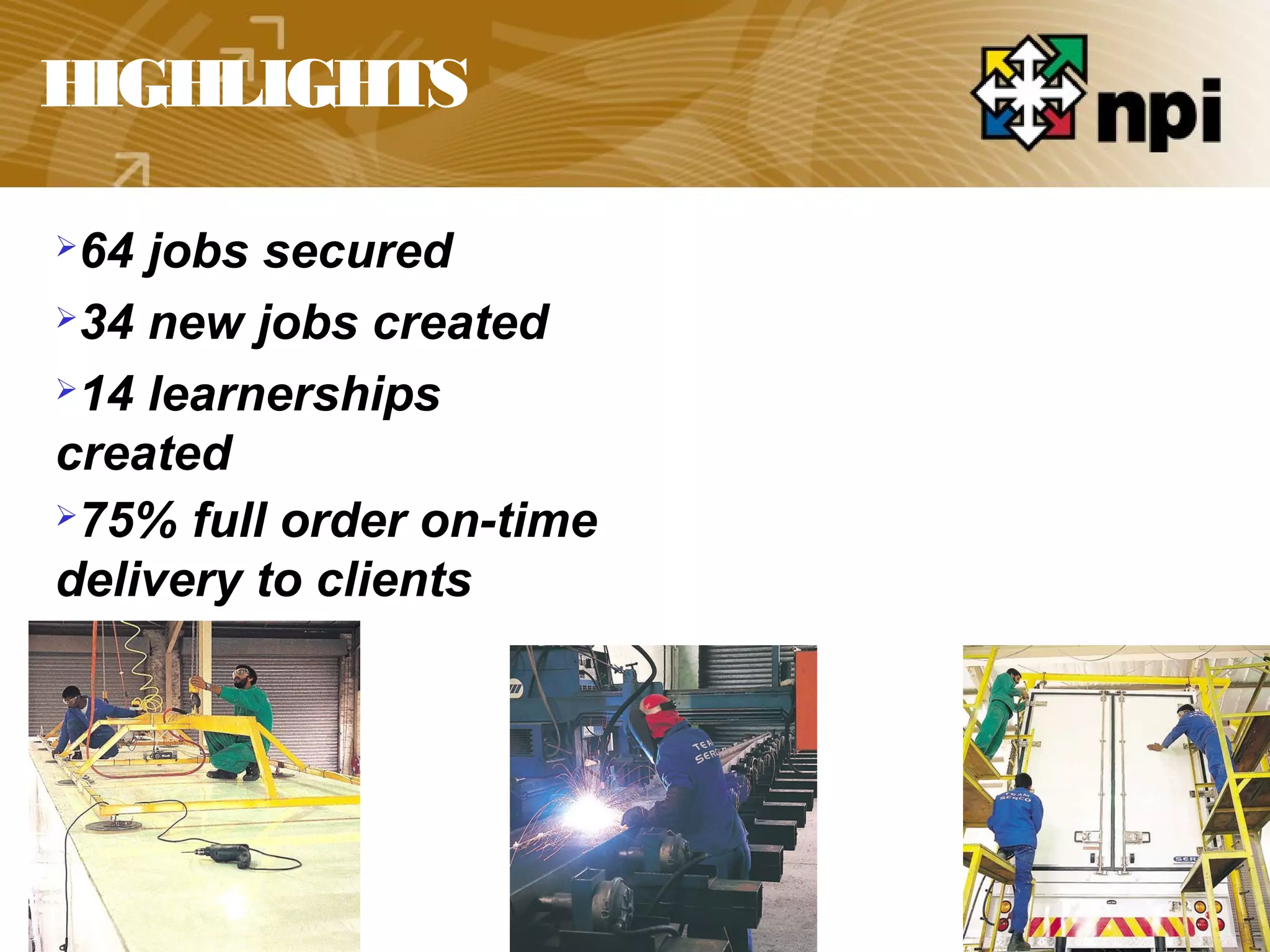
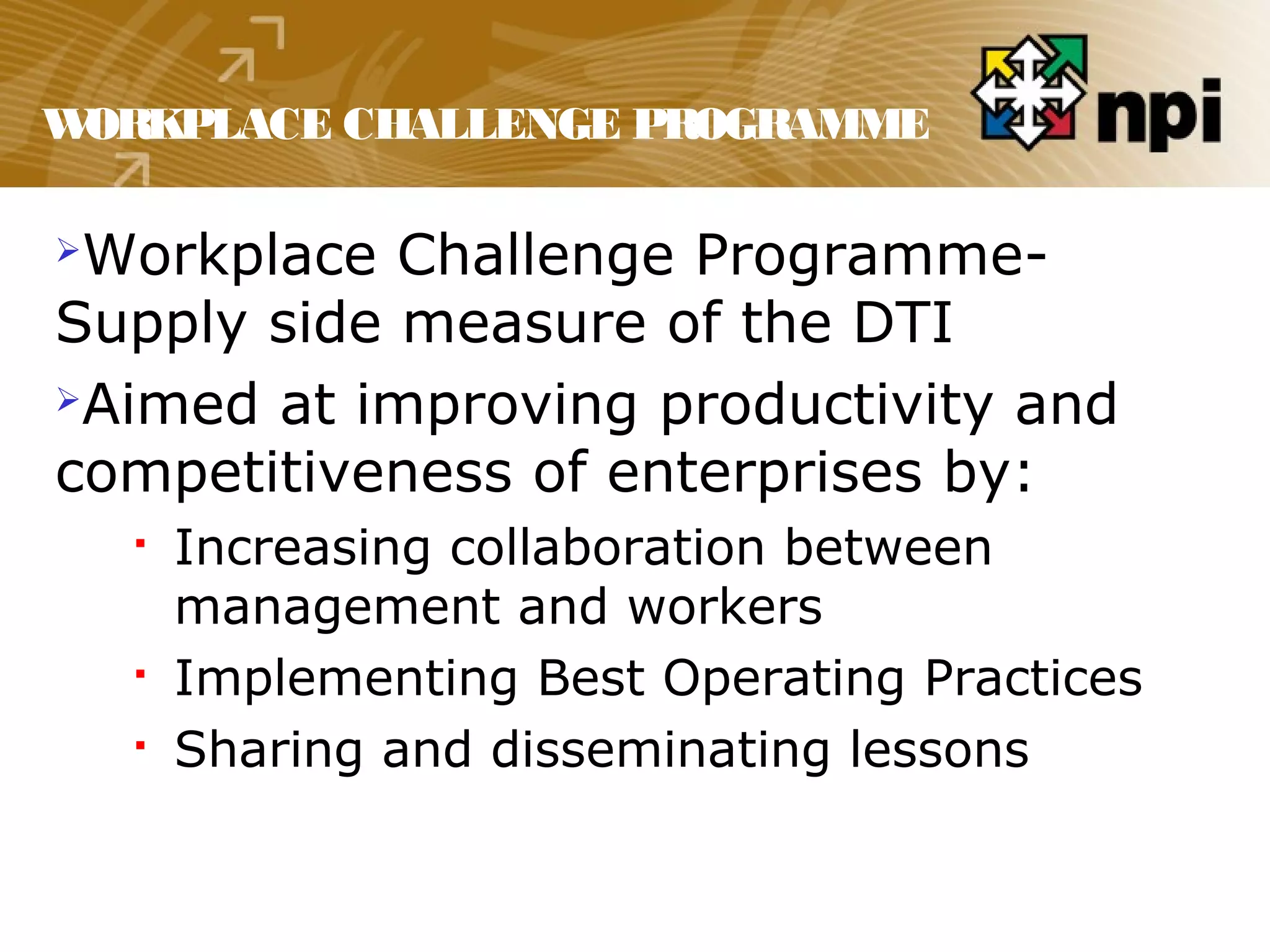
64 jobs secured
34 new jobs created
14 learnerships
created
75% full order on-time
delivery to clients
WORKPLACE CHALLENGE PROGRAMME
Workplace Challenge Programme-
Supply side measure of the DTI
Aimed at improving productivity and
competitiveness of enterprises by:
 Increasing collaboration between
management and workers
 Implementing Best Operating Practices
 Sharing and disseminating lessons
WIDNEY TRANSPORT COMPONENTS
Widney’s core business is the
manufacture of aluminium framed
sliding windows for the transport
industry. Widney services three main
customers namely: automotive
industry, bus industry and rail industry.
STEPS FORCONTINUOUS
IMPROVEMENT
Participated in the Alberton Cluster since late 2003
Leadership commitment and labour buy-in was
crucial for success from the onset
Established minibusiness areas and necessary
support structures
Created visual display mechanisms
Agree on performance and productivity improvement
measures
Generate standars judiciously and maintain them
Conducted regular audits
Problem solving sessions are active and functional
Sharing of benefits due to improvements
RESULTS
Reduced lead time from 6 weeks to 3 weeks
No customer rejects, from 3000 (internal rejects in 2001)
Increase in productivity of 10%
Increase in on-time delivery of 8%
Bus assembly time reduced from a week to one day
100% pass rate on related training and improvement
programme (ABET)
Increased worker participation
10 Learner-ships completed; personnel retained as staff
Absenteeism at less than 2.5%
Clearer focus on the customer.
HIGHLIGHTS
Widney is the first company worldwide to
design and manufacture plastic windows to
the rail market.
Innovations harvested from employees
resulted in R3500 saving on the cost of
making the product.
Captured close to 70% of the market share.
Employees empowered to make
improvements and implement their ideas.
END!
THANK YOU FOR YOUR
ATTENTION!
RELEVANT INFORMATION:
Telephone: (011) 848-5300
National Productivity Institute: www.npi.co.za
Social Plan: www.turnaroundsolutions.co.za
Workplace Challenge:
http://dev.absol.co.za/publisher%5Fwpc/

Nafcoc Conference'v3_24Aug06.PPT

  • 1.
    SMME Support Structure ImprovingProductivity, Profitability and Competitiveness NAFCOC RE-LAUNCH CONFERENCE: BOJANALA DISTRICT Rustenburg Civic Centre By: Conrad Sebego-Principal Consultant
  • 2.
    PRESENTATION OUTLINE NPI Mandate Overviewof NPI Strategic Thrusts Local Case Study: Turn Around Strategies Local Case Study: Continuous Improvement
  • 3.
    MANDATE  Tasked withthe responsibility of improving productivity in all spheres of the nation’s economic and community life.  Governed by a tripartite Advisory Council drawn from government, labour and business.  Our offices Johannesburg, Durban and Cape Town.
  • 4.
    STRATEGIC THRUSTS  Enterpriseproductivity and competitiveness  Micro-small enterprises productivity capabilities  Public sector efficiency and effectiveness  Knowledge Management and Research  Strategic Leadership on Productivity
  • 5.
    SOCIAL PLAN PROGRAMME Theprogramme is an initiative of the Jobs Summit, aimed at reducing retrenchments and creating new jobs:  it applies when large scale retrenchments look likely (50 people or 10% of the organisation’s labour force) because retrenchment on this scale can affect the sector, regional or national interests
  • 6.
    SOCIAL PLAN PROGRAMME(cont  it aims to prevent job losses and a decline in employment by promoting negotiations on security of employment  It aims to lessen the social and economic impact on individuals, regions and the national economy A social plan approach is vital when there is a reasonable possibility of developing alternatives that could save jobs
  • 7.
    WHAT DOES ITCOST? This support initiative is partially funded by the state, which pays 65% of the consulting costs. The company pays the balance. Companies that cannot afford to contribute 35% should submit a special application for a 100% funded intervention.
  • 8.
    PHASE 1 –PREVENTING JOB LOSSES Through the National Productivity Institute’s social plan technical support facility, we can:  Establish Future Forums to identify problems, working collaboratively with labour and management on the future of the company  Save the jobs of workers facing retrenchment by providing technical assistance and support  Develop strategies to turn the company around  Improve the company’s performance through better marketing, operations and financial strategies  Assist companies to assess their performance and detect early signs of decline
  • 9.
    PHASE 2 –MANAGING RETRENCHMENT Following notification by the company, the Department of Labour will:  Provide counselling of affected workers  Present life skills techniques in compiling a resume, interview behaviour, etc.  Provide information on accessing opportunities for employment, small, medium and micro enterprises and provincial projects  Provide contact details for organisations of learning or financing small business  Assist with skills development
  • 10.
    PHASE 3 –JOB CREATION The Department of Provincial and Local Government will help by:  Developing regional and local economies  Regenerating local economies affected by large scale retrenchment
  • 11.
  • 12.
    SERCO INDUSTRIES Serco Industriesstarted up 20 years ago. The business grew steadily and by the late 1990's was the leading supplier of insulated trucks in the country. New competitors emerged using lower prices and faster turnaround from their under-utilised facilities, and were able to capture a significant share of Serco's traditional market. Serco was in distress and facing the real provide assistance in turning the company around.
  • 13.
    THE PROBLEM After anindepth analysis, the NPI determined the following problems:  Late delivery  Low productivity  Clients complained of poor quality  Lack of reporting systems and ineffective planning  Accepted inferior products from suppliers  Ineffective customer relations
  • 14.
    NPI’s SOLUTION Implementation ofquality management and production methods Management were coached Supply chain development saw lead times and quality improve. Accurate specifications were developed and used to ensure products were delivered "right first time". Researching the market and identifying customer issues affecting relationships and sales
  • 15.
    THE IMPACT As Serco'sperformance improved, clients expressed approval of the positive developments and started to place more orders with the company. Turnover increased from R30.5 million in 2002/3 to R 45.0 million in 2004/5. Innovative thinking resulted in the development of new, technologically advanced trailers. Production increased from 12 units per months to 17 units per month A target of 80% "right first time" on completed products has been achieved. Improved workforce morale and greater motivation at management levels
  • 16.
    HIGHLIGHTS 64 jobs secured 34new jobs created 14 learnerships created 75% full order on-time delivery to clients
  • 17.
    WORKPLACE CHALLENGE PROGRAMME WorkplaceChallenge Programme- Supply side measure of the DTI Aimed at improving productivity and competitiveness of enterprises by:  Increasing collaboration between management and workers  Implementing Best Operating Practices  Sharing and disseminating lessons
  • 18.
    WIDNEY TRANSPORT COMPONENTS Widney’score business is the manufacture of aluminium framed sliding windows for the transport industry. Widney services three main customers namely: automotive industry, bus industry and rail industry.
  • 19.
    STEPS FORCONTINUOUS IMPROVEMENT Participated inthe Alberton Cluster since late 2003 Leadership commitment and labour buy-in was crucial for success from the onset Established minibusiness areas and necessary support structures Created visual display mechanisms Agree on performance and productivity improvement measures Generate standars judiciously and maintain them Conducted regular audits Problem solving sessions are active and functional Sharing of benefits due to improvements
  • 20.
    RESULTS Reduced lead timefrom 6 weeks to 3 weeks No customer rejects, from 3000 (internal rejects in 2001) Increase in productivity of 10% Increase in on-time delivery of 8% Bus assembly time reduced from a week to one day 100% pass rate on related training and improvement programme (ABET) Increased worker participation 10 Learner-ships completed; personnel retained as staff Absenteeism at less than 2.5% Clearer focus on the customer.
  • 21.
    HIGHLIGHTS Widney is thefirst company worldwide to design and manufacture plastic windows to the rail market. Innovations harvested from employees resulted in R3500 saving on the cost of making the product. Captured close to 70% of the market share. Employees empowered to make improvements and implement their ideas.
  • 22.
    END! THANK YOU FORYOUR ATTENTION! RELEVANT INFORMATION: Telephone: (011) 848-5300 National Productivity Institute: www.npi.co.za Social Plan: www.turnaroundsolutions.co.za Workplace Challenge: http://dev.absol.co.za/publisher%5Fwpc/