Reflections on Available 
Soil Databases 
Freddy Nachtergaele 
10-12 November "Reducing the costs of GHG Estimates in 
Agriculture to inform low emissions development”
Ø Introduction 
Ø Global Soil Databases. 
Ø FAO/UNESCO Soil Map of the World 
Ø Harmonized World Soil Database 
Ø Globsoilmap.net/Afsis 
Ø Soil Grid – ISRIC World_Soil 
Ø Regional and National Soil Databases. 
Ø Access: Soils Portal 
Ø Point Databases. 
Ø Conclusions
Introduction 
u Soils have received less attention than other natural 
resources, partly because they are largely invisible 
and partly because they are much more complex than 
air and water. 
u As with all data, there is a difference for soil 
databases between what exists and what is available. 
This is particular a problem in Europe and for point 
data, but the problem is becoming more widespread. 
u Remote sensing has great capabilities for monitoring. 
However for soils, although progress has been made, 
RS cannot determine (yet) soil properties in time and 
space with sufficient accuracy. 
u Soil monitoring by field sampling over large areas is 
near impossible because of time and resource 
constraints. 
Introduction
Global Soil Databases 
u Excelent for global modeling (in combination with GCM or other 
models eg GAEZ). 
u Relatively high number of soil properties available (7-20) at 
different depths (2-6) depending on type of global database. 
Disadvantages of Global Soil Databases 
u Those based on classical soil maps present polygon or raster data 
with associations of soils. Consequently there is no unique value 
for a soil property but several values are given, one of which is 
dominant. Point-based global soil databases present unique 
values with a(n) (un) reliability estimate attached. 
Inherent Difficulties related to soil property monitoring 
u Soil properties cannot be measured over very large areas within a 
limited time frame. Hence no baseline values for a single year 
globally are available. 
u Most soil properties change slowly in time, however some show 
fluctuations seasonally (soil moisture, salinity) or change 
drastically after a land use change (SOC, pH after deforestation). 
u Laboratory methods may have sometimes a higher error range 
than the change in time of soil properties. 
Global Soil Databases
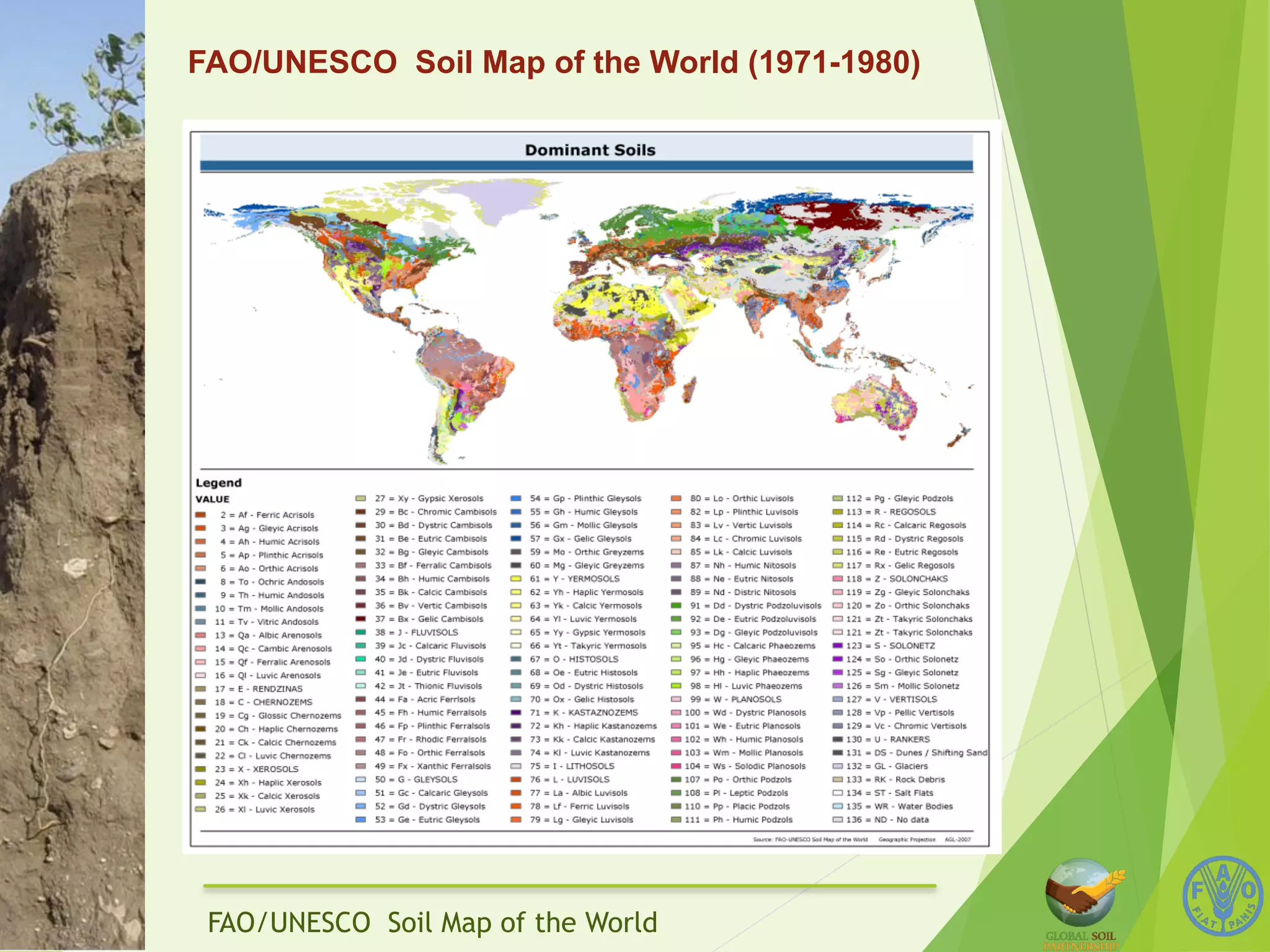
FAO/UNESCO Soil Map of the World (1971-1980) 
FAO/UNESCO Soil Map of the World
FAO/UNESCO Soil Map of the World (1971-1980) 
http://www.fao.org/geonetwork/srv/en/resources.get? 
id=14116&fname=DSMW.zip&access=private 
u Is still the only, fully consistent, harmonized global 
soil inventory 
u The paper map (1980) is polygon based and contains 
info on soil unit associations, topsoil texture and 
slope class. 
u The digitized version (1995) is also raster based and 
contains estimated values for 10 soil properties. 
u It is a soil database of historical value superseded 
by the Harmonized World Soil Database. 
FAO/UNESCO Soil Map of the World
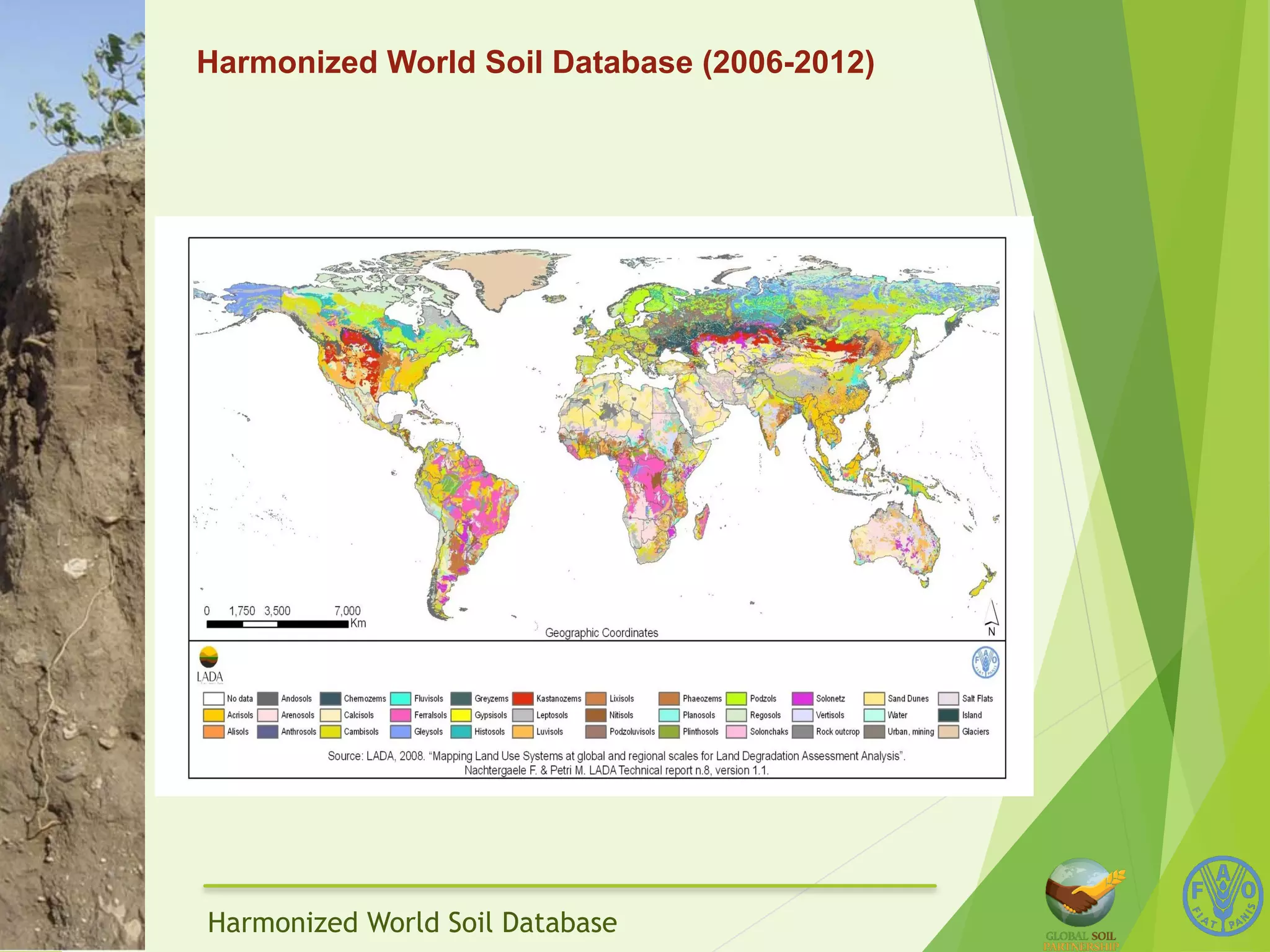
Harmonized World Soil Database (2006-2012) 
Harmonized World Soil Database
Harmonized World Soil Database (2006-2012) 
http://www.fao.org/soils-portal/soil-survey/soil-maps-and-databases/ 
harmonized-world-soil-database-v12/it/ 
u It is the most used global soil dataset. 
u Raster resolution of 1km by 1km 
u 20 soil properties for two soil depths (0-30 cm and 
30-100cm). 
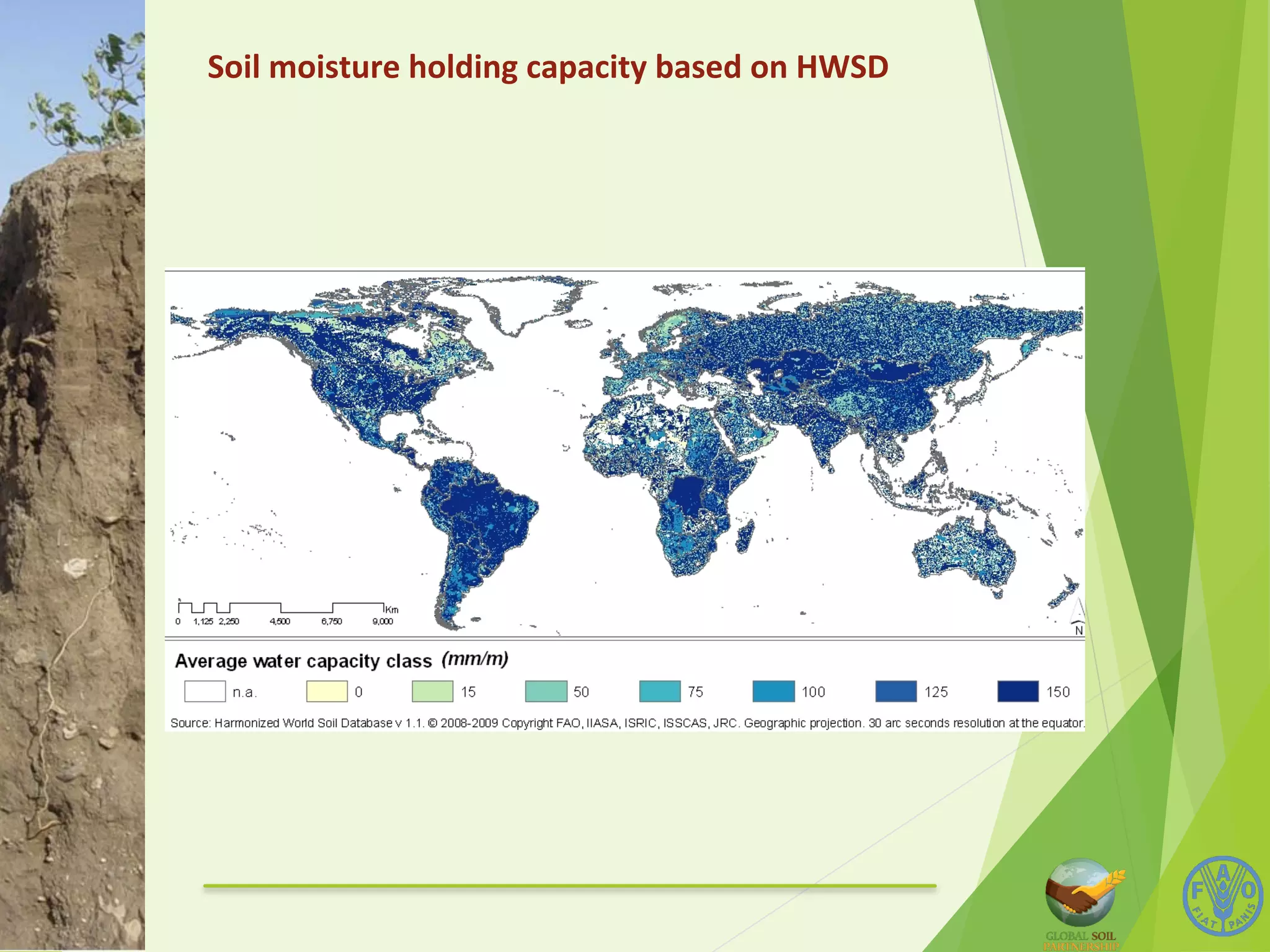
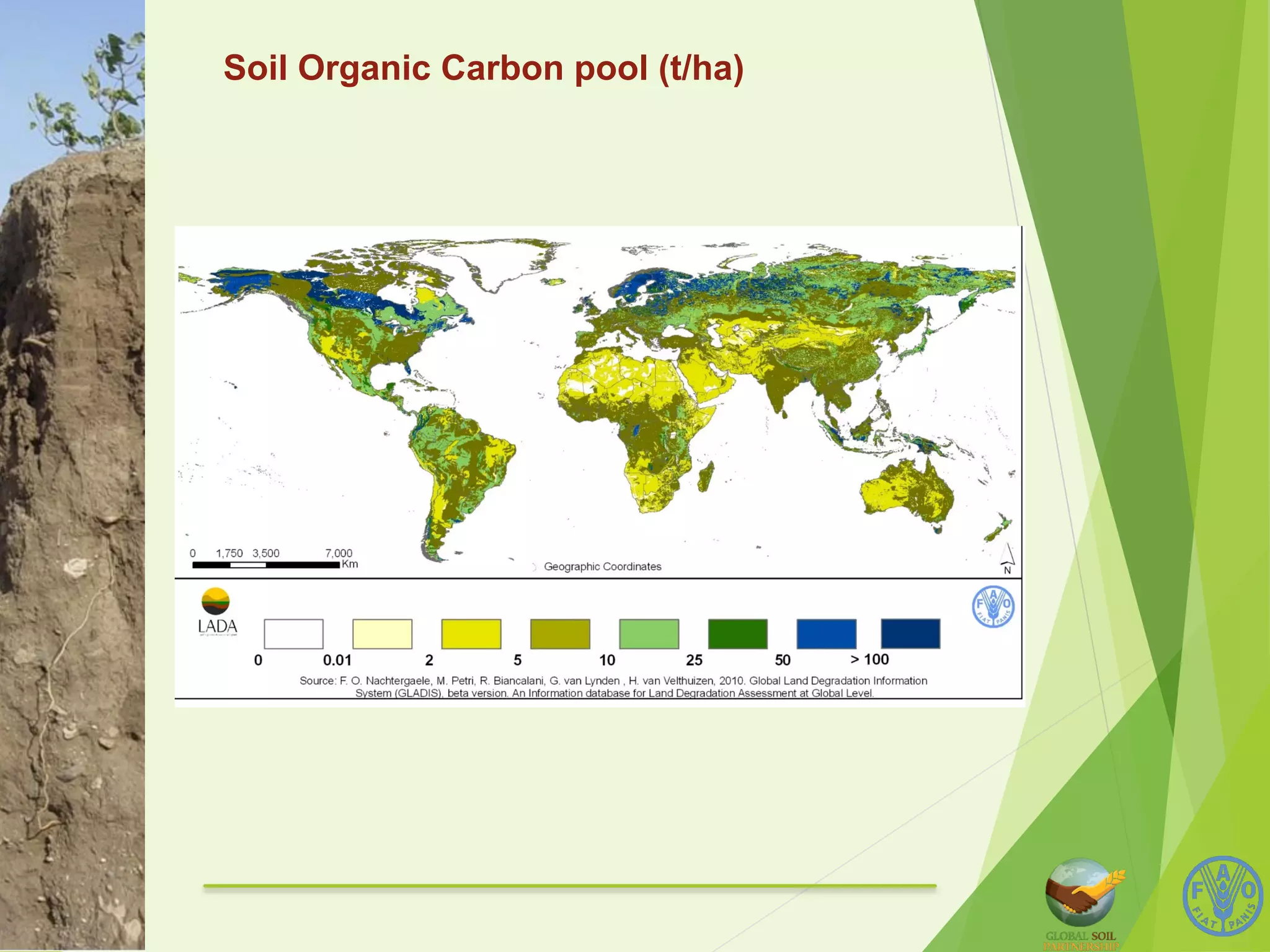
u Includes SOC pool and soil moisture storing 
capacities. 
u Is not fully harmonized. 
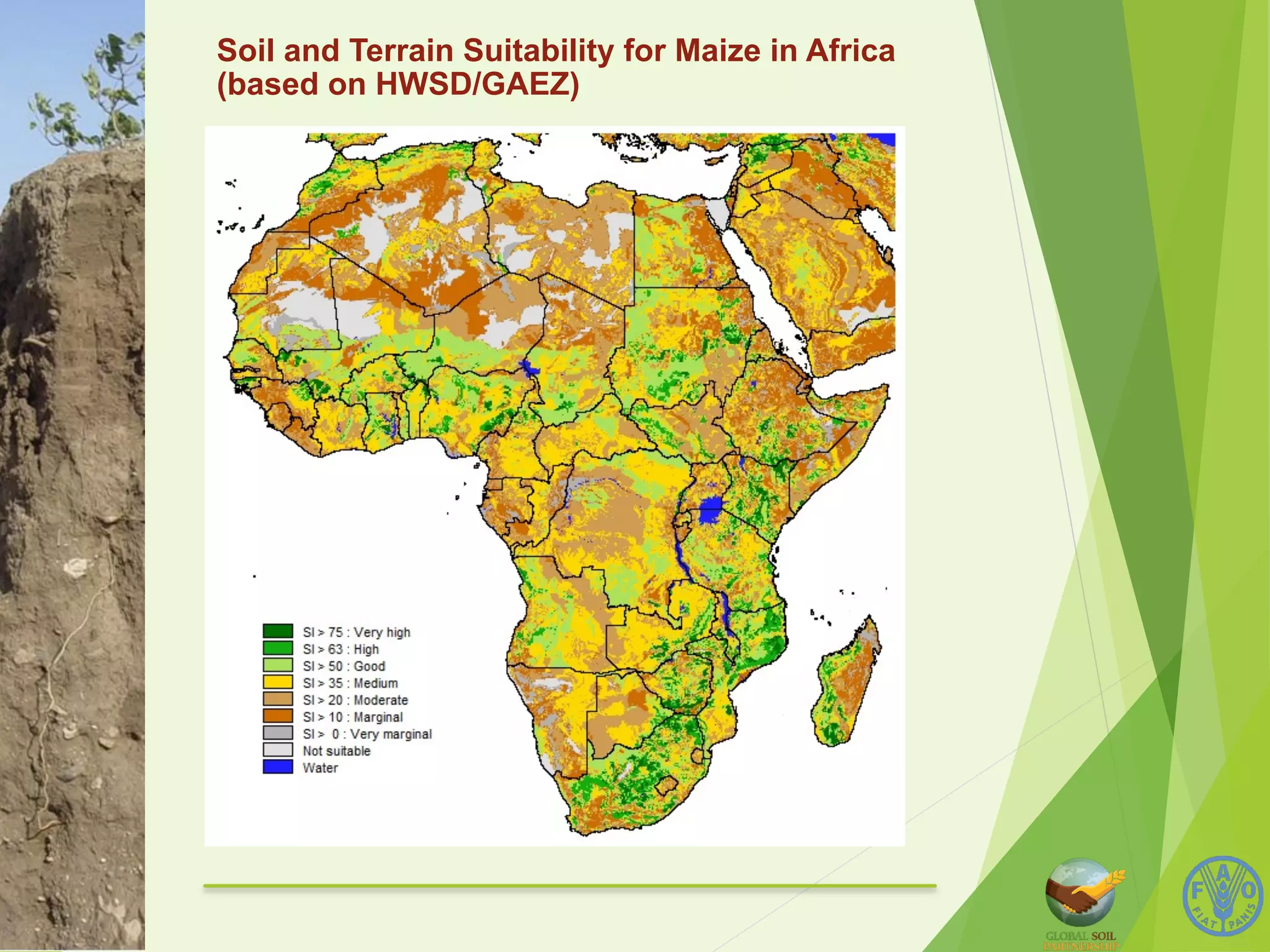
u Is part of GAEZ approach that models anticipated 
yields for hundreds of crops worldwide. 
http://www.fao.org/nr/gaez/about-data-portal/en/ 
u Updates no longer funded 
Harmonized World Soil Database
Soil 
moisture 
holding 
capacity 
based 
on 
HWSD
Soil Organic Carbon pool (t/ha)
Soil and Terrain Suitability for Maize in Africa 
(based on HWSD/GAEZ)
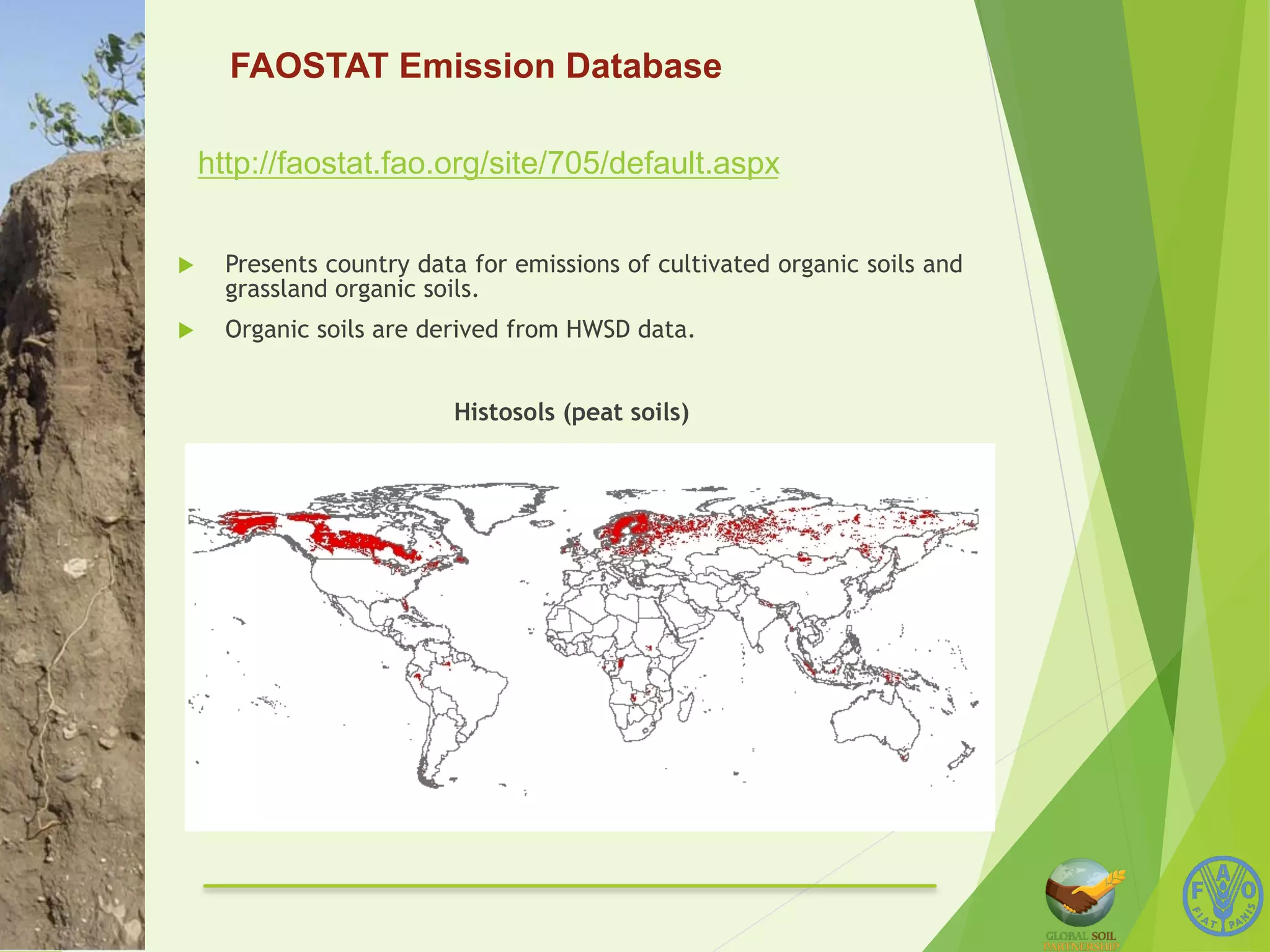
FAOSTAT Emission Database 
http://faostat.fao.org/site/705/default.aspx 
u Presents country data for emissions of cultivated organic soils and 
grassland organic soils. 
u Organic soils are derived from HWSD data. 
Histosols (peat soils)
Soil 
A9ributes 
present 
in 
HWSD 
(For 
top-­‐ 
and 
subsoil 
where 
appropriate) 
u Soil 
depth 
u Organic 
Carbon 
u pH(H2O) 
u CEC 
soil 
u CEC 
clay 
frac;on 
u Total 
Exchangeable 
Bases 
(TEB) 
u Base 
satura;on 
u Exchangeable 
Sodium 
Percentage 
(ESP) 
u Calcium 
carbonate 
u Gypsum 
u Sand 
frac;on 
u Silt 
frac;on 
u Clay 
frac;on 
u Ece 
(salinity) 
u USDA 
Texture 
Class 
u Bulk 
Density 
u Reference 
Bulk 
Density 
u Soil 
Drainage 
class 
u Presence 
of 
Gelic 
proper;es 
u Presence 
of 
Ver;c 
proper;es 
u Soil 
Phase 
informa;on
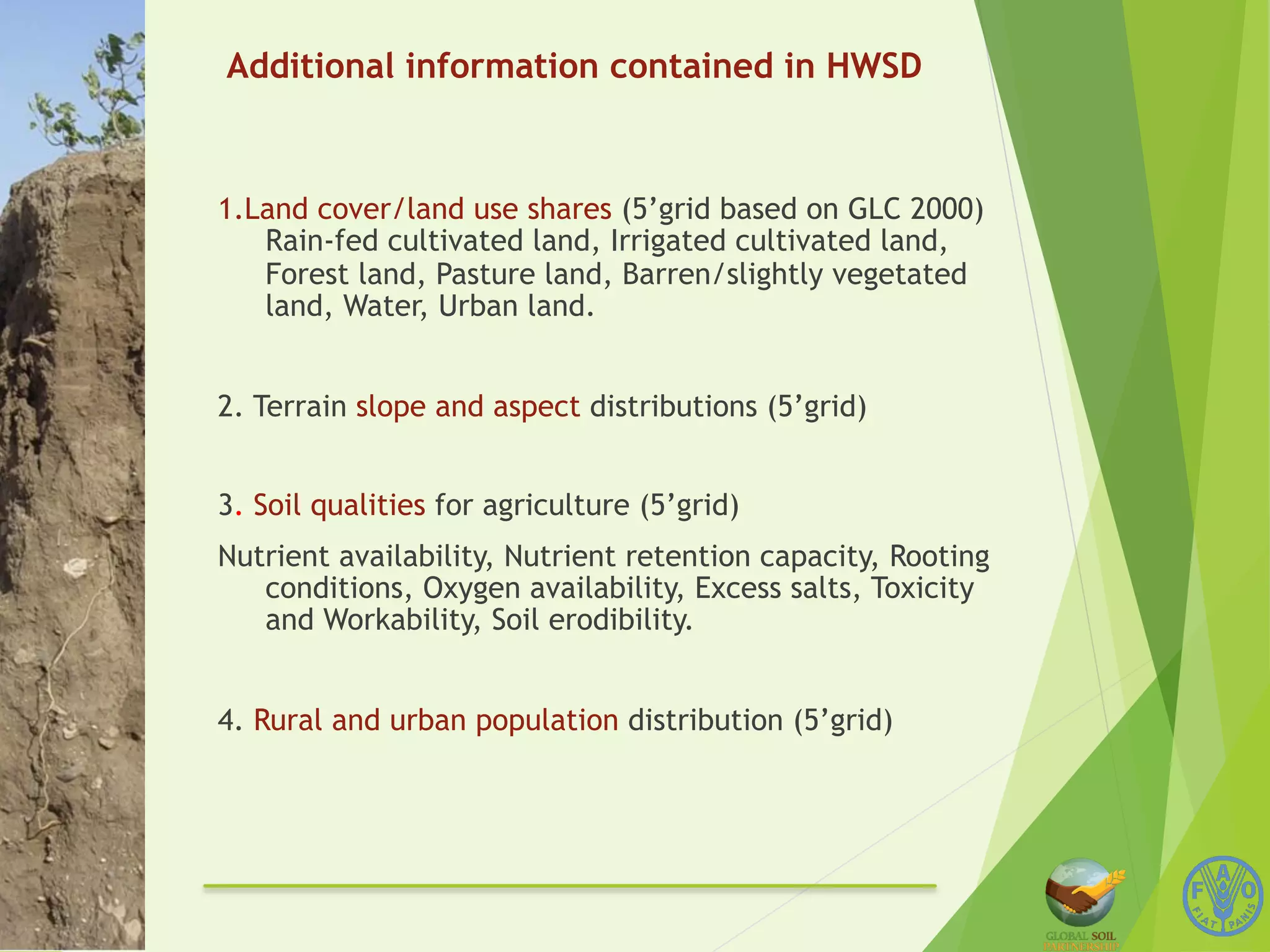
Additional information contained in HWSD 
1.Land cover/land use shares (5’grid based on GLC 2000) 
Rain-fed cultivated land, Irrigated cultivated land, 
Forest land, Pasture land, Barren/slightly vegetated 
land, Water, Urban land. 
2. Terrain slope and aspect distributions (5’grid) 
3. Soil qualities for agriculture (5’grid) 
Nutrient availability, Nutrient retention capacity, Rooting 
conditions, Oxygen availability, Excess salts, Toxicity 
and Workability, Soil erodibility. 
4. Rural and urban population distribution (5’grid)
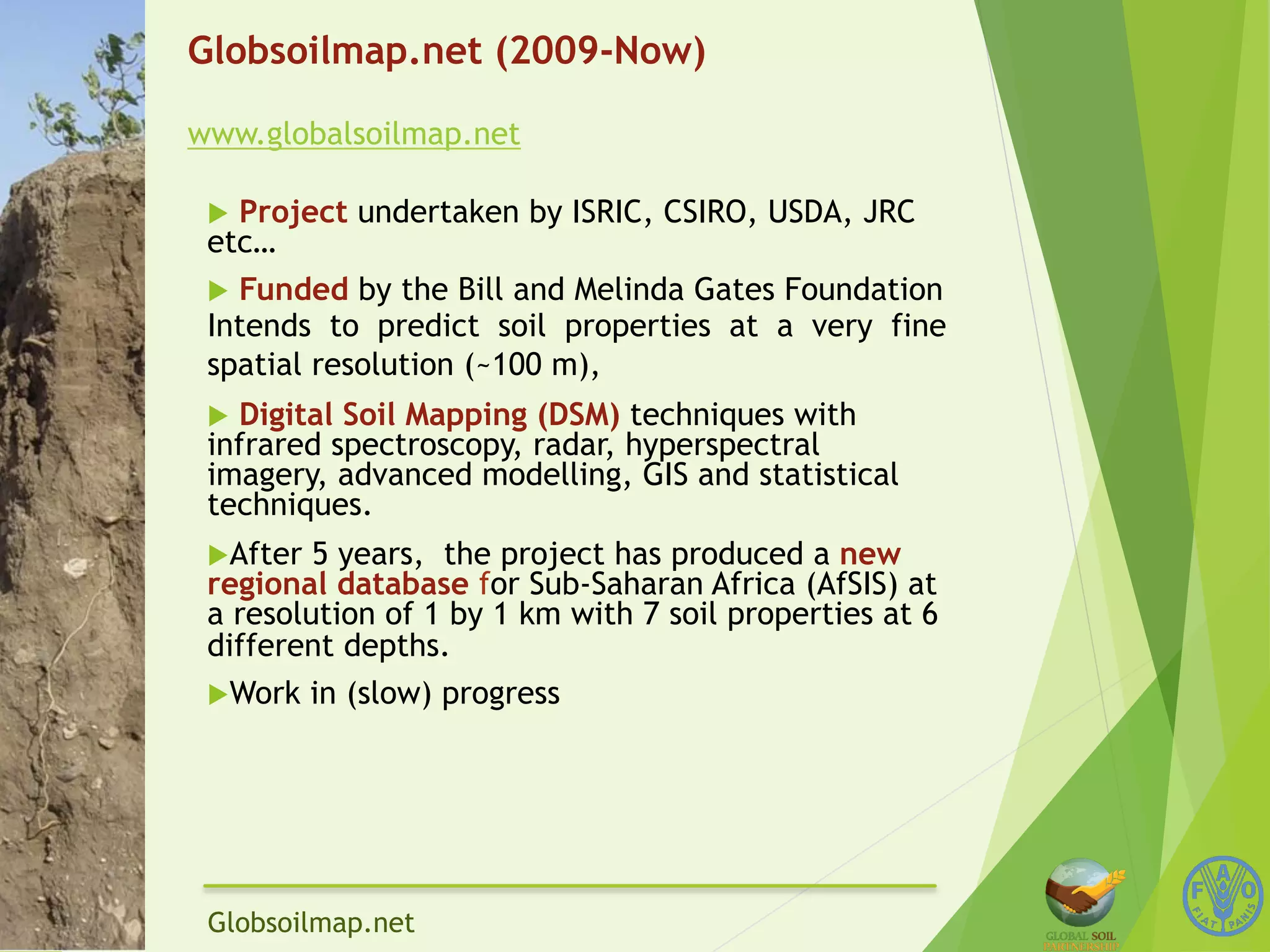
Globsoilmap.net (2009-Now) 
www.globalsoilmap.net 
u Project undertaken by ISRIC, CSIRO, USDA, JRC 
etc… 
u Funded by the Bill and Melinda Gates Foundation 
Intends to predict soil properties at a very fine 
spatial resolution (~100 m), 
u Digital Soil Mapping (DSM) techniques with 
infrared spectroscopy, radar, hyperspectral 
imagery, advanced modelling, GIS and statistical 
techniques. 
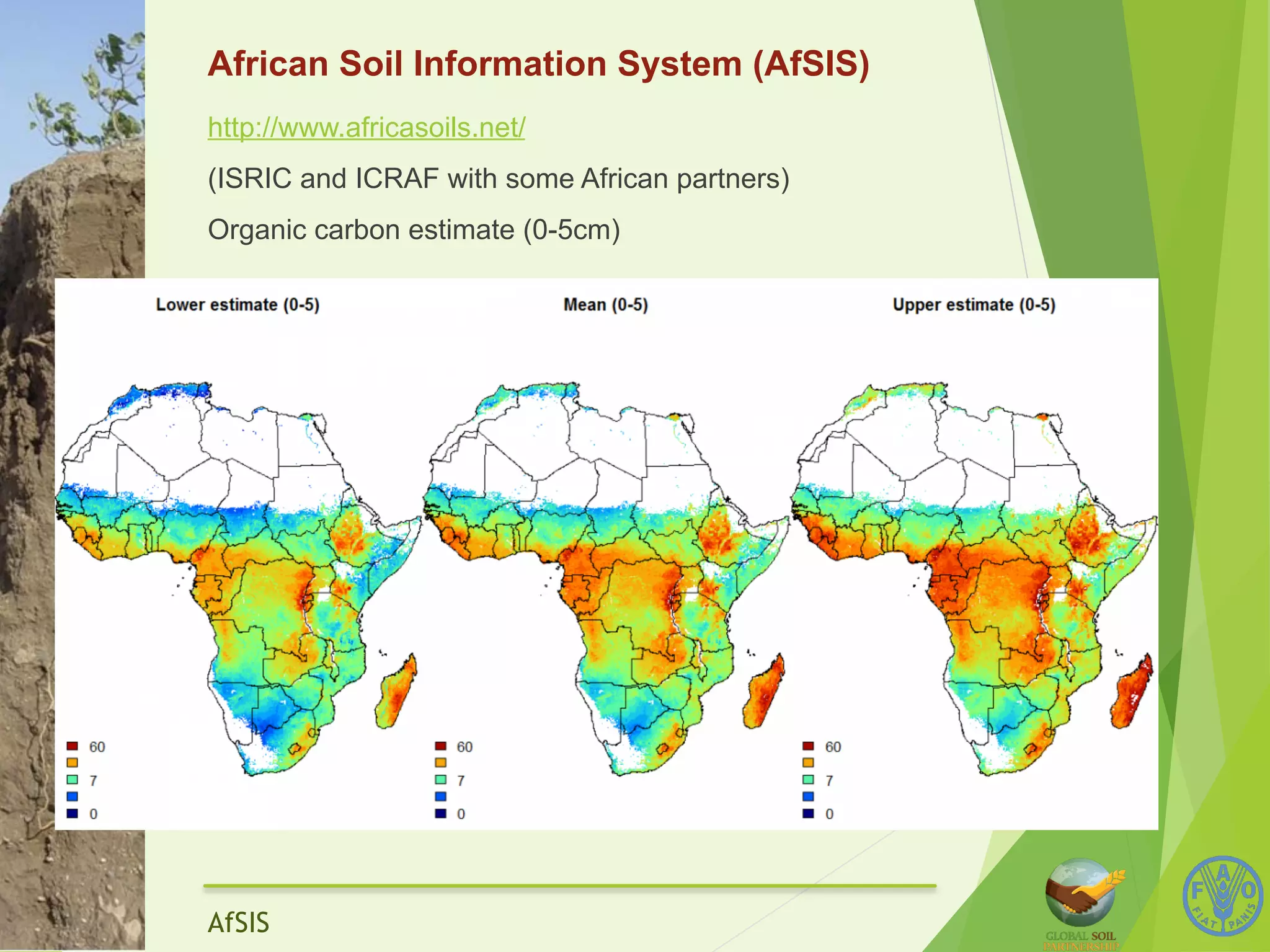
u After 5 years, the project has produced a new 
regional database for Sub-Saharan Africa (AfSIS) at 
a resolution of 1 by 1 km with 7 soil properties at 6 
different depths. 
u Work in (slow) progress 
Globsoilmap.net
African Soil Information System (AfSIS) 
http://www.africasoils.net/ 
(ISRIC and ICRAF with some African partners) 
Organic carbon estimate (0-5cm) 
AfSIS
Soil Grids 1km (2013- Now) 
http://soilgrids1km.isric.org/ 
u ISRIC’s Experimental global soil database 
u Resolution 1km by 1km 
u Uses advanced statistics 
u Maps for 7 soil properties at six standard 
depths 
u Predicts also soil types 
Soil Grids 1km (2013-now)
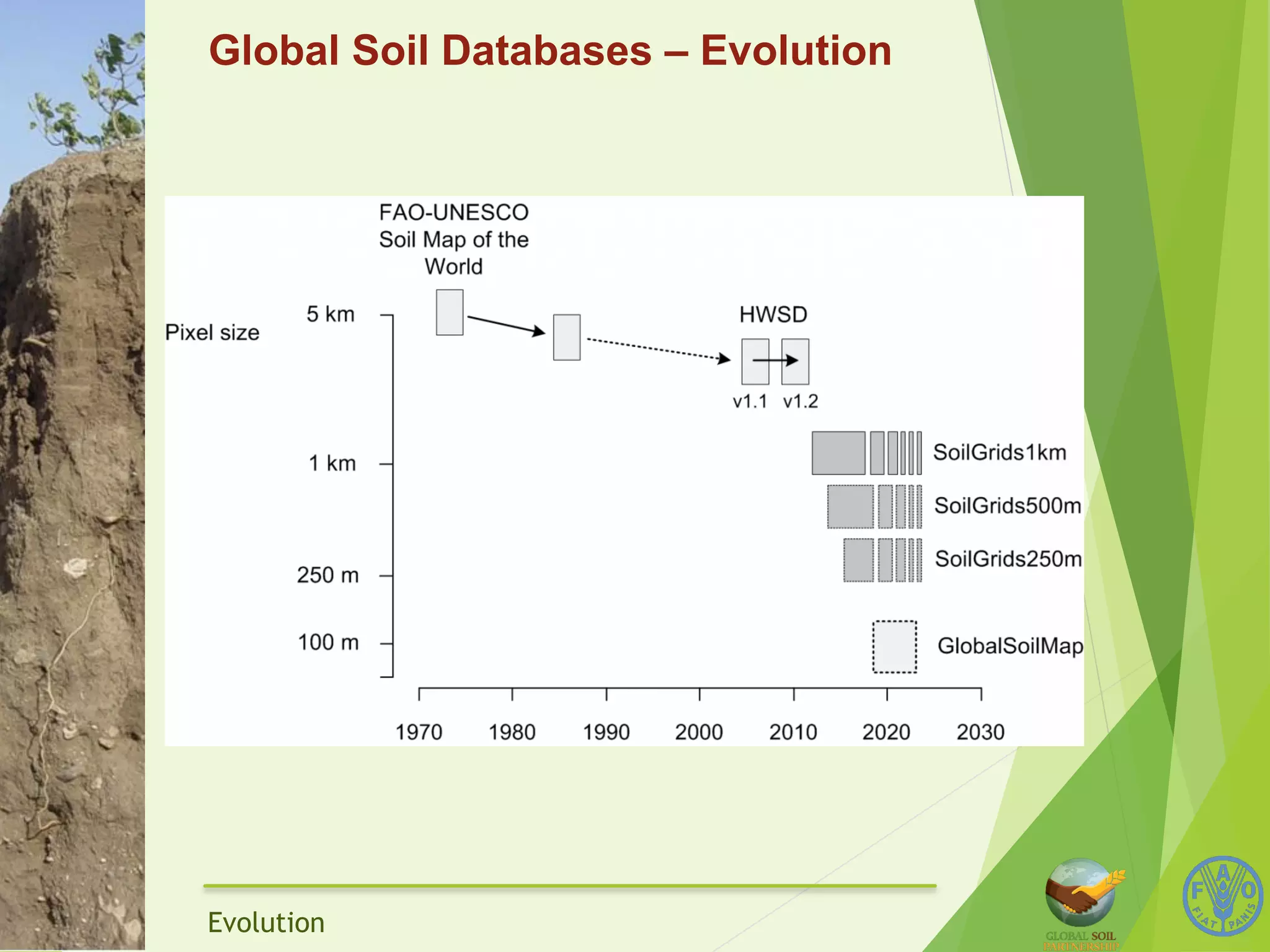
Global Soil Databases – Evolution 
Evolution
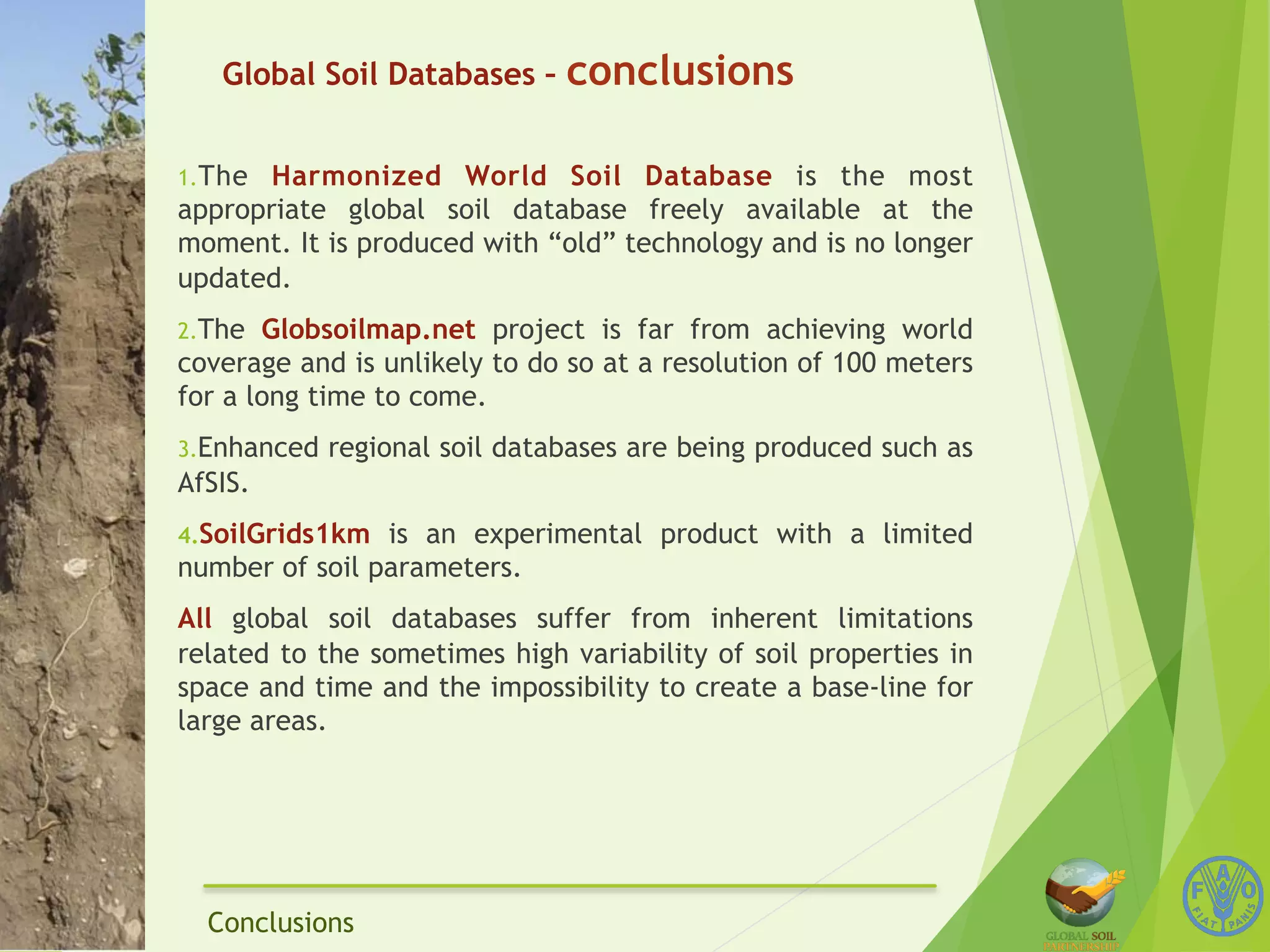
Global Soil Databases – conclusions 
1. The Harmonized World Soil Database is the most 
appropriate global soil database freely available at the 
moment. It is produced with “old” technology and is no longer 
updated. 
2. The Globsoilmap.net project is far from achieving world 
coverage and is unlikely to do so at a resolution of 100 meters 
for a long time to come. 
3. Enhanced regional soil databases are being produced such as 
AfSIS. 
4. SoilGrids1km is an experimental product with a limited 
number of soil parameters. 
All global soil databases suffer from inherent limitations 
related to the sometimes high variability of soil properties in 
space and time and the impossibility to create a base-line for 
large areas. 
Conclusions
National and Regional Soil Databases 
A multitude of regional and national soil databases exist and are accessible on-line: 
FAO: http://www.fao.org/soils-portal/it/ 
JRC: http://eusoils.jrc.ec.europa.eu/library/maps/country_maps/list_countries.cfm 
ISRIC: http://www.isric.org/content/data 
AFRICA 
Contact National Soil Information Centers 
Sub-regional Soil Information 
• Soil Atlas for Africa 
• New generation soil property maps for Africa 
• Soil and Terrain database for North Eastern Africa 
• Soil and Terrain database for Central Africa 
Country Soil Maps and Geographic Databases 
• EUSDAM (all African Countries) 
• Burkina Faso 
• SOTER Kenya 
• SOTER Senegal and Gambia 
• SWALIM - Somalia Water and Land information management 
• South Africa Natural Resources Atlas 
• SOTER Tunisia 
• Soil and Terrain database for Southern Africa
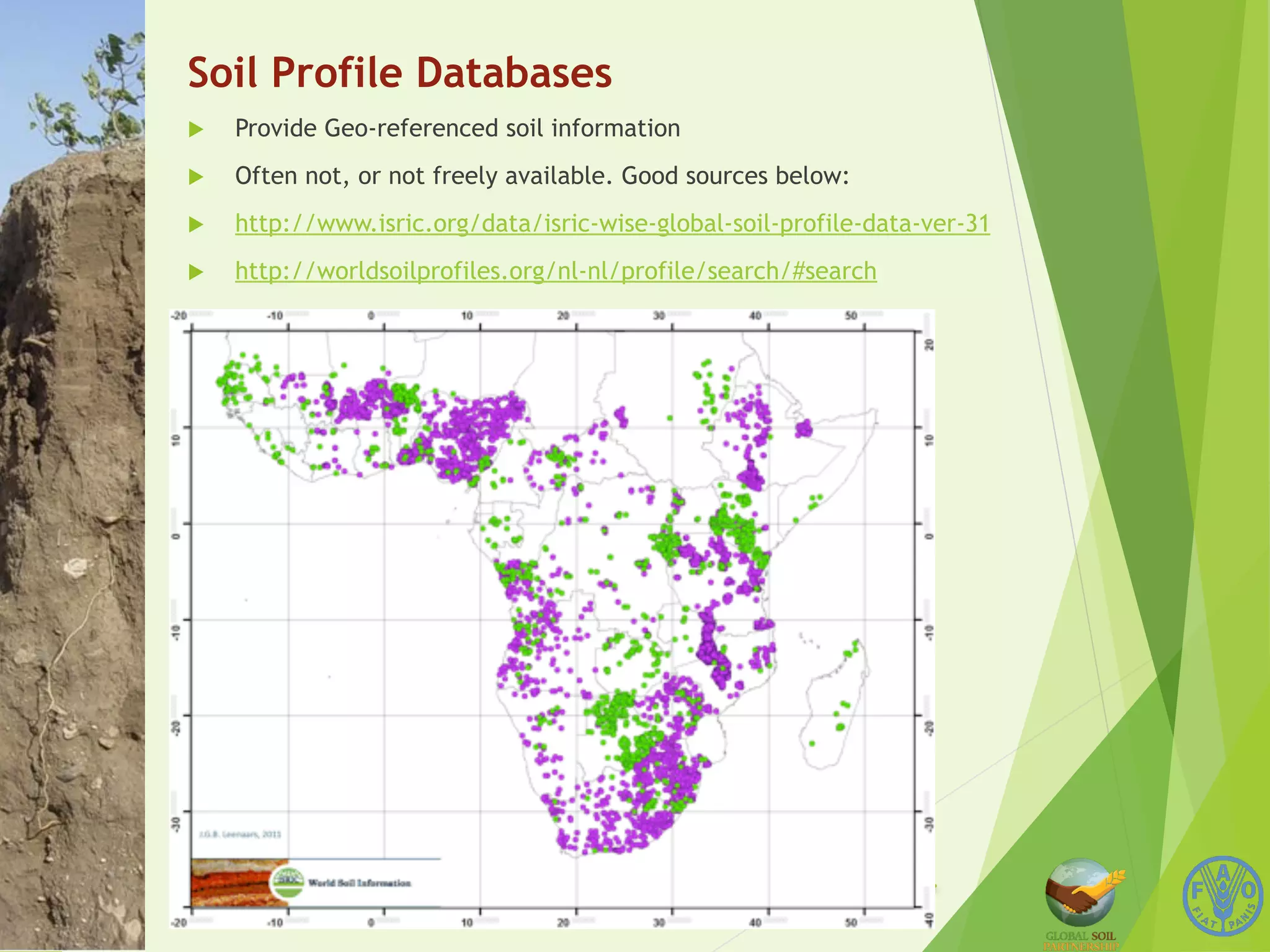
Soil Profile Databases 
u Provide Geo-referenced soil information 
u Often not, or not freely available. Good sources below: 
u http://www.isric.org/data/isric-wise-global-soil-profile-data-ver-31 
u http://worldsoilprofiles.org/nl-nl/profile/search/#search
New techniques 
u Mid-infrared (MIR) and near-infrared 
(NIR) spectroscopy techniques are used 
for chemical analysis and are based on 
diffuse-reflectance. 
u Remote sensing allow better modeling of 
soil properties: Digital Elevation Models, 
Land Cover Share, Population etc… 
u Advanced statistical techniques: 
krigging, co-krigging, use of splines etc…
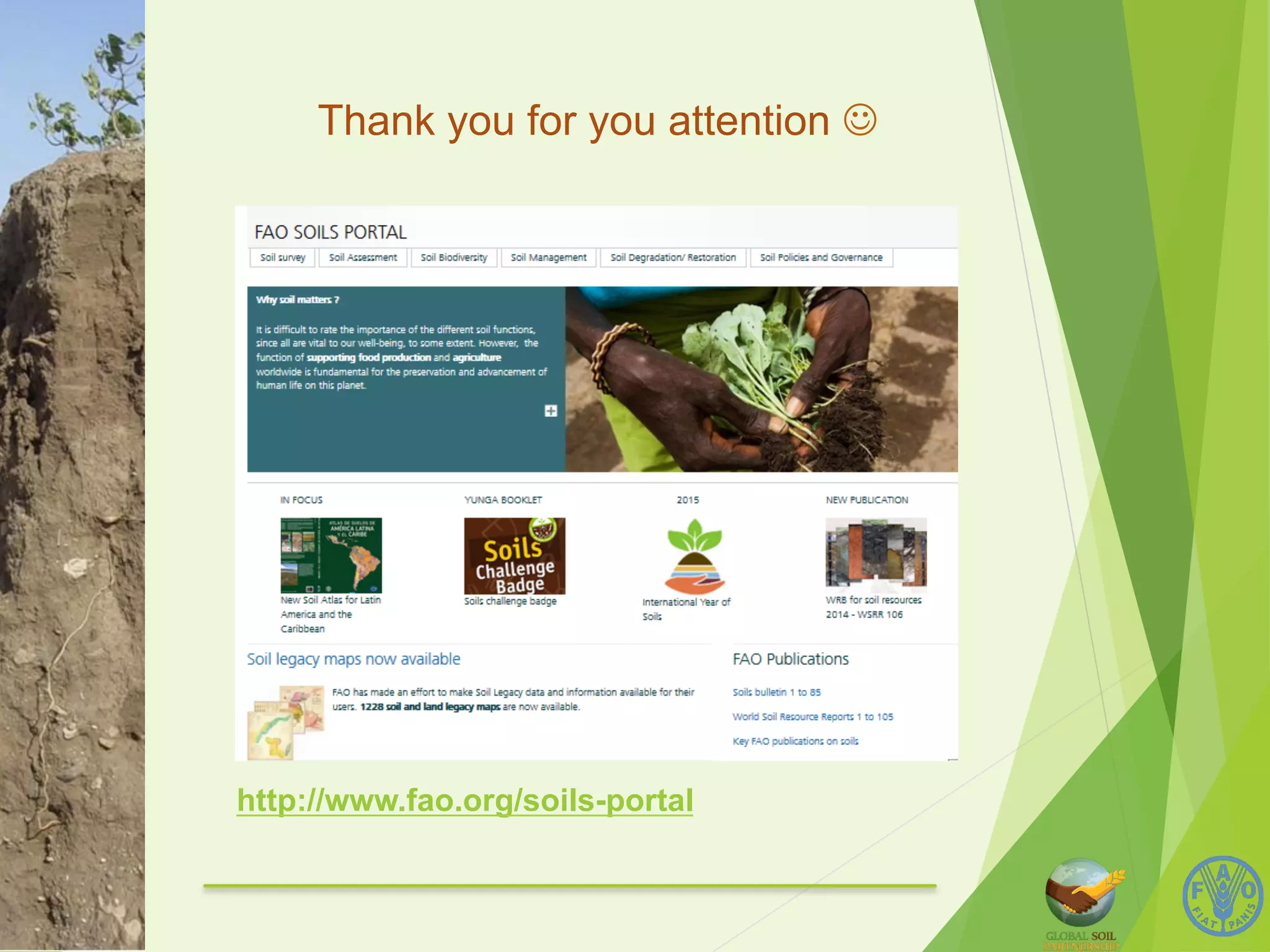
Thank you for you attention J 
http://www.fao.org/soils-portal

Nachtergaele Available soil databases Nov 10 2014

  • 1.
    Reflections on Available Soil Databases Freddy Nachtergaele 10-12 November "Reducing the costs of GHG Estimates in Agriculture to inform low emissions development”
  • 2.
    Ø Introduction ØGlobal Soil Databases. Ø FAO/UNESCO Soil Map of the World Ø Harmonized World Soil Database Ø Globsoilmap.net/Afsis Ø Soil Grid – ISRIC World_Soil Ø Regional and National Soil Databases. Ø Access: Soils Portal Ø Point Databases. Ø Conclusions
  • 3.
    Introduction u Soilshave received less attention than other natural resources, partly because they are largely invisible and partly because they are much more complex than air and water. u As with all data, there is a difference for soil databases between what exists and what is available. This is particular a problem in Europe and for point data, but the problem is becoming more widespread. u Remote sensing has great capabilities for monitoring. However for soils, although progress has been made, RS cannot determine (yet) soil properties in time and space with sufficient accuracy. u Soil monitoring by field sampling over large areas is near impossible because of time and resource constraints. Introduction
  • 4.
    Global Soil Databases u Excelent for global modeling (in combination with GCM or other models eg GAEZ). u Relatively high number of soil properties available (7-20) at different depths (2-6) depending on type of global database. Disadvantages of Global Soil Databases u Those based on classical soil maps present polygon or raster data with associations of soils. Consequently there is no unique value for a soil property but several values are given, one of which is dominant. Point-based global soil databases present unique values with a(n) (un) reliability estimate attached. Inherent Difficulties related to soil property monitoring u Soil properties cannot be measured over very large areas within a limited time frame. Hence no baseline values for a single year globally are available. u Most soil properties change slowly in time, however some show fluctuations seasonally (soil moisture, salinity) or change drastically after a land use change (SOC, pH after deforestation). u Laboratory methods may have sometimes a higher error range than the change in time of soil properties. Global Soil Databases
  • 5.
    FAO/UNESCO Soil Mapof the World (1971-1980) FAO/UNESCO Soil Map of the World
  • 6.
    FAO/UNESCO Soil Mapof the World (1971-1980) http://www.fao.org/geonetwork/srv/en/resources.get? id=14116&fname=DSMW.zip&access=private u Is still the only, fully consistent, harmonized global soil inventory u The paper map (1980) is polygon based and contains info on soil unit associations, topsoil texture and slope class. u The digitized version (1995) is also raster based and contains estimated values for 10 soil properties. u It is a soil database of historical value superseded by the Harmonized World Soil Database. FAO/UNESCO Soil Map of the World
  • 7.
    Harmonized World SoilDatabase (2006-2012) Harmonized World Soil Database
  • 8.
    Harmonized World SoilDatabase (2006-2012) http://www.fao.org/soils-portal/soil-survey/soil-maps-and-databases/ harmonized-world-soil-database-v12/it/ u It is the most used global soil dataset. u Raster resolution of 1km by 1km u 20 soil properties for two soil depths (0-30 cm and 30-100cm). u Includes SOC pool and soil moisture storing capacities. u Is not fully harmonized. u Is part of GAEZ approach that models anticipated yields for hundreds of crops worldwide. http://www.fao.org/nr/gaez/about-data-portal/en/ u Updates no longer funded Harmonized World Soil Database
  • 9.
    Soil moisture holding capacity based on HWSD
  • 10.
  • 11.
    Soil and TerrainSuitability for Maize in Africa (based on HWSD/GAEZ)
  • 12.
    FAOSTAT Emission Database http://faostat.fao.org/site/705/default.aspx u Presents country data for emissions of cultivated organic soils and grassland organic soils. u Organic soils are derived from HWSD data. Histosols (peat soils)
  • 13.
    Soil A9ributes present in HWSD (For top-­‐ and subsoil where appropriate) u Soil depth u Organic Carbon u pH(H2O) u CEC soil u CEC clay frac;on u Total Exchangeable Bases (TEB) u Base satura;on u Exchangeable Sodium Percentage (ESP) u Calcium carbonate u Gypsum u Sand frac;on u Silt frac;on u Clay frac;on u Ece (salinity) u USDA Texture Class u Bulk Density u Reference Bulk Density u Soil Drainage class u Presence of Gelic proper;es u Presence of Ver;c proper;es u Soil Phase informa;on
  • 14.
    Additional information containedin HWSD 1.Land cover/land use shares (5’grid based on GLC 2000) Rain-fed cultivated land, Irrigated cultivated land, Forest land, Pasture land, Barren/slightly vegetated land, Water, Urban land. 2. Terrain slope and aspect distributions (5’grid) 3. Soil qualities for agriculture (5’grid) Nutrient availability, Nutrient retention capacity, Rooting conditions, Oxygen availability, Excess salts, Toxicity and Workability, Soil erodibility. 4. Rural and urban population distribution (5’grid)
  • 15.
    Globsoilmap.net (2009-Now) www.globalsoilmap.net u Project undertaken by ISRIC, CSIRO, USDA, JRC etc… u Funded by the Bill and Melinda Gates Foundation Intends to predict soil properties at a very fine spatial resolution (~100 m), u Digital Soil Mapping (DSM) techniques with infrared spectroscopy, radar, hyperspectral imagery, advanced modelling, GIS and statistical techniques. u After 5 years, the project has produced a new regional database for Sub-Saharan Africa (AfSIS) at a resolution of 1 by 1 km with 7 soil properties at 6 different depths. u Work in (slow) progress Globsoilmap.net
  • 16.
    African Soil InformationSystem (AfSIS) http://www.africasoils.net/ (ISRIC and ICRAF with some African partners) Organic carbon estimate (0-5cm) AfSIS
  • 17.
    Soil Grids 1km(2013- Now) http://soilgrids1km.isric.org/ u ISRIC’s Experimental global soil database u Resolution 1km by 1km u Uses advanced statistics u Maps for 7 soil properties at six standard depths u Predicts also soil types Soil Grids 1km (2013-now)
  • 18.
    Global Soil Databases– Evolution Evolution
  • 19.
    Global Soil Databases– conclusions 1. The Harmonized World Soil Database is the most appropriate global soil database freely available at the moment. It is produced with “old” technology and is no longer updated. 2. The Globsoilmap.net project is far from achieving world coverage and is unlikely to do so at a resolution of 100 meters for a long time to come. 3. Enhanced regional soil databases are being produced such as AfSIS. 4. SoilGrids1km is an experimental product with a limited number of soil parameters. All global soil databases suffer from inherent limitations related to the sometimes high variability of soil properties in space and time and the impossibility to create a base-line for large areas. Conclusions
  • 20.
    National and RegionalSoil Databases A multitude of regional and national soil databases exist and are accessible on-line: FAO: http://www.fao.org/soils-portal/it/ JRC: http://eusoils.jrc.ec.europa.eu/library/maps/country_maps/list_countries.cfm ISRIC: http://www.isric.org/content/data AFRICA Contact National Soil Information Centers Sub-regional Soil Information • Soil Atlas for Africa • New generation soil property maps for Africa • Soil and Terrain database for North Eastern Africa • Soil and Terrain database for Central Africa Country Soil Maps and Geographic Databases • EUSDAM (all African Countries) • Burkina Faso • SOTER Kenya • SOTER Senegal and Gambia • SWALIM - Somalia Water and Land information management • South Africa Natural Resources Atlas • SOTER Tunisia • Soil and Terrain database for Southern Africa
  • 21.
    Soil Profile Databases u Provide Geo-referenced soil information u Often not, or not freely available. Good sources below: u http://www.isric.org/data/isric-wise-global-soil-profile-data-ver-31 u http://worldsoilprofiles.org/nl-nl/profile/search/#search
  • 22.
    New techniques uMid-infrared (MIR) and near-infrared (NIR) spectroscopy techniques are used for chemical analysis and are based on diffuse-reflectance. u Remote sensing allow better modeling of soil properties: Digital Elevation Models, Land Cover Share, Population etc… u Advanced statistical techniques: krigging, co-krigging, use of splines etc…
  • 23.
    Thank you foryou attention J http://www.fao.org/soils-portal