Name- Neera Katyayni
Section- B108
Reg no- 11717308
11/21/2018 1
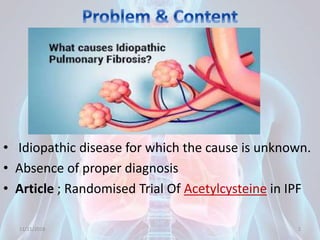
• Idiopathic disease for which the cause is unknown.
• Absence of proper diagnosis
• Article ; Randomised Trial Of Acetylcysteine in IPF
11/21/2018 2
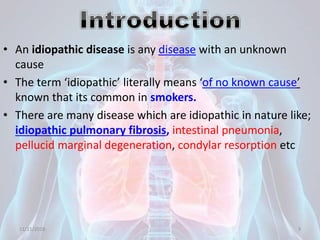
• An idiopathic disease is any disease with an unknown
cause
• The term ‘idiopathic’ literally means ‘of no known cause’
known that its common in smokers.
• There are many disease which are idiopathic in nature like;
idiopathic pulmonary fibrosis, intestinal pneumonia,
pellucid marginal degeneration, condylar resorption etc
11/21/2018 3
Idiopathic pulmonary fibrosis
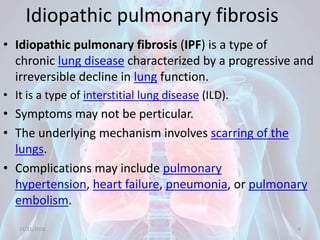
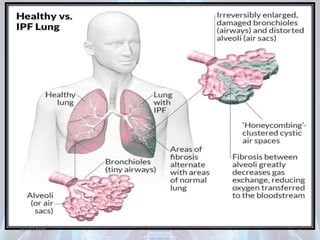
• Idiopathic pulmonary fibrosis (IPF) is a type of
chronic lung disease characterized by a progressive and
irreversible decline in lung function.
• It is a type of interstitial lung disease (ILD).
• Symptoms may not be perticular.
• The underlying mechanism involves scarring of the
lungs.
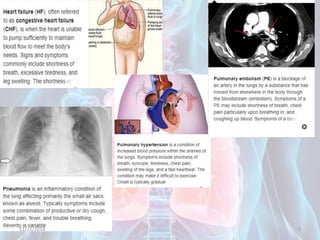
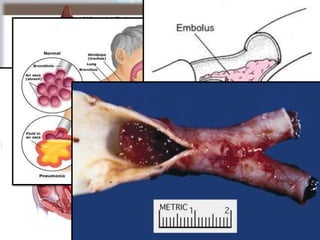
• Complications may include pulmonary
hypertension, heart failure, pneumonia, or pulmonary
embolism.
11/21/2018 4
11/21/2018 5
11/21/2018 6
11/21/2018 7
CAUSE
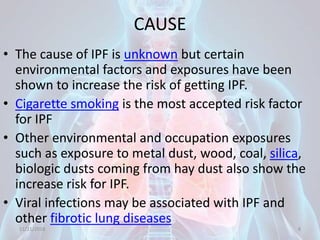
• The cause of IPF is unknown but certain
environmental factors and exposures have been
shown to increase the risk of getting IPF.
• Cigarette smoking is the most accepted risk factor
for IPF
• Other environmental and occupation exposures
such as exposure to metal dust, wood, coal, silica,
biologic dusts coming from hay dust also show the
increase risk for IPF.
• Viral infections may be associated with IPF and
other fibrotic lung diseases
11/21/2018 8
Symptoms
• Loss of elasticity leading to breathlessness, and a
crackling “Velcrolike” sound when breathing
• Dry cough(persistent cough )
• Tiredness
• Weight loss
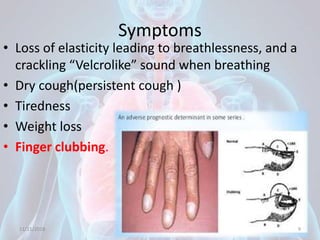
• Finger clubbing.
11/21/2018 9
11/21/2018 10
Drawback
• the general approach to treatment is to attempt to
suppress progression with corticosteroids, alone or
in combination with cytotoxic agents such as
azathioprine or cyclophosphamide.
• these compounds only slow the progression of the
disease, they do not act as a cure and cannot halt or
reverse the decline in lung function
11/21/2018 11
discussion
• Diagnosis may be supported by a CT scan or lung
biopsy.
• About 5 million people are affected globally
• Laboratory Tests - No specific serum laboratory
tests are available to diagnose IPF,
• but use of available tests can aid in
differentiating IPF from other diseases and
identifying complications and coexisting entities.
• Routine laboratory tests in the evaluation,
including complete blood cell count, may support
the presence of an infection.
11/21/2018 12
Developing new IPF therapies
• The world urgently needs improved
treatment of IPF. A range of agents are
currently being developed to combat IPF,
targeting various pathways
• One such research Article published on May
18,2014 by Fernando J . Martinez, MD, New
York
11/21/2018 13
Randomized Trial of Acetylcysteine in
Idiopathic Pulmonary Fibrosis
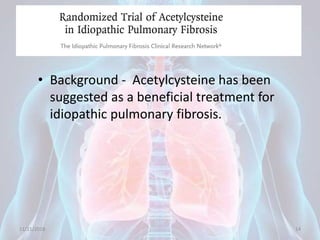
• Background - Acetylcysteine has been
suggested as a beneficial treatment for
idiopathic pulmonary fibrosis.
11/21/2018 14
Method
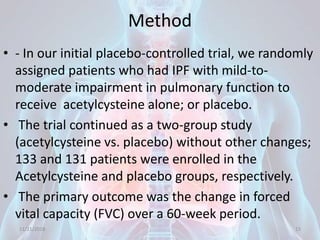
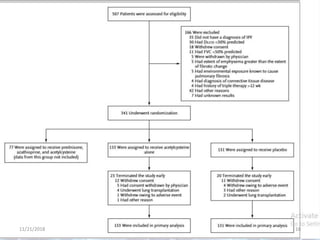
• - In our initial placebo-controlled trial, we randomly
assigned patients who had IPF with mild-to-
moderate impairment in pulmonary function to
receive acetylcysteine alone; or placebo.
• The trial continued as a two-group study
(acetylcysteine vs. placebo) without other changes;
133 and 131 patients were enrolled in the
Acetylcysteine and placebo groups, respectively.
• The primary outcome was the change in forced
vital capacity (FVC) over a 60-week period.
11/21/2018 15
11/21/2018 16
Result
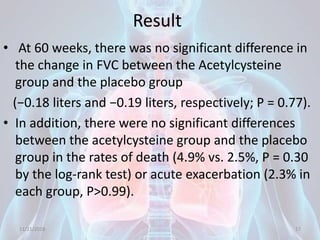
• At 60 weeks, there was no significant difference in
the change in FVC between the Acetylcysteine
group and the placebo group
(−0.18 liters and −0.19 liters, respectively; P = 0.77).
• In addition, there were no significant differences
between the acetylcysteine group and the placebo
group in the rates of death (4.9% vs. 2.5%, P = 0.30
by the log-rank test) or acute exacerbation (2.3% in
each group, P>0.99).
11/21/2018 17
Conclusion
• As compared with placebo, Acetylcysteine offered
no significant benefit with respect to the
preservation of FVC in patients with idiopathic
pulmonary fibrosis with mild to-moderate
impairment in lung function.
(Funded by the National Heart, Lung, and Blood
Institute and others
11/21/2018 18
11/21/2018 19

idiopathic disease

  • 1.
    Name- Neera Katyayni Section-B108 Reg no- 11717308 11/21/2018 1
  • 2.
    • Idiopathic diseasefor which the cause is unknown. • Absence of proper diagnosis • Article ; Randomised Trial Of Acetylcysteine in IPF 11/21/2018 2
  • 3.
    • An idiopathicdisease is any disease with an unknown cause • The term ‘idiopathic’ literally means ‘of no known cause’ known that its common in smokers. • There are many disease which are idiopathic in nature like; idiopathic pulmonary fibrosis, intestinal pneumonia, pellucid marginal degeneration, condylar resorption etc 11/21/2018 3
  • 4.
    Idiopathic pulmonary fibrosis •Idiopathic pulmonary fibrosis (IPF) is a type of chronic lung disease characterized by a progressive and irreversible decline in lung function. • It is a type of interstitial lung disease (ILD). • Symptoms may not be perticular. • The underlying mechanism involves scarring of the lungs. • Complications may include pulmonary hypertension, heart failure, pneumonia, or pulmonary embolism. 11/21/2018 4
  • 5.
  • 6.
  • 7.
  • 8.
    CAUSE • The causeof IPF is unknown but certain environmental factors and exposures have been shown to increase the risk of getting IPF. • Cigarette smoking is the most accepted risk factor for IPF • Other environmental and occupation exposures such as exposure to metal dust, wood, coal, silica, biologic dusts coming from hay dust also show the increase risk for IPF. • Viral infections may be associated with IPF and other fibrotic lung diseases 11/21/2018 8
  • 9.
    Symptoms • Loss ofelasticity leading to breathlessness, and a crackling “Velcrolike” sound when breathing • Dry cough(persistent cough ) • Tiredness • Weight loss • Finger clubbing. 11/21/2018 9
  • 10.
  • 11.
    Drawback • the generalapproach to treatment is to attempt to suppress progression with corticosteroids, alone or in combination with cytotoxic agents such as azathioprine or cyclophosphamide. • these compounds only slow the progression of the disease, they do not act as a cure and cannot halt or reverse the decline in lung function 11/21/2018 11
  • 12.
    discussion • Diagnosis maybe supported by a CT scan or lung biopsy. • About 5 million people are affected globally • Laboratory Tests - No specific serum laboratory tests are available to diagnose IPF, • but use of available tests can aid in differentiating IPF from other diseases and identifying complications and coexisting entities. • Routine laboratory tests in the evaluation, including complete blood cell count, may support the presence of an infection. 11/21/2018 12
  • 13.
    Developing new IPFtherapies • The world urgently needs improved treatment of IPF. A range of agents are currently being developed to combat IPF, targeting various pathways • One such research Article published on May 18,2014 by Fernando J . Martinez, MD, New York 11/21/2018 13
  • 14.
    Randomized Trial ofAcetylcysteine in Idiopathic Pulmonary Fibrosis • Background - Acetylcysteine has been suggested as a beneficial treatment for idiopathic pulmonary fibrosis. 11/21/2018 14
  • 15.
    Method • - Inour initial placebo-controlled trial, we randomly assigned patients who had IPF with mild-to- moderate impairment in pulmonary function to receive acetylcysteine alone; or placebo. • The trial continued as a two-group study (acetylcysteine vs. placebo) without other changes; 133 and 131 patients were enrolled in the Acetylcysteine and placebo groups, respectively. • The primary outcome was the change in forced vital capacity (FVC) over a 60-week period. 11/21/2018 15
  • 16.
  • 17.
    Result • At 60weeks, there was no significant difference in the change in FVC between the Acetylcysteine group and the placebo group (−0.18 liters and −0.19 liters, respectively; P = 0.77). • In addition, there were no significant differences between the acetylcysteine group and the placebo group in the rates of death (4.9% vs. 2.5%, P = 0.30 by the log-rank test) or acute exacerbation (2.3% in each group, P>0.99). 11/21/2018 17
  • 18.
    Conclusion • As comparedwith placebo, Acetylcysteine offered no significant benefit with respect to the preservation of FVC in patients with idiopathic pulmonary fibrosis with mild to-moderate impairment in lung function. (Funded by the National Heart, Lung, and Blood Institute and others 11/21/2018 18
  • 19.