NebulisedAntibiotics
Dr. MohamedTrabelsi
Pulmonary
Drug Delivery
Strategies
 Either for local deposition or for systemic
delivery
 Non-invasive
 High permeability
 Large absorptive surface area
 Good blood supply
 The capacity for overcoming first-pass
metabolism
 Deliver the optimum concentration of the drug
Why deliver
antimicrobials
by inhalation?
 Nidus of infection is more directly accessible via the
respiratory tract than the circulatory system
 High concentrations deposition directly at the site of
infection
 Without the systemic exposures that would be
necessary to achieve similar airway levels by oral or
intravenous (IV) delivery
 Reduced potential for the dose-limiting systemic
toxicities associated with many antimicrobials
 Overwhelm acquired microbial resistance mechanisms
by elevated local drug exposure
Shortcomings
 Inhalation can only deliver drug to ventilated
areas of the airway
 cannot deliver drugs past airway obstruction
 Ventilation inhomogeneity can result in
variable deposition within different ventilated
regions
Adverse
Effects
 Local adverse events, including but not limited to
 Cough
 Bronchospasm
 Hoarseness
 Dysphagia
 Dysgeusia
These tend to be reversible events and there is evidence
that their incidence and severity can decrease with
exposure,
Current
Available
nebulised and
inhaled
formulations
 Tobramycin Dry Powder Inhalation
 NebulisedTobramycin
 Colistimethate sodium Dry Powder Inhalation
 Nebulised Colistimethate sodium
 Nebulised Aztreonam
Uses of
Inhaled/
Nebulised
Antibiotics
P. aeruginosa in Cystic Fibrosis
Off label use:
Acute exacerbations of bronchiectasis
(non-cystic fibrosis)
Nebulisation of injectable formulations
of antibiotics
Airways
infection in
Cystic Fibrosis
 key complications of patients with CF is chronic
bacterial infection
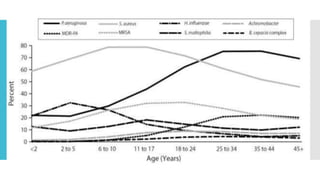
 P. aeruginosa can be isolated by selective
culture from patient airway secretions early in
life
 The most common bacterial opportunist in
adult patients
 Associated with worse symptoms, more
pulmonary exacerbations, and earlier death
P. aeruginosa in
Cystic Fibrosis
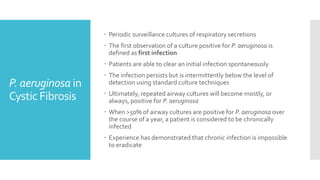
 Periodic surveillance cultures of respiratory secretions
 The first observation of a culture positive for P. aeruginosa is
defined as first infection
 Patients are able to clear an initial infection spontaneously
 The infection persists but is intermittently below the level of
detection using standard culture techniques
 Ultimately, repeated airway cultures will become mostly, or
always, positive for P. aeruginosa
 When >50% of airway cultures are positive for P. aeruginosa over
the course of a year, a patient is considered to be chronically
infected
 Experience has demonstrated that chronic infection is impossible
to eradicate
Eradication
Treatment
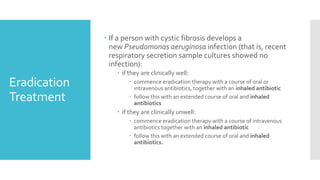
 If a person with cystic fibrosis develops a
new Pseudomonas aeruginosa infection (that is, recent
respiratory secretion sample cultures showed no
infection):
 if they are clinically well:
 commence eradication therapy with a course of oral or
intravenous antibiotics, together with an inhaled antibiotic
 follow this with an extended course of oral and inhaled
antibiotics
 if they are clinically unwell:
 commence eradication therapy with a course of intravenous
antibiotics together with an inhaled antibiotic
 follow this with an extended course of oral and inhaled
antibiotics.
Sustained
Treatment
If eradication treatment is not successful
despite treatment as recommended,
offer sustained treatment with an inhaled
antibiotic.
Consider nebulised colistimethate
sodium as first-line treatment
Colistimethate
sodium
 Nebulised Colistimethate sodium would be first choice
for chronic pulmonary infection caused
by Pseudomonas aeruginosa
 If patient cannot tolerate nebulised form and they
would clinically benefit from continued colistimethate
sodium, Colistimethate sodium dry powder for
inhalation (DPI) is recommended as an option
 If patient cannot tolerate both, tobramycin therapy
would be considered
 Dose:
 By inhalation of nebulised solution: 1-2 million Units twice daily, adjust
according to response. Increased to 2 million units 3 times daily for
subsequent respiratory isolates for Pseudomonas Aeruginosa
 By inhalation of powder: 1.66 million units twice daily
 For people with chronic Pseudomonas
aeruginosa infection who are clinically
deteriorating despite regular inhaled
colistimethate sodium, consider nebulised
aztreonam, nebulised tobramycin, or
tobramycin DPI
Tobramycin
 Tobramycin DPI is recommended as an option for
treating chronic pulmonary infection caused
by Pseudomonas aeruginosa in people with cystic
fibrosis only if:
 nebulised tobramycin is considered an appropriate
treatment, that is, when colistimethate sodium is
contraindicated, is not tolerated or has not produced an
adequate clinical response and
 Dose:
 By inhalation of nebulised solution: 300mg every 12 hours for 28
days, subsequent courses repeated after 28-day interval without
tobramycin nebuliser solution
 By inhalation of powder: 112mg every 12 hours for 28 days,
subsequent courses repeated after 28-day interval without
tobramycin inhalation powder
Other
Organisms in
CF
 For people with cystic fibrosis who have
chronic Burkholderia cepacia complex infection
and declining pulmonary status
 consider sustained treatment with an
inhaled antibiotic to suppress the infection
 seek specialist microbiological advice on
which antibiotic to use
 stop this treatment if there is no observed
benefit.
Inhaled
antibiotics in
acute
exacerbations of
bronchiectasis
(non-cystic
fibrosis)
 NCFB is a heterogeneous, complex disease
 Can lead to disability and poor quality of life
 Especially for patients with chronic airway infection with P.
aeruginosa and frequent exacerbations.
 Long-term inhaled antibiotics are currently used off-label for
‘difficult to treat’ NCFB patients with chronic airway infection
with P. aeruginosa based on evidence from positive trials in CF and
accumulating evidence in NCFB.
 Trials with long-term inhaled antibiotics in NCFB have indicated
some benefits
 Patients having 3 or more exacerbations per year requiring
antibiotic therapy or patients with fewer exacerbations that are
causing significant morbidity
 he BTS guideline states that further studies are needed to identify
the optimal antibiotic choice and doses
Off label use of
Injectable
formulations
 Injectable formulations of gentamicin,
tobramycin, amikacin, ceftazidime, and
amphotericin are currently nebulized
"off-label" to manage non-CF
bronchiectasis, drug-resistant
nontuberculous mycobacterial infections,
ventilator-associated pneumonia, and
post-transplant airway infections
References
1. Pulmonary drug delivery strategies: A concise, systematic review,
J. S. Patil and S. Sarasija
2. Clinical applications of pulmonary delivery of antibiotics, Patrick A.
Flume, MD and Donald R.VanDevanter, PhD
3. Cystic fibrosis: diagnosis and management NICE guidance
4. PNF 76 ed.
5. Inhaled antibiotics for lower airway infections. Quon BS1, Goss CH,
Ramsey BW.
6. Non-cystic fibrosis bronchiectasis: inhaled tobramycin NICE
guidance
7. Guideline for non-CF Bronchiectasis BritishThoracic Society
8. Oxford Academic; InhaledAntibiotics for Hospital-Acquired and
Ventilator-Associated Pneumonia; Lindsay M. Daniels Jonathan
Juliano Ashley Marx David J.Weber
9. Assessing effects of inhaled antibiotics in adults with non-cystic
fibrosis bronchiectasis––experiences from recent clinical trials
Sheyla Paredes Aller, Alexandra L. Quittner, Matthias A. Salathe &
Andreas Schmid
ThankYou!

Nebulised Antibiotics

  • 1.
  • 2.
    Pulmonary Drug Delivery Strategies  Eitherfor local deposition or for systemic delivery  Non-invasive  High permeability  Large absorptive surface area  Good blood supply  The capacity for overcoming first-pass metabolism  Deliver the optimum concentration of the drug
  • 3.
    Why deliver antimicrobials by inhalation? Nidus of infection is more directly accessible via the respiratory tract than the circulatory system  High concentrations deposition directly at the site of infection  Without the systemic exposures that would be necessary to achieve similar airway levels by oral or intravenous (IV) delivery  Reduced potential for the dose-limiting systemic toxicities associated with many antimicrobials  Overwhelm acquired microbial resistance mechanisms by elevated local drug exposure
  • 4.
    Shortcomings  Inhalation canonly deliver drug to ventilated areas of the airway  cannot deliver drugs past airway obstruction  Ventilation inhomogeneity can result in variable deposition within different ventilated regions
  • 5.
    Adverse Effects  Local adverseevents, including but not limited to  Cough  Bronchospasm  Hoarseness  Dysphagia  Dysgeusia These tend to be reversible events and there is evidence that their incidence and severity can decrease with exposure,
  • 6.
    Current Available nebulised and inhaled formulations  TobramycinDry Powder Inhalation  NebulisedTobramycin  Colistimethate sodium Dry Powder Inhalation  Nebulised Colistimethate sodium  Nebulised Aztreonam
  • 7.
    Uses of Inhaled/ Nebulised Antibiotics P. aeruginosain Cystic Fibrosis Off label use: Acute exacerbations of bronchiectasis (non-cystic fibrosis) Nebulisation of injectable formulations of antibiotics
  • 8.
    Airways infection in Cystic Fibrosis key complications of patients with CF is chronic bacterial infection  P. aeruginosa can be isolated by selective culture from patient airway secretions early in life  The most common bacterial opportunist in adult patients  Associated with worse symptoms, more pulmonary exacerbations, and earlier death
  • 10.
    P. aeruginosa in CysticFibrosis  Periodic surveillance cultures of respiratory secretions  The first observation of a culture positive for P. aeruginosa is defined as first infection  Patients are able to clear an initial infection spontaneously  The infection persists but is intermittently below the level of detection using standard culture techniques  Ultimately, repeated airway cultures will become mostly, or always, positive for P. aeruginosa  When >50% of airway cultures are positive for P. aeruginosa over the course of a year, a patient is considered to be chronically infected  Experience has demonstrated that chronic infection is impossible to eradicate
  • 11.
    Eradication Treatment  If aperson with cystic fibrosis develops a new Pseudomonas aeruginosa infection (that is, recent respiratory secretion sample cultures showed no infection):  if they are clinically well:  commence eradication therapy with a course of oral or intravenous antibiotics, together with an inhaled antibiotic  follow this with an extended course of oral and inhaled antibiotics  if they are clinically unwell:  commence eradication therapy with a course of intravenous antibiotics together with an inhaled antibiotic  follow this with an extended course of oral and inhaled antibiotics.
  • 12.
    Sustained Treatment If eradication treatmentis not successful despite treatment as recommended, offer sustained treatment with an inhaled antibiotic. Consider nebulised colistimethate sodium as first-line treatment
  • 13.
    Colistimethate sodium  Nebulised Colistimethatesodium would be first choice for chronic pulmonary infection caused by Pseudomonas aeruginosa  If patient cannot tolerate nebulised form and they would clinically benefit from continued colistimethate sodium, Colistimethate sodium dry powder for inhalation (DPI) is recommended as an option  If patient cannot tolerate both, tobramycin therapy would be considered  Dose:  By inhalation of nebulised solution: 1-2 million Units twice daily, adjust according to response. Increased to 2 million units 3 times daily for subsequent respiratory isolates for Pseudomonas Aeruginosa  By inhalation of powder: 1.66 million units twice daily
  • 14.
     For peoplewith chronic Pseudomonas aeruginosa infection who are clinically deteriorating despite regular inhaled colistimethate sodium, consider nebulised aztreonam, nebulised tobramycin, or tobramycin DPI
  • 15.
    Tobramycin  Tobramycin DPIis recommended as an option for treating chronic pulmonary infection caused by Pseudomonas aeruginosa in people with cystic fibrosis only if:  nebulised tobramycin is considered an appropriate treatment, that is, when colistimethate sodium is contraindicated, is not tolerated or has not produced an adequate clinical response and  Dose:  By inhalation of nebulised solution: 300mg every 12 hours for 28 days, subsequent courses repeated after 28-day interval without tobramycin nebuliser solution  By inhalation of powder: 112mg every 12 hours for 28 days, subsequent courses repeated after 28-day interval without tobramycin inhalation powder
  • 16.
    Other Organisms in CF  Forpeople with cystic fibrosis who have chronic Burkholderia cepacia complex infection and declining pulmonary status  consider sustained treatment with an inhaled antibiotic to suppress the infection  seek specialist microbiological advice on which antibiotic to use  stop this treatment if there is no observed benefit.
  • 17.
    Inhaled antibiotics in acute exacerbations of bronchiectasis (non-cystic fibrosis) NCFB is a heterogeneous, complex disease  Can lead to disability and poor quality of life  Especially for patients with chronic airway infection with P. aeruginosa and frequent exacerbations.  Long-term inhaled antibiotics are currently used off-label for ‘difficult to treat’ NCFB patients with chronic airway infection with P. aeruginosa based on evidence from positive trials in CF and accumulating evidence in NCFB.  Trials with long-term inhaled antibiotics in NCFB have indicated some benefits  Patients having 3 or more exacerbations per year requiring antibiotic therapy or patients with fewer exacerbations that are causing significant morbidity  he BTS guideline states that further studies are needed to identify the optimal antibiotic choice and doses
  • 18.
    Off label useof Injectable formulations  Injectable formulations of gentamicin, tobramycin, amikacin, ceftazidime, and amphotericin are currently nebulized "off-label" to manage non-CF bronchiectasis, drug-resistant nontuberculous mycobacterial infections, ventilator-associated pneumonia, and post-transplant airway infections
  • 19.
    References 1. Pulmonary drugdelivery strategies: A concise, systematic review, J. S. Patil and S. Sarasija 2. Clinical applications of pulmonary delivery of antibiotics, Patrick A. Flume, MD and Donald R.VanDevanter, PhD 3. Cystic fibrosis: diagnosis and management NICE guidance 4. PNF 76 ed. 5. Inhaled antibiotics for lower airway infections. Quon BS1, Goss CH, Ramsey BW. 6. Non-cystic fibrosis bronchiectasis: inhaled tobramycin NICE guidance 7. Guideline for non-CF Bronchiectasis BritishThoracic Society 8. Oxford Academic; InhaledAntibiotics for Hospital-Acquired and Ventilator-Associated Pneumonia; Lindsay M. Daniels Jonathan Juliano Ashley Marx David J.Weber 9. Assessing effects of inhaled antibiotics in adults with non-cystic fibrosis bronchiectasis––experiences from recent clinical trials Sheyla Paredes Aller, Alexandra L. Quittner, Matthias A. Salathe & Andreas Schmid
  • 20.

Editor's Notes

  • #10 Prevalence of bacterial species cultured from respiratory specimens in CF patients.[7]. These data are derived from the US CF Patient Registry and represent a cross-sectional analysis of the respiratory culture results include 27,804 unique patients in 2012. MDR-PA: multi-drug resistant P. aeruginosa