QCI
NABL – General
Scope of NABL
Certification Vs Accreditation
Process of NABL Accreditation
Benefit of Accreditation
Our Scope
Requirements
Where we are
Training needs
Infrastructure needs
Documentation
Requirements
Action Plan
QUALITY COUNCIL OF INDIA
QCI is governed by a Council of 38 members
with equal
representations of government, industry and
consumers.
 Chairman of QCI is appointed by the
Prime Minister's office on
recommendation of the government
and industry.
Council is the apex level body
responsible for formulating the
 strategy,
 general policy,
 constitution and monitoring of various components
of QCI
with objective to ensure transparent and credible
accreditation system.
 Each Board functions independently with its own
Chairperson appointed by the QCI Chairman and
with the members representing various
stakeholders.
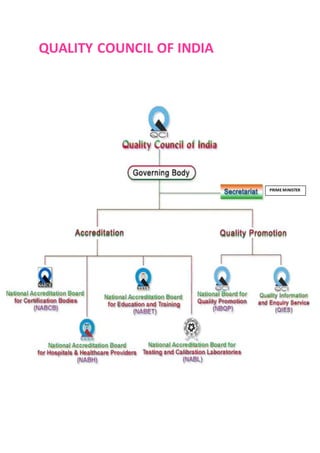
QUALITY COUNCIL OF INDIA
PRIMEMINISTER
 Is an autonomous body
 Registered under societies act in 1992
 Under the aegis of department of science and
technology,
by government.
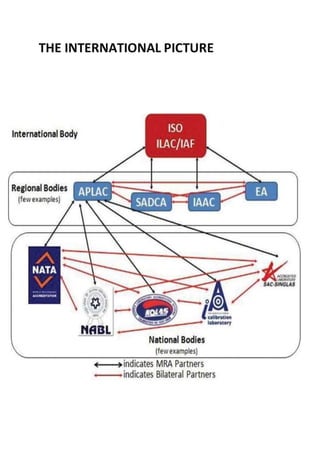
THE INTERNATIONAL PICTURE
ILAC:INTERNATIONAL LABORATORIES ACCREDITATIONCOOPERATION
NABL:NATIONAL ACCREDITATIONBOARD FORTESTING AND CALIBRATING
LABORATORIES
IAF:INTERNATIONAL ACCREDITATIONFORUM
APLAC: ASIA PECIFIC LABORATORIES ACCREDITATIONCOOPERATION
SADCA: THE SOUTHERNAFRICA DEVELOPLOPMENTCOMMUNITY
COOPERATIONINACCREDITATION
IAAC:THE INTERAMERICANACCREDITATIONCOOPERATION
EA: THE EUROPEANCOOPERATIONFORACCREDITATION
NATA: NATIONAL ASSOCIATIONOF TESTING AUTHORITIES, AUSTRALIA
IANZ:INTERNATIONAL ACCREDITATIONNEW ZELAND
THE INTERNATIONAL PICTURE
NABL, as an accreditation body, operates its
own system as per ISO/IEC 17011.
NABL is signatory to APLAC/ILAC mutual
recognition arrangements (MRA) since 2000
after its first evaluation by APLAC.
Second & Third evaluation by APLAC in 2004
& 2008 respectively.
Fourth evaluation completed in Sep.2012.
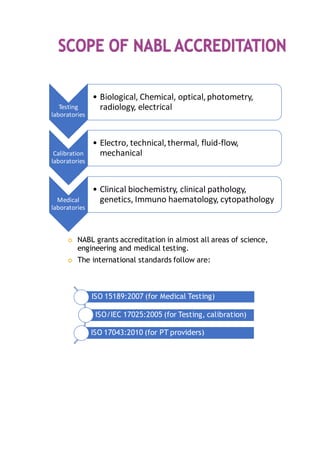
 NABL grants accreditation in almost all areas of science,
engineering and medical testing.
 The international standards follow are:
ISO 15189:2007 (for Medical Testing)
ISO/IEC 17025:2005 (for Testing, calibration)
ISO 17043:2010 (for PT providers)
Testing
laboratories
• Biological, Chemical, optical,photometry,
radiology, electrical
Calibration
laboratories
• Electro, technical,thermal, fluid-flow,
mechanical
Medical
laboratories
• Clinical biochemistry, clinical pathology,
genetics, Immuno haematology, cytopathology
BENEFITS OF ACCREDITATION CUSTOMER
Customer can search laboratories:
 Customer can search and identify the laboratories
accreditation by NABL for their specific requirement from the
directory of accreditation laboratories.
Increased confidence in report:
 The labs are required participants to proficiency testing
which is again demonstration of competence, so there is
increased confidence in the reports released by the
laboratories.
The customer gets services by credential staff.
Savings in term of time & money as it reduces or
eliminates the need of re-testing.
BENEFITS OF ACCREDITATION LABORATORY
 Use of accreditation symbol
 The accredited laboratories can issue test reports bearing
the accreditation body’s symbol or endorsement, as an
indication of accreditation.
 International Recognition
 Lab accreditation is highly regarded both nationally and
internationally as an indicator of technical competence.
 Satisfaction of the staff
 The staff in an accredited laboratory is satisfied as it
provides for continuous learning, good working
environment, leadership.
 Continuous improvement
 Accreditation to a laboratory stimulates continuous
improvement. It enables the laboratory in demonstrating
commitment to quality test reports.
 Systematic Control of lab work
 Better control of laboratory operations and feedback to
laboratories.
 Benchmark with best laboratories
 It also provides opportunity to the laboratory to benchmark
with the best.
 Rise in business
 There is marked increase in the business of the labs as the
accredited status can be seen by the clients on NABL website.
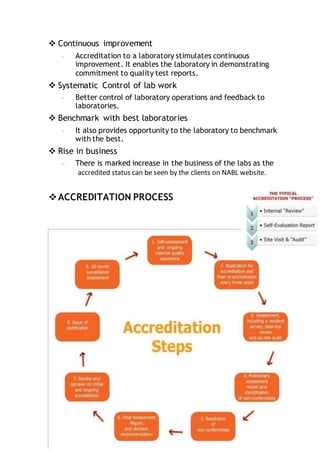
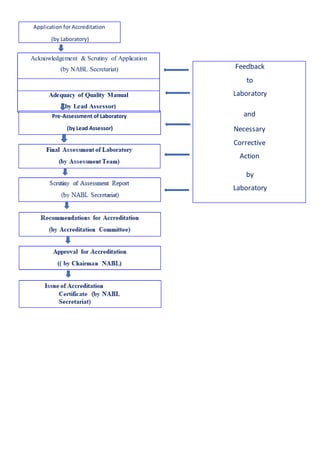
ACCREDITATION PROCESS
Acknowledgement & Scrutiny of Application
(by NABL Secretariat)
Adequacy of Quality Manual
(by Lead Assessor)
Application for Accreditation
(by Laboratory)
Pre-Assessment of Laboratory
(by Lead Assessor)
Feedback
to
Laboratory
and
Necessary
Corrective
Action
by
Laboratory

NABL Accreditation

  • 2.
    QCI NABL – General Scopeof NABL Certification Vs Accreditation Process of NABL Accreditation Benefit of Accreditation Our Scope Requirements Where we are Training needs Infrastructure needs Documentation Requirements Action Plan
  • 3.
    QUALITY COUNCIL OFINDIA QCI is governed by a Council of 38 members with equal representations of government, industry and consumers.  Chairman of QCI is appointed by the Prime Minister's office on recommendation of the government and industry. Council is the apex level body responsible for formulating the  strategy,  general policy,  constitution and monitoring of various components of QCI with objective to ensure transparent and credible accreditation system.  Each Board functions independently with its own Chairperson appointed by the QCI Chairman and with the members representing various stakeholders.
  • 4.
    QUALITY COUNCIL OFINDIA PRIMEMINISTER
  • 5.
     Is anautonomous body  Registered under societies act in 1992  Under the aegis of department of science and technology, by government.
  • 6.
  • 7.
    ILAC:INTERNATIONAL LABORATORIES ACCREDITATIONCOOPERATION NABL:NATIONALACCREDITATIONBOARD FORTESTING AND CALIBRATING LABORATORIES IAF:INTERNATIONAL ACCREDITATIONFORUM APLAC: ASIA PECIFIC LABORATORIES ACCREDITATIONCOOPERATION SADCA: THE SOUTHERNAFRICA DEVELOPLOPMENTCOMMUNITY COOPERATIONINACCREDITATION IAAC:THE INTERAMERICANACCREDITATIONCOOPERATION EA: THE EUROPEANCOOPERATIONFORACCREDITATION NATA: NATIONAL ASSOCIATIONOF TESTING AUTHORITIES, AUSTRALIA IANZ:INTERNATIONAL ACCREDITATIONNEW ZELAND THE INTERNATIONAL PICTURE NABL, as an accreditation body, operates its own system as per ISO/IEC 17011. NABL is signatory to APLAC/ILAC mutual recognition arrangements (MRA) since 2000 after its first evaluation by APLAC. Second & Third evaluation by APLAC in 2004 & 2008 respectively. Fourth evaluation completed in Sep.2012.
  • 8.
     NABL grantsaccreditation in almost all areas of science, engineering and medical testing.  The international standards follow are: ISO 15189:2007 (for Medical Testing) ISO/IEC 17025:2005 (for Testing, calibration) ISO 17043:2010 (for PT providers) Testing laboratories • Biological, Chemical, optical,photometry, radiology, electrical Calibration laboratories • Electro, technical,thermal, fluid-flow, mechanical Medical laboratories • Clinical biochemistry, clinical pathology, genetics, Immuno haematology, cytopathology
  • 9.
    BENEFITS OF ACCREDITATIONCUSTOMER Customer can search laboratories:  Customer can search and identify the laboratories accreditation by NABL for their specific requirement from the directory of accreditation laboratories. Increased confidence in report:  The labs are required participants to proficiency testing which is again demonstration of competence, so there is increased confidence in the reports released by the laboratories. The customer gets services by credential staff. Savings in term of time & money as it reduces or eliminates the need of re-testing. BENEFITS OF ACCREDITATION LABORATORY  Use of accreditation symbol  The accredited laboratories can issue test reports bearing the accreditation body’s symbol or endorsement, as an indication of accreditation.  International Recognition  Lab accreditation is highly regarded both nationally and internationally as an indicator of technical competence.  Satisfaction of the staff  The staff in an accredited laboratory is satisfied as it provides for continuous learning, good working environment, leadership.
  • 10.
     Continuous improvement Accreditation to a laboratory stimulates continuous improvement. It enables the laboratory in demonstrating commitment to quality test reports.  Systematic Control of lab work  Better control of laboratory operations and feedback to laboratories.  Benchmark with best laboratories  It also provides opportunity to the laboratory to benchmark with the best.  Rise in business  There is marked increase in the business of the labs as the accredited status can be seen by the clients on NABL website. ACCREDITATION PROCESS
  • 11.
    Acknowledgement & Scrutinyof Application (by NABL Secretariat) Adequacy of Quality Manual (by Lead Assessor) Application for Accreditation (by Laboratory) Pre-Assessment of Laboratory (by Lead Assessor) Feedback to Laboratory and Necessary Corrective Action by Laboratory