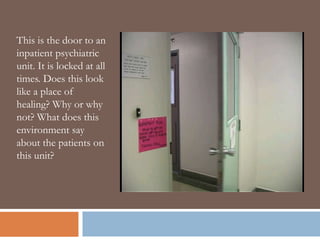
This is the door to an
inpatient psychiatric
unit. It is locked at all
times. Does this look
like a place of
healing? Why or why
not? What does this
environment say
about the patients on
this unit?
THE


          OF MENTAL
ILLNESS
Families will say this, "Only illness in the world
where you never get a covered dish." There is
something about having a mental illness
where everything falls away, and what you
experience is fear and isolation rather than a
sense of people coming towards you.
                                   (Joyce
Burland)
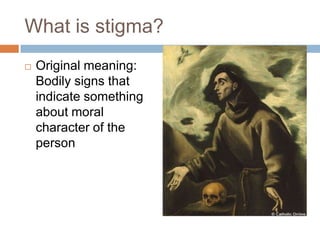
What is stigma?
   Original meaning:
    Bodily signs that
    indicate something
    about moral
    character of the
    person
What is stigma?

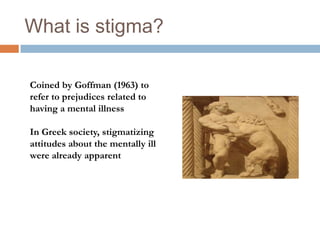
Coined by Goffman (1963) to
refer to prejudices related to
having a mental illness

In Greek society, stigmatizing
attitudes about the mentally ill
were already apparent
What is stigma?

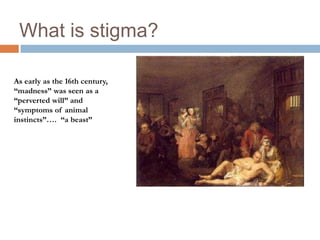
As early as the 16th century,
“madness” was seen as a
“perverted will” and
“symptoms of animal
instincts”…. “a beast”
What is stigma?
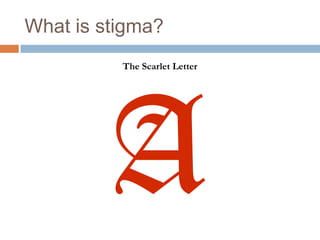
          The Scarlet Letter
What is stigma?

   In The Scarlet Letter by Nathanial Hawthorne, Hester
    is made to wear an “A”, signifying her identify as an
    adulteress. The “A” is meant to be a symbol of
    shame, but instead it becomes a powerful symbol of
    identity to Hester. The letter’s meaning shifts as time
    passes. Originally intended to mark Hester as an
    adulterer, the “A” eventually comes to stand for “Able.”
    Finally, it becomes indeterminate: the Native Americans
    who come to watch the Election Day pageant think it
    marks her as a person of importance and status. The
    letter helps to point out the ultimate meaninglessness of
    the community’s system of judgment and punishment.
    More often than not, a symbol becomes a focal point for
    critical analysis and debate.
What is stigma?

In The Scarlet Letter, Hester is publicly shamed and
forced by the people of Boston to wear a badge of
humiliation, but she was not willing to leave the town.
Hester’s behavior is premised on her desire to determine
her own identity rather than to allow others to determine
it for her. To her, running away or removing the letter
would be an acknowledgment of society’s power over
her: she would be admitting that the letter is a mark of
shame and something from which she desires to escape.
Instead, Hester stays, refiguring the scarlet letter as a
symbol of her own experiences and character. Her past
sin is a part of who she is; to pretend that it never
happened would mean denying a part of herself. Thus,
Hester very determinedly integrates her sin into her life.
What is stigma?
   What does the story of The Scarlet Letter
    teach us about the stigma of mental illness?
What is stigma?
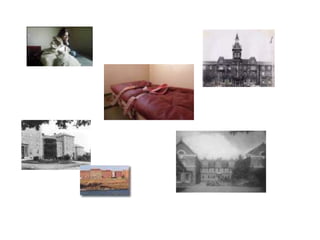
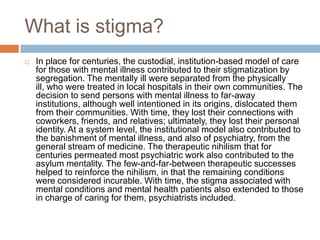
   In place for centuries, the custodial, institution-based model of care
    for those with mental illness contributed to their stigmatization by
    segregation. The mentally ill were separated from the physically
    ill, who were treated in local hospitals in their own communities. The
    decision to send persons with mental illness to far-away
    institutions, although well intentioned in its origins, dislocated them
    from their communities. With time, they lost their connections with
    coworkers, friends, and relatives; ultimately, they lost their personal
    identity. At a system level, the institutional model also contributed to
    the banishment of mental illness, and also of psychiatry, from the
    general stream of medicine. The therapeutic nihilism that for
    centuries permeated most psychiatric work also contributed to the
    asylum mentality. The few-and-far-between therapeutic successes
    helped to reinforce the nihilism, in that the remaining conditions
    were considered incurable. With time, the stigma associated with
    mental conditions and mental health patients also extended to those
    in charge of caring for them, psychiatrists included.
What is stigma?
   Labeling theory:
     Reactions of others of central significance in
      experience of mental illness
     Involves an “exchange of meaning” about what it
      means to have a mental illness
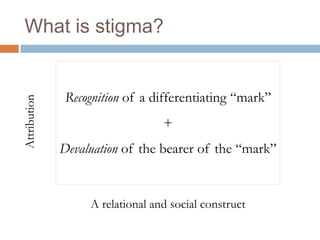
What is stigma?


    Recognition of a differentiating “mark”
                       +
   Devaluation of the bearer of the “mark”


        A relational and social construct
What is stigma?
   This static concept of stigma has been
    enlarged to encompass a social construct
    linked to values placed on social identities
    through a process consisting of 2 fundamental
    components: the recognition of the
    differentiating “mark” and the subsequent
    devaluation of the bearer. Stigma is therefore a
    relational construct based on attributes.
   Consequently, stigmatizing conditions may
    change with time and among cultures
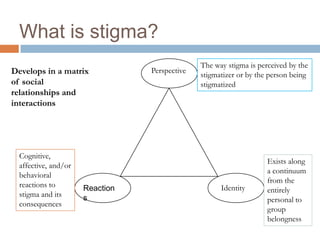
What is stigma?
                                               The way stigma is perceived by the
Develops in a matrix             Perspective
                                               stigmatizer or by the person being
of social                                      stigmatized
relationships and
interactions


  Cognitive,
                                                                    Exists along
  affective, and/or
                                                                    a continuum
  behavioral
                                                                    from the
  reactions to        Reaction                       Identity       entirely
  stigma and its      s                                             personal to
  consequences
                                                                    group
                                                                    belongness
What is stigma?
   Visibility: how obvious the mark is
   Controllability: whether the mark is under
    the bearer’s control
   Impact: if it instills fear by conveying an
    element of danger
What is stigma?
   Mental health patients who
      show visible signs of their conditions because of their
       symptoms, or because medication side effects may
       make appear “different”,
     are socially construed as being weak in character or
       lazy,
     who display threatening behaviours
    usually score high on the dimensions of
    visability, controllability and impact. By a process of
    association and class identity, all persons with mental
    illness are equally stigmatized: regardless of impairment
    or disability level, the individual patient is lumped into a
    class, and belonging to that class reinforces the stigma
    against the individual.
Stigma—a definition
   “Beliefs, attitudes and behaviours that result in
    social rejection or isolation of an individual
    based on any set of characteristics that are
    perceived by a group to be undesirable or
    threatening, regardless of whether exposure to
    the person with these characteristics would
    actually cause adverse consequences to
    others” (Van Dorn, 2005)
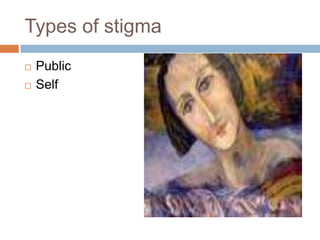
Types of stigma
   Public
   Self
Public stigma….
   Impacts on achieving essential life
    goals, particularly obtaining competitive
    employment and living safely and independently
   Fosters criminalization
       People with mental illness are dealt with by the
        police, courts and jails, instead of mental health
        system
           Related to inadequate funding for the mental health system
            and “get tough”, policies
           People with S&S of mental illness are more likely than others
            to be arrested (Teplin, 1984)
           People with mental illness tend to spend more time
            incarcerated than people without mental illness
            (Steadman, McCarty and Morrissey, 1989)
   Impacts utilization of health care system
Those affected by self-stigma
experience…
   Social isolation:
     people  restrict their social networks in anticipation
      of rejection
   Loss of self-esteem:
     people   believe that they are less valuable as
      people
   Limited prospects for recovery
Other consequences of stigma
include…
   Impaired social adaptation
     Socialisolation, exclusion from friendships
     Access to employment blocked

   Non-adherence to medication treatment
Models of stigma
   Cognitive models: stigma related processes
    formed and maintained at the psychological
    level.
       Stereotype:
           Knowledge structures learned by most members of a social
            group; represent collectively agreed on ideas about groups
            people
           Of mental illness: dangerousness, incompetence, character
            weakness
       Prejudice
           Endorsement of negative stereotype, experience negative
            emotional reactions
       Discrimination
           Behavioural reaction, often angry, leading to hostile
            discrimination such as withholding care, or fearful, leading to
            discriminatory avoidance
Models of stigma
   Motivational models: explain WHY people
    stigmatize, or the function it serves, although it
    is an incomplete picture
     Ego-justification
       Stigma avoids potential threat to one’s physical or
        psychological self, by avoiding a socially perceived
        threat
       Stigma rationalizes negative group based attitudes
        and discrimination
     Group or system-justification: not satisfactory
      explanations
Models of stigma
   Institutional models:
     Definition: rules, policies, and procedures of
      private and public institutions in positions of
      power that intentionally restrict the rights and
      opportunities of the group affected
     Examples:
         Legislation
                    restricting rights and opportunities of
         people with mental illness
Models of Stigma
   Structural models:
     Relates  to the effect rather than the intent of an
      action, rule or law
     Group goals are not accomplished because they
      seem to clash with dominant ideologies that
      maintain the status quo
       E.g.cost-effectiveness:
                             funding for mental health
       programs, insurance parity
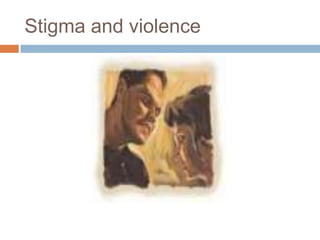
Stigma and violence
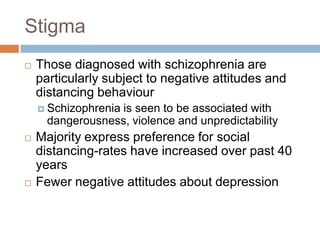
Stigma
   Those diagnosed with schizophrenia are
    particularly subject to negative attitudes and
    distancing behaviour
     Schizophreniais seen to be associated with
      dangerousness, violence and unpredictability
   Majority express preference for social
    distancing-rates have increased over past 40
    years
   Fewer negative attitudes about depression
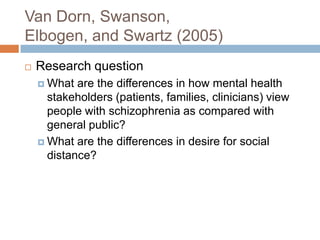
Van Dorn, Swanson,
Elbogen, and Swartz (2005)
   Research question
     What  are the differences in how mental health
      stakeholders (patients, families, clinicians) view
      people with schizophrenia as compared with
      general public?
     What are the differences in desire for social
      distance?
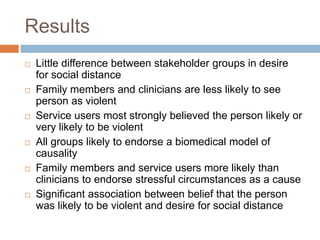
Results
   Little difference between stakeholder groups in desire
    for social distance
   Family members and clinicians are less likely to see
    person as violent
   Service users most strongly believed the person likely or
    very likely to be violent
   All groups likely to endorse a biomedical model of
    causality
   Family members and service users more likely than
    clinicians to endorse stressful circumstances as a cause
   Significant association between belief that the person
    was likely to be violent and desire for social distance
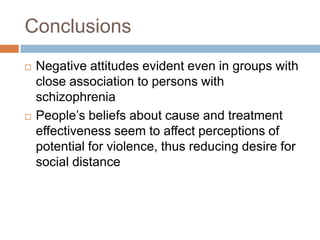
Conclusions
   Negative attitudes evident even in groups with
    close association to persons with
    schizophrenia
   People’s beliefs about cause and treatment
    effectiveness seem to affect perceptions of
    potential for violence, thus reducing desire for
    social distance
Changing public stigma
   Protest strategies
     Anecdotal evidence suggests that protest can be
      effective as a punishing consequence to decrease the
      likelihood that people will repeat the behaviour
     Asking people to suppress their prejudice about a
      group can promote a backlash and worsen attitudes
      as a result (Corrigan, etal 2001)
   Educational approaches
       Produces short term improvements in attitudes
        (Corrigan etal), those with greater prejudice are less
        likely to benefit from education
Changing public stigma
   Interpersonal contact
     Most  promising results
     Contact with promoted greater improvement in
      attitudes than protest, education and controls
     Improvements seem to be most pronounced
      when contact is with a person who moderately
      disconfirms stereotype (Reinke, etal 2004)
Targeted stigma change
   Anti-stigma programs are more successful
    when they target specific groups of people
    rather than the general public
   Specific prejudicial attitudes and discriminatory
    behaviours need to be targeted
     Behaviours   are more likely to change when
      strategies target attitudes that correspond to the
      behaviour
   Power groups must be challenged in the
    setting in which they might discriminate
Targeted stigma change
   Targets
       Landlords who fail to lease or make reasonable
        accommodation
       Employers who fail to hire or make reasonable
        accommodation
       Health care providers who withhold some services or are
        unnecessarily coercive
       Criminal justice personnel who are unnecessarily coercive
        and who fail to use mental health services
       Policy makers who allocate insufficient resources, interpret
        regulations in an “unfriendly” manner
       The media who perpetually disseminate stigmatizing
        images
Erasing public stigma—structural
change
   Affirmative actions: government approved
    activities focused on redressing historical
    disparities
     Prohibitionof discrimination
     Requiring “reasonable accommodation”
       Making changes to the work environment to assist the
       person to work
     Fair   housing
Food for thought
   What is the relationship between how North
    Americans understand the etiology of
    psychosis and the experience of stigma?
     Ifpsychosis was viewed as being caused by
      social factors, would there be any difference in
      the experience of stigma?
More food for thought
   Are psychiatric diagnoses a part of the
    problem or part of the solution?
     Dosome aspects of anti-stigma campaigns have
     a potentially negative impact on service users
     because they frame most psychosocial problems
     as a psychiatric diagnosis?
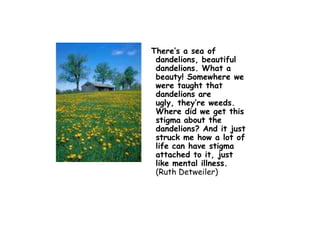
There’s a sea of
 dandelions, beautiful
 dandelions. What a
 beauty! Somewhere we
 were taught that
 dandelions are
 ugly, they’re weeds.
 Where did we get this
 stigma about the
 dandelions? And it just
 struck me how a lot of
 life can have stigma
 attached to it, just
 like mental illness.
 (Ruth Detweiler)
Additional References
Arboleda-Florez, J. (2003). Considerations on the stigma of mental illness
        (Editorial). Canadian Journal of Psychiatry, 48 (10), 645-650.

Corrigan, P., Green, A., Lundin, R., Kubiak, M., & Penn, D. (2001). Familiarity
with and            social distance from people who have serious mental
illness. Psychiatric          Services, 52 (7), 953-958.

Corrigan, P., Kerr, A., & Knudsen, L. (2005). The stigma of mental illness:
         explanatory models and methods for change. Applied and
Preventative        Psychology, 11, 179-190.

Jarvis, G. (2007). The social causes of psychosis in North American
Psychiatry: a      review of a disappearing literature. The Canadian Journal
of       Psychiatry, 52 (5), 287-294.
Additional References 2
Pilgrim, D. & Rogers, A. (2005). Psychiatrists as social engineers:
    a study of an anti-stigma campaign. Social Science and
    Medicine, 61, 2546-2556.
Rusch, N., Angermeyer, M., & Corrigan, P. (2005). Mental illness
   stigma: concepts, consequences, and initiatives to reduce
   stigma. European Psychiatry, (20), 529-539.
Van Dorn, R., Swanson, J., Elbogen, E., & Swartz, M. (2005). A
   comparison of stigmatizing attitudes toward persons with
   schizophrenia in four stakeholder groups: perceived likelihood
   go violence and desire for social distance. Psychiatry, 68 (2),
   152-163.

N4205 stigma

  • 1.
    This is thedoor to an inpatient psychiatric unit. It is locked at all times. Does this look like a place of healing? Why or why not? What does this environment say about the patients on this unit?
  • 2.
    THE OF MENTAL ILLNESS
  • 3.
    Families will saythis, "Only illness in the world where you never get a covered dish." There is something about having a mental illness where everything falls away, and what you experience is fear and isolation rather than a sense of people coming towards you. (Joyce Burland)
  • 4.
    What is stigma?  Original meaning: Bodily signs that indicate something about moral character of the person
  • 5.
    What is stigma? Coinedby Goffman (1963) to refer to prejudices related to having a mental illness In Greek society, stigmatizing attitudes about the mentally ill were already apparent
  • 6.
    What is stigma? Asearly as the 16th century, “madness” was seen as a “perverted will” and “symptoms of animal instincts”…. “a beast”
  • 7.
    What is stigma? The Scarlet Letter
  • 8.
    What is stigma?  In The Scarlet Letter by Nathanial Hawthorne, Hester is made to wear an “A”, signifying her identify as an adulteress. The “A” is meant to be a symbol of shame, but instead it becomes a powerful symbol of identity to Hester. The letter’s meaning shifts as time passes. Originally intended to mark Hester as an adulterer, the “A” eventually comes to stand for “Able.” Finally, it becomes indeterminate: the Native Americans who come to watch the Election Day pageant think it marks her as a person of importance and status. The letter helps to point out the ultimate meaninglessness of the community’s system of judgment and punishment. More often than not, a symbol becomes a focal point for critical analysis and debate.
  • 9.
    What is stigma? InThe Scarlet Letter, Hester is publicly shamed and forced by the people of Boston to wear a badge of humiliation, but she was not willing to leave the town. Hester’s behavior is premised on her desire to determine her own identity rather than to allow others to determine it for her. To her, running away or removing the letter would be an acknowledgment of society’s power over her: she would be admitting that the letter is a mark of shame and something from which she desires to escape. Instead, Hester stays, refiguring the scarlet letter as a symbol of her own experiences and character. Her past sin is a part of who she is; to pretend that it never happened would mean denying a part of herself. Thus, Hester very determinedly integrates her sin into her life.
  • 10.
    What is stigma?  What does the story of The Scarlet Letter teach us about the stigma of mental illness?
  • 12.
    What is stigma?  In place for centuries, the custodial, institution-based model of care for those with mental illness contributed to their stigmatization by segregation. The mentally ill were separated from the physically ill, who were treated in local hospitals in their own communities. The decision to send persons with mental illness to far-away institutions, although well intentioned in its origins, dislocated them from their communities. With time, they lost their connections with coworkers, friends, and relatives; ultimately, they lost their personal identity. At a system level, the institutional model also contributed to the banishment of mental illness, and also of psychiatry, from the general stream of medicine. The therapeutic nihilism that for centuries permeated most psychiatric work also contributed to the asylum mentality. The few-and-far-between therapeutic successes helped to reinforce the nihilism, in that the remaining conditions were considered incurable. With time, the stigma associated with mental conditions and mental health patients also extended to those in charge of caring for them, psychiatrists included.
  • 13.
    What is stigma?  Labeling theory:  Reactions of others of central significance in experience of mental illness  Involves an “exchange of meaning” about what it means to have a mental illness
  • 14.
    What is stigma? Recognition of a differentiating “mark” + Devaluation of the bearer of the “mark” A relational and social construct
  • 15.
    What is stigma?  This static concept of stigma has been enlarged to encompass a social construct linked to values placed on social identities through a process consisting of 2 fundamental components: the recognition of the differentiating “mark” and the subsequent devaluation of the bearer. Stigma is therefore a relational construct based on attributes.  Consequently, stigmatizing conditions may change with time and among cultures
  • 16.
    What is stigma? The way stigma is perceived by the Develops in a matrix Perspective stigmatizer or by the person being of social stigmatized relationships and interactions Cognitive, Exists along affective, and/or a continuum behavioral from the reactions to Reaction Identity entirely stigma and its s personal to consequences group belongness
  • 17.
    What is stigma?  Visibility: how obvious the mark is  Controllability: whether the mark is under the bearer’s control  Impact: if it instills fear by conveying an element of danger
  • 18.
    What is stigma?  Mental health patients who  show visible signs of their conditions because of their symptoms, or because medication side effects may make appear “different”,  are socially construed as being weak in character or lazy,  who display threatening behaviours usually score high on the dimensions of visability, controllability and impact. By a process of association and class identity, all persons with mental illness are equally stigmatized: regardless of impairment or disability level, the individual patient is lumped into a class, and belonging to that class reinforces the stigma against the individual.
  • 19.
    Stigma—a definition  “Beliefs, attitudes and behaviours that result in social rejection or isolation of an individual based on any set of characteristics that are perceived by a group to be undesirable or threatening, regardless of whether exposure to the person with these characteristics would actually cause adverse consequences to others” (Van Dorn, 2005)
  • 20.
    Types of stigma  Public  Self
  • 21.
    Public stigma….  Impacts on achieving essential life goals, particularly obtaining competitive employment and living safely and independently  Fosters criminalization  People with mental illness are dealt with by the police, courts and jails, instead of mental health system  Related to inadequate funding for the mental health system and “get tough”, policies  People with S&S of mental illness are more likely than others to be arrested (Teplin, 1984)  People with mental illness tend to spend more time incarcerated than people without mental illness (Steadman, McCarty and Morrissey, 1989)  Impacts utilization of health care system
  • 22.
    Those affected byself-stigma experience…  Social isolation:  people restrict their social networks in anticipation of rejection  Loss of self-esteem:  people believe that they are less valuable as people  Limited prospects for recovery
  • 23.
    Other consequences ofstigma include…  Impaired social adaptation  Socialisolation, exclusion from friendships  Access to employment blocked  Non-adherence to medication treatment
  • 24.
    Models of stigma  Cognitive models: stigma related processes formed and maintained at the psychological level.  Stereotype:  Knowledge structures learned by most members of a social group; represent collectively agreed on ideas about groups people  Of mental illness: dangerousness, incompetence, character weakness  Prejudice  Endorsement of negative stereotype, experience negative emotional reactions  Discrimination  Behavioural reaction, often angry, leading to hostile discrimination such as withholding care, or fearful, leading to discriminatory avoidance
  • 25.
    Models of stigma  Motivational models: explain WHY people stigmatize, or the function it serves, although it is an incomplete picture  Ego-justification  Stigma avoids potential threat to one’s physical or psychological self, by avoiding a socially perceived threat  Stigma rationalizes negative group based attitudes and discrimination  Group or system-justification: not satisfactory explanations
  • 26.
    Models of stigma  Institutional models:  Definition: rules, policies, and procedures of private and public institutions in positions of power that intentionally restrict the rights and opportunities of the group affected  Examples:  Legislation restricting rights and opportunities of people with mental illness
  • 27.
    Models of Stigma  Structural models:  Relates to the effect rather than the intent of an action, rule or law  Group goals are not accomplished because they seem to clash with dominant ideologies that maintain the status quo  E.g.cost-effectiveness: funding for mental health programs, insurance parity
  • 28.
  • 29.
    Stigma  Those diagnosed with schizophrenia are particularly subject to negative attitudes and distancing behaviour  Schizophreniais seen to be associated with dangerousness, violence and unpredictability  Majority express preference for social distancing-rates have increased over past 40 years  Fewer negative attitudes about depression
  • 30.
    Van Dorn, Swanson, Elbogen,and Swartz (2005)  Research question  What are the differences in how mental health stakeholders (patients, families, clinicians) view people with schizophrenia as compared with general public?  What are the differences in desire for social distance?
  • 31.
    Results  Little difference between stakeholder groups in desire for social distance  Family members and clinicians are less likely to see person as violent  Service users most strongly believed the person likely or very likely to be violent  All groups likely to endorse a biomedical model of causality  Family members and service users more likely than clinicians to endorse stressful circumstances as a cause  Significant association between belief that the person was likely to be violent and desire for social distance
  • 32.
    Conclusions  Negative attitudes evident even in groups with close association to persons with schizophrenia  People’s beliefs about cause and treatment effectiveness seem to affect perceptions of potential for violence, thus reducing desire for social distance
  • 33.
    Changing public stigma  Protest strategies  Anecdotal evidence suggests that protest can be effective as a punishing consequence to decrease the likelihood that people will repeat the behaviour  Asking people to suppress their prejudice about a group can promote a backlash and worsen attitudes as a result (Corrigan, etal 2001)  Educational approaches  Produces short term improvements in attitudes (Corrigan etal), those with greater prejudice are less likely to benefit from education
  • 34.
    Changing public stigma  Interpersonal contact  Most promising results  Contact with promoted greater improvement in attitudes than protest, education and controls  Improvements seem to be most pronounced when contact is with a person who moderately disconfirms stereotype (Reinke, etal 2004)
  • 35.
    Targeted stigma change  Anti-stigma programs are more successful when they target specific groups of people rather than the general public  Specific prejudicial attitudes and discriminatory behaviours need to be targeted  Behaviours are more likely to change when strategies target attitudes that correspond to the behaviour  Power groups must be challenged in the setting in which they might discriminate
  • 36.
    Targeted stigma change  Targets  Landlords who fail to lease or make reasonable accommodation  Employers who fail to hire or make reasonable accommodation  Health care providers who withhold some services or are unnecessarily coercive  Criminal justice personnel who are unnecessarily coercive and who fail to use mental health services  Policy makers who allocate insufficient resources, interpret regulations in an “unfriendly” manner  The media who perpetually disseminate stigmatizing images
  • 37.
    Erasing public stigma—structural change  Affirmative actions: government approved activities focused on redressing historical disparities  Prohibitionof discrimination  Requiring “reasonable accommodation”  Making changes to the work environment to assist the person to work  Fair housing
  • 38.
    Food for thought  What is the relationship between how North Americans understand the etiology of psychosis and the experience of stigma?  Ifpsychosis was viewed as being caused by social factors, would there be any difference in the experience of stigma?
  • 39.
    More food forthought  Are psychiatric diagnoses a part of the problem or part of the solution?  Dosome aspects of anti-stigma campaigns have a potentially negative impact on service users because they frame most psychosocial problems as a psychiatric diagnosis?
  • 40.
    There’s a seaof dandelions, beautiful dandelions. What a beauty! Somewhere we were taught that dandelions are ugly, they’re weeds. Where did we get this stigma about the dandelions? And it just struck me how a lot of life can have stigma attached to it, just like mental illness. (Ruth Detweiler)
  • 42.
    Additional References Arboleda-Florez, J.(2003). Considerations on the stigma of mental illness (Editorial). Canadian Journal of Psychiatry, 48 (10), 645-650. Corrigan, P., Green, A., Lundin, R., Kubiak, M., & Penn, D. (2001). Familiarity with and social distance from people who have serious mental illness. Psychiatric Services, 52 (7), 953-958. Corrigan, P., Kerr, A., & Knudsen, L. (2005). The stigma of mental illness: explanatory models and methods for change. Applied and Preventative Psychology, 11, 179-190. Jarvis, G. (2007). The social causes of psychosis in North American Psychiatry: a review of a disappearing literature. The Canadian Journal of Psychiatry, 52 (5), 287-294.
  • 43.
    Additional References 2 Pilgrim,D. & Rogers, A. (2005). Psychiatrists as social engineers: a study of an anti-stigma campaign. Social Science and Medicine, 61, 2546-2556. Rusch, N., Angermeyer, M., & Corrigan, P. (2005). Mental illness stigma: concepts, consequences, and initiatives to reduce stigma. European Psychiatry, (20), 529-539. Van Dorn, R., Swanson, J., Elbogen, E., & Swartz, M. (2005). A comparison of stigmatizing attitudes toward persons with schizophrenia in four stakeholder groups: perceived likelihood go violence and desire for social distance. Psychiatry, 68 (2), 152-163.