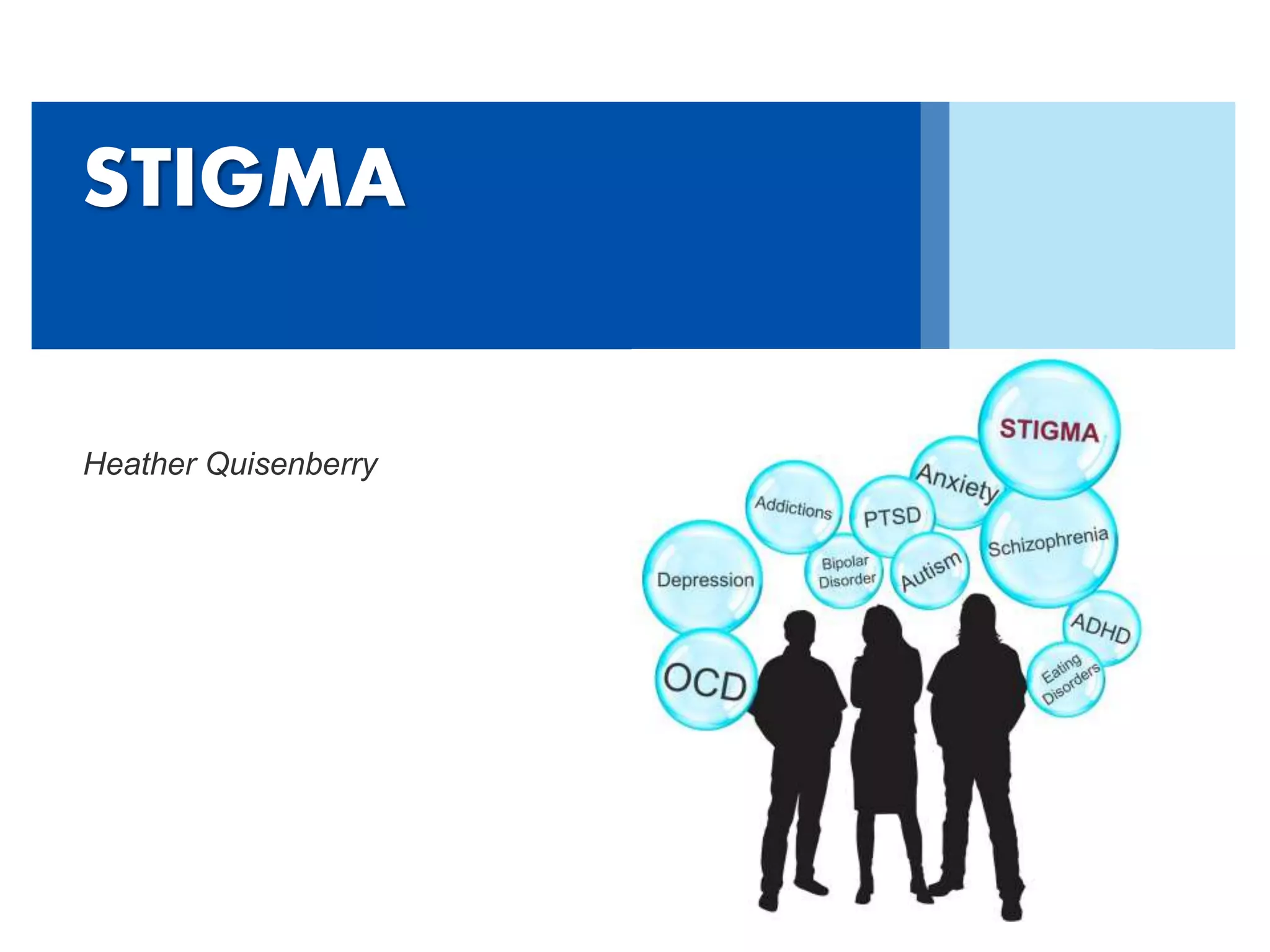
STIGMA
Heather Quisenberry
What is stigma?
 Stigma Definitions
– A mark of shame or discredit; an identifying mark or characteristic; a scar,
stain or brand (Merriam-Webster)
– Used by sociologist Erving Goffman (1960) to refer to “an attribute that is
deeply discrediting”…”reduces the person from a whole and usual person
to a tainted, discounted one”
– In Greek society, stizein was a mark placed on slaves to identify their
position in the social structure and to indicate that they were of less value
 Stigma involves people making unfair moral judgments about other
people often based on stereotypes and misinformation
 Stigmatization consists of 2 fundamental elements
– Recognition of the differentiating mark
– Subsequent devaluation of the person
2Source: World Psychiatry Journal
Stigma: who and why?
Stigma affects people with:
 Mental illness – most stigmatized group (World Psychiatry Journal, 2012)
 Disabilities
 LGBTQ populations
 Addictions
 Minority groups
Why stigma exists and how it is maintained:
 History of misunderstanding and mistreatment
 Myths and misconceptions
 The media
 Prejudice and discrimination
 Negative judgments and labels
 Stigmatizing phrases
3
Increased education helps reduce stigma
Myths and facts about mental illness
4
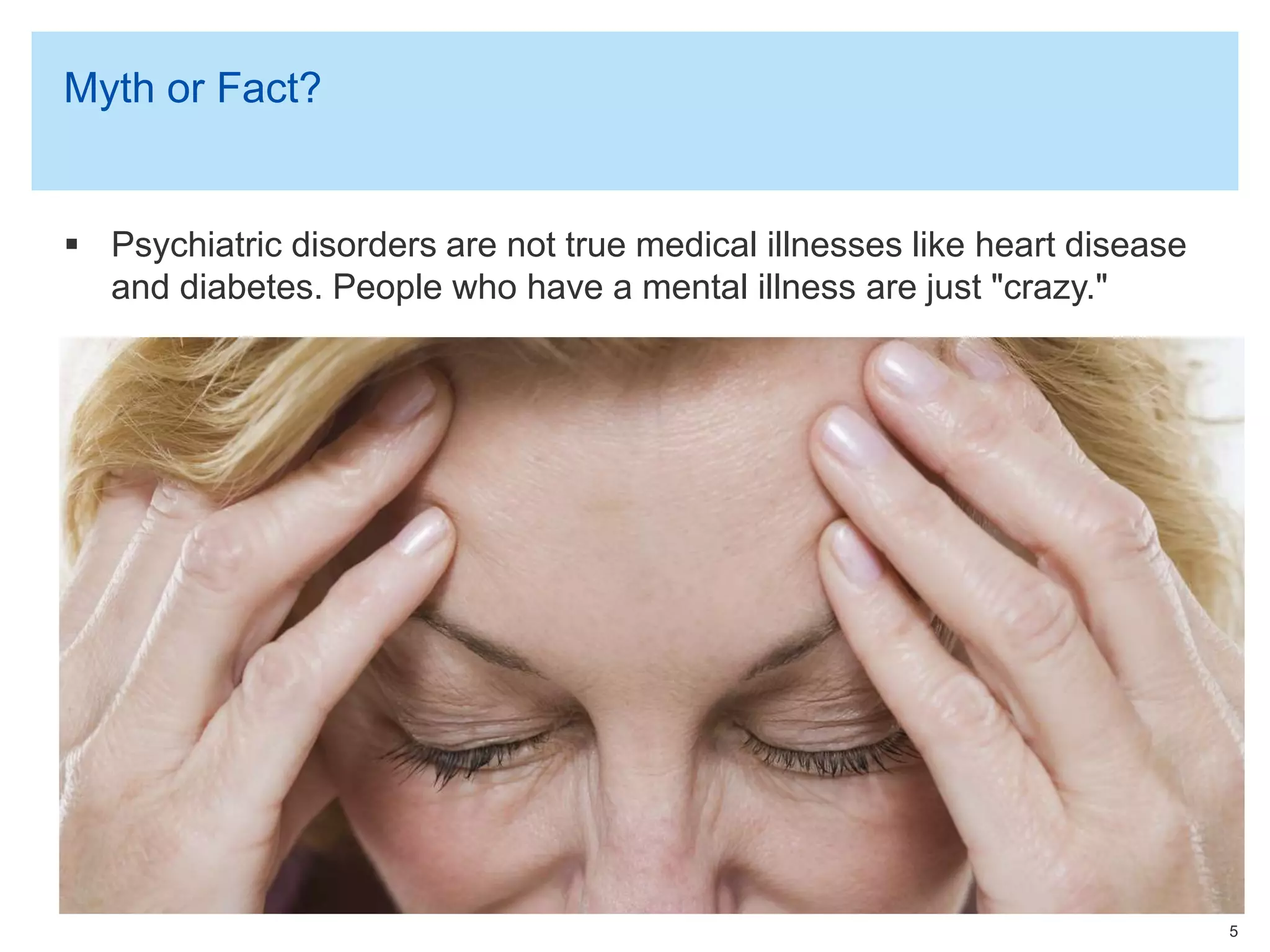
Myth or Fact?
 Psychiatric disorders are not true medical illnesses like heart disease
and diabetes. People who have a mental illness are just "crazy."
5
Myth
 Psychiatric disorders are not true medical illnesses like heart disease
and diabetes. People who have a mental illness are just "crazy.“
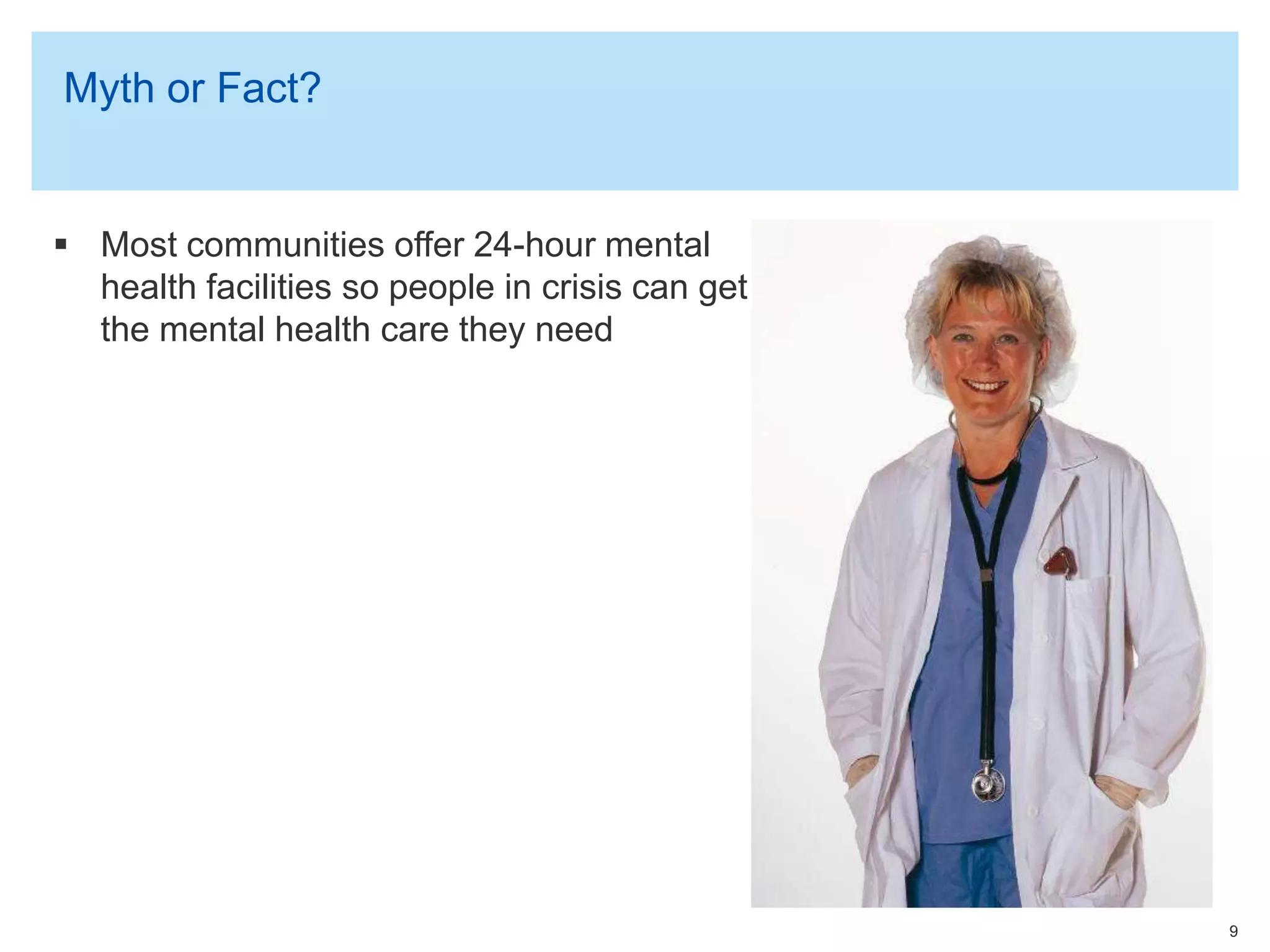
Brain disorders, like heart disease and diabetes, are legitimate medical
illnesses. Research shows there are genetic and biological causes for
psychiatric disorders, and they can be treated effectively.
6
Myth or Fact?
 People with a severe mental illness, such
as schizophrenia, are often dangerous and
violent.
7
Myth
 People with a severe mental illness, such as schizophrenia, are
usually dangerous and violent.
Statistics show that the incidence of violence in people who have a brain
disorder is not much higher than it is in the general population. Those
suffering from a psychosis such as schizophrenia are more often
frightened, confused and despairing than violent.
8
Myth or Fact?
9
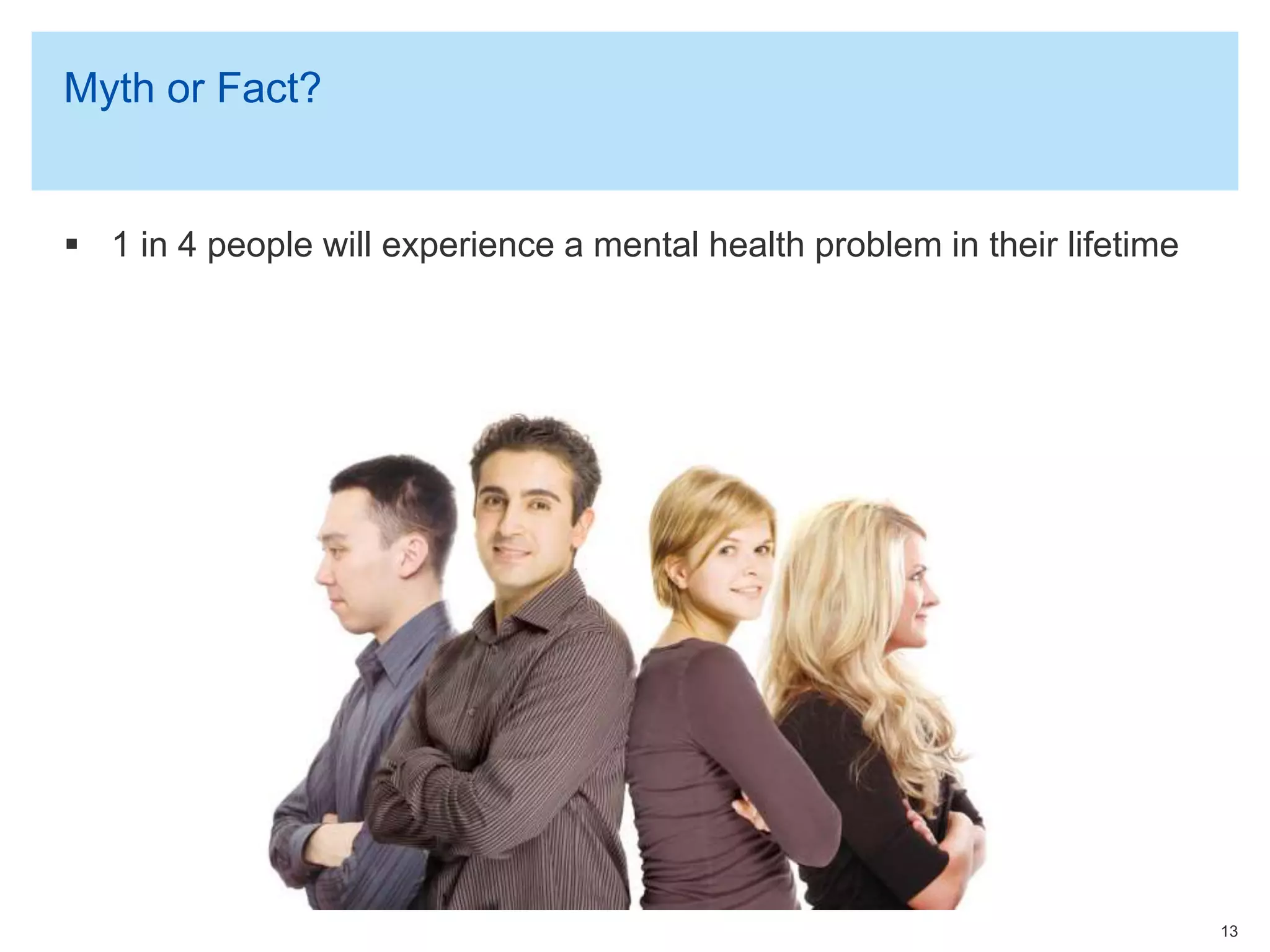
 Most communities offer 24-hour mental
health facilities so people in crisis can get
the mental health care they need
Myth
 Most communities offer 24-hour mental health facilities so people in
crisis can get the mental health care they need
Few communities offer 24-hour mental health crisis facilities. As a result,
those in crisis are often diverted to jails or hospitals or go untreated until
symptoms worsen.
10
Myth or Fact?
 Mental illness is a result of bad parenting
11
Myth
 Mental illness is a result of bad parenting
Most experts agree that a genetic predisposition, combined with other
risk factors, leads to a psychiatric disorder. In other words, mental
illnesses have a physical cause.
12
Myth or Fact?
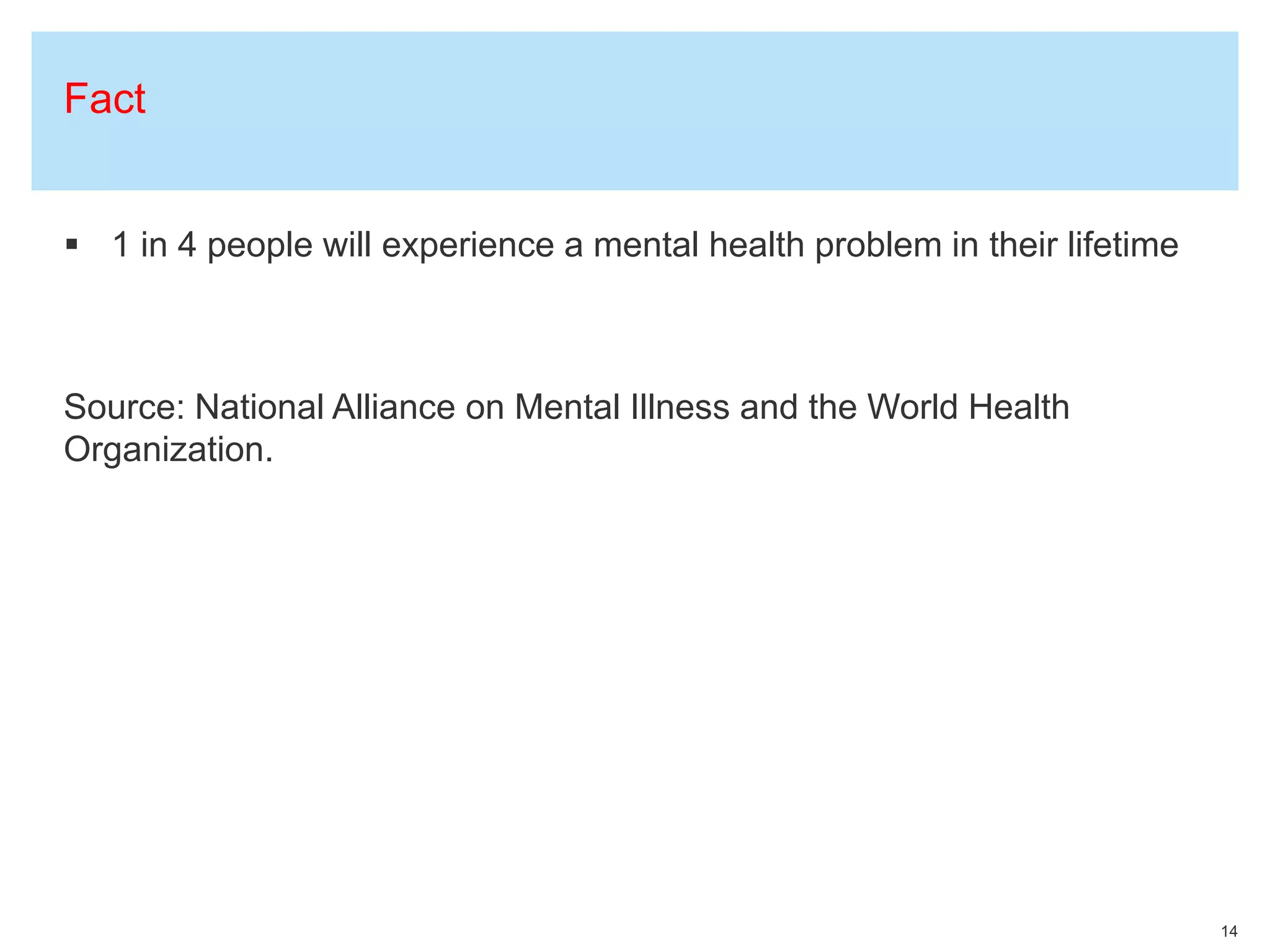
 1 in 4 people will experience a mental health problem in their lifetime
13
Fact
 1 in 4 people will experience a mental health problem in their lifetime
Source: National Alliance on Mental Illness and the World Health
Organization.
14
Myth or Fact?
 Schizophrenia means “split personality”
15
Myth
 Schizophrenia means “split personality”
Schizophrenia is often confused with multiple personality disorder. Actually,
schizophrenia is a brain disorder that robs people of their ability to think
clearly and logically.
The estimated 2.5 million Americans with schizophrenia have symptoms
ranging from social withdrawal to hallucinations and delusions. Medication
has helped many of these individuals to lead fulfilling, productive lives.
16
Myth or Fact?
 Depression results in more
short term workplace
disabilities than any other
ailment
17
Fact
 Depression results in more short term workplace disabilities than any
other ailment
 Major depression is associated with more annual sick days and higher
rates of short-term disability than other chronic diseases.
 People suffering from depression have high rates of absenteeism (in
some cases, three times more sick days than non-depressed workers)
and are less productive at work.
 In a study comparing depression treatment costs to lost productivity
costs, 45 to 98 percent of treatment costs were offset by increased
productivity.
Source: NAMI
18
Myth or Fact?
 Depression results from a character flaw
or weakness. People could snap out of it if
they had enough willpower.
19
Myth
 Depression results from a character flaw or weakness and people could
snap out of it if they had enough willpower
Depression has nothing to do with being lazy or weak. It results from
changes in brain chemistry or brain function, and medication and/or
psychotherapy often help people to recover.
20
Myth or Fact?
 Most suicides occur due to
mental illness
21
Fact
 Most suicides occur due to mental illness
Some statistics indicate as many as 90% of suicides result from (often
undiagnosed) mental illness.
There are roughly 39,000 suicides per year in the U.S. and 1 million
worldwide. The suicide rate has been climbing over the past decade.
22
Myth or Fact?
 Children rarely develop mental illnesses
23
Myth
 Children rarely develop mental illnesses
Children and adolescents can and do develop severe mental illnesses. In
the United States, one in ten children and adolescents has a mental
disorder severe enough to cause impairment.
24
Myth or Fact?
 Children with mental illnesses get
treatment more often than adults
25
Myth
 Children with mental illnesses get treatment more often than adults
Only 20% of children and half of adults get the mental health treatment
they need. Studies show that stigma is a major contributing factor for not
seeking help.
26
27
Schizo PSA
28
Appendix
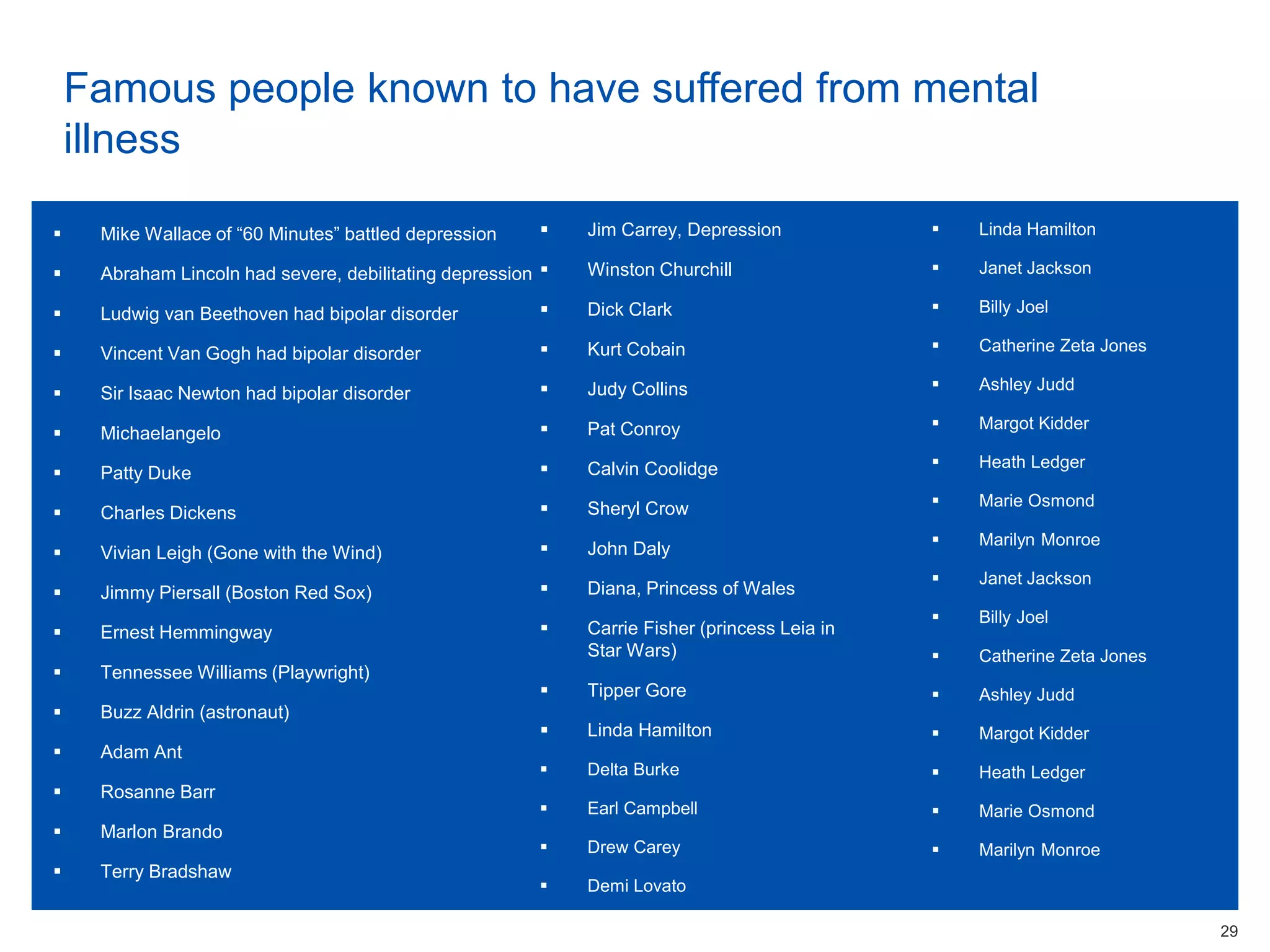
Famous people known to have suffered from mental
illness
 Mike Wallace of “60 Minutes” battled depression
 Abraham Lincoln had severe, debilitating depression
 Ludwig van Beethoven had bipolar disorder
 Vincent Van Gogh had bipolar disorder
 Sir Isaac Newton had bipolar disorder
 Michaelangelo
 Patty Duke
 Charles Dickens
 Vivian Leigh (Gone with the Wind)
 Jimmy Piersall (Boston Red Sox)
 Ernest Hemmingway
 Tennessee Williams (Playwright)
 Buzz Aldrin (astronaut)
 Adam Ant
 Rosanne Barr
 Marlon Brando
 Terry Bradshaw
29
 Jim Carrey, Depression
 Winston Churchill
 Dick Clark
 Kurt Cobain
 Judy Collins
 Pat Conroy
 Calvin Coolidge
 Sheryl Crow
 John Daly
 Diana, Princess of Wales
 Carrie Fisher (princess Leia in
Star Wars)
 Tipper Gore
 Linda Hamilton
 Delta Burke
 Earl Campbell
 Drew Carey
 Demi Lovato
 Linda Hamilton
 Janet Jackson
 Billy Joel
 Catherine Zeta Jones
 Ashley Judd
 Margot Kidder
 Heath Ledger
 Marie Osmond
 Marilyn Monroe
 Janet Jackson
 Billy Joel
 Catherine Zeta Jones
 Ashley Judd
 Margot Kidder
 Heath Ledger
 Marie Osmond
 Marilyn Monroe
References
 Indiana Consortium for Mental Health Services Research study
http://www.indiana.edu/~icmhsr/sgcmhs.html
 Stigma: An international Briefing Paper
 Stop Stigma
 People do what feels good
 Addiction stigma reduces rates of recovery
 http://www.stopstigmasacramento.org/
 http://www.nami.org/
 http://www.bringchange2mind.org/
30

Stigma Presentation

  • 1.
  • 2.
    What is stigma? Stigma Definitions – A mark of shame or discredit; an identifying mark or characteristic; a scar, stain or brand (Merriam-Webster) – Used by sociologist Erving Goffman (1960) to refer to “an attribute that is deeply discrediting”…”reduces the person from a whole and usual person to a tainted, discounted one” – In Greek society, stizein was a mark placed on slaves to identify their position in the social structure and to indicate that they were of less value  Stigma involves people making unfair moral judgments about other people often based on stereotypes and misinformation  Stigmatization consists of 2 fundamental elements – Recognition of the differentiating mark – Subsequent devaluation of the person 2Source: World Psychiatry Journal
  • 3.
    Stigma: who andwhy? Stigma affects people with:  Mental illness – most stigmatized group (World Psychiatry Journal, 2012)  Disabilities  LGBTQ populations  Addictions  Minority groups Why stigma exists and how it is maintained:  History of misunderstanding and mistreatment  Myths and misconceptions  The media  Prejudice and discrimination  Negative judgments and labels  Stigmatizing phrases 3 Increased education helps reduce stigma
  • 4.
    Myths and factsabout mental illness 4
  • 5.
    Myth or Fact? Psychiatric disorders are not true medical illnesses like heart disease and diabetes. People who have a mental illness are just "crazy." 5
  • 6.
    Myth  Psychiatric disordersare not true medical illnesses like heart disease and diabetes. People who have a mental illness are just "crazy.“ Brain disorders, like heart disease and diabetes, are legitimate medical illnesses. Research shows there are genetic and biological causes for psychiatric disorders, and they can be treated effectively. 6
  • 7.
    Myth or Fact? People with a severe mental illness, such as schizophrenia, are often dangerous and violent. 7
  • 8.
    Myth  People witha severe mental illness, such as schizophrenia, are usually dangerous and violent. Statistics show that the incidence of violence in people who have a brain disorder is not much higher than it is in the general population. Those suffering from a psychosis such as schizophrenia are more often frightened, confused and despairing than violent. 8
  • 9.
    Myth or Fact? 9 Most communities offer 24-hour mental health facilities so people in crisis can get the mental health care they need
  • 10.
    Myth  Most communitiesoffer 24-hour mental health facilities so people in crisis can get the mental health care they need Few communities offer 24-hour mental health crisis facilities. As a result, those in crisis are often diverted to jails or hospitals or go untreated until symptoms worsen. 10
  • 11.
    Myth or Fact? Mental illness is a result of bad parenting 11
  • 12.
    Myth  Mental illnessis a result of bad parenting Most experts agree that a genetic predisposition, combined with other risk factors, leads to a psychiatric disorder. In other words, mental illnesses have a physical cause. 12
  • 13.
    Myth or Fact? 1 in 4 people will experience a mental health problem in their lifetime 13
  • 14.
    Fact  1 in4 people will experience a mental health problem in their lifetime Source: National Alliance on Mental Illness and the World Health Organization. 14
  • 15.
    Myth or Fact? Schizophrenia means “split personality” 15
  • 16.
    Myth  Schizophrenia means“split personality” Schizophrenia is often confused with multiple personality disorder. Actually, schizophrenia is a brain disorder that robs people of their ability to think clearly and logically. The estimated 2.5 million Americans with schizophrenia have symptoms ranging from social withdrawal to hallucinations and delusions. Medication has helped many of these individuals to lead fulfilling, productive lives. 16
  • 17.
    Myth or Fact? Depression results in more short term workplace disabilities than any other ailment 17
  • 18.
    Fact  Depression resultsin more short term workplace disabilities than any other ailment  Major depression is associated with more annual sick days and higher rates of short-term disability than other chronic diseases.  People suffering from depression have high rates of absenteeism (in some cases, three times more sick days than non-depressed workers) and are less productive at work.  In a study comparing depression treatment costs to lost productivity costs, 45 to 98 percent of treatment costs were offset by increased productivity. Source: NAMI 18
  • 19.
    Myth or Fact? Depression results from a character flaw or weakness. People could snap out of it if they had enough willpower. 19
  • 20.
    Myth  Depression resultsfrom a character flaw or weakness and people could snap out of it if they had enough willpower Depression has nothing to do with being lazy or weak. It results from changes in brain chemistry or brain function, and medication and/or psychotherapy often help people to recover. 20
  • 21.
    Myth or Fact? Most suicides occur due to mental illness 21
  • 22.
    Fact  Most suicidesoccur due to mental illness Some statistics indicate as many as 90% of suicides result from (often undiagnosed) mental illness. There are roughly 39,000 suicides per year in the U.S. and 1 million worldwide. The suicide rate has been climbing over the past decade. 22
  • 23.
    Myth or Fact? Children rarely develop mental illnesses 23
  • 24.
    Myth  Children rarelydevelop mental illnesses Children and adolescents can and do develop severe mental illnesses. In the United States, one in ten children and adolescents has a mental disorder severe enough to cause impairment. 24
  • 25.
    Myth or Fact? Children with mental illnesses get treatment more often than adults 25
  • 26.
    Myth  Children withmental illnesses get treatment more often than adults Only 20% of children and half of adults get the mental health treatment they need. Studies show that stigma is a major contributing factor for not seeking help. 26
  • 27.
  • 28.
  • 29.
    Famous people knownto have suffered from mental illness  Mike Wallace of “60 Minutes” battled depression  Abraham Lincoln had severe, debilitating depression  Ludwig van Beethoven had bipolar disorder  Vincent Van Gogh had bipolar disorder  Sir Isaac Newton had bipolar disorder  Michaelangelo  Patty Duke  Charles Dickens  Vivian Leigh (Gone with the Wind)  Jimmy Piersall (Boston Red Sox)  Ernest Hemmingway  Tennessee Williams (Playwright)  Buzz Aldrin (astronaut)  Adam Ant  Rosanne Barr  Marlon Brando  Terry Bradshaw 29  Jim Carrey, Depression  Winston Churchill  Dick Clark  Kurt Cobain  Judy Collins  Pat Conroy  Calvin Coolidge  Sheryl Crow  John Daly  Diana, Princess of Wales  Carrie Fisher (princess Leia in Star Wars)  Tipper Gore  Linda Hamilton  Delta Burke  Earl Campbell  Drew Carey  Demi Lovato  Linda Hamilton  Janet Jackson  Billy Joel  Catherine Zeta Jones  Ashley Judd  Margot Kidder  Heath Ledger  Marie Osmond  Marilyn Monroe  Janet Jackson  Billy Joel  Catherine Zeta Jones  Ashley Judd  Margot Kidder  Heath Ledger  Marie Osmond  Marilyn Monroe
  • 30.
    References  Indiana Consortiumfor Mental Health Services Research study http://www.indiana.edu/~icmhsr/sgcmhs.html  Stigma: An international Briefing Paper  Stop Stigma  People do what feels good  Addiction stigma reduces rates of recovery  http://www.stopstigmasacramento.org/  http://www.nami.org/  http://www.bringchange2mind.org/ 30

Editor's Notes

  • #2 Stigma makes is difficult to speak openly about mental illness.
  • #4 Negative judgments and labels can be attached to people in a variety of ways: Blaming Shaming Fearing them Calling them names Talking behind their backs Laughing at them Considering their differences embarrassing or disgraceful Thinking they are childlike or unintelligent Thoughts of having nothing in common with them
  • #5 Since myths and misconceptions feed stigma that harms people who have mental illness, we decided to address some of them today. This is the audience participation part of the presentation so please shout out the answers to each question.
  • #11 According to a Sep 2011 Sustainability Audit on CCC, there is 1.1 psychiatric bed for 1,000 people who need them. CCC has only 22 beds
  • #23 1MM worldwide annually.
  • #28 Play video