Supersymmetric Dark Energy

     Neven Bilić
     Ruđer Bošković Institute
     Zagreb, Croatia

    BW2011, Donji Milanovac, 31 Aug 2011
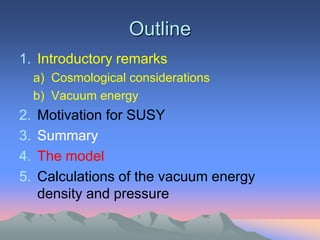
Outline
1. Introductory remarks
     a) Cosmological considerations
     b) Vacuum energy
2.   Motivation for SUSY
3.   Summary
4.   The model
5.   Calculations of the vacuum energy
     density and pressure
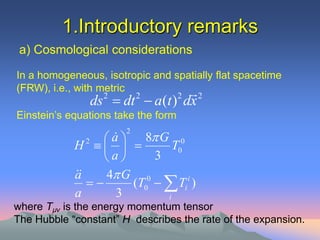
1.Introductory remarks
 a) Cosmological considerations

In a homogeneous, isotropic and spatially flat spacetime
(FRW), i.e., with metric           
                  ds  dt  a(t ) dx
                    2       2        2   2

Einstein’s equations take the form

                   a  8 G 0
                        2
                    
            H   
              2
                               T0
                  a      3
            
            a     4 G 0
                     (T0   Ti )
                                  i

            a        3       i
where Tµν is the energy momentum tensor
The Hubble “constant” H describes the rate of the expansion.
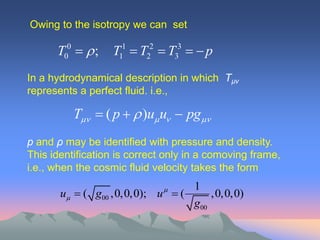
Owing to the isotropy we can set

      T00   ;   T11  T22  T33   p
In a hydrodynamical description in which Tµν
represents a perfect fluid. i.e.,

          T  ( p   )u u  pg
p and ρ may be identified with pressure and density.
This identification is correct only in a comoving frame,
i.e., when the cosmic fluid velocity takes the form
                                1
       u  ( g00 ,0,0,0); u  (     ,0,0,0)
                                 g00
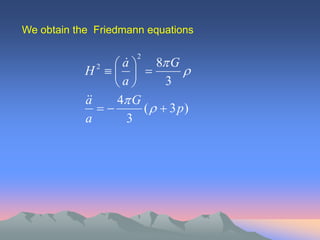
We obtain the Friedmann equations


                   a  8 G
                      2
                    
            H   
              2
                                 
                  a        3
            
            a      4 G
                      (   3 p)
            a        3
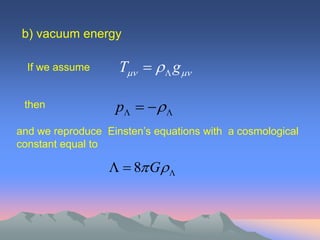
b) vacuum energy

  If we assume      T    g 

 then              p    
and we reproduce Einsten’s equations with a cosmological
constant equal to

                    8 G 
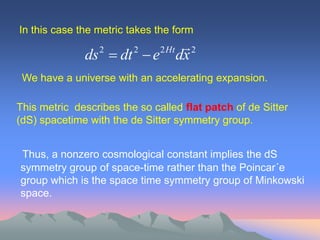
In this case the metric takes the form
                                       2
              ds  dt  e
                  2      2     2 Ht
                                      dx
 We have a universe with an accelerating expansion.

This metric describes the so called flat patch of de Sitter
(dS) spacetime with the de Sitter symmetry group.


Thus, a nonzero cosmological constant implies the dS
symmetry group of space-time rather than the Poincar´e
group which is the space time symmetry group of Minkowski
space.
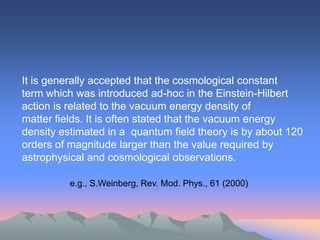
It is generally accepted that the cosmological constant
term which was introduced ad-hoc in the Einstein-Hilbert
action is related to the vacuum energy density of
matter fields. It is often stated that the vacuum energy
density estimated in a quantum field theory is by about 120
orders of magnitude larger than the value required by
astrophysical and cosmological observations.

          e.g., S.Weinberg, Rev. Mod. Phys., 61 (2000)
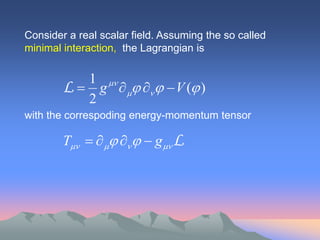
Consider a real scalar field. Assuming the so called
minimal interaction, the Lagrangian is

           1 
        L  g     V ( )
           2
with the correspoding energy-momentum tensor

        T       g L
We define
             vac =  T  H >
                       0
                        0


                      1
            pvac       Ti i 
                      3 i
Where < A> denotes the vacuum expectation value of
an operator A. In FRW spacetime
          1       1
  vac    
               2  ( )2    V ( ) 
              2

          2      2a
          1       1
 pvac     
               2  ( )2    V ( ) 
              2

          2      6a
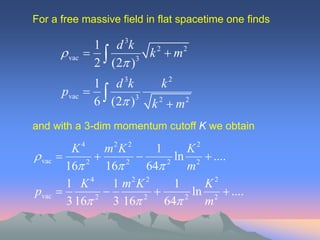
For a free massive field in flat spacetime one finds

                  1 d 3k
          vac           k 2  m2
                  2 (2 )3
                        3          2
                  1 d k        k
         pvac     
                  6 (2 )3   k 2  m2
and with a 3-dim momentum cutoff K we obtain

           K4     m2 K 2      1      K2
 vac                          ln 2  ....
          16 2
                  16 2
                            64 2
                                     m
          1 K 4 1 m2 K 2          1     K2
pvac                               ln 2  ....
          3 16 2
                    3 16  2
                                64 2
                                        m
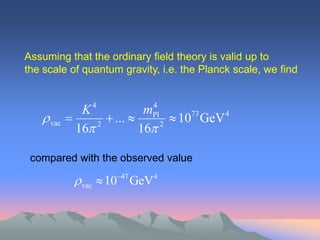
Assuming that the ordinary field theory is valid up to
the scale of quantum gravity, i.e. the Planck scale, we find


              K4             4
                            mPl
    vac           ...         1073 GeV 4
             16 2         16 2

 compared with the observed value

             vac  1047 GeV4
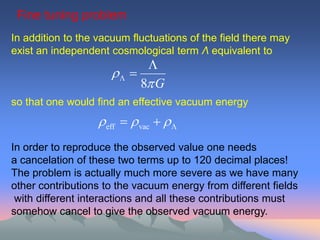
Fine tuning problem
In addition to the vacuum fluctuations of the field there may
exist an independent cosmological term Λ equivalent to
                            
                       
                           8 G
so that one would find an effective vacuum energy
                   eff   vac   
In order to reproduce the observed value one needs
a cancelation of these two terms up to 120 decimal places!
The problem is actually much more severe as we have many
other contributions to the vacuum energy from different fields
 with different interactions and all these contributions must
somehow cancel to give the observed vacuum energy.
Adding gravity

In fact, there would be no problem if there were no gravity!
In flat space one can renormalize the vacuum energy
by subtracting the divergent contributions since the energy
is defined up to an arbitrary additive constant.

However , in curved space this cannot be easily done because
the energy is a source of the gravitational field and
adding (even constant) energy changes the spacetime
geometry .
2. Motivation for SUSY
Question No 1
Can supersymmetry cure the mentioned problems?

At least we know that in a field theory with exact SUSY the
vacuum energy, and hence the cosmological constant, is
equal to zero as the contributions of fermions and bosons to
the vacuum energy precisely cancel!

Unfortunately, in the real world SUSY is broken at small
energy scales. The scale of SUSY breaking required by
particle physics phenomenology must be of the order of 1 TeV
or larger implying Λ still by about 60 orders of magnitude too
large.
Question No 2
How does the SUSY vacuum behave in curved spacetime,
e.g., in de Sitter spacetime?


Our aim is to investigate the fate of vacuum energy when
an unbroken supersymmetric model is embedded in
spatially flat, homogeneous and isotropic spacetime.
In addition, we assume the presence of a dark energy
type of substance obeying the equation of state
pDE =wρDE, with w<0.
The space time symmetry group of an exact SUSY is
 the Poincar´e group.. The lack of Poincar´e symmetry will lift
the Fermi-Bose degeneracy and the energy density of
vacuum fluctuations will be nonzero.


 This type of “soft” supersymmetry breaking is known
 in supersymmetric field theory at finite temperature
 where the Fermi-Bose degeneracy is lifted by statistics.

  Das and Kaku, Phys. Rev. D 18 (1978)
  Girardello, Grisaru and Salomonson, Nucl. Phys. B 178 (1981)
3. Summary
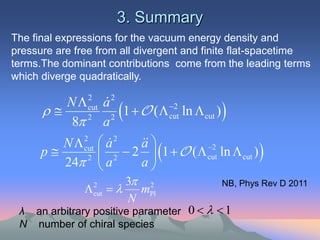
The final expressions for the vacuum energy density and
pressure are free from all divergent and finite flat-spacetime
terms.The dominant contributions come from the leading terms
which diverge quadratically.

         N  cut a 2
              2
                   
                     2 
                      1   (  cut ln  cut ) 
                                  2

          8 a2


         N  cut  a 2
             2
                           a
                            
      p      2  2
                         2  1   (  cut ln  cut ) 
                                            2

         24  a            a
                            3 2
                         
                                               NB, Phys Rev D 2011
                  2
                   cut        mPl
                            N
 λ an arbitrary positive parameter 0    1
 N number of chiral species
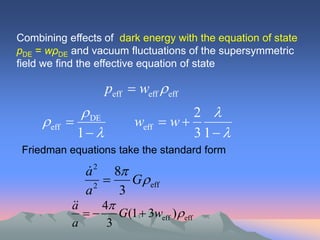
Combining effects of dark energy with the equation of state
pDE = wρDE and vacuum fluctuations of the supersymmetric
field we find the effective equation of state

                     peff  weff eff
               DE                     2 
     eff                  weff  w 
              1                      3 1 
 Friedman equations take the standard form

               a 2 8
               
                 2
                       G eff
               a      3
            
            a      4
                       G(1  3weff ) eff
            a        3
1. Imposing a short distance cutoff of the order mPl we have
found that the leading term in the energy density of vacuum
fluctuations is of the same order as dark energy (H2 mPl2)
and no fine tuning is needed
2. The contribution of the vacuum fluctuations to the effective
equation of state is always positive and, hence, it goes against
acceleration!
A similar conclusion was drawn by M. Maggiore, PRD (2011)
who considers massless scalar fields only and removes the
flat-spacetime contribution by hand.

3. If we require accelerating expansion, i.e., that the effective
equation of state satisfies weff < −1/3, the range −1 < w < −1/3
is compatible with 0 < λ < 1/2, whereas w < −1 (phantom)
would imply λ> 1/2.
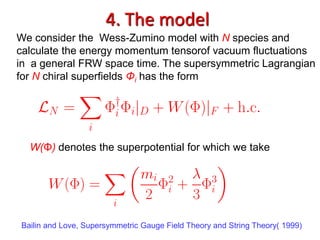
4. The model
We consider the Wess-Zumino model with N species and
calculate the energy momentum tensorof vacuum fluctuations
in a general FRW space time. The supersymmetric Lagrangian
for N chiral superfields Φi has the form


  W(Φ) denotes the superpotential for which we take


Bailin and Love, Supersymmetric Gauge Field Theory and String Theory( 1999)
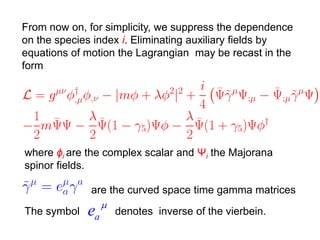
From now on, for simplicity, we suppress the dependence
on the species index i. Eliminating auxiliary fields by
equations of motion the Lagrangian may be recast in the
form


where ϕi are the complex scalar and Ψi the Majorana
spinor fields.

            are the curved space time gamma matrices
              
The symbol ea denotes inverse of the vierbein.
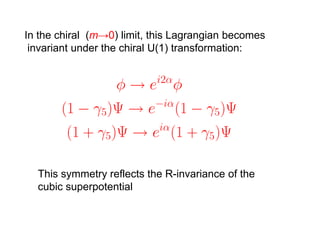
In the chiral (m→0) limit, this Lagrangian becomes
 invariant under the chiral U(1) transformation:


  This symmetry reflects the R-invariance of the
  cubic superpotential
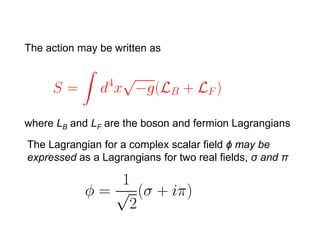
The action may be written as


where LB and LF are the boson and fermion Lagrangians

The Lagrangian for a complex scalar field ϕ may be
expressed as a Lagrangians for two real fields, σ and π
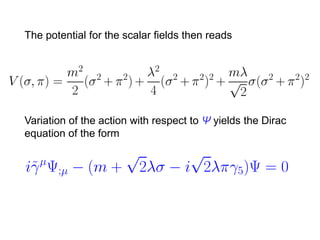
The potential for the scalar fields then reads


Variation of the action with respect to Ψ yields the Dirac
equation of the form
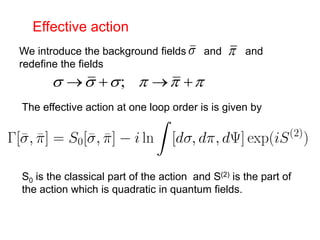
Effective action
We introduce the background fields  and          and
redefine the fields
        ;   
The effective action at one loop order is is given by


S0 is the classical part of the action and S(2) is the part of
the action which is quadratic in quantum fields.
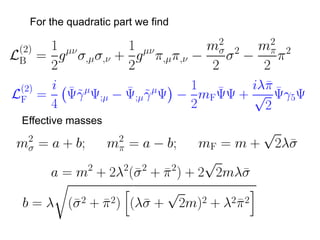
For the quadratic part we find


Effective masses
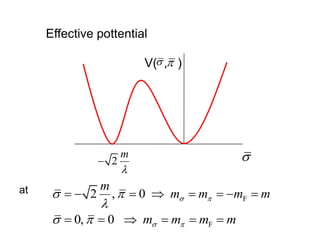
Effective pottential

                         V( , )


                2
                     m                   
                     
               m
at      2       ,   0  m  m  mF  m
               
        0,   0  m  m  mF  m
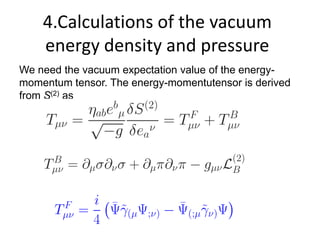
4.Calculations of the vacuum
    energy density and pressure
We need the vacuum expectation value of the energy-
momentum tensor. The energy-momentutensor is derived
from S(2) as
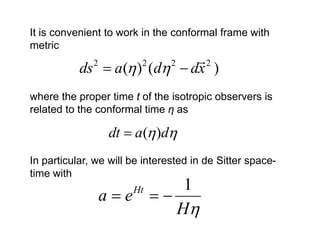
It is convenient to work in the conformal frame with
metric
                             2
           ds  a( ) (d  dx )
              2          2      2


where the proper time t of the isotropic observers is
related to the conformal time η as

                  dt  a( )d
In particular, we will be interested in de Sitter space-
time with
                          1
                  ae 
                       Ht

                         H
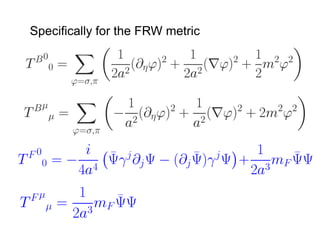
Specifically for the FRW metric
• Scalar fields
As in the flat space time, each real scalar field operator
is decomposed as


  The function χk(η) satisfies the field equation


 Where ’ denotes a derivative with respect to the
 conformal time η .
  [N.D. Birell, P.C.W. Davies, Quantum Fields in Curved Space]
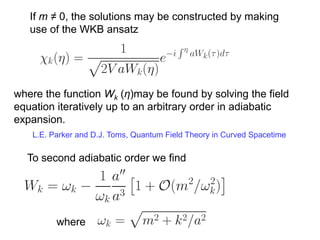
If m ≠ 0, the solutions may be constructed by making
   use of the WKB ansatz


where the function Wk (η)may be found by solving the field
equation iteratively up to an arbitrary order in adiabatic
expansion.
   L.E. Parker and D.J. Toms, Quantum Field Theory in Curved Spacetime

  To second adiabatic order we find


         where
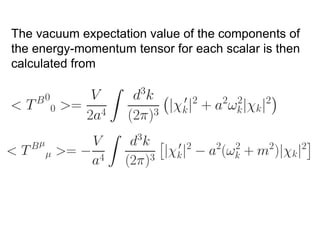
The vacuum expectation value of the components of
the energy-momentum tensor for each scalar is then
calculated from
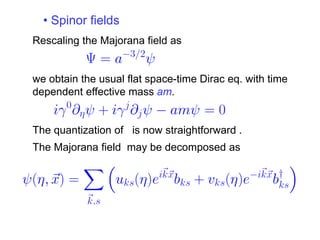
• Spinor fields
Rescaling the Majorana field as


we obtain the usual flat space-time Dirac eq. with time
dependent effective mass am.


The quantization of is now straightforward .
The Majorana field may be decomposed as
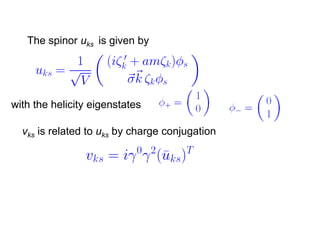
The spinor uks is given by


with the helicity eigenstates

  vks is related to uks by charge conjugation
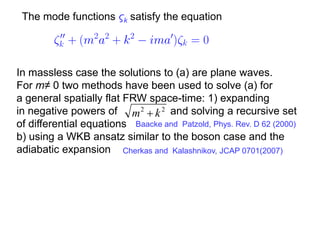
The mode functions ςk satisfy the equation


In massless case the solutions to (a) are plane waves.
For m≠ 0 two methods have been used to solve (a) for
a general spatially flat FRW space-time: 1) expanding
in negative powers of m 2  k 2 and solving a recursive set
of differential equations Baacke and Patzold, Phys. Rev. D 62 (2000)
b) using a WKB ansatz similar to the boson case and the
adiabatic expansion Cherkas and Kalashnikov, JCAP 0701(2007)
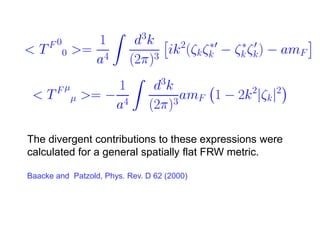
The divergent contributions to these expressions were
calculated for a general spatially flat FRW metric.

Baacke and Patzold, Phys. Rev. D 62 (2000)
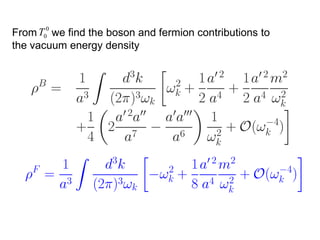
From T00 we find the boson and fermion contributions to
the vacuum energy density
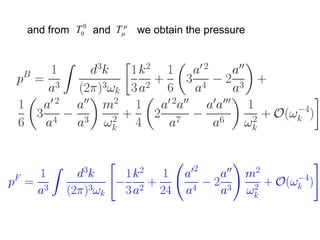
and from T00 and T we obtain the pressure
To make the results finite we need to regularize the integrals.
 We use a simple 3-dim momentum cutoff regularization
 for the following reasons

1. It is the only regularization scheme with a clear physical
   meaning: one discards the part of the momentum
   integral over those momenta where a different, yet
   unknown physics should appear.
2. We apply this in a cosmological context where we have
   a preferred reference frame: the frame fixed by the CMB
   background or large scale matter distribution.
3. As we have an unbroken SUSY, the cancelation of the
   flat-spacetime contributions takes place irrespective
   what regularization method we use.
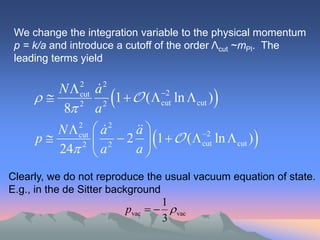
We change the integration variable to the physical momentum
 p = k/a and introduce a cutoff of the order Λcut ~mPl. The
 leading terms yield

        N a   2
                 2
                  2 
             cut
                     1   (  cut ln  cut ) 
                               2

         8 a  2


        N  cut  a
            2
                  2     a
                         
     p      2  2
                       2  1   (  cut ln  cut ) 
                                         2

        24  a          a
Clearly, we do not reproduce the usual vacuum equation of state.
E.g., in the de Sitter background
                                   1
                         pvac      vac
                                   3
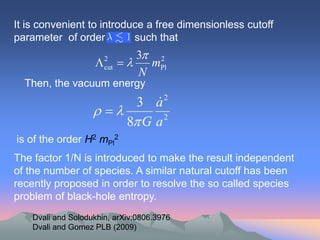
It is convenient to introduce a free dimensionless cutoff
parameter of order         such that
                                 3 2
                       2
                        cut      mPl
                                 N
  Then, the vacuum energy
                              
                           3 a2
                     
                         8 G a 2
is of the order H2 mPl2
The factor 1/N is introduced to make the result independent
of the number of species. A similar natural cutoff has been
recently proposed in order to resolve the so called species
problem of black-hole entropy.
    Dvali and Solodukhin, arXiv:0806.3976
    Dvali and Gomez PLB (2009)
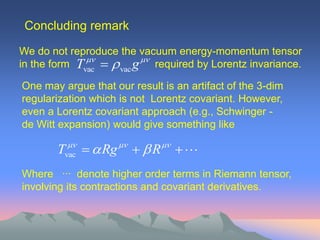
Concluding remark

We do not reproduce the vacuum energy-momentum tensor
                        
in the form Tvac   vac g required by Lorentz invariance.

One may argue that our result is an artifact of the 3-dim
regularization which is not Lorentz covariant. However,
even a Lorentz covariant approach (e.g., Schwinger -
de Witt expansion) would give something like
                             
       Tvac   Rg         R         
Where ∙∙∙ denote higher order terms in Riemann tensor,
involving its contractions and covariant derivatives.
Thank you

N. Bilic - Supersymmetric Dark Energy

  • 1.
    Supersymmetric Dark Energy Neven Bilić Ruđer Bošković Institute Zagreb, Croatia BW2011, Donji Milanovac, 31 Aug 2011
  • 2.
    Outline 1. Introductory remarks a) Cosmological considerations b) Vacuum energy 2. Motivation for SUSY 3. Summary 4. The model 5. Calculations of the vacuum energy density and pressure
  • 3.
    1.Introductory remarks a)Cosmological considerations In a homogeneous, isotropic and spatially flat spacetime (FRW), i.e., with metric  ds  dt  a(t ) dx 2 2 2 2 Einstein’s equations take the form  a  8 G 0 2  H    2 T0 a 3  a 4 G 0  (T0   Ti ) i a 3 i where Tµν is the energy momentum tensor The Hubble “constant” H describes the rate of the expansion.
  • 4.
    Owing to theisotropy we can set T00   ; T11  T22  T33   p In a hydrodynamical description in which Tµν represents a perfect fluid. i.e., T  ( p   )u u  pg p and ρ may be identified with pressure and density. This identification is correct only in a comoving frame, i.e., when the cosmic fluid velocity takes the form  1 u  ( g00 ,0,0,0); u  ( ,0,0,0) g00
  • 5.
    We obtain theFriedmann equations  a  8 G 2  H    2  a 3  a 4 G  (   3 p) a 3
  • 6.
    b) vacuum energy If we assume T    g  then p     and we reproduce Einsten’s equations with a cosmological constant equal to   8 G 
  • 7.
    In this casethe metric takes the form 2 ds  dt  e 2 2 2 Ht dx We have a universe with an accelerating expansion. This metric describes the so called flat patch of de Sitter (dS) spacetime with the de Sitter symmetry group. Thus, a nonzero cosmological constant implies the dS symmetry group of space-time rather than the Poincar´e group which is the space time symmetry group of Minkowski space.
  • 8.
    It is generallyaccepted that the cosmological constant term which was introduced ad-hoc in the Einstein-Hilbert action is related to the vacuum energy density of matter fields. It is often stated that the vacuum energy density estimated in a quantum field theory is by about 120 orders of magnitude larger than the value required by astrophysical and cosmological observations. e.g., S.Weinberg, Rev. Mod. Phys., 61 (2000)
  • 9.
    Consider a realscalar field. Assuming the so called minimal interaction, the Lagrangian is 1  L  g     V ( ) 2 with the correspoding energy-momentum tensor T       g L
  • 10.
    We define  vac =  T  H > 0 0 1 pvac     Ti i  3 i Where < A> denotes the vacuum expectation value of an operator A. In FRW spacetime 1 1  vac      2  ( )2    V ( )  2 2 2a 1 1 pvac      2  ( )2    V ( )  2 2 6a
  • 11.
    For a freemassive field in flat spacetime one finds 1 d 3k  vac   k 2  m2 2 (2 )3 3 2 1 d k k pvac   6 (2 )3 k 2  m2 and with a 3-dim momentum cutoff K we obtain K4 m2 K 2 1 K2  vac    ln 2  .... 16 2 16 2 64 2 m 1 K 4 1 m2 K 2 1 K2 pvac    ln 2  .... 3 16 2 3 16 2 64 2 m
  • 12.
    Assuming that theordinary field theory is valid up to the scale of quantum gravity, i.e. the Planck scale, we find K4 4 mPl  vac   ...   1073 GeV 4 16 2 16 2 compared with the observed value  vac  1047 GeV4
  • 13.
    Fine tuning problem Inaddition to the vacuum fluctuations of the field there may exist an independent cosmological term Λ equivalent to    8 G so that one would find an effective vacuum energy eff   vac    In order to reproduce the observed value one needs a cancelation of these two terms up to 120 decimal places! The problem is actually much more severe as we have many other contributions to the vacuum energy from different fields with different interactions and all these contributions must somehow cancel to give the observed vacuum energy.
  • 14.
    Adding gravity In fact,there would be no problem if there were no gravity! In flat space one can renormalize the vacuum energy by subtracting the divergent contributions since the energy is defined up to an arbitrary additive constant. However , in curved space this cannot be easily done because the energy is a source of the gravitational field and adding (even constant) energy changes the spacetime geometry .
  • 15.
    2. Motivation forSUSY Question No 1 Can supersymmetry cure the mentioned problems? At least we know that in a field theory with exact SUSY the vacuum energy, and hence the cosmological constant, is equal to zero as the contributions of fermions and bosons to the vacuum energy precisely cancel! Unfortunately, in the real world SUSY is broken at small energy scales. The scale of SUSY breaking required by particle physics phenomenology must be of the order of 1 TeV or larger implying Λ still by about 60 orders of magnitude too large.
  • 16.
    Question No 2 Howdoes the SUSY vacuum behave in curved spacetime, e.g., in de Sitter spacetime? Our aim is to investigate the fate of vacuum energy when an unbroken supersymmetric model is embedded in spatially flat, homogeneous and isotropic spacetime. In addition, we assume the presence of a dark energy type of substance obeying the equation of state pDE =wρDE, with w<0.
  • 17.
    The space timesymmetry group of an exact SUSY is the Poincar´e group.. The lack of Poincar´e symmetry will lift the Fermi-Bose degeneracy and the energy density of vacuum fluctuations will be nonzero. This type of “soft” supersymmetry breaking is known in supersymmetric field theory at finite temperature where the Fermi-Bose degeneracy is lifted by statistics. Das and Kaku, Phys. Rev. D 18 (1978) Girardello, Grisaru and Salomonson, Nucl. Phys. B 178 (1981)
  • 18.
    3. Summary The finalexpressions for the vacuum energy density and pressure are free from all divergent and finite flat-spacetime terms.The dominant contributions come from the leading terms which diverge quadratically. N  cut a 2 2  2   1   (  cut ln  cut )  2 8 a2 N  cut  a 2 2  a  p 2  2  2  1   (  cut ln  cut )  2 24  a a 3 2  NB, Phys Rev D 2011  2 cut mPl N λ an arbitrary positive parameter 0    1 N number of chiral species
  • 19.
    Combining effects ofdark energy with the equation of state pDE = wρDE and vacuum fluctuations of the supersymmetric field we find the effective equation of state peff  weff eff  DE 2  eff  weff  w  1  3 1  Friedman equations take the standard form a 2 8  2  G eff a 3  a 4  G(1  3weff ) eff a 3
  • 20.
    1. Imposing ashort distance cutoff of the order mPl we have found that the leading term in the energy density of vacuum fluctuations is of the same order as dark energy (H2 mPl2) and no fine tuning is needed 2. The contribution of the vacuum fluctuations to the effective equation of state is always positive and, hence, it goes against acceleration! A similar conclusion was drawn by M. Maggiore, PRD (2011) who considers massless scalar fields only and removes the flat-spacetime contribution by hand. 3. If we require accelerating expansion, i.e., that the effective equation of state satisfies weff < −1/3, the range −1 < w < −1/3 is compatible with 0 < λ < 1/2, whereas w < −1 (phantom) would imply λ> 1/2.
  • 21.
    4. The model Weconsider the Wess-Zumino model with N species and calculate the energy momentum tensorof vacuum fluctuations in a general FRW space time. The supersymmetric Lagrangian for N chiral superfields Φi has the form W(Φ) denotes the superpotential for which we take Bailin and Love, Supersymmetric Gauge Field Theory and String Theory( 1999)
  • 22.
    From now on,for simplicity, we suppress the dependence on the species index i. Eliminating auxiliary fields by equations of motion the Lagrangian may be recast in the form where ϕi are the complex scalar and Ψi the Majorana spinor fields. are the curved space time gamma matrices  The symbol ea denotes inverse of the vierbein.
  • 23.
    In the chiral(m→0) limit, this Lagrangian becomes invariant under the chiral U(1) transformation: This symmetry reflects the R-invariance of the cubic superpotential
  • 24.
    The action maybe written as where LB and LF are the boson and fermion Lagrangians The Lagrangian for a complex scalar field ϕ may be expressed as a Lagrangians for two real fields, σ and π
  • 25.
    The potential forthe scalar fields then reads Variation of the action with respect to Ψ yields the Dirac equation of the form
  • 26.
    Effective action We introducethe background fields  and  and redefine the fields   ;    The effective action at one loop order is is given by S0 is the classical part of the action and S(2) is the part of the action which is quadratic in quantum fields.
  • 27.
    For the quadraticpart we find Effective masses
  • 28.
    Effective pottential V( , )  2 m   m at   2 ,   0  m  m  mF  m    0,   0  m  m  mF  m
  • 29.
    4.Calculations of thevacuum energy density and pressure We need the vacuum expectation value of the energy- momentum tensor. The energy-momentutensor is derived from S(2) as
  • 30.
    It is convenientto work in the conformal frame with metric 2 ds  a( ) (d  dx ) 2 2 2 where the proper time t of the isotropic observers is related to the conformal time η as dt  a( )d In particular, we will be interested in de Sitter space- time with 1 ae  Ht H
  • 31.
  • 32.
    • Scalar fields Asin the flat space time, each real scalar field operator is decomposed as The function χk(η) satisfies the field equation Where ’ denotes a derivative with respect to the conformal time η . [N.D. Birell, P.C.W. Davies, Quantum Fields in Curved Space]
  • 33.
    If m ≠0, the solutions may be constructed by making use of the WKB ansatz where the function Wk (η)may be found by solving the field equation iteratively up to an arbitrary order in adiabatic expansion. L.E. Parker and D.J. Toms, Quantum Field Theory in Curved Spacetime To second adiabatic order we find where
  • 34.
    The vacuum expectationvalue of the components of the energy-momentum tensor for each scalar is then calculated from
  • 35.
    • Spinor fields Rescalingthe Majorana field as we obtain the usual flat space-time Dirac eq. with time dependent effective mass am. The quantization of is now straightforward . The Majorana field may be decomposed as
  • 36.
    The spinor uksis given by with the helicity eigenstates vks is related to uks by charge conjugation
  • 37.
    The mode functionsςk satisfy the equation In massless case the solutions to (a) are plane waves. For m≠ 0 two methods have been used to solve (a) for a general spatially flat FRW space-time: 1) expanding in negative powers of m 2  k 2 and solving a recursive set of differential equations Baacke and Patzold, Phys. Rev. D 62 (2000) b) using a WKB ansatz similar to the boson case and the adiabatic expansion Cherkas and Kalashnikov, JCAP 0701(2007)
  • 38.
    The divergent contributionsto these expressions were calculated for a general spatially flat FRW metric. Baacke and Patzold, Phys. Rev. D 62 (2000)
  • 39.
    From T00 wefind the boson and fermion contributions to the vacuum energy density
  • 40.
    and from T00and T we obtain the pressure
  • 41.
    To make theresults finite we need to regularize the integrals. We use a simple 3-dim momentum cutoff regularization for the following reasons 1. It is the only regularization scheme with a clear physical meaning: one discards the part of the momentum integral over those momenta where a different, yet unknown physics should appear. 2. We apply this in a cosmological context where we have a preferred reference frame: the frame fixed by the CMB background or large scale matter distribution. 3. As we have an unbroken SUSY, the cancelation of the flat-spacetime contributions takes place irrespective what regularization method we use.
  • 42.
    We change theintegration variable to the physical momentum p = k/a and introduce a cutoff of the order Λcut ~mPl. The leading terms yield N a 2 2 2   cut 1   (  cut ln  cut )  2 8 a 2 N  cut  a 2 2 a  p 2  2  2  1   (  cut ln  cut )  2 24  a a Clearly, we do not reproduce the usual vacuum equation of state. E.g., in the de Sitter background 1 pvac    vac 3
  • 43.
    It is convenientto introduce a free dimensionless cutoff parameter of order such that 3 2  2 cut  mPl N Then, the vacuum energy  3 a2   8 G a 2 is of the order H2 mPl2 The factor 1/N is introduced to make the result independent of the number of species. A similar natural cutoff has been recently proposed in order to resolve the so called species problem of black-hole entropy. Dvali and Solodukhin, arXiv:0806.3976 Dvali and Gomez PLB (2009)
  • 44.
    Concluding remark We donot reproduce the vacuum energy-momentum tensor   in the form Tvac   vac g required by Lorentz invariance. One may argue that our result is an artifact of the 3-dim regularization which is not Lorentz covariant. However, even a Lorentz covariant approach (e.g., Schwinger - de Witt expansion) would give something like    Tvac   Rg  R   Where ∙∙∙ denote higher order terms in Riemann tensor, involving its contractions and covariant derivatives.
  • 45.