testing the copernican principle in the light of dark energy


       Chris Clarkson
       Astrophysics, Cosmology & Gravitation Centre
       University of Cape Town


Thursday, 26 January 12
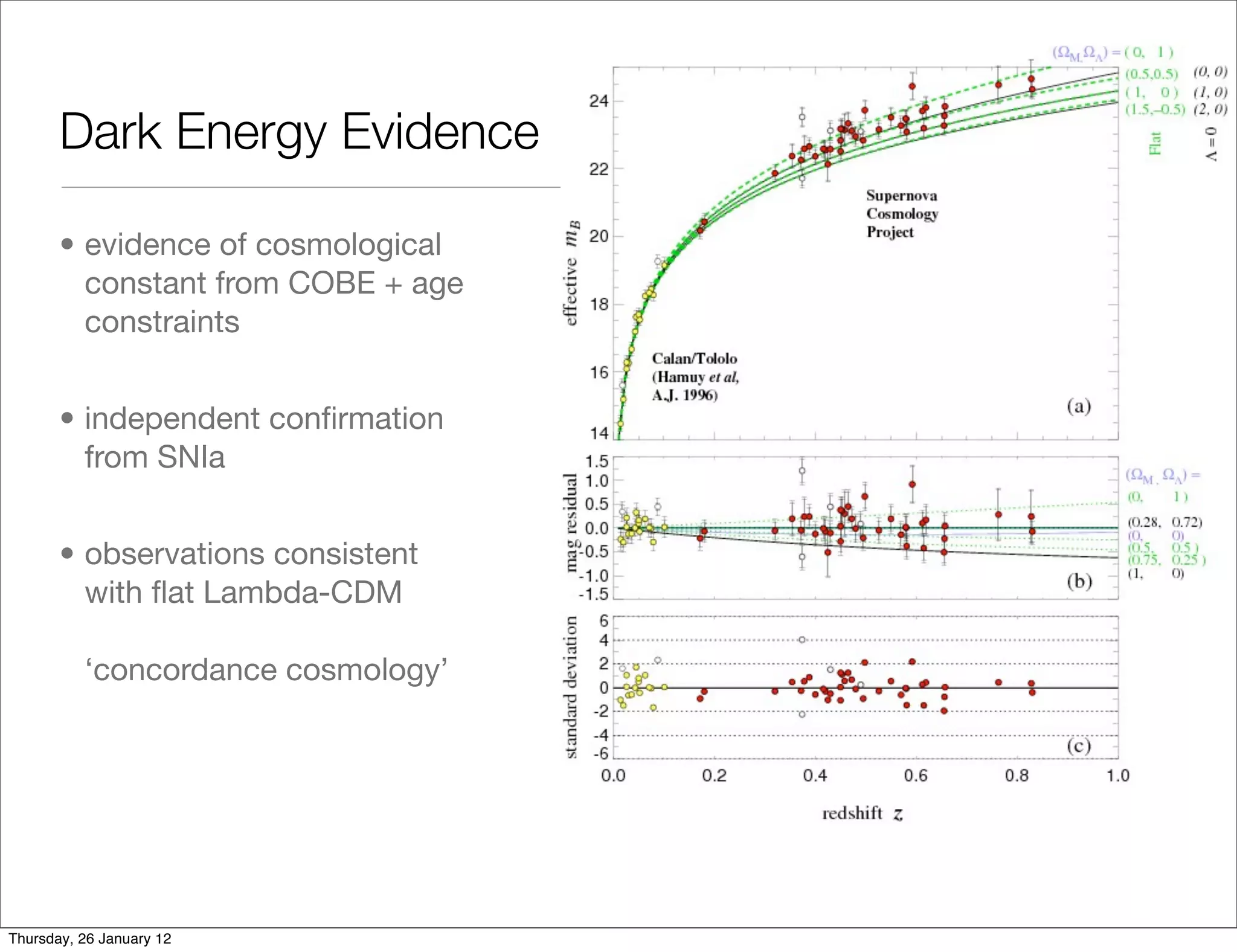
Dark Energy Evidence	

       • evidence of cosmological
         constant from COBE + age
         constraints


       • independent confirmation
         from SNIa


       • observations consistent
         with flat Lambda-CDM

          ‘concordance cosmology’


Thursday, 26 January 12
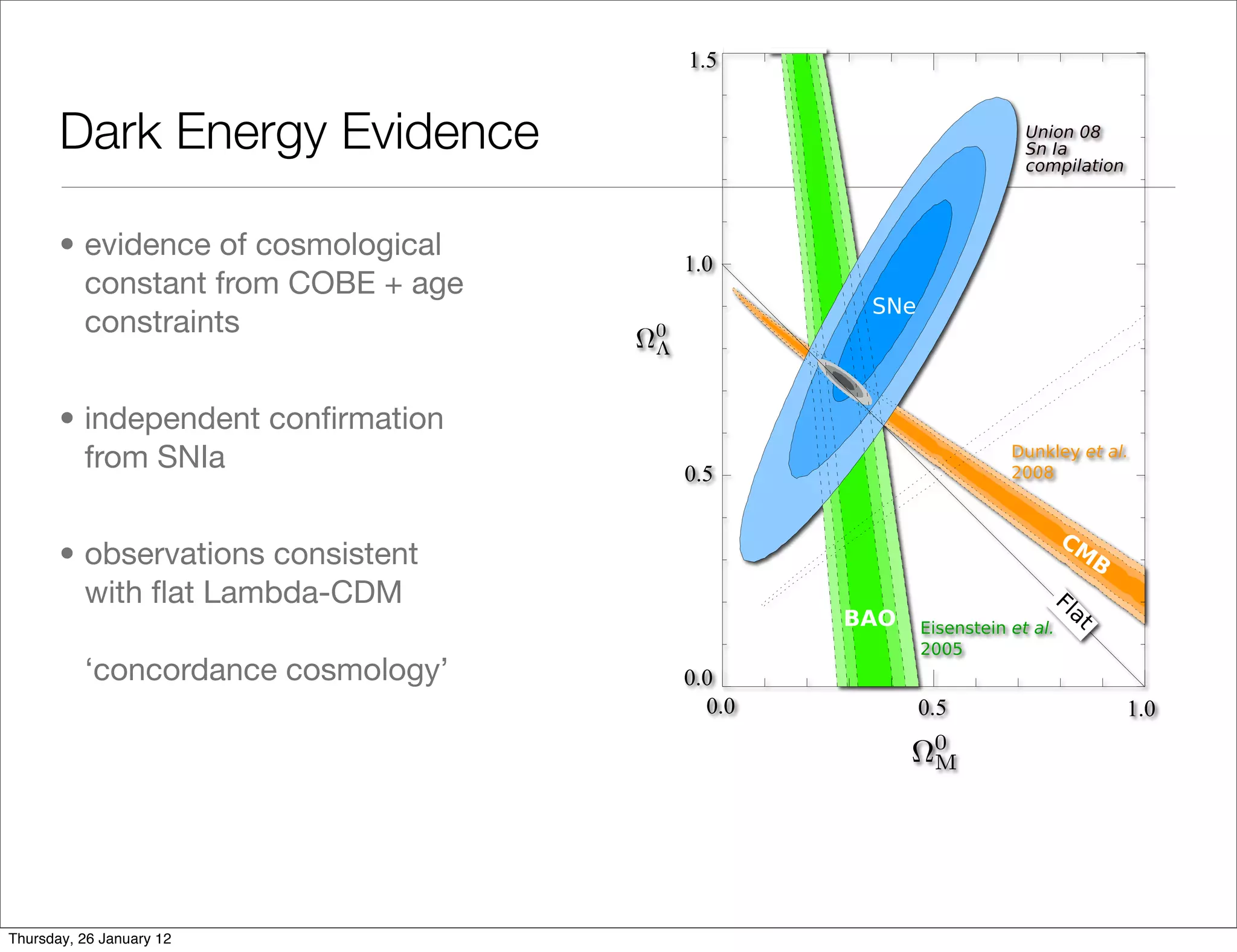
Dark Energy Evidence	

       • evidence of cosmological
         constant from COBE + age
         constraints


       • independent confirmation
         from SNIa


       • observations consistent
         with flat Lambda-CDM

          ‘concordance cosmology’


Thursday, 26 January 12
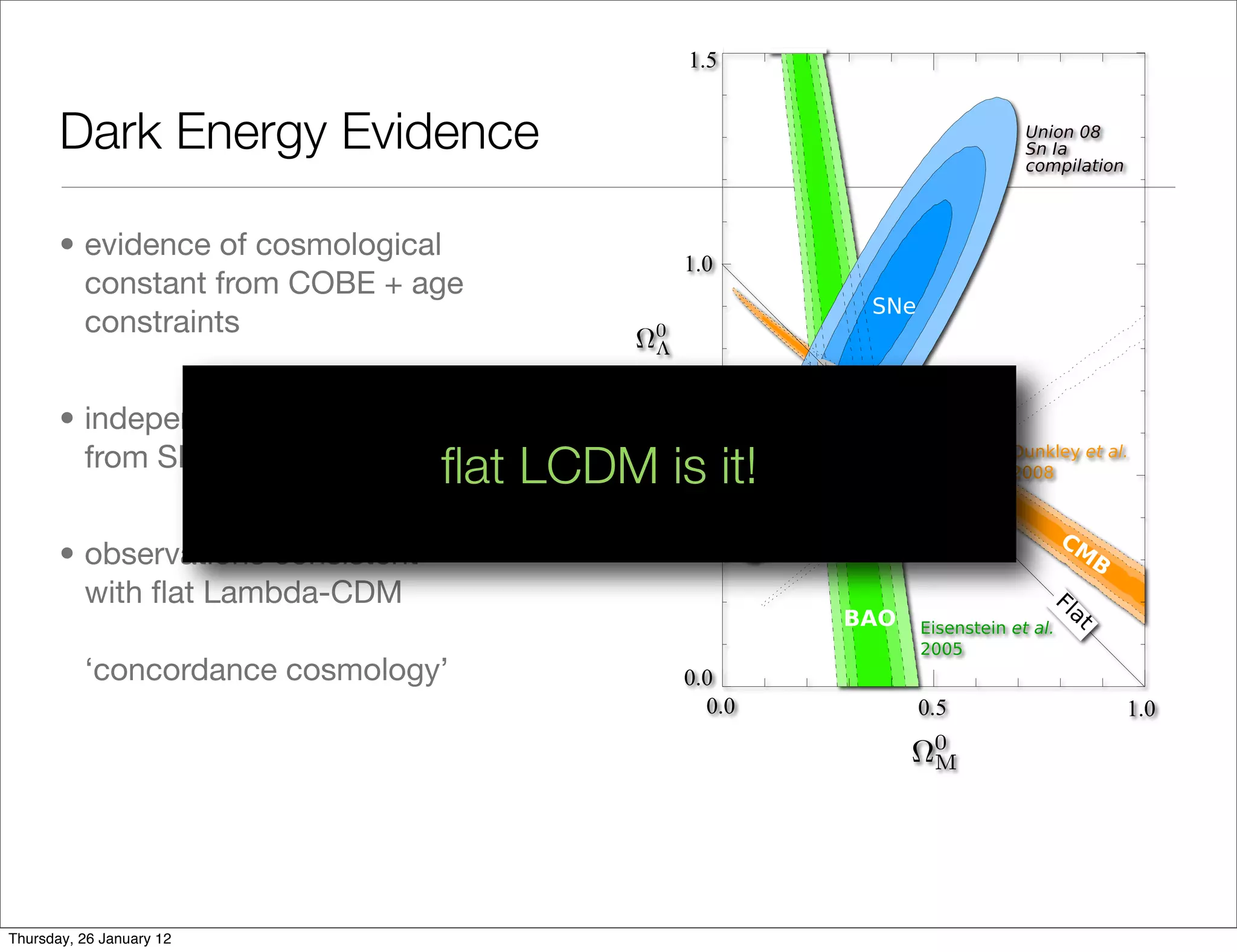
Dark Energy Evidence	

       • evidence of cosmological
         constant from COBE + age
         constraints


       • independent confirmation
         from SNIa                 flat LCDM is it!
       • observations consistent
         with flat Lambda-CDM

          ‘concordance cosmology’


Thursday, 26 January 12
relativity is valid up to the Planck scale, w
                                                                                     4
                       vacuum energy in terms of a mass scale as ρvac = Mvac , in te
                                                               ρ(theory) ∼ MP10−3 eV, satisf
                       required to explain our observations vac Mvac ∼ .
                                                                  is
                                                                       (obs) 4


       Problems with Λ Mvac ∼ 10 Mvac .  (obs)      −30   (theory)
                                                                                         (ob
                                                    Comparing this value to the value ρvac
                                               obtain
                       Nevertheless, this discrepancy of 30 orders of magnitude in ener
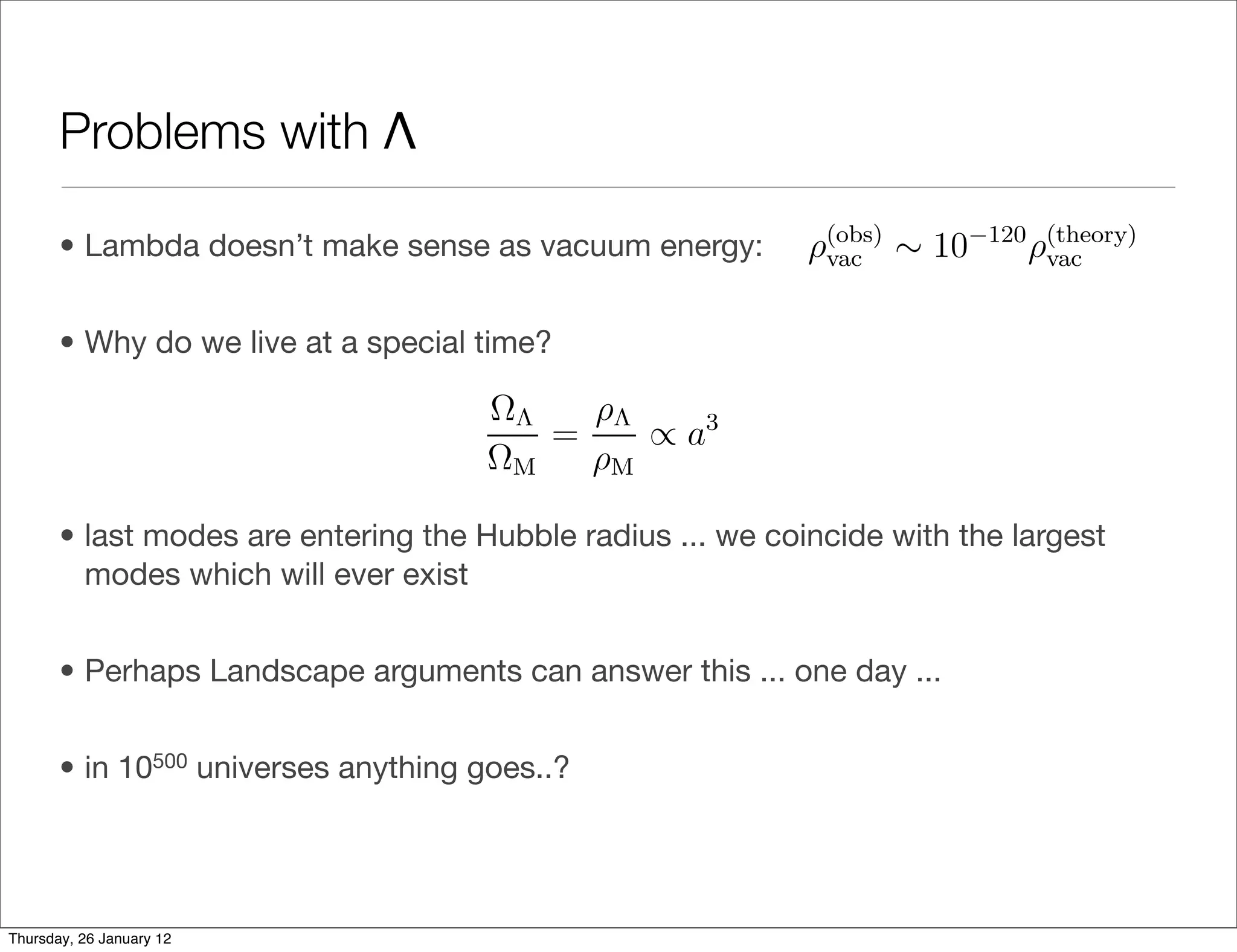
       • Lambda doesn’t make sense as by the cosmological(obs) ∼ 10−120 ρ(theory) ,
                       is what is meant vacuum energy: ρvac        constant problem.
                                                                                vac

                             One may add to this problem the following puzzling obser
       • Why do we live at a specialmatter densities changes as the universe expands a
                       vacuum and time?
                                        ΩΛ     ρΛ
                                            =      ∝ a3 .
                                        ΩM     ρM
                       Thus, only during a brief epoch of cosmic history is it possible
       • last modes are entering the Hubble radius ... we coincide with the largest
         modes whichthe transition from matter domination to Λ domination, durin
                        will ever exist
                       of the same order of magnitude. This is known as the coinciden
                             The issue of reliably calculating the cosmological constant,
       • Perhaps Landscape arguments can answer this ... one day ...
                       in which that calculation leads to a result dramatically differe
       • in 10500 universesproven remarkably resistant to theoretical attack. It is fair t
                       has anything goes..?
                       currently any especially promising approaches. Nevertheless, t
                       lines of research that are worth mentioning in this context.
                             The first is supersymmetry (SUSY). Supersymmetry is a sp
Thursday, 26 January 12
relativity is valid up to the Planck scale, w
                                                                                     4
                       vacuum energy in terms of a mass scale as ρvac = Mvac , in te
                                                               ρ(theory) ∼ MP10−3 eV, satisf
                       required to explain our observations vac Mvac ∼ .
                                                                  is
                                                                       (obs) 4


       Problems with Λ Mvac ∼ 10 Mvac .  (obs)      −30   (theory)
                                                                                         (ob
                                                    Comparing this value to the value ρvac
                                               obtain
                       Nevertheless, this discrepancy of 30 orders of magnitude in ener
       • Lambda doesn’t make sense as by the cosmological(obs) ∼ 10−120 ρ(theory) ,
                       is what is meant vacuum energy: ρvac        constant problem.
                                                                                vac

                             One may add to this problem the following puzzling obser
       • Why do we live at a specialmatter densities changes as the universe expands a
                       vacuum and time?
                                        ΩΛ     ρΛ
                                            =      ∝ a3 .
                                        ΩM     ρM
                       Thus, only during a brief epoch of cosmic history is it possible
       • last modes are entering the Hubble radius ... we coincide with the largest
         modes whichthe transition from matter domination to Λ domination, durin
                        will ever exist
                       of the same order of magnitude. This is known as the coinciden
                             The issue of reliably calculating the cosmological constant,
       • Perhaps Landscape arguments can answer this ... one day ...
                       in which that calculation leads to a result dramatically differe
       • in 10500 universesproven remarkably resistant to theoretical attack. It is fair t
                       has anything goes..?
                       currently any especially promising approaches. Nevertheless, t
                       lines of research that are worth mentioning in this context.
                             The first is supersymmetry (SUSY). Supersymmetry is a sp
Thursday, 26 January 12
relativity is valid up to the Planck scale, w
                                                                                     4
                       vacuum energy in terms of a mass scale as ρvac = Mvac , in te
                                                               ρ(theory) ∼ MP10−3 eV, satisf
                       required to explain our observations vac Mvac ∼ .
                                                                  is
                                                                       (obs) 4


       Problems with Λ Mvac ∼ 10 Mvac .  (obs)      −30   (theory)
                                                                                         (ob
                                                    Comparing this value to the value ρvac
                                               obtain
                       Nevertheless, this discrepancy of 30 orders of magnitude in ener
       • Lambda doesn’t make sense as by the cosmological(obs) ∼ 10−120 ρ(theory) ,
                       is what is meant vacuum energy: ρvac        constant problem.
                                                                                vac

                             One may add to this problem the following puzzling obser
       • Why do we live at a specialmatter densities changes as the universe expands a
                       vacuum and time?
                                        ΩΛ     ρΛ
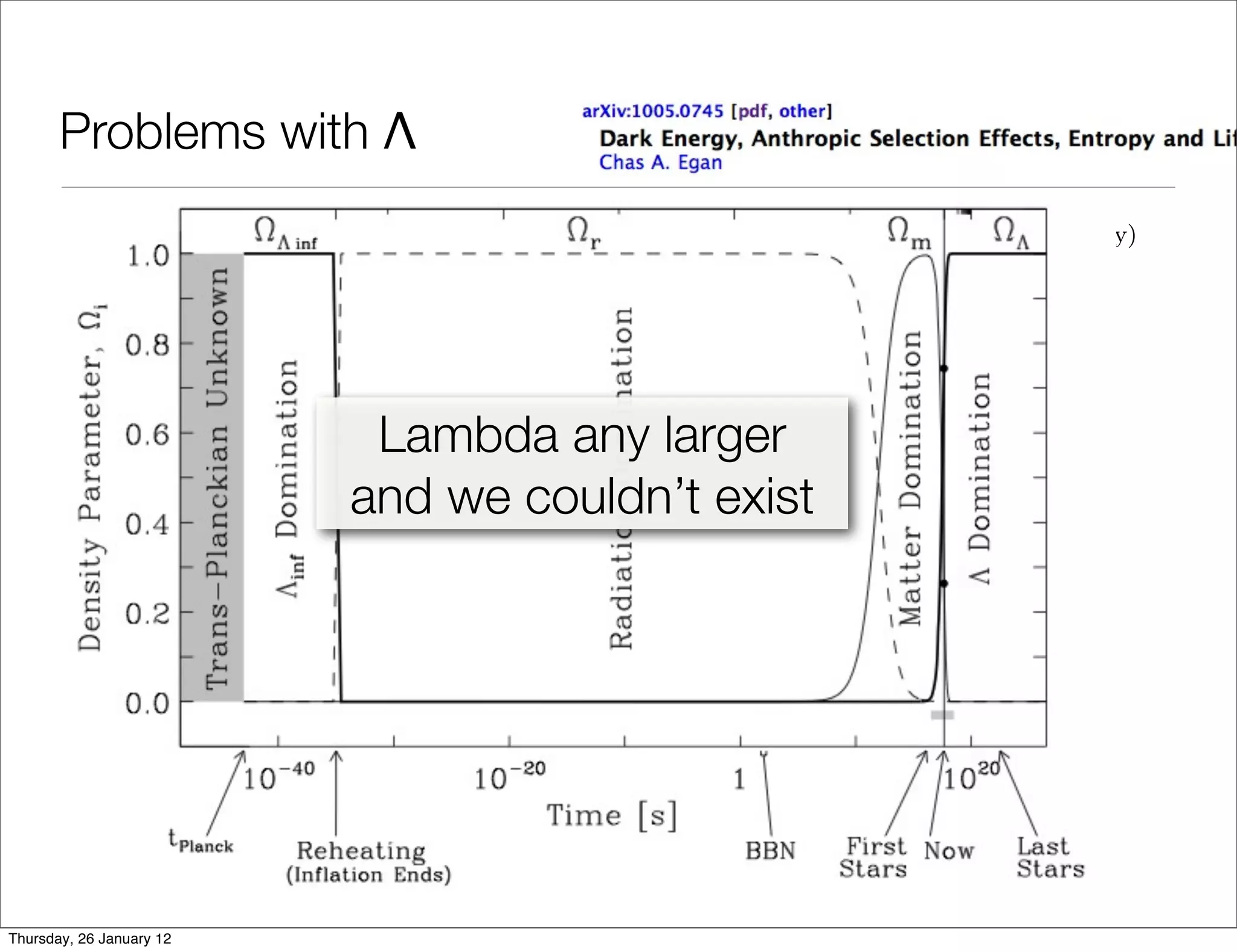
                                Lambda ρM larger
                                        ΩM
                                            =any∝ a3 .

                       Thus,and during a brief epoch of cosmic history is it possible
                               only we couldn’t exist
       • last modes are entering the Hubble radius ... we coincide with the largest
         modes whichthe transition from matter domination to Λ domination, durin
                        will ever exist
                       of the same order of magnitude. This is known as the coinciden
                             The issue of reliably calculating the cosmological constant,
       • Perhaps Landscape arguments can answer this ... one day ...
                       in which that calculation leads to a result dramatically differe
       • in 10500 universesproven remarkably resistant to theoretical attack. It is fair t
                       has anything goes..?
                       currently any especially promising approaches. Nevertheless, t
                       lines of research that are worth mentioning in this context.
                             The first is supersymmetry (SUSY). Supersymmetry is a sp
Thursday, 26 January 12
LCDM Denial
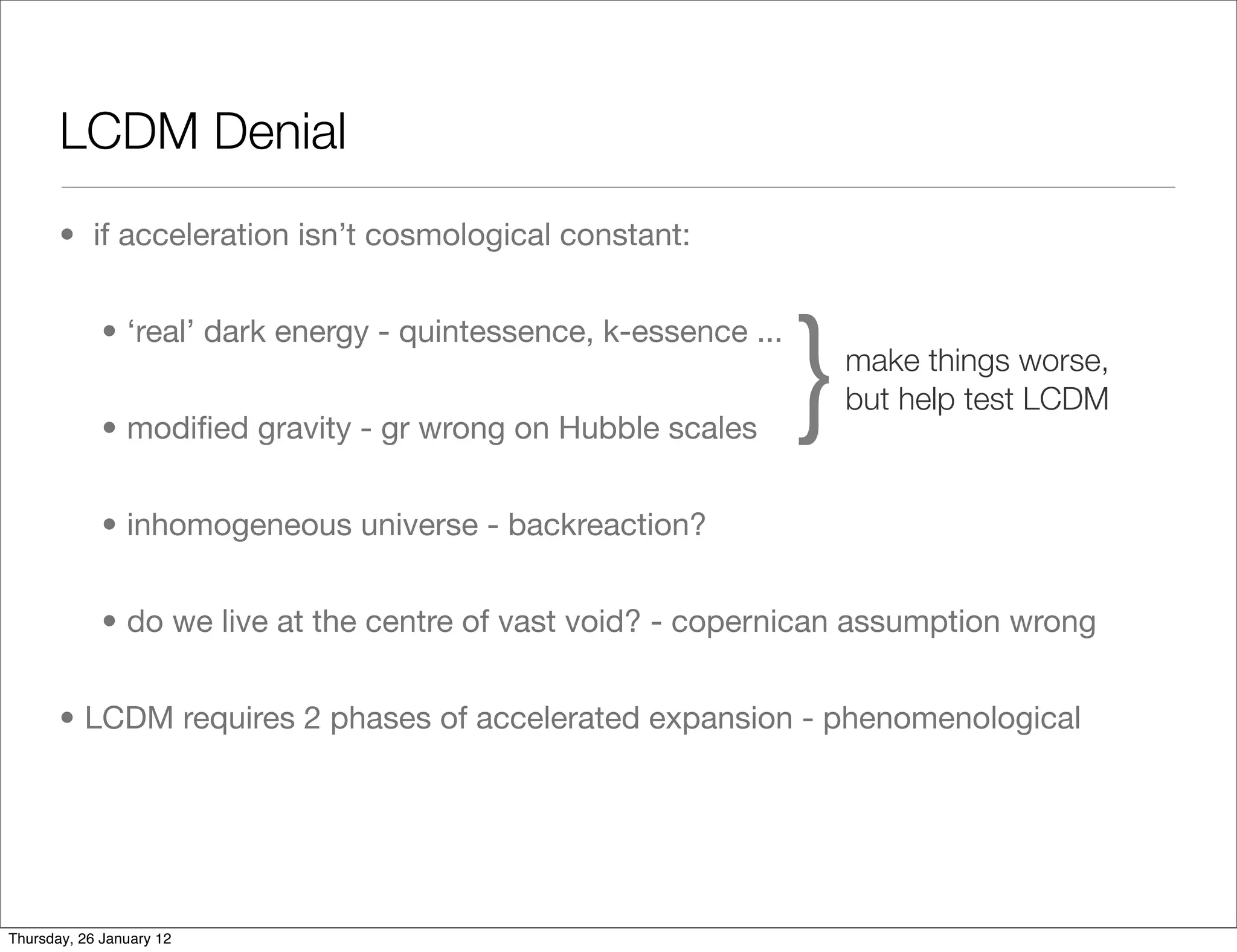
       • if acceleration isn’t cosmological constant:


                                                                  }
             • ‘real’ dark energy - quintessence, k-essence ...
                                                                      make things worse,
                                                                      but help test LCDM
             • modified gravity - gr wrong on Hubble scales


             • inhomogeneous universe - backreaction?


             • do we live at the centre of vast void? - copernican assumption wrong


       • LCDM requires 2 phases of accelerated expansion - phenomenological


Thursday, 26 January 12
priors critical

       • assumes FLRW background spacetime - spatial homogeneity


             • can we demonstrate this observationally?


                   • or have we already? at what confidence level?


       • what do we know if we don’t assume this?


             • does dark energy necessarily exist?


Thursday, 26 January 12
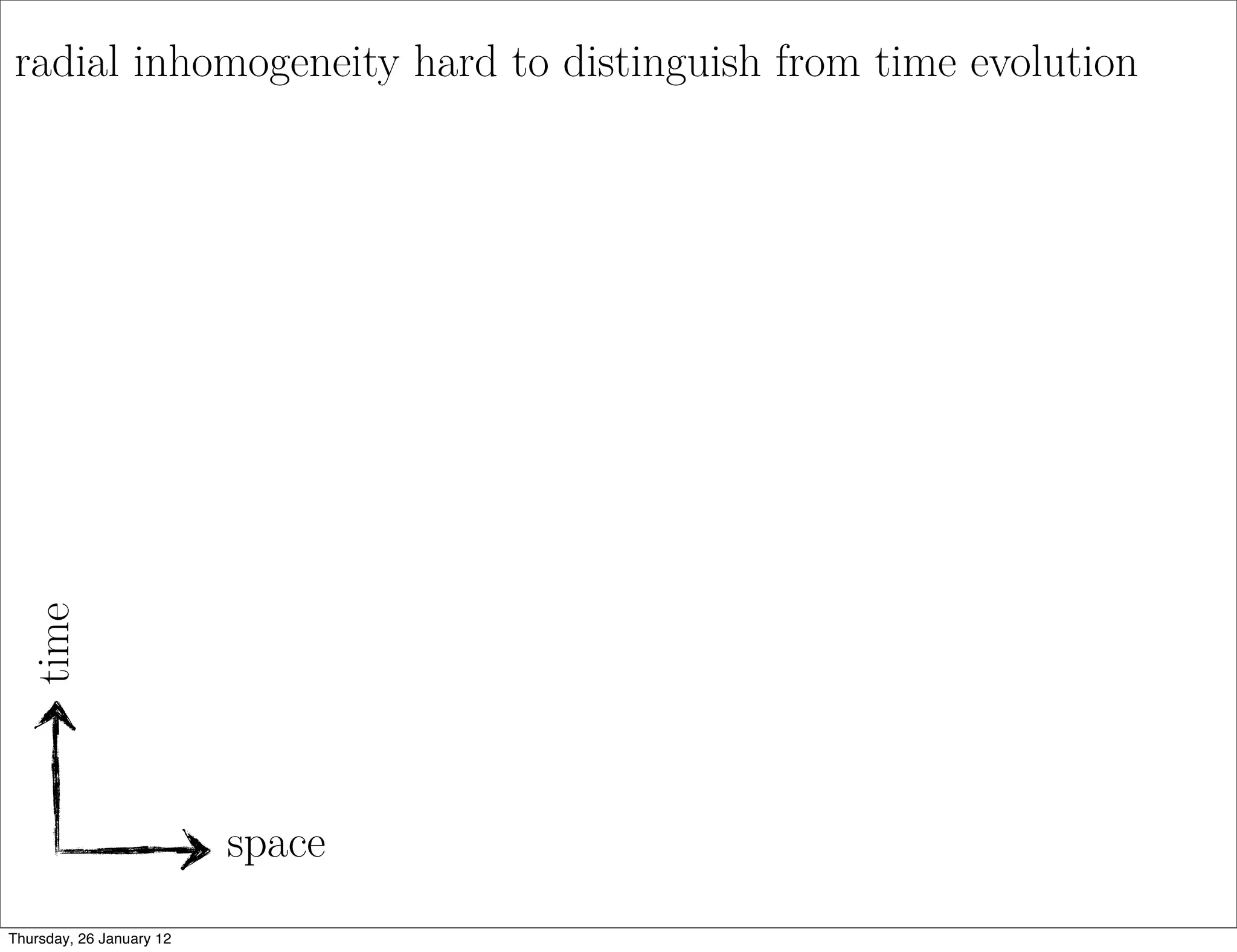
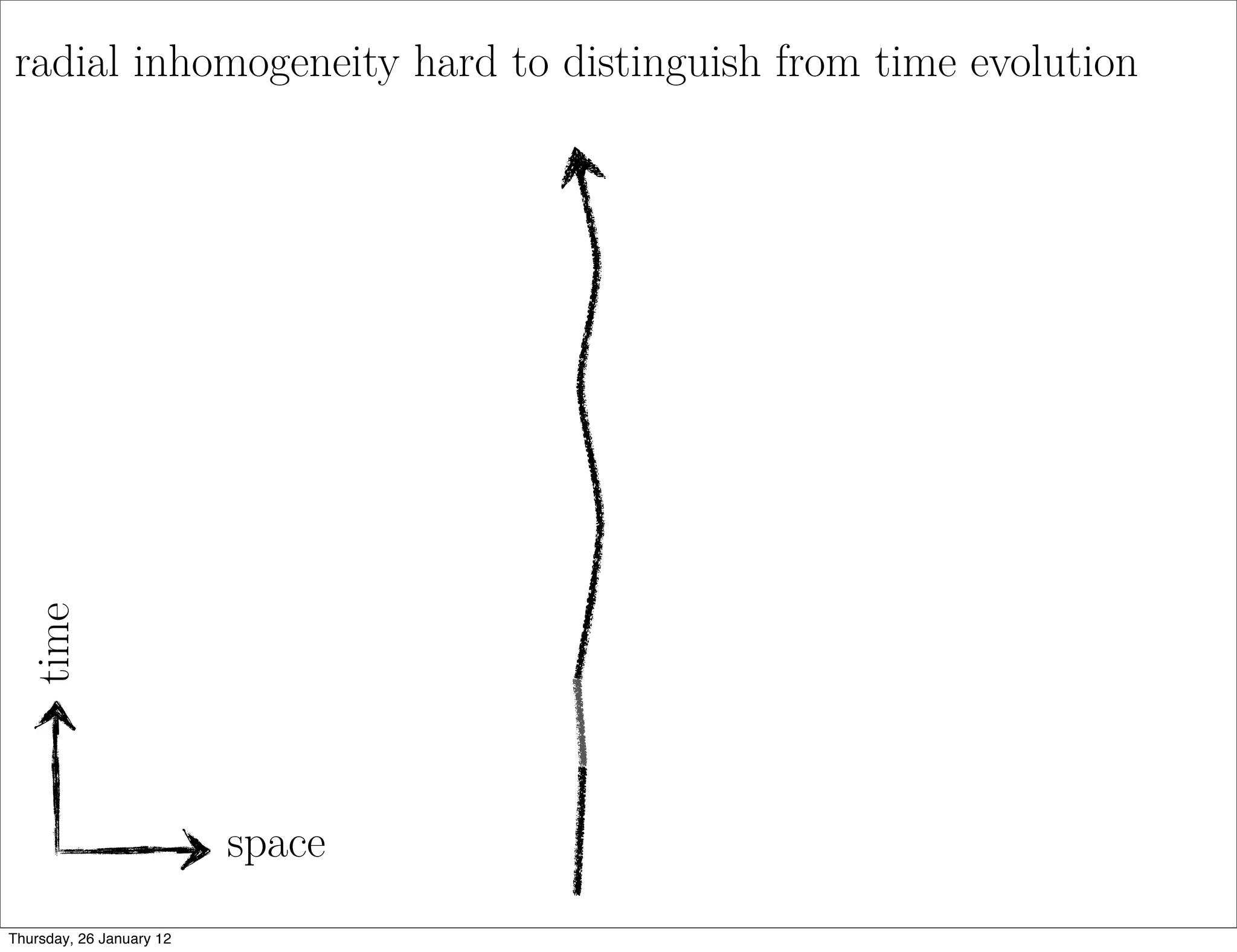
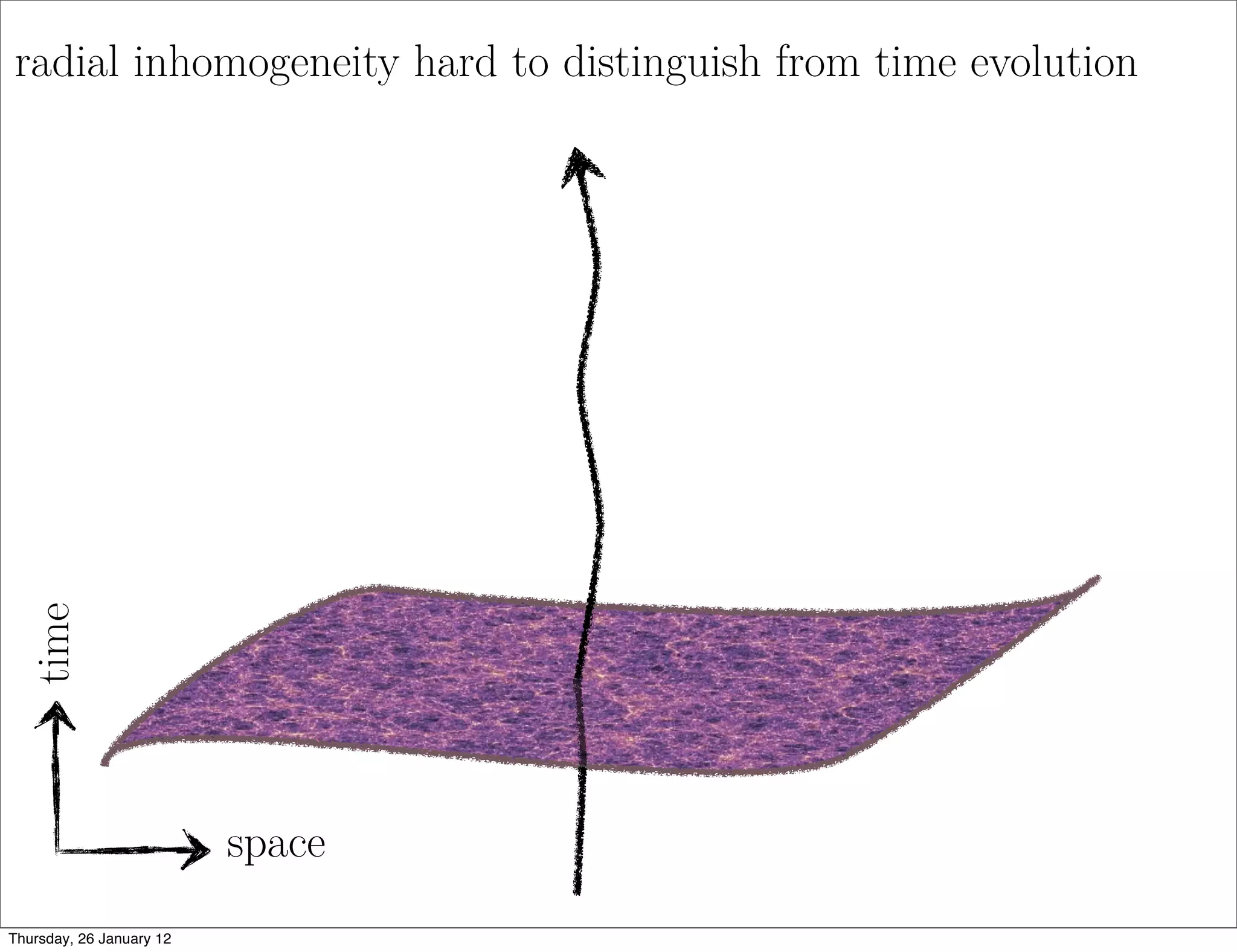
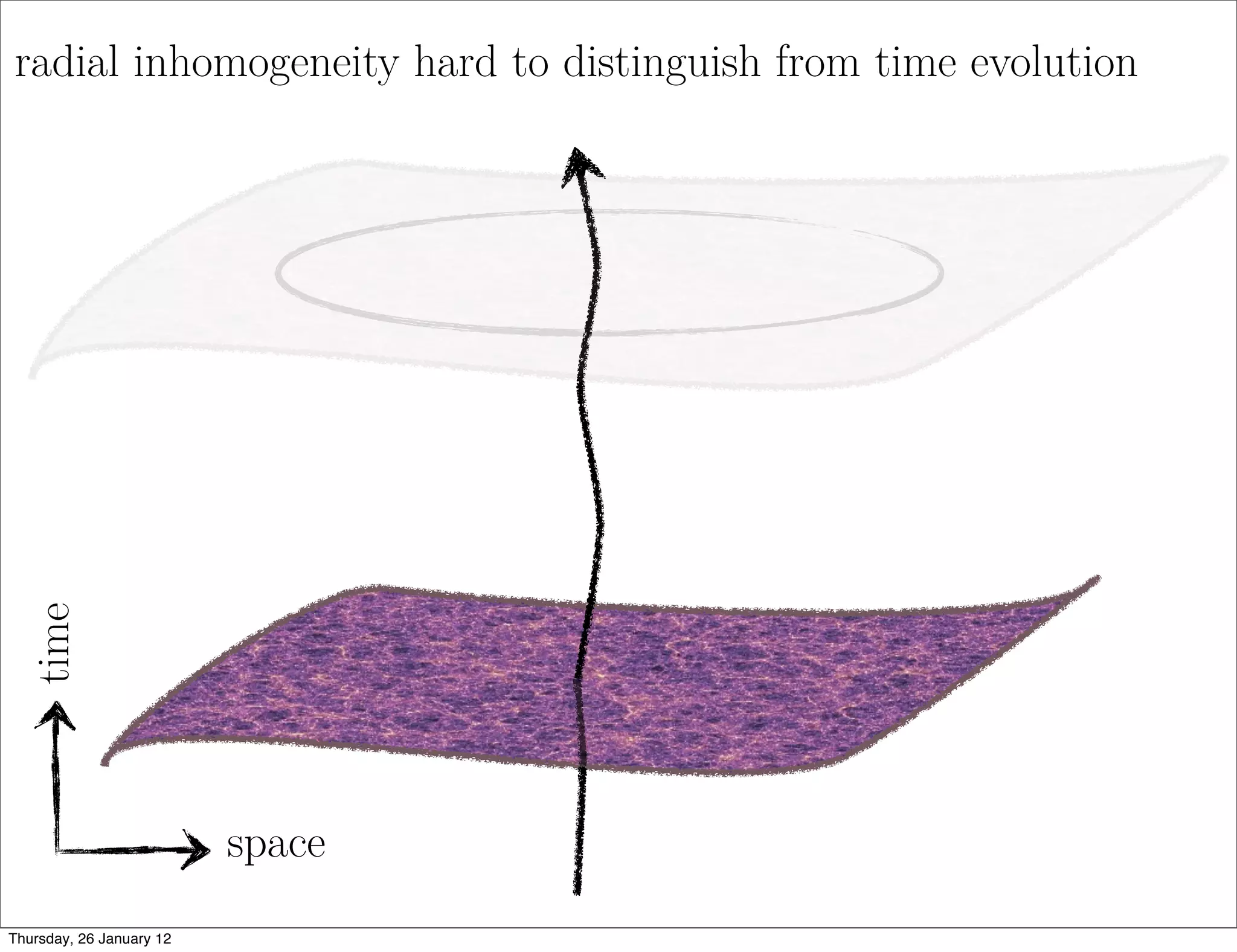
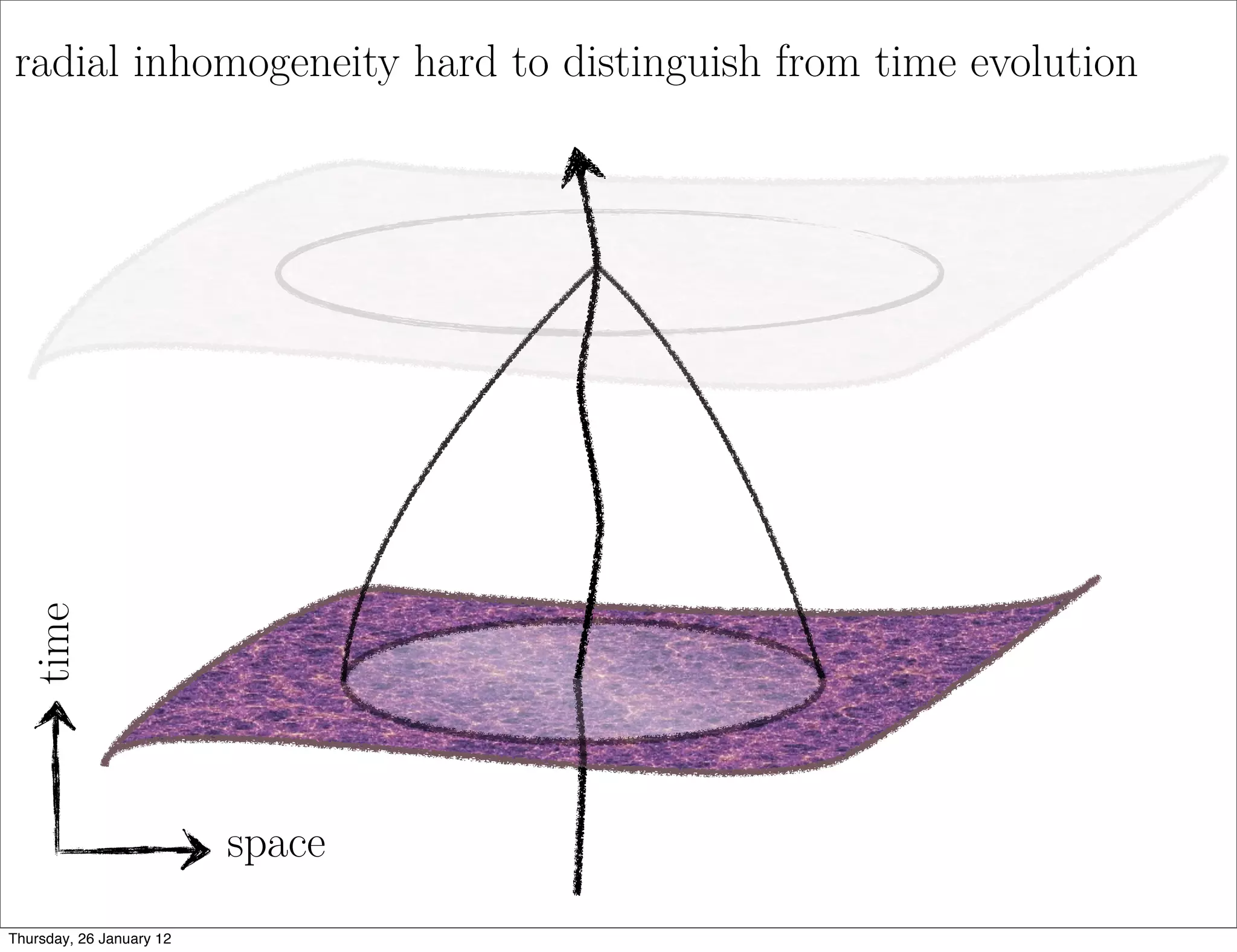
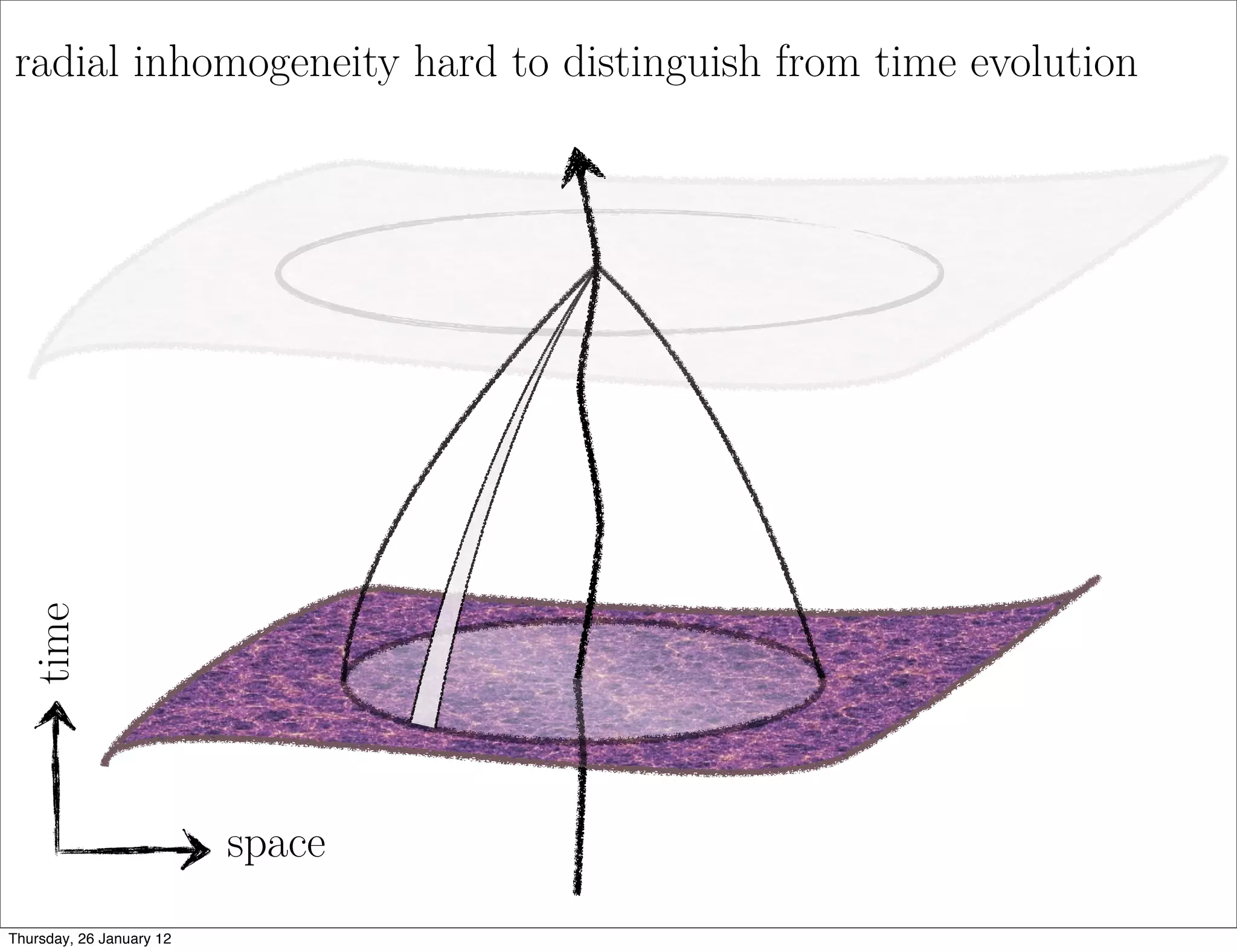
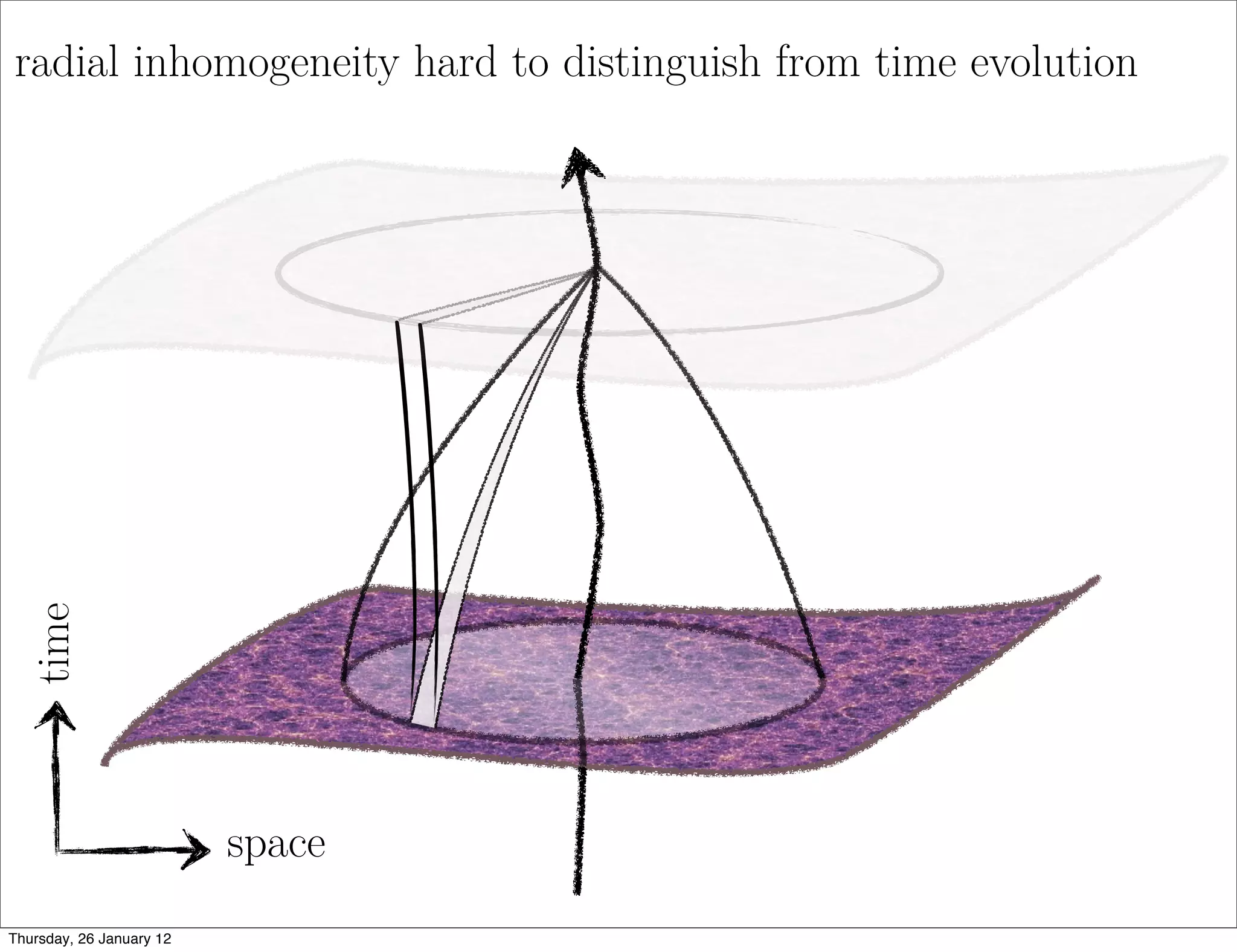
radial inhomogeneity hard to distinguish from time evolution


Thursday, 26 January 12
radial inhomogeneity hard to distinguish from time evolution
 time


                          space
Thursday, 26 January 12
radial inhomogeneity hard to distinguish from time evolution
 time


                          space
Thursday, 26 January 12
radial inhomogeneity hard to distinguish from time evolution
 time


                          space
Thursday, 26 January 12
radial inhomogeneity hard to distinguish from time evolution
 time


                          space
Thursday, 26 January 12
radial inhomogeneity hard to distinguish from time evolution
 time


                          space
Thursday, 26 January 12
radial inhomogeneity hard to distinguish from time evolution
 time


                          space
Thursday, 26 January 12
radial inhomogeneity hard to distinguish from time evolution
 time


                          space
Thursday, 26 January 12
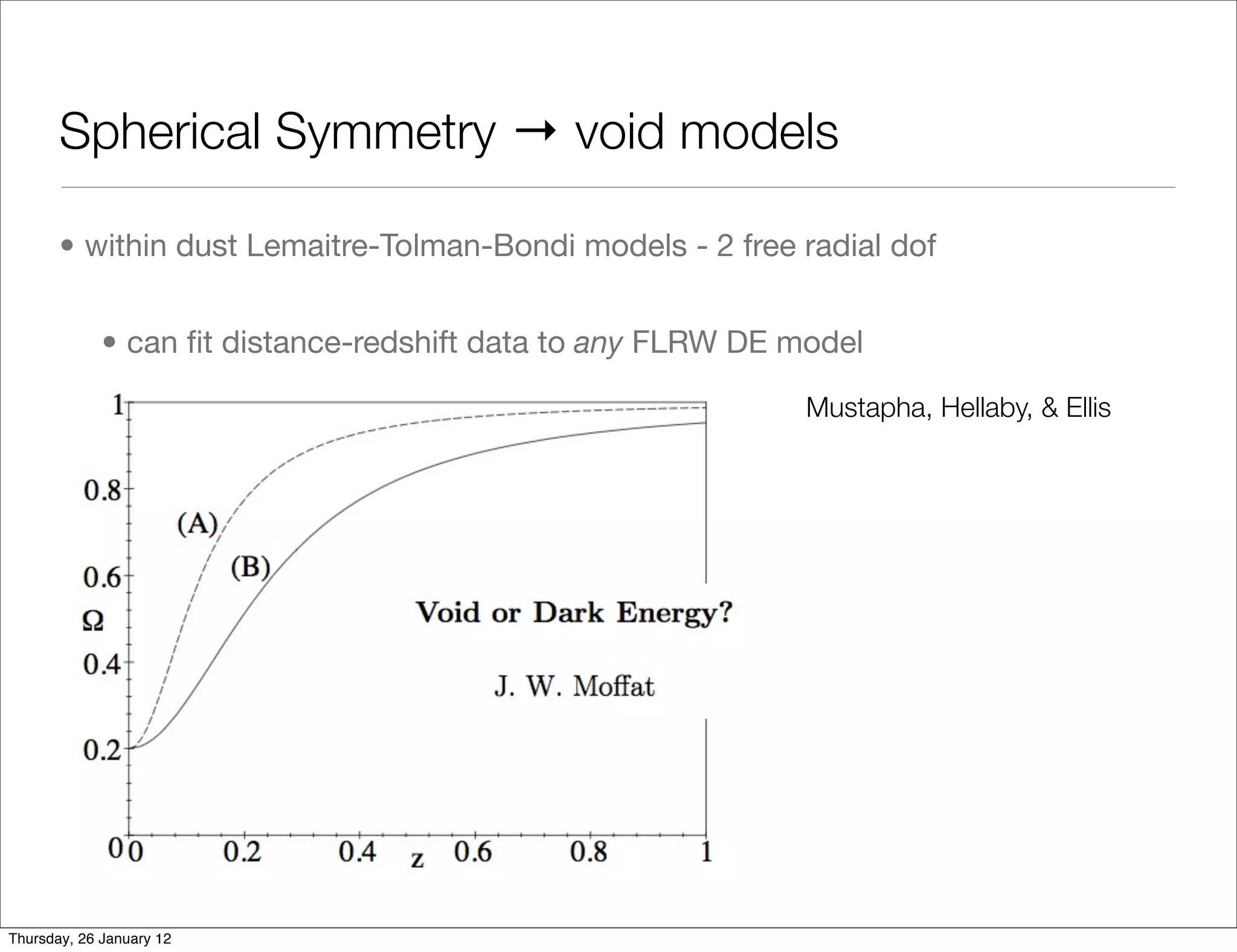
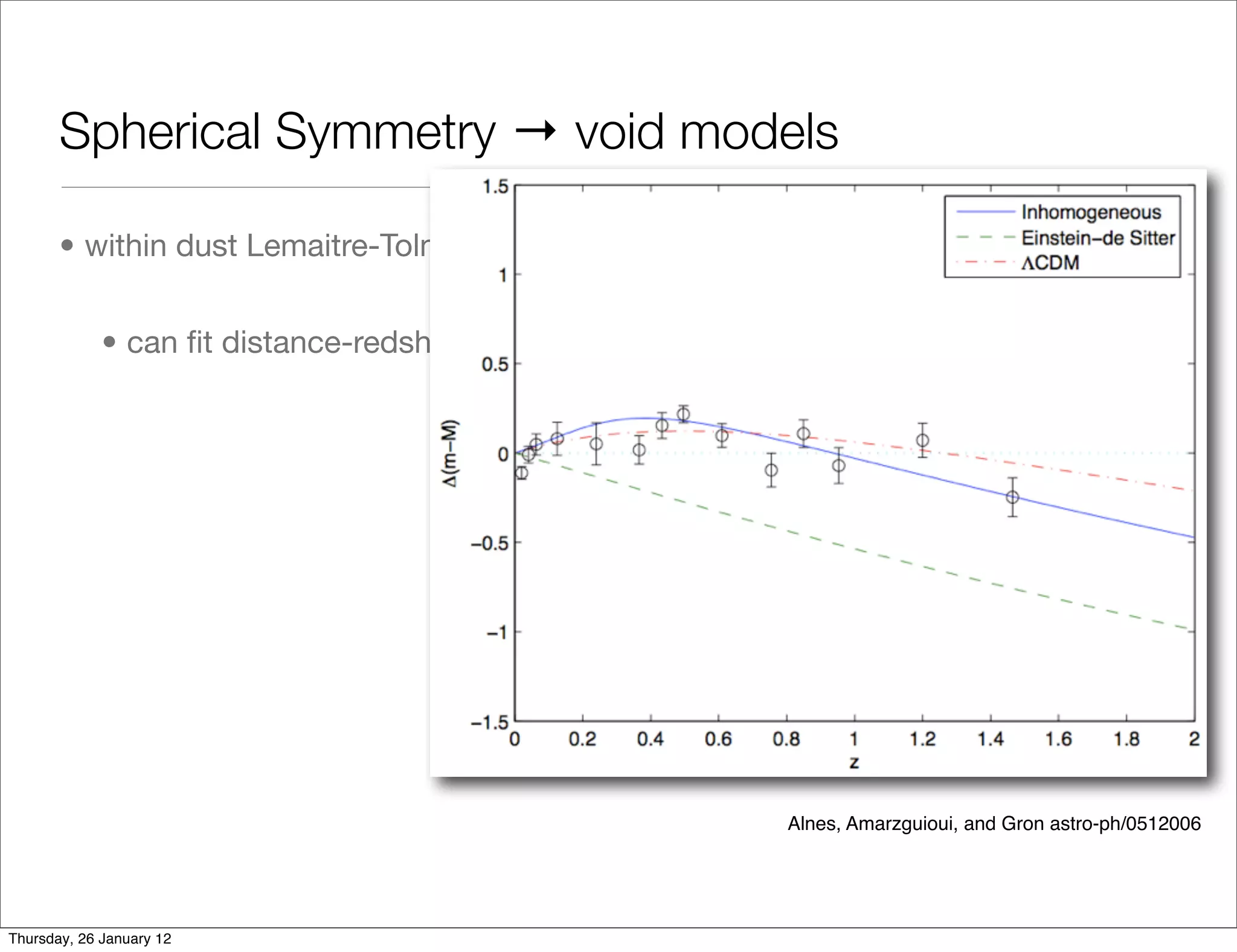
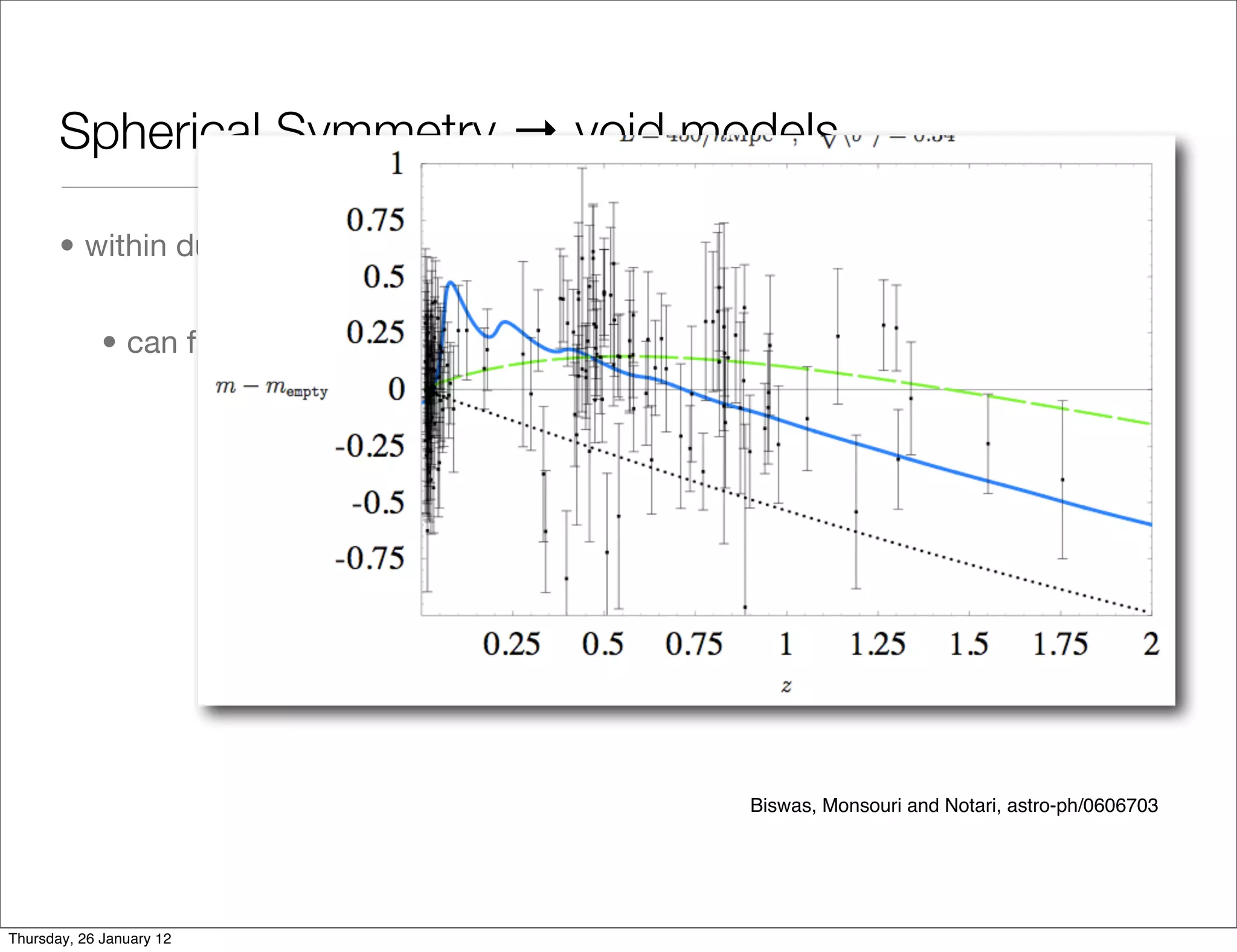
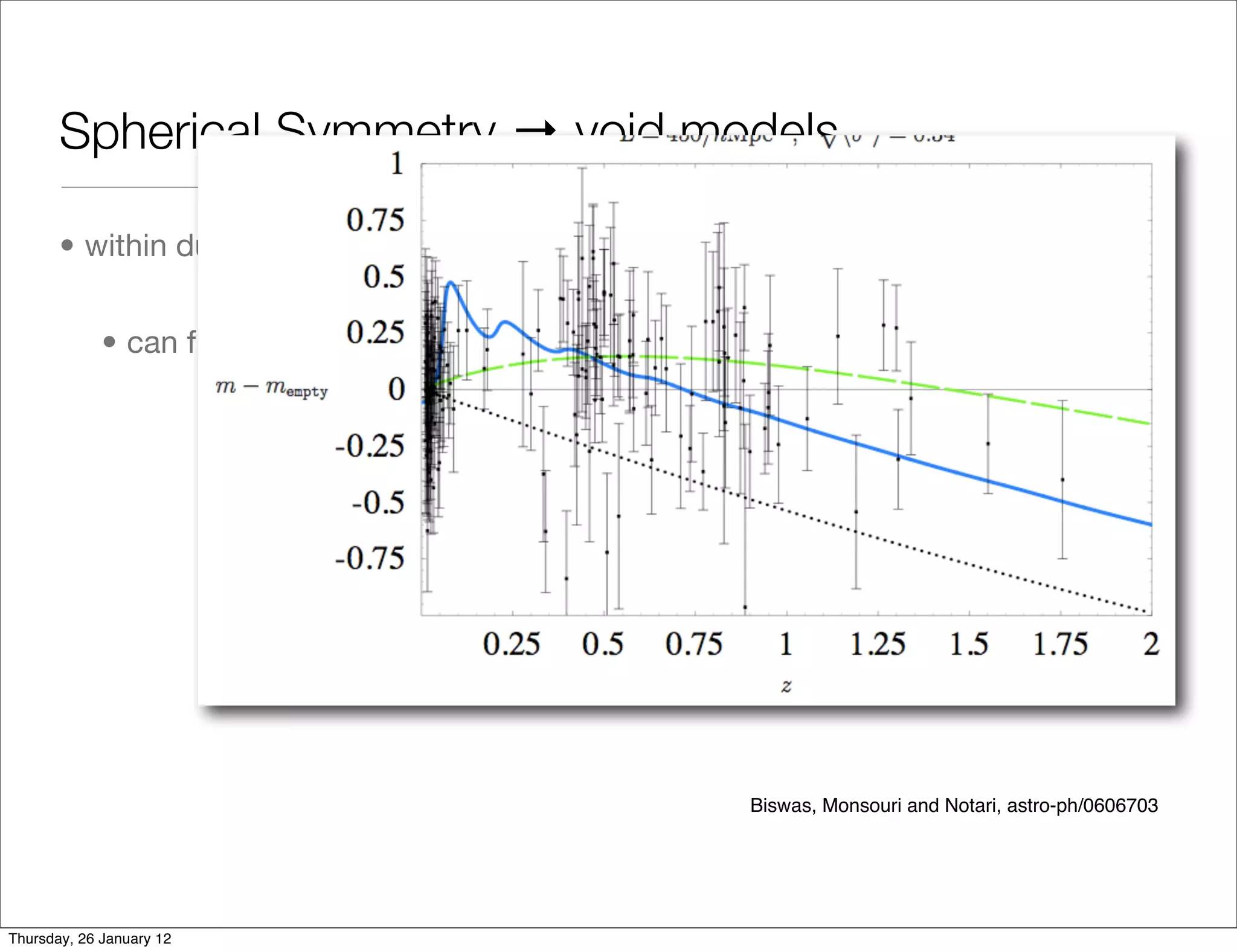
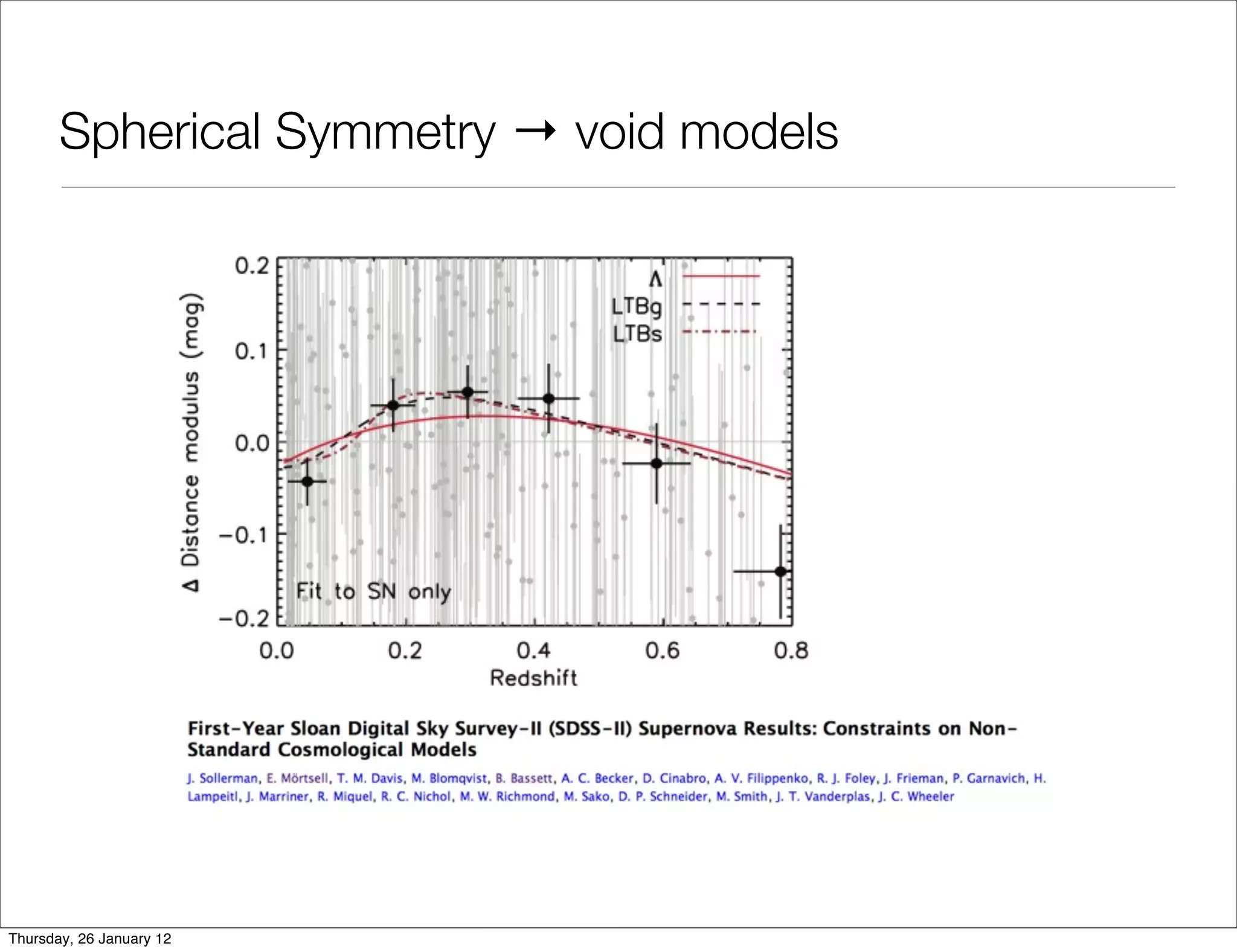
Spherical Symmetry → void models

       • within dust Lemaitre-Tolman-Bondi models - 2 free radial dof


             • can fit distance-redshift data to any FLRW DE model

                                                             Mustapha, Hellaby, & Ellis


Thursday, 26 January 12
Spherical Symmetry → void models

       • within dust Lemaitre-Tolman-Bondi models - 2 free radial dof


             • can fit distance-redshift data to any FLRW DE model

                                                             Mustapha, Hellaby, & Ellis


Thursday, 26 January 12
Spherical Symmetry → void models

       • within dust Lemaitre-Tolman-Bondi models - 2 free radial dof


             • can fit distance-redshift data to any FLRW DE model

                                                             Mustapha, Hellaby, & Ellis


Thursday, 26 January 12
Spherical Symmetry → void models

       • within dust Lemaitre-Tolman-Bondi models - 2 free radial dof


             • can fit distance-redshift data to any FLRW DE model

                                                             Mustapha, Hellaby, & Ellis


                                                           Alnes, Amarzguioui, and Gron astro-ph/0512006


Thursday, 26 January 12
Spherical Symmetry → void models

       • within dust Lemaitre-Tolman-Bondi models - 2 free radial dof


             • can fit distance-redshift data to any FLRW DE model

                                                               Mustapha, Hellaby, & Ellis


                                                         Biswas, Monsouri and Notari, astro-ph/0606703


Thursday, 26 January 12
z jump =0.085 ; ∆CENTRE =-0.48
       Spherical Symmetry → void models
                          0.75
                                                      0.5
                                       0.25
       • within dust Lemaitre-Tolman-Bondi models - 2 free radial dof
                                                         0
                                               m
                                                    -0.25
             • can fit distance-redshift data to any FLRW DE model
                                                     -0.5
                                                    -0.75                             Mustapha, Hellaby, & Ellis
                                                        -1
                                                             0        0.25    0.5     0.75          1      1.25     1.5   1.75
                                                                                                z
                                                                     1
                                                                  0.75
                                                                    0.5
                                                                  0.25
                                                             ∆Ρ
                                                                     0
                                                              Ρ
                                                                  -0.25
                                                                   -0.5
                                                                  -0.75
                                                                                Biswas, Monsouri and Notari, astro-ph/0606703
                                                                          0    0.02      0.04           0.06      0.08
                                                                                            z

                           FIG. 3: In the upper plot we show a fit of the Supernovae data (Riess et al. [28]) with an LTB model which has χ2 =
                           d.o.f. are 181). The inhomogeneous patch extends up to z     0.085 and the underdensity in the center is δCENTRE
Thursday, 26 January 12    We have shown ∆m ≡ m − mempty : the magnitude (m ≡ 5Log10 DL ) minus the magnitude of an empty open FLRW
Spherical Symmetry → void models

       • within dust Lemaitre-Tolman-Bondi models - 2 free radial dof


             • can fit distance-redshift data to any FLRW DE model

                                                               Mustapha, Hellaby, & Ellis


                                                         Biswas, Monsouri and Notari, astro-ph/0606703


Thursday, 26 January 12
Spherical Symmetry → void models

       • within dust Lemaitre-Tolman-Bondi models - 2 free radial dof


             • can fit distance-redshift data to any FLRW DE model

                                                             Mustapha, Hellaby, & Ellis


Thursday, 26 January 12
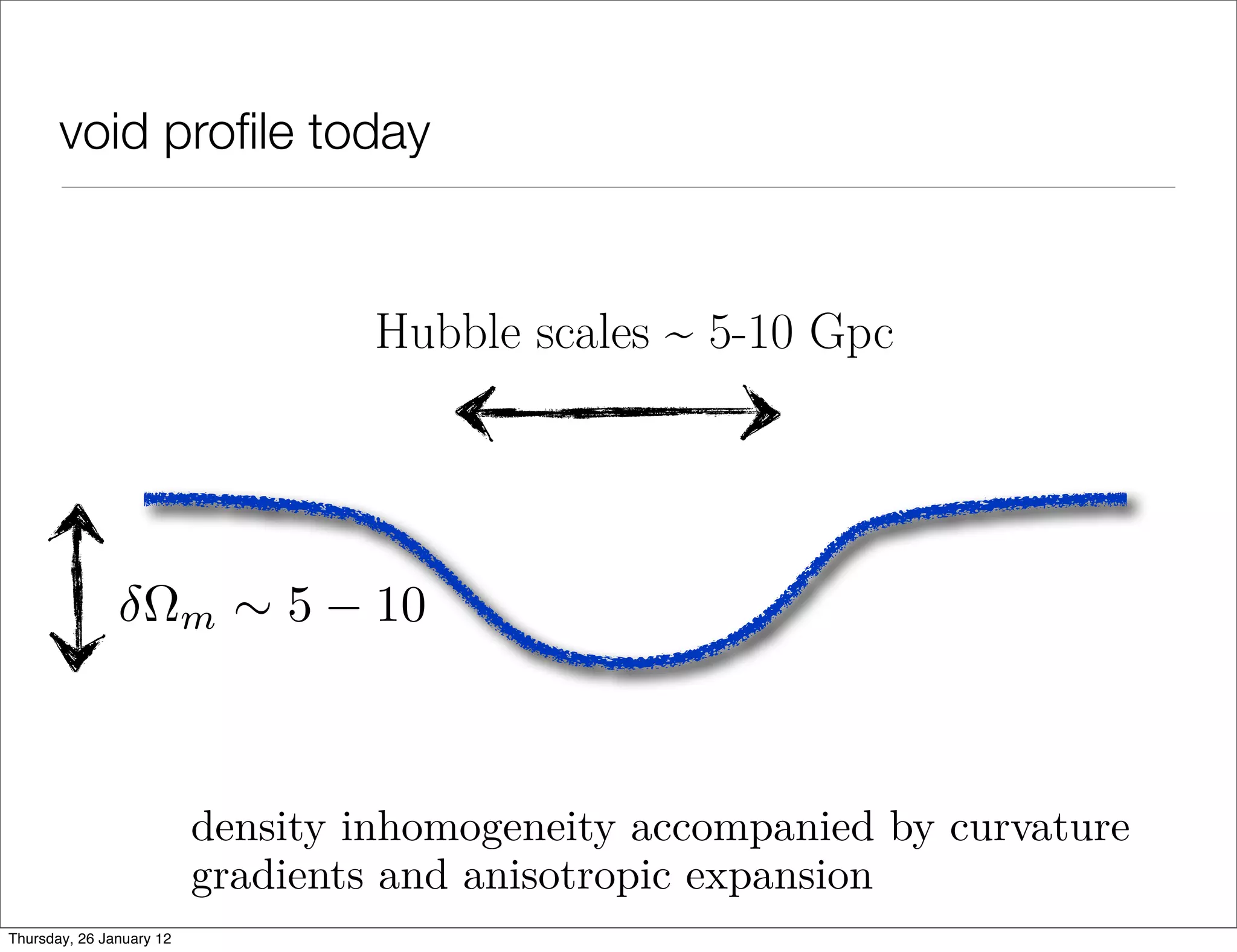
void profile today


                                  Hubble scales ~ 5-10 Gpc


                          density inhomogeneity accompanied by curvature
                          gradients and anisotropic expansion
Thursday, 26 January 12
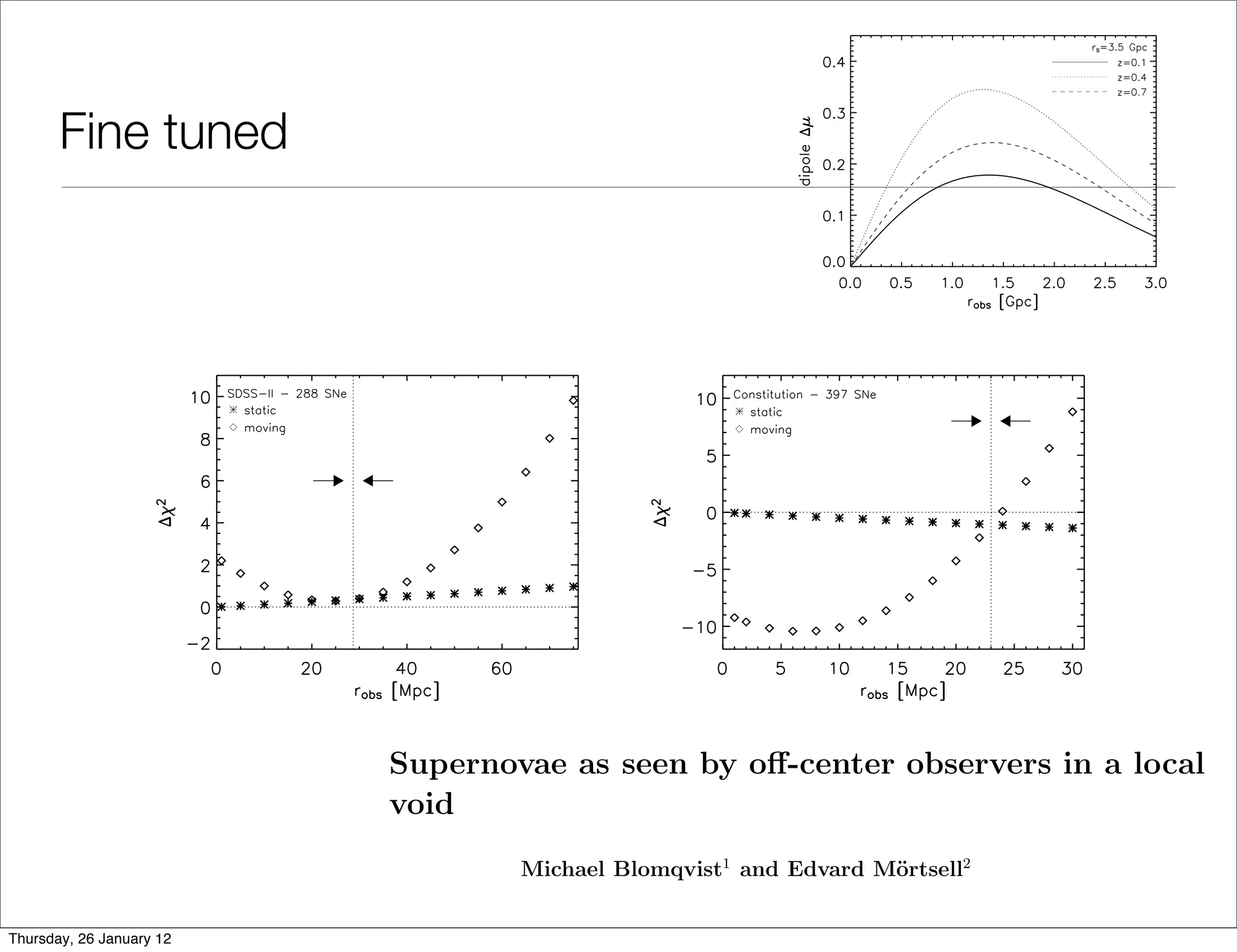
Fine tuned


            Supernovae as seen by off-center observers in a local void                                                    15

                                             Figure 4. Magnitude dipole induced by moving the observer away from the void
                                             center in the best fit on-center models. The curves show the difference in magnitude
                                             for two SNe Ia with the same redshift but in opposite directions in the sky. Left panel:
                                             A void with scale radius rs = 0.7 Gpc (z ≈ 0.18), preferred by the SDSS-II data
                                             set. Right panel: A void with scale radius rs = 3.5 Gpc (z ≈ 1.02), preferred by the
                                             Constitution data set.


                                  6. Constraining the observer position with SNe Ia

                                Off-center observers will see an anisotropic relation between the luminosity distance
                                and the redshift for the SNe Ia. This means that a standard candle with the same
                                redshift but in different directions in the sky will have different observed magnitudes.
                                The isotropy of the data can be used to establish constraints on the observer position
                          Figure 6. The void. In this section, we will investigate how farIa as a functionin the local
                                inside the changes in the as values for theoff-center observers of a
                                       Supernovae χ2 seen by fit to the SNe from the center the observer
                          observer’sbe located.
                                can position. The stars show the values when the static observer is displaced in
                                       void
                            Sep 2009


                          the direction of the CMB dipole in the best fit on-center LTB model. The diamonds
                          show the values when anisotropy also has a peculiar velocity directed 2to accommodate
                                6.1. Maximum the observer
                                                    Michael Blomqvist1 and Edvard M¨rtsell      o
                          the observed CMB dipole. The arrows indicate the direction of motion, either away
                                To get a sense for 1 The Oskarthe effect of being situated off-center has of Astronomy, Ia
                                                    how big Klein Centre for Cosmoparticle Physics, Department on the SN
                          from the void center or towards it. The vertical dotted line Center the position where
                                                    Stockholm University, AlbaNova University
                                                                                              shows
Thursday, 26 January 12         observations, we can calculate the maximum anisotropy in the form of the magnitude
                          the peculiar velocity is zero. The scale radius of the void is r = 5.0 Gpc for the
problem: anti-Copernican


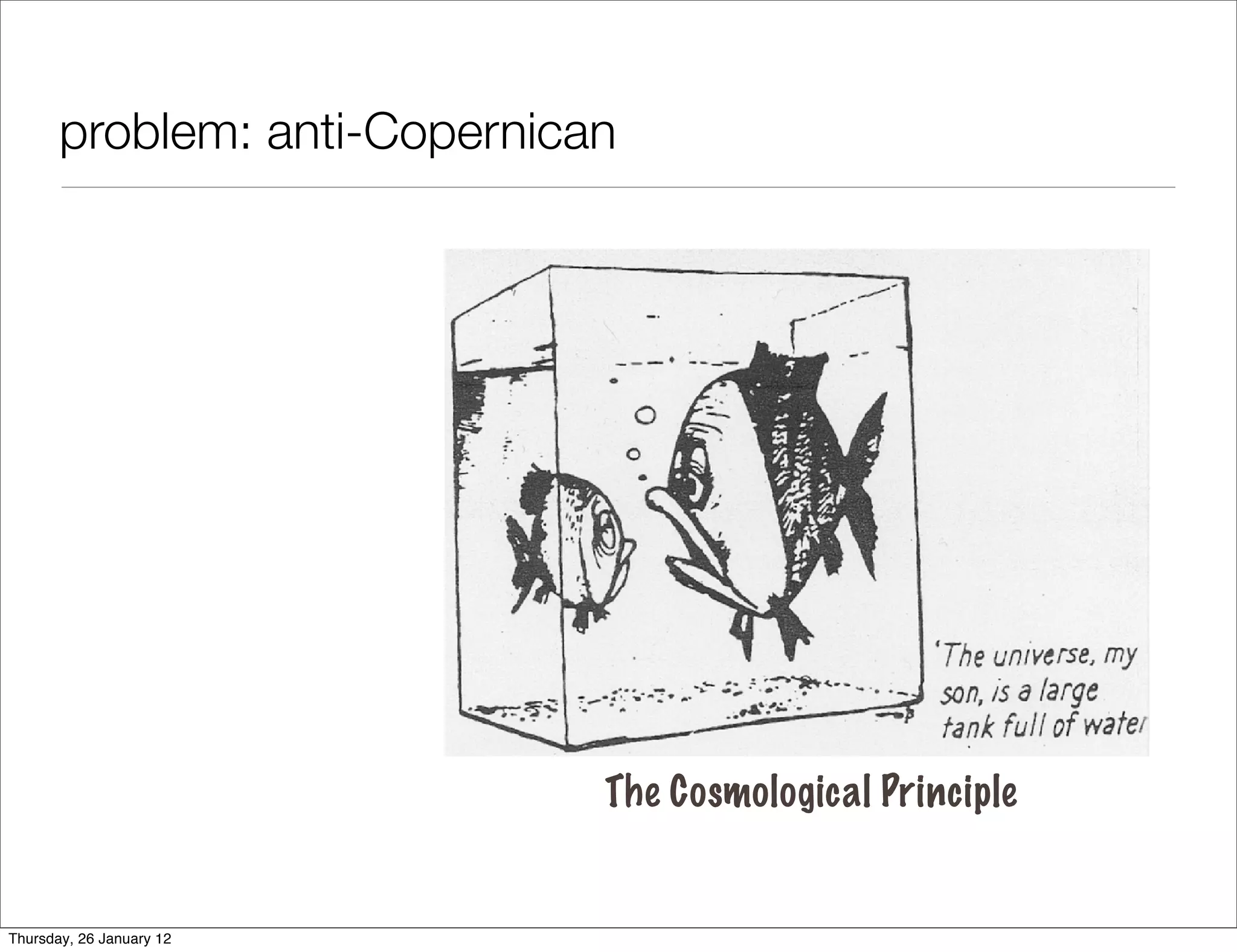
                              The Cosmological Principle


Thursday, 26 January 12
problem: anti-Copernican

       • Copernican P says we are not at special place in universe


       • Λ introduced for temporal CP ...


Thursday, 26 January 12
“Never let anyone tell
   you you’re crazy”
   Prof. Bob Nichol


Thursday, 26 January 12
Are void models ridiculous?

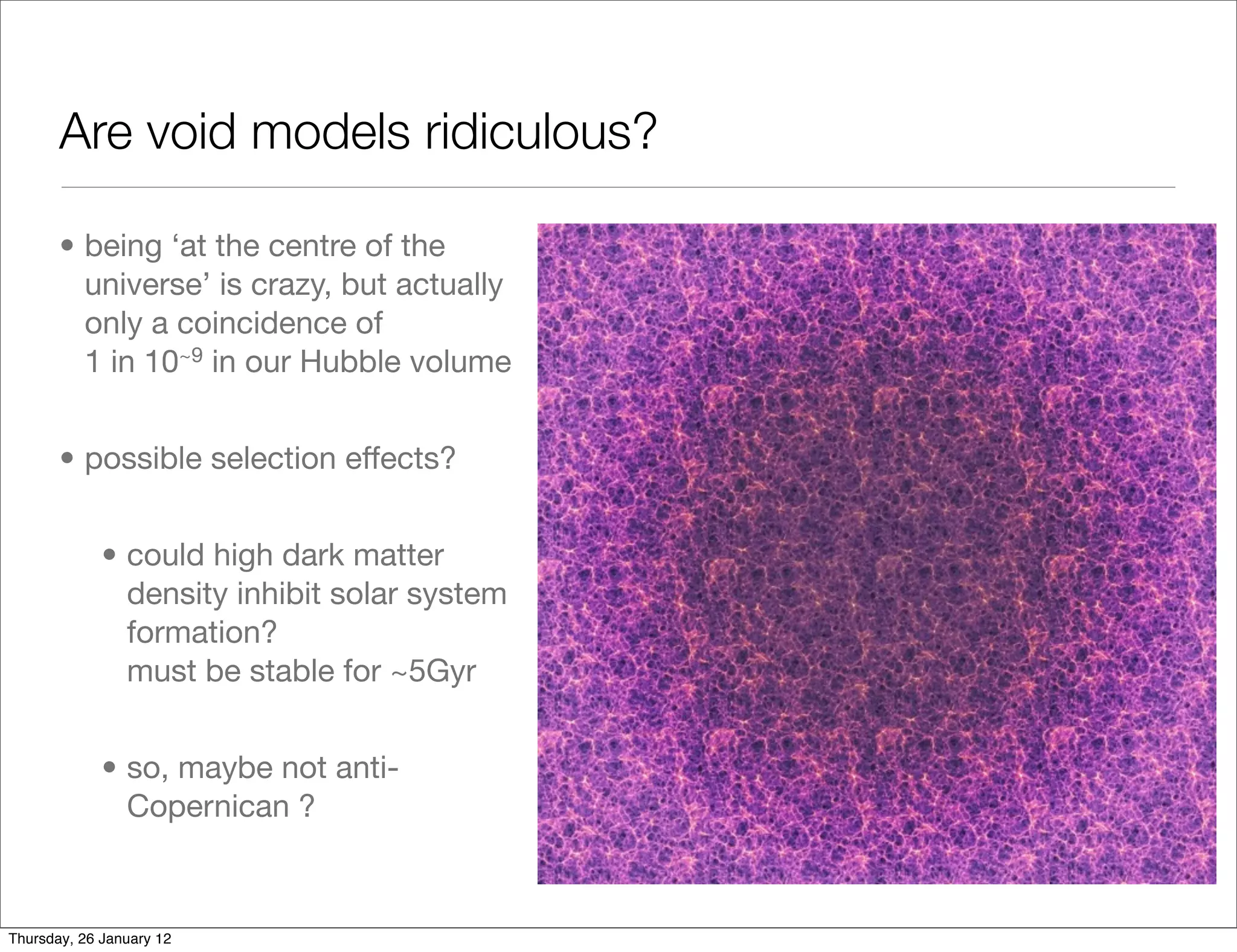
       • being ‘at the centre of the
         universe’ is crazy, but actually
         only a coincidence of
         1 in 10~9 in our Hubble volume


       • possible selection effects?


             • could high dark matter
               density inhibit solar system
               formation?
               must be stable for ~5Gyr


             • so, maybe not anti-
               Copernican ?


Thursday, 26 January 12
Isn’t this a bit silly?


Thursday, 26 January 12
Isn’t this a bit silly?
      • Yes


Thursday, 26 January 12
Isn’t this a bit silly?
      • Yes


      • But:


            • we should be able to rule all void models out observationally - tests CP


            • helps make data ‘cosmology independent’ (eg, compare SNIa vs BAO)


            • provides alternative probe of coincidence problem which can be tested


                  • unusual DE interpretation without LCDM as fixed point - only DE model
                    with known physics at late times


      • can we construct a void which fits all observations? [v fine-tuned?]

Thursday, 26 January 12
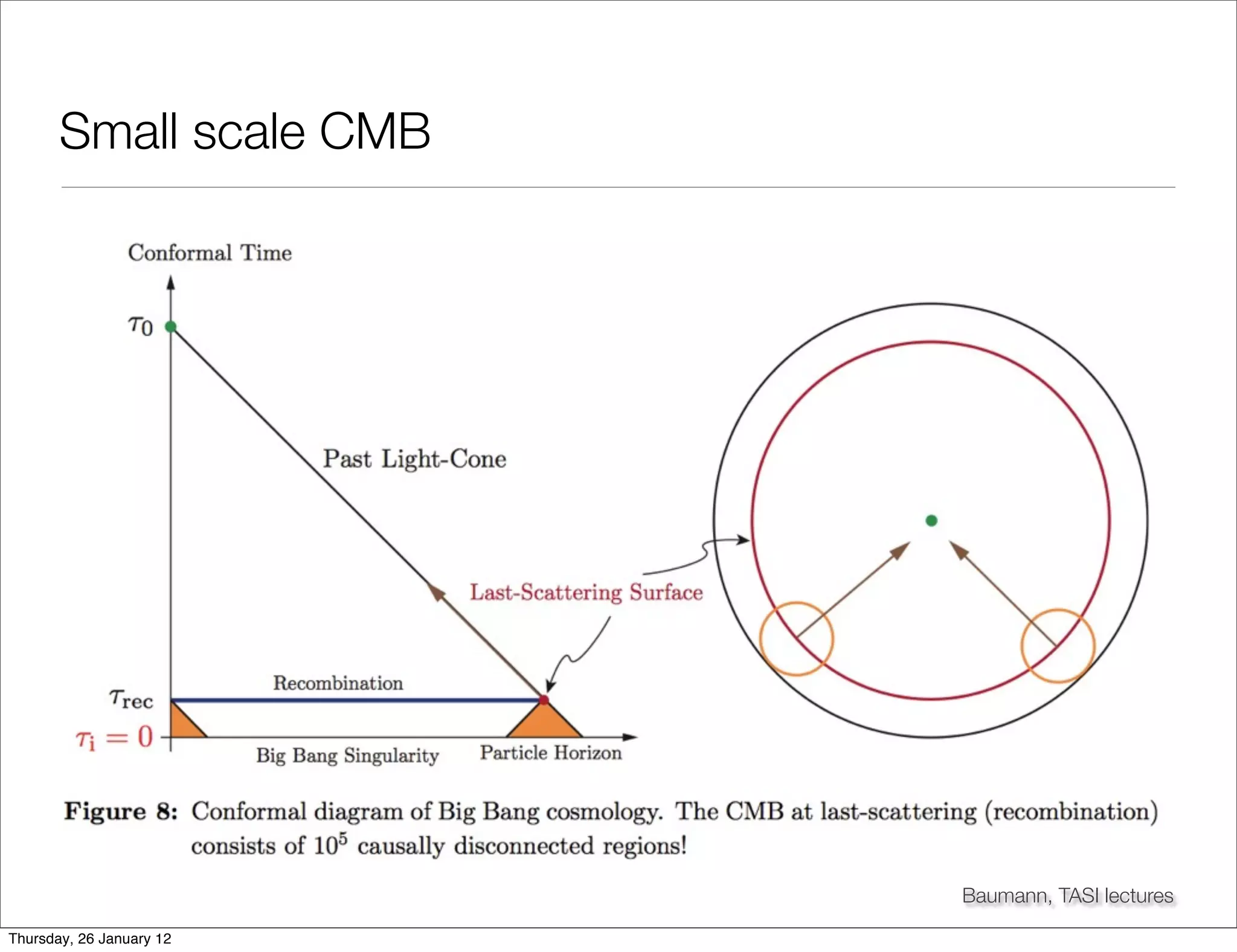
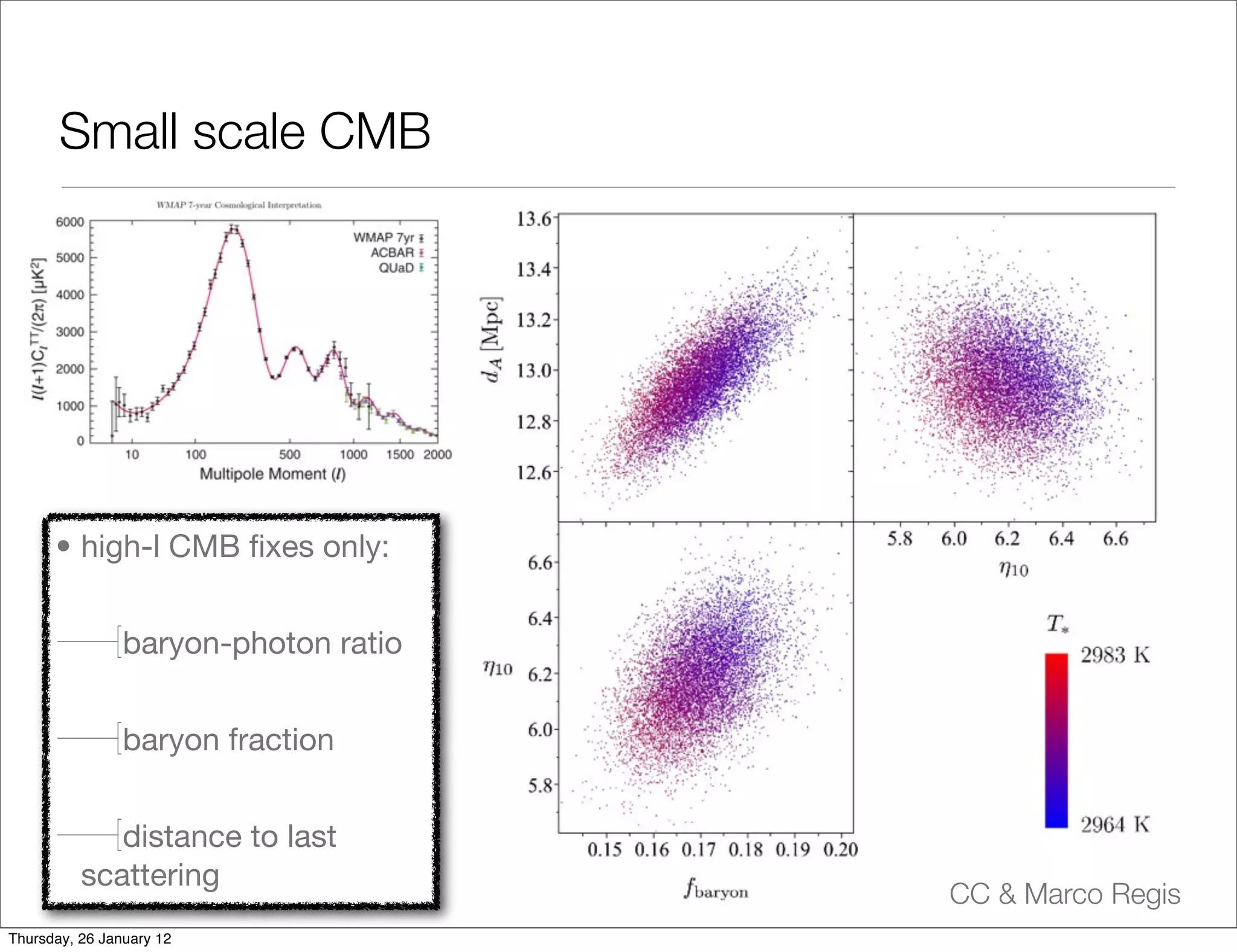
Small scale CMB


                          Baumann, TASI lectures

Thursday, 26 January 12
Small scale CMB


      • high-l CMB fixes only:


                baryon-photon ratio


                baryon fraction


             distance to last
          scattering
                                      CC & Marco Regis
Thursday, 26 January 12
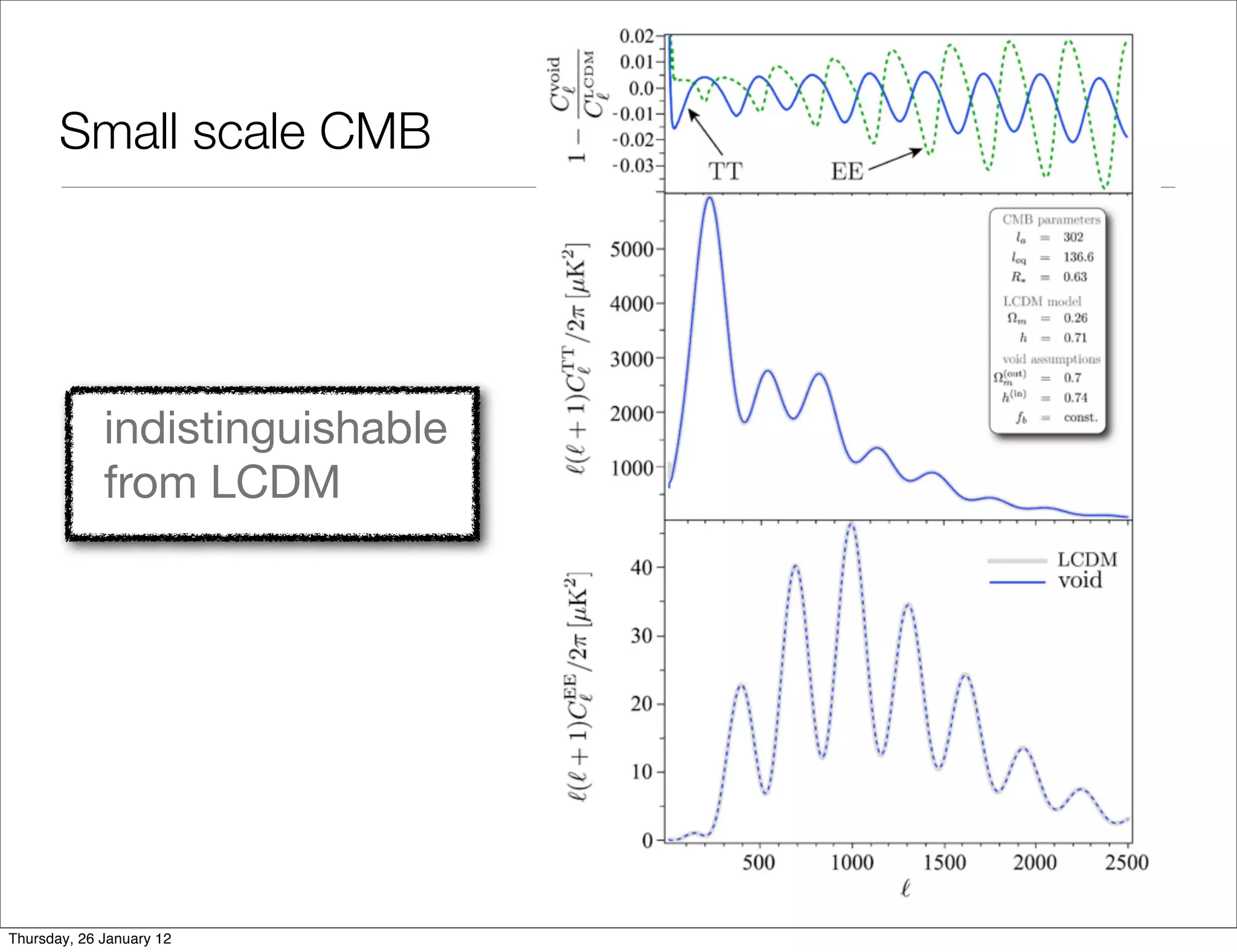
Small scale CMB


             indistinguishable
             from LCDM


Thursday, 26 January 12
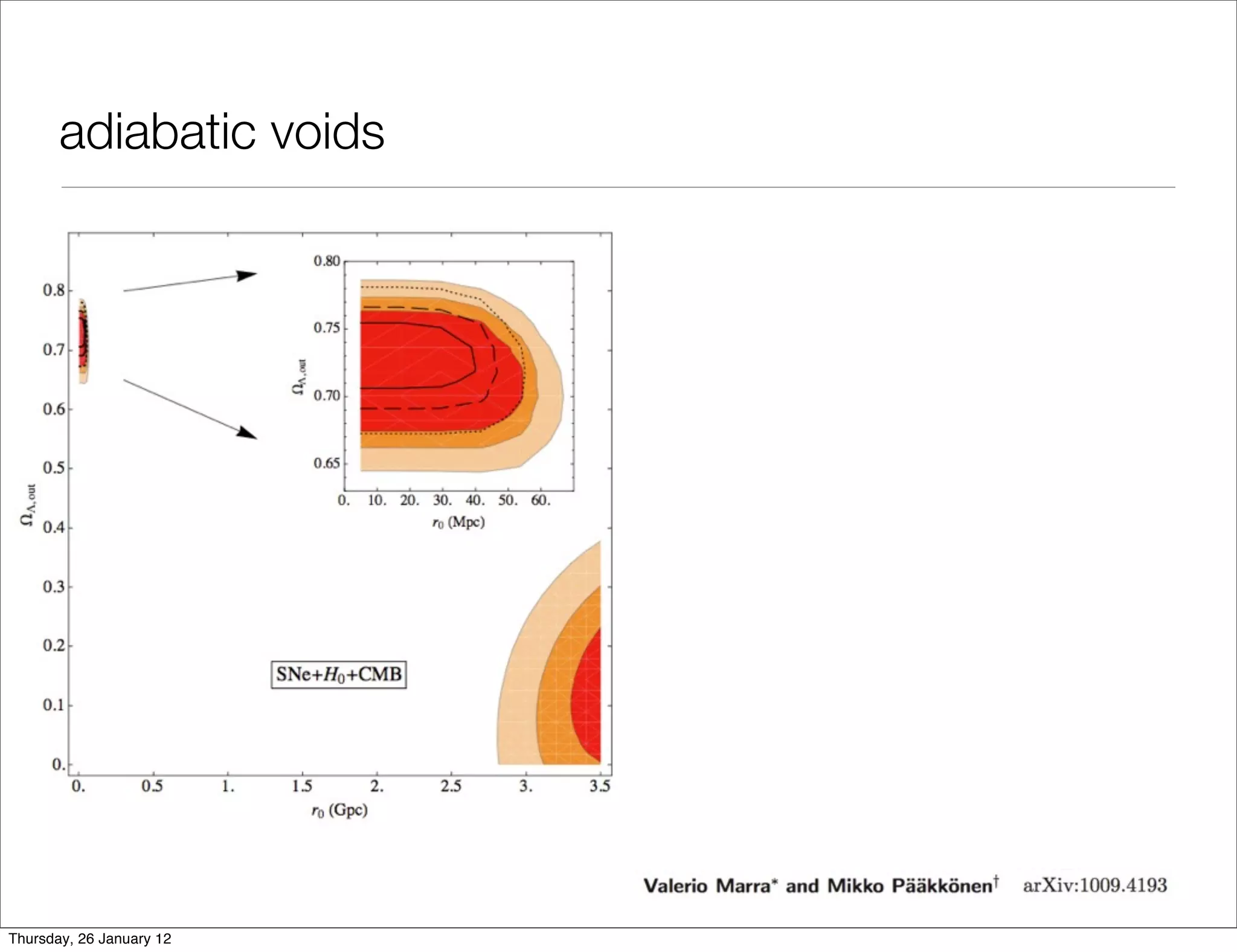
adiabatic voids


Thursday, 26 January 12
Lithium problem → inhomogeneity at early times?

    • a Gpc fluctuation in baryon-photon ratio solves Li problem


                 FIG. 1: Constraints on . Top left we estimate current constraints on 10 = 1010 from di erent
                        7    Do primordial Lithium abundances imply there’s no Dark Energy?
                 from Li observations [10] in Galactic globular clusters and Galactic halo are shown separately, alon
                 These agree with each other if 10 ⇠ 4. Local measurements of D are very uncertain [8] though they
                                                        Marco Regis and Chris Clarkson
                 assume the rather precise value we show (from Cosmology analyses inCentre,and an astration factor (i.e.
                                                  Astrophysics,
                                                                Bayesian & Gravity [11]) and,
Thursday, 26 January 12
                 formation in our Galaxy) of f ⇠ 2 3. (Or, alternatively, a smaller f [12] with a slightly di erent v
Lithium problem → inhomogeneity at early times?

    • a Gpc fluctuation in baryon-photon ratio solves Li problem


                 FIG. 1: Constraints on . Top left we estimate current constraints on 10 = 1010 from di erent
                        7    Do primordial Lithium abundances imply there’s no Dark Energy?
                 from Li observations [10] in Galactic globular clusters and Galactic halo are shown separately, alon
                 These agree with each other if 10 ⇠ 4. Local measurements of D are very uncertain [8] though they
                                                        Marco Regis and Chris Clarkson
                 assume the rather precise value we show (from Cosmology analyses inCentre,and an astration factor (i.e.
                                                  Astrophysics,
                                                                Bayesian & Gravity [11]) and,
Thursday, 26 January 12
                 formation in our Galaxy) of f ⇠ 2 3. (Or, alternatively, a smaller f [12] with a slightly di erent v
Lithium problem → inhomogeneity at early times?

    • a Gpc fluctuation in baryon-photon ratio solves Li problem


                 FIG. 1: Constraints on . Top left we estimate current constraints on 10 = 1010 from di erent
                        7    Do primordial Lithium abundances imply there’s no Dark Energy?
                 from Li observations [10] in Galactic globular clusters and Galactic halo are shown separately, alon
                 These agree with each other if 10 ⇠ 4. Local measurements of D are very uncertain [8] though they
                                                        Marco Regis and Chris Clarkson
                 assume the rather precise value we show (from Cosmology analyses inCentre,and an astration factor (i.e.
                                                  Astrophysics,
                                                                Bayesian & Gravity [11]) and,
Thursday, 26 January 12
                 formation in our Galaxy) of f ⇠ 2 3. (Or, alternatively, a smaller f [12] with a slightly di erent v
Lithium problem → inhomogeneity at early times?

    • a Gpc fluctuation in baryon-photon ratio solves Li problem


                 FIG. 1: Constraints on . Top left we estimate current constraints on 10 = 1010 from di erent
                        7    Do primordial Lithium abundances imply there’s no Dark Energy?
                 from Li observations [10] in Galactic globular clusters and Galactic halo are shown separately, alon
                 These agree with each other if 10 ⇠ 4. Local measurements of D are very uncertain [8] though they
                                                        Marco Regis and Chris Clarkson
                 assume the rather precise value we show (from Cosmology analyses inCentre,and an astration factor (i.e.
                                                  Astrophysics,
                                                                Bayesian & Gravity [11]) and,
Thursday, 26 January 12
                 formation in our Galaxy) of f ⇠ 2 3. (Or, alternatively, a smaller f [12] with a slightly di erent v
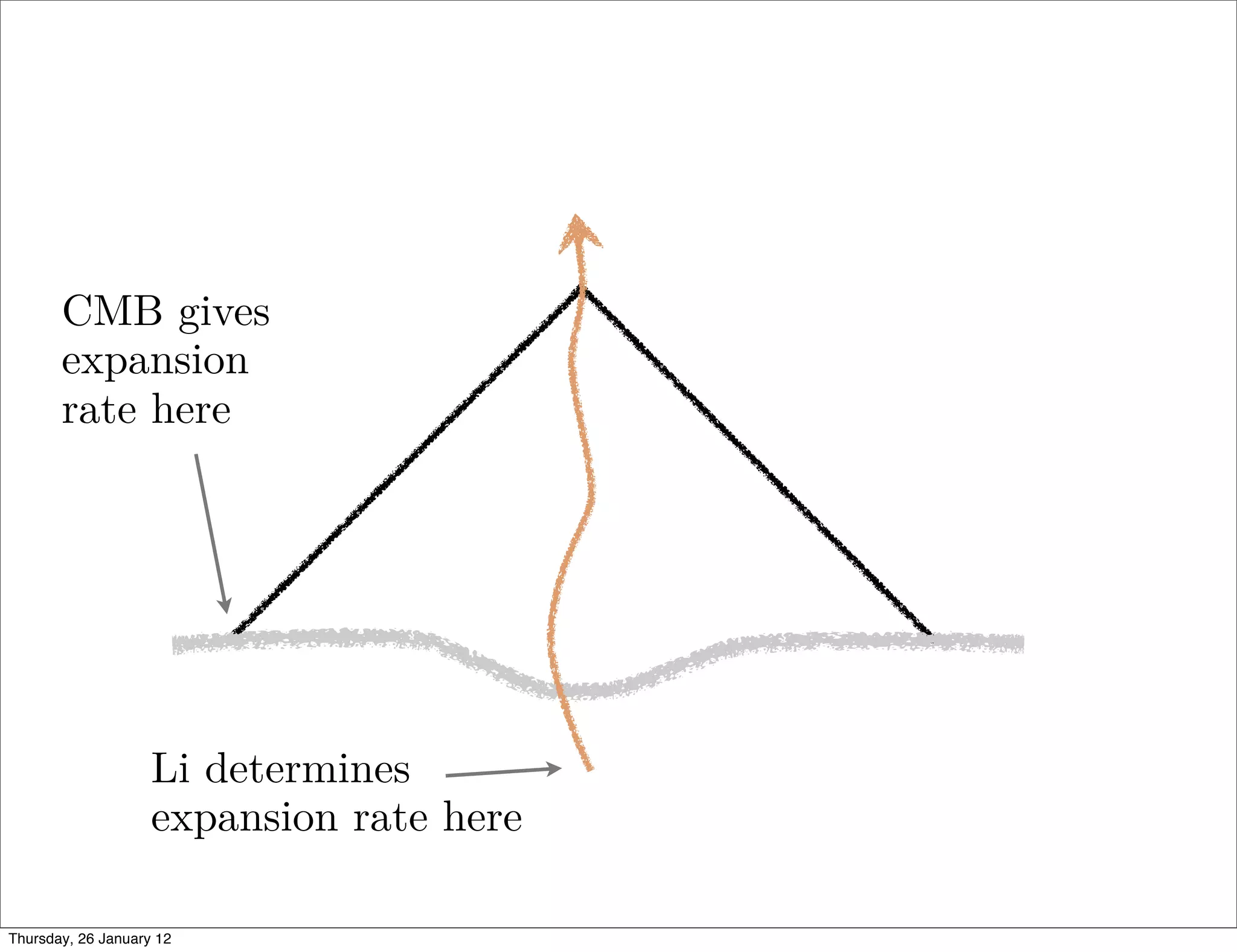
CMB gives
       expansion
       rate here


                    Li determines
                    expansion rate here

Thursday, 26 January 12
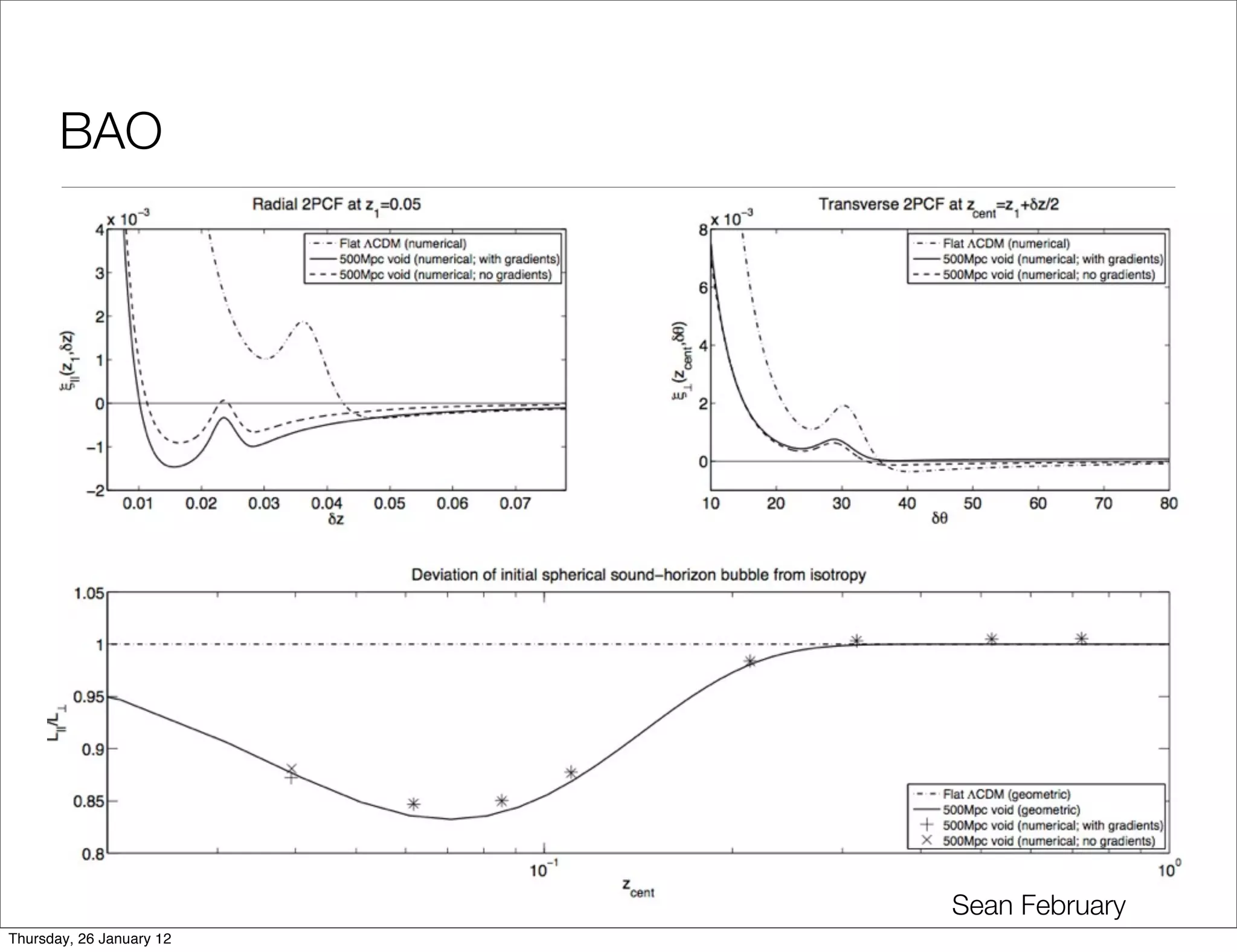
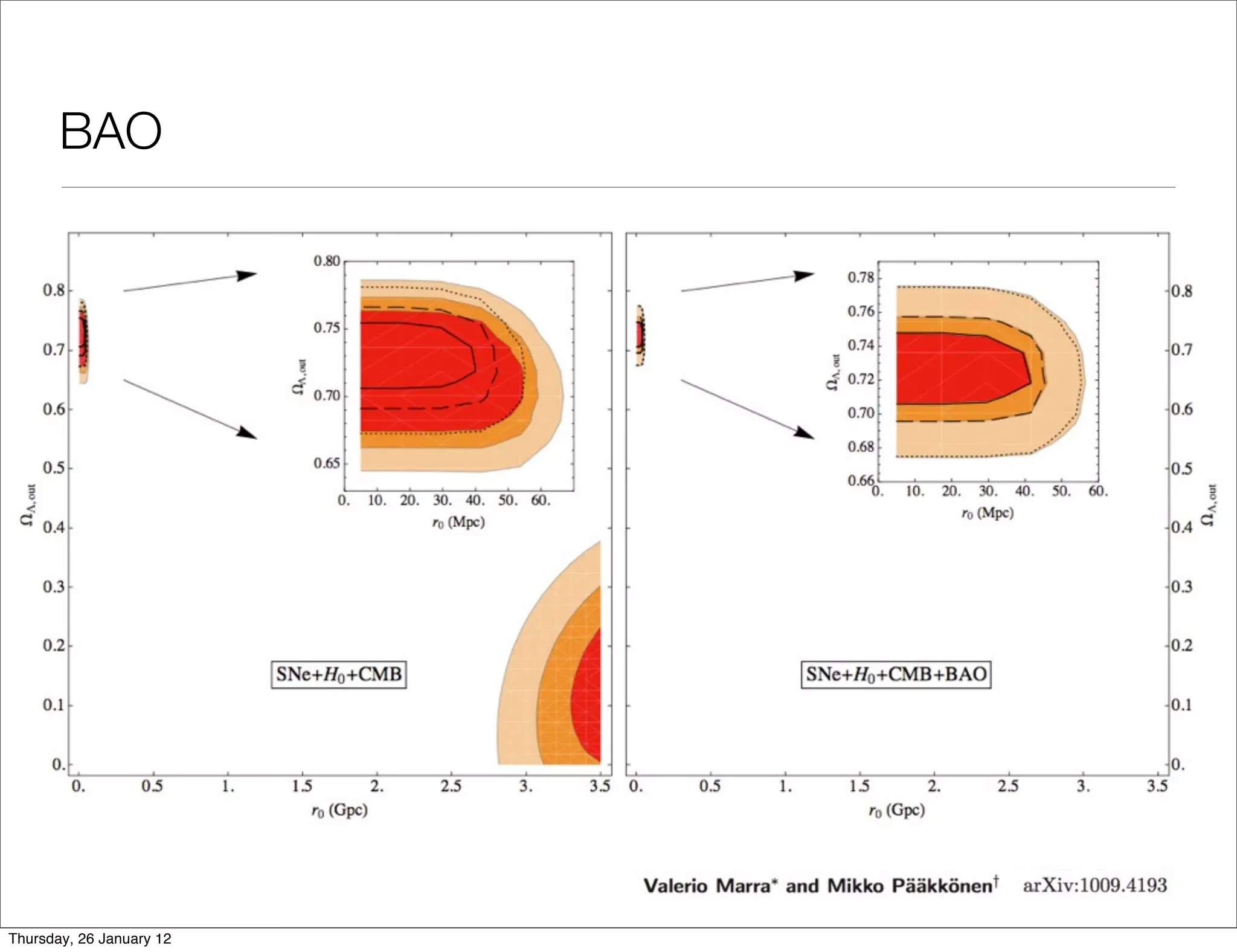
BAO


                          Sean February
Thursday, 26 January 12
BAO


Thursday, 26 January 12
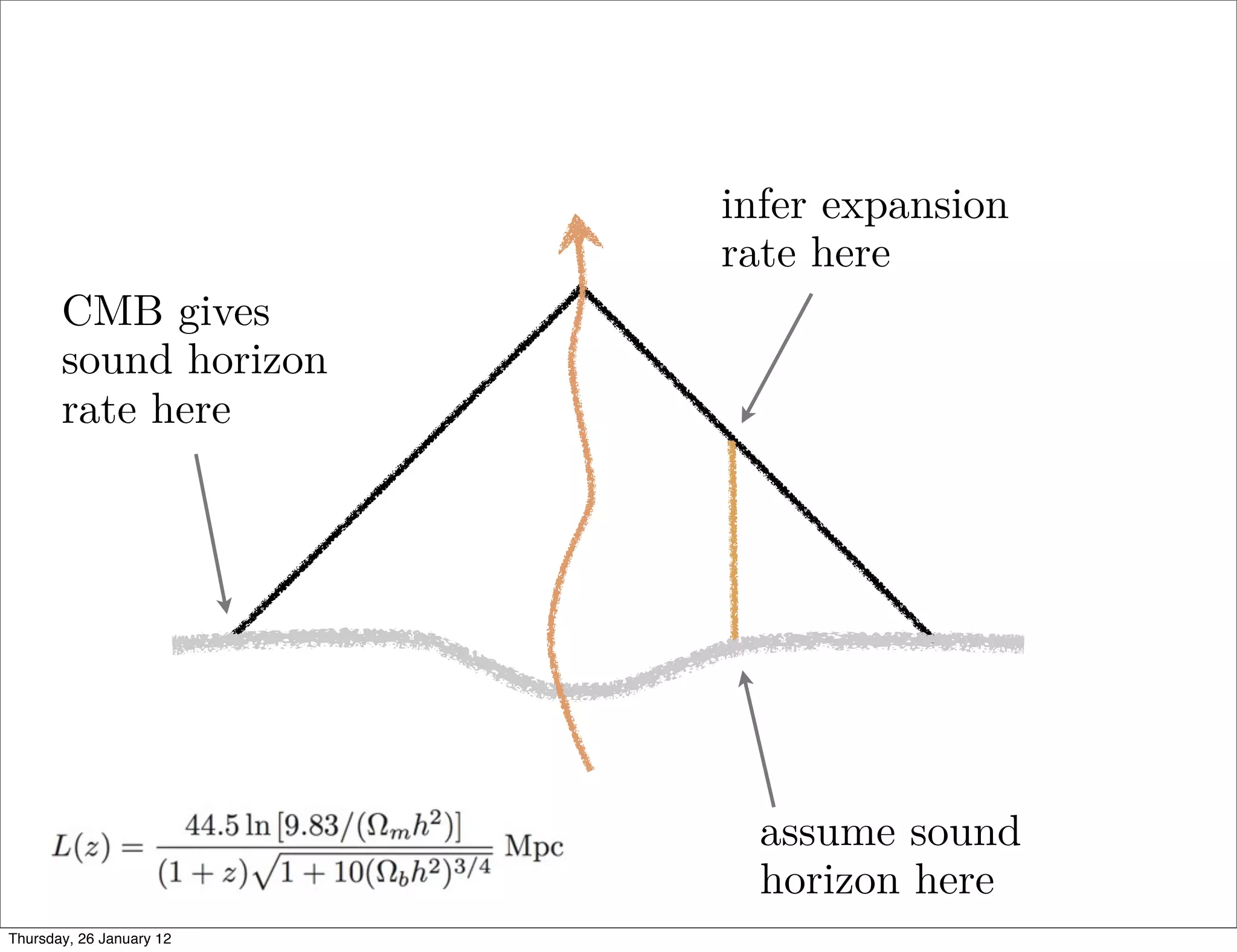
infer expansion
                          rate here
       CMB gives
       sound horizon
       rate here


                            assume sound
                            horizon here
Thursday, 26 January 12
e 2. Examples of the size of the dipole for different parameters of the constrained
model [19]. strong constraint left figure is the first order approximation
     kSZ The dashed line in the
n [30].

            • kSZ (and SZ) effect can look inside our past lightcone
                                                                                                              !in=0.23, r0=1.8, H0=0.65, "r/r0=0.35
 e void in90 eyes - the kSZ effect in LTB models
           the                                                                                            6
                                                                                                   8
            60

                                                                                                   6

            30                                                                                     4

                                                                                  vP [1000 km/s]
                                                                                                   2
            0             -45            -90           -135
                                                                                                   0


                                                                                                   -2
            -30
      Figure 1. An off-centre cluster of galaxies in a void will “observe” CMB photons
                                                                                       -4
      coming from the last scattering surface from all directions. Due to the higher expansion
      rate inside the void, photons arriving through the centre (from the right in the figure)
      will have a larger redshift (∆zin ), than photons arriving directly from the LSS (left,
            -60
                                                                                       -6
      with ∆zout ). There is a subdominant effect due to the time-dependent density profile
                                                                                         0.0
      (the solid line corresponds to the current time, while the dot-dashed line to one tenth of                   0.2                   0.4          0.6
      the present time). With a larger underdensity at later times, we have ∆z1 > ∆z4 , and
            -90                                                                                                             Redshift
      ∆z2 + ∆z3 < 0, giving an overall difference ∆z1 > ∆z2 + ∆z3 + ∆z4 or, equivalently, a
             Looking the void in the eyes - the kSZ effect in LTB
      subdominant dipole with a blueshift towards the centre of the void. The overall effect
      is a blueshift away from the centre.
             models
e 3. The angular and redshift distribution of current observations together with
                                                              1                                         1,2
  quently, in the ideal case Juan Garc´void, and a well embedded cluster, the
                             of a sphericalıa-Bellido , Troels Haugbølle
 server will see an almost perfect dipole in the CMB, aligned along the radial parsec sized void model. Red triangles and
  dicted dipoleInstituto de 28049 Madrid, UAM-CSIC, a gigaAut´noma de Madrid,
                                1
                                 distribution for Universidad o
                                           F´ısica Te´rica
                                                     o
008


                             Cantoblanco,                  Spain,
  and with the blueshift pointing away from the centre of the void, where the
 suares26 January 12 Department of Physics and Astronomy,negative peculiar C,
   (see Fig. 1).represent of a spherical void and CMB sky of of Aarhus, DK-8000 Aarhus velocities respectively, with the
                 The detailed effect positive on the University an
                                2
   Thursday,
e 2. Examples of the size of the dipole for different parameters of the constrained
model [19]. strong constraint left figure is the first order approximation
     kSZ The dashed line in the
n [30].

            • kSZ (and SZ) effect can look inside our past lightcone
                                                                                                              !in=0.23, r0=1.8, H0=0.65, "r/r0=0.35
 e void in90 eyes - the kSZ effect in LTB models
           the                                                                                            6
                                                                                                   8
            60

                                                                                                   6

            30                                                                                     4

                                                                                  vP [1000 km/s]
                                                                                                   2
            0             -45            -90           -135
                                                                                                   0


                                                                                                   -2
            -30
      Figure 1. An off-centre cluster of galaxies in a void will “observe” CMB photons
                                                                                       -4
      coming from the last scattering surface from all directions. Due to the higher expansion
      rate inside the void, photons arriving through the centre (from the right in the figure)
      will have a larger redshift (∆zin ), than photons arriving directly from the LSS (left,
            -60
                                                                                       -6
      with ∆zout ). There is a subdominant effect due to the time-dependent density profile
                                                                                         0.0
      (the solid line corresponds to the current time, while the dot-dashed line to one tenth of                   0.2                   0.4          0.6
      the present time). With a larger underdensity at later times, we have ∆z1 > ∆z4 , and
            -90                                                                                                             Redshift
      ∆z2 + ∆z3 < 0, giving an overall difference ∆z1 > ∆z2 + ∆z3 + ∆z4 or, equivalently, a
             Looking the void in the eyes - the kSZ effect in LTB
      subdominant dipole with a blueshift towards the centre of the void. The overall effect
      is a blueshift away from the centre.
             models
e 3. The angular and redshift distribution of current observations together with
                                                              1                                         1,2
  quently, in the ideal case Juan Garc´void, and a well embedded cluster, the
                             of a sphericalıa-Bellido , Troels Haugbølle
 server will see an almost perfect dipole in the CMB, aligned along the radial parsec sized void model. Red triangles and
  dicted dipoleInstituto de 28049 Madrid, UAM-CSIC, a gigaAut´noma de Madrid,
                                1
                                 distribution for Universidad o
                                           F´ısica Te´rica
                                                     o
008


                             Cantoblanco,                  Spain,
  and with the blueshift pointing away from the centre of the void, where the
 suares26 January 12 Department of Physics and Astronomy,negative peculiar C,
   (see Fig. 1).represent of a spherical void and CMB sky of of Aarhus, DK-8000 Aarhus velocities respectively, with the
                 The detailed effect positive on the University an
                                2
   Thursday,
e 2. Examples of the size of the dipole for different parameters of the constrained
model [19]. strong constraint left figure is the first order approximation
     kSZ The dashed line in the
n [30].

            • kSZ (and SZ) effect can look inside our past lightcone
                                                                                                              !in=0.23, r0=1.8, H0=0.65, "r/r0=0.35
 e void in90 eyes - the kSZ effect in LTB models
           the                                                                                            6
                                                                                                   8
            60

                                                                                                   6

            30                                                                                     4

                                                                                  vP [1000 km/s]
                                                                                                   2
            0             -45            -90           -135
                                                                                                   0


                                                                                                   -2
            -30
      Figure 1. An off-centre cluster of galaxies in a void will “observe” CMB photons
                                                                                       -4
      coming from the last scattering surface from all directions. Due to the higher expansion
      rate inside the void, photons arriving through the centre (from the right in the figure)
      will have a larger redshift (∆zin ), than photons arriving directly from the LSS (left,
            -60
                                                                                       -6
      with ∆zout ). There is a subdominant effect due to the time-dependent density profile
                                                                                         0.0
      (the solid line corresponds to the current time, while the dot-dashed line to one tenth of                   0.2                   0.4          0.6
      the present time). With a larger underdensity at later times, we have ∆z1 > ∆z4 , and
            -90                                                                                                             Redshift
      ∆z2 + ∆z3 < 0, giving an overall difference ∆z1 > ∆z2 + ∆z3 + ∆z4 or, equivalently, a
             Looking the void in the eyes - the kSZ effect in LTB
      subdominant dipole with a blueshift towards the centre of the void. The overall effect
      is a blueshift away from the centre.
             models
e 3. The angular and redshift distribution of current observations together with
                                                              1                                         1,2
  quently, in the ideal case Juan Garc´void, and a well embedded cluster, the
                             of a sphericalıa-Bellido , Troels Haugbølle
 server will see an almost perfect dipole in the CMB, aligned along the radial parsec sized void model. Red triangles and
  dicted dipoleInstituto de 28049 Madrid, UAM-CSIC, a gigaAut´noma de Madrid,
                                1
                                 distribution for Universidad o
                                           F´ısica Te´rica
                                                     o
008


                             Cantoblanco,                  Spain,
  and with the blueshift pointing away from the centre of the void, where the
 suares26 January 12 Department of Physics and Astronomy,negative peculiar C,
   (see Fig. 1).represent of a spherical void and CMB sky of of Aarhus, DK-8000 Aarhus velocities respectively, with the
                 The detailed effect positive on the University an
                                2
   Thursday,
e 2. Examples of the size of the dipole for different parameters of the constrained
model [19]. strong constraint left figure is the first order approximation
     kSZ The dashed line in the
n [30].

            • kSZ (and SZ) effect can look inside our past lightcone
                                                                                                              !in=0.23, r0=1.8, H0=0.65, "r/r0=0.35
 e void in90 eyes - the kSZ effect in LTB models
           the                                                                                            6
                                                                                                   8
            60

                                                                                                   6

            30                                                                                     4

                                                                                  vP [1000 km/s]
                                                                                                   2
            0             -45            -90           -135
                                                                                                   0


                                                                                                   -2
            -30
      Figure 1. An off-centre cluster of galaxies in a void will “observe” CMB photons
                                                                                       -4
      coming from the last scattering surface from all directions. Due to the higher expansion
      rate inside the void, photons arriving through the centre (from the right in the figure)
      will have a larger redshift (∆zin ), than photons arriving directly from the LSS (left,
            -60
                                                                                       -6
      with ∆zout ). There is a subdominant effect due to the time-dependent density profile
                                                                                         0.0
      (the solid line corresponds to the current time, while the dot-dashed line to one tenth of                   0.2                   0.4          0.6
      the present time). With a larger underdensity at later times, we have ∆z1 > ∆z4 , and
            -90                                                                                                             Redshift
      ∆z2 + ∆z3 < 0, giving an overall difference ∆z1 > ∆z2 + ∆z3 + ∆z4 or, equivalently, a
             Looking the void in the eyes - the kSZ effect in LTB
      subdominant dipole with a blueshift towards the centre of the void. The overall effect
      is a blueshift away from the centre.
             models
e 3. The angular and redshift distribution of current observations together with
                                                              1                                         1,2
  quently, in the ideal case Juan Garc´void, and a well embedded cluster, the
                             of a sphericalıa-Bellido , Troels Haugbølle
 server will see an almost perfect dipole in the CMB, aligned along the radial parsec sized void model. Red triangles and
  dicted dipoleInstituto de 28049 Madrid, UAM-CSIC, a gigaAut´noma de Madrid,
                                1
                                 distribution for Universidad o
                                           F´ısica Te´rica
                                                     o
008


                             Cantoblanco,                  Spain,
  and with the blueshift pointing away from the centre of the void, where the
 suares26 January 12 Department of Physics and Astronomy,negative peculiar C,
   (see Fig. 1).represent of a spherical void and CMB sky of of Aarhus, DK-8000 Aarhus velocities respectively, with the
                 The detailed effect positive on the University an
                                2
   Thursday,
e 2. Examples of the size of the dipole for different parameters of the constrained
model [19]. strong constraint left figure is the first order approximation
     kSZ The dashed line in the
n [30].

            • kSZ (and SZ) effect can look inside our past lightcone
                                                                                                              !in=0.23, r0=1.8, H0=0.65, "r/r0=0.35
 e void in90 eyes - the kSZ effect in LTB models
           the                                                                                            6
                                                                                                   8
            60

                                                                                                   6

            30                                                                                     4

                                                                                  vP [1000 km/s]
                                                                                                   2
            0             -45            -90           -135
                                                                                                   0


                                                                                                   -2
            -30
      Figure 1. An off-centre cluster of galaxies in a void will “observe” CMB photons
                                                                                       -4
      coming from the last scattering surface from all directions. Due to the higher expansion
      rate inside the void, photons arriving through the centre (from the right in the figure)
      will have a larger redshift (∆zin ), than photons arriving directly from the LSS (left,
            -60
                                                                                       -6
      with ∆zout ). There is a subdominant effect due to the time-dependent density profile
                                                                                         0.0
      (the solid line corresponds to the current time, while the dot-dashed line to one tenth of                   0.2                   0.4          0.6
      the present time). With a larger underdensity at later times, we have ∆z1 > ∆z4 , and
            -90                                                                                                             Redshift
      ∆z2 + ∆z3 < 0, giving an overall difference ∆z1 > ∆z2 + ∆z3 + ∆z4 or, equivalently, a
             Looking the void in the eyes - the kSZ effect in LTB
      subdominant dipole with a blueshift towards the centre of the void. The overall effect
      is a blueshift away from the centre.
             models
e 3. The angular and redshift distribution of current observations together with
                                                              1                                         1,2
  quently, in the ideal case Juan Garc´void, and a well embedded cluster, the
                             of a sphericalıa-Bellido , Troels Haugbølle
 server will see an almost perfect dipole in the CMB, aligned along the radial parsec sized void model. Red triangles and
  dicted dipoleInstituto de 28049 Madrid, UAM-CSIC, a gigaAut´noma de Madrid,
                                1
                                 distribution for Universidad o
                                           F´ısica Te´rica
                                                     o
008


                             Cantoblanco,                  Spain,
  and with the blueshift pointing away from the centre of the void, where the
 suares26 January 12 Department of Physics and Astronomy,negative peculiar C,
   (see Fig. 1).represent of a spherical void and CMB sky of of Aarhus, DK-8000 Aarhus velocities respectively, with the
                 The detailed effect positive on the University an
                                2
   Thursday,
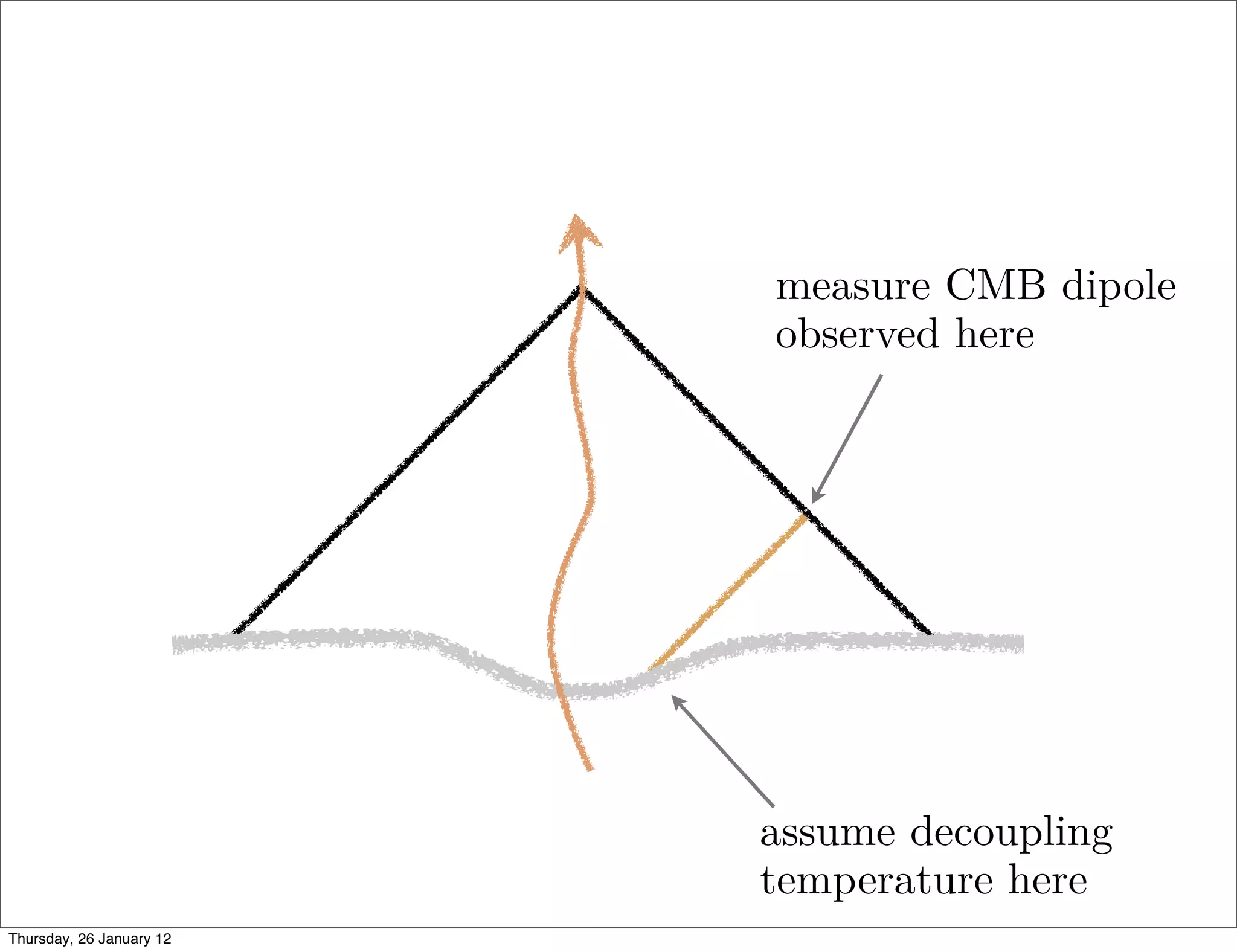
measure CMB dipole
                          observed here


                          assume decoupling
                          temperature here
Thursday, 26 January 12
so...	

       • voids fit key background observations [just!]: SN+H0+CMB


       • but simplest ‘adiabatic’ voids ruled out - probably not solution to DE!


             • they assume everything homogeneous except matter density


             • does that make sense?


       • if we don’t have a theory to make a void, we can only make a map of it


       • everything could be inhomogeneous ... what measures what?


Thursday, 26 January 12
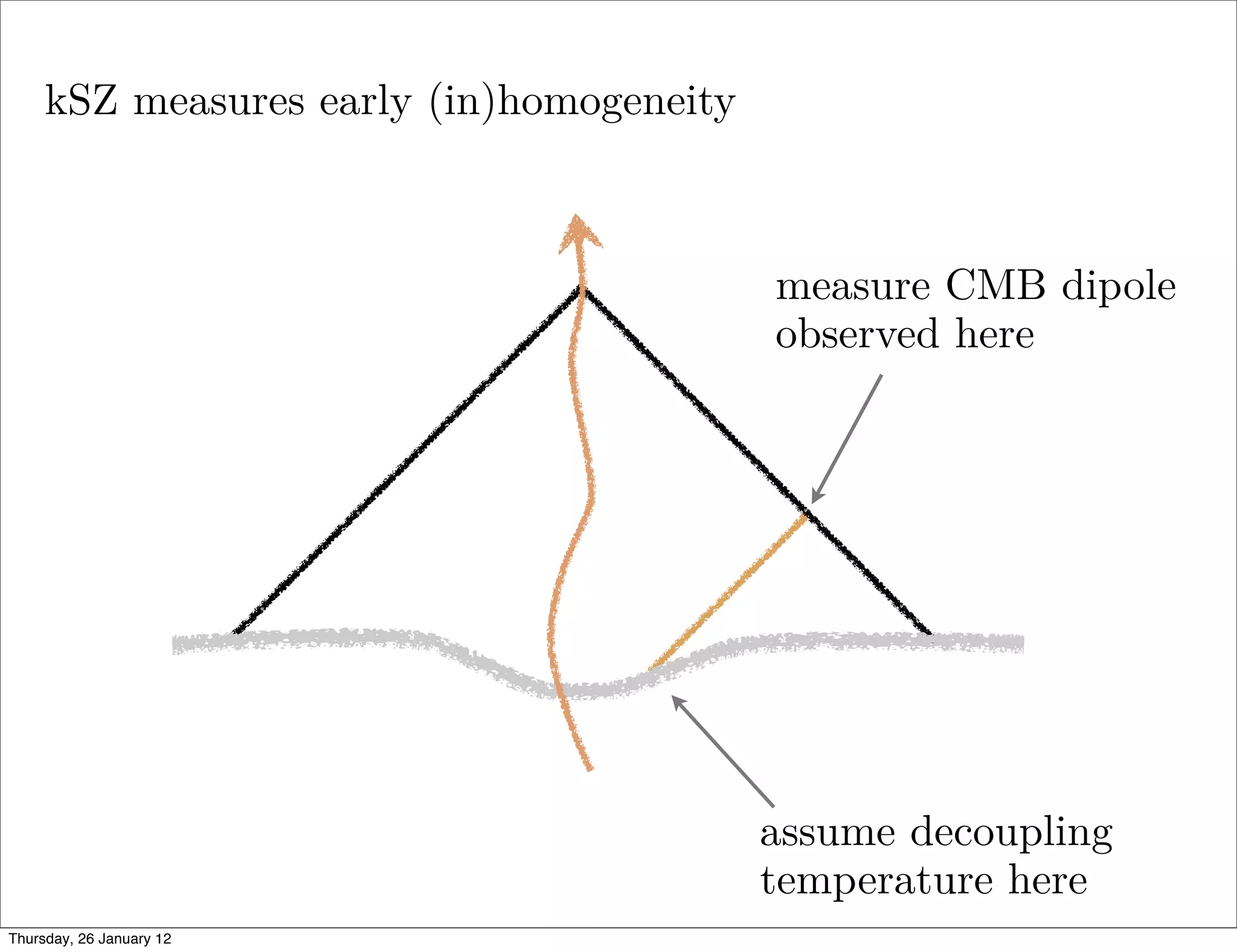
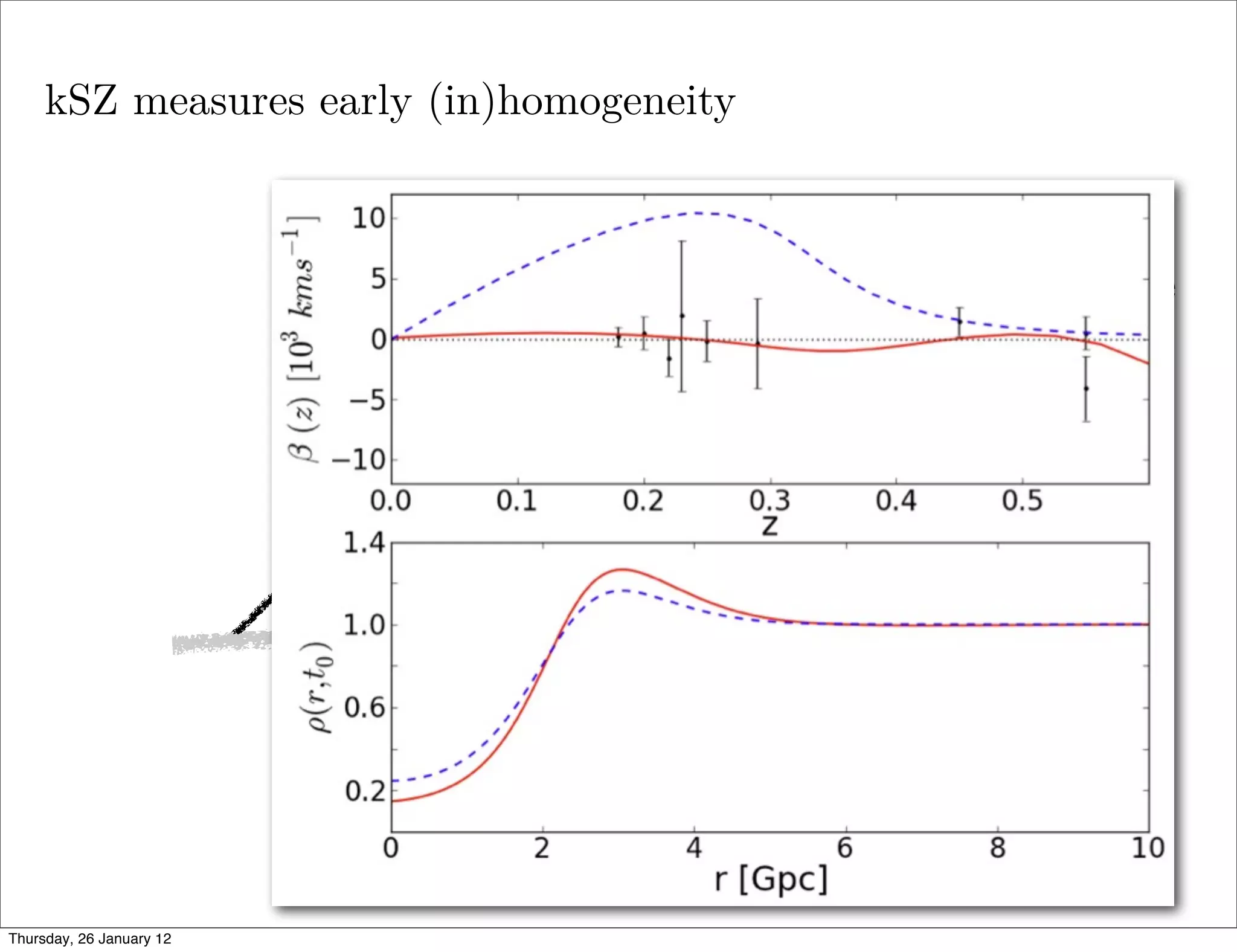
kSZ measures early (in)homogeneity


                                          measure CMB dipole
                                          observed here


                                          assume decoupling
                                          temperature here
Thursday, 26 January 12
kSZ measures early (in)homogeneity


                                          measure CMB dipole
                                          observed here


                                          assume decoupling
                                          temperature here
Thursday, 26 January 12
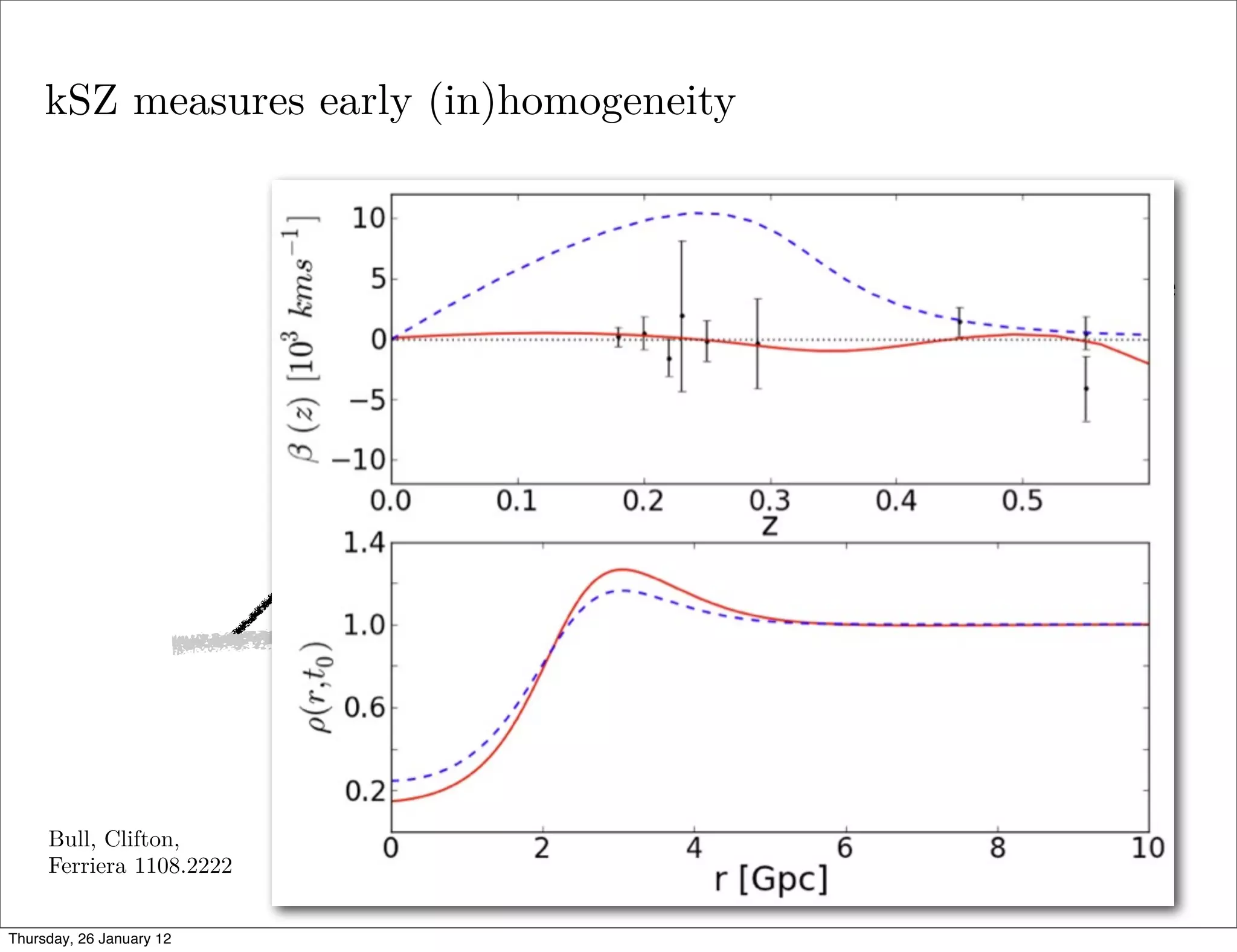
kSZ measures early (in)homogeneity


                                          measure CMB dipole
                                          observed here


     Bull, Clifton,                       assume decoupling
     Ferriera 1108.2222
                                          temperature here
Thursday, 26 January 12
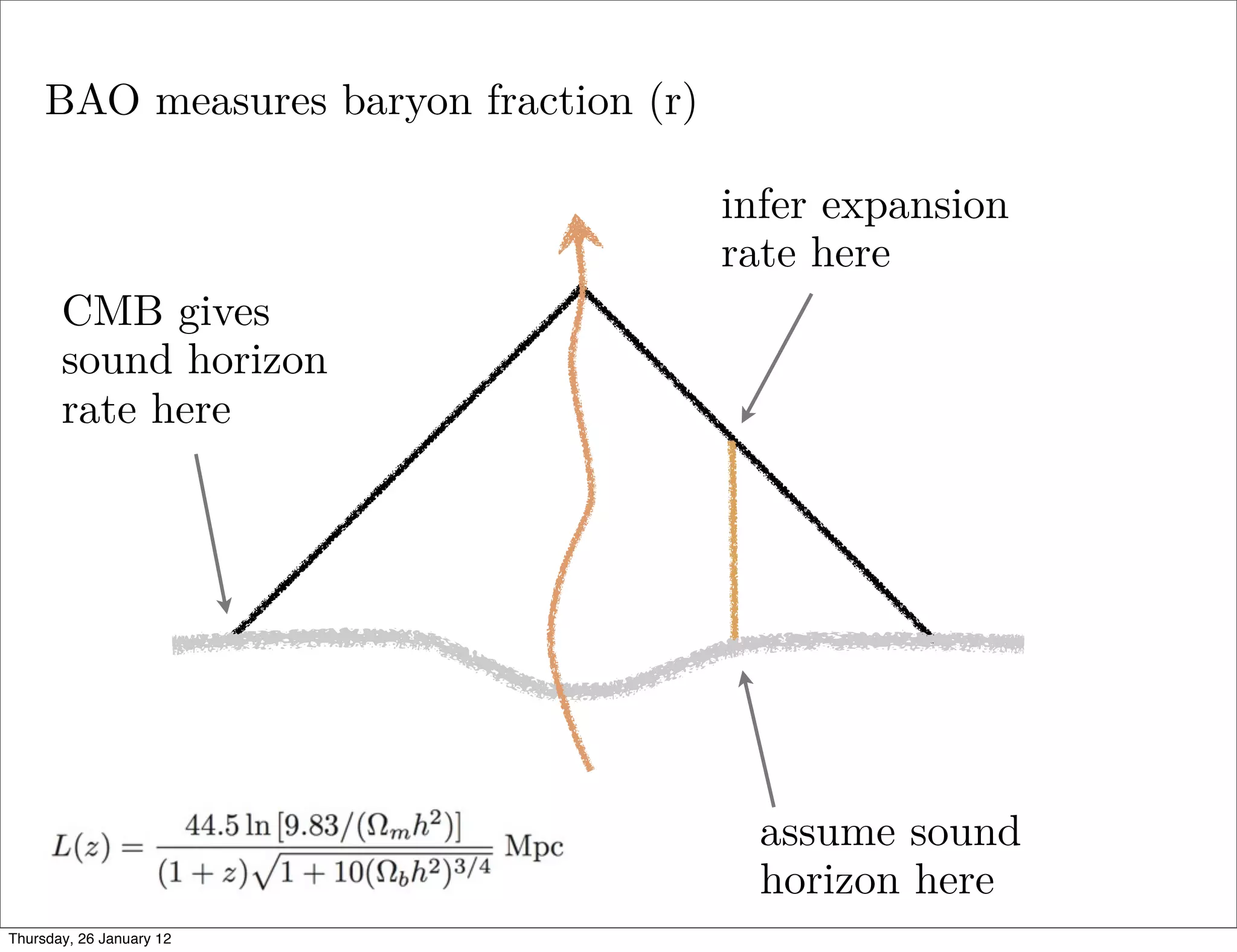
BAO measures baryon fraction (r)

                                        infer expansion
                                        rate here
       CMB gives
       sound horizon
       rate here


                                          assume sound
                                          horizon here
Thursday, 26 January 12
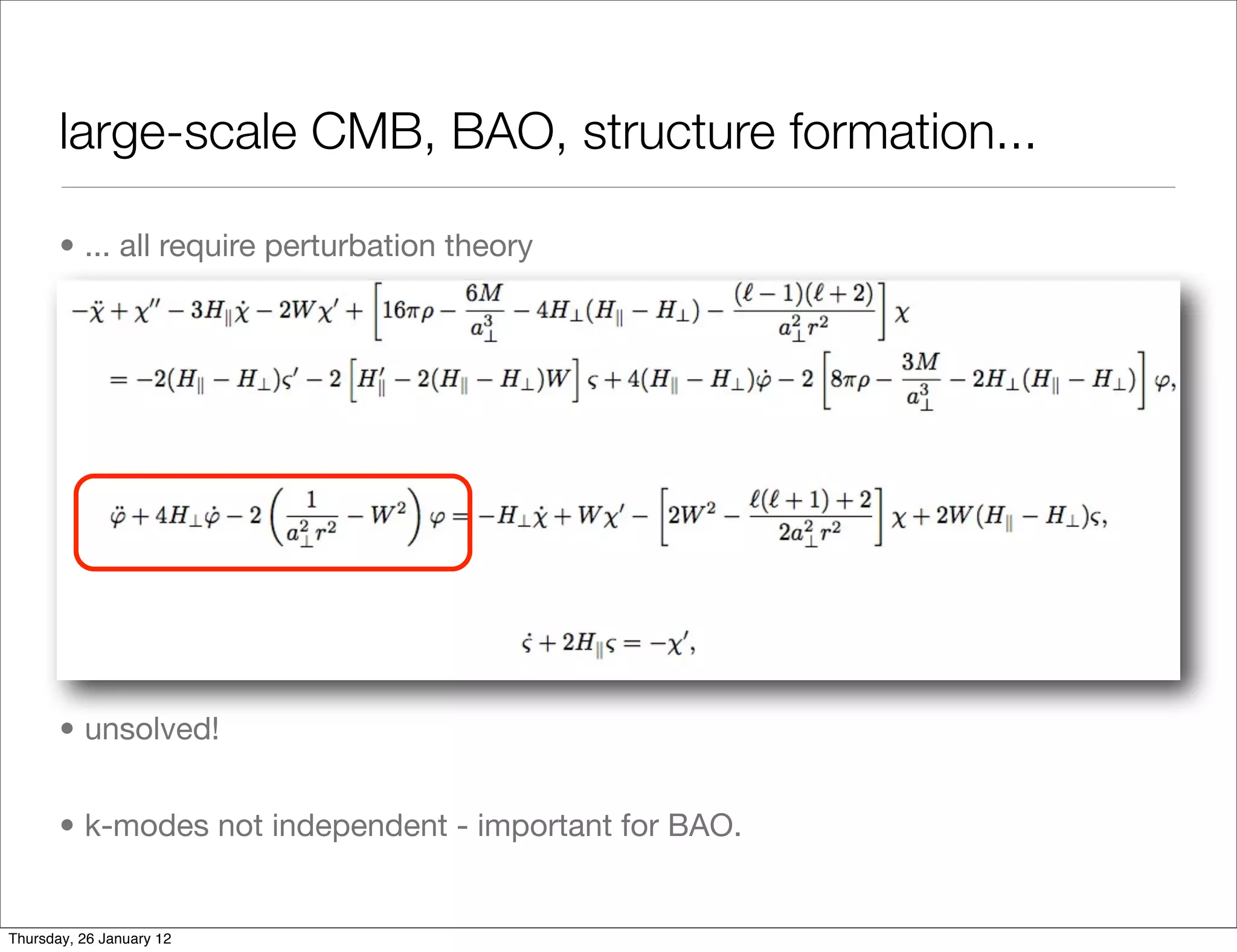
large-scale CMB, BAO, structure formation...

       • ... all require perturbation theory


       • unsolved!


       • k-modes not independent - important for BAO.


Thursday, 26 January 12
large-scale CMB, BAO, structure formation...

       • ... all require perturbation theory


       • unsolved!


       • k-modes not independent - important for BAO.


Thursday, 26 January 12
large-scale CMB, BAO, structure formation...

       • ... all require perturbation theory


       • unsolved!


       • k-modes not independent - important for BAO.


Thursday, 26 January 12
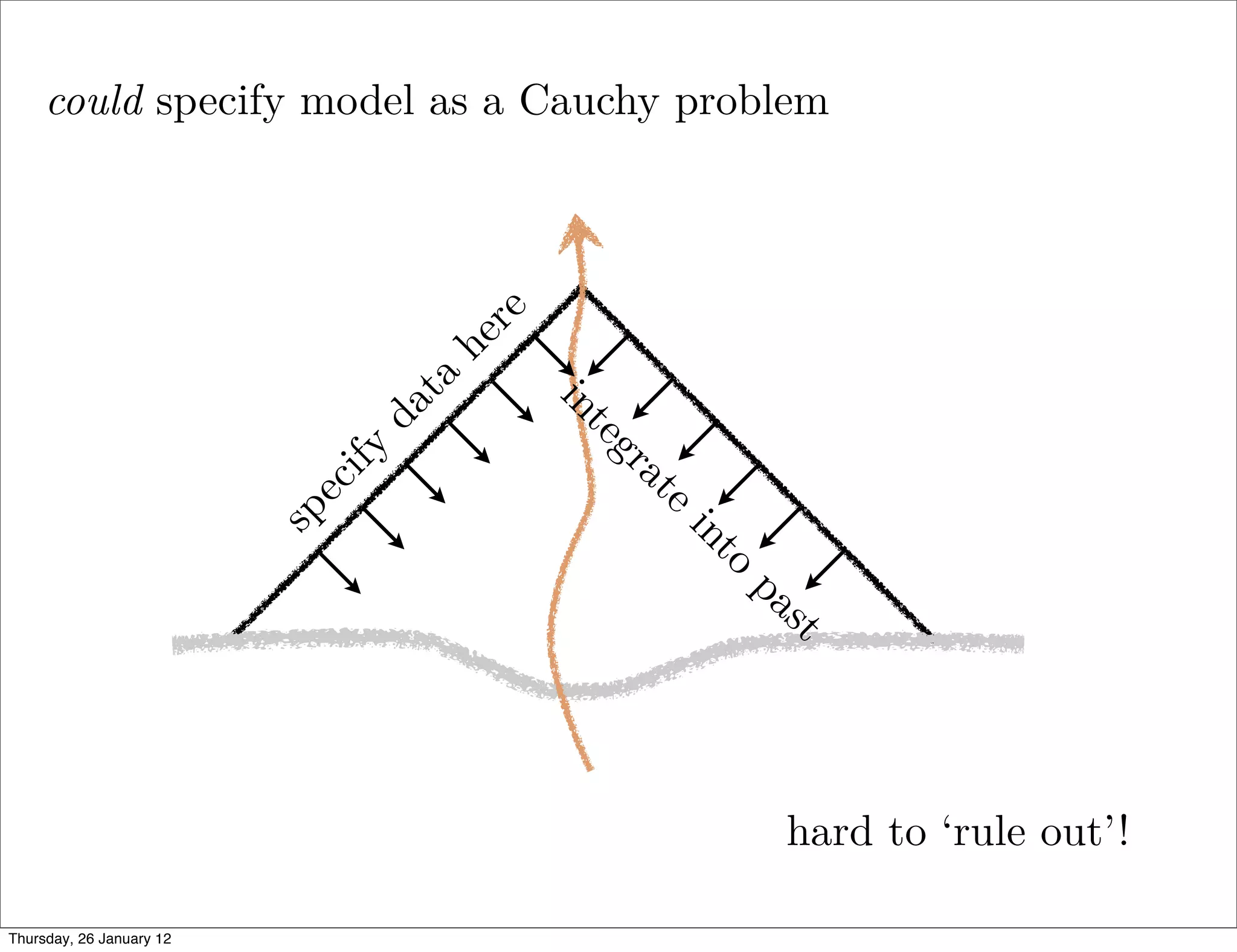
could specify model as a Cauchy problem


                                    re
                                  he
                               ta

                                         in
                               da


                                           te
                            ify


                                           gr
                                              a
                          ec


                                            te
                          sp


                                                in
                                                  to
                                                  pa
                                                     s t
                                                       hard to ‘rule out’!

Thursday, 26 January 12
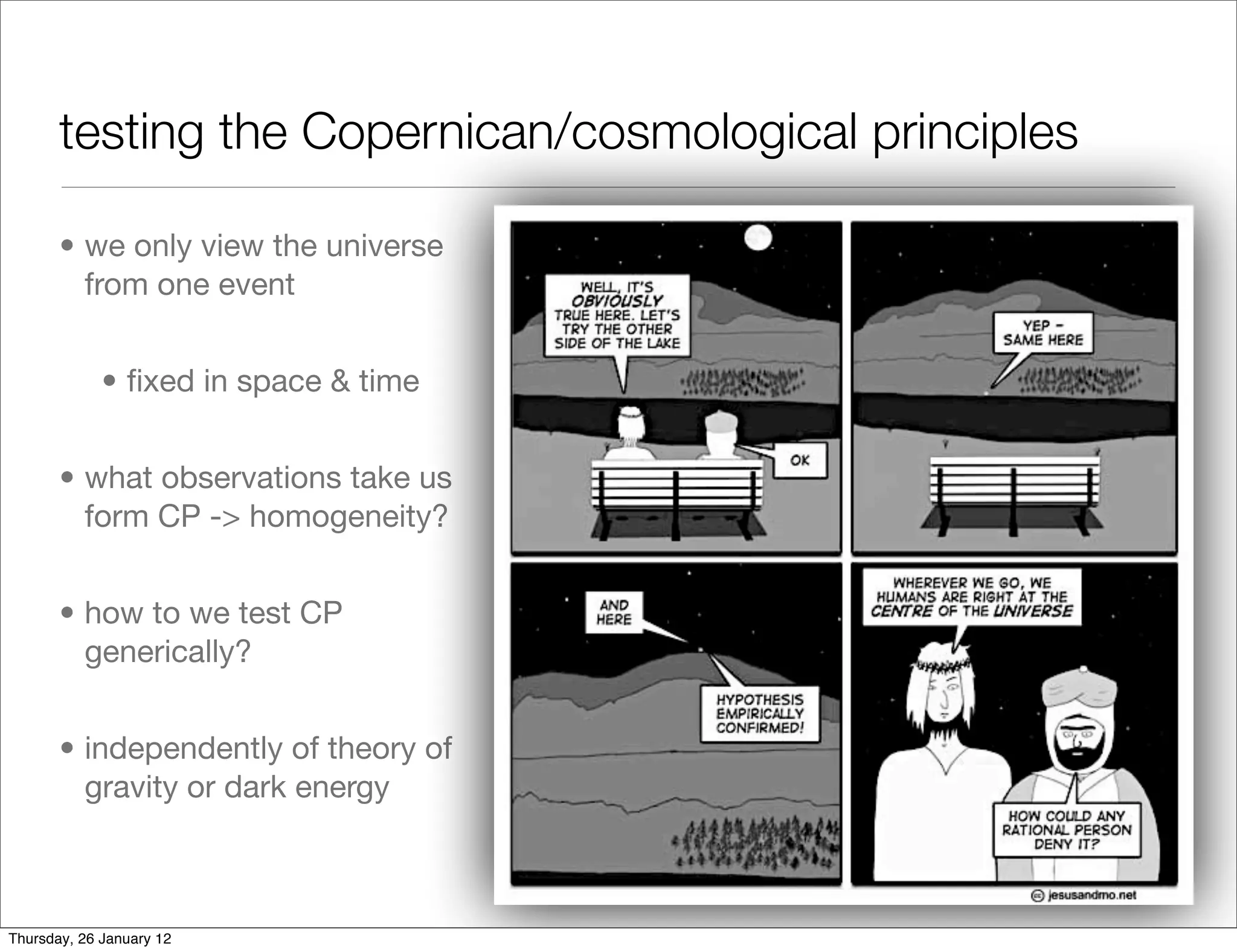
testing the Copernican/cosmological principles

       • we only view the universe
         from one event


             • fixed in space & time


       • what observations take us
         form CP -> homogeneity?


       • how to we test CP
         generically?


       • independently of theory of
         gravity or dark energy


Thursday, 26 January 12
when does CP imply homogeneity ?

       • if everyone sees an isotropic CMB => homo [Ehlers, Geren, Sachs, 1968]


       • if everyone sees isotropic distances => homo [Hasse, Perlick, 199..]


             • etc


       • can we see the universe from anywhere else?


       • do we need to?


Thursday, 26 January 12
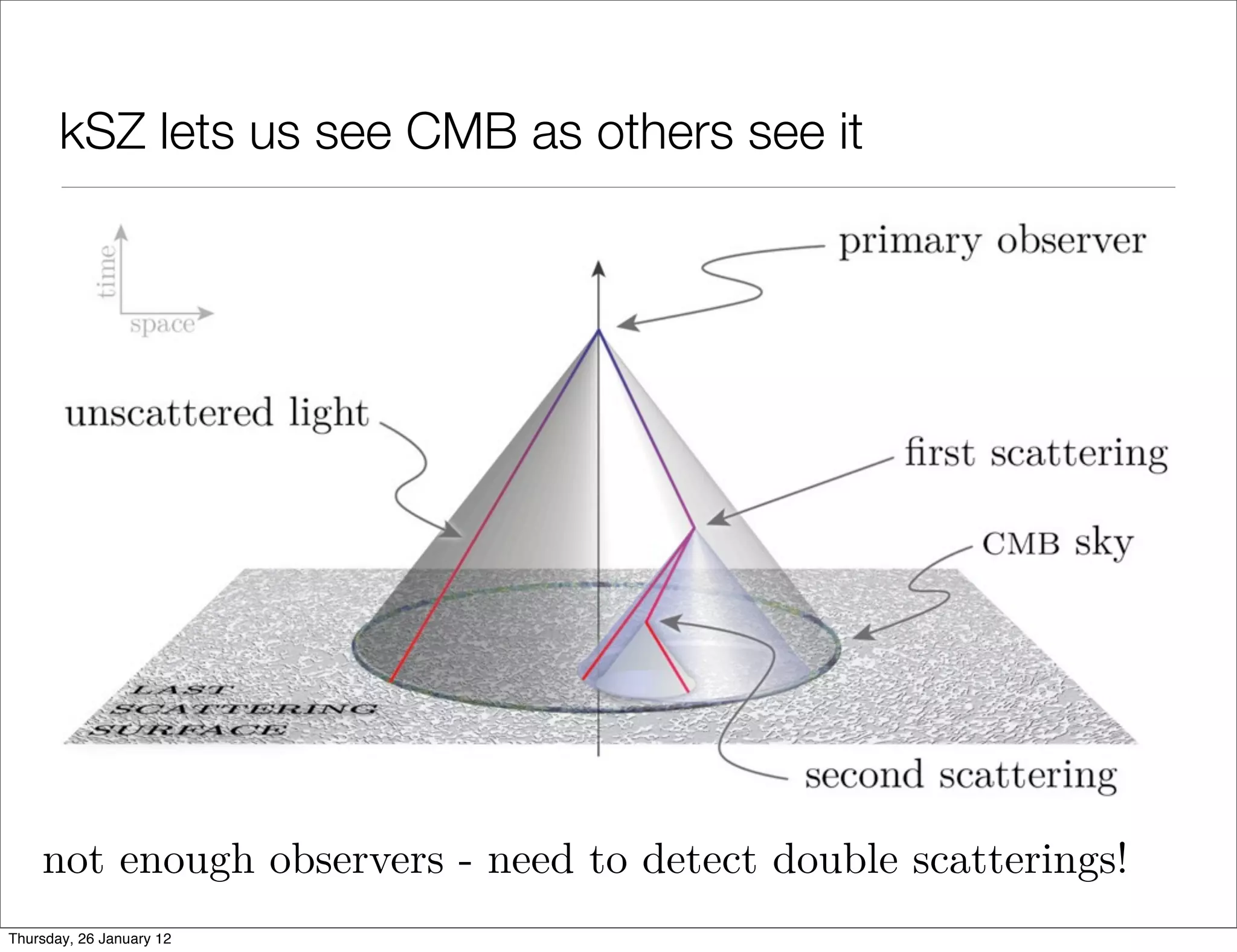
kSZ lets us see CMB as others see it


    not enough observers - need to detect double scatterings!
Thursday, 26 January 12
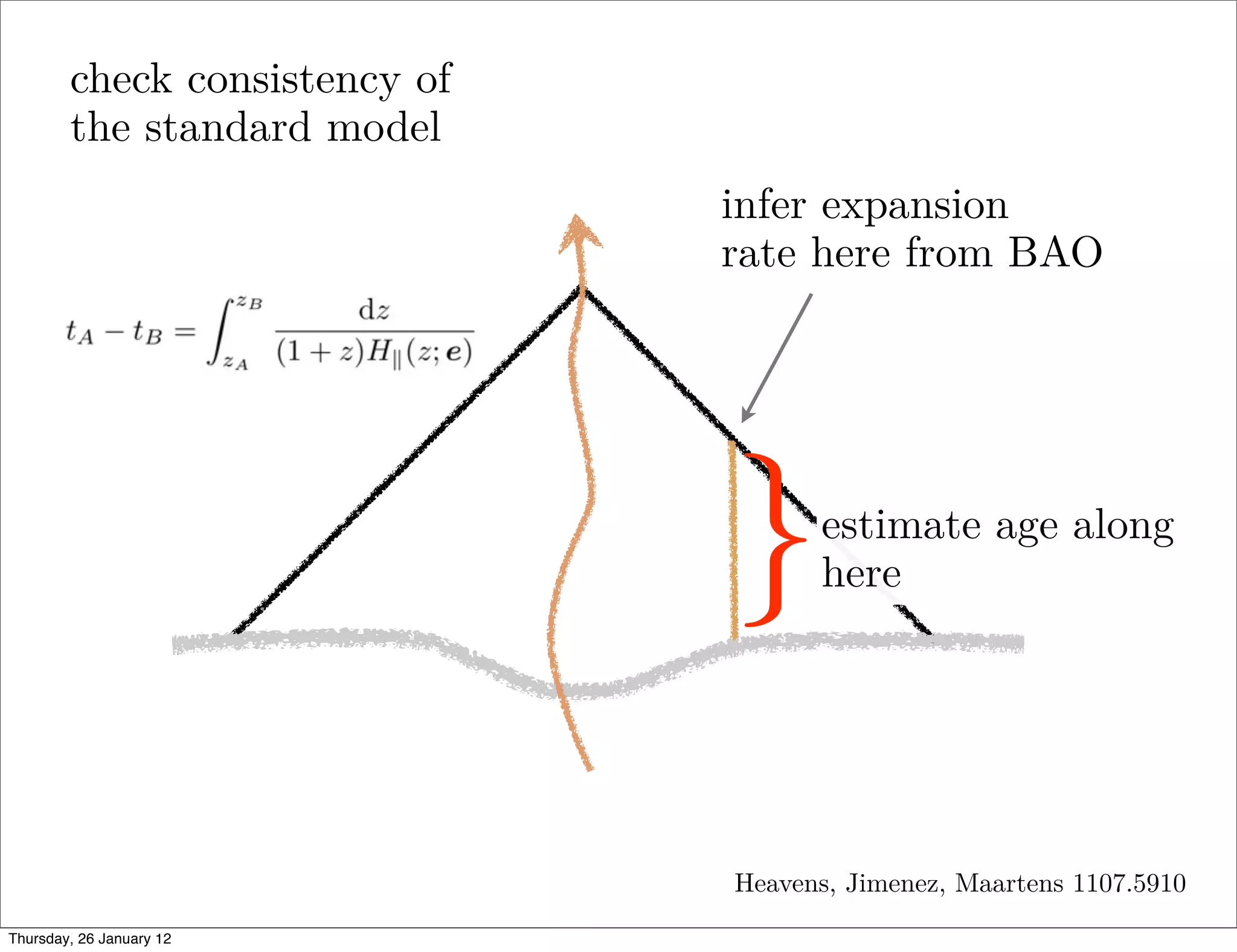
check consistency of
        the standard model
                               infer expansion
                               rate here from BAO


                               }     estimate age along
                                     here


                               Heavens, Jimenez, Maartens 1107.5910
Thursday, 26 January 12
‘on lightcone’ test

       • in FLRW we can combine Hubble rate and distance data to find curvature

                                                        2
                                          [H(z)D (z)]          1
                                    k   =
                                             [H0 D(z)]2
                                                                                         ⇥
                                                            dL = (1 + z)D = (1 + z) dA
                                                                                  2


       • independent of all other cosmological parameters, including dark energy
         model, and theory of gravity


       • tests the Copernican principle and the basis of FLRW
                                                         ⇥
                          C (z) = 1 + H   2
                                              DD   D   2
                                                             + HH DD = 0

       Clarkson, Basset & Lu, PRL 100 191303

Thursday, 26 January 12
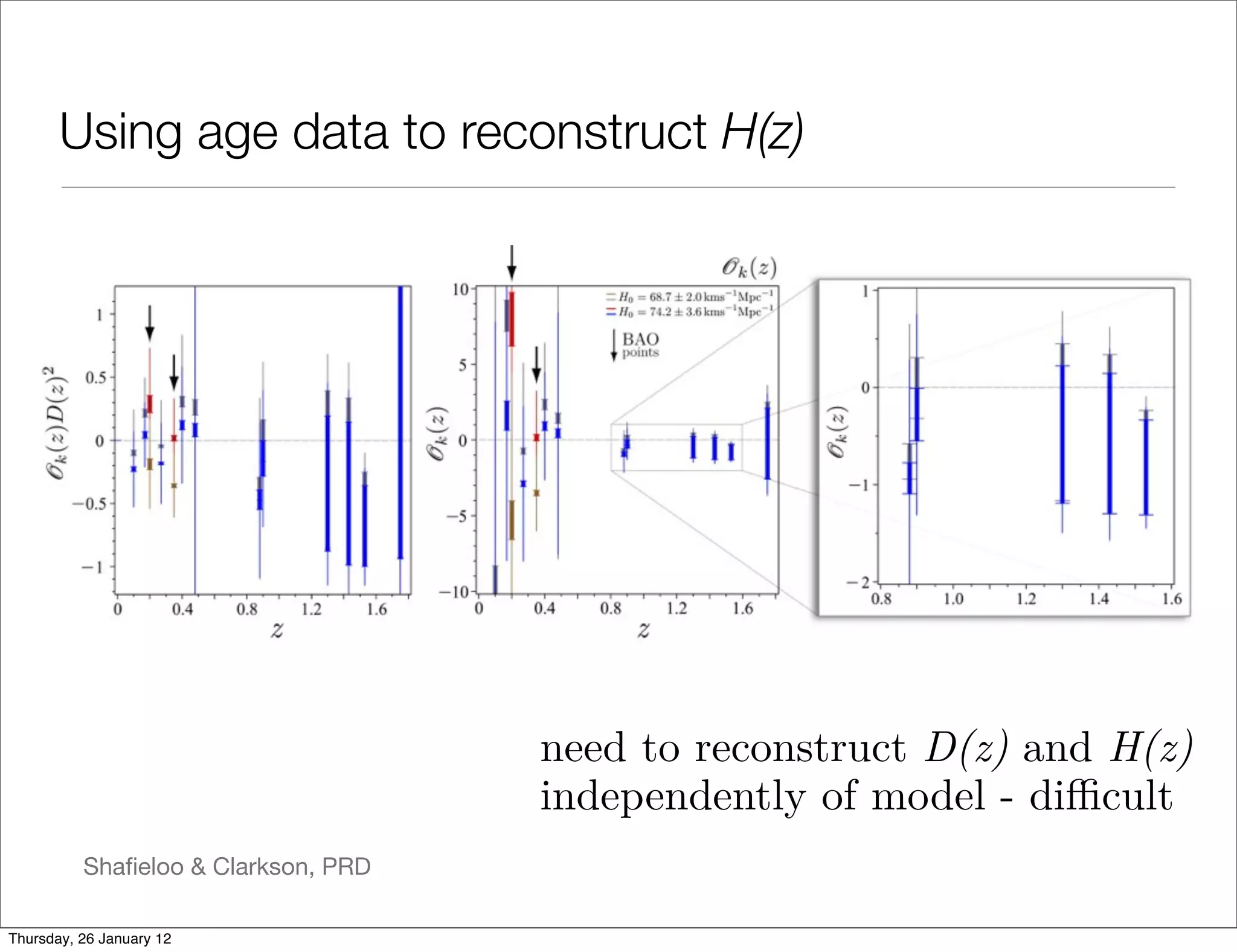
Using age data to reconstruct H(z)


                                     need to reconstruct D(z) and H(z)
                                     independently of model - difficult
          Shafieloo & Clarkson, PRD

Thursday, 26 January 12
consistency of standard model	

       • void models unlikely to be DE explanation


             • highlights need to test homogeneity assumption


       • ‘tests’ formulate CP as null hypothesis


       • compare observables or observe inside lightcone


             • ideally, in model-independent ways - independently of DE/GR


       • how do we place confidence limits on FLRW?


Thursday, 26 January 12

Chris Clarkson - Testing the Copernican Principle

  • 1.
    testing the copernicanprinciple in the light of dark energy Chris Clarkson Astrophysics, Cosmology & Gravitation Centre University of Cape Town Thursday, 26 January 12
  • 2.
    Dark Energy Evidence • evidence of cosmological constant from COBE + age constraints • independent confirmation from SNIa • observations consistent with flat Lambda-CDM ‘concordance cosmology’ Thursday, 26 January 12
  • 3.
    Dark Energy Evidence • evidence of cosmological constant from COBE + age constraints • independent confirmation from SNIa • observations consistent with flat Lambda-CDM ‘concordance cosmology’ Thursday, 26 January 12
  • 4.
    Dark Energy Evidence • evidence of cosmological constant from COBE + age constraints • independent confirmation from SNIa flat LCDM is it! • observations consistent with flat Lambda-CDM ‘concordance cosmology’ Thursday, 26 January 12
  • 5.
    relativity is validup to the Planck scale, w 4 vacuum energy in terms of a mass scale as ρvac = Mvac , in te ρ(theory) ∼ MP10−3 eV, satisf required to explain our observations vac Mvac ∼ . is (obs) 4 Problems with Λ Mvac ∼ 10 Mvac . (obs) −30 (theory) (ob Comparing this value to the value ρvac obtain Nevertheless, this discrepancy of 30 orders of magnitude in ener • Lambda doesn’t make sense as by the cosmological(obs) ∼ 10−120 ρ(theory) , is what is meant vacuum energy: ρvac constant problem. vac One may add to this problem the following puzzling obser • Why do we live at a specialmatter densities changes as the universe expands a vacuum and time? ΩΛ ρΛ = ∝ a3 . ΩM ρM Thus, only during a brief epoch of cosmic history is it possible • last modes are entering the Hubble radius ... we coincide with the largest modes whichthe transition from matter domination to Λ domination, durin will ever exist of the same order of magnitude. This is known as the coinciden The issue of reliably calculating the cosmological constant, • Perhaps Landscape arguments can answer this ... one day ... in which that calculation leads to a result dramatically differe • in 10500 universesproven remarkably resistant to theoretical attack. It is fair t has anything goes..? currently any especially promising approaches. Nevertheless, t lines of research that are worth mentioning in this context. The first is supersymmetry (SUSY). Supersymmetry is a sp Thursday, 26 January 12
  • 6.
    relativity is validup to the Planck scale, w 4 vacuum energy in terms of a mass scale as ρvac = Mvac , in te ρ(theory) ∼ MP10−3 eV, satisf required to explain our observations vac Mvac ∼ . is (obs) 4 Problems with Λ Mvac ∼ 10 Mvac . (obs) −30 (theory) (ob Comparing this value to the value ρvac obtain Nevertheless, this discrepancy of 30 orders of magnitude in ener • Lambda doesn’t make sense as by the cosmological(obs) ∼ 10−120 ρ(theory) , is what is meant vacuum energy: ρvac constant problem. vac One may add to this problem the following puzzling obser • Why do we live at a specialmatter densities changes as the universe expands a vacuum and time? ΩΛ ρΛ = ∝ a3 . ΩM ρM Thus, only during a brief epoch of cosmic history is it possible • last modes are entering the Hubble radius ... we coincide with the largest modes whichthe transition from matter domination to Λ domination, durin will ever exist of the same order of magnitude. This is known as the coinciden The issue of reliably calculating the cosmological constant, • Perhaps Landscape arguments can answer this ... one day ... in which that calculation leads to a result dramatically differe • in 10500 universesproven remarkably resistant to theoretical attack. It is fair t has anything goes..? currently any especially promising approaches. Nevertheless, t lines of research that are worth mentioning in this context. The first is supersymmetry (SUSY). Supersymmetry is a sp Thursday, 26 January 12
  • 7.
    relativity is validup to the Planck scale, w 4 vacuum energy in terms of a mass scale as ρvac = Mvac , in te ρ(theory) ∼ MP10−3 eV, satisf required to explain our observations vac Mvac ∼ . is (obs) 4 Problems with Λ Mvac ∼ 10 Mvac . (obs) −30 (theory) (ob Comparing this value to the value ρvac obtain Nevertheless, this discrepancy of 30 orders of magnitude in ener • Lambda doesn’t make sense as by the cosmological(obs) ∼ 10−120 ρ(theory) , is what is meant vacuum energy: ρvac constant problem. vac One may add to this problem the following puzzling obser • Why do we live at a specialmatter densities changes as the universe expands a vacuum and time? ΩΛ ρΛ Lambda ρM larger ΩM =any∝ a3 . Thus,and during a brief epoch of cosmic history is it possible only we couldn’t exist • last modes are entering the Hubble radius ... we coincide with the largest modes whichthe transition from matter domination to Λ domination, durin will ever exist of the same order of magnitude. This is known as the coinciden The issue of reliably calculating the cosmological constant, • Perhaps Landscape arguments can answer this ... one day ... in which that calculation leads to a result dramatically differe • in 10500 universesproven remarkably resistant to theoretical attack. It is fair t has anything goes..? currently any especially promising approaches. Nevertheless, t lines of research that are worth mentioning in this context. The first is supersymmetry (SUSY). Supersymmetry is a sp Thursday, 26 January 12
  • 8.
    LCDM Denial • if acceleration isn’t cosmological constant: } • ‘real’ dark energy - quintessence, k-essence ... make things worse, but help test LCDM • modified gravity - gr wrong on Hubble scales • inhomogeneous universe - backreaction? • do we live at the centre of vast void? - copernican assumption wrong • LCDM requires 2 phases of accelerated expansion - phenomenological Thursday, 26 January 12
  • 9.
    priors critical • assumes FLRW background spacetime - spatial homogeneity • can we demonstrate this observationally? • or have we already? at what confidence level? • what do we know if we don’t assume this? • does dark energy necessarily exist? Thursday, 26 January 12
  • 10.
    radial inhomogeneity hardto distinguish from time evolution Thursday, 26 January 12
  • 11.
    radial inhomogeneity hardto distinguish from time evolution time space Thursday, 26 January 12
  • 12.
    radial inhomogeneity hardto distinguish from time evolution time space Thursday, 26 January 12
  • 13.
    radial inhomogeneity hardto distinguish from time evolution time space Thursday, 26 January 12
  • 14.
    radial inhomogeneity hardto distinguish from time evolution time space Thursday, 26 January 12
  • 15.
    radial inhomogeneity hardto distinguish from time evolution time space Thursday, 26 January 12
  • 16.
    radial inhomogeneity hardto distinguish from time evolution time space Thursday, 26 January 12
  • 17.
    radial inhomogeneity hardto distinguish from time evolution time space Thursday, 26 January 12
  • 18.
    Spherical Symmetry →void models • within dust Lemaitre-Tolman-Bondi models - 2 free radial dof • can fit distance-redshift data to any FLRW DE model Mustapha, Hellaby, & Ellis Thursday, 26 January 12
  • 19.
    Spherical Symmetry →void models • within dust Lemaitre-Tolman-Bondi models - 2 free radial dof • can fit distance-redshift data to any FLRW DE model Mustapha, Hellaby, & Ellis Thursday, 26 January 12
  • 20.
    Spherical Symmetry →void models • within dust Lemaitre-Tolman-Bondi models - 2 free radial dof • can fit distance-redshift data to any FLRW DE model Mustapha, Hellaby, & Ellis Thursday, 26 January 12
  • 21.
    Spherical Symmetry →void models • within dust Lemaitre-Tolman-Bondi models - 2 free radial dof • can fit distance-redshift data to any FLRW DE model Mustapha, Hellaby, & Ellis Alnes, Amarzguioui, and Gron astro-ph/0512006 Thursday, 26 January 12
  • 22.
    Spherical Symmetry →void models • within dust Lemaitre-Tolman-Bondi models - 2 free radial dof • can fit distance-redshift data to any FLRW DE model Mustapha, Hellaby, & Ellis Biswas, Monsouri and Notari, astro-ph/0606703 Thursday, 26 January 12
  • 23.
    z jump =0.085; ∆CENTRE =-0.48 Spherical Symmetry → void models 0.75 0.5 0.25 • within dust Lemaitre-Tolman-Bondi models - 2 free radial dof 0 m -0.25 • can fit distance-redshift data to any FLRW DE model -0.5 -0.75 Mustapha, Hellaby, & Ellis -1 0 0.25 0.5 0.75 1 1.25 1.5 1.75 z 1 0.75 0.5 0.25 ∆Ρ 0 Ρ -0.25 -0.5 -0.75 Biswas, Monsouri and Notari, astro-ph/0606703 0 0.02 0.04 0.06 0.08 z FIG. 3: In the upper plot we show a fit of the Supernovae data (Riess et al. [28]) with an LTB model which has χ2 = d.o.f. are 181). The inhomogeneous patch extends up to z 0.085 and the underdensity in the center is δCENTRE Thursday, 26 January 12 We have shown ∆m ≡ m − mempty : the magnitude (m ≡ 5Log10 DL ) minus the magnitude of an empty open FLRW
  • 24.
    Spherical Symmetry →void models • within dust Lemaitre-Tolman-Bondi models - 2 free radial dof • can fit distance-redshift data to any FLRW DE model Mustapha, Hellaby, & Ellis Biswas, Monsouri and Notari, astro-ph/0606703 Thursday, 26 January 12
  • 25.
    Spherical Symmetry →void models • within dust Lemaitre-Tolman-Bondi models - 2 free radial dof • can fit distance-redshift data to any FLRW DE model Mustapha, Hellaby, & Ellis Thursday, 26 January 12
  • 26.
    void profile today Hubble scales ~ 5-10 Gpc density inhomogeneity accompanied by curvature gradients and anisotropic expansion Thursday, 26 January 12
  • 27.
  • 28.
  • 29.
  • 30.
    Fine tuned Supernovae as seen by off-center observers in a local void 15 Figure 4. Magnitude dipole induced by moving the observer away from the void center in the best fit on-center models. The curves show the difference in magnitude for two SNe Ia with the same redshift but in opposite directions in the sky. Left panel: A void with scale radius rs = 0.7 Gpc (z ≈ 0.18), preferred by the SDSS-II data set. Right panel: A void with scale radius rs = 3.5 Gpc (z ≈ 1.02), preferred by the Constitution data set. 6. Constraining the observer position with SNe Ia Off-center observers will see an anisotropic relation between the luminosity distance and the redshift for the SNe Ia. This means that a standard candle with the same redshift but in different directions in the sky will have different observed magnitudes. The isotropy of the data can be used to establish constraints on the observer position Figure 6. The void. In this section, we will investigate how farIa as a functionin the local inside the changes in the as values for theoff-center observers of a Supernovae χ2 seen by fit to the SNe from the center the observer observer’sbe located. can position. The stars show the values when the static observer is displaced in void Sep 2009 the direction of the CMB dipole in the best fit on-center LTB model. The diamonds show the values when anisotropy also has a peculiar velocity directed 2to accommodate 6.1. Maximum the observer Michael Blomqvist1 and Edvard M¨rtsell o the observed CMB dipole. The arrows indicate the direction of motion, either away To get a sense for 1 The Oskarthe effect of being situated off-center has of Astronomy, Ia how big Klein Centre for Cosmoparticle Physics, Department on the SN from the void center or towards it. The vertical dotted line Center the position where Stockholm University, AlbaNova University shows Thursday, 26 January 12 observations, we can calculate the maximum anisotropy in the form of the magnitude the peculiar velocity is zero. The scale radius of the void is r = 5.0 Gpc for the
  • 31.
    problem: anti-Copernican The Cosmological Principle Thursday, 26 January 12
  • 32.
    problem: anti-Copernican • Copernican P says we are not at special place in universe • Λ introduced for temporal CP ... Thursday, 26 January 12
  • 33.
  • 34.
    “Never let anyonetell you you’re crazy” Prof. Bob Nichol Thursday, 26 January 12
  • 35.
    Are void modelsridiculous? • being ‘at the centre of the universe’ is crazy, but actually only a coincidence of 1 in 10~9 in our Hubble volume • possible selection effects? • could high dark matter density inhibit solar system formation? must be stable for ~5Gyr • so, maybe not anti- Copernican ? Thursday, 26 January 12
  • 36.
    Isn’t this abit silly? Thursday, 26 January 12
  • 37.
    Isn’t this abit silly? • Yes Thursday, 26 January 12
  • 38.
    Isn’t this abit silly? • Yes • But: • we should be able to rule all void models out observationally - tests CP • helps make data ‘cosmology independent’ (eg, compare SNIa vs BAO) • provides alternative probe of coincidence problem which can be tested • unusual DE interpretation without LCDM as fixed point - only DE model with known physics at late times • can we construct a void which fits all observations? [v fine-tuned?] Thursday, 26 January 12
  • 39.
    Small scale CMB Baumann, TASI lectures Thursday, 26 January 12
  • 40.
    Small scale CMB • high-l CMB fixes only: baryon-photon ratio baryon fraction distance to last scattering CC & Marco Regis Thursday, 26 January 12
  • 41.
    Small scale CMB indistinguishable from LCDM Thursday, 26 January 12
  • 42.
  • 43.
    Lithium problem →inhomogeneity at early times? • a Gpc fluctuation in baryon-photon ratio solves Li problem FIG. 1: Constraints on . Top left we estimate current constraints on 10 = 1010 from di erent 7 Do primordial Lithium abundances imply there’s no Dark Energy? from Li observations [10] in Galactic globular clusters and Galactic halo are shown separately, alon These agree with each other if 10 ⇠ 4. Local measurements of D are very uncertain [8] though they Marco Regis and Chris Clarkson assume the rather precise value we show (from Cosmology analyses inCentre,and an astration factor (i.e. Astrophysics, Bayesian & Gravity [11]) and, Thursday, 26 January 12 formation in our Galaxy) of f ⇠ 2 3. (Or, alternatively, a smaller f [12] with a slightly di erent v
  • 44.
    Lithium problem →inhomogeneity at early times? • a Gpc fluctuation in baryon-photon ratio solves Li problem FIG. 1: Constraints on . Top left we estimate current constraints on 10 = 1010 from di erent 7 Do primordial Lithium abundances imply there’s no Dark Energy? from Li observations [10] in Galactic globular clusters and Galactic halo are shown separately, alon These agree with each other if 10 ⇠ 4. Local measurements of D are very uncertain [8] though they Marco Regis and Chris Clarkson assume the rather precise value we show (from Cosmology analyses inCentre,and an astration factor (i.e. Astrophysics, Bayesian & Gravity [11]) and, Thursday, 26 January 12 formation in our Galaxy) of f ⇠ 2 3. (Or, alternatively, a smaller f [12] with a slightly di erent v
  • 45.
    Lithium problem →inhomogeneity at early times? • a Gpc fluctuation in baryon-photon ratio solves Li problem FIG. 1: Constraints on . Top left we estimate current constraints on 10 = 1010 from di erent 7 Do primordial Lithium abundances imply there’s no Dark Energy? from Li observations [10] in Galactic globular clusters and Galactic halo are shown separately, alon These agree with each other if 10 ⇠ 4. Local measurements of D are very uncertain [8] though they Marco Regis and Chris Clarkson assume the rather precise value we show (from Cosmology analyses inCentre,and an astration factor (i.e. Astrophysics, Bayesian & Gravity [11]) and, Thursday, 26 January 12 formation in our Galaxy) of f ⇠ 2 3. (Or, alternatively, a smaller f [12] with a slightly di erent v
  • 46.
    Lithium problem →inhomogeneity at early times? • a Gpc fluctuation in baryon-photon ratio solves Li problem FIG. 1: Constraints on . Top left we estimate current constraints on 10 = 1010 from di erent 7 Do primordial Lithium abundances imply there’s no Dark Energy? from Li observations [10] in Galactic globular clusters and Galactic halo are shown separately, alon These agree with each other if 10 ⇠ 4. Local measurements of D are very uncertain [8] though they Marco Regis and Chris Clarkson assume the rather precise value we show (from Cosmology analyses inCentre,and an astration factor (i.e. Astrophysics, Bayesian & Gravity [11]) and, Thursday, 26 January 12 formation in our Galaxy) of f ⇠ 2 3. (Or, alternatively, a smaller f [12] with a slightly di erent v
  • 47.
    CMB gives expansion rate here Li determines expansion rate here Thursday, 26 January 12
  • 48.
    BAO Sean February Thursday, 26 January 12
  • 49.
  • 50.
    infer expansion rate here CMB gives sound horizon rate here assume sound horizon here Thursday, 26 January 12
  • 51.
    e 2. Examplesof the size of the dipole for different parameters of the constrained model [19]. strong constraint left figure is the first order approximation kSZ The dashed line in the n [30]. • kSZ (and SZ) effect can look inside our past lightcone !in=0.23, r0=1.8, H0=0.65, "r/r0=0.35 e void in90 eyes - the kSZ effect in LTB models the 6 8 60 6 30 4 vP [1000 km/s] 2 0 -45 -90 -135 0 -2 -30 Figure 1. An off-centre cluster of galaxies in a void will “observe” CMB photons -4 coming from the last scattering surface from all directions. Due to the higher expansion rate inside the void, photons arriving through the centre (from the right in the figure) will have a larger redshift (∆zin ), than photons arriving directly from the LSS (left, -60 -6 with ∆zout ). There is a subdominant effect due to the time-dependent density profile 0.0 (the solid line corresponds to the current time, while the dot-dashed line to one tenth of 0.2 0.4 0.6 the present time). With a larger underdensity at later times, we have ∆z1 > ∆z4 , and -90 Redshift ∆z2 + ∆z3 < 0, giving an overall difference ∆z1 > ∆z2 + ∆z3 + ∆z4 or, equivalently, a Looking the void in the eyes - the kSZ effect in LTB subdominant dipole with a blueshift towards the centre of the void. The overall effect is a blueshift away from the centre. models e 3. The angular and redshift distribution of current observations together with 1 1,2 quently, in the ideal case Juan Garc´void, and a well embedded cluster, the of a sphericalıa-Bellido , Troels Haugbølle server will see an almost perfect dipole in the CMB, aligned along the radial parsec sized void model. Red triangles and dicted dipoleInstituto de 28049 Madrid, UAM-CSIC, a gigaAut´noma de Madrid, 1 distribution for Universidad o F´ısica Te´rica o 008 Cantoblanco, Spain, and with the blueshift pointing away from the centre of the void, where the suares26 January 12 Department of Physics and Astronomy,negative peculiar C, (see Fig. 1).represent of a spherical void and CMB sky of of Aarhus, DK-8000 Aarhus velocities respectively, with the The detailed effect positive on the University an 2 Thursday,
  • 52.
    e 2. Examplesof the size of the dipole for different parameters of the constrained model [19]. strong constraint left figure is the first order approximation kSZ The dashed line in the n [30]. • kSZ (and SZ) effect can look inside our past lightcone !in=0.23, r0=1.8, H0=0.65, "r/r0=0.35 e void in90 eyes - the kSZ effect in LTB models the 6 8 60 6 30 4 vP [1000 km/s] 2 0 -45 -90 -135 0 -2 -30 Figure 1. An off-centre cluster of galaxies in a void will “observe” CMB photons -4 coming from the last scattering surface from all directions. Due to the higher expansion rate inside the void, photons arriving through the centre (from the right in the figure) will have a larger redshift (∆zin ), than photons arriving directly from the LSS (left, -60 -6 with ∆zout ). There is a subdominant effect due to the time-dependent density profile 0.0 (the solid line corresponds to the current time, while the dot-dashed line to one tenth of 0.2 0.4 0.6 the present time). With a larger underdensity at later times, we have ∆z1 > ∆z4 , and -90 Redshift ∆z2 + ∆z3 < 0, giving an overall difference ∆z1 > ∆z2 + ∆z3 + ∆z4 or, equivalently, a Looking the void in the eyes - the kSZ effect in LTB subdominant dipole with a blueshift towards the centre of the void. The overall effect is a blueshift away from the centre. models e 3. The angular and redshift distribution of current observations together with 1 1,2 quently, in the ideal case Juan Garc´void, and a well embedded cluster, the of a sphericalıa-Bellido , Troels Haugbølle server will see an almost perfect dipole in the CMB, aligned along the radial parsec sized void model. Red triangles and dicted dipoleInstituto de 28049 Madrid, UAM-CSIC, a gigaAut´noma de Madrid, 1 distribution for Universidad o F´ısica Te´rica o 008 Cantoblanco, Spain, and with the blueshift pointing away from the centre of the void, where the suares26 January 12 Department of Physics and Astronomy,negative peculiar C, (see Fig. 1).represent of a spherical void and CMB sky of of Aarhus, DK-8000 Aarhus velocities respectively, with the The detailed effect positive on the University an 2 Thursday,
  • 53.
    e 2. Examplesof the size of the dipole for different parameters of the constrained model [19]. strong constraint left figure is the first order approximation kSZ The dashed line in the n [30]. • kSZ (and SZ) effect can look inside our past lightcone !in=0.23, r0=1.8, H0=0.65, "r/r0=0.35 e void in90 eyes - the kSZ effect in LTB models the 6 8 60 6 30 4 vP [1000 km/s] 2 0 -45 -90 -135 0 -2 -30 Figure 1. An off-centre cluster of galaxies in a void will “observe” CMB photons -4 coming from the last scattering surface from all directions. Due to the higher expansion rate inside the void, photons arriving through the centre (from the right in the figure) will have a larger redshift (∆zin ), than photons arriving directly from the LSS (left, -60 -6 with ∆zout ). There is a subdominant effect due to the time-dependent density profile 0.0 (the solid line corresponds to the current time, while the dot-dashed line to one tenth of 0.2 0.4 0.6 the present time). With a larger underdensity at later times, we have ∆z1 > ∆z4 , and -90 Redshift ∆z2 + ∆z3 < 0, giving an overall difference ∆z1 > ∆z2 + ∆z3 + ∆z4 or, equivalently, a Looking the void in the eyes - the kSZ effect in LTB subdominant dipole with a blueshift towards the centre of the void. The overall effect is a blueshift away from the centre. models e 3. The angular and redshift distribution of current observations together with 1 1,2 quently, in the ideal case Juan Garc´void, and a well embedded cluster, the of a sphericalıa-Bellido , Troels Haugbølle server will see an almost perfect dipole in the CMB, aligned along the radial parsec sized void model. Red triangles and dicted dipoleInstituto de 28049 Madrid, UAM-CSIC, a gigaAut´noma de Madrid, 1 distribution for Universidad o F´ısica Te´rica o 008 Cantoblanco, Spain, and with the blueshift pointing away from the centre of the void, where the suares26 January 12 Department of Physics and Astronomy,negative peculiar C, (see Fig. 1).represent of a spherical void and CMB sky of of Aarhus, DK-8000 Aarhus velocities respectively, with the The detailed effect positive on the University an 2 Thursday,
  • 54.
    e 2. Examplesof the size of the dipole for different parameters of the constrained model [19]. strong constraint left figure is the first order approximation kSZ The dashed line in the n [30]. • kSZ (and SZ) effect can look inside our past lightcone !in=0.23, r0=1.8, H0=0.65, "r/r0=0.35 e void in90 eyes - the kSZ effect in LTB models the 6 8 60 6 30 4 vP [1000 km/s] 2 0 -45 -90 -135 0 -2 -30 Figure 1. An off-centre cluster of galaxies in a void will “observe” CMB photons -4 coming from the last scattering surface from all directions. Due to the higher expansion rate inside the void, photons arriving through the centre (from the right in the figure) will have a larger redshift (∆zin ), than photons arriving directly from the LSS (left, -60 -6 with ∆zout ). There is a subdominant effect due to the time-dependent density profile 0.0 (the solid line corresponds to the current time, while the dot-dashed line to one tenth of 0.2 0.4 0.6 the present time). With a larger underdensity at later times, we have ∆z1 > ∆z4 , and -90 Redshift ∆z2 + ∆z3 < 0, giving an overall difference ∆z1 > ∆z2 + ∆z3 + ∆z4 or, equivalently, a Looking the void in the eyes - the kSZ effect in LTB subdominant dipole with a blueshift towards the centre of the void. The overall effect is a blueshift away from the centre. models e 3. The angular and redshift distribution of current observations together with 1 1,2 quently, in the ideal case Juan Garc´void, and a well embedded cluster, the of a sphericalıa-Bellido , Troels Haugbølle server will see an almost perfect dipole in the CMB, aligned along the radial parsec sized void model. Red triangles and dicted dipoleInstituto de 28049 Madrid, UAM-CSIC, a gigaAut´noma de Madrid, 1 distribution for Universidad o F´ısica Te´rica o 008 Cantoblanco, Spain, and with the blueshift pointing away from the centre of the void, where the suares26 January 12 Department of Physics and Astronomy,negative peculiar C, (see Fig. 1).represent of a spherical void and CMB sky of of Aarhus, DK-8000 Aarhus velocities respectively, with the The detailed effect positive on the University an 2 Thursday,
  • 55.
    e 2. Examplesof the size of the dipole for different parameters of the constrained model [19]. strong constraint left figure is the first order approximation kSZ The dashed line in the n [30]. • kSZ (and SZ) effect can look inside our past lightcone !in=0.23, r0=1.8, H0=0.65, "r/r0=0.35 e void in90 eyes - the kSZ effect in LTB models the 6 8 60 6 30 4 vP [1000 km/s] 2 0 -45 -90 -135 0 -2 -30 Figure 1. An off-centre cluster of galaxies in a void will “observe” CMB photons -4 coming from the last scattering surface from all directions. Due to the higher expansion rate inside the void, photons arriving through the centre (from the right in the figure) will have a larger redshift (∆zin ), than photons arriving directly from the LSS (left, -60 -6 with ∆zout ). There is a subdominant effect due to the time-dependent density profile 0.0 (the solid line corresponds to the current time, while the dot-dashed line to one tenth of 0.2 0.4 0.6 the present time). With a larger underdensity at later times, we have ∆z1 > ∆z4 , and -90 Redshift ∆z2 + ∆z3 < 0, giving an overall difference ∆z1 > ∆z2 + ∆z3 + ∆z4 or, equivalently, a Looking the void in the eyes - the kSZ effect in LTB subdominant dipole with a blueshift towards the centre of the void. The overall effect is a blueshift away from the centre. models e 3. The angular and redshift distribution of current observations together with 1 1,2 quently, in the ideal case Juan Garc´void, and a well embedded cluster, the of a sphericalıa-Bellido , Troels Haugbølle server will see an almost perfect dipole in the CMB, aligned along the radial parsec sized void model. Red triangles and dicted dipoleInstituto de 28049 Madrid, UAM-CSIC, a gigaAut´noma de Madrid, 1 distribution for Universidad o F´ısica Te´rica o 008 Cantoblanco, Spain, and with the blueshift pointing away from the centre of the void, where the suares26 January 12 Department of Physics and Astronomy,negative peculiar C, (see Fig. 1).represent of a spherical void and CMB sky of of Aarhus, DK-8000 Aarhus velocities respectively, with the The detailed effect positive on the University an 2 Thursday,
  • 56.
    measure CMB dipole observed here assume decoupling temperature here Thursday, 26 January 12
  • 57.
    so... • voids fit key background observations [just!]: SN+H0+CMB • but simplest ‘adiabatic’ voids ruled out - probably not solution to DE! • they assume everything homogeneous except matter density • does that make sense? • if we don’t have a theory to make a void, we can only make a map of it • everything could be inhomogeneous ... what measures what? Thursday, 26 January 12
  • 58.
    kSZ measures early(in)homogeneity measure CMB dipole observed here assume decoupling temperature here Thursday, 26 January 12
  • 59.
    kSZ measures early(in)homogeneity measure CMB dipole observed here assume decoupling temperature here Thursday, 26 January 12
  • 60.
    kSZ measures early(in)homogeneity measure CMB dipole observed here Bull, Clifton, assume decoupling Ferriera 1108.2222 temperature here Thursday, 26 January 12
  • 61.
    BAO measures baryonfraction (r) infer expansion rate here CMB gives sound horizon rate here assume sound horizon here Thursday, 26 January 12
  • 62.
    large-scale CMB, BAO,structure formation... • ... all require perturbation theory • unsolved! • k-modes not independent - important for BAO. Thursday, 26 January 12
  • 63.
    large-scale CMB, BAO,structure formation... • ... all require perturbation theory • unsolved! • k-modes not independent - important for BAO. Thursday, 26 January 12
  • 64.
    large-scale CMB, BAO,structure formation... • ... all require perturbation theory • unsolved! • k-modes not independent - important for BAO. Thursday, 26 January 12
  • 65.
    could specify modelas a Cauchy problem re he ta in da te ify gr a ec te sp in to pa s t hard to ‘rule out’! Thursday, 26 January 12
  • 66.
    testing the Copernican/cosmologicalprinciples • we only view the universe from one event • fixed in space & time • what observations take us form CP -> homogeneity? • how to we test CP generically? • independently of theory of gravity or dark energy Thursday, 26 January 12
  • 67.
    when does CPimply homogeneity ? • if everyone sees an isotropic CMB => homo [Ehlers, Geren, Sachs, 1968] • if everyone sees isotropic distances => homo [Hasse, Perlick, 199..] • etc • can we see the universe from anywhere else? • do we need to? Thursday, 26 January 12
  • 68.
    kSZ lets ussee CMB as others see it not enough observers - need to detect double scatterings! Thursday, 26 January 12
  • 69.
    check consistency of the standard model infer expansion rate here from BAO } estimate age along here Heavens, Jimenez, Maartens 1107.5910 Thursday, 26 January 12
  • 70.
    ‘on lightcone’ test • in FLRW we can combine Hubble rate and distance data to find curvature 2 [H(z)D (z)] 1 k = [H0 D(z)]2 ⇥ dL = (1 + z)D = (1 + z) dA 2 • independent of all other cosmological parameters, including dark energy model, and theory of gravity • tests the Copernican principle and the basis of FLRW ⇥ C (z) = 1 + H 2 DD D 2 + HH DD = 0 Clarkson, Basset & Lu, PRL 100 191303 Thursday, 26 January 12
  • 71.
    Using age datato reconstruct H(z) need to reconstruct D(z) and H(z) independently of model - difficult Shafieloo & Clarkson, PRD Thursday, 26 January 12
  • 72.
    consistency of standardmodel • void models unlikely to be DE explanation • highlights need to test homogeneity assumption • ‘tests’ formulate CP as null hypothesis • compare observables or observe inside lightcone • ideally, in model-independent ways - independently of DE/GR • how do we place confidence limits on FLRW? Thursday, 26 January 12
  • 73.