
Ancient Greek Beliefs 
• The Ancient Greeks were polytheists 
• The Gods and Goddesses were: 
• immortal, yet they had human emotions e.g. anger, jealously, lust 
• connected to each other through relationships and stories 
• associated with aspects of nature e.g. Zeus with thunder 
• associated with certain cities e.g. Athena with Athens 
• seen to intervene in human affairs & interact with humans 
• subject to Fate
The Greek Pantheon 
• ‘Pantheon’ definition: 
• All the gods of a people or religion collectively. 
• (esp. in ancient Greece and Rome) A temple dedicated to all 
the gods. 
• Key groups: 
• The Titans 
• The Olympians (gained supremacy by destroying The Titans)
War of the Gods/War of the Titans/Titanomachy 
• Ten year battle in the ancient region of Thessaly between the Titans & 
the Olympians 
• The story: 
• Cronus (a Titan) became King of the Gods after overthrowing (and 
castrating) his Father, Uranus. 
• Cronus was an evil king and ate his children (also, his wife was his 
sister) 
• His wife/sister hid their youngest child, Zeus, on Crete & fed Cronus a 
rock. Zeus was suckled by a goat and raised by a nymph. 
• Zeus grew up and became a cupbearer for Cronus…
War of the Gods cont. 
• Zeus fed Cronus mustard and wine and Cronus vomited up his 
children 
• Zeus led his siblings in the battle against the Titans 
• Zeus and his siblings won and divided the world amongst 
themselves: Zeus took the sky and the air and became god of gods, 
Poseidon took the sea & Hades was given the Underworld.
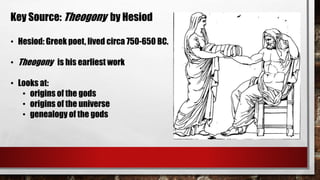
Key Source: Theogony by Hesiod 
• Hesiod: Greek poet, lived circa 750-650 BC. 
• Theogony is his earliest work 
• Looks at: 
• origins of the gods 
• origins of the universe 
• genealogy of the gods
But Rhea was subject in love to Cronos and bare splendid children, Hestia, Demeter, and gold-shod Hera and strong 
Hades, pitiless in heart, who dwells under the earth, and the loud-crashing Earth-Shaker, and wise Zeus, father of 
gods and men, by whose thunder the wide earth is shaken. These great Cronos swallowed as each came forth from 
the womb to his mother's knees with this intent, that no other of the proud sons of Heaven should hold the kingly 
office amongst the deathless gods. For he learned from Earth and starry Heaven that he was destined to be overcome 
by his own son, strong though he was, through the contriving of great Zeus. Therefore he kept no blind outlook, but 
watched and swallowed down his children: and unceasing grief seized Rhea. But when she was about to bear Zeus, 
the father of gods and men, then she besought her own dear parents, Earth and starry Heaven, to devise some plan 
with her that the birth of her dear child might be concealed, and that retribution might overtake great, crafty Cronos 
for his own father and also for the children whom he had swallowed down. And they readily heard and obeyed their 
dear daughter, and told her all that was destined to happen touching Cronos the king and his stout-hearted son. So 
they sent her to Lyetus, to the rich land of Crete, when she was ready to bear great Zeus, the youngest of her 
children. Him did vast Earth receive from Rhea in wide Crete to nourish and to bring up. Thither came Earth 
carrying him swiftly through the black night to Lyctus first, and took him in her arms and hid him in a remote cave 
beneath the secret places of the holy earth on thick-wooded Mount Aegeum; but to the mightily ruling son of 
Heaven, the earlier king of the gods, she gave a great stone wrapped in swaddling clothes. 
Theogony – Hesiod http://www.sacred-texts.com/cla/hesiod/theogony.htm
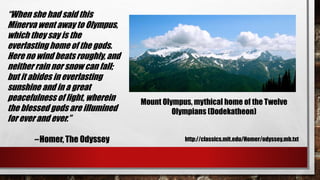
“When she had said this 
Minerva went away to Olympus, 
which they say is the 
everlasting home of the gods. 
Here no wind beats roughly, and 
neither rain nor snow can fall; 
but it abides in everlasting 
sunshine and in a great 
peacefulness of light, wherein 
the blessed gods are illumined 
for ever and ever.” 
– Homer, The Odyssey 
Mount Olympus, mythical home of the Twelve 
Olympians (Dodekatheon) 
http://classics.mit.edu/Homer/odyssey.mb.txt
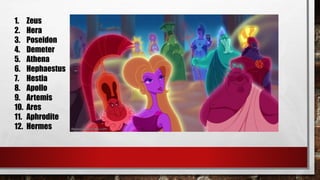
1. Zeus 
2. Hera 
3. Poseidon 
4. Demeter 
5. Athena 
6. Hephaestus 
7. Hestia 
8. Apollo 
9. Artemis 
10. Ares 
11. Aphrodite 
12. Hermes
Who 
is Hercules? 
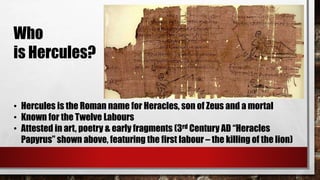
• Hercules is the Roman name for Heracles, son of Zeus and a mortal 
• Known for the Twelve Labours 
• Attested in art, poetry & early fragments (3rd Century AD “Heracles 
Papyrus” shown above, featuring the first labour – the killing of the lion)
http://www.theoi.com/

Greek Gods & Religion

  • 2.
    Ancient Greek Beliefs • The Ancient Greeks were polytheists • The Gods and Goddesses were: • immortal, yet they had human emotions e.g. anger, jealously, lust • connected to each other through relationships and stories • associated with aspects of nature e.g. Zeus with thunder • associated with certain cities e.g. Athena with Athens • seen to intervene in human affairs & interact with humans • subject to Fate
  • 3.
    The Greek Pantheon • ‘Pantheon’ definition: • All the gods of a people or religion collectively. • (esp. in ancient Greece and Rome) A temple dedicated to all the gods. • Key groups: • The Titans • The Olympians (gained supremacy by destroying The Titans)
  • 4.
    War of theGods/War of the Titans/Titanomachy • Ten year battle in the ancient region of Thessaly between the Titans & the Olympians • The story: • Cronus (a Titan) became King of the Gods after overthrowing (and castrating) his Father, Uranus. • Cronus was an evil king and ate his children (also, his wife was his sister) • His wife/sister hid their youngest child, Zeus, on Crete & fed Cronus a rock. Zeus was suckled by a goat and raised by a nymph. • Zeus grew up and became a cupbearer for Cronus…
  • 5.
    War of theGods cont. • Zeus fed Cronus mustard and wine and Cronus vomited up his children • Zeus led his siblings in the battle against the Titans • Zeus and his siblings won and divided the world amongst themselves: Zeus took the sky and the air and became god of gods, Poseidon took the sea & Hades was given the Underworld.
  • 6.
    Key Source: Theogonyby Hesiod • Hesiod: Greek poet, lived circa 750-650 BC. • Theogony is his earliest work • Looks at: • origins of the gods • origins of the universe • genealogy of the gods
  • 7.
    But Rhea wassubject in love to Cronos and bare splendid children, Hestia, Demeter, and gold-shod Hera and strong Hades, pitiless in heart, who dwells under the earth, and the loud-crashing Earth-Shaker, and wise Zeus, father of gods and men, by whose thunder the wide earth is shaken. These great Cronos swallowed as each came forth from the womb to his mother's knees with this intent, that no other of the proud sons of Heaven should hold the kingly office amongst the deathless gods. For he learned from Earth and starry Heaven that he was destined to be overcome by his own son, strong though he was, through the contriving of great Zeus. Therefore he kept no blind outlook, but watched and swallowed down his children: and unceasing grief seized Rhea. But when she was about to bear Zeus, the father of gods and men, then she besought her own dear parents, Earth and starry Heaven, to devise some plan with her that the birth of her dear child might be concealed, and that retribution might overtake great, crafty Cronos for his own father and also for the children whom he had swallowed down. And they readily heard and obeyed their dear daughter, and told her all that was destined to happen touching Cronos the king and his stout-hearted son. So they sent her to Lyetus, to the rich land of Crete, when she was ready to bear great Zeus, the youngest of her children. Him did vast Earth receive from Rhea in wide Crete to nourish and to bring up. Thither came Earth carrying him swiftly through the black night to Lyctus first, and took him in her arms and hid him in a remote cave beneath the secret places of the holy earth on thick-wooded Mount Aegeum; but to the mightily ruling son of Heaven, the earlier king of the gods, she gave a great stone wrapped in swaddling clothes. Theogony – Hesiod http://www.sacred-texts.com/cla/hesiod/theogony.htm
  • 8.
    “When she hadsaid this Minerva went away to Olympus, which they say is the everlasting home of the gods. Here no wind beats roughly, and neither rain nor snow can fall; but it abides in everlasting sunshine and in a great peacefulness of light, wherein the blessed gods are illumined for ever and ever.” – Homer, The Odyssey Mount Olympus, mythical home of the Twelve Olympians (Dodekatheon) http://classics.mit.edu/Homer/odyssey.mb.txt
  • 9.
    1. Zeus 2.Hera 3. Poseidon 4. Demeter 5. Athena 6. Hephaestus 7. Hestia 8. Apollo 9. Artemis 10. Ares 11. Aphrodite 12. Hermes
  • 10.
    Who is Hercules? • Hercules is the Roman name for Heracles, son of Zeus and a mortal • Known for the Twelve Labours • Attested in art, poetry & early fragments (3rd Century AD “Heracles Papyrus” shown above, featuring the first labour – the killing of the lion)
  • 12.