The Olympians
The divine family and
others
The Olympian Gods
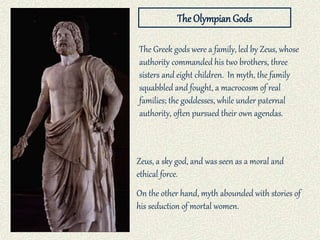
The Greek gods were a family, led by Zeus, whose
authority commanded his two brothers, three
sisters and eight children. In myth, the family
squabbled and fought, a macrocosm of real
families; the goddesses, while under paternal
authority, often pursued their own agendas.
Zeus, a sky god, and was seen as a moral and
ethical force.
On the other hand, myth abounded with stories of
his seduction of mortal women.
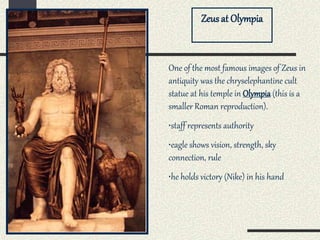
One of the most famous images of Zeus in
antiquity was the chryselephantine cult
statue at his temple in Olympia (this is a
smaller Roman reproduction).
•staff represents authority
•eagle shows vision, strength, sky
connection, rule
•he holds victory (Nike) in his hand
Zeus at Olympia
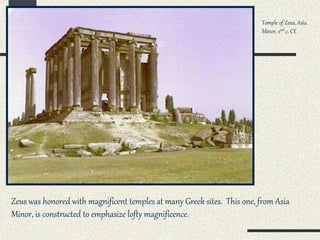
Temple of Zeus, Asia
Minor, 2nd c. CE
Zeus was honored with magnificent temples at many Greek sites. This one, from Asia
Minor, is constructed to emphasize lofty magnificence.
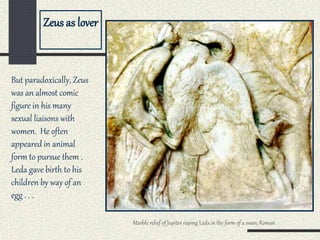
Marble relief of Jupiter raping Leda in the form of a swan; Roman
But paradoxically, Zeus
was an almost comic
figure in his many
sexual liaisons with
women. He often
appeared in animal
form to pursue them .
Leda gave birth to his
children by way of an
egg . . .
Zeus as lover
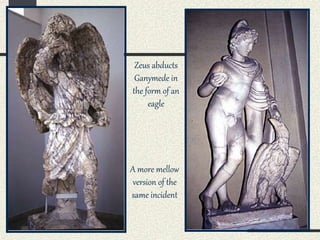
Zeus abducts
Ganymede in
the form of an
eagle
A more mellow
version of the
same incident
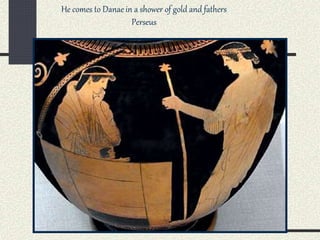
He comes to Danae in a shower of gold and fathers
Perseus
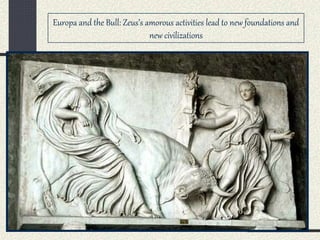
Europa and the Bull: Zeus’s amorous activities lead to new foundations and
new civilizations
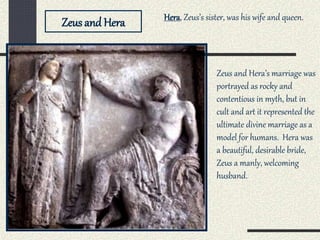
Zeus and Hera
Zeus and Hera’s marriage was
portrayed as rocky and
contentious in myth, but in
cult and art it represented the
ultimate divine marriage as a
model for humans. Hera was
a beautiful, desirable bride,
Zeus a manly, welcoming
husband.
Hera, Zeus’s sister, was his wife and queen.
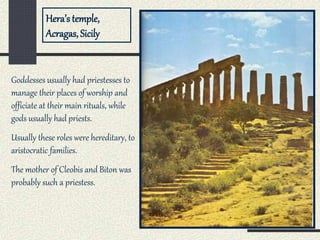
Hera’s temple,
Acragas, Sicily
Goddesses usually had priestesses to
manage their places of worship and
officiate at their main rituals, while
gods usually had priests.
Usually these roles were hereditary, to
aristocratic families.
The mother of Cleobis and Biton was
probably such a priestess.
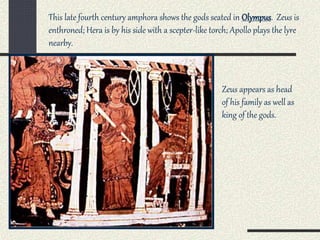
This late fourth century amphora shows the gods seated in Olympus. Zeus is
enthroned; Hera is by his side with a scepter-like torch; Apollo plays the lyre
nearby.
Zeus appears as head
of his family as well as
king of the gods.
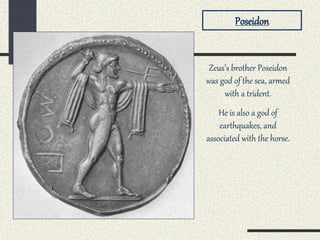
Zeus’s brother Poseidon
was god of the sea, armed
with a trident.
He is also a god of
earthquakes, and
associated with the horse.
Poseidon
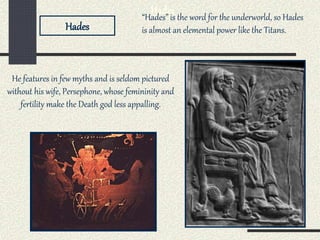
Hades
He features in few myths and is seldom pictured
without his wife, Persephone, whose femininity and
fertility make the Death god less appalling.
Hades
“Hades” is the word for the underworld, so Hades
is almost an elemental power like the Titans.
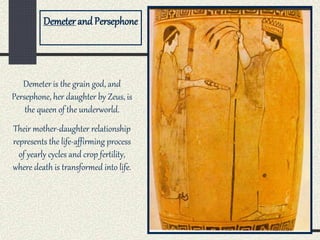
Demeter is the grain god, and
Persephone, her daughter by Zeus, is
the queen of the underworld.
Their mother-daughter relationship
represents the life-affirming process
of yearly cycles and crop fertility,
where death is transformed into life.
Demeter and Persephone
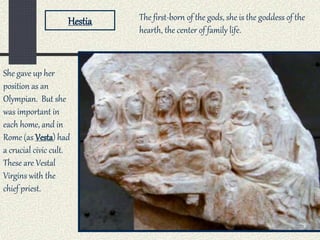
Hestia
She gave up her
position as an
Olympian. But she
was important in
each home, and in
Rome (as Vesta) had
a crucial civic cult.
These are Vestal
Virgins with the
chief priest.
The first-born of the gods, she is the goddess of the
hearth, the center of family life.
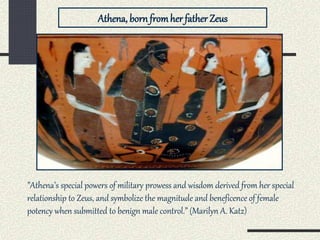
Athena, bornfromher father Zeus
”Athena’s special powers of military prowess and wisdom derived from her special
relationship to Zeus, and symbolize the magnitude and beneficence of female
potency when submitted to benign male control.” (Marilyn A. Katz)
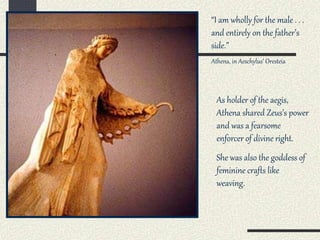
As holder of the aegis,
Athena shared Zeus’s power
and was a fearsome
enforcer of divine right.
She was also the goddess of
feminine crafts like
weaving.
“I am wholly for the male . . .
and entirely on the father’s
side.”
Athena, in Aeschylus’ Oresteia
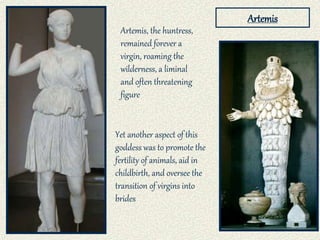
Artemis, the huntress,
remained forever a
virgin, roaming the
wilderness, a liminal
and often threatening
figure
Yet another aspect of this
goddess was to promote the
fertility of animals, aid in
childbirth, and oversee the
transition of virgins into
brides
Artemis
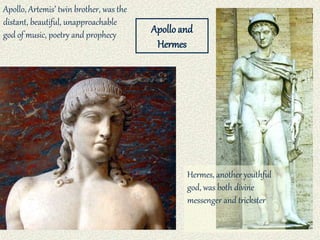
Apollo, Artemis’ twin brother, was the
distant, beautiful, unapproachable
god of music, poetry and prophecy
Hermes, another youthful
god, was both divine
messenger and trickster
Apolloand
Hermes
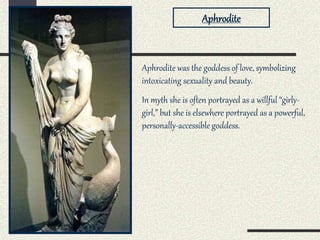
Aphrodite was the goddess of love, symbolizing
intoxicating sexuality and beauty.
In myth she is often portrayed as a willful “girly-
girl,” but she is elsewhere portrayed as a powerful,
personally-accessible goddess.
Aphrodite
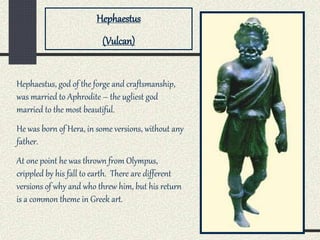
Hephaestus, god of the forge and craftsmanship,
was married to Aphrodite – the ugliest god
married to the most beautiful.
He was born of Hera, in some versions, without any
father.
At one point he was thrown from Olympus,
crippled by his fall to earth. There are different
versions of why and who threw him, but his return
is a common theme in Greek art.
Hephaestus
(Vulcan)
He is often a comic figure, but one who adds to the Olympian community. He solves
problems, calms arguments – and deals with a very unfaithful wife in creative ways!
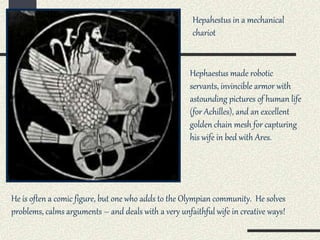
Hepahestus in a mechanical
chariot
Hephaestus made robotic
servants, invincible armor with
astounding pictures of human life
(for Achilles), and an excellent
golden chain mesh for capturing
his wife in bed with Ares.
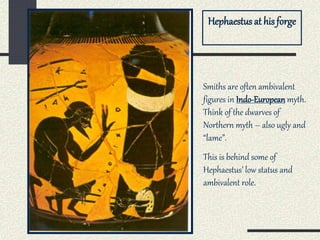
Hephaestus at his forge
Smiths are often ambivalent
figures in Indo-European myth.
Think of the dwarves of
Northern myth – also ugly and
“lame”.
This is behind some of
Hephaestus’ low status and
ambivalent role.
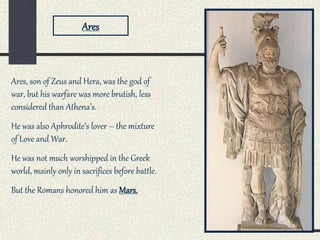
Ares, son of Zeus and Hera, was the god of
war, but his warfare was more brutish, less
considered than Athena’s.
He was also Aphrodite’s lover – the mixture
of Love and War.
He was not much worshipped in the Greek
world, mainly only in sacrifices before battle.
But the Romans honored him as Mars.
Ares
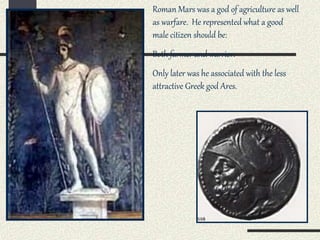
Roman Mars was a god of agriculture as well
as warfare. He represented what a good
male citizen should be:
Both farmer and warrior.
Only later was he associated with the less
attractive Greek god Ares.
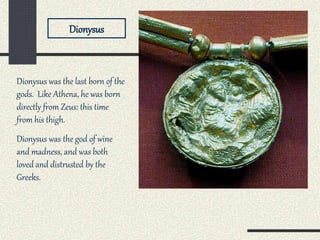
Dionysus was the last born of the
gods. Like Athena, he was born
directly from Zeus: this time
from his thigh.
Dionysus was the god of wine
and madness, and was both
loved and distrusted by the
Greeks.
Dionysus
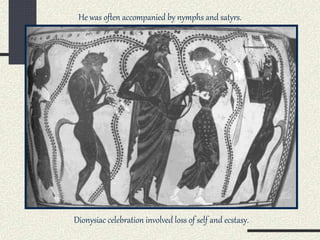
Dionysiac celebration involved loss of self and ecstasy.
He was often accompanied by nymphs and satyrs.
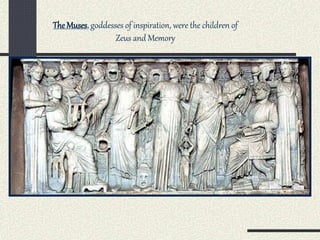
The Muses, goddesses of inspiration, were the children of
Zeus and Memory
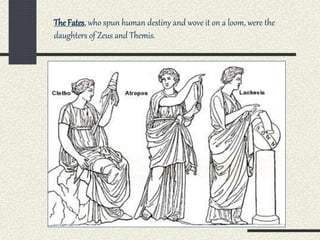
The Fates, who spun human destiny and wove it on a loom, were the
daughters of Zeus and Themis.
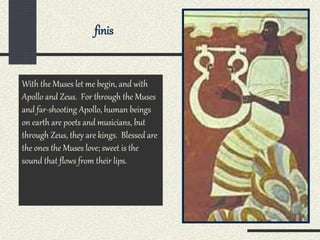
With the Muses let me begin, and with
Apollo and Zeus. For through the Muses
and far-shooting Apollo, human beings
on earth are poets and musicians, but
through Zeus, they are kings. Blessed are
the ones the Muses love; sweet is the
sound that flows from their lips.
finis

Olympians

  • 1.
    The Olympians The divinefamily and others
  • 2.
    The Olympian Gods TheGreek gods were a family, led by Zeus, whose authority commanded his two brothers, three sisters and eight children. In myth, the family squabbled and fought, a macrocosm of real families; the goddesses, while under paternal authority, often pursued their own agendas. Zeus, a sky god, and was seen as a moral and ethical force. On the other hand, myth abounded with stories of his seduction of mortal women.
  • 3.
    One of themost famous images of Zeus in antiquity was the chryselephantine cult statue at his temple in Olympia (this is a smaller Roman reproduction). •staff represents authority •eagle shows vision, strength, sky connection, rule •he holds victory (Nike) in his hand Zeus at Olympia
  • 4.
    Temple of Zeus,Asia Minor, 2nd c. CE Zeus was honored with magnificent temples at many Greek sites. This one, from Asia Minor, is constructed to emphasize lofty magnificence.
  • 5.
    Marble relief ofJupiter raping Leda in the form of a swan; Roman But paradoxically, Zeus was an almost comic figure in his many sexual liaisons with women. He often appeared in animal form to pursue them . Leda gave birth to his children by way of an egg . . . Zeus as lover
  • 6.
    Zeus abducts Ganymede in theform of an eagle A more mellow version of the same incident
  • 8.
    He comes toDanae in a shower of gold and fathers Perseus
  • 9.
    Europa and theBull: Zeus’s amorous activities lead to new foundations and new civilizations
  • 10.
    Zeus and Hera Zeusand Hera’s marriage was portrayed as rocky and contentious in myth, but in cult and art it represented the ultimate divine marriage as a model for humans. Hera was a beautiful, desirable bride, Zeus a manly, welcoming husband. Hera, Zeus’s sister, was his wife and queen.
  • 11.
    Hera’s temple, Acragas, Sicily Goddessesusually had priestesses to manage their places of worship and officiate at their main rituals, while gods usually had priests. Usually these roles were hereditary, to aristocratic families. The mother of Cleobis and Biton was probably such a priestess.
  • 12.
    This late fourthcentury amphora shows the gods seated in Olympus. Zeus is enthroned; Hera is by his side with a scepter-like torch; Apollo plays the lyre nearby. Zeus appears as head of his family as well as king of the gods.
  • 13.
    Zeus’s brother Poseidon wasgod of the sea, armed with a trident. He is also a god of earthquakes, and associated with the horse. Poseidon
  • 14.
    Hades He features infew myths and is seldom pictured without his wife, Persephone, whose femininity and fertility make the Death god less appalling. Hades “Hades” is the word for the underworld, so Hades is almost an elemental power like the Titans.
  • 15.
    Demeter is thegrain god, and Persephone, her daughter by Zeus, is the queen of the underworld. Their mother-daughter relationship represents the life-affirming process of yearly cycles and crop fertility, where death is transformed into life. Demeter and Persephone
  • 16.
    Hestia She gave upher position as an Olympian. But she was important in each home, and in Rome (as Vesta) had a crucial civic cult. These are Vestal Virgins with the chief priest. The first-born of the gods, she is the goddess of the hearth, the center of family life.
  • 17.
    Athena, bornfromher fatherZeus ”Athena’s special powers of military prowess and wisdom derived from her special relationship to Zeus, and symbolize the magnitude and beneficence of female potency when submitted to benign male control.” (Marilyn A. Katz)
  • 18.
    As holder ofthe aegis, Athena shared Zeus’s power and was a fearsome enforcer of divine right. She was also the goddess of feminine crafts like weaving. “I am wholly for the male . . . and entirely on the father’s side.” Athena, in Aeschylus’ Oresteia
  • 19.
    Artemis, the huntress, remainedforever a virgin, roaming the wilderness, a liminal and often threatening figure Yet another aspect of this goddess was to promote the fertility of animals, aid in childbirth, and oversee the transition of virgins into brides Artemis
  • 20.
    Apollo, Artemis’ twinbrother, was the distant, beautiful, unapproachable god of music, poetry and prophecy Hermes, another youthful god, was both divine messenger and trickster Apolloand Hermes
  • 21.
    Aphrodite was thegoddess of love, symbolizing intoxicating sexuality and beauty. In myth she is often portrayed as a willful “girly- girl,” but she is elsewhere portrayed as a powerful, personally-accessible goddess. Aphrodite
  • 22.
    Hephaestus, god ofthe forge and craftsmanship, was married to Aphrodite – the ugliest god married to the most beautiful. He was born of Hera, in some versions, without any father. At one point he was thrown from Olympus, crippled by his fall to earth. There are different versions of why and who threw him, but his return is a common theme in Greek art. Hephaestus (Vulcan)
  • 23.
    He is oftena comic figure, but one who adds to the Olympian community. He solves problems, calms arguments – and deals with a very unfaithful wife in creative ways! Hepahestus in a mechanical chariot Hephaestus made robotic servants, invincible armor with astounding pictures of human life (for Achilles), and an excellent golden chain mesh for capturing his wife in bed with Ares.
  • 24.
    Hephaestus at hisforge Smiths are often ambivalent figures in Indo-European myth. Think of the dwarves of Northern myth – also ugly and “lame”. This is behind some of Hephaestus’ low status and ambivalent role.
  • 25.
    Ares, son ofZeus and Hera, was the god of war, but his warfare was more brutish, less considered than Athena’s. He was also Aphrodite’s lover – the mixture of Love and War. He was not much worshipped in the Greek world, mainly only in sacrifices before battle. But the Romans honored him as Mars. Ares
  • 26.
    Roman Mars wasa god of agriculture as well as warfare. He represented what a good male citizen should be: Both farmer and warrior. Only later was he associated with the less attractive Greek god Ares.
  • 27.
    Dionysus was thelast born of the gods. Like Athena, he was born directly from Zeus: this time from his thigh. Dionysus was the god of wine and madness, and was both loved and distrusted by the Greeks. Dionysus
  • 28.
    Dionysiac celebration involvedloss of self and ecstasy. He was often accompanied by nymphs and satyrs.
  • 29.
    The Muses, goddessesof inspiration, were the children of Zeus and Memory
  • 30.
    The Fates, whospun human destiny and wove it on a loom, were the daughters of Zeus and Themis.
  • 31.
    With the Museslet me begin, and with Apollo and Zeus. For through the Muses and far-shooting Apollo, human beings on earth are poets and musicians, but through Zeus, they are kings. Blessed are the ones the Muses love; sweet is the sound that flows from their lips. finis