a a real-time pilot for the CMU ShuttleDaiying Chen		DAVId LevinsonAddam Hall		KAREN  MESKOLisa Hall		EI EI MIN THUNolan Leavitt		SUDHEER  SOMESHWARAFall 2009 Heinz College, Carnegie Mellon University
AgendaHistoryPlanningImplementationResultsGoing Forward
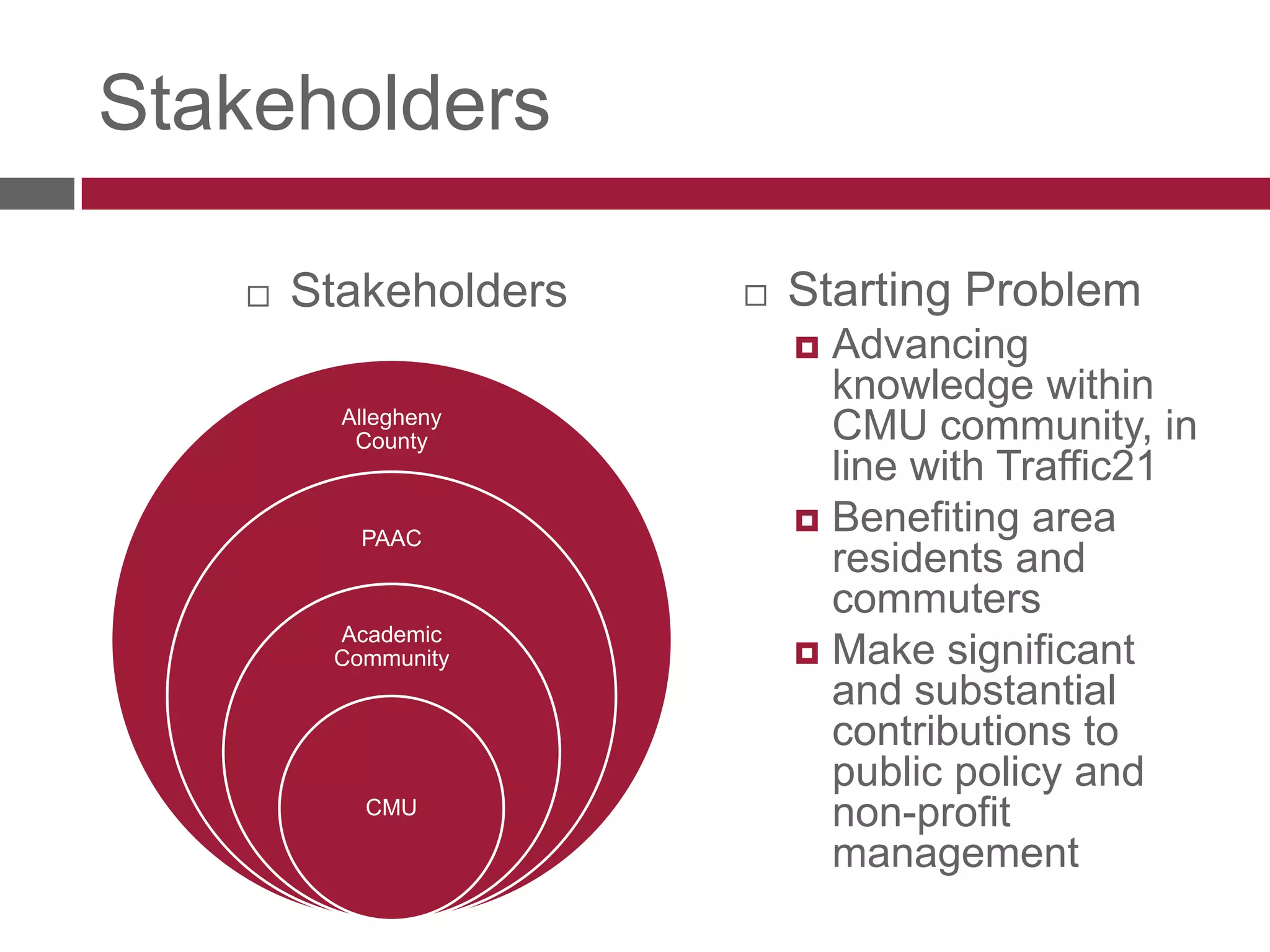
StakeholdersStakeholdersStarting ProblemAdvancing knowledge within CMU community, in line with Traffic21Benefiting area residents and commutersMake significant and substantial contributions to public policy and non-profit management
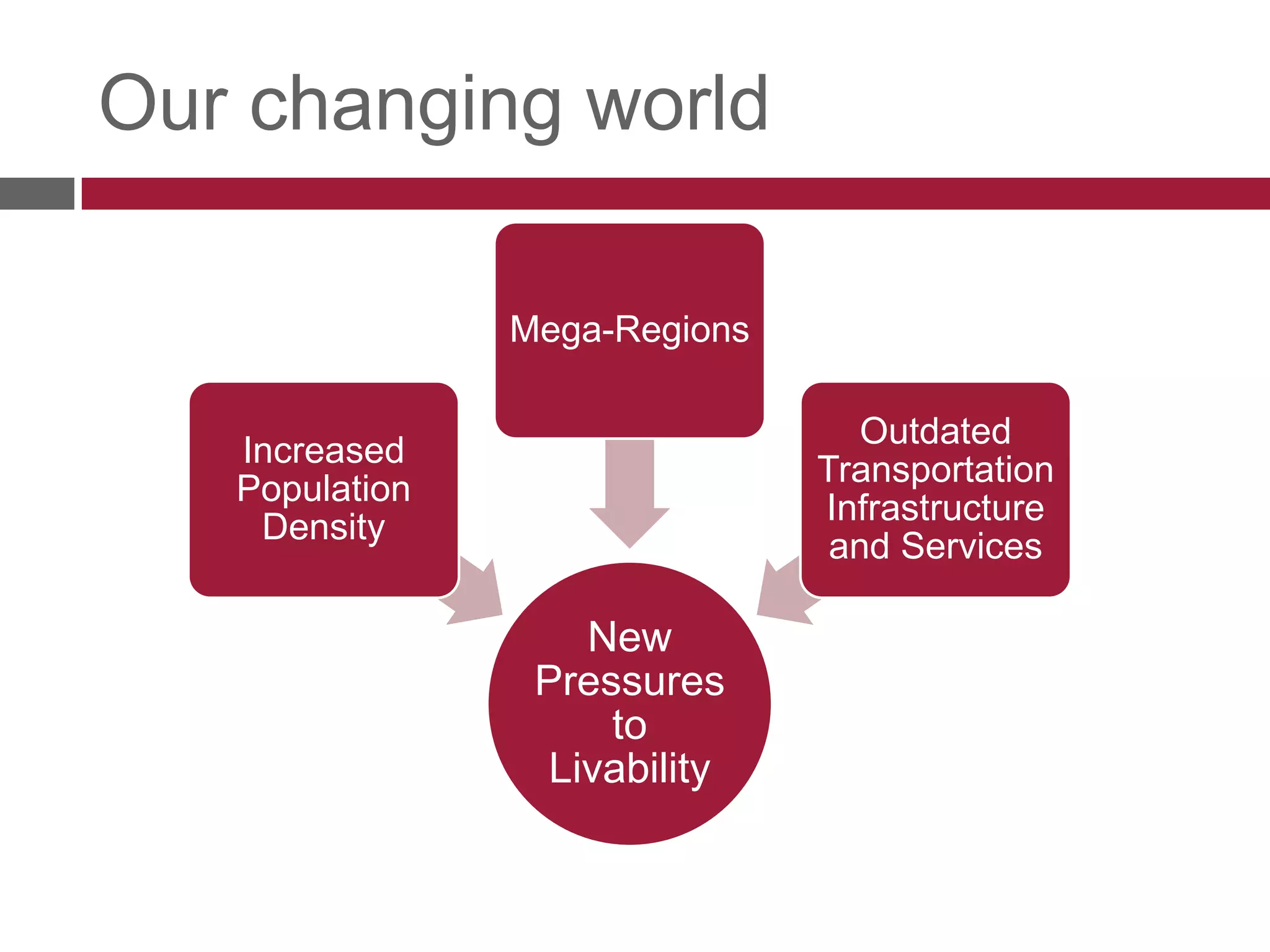
Our Changing World
Our Solution: Real-Time InformationReal-Time Transportation InformationCutting-edge technologyNovel solution to reliability problemsMany benefitsTo ridersTo transit providersTo community
AgendaHistoryPlanningImplementationResultsGoing Forward
DeliverablesPort Authority Technical Capabilities ReportPublic Transit Ridership SurveysmyRide website - http://myride.heinz.cmu.eduFunding Request for permanent systemFuture coursework plans Android Phone GPS tracking applicationGoogle Transit Feed Specification compliant databaseMobile Webpage Project Document Report
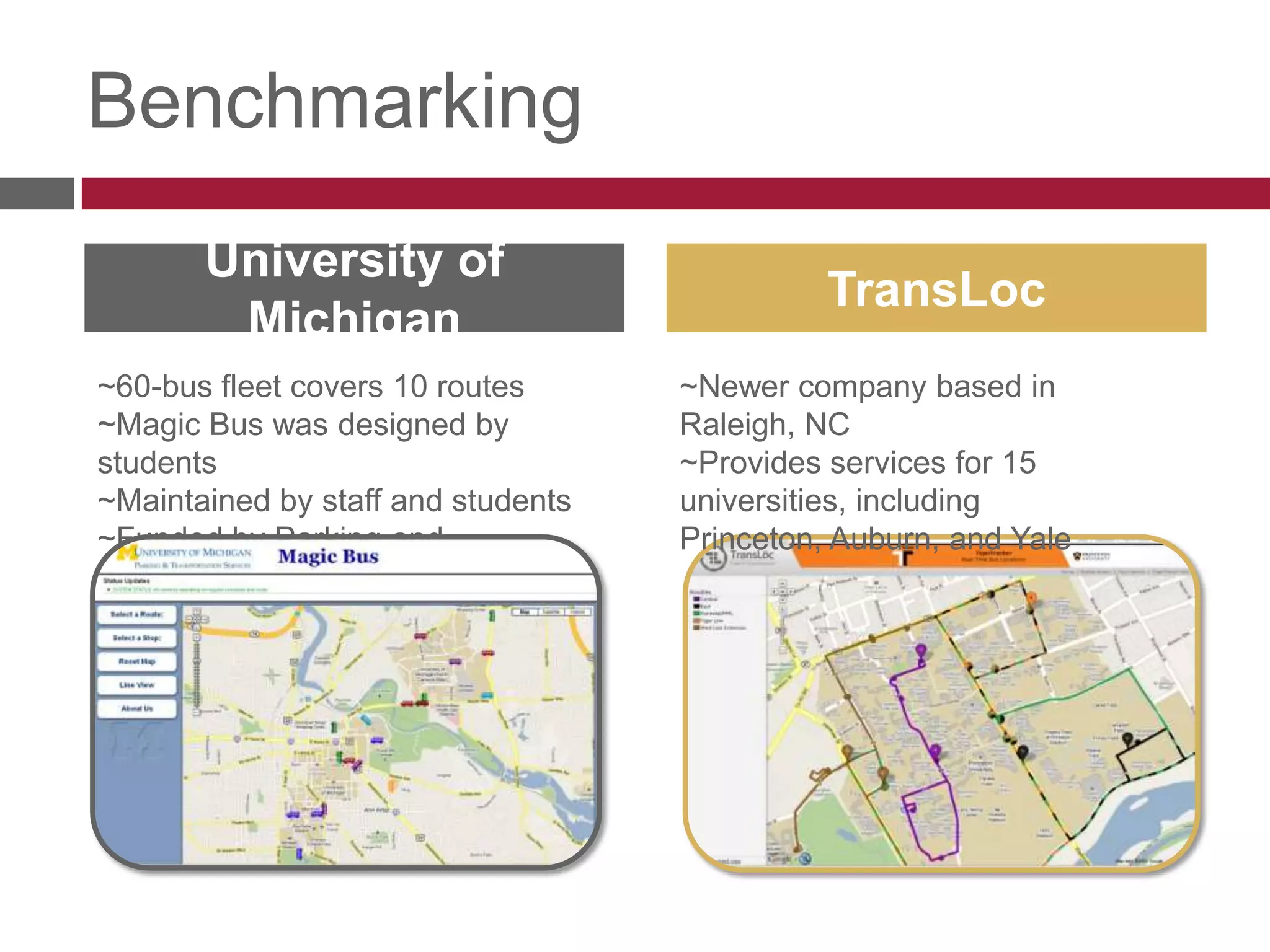
BenchmarkingUniversity of MichiganTransLoc~60-bus fleet covers 10 routes~Magic Bus was designed by students~Maintained by staff and students~Funded by Transportation Dept.~Newer company based in Raleigh~Provides services for 15 schools, including Princeton, Auburn, and Yale
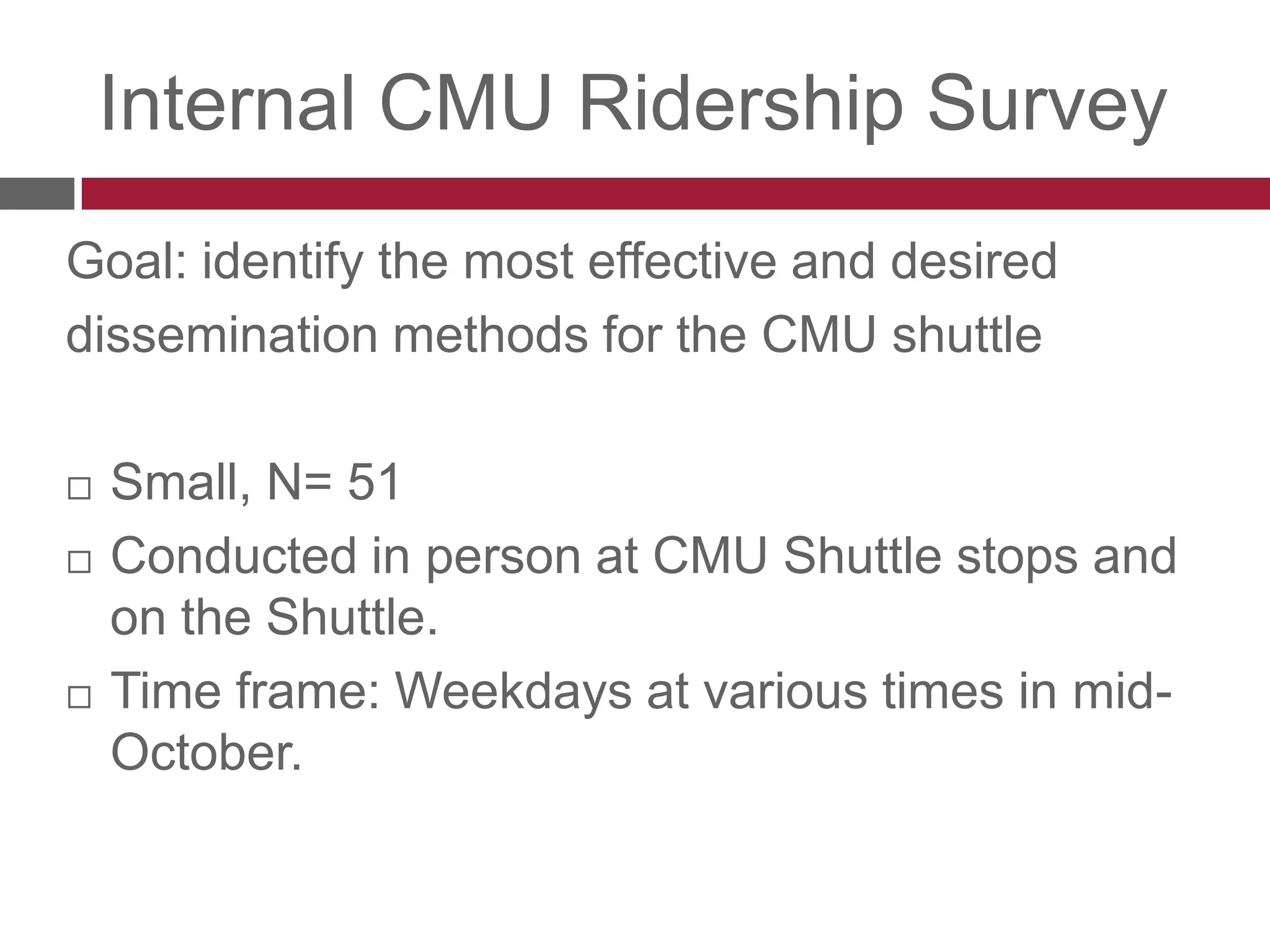
Internal CMU Ridership SurveyGoal: identify the most effective and desireddissemination methods for the CMU shuttleSmall, N= 51Conducted in person at CMU Shuttle stops and on the Shuttle.Time frame: Weekdays at various times in mid-October.
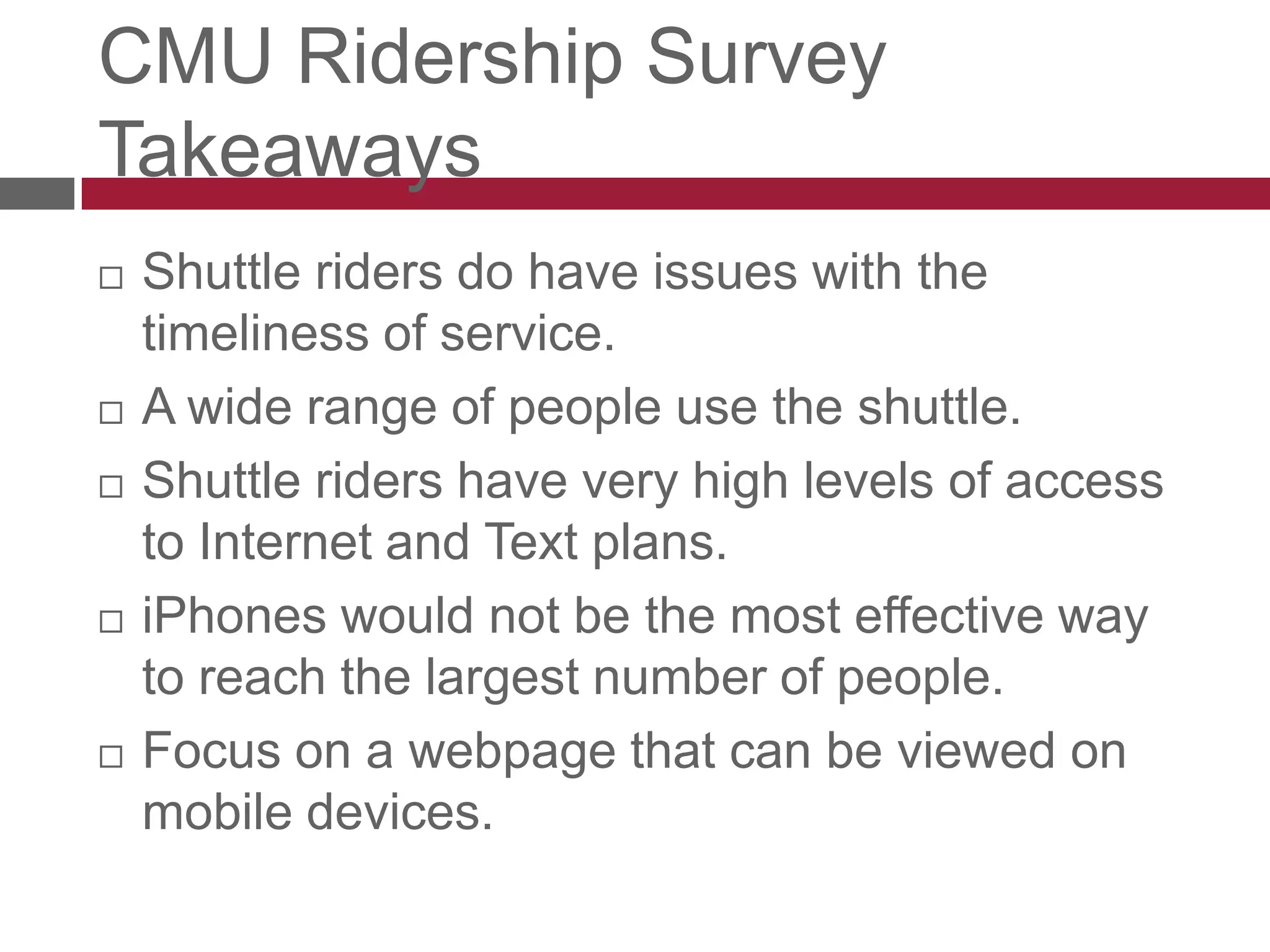
CMU Ridership Survey TakeawaysShuttle riders do have issues with the timeliness of service.A wide range of people use the shuttle.Shuttle riders have very high levels of access to Internet and Text plans.iPhones would not be the most effective way to reach the largest number of people.Focus on a webpage that can be viewed on mobile devices.
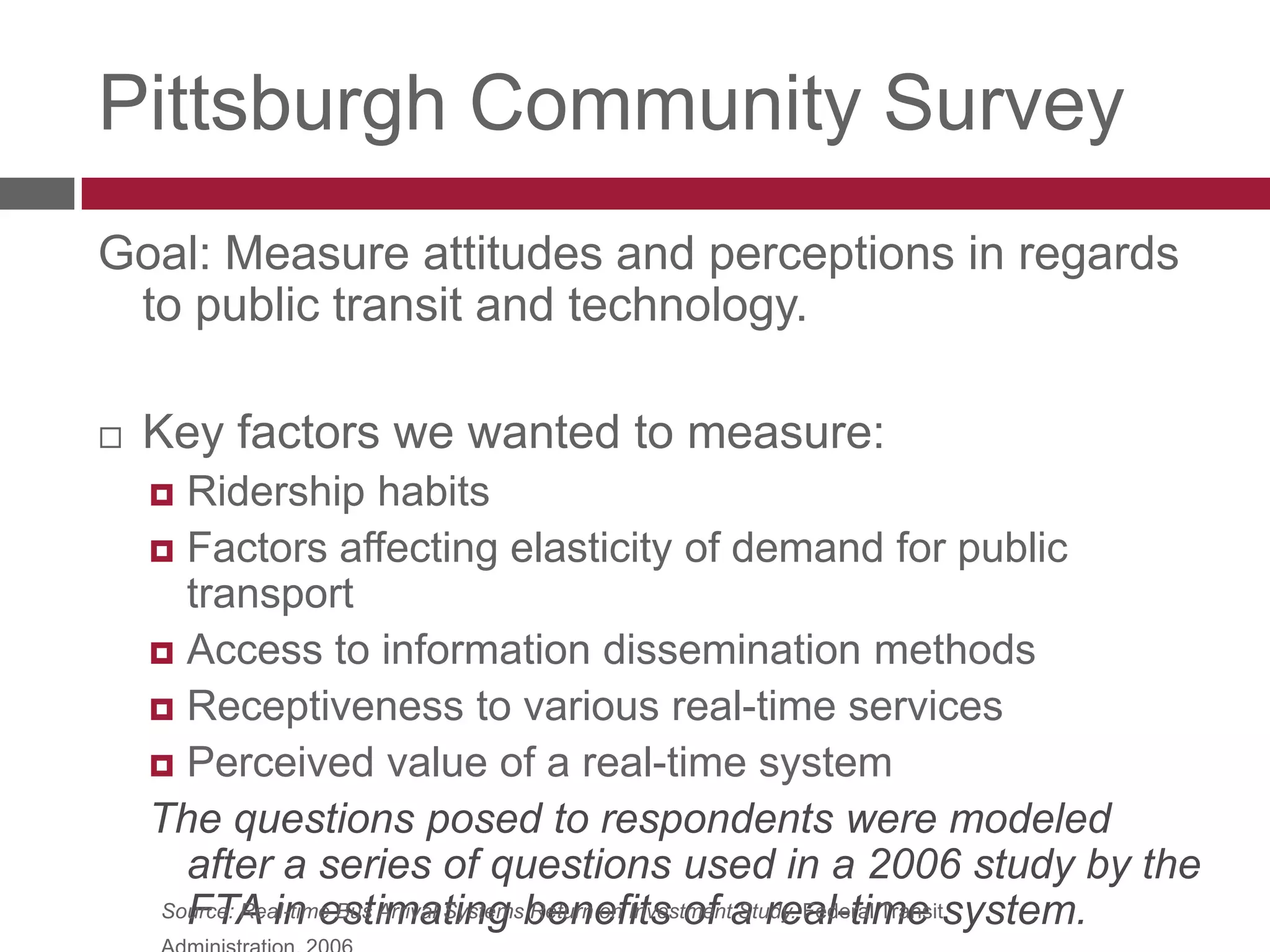
Pittsburgh Community SurveyGoal: Measure attitudes and perceptions in regards to public transit and technology. Key factors we wanted to measure:Ridership habitsFactors affecting demand elasticity for public transitAccess to information dissemination methodsReceptiveness to various real-time servicesPerceived value of a real-time systemThe questions posed to respondents were modeled after a series of questions used in a 2006 study by the FTA in estimating benefits of a real-time system.Source: Real-time Bus Arrival Systems Return on Investment Study. Federal Transit Administration, 2006.
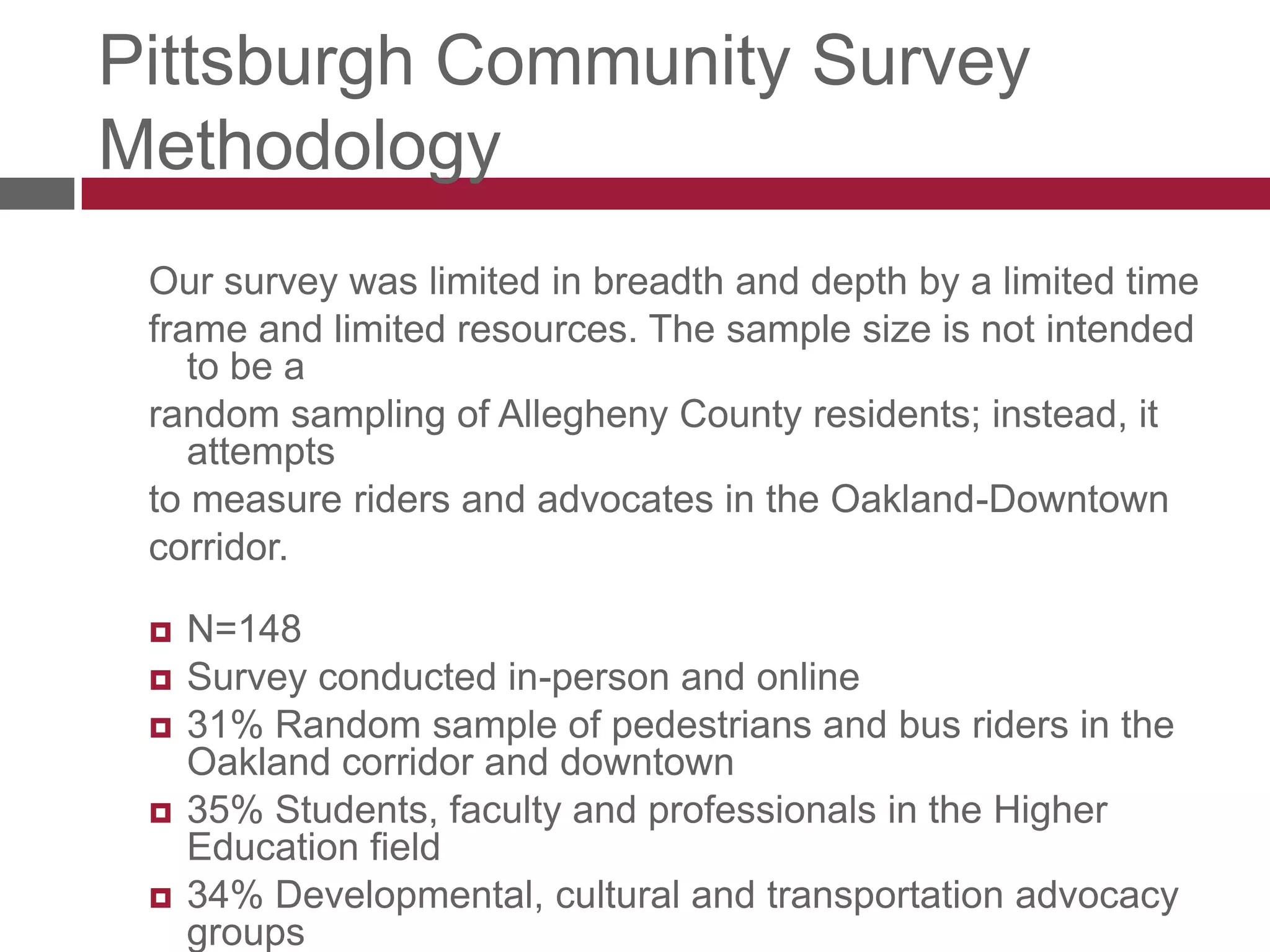
Pittsburgh Community Survey MethodologyOur survey was limited in breadth and depth by a limited timeframe and limited resources. The sample size is not intended to be arandom sampling of Allegheny County residents; instead, it attemptsto measure riders and advocates in the Oakland-Downtowncorridor. N=148Survey conducted in-person and online31% Random sample of pedestrians and bus riders in the Oakland corridor and downtown35% Students, faculty and professionals in the Higher Education field34% Developmental, cultural and transportation advocacy groups
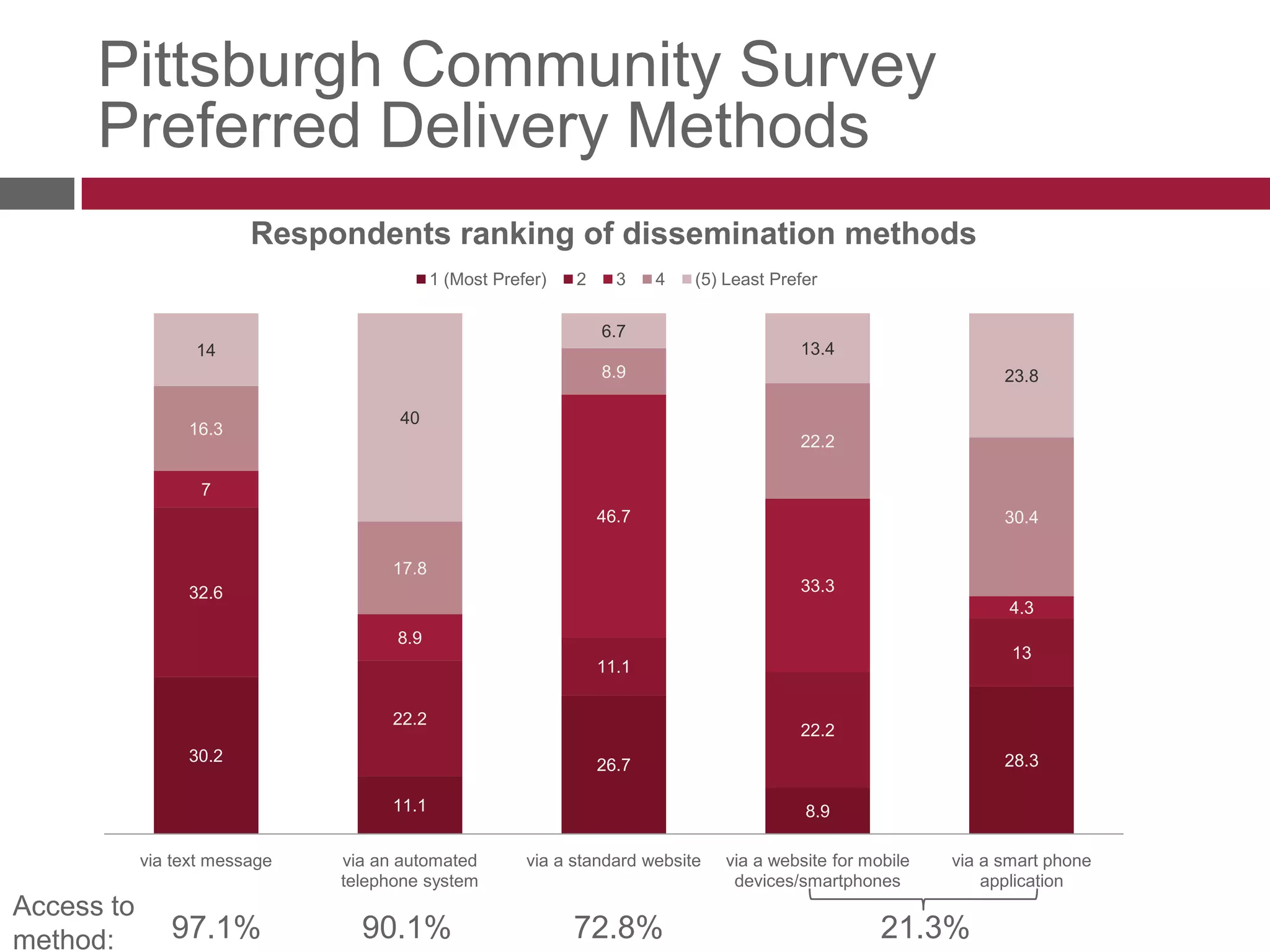
Pittsburgh Community SurveyPreferred Delivery MethodsAccess to method:97.1%90.1%72.8%21.3%
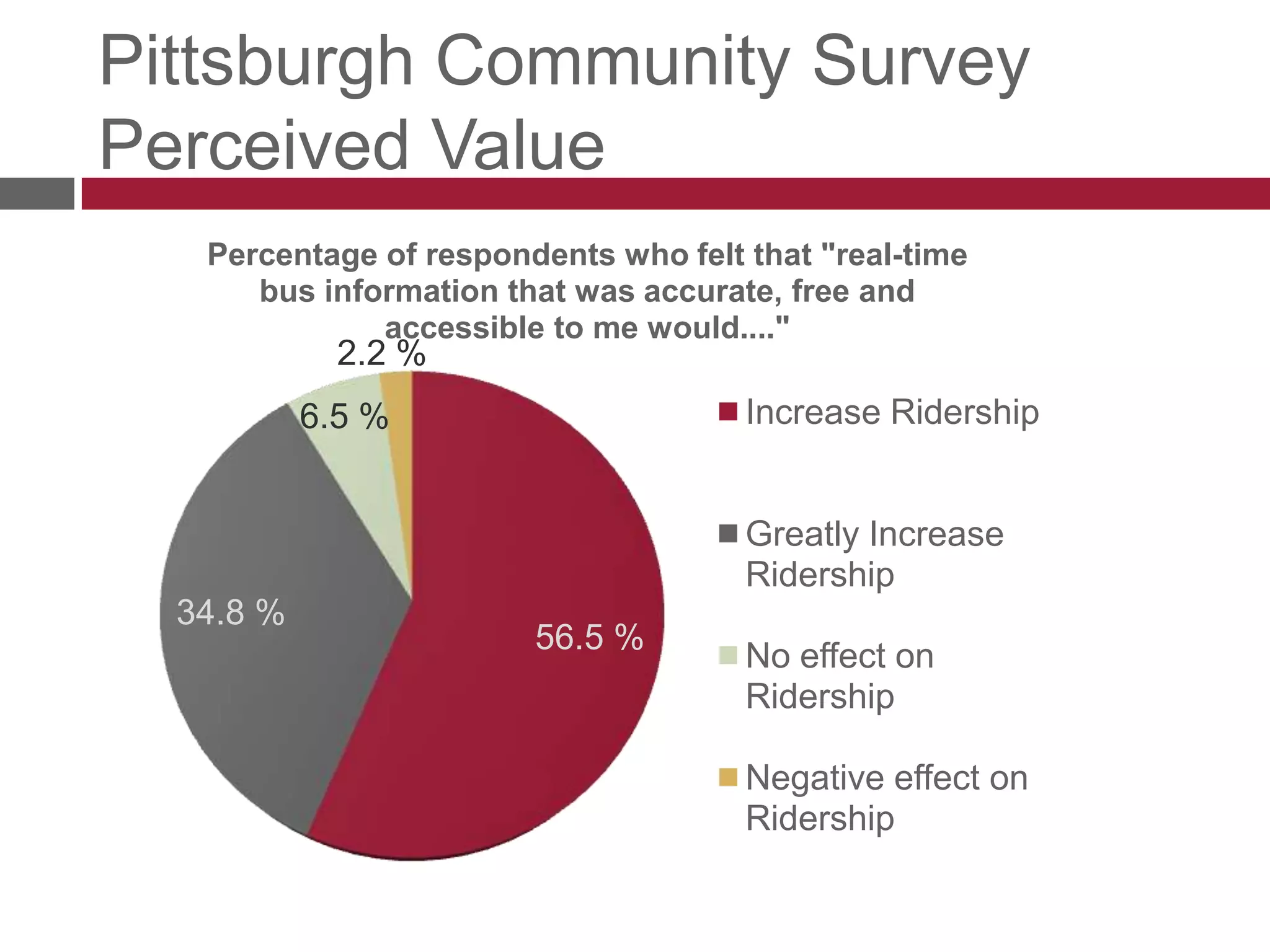
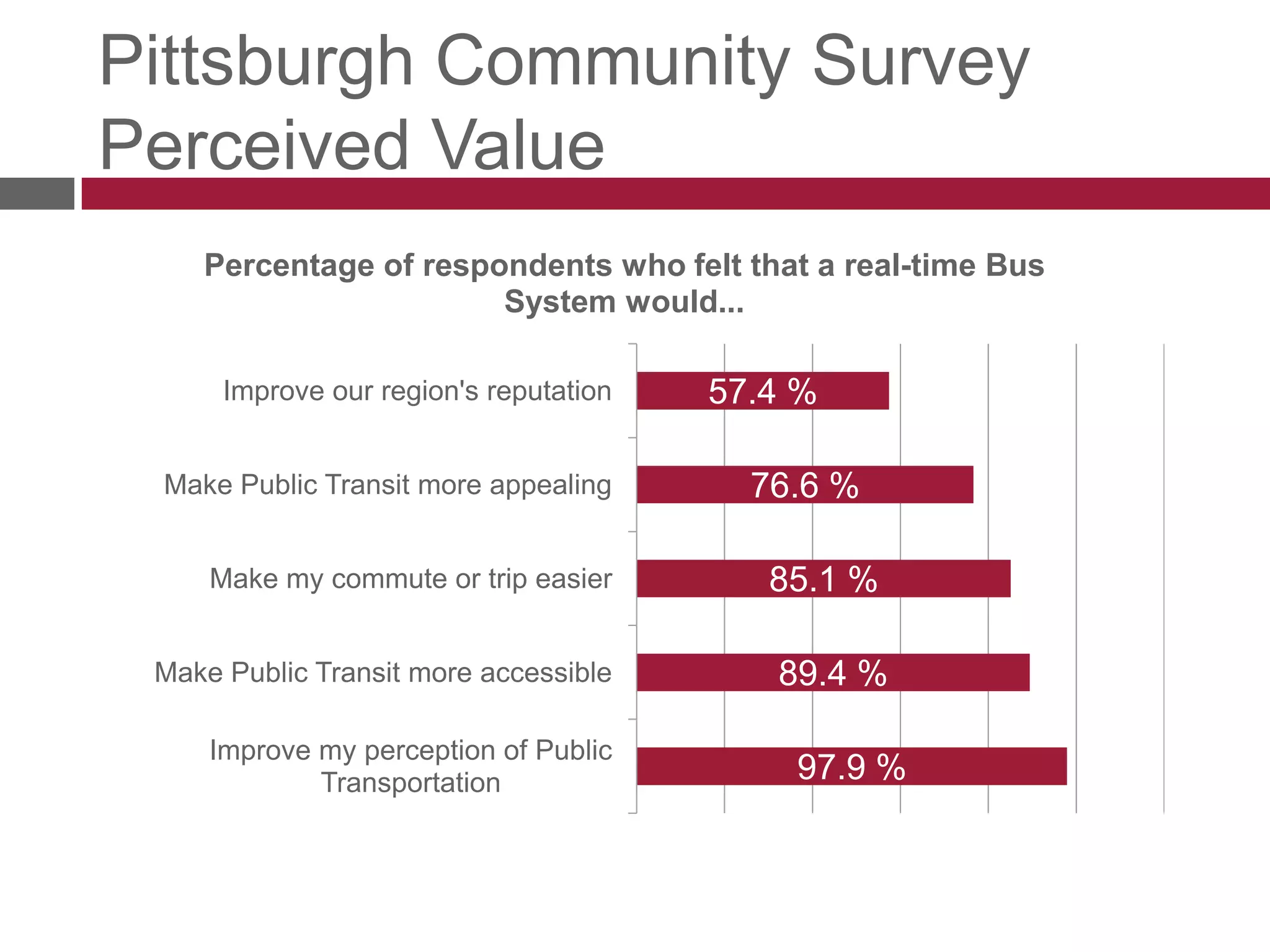
Pittsburgh Community SurveyPerceived Value
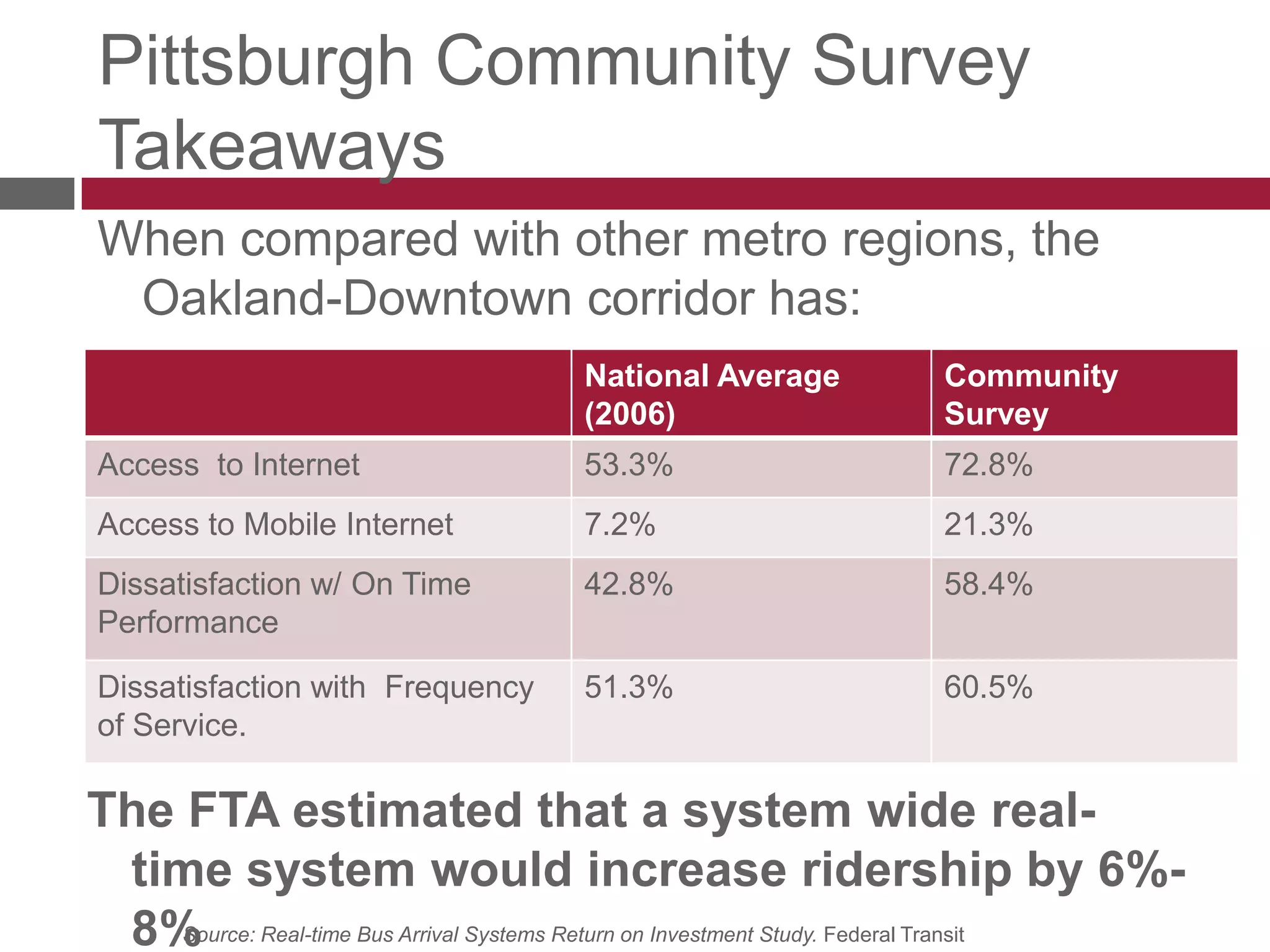
Pittsburgh Community Survey TakeawaysWhen compared with other metro regions, the Oakland-Downtown corridor has:The FTA estimated that a system widereal-time system would increase ridership by 6%-8%.Source: Real-time Bus Arrival Systems Return on Investment Study. Federal Transit Administration, 2006.
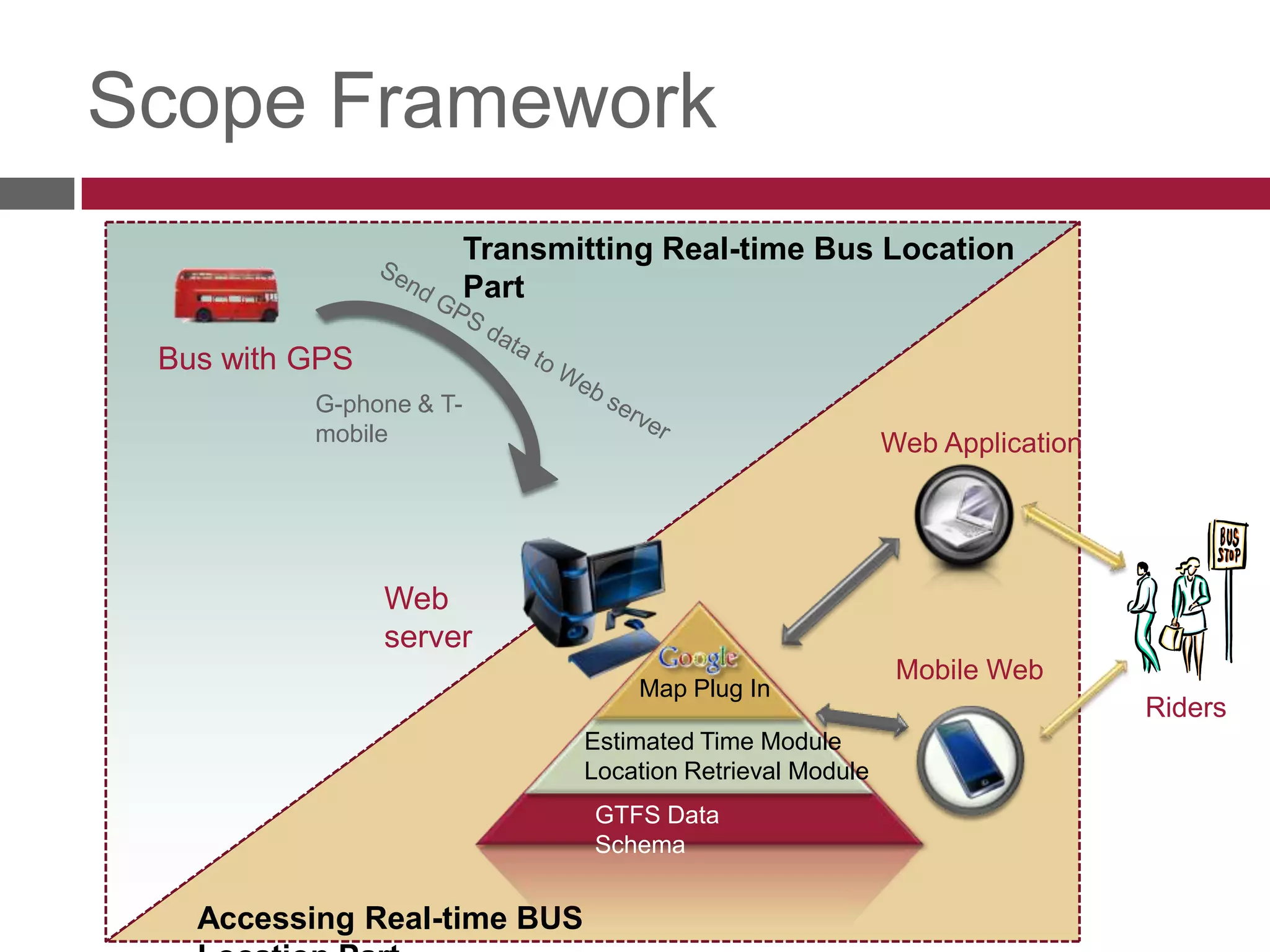
Scope FrameworkTransmitting Real-time Bus Location PartBus with GPS Send GPS data to Web serverG-phone & T-mobileWeb ApplicationWeb serverMobile WebRidersMap Plug InEstimated Time ModuleLocation Retrieval ModuleAccessing Real-time BUS Location PartGTFS Data Schema
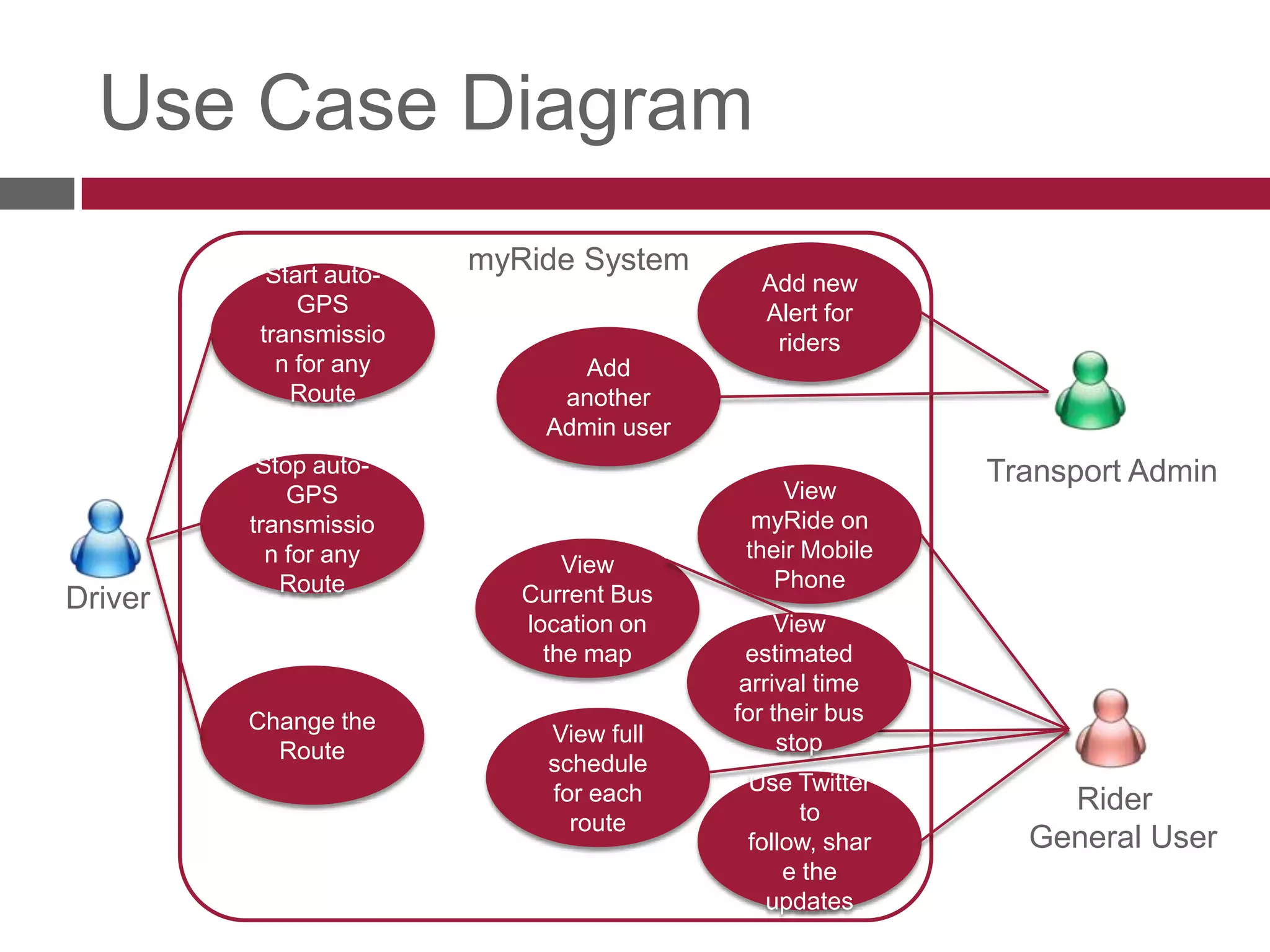
Use Case DiagrammyRide SystemAdd new Alert for ridersStart auto-GPS transmission for any RouteAdd another Admin userTransport AdminStop auto-GPS transmission for any RouteView myRide on their Mobile PhoneView Current Bus location on the mapDriverView estimated arrival time for their bus stopChange the Route View full schedule for each routeRiderGeneral UserUse Twitter to follow, share the updates
AgendaHistoryPlanningImplementationResultsGoing Forward
Logistics
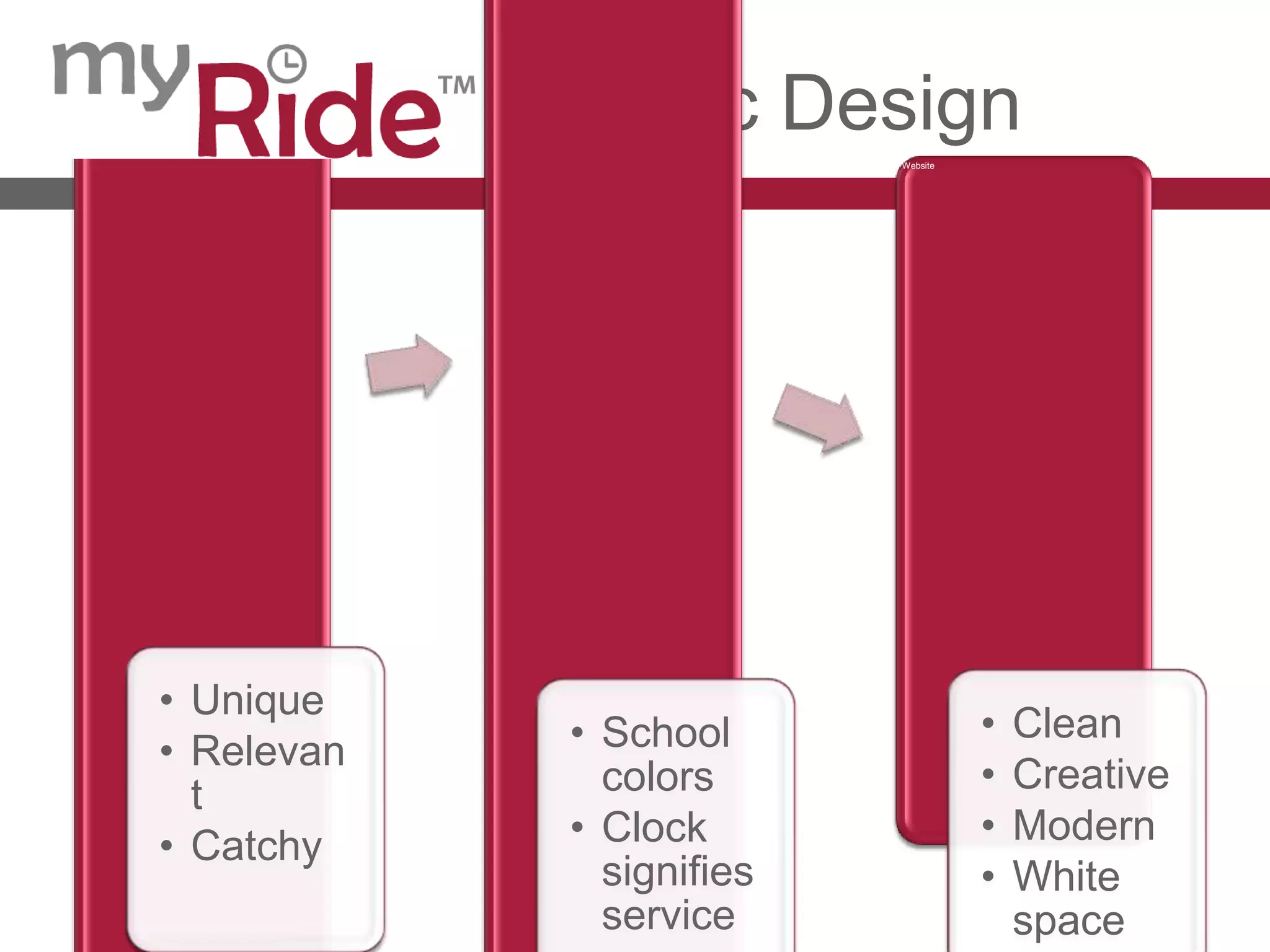
Graphic Design
Graphic Designhttp://myride.heinz.cmu.edu
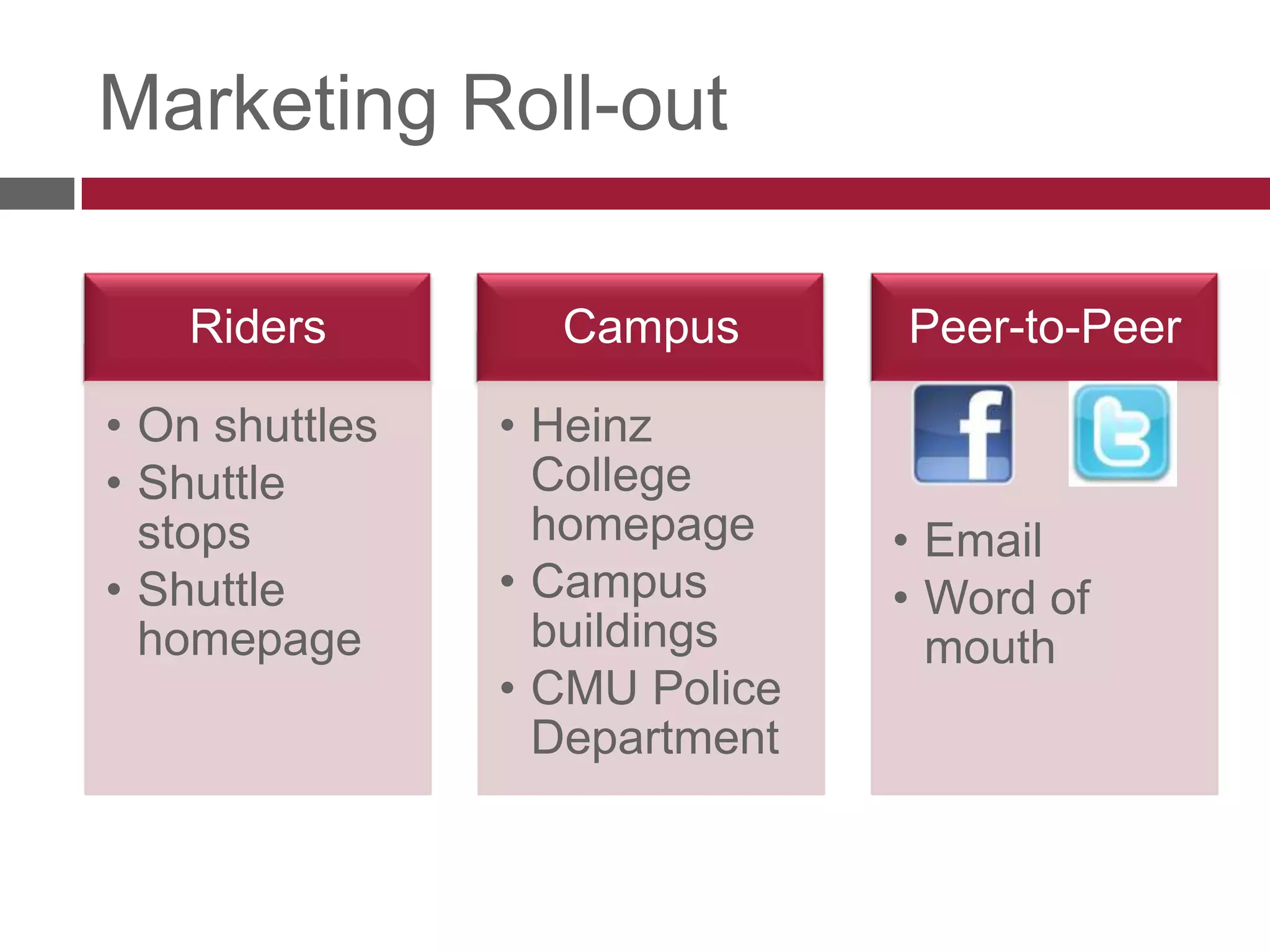
Marketing Roll-out
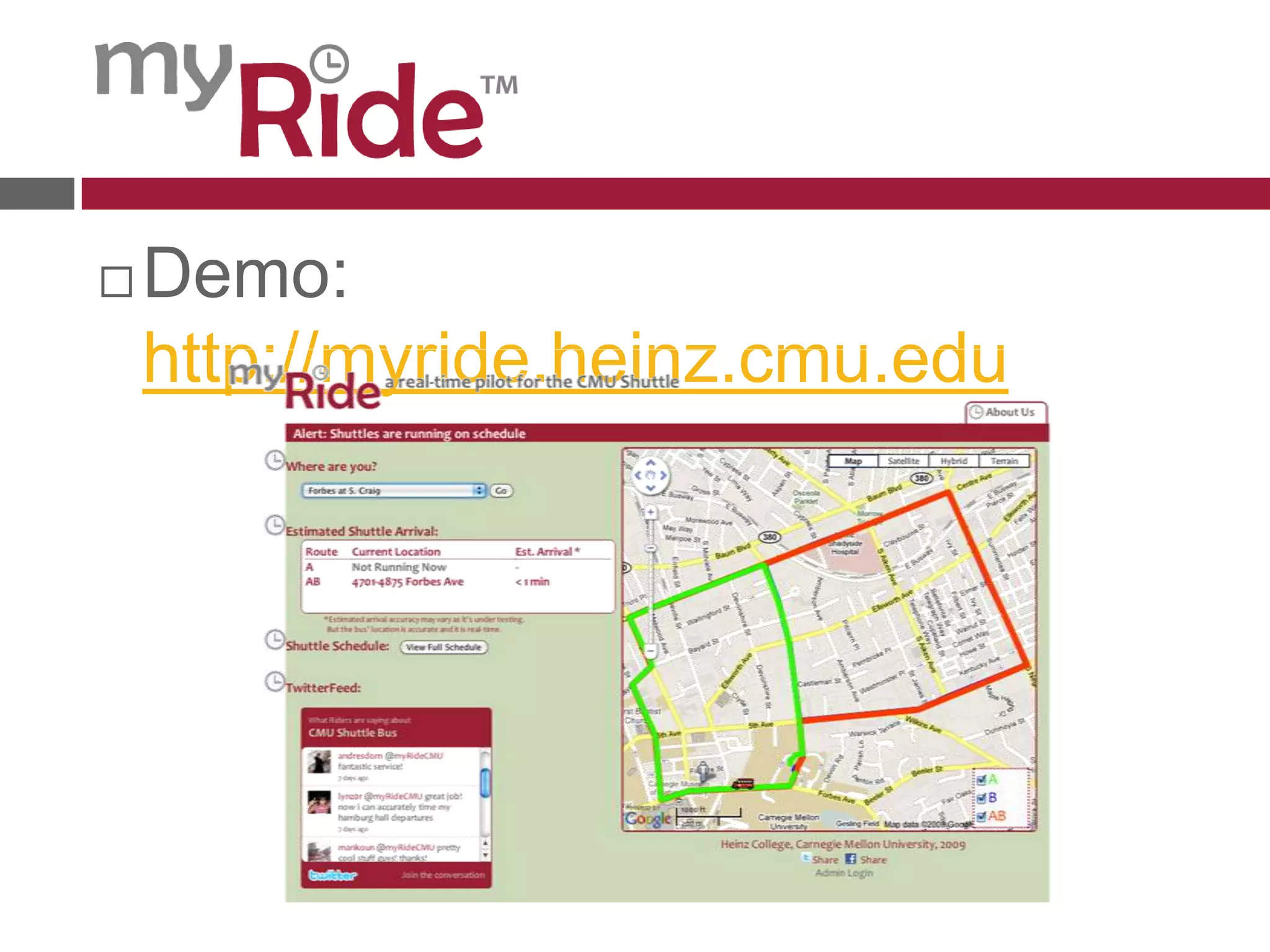
Demo: http://myride.heinz.cmu.edu
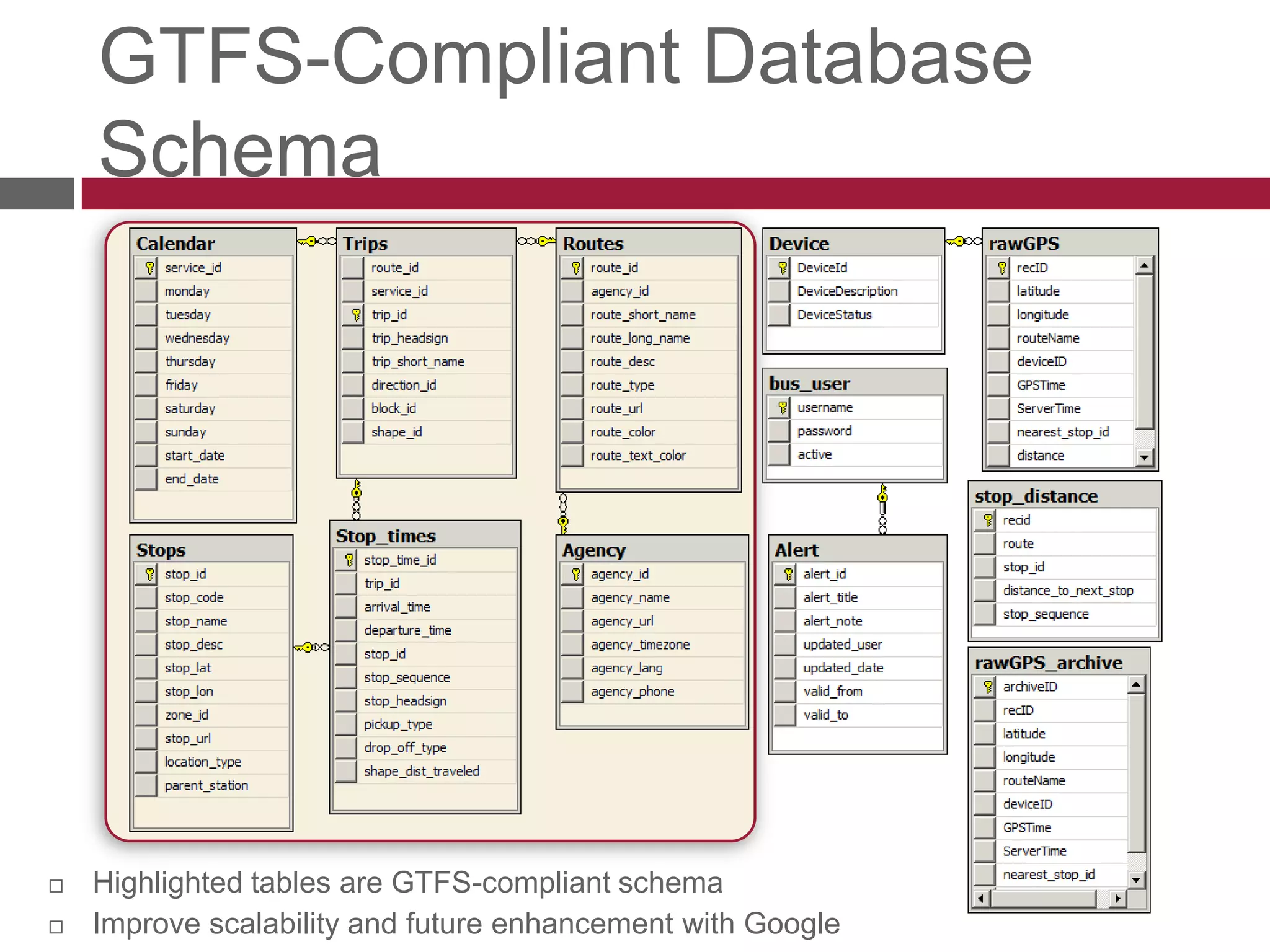
Highlighted tables are GTFS-compliant schemaImprove scalability and future enhancement with GoogleGTFS-Compliant Database Schema
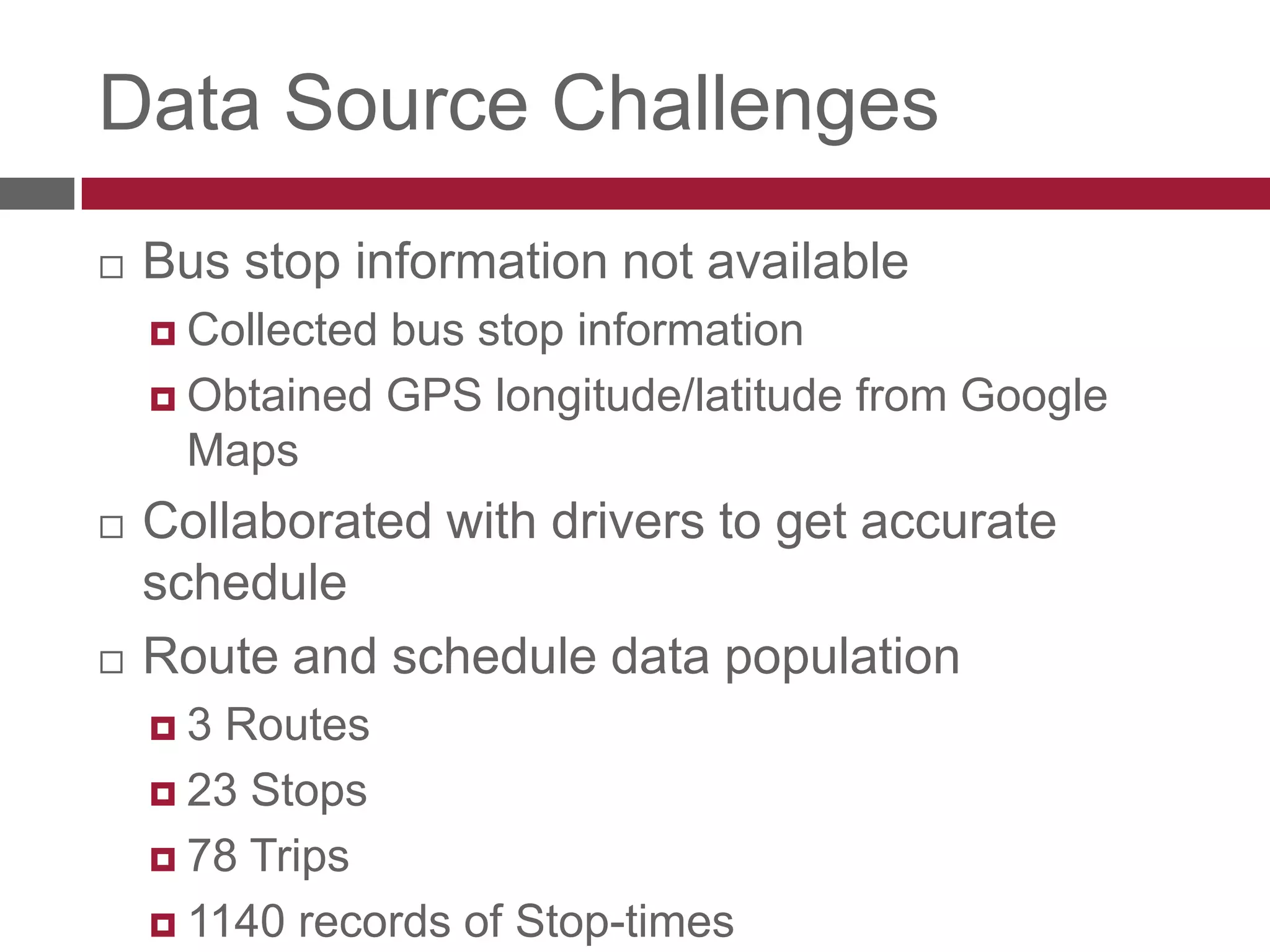
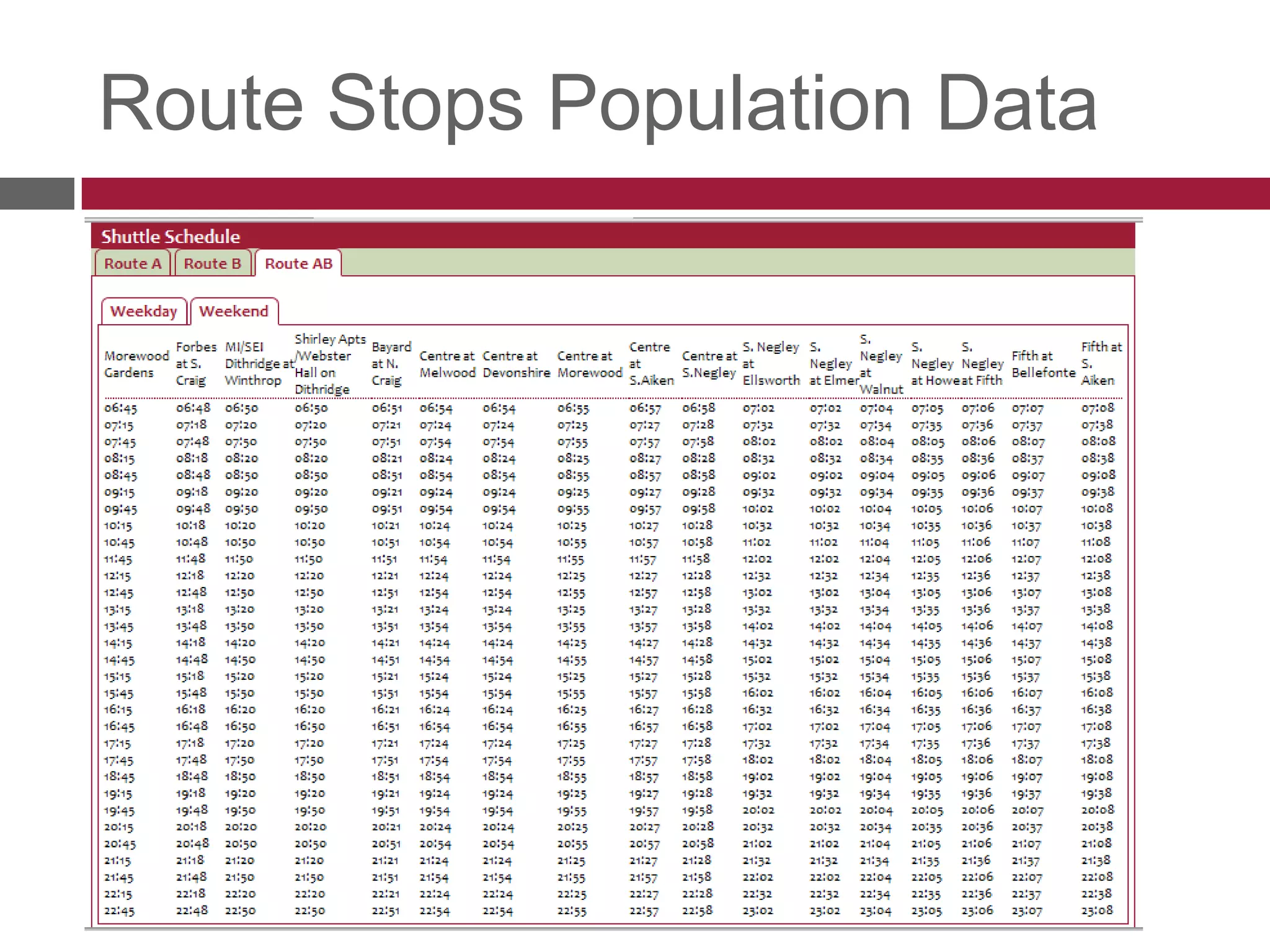
Data Source ChallengesBus stop information not availableCollected bus stop informationObtained GPS longitude/latitude from Google MapsCollaborated with drivers to get accurate scheduleRoute and schedule data population3 Routes23 Stops78 Trips1140 records of Stop-times
Route Stops Population Data
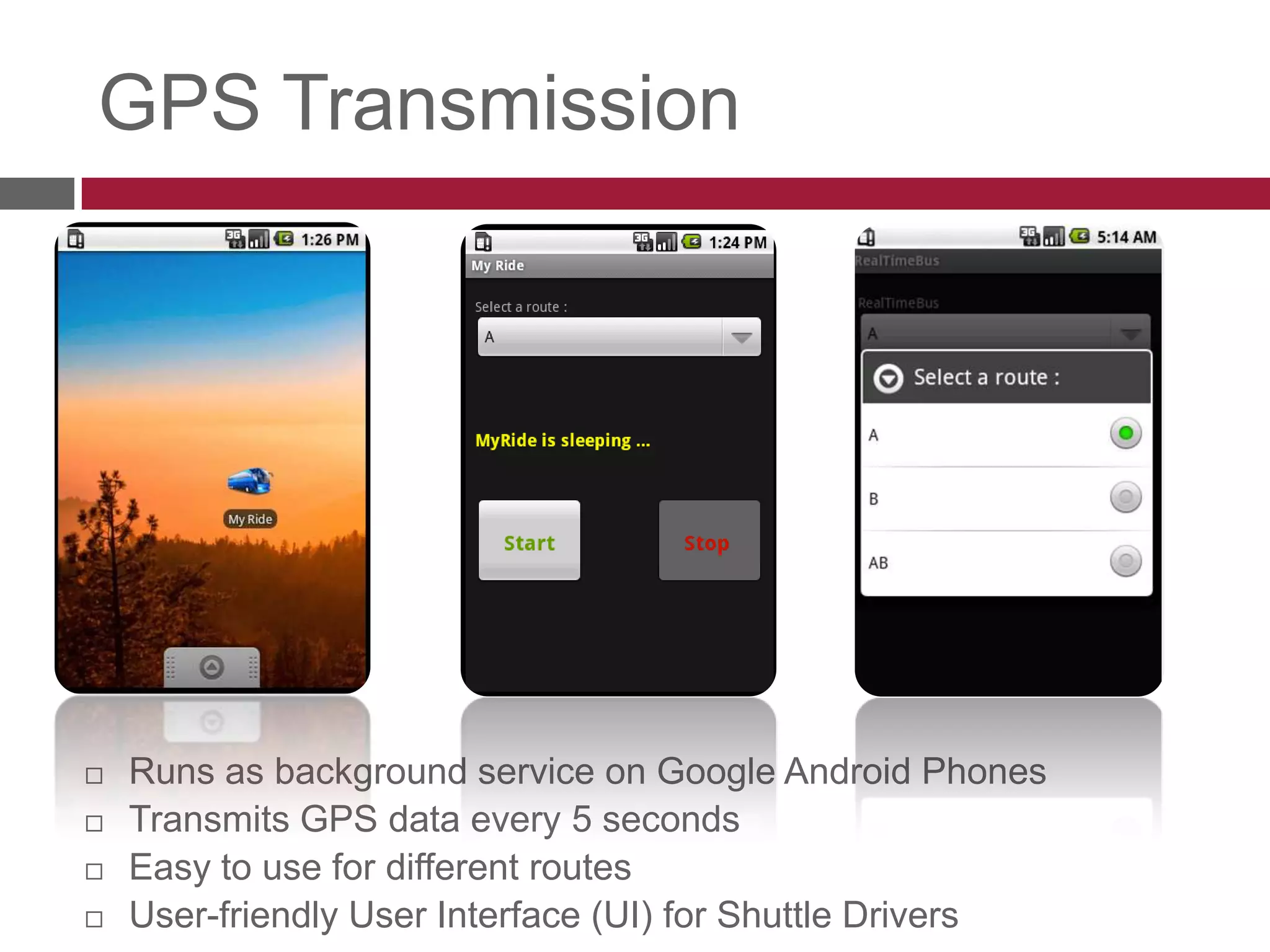
Runs as background service on Google Android PhonesTransmits GPS data every 5 secondsEasy to use for different routesUser-friendly User Interface (UI) for Shuttle DriversGPS Transmission
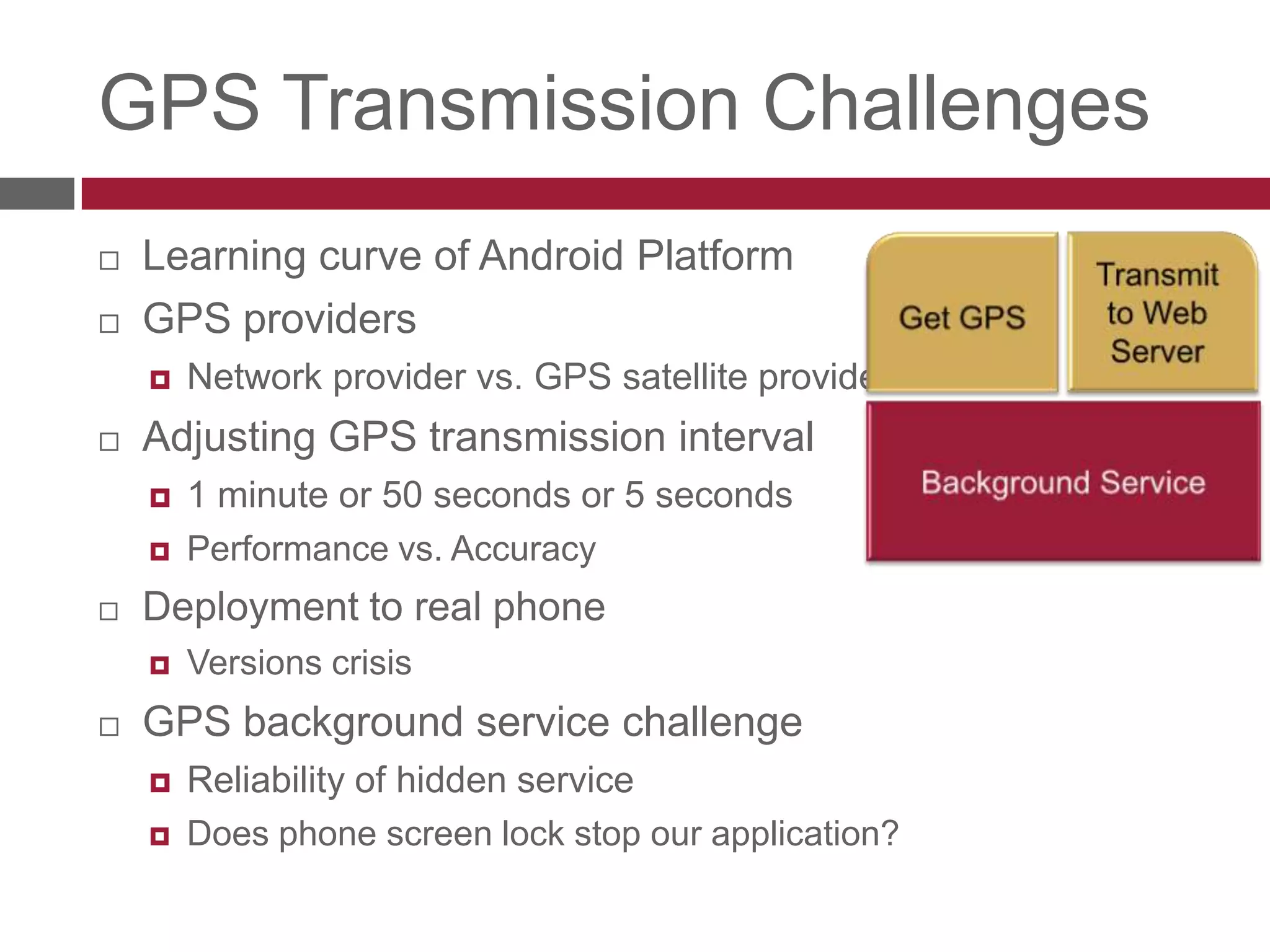
GPS Transmission ChallengesGet GPSLearning curve of Android PlatformGPS providers Network vs. GPS satellite provider Adjusting GPS transmission interval 1 minute or 50 seconds or 5 secondsPerformance vs. AccuracyDeployment to real phone Versions crisisGPS background service challengeReliability of hidden serviceDoes phone screen lock stop our application?Transmit to Web ServerBackground Service
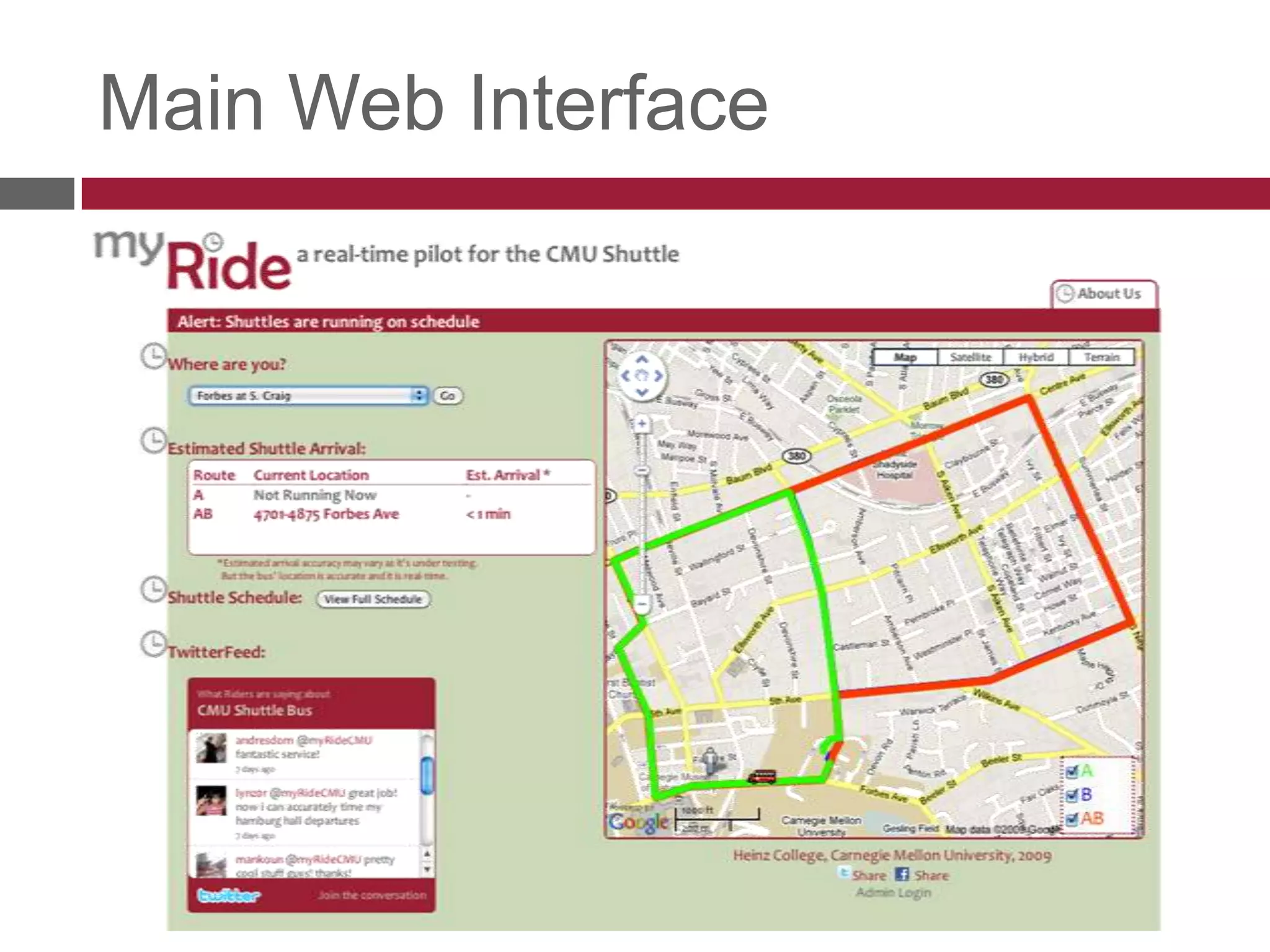
Main Web Interface
Challenges Behind the SceneGeographic Information SystemCalculating distance by Vincenty’s formula with ellipsoidal model of earthAccuracy within 0.5mm[1]Route distances vs. straight-line distanceMapping raw GPS to nearest bus stopGeocoding with Google MapReverse GeocodingEncoded Geopolyline mappingAjax and timer for updating real-timeCross-Browser Compatibility[1] Source: http://www.movable-type.co.uk/scripts/latlong-vincenty.html
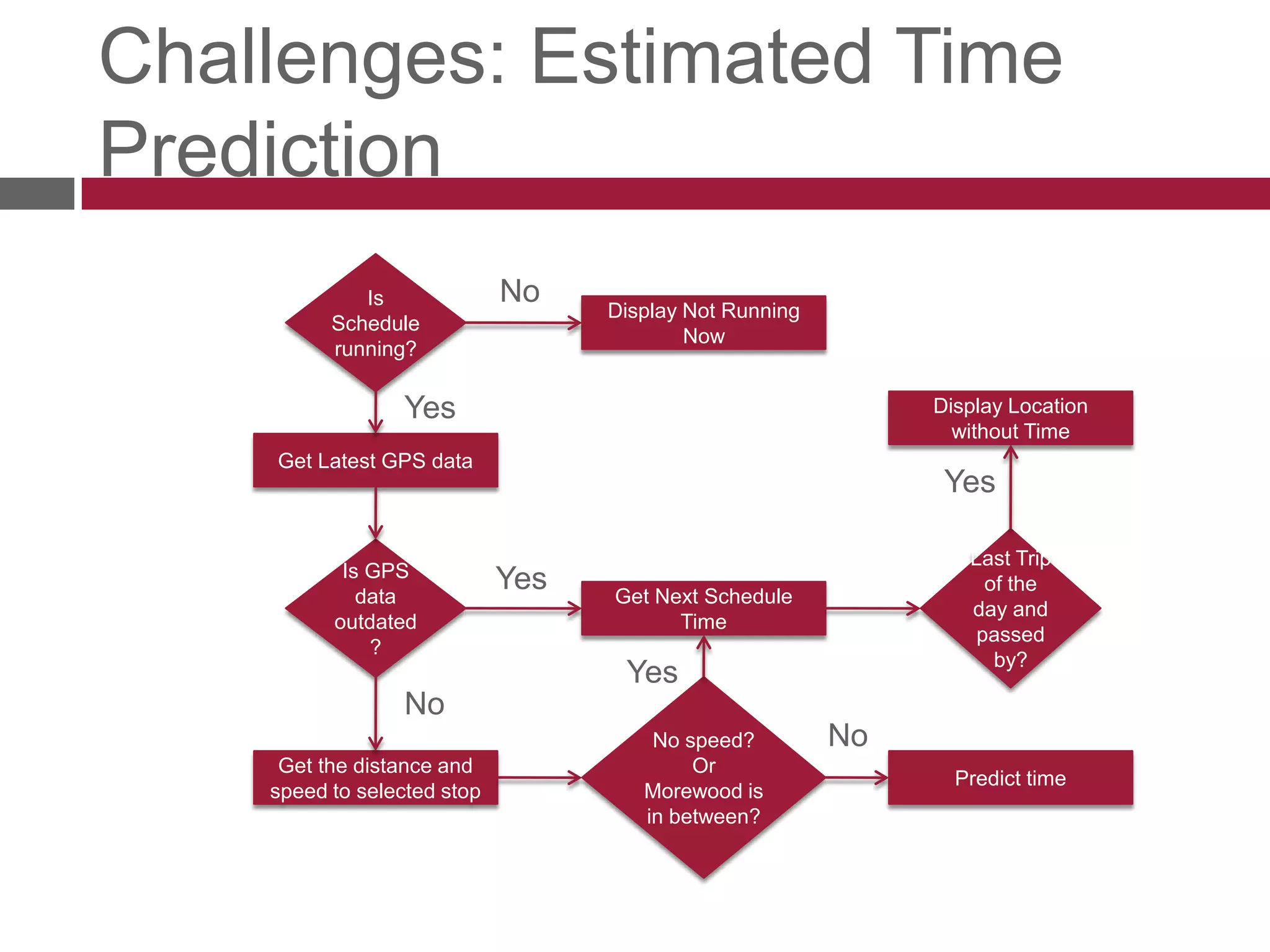
Challenges: Estimated Time PredictionInaccurate schedule stop timesExponentially Weighted Moving AverageProblem with frequent stop times Kalman-Filter Prediction Algorithms[1]Consider dwelling timesVarious Scenarios Select stop timeSchedule timeLast trip[1] Source: Prediction Models of Bus Arrival and Departure Times, University of Toronto
Challenges: Estimated Time PredictionIs Schedule running?NoDisplay Not Running NowYesDisplay Location without TimeGet Latest GPS dataYesLast Trip of the day and passed by?Is GPS data outdated?YesGet Next Schedule TimeYesNoNo speed? Or Morewood is in between?NoGet the distance and speed to selected stopPredict time
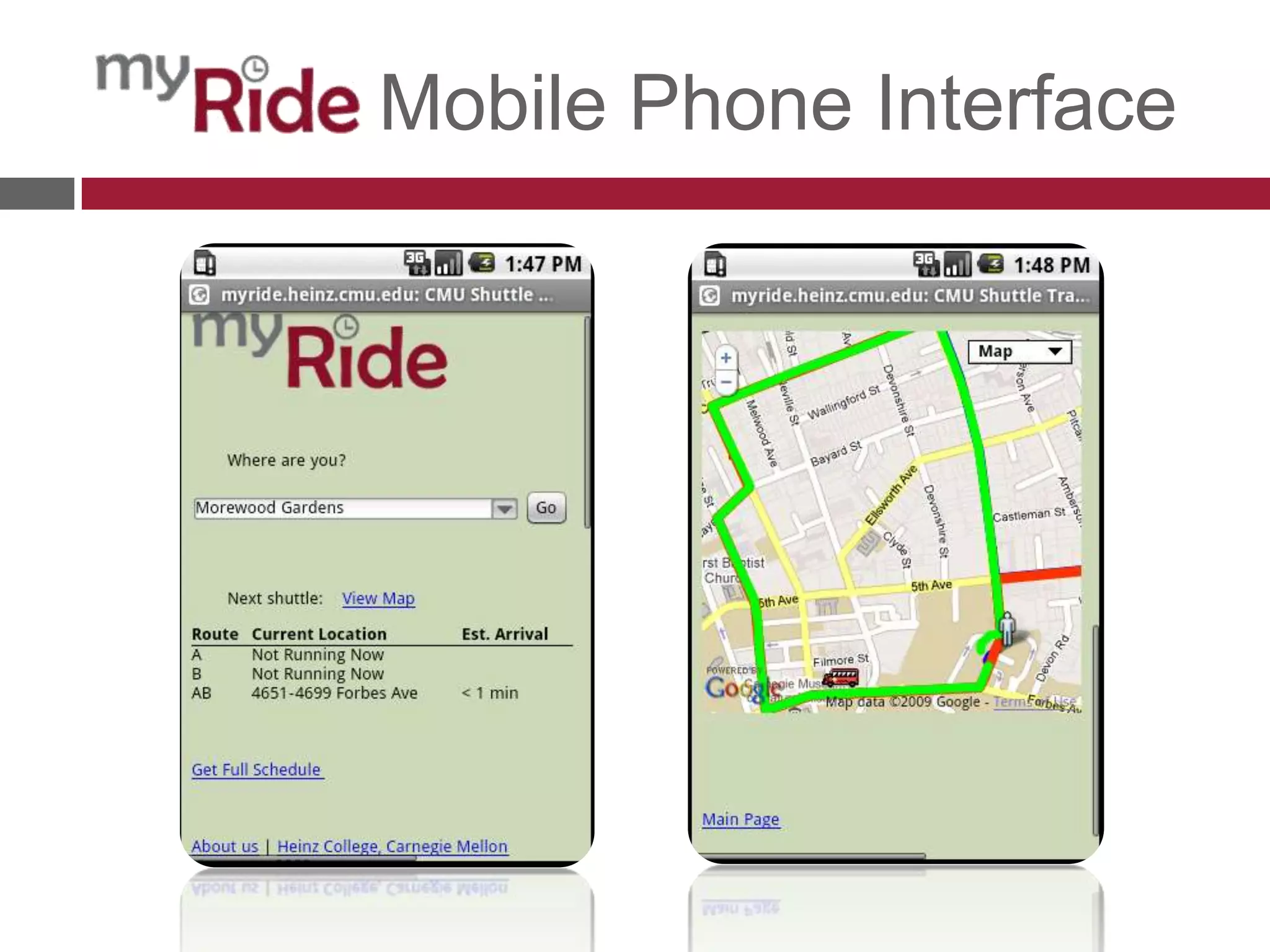
             Mobile Phone Interface
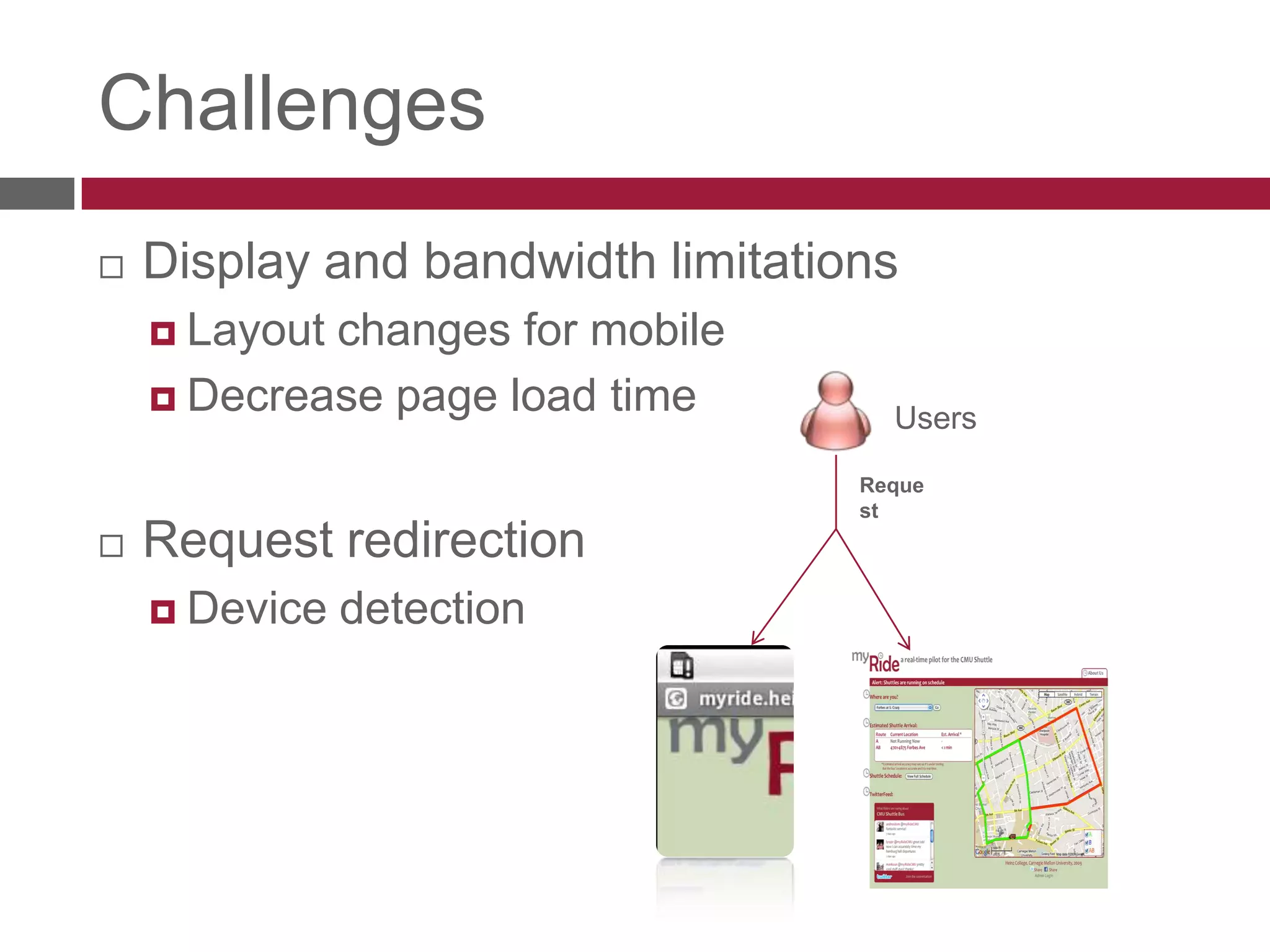
ChallengesDisplay and bandwidth limitationsLayout changes for mobileDecrease page load timeRequest redirectionDevice detectionUsersRequest
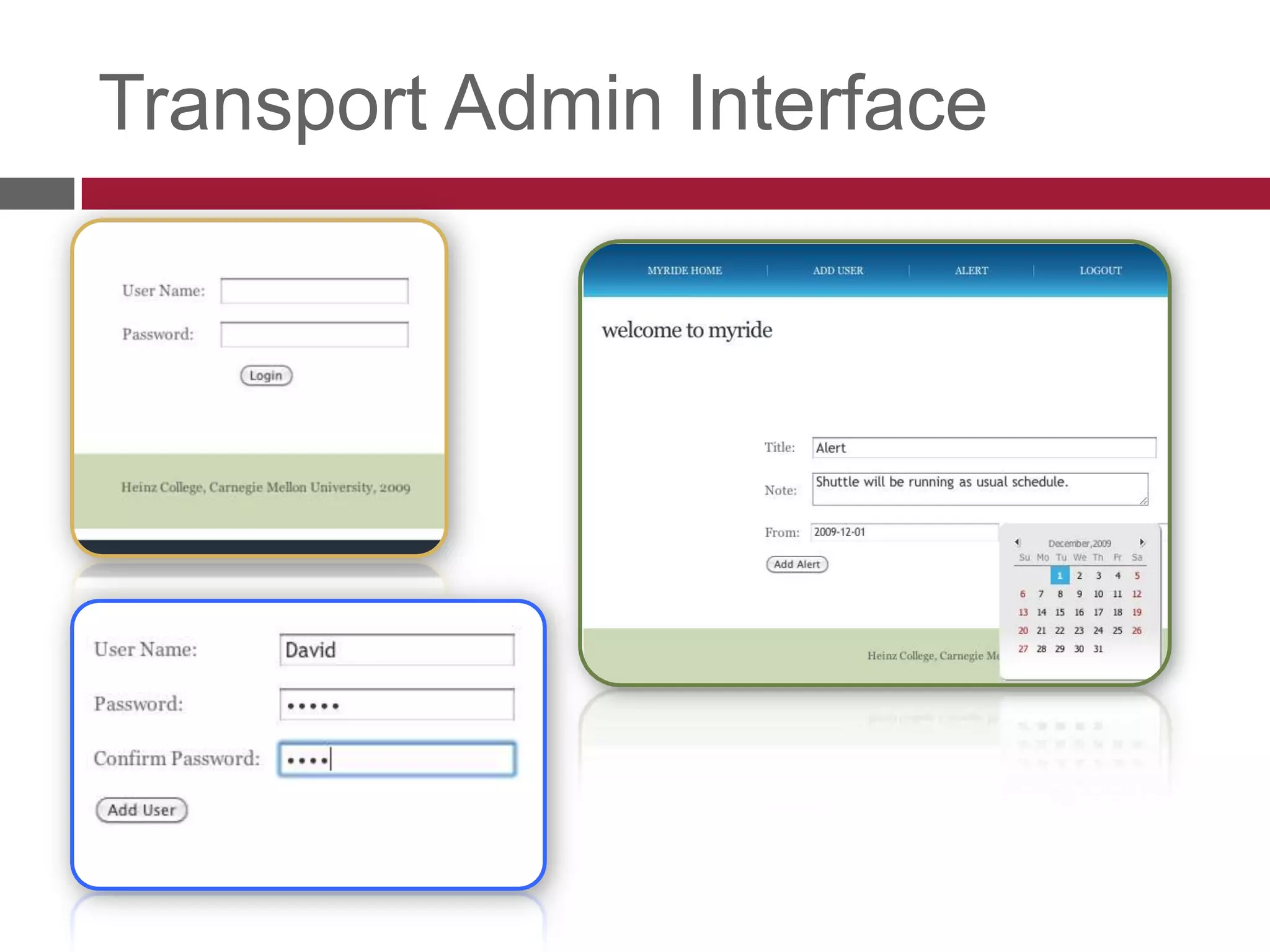
Transport Admin Interface
User Location DetectionDetecting nearest stop based on user’s current locationGoogle Gears – Geolocation API
AgendaHistoryPlanningImplementationResultsGoing Forward
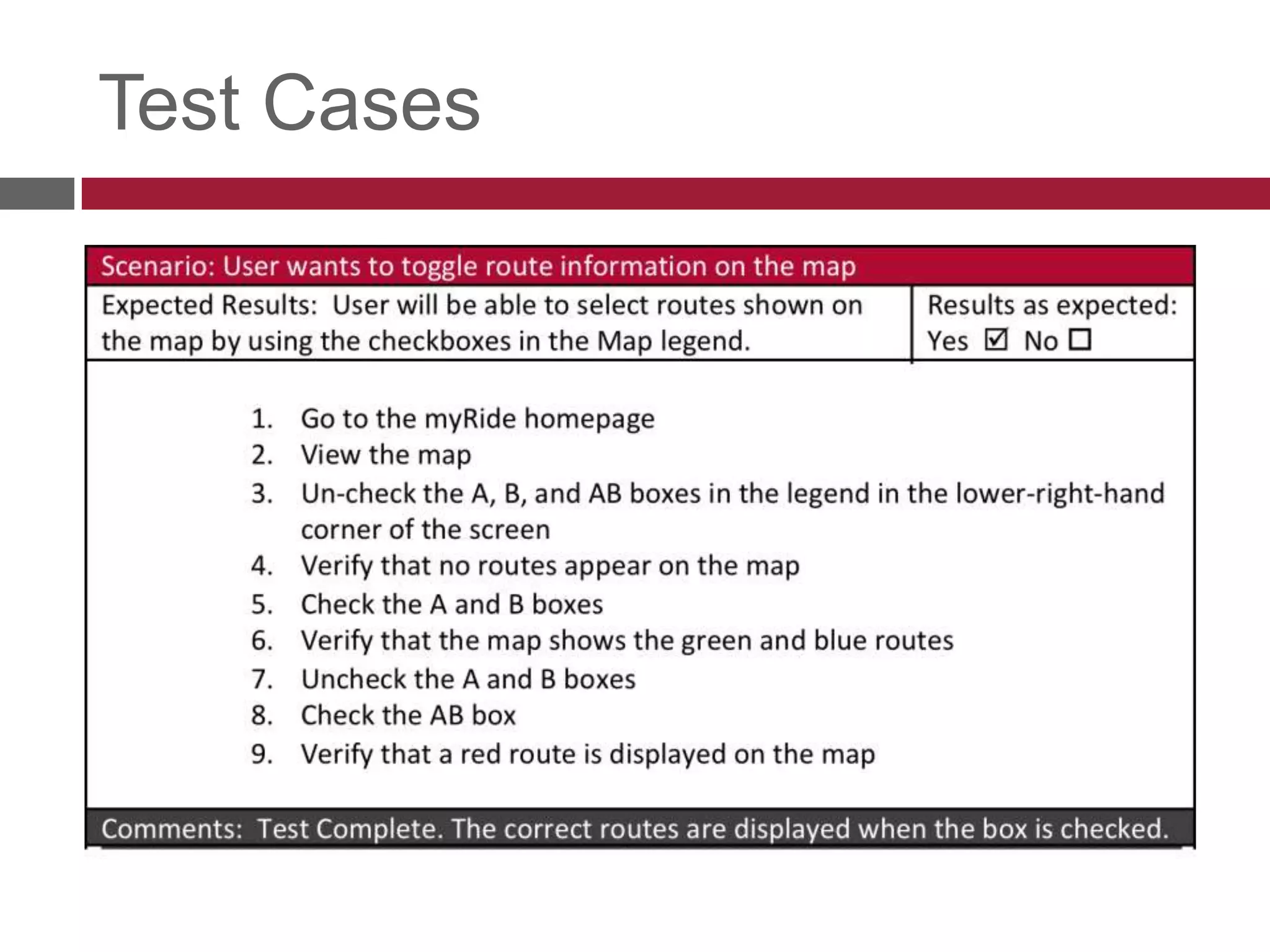
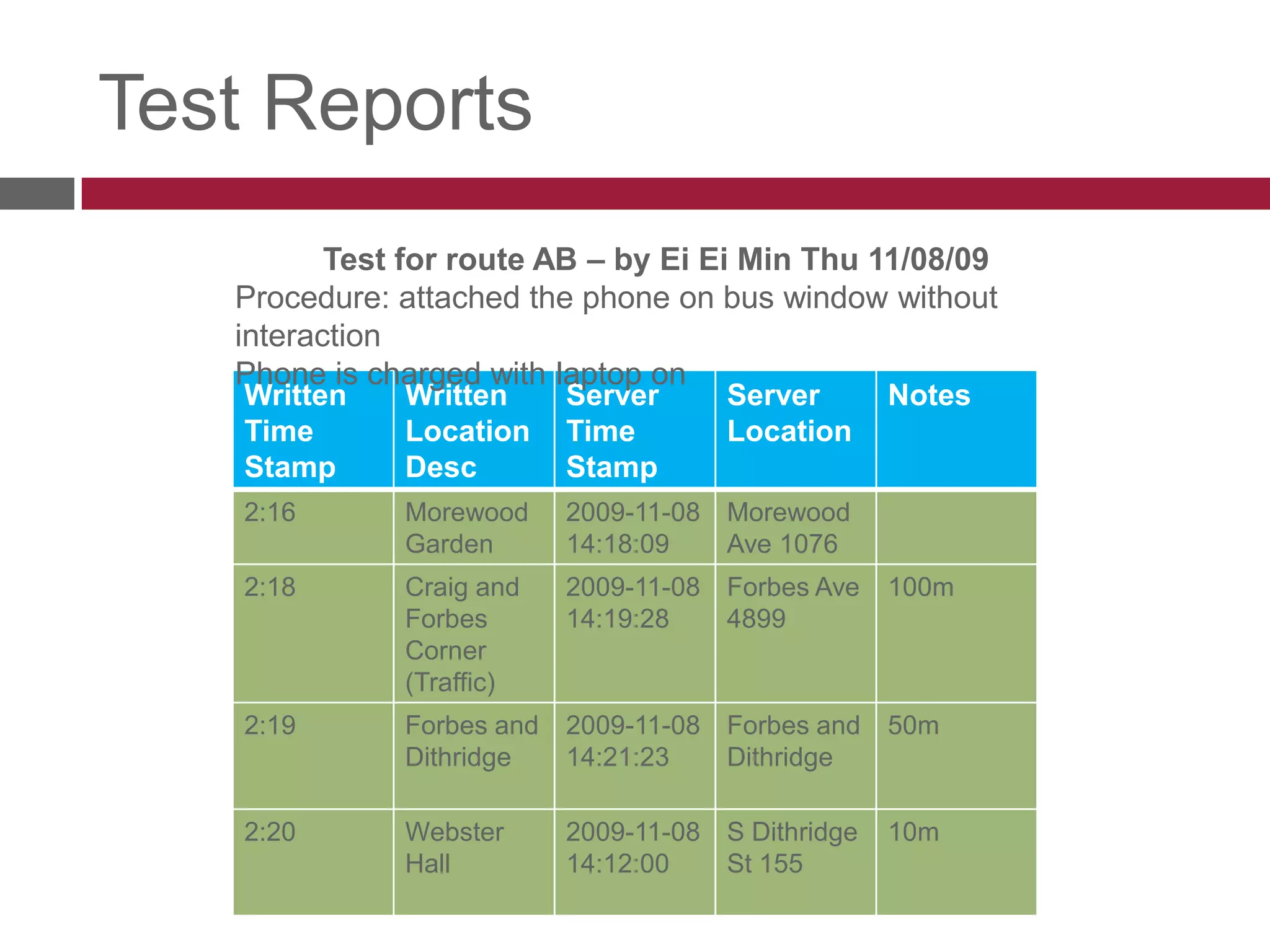
Test Cases
Test ReportsTest for Route AB – by Ei Ei Min Thu 11/08/09Procedure: attached the phone on bus window without interaction.  Phone is charged with laptop on.
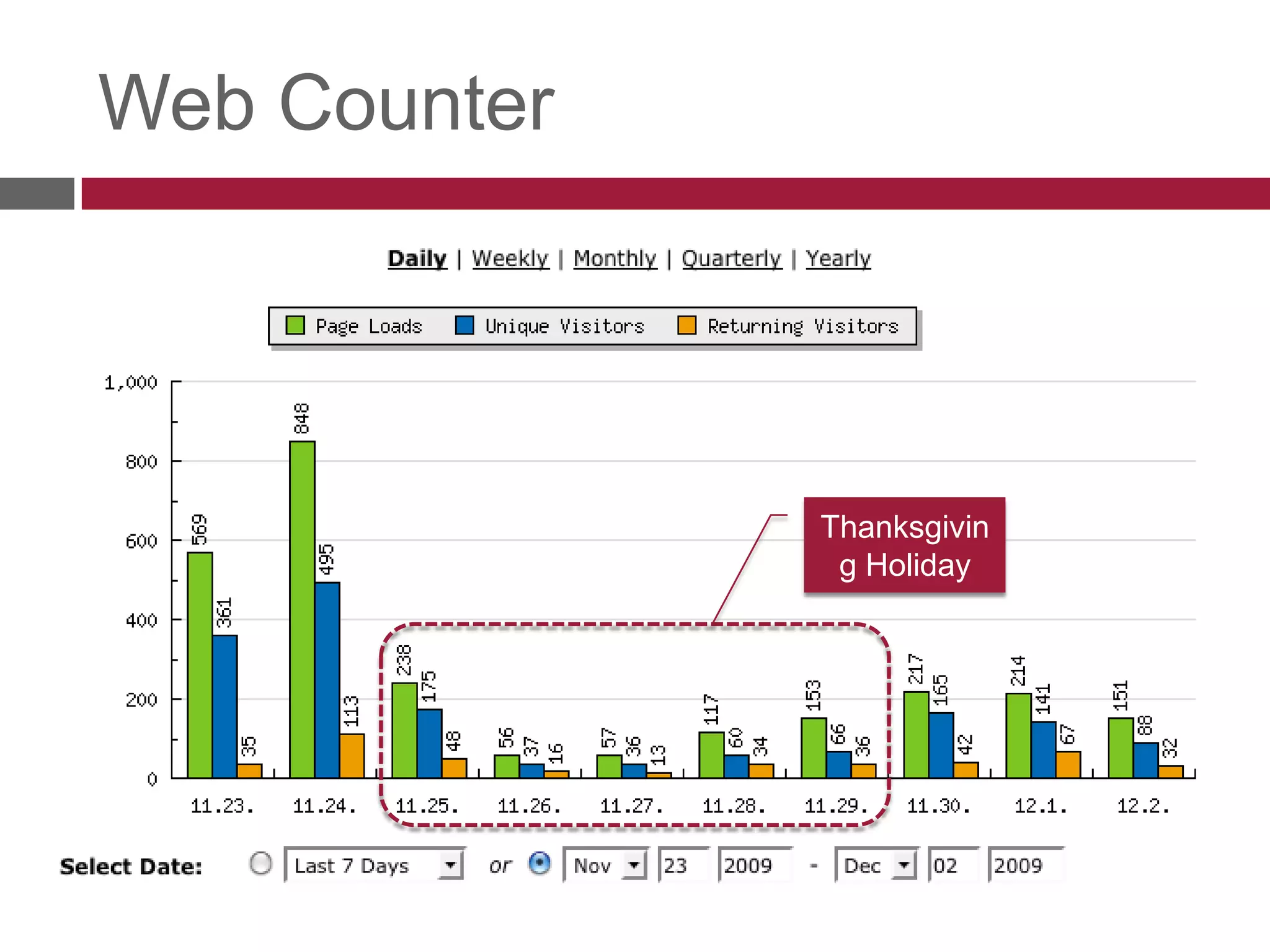
Web CounterThanksgiving Holiday
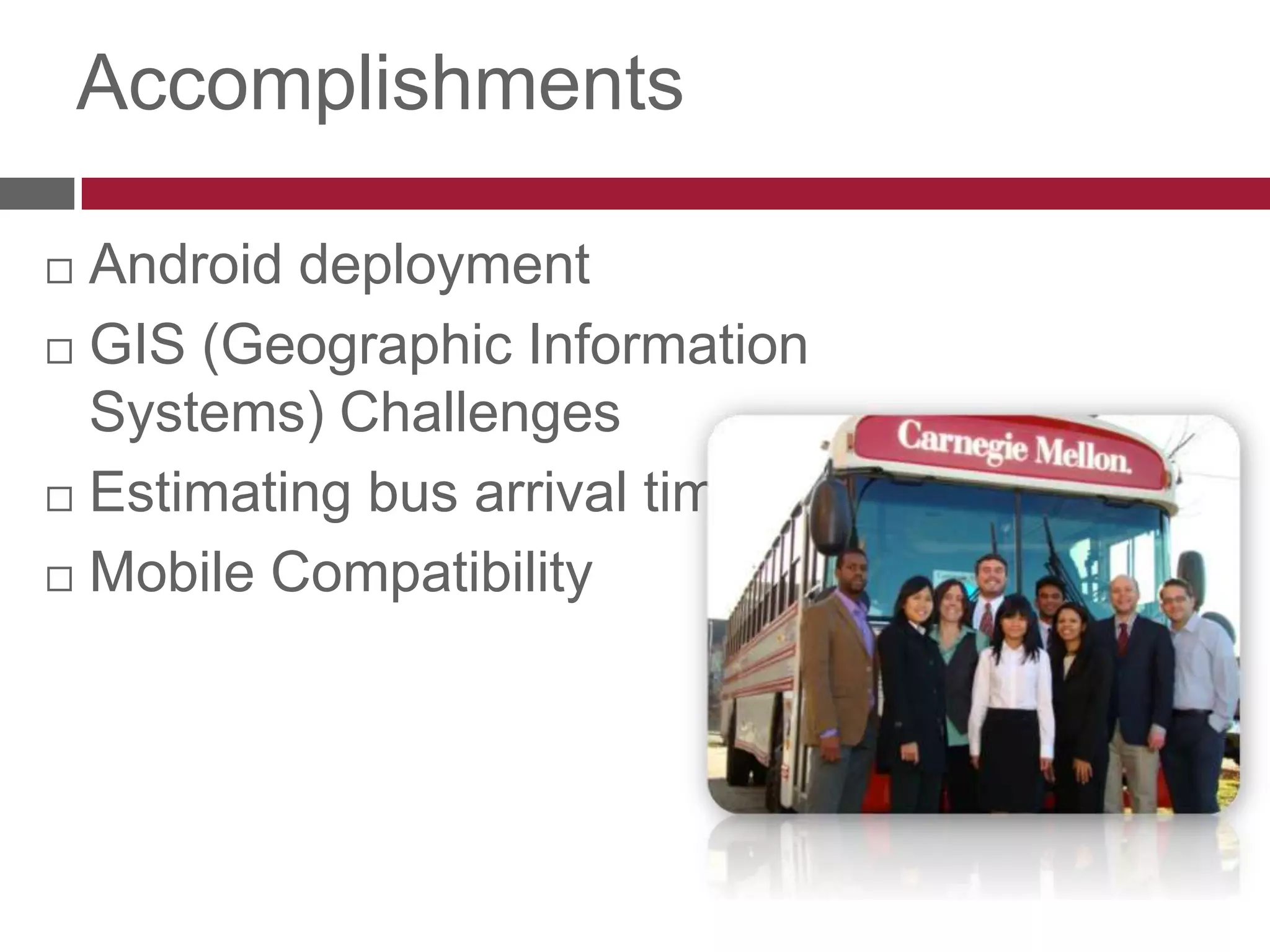
AccomplishmentsAndroid deploymentGIS (Geographic Information Systems) ChallengesEstimating bus arrival timeMobile Compatibility
AgendaHistoryPlanningImplementationResultsGoing Forward
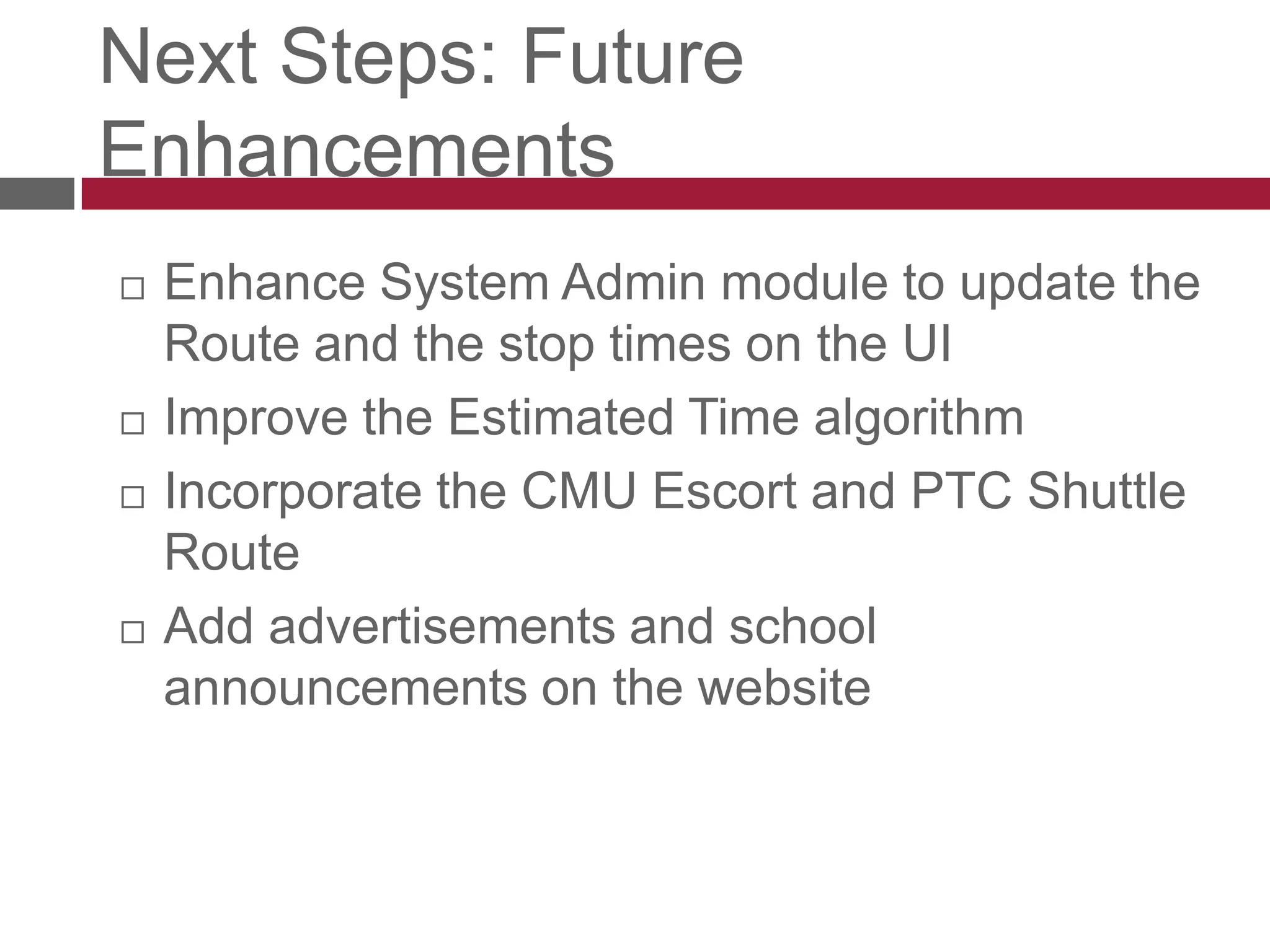
Next Steps: Future EnhancementsEnhance System Admin module to update the Route and the stop times on the UI
Improve the Estimated Time algorithm
Incorporate the CMU Escort and PTC Shuttle Route
Add advertisements and school announcements on the websiteNext StepsContinue the Pilot Install more robust hardwareCreate an iPhone applicationDevise traffic monitoring system based on sensor and server capabilitiesPursue funding opportunitiesAdvertisementsUniversity FundingTraffic21

myRide: A Real-Time Information System for the Carnegie Mellon University Shuttle

  • 1.
    a a real-timepilot for the CMU ShuttleDaiying Chen DAVId LevinsonAddam Hall KAREN MESKOLisa Hall EI EI MIN THUNolan Leavitt SUDHEER SOMESHWARAFall 2009 Heinz College, Carnegie Mellon University
  • 2.
  • 3.
    StakeholdersStakeholdersStarting ProblemAdvancing knowledgewithin CMU community, in line with Traffic21Benefiting area residents and commutersMake significant and substantial contributions to public policy and non-profit management
  • 4.
  • 5.
    Our Solution: Real-TimeInformationReal-Time Transportation InformationCutting-edge technologyNovel solution to reliability problemsMany benefitsTo ridersTo transit providersTo community
  • 6.
  • 7.
    DeliverablesPort Authority TechnicalCapabilities ReportPublic Transit Ridership SurveysmyRide website - http://myride.heinz.cmu.eduFunding Request for permanent systemFuture coursework plans Android Phone GPS tracking applicationGoogle Transit Feed Specification compliant databaseMobile Webpage Project Document Report
  • 8.
    BenchmarkingUniversity of MichiganTransLoc~60-busfleet covers 10 routes~Magic Bus was designed by students~Maintained by staff and students~Funded by Transportation Dept.~Newer company based in Raleigh~Provides services for 15 schools, including Princeton, Auburn, and Yale
  • 9.
    Internal CMU RidershipSurveyGoal: identify the most effective and desireddissemination methods for the CMU shuttleSmall, N= 51Conducted in person at CMU Shuttle stops and on the Shuttle.Time frame: Weekdays at various times in mid-October.
  • 10.
    CMU Ridership SurveyTakeawaysShuttle riders do have issues with the timeliness of service.A wide range of people use the shuttle.Shuttle riders have very high levels of access to Internet and Text plans.iPhones would not be the most effective way to reach the largest number of people.Focus on a webpage that can be viewed on mobile devices.
  • 11.
    Pittsburgh Community SurveyGoal:Measure attitudes and perceptions in regards to public transit and technology. Key factors we wanted to measure:Ridership habitsFactors affecting demand elasticity for public transitAccess to information dissemination methodsReceptiveness to various real-time servicesPerceived value of a real-time systemThe questions posed to respondents were modeled after a series of questions used in a 2006 study by the FTA in estimating benefits of a real-time system.Source: Real-time Bus Arrival Systems Return on Investment Study. Federal Transit Administration, 2006.
  • 12.
    Pittsburgh Community SurveyMethodologyOur survey was limited in breadth and depth by a limited timeframe and limited resources. The sample size is not intended to be arandom sampling of Allegheny County residents; instead, it attemptsto measure riders and advocates in the Oakland-Downtowncorridor. N=148Survey conducted in-person and online31% Random sample of pedestrians and bus riders in the Oakland corridor and downtown35% Students, faculty and professionals in the Higher Education field34% Developmental, cultural and transportation advocacy groups
  • 13.
    Pittsburgh Community SurveyPreferredDelivery MethodsAccess to method:97.1%90.1%72.8%21.3%
  • 14.
  • 15.
  • 16.
    Pittsburgh Community SurveyTakeawaysWhen compared with other metro regions, the Oakland-Downtown corridor has:The FTA estimated that a system widereal-time system would increase ridership by 6%-8%.Source: Real-time Bus Arrival Systems Return on Investment Study. Federal Transit Administration, 2006.
  • 17.
    Scope FrameworkTransmitting Real-timeBus Location PartBus with GPS Send GPS data to Web serverG-phone & T-mobileWeb ApplicationWeb serverMobile WebRidersMap Plug InEstimated Time ModuleLocation Retrieval ModuleAccessing Real-time BUS Location PartGTFS Data Schema
  • 18.
    Use Case DiagrammyRideSystemAdd new Alert for ridersStart auto-GPS transmission for any RouteAdd another Admin userTransport AdminStop auto-GPS transmission for any RouteView myRide on their Mobile PhoneView Current Bus location on the mapDriverView estimated arrival time for their bus stopChange the Route View full schedule for each routeRiderGeneral UserUse Twitter to follow, share the updates
  • 19.
  • 20.
  • 21.
  • 22.
  • 23.
  • 24.
  • 25.
    Highlighted tables areGTFS-compliant schemaImprove scalability and future enhancement with GoogleGTFS-Compliant Database Schema
  • 26.
    Data Source ChallengesBusstop information not availableCollected bus stop informationObtained GPS longitude/latitude from Google MapsCollaborated with drivers to get accurate scheduleRoute and schedule data population3 Routes23 Stops78 Trips1140 records of Stop-times
  • 27.
  • 28.
    Runs as backgroundservice on Google Android PhonesTransmits GPS data every 5 secondsEasy to use for different routesUser-friendly User Interface (UI) for Shuttle DriversGPS Transmission
  • 29.
    GPS Transmission ChallengesGetGPSLearning curve of Android PlatformGPS providers Network vs. GPS satellite provider Adjusting GPS transmission interval 1 minute or 50 seconds or 5 secondsPerformance vs. AccuracyDeployment to real phone Versions crisisGPS background service challengeReliability of hidden serviceDoes phone screen lock stop our application?Transmit to Web ServerBackground Service
  • 30.
  • 31.
    Challenges Behind theSceneGeographic Information SystemCalculating distance by Vincenty’s formula with ellipsoidal model of earthAccuracy within 0.5mm[1]Route distances vs. straight-line distanceMapping raw GPS to nearest bus stopGeocoding with Google MapReverse GeocodingEncoded Geopolyline mappingAjax and timer for updating real-timeCross-Browser Compatibility[1] Source: http://www.movable-type.co.uk/scripts/latlong-vincenty.html
  • 32.
    Challenges: Estimated TimePredictionInaccurate schedule stop timesExponentially Weighted Moving AverageProblem with frequent stop times Kalman-Filter Prediction Algorithms[1]Consider dwelling timesVarious Scenarios Select stop timeSchedule timeLast trip[1] Source: Prediction Models of Bus Arrival and Departure Times, University of Toronto
  • 33.
    Challenges: Estimated TimePredictionIs Schedule running?NoDisplay Not Running NowYesDisplay Location without TimeGet Latest GPS dataYesLast Trip of the day and passed by?Is GPS data outdated?YesGet Next Schedule TimeYesNoNo speed? Or Morewood is in between?NoGet the distance and speed to selected stopPredict time
  • 34.
    Mobile Phone Interface
  • 35.
    ChallengesDisplay and bandwidthlimitationsLayout changes for mobileDecrease page load timeRequest redirectionDevice detectionUsersRequest
  • 36.
  • 37.
    User Location DetectionDetectingnearest stop based on user’s current locationGoogle Gears – Geolocation API
  • 38.
  • 39.
  • 40.
    Test ReportsTest forRoute AB – by Ei Ei Min Thu 11/08/09Procedure: attached the phone on bus window without interaction. Phone is charged with laptop on.
  • 41.
  • 42.
    AccomplishmentsAndroid deploymentGIS (GeographicInformation Systems) ChallengesEstimating bus arrival timeMobile Compatibility
  • 43.
  • 44.
    Next Steps: FutureEnhancementsEnhance System Admin module to update the Route and the stop times on the UI
  • 45.
    Improve the EstimatedTime algorithm
  • 46.
    Incorporate the CMUEscort and PTC Shuttle Route
  • 47.
    Add advertisements andschool announcements on the websiteNext StepsContinue the Pilot Install more robust hardwareCreate an iPhone applicationDevise traffic monitoring system based on sensor and server capabilitiesPursue funding opportunitiesAdvertisementsUniversity FundingTraffic21
  • 48.
    AcknowledgementsRobert Hampshire (teamadvisor) (donation of G1 Phones)CMU Shuttle: Lt. Gary Scheimer, Jim Heverly, Jim McNeil, Colton Brown, James Collins, & Jason BrownRamayyaKrishnan, Rick Stafford, Dave Roger, Steve Bland, and Joe Hughes (advisory board)Hillman FoundationGary Franko (design and printing support)
  • 49.
    Contact InformationAddam Hall(project manager): aehall@andrew.cmu.eduEiEi Min Thu (IT manager): eiei@cmu.eduRobert Hampshire (advisor): hamp@cmu.edu