Center for Urban Transportation Research | University of South Florida
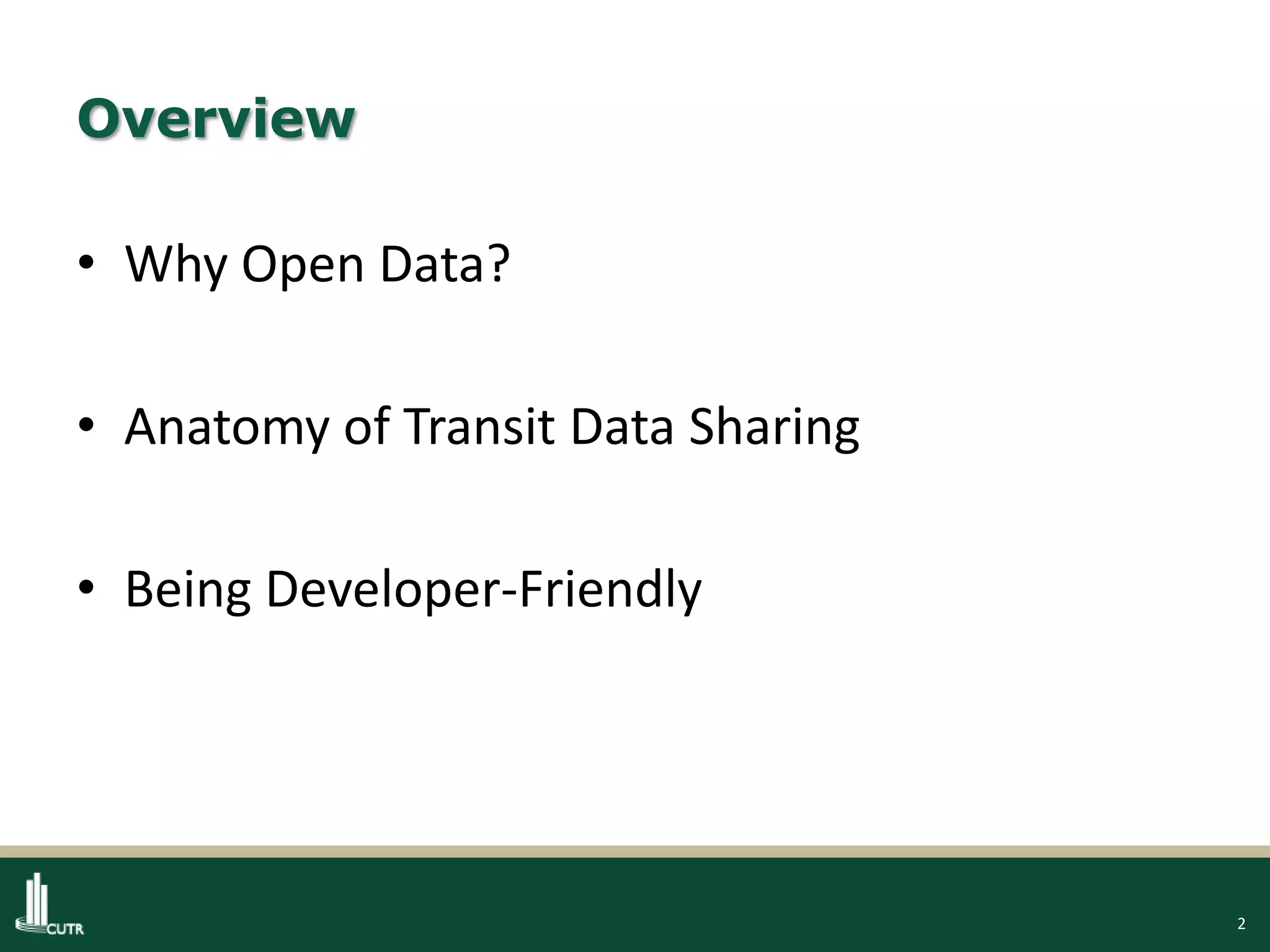
Open Transit Data –
A Developer’s Perspective
Sean J. Barbeau, Ph.D.
2
Overview
• Why Open Data?
• Anatomy of Transit Data Sharing
• Being Developer-Friendly
3
WHY OPEN DATA?
4
What is open data?
• Transit data that is shared
with the public
– Typically shared via
website/FTP site/web
services
• No login should be required
(may use API key)
– Should be updated
regularly, with any changes
in schedule/routes/stops
5
Open [Data Architecture Source]
• Open architectures mostly focus on:
– Standards within an agency’s software/hardware systems
– Interconnectivity with other government systems
• Open source means software source code is available
• Open data is the sharing of data with external public
parties
3rd party
developers
OPEN DATA
Transit Agency
Transit Vehicle AVL Server
Schedule System
6
Why is open data important?
• Allows public to contribute
services that are cost/time-
prohibitive for the public sector
– e.g., many mobile platforms
• Vendors are unpredictable
– Some agencies have shared data
only with Google
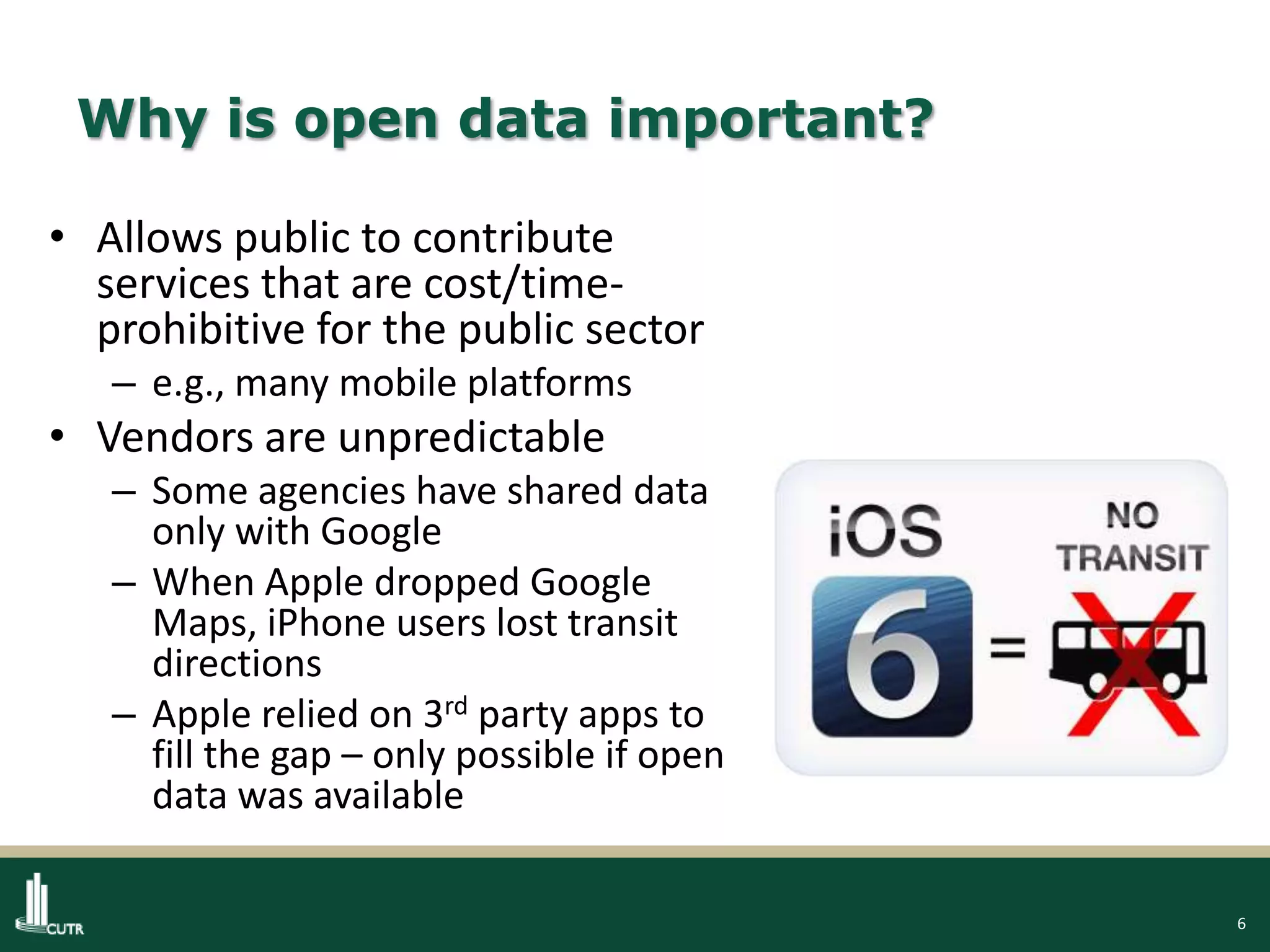
– When Apple dropped Google
Maps, iPhone users lost transit
directions
– Apple relied on 3rd party apps to
fill the gap – only possible if open
data was available
7
Why is open data important
(to developers)?
• Developers want to create
innovative apps that meet a
need!
– Some are monetized, some are
not
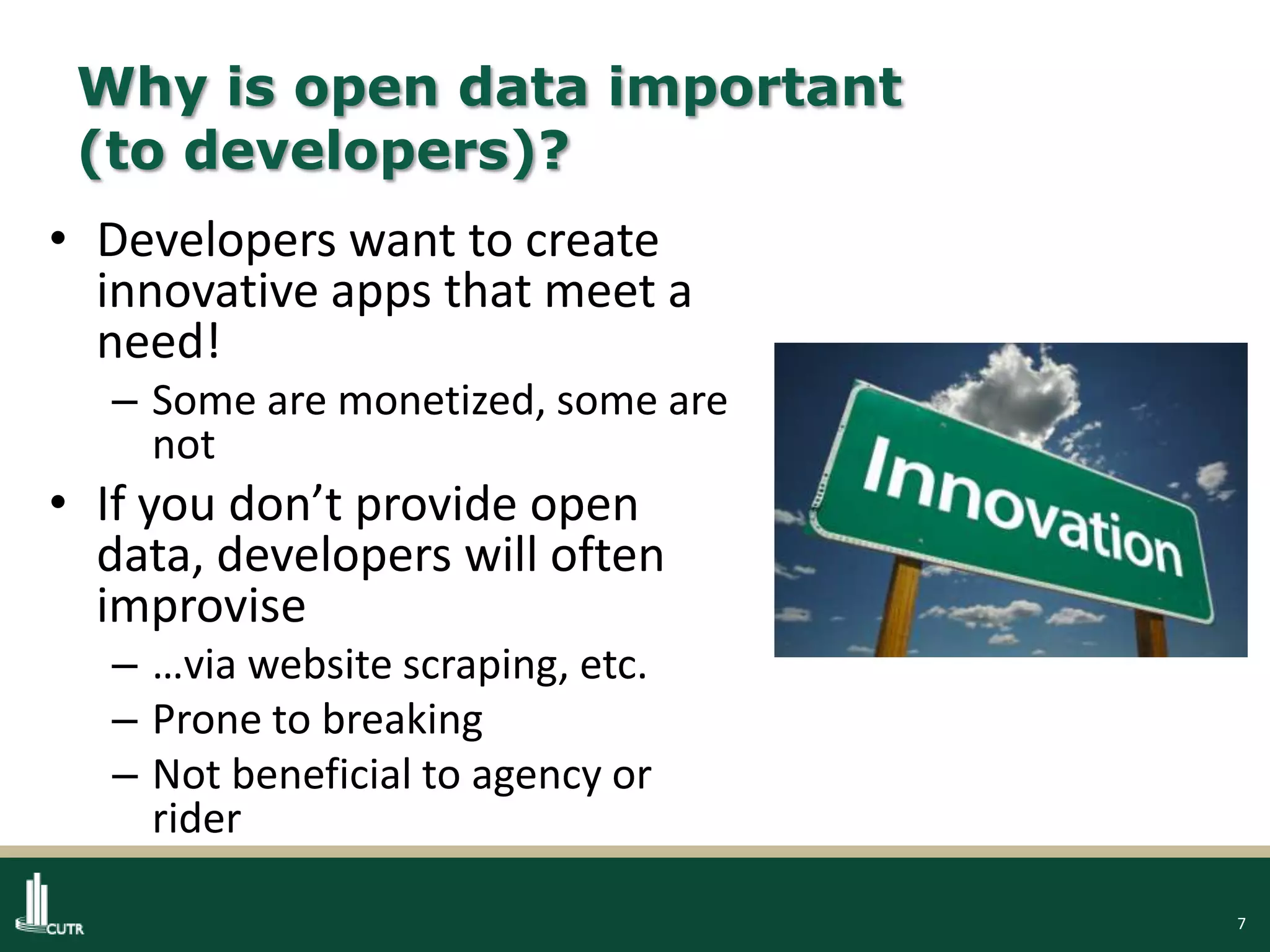
• If you don’t provide open
data, developers will often
improvise
– …via website scraping, etc.
– Prone to breaking
– Not beneficial to agency or
rider
8
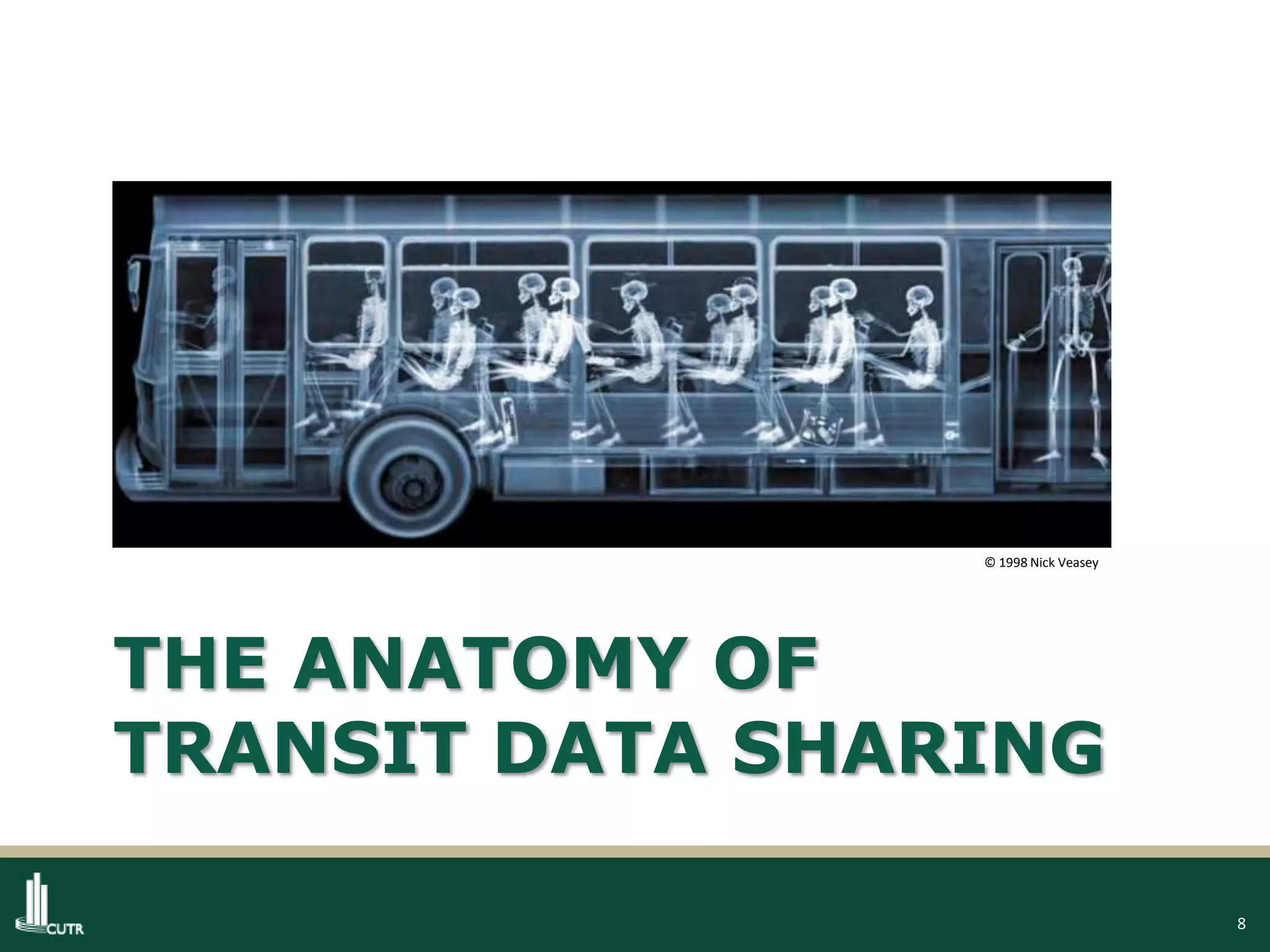
THE ANATOMY OF
TRANSIT DATA SHARING
© 1998 Nick Veasey
9
Two Types of Open Data
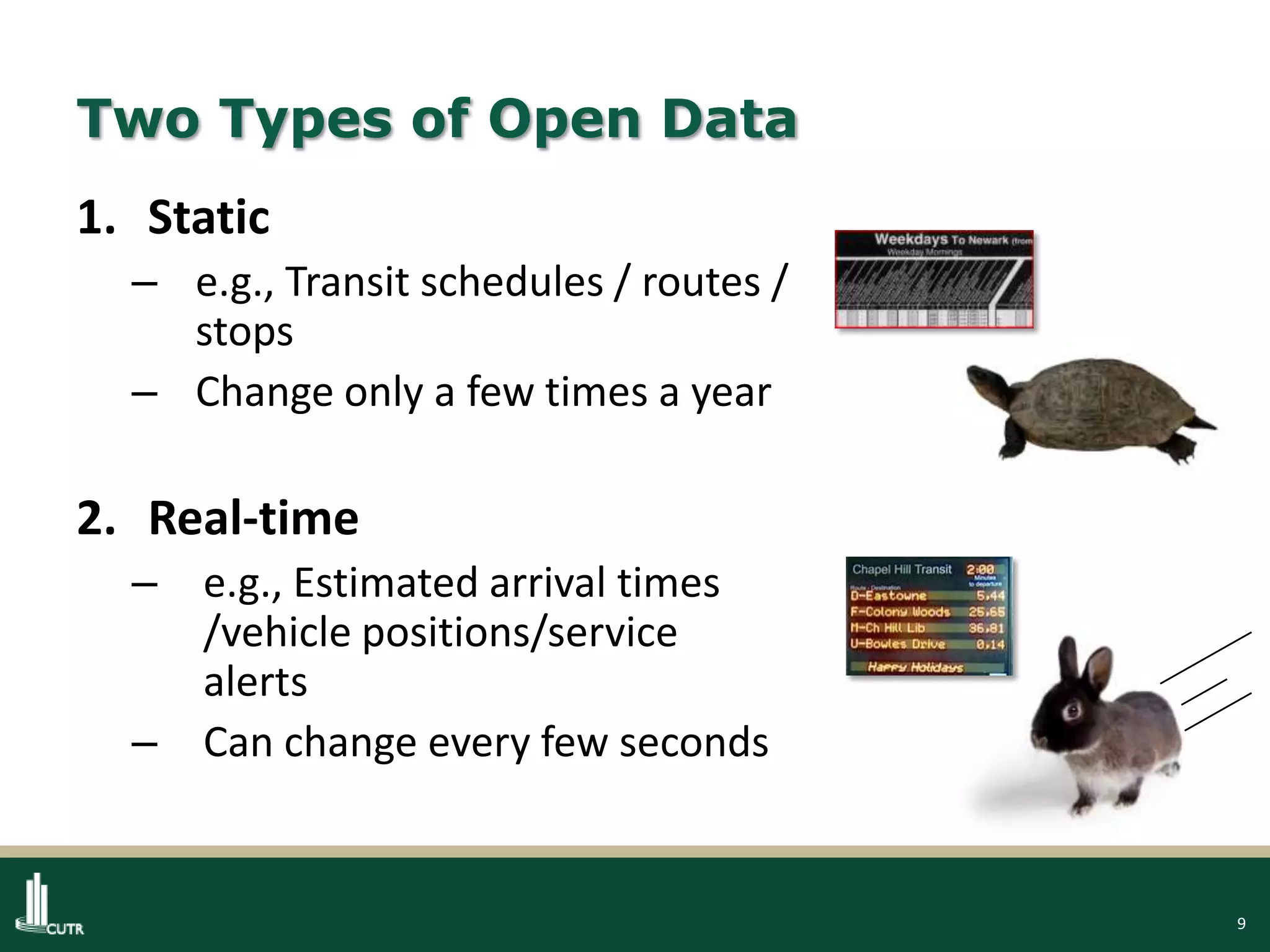
1. Static
– e.g., Transit schedules / routes /
stops
– Change only a few times a year
2. Real-time
– e.g., Estimated arrival times
/vehicle positions/service
alerts
– Can change every few seconds
10
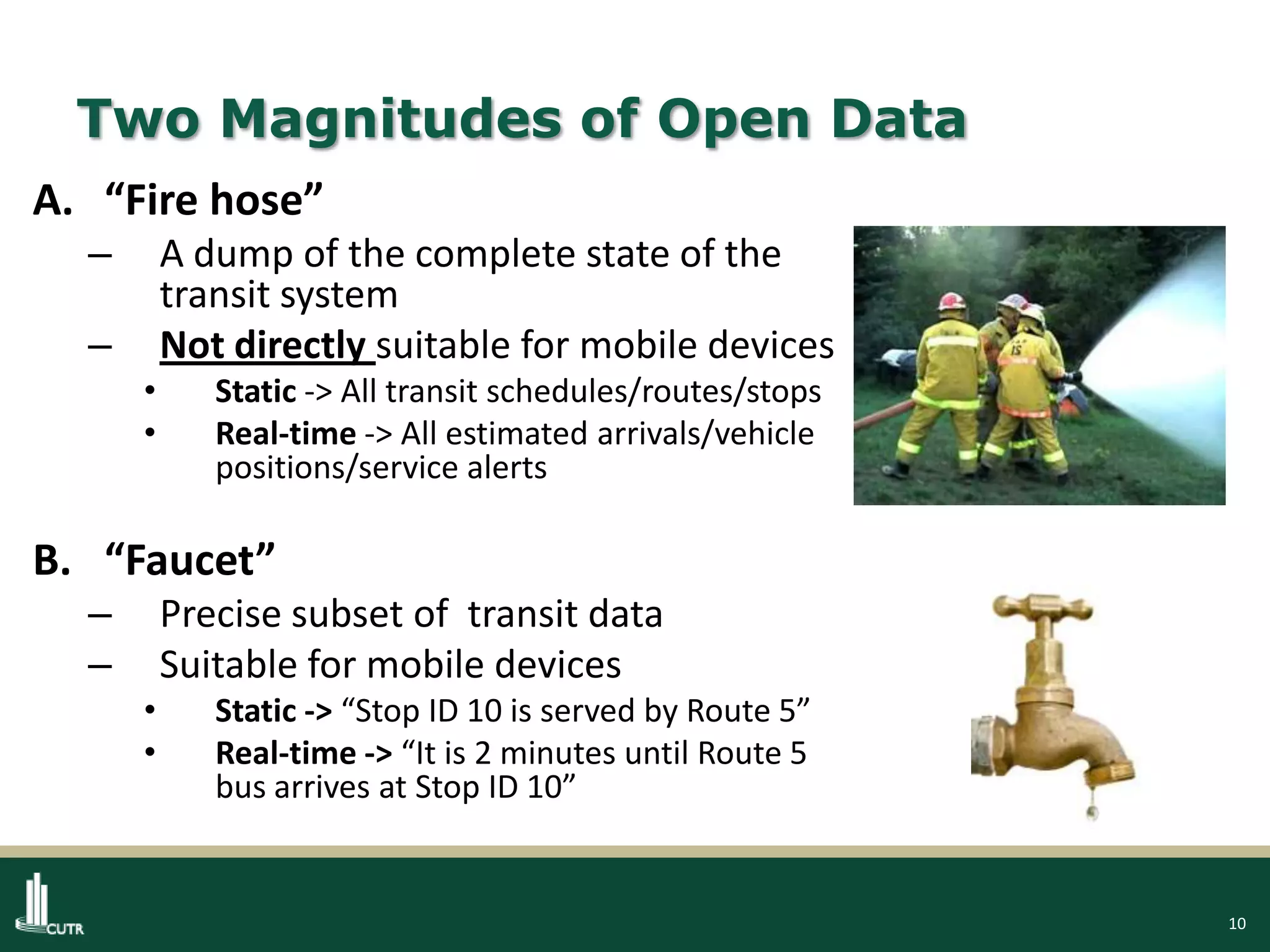
Two Magnitudes of Open Data
A. “Fire hose”
– A dump of the complete state of the
transit system
– Not directly suitable for mobile devices
• Static -> All transit schedules/routes/stops
• Real-time -> All estimated arrivals/vehicle
positions/service alerts
B. “Faucet”
– Precise subset of transit data
– Suitable for mobile devices
• Static -> “Stop ID 10 is served by Route 5”
• Real-time -> “It is 2 minutes until Route 5
bus arrives at Stop ID 10”
11
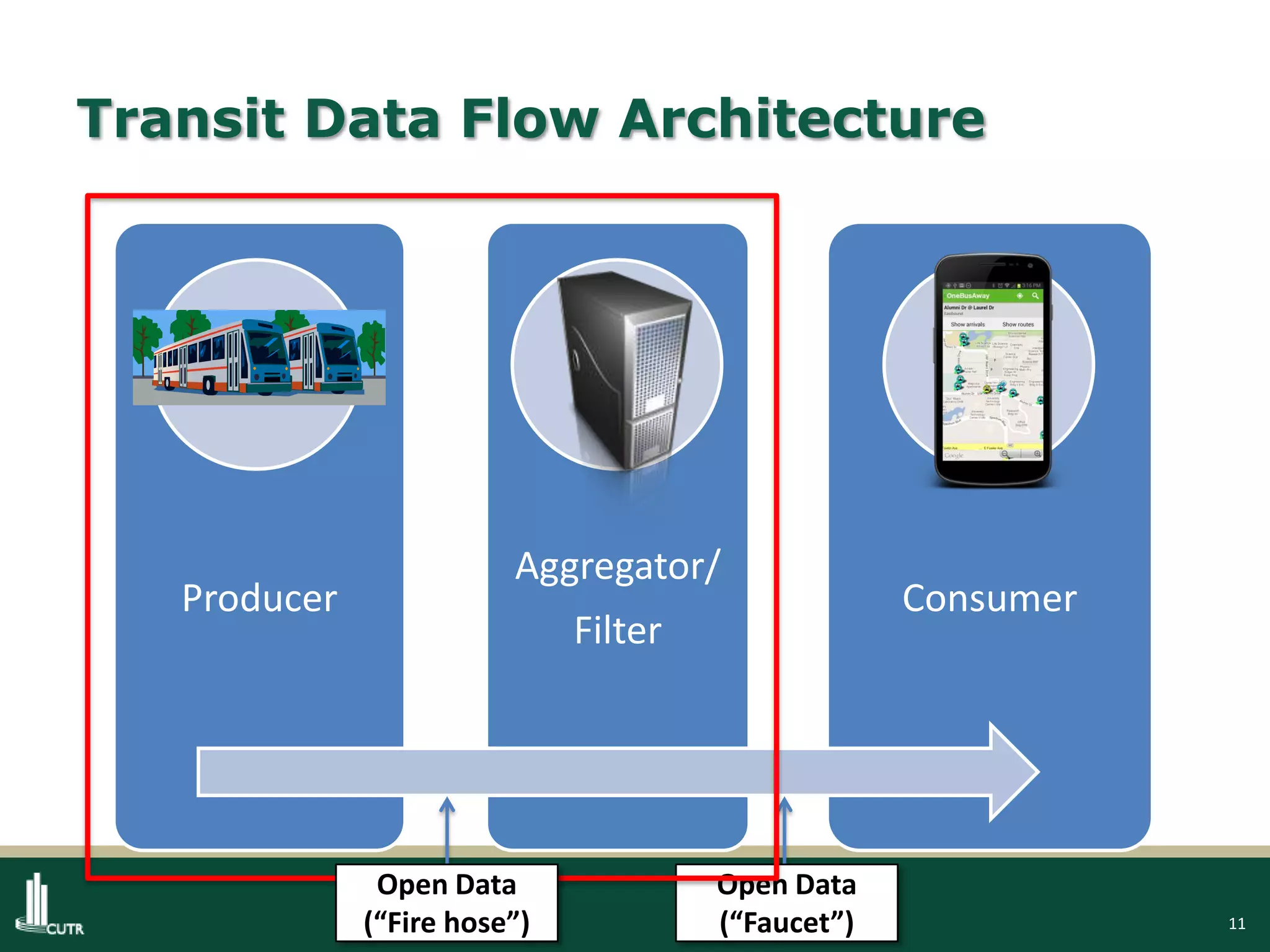
Transit Data Flow Architecture
Producer
Aggregator/
Filter
Consumer
Open Data
(“Faucet”)
Open Data
(“Fire hose”)
12
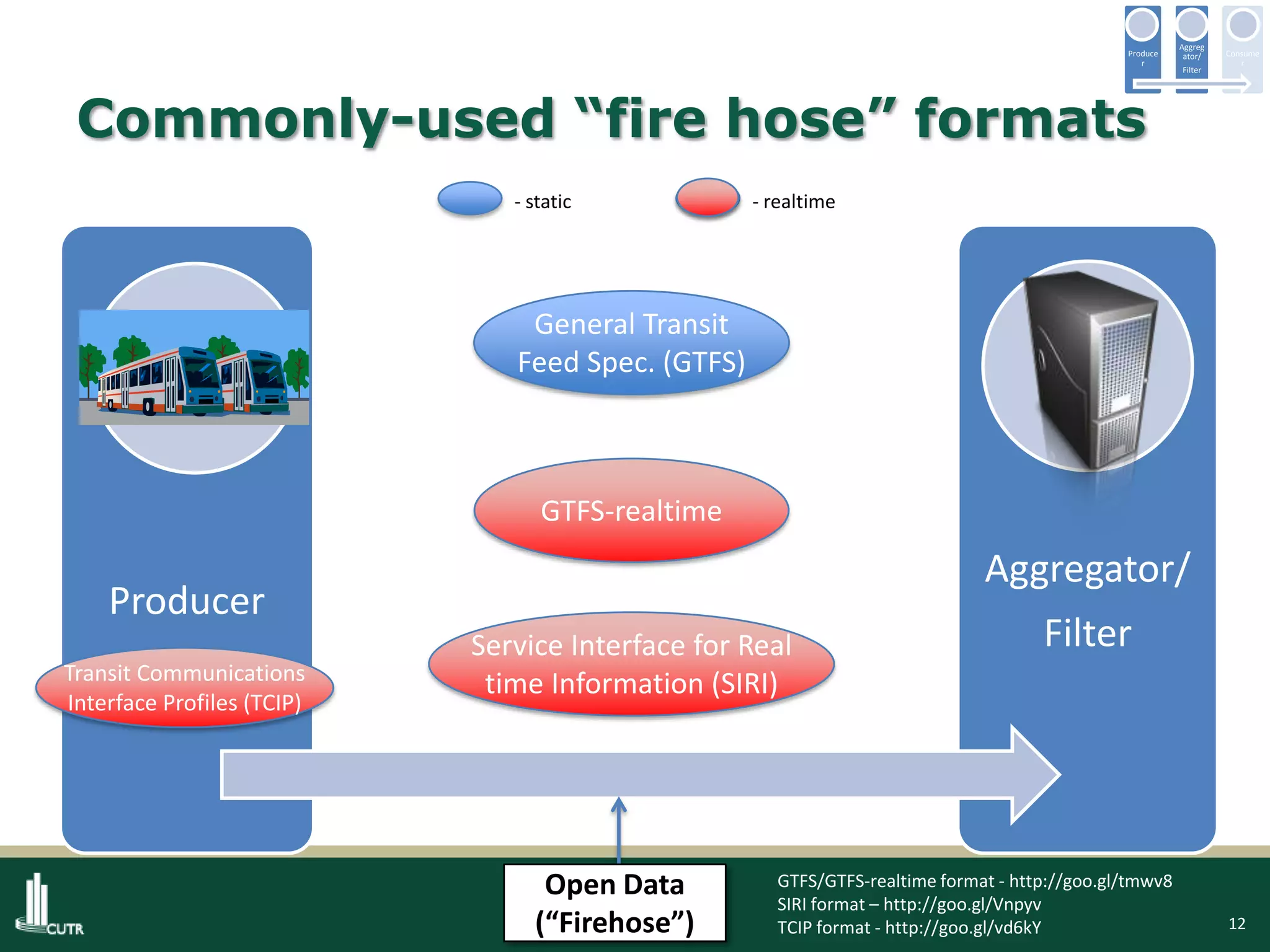
Producer
Aggregator/
Filter
Commonly-used “fire hose” formats
Open Data
(“Firehose”)
General Transit
Feed Spec. (GTFS)
GTFS-realtime
- static - realtime
Service Interface for Real
time Information (SIRI)Transit Communications
Interface Profiles (TCIP)
Produce
r
Aggreg
ator/
Filter
Consume
r
GTFS/GTFS-realtime format - http://goo.gl/tmwv8
SIRI format – http://goo.gl/Vnpyv
TCIP format - http://goo.gl/vd6kY
13
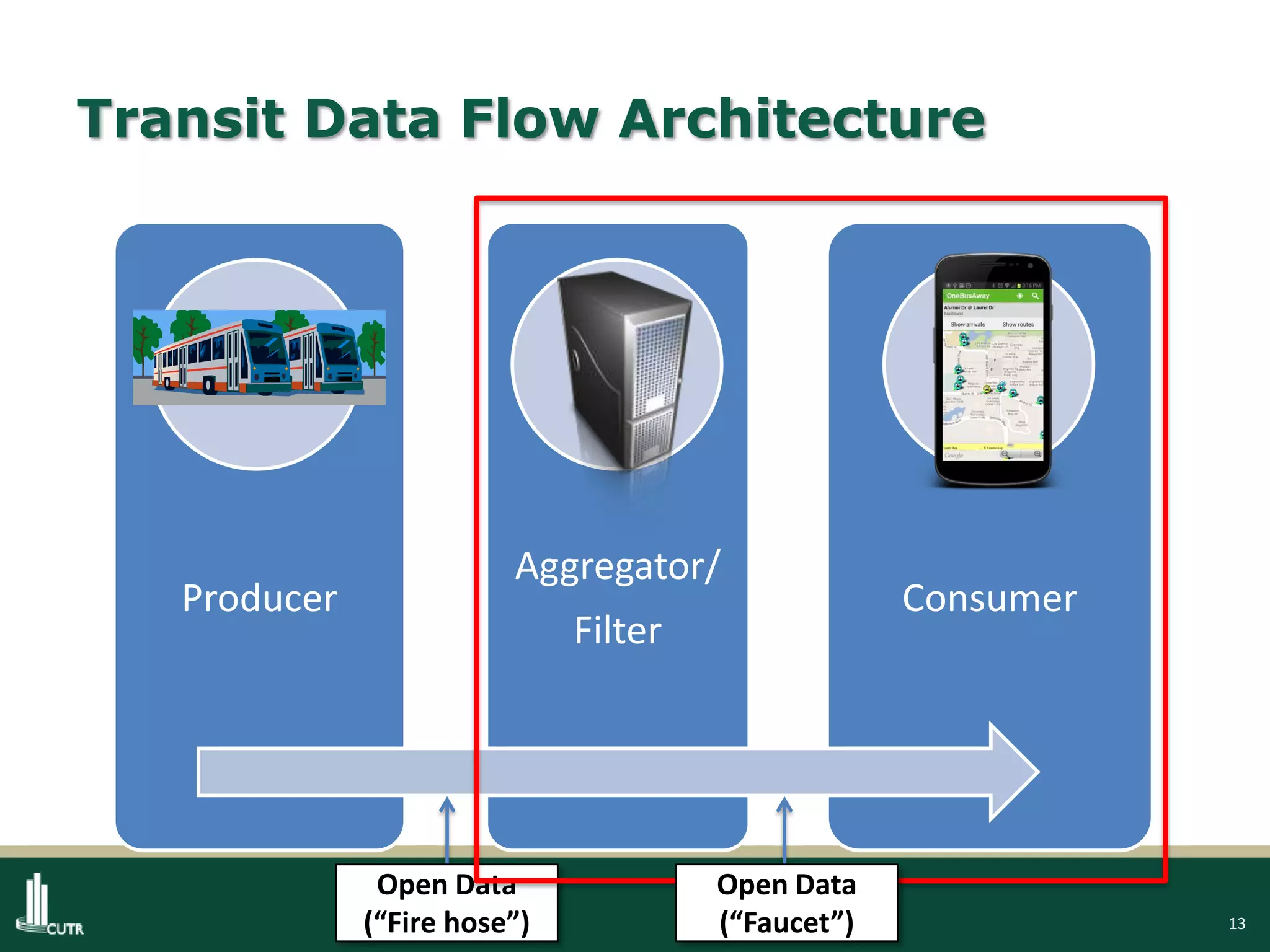
Transit Data Flow Architecture
Producer
Aggregator/
Filter
Consumer
Open Data
(“Fire hose”)
Open Data
(“Faucet”)
14
Aggregator/
Filter
Consumer
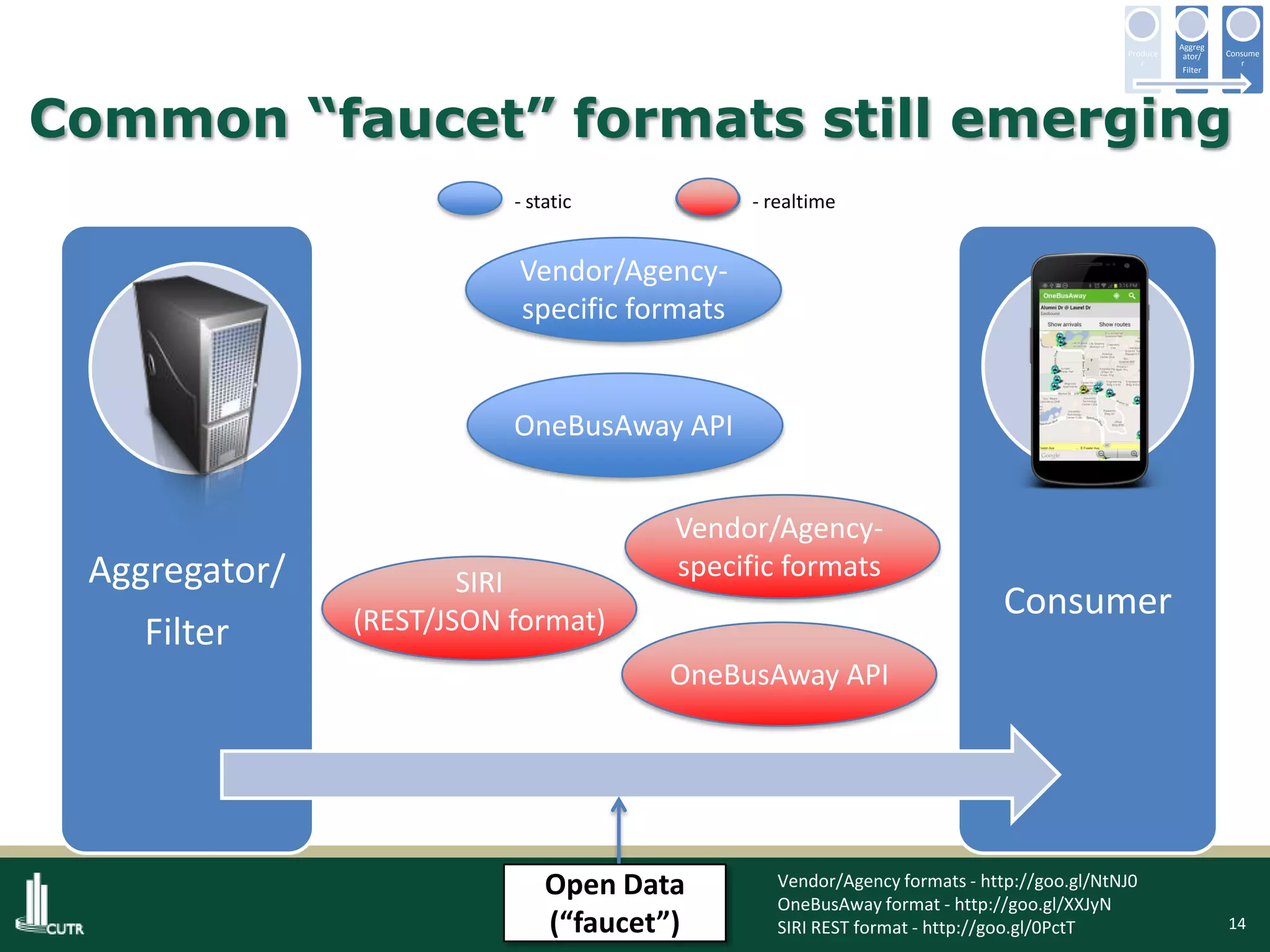
Common “faucet” formats still emerging
Open Data
(“faucet”)
Vendor/Agency-
specific formats
Vendor/Agency-
specific formats
- static - realtime
SIRI
(REST/JSON format)
OneBusAway API
OneBusAway API
Produce
r
Aggreg
ator/
Filter
Consume
r
Vendor/Agency formats - http://goo.gl/NtNJ0
OneBusAway format - http://goo.gl/XXJyN
SIRI REST format - http://goo.gl/0PctT
15
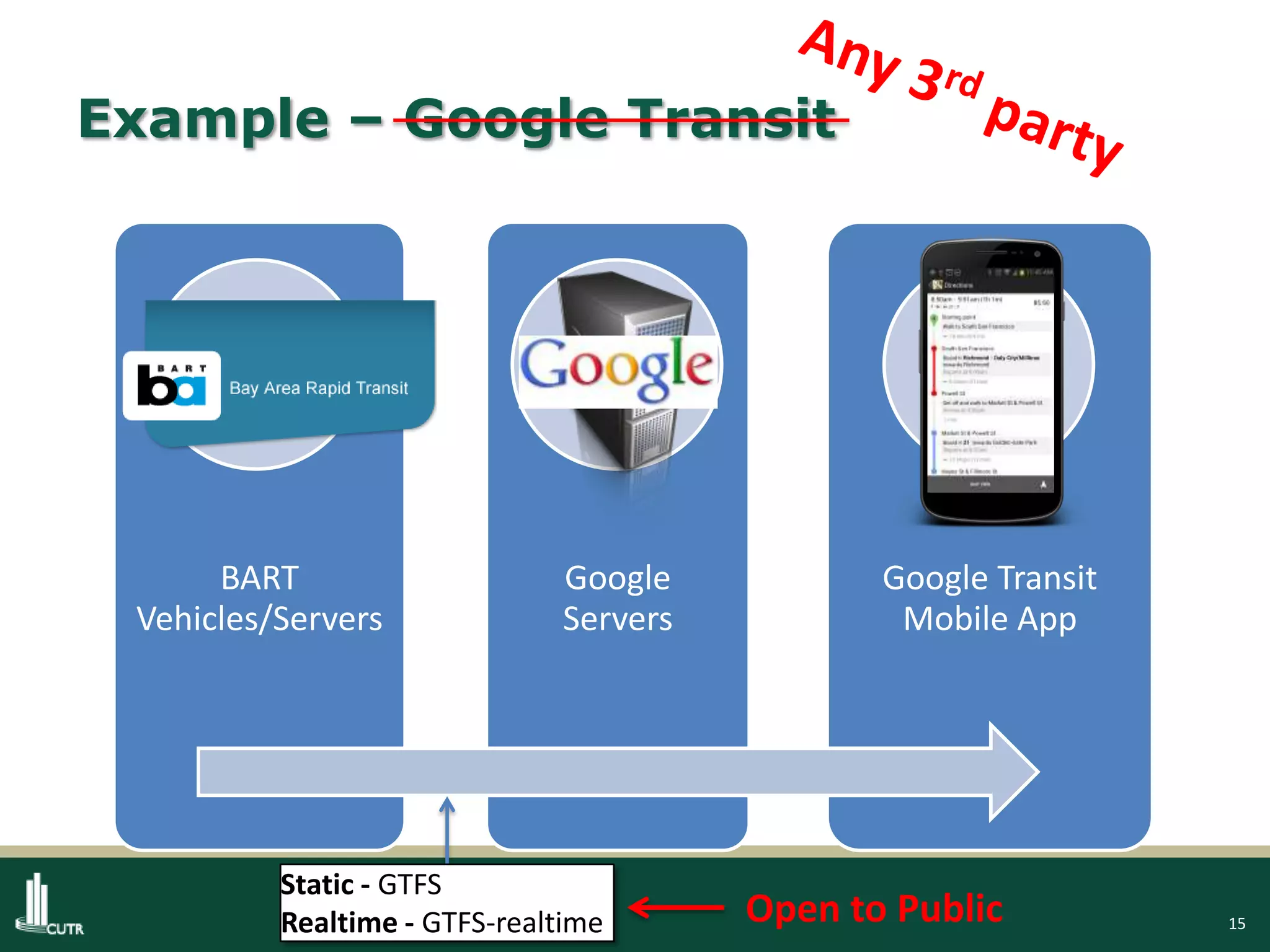
Example – Google Transit
BART
Vehicles/Servers
Google
Servers
Google Transit
Mobile App
Static - GTFS
Realtime - GTFS-realtime Open to Public
16
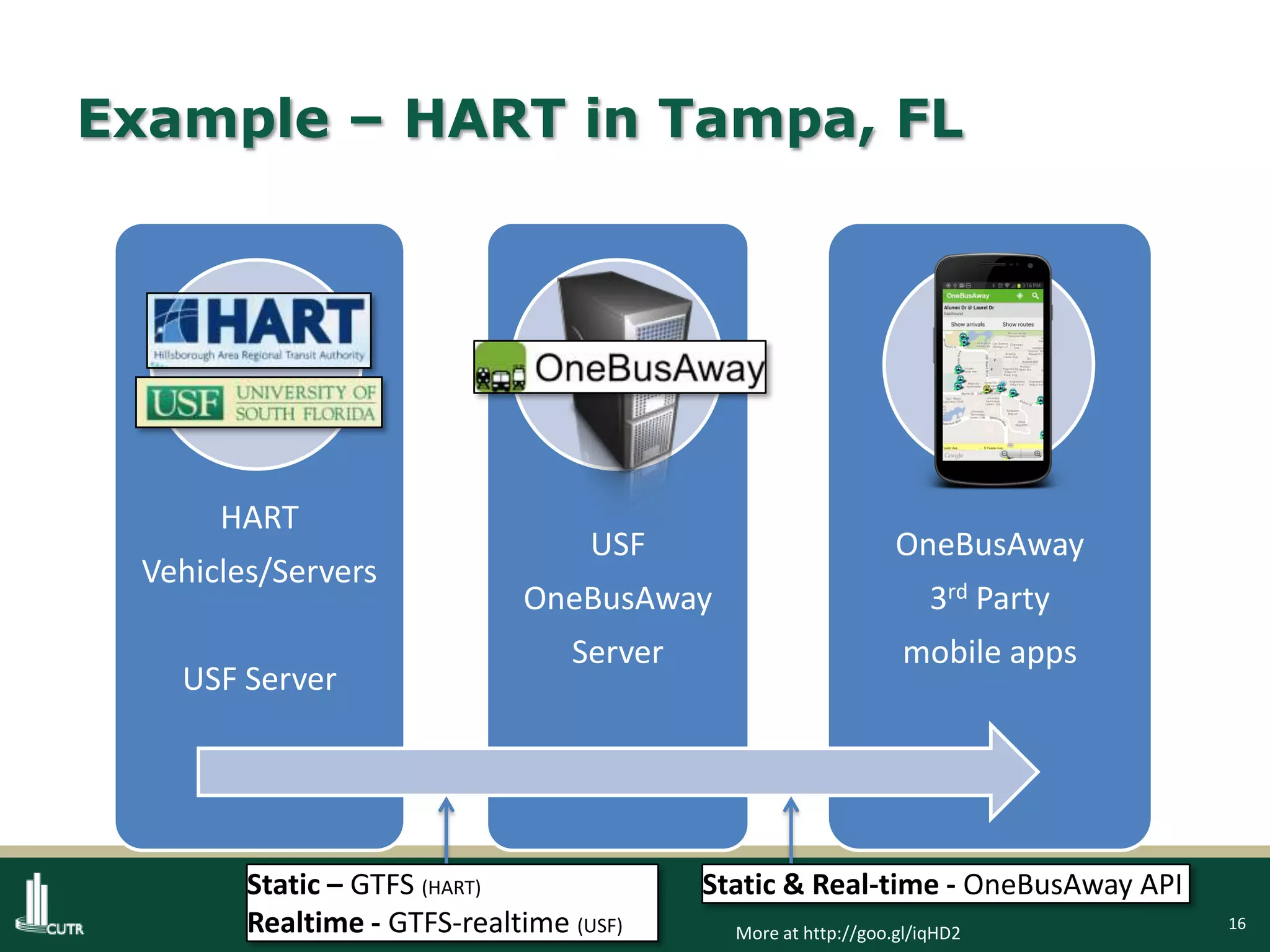
Example – HART in Tampa, FL
HART
Vehicles/Servers
USF Server
USF
OneBusAway
Server
OneBusAway
3rd Party
mobile apps
Static & Real-time - OneBusAway APIStatic – GTFS (HART)
Realtime - GTFS-realtime (USF) More at http://goo.gl/iqHD2
17
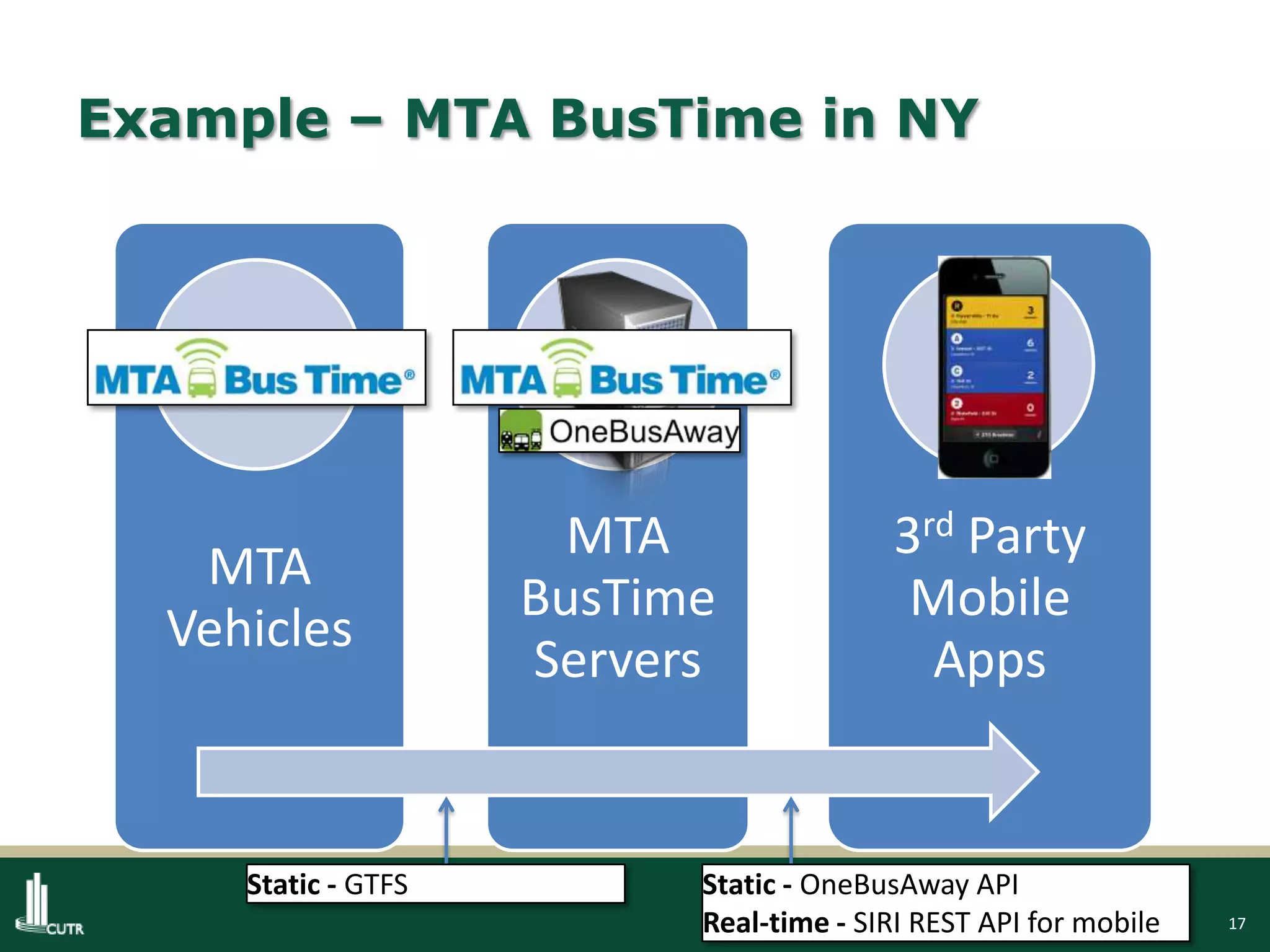
Example – MTA BusTime in NY
MTA
Vehicles
MTA
BusTime
Servers
3rd Party
Mobile
Apps
Static - OneBusAway API
Real-time - SIRI REST API for mobile
Static - GTFS
18
Successful Open Data Formats Are…
• Organic
– Created and improved by the people actually
producing and consuming the data
• Open
– Open process for evolution
– Data/documentation not hidden behind log-ins
• Easy-to-use for app developers
– Is documentation simple to understand?
– Are there existing open-source software tools?
19
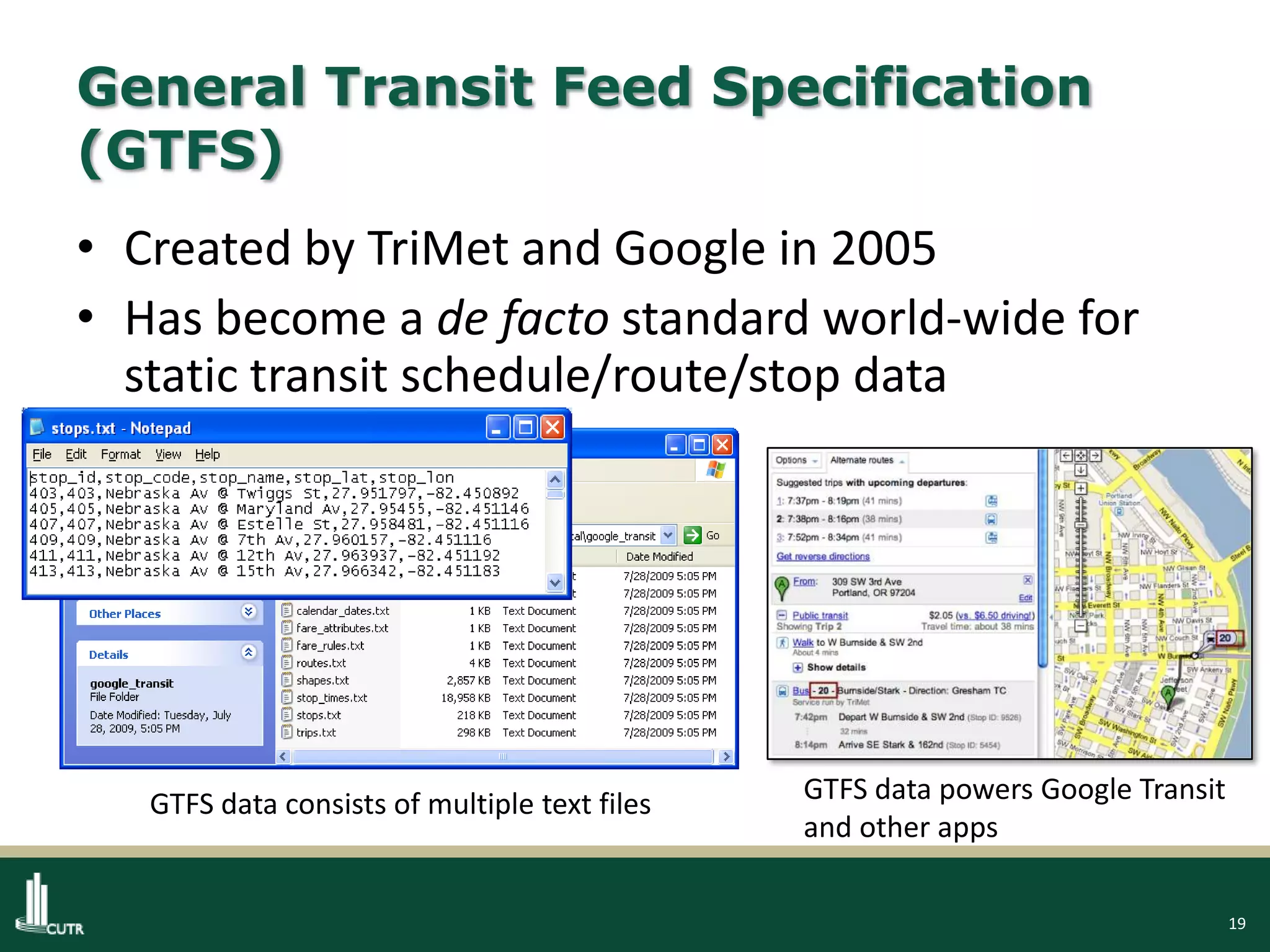
General Transit Feed Specification
(GTFS)
• Created by TriMet and Google in 2005
• Has become a de facto standard world-wide for
static transit schedule/route/stop data
GTFS data consists of multiple text files GTFS data powers Google Transit
and other apps
20
General Transit Feed Specification
(GTFS)
• Over 500 agencies worldwide have transit data in GTFS
format[1]
– 49 of top 50 largest U.S. transit agencies share GTFS data,
over 227 worldwide
– At least 20 Canadian agencies share open data
• Most agencies created GTFS data for Google Transit
– But, GTFS is open-data format used by web/mobile apps,
OpenTripPlanner, OneBusAway, etc.[2]
• See “GTFS Data Exchange” for list of agencies with GTFS
data
– http://www.gtfs-data-exchange.com/
– Or, ask your local agency
[1] City-Go-Round, http://www.citygoround.org/, Dec. 4, 2012
[2] For more GTFS info and references, see paper co-authored by Sean Barbeau and Aaron Antrim – “The Many Uses of GTFS Data” - http://goo.gl/asR96
21
BEING DEVELOPER-
FRIENDLY
Promoting app development with open data
22
Create a relationship with developers
• Open your GTFS data, and share
on GTFS-Data-Exchange!
– GTFS data should not be
password or login protected
• Share real-time data too
(national list pending)
• Create a “Developer page” with
access to resources (e.g., GTFS
license, data)
• Create developer email
list/group for
announcements/Q&A/collabora
tion
• Announce resources on “Transit
Developers” group[1]
HART Developer page -
http://www.gohart.org/developers/
[1] Transit Developers group, https://groups.google.com/forum/?fromgroups#!forum/transit-developers, Dec. 4th, 2012
23
Be Developer-Friendly!
• Use a simple “Terms of Service” based on
existing industry examples[1][2][3][4][5]
• Use GTFS naming conventions throughout
• “Direction_ID” is 0/1 (not N/S/E/W) in real-time data too!
• Make sure IDs match among datasets
– E.g., tripID in real-time data matches GTFS tripID
[1] TriMet “Terms of Use." http://developer.trimet.org/terms_of_use.shtml
[2] BART "Terms of Use." http://www.bart.gov/dev/schedules/license.htm
[3] Corona, CA "Terms of Use.” http://www.discovercorona.com/City-Departments/Public-
Works/Transportation/GTFS.aspx
[4] PSTA "Terms of Use.” http://www.psta.net/developers/License%20Agreement%20for%20App%20Devs.pdf
[5] HART "Terms of Use.” http://www.gohart.org/developers/terms_of_use.html
24
Be Developer-Friendly!
• Use developer/mobile-friendly formats
1. For data – GTFS, GTFS-realtime, SIRI REST API (see
MTA NY BusTime API[1])
2. For mobile APIs – RESTful web services design and
JSON encoding preferred (not SOAP and XML)
[1] MTA BusTime API, http://bustime.mta.info/wiki/Developers/SIRIIntro, Dec. 4th, 2012
POST /busstoparrival/busstopws.asmx HTTP/1.1
Host: 73.205.128.123
Content-Type: text/xml; charset=utf-8
Content-Length: length
SOAPAction: "http://tempuri.org/GetNextNVehicleArrivals"
<?xml version="1.0" encoding="utf-8"?>
<soap:Envelope xmlns:xsi="http://www.w3.org/2001/XMLSchema-
instance" xmlns:xsd="http://www.w3.org/2001/XMLSchema"
xmlns:soap="http://schemas.xmlsoap.org/soap/envelope/">
<soap:Body>
<GetNextNVehicleArrivals xmlns="http://tempuri.org/">
<n>int</n>
<RouteID>int</RouteID>
<DirectionCodeID>int</DirectionCodeID>
<BusStopID>int</BusStopID>
<TripID_External>string</TripID_External>
</GetNextNVehicleArrivals>
</soap:Body>
</soap:Envelope>
SOAP Request
GET /busstoparrival/busstopws.asmx/ GetNextNVehicleArrivals?
n=string&RouteID=string&DirectionCodeID=string
&BusStopID=string&
TripID_External=string HTTP/1.1 Host: 73.205.128.123
HTTP-Post Request
<Siri xmlns:ns2="http://www.ifopt.org.uk/acsb"
xmlns:ns4="http://datex2.eu/schema/1_0/1_0"
xmlns:ns3="http://www.ifopt.org.uk/ifopt"
xmlns="http://www.siri.org.uk/siri"> <ServiceDelivery>
<ResponseTimestamp>2012-09-12T09:28:17.213-
04:00</ResponseTimestamp> <VehicleMonitoringDelivery>
<VehicleActivity> <MonitoredVehicleJourney> <LineRef>MTA
NYCT_S40</LineRef> <DirectionRef>0</DirectionRef>
<FramedVehicleJourneyRef> <DataFrameRef>2012-09-
12</DataFrameRef> <DatedVehicleJourneyRef>MTA
NYCT_20120902EE_054000_S40_0031_MISC_437</DatedVehicleJou
rneyRef> </FramedVehicleJourneyRef> <JourneyPatternRef>MTA
NYCT_S400031</JourneyPatternRef>
<PublishedLineName>S40</PublishedLineName>
<OperatorRef>MTA NYCT</OperatorRef> <OriginRef>MTA
NYCT_200001</OriginRef> </MonitoredVehicleJourney>
</VehicleActivity> </VehicleMonitoringDelivery> <ServiceDelivery>
</Siri>
XML Response
{ Siri: { ServiceDelivery: { ResponseTimestamp: "2012-08-
21T12:06:21.485-04:00", VehicleMonitoringDelivery: [ {
VehicleActivity: [ { MonitoredVehicleJourney: { LineRef: "MTA
NYCT_S40", DirectionRef: "0", FramedVehicleJourneyRef: {
DataFrameRef: "2012-08-21", DatedVehicleJourneyRef: "MTA
NYCT_20120701CC_072000_S40_0031_S4090_302" },
JourneyPatternRef: "MTA NYCT_S400031", PublishedLineName:
"S40", OperatorRef: "MTA NYCT", OriginRef: "MTA
NYCT_200001" } } ] } ] } }
JSON Response
• 1.8 times more
characters using XML!
• 3.7 times more
characters using SOAP!
25
25
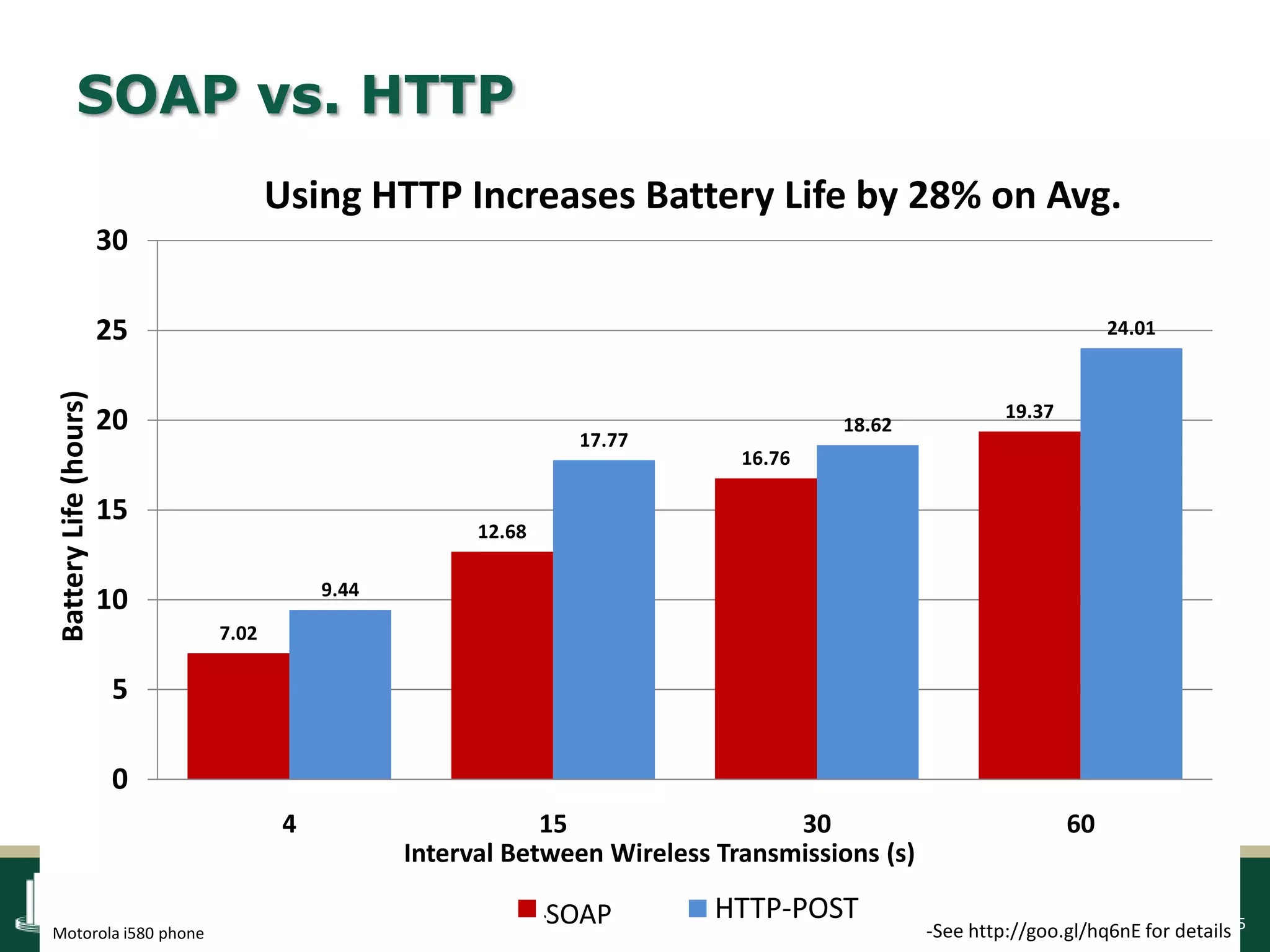
7.02
12.68
16.76
19.37
9.44
17.77
18.62
24.01
0
5
10
15
20
25
30
4 15 30 60
BatteryLife(hours)
Interval Between Wireless Transmissions (s)
Using HTTP Increases Battery Life by 28% on Avg.
JAX-RPC HTTP-POSTSOAP
SOAP vs. HTTP
Motorola i580 phone -See http://goo.gl/hq6nE for details
26
0
2000
4000
6000
8000
10000
12000
14000
16000
18000
20000
Min. Max. Avg. 50th percentile68th percentile95th percentileStd dev.
ElapsedTime(ms)
JSON
XML
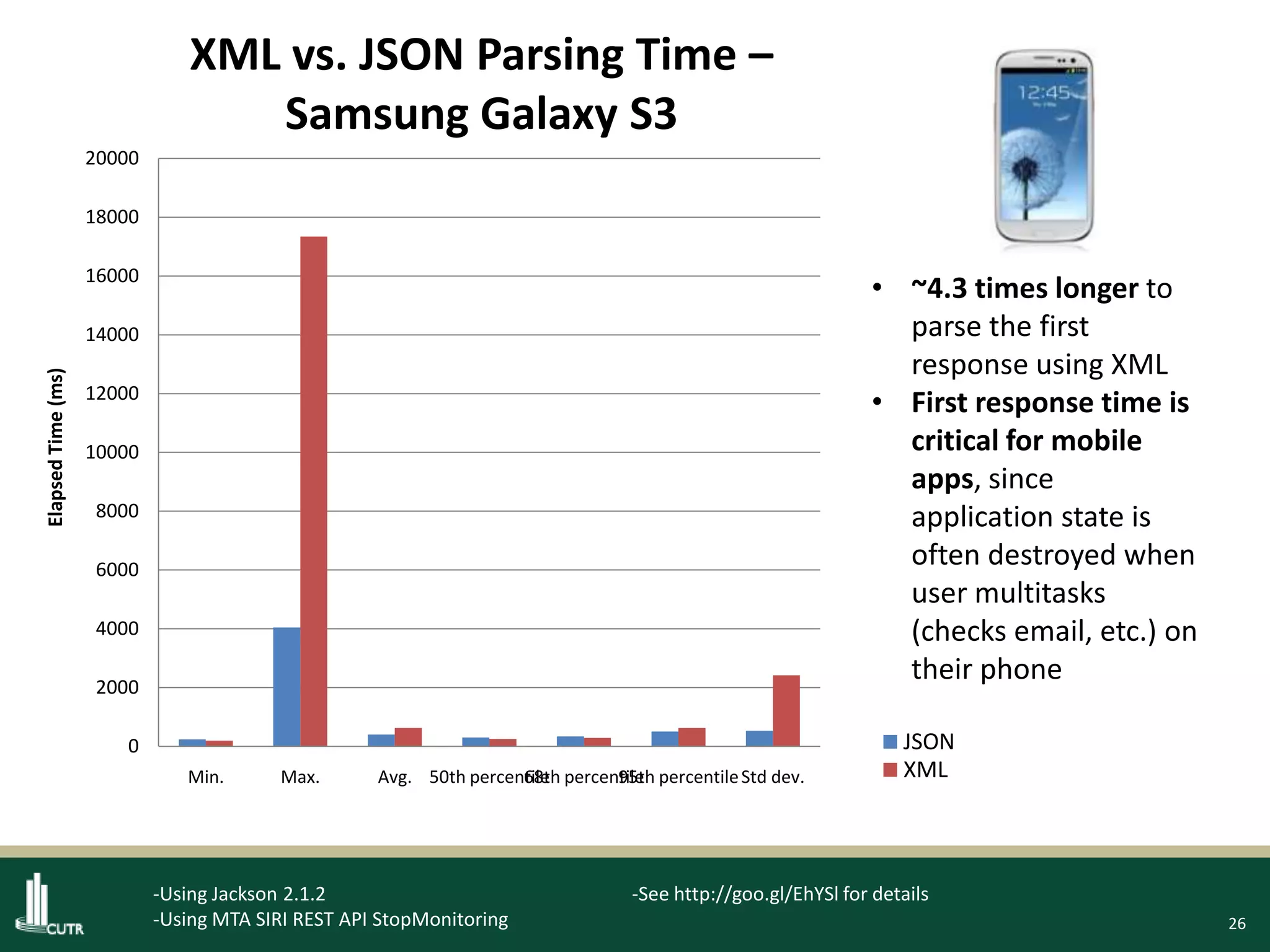
XML vs. JSON Parsing Time –
Samsung Galaxy S3
• ~4.3 times longer to
parse the first
response using XML
• First response time is
critical for mobile
apps, since
application state is
often destroyed when
user multitasks
(checks email, etc.) on
their phone
-Using Jackson 2.1.2
-Using MTA SIRI REST API StopMonitoring
-See http://goo.gl/EhYSl for details
27
Get the word out!
• After developers
have created
mobile
apps, share them
with riders
• Consider an “App
Center”[1-9] to
showcase apps [1] TriMet "TriMet App Center." http://trimet.org/apps/
[2] BART "Third Party Apps." http://www.bart.gov/schedules/appcenter/
[3] MTA "App Center." http://www.mta.info/apps/
[4] CTA "App Center." http://www.transitchicago.com/apps/
[5] GoTriangle. "App Center." http://www.gotriangle.org/developers/transit_apps
[6] HART "App Center." http://www.gohart.org/developers/appcenter.html
[7] MBTA "App Center." http://www.mbta.com/rider_tools/apps/
[8] KCATA "App Center." http://www.kcata.org/maps_schedules/app_center/
[9] UTA"App Center." http://developer.rideuta.com/DeveloperApps.aspx
28
Conclusions
• Open data (e.g., GTFS) makes transit apps possible
• Understand open [data vs. architecture vs. source]
• Understand the differences in data:
– Static vs. real-time
– “Fire hose” vs. “Faucet”
• Understand that certain formats are more appropriate
than others for certain situations (e.g., mobile)
• Being developer-friendly encourages mobile app
development!
29
Thanks!
Sean J. Barbeau, Ph.D.
barbeau@cutr.usf.edu
813.974.7208
Principal Mobile Software Architect for R&D
Center for Urban Transportation Research
University of South Florida
For more GTFS info and references, see paper co-authored by Sean Barbeau and Aaron Antrim – “The Many
Uses of GTFS Data” - http://goo.gl/asR96
30
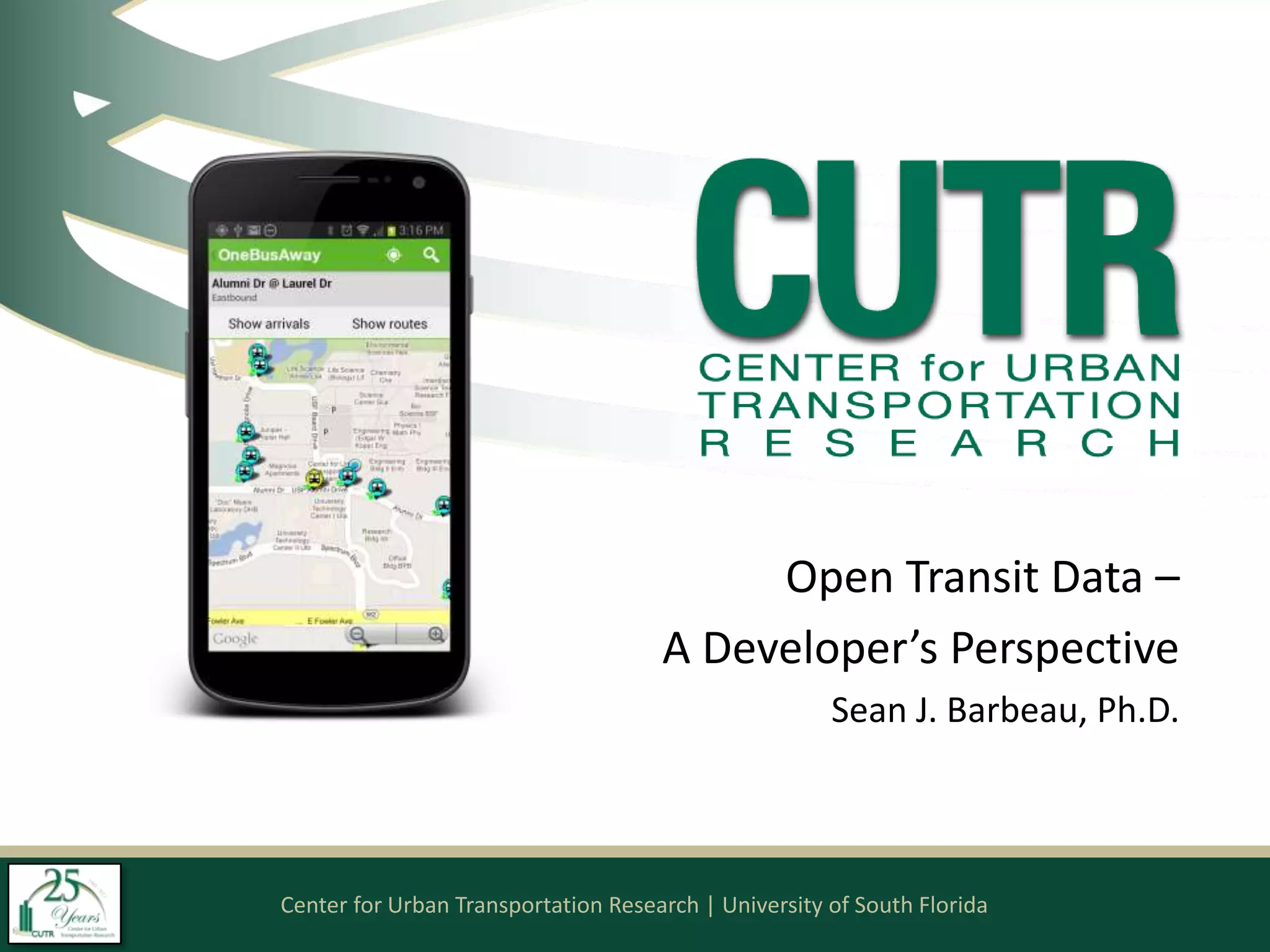
Glossary
• API – Application Programming Interface
• AVL – Automatic Vehicle Location
• FTP – File Transfer Protocol
• GTFS – General Transit Feed Specification
• HTTP – HyperText Transfer Protocol
• IT – Information Technology
• JSON – Javascript Object Notation
• REST – Representational State Transfer
• SIRI -Service Interface for Real time Information
• TCIP - Transit Communications Interface Profiles
• XML – Extensible Markup Language

APTA TransITech 2013 - "Open Transit Data - A Developers Perspective"

  • 1.
    Center for UrbanTransportation Research | University of South Florida Open Transit Data – A Developer’s Perspective Sean J. Barbeau, Ph.D.
  • 2.
    2 Overview • Why OpenData? • Anatomy of Transit Data Sharing • Being Developer-Friendly
  • 3.
  • 4.
    4 What is opendata? • Transit data that is shared with the public – Typically shared via website/FTP site/web services • No login should be required (may use API key) – Should be updated regularly, with any changes in schedule/routes/stops
  • 5.
    5 Open [Data ArchitectureSource] • Open architectures mostly focus on: – Standards within an agency’s software/hardware systems – Interconnectivity with other government systems • Open source means software source code is available • Open data is the sharing of data with external public parties 3rd party developers OPEN DATA Transit Agency Transit Vehicle AVL Server Schedule System
  • 6.
    6 Why is opendata important? • Allows public to contribute services that are cost/time- prohibitive for the public sector – e.g., many mobile platforms • Vendors are unpredictable – Some agencies have shared data only with Google – When Apple dropped Google Maps, iPhone users lost transit directions – Apple relied on 3rd party apps to fill the gap – only possible if open data was available
  • 7.
    7 Why is opendata important (to developers)? • Developers want to create innovative apps that meet a need! – Some are monetized, some are not • If you don’t provide open data, developers will often improvise – …via website scraping, etc. – Prone to breaking – Not beneficial to agency or rider
  • 8.
    8 THE ANATOMY OF TRANSITDATA SHARING © 1998 Nick Veasey
  • 9.
    9 Two Types ofOpen Data 1. Static – e.g., Transit schedules / routes / stops – Change only a few times a year 2. Real-time – e.g., Estimated arrival times /vehicle positions/service alerts – Can change every few seconds
  • 10.
    10 Two Magnitudes ofOpen Data A. “Fire hose” – A dump of the complete state of the transit system – Not directly suitable for mobile devices • Static -> All transit schedules/routes/stops • Real-time -> All estimated arrivals/vehicle positions/service alerts B. “Faucet” – Precise subset of transit data – Suitable for mobile devices • Static -> “Stop ID 10 is served by Route 5” • Real-time -> “It is 2 minutes until Route 5 bus arrives at Stop ID 10”
  • 11.
    11 Transit Data FlowArchitecture Producer Aggregator/ Filter Consumer Open Data (“Faucet”) Open Data (“Fire hose”)
  • 12.
    12 Producer Aggregator/ Filter Commonly-used “fire hose”formats Open Data (“Firehose”) General Transit Feed Spec. (GTFS) GTFS-realtime - static - realtime Service Interface for Real time Information (SIRI)Transit Communications Interface Profiles (TCIP) Produce r Aggreg ator/ Filter Consume r GTFS/GTFS-realtime format - http://goo.gl/tmwv8 SIRI format – http://goo.gl/Vnpyv TCIP format - http://goo.gl/vd6kY
  • 13.
    13 Transit Data FlowArchitecture Producer Aggregator/ Filter Consumer Open Data (“Fire hose”) Open Data (“Faucet”)
  • 14.
    14 Aggregator/ Filter Consumer Common “faucet” formatsstill emerging Open Data (“faucet”) Vendor/Agency- specific formats Vendor/Agency- specific formats - static - realtime SIRI (REST/JSON format) OneBusAway API OneBusAway API Produce r Aggreg ator/ Filter Consume r Vendor/Agency formats - http://goo.gl/NtNJ0 OneBusAway format - http://goo.gl/XXJyN SIRI REST format - http://goo.gl/0PctT
  • 15.
    15 Example – GoogleTransit BART Vehicles/Servers Google Servers Google Transit Mobile App Static - GTFS Realtime - GTFS-realtime Open to Public
  • 16.
    16 Example – HARTin Tampa, FL HART Vehicles/Servers USF Server USF OneBusAway Server OneBusAway 3rd Party mobile apps Static & Real-time - OneBusAway APIStatic – GTFS (HART) Realtime - GTFS-realtime (USF) More at http://goo.gl/iqHD2
  • 17.
    17 Example – MTABusTime in NY MTA Vehicles MTA BusTime Servers 3rd Party Mobile Apps Static - OneBusAway API Real-time - SIRI REST API for mobile Static - GTFS
  • 18.
    18 Successful Open DataFormats Are… • Organic – Created and improved by the people actually producing and consuming the data • Open – Open process for evolution – Data/documentation not hidden behind log-ins • Easy-to-use for app developers – Is documentation simple to understand? – Are there existing open-source software tools?
  • 19.
    19 General Transit FeedSpecification (GTFS) • Created by TriMet and Google in 2005 • Has become a de facto standard world-wide for static transit schedule/route/stop data GTFS data consists of multiple text files GTFS data powers Google Transit and other apps
  • 20.
    20 General Transit FeedSpecification (GTFS) • Over 500 agencies worldwide have transit data in GTFS format[1] – 49 of top 50 largest U.S. transit agencies share GTFS data, over 227 worldwide – At least 20 Canadian agencies share open data • Most agencies created GTFS data for Google Transit – But, GTFS is open-data format used by web/mobile apps, OpenTripPlanner, OneBusAway, etc.[2] • See “GTFS Data Exchange” for list of agencies with GTFS data – http://www.gtfs-data-exchange.com/ – Or, ask your local agency [1] City-Go-Round, http://www.citygoround.org/, Dec. 4, 2012 [2] For more GTFS info and references, see paper co-authored by Sean Barbeau and Aaron Antrim – “The Many Uses of GTFS Data” - http://goo.gl/asR96
  • 21.
  • 22.
    22 Create a relationshipwith developers • Open your GTFS data, and share on GTFS-Data-Exchange! – GTFS data should not be password or login protected • Share real-time data too (national list pending) • Create a “Developer page” with access to resources (e.g., GTFS license, data) • Create developer email list/group for announcements/Q&A/collabora tion • Announce resources on “Transit Developers” group[1] HART Developer page - http://www.gohart.org/developers/ [1] Transit Developers group, https://groups.google.com/forum/?fromgroups#!forum/transit-developers, Dec. 4th, 2012
  • 23.
    23 Be Developer-Friendly! • Usea simple “Terms of Service” based on existing industry examples[1][2][3][4][5] • Use GTFS naming conventions throughout • “Direction_ID” is 0/1 (not N/S/E/W) in real-time data too! • Make sure IDs match among datasets – E.g., tripID in real-time data matches GTFS tripID [1] TriMet “Terms of Use." http://developer.trimet.org/terms_of_use.shtml [2] BART "Terms of Use." http://www.bart.gov/dev/schedules/license.htm [3] Corona, CA "Terms of Use.” http://www.discovercorona.com/City-Departments/Public- Works/Transportation/GTFS.aspx [4] PSTA "Terms of Use.” http://www.psta.net/developers/License%20Agreement%20for%20App%20Devs.pdf [5] HART "Terms of Use.” http://www.gohart.org/developers/terms_of_use.html
  • 24.
    24 Be Developer-Friendly! • Usedeveloper/mobile-friendly formats 1. For data – GTFS, GTFS-realtime, SIRI REST API (see MTA NY BusTime API[1]) 2. For mobile APIs – RESTful web services design and JSON encoding preferred (not SOAP and XML) [1] MTA BusTime API, http://bustime.mta.info/wiki/Developers/SIRIIntro, Dec. 4th, 2012 POST /busstoparrival/busstopws.asmx HTTP/1.1 Host: 73.205.128.123 Content-Type: text/xml; charset=utf-8 Content-Length: length SOAPAction: "http://tempuri.org/GetNextNVehicleArrivals" <?xml version="1.0" encoding="utf-8"?> <soap:Envelope xmlns:xsi="http://www.w3.org/2001/XMLSchema- instance" xmlns:xsd="http://www.w3.org/2001/XMLSchema" xmlns:soap="http://schemas.xmlsoap.org/soap/envelope/"> <soap:Body> <GetNextNVehicleArrivals xmlns="http://tempuri.org/"> <n>int</n> <RouteID>int</RouteID> <DirectionCodeID>int</DirectionCodeID> <BusStopID>int</BusStopID> <TripID_External>string</TripID_External> </GetNextNVehicleArrivals> </soap:Body> </soap:Envelope> SOAP Request GET /busstoparrival/busstopws.asmx/ GetNextNVehicleArrivals? n=string&RouteID=string&DirectionCodeID=string &BusStopID=string& TripID_External=string HTTP/1.1 Host: 73.205.128.123 HTTP-Post Request <Siri xmlns:ns2="http://www.ifopt.org.uk/acsb" xmlns:ns4="http://datex2.eu/schema/1_0/1_0" xmlns:ns3="http://www.ifopt.org.uk/ifopt" xmlns="http://www.siri.org.uk/siri"> <ServiceDelivery> <ResponseTimestamp>2012-09-12T09:28:17.213- 04:00</ResponseTimestamp> <VehicleMonitoringDelivery> <VehicleActivity> <MonitoredVehicleJourney> <LineRef>MTA NYCT_S40</LineRef> <DirectionRef>0</DirectionRef> <FramedVehicleJourneyRef> <DataFrameRef>2012-09- 12</DataFrameRef> <DatedVehicleJourneyRef>MTA NYCT_20120902EE_054000_S40_0031_MISC_437</DatedVehicleJou rneyRef> </FramedVehicleJourneyRef> <JourneyPatternRef>MTA NYCT_S400031</JourneyPatternRef> <PublishedLineName>S40</PublishedLineName> <OperatorRef>MTA NYCT</OperatorRef> <OriginRef>MTA NYCT_200001</OriginRef> </MonitoredVehicleJourney> </VehicleActivity> </VehicleMonitoringDelivery> <ServiceDelivery> </Siri> XML Response { Siri: { ServiceDelivery: { ResponseTimestamp: "2012-08- 21T12:06:21.485-04:00", VehicleMonitoringDelivery: [ { VehicleActivity: [ { MonitoredVehicleJourney: { LineRef: "MTA NYCT_S40", DirectionRef: "0", FramedVehicleJourneyRef: { DataFrameRef: "2012-08-21", DatedVehicleJourneyRef: "MTA NYCT_20120701CC_072000_S40_0031_S4090_302" }, JourneyPatternRef: "MTA NYCT_S400031", PublishedLineName: "S40", OperatorRef: "MTA NYCT", OriginRef: "MTA NYCT_200001" } } ] } ] } } JSON Response • 1.8 times more characters using XML! • 3.7 times more characters using SOAP!
  • 25.
    25 25 7.02 12.68 16.76 19.37 9.44 17.77 18.62 24.01 0 5 10 15 20 25 30 4 15 3060 BatteryLife(hours) Interval Between Wireless Transmissions (s) Using HTTP Increases Battery Life by 28% on Avg. JAX-RPC HTTP-POSTSOAP SOAP vs. HTTP Motorola i580 phone -See http://goo.gl/hq6nE for details
  • 26.
    26 0 2000 4000 6000 8000 10000 12000 14000 16000 18000 20000 Min. Max. Avg.50th percentile68th percentile95th percentileStd dev. ElapsedTime(ms) JSON XML XML vs. JSON Parsing Time – Samsung Galaxy S3 • ~4.3 times longer to parse the first response using XML • First response time is critical for mobile apps, since application state is often destroyed when user multitasks (checks email, etc.) on their phone -Using Jackson 2.1.2 -Using MTA SIRI REST API StopMonitoring -See http://goo.gl/EhYSl for details
  • 27.
    27 Get the wordout! • After developers have created mobile apps, share them with riders • Consider an “App Center”[1-9] to showcase apps [1] TriMet "TriMet App Center." http://trimet.org/apps/ [2] BART "Third Party Apps." http://www.bart.gov/schedules/appcenter/ [3] MTA "App Center." http://www.mta.info/apps/ [4] CTA "App Center." http://www.transitchicago.com/apps/ [5] GoTriangle. "App Center." http://www.gotriangle.org/developers/transit_apps [6] HART "App Center." http://www.gohart.org/developers/appcenter.html [7] MBTA "App Center." http://www.mbta.com/rider_tools/apps/ [8] KCATA "App Center." http://www.kcata.org/maps_schedules/app_center/ [9] UTA"App Center." http://developer.rideuta.com/DeveloperApps.aspx
  • 28.
    28 Conclusions • Open data(e.g., GTFS) makes transit apps possible • Understand open [data vs. architecture vs. source] • Understand the differences in data: – Static vs. real-time – “Fire hose” vs. “Faucet” • Understand that certain formats are more appropriate than others for certain situations (e.g., mobile) • Being developer-friendly encourages mobile app development!
  • 29.
    29 Thanks! Sean J. Barbeau,Ph.D. barbeau@cutr.usf.edu 813.974.7208 Principal Mobile Software Architect for R&D Center for Urban Transportation Research University of South Florida For more GTFS info and references, see paper co-authored by Sean Barbeau and Aaron Antrim – “The Many Uses of GTFS Data” - http://goo.gl/asR96
  • 30.
    30 Glossary • API –Application Programming Interface • AVL – Automatic Vehicle Location • FTP – File Transfer Protocol • GTFS – General Transit Feed Specification • HTTP – HyperText Transfer Protocol • IT – Information Technology • JSON – Javascript Object Notation • REST – Representational State Transfer • SIRI -Service Interface for Real time Information • TCIP - Transit Communications Interface Profiles • XML – Extensible Markup Language