MYOPIA
Definition
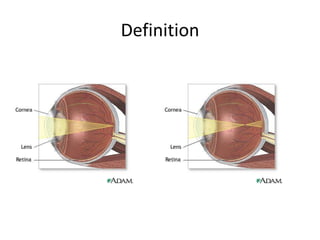
Myopia (Greek: μυωπία, muōpia,
"nearsightedness", from myein "to shut" + ops
(gen. opos) "eye."), also called
nearsightedness or shortsightedness, is a
refractive defect of the eye in which
collimated light (a light whose rays are nearly
parallel) produces image focus in front of the
retina when accommodation is relaxed
• Myopia
– (pathology) A disorder of the vision where distant
objects appear blurred because the eye focuses
their images in front of the retina instead of on it.
– A lack of imagination, discernment or long-range
perspective in thinking or planning.
Classifications
• Cause
• Clinical entity
• Degree
• Age of onset
Classifications
• Cause
• Clinical entity
• Degree
• Age of onset
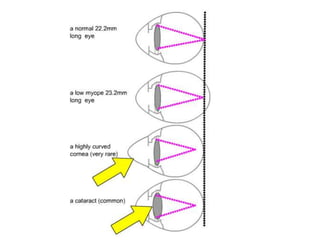
• Axial myopia is attributed to an increase in the eye's axial length.
But not every eye with an increased axial length is myopic. The
refractive error appears only when there is a mismatch between
axial length and refractive power of the eye.
• Refractive myopia is attributed to the condition of the refractive
elements of the eye. Borish further subclassified refractive myopia:
- Curvature myopia is attributed to excessive, or increased, curvature
of one or more of the refractive surfaces of the eye, especially the
cornea.
- Index myopia is attributed to variation in the index of refraction of
one or more of the ocular media. Practically, it is almost always
related to a nuclear cataract.
Classifications
• Cause
• Clinical entity
• Degree
• Age of onset
Simple myopia
Simple myopia is more common than other
types of myopia and is characterized by an eye
that is too long for its optical power (which is
determined by the cornea and crystalline lens)
or optically too powerful for its axial length.
Both genetic and environmental factors,
particularly significant amounts of near work,
are thought to contribute to the development
of simple myopia.
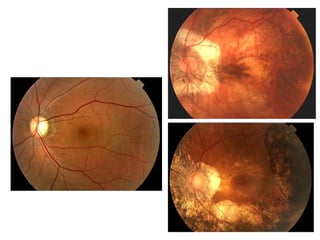
Degenerative myopia
also known as malignant, pathological, or
progressive myopia, is characterized by
marked fundus changes, such as posterior
staphyloma, and associated with a high
refractive error and subnormal visual acuity
after correction.This form of myopia gets
progressively worse over time. Degenerative
myopia has been reported as one of the main
causes of visual impairment.
Nocturnal myopia
also known as night myopia or twilight myopia, is a
condition in which the eye has a greater difficulty
seeing in low illumination areas, even though its
daytime vision is normal. Essentially, the eye's far
point of an individual's focus varies with the level
of light. Night myopia is believed to be caused by
pupils dilating to let more light in, which adds
aberrations resulting in becoming more
nearsighted. A stronger prescription for myopic
night drivers is often needed.
Pseudomyopia
Pseudomyopia is the blurring of distance vision
brought about by spasm of the ciliary muscle
Induced myopia
• Induced myopia, also known as acquired myopia, results from
exposure to various pharmaceuticals, increases in glucose levels,
nuclear sclerosis, or other anomalous conditions. The encircling
bands used in the repair of retinal detachments may induce myopia
by increasing the axial length of the eye.
- Index myopia is attributed to variation in the index of refraction of
one or more of the ocular media. Cataracts may lead to index
myopia.
- Form deprivation myopia is a type of myopia that occurs when the
eyesight is deprived by limited illumination and vision range, or the
eye is modified with artificial lenses or deprived of clear form
vision. In lower vertebrates this kind of myopia seems to be
reversible within short periods of time. Myopia is often induced this
way in various animal models to study the pathogenesis and
mechanism of myopia development.
Nearwork Induced Transient Myopia
(NITM)
short-term myopic far point shift immediately
following a sustained near visual task. Some
authors argue for a link between NITM and
the development of permanent myopia
Classifications
• Cause
• Clinical entity
• Degree
• Age of onset
• Low myopia usually describes myopia of −3.00
diopters or less.
• Medium myopia usually describes myopia
between −3.00 and −6.00 diopters.
• High myopia usually describes myopia of −6.00 or
more. People with high myopia are more likely to
have retinal detachments and primary open angle
glaucoma. They are also more likely to experience
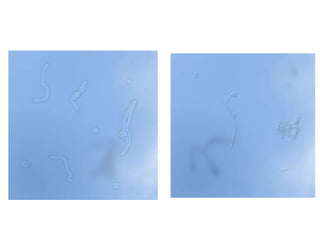
floaters, shadow-like shapes which appear singly
or in clusters in the field of vision. Roughly 30% of
myopes have high myopia.
Classifications
• Cause
• Clinical entity
• Degree
• Age of onset
• Congenital myopia, also known as infantile myopia, is
present at birth and persists through infancy.
• Youth onset myopia occurs prior to age 20
• School myopia appears during childhood, particularly
the school-age years. This form of myopia is attributed
to the use of the eyes for close work during the school
years.
• Adult onset myopia
-Early adult onset myopia occurs between ages 20 and
40.
-Late adult onset myopia occurs after age 40
Genetic factors
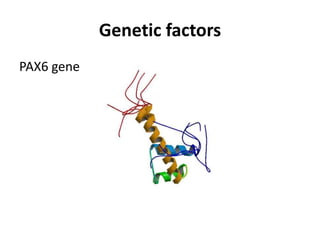
PAX6 gene

myopia.pptx

  • 1.
  • 2.
  • 3.
    Myopia (Greek: μυωπία,muōpia, "nearsightedness", from myein "to shut" + ops (gen. opos) "eye."), also called nearsightedness or shortsightedness, is a refractive defect of the eye in which collimated light (a light whose rays are nearly parallel) produces image focus in front of the retina when accommodation is relaxed
  • 4.
    • Myopia – (pathology)A disorder of the vision where distant objects appear blurred because the eye focuses their images in front of the retina instead of on it. – A lack of imagination, discernment or long-range perspective in thinking or planning.
  • 5.
    Classifications • Cause • Clinicalentity • Degree • Age of onset
  • 6.
    Classifications • Cause • Clinicalentity • Degree • Age of onset
  • 8.
    • Axial myopiais attributed to an increase in the eye's axial length. But not every eye with an increased axial length is myopic. The refractive error appears only when there is a mismatch between axial length and refractive power of the eye. • Refractive myopia is attributed to the condition of the refractive elements of the eye. Borish further subclassified refractive myopia: - Curvature myopia is attributed to excessive, or increased, curvature of one or more of the refractive surfaces of the eye, especially the cornea. - Index myopia is attributed to variation in the index of refraction of one or more of the ocular media. Practically, it is almost always related to a nuclear cataract.
  • 9.
    Classifications • Cause • Clinicalentity • Degree • Age of onset
  • 10.
  • 11.
    Simple myopia ismore common than other types of myopia and is characterized by an eye that is too long for its optical power (which is determined by the cornea and crystalline lens) or optically too powerful for its axial length. Both genetic and environmental factors, particularly significant amounts of near work, are thought to contribute to the development of simple myopia.
  • 12.
    Degenerative myopia also knownas malignant, pathological, or progressive myopia, is characterized by marked fundus changes, such as posterior staphyloma, and associated with a high refractive error and subnormal visual acuity after correction.This form of myopia gets progressively worse over time. Degenerative myopia has been reported as one of the main causes of visual impairment.
  • 14.
    Nocturnal myopia also knownas night myopia or twilight myopia, is a condition in which the eye has a greater difficulty seeing in low illumination areas, even though its daytime vision is normal. Essentially, the eye's far point of an individual's focus varies with the level of light. Night myopia is believed to be caused by pupils dilating to let more light in, which adds aberrations resulting in becoming more nearsighted. A stronger prescription for myopic night drivers is often needed.
  • 16.
    Pseudomyopia Pseudomyopia is theblurring of distance vision brought about by spasm of the ciliary muscle
  • 17.
    Induced myopia • Inducedmyopia, also known as acquired myopia, results from exposure to various pharmaceuticals, increases in glucose levels, nuclear sclerosis, or other anomalous conditions. The encircling bands used in the repair of retinal detachments may induce myopia by increasing the axial length of the eye. - Index myopia is attributed to variation in the index of refraction of one or more of the ocular media. Cataracts may lead to index myopia. - Form deprivation myopia is a type of myopia that occurs when the eyesight is deprived by limited illumination and vision range, or the eye is modified with artificial lenses or deprived of clear form vision. In lower vertebrates this kind of myopia seems to be reversible within short periods of time. Myopia is often induced this way in various animal models to study the pathogenesis and mechanism of myopia development.
  • 18.
    Nearwork Induced TransientMyopia (NITM) short-term myopic far point shift immediately following a sustained near visual task. Some authors argue for a link between NITM and the development of permanent myopia
  • 19.
    Classifications • Cause • Clinicalentity • Degree • Age of onset
  • 20.
    • Low myopiausually describes myopia of −3.00 diopters or less. • Medium myopia usually describes myopia between −3.00 and −6.00 diopters. • High myopia usually describes myopia of −6.00 or more. People with high myopia are more likely to have retinal detachments and primary open angle glaucoma. They are also more likely to experience floaters, shadow-like shapes which appear singly or in clusters in the field of vision. Roughly 30% of myopes have high myopia.
  • 22.
    Classifications • Cause • Clinicalentity • Degree • Age of onset
  • 23.
    • Congenital myopia,also known as infantile myopia, is present at birth and persists through infancy. • Youth onset myopia occurs prior to age 20 • School myopia appears during childhood, particularly the school-age years. This form of myopia is attributed to the use of the eyes for close work during the school years. • Adult onset myopia -Early adult onset myopia occurs between ages 20 and 40. -Late adult onset myopia occurs after age 40
  • 24.