



MYOPIA
OPTOM.ASKAR.PK
Refractive Errors
Refractive status of the eye
 The ocular refractive status refers to the locus
within the eye conjugate with optical infinity
during minimal accommodation.* Under these
conditions:
 In an emmetropic eye, incident parallel rays of
light are brought to a focus upon the retina.
 In a hyperopic (or hypermetropic) eye, incident
parallel rays of light are brought to a focus behind
the retina.
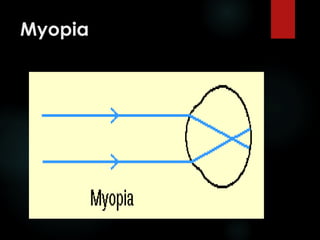
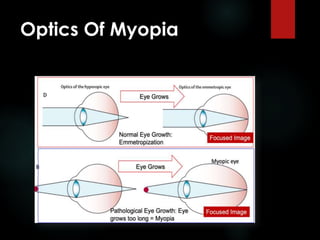
 In a myopic eye, incident parallel rays of light are
brought to a focus in front ofthe retina.
Refractive status of the eye
 Ametropia, or the absence of emmetropia,
may be produced by variations in:
1. The relative location of the optical elements of
the eye with respect to the retina.
2. The relative refractive power of the optical
elements with respect to the location of the
retina
Refractive errors
Ametropia: a refractive error is present
• Myopia: Near sightedness
• Hyperopia(Hypermetropia): Far sightedness
• Astigmatism: the curvature of the cornea and/or lens is not sphericaland
 therefore causes image blur on the retina
Refractive errors
• Anisometropia: a refractive power difference between
the 2 eyes (> 2D)
• Aniseikonia: a difference of image size between the 2
eyes as perceived by the patient
• Aphakia: (Phakos=lens), aphakia is no lens
• Pseudophakia: artificial lens in the eye
Myopia
Myopia
Myopia
 Results from an eye having excessive
refractive power for its axial length.
 This may be due either to the eye having
a relatively long axial length or to
increased dioptric power of one or more
of the refractive elements.
Myopia
 Term myopia was derived by Galen from the
words myein ("to close") and ops ("eye").
 Galen observed that nearsighted people partially
closed their eyes to see better.
Optics Of Myopia
 In myopia the eyeball is usually deformed ; the
deformation occurs at the posterior part of the
globe only ,the anterior part is normal. The eyeball
is usually large and looks prominent. When
adducted the equator can be seen.
Optics Of Myopia
Classifications
 Rate of myopic progression
 Anatomical features of myopia
 Degree of myopia
 Physiological and pathological myopia
 Hereditary and environmentally induced myopia
 theory of myopic development
 Age of myopia onset
Rate of myopic progression- Donders
Three categories of myopia:
 Stationary: Stationary myopia is generally of low degree (-1.50
to -2.00 D) and arises "in the years of development. remains
stationary during adulthood
 Temporarily :early teens and progresses until the late 20s.
After this age, the rate of myopia progression approaches
zero.
 Permanently progressive:. Permanently progressive myopia
ascends rapidly until around 25 to 35 years of age, and
thereafter advances more slowly.
Based on Anatomical features
 Axial: increased Axial length of eyeball
 Refractive:refractive system is too powerful for
the axial length of the eye.
Boris further divided in to Ref.Myopia into:
1. Curvatural- reduced radius of curvature of one
or more refractive surfaces produces increased
dioptric power.
2. Index-one or more ofthe refractive indices
ofthe media are anomalous.increased
refractive index of lens withnuclear sclerosis
3. Anterior chamber myopia:deeper in anterior
chamber depth increases the refractive power
of the eye
Degree of myopia
 Low (<3D)
 Medium –(3-6D)
 High – (>6D)
Physiological and Pathological
Myopia
 Physiological myopia: in which each component of
refraction lies within the normal distribution for that
population.
 Physiological/school myopia
 Commonest type
 Results due to normal biological variations in developmentof eye
 Age of onset- 7-10yrs
 Moderate severity-<5D,neverexceeds8D
 No degenerativechanges
Pathological myopia
 Refractive anomalies determined by the presence in the
optical system of the eye of an element which lies outside
the limits of the normal biological variations.
 Malignant or degenerative myopia - degenerative
changes, particularly in the posterior segment of the
globe.
 Most frequently found in high (>6 D) degrees of myopia
 Age of onset-early adultlife
 Progressive in nature
Pathological myopia
 Also called degenerative/ progressive myopia
 Related to heredity
 Increased axial length, degenerative changes in
retina, choroid, vitreous changes
Classification Based on Age of
Onset
 myopia on the basis of the subjects' age at the time of
reported myopia onset.
1. Congenital myopia-Myopia is present at birth and persists
through infancy
2. Youth-onset myopia -The onset of myopia occurs between 6
years of age and the early teens.
3. Early adult-onset myopia -The onset of myopia occurs
between 20 and 40 years of age.
4. Late adult-onset myopia -Myopia onset occurs after 40 years
of age.
Congenital myopia
 Common in premature babies or with birth
defects
 Stationary(8-10D)
 Associated with
 Increase in axiallength
Esotropia
Other congenital anomalies of eye
 Early and full correction under
cycloplegia Poor prognosis in unilateral
cases with severe
 myopia and anisometropia
Other types myopia
 Night myopia: increased myopia under low
iluminance conditions was first reported in 1789.
produced by an increased accommodative
response (typically on the order of 0.50 to 1.00 D)
under degraded stimulus conditions.
 Pseudo myopia: results from a spasm of the ciliary
muscle
Pathological changes in
myopia
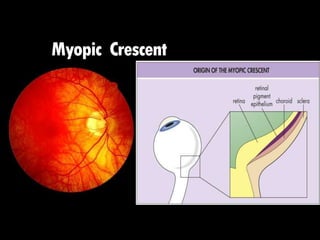
 Optic disc appear large and pale
 Degenerative changes in retina & choroid
 Vitreous degeneration
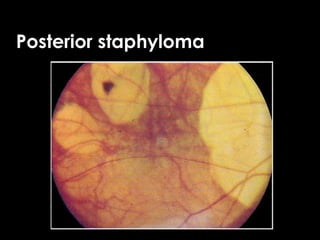
 Posterior staphyloma
Myopic Crescent
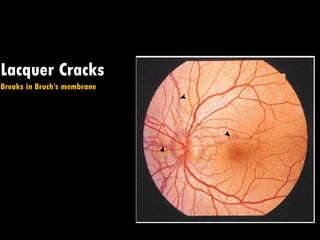
Lacquer Cracks
Breaks in Bruch’s membrane
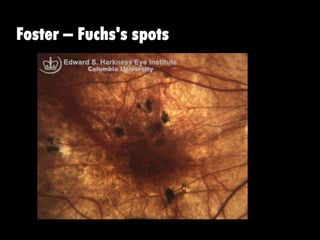
Foster – Fuchs's spots
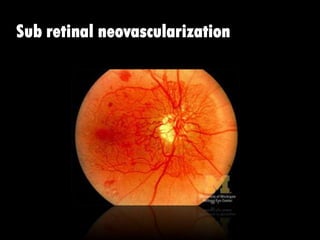
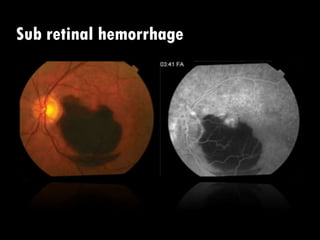
Sub retinal neovascularization
Sub retinal hemorrhage
Posterior staphyloma
Complications
Macular hemorrhage
Retinal tears, detachment
Vitreous hemorrhage
Choroidal hemorrhage
Complicated cataract
Nuclear sclerosis
Primary open angle glaucoma
Clinicalfeatures-Symptoms
Distant blurred vision
Half shutting of eyes
Asthenopic symptoms
Floating black opacities infront of the
eye
Night blindness
Divergent squint
Signs
Prominent eyeballs
Large cornea
Anterior chamberis deep
Large &sluggishly reacting pupil
Fundus examination-changes seen only in
pathological myopia
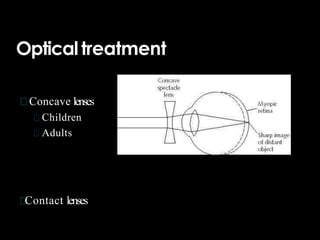
Opticaltreatment
Concave lenses
Children
Adults
Contact lenses
Optical treatment
Minimum acceptance providing maximum vision
Low myopia(<6D):
 Young children : glasses required only if
Isometropia
<2years ≥ -4.0D
2-3years ≥ -3.0D
Anisometropia:
≥ -2.5D
Give full correction under cycloplegia
Avoid overcorrection
Adults:
 <30years-full correction
 >30years-less than full correction with which patient
is
comfortable for nearvision.
HIGH MYOPIA
 under correction is done to avoid
near vision problem
minification of images
contact lenses are better(to avoid image minification)
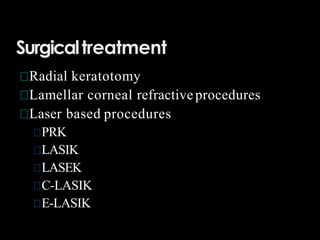
Surgicaltreatment
Radial keratotomy
Lamellar corneal refractiveprocedures
Laser based procedures
PRK
LASIK
LASEK
C-LASIK
E-LASIK
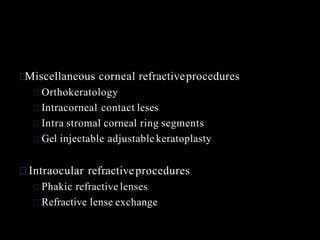
Miscellaneous corneal refractiveprocedures
Orthokeratology
Intracorneal contact leses
Intra stromal corneal ring segments
Gel injectable adjustable keratoplasty
Intraocular refractiveprocedures
Phakic refractive lenses
Refractive lense exchange
Thank you

MYOPIA REFRACTIVE ERROR.pdf

  • 1.
  • 2.
  • 3.
    Refractive status ofthe eye  The ocular refractive status refers to the locus within the eye conjugate with optical infinity during minimal accommodation.* Under these conditions:  In an emmetropic eye, incident parallel rays of light are brought to a focus upon the retina.  In a hyperopic (or hypermetropic) eye, incident parallel rays of light are brought to a focus behind the retina.  In a myopic eye, incident parallel rays of light are brought to a focus in front ofthe retina.
  • 4.
    Refractive status ofthe eye  Ametropia, or the absence of emmetropia, may be produced by variations in: 1. The relative location of the optical elements of the eye with respect to the retina. 2. The relative refractive power of the optical elements with respect to the location of the retina
  • 5.
    Refractive errors Ametropia: arefractive error is present • Myopia: Near sightedness • Hyperopia(Hypermetropia): Far sightedness • Astigmatism: the curvature of the cornea and/or lens is not sphericaland  therefore causes image blur on the retina
  • 6.
    Refractive errors • Anisometropia:a refractive power difference between the 2 eyes (> 2D) • Aniseikonia: a difference of image size between the 2 eyes as perceived by the patient • Aphakia: (Phakos=lens), aphakia is no lens • Pseudophakia: artificial lens in the eye
  • 7.
  • 8.
  • 9.
    Myopia  Results froman eye having excessive refractive power for its axial length.  This may be due either to the eye having a relatively long axial length or to increased dioptric power of one or more of the refractive elements.
  • 10.
    Myopia  Term myopiawas derived by Galen from the words myein ("to close") and ops ("eye").  Galen observed that nearsighted people partially closed their eyes to see better.
  • 11.
    Optics Of Myopia In myopia the eyeball is usually deformed ; the deformation occurs at the posterior part of the globe only ,the anterior part is normal. The eyeball is usually large and looks prominent. When adducted the equator can be seen.
  • 12.
  • 13.
    Classifications  Rate ofmyopic progression  Anatomical features of myopia  Degree of myopia  Physiological and pathological myopia  Hereditary and environmentally induced myopia  theory of myopic development  Age of myopia onset
  • 14.
    Rate of myopicprogression- Donders Three categories of myopia:  Stationary: Stationary myopia is generally of low degree (-1.50 to -2.00 D) and arises "in the years of development. remains stationary during adulthood  Temporarily :early teens and progresses until the late 20s. After this age, the rate of myopia progression approaches zero.  Permanently progressive:. Permanently progressive myopia ascends rapidly until around 25 to 35 years of age, and thereafter advances more slowly.
  • 15.
    Based on Anatomicalfeatures  Axial: increased Axial length of eyeball  Refractive:refractive system is too powerful for the axial length of the eye. Boris further divided in to Ref.Myopia into: 1. Curvatural- reduced radius of curvature of one or more refractive surfaces produces increased dioptric power. 2. Index-one or more ofthe refractive indices ofthe media are anomalous.increased refractive index of lens withnuclear sclerosis 3. Anterior chamber myopia:deeper in anterior chamber depth increases the refractive power of the eye
  • 16.
    Degree of myopia Low (<3D)  Medium –(3-6D)  High – (>6D)
  • 17.
    Physiological and Pathological Myopia Physiological myopia: in which each component of refraction lies within the normal distribution for that population.  Physiological/school myopia  Commonest type  Results due to normal biological variations in developmentof eye  Age of onset- 7-10yrs  Moderate severity-<5D,neverexceeds8D  No degenerativechanges
  • 18.
    Pathological myopia  Refractiveanomalies determined by the presence in the optical system of the eye of an element which lies outside the limits of the normal biological variations.  Malignant or degenerative myopia - degenerative changes, particularly in the posterior segment of the globe.  Most frequently found in high (>6 D) degrees of myopia  Age of onset-early adultlife  Progressive in nature
  • 19.
    Pathological myopia  Alsocalled degenerative/ progressive myopia  Related to heredity  Increased axial length, degenerative changes in retina, choroid, vitreous changes
  • 20.
    Classification Based onAge of Onset  myopia on the basis of the subjects' age at the time of reported myopia onset. 1. Congenital myopia-Myopia is present at birth and persists through infancy 2. Youth-onset myopia -The onset of myopia occurs between 6 years of age and the early teens. 3. Early adult-onset myopia -The onset of myopia occurs between 20 and 40 years of age. 4. Late adult-onset myopia -Myopia onset occurs after 40 years of age.
  • 21.
    Congenital myopia  Commonin premature babies or with birth defects  Stationary(8-10D)  Associated with  Increase in axiallength Esotropia Other congenital anomalies of eye  Early and full correction under cycloplegia Poor prognosis in unilateral cases with severe  myopia and anisometropia
  • 22.
    Other types myopia Night myopia: increased myopia under low iluminance conditions was first reported in 1789. produced by an increased accommodative response (typically on the order of 0.50 to 1.00 D) under degraded stimulus conditions.  Pseudo myopia: results from a spasm of the ciliary muscle
  • 23.
    Pathological changes in myopia Optic disc appear large and pale  Degenerative changes in retina & choroid  Vitreous degeneration  Posterior staphyloma
  • 24.
  • 25.
    Lacquer Cracks Breaks inBruch’s membrane
  • 26.
  • 27.
  • 28.
  • 29.
  • 30.
    Complications Macular hemorrhage Retinal tears,detachment Vitreous hemorrhage Choroidal hemorrhage Complicated cataract Nuclear sclerosis Primary open angle glaucoma
  • 31.
    Clinicalfeatures-Symptoms Distant blurred vision Halfshutting of eyes Asthenopic symptoms Floating black opacities infront of the eye Night blindness Divergent squint
  • 32.
    Signs Prominent eyeballs Large cornea Anteriorchamberis deep Large &sluggishly reacting pupil Fundus examination-changes seen only in pathological myopia
  • 33.
  • 34.
    Optical treatment Minimum acceptanceproviding maximum vision Low myopia(<6D):  Young children : glasses required only if Isometropia <2years ≥ -4.0D 2-3years ≥ -3.0D Anisometropia: ≥ -2.5D Give full correction under cycloplegia Avoid overcorrection
  • 35.
    Adults:  <30years-full correction >30years-less than full correction with which patient is comfortable for nearvision. HIGH MYOPIA  under correction is done to avoid near vision problem minification of images contact lenses are better(to avoid image minification)
  • 36.
    Surgicaltreatment Radial keratotomy Lamellar cornealrefractiveprocedures Laser based procedures PRK LASIK LASEK C-LASIK E-LASIK
  • 37.
    Miscellaneous corneal refractiveprocedures Orthokeratology Intracornealcontact leses Intra stromal corneal ring segments Gel injectable adjustable keratoplasty Intraocular refractiveprocedures Phakic refractive lenses Refractive lense exchange
  • 38.