Myocardial Infarction
Dr Anantha Chaitanya J
Intern
BGS GIMS
1
Overview
1. Case History.
2. Classification and Definitions.
3. Blood Supply Of Heart.
4. Common Vessels Involved.
5. ECG Changes.
6. Guidelines.
2
Case History
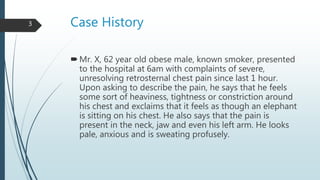
Mr. X, 62 year old obese male, known smoker, presented
to the hospital at 6am with complaints of severe,
unresolving retrosternal chest pain since last 1 hour.
Upon asking to describe the pain, he says that he feels
some sort of heaviness, tightness or constriction around
his chest and exclaims that it feels as though an elephant
is sitting on his chest. He also says that the pain is
present in the neck, jaw and even his left arm. He looks
pale, anxious and is sweating profusely.
3
Classification
and
Definitions
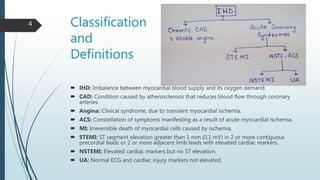
 IHD: Imbalance between myocardial blood supply and its oxygen demand.
 CAD: Condition caused by atherosclerosis that reduces blood flow through coronary
arteries.
 Angina: Clinical syndrome, due to transient myocardial ischemia.
 ACS: Constellation of symptoms manifesting as a result of acute myocardial ischemia.
 MI: Irreversible death of myocardial cells caused by ischemia.
 STEMI: ST segment elevation greater than 1 mm (0.1 mV) in 2 or more contiguous
precordial leads or 2 or more adjacent limb leads with elevated cardiac markers.
 NSTEMI: Elevated cardiac markers but no ST elevation.
 UA: Normal ECG and cardiac injury markers not elevated.
4
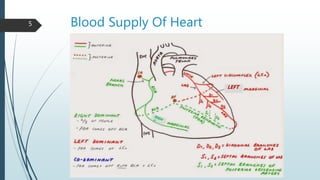
Blood Supply Of Heart5
LEFT
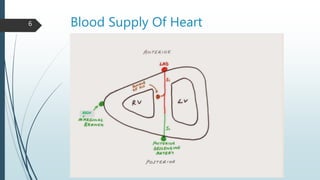
Blood Supply Of Heart6
RIGH
T
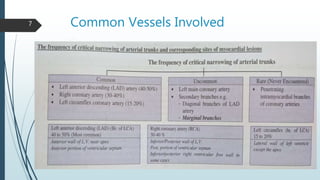
Common Vessels Involved7
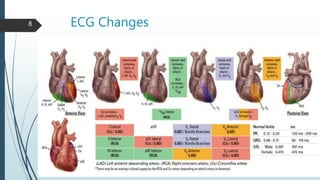
ECG Changes8
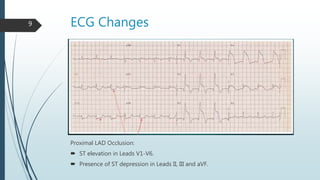
ECG Changes9
Proximal LAD Occlusion:
 ST elevation in Leads V1-V6.
 Presence of ST depression in Leads II, III and aVF.
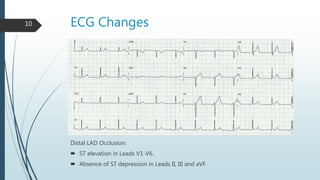
ECG Changes10
Distal LAD Occlusion:
 ST elevation in Leads V1-V6.
 Absence of ST depression in Leads II, III and aVF.
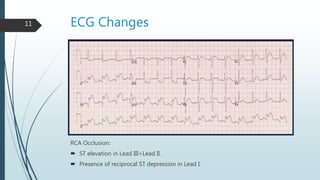
ECG Changes11
RCA Occlusion:
 ST elevation in Lead III>Lead II.
 Presence of reciprocal ST depression in Lead I.
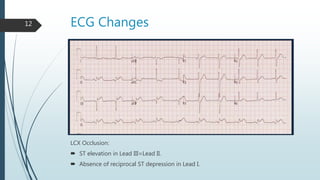
ECG Changes12
LCX Occlusion:
 ST elevation in Lead III=Lead II.
 Absence of reciprocal ST depression in Lead I.
Guidelines
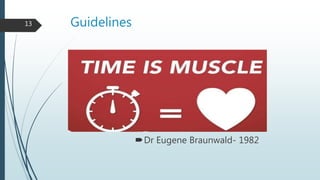
Dr Eugene Braunwald- 1982
13
Guidelines
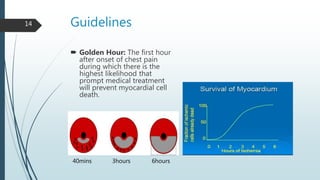
 Golden Hour: The first hour
after onset of chest pain
during which there is the
highest likelihood that
prompt medical treatment
will prevent myocardial cell
death.
14
6hours40mins 3hours
Guidelines-ACC/AHA 201715
90
30
Door-To-Needle-Time
Guidelines-ACC/AHA 2017
 In general, PCI is the treatment of choice, provided it can be performed
promptly by a qualified interventional cardiologist in an appropriate facility.
 In general, the maximum acceptable delay from presentation to balloon
inflation is:
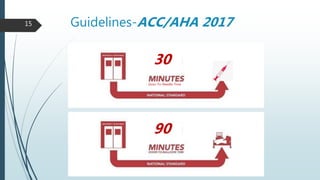
1. 90 minutes if a patient presents to a PCI-enabled hospital (door-to-balloon time).
2. 120 minutes if a patient is referred from another hospital (first medical contact to
balloon time) with door-in door-out time in the first hospital <30 minutes.
 Fibrinolysis should be considered early when anticipated first medical contact
(FMC)-to-device time at a PCI-capable hospital exceeds 120 minutes because
of unavoidable delays. It should be performed within 30 minutes of arrival
(door-to-needle time).
 Re-perfusion is not routinely recommended in patients who present more than
12 hours after symptom of onset.
 Beyond 12 hours, PCI may be of benefit in patients who continue to be
symptomatic or develop cardiogenic shock or heart failure.
16
Bibliography
Harrison’s Principles Of Internal Medicine, 19th
Edition.
ACC/AHA Guidelines, 2017.
Mudit Khanna, Self Assessment and Review, 11th
Edition.
17
Thank You
18

Myocardial infarction

  • 1.
    Myocardial Infarction Dr AnanthaChaitanya J Intern BGS GIMS 1
  • 2.
    Overview 1. Case History. 2.Classification and Definitions. 3. Blood Supply Of Heart. 4. Common Vessels Involved. 5. ECG Changes. 6. Guidelines. 2
  • 3.
    Case History Mr. X,62 year old obese male, known smoker, presented to the hospital at 6am with complaints of severe, unresolving retrosternal chest pain since last 1 hour. Upon asking to describe the pain, he says that he feels some sort of heaviness, tightness or constriction around his chest and exclaims that it feels as though an elephant is sitting on his chest. He also says that the pain is present in the neck, jaw and even his left arm. He looks pale, anxious and is sweating profusely. 3
  • 4.
    Classification and Definitions  IHD: Imbalancebetween myocardial blood supply and its oxygen demand.  CAD: Condition caused by atherosclerosis that reduces blood flow through coronary arteries.  Angina: Clinical syndrome, due to transient myocardial ischemia.  ACS: Constellation of symptoms manifesting as a result of acute myocardial ischemia.  MI: Irreversible death of myocardial cells caused by ischemia.  STEMI: ST segment elevation greater than 1 mm (0.1 mV) in 2 or more contiguous precordial leads or 2 or more adjacent limb leads with elevated cardiac markers.  NSTEMI: Elevated cardiac markers but no ST elevation.  UA: Normal ECG and cardiac injury markers not elevated. 4
  • 5.
    Blood Supply OfHeart5 LEFT
  • 6.
    Blood Supply OfHeart6 RIGH T
  • 7.
  • 8.
  • 9.
    ECG Changes9 Proximal LADOcclusion:  ST elevation in Leads V1-V6.  Presence of ST depression in Leads II, III and aVF.
  • 10.
    ECG Changes10 Distal LADOcclusion:  ST elevation in Leads V1-V6.  Absence of ST depression in Leads II, III and aVF.
  • 11.
    ECG Changes11 RCA Occlusion: ST elevation in Lead III>Lead II.  Presence of reciprocal ST depression in Lead I.
  • 12.
    ECG Changes12 LCX Occlusion: ST elevation in Lead III=Lead II.  Absence of reciprocal ST depression in Lead I.
  • 13.
  • 14.
    Guidelines  Golden Hour:The first hour after onset of chest pain during which there is the highest likelihood that prompt medical treatment will prevent myocardial cell death. 14 6hours40mins 3hours
  • 15.
  • 16.
    Guidelines-ACC/AHA 2017  Ingeneral, PCI is the treatment of choice, provided it can be performed promptly by a qualified interventional cardiologist in an appropriate facility.  In general, the maximum acceptable delay from presentation to balloon inflation is: 1. 90 minutes if a patient presents to a PCI-enabled hospital (door-to-balloon time). 2. 120 minutes if a patient is referred from another hospital (first medical contact to balloon time) with door-in door-out time in the first hospital <30 minutes.  Fibrinolysis should be considered early when anticipated first medical contact (FMC)-to-device time at a PCI-capable hospital exceeds 120 minutes because of unavoidable delays. It should be performed within 30 minutes of arrival (door-to-needle time).  Re-perfusion is not routinely recommended in patients who present more than 12 hours after symptom of onset.  Beyond 12 hours, PCI may be of benefit in patients who continue to be symptomatic or develop cardiogenic shock or heart failure. 16
  • 17.
    Bibliography Harrison’s Principles OfInternal Medicine, 19th Edition. ACC/AHA Guidelines, 2017. Mudit Khanna, Self Assessment and Review, 11th Edition. 17
  • 18.