International Journal of Trend in Scientific Research and Development (IJTSRD)
Volume: 3 | Issue: 4 | May-Jun 2019 Available Online: www.ijtsrd.com e-ISSN: 2456 - 6470
@ IJTSRD | Unique Paper ID - IJTSRD24012 | Volume – 3 | Issue – 4 | May-Jun 2019 Page: 1144
Myanmar Named Entity Recognition
with Hidden Markov Model
Khin Khin Lay1, Aung Cho2
1Associate Professor, 2Lecturer
1Faculty of Computer Science, 2
Application Department,
1,2University of Computer Studies, Maubin, Myanmar
How to cite this paper: Khin Khin Lay |
Aung Cho "Myanmar Named Entity
Recognition with Hidden Markov
Model" Published in International
Journal of Trend in Scientific Research
and Development
(ijtsrd), ISSN: 2456-
6470, Volume-3 |
Issue-4, June 2019,
pp.1144-1147, URL:
https://www.ijtsrd.c
om/papers/ijtsrd24
012.pdf
Copyright © 2019 by author(s) and
International Journal of Trend in
Scientific Research and Development
Journal. This is an Open Access article
distributed under
the terms of the
Creative Commons
Attribution License (CC BY 4.0)
(http://creativecommons.org/licenses/
by/4.0)
ABSTRACT
Named Entity Recognition is the process to detect Named Entities(NEs)in afile,
document or from a corpus and to categorize them into certain Named entity
classes like name of city, State, Country, organization, person, location, sport,
river, quantity etc. This paper introduces the Named Entities Recognition(NER)
for Myanmar language using Hidden Markov Model (HMM).The main idea
behind the use of HMM language independent and we can apply this system for
any language domain. The corpus used by our NER system is also not domain
specific.
Keywords: Named Entity Recognition (NER), Natural Language processing(NLP),
Hidden Markov Model (HMM)
I. INTRODUCTION
Named Entity Recognition is a subtask of Information extraction whose aim is to
classify text from a document or corpus into some predefined categories like
person name(PER), location name(LOC), organization name(ORG), month, date,
time etc. And other to the text which is not named entities. NER has many
applications in NLP. Some of the applications include machine translation, more
accurate internet search engines, automatic indexing of documents, automatic
question answering, information retrieval etc. An accurate NERsystemisneeded
for these applications. Most NER systems use a rule based approach or statistical
machine learning approach or a Combination of these.
A Rule-based NER system uses hand-written rules frame by
linguist which are certain language dependent rules that
help in the identification of Named Entities in a document.
Rule based systems are usually best performing system but
suffers some limitation such as languagedependent, difficult
to adapt changes.
II. RELATED WORK
There are a variety of techniques for NER. NER is classified
two approaches:
A. Linguistic approach
The linguistic approach is the classical approach written by
linguists to NER. It typically uses rules manually written by
linguists. Though it requires a lot ofwork bydomainexperts,
a NER system based on manual rules may provide very high
accuracy. Rule based systems are lexicalized grammar,
gazetteer lists, and list of trigger words. The main
disadvantages of these rule based techniques are: they
require huge experience and grammatical knowledgeonthe
particular language or domain; the developmentisgenerally
time-consuming and sometimes changes in the system may
be hard to accommodate.
B. Machine learning based approach
The recent Machine learning (ML) techniques make use of a
large amount of annotated data to acquire high level
language knowledge. ML based techniques facilitate the
development of recognizers in a short time. Several ML
techniques have been successfully used for the NER task.
HMM is a ML. Other ML approaches like Support Vector
Machine (SVM), Condition Random Field (CRF), Maximum
Entropy Markov Model (MEMM) are also used in developing
NER systems.
III. OUR PROPOSED METHOD
A. HMM based NER
We are using Hidden Markov Model based machine learning
approach. Named Entity RecognitioninMyanmar Languages
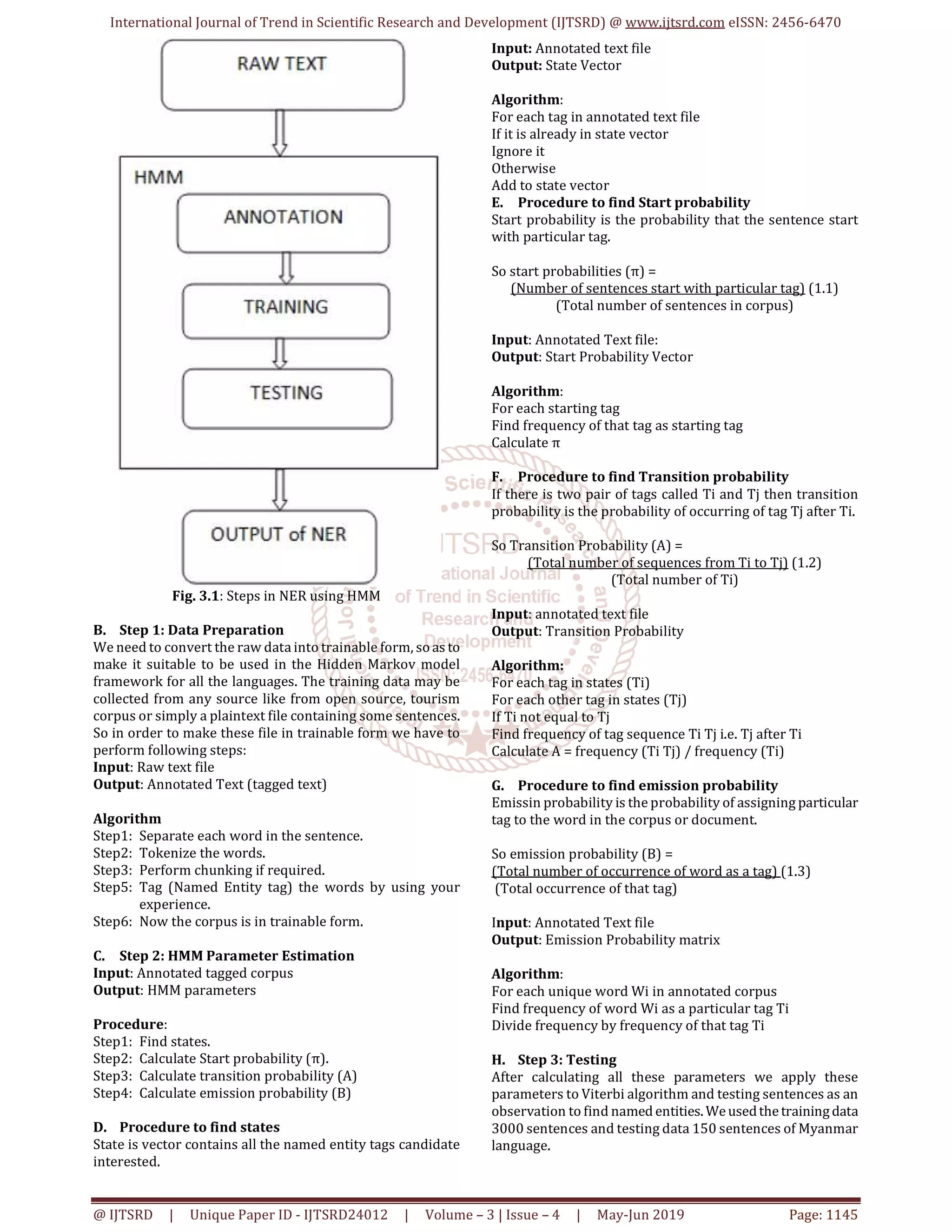
is a current topic of research. The HMM based NER system
works in three phases. The first phase is referred to as
„Annotation phase‟ that produces tagged or annotated
document from the given raw text, document or corpus. The
second phase is referred to as „Training Phase‟. In this
phase, it computes the three parameters of HMM i.e. Start
Probability, Emission Probability (B) and the Transition
Probability (A). The last phase is the „TESTING Phase‟. In
this phase, user gives certain test sentences to the system,
and based on the HMM parameters computed in the
previous state, Viterbi algorithm computes theoptimalstate
sequence for the given test sentence.
IJTSRD24012
International Journal of Trend in Scientific Research and Development (IJTSRD) @ www.ijtsrd.com eISSN: 2456-6470
@ IJTSRD | Unique Paper ID - IJTSRD24012 | Volume – 3 | Issue – 4 | May-Jun 2019 Page: 1145
Fig. 3.1: Steps in NER using HMM
B. Step 1: Data Preparation
We need to convert the raw data into trainable form, soas to
make it suitable to be used in the Hidden Markov model
framework for all the languages. The training data may be
collected from any source like from open source, tourism
corpus or simply a plaintext file containing some sentences.
So in order to make these file in trainable form we have to
perform following steps:
Input: Raw text file
Output: Annotated Text (tagged text)
Algorithm
Step1: Separate each word in the sentence.
Step2: Tokenize the words.
Step3: Perform chunking if required.
Step5: Tag (Named Entity tag) the words by using your
experience.
Step6: Now the corpus is in trainable form.
C. Step 2: HMM Parameter Estimation
Input: Annotated tagged corpus
Output: HMM parameters
Procedure:
Step1: Find states.
Step2: Calculate Start probability (π).
Step3: Calculate transition probability (A)
Step4: Calculate emission probability (B)
D. Procedure to find states
State is vector contains all the named entity tags candidate
interested.
Input: Annotated text file
Output: State Vector
Algorithm:
For each tag in annotated text file
If it is already in state vector
Ignore it
Otherwise
Add to state vector
E. Procedure to find Start probability
Start probability is the probability that the sentence start
with particular tag.
So start probabilities (π) =
(Number of sentences start with particular tag) (1.1)
(Total number of sentences in corpus)
Input: Annotated Text file:
Output: Start Probability Vector
Algorithm:
For each starting tag
Find frequency of that tag as starting tag
Calculate π
F. Procedure to find Transition probability
If there is two pair of tags called Ti and Tj then transition
probability is the probability of occurring of tag Tj after Ti.
So Transition Probability (A) =
(Total number of sequences from Ti to Tj) (1.2)
(Total number of Ti)
Input: annotated text file
Output: Transition Probability
Algorithm:
For each tag in states (Ti)
For each other tag in states (Tj)
If Ti not equal to Tj
Find frequency of tag sequence Ti Tj i.e. Tj after Ti
Calculate A = frequency (Ti Tj) / frequency (Ti)
G. Procedure to find emission probability
Emissin probability is the probability of assigning particular
tag to the word in the corpus or document.
So emission probability (B) =
(Total number of occurrence of word as a tag) (1.3)
(Total occurrence of that tag)
Input: Annotated Text file
Output: Emission Probability matrix
Algorithm:
For each unique word Wi in annotated corpus
Find frequency of word Wi as a particular tag Ti
Divide frequency by frequency of that tag Ti
H. Step 3: Testing
After calculating all these parameters we apply these
parameters to Viterbi algorithm and testing sentences as an
observation to find named entities. Weusedthetrainingdata
3000 sentences and testing data 150 sentences of Myanmar
language.
International Journal of Trend in Scientific Research and Development (IJTSRD) @ www.ijtsrd.com eISSN: 2456-6470
@ IJTSRD | Unique Paper ID - IJTSRD24012 | Volume – 3 | Issue – 4 | May-Jun 2019 Page: 1146
IV. EXAMPLE
Consider these raw text containing 5 sentences of Myanmar
language.
PER OTHER OTHER OTHER OTHER OTHER OTHER OTHER
OTHER OTHER LOC OTHER OTHER OTHER OTHER
OTHER OTHER PER OTHER OTHER OTHER OTHER OTHER
OTHER OTHER OTHER OTHER OTHER OTHER
PER OTHER LOC OTHER OTHER OTHER OTHER OTHER
OTHER OTHER OTHER OTHER LOC OTHER OTHER OTHER
OTHER OTHER OTHER
OTHER OTHER OTHER OTHER OTHER OTHER OTHER
OTHER ORG OTHER OTHER OTHER OTHER
PER OTHER OTHER OTHER OTHER OTHER OTHER OTHER
LOC OTHER ORG OTHEROTHEROTHEROTHERLOC OTHER
OTHER OTHER OTHER OTHER OTHER OTHER OTHER
OTHER OTHER OTHER
Now we calculate all the parameters of HMM model. These
are
States= { PER ,LOC, ORG, OTHER,}
Total Sentences = 5
Total words for PER = 4
Total words for LOC = 5
Total words for ORG = 2
Total words for OTHER= 77
TABLE.I START PROBABILITY(π)
PER LOC ORG OTHER
3/5 0/5 0/5 2/5
TABLE.II TRANSACTION PROBABILITY(A)
PER LOC ORG OTHER
PER 0 0 0 4/4
LOC 0 0 0 5/5
ORG 0 0 0 2/2
OTHER 1/77 5/77 2/77 69/77
Emission Probability (B) =
Since in the emission probability we have to consider all the
words in the file. But it’s not possible to display allthe words
so we just gave the snapshot of first sentence of the file.
Similarly we can find the emission probability of all the
words.
PER = 1/4
LOC = 1/5
ORG = 0/2
OTHER = 13/77
V. PERFORMANCE EVALUATION
To evaluate the algorithm throughaccuracy,precision,recall
and f-measure in table 2, there is a need to count true
positives, false positive, true negative and false negatives in
the result records [8] table1.
Precision: It is the fraction of the correct answers produced
by the algorithm to the total answer produced. The formula
for precision is:
Precision(P)
= (Corrected answers/ answers produced) (1.4)
Recall: It is the fraction of the documents that are matching
to the query mentioned and aresuccessfullyretrieved. Recall
is calculated in the following manner:
Recall (R) =
(Corrected answers/total possible answers) (1.5)
F-Measure: It is the harmonic mean of precision and recall.
The F-Measure is calculated as:
F-Measure = (2* R* P)/ (R+P) (1.6)
Precision = TP/(TP+FP);
Recall = TP/(TP+FN);
F-Measure = 2*precision*recall/ (precision+ recall);
accuracy = (TP+TN)/ total-population(N)
International Journal of Trend in Scientific Research and Development (IJTSRD) @ www.ijtsrd.com eISSN: 2456-6470
@ IJTSRD | Unique Paper ID - IJTSRD24012 | Volume – 3 | Issue – 4 | May-Jun 2019 Page: 1147
TABLE.III CONFUSION MATRIX FOR A BINARY
CLASSIFIER
TP =True Postive
TN =True Negative
FP =False Postive
FN = False Negative
TABLE.IV MEASURE ON TEST DATA
Measures Result
Accuracy 0.9523809523809523
Precision 0.9928003031451307
Recall 0.9523809523809523
F-Measure 0.9721706864564007
VI. CONCLUSION
Named Entity Recognition is a long-studied technology with
a wide range of natural language applications NER systems
have been developed for resource-rich languages like
English with very high accuracies. But construction of an
NER system for a resource-poor language like Myanmar
language is very challenging due to unavailability of proper
resources. Myanmar is no concept of capitalization which is
the indicator of proper names for some other languages like
English. If we perform Named Entity Recognition in HMM
and also provide the ways to improve the accuracy and the
performance metrics.
References
[1] A. Nayan, B. R. K. Raoand P. Singh, S. Sanyal, and R.
Sanyal. Named entity recognition for indian languages.
In IJCNLP, pages 97–104, 2008.
[2] S. K. Saha, S. Chatterji, S. Dandapat, S. Sarkar, and P.
Mitra. A hybrid approach for named entity recognition
in indian languages. In Proceedings of the IJCNLP08
Workshop on NER for South and South East Asian
Languages, pages 17–24, 2008.
[3] A. Ekbal, R. Haque, A. Das, V. Poka, and S.
Bandyopadhyay. Language independent named entity
recognition in Indian languages. In IJCNLP, pages 33–
40, 2008.
[4] Leah Larkey, Nasreen AbdulJaleel, and Margaret
Connell, What's in a Name? Proper Names in Arabic
Cross-Language Information Retrieval. CIIR Technical
Report, IR-278,2003.
[5] B. Sasidhar#1, P. M. Yohan*2, Dr. A. Vinaya Babu3, Dr.
A. Govardhan4” A Survey on Named EntityRecognition
in Indian Languages with particular reference to
Telugu” in IJCSI International Journal of Computer
Science Issues, Vol. 8, Issue 2, March 2011 availableat:
http://www.ijcsi.org/papers/IJCSI-8-2-438-443.pdf.
[6] Shilpi Srivastava, Mukund Sanglikar & D.C Kothari.
”Named Entity Recognition SystemforHindiLanguage:
A Hybrid Approach” International Journal of
Computational P(qi|qi−1P(qi|qi−1Linguistics(IJCL),
Volume(2):Issue(1):
2011.Availableat:http://cscjournals.org/csc/manuscri
pt/Journals/IJCL/volume2/Issue1/IJCL-19.pdf
[7] “Padmaja Sharma, Utpal Sharma, Jugal Kalita”Named
Entity Recognition: A Survey for the Indian
Languages”(Language in India
www.languageinindia.com 11:5 May 2011 Special
Volume: Problems of Parsing in Indian Languages.)
Available at:
[8] Simple-guide-to-confusion-matrix-terminology.pdf
https://www.dataschool.io/simple-guide-to-
confusion-matrix-terminology/

Myanmar Named Entity Recognition with Hidden Markov Model

  • 1.
    International Journal ofTrend in Scientific Research and Development (IJTSRD) Volume: 3 | Issue: 4 | May-Jun 2019 Available Online: www.ijtsrd.com e-ISSN: 2456 - 6470 @ IJTSRD | Unique Paper ID - IJTSRD24012 | Volume – 3 | Issue – 4 | May-Jun 2019 Page: 1144 Myanmar Named Entity Recognition with Hidden Markov Model Khin Khin Lay1, Aung Cho2 1Associate Professor, 2Lecturer 1Faculty of Computer Science, 2 Application Department, 1,2University of Computer Studies, Maubin, Myanmar How to cite this paper: Khin Khin Lay | Aung Cho "Myanmar Named Entity Recognition with Hidden Markov Model" Published in International Journal of Trend in Scientific Research and Development (ijtsrd), ISSN: 2456- 6470, Volume-3 | Issue-4, June 2019, pp.1144-1147, URL: https://www.ijtsrd.c om/papers/ijtsrd24 012.pdf Copyright © 2019 by author(s) and International Journal of Trend in Scientific Research and Development Journal. This is an Open Access article distributed under the terms of the Creative Commons Attribution License (CC BY 4.0) (http://creativecommons.org/licenses/ by/4.0) ABSTRACT Named Entity Recognition is the process to detect Named Entities(NEs)in afile, document or from a corpus and to categorize them into certain Named entity classes like name of city, State, Country, organization, person, location, sport, river, quantity etc. This paper introduces the Named Entities Recognition(NER) for Myanmar language using Hidden Markov Model (HMM).The main idea behind the use of HMM language independent and we can apply this system for any language domain. The corpus used by our NER system is also not domain specific. Keywords: Named Entity Recognition (NER), Natural Language processing(NLP), Hidden Markov Model (HMM) I. INTRODUCTION Named Entity Recognition is a subtask of Information extraction whose aim is to classify text from a document or corpus into some predefined categories like person name(PER), location name(LOC), organization name(ORG), month, date, time etc. And other to the text which is not named entities. NER has many applications in NLP. Some of the applications include machine translation, more accurate internet search engines, automatic indexing of documents, automatic question answering, information retrieval etc. An accurate NERsystemisneeded for these applications. Most NER systems use a rule based approach or statistical machine learning approach or a Combination of these. A Rule-based NER system uses hand-written rules frame by linguist which are certain language dependent rules that help in the identification of Named Entities in a document. Rule based systems are usually best performing system but suffers some limitation such as languagedependent, difficult to adapt changes. II. RELATED WORK There are a variety of techniques for NER. NER is classified two approaches: A. Linguistic approach The linguistic approach is the classical approach written by linguists to NER. It typically uses rules manually written by linguists. Though it requires a lot ofwork bydomainexperts, a NER system based on manual rules may provide very high accuracy. Rule based systems are lexicalized grammar, gazetteer lists, and list of trigger words. The main disadvantages of these rule based techniques are: they require huge experience and grammatical knowledgeonthe particular language or domain; the developmentisgenerally time-consuming and sometimes changes in the system may be hard to accommodate. B. Machine learning based approach The recent Machine learning (ML) techniques make use of a large amount of annotated data to acquire high level language knowledge. ML based techniques facilitate the development of recognizers in a short time. Several ML techniques have been successfully used for the NER task. HMM is a ML. Other ML approaches like Support Vector Machine (SVM), Condition Random Field (CRF), Maximum Entropy Markov Model (MEMM) are also used in developing NER systems. III. OUR PROPOSED METHOD A. HMM based NER We are using Hidden Markov Model based machine learning approach. Named Entity RecognitioninMyanmar Languages is a current topic of research. The HMM based NER system works in three phases. The first phase is referred to as „Annotation phase‟ that produces tagged or annotated document from the given raw text, document or corpus. The second phase is referred to as „Training Phase‟. In this phase, it computes the three parameters of HMM i.e. Start Probability, Emission Probability (B) and the Transition Probability (A). The last phase is the „TESTING Phase‟. In this phase, user gives certain test sentences to the system, and based on the HMM parameters computed in the previous state, Viterbi algorithm computes theoptimalstate sequence for the given test sentence. IJTSRD24012
  • 2.
    International Journal ofTrend in Scientific Research and Development (IJTSRD) @ www.ijtsrd.com eISSN: 2456-6470 @ IJTSRD | Unique Paper ID - IJTSRD24012 | Volume – 3 | Issue – 4 | May-Jun 2019 Page: 1145 Fig. 3.1: Steps in NER using HMM B. Step 1: Data Preparation We need to convert the raw data into trainable form, soas to make it suitable to be used in the Hidden Markov model framework for all the languages. The training data may be collected from any source like from open source, tourism corpus or simply a plaintext file containing some sentences. So in order to make these file in trainable form we have to perform following steps: Input: Raw text file Output: Annotated Text (tagged text) Algorithm Step1: Separate each word in the sentence. Step2: Tokenize the words. Step3: Perform chunking if required. Step5: Tag (Named Entity tag) the words by using your experience. Step6: Now the corpus is in trainable form. C. Step 2: HMM Parameter Estimation Input: Annotated tagged corpus Output: HMM parameters Procedure: Step1: Find states. Step2: Calculate Start probability (π). Step3: Calculate transition probability (A) Step4: Calculate emission probability (B) D. Procedure to find states State is vector contains all the named entity tags candidate interested. Input: Annotated text file Output: State Vector Algorithm: For each tag in annotated text file If it is already in state vector Ignore it Otherwise Add to state vector E. Procedure to find Start probability Start probability is the probability that the sentence start with particular tag. So start probabilities (π) = (Number of sentences start with particular tag) (1.1) (Total number of sentences in corpus) Input: Annotated Text file: Output: Start Probability Vector Algorithm: For each starting tag Find frequency of that tag as starting tag Calculate π F. Procedure to find Transition probability If there is two pair of tags called Ti and Tj then transition probability is the probability of occurring of tag Tj after Ti. So Transition Probability (A) = (Total number of sequences from Ti to Tj) (1.2) (Total number of Ti) Input: annotated text file Output: Transition Probability Algorithm: For each tag in states (Ti) For each other tag in states (Tj) If Ti not equal to Tj Find frequency of tag sequence Ti Tj i.e. Tj after Ti Calculate A = frequency (Ti Tj) / frequency (Ti) G. Procedure to find emission probability Emissin probability is the probability of assigning particular tag to the word in the corpus or document. So emission probability (B) = (Total number of occurrence of word as a tag) (1.3) (Total occurrence of that tag) Input: Annotated Text file Output: Emission Probability matrix Algorithm: For each unique word Wi in annotated corpus Find frequency of word Wi as a particular tag Ti Divide frequency by frequency of that tag Ti H. Step 3: Testing After calculating all these parameters we apply these parameters to Viterbi algorithm and testing sentences as an observation to find named entities. Weusedthetrainingdata 3000 sentences and testing data 150 sentences of Myanmar language.
  • 3.
    International Journal ofTrend in Scientific Research and Development (IJTSRD) @ www.ijtsrd.com eISSN: 2456-6470 @ IJTSRD | Unique Paper ID - IJTSRD24012 | Volume – 3 | Issue – 4 | May-Jun 2019 Page: 1146 IV. EXAMPLE Consider these raw text containing 5 sentences of Myanmar language. PER OTHER OTHER OTHER OTHER OTHER OTHER OTHER OTHER OTHER LOC OTHER OTHER OTHER OTHER OTHER OTHER PER OTHER OTHER OTHER OTHER OTHER OTHER OTHER OTHER OTHER OTHER OTHER PER OTHER LOC OTHER OTHER OTHER OTHER OTHER OTHER OTHER OTHER OTHER LOC OTHER OTHER OTHER OTHER OTHER OTHER OTHER OTHER OTHER OTHER OTHER OTHER OTHER OTHER ORG OTHER OTHER OTHER OTHER PER OTHER OTHER OTHER OTHER OTHER OTHER OTHER LOC OTHER ORG OTHEROTHEROTHEROTHERLOC OTHER OTHER OTHER OTHER OTHER OTHER OTHER OTHER OTHER OTHER OTHER Now we calculate all the parameters of HMM model. These are States= { PER ,LOC, ORG, OTHER,} Total Sentences = 5 Total words for PER = 4 Total words for LOC = 5 Total words for ORG = 2 Total words for OTHER= 77 TABLE.I START PROBABILITY(π) PER LOC ORG OTHER 3/5 0/5 0/5 2/5 TABLE.II TRANSACTION PROBABILITY(A) PER LOC ORG OTHER PER 0 0 0 4/4 LOC 0 0 0 5/5 ORG 0 0 0 2/2 OTHER 1/77 5/77 2/77 69/77 Emission Probability (B) = Since in the emission probability we have to consider all the words in the file. But it’s not possible to display allthe words so we just gave the snapshot of first sentence of the file. Similarly we can find the emission probability of all the words. PER = 1/4 LOC = 1/5 ORG = 0/2 OTHER = 13/77 V. PERFORMANCE EVALUATION To evaluate the algorithm throughaccuracy,precision,recall and f-measure in table 2, there is a need to count true positives, false positive, true negative and false negatives in the result records [8] table1. Precision: It is the fraction of the correct answers produced by the algorithm to the total answer produced. The formula for precision is: Precision(P) = (Corrected answers/ answers produced) (1.4) Recall: It is the fraction of the documents that are matching to the query mentioned and aresuccessfullyretrieved. Recall is calculated in the following manner: Recall (R) = (Corrected answers/total possible answers) (1.5) F-Measure: It is the harmonic mean of precision and recall. The F-Measure is calculated as: F-Measure = (2* R* P)/ (R+P) (1.6) Precision = TP/(TP+FP); Recall = TP/(TP+FN); F-Measure = 2*precision*recall/ (precision+ recall); accuracy = (TP+TN)/ total-population(N)
  • 4.
    International Journal ofTrend in Scientific Research and Development (IJTSRD) @ www.ijtsrd.com eISSN: 2456-6470 @ IJTSRD | Unique Paper ID - IJTSRD24012 | Volume – 3 | Issue – 4 | May-Jun 2019 Page: 1147 TABLE.III CONFUSION MATRIX FOR A BINARY CLASSIFIER TP =True Postive TN =True Negative FP =False Postive FN = False Negative TABLE.IV MEASURE ON TEST DATA Measures Result Accuracy 0.9523809523809523 Precision 0.9928003031451307 Recall 0.9523809523809523 F-Measure 0.9721706864564007 VI. CONCLUSION Named Entity Recognition is a long-studied technology with a wide range of natural language applications NER systems have been developed for resource-rich languages like English with very high accuracies. But construction of an NER system for a resource-poor language like Myanmar language is very challenging due to unavailability of proper resources. Myanmar is no concept of capitalization which is the indicator of proper names for some other languages like English. If we perform Named Entity Recognition in HMM and also provide the ways to improve the accuracy and the performance metrics. References [1] A. Nayan, B. R. K. Raoand P. Singh, S. Sanyal, and R. Sanyal. Named entity recognition for indian languages. In IJCNLP, pages 97–104, 2008. [2] S. K. Saha, S. Chatterji, S. Dandapat, S. Sarkar, and P. Mitra. A hybrid approach for named entity recognition in indian languages. In Proceedings of the IJCNLP08 Workshop on NER for South and South East Asian Languages, pages 17–24, 2008. [3] A. Ekbal, R. Haque, A. Das, V. Poka, and S. Bandyopadhyay. Language independent named entity recognition in Indian languages. In IJCNLP, pages 33– 40, 2008. [4] Leah Larkey, Nasreen AbdulJaleel, and Margaret Connell, What's in a Name? Proper Names in Arabic Cross-Language Information Retrieval. CIIR Technical Report, IR-278,2003. [5] B. Sasidhar#1, P. M. Yohan*2, Dr. A. Vinaya Babu3, Dr. A. Govardhan4” A Survey on Named EntityRecognition in Indian Languages with particular reference to Telugu” in IJCSI International Journal of Computer Science Issues, Vol. 8, Issue 2, March 2011 availableat: http://www.ijcsi.org/papers/IJCSI-8-2-438-443.pdf. [6] Shilpi Srivastava, Mukund Sanglikar & D.C Kothari. ”Named Entity Recognition SystemforHindiLanguage: A Hybrid Approach” International Journal of Computational P(qi|qi−1P(qi|qi−1Linguistics(IJCL), Volume(2):Issue(1): 2011.Availableat:http://cscjournals.org/csc/manuscri pt/Journals/IJCL/volume2/Issue1/IJCL-19.pdf [7] “Padmaja Sharma, Utpal Sharma, Jugal Kalita”Named Entity Recognition: A Survey for the Indian Languages”(Language in India www.languageinindia.com 11:5 May 2011 Special Volume: Problems of Parsing in Indian Languages.) Available at: [8] Simple-guide-to-confusion-matrix-terminology.pdf https://www.dataschool.io/simple-guide-to- confusion-matrix-terminology/