North Central Region
One Water Action Forum
Session: My Water - Connecting
Farmers, Communities and the
Public to Source Water Protection
December 13, 2018
Indianapolis, Indiana
Erin Meier, Director
Green Lands Blue Waters
greenlandsbluewaters.org
GREEN LANDS BLUE WATERS
 A regional collaborative
 working to improve soil & water quality
 by increasing Continuous Living Cover
 on the Upper Mississippi River Basin agricultural landscape
greenlandsbluewaters.org
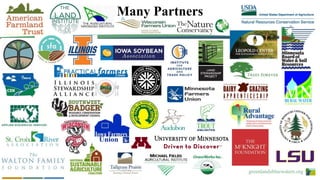
Many Partners
greenlandsbluewaters.org
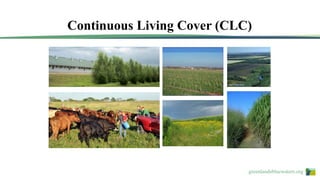
Continuous Living Cover (CLC)
greenlandsbluewaters.org
GREEN LANDS BLUE WATERS
• CLC = Combination of summer row crops, cover
crops, winter annuals & perennials to keep fields
covered & rooted in place year-round
• 5 GLBW CLC Strategies
*Agroforestry *Cover Crops *Perennial Biomass
*Perennial Forages *Perennial Grains
greenlandsbluewaters.org
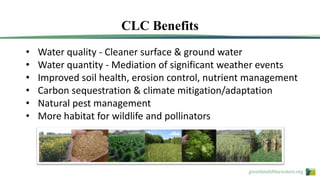
CLC Benefits
• Water quality - Cleaner surface & ground water
• Water quantity - Mediation of significant weather events
• Improved soil health, erosion control, nutrient management
• Carbon sequestration & climate mitigation/adaptation
• Natural pest management
• More habitat for wildlife and pollinators
greenlandsbluewaters.org
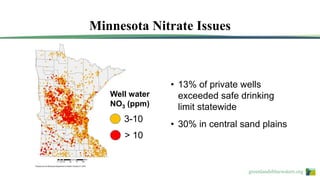
3-10
> 10
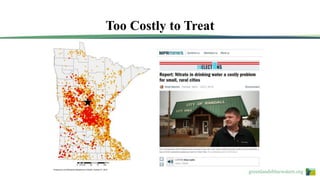
Well water
NO3 (ppm)
• 13% of private wells
exceeded safe drinking
limit statewide
• 30% in central sand plains
Minnesota Nitrate Issues
greenlandsbluewaters.org
Too Costly to Treat
greenlandsbluewaters.org
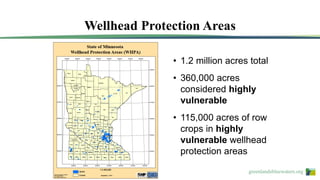
• 1.2 million acres total
• 360,000 acres
considered highly
vulnerable
• 115,000 acres of row
crops in highly
vulnerable wellhead
protection areas
Wellhead Protection Areas
greenlandsbluewaters.org
MN collaboration for source water protection
Kernza®?
greenlandsbluewaters.org
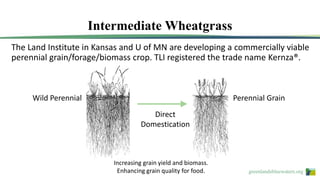
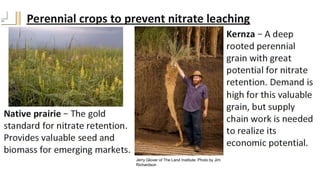
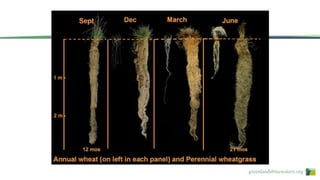
The Land Institute in Kansas and U of MN are developing a commercially viable
perennial grain/forage/biomass crop. TLI registered the trade name Kernza®.
Increasing grain yield and biomass.
Enhancing grain quality for food.
Direct
Domestication
Wild Perennial Perennial Grain
Intermediate Wheatgrass
Jerry Glover of The Land Institute: Photo by Jim
Richardson
greenlandsbluewaters.org
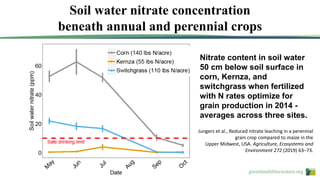
Jungers et al., Reduced nitrate leaching in a perennial
grain crop compared to maize in the
Upper Midwest, USA. Agriculture, Ecosystems and
Environment 272 (2019) 63–73.
Nitrate content in soil water
50 cm below soil surface in
corn, Kernza, and
switchgrass when fertilized
with N rates optimize for
grain production in 2014 -
averages across three sites.
Soil water nitrate concentration
beneath annual and perennial crops
greenlandsbluewaters.org
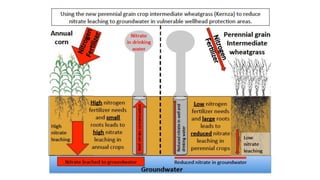
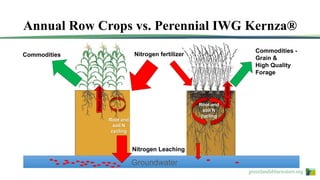
Nitrogen fertilizer
Groundwater
Nitrogen Leaching
Plantuptake
Root and
soil N
cycling
Root and
soil N
cycling
Plantuptake
Commodities
Commodities -
Grain &
High Quality
Forage
Annual Row Crops vs. Perennial IWG Kernza®
greenlandsbluewaters.org
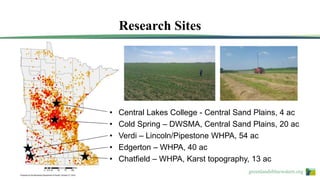
• Central Lakes College - Central Sand Plains, 4 ac
• Cold Spring – DWSMA, Central Sand Plains, 20 ac
• Verdi – Lincoln/Pipestone WHPA, 54 ac
• Edgerton – WHPA, 40 ac
• Chatfield – WHPA, Karst topography, 13 ac
Research Sites
greenlandsbluewaters.org
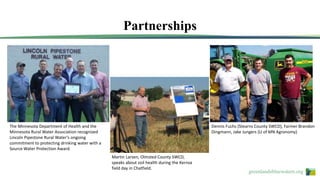
Partnerships
The Minnesota Department of Health and the
Minnesota Rural Water Association recognized
Lincoln Pipestone Rural Water’s ongoing
commitment to protecting drinking water with a
Source Water Protection Award.
Martin Larsen, Olmsted County SWCD,
speaks about soil health during the Kernza
field day in Chatfield.
Dennis Fuchs (Stearns County SWCD), Farmer Brandon
Dingmann, Jake Jungers (U of MN Agronomy)
greenlandsbluewaters.org
Team
• UMN: JACOB JUNGERS*, Craig Sheaffer, Jessica Gutknecht, Don Wyse, David Mulla
• The Land Institute: Lee DeHaan,
• Minnesota Rural Water Association: Aaron Meyer & Scott Hanson
• Minnesota Dept. of Agriculture Margaret Wagner, Bruce Montgomery, Ryan Perish
• Minnesota Department of Health: Randy Ellingboe & Mark Wettlaufer
• City of Chatfield: Brian Burkholder & Joel Young
• Lincoln Pipestone Rural Water: Jason Overby
• Central Lakes College: Keith Olander, Hannah Barrett
• Agricultural Utilization Research Institute: Rod Larkins & Goutham Vemuri
Funding
• Minnesota Legislative Trust Fund for Natural Resources
• Clean Water Fund – Forever Green Initiative
• Institute for Renewable Energy and the Environment
• The Land Institute and Malone Family Foundation
• Minnesota Department of Agriculture
Acknowledgements*
greenlandsbluewaters.org
THANK YOU
Erin Meier, Director
Green Lands Blue Waters
tegtm003@umn.edu
612-625-3709

My Water WS - Erin Meier

  • 2.
    North Central Region OneWater Action Forum Session: My Water - Connecting Farmers, Communities and the Public to Source Water Protection December 13, 2018 Indianapolis, Indiana Erin Meier, Director Green Lands Blue Waters
  • 3.
    greenlandsbluewaters.org GREEN LANDS BLUEWATERS  A regional collaborative  working to improve soil & water quality  by increasing Continuous Living Cover  on the Upper Mississippi River Basin agricultural landscape
  • 4.
  • 5.
  • 6.
    greenlandsbluewaters.org GREEN LANDS BLUEWATERS • CLC = Combination of summer row crops, cover crops, winter annuals & perennials to keep fields covered & rooted in place year-round • 5 GLBW CLC Strategies *Agroforestry *Cover Crops *Perennial Biomass *Perennial Forages *Perennial Grains
  • 7.
    greenlandsbluewaters.org CLC Benefits • Waterquality - Cleaner surface & ground water • Water quantity - Mediation of significant weather events • Improved soil health, erosion control, nutrient management • Carbon sequestration & climate mitigation/adaptation • Natural pest management • More habitat for wildlife and pollinators
  • 8.
    greenlandsbluewaters.org 3-10 > 10 Well water NO3(ppm) • 13% of private wells exceeded safe drinking limit statewide • 30% in central sand plains Minnesota Nitrate Issues
  • 9.
  • 10.
    greenlandsbluewaters.org • 1.2 millionacres total • 360,000 acres considered highly vulnerable • 115,000 acres of row crops in highly vulnerable wellhead protection areas Wellhead Protection Areas
  • 11.
    greenlandsbluewaters.org MN collaboration forsource water protection Kernza®?
  • 12.
    greenlandsbluewaters.org The Land Institutein Kansas and U of MN are developing a commercially viable perennial grain/forage/biomass crop. TLI registered the trade name Kernza®. Increasing grain yield and biomass. Enhancing grain quality for food. Direct Domestication Wild Perennial Perennial Grain Intermediate Wheatgrass
  • 13.
    Jerry Glover ofThe Land Institute: Photo by Jim Richardson
  • 14.
  • 15.
    greenlandsbluewaters.org Jungers et al.,Reduced nitrate leaching in a perennial grain crop compared to maize in the Upper Midwest, USA. Agriculture, Ecosystems and Environment 272 (2019) 63–73. Nitrate content in soil water 50 cm below soil surface in corn, Kernza, and switchgrass when fertilized with N rates optimize for grain production in 2014 - averages across three sites. Soil water nitrate concentration beneath annual and perennial crops
  • 17.
    greenlandsbluewaters.org Nitrogen fertilizer Groundwater Nitrogen Leaching Plantuptake Rootand soil N cycling Root and soil N cycling Plantuptake Commodities Commodities - Grain & High Quality Forage Annual Row Crops vs. Perennial IWG Kernza®
  • 18.
    greenlandsbluewaters.org • Central LakesCollege - Central Sand Plains, 4 ac • Cold Spring – DWSMA, Central Sand Plains, 20 ac • Verdi – Lincoln/Pipestone WHPA, 54 ac • Edgerton – WHPA, 40 ac • Chatfield – WHPA, Karst topography, 13 ac Research Sites
  • 19.
    greenlandsbluewaters.org Partnerships The Minnesota Departmentof Health and the Minnesota Rural Water Association recognized Lincoln Pipestone Rural Water’s ongoing commitment to protecting drinking water with a Source Water Protection Award. Martin Larsen, Olmsted County SWCD, speaks about soil health during the Kernza field day in Chatfield. Dennis Fuchs (Stearns County SWCD), Farmer Brandon Dingmann, Jake Jungers (U of MN Agronomy)
  • 20.
    greenlandsbluewaters.org Team • UMN: JACOBJUNGERS*, Craig Sheaffer, Jessica Gutknecht, Don Wyse, David Mulla • The Land Institute: Lee DeHaan, • Minnesota Rural Water Association: Aaron Meyer & Scott Hanson • Minnesota Dept. of Agriculture Margaret Wagner, Bruce Montgomery, Ryan Perish • Minnesota Department of Health: Randy Ellingboe & Mark Wettlaufer • City of Chatfield: Brian Burkholder & Joel Young • Lincoln Pipestone Rural Water: Jason Overby • Central Lakes College: Keith Olander, Hannah Barrett • Agricultural Utilization Research Institute: Rod Larkins & Goutham Vemuri Funding • Minnesota Legislative Trust Fund for Natural Resources • Clean Water Fund – Forever Green Initiative • Institute for Renewable Energy and the Environment • The Land Institute and Malone Family Foundation • Minnesota Department of Agriculture Acknowledgements*
  • 21.
    greenlandsbluewaters.org THANK YOU Erin Meier,Director Green Lands Blue Waters tegtm003@umn.edu 612-625-3709