
Platelet-Rich Plasma
                Alan M. Hirahara, M.D., FRCS(C)
       Board Certified in Orthopaedic Surgery & Orthopaedic Sports Medicine
                    Specializing in arthroscopic shoulder surgery


     Medical Director               Team Physician              Consultant
Sacramento State Athletics       Sacramento River Cats          Oakland A’s
                                      MiLB - AAA
BASIC SCIENCE
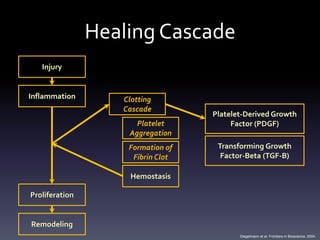
Healing Cascade
   Injury


Inflammation       Clotting
                   Cascade
                                   Platelet-Derived Growth
                      Platelet          Factor (PDGF)
                    Aggregation
                    Formation of    Transforming Growth
                     Fibrin Clot     Factor-Beta (TGF-B)

                     Hemostasis

Proliferation


Remodeling
                                          Diegelmann et al. Frontiers in Bioscience, 2004.
Clotting Cascade
• Intrinsic pathway
   – Activated by contact with exposed
      collagen or foreign surface (ie glass)


• Extrinsic pathway
   – Activated by tissue factors external
      to blood (tissue thromboplastin)

                                               Clot formation occurs in 3 – 6 minutes

• Ultimate Goal:
   – Fibrin Clot
                                                              Hoffman, Hematology: Basic Principles & Practice, 4th Ed.
                                                              Sherwood, Human Physiology, 5th Ed.
Thrombin
         Converts Fibrinogen to Fibrin


         Activates Factors V, VIII, XI, XIII


         Activates Platelets


  Thrombin
Platelet Function

• Hemostasis
   – Platelet plug
   – Blood clot
• Secretion of active proteins
   – Cellular chemotaxis, proliferation, & differentiation
   – Angiogenesis
   – Regeneration of appropriate tissue
Platelet Function
• Dose-Response relationship of [Platelets] to
   – Proliferation of human adult MSC’s
       • Mesenchymal stem cells

   – Proliferation of fibroblasts
   – Production of type I collagen


• MSC proliferation directly related to PDGF release by α
  granules from platelets
Platelet-Rich Plasma (PRP)
• Current definition:
    – Volume of the plasma fraction of autologous blood having a platelet
      concentration above baseline


                                                                        Marx et al, Implant Dent, 2001.
Consensus?
• Marx states PRP = 1,000,000 platelets/uL
• Anitua claims PRP = 300,000 platelets/uL
• Others discuss 3 – 5 fold increase [platelet] > baseline


• What level needed to improve healing?
    – Weibrich suggests that each individual requires a different platelet
      concentration ratio
    – Graziani found 2.5x to be ideal level for osteoblast & fibroblast
      proliferation. Greater levels reduced response       Marx et al, J Oral Maxillofac Surg, 2004.
                                                           Marx et al, Imp Dent, 2001.
                                                           Anitua et al, Thromb Haemost, 2004.
                                                           Marx et al, Bone Engineering, 2000.
                                                           Kevy et al, J Extra Corpor Technol, 2004.
                                                           Gonshor, Int J Periodontics Restorative Dent, 2002.
                                                           Weibrich, J Craniomaxillofac Surg, 2002.
                                                           Graziani et al, Clin Oml Impl Res, 2006
Creating PRP
•   After centrifuge, we see 3 layers:
     –   Top layer: Plasma (PPP) (spec grav = 1.03)
     –   Middle layer: Platelets (spec grav = 1.04-5)
     –   Middle layer: WBC’s (spec grav = 1.06)
     –   Bottom layer: Red blood cells (specific gravity = 1.09)


•   Variable result based on:
     –   Speed, Duration, & Technique of spin


                                                                   Welsh et al, Cosmetic Derm, 2000.
                                                                   Marx et al, Imp Dent, 2001.
Two Types of Systems
Buffy Coat Systems         Plasma Based Systems

• Biomet (GPS)             • ACP (Arthrex)

• Harvest (Symphony)       • MTF Cascade (FibriNet)

• Arteriocyte (Magellan)   • BTI (Anitua / Sanchez)

• Exactech (Accelerate)    • OrthoVita (?)
Buffy Coat Systems
•   One or two centrifugations: End product = Buffy-coat PRP layer
     –    Expensive capital & kits
     –    Ancillary staff required
     –    Anticoagulant required
     –    Long procedure time (15-30 minutes)
     –    Increased concentration platelets
     –    BUT, also increased concentration WBC’s & RBC’s


         Blood + anticoagulant                                                            PPP

                                                            Plasma

                            1st centrifugation                       2nd centrifugation
                                                                                          PRP
                                                             RBC


                                                                                          RBC
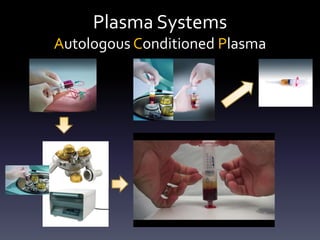
Plasma Systems
Autologous Conditioned Plasma
WHAT WE’VE LEARNED
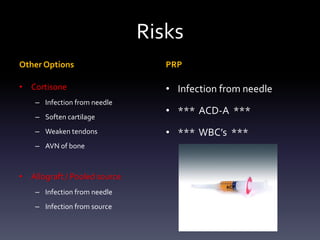
Risks
Other Options                    PRP

• Cortisone                      • Infection from needle
    – Infection from needle
                                 • *** ACD-A ***
    – Soften cartilage
    – Weaken tendons             • *** WBC’s ***
    – AVN of bone


• Allograft / Pooled source
    – Infection from needle
    – Infection from source
ACD-A
• Anticoagulant Citrate Dextrose Solution A
    – Binds free Ca++ in blood, preventing clotting cascade
    – pH = 5.0  OUCH!!!


• Indications for injections without ACD-A
    – Intra-articular injections
    – Ligament irritations or injuries
    – Any tissue that is well supplied with blood


• Draw / Spin / Inject < 20 min
ACP Concentrates GF & Platelets
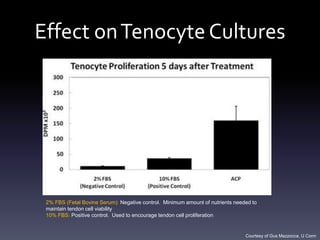
Effect on Tenocyte Cultures


 2% FBS (Fetal Bovine Serum): Negative control. Minimum amount of nutrients needed to
 maintain tendon cell viability
 10% FBS: Positive control. Used to encourage tendon cell proliferation


                                                                                Courtesy of Gus Mazzocca, U Conn
Local Anesthesics / Cortisone


   Potential Harmful effects on tenocytes & chondrocytes (Chu,C)
                                                          Courtesy of Gus Mazzocca, U Conn
Multiple Dosings


Tendon cells in vitro treated with ACP every 4 days & cell proliferation measured
Tenocyte proliferation increased with additional ACP treatments

                                                                   Courtesy of Gus Mazzocca, U Conn
Comparing the Systems


• All far better than
   positive control


• Terminal velocity?


                         Courtesy of Gus Mazzocca, U Conn
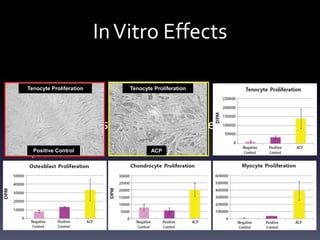
In Vitro Effects

 Tenocyte Proliferation       Tenocyte Proliferation


• Statistically significant increase in
  proliferation
   Positive Control                   ACP
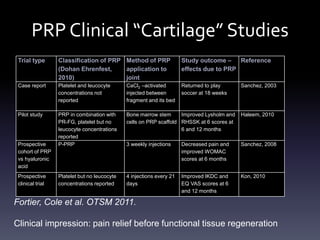
PRP Clinical “Cartilage” Studies
 Trial type       Classification of PRP Method of PRP                 Study outcome –    Reference
                  (Dohan Ehrenfest,     application to                effects due to PRP
                  2010)                 joint
 Case report      Platelet and leucocyte      CaCl2 –activated        Returned to play     Sanchez, 2003
                  concentrations not          injected between        soccer at 18 weeks
                  reported                    fragment and its bed

 Pilot study      PRP in combination with     Bone marrow stem      Improved Lysholm and   Haleem, 2010
                  PR-FG, platelet but no      cells on PRP scaffold RHSSK at 6 scores at
                  leucocyte concentrations                          6 and 12 months
                  reported
 Prospective      P-PRP                       3 weekly injections     Decreased pain and   Sanchez, 2008
 cohort of PRP                                                        improved WOMAC
 vs hyaluronic                                                        scores at 6 months
 acid
 Prospective      Platelet but no leucocyte   4 injections every 21   Improved IKDC and    Kon, 2010
 clinical trial   concentrations reported     days                    EQ VAS scores at 6
                                                                      and 12 months

Fortier, Cole et al. OTSM 2011.

Clinical impression: pain relief before functional tissue regeneration
Pain, OA, and PRP
• PRP ↑ HA synthesis in synoviocytes
  – Anitua, Rheum, 2007

• PRP ↓NFκβ, COX-2, CXCR-4
  – Bendinelli, J Cell Physiol, 2010

• PRP ↓ RA in pig model
  – Lippross Arthr and Rheum, 2011
WBC’S:
EVIL OR JUST MISUNDERSTOOD?
Controversy: White Blood Cells
          • No single cell necessary or required for healing
          • Appropriate inflammation necessary for healing as initiates the
                 healing cascade
          • Control infection
          • Aid in debridement & opens channels for influx of serum


Martin et al. Trends in Cell Biology. 2005.
Simpson et al. J Clin Invest. 1972.
Szpaderska et al. J Invest Dermatol. 2003.
Dovi et al. J Leukoc Biol. 2003.
Egozi et al. Wound Rep Regen. 2003.
Martin et al. Curr Biol. 2003.
WBC’s: Harmful to Healing
          •        The inflammatory response can cause muscle damage
                     –      Neutrophils can delay regenerative healing capacity1
                     –      Neutrophils cause cytotoxic destruction of muscle2


          •        WBCs can suppress bone formation and bone healing
                     –      Neutropenic mice—higher bending moment at fracture callus site3
                     –      Immunosuppressed rats; implanted DBM had enhanced bone formation4


          •        Concentrated WBCs may be detrimental toward wound healing
                     –      Neutropenic mice had accelerated wound closure and healing5
                     –      PU.1 null mice (lack neutrophils and macrophages) repair wounds in a scar-free manner, similar to
                            embryonic healing6
                     –      Oral mucosa wounds heal fast without scarring—have reduced influx of neutrophils and macrophages7

1.   Toumi H et al. The inflammatory response: friend or enemy for muscle injury? Br J Sports Med 2003; 37(4): 284-6.
2.   Schneider BS et al. Neutrophil infiltration in exercise-injured skeletal muscle: how do we resolve the controversy? Sports Med 2007; 37(10): 837-56.
3.   Grogaard B et al. The polymorphonuclear leukocyte: has it a role in fracture healing? Arch Orthop Trauma Surg 1990; 109(5): 268-71.
4.   Voggenreiter G et al. Immunosuppression with FK506 increases bone induction in demineralized isogenic and xenogenic bone matrix in the rat. J Bone Miner Res 2000; 15(9): 1825-34.
5.   Dovi JV et al. Accelerated wound closure in neutrophil-depleted mice. J Leukoc Biol 2003; 73(4): 449-55.
6.   Martin P et al. Wound healing in the PU.1 null mouse—tissue repair is not dependent on inflammatory cells. Curr Biol 2003; 13(13): 1122-8.
7.   Szpaderka AM. Differential injury responses in oral mucosal and cutaneous wounds. J Dent Res 2003; 82(8): 621-6.
Buffy-coat PRP

                          Mass density distribution
                          of blood components:
                             A – Platelets
Platelets   Neutrophils
                             B – Monocytes
                             C – Lymphocytes
                             D – Basophils
                             E – Neutrophils
                             F – Erythrocytes
                             G – Eosinophils
Plasma Based PRP

           Platelets              Neutrophils


              Mass density distribution of blood components:
A – Platelets     B – Monocytes       C – Lymphocytes   D – Basophils
E – Neutrophils F – Erythrocytes      G – Eosinophils
INCREASED CONCENTRATION OF
    WHITE BLOOD CELLS IN PRP
 WEAKENS ROTATOR CUFF TENDONS
  WHEN USED FOR PASTA REPAIRS

                              Alan M Hirahara, MD, FRCSC


*Submitted for Presentation
Study Design
• Case-Control study design


• 3 Groups
    – Group 1: 14 patients, PASTA repair without PRP
    – Group 2: 72 patients, PASTA repair with PRP with concentrated WBC’s
    – Group 3: 29 patients, PASTA repair with PRP with reduced WBC’s


• MRA or surgery was performed for people having persistent pain or
   complaints at four to six months post-operatively to evaluate healing
Study
• No significant difference in improvement of ASES &
  VAS scores
• Significant difference in Modes of Failure
   – Group 1: 2 (14%) fail by non-healing of primary lesion
   – Group 2: 10 (14%) fail by cut-through from sutures
      • 2 (3.5%) fail by non-healing of primary lesion
   – Group 3: 1 (3.5%) fail by different, new delamination tear
Study

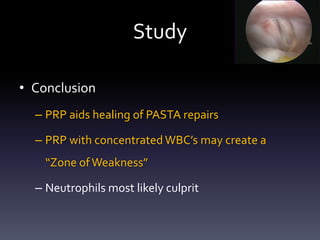
• Conclusion
  – PRP aids healing of PASTA repairs

  – PRP with concentrated WBC’s may create a
    “Zone of Weakness”

  – Neutrophils most likely culprit
NON-SURGICAL USE OF PRP /
ULTRASOUND
Ultrasound

• Inexpensive
• Portable
• Non-Invasive
• No radiation / Harmless
• Easy to use
• Visualizes pathology
• Aids in surgery or needle
  guidance
Why Are We Discussing Ultrasound?
Ultrasound – Accurate / Versatile
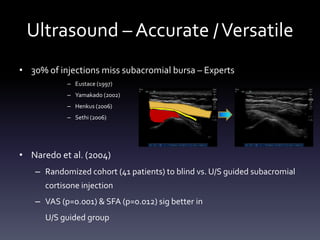
• 30% of injections miss subacromial bursa – Experts
            – Eustace (1997)
            – Yamakado (2002)
            – Henkus (2006)
            – Sethi (2006)


• Naredo et al. (2004)
   – Randomized cohort (41 patients) to blind vs. U/S guided subacromial
      cortisone injection
   – VAS (p=0.001) & SFA (p=0.012) sig better in
      U/S guided group
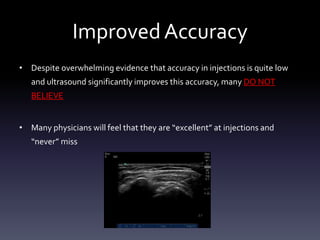
Better Accuracy
• Despite overwhelming evidence that accuracy in injections is quite low
   and ultrasound significantly improves this accuracy, many DO NOT
   BELIEVE


• Many physicians will feel that they are “excellent” at injections and
   “never” miss
My Experience
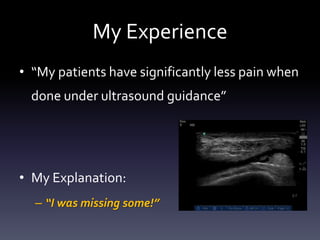
• “My patients have significantly less pain when
  done under ultrasound guidance”


• My Explanation:
  – “I was missing some!”
Ultrasound
• Already used in OB/GYN, emergency medicine
• Becoming accepted in Orthopaedic Sports Medicine
• Sidelines of sports events for immediate diagnosis
• Courses in ultrasound filling up everywhere
NBA Team Physicians
 May 2011, Chicago
Localization of Biceps/Notch
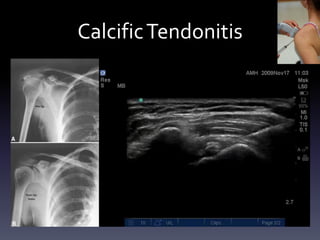
Calcific Tendonitis
Injections
What Do You Need?

• Sterile gloves / gown
   – with mask/hat

• Sterile drapes

• Sterile transducer sheath or cover

• Sterile gel

• Sterile operating room
Sterile Technique
Non-Surgical Use of ACP
 Adhesive Capsulitis                                                        70


                RCT                               26


pPatellar tendon tear                        24


               pRCT                         23


          DJD - Knee                        23


Lateral Epicondylitis                  21


      Tendonopathy                19


      DJD - Shoulder              19

                        0   10   20                30   40   50   60   70
Non-Surgical Use of ACP
                 pUCL tear                                                                          15
              Meniscus tear                                                                    14
              Ca tendonitis                                                          13
    Achilles tendonopathy                                              9
               SLAP lesion                                         8
     Quad Tendonopathy                                             8
           Plantar Fasciitis                               6
              Muscle strain                                6
            Sprained ankle                         5
Valgus Extension Overload                      4
     Pes Anserine Bursitis                     4
      Medial Epicondylitis                     4
                 Instability                   4
          Biceps tendonitis                    4
                  MCL tear         1
                               0       2   4           6       8           10   12        14             16
Platelet-Rich Plasma vs. Cortisone
  Injections for the Non-surgical
    Treatment of Shoulder Pain

        Alan M Hirahara, MD, FRCSC
          *Presented @ AANA, WOA 2011 & COA 2012

       * Accepted for Presentation @ WSTC & EFOST 2012
Study
•   Case-Control study design
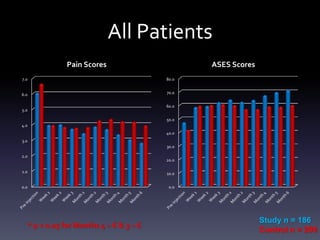
•   485 patients with injection of cortisone or PRP for shoulder pain under ultrasound
    guidance
     – 186 Study patients / 299 Control patients


•   Results
     –   Statistical significance between groups for pain (mo 4-6) & ASES scores (mo 3-6)


•   Conclusion
     – PRP is as more effective than cortisone for relief of shoulder pain but with less risk
     – But varied based on diagnosis
More Effective – Specific
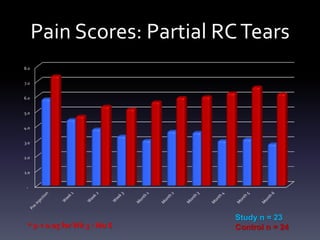
VAS – PASTA Lesions
                    Pathologiesimprovement
                          Significant

8.0

7.0

6.0                                 • Partial tears & degenerative
5.0
                                        – Tendon, ligament, muscle
4.0

3.0

2.0

1.0
                                    • Inflammatory & calcific
 -                                 Study – = 23
                                         n Tendonopathy
                                   Control n = 24


      * p < 0.05 for Wk 3 - Mo 6
Anti-Pain/Anti-Inflammatory
 VAS – RC Tear                                 No significant difference

  8.0

  7.0

  6.0                                          • Full thickness tears
  5.0
                                                   – Rotator cuff, SLAP, meniscus
  4.0

  3.0

  2.0
                                               • Joint problems
  1.0

   -                                      Study– DJD, RA, chondral lesions
                                                n = 26
                                          Control n = 48


* No statistical significance between groups
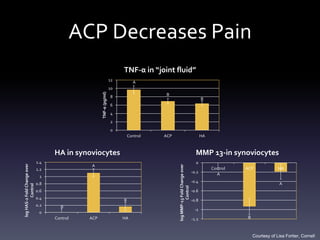
ACP Decreases Pain
                                                                        TNF-α in “joint fluid”
                                                                   12
                                                                              A
                                                                   10


                                                   TNF-α (pg/ml)
                                                                   8                   B
                                                                                                                                 B
                                                                   6
                                                                   4
                                                                   2
                                                                   0
                                                                            Control   ACP                                        HA


                                   HA in synoviocytes                                                                       MMP 13-in synoviocytes
                             1.4                                                                                            0
log HAS-2 Fold Change over


                                             A


                                                                                            log MMP-13 Fold Change over
                             1.2                                                                                                      Control   ACP               HA
                                                                                                                          -0.2          A
                              1
                                                                                                                          -0.4
                             0.8                                                                                                                                   A
         Control


                                                                                                     Control
                             0.6                                                                                          -0.6
                             0.4                                                                                          -0.8
                                                                        B
                             0.2      B
                                                                                                                            -1
                              0
                                   Control   ACP                        HA                                                -1.2                   B


                                                                                                                                                     Courtesy of Lisa Fortier, Cornell
All Patients
              Pain Scores                      ASES Scores
7.0                                     80.0


6.0                                     70.0


                                        60.0
5.0

                                        50.0
4.0
                                        40.0
3.0
                                        30.0

2.0
                                        20.0

1.0                                     10.0


0.0                                      0.0


                                                             Study n = 186
  * p < 0.05 for Months 4 – 6 & 3 – 6
                                                             Control n = 299
Subacromial Injection
Bursitis – Subacromial Injection
Subacromial Injection – Arm Neutral
Pain Scores: Tendonopathy
  8.0


   7.0


  6.0


   5.0


  4.0


   3.0


  2.0


   1.0


    -


                                               Study n = 19
* No statistical significance between groups   Control n = 68
Partial-thickness RC Tears
Pain Scores: Partial RC Tears
8.0


7.0


6.0


5.0


4.0


3.0


2.0


1.0


 -


                              Study n = 23
 * p < 0.05 for Wk 3 - Mo 6   Control n = 24
Massive RCT – Injection
Pain Scores: Full RC Tears
  8.0


   7.0


  6.0


   5.0


  4.0


   3.0


  2.0


   1.0


    -


                                               Study n = 26
* No statistical significance between groups   Control n = 48
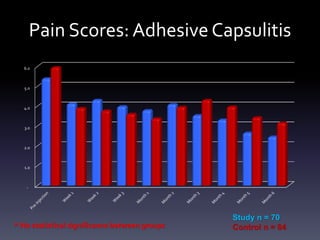
Pain Scores: Adhesive Capsulitis
  6.0


   5.0


   4.0


   3.0


   2.0


   1.0


    -


                                               Study n = 70
* No statistical significance between groups   Control n = 84
Shoulder Joint Injection
Pain Scores: Shoulder DJD
   7.0


  6.0


   5.0


   4.0


   3.0


   2.0


   1.0


    -


                                               Study n = 19
* No statistical significance between groups   Control n = 39
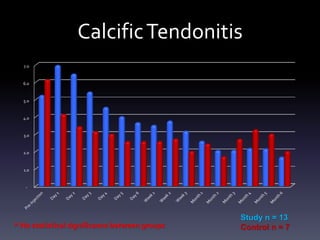
Calcific Tendonitis
Calcific Tendonitis
  7.0


  6.0


  5.0


  4.0


  3.0


  2.0


  1.0


   -


                                               Study n = 13
* No statistical significance between groups   Control n = 7
Knee Suprapatellar Injection
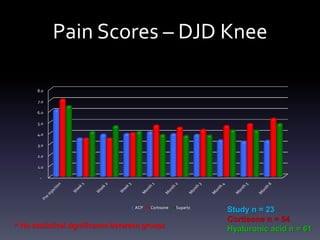
Pain Scores – DJD Knee

      8.0

       7.0

      6.0

      5.0

      4.0

      3.0

      2.0

      1.0

        -


                                   ACP   Cortisone   Supartz
                                                               Study n = 23
                                                               Cortisone n = 54
* No statistical significance between groups                   Hyaluronic acid n = 61
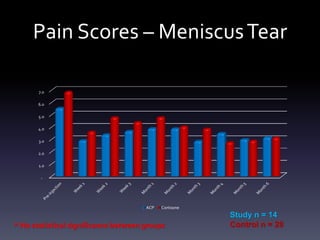
Pain Scores – Meniscus Tear

       7.0

       6.0

       5.0

       4.0

       3.0

       2.0

       1.0

        -


                                      ACP   Cortisone
                                                        Study n = 14
* No statistical significance between groups            Control n = 28
Partial Patellar Tendon Tear
     Treated with ACP

             ACP


                      3 Months
Pain Scores –
     Partial Patellar Tendon Tears
7.0          6.1
       5.9
6.0

5.0
                   3.6
4.0
                         2.9                                             3.2               3.3   3.3
                                                                               3.0   3.0
3.0                                                    2.7   2.6
                               2.3                                 2.4
                                     1.9         2.0
                                           1.7
2.0

1.0

 -


                                                                                           n = 12
Lateral Epicondyle Injection
Pain Scores – Lateral Epicondylitis

  7.0         6.3   6.2
        6.1               6.0

  6.0
                                5.1
                                                        4.9
                                                  4.7
  5.0                                 4.4
                                            4.2               4.2
                                                                    3.8
  4.0
                                                                          3.2   3.0
  3.0                                                                                 2.4
                                                                                            1.9
  2.0                                                                                             1.4

  1.0

   -


                                                                                            n = 21
Proximal pUCL Tear – PRP
        Injection
Pain Scores – pUCL Tears

       6.5
7.0

6.0          5.3

5.0
                   4.4

                         3.5
4.0
                               3.0
3.0                                  2.5
                                           2.1
                                                 1.7
2.0
                                                       1.0   0.8   0.8   1.0   1.0   1.0
1.0
                                                                                           0.7   0.7

 -


                                                                                           n = 15
Plantar Fasciitis
Transverse / In-Plane
Pain Scores – Plantar Fasciitis

       6.4
 7.0

 6.0
             4.7
 5.0
                   4.0

 4.0                     3.3


 3.0
                               2.0   2.0
                                           1.7   1.7
 2.0                                                   1.3   1.3
                                                                   1.0
 1.0                                                                     0.3   0.3
                                                                                     -   -   -
  -


                                                                                         n=6
ORTHOBIOLOGICS IN
ARTHROSCOPIC SURGERY
Surgical Use of PRP
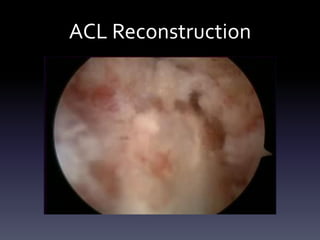
Shoulder Arthroscopy   Knee Arthroscopy


• SLAP lesions         • ACL reconstructions

• RC repairs           • Meniscal repairs
• Stabilizations       • Menisectomy

                       • Chondroplasty
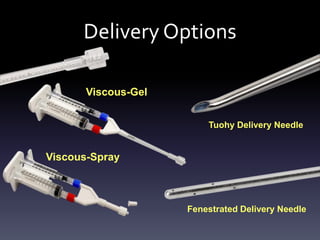
Delivery Options

       Viscous-Gel


                         Tuohy Delivery Needle


Viscous-Spray


                     Fenestrated Delivery Needle
Summary of Literature
• RC Repairs
    – 5 – 10% failure (worse with increasing size)
                                                                   Burkhart, Arthroscopy, 2001; 17:905-912.
                                                                   Gartsman, JBJS Am, 1998; 80:832-840.
                                                                   Yamaguchi et al, ICL Shoulder & Elbow, 2005.


• Instability Repairs
    – Anterior: 10%, but have ranged from 0 – 33%
    – Posterior: 50% failure (open) & 25% (arthroscopic)
    – MDI: 2 – 5%, but up to 25%                             Cole et al. ICL Sports Medicine, 2005.
                                                             Metcalf et al. ICL Shoulder & Elbow, 2005.
                                                             Gartsman et al. Arthroscopy. 2001; 17:236-243.
                                                             Wolf et al. J Southern Orthop Assoc. 2002; 11:102-9.
                                                             Fischer. Sports Med Arthrosc Rev. 2004; 12:127-134.


• SLAP Repairs
    – 85% excellent & good results but little data on non-healing. One study shows
       20% failure
                                                                    Morgan et al, Arthroscopy, 1998, 14:553-565.
                                                                    Snyder et al, AJSM, 2003, 31(5): 798-810.
RC Repair
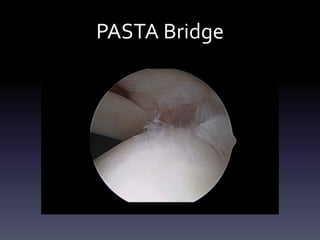
PASTA Bridge
ACL Reconstruction
Menisectomy
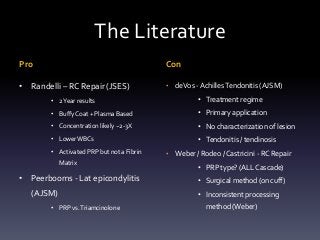
The Literature
Pro                                        Con

• Randelli – RC Repair (JSES)              • deVos - Achilles Tendonitis (AJSM)

        • 2 Year results                             • Treatment regime
        • Buffy Coat + Plasma Based                  • Primary application
        • Concentration likely ~2-3X                 • No characterization of lesion
        • Lower WBCs                                 • Tendonitis / tendinosis
        • Activated PRP but not a Fibrin   • Weber / Rodeo / Castricini - RC Repair
            Matrix
                                                     • PRP type? (ALL Cascade)
• Peerbooms - Lat epicondylitis                      • Surgical method (on cuff)
   (AJSM)                                            • Inconsistent processing
        • PRP vs. Triamcinolone                        method (Weber)
Enhancing SLAP repairs with
        Fibrin-PRP Clots
                             Alan M Hirahara, MD, FRCSC
                                   Kyle Yamashiro, PT
                                  Russ Dunning, MSPT


*Presented @ AANA, COA, AOSSM, WOA 2009
SLAP Repair
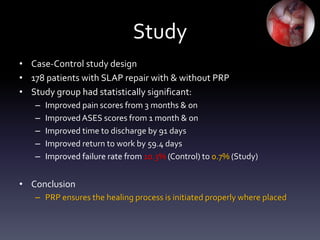
Study
• Case-Control study design
• 178 patients with SLAP repair with & without PRP
• Study group had statistically significant:
   –   Improved pain scores from 3 months & on
   –   Improved ASES scores from 1 month & on
   –   Improved time to discharge by 91 days
   –   Improved return to work by 59.4 days
   –   Improved failure rate from 10.3% (Control) to 0.7% (Study)


• Conclusion
   – PRP ensures the healing process is initiated properly where placed
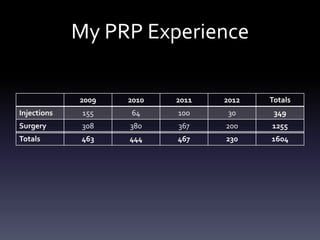
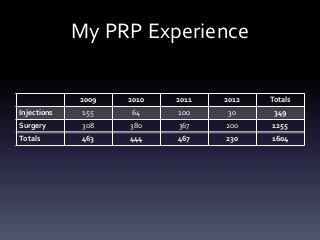
My PRP Experience

             2009   2010   2011   2012   Totals
Injections    155   64     100     30     349
Surgery       308   380    367    200    1255
Totals        463   444    467    230    1604
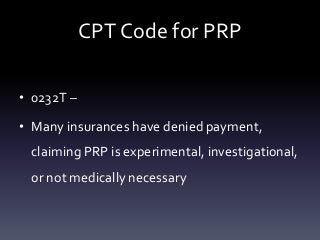
CPT Code for PRP

• 0232T –

• Many insurances have denied payment,
 claiming PRP is experimental, investigational,
 or not medically necessary
PRP for ALL

• As the data continues to stockpile about its
  efficacy, it is inappropriate to deny patients a
  potential treatment option over surgery

• Patients can legally opt-out of their insurance
  and pay cash for the treatment
0232T - Medicare

• Considered a Non-Covered Benefit by
  Medicare

• Able to bill patient if prior informed consent
  to pay for non-covered benefit
  – ABN Form from Medicare website required
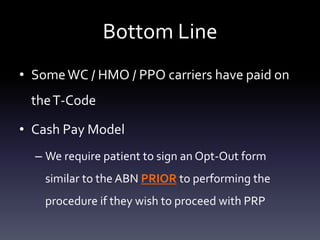
Bottom Line
• Some WC / HMO / PPO carriers have paid on
 the T-Code

• Cash Pay Model
  – Patients sign an Opt-Out form with informed
    consent similar to the ABN PRIOR to performing
    the procedure if they wish to proceed with PRP
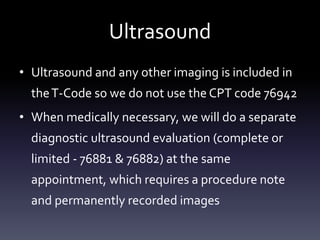
Ultrasound
• Ultrasound and any other imaging is included in the T-
  Code so we do not use the CPT code 76942
• When medically necessary, we will do a separate
  diagnostic ultrasound evaluation (complete or limited
  - 76881 & 76882) at the same appointment, which
  requires a separate procedure note and permanently
  recorded images
Thank You!

Platelet-Rich Plasma

  • 1.
    Platelet-Rich Plasma Alan M. Hirahara, M.D., FRCS(C) Board Certified in Orthopaedic Surgery & Orthopaedic Sports Medicine Specializing in arthroscopic shoulder surgery Medical Director Team Physician Consultant Sacramento State Athletics Sacramento River Cats Oakland A’s MiLB - AAA
  • 2.
  • 3.
    Healing Cascade Injury Inflammation Clotting Cascade Platelet-Derived Growth Platelet Factor (PDGF) Aggregation Formation of Transforming Growth Fibrin Clot Factor-Beta (TGF-B) Hemostasis Proliferation Remodeling Diegelmann et al. Frontiers in Bioscience, 2004.
  • 4.
    Clotting Cascade • Intrinsicpathway – Activated by contact with exposed collagen or foreign surface (ie glass) • Extrinsic pathway – Activated by tissue factors external to blood (tissue thromboplastin) Clot formation occurs in 3 – 6 minutes • Ultimate Goal: – Fibrin Clot Hoffman, Hematology: Basic Principles & Practice, 4th Ed. Sherwood, Human Physiology, 5th Ed.
  • 5.
    Thrombin  Converts Fibrinogen to Fibrin  Activates Factors V, VIII, XI, XIII  Activates Platelets Thrombin
  • 6.
    Platelet Function • Hemostasis – Platelet plug – Blood clot • Secretion of active proteins – Cellular chemotaxis, proliferation, & differentiation – Angiogenesis – Regeneration of appropriate tissue
  • 7.
    Platelet Function • Dose-Responserelationship of [Platelets] to – Proliferation of human adult MSC’s • Mesenchymal stem cells – Proliferation of fibroblasts – Production of type I collagen • MSC proliferation directly related to PDGF release by α granules from platelets
  • 8.
    Platelet-Rich Plasma (PRP) •Current definition: – Volume of the plasma fraction of autologous blood having a platelet concentration above baseline Marx et al, Implant Dent, 2001.
  • 9.
    Consensus? • Marx statesPRP = 1,000,000 platelets/uL • Anitua claims PRP = 300,000 platelets/uL • Others discuss 3 – 5 fold increase [platelet] > baseline • What level needed to improve healing? – Weibrich suggests that each individual requires a different platelet concentration ratio – Graziani found 2.5x to be ideal level for osteoblast & fibroblast proliferation. Greater levels reduced response Marx et al, J Oral Maxillofac Surg, 2004. Marx et al, Imp Dent, 2001. Anitua et al, Thromb Haemost, 2004. Marx et al, Bone Engineering, 2000. Kevy et al, J Extra Corpor Technol, 2004. Gonshor, Int J Periodontics Restorative Dent, 2002. Weibrich, J Craniomaxillofac Surg, 2002. Graziani et al, Clin Oml Impl Res, 2006
  • 10.
    Creating PRP • After centrifuge, we see 3 layers: – Top layer: Plasma (PPP) (spec grav = 1.03) – Middle layer: Platelets (spec grav = 1.04-5) – Middle layer: WBC’s (spec grav = 1.06) – Bottom layer: Red blood cells (specific gravity = 1.09) • Variable result based on: – Speed, Duration, & Technique of spin Welsh et al, Cosmetic Derm, 2000. Marx et al, Imp Dent, 2001.
  • 11.
    Two Types ofSystems Buffy Coat Systems Plasma Based Systems • Biomet (GPS) • ACP (Arthrex) • Harvest (Symphony) • MTF Cascade (FibriNet) • Arteriocyte (Magellan) • BTI (Anitua / Sanchez) • Exactech (Accelerate) • OrthoVita (?)
  • 12.
    Buffy Coat Systems • One or two centrifugations: End product = Buffy-coat PRP layer – Expensive capital & kits – Ancillary staff required – Anticoagulant required – Long procedure time (15-30 minutes) – Increased concentration platelets – BUT, also increased concentration WBC’s & RBC’s Blood + anticoagulant PPP Plasma 1st centrifugation 2nd centrifugation PRP RBC RBC
  • 13.
  • 14.
  • 15.
    Risks Other Options PRP • Cortisone • Infection from needle – Infection from needle • *** ACD-A *** – Soften cartilage – Weaken tendons • *** WBC’s *** – AVN of bone • Allograft / Pooled source – Infection from needle – Infection from source
  • 16.
    ACD-A • Anticoagulant CitrateDextrose Solution A – Binds free Ca++ in blood, preventing clotting cascade – pH = 5.0  OUCH!!! • Indications for injections without ACD-A – Intra-articular injections – Ligament irritations or injuries – Any tissue that is well supplied with blood • Draw / Spin / Inject < 20 min
  • 17.
  • 18.
    Effect on TenocyteCultures 2% FBS (Fetal Bovine Serum): Negative control. Minimum amount of nutrients needed to maintain tendon cell viability 10% FBS: Positive control. Used to encourage tendon cell proliferation Courtesy of Gus Mazzocca, U Conn
  • 19.
    Local Anesthesics /Cortisone Potential Harmful effects on tenocytes & chondrocytes (Chu,C) Courtesy of Gus Mazzocca, U Conn
  • 20.
    Multiple Dosings Tendon cellsin vitro treated with ACP every 4 days & cell proliferation measured Tenocyte proliferation increased with additional ACP treatments Courtesy of Gus Mazzocca, U Conn
  • 21.
    Comparing the Systems •All far better than positive control • Terminal velocity? Courtesy of Gus Mazzocca, U Conn
  • 22.
    In Vitro Effects Tenocyte Proliferation Tenocyte Proliferation • Statistically significant increase in proliferation Positive Control ACP
  • 23.
    PRP Clinical “Cartilage”Studies Trial type Classification of PRP Method of PRP Study outcome – Reference (Dohan Ehrenfest, application to effects due to PRP 2010) joint Case report Platelet and leucocyte CaCl2 –activated Returned to play Sanchez, 2003 concentrations not injected between soccer at 18 weeks reported fragment and its bed Pilot study PRP in combination with Bone marrow stem Improved Lysholm and Haleem, 2010 PR-FG, platelet but no cells on PRP scaffold RHSSK at 6 scores at leucocyte concentrations 6 and 12 months reported Prospective P-PRP 3 weekly injections Decreased pain and Sanchez, 2008 cohort of PRP improved WOMAC vs hyaluronic scores at 6 months acid Prospective Platelet but no leucocyte 4 injections every 21 Improved IKDC and Kon, 2010 clinical trial concentrations reported days EQ VAS scores at 6 and 12 months Fortier, Cole et al. OTSM 2011. Clinical impression: pain relief before functional tissue regeneration
  • 24.
    Pain, OA, andPRP • PRP ↑ HA synthesis in synoviocytes – Anitua, Rheum, 2007 • PRP ↓NFκβ, COX-2, CXCR-4 – Bendinelli, J Cell Physiol, 2010 • PRP ↓ RA in pig model – Lippross Arthr and Rheum, 2011
  • 25.
    WBC’S: EVIL OR JUSTMISUNDERSTOOD?
  • 26.
    Controversy: White BloodCells • No single cell necessary or required for healing • Appropriate inflammation necessary for healing as initiates the healing cascade • Control infection • Aid in debridement & opens channels for influx of serum Martin et al. Trends in Cell Biology. 2005. Simpson et al. J Clin Invest. 1972. Szpaderska et al. J Invest Dermatol. 2003. Dovi et al. J Leukoc Biol. 2003. Egozi et al. Wound Rep Regen. 2003. Martin et al. Curr Biol. 2003.
  • 27.
    WBC’s: Harmful toHealing • The inflammatory response can cause muscle damage – Neutrophils can delay regenerative healing capacity1 – Neutrophils cause cytotoxic destruction of muscle2 • WBCs can suppress bone formation and bone healing – Neutropenic mice—higher bending moment at fracture callus site3 – Immunosuppressed rats; implanted DBM had enhanced bone formation4 • Concentrated WBCs may be detrimental toward wound healing – Neutropenic mice had accelerated wound closure and healing5 – PU.1 null mice (lack neutrophils and macrophages) repair wounds in a scar-free manner, similar to embryonic healing6 – Oral mucosa wounds heal fast without scarring—have reduced influx of neutrophils and macrophages7 1. Toumi H et al. The inflammatory response: friend or enemy for muscle injury? Br J Sports Med 2003; 37(4): 284-6. 2. Schneider BS et al. Neutrophil infiltration in exercise-injured skeletal muscle: how do we resolve the controversy? Sports Med 2007; 37(10): 837-56. 3. Grogaard B et al. The polymorphonuclear leukocyte: has it a role in fracture healing? Arch Orthop Trauma Surg 1990; 109(5): 268-71. 4. Voggenreiter G et al. Immunosuppression with FK506 increases bone induction in demineralized isogenic and xenogenic bone matrix in the rat. J Bone Miner Res 2000; 15(9): 1825-34. 5. Dovi JV et al. Accelerated wound closure in neutrophil-depleted mice. J Leukoc Biol 2003; 73(4): 449-55. 6. Martin P et al. Wound healing in the PU.1 null mouse—tissue repair is not dependent on inflammatory cells. Curr Biol 2003; 13(13): 1122-8. 7. Szpaderka AM. Differential injury responses in oral mucosal and cutaneous wounds. J Dent Res 2003; 82(8): 621-6.
  • 28.
    Buffy-coat PRP Mass density distribution of blood components: A – Platelets Platelets Neutrophils B – Monocytes C – Lymphocytes D – Basophils E – Neutrophils F – Erythrocytes G – Eosinophils
  • 29.
    Plasma Based PRP Platelets Neutrophils Mass density distribution of blood components: A – Platelets B – Monocytes C – Lymphocytes D – Basophils E – Neutrophils F – Erythrocytes G – Eosinophils
  • 30.
    INCREASED CONCENTRATION OF WHITE BLOOD CELLS IN PRP WEAKENS ROTATOR CUFF TENDONS WHEN USED FOR PASTA REPAIRS Alan M Hirahara, MD, FRCSC *Submitted for Presentation
  • 31.
    Study Design • Case-Controlstudy design • 3 Groups – Group 1: 14 patients, PASTA repair without PRP – Group 2: 72 patients, PASTA repair with PRP with concentrated WBC’s – Group 3: 29 patients, PASTA repair with PRP with reduced WBC’s • MRA or surgery was performed for people having persistent pain or complaints at four to six months post-operatively to evaluate healing
  • 32.
    Study • No significantdifference in improvement of ASES & VAS scores • Significant difference in Modes of Failure – Group 1: 2 (14%) fail by non-healing of primary lesion – Group 2: 10 (14%) fail by cut-through from sutures • 2 (3.5%) fail by non-healing of primary lesion – Group 3: 1 (3.5%) fail by different, new delamination tear
  • 33.
    Study • Conclusion – PRP aids healing of PASTA repairs – PRP with concentrated WBC’s may create a “Zone of Weakness” – Neutrophils most likely culprit
  • 34.
    NON-SURGICAL USE OFPRP / ULTRASOUND
  • 35.
    Ultrasound • Inexpensive • Portable •Non-Invasive • No radiation / Harmless • Easy to use • Visualizes pathology • Aids in surgery or needle guidance
  • 36.
    Why Are WeDiscussing Ultrasound?
  • 37.
    Ultrasound – Accurate/ Versatile • 30% of injections miss subacromial bursa – Experts – Eustace (1997) – Yamakado (2002) – Henkus (2006) – Sethi (2006) • Naredo et al. (2004) – Randomized cohort (41 patients) to blind vs. U/S guided subacromial cortisone injection – VAS (p=0.001) & SFA (p=0.012) sig better in U/S guided group
  • 38.
    Better Accuracy • Despiteoverwhelming evidence that accuracy in injections is quite low and ultrasound significantly improves this accuracy, many DO NOT BELIEVE • Many physicians will feel that they are “excellent” at injections and “never” miss
  • 39.
    My Experience • “Mypatients have significantly less pain when done under ultrasound guidance” • My Explanation: – “I was missing some!”
  • 40.
    Ultrasound • Already usedin OB/GYN, emergency medicine • Becoming accepted in Orthopaedic Sports Medicine • Sidelines of sports events for immediate diagnosis • Courses in ultrasound filling up everywhere
  • 41.
    NBA Team Physicians May 2011, Chicago
  • 42.
  • 43.
  • 44.
  • 45.
    What Do YouNeed? • Sterile gloves / gown – with mask/hat • Sterile drapes • Sterile transducer sheath or cover • Sterile gel • Sterile operating room
  • 46.
  • 47.
    Non-Surgical Use ofACP Adhesive Capsulitis 70 RCT 26 pPatellar tendon tear 24 pRCT 23 DJD - Knee 23 Lateral Epicondylitis 21 Tendonopathy 19 DJD - Shoulder 19 0 10 20 30 40 50 60 70
  • 48.
    Non-Surgical Use ofACP pUCL tear 15 Meniscus tear 14 Ca tendonitis 13 Achilles tendonopathy 9 SLAP lesion 8 Quad Tendonopathy 8 Plantar Fasciitis 6 Muscle strain 6 Sprained ankle 5 Valgus Extension Overload 4 Pes Anserine Bursitis 4 Medial Epicondylitis 4 Instability 4 Biceps tendonitis 4 MCL tear 1 0 2 4 6 8 10 12 14 16
  • 49.
    Platelet-Rich Plasma vs.Cortisone Injections for the Non-surgical Treatment of Shoulder Pain Alan M Hirahara, MD, FRCSC *Presented @ AANA, WOA 2011 & COA 2012 * Accepted for Presentation @ WSTC & EFOST 2012
  • 50.
    Study • Case-Control study design • 485 patients with injection of cortisone or PRP for shoulder pain under ultrasound guidance – 186 Study patients / 299 Control patients • Results – Statistical significance between groups for pain (mo 4-6) & ASES scores (mo 3-6) • Conclusion – PRP is as more effective than cortisone for relief of shoulder pain but with less risk – But varied based on diagnosis
  • 51.
    More Effective –Specific VAS – PASTA Lesions Pathologiesimprovement Significant 8.0 7.0 6.0 • Partial tears & degenerative 5.0 – Tendon, ligament, muscle 4.0 3.0 2.0 1.0 • Inflammatory & calcific - Study – = 23 n Tendonopathy Control n = 24 * p < 0.05 for Wk 3 - Mo 6
  • 52.
    Anti-Pain/Anti-Inflammatory VAS –RC Tear No significant difference 8.0 7.0 6.0 • Full thickness tears 5.0 – Rotator cuff, SLAP, meniscus 4.0 3.0 2.0 • Joint problems 1.0 - Study– DJD, RA, chondral lesions n = 26 Control n = 48 * No statistical significance between groups
  • 53.
    ACP Decreases Pain TNF-α in “joint fluid” 12 A 10 TNF-α (pg/ml) 8 B B 6 4 2 0 Control ACP HA HA in synoviocytes MMP 13-in synoviocytes 1.4 0 log HAS-2 Fold Change over A log MMP-13 Fold Change over 1.2 Control ACP HA -0.2 A 1 -0.4 0.8 A Control Control 0.6 -0.6 0.4 -0.8 B 0.2 B -1 0 Control ACP HA -1.2 B Courtesy of Lisa Fortier, Cornell
  • 54.
    All Patients Pain Scores ASES Scores 7.0 80.0 6.0 70.0 60.0 5.0 50.0 4.0 40.0 3.0 30.0 2.0 20.0 1.0 10.0 0.0 0.0 Study n = 186 * p < 0.05 for Months 4 – 6 & 3 – 6 Control n = 299
  • 55.
  • 56.
  • 57.
  • 58.
    Pain Scores: Tendonopathy 8.0 7.0 6.0 5.0 4.0 3.0 2.0 1.0 - Study n = 19 * No statistical significance between groups Control n = 68
  • 59.
  • 60.
    Pain Scores: PartialRC Tears 8.0 7.0 6.0 5.0 4.0 3.0 2.0 1.0 - Study n = 23 * p < 0.05 for Wk 3 - Mo 6 Control n = 24
  • 61.
    Massive RCT –Injection
  • 62.
    Pain Scores: FullRC Tears 8.0 7.0 6.0 5.0 4.0 3.0 2.0 1.0 - Study n = 26 * No statistical significance between groups Control n = 48
  • 63.
    Pain Scores: AdhesiveCapsulitis 6.0 5.0 4.0 3.0 2.0 1.0 - Study n = 70 * No statistical significance between groups Control n = 84
  • 64.
  • 65.
    Pain Scores: ShoulderDJD 7.0 6.0 5.0 4.0 3.0 2.0 1.0 - Study n = 19 * No statistical significance between groups Control n = 39
  • 66.
  • 67.
    Calcific Tendonitis 7.0 6.0 5.0 4.0 3.0 2.0 1.0 - Study n = 13 * No statistical significance between groups Control n = 7
  • 68.
  • 69.
    Pain Scores –DJD Knee 8.0 7.0 6.0 5.0 4.0 3.0 2.0 1.0 - ACP Cortisone Supartz Study n = 23 Cortisone n = 54 * No statistical significance between groups Hyaluronic acid n = 61
  • 70.
    Pain Scores –Meniscus Tear 7.0 6.0 5.0 4.0 3.0 2.0 1.0 - ACP Cortisone Study n = 14 * No statistical significance between groups Control n = 28
  • 71.
    Partial Patellar TendonTear Treated with ACP ACP 3 Months
  • 72.
    Pain Scores – Partial Patellar Tendon Tears 7.0 6.1 5.9 6.0 5.0 3.6 4.0 2.9 3.2 3.3 3.3 3.0 3.0 3.0 2.7 2.6 2.3 2.4 1.9 2.0 1.7 2.0 1.0 - n = 12
  • 73.
  • 74.
    Pain Scores –Lateral Epicondylitis 7.0 6.3 6.2 6.1 6.0 6.0 5.1 4.9 4.7 5.0 4.4 4.2 4.2 3.8 4.0 3.2 3.0 3.0 2.4 1.9 2.0 1.4 1.0 - n = 21
  • 75.
    Proximal pUCL Tear– PRP Injection
  • 76.
    Pain Scores –pUCL Tears 6.5 7.0 6.0 5.3 5.0 4.4 3.5 4.0 3.0 3.0 2.5 2.1 1.7 2.0 1.0 0.8 0.8 1.0 1.0 1.0 1.0 0.7 0.7 - n = 15
  • 77.
  • 78.
    Pain Scores –Plantar Fasciitis 6.4 7.0 6.0 4.7 5.0 4.0 4.0 3.3 3.0 2.0 2.0 1.7 1.7 2.0 1.3 1.3 1.0 1.0 0.3 0.3 - - - - n=6
  • 79.
  • 80.
    Surgical Use ofPRP Shoulder Arthroscopy Knee Arthroscopy • SLAP lesions • ACL reconstructions • RC repairs • Meniscal repairs • Stabilizations • Menisectomy • Chondroplasty
  • 81.
    Delivery Options Viscous-Gel Tuohy Delivery Needle Viscous-Spray Fenestrated Delivery Needle
  • 82.
    Summary of Literature •RC Repairs – 5 – 10% failure (worse with increasing size) Burkhart, Arthroscopy, 2001; 17:905-912. Gartsman, JBJS Am, 1998; 80:832-840. Yamaguchi et al, ICL Shoulder & Elbow, 2005. • Instability Repairs – Anterior: 10%, but have ranged from 0 – 33% – Posterior: 50% failure (open) & 25% (arthroscopic) – MDI: 2 – 5%, but up to 25% Cole et al. ICL Sports Medicine, 2005. Metcalf et al. ICL Shoulder & Elbow, 2005. Gartsman et al. Arthroscopy. 2001; 17:236-243. Wolf et al. J Southern Orthop Assoc. 2002; 11:102-9. Fischer. Sports Med Arthrosc Rev. 2004; 12:127-134. • SLAP Repairs – 85% excellent & good results but little data on non-healing. One study shows 20% failure Morgan et al, Arthroscopy, 1998, 14:553-565. Snyder et al, AJSM, 2003, 31(5): 798-810.
  • 83.
  • 84.
  • 85.
  • 86.
  • 87.
    The Literature Pro Con • Randelli – RC Repair (JSES) • deVos - Achilles Tendonitis (AJSM) • 2 Year results • Treatment regime • Buffy Coat + Plasma Based • Primary application • Concentration likely ~2-3X • No characterization of lesion • Lower WBCs • Tendonitis / tendinosis • Activated PRP but not a Fibrin • Weber / Rodeo / Castricini - RC Repair Matrix • PRP type? (ALL Cascade) • Peerbooms - Lat epicondylitis • Surgical method (on cuff) (AJSM) • Inconsistent processing • PRP vs. Triamcinolone method (Weber)
  • 88.
    Enhancing SLAP repairswith Fibrin-PRP Clots Alan M Hirahara, MD, FRCSC Kyle Yamashiro, PT Russ Dunning, MSPT *Presented @ AANA, COA, AOSSM, WOA 2009
  • 89.
  • 90.
    Study • Case-Control studydesign • 178 patients with SLAP repair with & without PRP • Study group had statistically significant: – Improved pain scores from 3 months & on – Improved ASES scores from 1 month & on – Improved time to discharge by 91 days – Improved return to work by 59.4 days – Improved failure rate from 10.3% (Control) to 0.7% (Study) • Conclusion – PRP ensures the healing process is initiated properly where placed
  • 91.
    My PRP Experience 2009 2010 2011 2012 Totals Injections 155 64 100 30 349 Surgery 308 380 367 200 1255 Totals 463 444 467 230 1604
  • 92.
    CPT Code forPRP • 0232T – • Many insurances have denied payment, claiming PRP is experimental, investigational, or not medically necessary
  • 93.
    PRP for ALL •As the data continues to stockpile about its efficacy, it is inappropriate to deny patients a potential treatment option over surgery • Patients can legally opt-out of their insurance and pay cash for the treatment
  • 94.
    0232T - Medicare •Considered a Non-Covered Benefit by Medicare • Able to bill patient if prior informed consent to pay for non-covered benefit – ABN Form from Medicare website required
  • 95.
    Bottom Line • SomeWC / HMO / PPO carriers have paid on the T-Code • Cash Pay Model – Patients sign an Opt-Out form with informed consent similar to the ABN PRIOR to performing the procedure if they wish to proceed with PRP
  • 96.
    Ultrasound • Ultrasound andany other imaging is included in the T- Code so we do not use the CPT code 76942 • When medically necessary, we will do a separate diagnostic ultrasound evaluation (complete or limited - 76881 & 76882) at the same appointment, which requires a separate procedure note and permanently recorded images
  • 97.